




Abstract
This paper investigates the relation between food, the body and morality in fashion modelling. More than has been recognized so far, eating is a continuous form of body work that is decidedly essential to aesthetic labour. Against the backdrop of slender aesthetics, models are purposefully socialized into remaining or becoming slender, through food beliefs inducing them to eat in specific ways. Food is classified into good and bad categories, and believed to affect male and female bodies differently. But other than to aesthetics or gender, considering ‘what (not) to eat’ links to morality, enabling models to draw symbolic boundaries between themselves and others. These show two main moral imperatives: models should eat controlled and effortlessly. Solving this moral paradox, models normalize and conceal controlled eating. Ultimately, the fashion modelling food system preoccupies models with self-surveillance and reinforces power inequalities between models and other professionals.
Keywords
On an evening in a bar in downtown Brussels, I have drinks with Nahima, a 32-year-old French-Moroccan ex-model. From the age of 14 she has been a high-end ‘ethnic’ model working mainly in Paris and Milan. Retired from the industry for four years now, she currently works in Brussels as a social volunteer. She looks back on her time in modelling as a joyful and exciting period: ‘fashion was an environment where I felt completely in the right place. Modelling was like a second nature to me. And luckily’, she says, ‘I managed to keep both my feet firmly on the ground’. She reminisces about the amazing parties and the beautiful, pleasant people she encountered. Recalling the glamour and excitement of those times, a radiant, almost euphoric expression appears on her face.
Nahima tells me all about the sexy, low-cut dresses and the high heels she used to wear during photo-shoots. I ask her whether she had to make any particular effort in order to fit into those outfits. She replies: ‘no, look at me now!’ – Nahima has a slender body, and a particularly narrow face, with prominent cheekbones – ‘and now, I even gained weight! No, all that just went by itself’. At some point during our conversation I feel like having a drink. I decide on a glass of beer and I offer to get one for Nahima as well, at which point she looks disgusted, and even quite shocked by my proposal. She answers with a firm, decisive ‘no’. In response to my probably puzzled facial expression (surprised that offering someone a drink could elicit such an indignant reaction) she explains that her aversion to beer is a remainder from her modelling period. ‘The problem with beer’, she says, ‘is not just the amount of calories it contains, but that it stimulates the body’s production of female hormones, oestrogen’. She tells me that oestrogen stimulates the body to produce fat and slows down the generation of muscles. Hence, beer makes the body particularly plump. Nahima prefers to drink wine, which contains around the same amount of calories as beer, a bit over a hundred per glass she tells me, but does not have negative hormonal effects on her body.
Nahima then continues to lay out her nutritional habits to me, emphasizing that she never followed a diet, but has always eaten quite normally. Her extensive explanation of her eating and drinking habits, however, indicates something else: I eat no carbohydrates, not at all back then and now very rarely. I used to eat a lot of grated carrots, because they put that in just about everything they served me at work … And meat, only that very white part of a chicken. But no lamb, absolutely no lamb! Very fat. No pig, but that’s also because I’m a Muslim. And no beef. Maybe, yes, sometimes I eat goat, a little piece. And fish, grilled fish.
In the detailed account of her eating habits, Nahima excludes a range of foodstuffs from her habitual regimen by constructing categories of allowed, good foods and forbidden, bad foods (cf. Furst et al., 2000). These categories are based on various (presumed) characteristics, such as caloric value, sugar level, amount of fat, carbohydrates, and hormonal effect. In addition, she takes into account religious prohibitions regarding pork. Nahima’s classifications lay bare rules and beliefs regarding food salient to fashion modelling – a field particularly preoccupied with slender models (Mears, 2011; Neff et al., 2005; Wissinger, 2015: 108–9). This standard of thinness is (increasingly) extreme and, for many models, not readily achievable (Reaves et al., 2004; Van der Laan, 2015; Wissinger, 2015). Against the backdrop of slender corporeal aesthetics, beginning young models are purposefully socialized, often by modelling agents, into remaining or becoming slender, through food rules and beliefs inducing them to eat in specific ways.
Based on ethnographic data obtained in Amsterdam, Paris and Warsaw, I investigate the relation between food, the body and morality in the aesthetic labour of fashion models. I present fashion modelling as an insightful case for understanding how food and eating practices are relevant and often challenging to the work of aesthetic labourers, and ask: how, and to what ends, do professional fields embed food rules and beliefs that structure (as well as challenge) the aesthetic labour of the workers they inhabit?
This paper is inspired by Mary Douglas’ work on food categorizations (1972, 2003). It identifies which food categories are relevant in this field by looking at how fashion professionals classify food (cf. Douglas, 1972: 62; Furst et al., 2000). While classifications of food are often embedded in rational, scientific frames, they are not merely based on facts. They rather provide a guide for individuals to assess their eating habits in terms of what is good (Coveney, 2001: viii). Because the knowledges upon which food is categorized are normative, and at times arbitrary, I study food in fashion modelling anthropologically, as a categorical belief system (cf. Douglas, 1972, 2003; Lévi-Strauss, 1997).
The consideration of ‘what (not) to eat’ is both an aesthetic and ethical one, and in addition, it is a gendered concern. First, eating is a form of body work that is carried out with the motivation to aesthetically shape, or alter, the model’s body (Gimlin, 2007; Tyler and Abbott, 1998). The majority of fashion professionals bestow food with specific properties that are believed to affect models’ physiques. Different foods and eating techniques are classified as more or less obstructive to successfully embodying the standard of slenderness. At the same time, eating is linked to various moral rules, which enable fashion models to draw boundaries and morally position themselves vis-à-vis others (Coveney, 2001; cf. Holla, 2016; Lamont, 1992). And finally, food is believed to have different effects on male and female model-bodies. Caloric foods, in particular carbohydrates, are framed as dangerous for female model bodies, and needing to be controlled in different ways and by various degrees (cf. Douglas, 2003).
Categorizations of good, bad, healthy or dangerous foods, produced in the fashion modelling food system, stimulate controlled eating. Simultaneously, a persistent norm of effortlessness requires concealment of such control (Tyler and Abbott, 1998: 434–5). This paradox of moral imperatives renders models preoccupied with self-surveillance and self-objectification, and subjugated by agencies and clients (cf. Mears, 2008). It also renders eating a sober, solitary, hardly enjoyable practice for models.
Finally, the fashion modelling food system is significant for how people increasingly ‘aestheticize’ and moralize the body, its size and the practice of eating accordingly (Featherstone, 1991; Mennell, 1996; Shilling, 2012). Dietary rules in fashion modelling reflect, in a magnified way, how food is categorized and dealt with in contemporary western societies that are increasingly obsessed with food in relation to slender bodies (Mennell, 1996; Shilling, 2012).
Moralizing looks, size and food
Within the contemporary western framework of bodily aesthetics, slenderness is an increasingly prominent beauty standard (Bordo, 2004; Featherstone, 1991; Mennell, 1996; Shilling, 2012; Van der Laan, 2015; Wissinger, 2015). The demand of being slim places minding what you eat central to people’s body work (cf. Tyler and Abbot, 1998; Gimlin, 2007). For aesthetic labourers, who work in industries revolving around appearance, being slender is a job requirement their salaries depend on (Warhurst and Nickson, 2001; Witz et al. 2003). However, also for people outside aesthetic industries slenderness has become something to aspire: not in the last place, because it comes with social and economic benefits (Hamermesh, 2011; Vandebroeck, 2016).
Slenderness is associated with a whole range of positive traits: advertising, fashion and mainstream media project the belief that thinness connotes control, power, wealth, competence, and success (Counihan, 1999: 9, O’Neil and Silver 2017: 117). Slender persons, then, are perceived to ‘house a self that errs on the side of moral superiority’ (Paxson, 2005: 20). Such positive perceptions, in turn, create a ‘halo-effect’: a self-fulfilling prophecy of being granted those opportunities (in work, friendship, love) through which people actually become more successful (Kaplan, 1978; Hamermesh, 2011). In other words: slenderness produces privileged positions.
Vis-à-vis the appraisal of slender bodies there is an intensified condemnation of fat bodies – on aesthetic, but on moral grounds too: ‘fat individuals are considered personally responsible for their weight, lazy, lacking in self-control, and incompetent’ (Gruys, 2012: 484, cf. O’Neill and Silver, 2017: 121). Their body-size is read ‘as an indication of moral sloppiness’ (Paxson, 2005: 17). This condemnation of fat bodies gives ground to a persistent fat stigma that leads to workplace discrimination and social exclusion of the obese (Kwan and Trautner, 2011; O’Brien et al., 2013).
The moralization of body size turns food and the eating body into a moral matter accordingly (Coveney, 2001; Wacquant, 1998: 346). In western societies especially, there has been a surge of foodie blogging (Johnston and Baumann, 2010) and food activism (Siniscalchi and Counihan, 2014), giving rise to a proliferation of food discourses that separate right from wrong foodstuffs and ways of eating them. Food consumption is increasingly used by people to morally position themselves as good eaters in relation to others who they depict as bad eaters (Johnston et al., 2011: 312). This makes food a very personal thing, touching upon people’s sense of self. Belasco and Scranton write that ‘if we are what we eat, we are also what we don’t eat … To eat is to distinguish and discriminate, include and exclude. Food choices establish boundaries and borders’ (2014: 2). The food system in fashion modelling is a case in point to get a closer look into the way symbolic boundaries between self and others are drawn.
Bringing food studies to aesthetic labour studies
Food and eating practices are relevant to aesthetic labourers across a myriad of professions and fields, but mostly to those that involve display work (Mears and Connell, 2016). For ballet dancers, exotic dancers, but also for shopfloor workers in clothing retail, the control of food-intake is an important aesthetic practice that structures their labour (Thomas, 1993; Turner and Wainwright, 2003; Aalten, 2007; Janz, 2013; Craig, 2013). However, while the importance of food is a well-researched fact in studies of dance or professional athleticism (Wacquant, 1992; Thomas, 1993; Turner and Wainwright, 2003; Aalten, 2007; Ono et al., 2012), the apparent centrality of (not) eating in the field of fashion modelling is largely disregarded. Especially viewing the abundant attention popular media and fashion industries pay to (disordered) eating practices of fashion models,11 surprisingly few scholars have placed fashion models’ eating practices central to their investigations (cf. Entwistle, 2002; Entwistle and Wissinger, 2006; Mears, 2011; Neff et al., 2005; Soley-Beltran, 2006; Wissinger, 2015). An exception is Czerniawski (2015), who looks at the backstage of aesthetic labour and pays attention to eating practices of plus-size female fashion models. Interestingly, she argues that plus-size models engage in forms of bodily discipline that rely on wider, societally shared ‘thin aesthetics’ (2015: 23).
This paper empirically investigates the role of food and eating in the field of fashion modelling. In doing so, I draw on the concept of ‘body work’, notably elaborated by Debra Gimlin. Body work particularly covers the load of what fashion models (are expected to) do with their bodies, as well as what other professionals do with the bodies of models, as it refers to the work that individuals undertake on their bodies in private; to the practices through which bodies are produced in the workplace; and to the paid work performed on the bodies of others (Gimlin, 2002, 2007: 353).
Importantly, private body work and professional aesthetic labour are hardly separable. The one continuously seeps into the other (Enwistle and Wissinger, 2006; Maguire, 2008). The enduring nature of aesthetic labour requires workers to ‘always be on’, as they need to adapt their whole lifestyle – their entire embodied selves – to professional aesthetic imperatives (Entwistle and Wissinger, 2006: 783). By analogy to Hochschild’s emotion work (Hochschild, 1979), body work further implies that the embodiment of aesthetics is practised most successfully when it is done through constraint, concealment and containment (Young, 1990). Moreover, much body work is reflexive, carried out with the primary purpose of ‘acting back upon the body, so as to modify, maintain or thematise it in some way’ (Crossley, 2005: 9). And finally, body work is gendered. Even though men are increasingly subjected to more rigorous norms of physical beauty, Gimlin notes that, still, ‘women are expected to engage in a larger number of body management practices, spend more effort and money on them, and be more concerned about them than men’ (2007: 354). In fashion modelling, slender aesthetics do not merely apply to female models: male models too are concerned with controlling their bodily measurements and size (Entwistle, 2004). Whether and how eating in fashion modelling is gendered is explored by looking at differences in beliefs about food affecting male and female model-bodies that possibly result in gendered eating practices.
Linking food talk to food practice through person-centred ethnography
To investigate the relation between food beliefs and eating practices in fashion modelling, I draw on in-depth interviews and participant observation, often accompanied by interviewees. Between March 2011 and March 2013, I interviewed 36 models in Amsterdam, Paris and Warsaw, cities that are all part of the transnational field of fashion modelling. Some of these models became key informants and were interviewed more than once. I spoke to fashion photographers, bookers, scouts, fashion designers, magazine editors, stylists, make-up artists and a fashion modelling coach. Most informants were recruited during fashion events, with some of them recruiting further informants from their social networks. This chain-referral sampling allowed for insights into the social network connecting these actors and provided access to people I would not otherwise have been able to reach. In terms of the selection, as far as possible I paid attention to factors likely to influence informants’ practices and experiences, such as gender, age, ethnicity, nationality, city and position in the modelling field (commercial or high-end). However, variation in fashion models is limited due to existing conventions of gender, class, age and ethnicity, so the informants consist mainly of young, tall, slim, mostly white fashion models, the majority of them female (22 or 61%). Interviews lasted between one and two hours, were recorded with permission of the informants, and mostly took place in restaurants and cafés in the city centre. To identify relevant themes, topics and issues, all interviews were transcribed, inductively coded, and studied through thematic and narrative analyses (Riessman, 2005: 2, 5).
Investigating fashion professionals’ narratives on food enabled me to discern ‘the emotional landscape of desire, morality and expectations’ they inhabit (Pugh, 2013: 50 in Jerolmack and Khan, 2014: 3). In addition, fashion models’ narratives were used to make inferences about their eating practices. The method of person-centred ethnography (Hollan, 2001) proved to be particularly useful as it permits a focus on people’s practical involvement in the world and explains social practices and behaviour from the experiential perspective of acting, intending and attentive subjects (Hollan, 2001: 55). This method enabled me to witness and apprehend (on several occasions) how fashion models deal with food in relation to their bodies. As a participant observer, I learned how models eat at different times and in various situations. I also learned about the rationale behind it, by simultaneously engaging in ‘food talk’ with them. At a model’s home, I engaged in cooking and eating supper with her. While going out to bars and clubs in Warsaw, Paris and Brussels, I engaged in drinking with models. Working as a stylist assistant, a director’s assistant or as a model myself, I closely observed how food was dealt with, or shunned, in back stages of fashion shows and shoots.
Observations were written down in field reports and analysed thematically. Comparing these different but mutually complementary sources resulted in comprehensive, ‘thick descriptive’ ethnographic narratives of models’ eating practices, their food classifications and the institutional food system in which these practices and classifications make sense.
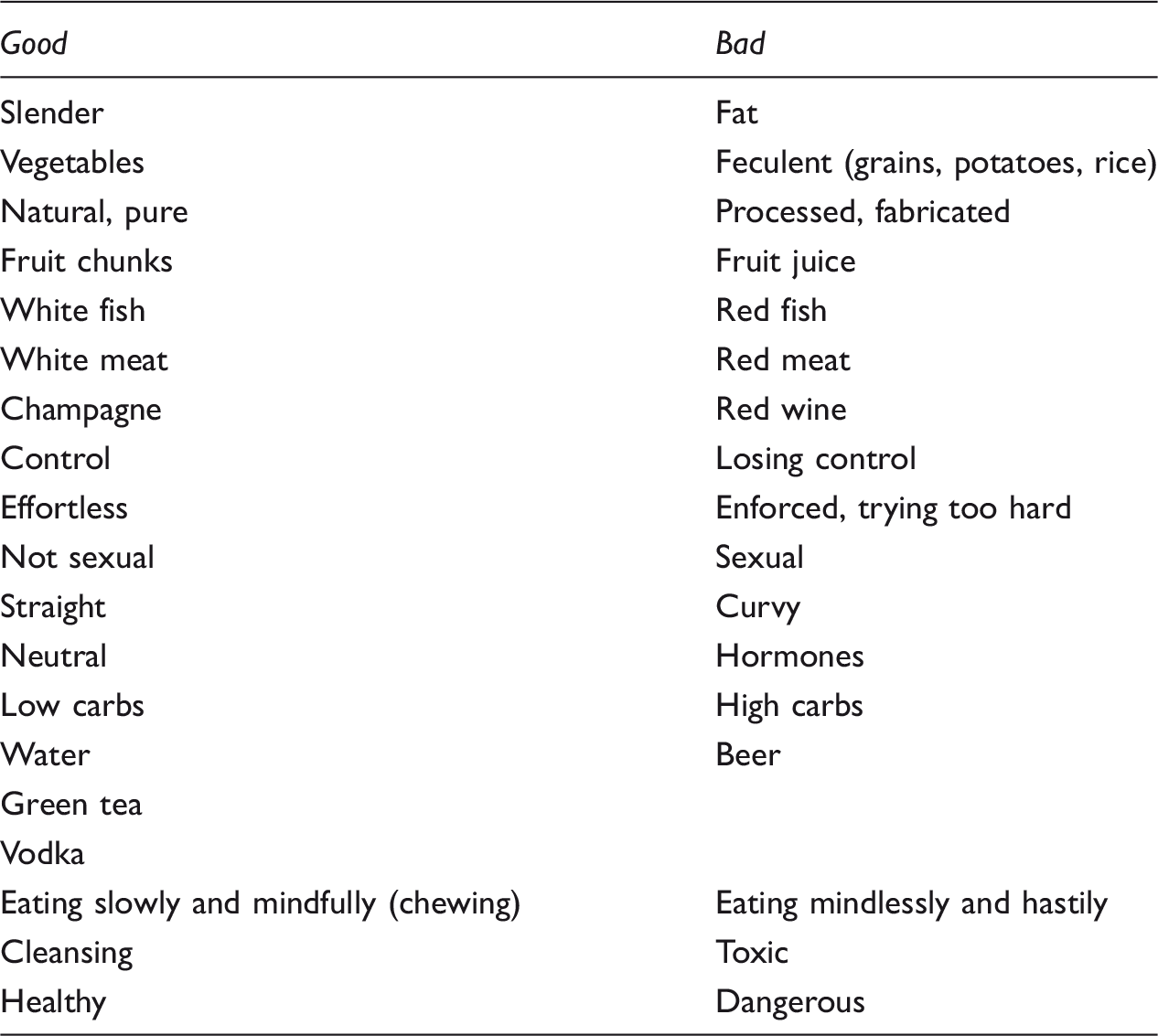
Good, bad, dangerous and healthy foods
Fashion modelling is a physically, emotionally and personally demanding profession (Entwistle and Wissinger, 2006; Mears, 2011; Soley-Beltran, 2006), characterized by high levels of implicit and explicit forms of discipline and control (Mears, 2011; Czerniawski, 2015; Neff et al., 2005). Fashion models are expected to possess specific physical features that comply with institutional standards of tallness, youthfulness, slenderness and – very often – whiteness as well (Entwistle and Wissinger, 2013; Mears, 2011). All models are expected to conform to these aesthetic conventions: once under contract, they are disciplined to maintain or improve their bodies through body work. While skin-color and body-length are fixed, body-size can be altered. When starting at an agency, models’ body measurements are often explicitly assessed by means of a measure tape. As they are frequently required to size down, young models quickly learn to turn their body into an object that they rigorously monitor and work upon (Mears and Finlay, 2005: 319; Mears, 2011; Wissinger, 2015). Controlling their food-intake is therefore the main and most crucial body practice fashion models engage in.
Professionals in fashion modelling believe that many, if not most, foodstuffs are obstructive to maintaining or attaining the required model-body. For both male and female fashion models, the greatest challenge for models is to apply the standard of slenderness, which takes on more extreme levels at the high-end of modelling (Van der Laan, 2015). Beginning models unavoidably deal with slenderness when they enter the field. Agents, clients, designers and coaches, who uphold fashion aesthetics, socialize models into their role of embodying them. A considerable part of learning how to be a model consists of becoming knowledgeable about good and safe, bad and dangerous foods. Classifying foods into these institutionally relevant categories is an important part of modelling.
Focusing on these classifications, this section unravels the knowledges on food that circulate in the field of fashion modelling. These knowledges sometimes contradict each other and are not necessarily factual. I refer to them as food beliefs that provide guidance in assessing models’ eating practices in terms of what is good. As such, food beliefs form the basis for moral judgements models make about themselves and others, and other fashion professionals make about them (cf. Coveney, 2001: viii).
Although the viewpoints of various informants are presented, I discuss the beliefs of two informants in particular: Natasha, a female commercial model from Amsterdam, and Timothy, a French self-proclaimed model coach. They represent two groups in the field with different tasks. Natasha is illustrative of models who classify foods according to certain beliefs about their effects. Her classifications of good and bad foods, as well as her eating practices, do not always correspond with those of other models. But the fact that she classifies food, like Nahima from the introduction, is typical. By simultaneously discussing, preparing and eating food together, I learned how beliefs, classifications and practices relate: Natasha’s food beliefs result in categorical food classifications upon which she engages in specific eating practices. Model coach Timothy, on the other hand, is representative of models’ ‘socializers’. This professional group, consisting of agents, clients, nutritionists, coaches, but also stylists and designers, upholds and enforces bodily standards and fulfils a pedagogical task of influencing models’ behaviour towards their own bodies.
I meet Natasha, a 19-year-old model, at a local fashion event in the city centre of Amsterdam. We subsequently get together several times to talk about her modelling career. After our second interview in a bistro, Natasha invites me to her home to cook dinner and eat together. I happily accept her invitation. In her small kitchen we sort out the products she has bought and we discuss the foods we will eat. Natasha elaborates on the foodstuffs that make her put on weight and how she tries to avoid that. Like many female models, Natasha has collected information on calories and physical effects of every foodstuff entering our conversation. This evening we prepare baked vegetables with spices and chicken. Our meal does not include carbohydrate loading foods like rice, potatoes, bread or pasta. Natasha tells me she never buys or prepares these kinds of food. During lunch, which typically consists of sandwiches in the Netherlands, Natasha eats soup (without croutons) or salad (without bread on the side). The majority of female models avoid carbohydrates. These are generally thought of as detrimental to a model’s body. According to model coach Timothy – a former professional basketball player and much concerned with physical activity and metabolic rates – carbohydrates stock up as fat when they do not get burned. Moreover, Natasha adds, high-carb foods are difficult to measure: Although pasta and bread are healthier than chocolate and cheese, you never cook just five pieces of pasta. You always eat a lot of it, always too much. If you start eating pasta, you keep on eating, even though you don’t need that amount of carbohydrates for your body. That’s how you gain weight. One piece of chocolate is satisfying. So in the end, that’s much better. Better eat fish instead. But never eat salmon, it’s very fat. It’s not white fish anyway, so you should avoid it. This goes for tuna too by the way. So sushi should be put aside as well. If you have a real objective you must be strict like that. And go to the gym, morning and night. At night my models eat steamed vegetables, and they can eat as many as they like. But then there’s the question of the sauce. People just put too much sauce on everything. Dressings, with oil! It’s catastrophic. Better put some herbs in your salad instead of sauce.
Dinner is cooked and Natasha and I start to eat. Along with the meal we drink water with lemon squeezed into it, which is Natasha’s favourite drink: ‘it’s healthy, free of calories and lemon stimulates the burning of fat’. Natasha never drinks sugary sodas, fruit juices or milk. This is contrary to other models who drink full-fat milk in their café lattes, usually as a stand-in for breakfast or lunch, during interviews. Coach Timothy is sceptical about models consuming dairy, and any other fat-containing foodstuffs: Models should avoid drinking milk. Dairy makes you fat. Yoghurt is not bad obviously, but better use soy products instead. Eggs should also be avoided, the yolk is very fat. It’s a catastrophe to eat the yolk. If you only eat the white it’s fine. No nuts, no almonds. It’s all too fat. Better eat white fish instead of nuts.
Although eating fruit is deemed better than drinking it, there are limits to how much fruit models can eat. Macy from Amsterdam tells me she sometimes has the munchies and binges on a whole bag of apples: ‘It’s very bad to do that, because you eat way too much sugar’ (Macy, 22, Amsterdam). In addition, not all kinds of fruits are allowed to be eaten by models. Coach Timothy notes: [Models should eat] no sugar. Very little fruit, except fruit containing lots of water, like watermelon. Bananas are forbidden, because they contain most sugar and fat. Apples are not bad, they’re okay, but you shouldn’t let yourself go with them either. We can eat fruits, but not every fruit, because fruits have a lot of sugar. We can eat watermelon, but that’s not there right now [in winter]. So we can eat apples. But you can only eat fruits before three in the afternoon, because later in the day you have to burn all these calories, but you can’t. (Mirthe, 20, Paris/Warsaw) In Japan … when you have the job they call you and say: ‘remember, don't eat breakfast!’ Because your stomach will be blown. (Rita, 27, Warsaw)
The way the body responds to different foods is seen as predictable, even calculable. For example, when Timothy formulates nutritional advice to models, he also considers how much models exercise, as this affects the amount of carbohydrates models can eat: ‘if you want to eat bread and pasta, the gym should be your very best friend.… When you do only a little bit of exercise every day, I guess you shouldn’t [eat that]’. He seems to think of models’ bodies as machines, of which the input (eaten calories) and output (burned calories) can be precisely quantified (Turner, 1982: 258).
Natasha speaks of her body not as a machine but as a learning organism that can be purposefully sensitized about what it is enduring. During our dinner, Natasha eats in a concentrated manner, taking well-measured portions onto her fork and chewing meticulously. She finishes her plate calmly, almost systematically. She explains the more you chew on food before swallowing, the better you digest it. Moreover, slow eating prevents overeating, because the body gets enough time to realize it is being fed and becoming full. Through the practice of slow eating, Natasha makes her body ‘aware’ of being filled with food.
Finally, the body is believed to be in need of sanitizing. Some foodstuffs, but also skin cosmetics and polluted air, are seen as contaminating the body. Fat, for example, is dangerous for clogging the pores, in addition to its high caloric value. For maintaining the clear and smooth skin that is required from fashion models, the body should be cleaned through drinking lots of water and green tea. Herbal tea and water, Natasha says, are healthy for flushing toxins out of her body. Coach Timothy agrees: ‘Green tea is detoxing. It allows the body to expel stuff, so it’s good for the skin’.
Relevant categories in the fashion modelling food system.
From external control to self-control
Based upon their classifications models act upon food. However, models are often young and inexperienced when they enter the field and first have to learn how to ‘eat like a model’. This requires socialization, taken up by fashion professionals like agents, clients, coaches or nutritionists, who regulate or train models’ attitudes towards food. This renders something seemingly personal and mundane, like deciding whether or not to eat a banana at lunch time, part of deliberate professional decision-making. Modelling agents especially are inclined to regulate models’ food-intake. However, some show themselves more involved than others. Maggie, the director of a leading agency in Warsaw, employs a nutritionist to help debutant models develop a ‘balanced diet’ against the backdrop of slender aesthetic standards. When models work abroad, some agents accompany them to restaurants, where they control what and how much food models eat: In Italy they [the agencies] told me to eat sushi. Models have so much trouble over there with all that pasta and pizza around. So they check on you, what you eat. The agencies take you out to dinner in the evening so they know what you order. (Rita, 27, Warsaw) They give you food occasionally, like salad or a sandwich, but sometimes they say: ‘no you can’t eat, you’re a model, shut up’. … When I was very young, 15, I was doing a show here in Warsaw. They didn’t give me one meal, from six a.m. to eight p.m. I only got a small sandwich. Everyone was on water and cigarettes, which is kind of the diet backstage. … I was going to the runway, but I was weak and I fainted. An ambulance brought me to the hospital. One year later I was doing the same show and they gave me food, even chocolate! So they learned from it.
Although the aesthetic result of models’ eating practices – slenderness – is a collective goal, paradoxically, striving to achieve it through controlled eating is not always supported, let alone recognized, by professionals working with models. Coach Timothy critically notes: All their agencies tell them is to withhold food from themselves, but they don’t get into the question of how to do that. I know girls that only eat white cheese. Morning, day and night. Only that. In the morning they add some granola, at night they throw in some strawberries. End of story, good night. It’s ridiculous. You have to eat varied. To eat very little, but varied. Models are on and off the airplane constantly, working in different countries. They experience jetlag, miss out on sleep … and can’t cook their own meals. When the money comes in they want to relax for a while. Of course, understandable. But then they take a holiday and let themselves go. They eat, drink, spend their money. I say they’d better get back into the gym straight away and save up their money to invest in a house or education. But instead they gain weight and once they want to get back to work, because they’re out of money, they have to go on some crazy diet, because their sizes aren’t right anymore. Taking in-betweens, like a piece of chocolate, will make you think about chocolate. The next morning you pass by the cupboard where you’ve stored the rest of the bar, and it will lure you. You’ll think ‘well I took a piece yesterday and I didn’t gain weight, so why couldn’t I take another little piece today!’ You have to be strong in your mind, you see.
In back-stages of shows and shoots, models are sometimes treated with sweets and snacks, by which their self-control is tested. In Paris, Amsterdam and Warsaw, I observed models surrounded with ‘bad foods’: candies, cookies, crisps or cheese sandwiches – all things models try to avoid eating – while good foods, such as soups or salads, were absent. To resist temptations of sugar and fat, some models bring their own food to the set. During Warsaw Fashion Weekend, several models were nibbling on self-brought rice cakes and whole-wheat slices of bread, avoiding the jars of sweets.
An often mentioned bad foodstuff that entices the appetite to the extent that models lose their self-control are crisps. Commercial model Lynn (19, Amsterdam) used to habitually eat crisps with her boyfriend. Each time she opened a bag she could not bring herself to stop eating until it was empty. She gained weight, which got her into trouble: ‘My agency deleted my pictures from their website. They told me they’d place them back only after I would lose at least three centimetres around my hips’. Lynn’s agency fully held her responsible for her added centimetres (cf. O’Neill and Silver, 2017: 121). Eventually, Lynn took hard measures to regain self-control: to refrain from eating crisps she started spending her evenings at a gym instead of with her boyfriend, with whom she broke up.
Finally, some fashion professionals entirely repudiate the idea that eating is an important and complicated part of models’ body work. An Amsterdam stylist claims that ‘good models shouldn’t need to mind what they eat. If they do, I tell them to give it up, because they are simply not fit to be a model’ (Dave, 44, Amsterdam). This narrative defines good models as uncontrolled eaters, and establishes a norm of effortlessness. Yet, for most models eating good is a challenge. A significant food practice is therefore to not be straightforward about food. Several models demonstrate they are good models by emphasizing that modelling comes natural to them, without making effort (cf. Holla, 2016). Other models avoid talking about their own dealings with food, while being blunt about how other models deal with food in extreme and ‘wrong’ ways. They tell second-hand stories about crash dieting, binge-eating, vomiting, drinking vinegar, eating tissues or replacing food with drugs. Chantal tells me that she ‘lived in a model house with these girls who only ate apple compote. I was really the odd one out over there’ (Chantal, 22, Amsterdam). Rita notes that: ‘there are some girls that have such fucked ideas. I had this roommate, she was drinking pure vinegar after a meal. Because she heard it helped digest’ (Rita, 27, Warsaw).
While I am unsure whether all of these stories reflect actual practices, they surely serve models to draw symbolic boundaries between the self and others (Lamont, 1992). In these narratives, it is always other models who are ‘out of control’ or ‘try too hard’ to become or remain slender. These symbolic boundaries clearly show two main moral imperatives on food in fashion modelling: models should eat in both a controlled and effortless way.
Models try to solve the moral paradox through alternatively framing their eating practices. Even the ones with plain, austere nutritional regimes, like Nahima from the introduction, normalize their eating practices, using the careless expression of ‘watching my food’. They emphasize they do not diet, which is seen as a forced, unnatural and therefore illegitimate way of eating. By contrast, through watching their food models demonstrate they engage in a sane, healthy and unforced way of eating, without losing track of what they put into their bodies.
Importantly, the taboo of (overly) controlled eating, which spurs fashion models to demonstrate that they are effortless, seems to hold especially for female models. A possible explanation for the genderedness of this taboo is that it links to the persistent risk of institutional weight and body-size requirements to induce eating disorders (Shilling, 2012: 105; Swami and Szmigielska, 2013). As disordered eating is perceived to be ultimately a feminine risk, this might explain why mostly female models go out of their way to demonstrate they do not obsess over food.
The moralities of control and effortlessness complicate eating as a professional aesthetic practice. By disallowing openness on food as an important issue, and creating a taboo about putting in effort, models are left by themselves in their task to embody slender aesthetics. While perpetually caught up in body work for aesthetic purposes, they are simultaneously concerned with concealing it. The perception of modelling success as an individual responsibility pushes models toward continuous efforts of self-improvement (Neff et al., 2005: 320).
Accordingly, models are held fully accountable for their bodies: any failure to conform to aesthetic standards is interpreted as an individual lack of discipline and self-control. This reinforces the winner-takes-all principle of fashion modelling (Mears, 2011). In the quest for success, the law of the strongest applies. Models who are ‘out of control’, such as Lynn, receive little mercy and irrevocably disappear from the stage. In turn, overly self-controlling models, who ‘try too hard’ are also viewed as unable to make it in the long run. Finally, eating the right way is a three-fold challenge for fashion models: an aesthetic, moral as well as a personal one.
A gendered division of food?
Beliefs on how the model-body reacts to food, and the rules on how it should be controlled, differ for male and female models, as their bodies are considered to react somewhat differently to food. While fashion modelling mostly revolves around feminine looks, female model-bodies are perceived a jeopardy. Models and other professionals consider female bodies vulnerable to carbohydrates and fat. Hence, they are as dangerous as they are eminent. Conversely, male model-bodies are perceived more resistant to physiological infringements of food. As the male model-body is believed to be less violable, practices of controlled eating are prone to be defined as feminine.
However, the genderedness of food control intersects with the division between high and low aesthetics that exists in modelling, making it a ‘high-end concern’ as well (Mears, 2011; Van der Laan, 2015). The ‘sexual division of dieting’ (Germov and Williams, 1996) only holds in commercial modelling, where female models watch their food, but male models repetitively state they eat and drink whatever they crave. Through this, they enact an appropriate heteronormative masculinity (Connell, 1995). Felix, for example, says: ‘I eat normally. Also bread, French fries and Coca Cola. As long as I go to the gym I’m okay’ (Felix, 24, Amsterdam). Instead of rendering his body passive by withholding it from eating, Felix endows himself an active role, by managing his body through exercise – a self-objectifying practice that compensates for uncontrolled eating and is gender-role confirming.
Conversely, high-end male models engage in controlled eating in rather similar ways as female models. Jim, a high-end model working for luxury brands such as Prada and Jil Sander, watches his food to a considerable extent. I meet him in the home of a befriended model, where they are planning to cook dinner together. They agree on preparing carrot soup and a salad. While making the grocery list, he requests the salad to be without meat and says he cannot drink wine along with the meal, because: ‘I’m going back to Milan soon. I have to be strict with myself’ (Jim, 23, Warsaw).
The contrast between male and female eating practices dissolves the further one moves towards higher-ends of fashion modelling, where gender distinctions are less pronounced and bodily aesthetic standards for both male and female models are characterized as androgen, at times non-sexual or even adolescent. Overly visible signs of a body/self that is masculine or feminine are avoided: all high-end models are required to be thin and straight. Finally, food becomes more gender-neutral towards the higher-ends of fashion modelling.
Discussion and conclusion
This paper investigated the relation between food, the body and morality in the field of fashion modelling and found that the food beliefs that structure the aesthetic labour of fashion models render ‘eating like a model’ complicated and extensive. More than has been recognized in modelling studies so far, eating is a continuous and reflexive form of body work that is decidedly essential to models’ aesthetic labour.
Fashion professionals classify different foods and ways of eating them as more or less obstructive to the embodiment of slenderness. Caloric food in particular is framed as dangerous (cf. Douglas, 2003) and needing to be controlled in different ways. Nonetheless, controlled eating entails more than counting calories: it is about eating a variety of good foods, in the right quantities, at the right time. Food is valued for its low caloric value, but also because it is believed to stimulate digestion, to detoxify the body, or to burn body-fat. However, food is believed to have different effects on male and female model-bodies, which results in gendered food rules. This genderedness intersects with an institutional division between high and low aesthetics, which inclines high-end male models to control their food-intake just like female models.
Eating the right way is a three-fold challenge in fashion modelling: an aesthetic, moral as well as a personal one. First, eating is geared explicitly at aesthetic professional purposes and is therefore a job requirement for fashion models. Their decisions on whether, what, or how much to eat include a recurring differentiation between their selves as choosing subjects and their bodies as shapable and controllable objects (cf. Czerniawski, 2015). With every bite they (do not) take, models are prone to consider their professional status as aesthetic objects to be displayed: they are ‘permanent overseers of their own bodies’ (Mears and Finlay, 2005: 333).
Second, food beliefs include moral imperatives that further complicate good eating for fashion models. By framing food-control as an individual responsibility and slenderness as an individual achievement, models are thrown back on their own capacities of self-control, and they are also held fully accountable when they fail to comply to slender aesthetics. Controlled eating ultimately renders models preoccupied with self-surveillance and self-objectification, and subjugated by agencies and clients. Food beliefs therefore reinforce power-inequalities between models and other professionals.
Along with the imperative of food control exists the idea that ‘truly good models’ achieve aesthetic standards effortlessly. This creates a taboo around practices of food-control which, paradoxically, de-legitimizes controlled eating. This does not result, however, in a casual attitude towards food, but rather renders practices concealed. Food is rarely not an issue for models, even – or especially – when food is absent or treated as a non-topic. However, the moral paradox of control and effortlessness does result in normalizing narratives on food-control. Especially female models normalize their sober eating practices by using the careless expression of ‘watching my food’. The taboo of (overly) controlled eating is possibly explained by the persistent risk of eating disorders, caused by the industry’s weight and body-size requirements. As disordered eating is perceived to be ultimately a feminine risk, this might explain why mostly female models go out of their way to demonstrate they do not obsess over food.
This analysis of model’s food practices has implications for theories of aesthetic labour and aesthetic capital, as well as studies of food. First, the importance of food and eating practices stretches beyond fashion modelling, as it pertains to aesthetic professions more generally. This paper empirically substantiates the thesis of Entwistle and Wissinger (2006) on the enduring and demanding nature of the aesthetic labour and adds that the centrality of food and eating in the work and life of aesthetic labourers is the primary cause for the personal and the professional, the physical and the emotional, to seep into each other to such a great extent. Second, the food system in fashion modelling can enhance interpretations of how people in society at large deal with food in relation to their bodies. Against the backdrop of an increasing aesthetization of work and life (Featherstone, 1991), beauty has become a quality that ‘pays’ and hence a source of inequality (Hamermesh, 2011). As the ones who are not seen as attractive miss out and find themselves disadvantaged, making sure the body is slender is an imperative that exists well beyond aesthetic industries.
Finally, looking at eating in a delineated institutional context potentially enriches understandings of contemporary foody cultures (cf. Cairns et al., 2010) that consist of ethically-consuming, upper/middle-class urbanites that embrace food-reflexive life-styles (cf. Guthman, 2003). Models are possibly a vanguard of such social developments. In fashion modelling, eating demarcates boundaries: cultural ones, based on gendered bodies and high-low aesthetics, and moral ones, based on the seemingly conflicting norms of control and effortlessness. Just as ‘good eating models’ are identified – by others and themselves – as good models (cf. Holla, 2016), contemporary foodies, slow-eaters, vegans, flexitarians and other (non-professional) reflexive eaters use food to morally position themselves vis-à-vis others. There is a difference though. In contrast to these non-professional reflexive eaters, models are unequivocally held accountable for their eating: they might lose their job over it.
Footnotes
Acknowledgements
I thank Giselinde Kuipers and Olav Velthuis for reading multiple versions of the manuscript and their helpful feedback on how to improve it.
Declaration of Conflicting Interests
The author(s) declared no potential conflicts of interest with respect to the research, authorship, and/or publication of this article.
Funding
The author(s) disclosed receipt of the following financial support for the research, authorship, and/or publication of this article: ERC Starting Grant BEAUTY 241073.