




Abstract
While previous studies have significantly contributed to our understanding of bricolage – an important resource mobilisation approach in resource-constrained contexts, there is limited research on the impact of formal enterprises’ prior informal sector experience on their adoption of bricolage. This paper develops and tests the hypothesis that the adoption of bricolage can be a function of prior informal sector experience. Using survey data from 1251 formal enterprises operating in Indonesia, we found support for our proposition. Our findings show that there is a positive relationship between prior informal sector experience and the adoption of bricolage. This relationship is strengthened by greater levels of informal competition. The results have implications for theory and practice.
Introduction
In emerging economies, formal enterprises often operate in resource-constrained environments where market-supporting institutions are unstable and weak (Desa and Basu, 2013; Liedong et al., 2017; Villanueva et al., 2012), resources are scarce (Starr and MacMillan, 1990; Witt, 2004), resource competition and resource cost regimes are high (Mendi and Costamagna, 2017; Webb et al., 2014; Welter et al., 2018), and enterprise learning precedents are few (Foo et al., 2020; Sydow et al., 2020). Consequently, the mobilisation of resources is one of the most daunting challenges for firms in these countries (Baker and Nelson, 2005; Elfring and Hulsink, 2007). Given this challenge, bricolage – defined as ‘making do by applying combinations of resources already at hand’ (Baker and Nelson, 2005: 333) – offers an alternative viable resource mobilisation (RM) approach to respond to the issue of difficult resource regimes in emerging economies (Bacq et al., 2015; Bojica et al., 2018; Busch and Barkema, 2021; Davidsson et al., 2017; Duymedjian and Rüling, 2010). Bricolage helps firms to mobilise resources to take advantage of entrepreneurial opportunities (An et al., 2018; Bacq et al., 2015; Desa, 2012; Fisher, 2012). It is an important mechanism for early-stage exploration and exploitation, enabling enterprises to make unusual and unexpected use of a variety of amateur resources at hand (Baker and Nelson, 2005).
While extant literature suggests that resource scarcity is an important driver of bricolage in emerging economies, other important drivers that take into consideration the business landscape in these economies characterised by high informality and a large informal sector have been overlooked. Most formal enterprises in emerging economies often operate first in the informal sector where they are more likely to orchestrate bricolage to mobilise resources primarily due to resource shortages (Stenholm and Renko, 2016) but also because of the substantial degree of adaptability and flexibility bricolage provides (Godfrey, 2011) as well as the opportunity it avails to informal businesses to compete with enterprises in the formal sector (Iriyama et al., 2016) until they can afford the cost of formalisation and use standard resources (Blackman, 2000; De Soto, 1989; Quintin, 2008; Sutter et al., 2017). Indeed, some contemporary research in developing economies has reported the impact of experience of operating informally on the performance and behaviour of formal enterprises’ (e.g. Larsen and Witte, 2023; Williams et al., 2017). However, it remains to be understood how prior informal sector experience (PISE) – defined as an enterprise's experience of operating in the informal sector before becoming a formal enterprise – affects the adoption of bricolage, especially whether formal enterprises with PISE continue to use bricolage or transition away from it to alternative RM approaches. At the same time, the large informal sector in emerging economies creates strong competition for firms in the formal sector (Iriyama et al., 2016; LaPorta and Shleifer 2014, McCann and Bahl, 2017; Mendi and Costamagna, 2017), but it is less known how informal competition (IC) affects the bricolage behaviour of firms with PISE. The purpose of this study, therefore, is to advance research on formal enterprises in emerging economies (Bu and Cuervo-Cazurra, 2020; Omri, 2020) by investigating the relationship between PISE and bricolage, as well as the moderating impact of IC on this relationship. More specifically, we ask and address the following research question: Does formal enterprises’ prior experience in the informal sector drive their adoption of bricolage, and what is the role of informal competition in this relationship? Focusing on PISE and IC is particularly important because they are peculiar to emerging economy contexts and can contribute new insights into how formal enterprises operate and deal with the realities within these contexts (Bu and Cuervo-Cazurra, 2020; Omri, 2020; Simba et al., 2021).
We draw on the prior experience literature (Becker, 1964; Coleman, 1988; Davidsson and Honig, 2003; Weerawardena et al., 2007) to develop and examine our conceptual model. We acknowledge that prior industry experience improves RM due to the learning effects of experience (e.g. Ahmed and Brennan, 2019; Weerawardena et al., 2007) and argue that given the resource-constrained environment of emerging economies, success in mobilising resources in the informal sector may lead formal enterprises to exploit their existing expertise and experiences. PISE provides firms with a broader set of experiences to draw upon; these broader experiences are likely more important in difficult resource regimes (e.g. Bacq et al., 2015; Baker and Nelson, 2005; Sinha et al., 2022; Webb et al., 2013). Here, we advance that enterprises that previously operated in the informal sector learn to deal with difficult resource regimes through bricolage activities and are more likely to draw from these experiences to continue to orchestrate bricolage. Additionally, we probe the moderating effect of IC on the PISE–bricolage relationship.
We elect to examine the moderating effect of IC because it is an important institutional and market condition that formal enterprises operating in emerging economies encounter (Michalopoulos and Papaioannou, 2015; Zhou and Peng, 2012), making it more likely to activate or constrain the utility of PISE to orchestrate effective bricolage strategies for gaining or maintaining competitive advantage. IC influences formal firms’ innovation, environmental, and product strategies in emerging and developing countries (e.g. Cenophat and Haas, 2025; Heredia et al., 2024; McCann and Bahl, 2017). It is also a phenomenon that formal firms with PISE would be familiar with given their evolution and history. Hence, when facing competition from a sector that they previously operated in, we expect that their experience from that sector will serve as a boundary condition for their resourcing strategies. We therefore argue that higher levels of IC may cause formal enterprises to increasingly fall back or rely on their bricolage experience to match or beat their informal competitors at lower costs. Using a sample of 1251 formal enterprises operating in Indonesia, we test these arguments.
Our paper contributes to the bricolage literature and resourcing behaviour in the following ways: first, it contributes to the bricolage literature (e.g. Bacq et al., 2015; Desa and Basu, 2013; Fisher, 2012; Magobe et al., 2024; Reypens et al., 2021) by showing that PISE is an important antecedent to bricolage. To the best of our knowledge, our paper is the first to develop a theoretical framework that delineates how formal firms leverage their PISE to shape their resourcing strategies, particularly the adoption of bricolage. Our study also extends prior works about PISE in developing economies by advancing that the low cost that underpins the positive performance (e.g. Williams et al., 2017) and high export propensity (e.g. Larsen and Witte, 2023) of firms with informal legacies is shaped by the firms’ return to bricolage resourcing strategies to match or overcome IC. Second, our paper contributes to the bricolage literature by extending Baker and Nelson's (2005) seminal insights on the entrepreneurial behaviour of enterprises in their RM response to resource constraint by providing new insights of the dynamic interplay between PISE, level of IC, and bricolage. In doing so, we provide a more nuanced understanding of this dynamic interplay and stress the absolute importance of recognising the joint role of PISE and IC in bricolage adoption in the emerging economic context. Third, our paper offers an important extension beyond the recent work of Reypens et al. (2021) and their suggestion of experiences of distinct events as an increasingly important explanation of how enterprises’ bricolage behaviours evolve. While Reypens et al. (2021) suggest that experience depends on catalytic events, we show that perceptions of the competitive context (degree of IC) bound PISE. Lastly, our paper also offers a useful complement to prior work on formal enterprises. Much of this work has focused on the antecedents of formal enterprise activity, for example, by linking its prevalence to the strength of local institutions (De Castro et al., 2014; Kistruck et al., 2015). In contrast, our paper helps build an understanding of the consequences of prior experience (Faroque et al., 2020) in the informal sector, showing that it has important implications for formal enterprises’ adoption of bricolage in emerging economies.
Our findings also have managerial and policy relevance. They show the need for firms to deploy diverse resourcing strategies for dealing with different types of competition. While formal enterprises may use more standardised resources from formalised sources (e.g. loans from banks, specialised machinery, etc.) to compete with other formal enterprises, they may need to use bricolage to deal with IC (Mendi and Costamagna, 2017). Hence, for firms that have transitioned from the informal sector (where they likely used bricolage) to the formal sector, it is important for managers to not abandon their organisation's knowledge of bricolage. This is especially critical in developing and emerging countries where the informal sector is often larger and IC is usually more prevalent (Webb et al., 2013). At the same time, it is necessary to acknowledge that bricolage has been conceived to be less superior to other resourcing strategies. It is not perceived as the ideal resourcing approach for an enterprise; it is a hard choice based on the lack of or inability to use other supposedly superior resourcing strategies (Adegbile et al., 2024). Hence, bricolage may not be associated with high productivity and efficiency. For policymakers, our findings indicate the need to facilitate and promote business transition from the informal sector to reduce the level of IC that creates the need for formal enterprises to revert to bricolage. Doing so will ensure the private sector's use of more value-adding resource strategies, which will contribute to overall productivity and economic growth.
Theoretical background
The informal sector in emerging economies and bricolage
The informal sector refers to economic activities that take place outside of formal structures and regulations but operate within informal norms, values, and understandings (Portes and Haller, 2005; Webb et al., 2009). Given that PISE is the focus of our study, it is necessary that we first discuss the context from which it is gained – that is, the informal sector. Within the entrepreneurship literature, there is a wealth of research that has documented the entrepreneurial activities that occur within informal sectors (De Castro et al., 2014; Gurtoo and Williams, 2009; Hart, 1973; Mair et al., 2012; Sutter et al., 2013). More specifically, the informal sectors in emerging economies are often characterised by necessity-driven entrepreneurship, where individuals engage in economic activities out of necessity rather than opportunity. Within these environments, individuals use the informal economy as their sole source of income given the lack of alternative means for their livelihood (Gurtoo and Williams, 2009; Webb et al., 2013). The informal sector in emerging economies serves as a source of sustenance for individuals who lack viable alternatives (Larsen and Witte, 2023; Williams et al., 2017). Given that entrepreneurship in this context is often necessity-driven, the informal sectors of emerging economies are characterised by very different dynamics relative to those of developed economies. Informal sector entrepreneurs in emerging economies do not have the luxury of affording standard resources needed to start their businesses. They rely on resources already at hand through informal sources or social networks, hence using bricolage (Desa and Basu, 2013). Hence, bricolage is more prevalent in the informal sector, and it is expected that businesses that operate informally, especially in emerging countries characterised by resource constraints, are more likely to adopt and deploy it. Also, firms in the formal sector that previously operated in the informal sector are more likely to have used bricolage in their evolution.
Bricolage refers to ‘making do by applying combinations of resources already at hand to new problems and opportunities’ (Baker and Nelson, 2005: 353). Broadly, it entails recombining existing resources for new uses. This approach, which allows an entrepreneur to accumulate resources by internally developing them, may be borne out of necessity when resources are scarce (Bacq et al., 2015; Bojica et al., 2018; Davidsson et al., 2017; Duymedjian and Rüling, 2010). In the context of emerging economies and especially in the informal sector, entrepreneurs often use ‘resources at hand’ to counteract the limitations of their resource scarcity environment. The resources at hand include those that are ‘available cheaply or free often because others judge them to be useless or substandard’ (Baker and Nelson, 2005: 336). Entrepreneurs scavenge for these resources (Baker and Nelson, 2005; Stinchfield et al., 2013) or access them through their networks (Baker et al., 2003). Indeed, the literature has advanced different types and patterns of bricolage, such as selective, parallel, and network bricolage (e.g. Baker and Nelson, 2005; Chang et al., 2024). While these types or patterns of bricolage may represent different configurations, they still reflect the fundamental practice of using resources at hand, combining existing resources for new purposes, or making do with available resources. Accordingly, whereas we develop arguments using the broader term bricolage, our empirical operationalisation (due to the data measures we use) focuses on network bricolage – that is, the use of existing network ties beyond their originally intended utility or purpose to circumvent resource constraints (Chang et al., 2024).
According to Fisher (2012), bricolage can be enacted in five distinct areas, which are: (1) physical input, that is, utilising physical resources such as forgotten, discarded, worn-out, or assumed single-use materials in novel ways; (2) labour inputs – that is, employing help or ideas from customers, suppliers, family, and friends to carry out work; (3) skills input, that is, utilising amateur, non-professional, and self-taught skills to generate value; (4) customers and market, that is, providing products or services that would otherwise be unavailable to customers and markets; and (5) institutional and regulatory environment – that is, experimenting with various methods without considering regulatory standards and limitations in the institutional and regulatory environment. In the informal sector of emerging economies, enterprises often combine different forms of bricolage to make the most of the resources available to them (Baker and Nelson, 2005; Perkmann and Spicer, 2014). For example, to start their textile business, many informal enterprises in emerging economies use discarded wood, metal scraps, and other recycled materials to create makeshift stalls where they make the textile, borrow tools and equipment needed to make the textile from community members to save on capital expenses, and their family members provide free human resources by helping weave, sell, and deliver the textiles to the market (Adams 2018; Hossain et al., 2022).
Bricolage is particularly relevant for enterprises in the informal sector of emerging economies because of the severe resource challenges that characterise these contexts (Reypens et al., 2021). For example, in contrast to formal enterprises, informal enterprises must devise their own means of constructing resources because of the lack of legal recognition, which can make it difficult for them to access formal financing, government contracts, and other resources that are available to formal enterprises (Holt and Littlewood, 2017; Sutter et al., 2017; Webb et al., 2020). Second, informal enterprises operate in environments mostly characterised by weak market-supporting institutions, which limit access to the financial and knowledge resources needed to pursue entrepreneurial opportunities (Desa and Basu, 2013; Villanueva et al., 2012). The presence of formal market-supporting institutions (e.g. courts, contracts, and educational systems, among other mechanisms) provides a framework that allows resource providers to be willing to provide formal enterprises access to needed resources. In contrast to formal enterprises, informal enterprises do not benefit from formal market-supporting institutions that allow for resources to be mobilised more easily (Sutter et al., 2017). In sum, enterprises in informal sectors in emerging economies are often characterised by significant resource constraints, and the use of bricolage offers a constructive method to access and marshal together the resources within reach to exploit new opportunities, scale up operations, minimise costs, and achieve satisfactory performance (Baker et al., 2003; Desa, 2012; Fisher, 2012). Thus, while our theoretical discussion considers bricolage in a broad sense, our empirical focus is specifically on network bricolage due to its prevalence and strategic importance in developing countries where the economic systems are largely relationship-based and social networks serve as substitutes for weak market-supporting formal institutions (Liedong and Rajwani, 2021). In such contexts, entrepreneurs frequently rely on their social and relational networks to access critical resources and navigate institutional limitations.
The challenges of transitioning from informal to formal sectors and the role of PISE
Mobilising resources for enterprises presents unique challenges, particularly for informal enterprises that seek to transition into the formal sector. This process requires navigating the host of institutional pressures that govern the formal sector, which can be daunting in practice. Informal enterprises must contend with the costs of transitioning, such as registration fees (De Soto, 1989), taxes (Quintin, 2008), regulatory compliance costs (Blackman, 2000), and competition from other informal sector enterprises. These new realities can make it difficult for informal enterprises to envision the possibility of mobilising resources in the formal sectors (Scott, 2013). The literature on transitioning from the informal to the formal sector underscores that during this change, informal enterprises face uncertainty in the new formal markets and may be more resource-constrained compared to their formal counterparts (Fu et al., 2018; Holt and Littlewood, 2017; Williams, 2007; Williams and Round, 2007).
Sutter et al. (2017) provided further insights into the challenges that enterprises face when transitioning from the informal to formal sectors, particularly in the context of emerging economies. Their work comprehensively explains that these challenges involve not only accessing formal regulations and infrastructures but also transforming how informal enterprises operate to effectively participate in more established markets that demand higher quality and efficiency standards and larger volumes. As informal enterprises transition to the formal sector, they must not only comply with regulations but also learn to navigate distinct normative systems and cognitive understandings of what constitutes socially acceptable behaviours and outcomes (Ruef and Scott, 1998). For instance, in emerging economies such as Indonesia, many enterprises operate in the informal sector characterised by tightly knit community networks where informal arrangements such as flexible payment terms or unregulated labour practices are common (Berenschot and Van Klinken, 2018; Yunita and Dhewanto, 2015). Transitioning to formal structures may reduce these informal support systems on which they rely and create costs such as taxes, employee benefits, and compliance-related expenses that many informal firms are not equipped to handle (Tambunan, 2019). This process places informal enterprises in a more resource-constrained situation than their formal enterprise counterparts because formalisation requires a dramatic shift in practices, organising methods, and means-end combinations. To corroborate, organisational institutionalism suggests that during such change, informal enterprises face uncertainty in the new institutional environment and may resist change even when economically rational incentives may be possible in an alternative institutional arrangement (Beckert, 1999).
Considering the foregoing, it is likely that PISE may be the cause of inertia when informal firms transition to the formal sector, but it could as well be a potential source of RM for newly transitioned firms that are dealing with formal and IC. Scholars argue that entrepreneurial experience may occur via experiential learning and experience accumulation through activities such as venture creation, student consultancy activities, and educational simulation (Corbett, 2005; Pittaway and Cope, 2007), whereby individuals learn on both cognitive and behavioural levels (Mitchell et al., 2002). Through repeated activities, individuals develop cognitive frames that help them reflect on their prior entrepreneurial experiences, thus improving their understanding of distinct activities. Over time, insights gained through this iterative process can shape subsequent attitudes and behaviours (Shepherd, 2003; Ucbasaran et al., 2010), laying the foundation for ways to address business start-up challenges. Hence, prior entrepreneurial experience is central to an entrepreneur's ability to start a business (Faroque et al., 2020).
Empirical evidence from Ahmed and Brennan (2019) and Weerawardena et al. (2007) highlights that founders’ prior experience in early internationalisation can help alleviate the initial resource constraints of new ventures by offering knowledge, skills, expertise, and social connections. Similarly, scholars emphasise the importance of prior experience in the informal sector in shaping formal enterprise's ability to achieve export growth and performance (Larsen and Witte, 2023; Williams et al., 2017). Moreover, Bhagavatula et al.'s (2010) study of the handloom industry suggests that prior knowledge and industry experience positively influence RM. Overall, existing studies suggest that prior industry experience is advantageous in terms of achieving low cost, as enterprises can leverage it to effectively tackle the distinct challenges of resource access that arise when transitioning from informal to formal enterprises. This prevailing notion in the literature suggests that prior industry experience improves firm outcomes due to the learning effects of experience.
By extension, PISE could be instrumental to a firm's ability to mobilise resources, allowing it to confront resource constraints more generally. Not only will it increase the portfolio of a firm's RM strategies (e.g. bricolage, optimisation, etc.), but it will also enhance the effectiveness of a firm's bricolage strategies due to the firm's previous use of these strategies when it operated in the informal sector. Yet, despite the general acknowledgement of experience as an important factor in RM, we are unaware of research that has specifically examined the influence of PISE. The prior experience literature has shown that prior entrepreneurial experience and industry-specific experience are crucial as they offer pertinent knowledge and information for entrepreneurs. We argue that PISE can also influence formal enterprises’ adoption of bricolage, as depicted in Figure 1.
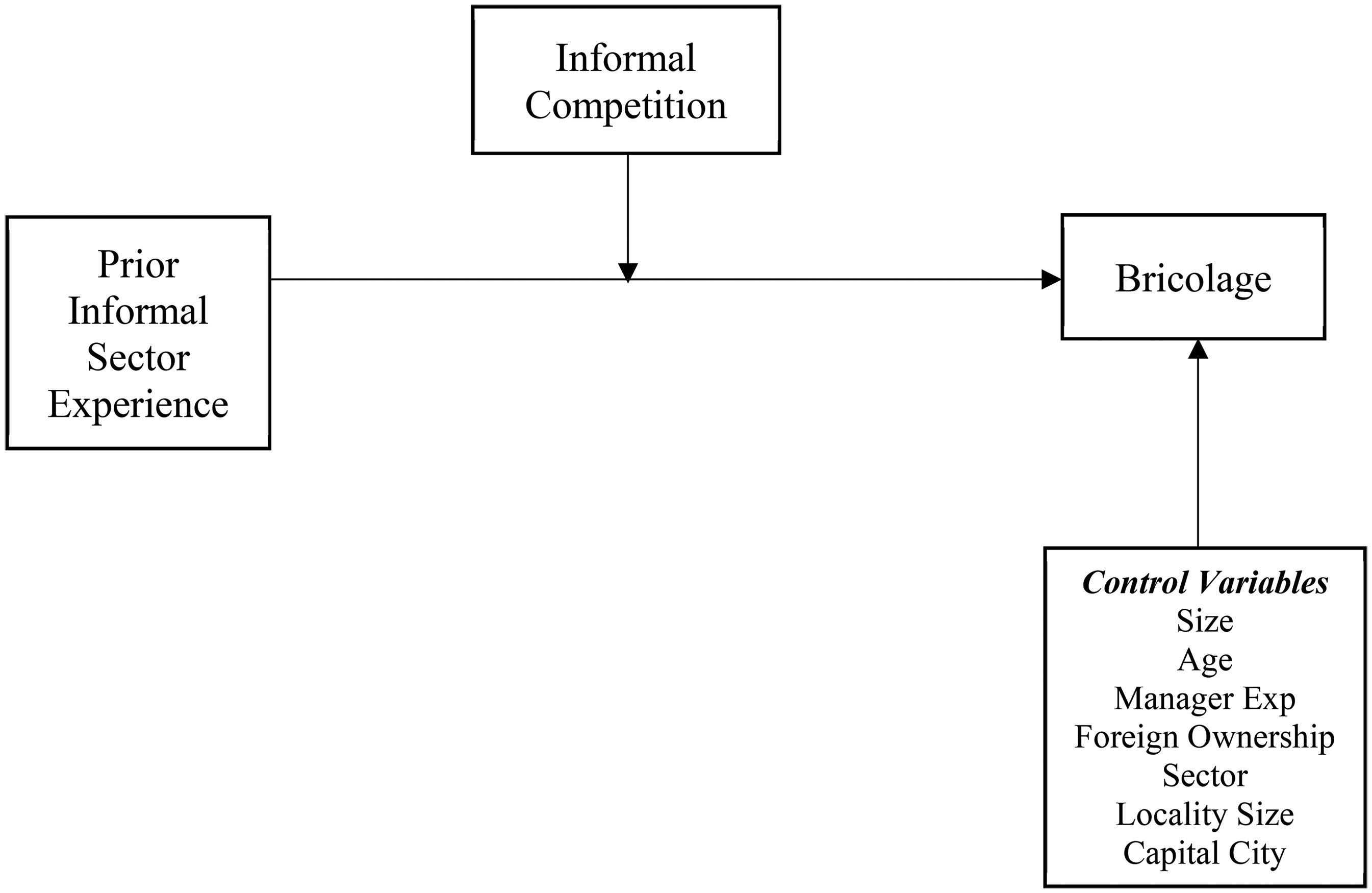
Conceptual model.
Informal competition in emerging economies
To understand the notion of IC, it is important to refer to the term ‘informality’. The term informality or informal sector was first proposed by Hart (1973). The author addressed the notion of the informal sector ‘as part of the urban labour force, which takes place outside of the formal labour market’ (Hart, 1973: 3). For our argumentation, we employ Nichter and Goldmark's (2009: 1455) definition of informal enterprises as ‘businesses that are unregistered but derive income from the production of legal goods and services’. Scholars have suggested that competition from informal enterprises represents a major problem for their formal counterparts as they produce and sell legal goods and services, yet they remain unregistered, allowing them to avoid legal requirements such as taxes and regulations (Iriyama et al., 2016; McCann and Bahl, 2017).
Thus, although most formal enterprises are faced with enormous and considerable constraints in their operations imposed by IC, such constraints are perhaps more significant in emerging economies for two reasons. First, according to the World Bank's Enterprise Surveys Unit, the percentage of informal enterprises in emerging economies competing against formal enterprises is 50%, which suggests that half the operating enterprises are informal, and they account for 30–40% of economic activity in developing countries (LaPorta and Shleifer 2014). Consequently, the presence of large numbers of informal enterprises in emerging economies influences formal enterprises’ strategies (Lewis, 1954; Webb et al., 2009). Second, developing and emerging economies are known for the cultural, institutional, and other contextual factors that pose a limitation on the entrepreneurial initiatives of formal enterprises (Michalopoulos and Papaioannou, 2015; Zhou and Peng, 2012). For example, the lack of government support, corruption, and so on have been shown to positively promote the operation of informal enterprises (De Soto, 1989; Schneider and Enste, 2002). In this regard, experts (e.g. Gonzalez and Lamanna, 2007; Loayza, 1996) note that IC occurs when unregistered or informal enterprises, owing to inefficiencies in law enforcement, can avoid a country's regulatory and legal obligations.
In sum, although current studies have highlighted the potential threats posed by IC to formal enterprises (Birkinshaw et al., 2014; Webb et al., 2013), there is still limited understanding of the impact of IC on formal enterprises’ entrepreneurial actions (Mendi and Costamagna, 2017). We address this limitation by exploring the impact of IC on formal enterprises’ adoption of bricolage – a resourcing behaviour that is largely recognised to contribute to firm growth (Penrose, 1959), help firms pursue opportunities and generate solutions (Senyard et al., 2010), and enhance competitive advantage (Salunke et al., 2011).
Next, as explained in detail below, we first predict that enterprises with PISE are more likely to adopt bricolage, and this is strengthened by greater levels of IC.
Hypotheses
The direct effect of prior experience in the informal sector
To develop our argument on the link between prior experience in the informal sector and bricolage, we first explain why informal firms are more resource-constrained than formal firms; then we explain why informal sector enterprises are more likely to use bricolage; next, we explain why prior experience in the informal sector provides an advantage for enterprises in confronting resource-constraints; and finally, we describe why enterprises adopt bricolage as an associated response.
Indeed, though formal firms in emerging economies are resource-constrained, informal firms in emerging economies face even greater resource constraints for the following reasons: first, in contrast to formal firms, informal firms do not have the luxury of being able to mobilise standard resources, given the lack of track record of legal recognition that makes it difficult for them to access formal financing, government contracts, and other resources that are available to formal firms (Holt and Littlewood, 2017; Sutter et al., 2017; Turkson et al., 2022; Webb et al., 2020). Second, informal firms in developing countries are mostly characterised by restricted access to financial and knowledge resources that create limitations in building a reputation and establishing relationships with resource providers of standard resources (Fu et al., 2018; Williams, 2007). This limits access to standard resources to pursue entrepreneurial opportunities. Overall, the quality or ease of mobilising standard resources is likely to be more challenging for informal firms due to a lack of legal recognition and restricted financial and knowledge resources, which do not provide them the means to afford standard resources compared to formal firms (Williams and Round, 2007). Consequently, we have logically assumed in this paper that informal firms are relatively more resource-constrained, are more likely to orchestrate bricolage, and have a higher propensity to learn about bricolage from their experience.
There are reasons to expect that informal sector enterprises are more likely to use bricolage. First, given that the informal sector in emerging economies is characterised by a lack of access to formal institutions that support the resource market, bricolage helps informal sector enterprises overcome resource constraints and institutional voids (An et al., 2020; Desa and Basu, 2013; Senyard et al., 2014; Stinchfield et al., 2013) and exploit opportunities created by their informal status (Webb et al., 2013). Second, the informal sector in emerging economies is characterised by shared norms, values, and understandings that help establish expectations, facilitate transactions, define incentives and constraints, and create localised infrastructural mechanisms, such as lending and insurance arrangements (Sutter et al., 2017; Webb et al., 2013). These norms, values, and understandings help promote the use of bricolage because it helps enterprises achieve affordability by reducing costs through resource sharing from kinship-based arrangements as well as deliver value by finding alternative, unconventional, and creative solutions (Weiser et al., 2006) through social conventions that allow them to help out others who are in need (Brandes, 1973). Thus, we expect that informal sector enterprises are more likely to use bricolage due to the characteristics of the institutional environment of informal sectors in emerging economies.
The idea that resource constraints are an issue that enterprises in emerging economies must confront seems relatively uncontroversial due to the presence of institutional voids and institutional adversity in these economies (e.g. Foo et al., 2020; Sydow et al., 2020; Villanueva et al., 2012). As Reypens et al. (2021) note, the response to resource constraints is fundamentally a function of entrepreneurs’ ability to be resourceful by finding ‘novel and clever ways to bring, assemble, and deploy resources’ (Williams et al., 2021: 2). We contend that this resourcefulness will naturally extend to formal enterprises in the context of emerging economies. An initial intuition could be that formal enterprises, even in this context, do not need any experience from the informal sector, given that they might be able to afford and get standard resources that can generate and leverage capabilities to create value (Barney et al., 2011; Helfat and Peteraf, 2003; Sirmon et al., 2007) that competitors may struggle to match. However, prior work in emerging economies indicates that resources are often scarce (Seelos and Mair, 2005; Zahra et al., 2008), and the institutions that can enhance resource access are either weak or unavailable (Desa and Basu, 2013; Kistruck et al., 2015; Mair and Marti, 2009).
Due to the scarcity of resources, formal enterprises can draw from their learning experiences of mobilising resources in the informal sector to confront resource constraints. Therefore, prior experience from the informal sector is important for formal enterprises because they would have had the opportunity to observe what resources and capabilities are available in the informal sector, develop means to engage with limited resources, judge how best to access resources and capabilities and develop measures that guide decision-making. In sum, the ubiquity and collective impact of prior experience in the informal sector represent a significant way of learning to deal with the issue of resource constraints when operating in the formal sector.
We next consider why the adoption of bricolage is likely to be influenced by PISE. First, prior studies suggest that prior experience provides relevant knowledge and information (Ahmed and Brennan, 2019; Faroque et al., 2020). Accordingly, PISE may improve bricolage knowledge and thus influence its adoption by formal enterprises. In this regard, PISE exposes formal enterprises to variation in bricolage practices and outcomes and facilitates the development of a ‘broad repertoire of experiences’ (Anand and Khanna, 2000: 298). This enables the formal enterprises to make inferences about the likely outcomes of various bricolage practices and selectively adopt new practices suitable for the formal sector. Consequently, PISE allows formal enterprises to identify effective processes for accessing available resources as well as minimise the inefficiency and maladaptation linked to bricolage. Therefore, enterprises with PISE are better positioned to select appropriate bricolage processes to achieve efficiency in the formal sector.
Second, firms may have developed some strong bricolage competencies when they operated in the informal sector, and those competencies may be difficult to abandon even after a transition to the formal sector. In other words, PISE could create competency traps that lock firms into continuing to use bricolage mainly because of the competency they have gained in minimising any inefficiency and maladaptation associated with bricolage. According to Levinthal and March (1988), ‘a competency trap can occur when favourable performance with an inferior procedure leads an organisation to accumulate more experience with it, thus keeping experience with a superior procedure inadequate to make it rewarding to use’ (p. 322). Studies have shown that prior experience can trigger the underpinnings of the competency trap (Argote et al., 2021; Levinthal and March, 1988; Mu and Jiang, 2024). Moreover, PISE may engender a kind of cognitive rigidity that makes it difficult for informal enterprises to adapt to newly transitioned formal sector contexts. Consequently, formal enterprises with PISE may tend to be confident with their own expertise of using bricolage in the informal sector, thus reinforcing the competency trap and encouraging them to continue its use in the formal sector (Ener, 2019; Finkelstein, 2019). Together, this implies, first, that enterprises with prior experience in the informal sector have the knowledge and skills that predispose them to adopt bricolage; and second, that prior experience of using bricolage in the informal sector entails a competency trap that causes enterprises to continue to use bricolage even after transitioning to the formal sector. Based on the foregoing, we offer the following hypothesis:
H1: There is a positive relationship between prior experience in the informal sector and the adoption of bricolage.
The moderating effect of IC
Prior research argues that there may be limits to the positive benefits of accumulated experience. Sampson (2005) notes that learning often leads to the adoption of specific processes that are perceived to improve outcomes. Given that these processes are perceived to improve outcomes, firms will use them more frequently. When there is heavy reliance on prior experience in the informal sector without considering the competitive environment, an enterprise may experience reduced bricolage benefits. The extant literature emphasises the importance of considering the competitive environment for formal enterprises operating in developing economies context (e.g. Amin, 2023; Mbaye and Gueye, 2018). In particular, studies have highlighted that IC in emerging economy contexts pose a threat to formal enterprises’ entrepreneurial activities (Michalopoulos and Papaioannou, 2015; Zhou and Peng, 2012), thereby influencing the strategies of formal enterprises making it especially relevant to how PISE translates into the adoption of bricolage. Unlike formal competition, informal rivals operate outside regulatory frameworks, creating distinct pressures that more directly shape the strategic value and application of PISE. Thus, a key question in establishing how PISE is used is understanding which levels of IC the enterprise is facing.
In this study, we assume that firms can recognise or perceive the competition they face from the informal sector (see more on this in the section ‘Informal competition in emerging economies’), regardless of whether they have prior informal experience or not. While it is likely that those with prior informal experience may know more about IC, it is also likely that those without this experience can effectively detect this competition through their market intelligence (e.g. detecting fake or alternative products from unregistered or informal enterprises). This has important implications for formal enterprises’ adoption of bricolage in emerging economies.
We noted earlier that competition from informal enterprises represents a major problem for formal enterprises, and therefore formal enterprises are more likely to see their informal counterparts as serious rivals (Iriyama et al., 2016; McCann and Bahl, 2017). As such, we anticipate that the strong presence of IC will strengthen the likelihood that a formal enterprise with PISE will adopt bricolage. Given that PISE provides a broader repertoire of experiences to draw on when making inferences about the likely outcomes of certain actions, it may provide enhanced judgement or a better ability to manage IC. As such, we argue that it will matter more when IC is high, allowing firms to match or exceed the value propositions of their informal counterparts.
In this regard, we argue that the positive effect of PISE on formal enterprises’ adoption of bricolage will be strengthened when the level of IC is high. As formal enterprises operate in the formal sector, they would have to abandon or stop using some knowledge, practices, and routines from when they were operating in the informal sector. This is because they can create competency traps and cognitive structures that prevent them from learning new ways of operating in the formal sector (cf. Cegarra-Navarro and Moya, 2011; Cohen and Levinthal, 1990; Lyu et al., 2020; Morais-Storz and Nguyen, 2017). A transitioning formal enterprise, therefore, needs to identify and discard obsolete routines or norms and invest in developing or obtaining new knowledge and competencies. However, as there is higher level of IC, formal enterprises with PISE are more likely to revert to their old ways of competing in informal markets. They will orchestrate bricolage to achieve competitive parity with informal competitors who are more likely to use bricolage. In other words, when there is high IC, enterprises with PISE can be caught in much stronger competency traps that their managers would find easier to rationalise or justify using the need to match the resourcing approaches or strategies of their informal rivals. While they may learn and deploy other resourcing approaches to deal with formal competition, firms will fall back on their knowledge of bricolage to counter IC. Based on the foregoing, we argue that when IC is high, formal firms with PISE are more likely to revert to bricolage. Therefore, we expect a strengthening of the positive relationship between PISE and bricolage when IC is higher.
Hypothesis 2: The positive effect of prior experience in the informal sector on the adoption of bricolage strengthens with increasing IC.
Methods
Research setting
This study is set in Indonesia. We have elected to choose Indonesia for several reasons: first, Indonesia is the largest economy in Southeast Asia with a large informal sector (over 93% of enterprises are informal) which singles it out among G20 nations (Asian Development Bank, 2011; Rothenberg et al., 2016; The World Bank, 2022). The informal sector contributes significantly to Indonesia's economy, employing between 61 and 70% of the total labour force (Alatas and Newhouse, 2010; Firdausy, 2000). Second, there is increasing evidence of enterprise evolution from the informal sector to the formal sector to overcome the constraint of legally obtaining credit from formal financial sources, accessing government programmes, or exporting products (Rothenberg et al., 2016). Third, formal enterprises in Indonesia often face several institutional voids and weaknesses that hinder their operations, thus leading to a lack of growth (Rothenberg et al., 2016). Particularly in their early stages of operations in the formal sector, formal enterprises often have little or no support from the government or individual resource providers (Rothenberg et al., 2016), thus motivating entrepreneurs to carefully consider where to get needed resources and what RM approach to use for value creation.
Sample
We draw our data from the Business Environment and Enterprise Performance Survey (BEEPS). According to the World Bank, BEEPS are comprehensive, nationally representative studies involving top managers and business owners from more than 150 economies, with plans to expand to 180 in the coming years. These surveys offer valuable insights into various aspects of the business environment, including access to finance, corruption, infrastructure, and overall performance. The data gathered from these surveys is accessible to the public at both the economy and firm levels. From this data, we use a subset of 1251 formal enterprises operating in Indonesia. Prior academic and policy-oriented studies have featured data from the BEEPS (Gonzalez and Lamanna, 2007; Lee and Weng, 2013; McCann and Bahl, 2017; Shinkle and McCann, 2014). Respondents to BEEPS are either the owner(s) or other top managers of the business.
Measures
Dependent variable: Bricolage
As previously mentioned, there are different types or patterns of bricolage. In our study, we operationalise bricolage with a specific focus on network bricolage. Network bricolage is particularly relevant in our study context because informal firms often depend on personal and social ties to access resources in the absence of formal support structures, making this form of bricolage especially critical during their transition into formality. Its relational nature distinguishes it from other forms by emphasising the strategic use of networks to navigate institutional voids and resource constraints (Adegbile et al., 2024; Liedong and Rajwani, 2021) as it is in our study context. We define network bricolage as a resource acquisition strategy where entrepreneurs draw on their existing networks, typically composed of friends, family, former colleagues, other personal connections, and customers, to meet financial needs for their ventures (Baker et al., 2003; Chang et al., 2024). Instead of actively forming new connections, network bricolage relies on pre-existing relationships as the main resource channel (Baker and Aldrich, 1994). That is, such a bricolage relies on the entrepreneur's established relationships to secure financial support in the form of direct loans, investments, or even gifts that help the business meet immediate financial needs. Our measure of network bricolage differs from other informal financing practices. While network bricolage and other informal financing practices both involve resource acquisition outside of traditional financial institutions, network bricolage does not include informal financial creditors such as the so-called loan sharks. Unlike network bricolage, other informal financing practices do not rely on pre-existing trusted networks. These practices are more transactional. For instance, under network bricolage, a family member might provide a loan with no specific repayment date or interest, or a former employer might offer financial help as part of mutual understanding and without formalised terms. Thus, we measured network bricolage in terms of the percentage of funding (0‒100%) that is raised from friends, family, former colleagues, other personal connections, and customers (in terms of advance payment). Zero per cent means that the enterprise did not raise any funding from friends, family, former colleagues, other personal connections, or customers to meet financial needs for their ventures. The descriptive statistics are illustrated in Table 1.
Data description.
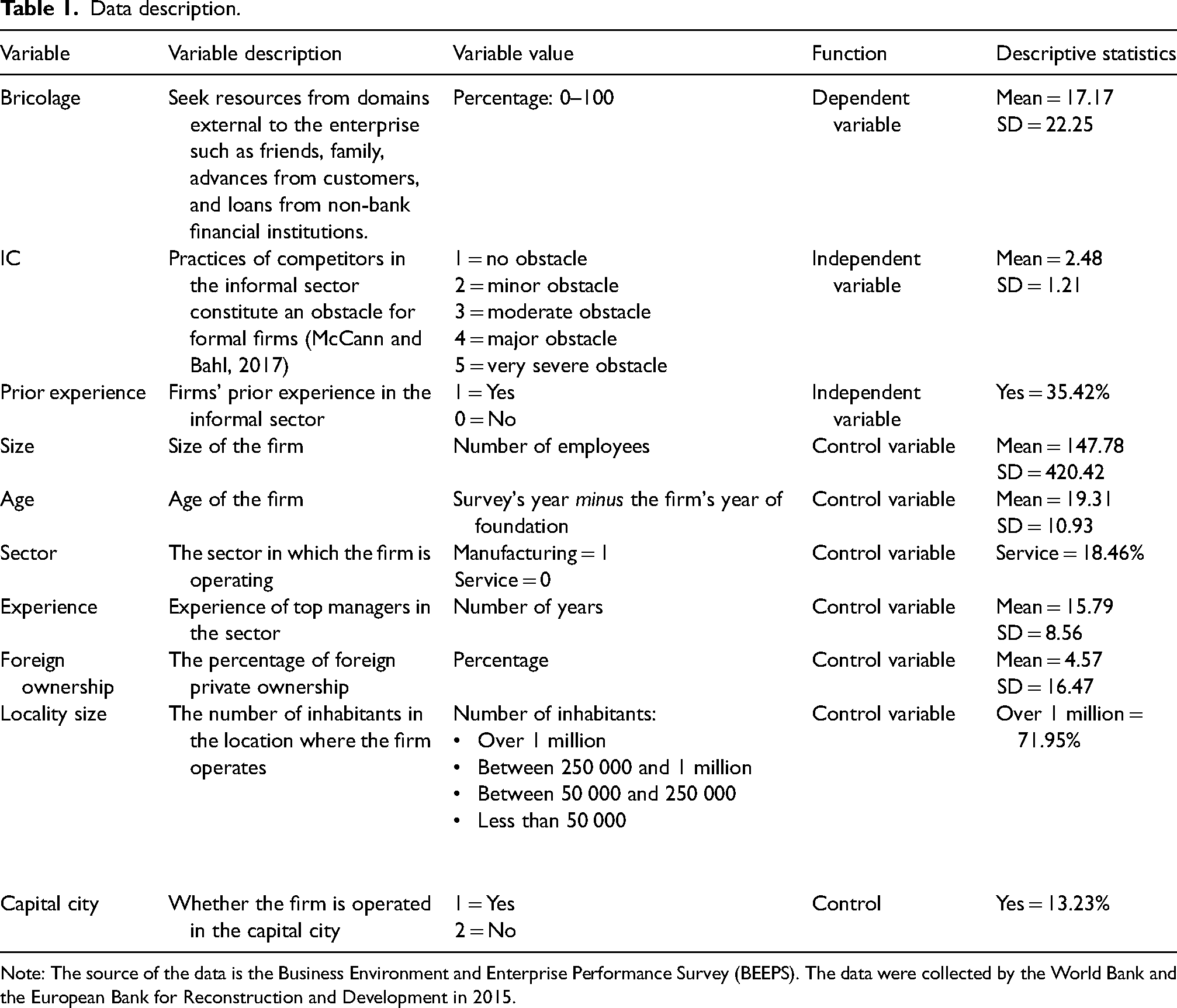
Note: The source of the data is the Business Environment and Enterprise Performance Survey (BEEPS). The data were collected by the World Bank and the European Bank for Reconstruction and Development in 2015.
Explanatory variables
We measure prior experience in the informal sector (PISE) using a dummy variable coded as 1 = yes if the firm has prior experience in the informal sector and 0 = no if the firm does not have prior experience in the informal sector. As in McCann and Bahl (2017), we measure the level of IC by relying on questions that asked respondents, ‘Are practices of competitors in the informal sector no obstacle (1), a minor obstacle (2), a moderate obstacle (3), a major obstacle (4), or a very severe obstacle (5) to the current operations of this establishment?’.
Control variables
We also include some firm-level control variables. We control for Firm Size based on the logged number of employees working for the firm; Firm age as the survey's year minus the firm's year of foundation; Top Manager Experience in the sector is the number of years of experience the firm's top manager has in the firm's primary industry. We also considered the ownership composition of the firm by including controls for percentage ownership that is foreign. Foreign ownership was coded as a dummy variable (no = 0, yes = 1). We include the sectors in which the firms operate to capture other conditions that may be related to bricolage. The firm's sector was coded into ‘1’ for Manufacturing and ‘0’ for Services. We also controlled for the size of the locality where the firm operates and whether it is in the capital city, where resources may be less constrained. The description of the data and measurements is illustrated in Table 1.
Common method bias
We note that many of our measures are based on survey responses provided by the same respondent, and this could cause common method bias (CMB). We believe concern about CMB is minimised for several reasons. First, the dependent variable of bricolage is largely a report of an action taken and not a perceptual measure; we also made sure to eliminate any statement that did not closely relate to our construct of bricolage. We also note that the independent and dependent variables are on different scales, and their associated questions were temporally separated in the survey (Podsakoff et al., 2003). Another factor that reduces concerns about CMB is the use of interaction hypotheses, which represent complex relationships that are less likely to be affected by CMB (Chang et al., 2010). Lastly, we note that the BEEPS procedure included several steps that reduce CMB concerns (cf. Lee and Weng, 2013).
Results
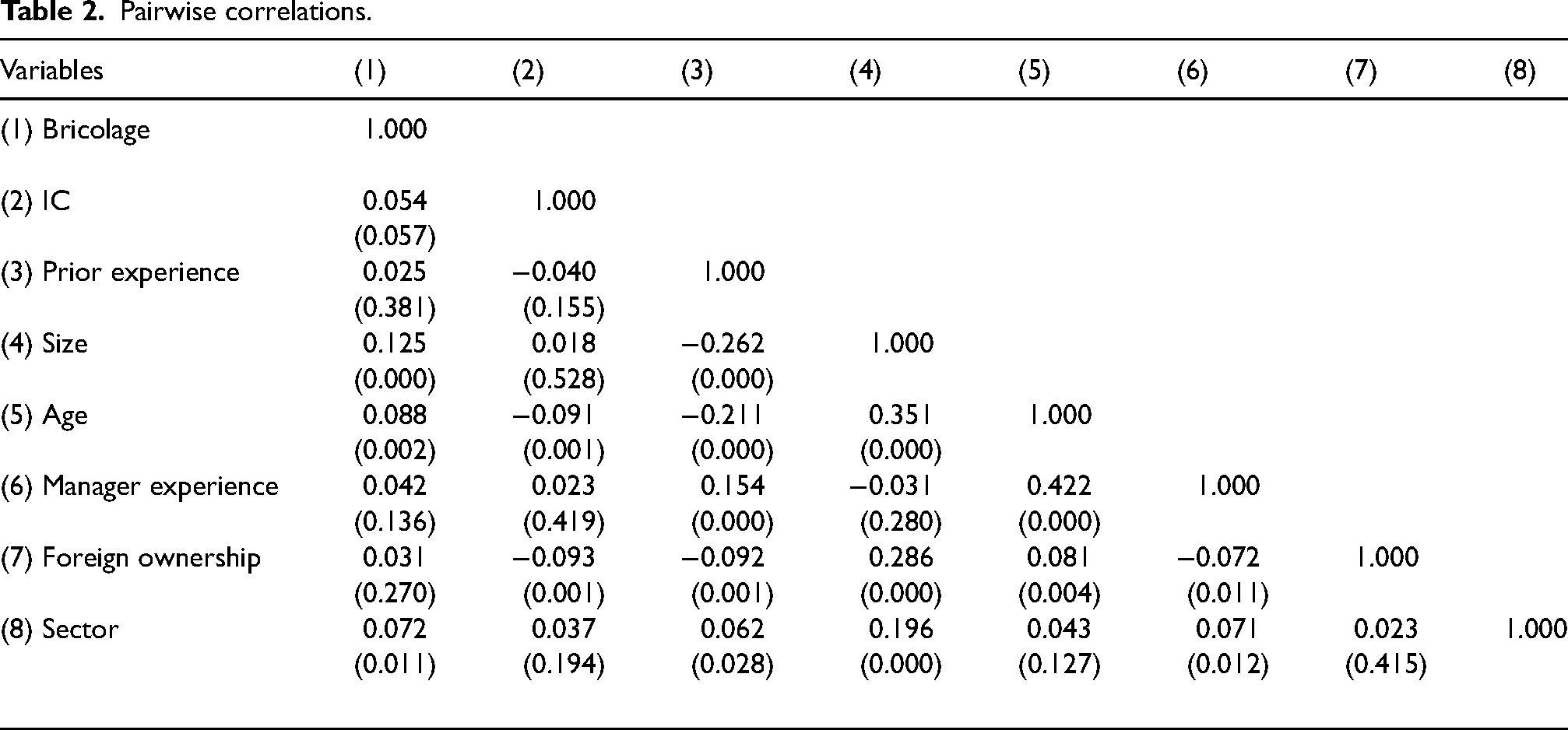
Before running the regression analysis, we tested our model for potential variance inflation. The pairwise correlation among the variables is shown in Table 2. The variance inflation factor (VIF) values ranged from 1.08 to 1.67, indicating no issues of multi-collinearity. Multi-collinearity occurs when two or more independent variables are highly correlated, potentially inflating the variances of the estimated regression coefficients. The range (1.08 ‒1.67) implies that the variance of the estimated coefficients is not significantly inflated. In practical terms, this means that the independent variable in question does not have a strong linear relationship with the other independent variables in the model, which reduces the risk of unstable coefficient estimates. This allows for more reliable and interpretable regression results. Table 3 shows the results of the regression analyses. The regression results showed that PISE influences bricolage (b = 3.24; SE = 1.41; p < .05) – confirming H1. The findings also indicated a significant interaction between PISE and IC (b = 2.30, SE = 1.11, p < .05). Next, we conducted a spotlight analysis to probe the impact of different levels of IC on the relationship between prior experience and bricolage. IC was split into low, moderate, and high levels. The spotlight analysis shows that the positive effect of prior experience on bricolage becomes stronger with increasing IC. The spotlight analysis is illustrated in Figure 2 and Table 4.
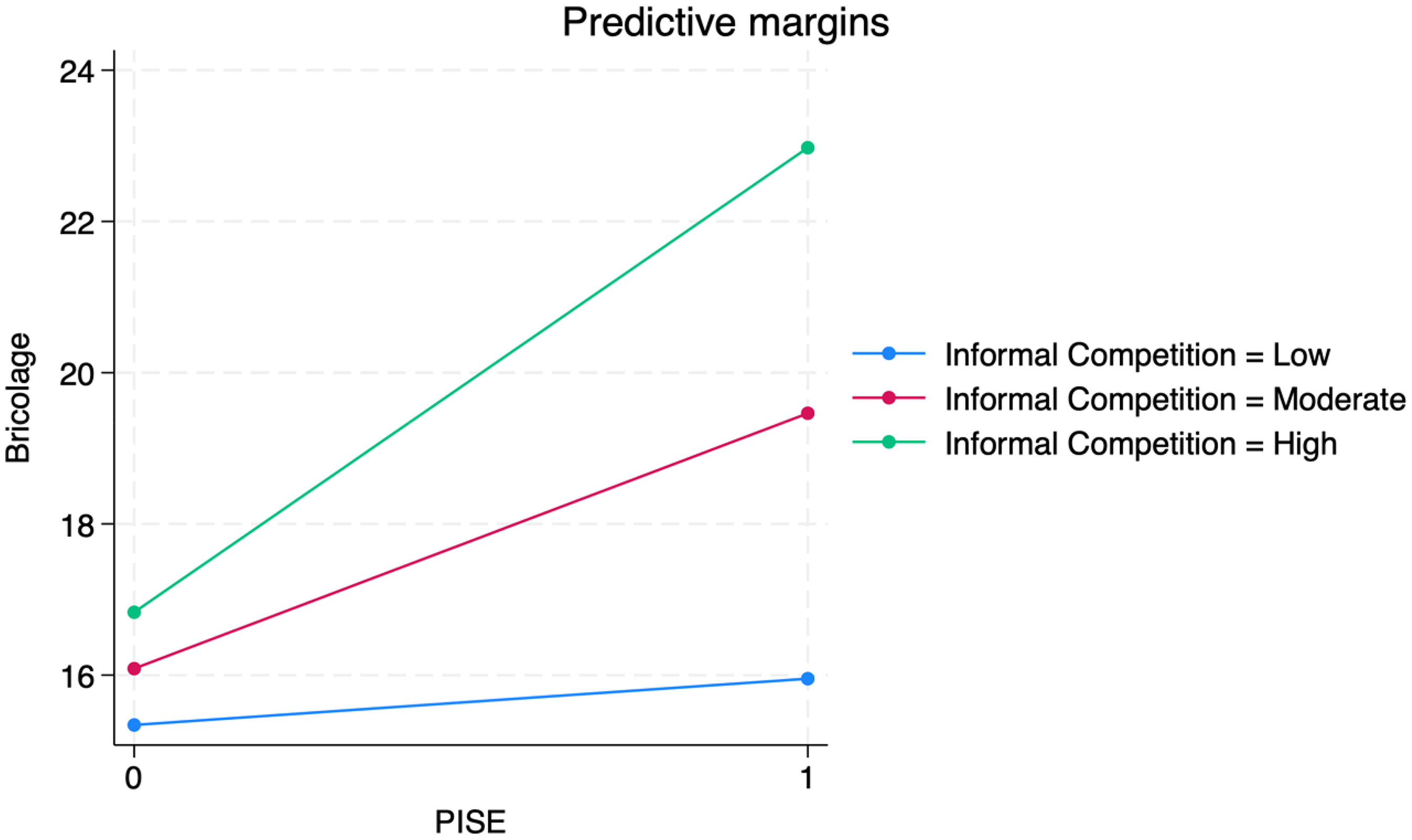
Conditional effects.
Pairwise correlations.
Regression estimates.
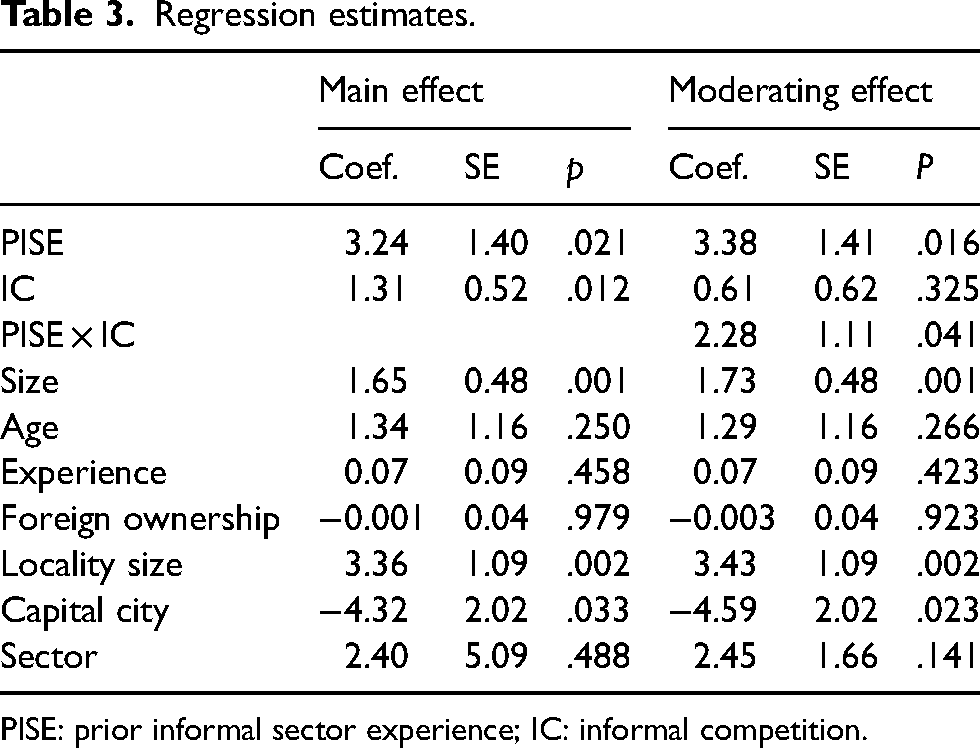
PISE: prior informal sector experience; IC: informal competition.
Initial margins analysis – impact of prior experience on bricolage at different levels of informal competition.
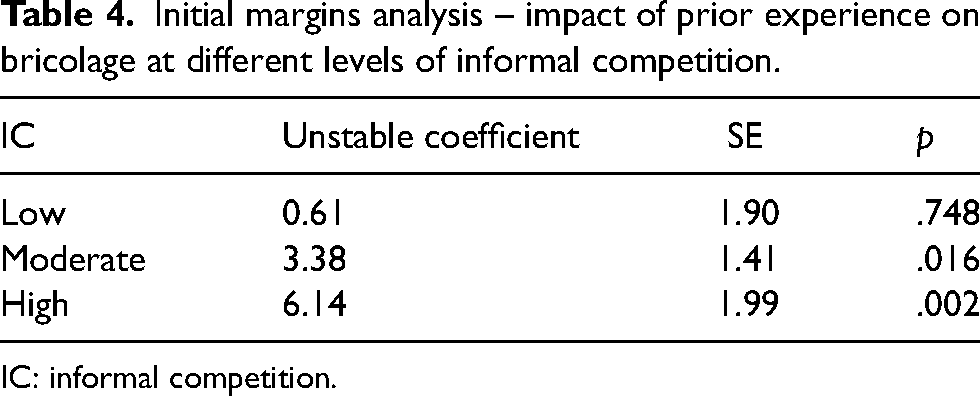
IC: informal competition.
Robustness
One can argue that bricolage may well be a function of PISE; we address this concern by testing for potential endogeneity. We followed Young (2015) to select an appropriate instrumental variable (IV). First, we ensured that the IV is a predictor of the independent variable (PISE) but has no significant direct impact on dependent variable (bricolage). Therefore, we use the difficulty of obtaining an operating licence (DfOL) as an IV. Prior studies suggested that business registration difficulties reduce the freedom of choice for entrepreneurs to participate in the formal sector (Djankov et al., 2003). This implies that formal firms in environments with difficulty of obtaining an operating license might have started as informal (Bruhn, 2013) – suggesting that such difficulty may well explain PISE. Furthermore, we anticipate no direct impact of DfOL on bricolage. From an institutional perspective, research argues that bricolage can be enacted by experimenting with methods without considering regulatory standards and limitations in the institutional and regulatory environment (Fisher, 2012). That is, such enactment may go beyond elements of the institutional and regulatory environment. Hence, as an element of such an environment, DfOL will not directly drive bricolage. The difficulty of obtaining an operating license is operationalised as the extent to which business licensing and permits represent a major obstacle for enterprises (WBES, 2006–2018).
We adopted a two-stage control function to account for potential endogeneity by modelling the endogeneity in the residual (see Petrin and Train, 2010; Wooldridge, 2015). First, we run a model wherein PISE is the dependent variable and DfOL is the independent variable. We also included the independent and control variables of our conceptual framework in this model. As expected, the results showed a positive impact of DfOL on PISE (b = 0.15, SE = 0.07, p < .05). Second, we retain the residual and include it as an independent variable in the bricolage model with the independent and control variables of our conceptual framework. The t statistic on the included residual indicates that the null hypothesis, that is, PISE is exogenous, could not be rejected at a 95% confidence interval (p > .05).
Discussion
This paper examined the influence of formal enterprises’ PISE on their adoption of bricolage and the moderating impact of IC. Our findings indicate that prior experience in the informal sector, in general, increases formal enterprises’ adoption of bricolage. Our results further showed that this effect is strengthened when enterprises face strong IC, suggesting that formal enterprises with PISE are more likely to engage in bricolage at high levels of IC.
Contributions
Our paper contributes to the literature on strategic entrepreneurship, resourcing behaviour, and bricolage literature in the following ways. First, while previous studies have significantly contributed to our understanding of bricolage in resource-constrained contexts, there is limited research on the impact of formal enterprises’ PISE on their adoption of bricolage. We contribute new theory to the literature on bricolage (e.g. Bacq et al., 2015; Bojica et al., 2018; Desa and Basu, 2013; Duymedjian and Rüling, 2010; Fisher, 2012; Magobe et al., 2024; Reypens et al., 2021) by drawing on prior experience literature (Coleman, 1988; Davidsson and Honig, 2003; Shepherd, 2003) to investigate the effect of PISE on bricolage. In a departure from previous studies examining the antecedents of bricolage (Desa and Basu, 2013; Magobe et al., 2024; Reypens et al., 2021), our paper helps unpack the role of the formal/informal market divide in the orchestration of bricolage. By identifying PISE as an important antecedent of bricolage in the context of formal enterprises that previously operated in the informal sector, we offer a fresh perspective on the evolution and transition that formal firms in resource-constrained contexts make from the informal sector and advance how prior learning and experiences in the informal sector shape the adoption of bricolage.
Additionally, our study extends the extant corpus by suggesting that bricolage underpins the positive impact of informal legacy on firms’ outcomes. Prior studies have reported how informal sector experience has a positive impact on firms, such as enhancing their export intensity (e.g. Larsen and Witte, 2023) and increasing their performance (e.g. Williams et al., 2017). These studies primarily report that informal legacy is associated with low-cost structures that enable firms to save money and innovate. Our study extends these prior works by deep diving into the micro-mechanisms of informal legacy to advance that bricolage affords the low-cost propositions that underlie informal sector experiences.
Second, although prior studies have highlighted the potential threats posed by IC to formal enterprises (Birkinshaw et al., 2014; Webb et al., 2013), there is still a limited understanding of the impact of IC on formal enterprises’ entrepreneurial actions (Mendi and Costamagna, 2017). Our paper sheds light on this issue by advancing that high levels of IC accentuate the tendency for formal firms with PISE to revert to their prior bricolage knowledge to match informal competitors. Our paper also extends extant theory that informal enterprises in emerging economies influence formal enterprises’ strategies (Lewis, 1954; Webb et al., 2009) by showing RM and specifically bricolage to be one of those strategies affected by IC. It contributes to the bricolage literature by extending Baker and Nelson's (2005) seminal insights on the resourcing behaviour of enterprises through highlighting the dynamic interplay between prior experience and level of IC on enterprises adoption of bricolage.
Lastly, our paper also offers a useful complement to prior work on the phenomenon of formal enterprises. Much of this work has focused on the antecedents of formal enterprise activity, for example, by linking its prevalence to the strength of local institutions (De Castro et al., 2014; Kistruck et al., 2015). In contrast, our paper helps build an understanding of the consequences of prior experience in the informal sector (Faroque et al., 2020), showing that it has important implications for formal enterprises’ adoption of bricolage in emerging economies.
Limitations and suggestions for future research
Our study is not without limitations. First, our primary empirical analysis is cross-sectional and based on single-country data, limiting our ability to draw strong causal conclusions. Our arguments, findings, and conclusions are therefore not widely generalisable, though they may apply to other countries whose informal sector and institutional profiles are similar to Indonesia. Nevertheless, we encourage future studies to examine this topic using multi-country data. Doing so will make it possible to examine how country-level conditions may influence the PISE–bricolage relationship. Also, as our data comes from the BEEPS, we acknowledge the potential challenges with subjective measures. Nevertheless, the merit of subjective measures cannot be overestimated, and in this study, we checked for CMB and did not find evidence of it. Although we included a robust set of control variables, including firm and industry effects, there may be other unobserved factors that influence both the adoption of bricolage by the enterprises and their prior experience in the informal sector. Moreover, our measure of prior experience in the informal sector is a dichotomous measure, which is a limitation because a continuous measure would have been more appropriate to capture more variance in bricolage experience. Because of this, we suggest future research to verify our findings using continuous measures. Importantly, our theory and results highlight how scholars interested in the drivers of bricolage might fruitfully give greater systematic attention to other determinants of bricolage in emerging economies and thereby work towards opening up another main ‘front’ in research on bricolage and resourcing behaviour in general.
Second, our study focused on one specific type of RM behaviour, namely, bricolage. We invite additional research that considers how prior experience in the informal sector impacts other types of RM behaviour. Third, our bricolage measure is somewhat limited in that it only focuses on a relatively narrower concept of bricolage – seeking financial resources from informal domains – and does not consider other bricolage options such as downsizing, disbanding, or applying combinations of the resources at hand (Baker and Nelson, 2005). The analysis would be enriched when future research considers these other bricolage options. More specifically, given the different bricolage options, it would be illuminating to understand whether the adoption of bricolage based on PISE tends to favour one or the other of these bricolage options.
Another limitation of this research is the potential issue of endogeneity, which arises from using cross-sectional data and can lead to reverse causality. This means that while enterprises with PISE may perceive IC as a significant obstacle to their business, those without PISE may not have the same perception or awareness of the strength of competition from informal firms since they were never informal firms themselves. To address this issue, we attempted to mitigate potential endogeneity by conducting a two-stage control function that modelled endogeneity in the residual. Analysis of the included residual suggested that the null hypothesis of exogeneity could not be rejected at a 95% confidence interval. However, we acknowledge that unobserved or missing factors may still influence the results. Lastly, we note that our choice of data source included several trade-offs. Although the BEEPS data source allows us to analyse one country across two industries, contributing to the generalisability of our findings to some extent, we recommend additional research to cover more countries.
Footnotes
Author's note
Sadrac Cenophat is now affiliated with the University of Applied Management Studies, Germany.
Declaration of conflicting interests
The authors declared no potential conflicts of interest with respect to the research, authorship, and/or publication of this article.
Funding
The authors received no financial support for the research, authorship, and/or publication of this article.
