



Abstract
This conceptual paper focuses on bricolage and it pays particular attention on the context of micro and small enterprises (MSEs) in resource-constrained environments – a common feature of most emerging economies. Knowledge about the underlying factors that determine bricolage as a common practice among MSEs operating in emerging economies is yet to advance and develop within the mainstream entrepreneurship literature. Much of this scholarship tends to focus on multi-national enterprises (MNEs) in advanced economies and it discusses bricolage as their strategic choice. Such an approach has led to a lack of meaningful theoretical paradigms for defining the business approaches MSEs adopt as a way of mitigating their perennial operational issues inherent in their environment. Thus, in this conceptual paper, which adopts a scoping review approach, we study the constructs of bricolage particularly their application in MSEs operating in emerging economies. From our analysis a fresh deterministic model mapping out the causal factors that give rise to bricolage behaviour in MSEs that operate in difficult conditions emerged. Thus, we contribute to entrepreneurial behaviour theories by identifying distinctive business methods MSEs adopt to withstand operational difficulties inherent in their environments.
Introduction
The process of managing and growing businesses in many emerging economies is often inhibited by market imperfections including; under-developed infrastructure, political morass, and resource limitations (see for example: Ahmed and Nwankwo, 2013; Holt and Littlewood, 2017; Linna, 2013; Naudé, 2010). In the presence of these limitations, businesses in general and MSEs in particular, are forced to introduce innovative but radical measures. One of the ways in which they can apply these measure, is through adopting ingenious entrepreneurial practices such as bricolage (Lévi-Strauss, 1967) for mobilising whatever resources (Barker et al., 2003) they can access within their surroundings. As they embrace such a mindset in their business environments (Timmons, 1978), it is to be expected that their actions will also be shaped by whatever resources they may or not hold (Dolmans et al., 2014; Powell and Barker, 2014; Senyard et al., 2014).
For the purposes of this conceptual paper, we employ the term ‘resources’ to imply both tangible and intangible firm-based resources. We specify that these firm-based recources (Penrose, 1959) encompass human capital, financial capital, knowledge capital and physical assets (Cooper et al., 1994) and externally derived resources comprising institutional support in the form of expertise, technical know-how, information and materials (Di Domenico et al., 2010; Teece, 2012). In several management, organisation (e.g. Duymedjian and Rüling, 2010; Powell and Baker, 2014; Visscher et al., 2018), and also social studies (e.g. Grivins et al., 2017) the idea of relying on whatever resources a firm has available to fulfil its ambitions is often associated with bricolage (Baker, 2007; Baker et al., 2003).
Bricolage is a concept that, in many ways, embodies ideas associated with ‘make-do’ (Baker and Nelson, 2005; MacMaster et al., 2015) ‘do-it-yourself’ (Lévi-Strauss, 1967) and improvisation (Baker et al., 2003; Crossan, 1998) as methods for manipulating scarce resources through ingenious ways that enable business survival and even growth – that is, if the desire is to grow (Simba and Thai, 2019).
Within the scholarship on bricolage, ‘make-do’ and improvisation are conceptualised as methods that resource-constrained firms utilise to solve new problems and create fresh opportunities using whatever resources they may have at-hand (see for example: Barker, 2007; Barker and Nelson, 2005; Lévi-Strauss, 1962). The business landscape that many MSEs operating in emerging economies have to navigate clearly demands that they concentrate on what they have (Penrose, 1959) to produce something (Baron and Hmieleski, 2018; Sarkar, 2018). Thus, adopting both a ‘make-do’ attitude and improvisation as response mechanisms in the way they prepare for, and manage their business processes (Bojica et al., 2014; Gras and Nason, 2015) is pivotal to the actions they take or have to take to mobilise resources and unlock firm creativity (Lampel et al., 2011).
By way of comparison, the use of bricolage in firms in advanced economies differs from its practise among MSEs in emerging economies. The literature recognises that enterprises trading in advanced economies often enjoy great latitude in their processes for collecting and utilising resources that they may not access or employ via rational or standard procedures (Baker and Aldrich, 2000; Duymedjian and Rüling, 2010). To the contrary, other scholarly works describe MSEs in emerging economies as having far-less freedom in the way they mobilise their often-scarce resources due to constraints inherent in their environment (Winkel et al., 2013).
For instance, the regulatory and institutional environment in emerging countries is notoriously burdensome and it frequently hampers small enterprise growth as compared to that of developed economies (World Bank, 2006). But despite these intractable challenges that often militate MSE survival and growth, the practice of ‘making do’, improvising and recombining available resources (Baker et al., 2003; Visscher et al., 2018) emerges as a potent response mechanism they can employ enabling them to bridge their resource deficiencies (Teece, 2012). To advance and develop knowledge on bricolage as a practice in emerging economies, our review is guided by the following overarching business development question.
In what ways do micro and small businesses in emerging countries respond to resource constraints in emerging economies?
The main goal is to develop and advance understanding about the behaviours and actions of MSEs in emerging economies. Also, our motivation for focusing on MSEs and their practices in their resource-constrained environments stems from our in-depth study of the literature, and the knowledge that these firms perform an important regional and economic development role in many countries (Acs and Storey, 2004; Mead and Liedholm, 1998).
There is ample evidence in the literature on entrepreneurship bricolage indicating that ‘fiddling’ (Holt and Littlewood, 2017), ‘make-do’ (Baker et al., 2003) and recombining resources are behaviours businesses activate to mitigate their resource deficiencies (see for example: Desa, 2012; Guo et al., 2018). Nichter and Goldmark (2009) clarified that severe resource shortages are the main trigger which causes a permanent paradigm recast in business practice among MSEs. Nichter and Goldmark understood that when faced with such shortages MSEs often respond by embracing bricolage as an attitude influencing the way they search for entrepreneurial solutions.
Nevertheless, this seemingly potent entrepreneurial approach among MSEs in resource penurious environments is yet to advance and develop in the mainstream literature on entrepreneurship (Nichter and Goldmark, 2009). Much of the available scholarship within this domain offers ample evidence describing the use of bricolage as a strategic alternative for MNEs (see for example: Gundry et al., 2011; Lennerfors and Rehn, 2014). Our observations concerning the distortion this creates in the literature were also shared by Linna (2013). Linna expressed the view that there is a gap in the literature on studies that pay attention to the concept of bricolage in an emerging country context in which the shortage of resources is more severe than in industrialised countries. Thus, we contend that the more we pay attention to the debate on MSEs operating in environments with severe resource deficiencies, as this research does, the more we focus the limelight on their business practices making a contribution to entrepreneurship behavioural concepts.
In line with the views advanced in this research Winkel et al. (2013) explained that bricolage is a key mechanism to explore and for explaining entrepreneurship in emerging economies. Accordingly, our literature review effusively advances bricolage as a practice in small businesses in at least three ways. Firstly, it describes a mindset adopted by those MSEs that have limited latitude in the way they mobilise resources in emerging economies. Secondly, it theoretically explains how bricolage can be utilised as a mechanism for mobilising depleted resources by MSEs with the objective of responding to the operational challenges inherent in their ambiguous environments as depicted in our newly developed model (Figure 1). Thirdly, it delineates why methods of improvisation comprising ‘make-do’ and ‘do-it-yourself’ attitudes often shape the entrepreneurial actions (Verjans, 2005) in MSEs. Particularly, the notion of routinely doing more with less (Sunduramurthy et al., 2016) as a way of surviving in resource-constrained surroundings.
The ideas advanced in this research also extend the application of Lévi-Strauss’s (1967) dated but routinely cited works on bricolage to understand bricolage behaviour in MSEs. The base argument in Lévi-Strauss’s (1967) works ‘From the Savage Mind’ is that, the process of reasoning in indigenous populations is neither ‘pre-logic’ nor opposed to scientific rationality. Lévi-Strauss framed this process of reasoning as a ‘science of the concrete’ featuring a systematic inventorying of the environmental conditions that militate against a social world and individual actions. The implications of Lévi-Strauss’ views are that; for institutions, firms, and individuals in resource constrained surroundings, their foremost alternative is to activate high-order cognitive modes (Kuratko, 2017) of understanding their social world and their intimacy with the concrete (Lévi-Strauss, 1967) in order to survive, develop and even grow. In that regard, their actions can best be understood by using the concept of bricolage.
The knowledge generated in this conceptual paper, offers insights into MSEs’ propensity to use bricolage as a response mechanism that supplements their resource deficiencies. As previously stated, such insights can be beneficial to other stakeholders including entrepreneurship practitioners, academics, established organisations and policy-makers in that they can develop an understanding of their (MSE) practices. Clearly, an awareness of the actions of these key economic agents can be used to inform policy development, to understand how they conceptualise their social world (theoretical perspective) plus as a point of comparison with their established counterparts in advanced economies.
The conceptualisation of bricolage
The concept of making it along as you go, or ‘do-it-yourself’ (Lévi-Strauss, 1967) or improvise (Baker et al., 2003) in other words, is a type of behaviour that can best be defined using the bricolage paradigm. Although bricolage is well-established as a practice in music, architecture and visual arts it has also been used in other fields including; anthropology, philosophy, education, and increasingly in business management studies. Within the field of management this mechanism for mobilising resources is used to describe an endeavour to ‘make-do’ with whatever resources a firm has (Baker and Nelson, 2005). In that way it defines the creation of something new by actors involved in the recombination and transformation of resources existing in a firm (Bacq et al., 2015; Fisher, 2012; Senyard et al., 2014).
Bricolage is also contrasted with the more rational problem-solving approaches that often involve systematic and standardised methods and resources (Visscher et al., 2018), and Baker and Nelson (2005) extended it to include improvisation. Baker and Nelson theorised that bricolage and improvisation have more to do with the strategy of making do with the resources at hand. Improvisation and ‘making do’ are processes that involve ‘fiddling’ or recombining resources to provide solutions to operational limitations, in organisations, often imposed by institutions and/or political entities (Ciborra, 1996; Linna, 2013). In the same way, Baker et al. (2003) and Weick (1993) conceptualised bricolage as a process of tinkering and recombining available materials in creative ways. Firms that apply bricolage as a method in the way they operate refuse to be constrained by their resource limitations. Rather, they are always in search of ingenious ways to transcend them (Weick, 1979). This view resonates with the ideas expressed by Steffens et al. (2010: 8) who expressed similar views stressing that ‘bricolage includes a refusal to simply accept existing standards and a willingness to experiment’.
Likewise, Valliere and Gegenhuber (2014: 6) extended Weick’s (1979) ideas by arguing that resource-constrained ‘firms are more likely to enact given environments without testing their implied limitations’. These firms would more or less use bricolage to resolve issues of resource constraints and develop idiosyncratic relationships with their resource-poor environments (Valliere and Gegenhuber, 2014). Baker conceived bricolage as a concept by commenting that ‘much of what is interesting about the concept comes from the combination-artful or clumsy-of various resources at hand…What is interesting is not the simple fact of starting with little, or the sensible response of avoiding activities that devour liquidity, but rather the active things that resource constrained entrepreneurs do in order to access, draw upon and combine other resources that are available cheaply or for the taking’ (2006: 7). Extending Barker’s conceptualisation of bricolage to explore MSEs in emerging economies that are characterised with resource deficiencies, can be an effective way for understanding ways in which they respond to the resource constraints in their indigent surroundings.
Defining MSEs
Scholarship on regional studies recognises that MSEs significantly contribute to the economic development of many economies (Ayyagari et al., 2011; Muller et al., 2016). But despite this recognition, the way this category of enterprises has been defined has varied widely from country to country (Donner and Escobari, 2010). The most commonly utilised measures range from the number of employees, scope, size to assets and the revenue they generate (see for example: Curran and Blackburn, 2001; European Commission, 2003; Gibson and van der Vaart, 2008; Mead and Leidholm, 1998; Stokes and Wilson, 2010). Nonetheless, for the purpose of this review, we characterise MSEs as informal businesses although there is no universal standard to determine what makes an enterprise informal vs. formal (Esselaar et al., 2007).
On the basis of our characterisation of MSEs as informal businesses, we conceptualise their access to key resources for business development as severely limited (see Duncombe and Heeks, 2002; La Porta and Shleifer, 2008). MSEs share a basic similarity with all enterprises; each combines investments in capital with some labour (their own, their families’ or their employees) in the hopes of yielding a product or service whose market value exceeds the cost of those inputs (Donner and Escobari, 2010). Considering our characterisation and the approach adopted by MSEs in business management and development especially in the context of emerging economies, there is merit in using a bricolage lens to advance knowledge about how they survive in resource-constrained conditions.
MSEs in resource-constrained environments
Micro and small firms in emerging economies are increasingly redefining new product development and innovation in emerging economies (Thai et al., in press) irrespective of their limited access to essential resources. Scholarship on innovation management, both theoretical and empirical, seem to focus on bricolage as a strategy in MNEs (see for example: Halme et al., 2012) and this literature does not mention bricolage in the context of local entrepreneurs and small businesses in developing countries (Linna, 2013; Ray and Ray, 2009). Yet bricolage is essential for these entrepreneurs and small businesses because they constantly operate under resource constraint conditions (Linna, 2013). Considering this knowledge gap on bricolage in resource-constrained emerging economies, it is important that we develop insights into its use in MSEs. Thus, recognising the nature of a firm’s resource environment can provide a different and perhaps more useful basis for understanding how entrepreneurs may create value in depleted and penurious environments (Baker and Nelson, 2005). Such focus on a firm’s resources and the environment has relevance to the debate about MSEs in emerging economies that often operate under severe resource shortages (Linna, 2013).
In the discussion on MSEs in emerging countries, context matters (Nichter and Goldmark, 2009) because it shapes the availability of firm-based resources (Penrose, 1959) or external resources needed for business success, development and growth (Davidsson et al., 2017; Desa, 2012).
Given this characterisation of the environments these enterprises operate in, ingenuity among actors would render the impact of their resource shortages less of a barrier in their way of operating. The patterns of resource scarcity create a criteria for selection that determines patterns of firm survival (Baker and Nelson, 2005). Considering the indigent conditions for MSEs characterised with limited resources and further complicated by political morass etc. in emerging economies, they face diminishing alternatives. This implies that they have to manage and ‘make do’ with the limited resources they may have in order to achieve their organisational objectives (Nichter and Goldmark, 2009).
The process of managing firm resources is known to be fundamentally dynamic (Teece, 2012), with change resulting from adapting to environmental contingences and through taking advantage of the opportunities those contingencies may create (Sirmon et al., 2007). Considering the context of the MSEs dictated by the scarcity of resources, relying on their understanding of their settings (social world) and their intimacy with the concrete (Lévi-Strauss, 1967), is perhaps a realistic approach that offers a way for enabling their survival, development and growth. Penrose’s (1959) resource-based theory (RBV) of the firm offers an alternative explanation of firm development in resource-constrained environments. RBV advances the school of thought that resources are objective and can include physical resources, labour and skills (Barney et al., 2011; Wernerfelt, 1984). This view provides two important distinctions pertinent to the behaviours MSEs exhibit in an emerging country context. Firstly, the theory suggests that it is not the resources per se that are important to firms, but the services firms obtain out of the resources they have (Steffens et al., 2010).
In that context, the resource-based view highlights that services are contributions that resources make to the operations of the firm. Applying the resource-based view analogy to the context of MSEs in resource-constrained settings, their focus on what they can get from any resources they may have at hand is logical and it appears to be a method they frequently activate in their response to their circumstances.
The second assumption advanced by Penrose (1959) introduced the idea that there is no firm that perceives a complete range of services available from any resources. From that perspective, each firm is unique in its idiosyncratic relation to its resource environment. Firm differences arise because different firms elicit different services from the same set of resources (Desa, 2012). The same resources that may be worthless to one firm can be valuable to another. Though it is hard for MSEs to acquire new resources from their environment because of the institutional frames in emerging countries that are notoriously burdensome (World Bank, 2006), improvisation could perhaps offer a genuine chance for them to succeed.
Improvisation: MSEs and resource-constrained environments
Improvisation is a concept frequently discussed and extensively recognised in the arts (de Klerk, 2014) including music, theatre, choreography and dance than in business (Hadida et al., 2015). In jazz combos it is prominently used to describe how musicians are not fazed by uncertainty arising from their structured music systems (Cunha et al., 1999). The metaphor(s) that can be derived from its use particularly in jazz (Barrett, 1998) offer business researchers the opportunity to derive meanings from alternative sources enabling an effective rationalisation of particular behaviour observable in business settings (Hadida et al., 2015; Kamoche et al., 2003). Leybourne and Sadler-Smith (2006) conceptualised improvisation as a combination of intuition, creativity, and bricolage and they stressed that it is often driven by time pressures.
Consistent with this Moorman and Miner (1998) perceived improvisation to be an action that is simultaneously devised and executed. Explained differently, it is a practice that does not conform to an orthodox style of careful planning or strategising in a business context (Duxbury, 2014). It is rather about being able to change or adjust plans ‘on the fly’ (Baron and Hmieleski, 2018). The form and nature of the conditions MSEs operate in that are characterised by economic and political morass, thus using improvisation offers them the ability to respond to uncertainty arising from their surroundings accordingly.
With improvisation, it is unequivocal that instead of following a pre-arranged plan, actions are influenced by the circumstances under which a business exists (Duxbury, 2014). In emerging economies severe resource shortages (Linna, 2013) are known to be the main problem arising from deteriorated economic and political structures (Simba, 2018). Under such conditions micro and small enterprises are left with little choice but the reality of either to ‘adjust or fail’ (Baron and Hmieleski, 2018). This implies that small businesses must be ready, willing and able to improvise, that is, they have to come up with alternative operational methods ‘on the fly’ so that they confront the challenge posed by the negative impact of resource shortages on their business operations (Baker et al., 2003; Hmieleski and Cobbett, 2008).
The types of businesses (MSEs) that are the subject matter in this review are known to endure severe time and operational pressures (see for example: Ahmed and Nwankwo, 2013; Naudé, 2010; Naudé and Havenga, 2005). Because they exist under conditions of uncertainty and with little time, expertise, resources or even inclination for contingency planning, their circumstances demand that they improvise (Baker et al., 2003; Hmieleski and Corbett, 2006) and make quick novel modifications in their business processes in order to succeed (Hmieleski et al., 2013).
From that perspective it would be logical to utilise improvisation as a coping mechanism (i.e. making do with available resources) given their environmental problems. Related to that Moorman and Miner (1998) explained that improvisation occurs more or less swiftly in response to environmental problems. Following Moorman and Miner’s reasoning, it is plausible to depict improvisation as an intervention mechanism compensating for resource shortages in firms facing constantly changing environments (Chelariu et al., 2002; Weick, 1993). Linna (2013) identified a connection between bricolage and improvisation. Linna expressed that bricolage is a concept that can be used to describe a set of resources invoked by improvisation. As a feature of bricolage, improvisation was described by Baker et al. (2003) as a method entrepreneurs or bricoleurs (Lévi-Strauss, 1966) take advantage of in the way they mobilise resources, that is, turning materials or information into novel combinations (Weick, 1993). Furthermore, improvisational behaviour can offer a practical framework for evaluating how firm-based resources can be applied to either meet pre-existing goals that is causation or as an attempt to discover outcomes that are possible namely effectuation (Hmieleski et al., 2013; Sarasvathy, 2001).
Focusing on the causality between the environment and improvisation, Chelariu et al. (2002) explained that if uncertainty partially reflects the degree to which the environment is changing, and dynamism as the rate of change, equivocality will be concerned with the complexity of the environment with its changes. Chelariu et al. further stressed that in ambiguous environments improvisation may be problematic, because the main actors are likely to have conflicting interpretations of the environment (Daft and Macintosh, 1981) to the extent that they may take different views on the causal relationship between the environment and the decision variables.
Applying Fazlollahi and Tanniru’s (1991) views Chelariu et al. (2002) further explained that if an uncertain environment, contributes towards not knowing the answers to questions, a stable environment – mainly associated with advanced economies, may result in not knowing the question to ask. An important point to make from this is that improvisation is mainly dependent on the general characteristics of the environment and the specific nature of the problem or opportunity at hand.
Bricolage among MSEs in emerging economies
Entrepreneurship is conceptualised as a key feature of micro and small enterprises (Bridge and O’Neill, 2018; Stokes and Wilson, 2017) and for those enterprises that operate in ambiguous surroundings, the availability of resources is a critical component of their success, survival, development and growth (Domenico et al., 2010; Senyard et al., 2011). Existing scholarly works in entrepreneurship and organisational studies have utilised bricolage to delineate the entrepreneurial tendencies within firms operating in resource-penurious environments (see for example: Bojica et al., 2014; Garud and Karnoe, 2003; Holt and Littlewood, 2017; Vanevenhoven et al., 2011). The vast majority of these studies specifically point to entrepreneurial bricolage as essential for firm survival, development and growth (Davidsson et al., 2017; Powell and Baker, 2014; Senyard, 2015) with the exception of Guo et al. (2018) who point to the conditional effect of bricolage in SME opportunity exploitation. Nonetheless, considering that in many emerging economies resources are generally depleted (Naudé, 2010), there is no reason not to believe that entrepreneurs who own/manage small enterprises utilise bricolage as their main response mechanism for mobilising resources.
Bricolage behaviour among these enterprises was reported by Linna as an unconscious act activated in order to respond to their penurious conditions. For the purpose of this research we align with Cunha who conceptualised bricolage as a ‘local, contextual, and sudden process…which cannot be thought of outside the specific situation where it appears’ (2005: 6). From that perspective, bricolage is evident in the way in which diverse and innovative approaches are employed by MSEs as well as entrepreneurs who resort to bricolage sources as an immediate means for mobilising resources (Linna, 2013) in their resource-indigent surroundings. Guo et al. (2018) and Witell et al. (2017) concurred that SMEs use bricolage to reconstruct extant resources and build creative combinations that in turn produce recognisable opportunities. Indeed, for enterprises in emerging economies their actions are often defined by their resourcefulness (Winkel et al., 2013). They have to discover, develop and exploit opportunities with limited and idiosyncratic resources (Penrose, 1959). As they do so, they demonstrate their dextrous abilities in their entrepreneurial process. A key question for these enterprises is concerned with mobilising affordable resources (Guo et al., 2018). Indeed, entrepreneurs leading these enterprises would follow strategies that avoid the use of standard resources because they are often scare. This approach arguably increases attention to the notion of using resources at hand (Barker et al., 2003). Put slightly differently, bricolage (Levi-Strauss, 1967).
In dynamic and often restrictive settings, entrepreneurs intending to capitalise on opportunities must be able to manage with novel combinations of existing resources (Winkel et al., 2013). From that perspective, bricolage is arguably a relevant business practice to rely upon. Moreover, bricolage is a method that can be utilised for managing unforeseen, ad hoc environments making it an invaluable asset for entrepreneurs in emerging markets (Winkel et al., 2013). Clearly, in such markets, MSEs rely on resources immediately available to quickly exploit potentially fleeting opportunities without the ability to modify existing plans, or develop new ones (Cunha, 2005).
To successfully utilise bricolage in their entrepreneurial process, entrepreneurs leading MSEs have limited choices other than to develop intimate knowledge of their available resources while being aware and observant of their environment (Barker, 2007). According to Nichter and Goldmark (2009) many MSEs in emerging countries lack both profitable business opportunities and capabilities such as skills, resources, and technology. Based on that assessment, it is unequivocal that contextual factors play a major role in shaping their opportunities and capabilities (Winkel et al., 2013). In that regard, embarking on an entrepreneurial journey in emerging economies would require creativity, critical thinking, improvisation and flexibility. Thus, adopting such a mindset underscores the importance of bricolage as ‘a way of life’ (Verjans, 2005) among MSEs in emerging economies.
Research approach
Considering that knowledge on bricolage especially about micro and small enterprises in emerging economies is yet to advance and develop, this study adopts a scoping review approach (Boland et al., 2017) to enable the analysis and synthesis of the key concepts of bricolage. Although scoping reviews are often used in health science studies (Arksey and O’Malley, 2005) their ability to allow for the contextualisation of knowledge (Anderson et al., 2008) was deemed relevant for this particular research which pays attention to the attitudes and entrepreneurship practices of micro and small enterprises in resource-constrained environments. Additionally, in considering the broad nature of our overarching research question, which was intended to explore the approaches used by MSEs for resource mobilisation in resource constrained environments, adopting a scoping review technique as a research strategy facilitated a focused and in-depth analysis of the disjointed evidence (Levac et al., 2010) on the usage of bricolage in these types of enterprises. From this in-depth study we developed new perspectives about bricolage in MSEs operating within resource-depleted conditions.
Moreover, were provided a fresh deterministic model illustrating how bricolage can be vital for their survival. The principles that underlie a scoping review approach were applied in mapping out a mixture (Levac et al., 2010) of the main theories pertaining to how bricolage can be utilised in micro and small businesses under resource-constrained conditions. This is consistent with Davis et al.’s (2009) point that scoping reviews involve an in-depth analysis of a wide range of research material in order to provide greater conceptual clarity on a specific topic or field of evidence. Indeed, by analysing the literature on bricolage and its constructs (e.g. ‘make-do’ and improvisation) this research was able to define entrepreneurial behaviour among MSEs in resource-constrained environment that is yet to advance and develop in the mainstream literature on entrepreneurship. More importantly, their entrepreneurial approach presented fresh insights and knowledge that meaningfully advances bricolage as a potent practice in small businesses. To identify relevant studies featuring bricolage, other key terms comprising ‘make do’, ‘do-it-yourself’, ‘fiddling’, entrepreneurship, improvisation and MSEs in resource constrained/poor environments, were utilised to sift through a sizable body of literature on entrepreneurship. These key terms were used either separately and/or as a combination linked by Boolean connectors as advised by Cronin et al. (2008). The rationale for doing so was to maximise the results of the search from relevant literature sources. Using this inclusion/exclusion technique, a range of databases including Wiley Online Library, EBSCOhost Business Source Complete, Science Direct, SAGE, PROQUEST and Taylor & Francis Online were searched.
With respect to the search criteria adopted for the purpose of identifying relevant data, no constrains we introduced to narrow the search for articles on the basis of the publication date(s) as is often the case with purely systematic review designed studies (see for example: Terjesen et al., 2016). The rationale for not using time-bound studies was to enable as much access to the dispersed literature on bricolage in MSEs in resource-constrained environments that seems to be obscured in the mainstream literature on entrepreneurship.
Discussion
This scoping review advances knowledge on bricolage as a method that is embedded in the way MSEs function in resource-constrained environments such as those offered by emerging economies. At its core of its discussion the study illuminates the methods these types of enterprises apply in order to respond accordingly to their indigent environment(s). It unequivocally contributes new insights and knowledge about the practice of bricolage in business in general and in MSEs, in particular. As previously noted, in many emerging economies various factors comprising rapid & unregulated market transformations, political morass, etc. are prominent forces at play. Their interplay makes bricolage and its constructs comprising improvisation, ‘make do’ and ‘do-it-yourself’ attitudes towards managing and growing MSEs, potent options to rely on in order to remain functional. Elsewhere several other scholars (e.g. Chelariu at al., 2002; Donner and Escobari, 2010; Linna, 2013; Stinchfield et al., 2013) have acknowledged that bricolage offers a framework for businesses in resource-constrained conditions to ‘fiddle’ and ‘make do’ with resources they have at hand. As they make the most of the resources they have, they work incredibly hard to survive and remain operational (Dolmans et al., 2014).
On the basis of these assumptions, it is less-surprising that MSEs in emerging economies use bricolage as an orthodox business practice – an observation which seems to have been eclipsed in the current literature. As such this research makes a timely contribution through the way it conceptualises bricolage and advances it as practice in MSEs. According to Steffens et al. (2010) bricolage plays a decisive role for resource-poor firms because it provides them with a way for decoupling between resources and outcomes that sometimes permits them to do better than their resource levels would otherwise predict. It is a key mechanism that can be effectively used to explore and for explaining entrepreneurship in emerging economies (Winkel et al., 2013). Quite clearly, bricolage is a concept that pays less-attention to resource shortages within a firm, but it instead encourages firms to see beyond their limitations (Kwong et al. 2017; Visscher et al., 2018). Accordingly, the manner in which this research advances the school of thought that bricolage can be used in firms, especially in MSEs, as a coping mechanism as well as a standard practice in their resource-constrained surroundings in emerging economies underscores its contribution. An important insight the research brings to the centre of the debate on bricolage is that while bricolage is seen as a strategy to fall back on, during episodes of economic downturn, by MNEs in advanced economies, in small businesses operating in resource depleted environments it is an attitude that is inherent in their daily routines. As MSEs engage in business activities in their resource depleted environments, they start from a disadvantaged position. Thus, they have limited or no options to select from to use for acquiring resources other than adopting a ‘make do’ (Baker, 2007) attitude, follow a ‘do-it-yourself’ (Levi-Strauss, 1967) approach as well as evoking an improvisation (Baker et al., 2003) mentality in their daily business routines and even throughout their lifecycle. Such fresh insights and new knowledge have theoretical and practical implications for several stakeholders including policymakers, business practitioners, small businesses and entrepreneurship scholars.
Deterministic model: Bricolage behaviour and MSEs
The intractable nature of the operational issues MSEs have to deal with in their resource constrained conditions determines that their actions and responses should transcend conventional business strategies (Weick, 1979). Figure 1 demonstrates that the dual impact of their internal factors comprising human, knowledge, financial capital & physical assets and external factors covering political morass, transforming, unregulated markets as well as infrastructure instigate bricolage behaviour in MSEs. We conceptualise the interplay between the internal and external variable on Figure 1 as particularly burdensome for MSEs in emerging economies as compared to those MNEs in developed economies and they frequently hamper their development (World Bank, 2006).
In that regard, we maintain that bricolage together with its multi-faceted dimensions is perhaps a method MSEs can rely on in order to survive/withstand operational difficulties inherent in their conditions. We further advance that by applying bricolage behaviour in their entrepreneurial processes, MSEs would almost refuse to be constrained by their resource limitations but they would rather, transcend them (Weick, 1979). This complements Steffens et al.’s (2010: 8) view that ‘bricolage includes a refusal to simply accept existing standards and a willingness to experiment’. Indeed, we see bricolage as a ‘regime of action’ which denotes a particular manner of viewing and collecting resources and developing intimacy with them over time (Visscher et al., 2018).
As previously stated, bricolage is a concept that embodies the ideas of improvisation and resource mobilisation (Baker and Nelson, 2005) recombining and fiddling available resources (Lévi-Strauss, 1967) and ‘make-do’ (Baker et al., 2003) with whatever they may or not hold (Dolmans et al., 2014). Thus, in our newly developed behavioural deterministic model (Figure 1) we conceptualise it as an entrepreneurial behaviour that determines MSEs’ survival in resource constrained environments. Moreover, we perceive that MSEs in resource constrained conditions that turn to bricolage would do so as a natural reaction to their circumstances. As much as we represent bricolage as the panacea for resource-constrained MSEs, we however perceive two outcomes as illustrated in our deterministic model below. One outcome is when bricolage leads to the success of an MSE. Such success is denoted by its survival, growth and development resulting from embracing bricolage as a behaviour. We contend that such success is driven by a process that involves a systematic inventorying of their environmental conditions (Lévi-Strauss, 1967; Valliere and Gegenhuber, 2014). The second outcome relates to their failure. Failure would happen when the combined effect of a firm’s internal and external variables is unyielding. In that situation the negative impact of resource shortages is likely to be high and at that point even practising bricolage would not be a solution.
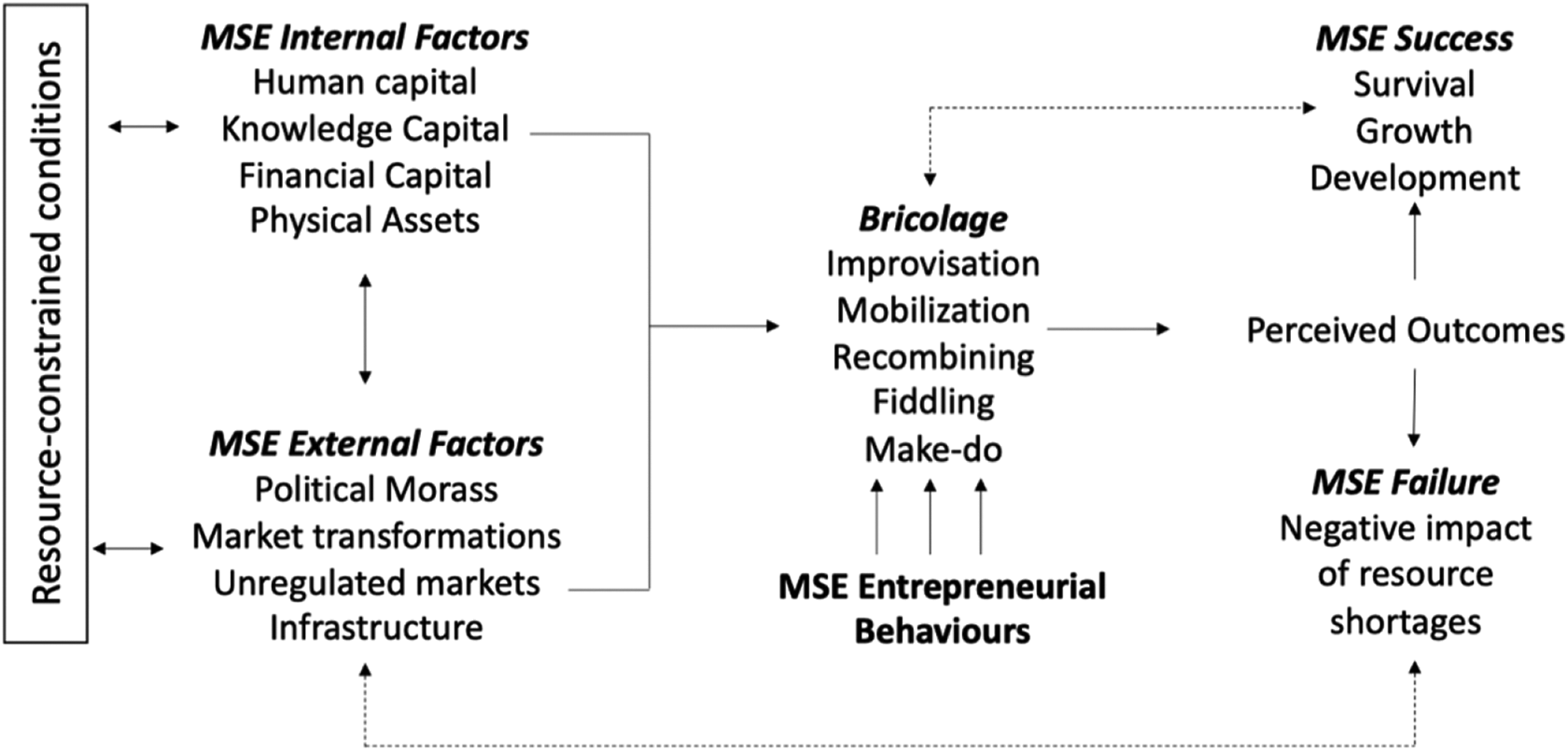
A deterministic model: MSEs and bricolage behaviour in emerging economies.
Theoretical implications
Academic scholars studying small business, enterprising organisations and resource-constrained environments stand to benefit from the fresh insights generated in this research concerning a way of mobilising resources in MSEs (Winkel et al., 2013) in emerging economies, but treated as a corporate strategic choice in MNEs in advanced economies. The use of bricolage in MSEs in emerging economies gives organisations, entrepreneurship and small business management scholars a point of comparison with respect to the way in which it is utilised in business. A key differentiating factor being that in advanced economies more established enterprises enjoy great latitude in their processes for collecting and utilising resources (Baker and Aldrich 2000; Duymedjian and Rüling, 2010). The reverse is true for MSEs in emerging economies because of their surroundings in which socio-economic and political factors often conspire to influence their actions. Thus, bricolage provides the framework for analysing ways in which resource-poor firms especially MSEs can produce something (Baron and Hmieleski, 2018).
Practical implications
For entrepreneurs in MSEs and business practitioners this review offers them applied and meaningful knowledge about how they can inexpensively enable their businesses to succeed, develop and grow in resource depleted environments by embracing bricolage (Guo et al., 2018). Furthermore, the review informs policy-makers about the need to establish entrepreneurship policies that enable the availability of key resources including, institutional support in the form of expertise, technical know-how, information and materials and financial, human and knowledge capital for small businesses to develop and grow. This is particularly important because emerging economies are often unregulated burdensome and frequently hampering small enterprise growth (World Bank, 2006).
Research limitations
The lack of breadth of studies focusing purely on bricolage in MSEs in emerging economies, meant that other search terms including penurious environments, bottom of-the-pyramid markets, and constraints in less-developed countries (LDCs) were added. Moreover, the lack of empirical evidence to support insights generated in this research can be a limitation. Perhaps, the theoretical insights we offer can inspire other scholars to undertake field work and empirically demonstrate how bricolage is a paradigm that can utilised to effectively explain entrepreneurship in emerging economies (Winkel et al., 2013).
Conclusions
A fundamental question this review set out to address concerned ways in which MSEs in emerging economies respond to the resource constraints in their indigent surroundings. The review demonstrated that bricolage is an unconscious act MSEs activate as a response mechanism to their penurious conditions. In comparison with the firms in advanced economies, the review showed that MSEs in emerging economies have limited latitude in the way they mobilise their often-depleted resources due to constraints inherent in their environment (Winkel et al., 2013). As such, there is no reason not to believe that entrepreneurs who own/manage small enterprises would utilise bricolage for mobilising resources. The scholarly works which were analysed in this review converged on the idea that bricolage and its associated constructs including ‘fiddling’, ‘make do’ improvisation are not strategic alternatives for MSEs but are behaviours/attitudes embedded in their business practice because of their resource indigent environments. Such insights meaningfully advance and develop the concept of bricolage as a practice in MSEs. By focusing the limelight on bricolage in MSEs the review contributes to entrepreneurship theory and practice in businesses.
This has practical and theoretical implications for academics, micro and small businesses and policy makers. Because of the vital role micro and small businesses perform in emerging economies understanding the factors militating their social world will be essential in terms of providing the resources they need for success, survival, development and growth.
Suggestions for future studies
Scholarship that examines micro and small enterprises active in resource penurious environments such as those found in emerging economies is very limited and yet these enterprises play a crucial economic role creating jobs for the vast majority of their citizens. Thus, empirical studies that pay attention on how MSEs function in environmental conditions with depleted resources, particularly in emerging economies, would further develop understanding about the ways in which they mobilise resource in such circumstances.
Footnotes
Declaration of conflicting interests
The author(s) declared no potential conflicts of interest with respect to the research, authorship, and/or publication of this article.
Funding
The author(s) received no financial support for the research, authorship, and/or publication of this article.
