



Abstract
Establishing and sustaining the legitimacy of new ventures is a complex endeavour for entrepreneurs. In this article, we draw insights on ecosystem and legitimacy theories, and we employ a fuzzy-set qualitative comparative analysis approach to study effective configurations of (technological and market) innovation newness influencing the new-venture legitimation strategy orientations of 228 startups in Finland. The results reveal that the startups operating in established markets (existing markets) with incremental technology (as essential [core] conditions) are likely to opt for conformance and selection legitimation strategies. However, a firm's radical technology has been revealed as a supplementary (peripheral) condition in this context. Furthermore, the results show that startups are likely to opt for a manipulation strategy when operating in new markets (as a core condition, with incremental technology as a peripheral condition). We further find that startups can opt for a creation strategy when operating in new markets with radical technology (as core conditions). We conclude by offering the implications of our findings and avenues for further research.
Introduction
Entrepreneurs thrive within an entrepreneurial ecosystem (EE), which consists of interconnected actors and resources that collaboratively enhance productive entrepreneurship (Stam and Van de Ven, 2021). These ecosystems are vital for resource allocation, providing the necessary support for ventures to grow and succeed (Lechner et al., 2022; Shi and Shi, 2022). By drawing insights from ecosystem and legitimacy theories and by selecting an ecosystem rich in networking opportunities (Malecki, 2018), new ventures can forge essential connections with peers, investors and industry experts (Goswami et al., 2018). Additionally, ecosystems offer crucial access to physical infrastructure, financial resources, formal institutions and skilled talent (Pittz, 2024; Spigel, 2017). A new venture cannot thrive in isolation; rather, it depends on a vibrant ecosystem that promotes collaboration, encourages innovation and supports efficient resource management (Lechner et al., 2022; Roundy and Burke-Smalley, 2022).
For entrepreneurs to have access to critical resources from the EE, their ventures must first be considered as legitimate in the eyes of different EE actors (investors, customers, governments and support agencies) (Kuratko et al., 2017; Lechner et al., 2022). Garnering legitimacy is, however, a complex process due to factors such as audience diversity, a lack of operating history and multiple legitimacy thresholds (Aldrich and Fiol, 1994; Fisher, 2020). Moreover, entrepreneurs and their new ventures typically face the challenge of establishing their credibility within and beyond existing EEs (Kansheba et al., 2024; Kuratko et al., 2017) since internal EE actors must first consider the venture as legitimate before disseminating information on the venture's legitimacy to external EE actors (Kuratko et al., 2017).
Thus, legitimacy becomes a crucial resource for entrepreneurs, and it also enables them to garner diverse resources from the EE for their (new) ventures (Acs et al., 2017; Kuratko et al., 2017). A new venture is legitimate when it is perceived by others as desirable and appropriate within a socially constructed system of norms, values, beliefs and definitions (Zimmerman and Zeitz, 2002). Earlier studies have underlined the prominence of new ventures to establish and maintain legitimacy to have access to critical entrepreneurial resources required for their survival and expansion (Fisher et al., 2017; Lechner et al., 2022). As Kuratko et al. (2017) argued, legitimacy helps entrepreneurs and their related ventures forge partnerships and strategic alliances with other actors within and beyond their existing EEs, thus contributing to their survival. Research has identified different legitimation strategies that entrepreneurs can use to legitimise their ventures. These include conforming to the rules and regulations guiding business operations, selecting EEs that are favourable for their operations, manipulating the EE to suit their operations and creating new contexts (new EEs) in which they can fit and operate (Zimmerman and Zeitz, 2002).
The rising interest in legitimacy research underscores its critical role in helping organisations navigate intricate environments (Beyhan et al., 2024). Scholars are calling for more studies on ecosystem legitimacy, which involves the shared acceptance among various actors within an ecosystem (Donaldson et al., 2024; Thomas and Ritala, 2022). This is particularly important for new ventures as they often encounter unique obstacles in establishing trust and securing recognition from stakeholders (Lechner et al., 2022; Poh et al., 2024; Spanuth and Urbano, 2024). Innovation plays a crucial role in addressing some of these challenges since ventures could leverage it to showcase their potential to meet important stakeholder needs.
Prior research argues that the new ventures benefit the most from innovation when they adopt strategies that enhance their legitimacy in the eyes of stakeholders (Rao et al., 2008). Research highlights innovation as a crucial means to create a sustainable competitive advantage and as a fundamental aspect of entrepreneurship (Johannessen et al., 2001). Newness on the other hand is an important aspect of innovation since it highlights the difference between innovation and change (Slappendel, 1996). With this regard, newness is particularly important in understanding the relationship between innovation and entrepreneurship and the combined role of innovation newness in new venture creation (Gartner, 1988; Gimenez-Fernandez et al., 2020; Lumpkin and Dess, 1996) and legitimacy acquisition (Kuratko et al., 2017). Scholars have considered innovation to be in terms of new products, new services, new production techniques, and entering new markets among others (Dahlqvist and Wiklund, 2012; Johannessen et al., 2001) and these different types of innovation can be categorised into incremental (McKnight and Zietsma, 2018) or radical innovation (Shkolnykova and Kudic, 2022). Innovation newness goes beyond novelty; it serves as a strategic tool that can be used by ventures to build trust, differentiate themselves and their offerings from competitors and align with the expectations of the EE. In addition, it is also crucial in crafting and implementing legitimation strategies, thus underscoring its importance in garnering and maintaining new venture legitimacy.
While new venture legitimacy has mainly been seen as a condition or characteristic that should be achieved through the legitimation process, it has less been studied extrinsically from the new venture within the EE through the perceptions of the EE actors. EE scholars have mainly raised the question about who is legitimate in the ecosystem through the lens of governance, yet more research should unravel the legitimation strategies in the EE (Lechner et al., 2022). Examining how different types of (venture) innovation newness and different legitimation strategies result in different levels of legitimacy diffusion in the EE is essential (Kuratko et al., 2017). Therefore, we aim to contribute towards filling this important research gap by asking the question: How does innovation newness influence new-venture legitimation strategy choices in the EE?
To address this gap, we extend the innovation newness and new-venture legitimation theorising by providing empirical validation. In this article, we employ a fuzzy-set qualitative comparative analysis (fsQCA) approach to study effective configurations of (technological and market) innovation newness influencing the new-venture legitimation strategy orientations of 228 startups in Finland. The results reveal that the startups operating in established markets (existing markets) with incremental technology (as essential [core] conditions) are likely to opt for conformance and selection legitimation strategies. However, a firm's radical technology has been revealed as a supplementary (peripheral) condition in this context. Furthermore, the results show that startups are likely to opt for a manipulation strategy when operating in new markets (as a core condition, with incremental technology as a peripheral condition). We further find that startups can opt for a creation strategy when operating in new markets with radical technology (as core conditions).
We ultimately make three contributions to the EE and venture legitimacy bodies of literature (Fisher, 2020; Lechner et al., 2022; Zimmerman and Zeitz, 2002). First, we contribute to the EE literature by highlighting the significance of venture legitimation selection in the EE in regard to benefiting from various available resources (Kuratko et al., 2017). We expand this research discussion by providing insights by not only asking who is legitimate in governing the ecosystem but also asking how legitimation strategies enable new venture legitimacy, providing an in-depth understanding of analysing and improving legitimacy within the EE context. Second, we contribute to the venture legitimacy literature by shifting the focus away from entrepreneurs’ individual to an ecosystem-level perspective by examining legitimacy diffusion in an EE (Beyhan et al., 2024; Donaldson et al., 2024; Spanuth and Urbano, 2024). Finally, our unique analytical approach highlights technological newness and market newness as typologies of innovation that influence the legitimation strategy that an entrepreneur may adopt in the EE, thus contributing significantly to the literature on the intersection of innovation and legitimation strategies in the EE context (Acs et al., 2017; Kuratko et al., 2017).
The rest of our paper proceeds as follows. In the second section, we highlight the role of EEs and their implications for new venture legitimacy. We also emphasise the interplay between technological and market innovation newness and how they inform new-venture legitimation strategy choices. The third section articulates the employed methods, while the fourth section documents the findings. We comprehensively discuss the findings in the fifth section before offering the conclusion and implications in the sixth section.
The theoretical framework
EEs and new-venture legitimacy
The EE has recently became popular among practitioners, policymakers and academia (Cavallo et al., 2019; Colombo et al., 2019; Ferreira et al., 2023); it has its roots in two lineages, namely regional development literature (especially industrial economics and economic geography literature) and strategy literature (Acs et al., 2017). Both lineages emerged from ecological thinking and provide new insights on the interdependence and interaction which exist between entrepreneurs aiming to create value in the communities in which they operate (Acs et al., 2017). We define the EE in this study as ‘combinations of social, political, economic and cultural elements within a region that support the development and growth of innovative startups and encourage nascent entrepreneurs and other actors to take the risks of starting, funding and otherwise assisting high-risk ventures’ (Spigel, 2017: 50).
Entrepreneurship and innovation research have increasingly embraced a community-based perspective (Chaudhary et al., 2024). The latter highlights how entrepreneurs leverage community engagement and the importance of embedded interdependence to access resources, mitigate uncertainties driving creative destruction and co-creation of innovative solutions. In EEs, the spotlight is on entrepreneurs, with an emphasis on entrepreneurship as a key output of the ecosystem (Acs et al., 2017; Stam and Van de Ven, 2021). The EE is characterised by the interrelation, interactions and cooperation of different stakeholders including agents, institutions, intermediaries and investors (Colombo et al., 2019; Steigertahl and Mauer, 2023). Moreover, these ecosystems highlight the importance of entrepreneurial knowledge in addition to technical and market insights (Spigel and Harrison, 2018). Conversely, the innovation ecosystem primarily focuses on value creation (Gomes et al., 2018; Granstrand and Holgersson, 2020). In this context, firms collaborate to combine their offerings into a unified, customer-centric solution (Adner, 2006). Larger companies tend to play a dominant role in this ecosystem, acting as the orchestrators of the collaborative process (Shen et al., 2024). This interconnected approach facilitates knowledge spillovers and collective problem-solving and enhances adaptive capacity within the ecosystem. By embedding innovation within social networks, entrepreneurs can accelerate the diffusion of new ideas and drive sustained ecosystem evolution (Theodoraki, 2024).
The EE is considered as a conducive environment for entrepreneurs and their ventures (Buratti et al., 2023; Malecki, 2018). In this regard, research has identified and categorised different elements or components of the EE into framework and systemic conditions whose continuous interactions result in productive entrepreneurship (Stam, 2015; Stam and Van de Ven, 2021). The framework conditions are the formal and informal institutions and physical factors that enable or constrain human interaction in general and entrepreneurial action in particular. These conditions impact on both entrepreneurial activities and the demand for new value (products and services) within a specific entrepreneurial environment. The systemic conditions, on the other hand, emphasise the relationships within the EE and how the different elements of the EE interact and support one another in order to create a self-sustaining and vibrant entrepreneurial environment. They are constrained or enabled by the framework conditions (Stam, 2015). However, we emphasise that both conditions are crucial for a well-functioning EE. Additionally, the framework conditions of the EE include cultural support, demand and formal institutions. Cultural support relates to the formal and informal institutions that guide business activities across regions (Spigel, 2013). Demand revolves around the availability of markets for the goods and services that entrepreneurs have to offer within the EE. Physical infrastructure involves the presence of road networks, buildings and other visible structures which can support entrepreneurs (Audretsch and Belitski, 2017). Formal institutions are the rules and regulations that guide the operations of businesses with the EE (Gomes et al., 2023; Roundy and Bayer, 2019).
The systemic conditions that are considered to be at the heart of the EE include networks, leadership, finance, talent and support institutions (Stam, 2015). The networks facilitate the exchange of information and other resources between entrepreneurs, while leadership provides guidance to entrepreneurs within the EE (Scott et al., 2021; Stam, 2015). The presence of financial institutions that provide funds and talented individuals within the EE also facilitate the exchange of invaluable ideas, resulting in a well-functioning EE (Stam and Van de Ven, 2021). Moreover, support institutions within the EE such intermediaries reduce entry barriers, thus facilitating the establishment of new ventures within the EE (Goswami et al., 2018; Hernández-Chea et al., 2021).
As prior research posits, EEs provide supportive environments for new ventures by offering access to various resources, such as social capital, financial, production and technological resources (Cao and Shi, 2021; Spigel, 2017), which in turn foster their legitimacy (Nicotra et al., 2018). Moreover, research opines that new ventures will struggle to acquire critical resources from the EE if they are not legitimate in the eyes of EE stakeholders (Kansheba et al., 2024; Lechner et al., 2022). As such, the acquisition of EE resources by new ventures is primarily dependent on their legitimacy in the eyes of EE stakeholders. In this article we define legitimacy as a ‘generalised perception or assumption that the actions of an entity are desirable, proper or appropriate within some socially constructed system of norms, values, beliefs and definitions’ (Suchman, 1995: 574).
Gaining legitimacy can be challenging for new ventures as they often lack established firms’ reputations and track records (Chen et al., 2022; Zuo et al., 2022). Moreover, they always need to be approved by various stakeholders within/beyond existing EEs before becoming legitimate (Kansheba et al., 2024; Kuratko et al., 2017). Consequently, this makes the legitimation process gradual, complex and dynamic. Furthermore, apart from establishing legitimacy, the most critical issue is its maintenance over time (Fisher, 2020). New ventures need to establish themselves as legitimate and credible entities within the industries or markets in which they operate in order to overcome the liability of newness. This includes gaining legitimacy from other members of the EE, such as customers, suppliers, partners and investors (de Lange and Valliere, 2020). Entrepreneurs who legitimise their new ventures are more likely to have access to the critical resources they need to grow and survive (Fisher et al., 2017; Kuratko et al., 2017; Lechner et al., 2022; Taeuscher et al., 2021).
EEs provide a platform for new ventures to connect with potential partners, customers, investors, funders and other stakeholders (Acs et al., 2017; Stam, 2015). In doing so, they gain exposure and build relationships that can be valuable for their future growth (Audretsch and Belitski, 2017; Ratten, 2020; Spigel, 2017). These relationships can help the new ventures gain legitimacy within the EE by providing access to resources, networks and knowledge that can be difficult for a new venture to acquire on its own (Kuratko et al., 2017; Stam and Van de Ven, 2021). Furthermore, by being part of the EE, new ventures can align themselves with the existing norms, rules and expectations, which can help them gain legitimacy among other actors within the ecosystem.
Venture innovation newness
Past research (e.g., Benner and Tushman, 2003; Krizaj et al., 2014; Kuratko et al., 2017; Ma et al., 2015; Zhou et al., 2005) describe innovation newness to encompasses both market newness and technological newness, highlighting how new markets, goods, methods and structures drive entrepreneurial opportunities. Market newness refers to the degree to which a product or service is new to the market, potentially creating new demand or tapping into untapped customer segments (Garrett et al., 2009). It enables firms to proactively create novel product-market arenas, often securing first-mover advantages (Mueller et al., 2012). Concurrently, technological newness fosters differentiation through groundbreaking advancements, solidifying firms’ innovation leadership (Eckhardt and Shane, 2011; Lee et al., 2024). It further involves the application of novel technologies or processes that significantly differentiate the offering from existing solutions (Cheng et al., 2013; Krizaj et al., 2014). Researchers document that consumer perceptions of these dimensions greatly influence product adoption, necessitating nuanced communication strategies (Ma et al., 2015; Niu et al., 2023). Thus, recognising and integrating these facets into new venture legitimation strategies is vital for fostering venture adaptability and long-term growth (Geissinger et al., 2021; Liang et al., 2024).
Scholars have categorised technological newness into incremental innovation and radical innovation, both of which explain the different levels of novelty and newness in firms’ innovative activities in EEs (Ding and Ding, 2022; Sheng and Chien, 2016). Incremental innovations are minor changes in existing technology, simple product improvements or minimally altering an existing market category (McKnight and Zietsma, 2018). Incremental innovation also depicts innovations that represent gradual or minimal changes in existing firm practices (Damanpour, 1996). Moreover, incremental innovation could be ideas and practices that are new to a firm, but which exist or have been used already by other firms (Hurmelinna-Laukkanen et al., 2008; Johannessen et al., 2001). Research indicates that complexity and knowledge depth are less important for incremental innovation because it requires less knowledge resources from the organisation for its development (Al-Khatib and Al-ghanem, 2022; Dewar and Dutton, 1986). Because incremental innovation involves minimal or minor changes that take place within the organisation, these changes can be facilitated by mere exposure to innovative ideas from other organisations.
Radical innovation, on the other hand, represents new techniques or a complex combination of already existing knowledge (Shkolnykova and Kudic, 2022). Radical innovation also characterises innovations that bring about fundamental changes in various activities of the firm and represents large or clear departures from existing firm practices (Damanpour, 1996; Hurmelinna-Laukkanen et al., 2008). It can be ideas or practices that are completely novel to the industry or sector. Radical innovation ideas may exist and circulate in the EE. However, few of these ideas will be adopted by firms. Moreover, unless an organisation has the internal knowledge resources to interpret and implement these ideas, it will not be able to innovate (Al-Khatib and Al-ghanem, 2022; Dewar and Dutton, 1986). The major difference between incremental and radical innovation is the degree of novel technological process and the new knowledge that are embedded in the innovation (Dewar and Dutton, 1986).
Market newness refers to efforts by firms to establish a new market arena in which to attract new customers to a product or services (Feng et al., 2018; Zhou et al., 2005). It also refers to new attributes and features that address unfulfilled customer needs and demands in an emerging market, making it easier for customers to adopt new products or services (Jin et al., 2019). Thus, market newness can be categorised into established markets (existing markets) and new markets. We note that an existing market may be a new market for other firms, while new markets may be existing markets for other firms. Moreover, markets can be viewed as being divided into sub-markets. Research suggests that the newness created in a specific (new) market may not be new to the actor generating the newness (Dahlqvist and Wiklund, 2012; Feng et al., 2018). In other words, a firm's expansion into an existing local market where a business concept, though existing elsewhere, is not yet present can be considered as entering a new market. Moreover, introducing an existing product or service into a local market can drive market development within that setting, and this can even be viewed as an innovation. Therefore, market newness should be viewed from the market's perspective since there are many markets that are not global or homogenous; a new product or service in an existing market may be viewed as an existing product, while in another, new market it may be seen as a new product.
Innovation newness – technological and market newness – is, therefore, essential to a company's success as it allows them to stay ahead of the competition and attract new customers (Donbesuur et al., 2022). Companies that can innovate and differentiate their product offerings from those of their competitors can gain a competitive advantage in the market (Gui et al., 2022; Hurmelinna-Laukkanen et al., 2008). Thus, empirically exploring how such forms of innovation newness inform new ventures’ legitimation efforts would provide invaluable insights for academia, policy and practitioners (Kuratko et al., 2017).
New-venture legitimation strategies
Previous research suggested that new ventures can acquire legitimacy by selecting specific strategies – such as conformance, selection, manipulation and creation – depending on the level of (technological and market) innovation newness (Kuratko et al., 2017; Zimmerman and Zeitz, 2002). For example, if the market or industry is highly innovative, a new venture may choose a manipulation or creation strategy in order to differentiate itself and establish its unique identity within the ecosystem. On the other hand, if the market or industry is less innovative, a new venture may choose to adopt a strategy of conformance or selection in order to align itself with established norms and gain acceptance from other stakeholders in the ecosystem.
A conformance strategy is the strategy most used by new ventures, indicating that the firms follow established rules, norms, scripts, values and models in the ecosystem (Zimmerman and Zeitz, 2002). This legitimation strategy is considered the easiest as entrepreneurs change nothing in an EE (Kuratko et al., 2017). A conformance strategy allows entrepreneurs to gain legitimacy with minimal investment, especially when the technology is incremental and entering an existing market. This is because a new venture can gain acceptance and credibility within the EE by meeting the stakeholders’ expectations (Kansheba et al., 2024).
On the other hand, the term selection legitimation strategy refers to a process by which new ventures use the endorsement or acceptance of key stakeholders – such as investors, customers or industry experts – to gain legitimacy within an ecosystem (Donbesuur et al., 2022; Zimmerman and Zeitz, 2002). This can be especially important for new ventures entering an existing market with a radical technology as the stakeholders in that market may be sceptical of or unfamiliar with the new technology. By gaining the endorsement of key stakeholders, the new venture can demonstrate that its technology is viable and worthy of attention and thus gain a foothold in the market.
According to Zimmerman and Zeitz (2002), when new firms enter a market with incremental technology, they will likely use a manipulation strategy. This strategy involves changing the existing norms, values, rules or models in the market to create a more favourable environment for the new firm's products or services. It involves deliberately manipulating the features and context of the EE to gain an advantage. A manipulation strategy involves presenting the new venture or its technology, emphasising its unique or differentiated features and benefits. This can help the new venture stand out and differentiate itself from existing players in the market.
Moreover, creation is a strategy that involves creating a new environment that is advantageous to the new venture. This strategy is most effective when the new venture has enough resources and expertise to create a favourable new environment for its goals (Shkolnykova and Kudic, 2022). By creating a new environment, the new venture can gain legitimacy and build relationships with stakeholders in order to help it succeed. For example, a new venture may create a new market by introducing a product or service that is not currently offered. It may also create a new brand identity or business model. Additionally, a new venture may recreate a process or system to suit its goals better.
The interplay between innovation newness and legitimation strategies choices: A complexity perspective
Understanding the interplay between innovation newness and legitimation strategies in EEs necessitates a configurational approach that recognises the complexity and non-linearity inherent in such environments. According to Woodside (2014), the complexity theory underlines the interrelatedness and the emergent properties of systems. Accordingly, such complexity in EEs becomes more pronounced when ventures serve multiple markets, each with distinct levels of technological innovation. This viewpoint challenges the linear models of strategic choice proposed in prior studies, necessitating a configurational approach in order to understand the conditions influencing venture legitimation strategy choices. As also pointed out by Miller (2018), this complexity is further associated with the interdependent nature of the relationship between innovation newness and market diversity. We argue that a single-strategy approach is insufficient in such a multifaceted context.
Therefore, we propose that an fsQCA approach is particularly appropriate for exploring various possible configurations as multiple pathways to new venture legitimacy (Fisher, 2020). This approach goes beyond the traditional linear models, offering a richer understanding of how different combinations of market contexts and innovation levels interact, influencing strategic choices in venture legitimation. The fsQCA's principles of equifinality, multiple conjunctural causation and asymmetry (Pappas and Woodside, 2021; Wang et al., 2023) make it particularly suitable for understanding the studied phenomenon in a complex environment (systems) such EEs. While the equifinality principle entails the possibility of multiple pathways to an outcome (the legitimation strategy choices in our case), the conjunctural causation emphasises the combination (rather than isolation) fashion of those conditions. We posit that the different configurations of technological and market innovation newness can lead to different, yet equally effective, legitimation strategies.
The interplay between technological and market newness exemplifies these features. Incremental or radical innovation alone may not dictate a venture's choice of legitimation strategy. However, when combined with market innovation, these conditions create unique configurations that lead to specific strategic choices. For instance, in serving diverse markets, a new venture might simultaneously employ incremental innovation in a mature (existing/established) market while introducing radical innovation in an emerging one. Zimmerman and Zeitz (2002) further argued that this duality complicates the legitimacy-building process as each market may require different approaches to legitimation. Accordingly, incremental innovations in established markets might favour conformance strategies, aligning with existing norms to gain legitimacy (McKnight and Zietsma, 2018). Conversely, radical innovations in new markets could necessitate creation strategies, establishing new norms and actively shaping market expectations (Kuratko et al., 2017). Our conceptual framework is shown in Figure 1.
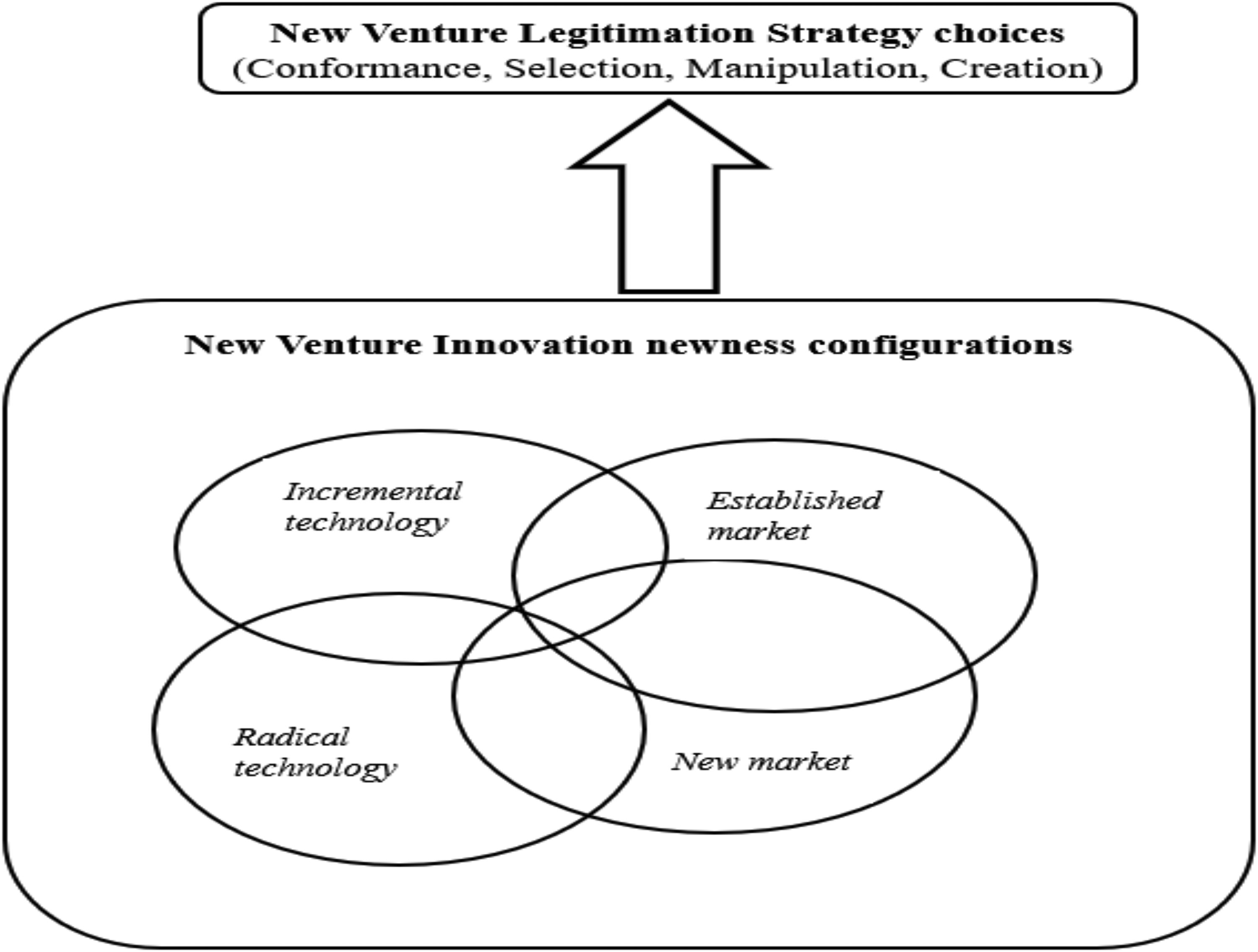
Venn conceptual framework.
Methods
The research setting
The Finnish startup ecosystem is one of Europe's most vibrant and innovative. The country has a strong network of accelerators and investors that are actively supporting the growth of startups. Based on the Ministry of Economic Affairs and Employment of Finland (MEAEF, 2023), the Finnish government has also created numerous initiatives to encourage the growth of startups in the country. As a result, the Finnish startup ecosystem is expected to continue to grow and thrive in the coming years. Each of these ecosystems has a different emphasis on particular industries and different strategies for promoting and supporting startups and entrepreneurs. Business Helsinki, for example, has a strong focus on technology and innovation, while Business Tampere has a strong focus on digitalisation and Industry 4.0.
The most notable ecosystems in Finland are Business Helsinki, Business Espoo, Business Tampere, Business Turku and Business Oulu. The Finnish ecosystem is home to over 3000 startups, with more than half located in the Helsinki region (Müller, 2022). Early-stage funding in the Helsinki metropolitan area amounted to €886 million, while the global average was estimated to be €641 million by 2022 (Startup Genome, 2022). The Espoo and Tampere startup ecosystems are the second and third largest in Finland. Both Espoo and Tampere have more than 300 startup companies from various industries (see, e.g. Business Tampere). Oulu is one of the central business hubs in Finland and has more than 300 startups. Similarly, the Turku region is also a business hub and home to more than 100 companies (Business Oulu, 2024).
Sample and data collection
We relied on a publicly available database of Finnish startups where a non-probability sampling process resulted in the selection of 1000 startups. We first collected these startups’ contact details (the email addresses of persons from top management) by visiting their official websites. A total of 1000 questionnaires were sent to these startups via email. In order to encourage a high response rate, respondents were given crucial insights about the study and the nature of the information needed. This was done by revealing the purpose of the study, the benefits of participation and the fact that the information given would be treated with high confidentiality. After three rounds of response follow-ups (reminders), 360 questionnaires were retrieved. The data cleaning process led to the elimination of 132 of these questionnaires due to incompleteness (unfilled or partially filled questionnaires) and straight-lining problems (where respondents provide similar answers to 10 or more consecutive items, including items from different multiple-item constructs) (Shneor and Munim, 2019). Thus, only 228 questionnaires (22.8%) were retained for subsequent data analyses.
Constructs and their assessment
We operationalised our studied constructs using multiple measurement items developed from prior studies (see Table 1 below) and slightly conceptually adjusted them to fit the studied context. We used five-point Likert scales due to their suitability for capturing respondents’ perceptions. We first performed the exploratory factor analysis, which led to eliminating some items that did not load sufficiently to the respective constructs. Thus, we retained items with significant factor loadings of 0.7 and above (Kansheba et al., 2023). We then checked whether the data met the convergent and discriminant validity criteria. All the constructs were reliable based on their Cronbach alpha and composite reliability values of 0.7 and above. The average variance extracted (AVE) also exceeded the cut-off point of 0.5, confirming their validity. The AVE was greater than the squared correlation between the latent constructs, which confirms discriminant validity. Moreover, the confirmatory factor analysis results still suggested that the revealed factors match our prior conceptualisation, based on their accepted fit indices. Supplemental Appendix 1 provides the validity and reliability results.
Variable operationalisation.
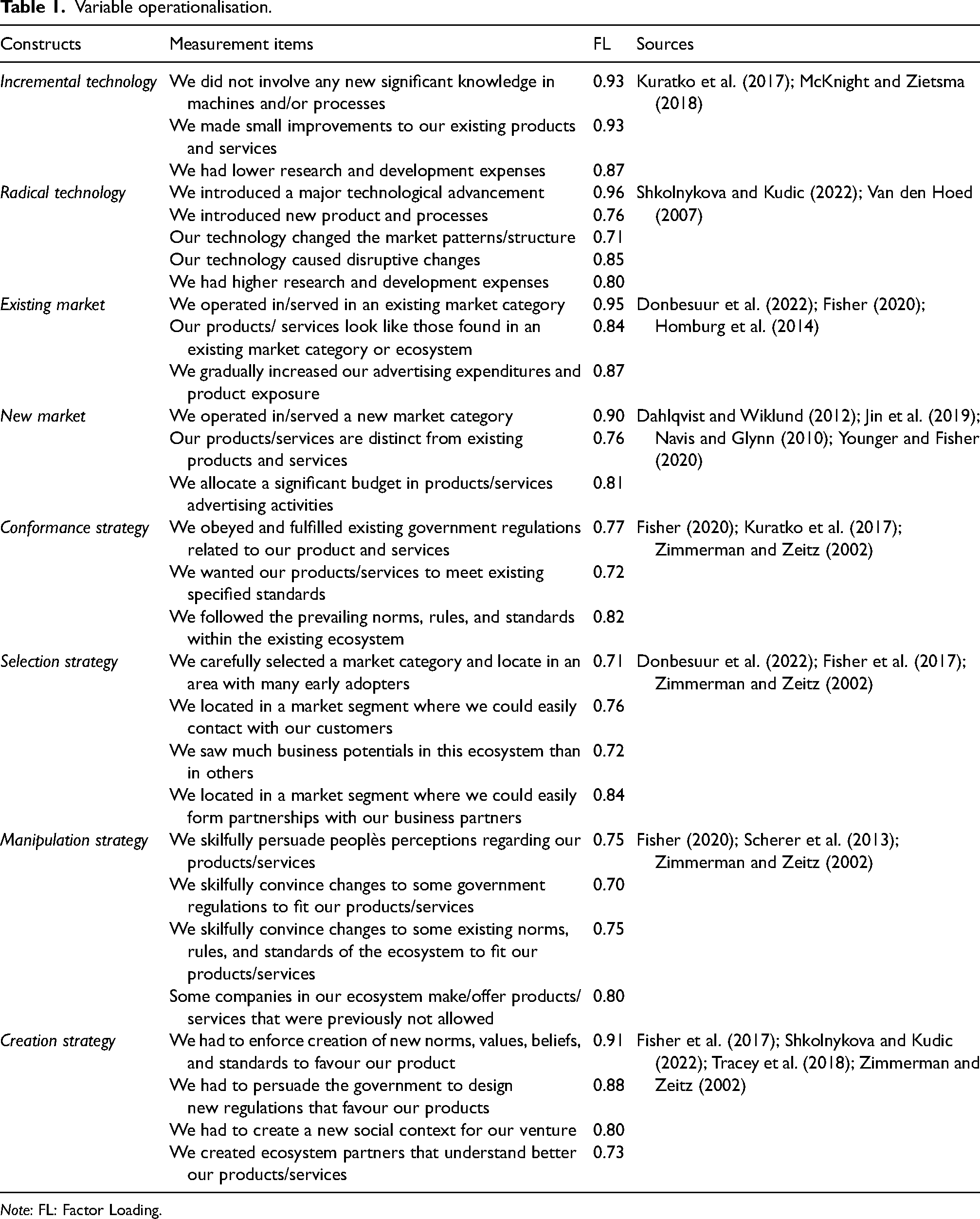
Note: FL: Factor Loading.
The non-response bias and common method bias check
We checked for non-response bias problems by performing a wave analysis, following the work of Shneor and Munim (2019). We divided our sample into two sub-samples consisting of the first 114 respondents and the last 114 respondents. Thereafter, the mean differences of the selected demographic variables were tested, and no statistically significant mean difference was reported among the sub-samples (see Supplemental Appendix 2). This confirms the absence of severe non-response bias in our studied sample. A common method bias was also checked using Herman's single factor and common latent factor tests. The created single factor explains that about 3% of the variation is clearly below the threshold of 50%. After that, a common latent factor was added to the original confirmatory factor analysis model. The added common latent factor was uncorrelated with other latent factors and fixed equal factor loading of all the measurement items of the common factor. The value of the equal factor loading (0.06) suggests that the common factor explained about 0.0036 of the variances, which is below the recommended threshold of 0.5, thus confirming the absence of a common method bias problem (Rialti et al., 2019).
Data analysis
We analysed our data using a fsQCA method. Its advantage is that one can learn all the theoretically viable conditions that could be combined to achieve the same result (Wang et al., 2023). Its emphasis rests on the fact that the influence on a given outcome depends on the possible combinations of attributes or conditions rather than individual (stand-alone) attributes/conditions. Thus, the fsQCA considers the equifinality or the several approaches that could lead to arriving at a specific result. We first transformed the raw data into fuzzy-set responses. The fsQCA requires the values of all variables to be recalibrated with values between 0 and 1. However, as cautioned by Ragin et al. (2008), precisely 1 and 0 membership thresholds (breakpoints) can result in positive and negative infinity, respectively, for the log of odds. Therefore, instead of using the 0 and 1 membership scores range, we followed the suggestions of Pappas and Woodside (2021) and considered 0.05, 0.5 and 0.95 as thresholds (breakpoints) for data calibration. The first value (0.05) considers an observation entirely outside the set (non-membership). The second value (0.50) assumes a midpoint, neither inside nor outside the set (the crossover point). Finally, the third value (0.95) considers the observation entirely inside the set (full membership). Similar thresholds have been utilised by other studies (e.g. González-Serrano et al., 2021; Wang et al., 2023).
We used the 5%, 50% and 95% percentile computation to determine which values in their dataset correspond to the 0.05, 0.5 and 0.95 thresholds (see Table 1). Thus, we employed these values as the three breakpoints for data calibration in the fsQCA software. After data calibration, we performed the necessity and sufficiency tests to evaluate the effect of the different conditions (the variables) on the legitimation strategy choices (the selections). We first performed a necessity test. Kraus et al. (2018) further pointed out that a condition is necessary when it must always be present in the occurrence of a particular outcome. Thus, consistency, in this case, denotes how well the condition can forecast a particular result. According to González-Serrano et al. (2021), for a condition to be considered necessary, its value should be ≥0.90. We then performed the sufficiency analysis of the conditions. Although other combinations of conditions can also lead to a particular outcome, a sufficiency condition expresses a set of conditions that can result in that particular outcome.
In calculating the sufficiency conditions, the fsQCA consists of two stages (Wang et al., 2023). First, a truth table algorithm transforms the scores in a fuzzy data set into a truth table that lists all the logically possible combinations of causal conditions and the empirical result of each configuration. As suggested by prior studies (e.g. Ragin, 2008; Wang et al., 2023; Kansheba et al., 2024), to balance inclusivity and rigour and allow for meaningful (robust) conclusions from our data, we set the frequency threshold of 3 and a consistency threshold above 0.90 in the truth tables in both strategies. A frequency threshold of three ensures that configurations with minimal empirical relevance are excluded, which allows for focusing on common and reliable patterns. Additionally, a consistency threshold above 0.90 ensures high empirical accuracy, indicating a strong alignment between the identified configurations and the outcome.
Second, fsQCA produces three possible solutions: complex, parsimonious and intermediate solutions. The complex solution provides all the possible combinations (configurations) of the conditions, and then traditional logical operations are applied. However, due to its complexity, arising from the many configurations (solutions), interpretations become impractical (Pappas and Woodside, 2021). Thus, the complex solutions are further simplified into parsimonious and intermediate solution/configurational sets.
The parsimonious solution presents the most important ‘core’ conditions that cannot be left out of any configuration. Unlike a complex solution, a parsimonious solution includes any counterfactual combination for logical and simplified configurations. The intermediate solution is generated by performing counterfactual analysis of the complex and parsimonious solutions, only including theoretically plausible counterfactuals (Pappas and Woodside, 2021). The conditions eliminated in the parsimonious solution and only appearing in the intermediate solution are referred to as ‘peripheral conditions’ (Wang et al., 2023). Therefore, merging the parsimonious and intermediate solutions offers a more detailed and aggregated view of the findings (Wang et al., 2023). Thus, we highlighted the intermediate solution by identifying the ‘core’ conditions (those appearing in both parsimonious and intermediate solutions) and peripheral conditions (those that only appear in the intermediate solution).
Finally, it is worth mentioning the critical advantage of fsQCA over conventional variance-based approaches such as linear multivariate analysis, cluster analysis, analysis of variance (ANOVA) and multivariate ANOVA (MANOVA). While computing the net effect between the variables in a model, variance-based approaches often evaluate variables in a competitive environment (focusing on the effect of individual variables). In contrast, fsQCA focuses on the intricate and asymmetric relationships between the outcome of interest and its antecedents/conditions (González-Serrano et al., 2021). Consequently, fsQCA is popularised as an adequate tool for understanding complex social phenomena, such as EEs (Kraus et al., 2018). We used fsQCA 3.0 software to perform these configurational analyses.
Results
Descriptive statistics
Table 2 provides the descriptive results of the studied sample. Regarding the respondents’ positions, the majority (about 67%) were business owners, and the rest were managers. We specifically targeted these two respondent categories as we believe they possess adequate knowledge and understanding of the dynamics of their businesses. Furthermore, they had an average of 17 years of (entrepreneurial) business experience. Moreover, 71% were male-owned businesses, while 21% were female-owned businesses. Regarding age, the majority had an average age of 48 years old. About 94% of the respondents reported having attended higher education institutions, while the remaining 6% attended tertiary education institutions (vocational training or college). The majority of businesses had an average age of 12 years old, with an average number of 33 employees. The businesses were clustered between health (24%), information technology (26%), hospitality (23%) and construction (18%), while a few were in the financial services industry (9%).
Descriptive statistics.
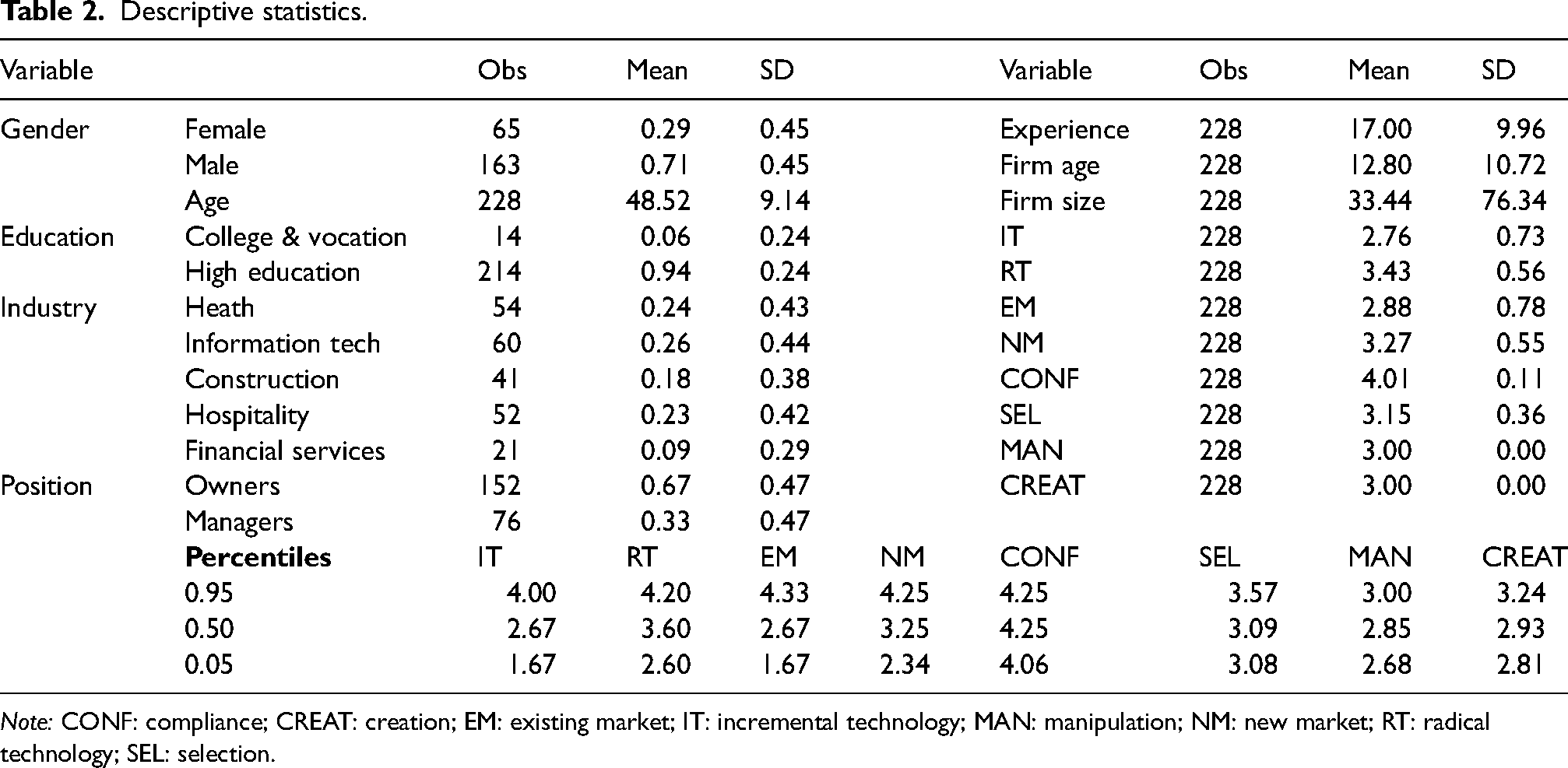
Note: CONF: compliance; CREAT: creation; EM: existing market; IT: incremental technology; MAN: manipulation; NM: new market; RT: radical technology; SEL: selection.
Necessary and sufficiency conditions for legitimation strategy (selection) choices
We further examined necessary and sufficiency conditions for a new-venture legitimation strategy choice (or new-venture legitimation strategy choices). The results displayed in Table 3 show that no necessary conditions were found as none of the legitimation strategies had conditions with a consistency that exceed 0.90, as recommended by prior studies (González-Serrano et al., 2021).
Necessary conditions for new venture legitimation strategy choice(s).
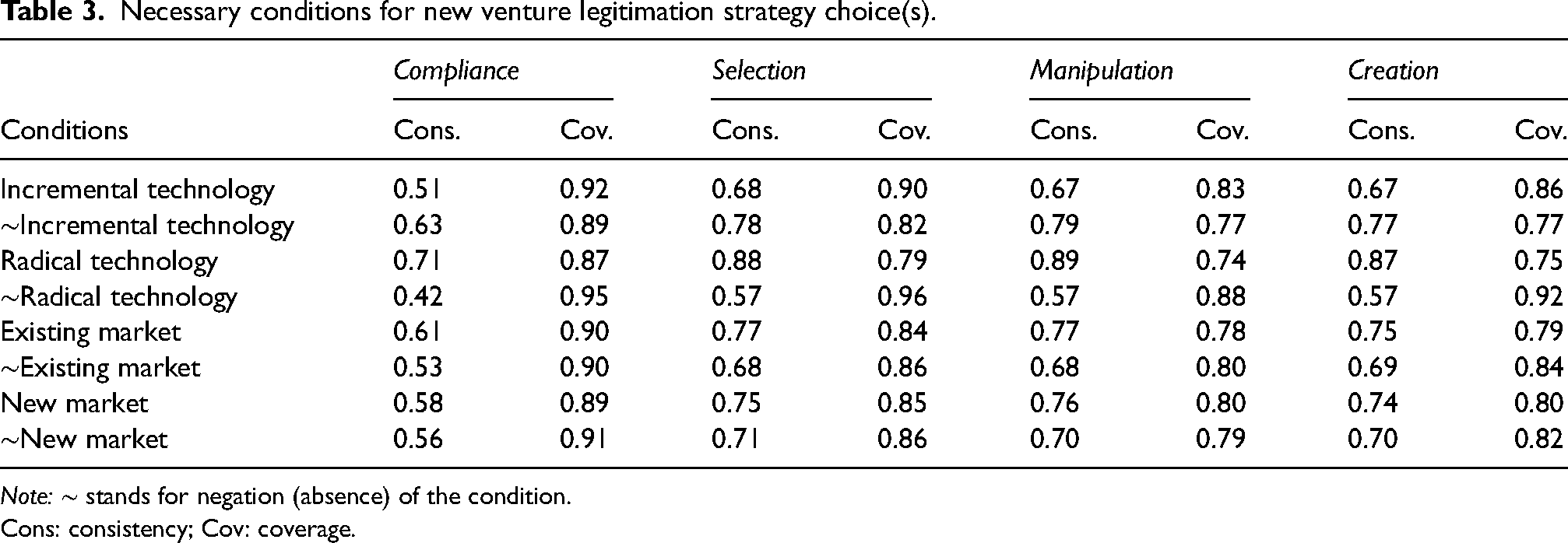
Note: ∼ stands for negation (absence) of the condition.
Cons: consistency; Cov: coverage.
Furthermore, the results shown in Tables 4 and 5 confirm that the fsQCA model, as a whole, is adequate, informative and valid as under all the strategies, the overall configurational (solution) consistencies were above 0.80 (Wang et al., 2023). Specifically, the results entail that all the identified configurations are sufficient for explaining new-venture legitimation strategy choices. Moreover, the frequency thresholds in the truth tables for both strategies were set at 3, while the consistency thresholds were set above 0.90 (see Supplemental Appendix 6).
fsQCA results – configurations for venture newness and legitimation strategy choice.
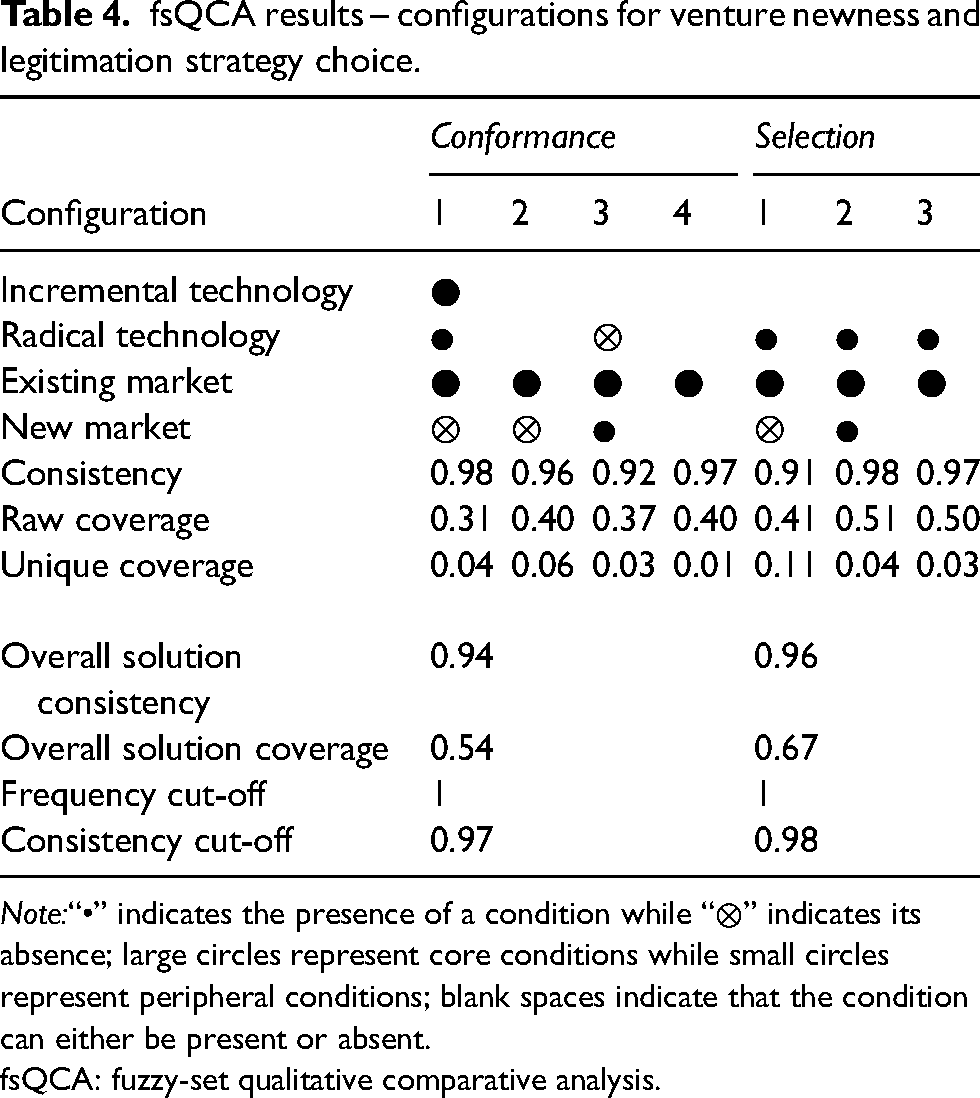
Note:“•” indicates the presence of a condition while “⊗” indicates its absence; large circles represent core conditions while small circles represent peripheral conditions; blank spaces indicate that the condition can either be present or absent.
fsQCA: fuzzy-set qualitative comparative analysis.
fsQCA results – configurations for venture newness and legitimation strategy choice.
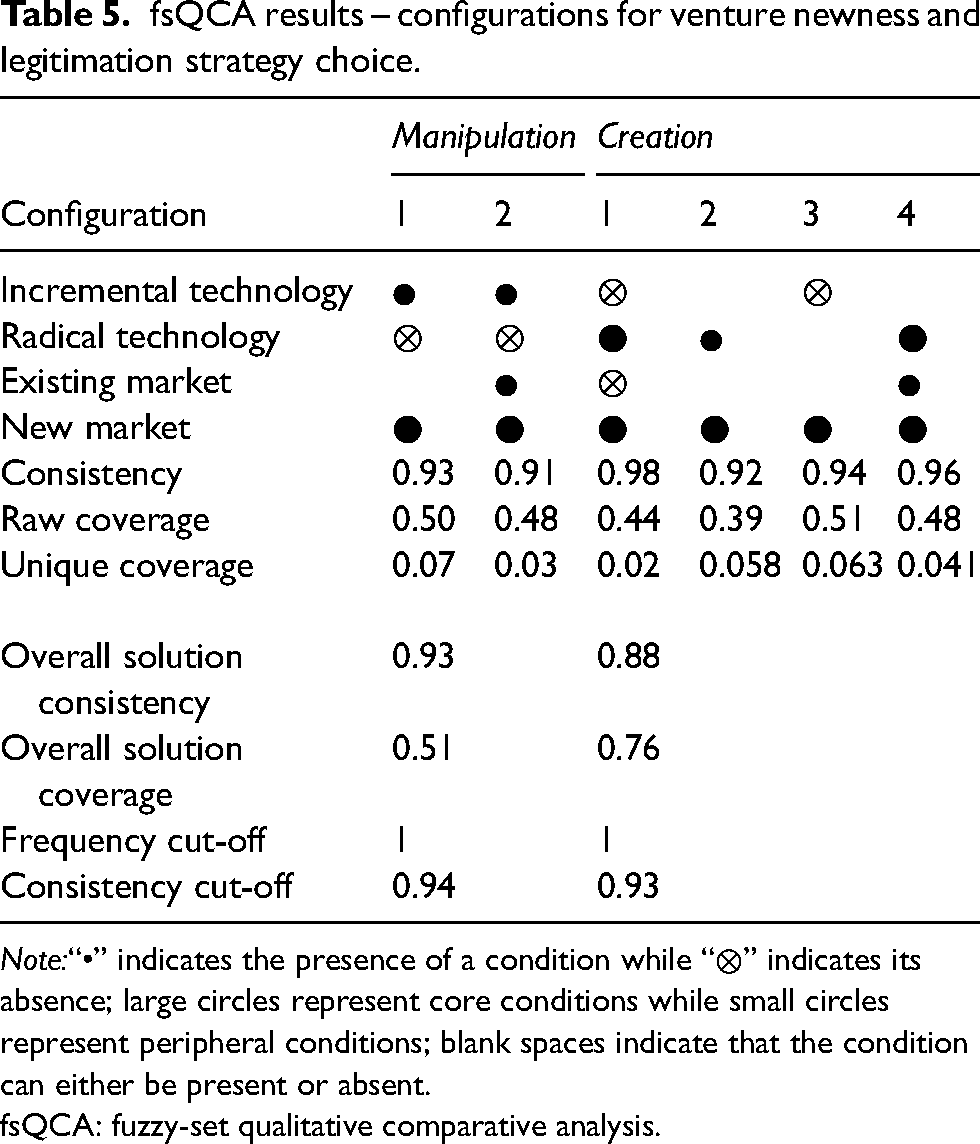
Note:“•” indicates the presence of a condition while “⊗” indicates its absence; large circles represent core conditions while small circles represent peripheral conditions; blank spaces indicate that the condition can either be present or absent.
fsQCA: fuzzy-set qualitative comparative analysis.
The identification of effective configurations for legitimation strategy (selection) choices
We found various configurations that can explain (induce) legitimation strategy choices for new ventures, as shown in Tables 4 and 5. Our results reveal four configurations (solutions) for a conformance strategy with an overall (explanatory power) consistency of 94%. Operating in an existing market (an established market) has been revealed as a necessary (core) condition for making a conformance strategy choice under all four configurations. In addition to operating in an established market, a new venture is likely to opt for a conformance strategy if it utilises an incremental technology (a core condition) and a radical technology (a supplementary/peripheral condition) as per most explained configurations, 1 and 4 (with 0.98 and 0.97 consistency, respectively). Furthermore, configuration 3 (with 0.92 consistency) reveals the chance that the new ventures may opt for a conformance strategy when operating in a new market (a peripheral condition) with the presence or absence of incremental technology. Configuration 2 (with 0.96 consistency) shows that a new venture can still opt for a conformance strategy when operating in an existing market (an established market) with or without incremental and radical technologies.
The results displayed in Table 4 further show three configurations with an overall explanatory power (consistency) of 0.96 for the likelihood of new ventures choosing a selection strategy. The results under all three configurations show that a new venture is likely to opt for a selection strategy when operating in an existing market (an established market) with radical technology. Specifically, operating in an existing market (an established market) has been identified as an essential condition (a core condition), while the utilisation of radical technology is identified as a supplementary condition (a peripheral condition). The results further show the non-necessity (absence) of incremental technology and new market conditions in regard to influencing the new venture selection strategy choice.
The results displayed in Table 5 show two possible configurations explaining (0.93) the chance of new ventures utilising a manipulation strategy. Both configurations provide a more likely similar conclusion that new ventures can embark on a manipulation strategy when operating in new markets (as a core condition) with incremental technology (as a peripheral condition). Configurations 1 and 2 further show the total absence of the influence of radical technology on a manipulation strategy choice. These results do not support the prior argument that necessitated new ventures opting for a manipulation strategy in order to engage radical technology in their operations. The results under both configurations for a manipulation strategy also show that, in addition to incremental technology, a new venture may still opt for this strategy when operating in an existing market (an established market) (also as a peripheral condition). Regarding a creation strategy, our results reveal four possible configurations with an overall explanatory power of 0.88. Operating in a new market has been identified as a crucial condition (a core condition) under all configurations with operating in an existing market being a supplementary condition (a peripheral condition). In addition to this, other conditions are the presence of radical technology, which is identified as a core condition under configurations 1 and 4 and as a peripheral condition under configuration 2. Incremental technology has been identified as peripheral (partially) absent (configurations 1 and 3), but either present or absent under configurations 2 and 4.
Robustness checks
To assess the robustness of the fsQCA, we first bootstrapped our original sample (using Stata software) with 228 to 500 data points (Kansheba et al., 2023). Then, following Wang et al. (2023), we reperformed the fsQCAs by setting a new mid-(crossover)calibration point from the 50th to 55th percentile. We also edited the truth tables with a raised frequency cut-off point ranging from 3 to 5. We maintained the original consistency threshold between 0.93 and 0.98 as we considered this sufficient (Pappas and Woodside, 2021). Despite slight (insignificant) changes in overall solution consistencies, the new configurations did not deviate from the original ones. They thus concluded that our findings are robust (see Supplemental Appendices 9 and 10).
Discussion
Extant studies have documented different strategies for attaining new ventures’ legitimacy (Elfring et al., 2021; Kuratko et al., 2017; Zimmerman and Zeitz, 2002), while having at least a partial understanding of these strategies and how they may be amplified based on the specificities of the context in general and in the entrepreneurial ecosystem in particular (Lechner et al., 2022; Thomas and Ritala, 2022). Although there is still a knowledge gap regarding when these strategies can be applied within and beyond existing EEs (Kansheba et al., 2024; Kuratko et al., 2017). The EEs’ centric focus is to create a conducive entrepreneurial support environment for entrepreneurs and their related ventures (their new and existing ventures). Thus, EEs are considered resource houses and habitats for innovative entrepreneurs (Kansheba et al., 2024). Nevertheless, given their smallness and newness, entrepreneurs typically encounter challenges in establishing their credibility/legitimacy within and beyond their existing EEs (Lechner et al., 2022; Zuo et al., 2022). Kuratko et al. (2017) highlighted that among the liabilities of the newness of entrepreneurs and their new ventures is the liability of being unknown and poorly understood by other ecosystems’ members, individuals and organisations. Fisher et al. (2017) added that new ventures normally struggle to garner critical entrepreneurial resources and support, such as finance, strategic collaborations and even attention from the media. Despite its novelty, there still exists a knowledge gap in current studies on how entrepreneurs, as the focal point of EEs, can establish their (credibility) legitimacy for their new ventures (Lechner et al., 2022; Thomas and Ritala, 2022). This original positioning enables us to advance the scholarly discussion, which has mainly focused on who can legitimately govern the ecosystem, but rather how establishing and efficient ecosystem strategy (Theodoraki et al., 2022), through a set of legitimation strategies in order to improve legitimacy within the EE.
Our configurational findings reveal that new ventures are likely to opt for conformance as a legitimation strategy when operating (entering) in existing markets with not only incremental technology (as a core condition) but also with radical technology (as a peripheral condition). Under this strategy, firms simply comply with the demands and expectations of the existing social structures in which they operate. In line with prior studies, Chen et al. (2022) further documented that firms will not question nor change existing structures (established structures) given their limited power and resources (McKnight and Zietsma, 2018) but rather follow prevailing rules, norms and values. Thus, conforming entrepreneurs, to legitimate their ventures, will incrementally advance their existing technologies when entering or operating in existing markets and align their products and services with reference to existing ones.
Moreover, though new ventures conform to existing social structures, they still maintain some level of competitiveness. According to optimal distinctiveness and strategy design theories, as firms’ efforts directed at innovation and conformity interact, they are likely to choose a certain level and scope of innovation regardless of their level of conformity (Zimmerman and Zeitz, 2002). Thus, competitiveness among conforming new ventures is maintained by their similarities through their incremental technological (innovation) activities and differences through their radical technological (innovation) activities (Taeuscher et al., 2021). Our results are in line with the prior conceptualisation (e.g. Kuratko et al., 2017) that conformance is the preferred strategy employed by entrepreneurs to legitimise their new ventures, given its simplicity (no changes are required to be made in institutional contexts such as the EEs). Consequently, a conformance strategy enables entrepreneurs to avert some costs and risks associated with establishing legitimacy for their new ventures. Still, as further stated by McKnight and Zietsma (2018), there are cases where just conforming is not an option since not all new venture aspects can naturally fit within the established EEs. As a result, entrepreneurs opt for other forms of new-venture legitimation strategies, such as selection, manipulation or creation strategies.
In addition, we found that entrepreneurs are likely to utilise a selection strategy to legitimise their new ventures when operating in existing markets (as a core condition) with radical technology (as a peripheral condition). These findings extend the prior proposition by showing that a selection strategy can also be used when new firms operate in new markets with incremental technology. Although a selection strategy contains some elements of conformance, it allows new ventures to choose the environments that are consistently the most advantageous to operate in. It is also worth pointing out that the environmental (market) selection will depend on new ventures’ resource and opportunity scanning (identification) capabilities.
Additionally, Van Werven et al. (2015) pointed out that new ventures gain legitimacy by locating themselves in geographical areas with organisations that are bounded by similar social structures/norms, values, beliefs and models. For instance, new ventures that locate their operations in areas (ecosystems) with rich networks can easily garner necessary resources and even increase their acceptance in the eyes of other ecosystem members. New ventures with new (radical) technology always face legitimacy hurdles due to unfamiliarity and uncertainty to most EE members (Chen et al., 2022). Even so, they can still enhance their legitimacy by strategically locating (selecting) market (or ecosystem) niches that are characterised by early adopter consumers/customers who normally try out (technological) innovations. Still, despite the selection strategy being less costly and risky than manipulation and creation strategies, entrepreneurs, in other cases, will adopt the latter given the level of newness and legitimacy hurdles confronting their ventures.
We also found that entrepreneurs are likely to opt for a manipulation legitimation strategy when operating in a new market (or new markets), a core condition, with using incremental technology being a peripheral condition. Our configurational results reveal radical technology's absolute omission (absence) as a condition, confirming the prior conceptualisation (Kuratko et al., 2017) as well as the assertion that entrepreneurs will embark on creation as a legitimation strategy when operating in new markets with radical technology (identified as crucial/core conditions). New ventures that radically disrupt and create new market categories face institutional voids associated with unestablished norms and expectations of their contexts. Alternatively, ventures can bridge such a legitimacy gap by leveraging existing technology to increase the acceptance of their products and services. In doing so, entrepreneurs can change (manipulate) the ecosystem audience's perceptions regarding using their technology, leading to the technology being viewed in a new way (Vershinina et al., 2020).
Moreover, the manipulation legitimation strategy involves intentional and opportunistic attempts to co-opt, influence or control institutional demands (pressures) and appraisals of the goods and services provided by new companies. However, given the embedded nature of the resource and power constraints of new ventures, it becomes challenging to manipulate the environment in some cases. Accordingly, entrepreneurs can only commit efforts and resources to adopting the manipulation strategy when conformance and selection strategies are not sufficient or effective enough to render their ventures’ legitimate. Moreover, as entrepreneurs seek to pursue more advanced new technologies that create entirely new markets, a creation strategy becomes more nuanced and relevant than a manipulation strategy.
Conclusion
This study originally draws on ecosystem and legitimacy theories, aiming at exploring the influence of technological newness on the legitimation of the strategic orientations of new ventures. Likewise, this study extends the current scholarly discussion (Kuratko et al., 2017; Vershinina et al., 2020; Zimmerman and Zeitz, 2002) that articulates the paradox of technological innovation newness and new-venture legitimation strategic choice. To do so, we employed fsQCA to identify possible combinations of conditions (configurations) in terms of the technological newness mixes that are necessary for new-venture legitimation strategy choices in the Finnish context. Also, by adopting a configurational approach (fsQCA), we relax prior singularity-based legitimacy propositions that are built on the notion that firms operate in a single type of market with a specific type of technology. Our findings revealed different possible technological newness configurations shaping new ventures’ legitimation strategies, and we illustrate multiple possibilities where firms can still operate in different markets with different levels of technology. As such, the key findings reveal that startups that operate in both existing and new markets with incremental technologies are likely to choose conformance and selection strategies to gain legitimacy. Additionally, we found that startups are likely to utilise manipulation and creation strategies to gain credibility when operating in new markets with radical technologies. Thus, we stress how entrepreneurs select legitimation strategies (conformance, selection, manipulation and creation strategies) for their new ventures based on different configurations as a result of the conditions mix (involving incremental technology, radical technology, existing market and new market conditions). Our findings offer several theoretical and practical (policy and managerial) implications, as discussed below.
Theoretical implications
Overall, the study makes new contributions to the EE and venture legitimacy literature (Lechner et al., 2022). Firstly, this study contributes to EE research by examining new-venture legitimation selection in the EE of the firm's ability to benefit from various resources available. This study argues that the necessity of understanding the relationship between the firm's level of technology and market needs in regard to the strategy choice for a new venture. The impact of the technology level and market newness on different types of strategic choices to benefit from the external resources available to firms in the EE. This theoretical consideration helps us understand how a new venture acquires legitimacy by applying different strategies in order to overcome resource constraints, and how it survives and grows using ecosystem resources (Taeuscher et al., 2021). Secondly, it contributes to venture legitimacy literature by examining the firm's level of technology development and market newness. This study contributes significantly to this body of literature by examining how different types of venture newness employ different legitimation strategies, resulting in differing levels of legitimacy diffusion in EEs. Third, the study used a unique analytical approach, the fsQCA, to analyse the possible configurations (solutions) for new-venture legitimation strategy choices. The fsQCA technique enables the researcher to suggest many alternative paths for the ventures to acquire legitimacy within and beyond EEs, something which is not possible with other, conventional analytical techniques (such as multivariate analyses) (Kraus et al., 2018). Moreover, this study contributes to the literature on the intersection of EEs and legitimacy highlighting specifically how innovation newness – central in entrepreneurship and new venture creation – shapes the legitimation strategies of new ventures in the context of the EE. Thus the study extends the debate on different strategy pathways and the configuration of strategies that new ventures adopt to acquire legitimacy in the EE.
Practical implications
The findings have several managerial implications for entrepreneurs and their related ventures, as well as for policymakers and ecosystem actors who wish to implement efficient ecosystem strategies in order to improve their legitimacy. Firstly, the results of this study show that a new venture can gain legitimacy by embarking on any specific strategy, depending on the level of technology and market newness. Furthermore, in each strategy, a new venture can select different configurations. This indicates that for a new venture to gain legitimacy, there is no single pathway in any specific strategy, but rather, there are different settings and configurations that companies can select based on their level of technology and market newness. Thus, Small and medium-sized enterprises (SMEs) must carefully evaluate their technology level and market newness in order to select the right combination of factors that can result in desirable outcomes. It is possible for firms to operate in different market contexts, utilising different levels of technology and likely legitimation strategy choice. Therefore, entrepreneurs must assess their respective markets and choose the most appropriate mix of strategies in order to maximise legitimacy. Moreover, the study's results show that because of the liability of newness, new ventures need to be astute in deciding which type of newness – technological or market newness – to emphasise in developing new products. This study has also provided evidence for several potential avenues for additional research into new-venture legitimation.
Finally, the research also guides entrepreneurs in developing a legitimacy-building strategy for their venture. Managers can assess their level of technology and market newness, identify appropriate configurations of legitimacy-building strategies and focus on their core competencies. By doing so, they can increase the effectiveness of their legitimacy-building efforts and develop a successful venture in the long run.
The research also has implications for policymakers. When designing policies, a combined top-down and bottom-up approach (Colombo et al., 2019) is essential for fostering entrepreneurial ecosystems. A top-down policy design would enable policymakers to provide the necessary institutional (strategic) frameworks and effectively allocate resources, especially for ventures leveraging radical technologies and entering new markets. Simultaneously, a bottom-up approach can benefit entrepreneurs by allowing them to influence policy design with ground-level insights into their specific resource needs and market dynamics. This dual approach ensures adaptive policies that support diverse strategic pathways for venture legitimation, fostering innovation and sustainable growth. Moreover, the study results illustrate that policymakers can develop policies tailored to the unique needs of specific ecosystems, providing them with the resources needed to achieve their strategic goals. Moreover, tailoring policies to the needs of specific EEs can ensure that resources are effectively allocated, and ecosystem-specific challenges are directly addressed. This approach can foster a resilient and a more inclusive EE. Furthermore, the research can be used to assess the resources needed for each strategy, allowing policymakers to allocate resources for each venture better. It will enable them to create a more level playing field for new and existing firms. The overall aim of the ecosystem, to foster entrepreneurship, may not be achieved if the new ventures cannot gain legitimacy.
Limitations and future research directions
The current study has some limitations. Our sample was limited to the Finnish context. Future research should include more extensive and diverse samples from other settings in order to better understand how different types of venture innovation newness and legitimation strategies result in distinct levels of legitimacy diffusion. Moreover, the study did not investigate the impact of venture innovation newness on legitimacy diffusion over time. Future research should explore how different levels of venture innovation newness can lead to distinct levels of legitimacy diffusion over time. Moreover, future research could investigate how ‘born technological/digital’ companies (ventures which are inherently built on advanced technologies from inception) navigate innovation newness. This could reveal distinctive pathways for venture legitimacy and competitive advantage, especially in rapidly evolving and technology-intensive markets. This perspective could uncover strategies that enable such firms to swiftly adapt, scale and disrupt traditional industries.
Supplemental Material
sj-pdf-1-iei-10.1177_14657503251330088 - Supplemental material for Innovation newness shaping venture legitimation strategy choices in the entrepreneurial ecosystem: An empirical analysis based on fsQCA
Supplemental material, sj-pdf-1-iei-10.1177_14657503251330088 for Innovation newness shaping venture legitimation strategy choices in the entrepreneurial ecosystem: An empirical analysis based on fsQCA by Jonathan Mukiza Kansheba, Abdollah Mohammadparast Tabas, Christina Theodoraki and Clavis Nwehfor Fubah in The International Journal of Entrepreneurship and Innovation
Footnotes
Acknowledgements
The second author gratefully acknowledges the financial support of the Research Council of Finland in the FRONT7 project.
Declaration of conflicting interests
The authors declared no potential conflicts of interest with respect to the research, authorship, and/or publication of this article.
Funding
The authors received no financial support for the research, authorship, and/or publication of this article.

Supplemental material
Supplemental material for this article is available online.
References
Supplementary Material
Please find the following supplemental material available below.
For Open Access articles published under a Creative Commons License, all supplemental material carries the same license as the article it is associated with.
For non-Open Access articles published, all supplemental material carries a non-exclusive license, and permission requests for re-use of supplemental material or any part of supplemental material shall be sent directly to the copyright owner as specified in the copyright notice associated with the article.
