



Abstract
This note offers a novel perspective on entrepreneurship as a viable career path for mothers of children with additional needs. Existing literature on maternal employment, coupled with caregiving responsibilities, has highlighted significant limitations for these mothers. However, the skills acquired through parenting children with additional needs, such as resilience, adaptability, networking, time management, and self-reliance, can potentially be transferred to entrepreneurial ventures. This note argues that entrepreneurship can address the career limitations faced by these mothers, presenting it as a suitable and flexible career choice. Furthermore, this note challenges the traditional entrepreneurial paradigms and the “one size fits all” approach to entrepreneurship illustrating that entrepreneurship is of its time and must evolve according to the limitations and skills of potential entrepreneurs.
Keywords
Introduction
Often when considering topics of interest, one turns to themselves, their families, and social circles for inspiration. The emergence of this topic as an area of interest started nearly 12 years ago, while I was an entrepreneur caring for three children, one with additional needs (AN 1 henceforth). During this time, my business took center stage, maneuvering its way within the complexities of the time and space my family occupied (Ekinsmyth, 2013). However, as my son's needs increased, and a myriad of responsibilities orbiting his needs dominated much of my time, I started to question my position as a mother and entrepreneur, a mompreneur and considered how other mothers with similar additional responsibilities manage full-time employment (Scott, 2018).
In this Fresh Perspective Research Note, I propose that entrepreneurship could be considered for mothers caring for AN children as a means to combine caregiving responsibilities and fulfill personal goals. I further propose that mother-caregivers could apply skills attained through caring for an AN child towards entrepreneurial ventures and venture into perhaps a less traditional entrepreneur paradigm primarily considered as financially driven (Audretsch et al., 2015).
Literature review
Mothers with additional needs children and their employment
The caregiving of a child with additional needs can have an enervating 2 effect on everyone in the family, particularly mothers (Brandon, 2007; Chou et al., 2018). Extensive literature has identified the predominance of mothers as primary carers for children with AN (Docherty and Reid, 2009; Lang et al., 2021; Pakaluk and Price, 2020; Strnadová et al., 2013). These mothers often face the challenge of balancing their paid employment with caregiving duties, with roles scrutinized through the lens of gendered expectations (Lewis et al., 1999).
Societal ideologies significantly influence perceptions of motherhood, particularly for mothers of children with AN (Docherty and Reid, 2009; Lang et al., 2021). These ideologies shape expectations around managing the developmental stages of such children often including unexpected challenges. Moreover, these challenges associated with raising a child with AN do not diminish over time; instead, they evolve into new challenges that necessitate an adaptable household dynamic and flexible employment (Home, 2004). Alongside these challenges, the financial burden of raising a child with AN is notably higher compared to raising a child without such needs (Stabile and Allin, 2012). These costs encompass medical care, loss of wages (primarily due to mothers reducing their working hours), care services (either in facilities or at home), and unexpected expenses for supplies, clothing, and food (Porterfield, 2002).
Since the initial studies on maternal employment and caregiving in the 1960s, workplace success for mothers has been identified as contingent upon several factors, including the child's disability, the level of assistance available, the cost of appropriate childcare, the mother's perceived ability to cope, and the availability of flexible employment opportunities (Breslau et al., 1982; Heiman, 2002; Shearn and Todd, 2000). Furthermore, recent research indicates that despite increased societal support, underemployment remains prevalent among mother-caregivers (Chou et al., 2018).
The existing literature additionally, consistently highlights the importance of workplace flexibility for mothers to maintain employment outside the home (Crettenden et al., 2014). A recent study found that offering inclusive and flexible conditions for parents of children with AN enhances work retention, reduces stigma and fear of job loss, as well as challenges assumptions about caregiving and full-time employment (Stewart et al., 2023).
However, in practice, achieving workplace flexibility is often challenging. It has been acknowledged that mothers are disproportionately compelled to modify their work arrangements due to employers’ inflexibility in accommodating the additional caregiving needs and unexpected issues that arise when raising a child with AN (Scott, 2018). Furthermore, the availability of flexible work conditions varies by job type, with low-wage positions offering less flexibility compared to higher-wage roles (Fuller and Hirsh, 2019).
Despite the recognized challenges, engaging in flexible, meaningful waged work has been shown in numerous studies to provide psychological (wellbeing) and financial benefits to mothers and their families (Lewis et al., 1999). These benefits serve as significant motivations for mothers to remain in waged work while managing additional caregiving responsibilities. Additional motivating factors, as identified by Deming, include the lack of (societal) financial support towards a family and an increased sense of responsibility that children bring to women's lives (Deming, 2023). These factors underscore the importance of engaging in work for mothers, for their wellbeing and the wellbeing of their families.
Given the extensive literature recognizing the value of engaging in work, this note advocates for considering entrepreneurship as an alternative form of employment. I argue that entrepreneurship could provide a viable means for these mothers to engage in meaningful work while managing caregiving responsibilities, thereby reaping financial, societal, and psychological benefits. Further, I argue that mothers caring for AN children have developed skills that could be considered advantageous towards building an entrepreneurial venture.
Transferable skills
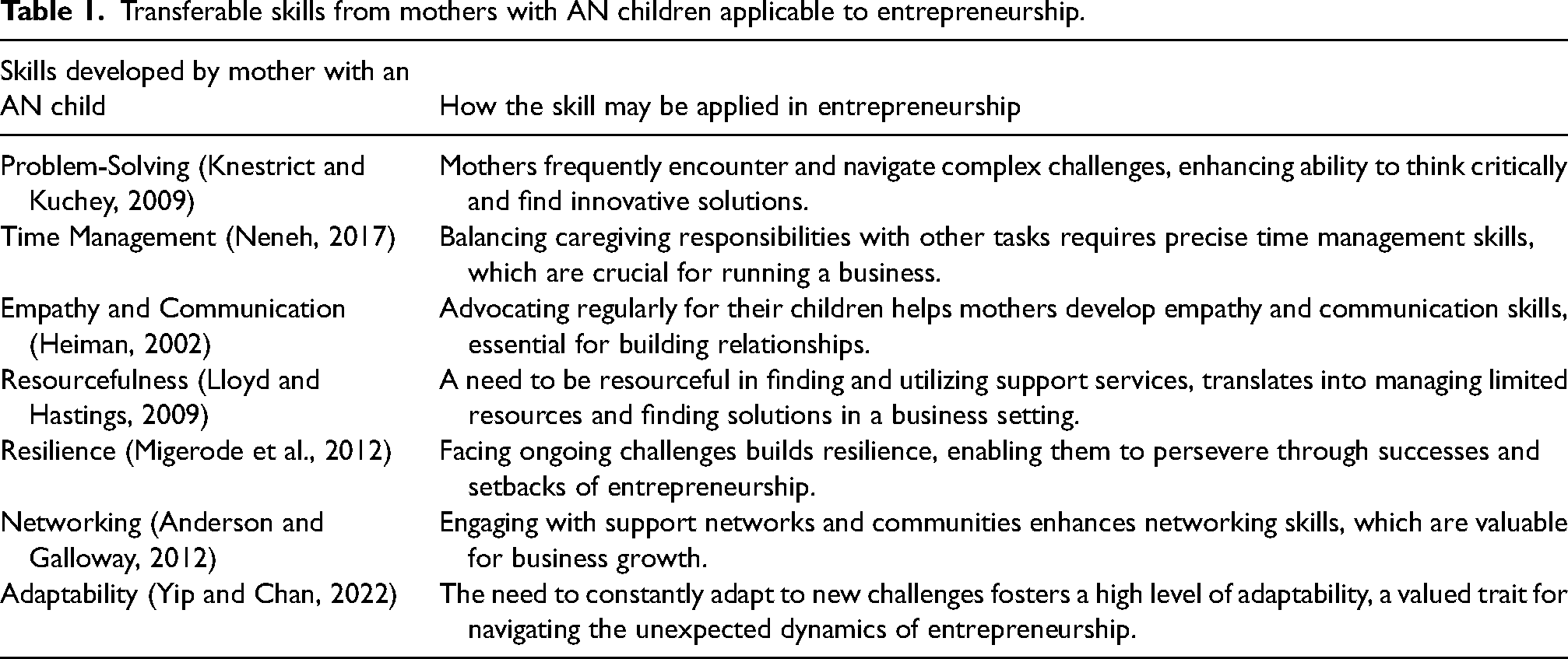
Mothers of children with AN develop unique coping skills that may enhance their entrepreneurial success (Bozkur et al., 2022; Dillon-Wallace et al., 2013). These adaptations, driven by the necessity to manage their child's needs, distinguish them from mothers of children without additional needs (Morris, 2012; Taanila et al., 2002). Their ability to handle traumatic situations could be beneficial in navigating unexpected challenges in entrepreneurship. These skills are illustrated in Table 1 and Figure 1 below.
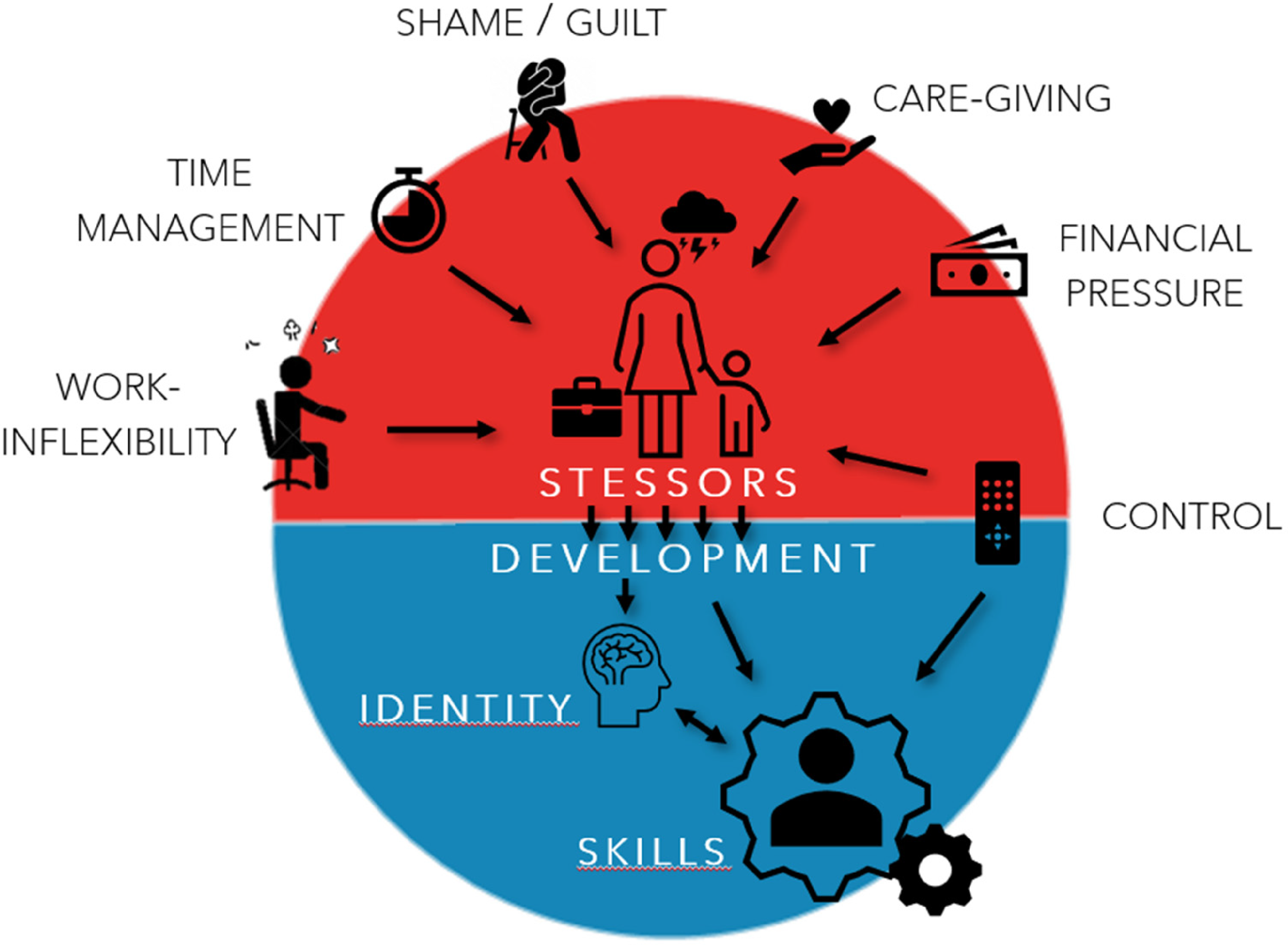
External and internal stressors unique to working mothers with an AN child contribute to the development of a set of unique skills and identity. Control is at the interface, since (external or internal) control can be negative, but also an action to take control to limit stressors, Casteleijn-Osorno, R.
Transferable skills from mothers with AN children applicable to entrepreneurship.
Entrepreneurship
One of the pioneers in entrepreneurship studies, Joseph Schumpeter, defines the entrepreneur as a person “constantly seeking opportunities and innovations” acknowledging that “the motivation of the individual has a decisive impact on their behaviour” (Gódány et al., 2021). Mothers of children with AN align with Schumpeter's concept of entrepreneurs as innovators driven by personal motivations and skills (Mehmood et al., 2019). They seek opportunities and innovate in caregiving due to their child's needs compromising regular waged work to fulfill caregiving obligations. This aligns with current studies which indicate beyond financial motivations, work–family balance, and personal wellbeing are higher priorities in entrepreneurship (Murnieks et al., 2019).
Rather sparking from one static moment in time, entrepreneurial intention particularly for women stems from several variables such as family and role balance (Džananović and Tandir, 2020; Naguib, 2024; Rey-Martí et al., 2015; Ribes-Giner et al., 2018). However, it should be noted both men and women identify independence and desire to break out of unfavorable working conditions as a motivating factor (Dawson and Henley, 2012).
Women may pursue entrepreneurship due to inflexible or unavailable employment, or after traumatic life events (Haynie and Shepherd, 2011; Murnieks et al., 2019). For mothers of AN children, caregiving responsibilities without prior experience can be experienced as traumatic (Hudspeth, 2015). Female entrepreneurship is often driven by empathy, loyalty, discernment, benevolence, and community, reflecting the ethics of care and motivations similar to those of mother-caregivers of AN children (Xie and Wu, 2022). Entrepreneurship can also serve as a means of constructing an entrepreneurial identity that functions as a form of empowerment, enabling mothers of children with AN to transcend the traditional social narrative of being perceived solely as caregivers (Kašperová et al., 2018).
Conclusion
This Fresh Perspective note advocates for the utilization of entrepreneurship as a viable solution for mothers of children with AN to integrate caregiving responsibilities while simultaneously engaging in meaningful employment. The note identifies career limitations stemming from the lack of flexible employment options and posits that entrepreneurship could offer wellbeing benefits comparable to those derived from traditional waged work (Brush et al., 2009; Hughes et al., 2012).
Additionally, entrepreneurship provides an alternative means of self-identification distinct from the mother-caregiver role (Kašperová et al., 2012; Sousa, 2011), enabling mothers to leverage transferable skills acquired through parenting a child with AN. Furthermore, entrepreneurship, through community connections, has the potential to impact others by harnessing the strength of networks and fostering development and collaborations that can enrich the lives of many. Even in the absence of a social enterprise, the wellbeing benefits derived from meaningful work can have a significant impact on caregiving mothers.
Further studies are necessary to determine whether the skills identified in Table 1, observed in mothers of children with AN are transferable to entrepreneurship. Furthermore, it is important to investigate if the benefits associated with entrepreneurship, such as enhanced wellbeing, are applicable to these mothers. While entrepreneurship offers autonomy, flexibility, and a sense of purpose, it also presents its own set of challenges, which future research should address. Further studies can address this aspect as well, while investigating if the types of businesses these mothers have also have an impact. This can include the potential creation of social firms, meant to support and empower persons with AN
In sum, this note opens up the discussion regarding mothers caring for AN children and their career limitations suggesting strengths such as resilience are transferable to entrepreneurship. I identify that although mothers caring for AN children face challenges and limitations both in their personal lives and career, entrepreneurship could be considered as a potential way to achieve desired goals. Finally, I suggest further studies are necessary to identify if any entrepreneurial benefits are applicable and if skills attained by mothers to AN children are transferable to venture creation.
Footnotes
Declaration of conflicting interests
The author declared no potential conflicts of interest with respect to the research, authorship, and/or publication of this article.
Funding
The author received no financial support for the research, authorship, and/or publication of this article.
