




Abstract
Although most students of entrepreneurship education find employment in established organizations after graduation, the employability of entrepreneurship education graduates remains largely overlooked in the education research literature. In this conceptual paper, the authors address this gap to motivate a future research agenda. The paper describes how entrepreneurship education may enable or impede the graduates’ entrance, development and transition in the labour market. To develop the theoretical arguments, the authors build on a processual conceptualization of employability. Seven propositions are presented to conceptually explore how competencies that are obtained through entrepreneurship education may influence the employability of graduates in a dynamic labour market. The propositions lay the groundwork for future studies on entrepreneurship education graduates’ employability and set a research agenda for how the employability of these graduates could be studied.
Entrepreneurship has long been seen as a vehicle for economic growth and innovation (Matlay, 2008), and is becoming even more important as we move from a stable to a volatile and dynamic labour market. Technological changes, such as advances in computing power, sensor technology, big data analysis and clean technology, are disrupting existing industries and creating new ones (World Economic Forum, 2016). These trends are changing not only industries, markets and firms but also the very nature of work. Some scholars and policymakers have argued that many jobs may be replaced by automated solutions (Frey and Osborne, 2017). Rapid advances in technology also constantly change work routines and labour market demands (World Economic Forum, 2016). Lately, we have witnessed the consequences of the Covid-19 pandemic, which is leading to mass unemployment, businesses becoming bankrupt, major changes in work routines (e.g., remote working, virtual teams, increasing digitalization, etc.) and even more unpredictability. While, on the negative side, these trends lead to less security and more unpredictability for individual employees who no longer have stable employment, on the positive side scholars have looked at how these trends are empowering those individuals who are able to adapt to the changes and entrepreneurially construct their careers across the boundaries of different organizational contexts (Arthur and Rousseau, 2001; Hall, 1996).
Scholars have suggested that entrepreneurship education (EE) can be a promising way of preparing students for such a volatile and dynamic labour market (Rae, 2008). In this respect, universities have increased their focus on developing EE Master’s programmes to accommodate this demand (Hoppe et al., 2017; Winkel et al., 2013). Although studies demonstrate that EE has some effect on entrepreneurial activity such as venture creation (Charney and Libecap, 2000; Jones et al., 2017), most EE graduates do not become entrepreneurs; instead, they are employed by established organizations. Yet, we do not know much about the employability of these graduates because the topic remains largely underdeveloped. EE and entrepreneurial competencies are generally seen as attractive in the labour market (Rae, 2007). However, Pittaway and Cope (2007a) state that a particular weakness in EE research is the lack of studies that link EE learning outcomes to specific factors relevant for employability. A few studies have investigated the impact of EE on graduates’ success in the labour market. For example, Charney and Libecap (2000) found that graduates who included entrepreneurship as part of their education were more likely to be employed on a full-time basis, had higher salaries and were more satisfied with their job opportunities. General higher education studies have indicated that creativity, problem solving, innovation skills, general business knowledge, team working skills, interpersonal skills and learning skills – competencies frequently associated with EE – are valuable to employers (Lowden et al., 2011; Wickramasinghe and Perera, 2010). Bell (2016) also found that graduates with entrepreneurial traits such as a proactive disposition and achievement motivation had an increased likelihood of being employed in a managerial or professional position 6 months after graduation.
Missing from the field, however, are studies of EE graduates in the workplace. Mwasalwiba (2010) explicitly called for more research on the links between EE and the workplace context. The aim of this conceptual paper is to address this gap by exploring theoretical links between EE and employability, and by suggesting a research agenda for future empirical studies. For the purposes of this paper, we define employability as ‘the capability of being an effective operator in the labour market’, which encompasses far more than securing a first job or achieving objective career success such as a high salary. More specifically, we draw on extant career research (Arthur and Rousseau, 2001; Hall, 1996; Sullivan and Baruch, 2009) and studies that have explored entrepreneurial competencies developed through EE (Haase and Lautenschläger, 2011; Kubberød and Pettersen, 2018b; Lackéus, 2014; Morris et al., 2013) to outline our arguments. We conceptually explore how central learning outcomes from EE relate to different career orientations. We demonstrate how competencies acquired from EE enable or constrain the graduates’ entrance, development, and transition in a volatile and dynamic labour market. Through our theorizing, our purpose is to move beyond the trivial question of whether or not EE graduates are successful in the labour market by considering the underlying questions about their competencies and behaviours that might in fact lead to their success, or eventually to possible setbacks. These underlying questions are framed through seven researchable propositions that describe how EE influences graduates’ employability.
A career perspective on entrepreneurship education
Traditionally, EE originated from the idea of enabling and inspiring individuals to engage in entrepreneurial activities to stimulate economic growth (Hytti and O’Gorman, 2004). This view suggests that the process of new business formation requires a specific set of skills, usually a combination of hard facts, business school skills, such as accounting, small business management and marketing (‘know-what’) and soft skills (‘know-how’) (Haase and Lautenschläger, 2011), such as handling uncertainty and resource constraints (Blenker et al., 2011).
Although EE originated from the rather narrow idea of training students to start ventures (Blenker et al., 2011), today we find programmes with different purposes and pedagogy that are also relevant to innovation and entrepreneurship in established firms, as well as social entrepreneurship and cultural entrepreneurship that focus on other forms of value creation (Blenker et al., 2011; Lackéus, 2014). We also acknowledge that there are different EE offerings at different universities in Europe, ranging from short single courses to full programmes and majors in entrepreneurship (Winkel et al., 2013). In this paper, we focus primarily on graduates from entrepreneurship schools, taking a full programme or Master’s degree, oriented towards commercialization and innovation activities where the start-up is the most common organizational artefact for learning. Most importantly, EE emphasizes experiential learning experiences (Kolb, 1984), through which students are exposed to unpredictable entrepreneurial processes. This exposure simulates an entrepreneurial learning process or at least involves aspects of entrepreneurial learning, ideally by engaging the students in real-life projects for external actors or starting a venture (Kyro, 2008; Rasmussen and Sørheim, 2006). As with the entrepreneurial learning processes entrepreneurs go through, this form of education should mirror such experiences and be characterized by uncertainty and ambiguity (Pittaway and Cope, 2007b). This educational form stands in sharp contrast to traditional classroom learning, and emphasizes the importance of students stepping out of their comfort zones, involving themselves in trial and error learning, and reflecting on mistakes (Pittaway and Cope, 2007b) – which often lead to transformational new insights that are of high value to themselves and others (Kubberød and Pettersen, 2017; Lackéus, 2014).
Eventually, the entrepreneurial learning processes that students go through in EE leads to the development and demonstration of entrepreneurial competencies (Kubberød and Pettersen, 2018b; Lackéus, 2014; Morris et al., 2013). Entrepreneurial competencies have been defined as ‘knowledge, skills and attitudes that affect the willingness and ability to perform the entrepreneurial job of new value creation’ (Lackéus, 2014: 377). However, the underlying assumption is that the entrepreneurial competencies developed through EE practices can be useful not only in the creation of new ventures but also in many different walks of life for solving a broad range of societal problems (Blenker et al., 2011; Gibb, 2002).
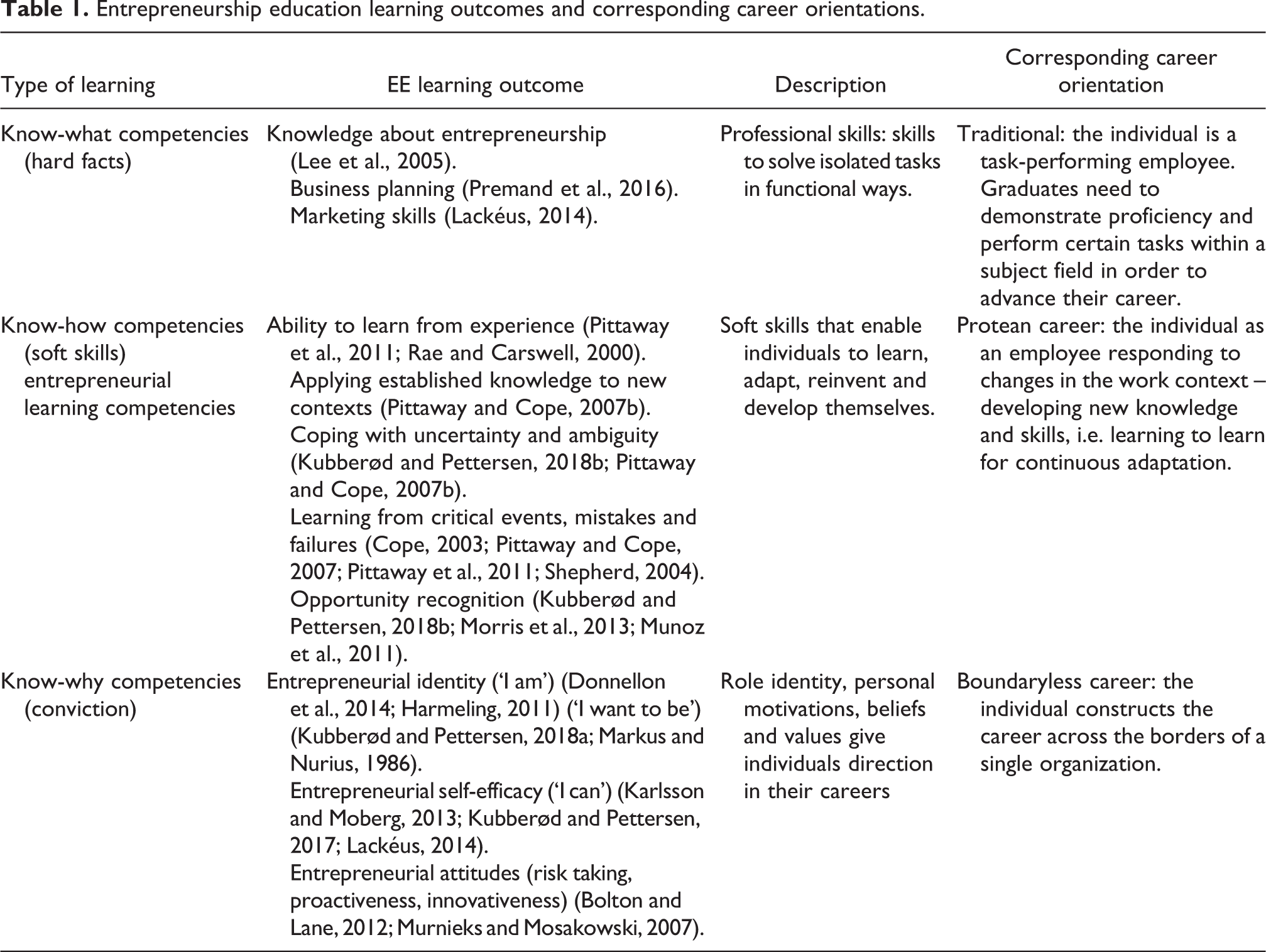
Haase and Lautenschläger (2011) categorize the learning outcomes of EE into three types of competencies: ‘know-what’, ‘know-how’ and ‘know-why’ competencies. Building on this categorization, we discuss how these learning outcomes are made relevant in different aspects of an EE graduate’s career by building on three prevailing career orientations that co-exist in the career literature: ‘the traditional understanding of careers’ (Levinson, 1978; Rosenbaum, 1979; Super, 1957), ‘the boundaryless career’ (Arthur and Rousseau, 2001) and ‘the protean career’ (Hall, 1996). As we will demonstrate, the different career orientations have quite different implications with regard to which competencies the labour market requires.
Traditionally, career research has focused on the individual’s relationship with a single employer, and how the individual ascended the organizational hierarchy (Rosenbaum, 1979). Such careers are typically characterized by stable organizational structures and usually see the career as consisting of subsequent stages (Levinson, 1978; Super, 1957). According to Super’s (1957) career development theory, a university graduate typically first needs to secure his or her place in an organization by adapting to organizational requirements and demonstrating proficiency in certain subject-specific tasks to become acknowledged as a well-performing and successful employee. This requires ‘know-what’ competencies within a field. For an EE graduate, ‘know-what’ competencies encompass hard facts about business management and functional skills needed for entrepreneurs, such as general knowledge about entrepreneurship, commercialization and innovation (Lee et al., 2005) and business planning (Premand et al., 2016), as well as other business school subjects, such as marketing (Lackéus, 2014) and finance and accounting skills (Haase and Lautenschläger, 2011). Haase and Lautenschläger (2011) refer to these as the ‘old school of entrepreneurship’. Nevertheless, hard facts in subjects such as business planning and marketing will enable a graduate to demonstrate proficiency within a subject field and perform related functional tasks.
As a response to the decreased stability and increased uncertainty of working life, Hall (1996) introduced the concept of the ‘protean career’. The protean careerists can repackage their skills to fit a changing work environment and remain relevant and employable, as well as adapting to different roles and positions in the labour market. Protean careerists are highly flexible, value freedom and strive for continuous learning. This view corresponds well with the ‘know-how’ competencies developed in EE. ‘Know-how’ competencies encompass the soft/transferable competencies of entrepreneurship (Haase and Lautenschläger, 2011), including competencies such as learning from experience (Rae, 2000; Rae and Carswell, 2000), applying established knowledge to new problems (Pittaway and Cope, 2007b), the ability to acquire knowledge and change behaviour based on experience (Gartner, 1988; Pittaway et al., 2011), coping with uncertainty and ambiguity (Kubberød and Pettersen, 2017; Lackéus, 2014; Pittaway and Cope, 2007b), learning from failure (Cope, 2003, 2011; Pittaway and cope, 2007b; Pittaway et al., 2011; Shepherd, 2004), opportunity recognition (Kubberød and Pettersen, 2018b; Morris et al., 2013; Muñoz et al., 2011) and creativity (Gundry et al., 2014). In the rest of the paper, we refer to these competencies as ‘entrepreneurial learning competencies’. These competencies can be learned and practised (Neck and Greene, 2011) and enable an individual to become a better learner in the labour market.
Introduced by Arthur and Rousseau (2001), the concept of the ‘boundaryless career’ concerns careers that unfold across the borders of a single organization. Unlike the traditional organizational career focus (Levinson, 1978; Rosenbaum, 1979; Super, 1957), the ‘boundaryless career’ involves movement across the institutional boundaries of an organization or other boundaries (Arthur and Rosseau, 2001). In this perspective, careers are built by individuals in a wide range of different jobs within different organizations. This might also involve voluntary work and self-employment. When an individual creates careers across a vast array of different organizations, personal values, identities and self-beliefs work as a guide for his or her career (DeFillippi and Arthur, 1994; Fugate et al., 2004). The ‘know-why’ competencies become paramount. For an EE graduate, ‘know-why’ competencies include entrepreneurial identity (Donnellon et al., 2014; Harmeling, 2011; Kubberød and Pettersen, 2018a), self-efficacy (Karlsson and Moberg, 2013; Kubberød and Pettersen, 2017; Lackéus, 2014) and entrepreneurial attitudes (Bolton and Lane, 2012; Murnieks and Mosakowski, 2007). Eventually these competencies will help guide individuals through the labour market by giving direction to their careers and acting as a compass when they select and evaluate opportunities for work. Table 1 summarizes the most relevant learning outcomes that can be linked to the corresponding career orientations.
Entrepreneurship education learning outcomes and corresponding career orientations.
A processual view of employability
Employability has been studied from both organizational and individual perspectives, and scholars have made several attempts to theorize on the meaning of the concept (Finch et al., 2016; Fugate et al., 2004, Tomlinson, 2017, Van Der Heijde and Van Der Heijden, 2006). Here, we focus on the individual perspective, which focuses on the characteristics and behaviours that enable an individual to thrive in the labour market (Fugate et al., 2004; Van Der Heijde and Van Der Heijden, 2006).
More precisely, employability has traditionally been conceptualized as a set of individual competencies, knowledge and personal attributes that make it more likely that individuals will find employment and succeed in their chosen profession (Hillage and Pollard, 1998; Moreau and Leathwood, 2006; Yorke, 2006). Yorke (2006: 8) defines graduate employability as students acquiring: the skills, understandings and personal attributes that make them more likely to secure employment and be successful in their chosen occupations to the benefit of themselves, the workforce, the community and the economy. a person, such as a graduate, is not simply a carrier of skills, knowledge and personal attributes. Their own unique identity, personality, and motivation, going beyond, personal attributes, which often change markedly during the HE experiences, are also likely to be factors. Also, the wider context of the university and the degree subject, in relation to demand from employers, and in the prevailing economic climate, may be significant.
The entering phase of employability concerns the ability to enter the labour market by gaining initial employment. To enter the labour market, candidates need to convince the employer that there is a good fit between the competencies needed and the competencies held by the individual (Lowden et al., 2011). In addition, the entering phase of employability also includes overcoming initial challenges and socializing in the workplace (Wendlandt and Rochlen, 2008).
The developing phase of employability concerns maintaining relevancy and employability by constantly developing oneself (Kanter, 1990). Individuals need to grow their skills and accomplishments to maintain their relevance and to stay attractive to their current and potential employers. In addition, individuals need to adapt to changes beyond their control (Van Der Heijde and Van Der Heijden, 2006), as well as proactively planning for optimal career outcomes (Bridgstock, 2009; Van Der Heijde and Van Der Heijden, 2006).
Finally, the transitioning phase of employability concerns the ability to obtain new employment, which might be required because of shifting work conditions and downsizing, but also encompasses individuals’ ability to create their own careers and transition between positions to achieve optimal career outcomes. In such circumstances, the careers should be individually constructed and guided by individuals’ preferences, identities and self-beliefs, rather than being determined by organizational career paths (DeFillippi and Arthur, 1994; Fugate et al., 2004).
Integrating entrepreneurship education with employability
As we have shown in the previous section, achieving and maintaining employability have different implications for the individual, depending on which phase he or she is in. Furthermore, in this section, we show that different career orientations will come into play at different stages of an individual’s career, which again will demand different competencies, and we theorize on how EE prepares students for each of these phases.
The discussion is structured around the three different phases of entering, developing and transitioning in the labour market, as they have different dynamics and require specific competencies. As a result of the discussion, we propose seven propositions that elaborate on ways in which EE outcomes influence the employability of graduates.
Entering the labour market
The ‘entering the labour market’ phase concerns securing an initial position in the labour market (Hillage and Pollard, 1998; Super, 1957), overcoming initial challenges in the labour market (Wendlandt and Rochlen, 2008) and integrating into the workplace to become a full participating member (Lave and Wenger, 1991). Although it has been argued that the traditional linear view of careers is less relevant today (Arthur and Rousseau, 2001; Hall, 1996; Sullivan and Baruch, 2009), when making a processual model of employability, we cannot ignore it completely. While the other two phases of developing and transitioning in the labour market are ongoing processes that individuals follow throughout the course of their career, entering the labour market as fresh graduates with limited work experience happens only once. Also, while the other two phases of employability are about striving for optimal career outcomes and maintaining employability, the entering phase of employability is more like an admission ticket to a place where individuals can access learning and labour market opportunities that will allow them to develop and optimize their careers. The entering phase of employability should, therefore, be linked to a more traditional career orientation in which the individual first demonstrates professional expertise to gain initial employment and secure his or her place in the organization (Super, 1957).
Employers are particularly alert to and look for specific professional skills when hiring (Lowden et al., 2011; Van Der Heijde and Van Der Heijden, 2006). According to the concept of ‘Legitimate Peripheral Participation’ (Lave and Wenger, 1991), newcomers to a community of practice, such as a workplace, usually work in the periphery where they are given low-risk tasks that typically require them to solve problems in a functional way, which requires ‘know-what’ competencies (Brown and Duguid, 1991; Fuller et al., 2005; Gardiner, 2016; Lave and Wenger, 1991). To advance to more centralized positions in the organization, newcomers need to demonstrate their proficiency in these tasks. As it is likely that most of these graduates will have developed strong autonomy through EE and view themselves as innovators or entrepreneurs (Donnellon et al., 2014), there may be conflicts between the employer’s need for an isolated demonstration of solving basic tasks and EE graduates’ need for autonomy, and aspirations to become involved in high-risk and complex innovation roles initially in an employment relationship. To gain access to greater responsibilities and relevant tasks, the EE graduate must be patient and demonstrate a basic level of proficiency in ‘know-what’ competencies and be willing to perform basic tasks that may not initially be directly related to an entrepreneurial role. ‘Know-what’ competencies are, therefore, important for being an efficient operator in the entering phase of employability but may not correspond well with the entrepreneurship graduates’ wishes or need for autonomy, leading us to suggest the following proposition. Proposition 1: EE includes various learning arrangements in which students act as autonomous innovators and entrepreneurs. EE graduates are, therefore, more inclined than others to experience greater role conflicts when transitioning from higher education to working life because they have to perform tasks that are less associated with an entrepreneurial role.
Transitioning from higher education to working life has been found to involve overcoming particular challenges, such as inflated expectations, the gap between competencies developed in higher education and competencies required in the labour market, and differences between academia and working life (Wendlandt and Rochlen, 2008). As EE includes several arrangements in which the students interact with potential customers, collaborators and industry actors via internships and start-up activities, EE graduates may have more realistic expectations of the demands of employers (Blenker et al., 2011; Kubberød and Pettersen, 2017; Pittaway and Cope, 2007b; Rasmussen and Sørheim, 2006) and may have developed professionalism and work readiness while performing as students. Thus, even though the initial tasks in their employment may be less stimulating from an entrepreneurial point of view, the students may have developed professionalism in dealing with various tasks during their education. This leads us to put forward the second proposition. Proposition 2: EE includes various arrangements whereby the students interact and work with different actors in the labour market. EE graduates are, therefore, better prepared than others for the transition from higher education to working life.
Developing in the labour market
The developing phase of employability revolves around learning and adapting to maintain relevance (Kanter, 1990). As new technologies and work routines are implemented at an increasing pace, and individuals need to adapt constantly, repackage their skills to fit new settings and learn new things to remain updated (Kanter, 1990), the best learners become the best performers. Individuals relying on established practices and old skills will soon become outdated, while those who rapidly manage to learn new skills, repackage old ones and adapt to changing work conditions will excel. As such, this phase should be linked to a protean career orientation (Hall, 1996). For several reasons, the entrepreneurial ‘know-how’ competencies are therefore especially important in the developing phase of employability – in particular, the ability to adapt to changing work conditions by repackaging old competencies and learning new ones. The entrepreneurial learning competencies developed through EE might be especially well suited for preparing students to constantly learn and adapt to new situations. Several scholars have suggested that EE increases the student’s ability to learn (Gibb, 1993; Hytti and O’Gorman, 2004; Pittaway and Cope, 2007b). Entrepreneurial learning is about acquiring tacit knowledge (Rae, 2000; Rae and Carswell, 2000), changing behaviour (Gartner, 1988), and developing competencies (Kubberød and Pettersen, 2018b; Lackéus, 2014; Morris et al., 2013) through experience. As with learning to initiate or develop a new venture, the ‘entrepreneurial learning’ competencies developed through EE can also be useful for graduates when facing changing work requirements and demands from disruptions in the work context. Furthermore, when operating and navigating in a shifting and unpredictable labour market, many of the same factors facing entrepreneurs in the entrepreneurial process come into play, including high uncertainty, ambiguity, social engagement and opportunity focus, and having to deal with critical events such as failure and crises (Kubberød and Pettersen, 2018b; Pittaway and Cope, 2007b; Pittaway et al., 2011; Rae, 2008). Graduates who have developed entrepreneurial learning competencies through higher education are, therefore, well suited to constantly adapt and learn in such an environment. Proposition 3: EE graduates are trained in entrepreneurial learning processes and develop entrepreneurial learning competencies, which makes them more adaptable than others when faced with changing work requirements and situations in which they need to reinvent themselves and learn new things.
The entrepreneurial learning processes that take place in EE are imbued with challenges in which learners must cope with critical events, failures and crises (Cope, 2003, 2011; Shepherd, 2004). Like the critical events that take place in a start-up, those that occur in the labour market during the course of a career (e.g., losing a job, experiencing bankruptcy, downsizing, reorganizing or industry disruption) may have emotional impacts on employees, who might experience these events as crises or failures. As rapid technological development and other macro trends change the labour market, these critical events are happening more rapidly (Frey and Osbourne, 2017; World Economic Forum, 2016). Being able to deal with such events in a productive way is, therefore, a crucial competence in the dynamic labour market. EE graduates are trained in showing resilience and learning from such critical events, and this training can be utilized when they face similar events as employees in the labour market (Pittaway and Cope, 2007b; Pittaway et al., 2011; Shepherd, 2004). For EE graduates, dealing with such events involves dealing with the emotional impact they have on the individual and maximizing the learning outcomes (Shepherd, 2004). Ultimately, entrepreneurial learners view these critical events as learning opportunities, which in turn can lead to transformative, higher-order learning (Cope, 2003, 2011). Proposition 4: EE graduates are adept in showing resilience when faced with failures and crises, and they are more inclined than others to learn from and deal with the crises and major changes that occur in the labour market in a productive way.
Scholars have suggested that employability also require ‘career building skills’ in order to achieve optimal career outcomes (Bridgstock, 2009). Central to career building skills is the ability to identify and choose labour market opportunities. We, however, propose that these labour market opportunities are not only fixed but are also constructed and socially negotiated between graduates and potential employers. There are at least two ways in which EE graduates have an advantage when it comes to ‘career building skills’: social capital and social negotiation skills, and opportunity skills.
A crucial part of ‘career building skills’ is the ability to create social capital (Bridgstock, 2009). By creating strategic and personal ties with different stakeholders in the labour market, individuals obtain access to resources and opportunities for work (Bridgstock, 2009). EE puts students in situations in which they learn to interact and work with external stakeholders (Lackéus, 2014; Pittaway and Cope, 2007b; Rasmussen and Sørheim, 2006). As such, the students are trained in building professional networks during their education and through this process have developed their social skills. Eventually, this will give them an edge over other students, as they can benefit from employing these skills further when building their careers, which leads us to suggest the following proposition. Proposition 5: EE involves arrangements where students interact socially with multiple external stakeholders. These students are, therefore, better than others at developing their professional networks and building interpersonal and networking skills, which ultimately will enhance their resourcefulness in a dynamic labour market.
Finally, EE students might benefit from opportunity skills when building their careers. Scholars have suggested that entrepreneurial opportunities may emerge from changes in technologies, industries or markets (Drucker, 2014; Kirzner, 1997; Schumpeter, 1934; Shane and Venkataraman, 2000). EE graduates with the ability to recognize and exploit opportunities may harness changes in technology and the business landscape to exploit entrepreneurial opportunities and become entrepreneurs (Kubberød and Pettersen, 2018b; Morris et al., 2013). These opportunities might also be harnessed within established organizations: when an individual chooses to act on an opportunity while employed in an established organization, the new business opportunity will naturally benefit the organization but it can also benefit the individual, who may be rewarded for the initiative. In addition, acting on such opportunities might provide the individual with additional opportunities for work in a new business area or with new technology. Proposition 6: EE provides students with the ability to recognize and exploit entrepreneurial opportunities, which makes these graduates better prepared than others to act as intrapreneurs or spin-out entrepreneurs within established organizations.
1
Transitioning in the labour market
Finally, the transitioning phase of employability concerns larger voluntary and involuntary movement across different positions, organizations and other boundaries to achieve optimal career outcomes.
As individual careers are no longer limited by organizational boundaries (Arthur and Rousseau, 2001), and individuals can reinvent themselves to meet changing work requirements (Hall, 1996), there are essentially no limits to the different directions a career can take (Fugate et al., 2004). In addition, the changing nature of the dynamic labour market means that there are fewer career templates and role models to give direction to the individual when shaping his or her career (Fugate et al., 2004; Meijers, 1998). This might be especially true for EE graduates. EE is not a vocational education that focuses on preparing for a specific profession. It is a relatively young form of education and there are no typical career paths. The career development of EE graduates appears to be idiosyncratic and open, as graduates from EE find work in a vast array of different professions and organizations (Charney and Libecap, 2000; Jones et al., 2017; Rae and Woodier-Harris, 2013).
Scholars have, therefore, become interested in how personal ‘career identities’ give direction to individual careers (Ashforth, 2000; Fugate et al., 2004). Career identities involve making sense of past and present experiences to give direction to the future (Fugate et al., 2004) and imagine ‘possible selves’ in the labour market (Markus and Nurius, 1986). Career identities, thus, give individuals the “cognitive and affective foundation of employability” (Fugate et al., 2004: 20). By asking ‘Who do I want to be in the workspace?’, individuals imagine different possible selves in the labour market. Ultimately, these possible selves will affect the career choices of graduates and other actors in the workplace (Fugate et al., 2004).
Accordingly, for EE graduates, ‘know-why’ competencies will give direction to their careers. Several scholars have explored how the entrepreneurial identity is fostered through EE (Donnellon et al., 2014; Harmeling, 2011; Kubberød and Pettersen, 2018a). This is done through a process of identity matching (Ibarra, 1999; Kubberød and Pettersen, 2018a), in which students experiment with their possible selves (Markus and Nurius, 1986) through experiential and action-based learning (Harmeling, 2011). Experimentation with different possible selves in EE will have an impact on the direction the career of EE graduates will take, as they will likely gravitate towards roles and career paths that are consistent with an entrepreneurial identity (Donnellon et al., 2014; Harmeling, 2011; Kubberød and Pettersen, 2018a).
Like the identity matching process that takes place in EE, the different roles and positions a graduate considers when transitioning in the labour market are also subject to an identity matching process (Ibarra, 1999). The self-efficacy that is developed through EE (Karlsson and Moberg, 2013; Kubberød and Pettersen, 2017; Lackéus, 2014) is an important component when the graduate evaluates the feasibility of different positions and what he or she can manage (‘can do’). Finally, the different roles will be evaluated, based on whether they are consistent with the personal attitudes and values of the individuals. As such, underlying entrepreneurial attitudes, such as innovativeness, autonomy, proactiveness and attitudes towards risk, come into play (Bolton and Lane, 2012; Murnieks and Mosakowski, 2007). It is, therefore, plausible that an EE graduate who has developed a higher propensity towards, for example, risk-taking, is more proactive when new career opportunities appear, and may take larger chances and career leaps when evaluating different career opportunities. In accordance with such entrepreneurial thinking and reasoning, this may offer both new and lucrative career opportunities and sometimes setbacks associated with taking higher career risks, leading us to put forward the last proposition. Proposition 7: Through EE, students develop an entrepreneurial identity, and in compliance with entrepreneurial attitudes like risk taking, EE graduates are more inclined than others to take riskier career choices when manoeuvring their careers.
The employability of EE graduates – Towards a new research agenda
In the previous section, we suggest seven propositions that describe ways in which EE might influence the employability of graduates at different stages of their careers. These propositions should be empirically elaborated, adjusted and eventually tested. Below, we suggest how such studies might be designed, with research questions based on our previous propositions.
Suggestion 1: Longitudinal studies that follow EE graduates as they enter, develop and transition in the labour market. As we are heading towards a more dynamic and less predictable labour market, employability is an ongoing process of entering, developing and transitioning in the labour market. To explore how EE graduates utilize entrepreneurial competencies to navigate and perform in the labour market, future studies should be longitudinal and should follow individuals as they enter, develop in and transition in the labour market. The processual model of employability proposed in this paper serves as a foundation for such studies. The entering phase from higher education to working life is of special interest as it is reasonable to think that this is where EE has the largest impact on the competencies and behaviours of these graduates (Propositions 1 and 2). This paper also suggests that the entrepreneurial ‘know-what’ competencies are of particular importance in this early phase of the graduate’s career. Possible research questions might be: How do EE graduates transition from EE to the workplace? What particular challenges do EE graduates have when entering the workplace and how do they overcome these challenges? How do EE graduates legitimize themselves in the workplace?
Suggestion 2: Critical incident case studies that explore how EE graduates are dealing with critical events in the labour market. As the labour market becomes more dynamic, employees need to be flexible and adapt to changes beyond their control (Hall, 1996). Scholars have suggested that EE might be particularly effective in enhancing the employability prospects of individuals in such a context (Rae, 2008). In Propositions 3, 4, 5 and 6, we propose that entrepreneurial learning competencies enable individuals to reinvent themselves, learn new things and adapt to new situations, as well as to enter intrapreneurial roles. Especially important is the ability to deal with and learn from critical events. To empirically investigate this, critical incident case studies are useful (Cope, 2003; Flanagan, 1954). These should focus on how EE graduates deal with issues such as losing their jobs, downsizing, the introduction of new technology into the workspace and the reorganization of the workspace. Possible research questions might be: How do EE graduates deal with and learn from critical events in the workplace? What strategies do EE graduates follow to proactively adapt for optimal career outcomes?
Suggestion 3: Narrative studies that focus on affective and cognitive foundations for career changes. In this paper we suggest that entrepreneurial identity (Harmeling, 2011), entrepreneurial self-efficacy (Karlsson and Moberg, 2013; Kubberød and Pettersen, 2017; Lackéus, 2014) and entrepreneurial attitudes and values (Bolton and Lane, 2012; Murnieks and Mosakowski, 2007) give direction to EE graduates’ careers. Ultimately, we suggest that these competencies have an impact on EE graduates’ career progressions and might, therefore, be characterized by riskier career changes (Proposition 7). In addition, the identity of these graduates must be matched and adapted to the requirements of the labour market (Ibarra, 1999). As discussed in Proposition 1, this might be a particular challenge for EE graduates as there may be a conflict between the entrepreneurial identity of these graduates and the requirements of the labour market. Researchers should apply a narrative life-story approach that focuses on career changes and progressions to understand the affective and cognitive foundations of the EE graduates’ career transitions. Possible research questions might be: How does entrepreneurial identity impact the career choices of EE graduates? How are the entrepreneurial identities of EE graduates matched and adapted to the requirements of the labour market?
Conclusion
Although most EE graduates become employed in established organizations, studies focusing on the employability of entrepreneurial graduates are still largely missing from the EE literature. Although some studies indicate that these graduates perform better than others in the labour market, what makes these graduates more employable remains relatively unexplored.
The goal of this paper has been, therefore, to explore theoretical links between EE and the seemingly unrelated field of employability, and to suggest different research avenues for further investigating these links. We have suggested an understanding of employability as a process of entering, developing and transitioning in the labour market, and that achieving and maintaining employability means different things in different phases of an individual’s career. Furthermore, we have built on the notion that competencies developed in EE might be categorized under the three headings of ‘know-what’, ‘know-how’ and ‘know-why’ competencies, and we have shown how each category is especially prevalent during different phases of employability.
The paper builds on the notion that the labour market is moving towards a more dynamic and unpredictable state, and we have shown how and where EE can prepare university graduates for this disrupted labour market. The theoretical links between some of the concepts, such as the ability to learn and to deal with and learn from critical events, are quite alluring. The propositions should be further empirically elaborated, adjusted and eventually tested. In turn, these propositions can inspire educators to design education that prepares students for both entrepreneurship and a more dynamic and unpredictable labour market.
We acknowledge that there may be other links between EE and employability that are not discussed in this paper. Future studies should also consider the potential negative aspects of EE. A core argument of this paper has been that EE has a positive impact, and as such we have proposed ways in which EE might enhance the employability of graduates. However, there may also be ways in which EE is harmful or hinders the employability of graduates, and studies should be sensitive to potentially harmful effects of EE. For example, as described in Proposition 1, there may be a conflict between an EE graduate’s need for autonomy and aspirations to work with entrepreneurship and innovation projects, and the employer’s need to solve functional tasks that typically require ‘know-what’ competencies. In line with this thinking, Proposition 7 also suggests that the risk-taking propensity of EE graduates may in some circumstances lead candidates to take chances that might not be optimal in terms of their career.
We invite our fellow scholars to join in the academic discussion and empirical scrutiny to explore this intriguing research field in the future. Hopefully, this will inspire a new debate on the relevance of entrepreneurship education for established organizations and in the development of the future labour market.
Footnotes
Declaration of conflicting interests
The author(s) declared no potential conflicts of interest with respect to the research, authorship, and/or publication of this article.
Funding
The author(s) received no financial support for the research, authorship, and/or publication of this article.
