



Abstract
New universities faced difficulties in establishing a research culture following the ending of the binary divide in 1992. Teaching staff were reluctant to develop their research profiles. We draw on the case of the Centre for Enterprise (CfE) based in Manchester Metropolitan University Business School to illustrate a unique approach to increasing research output. The CfE was established to deliver practical support for entrepreneurs and owner-managers. The recruits to these projects were encouraged to use this practical engagement as a basis for conventional research outputs. Drawing on data related to publications in the period 2000–2010, we illustrate the effectiveness of creating an entrepreneurial community of practice to create a strong research orientation. Success is illustrated in a number of ways, particularly a substantial contribution to the Business School's 2008 Research Assessment Exercise submission. All staff employed in the CfE have established successful academic and administrative careers. In addition, all seven PhD students attached to the Centre during this period have successful careers in academia or private sector educational organisations. Theoretically, we add to the concepts of communities of practice and legitimate peripheral participation by identifying several factors that support the development of a highly productive research culture.
Introduction
The ‘binary divide’ between universities and polytechnics ended in 1992 as a result of changes to higher education implemented by John Major's Conservative government (Baimbridge, 1996). A key element of the change was that the new universities began to develop research profiles. Previously, most polytechnics focused on teaching and the delivery of degree courses, which had a strong vocational element (Parry, 2015). Vice chancellors of new universities believed a commitment to research would raise the status of their organisations (Sikes, 2006). In most ex-polytechnics, developing a research culture was difficult because staff had high teaching loads and the majority were ambivalent about the need to do research. For example, in his account of Nottingham Business School (also an ex-polytechnic) Mutch (2021) describes the differences between ‘research-led’ teaching in traditional university business schools and ‘research-informed’ teaching in polytechnics. Teaching in research-led institutions is based on the interests of the researcher whereas research-informed teaching is led by the needs and experiences of learners (Mutch, 2021, p. 408). Ending the binary divide was envisioned to create opportunities for ex-polytechnics by funding research across the sector on a more equitable basis. As pointed out by Taylor (2003, p. 275) at the time, ‘there is no sign of such redistribution occurring’. Various analyses of the UK's RAE (Research Assessment Exercise) and the REF (Research Excellence Framework), 1 have indicated that research funding has been increasingly concentrated in the most research intensive institutions (Boliver, 2015; Geary et al., 2004).
Sikes (2006) reports on the difficulties associated with increasing research activity in a department of education in New University. Here, we focus on the challenges facing Business Schools attempting develop a research culture where none previously existed. See, for example, Bessant et al. (2003) who examine the state of business and management research following the 2001 RAE. This date is significant because in this article we concentrate on one business school during the period 2000 to 2010. MMUBS (Manchester Metropolitan University Business School) had a small core who were committed researchers while most longer-serving staff believed that research was a distraction from the core task of teaching undergraduate students (Mutch, 2021). Nevertheless, MMUBS was, at the time, the only new university to have an ESRC (Economic and Social Research Council) approved doctoral programme, which attracted several gifted students who went on to establish successful academic careers.
In this article, the focus is a sub-unit of MMUBS, which was established in 2001 and known as the Centre for Enterprise (CfE). The CfE was initially set up to deliver the New Entrepreneur Scholarship (NES), which was a practical training programme for those from disadvantaged backgrounds wanting to start their own businesses (Jayawarna et al., 2007b). Over the next few years, a number of projects were attracted to the CfE and it rapidly grew in size from 2 (in 2001) to 15 staff in 2008 (Jones et al., 2008). Despite a practical focus in the early stages, growth was based on a commitment to establishing a core of research-focused staff who would enhance the publication output of MMUBS. The drive to create a separate research centre was stimulated by the disappointing results of the 2001 RAE for MMUBS. The RAE submission contained a strong narrative about progress in establishing a research culture in the school. Although the 25 staff submitted for the assessment only represented 20% of the total, the quality of published outputs were similar to a number of institutions which received a higher rating than the ‘4’ awarded to MMUBS (Geary et al., 2004). For example, at least two Business Schools, one in a Russel Group university and the other a Plate-glass 2 university (Beloff, 1970) submitted fewer staff with comparable outputs to MMUBS but both Institutions were awarded ‘5’ ratings. This perceived failure encouraged teaching staff in the Business School to claim that the commitment to research had been a waste of time and resources. As indicated above, only 25 staff members were submitted to the 2001 REF exercise and at least 50% of those were relatively new recruits to MMUBS. Talented graduates from the doctoral programme generally sought employment at research-focused institutions. In addition, while senior researchers were keen to act as mentors to those teaching staff wishing to begin publishing, few were willing to engage. Therefore, the creation of a standalone research unit (the CfE) was a way of recruiting young staff who wanted to develop their research profiles by publishing in good-quality journals.
While the focus of this article is the period 2001–2010, it is relevant to contemporary scholars for two reasons. First, the pressure to publish has grown increasingly intense in the intervening period and it is challenging for postgraduate students to make the transition from doctoral study to productive academic careers (Galimberti, 2023). As stated by Hollywood et al. (2020, p. 998) balancing the demands of teaching, publishing and administration, means that young academics can be ‘overwhelmed’ at the start of their academic careers. Secondly, the study is significant because it demonstrates that encouraging high levels of professionalism at an early career stage can have longer-term benefits for the development of productive academics (Wilkins et al., 2021) and professional staff (Veles et al., 2023).
The article is organised in the following manner, we begin with an overview of how new universities responded to the problems of developing their research activities following the 1992 changes. We then focus on the creation of entrepreneurial communities of practice (CoP) committed to research and publishing based on engagement with practice and practitioners. The research approach is then discussed and to demonstrate the effectiveness of this project, data are presented related to staff employed in the CfE during the 10-year period from 2000 onwards. The results are then discussed demonstrating several contributions to knowledge followed by the conclusions, which include a reflexive account of the research approach. The findings are summarised in the conclusions.
Entrepreneurial universities and new research centres
Clark (1998) suggested that entrepreneurial universities consist of five key elements: a steering group; an expanded developmental periphery; diversified funding model; a stimulated academic heartland; and an integrated entrepreneurial culture embracing change and transforming beliefs. Others have pointed out that changing attitudes, beliefs and values are strongly linked to an organisation's history and the environment in which it operates (Pratt et al., 1999). As Pratt et al. (1999, p. 50) go on to say, enacting cultural change means modifying the beliefs, attitudes and values of all staff about the value of research vis a vis teaching (Olvido, 2021). While Rae et al. (2009, p. 196), based on their study of the University of Derby, propose that entrepreneurial universities are enacted through teams of people working interdependently as entrepreneurs within and beyond their organisation (Martin and Turner, 2010). Such teams must engage with a variety of individuals and agendas to create a coherent stream of enterprising activities. These activities create financial value as well as enhancing learning, innovation and culture for the university, students, staff and external stakeholders (Rae et al., 2009). Drawing on an extensive review of the literature, Guerrero and Urbano (2019, p. 122) claim that entrepreneurial universities foster innovation and entrepreneurship by creating an ecosystem involving a range of actors including educational programmes, incubators, technology transfer offices, business creation offices, culture (role models, attitudes towards entrepreneurship, etc.), ‘as well as relationships with government, investors, industry and other socio-economic agents’.
Etzkowitz (2003) argues that all universities began as teaching institutions, gradually incorporated research and then began to engage with the ‘third mission’ which added economic and social engagement (Anderson et al., 2017). The author goes on to claim that MIT (Massachusetts Institute of Technology) and Stanford University were early adopters of the third mission in addition to their teaching and research activities. Based on these two examples, Etzkowitz (2003) suggests that encouraging research groups to act as ‘quasi-firms’ is an important factor in the creation of an enterprising university. This claim was based on the examples of engineering departments in MIT and Stanford, which led to numerous spin-out companies (Minshall et al., 2008). Nevertheless, the idea of research groups acting as autonomous units has some resonance in the general social sciences (De Saá-Pérez et al., 2017; Oswick et al., 2000; Todorovic et al., 2005).
Entrepreneurial universities responded to the challenge to be more economically relevant ‘by establishing dedicated entrepreneurship centers, entrepreneurship research centers or cooperative research centers to effectively and sustainably address socio-economic demands and expectations’ (Dolan et al., 2019, p. 3407). What the authors describe as ‘cooperative research centres’ (CRC) are focused on collaborative with external organisations to promote knowledge and technology transfer. Based on the analysis of HESA (Higher Education Statistical Agency) data for all UK institutions, Abreu and Grinevich (2024) identify a number of elements contributing to an entrepreneurial university. Of relevance to this study are factors such as a commitment to entrepreneurial training, a strong local and regional orientation, an internal department focused on business engagement and an on-campus incubator. There is a literature that confirms the creation of enterprise centres is a key element of the entrepreneurial university (Maas and Jones, 2017). Jones et al. (2021b, p. 206) define entrepreneurship centres in the following way: ‘an entity that facilitates entrepreneurial activity through enabling and supporting business start-up, encouraging entrepreneurial mind sets through the provision of curriculum across the University, undertakes research into entrepreneurial behaviour and small business management and supports third mission activity’.
Bell and Bell (2016) argue that universities primary objective in establishing entrepreneurial centres is to promote student entrepreneurship as a basis for regional economic development. Other studies of entrepreneurship centres also focus on the provision of services to promote entrepreneurial attitudes via accredited entrepreneurship courses such as those offered at the Technical University of Catalonia (del-Palacio et al., 2008). An ethnographic study of two entrepreneurship centres, known as CLabs (contamination labs) in Italian universities also found that the focus was on enterprise education designed to develop students’ entrepreneurial mindsets (Secundo et al., 2020). The initiatives developed by CLabs were extra-curricular rather than conventional courses forming part of a degree programme. Participating students came from a range of different disciplines and were encourage to engage with various actors in the local entrepreneurial ecosystem (Secundo et al., 2020, p. 1312).
There is a related literature examining university research centres (URC) although the focus is primarily science and technology (Boardman and Corley, 2008; Bozeman and Boardman, 2013; Dietz and Bozeman, 2005; Sondakh and Rajah, 2006; Toker and Gray, 2008). A number of recent publications also focus on URCs although much of this output appears in non-mainstream journals (Moutinho et al., 2023; Noaman et al., 2022) or more lowly rated 3 business and management journals based on the 2021 CABS (Chartered Association of Business Schools) list (Franco and Pinho, 2019; Lind et al., 2013; Valmeekanathan et al., 2021). Moutinho et al. (2023) review 28 articles to develop a conceptual framework summarising the key influences on collaborative R&D (research and development) projects between academia and practitioners rather than research-oriented centres such as the CfE.
Franco and Pinho (2019) examine collaboration between six URCs engaged on an EU Seventh Framework Programme known as the Singular project (Smart and Sustainable Insular Electricity Grids Under Large-Scale Renewable Integration). The purpose of the study was to identify mechanisms that enabled research centres to gain quicker access to knowledge held by researchers in other such centres and identify solutions to common problems (Franco and Pinho, 2019, p. 67). According to Valmeekanathan et al. (2021: p. 232) the overarching aim of their study was to better understand ‘the relationships, incentives and structures that support John Hopkins Bloomberg School of Public Health (JHSPH) faculty engagement with government decision-makers at the city, state, federal, and global levels’. While the study draws on 76 interviews with members of faculty (52) and decision-makers (24), the focus is knowledge transfer rather than conventional research outputs in the form of publications.
An earlier study (Lind et al., 2013) also examined university-industry collaboration by exploring three research centres in a Swedish technical university. Lind et al. (2013) found that the role of research centres varied depending on whether they were mediators or facilitators of collaboration. A URC known as the Centre for Rural Studies was initially an independent organisation but was integrated into the University of Southern Denmark. The Centre was funded from various sources including the Danish government, private finance and the European Union (Noe and Alrøe, 2024). Consequently, staff needed to satisfy a range of stakeholders including local communities, municipalities and regions as well as lobbyists for the agriculture and food sectors. The study examines the extent to which it is possible for research centres to uphold the requisite research integrity to provide society with truthful and tical knowledge (Noe and Alrøe, 2024). The authors point out the difficulties that such research centres face in transmitting scientific knowledge to various, often, competing stakeholders. While all these studies provide some insight into the problems associated with combining academic research with practical engagement, there is no focus on the internal activities of the various URCs or on the researchers themselves.
In contrast, Torres Zapata (2019) establishes that a mix of individual characteristics including age, experience, education and gender have a positive influence on research outputs (publication and patents). Torres Zapata (2019, p. 40) established that an informal management structure (Baù et al., 2021) was the best way of promoting internal collaboration and enhancing group research capabilities. In their study of a Malaysian university, Henry et al. (2020) also found that team characteristics (age, qualifications, cohort and research emphasis) had a positive impact on research productivity. A range of environmental factor including research culture, workload, research assistance and research funding also contributed to productivity in terms of publications, research grants, PhD supervisions and patents (Henry et al., 2020).
Research-based communities of practice
As discussed above, the intention from the early stages of establishing the CfE was to create a research-based community of practice (McDonald and Cater-Steel, 2017). CoP are defined ‘as groups of people informally bound together by shared expertise and passion for a joint enterprise, who interact regularly to learn about or improve their practice’ (Nicolini et al., 2022, p. 680). Central to the formation of CoP is the idea of legitimate peripheral participation (LPP) which stems from interest Lave and Wenger (1991) had in recapturing the term ‘apprenticeship’. Situated learning is not based on formal instruction, rather, the focus is on the day-today practices established by CoP members (McDonald and Cater-Steel, 2017; Mercieca, 2017; Jones et al., 2021a). Those individuals develop their academic identities as an outcome of participating in various situated learning activities (Lave and Wenger, 1991; Wenger, 2000; Handley et al., 2006, 2007). Legitimate peripheral participation is a key element of situated learning as new members are socialised into community norms by taking part in group activities (Burt et al., 2022; Ng and Pemberton, 2013). Frederiksen and Tanggaard (2023) use the concept of legitimate peripheral participation in CoP to demonstrate how students are initiated into the practices associated with entrepreneurship education.
To be effective, CoP should be based on small groups of learners (Campbell et al., 2022; Lave and Wenger, 1991; Warren, 2004). Three factors define a community of practice: joint enterprise, mutual engagement and a shared repertoire of resources and capabilities (Lave and Wenger, 1991; van Weele et al., 2018b). Joint enterprise arises from a shared understanding of what community members believe they are trying to achieve (Nicolini et al., 2022; Zhang and Watts, 2008). Therefore, shared goals are not formally defined but gradually emerge based on collective activities and negotiations (Wenger, 1999), which helps create accountability amongst community members. Mutual engagement describes a community's social relationships through which members interact, the shared norms and values they establish, and the shared identities that reflect these interactions and values (Akkerman et al., 2008; Zhang and Watts, 2008). Creating a shared identity contributes to members’ sense of belonging and commitment to their new community. A common repertoire includes ‘routines, words, tools, ways of doing things, stories, gestures, symbols, genres, actions, or concepts’ (Wenger, 1999, p. 83) that become part of the community's practices (Frederiksen and Tanggaard, 2023; Garavan et al., 2007). Bastiaens and Heymann (2023) stress the importance of taking a strategic approach to the development of CoPs in higher education although their case study is focused on enhancing student employability. As pointed out by Nicolini et al. (2022), much of the early work examining CoP concentrated on occupational groups (Lave and Wenger, 1991; Wenger, 1999), while there are CoP-related studies of higher education most of this work focuses on student groups rather than academic researchers.
The UK's RAE/REF exercises accentuated the importance of research outputs both in terms of university league tables and the allocation of research funding. Most institutional approaches to enhancing their research outputs were generally focused on departments or formal research groups (Todorovic et al., 2005). At the same time, informal groups can emerge when staff members have common interests, entrepreneurship for example (Elfring et al., 2021), and create a community of practice. Ng and Pemberton (2013) argue that little is known about how CoPs benefit universities or individual members of staff although there have been a small number of subsequent studies (Arthur, 2016; Howlett et al., 2016; McDonald and Cater-Steel, 2017). Based on their study of five research-based CoPs from different disciplines, Ng and Pemberton (2013) identified 20 themes of which 8 were unique to communities in higher education and included overcoming intellectual isolation, fostering tangible returns, undertaking collaborative research, responding to research pressure. The benefit to individuals of belonging to a CoP are summarised by Ng and Pemberton (2013, p. 1536): ‘The findings also show that these communities tend to embrace individuals who are at different stages of development in terms of their research ability and, as they participate, less experienced members gradually learn, gain confidence and start to see themselves as legitimate researchers’.
CoPs are based on the idea that much knowledge is tacit in nature and, therefore, can only be acquired via direct social interaction (Nonaka and Takeuchi, 1995). Regular interaction helps ensure that high levels of mutual trust are established within a CoP enabling participants to share information, problems, knowledge and practices (Brown and Duguid, 1991, 2001; Maclean et al., 2020). It is generally accepted that CoPs cannot be created by management fiat although managers/leaders can provide the supporting infrastructure and control who joins the CoP (Wenger et al., 2002). Leaders themselves can provide links between community members who need advice or information and individuals or organisations that can provide the necessary support (Garavan et al., 2007; Wenger and Snyder, 2000). Knowledge brokers may also establish links between various CoPs by introducing members or practices from one community into another (Wenger et al., 2002). The study carried out by van Weele et al. (2018b) confirms the importance of leaders adopting roles as facilitators to introduce newcomers to the CoP and build links with external knowledge and resource providers.
Research approach
Case-based research is acknowledged to be important by many leading scholars (Bell et al., 2022; Hammersley and Foster, 2000; Suddaby, 2006; Suddaby et al., 2015). Researchers must legitimize their methodology by clarifying the underlying ontological and epistemological assumptions (Leppäaho et al., 2016, p. 169). Those operating within the interpretive paradigm reject the widely cited positivistic approaches to case study research associated with Eisenhardt (1989) and Yin (2009). For example, Piekkari and Welch (2018) are critical of the focus on what they describe as a ‘replication logic’ (Volmar and Eisenhardt, 2020) that dominates case study research. The interpretive tradition in organisation studies is based on distinctive assumptions about the nature of the social world and the manner in which it is investigated (Burrell and Morgan, 2019). In terms of ontology, this means that external reality cannot be separated from the individual researcher. As stated by Morgan (1983, p. 12) ‘an object gains its objectivity only by being observed, and that objectivity must be a property that stems from the observer’. The related epistemological stance means that the social world can only be understood by those individuals who are directly involved in the activities that are being observed (Burrell and Morgan, 2019, p. 5). Hence, epistemological knowledge is subjectively characterised as narrative, discursive, textual (Lindgren and Packendorff, 2009) and a socially constructed phenomenon (Berger and Luckmann, 1966; Stake, 2013).
The material on which this article is constructed comes from a range of different sources. First, it is based on the author's experience as an employee of MMUBS and a member of the CfE for more than 10 years. In addition, it was possible to access institutional records, that were related to the recruitment of new team members during the project as well as information from various websites (including Google Scholar and Linkedin) and publicly available material from Manchester Metropolitan University Business School. 4 Information on the performance of MMUBS and other institutions was obtained from the RAE/REF website. 5
Abductive methods are an alternative to the positivism of hypothesis testing approaches (Eisenhardt, 1989; Yin, 2009) and the inductive approach of grounded theory (Glaser and Strauss, 2017). Adopting an abductive approach means using existing theories to guide researchers’ encounters with the empirical world (Dubois and Gadde, 2002, 2017). The original theories can then be developed to provide deeper insights into the phenomenon being researched (Dubois and Gadde, 2017; Suddaby, 2006). In this study, the research approach was guided by three theoretical concepts: the entrepreneurial university (Abreu and Grinevich, 2024; Etzkowitz, 2003), CoP (Wenger et al., 2002) and legitimate peripheral participation (Lave and Wenger, 1991). In practice, this meant using key ideas such as university research centres (individual characteristics of researchers, etc), knowledge-sharing practices and the inculcation of norms amongst new staff, to inform the analysis and presentation of data associated with day-to-day operation of the CfE.
In summary, this approach to research is based on the principles of ‘social constructionism’, which, as stated by Lindgren and Packendorff (2009, p. 30), ‘is explicitly linked to the hermeneutic tradition’. Everything we know about human behaviours is created by the subjective and intersubjective interpretations of reality (Berger and Luckmann, 1966). A social constructionist approach means examining existing social structures and processes as a means of interpreting the ways in which individuals and groups make sense of their experiences and activities (Cunliffe, 2008; Haslam et al., 2017). One of the key issues for constructionist approaches to research is the question of how to establish rigour and reliability. Lincoln and Guba (1986) introduced trustworthiness as a key issue in qualitative research, involving four criteria: credibility, transferability, dependability and confirmability. Dubois and Gadde (2014, p. 1282) are critical of this approach: ‘these criteria and most of the measures used to achieve them seem closely related to positivistic research ideals’. In offering an alternative to justify qualitative cases, Dubois and Gadde (2017) argue that it is important researchers are ‘reflexive’ about their methods (Alvesson and Sköldberg, 2018). The author's reflexive account is presented in the conclusions of this article.
The Centre for Enterprise as a community of practice
As mentioned above, most polytechnics (new universities) were focused on applied and vocational activities with far more emphasis on teaching than research. Few members of academic staff had doctoral qualifications, which are generally a pre-requisite for ‘doing’ research (Saunders and Lewis, 2017). MMUBS was distinctive in having a thriving, ESRC-approved, doctoral programme and a number of early graduates went on to have distinguished academic careers (Arrowsmith and Parker, 2013, 2020; Bell et al., 2019, 2022; Bell and Taylor, 2005; Cornelissen and Clarke, 2010; Cornelissen, 2019; Woodhams et al., 2015; Woodhams and Lupton, 2009). Despite a core of research-active staff and the doctoral programme, most academic staff (80 out of a total of 105) were lecturers with little interest and, in some cases, hostility to the idea of doing research. This hostility was related to the idea that a commitment to research inevitably meant that there were less resources for teaching and student support. For example, not one member of teaching staff became a regular publisher or completed a PhD between 2000 and 2010.
The CfE was founded in 2001 to deliver the New Entrepreneur Scholarship (Jayawarna et al., 2007b; Rouse and Jayawarna, 2006; Slack, 2005) which was eventually funded by the Learning & Skills Council (disbanded in 2010 by the Coalition Government). In 2002, the CfE was successful in obtaining two EU (European Union) projects 6 : an ERDF (European Regional Development Fund) initiative to improve the competitiveness of SMEs (Small & Medium-sized Enterprises) in the Greater Manchester and an ESF (European Social Fund) programme to examine the ways in which small firms accessed external knowledge (Jones et al., 2008). Eight new staff were recruited to the CfE, one project manager, one administrator and six ‘business analysts’. The term business analyst was used to indicate that the main priority was to deliver both EU funded programmes by engaging with the owner-managers of small firms. The intention was to use this practical engagement as basis for publications in good-quality journals, thereby enhancing MMUBS's research capacity. All four ERDF business analysts had recently completed their PhDs although none had previous experience of entrepreneurship or small firm management (Table 1). The two ESF recruits were less experienced researchers, and both registered for PhDs along with seven doctoral students associated with the CfE. Soon after the ERDF project had started, the ESRC issued a call for a major initiative known as the Evolution of Business Knowledge (Scarbrough, 2008). In January 2003, a proposal submitted by MMUBS staff was accepted and the EBK project to examine knowledge in small firms began in the following June (Thorpe et al., 2005). Four of the six project applicants were employed or, in the case of AM, associated with the CfE (Table 1). Two of the four ERDF business analysts who made significant contributions to writing the ESRC proposal transferred to the 3-year research project and 2 new business analysts were recruited as replacements. Over the following 6 years, the CfE continued to attract external funding (ERDF/ESF), an ESRC funded PhD studentship, a Leverhulme Research Fellowship and 2 rounds of HEFCE (Higher Education Funding Council of England) funding (Jones et al., 2008). Several PhD students were attached to the CfE (these individuals are listed in Table 1) and the majority used CfE projects as their research sites (Lee, 2017; Lourenço et al., 2013).
CfE staff and PhD students.
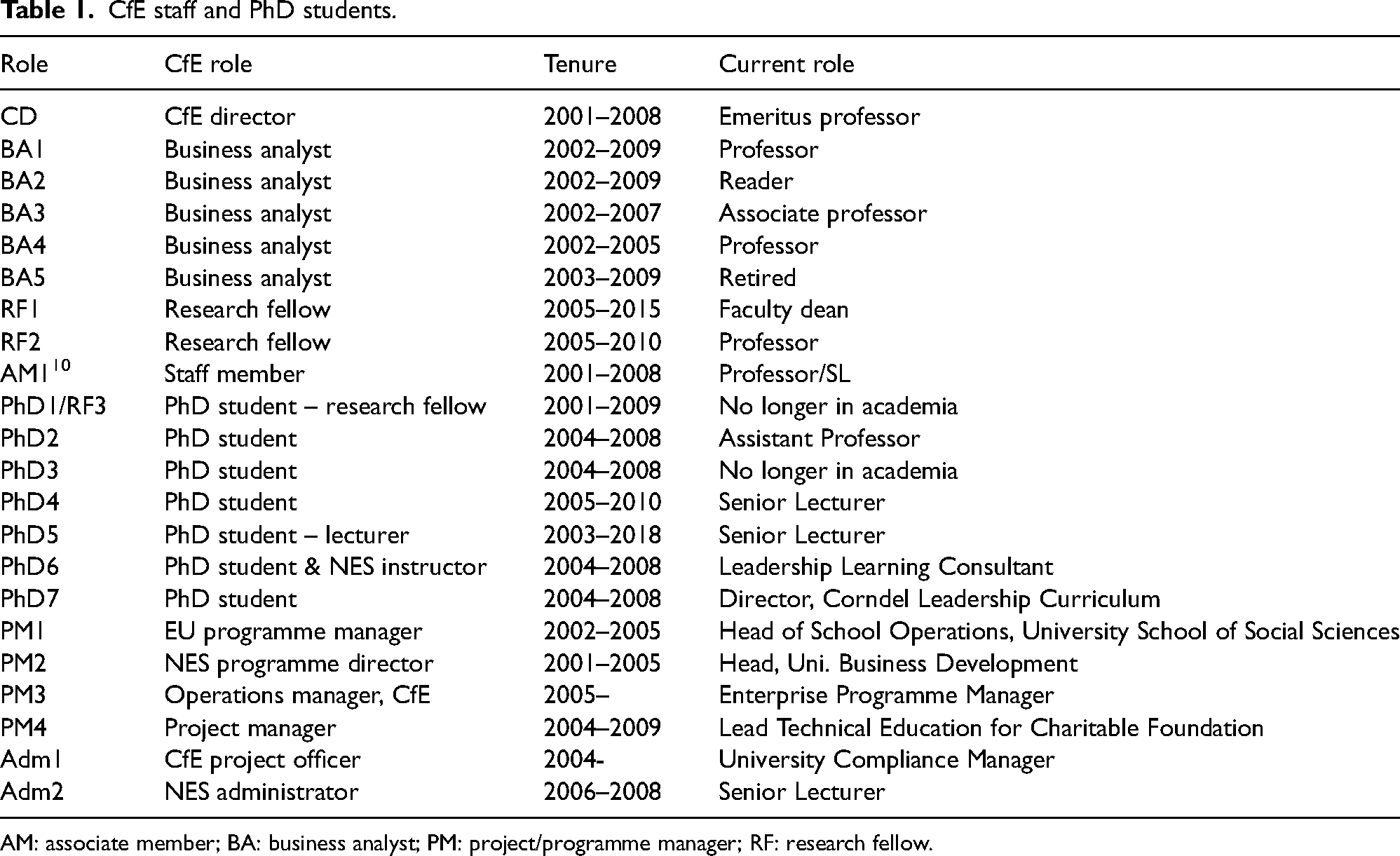
AM: associate member; BA: business analyst; PM: project/programme manager; RF: research fellow.
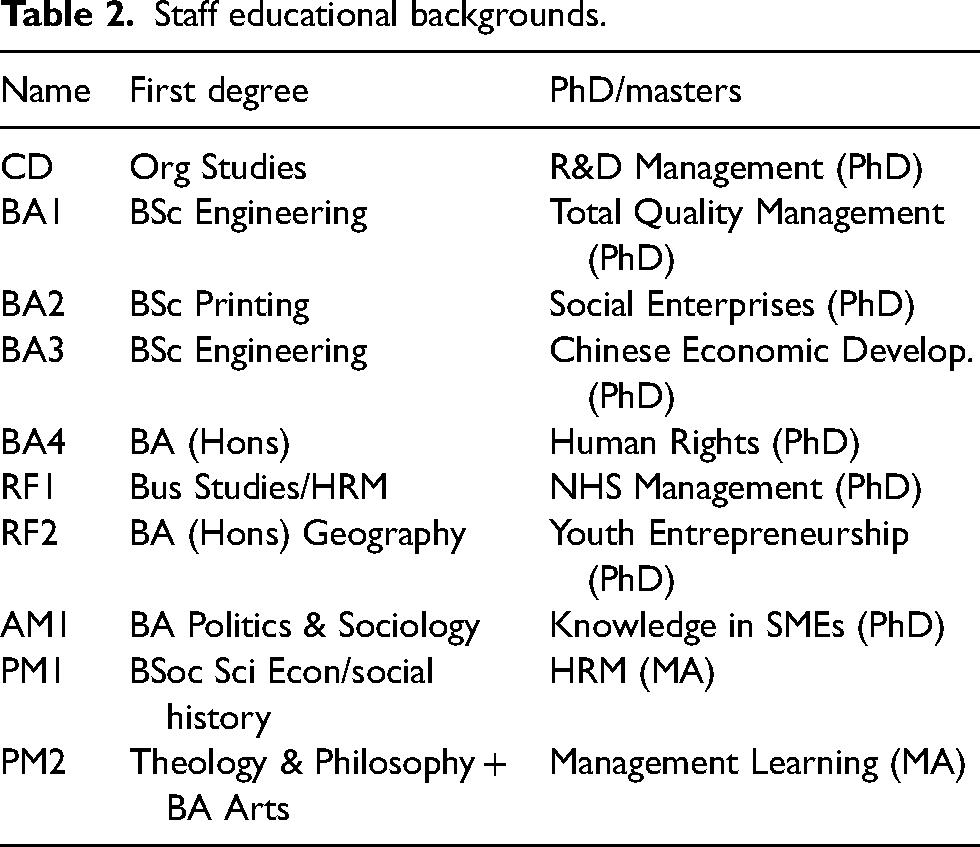
By recruiting young staff who had recently completed their PhDs, the expectation was that they would be committed to using practical engagement with small firms as a basis for conventional research outputs in the form of good-quality journal articles. Obtaining a £350k ESRC (Economic and Social Research Council) grant reinforced the importance of conventional research funding and publications to the future of the CfE. The new recruits were dedicated to pursuing academic careers and recognised the importance of publishing to ensure they were employable in the future. This was particularly important as all the business analysts, administrators and project managers were on fixed-term contracts linked to specific funding streams. Although most of the first recruits were under 30 years of age and were undertaking their first academic roles, there was a considerable amount of educational diversity (Table 2) and experience as well as an even male–female split. A strong commitment to research and engagement were more important than the areas of their undergraduate and research degrees and this diversity helped stimulate a creative research environment within the CfE.
Staff educational backgrounds.
The model for how the Centre should develop in the future was the Small Business Research Centre at Kingston University, 7 which combined practical engagement, journal and book publications as well as influencing policymakers (Blackburn and Smallbone, 2007, 2008). For example, in April 2008 the CfE hosted an event which examined the new enterprise landscape in response to the Labour Government's enterprise white paper (Bennett, 2008; Huggins and Williams, 2009). The event was focused on the Northwest and included key policymakers such as the Head of Enterprise for the Northwest Development Agency. Other organisations represented were Manchester and Salford City Councils, various Metropolitan Borough Councils, Northwest Universities Association, various Chambers of Commerce, a wide range of business support organisations and representatives from universities across the region. The keynote address was given by Professor Henry Etzkowitz, a leading advocate of the ‘enterprising university’ (Etzkowitz, 1998; Etzkowitz et al., 2000). As indicated in Figure 1, the overarching plan was to create a virtuous circle involving engagement with practitioners, evaluation of that engagement, conventional research outputs (journal articles) and meetings with local and national policymakers (Trehan et al., 2018). Establishing links to policymakers in the Northwest were halted when, in May 2010, the coalition government 8 announced that the nine English Regional Development Agencies would be replaced by Local Enterprise Partnerships (Broadhurst et al., 2023).
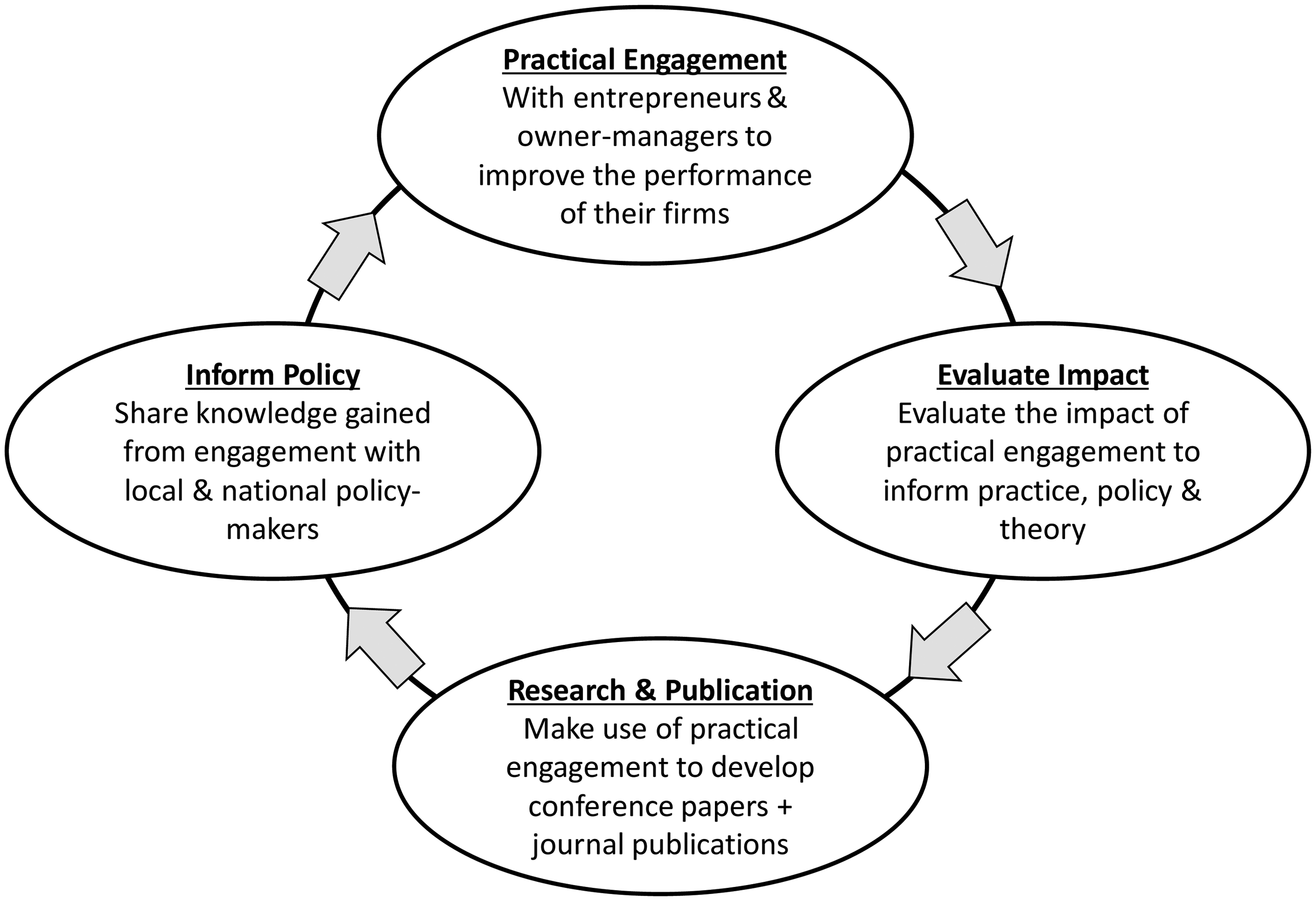
The virtuous circle of engagement.
Engagement with the entrepreneurship and small firm communities was extremely successful. All ERDF and ESF projects met the stringent EU output requirements including jobs created/protected and increased turnover. The evolution of business knowledge in small firms was the only EBK project, of 12, to be awarded an outstanding grade by ESRC assessors (Scarbrough, 2008). In terms of publications, CfE staff made a substantial contribution to the Business School's 2008 RAE submission (Table 3). The CfE also made a substantial contribution by obtaining £350k of ESRC funding for the EBK project, a 3-year ESRC doctoral studentship (£50 K), a Leverhulme grant (£30 K) as well as more than £9 million in external funding from a variety of sources including the Learning & Skills Council, various ERDF and ESF projects as well as several consultancy projects (Jones et al., 2008). In addition, all seven original PhD students successfully completed their doctorates.
CfE staff publications 2001 to 2008.
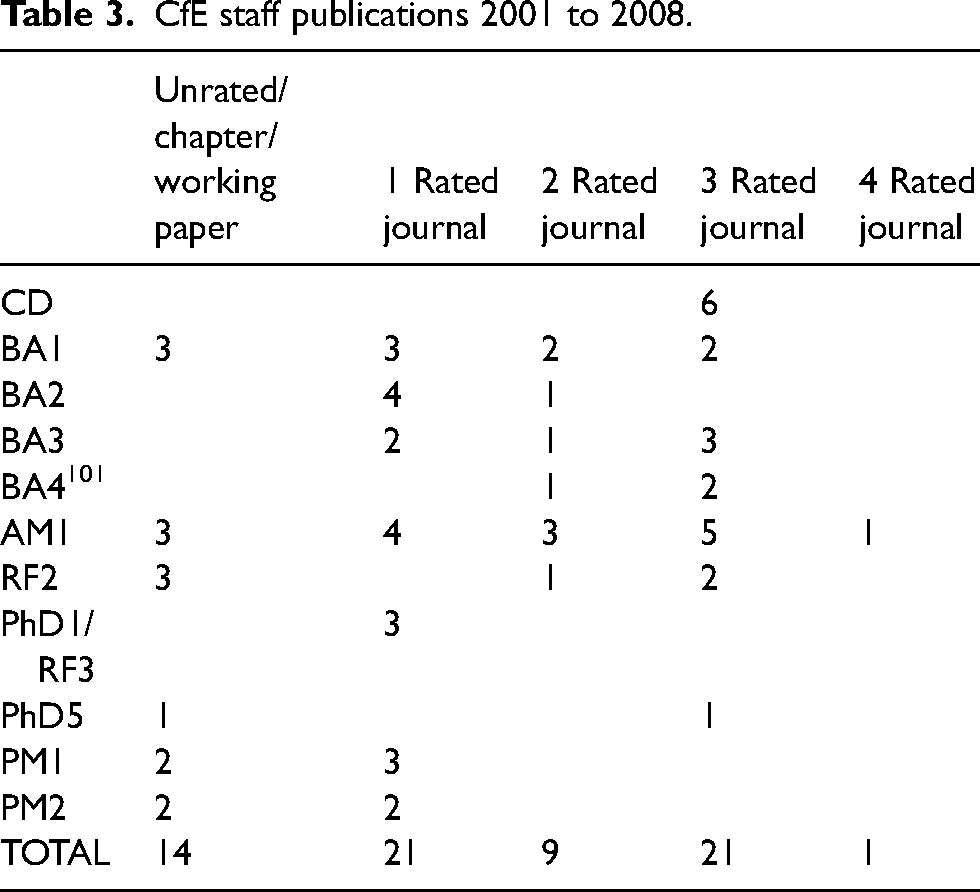
Because the CfE was entirely externally funded there was little interference with day-to-day activities from either MMUBS (dean) or the University (vice chancellor). In addition, only the CfE director had teaching duties and the focus was on delivering the various projects and preparing papers for conferences and publication. Initially, output from less experienced staff in the Centre were aimed at 1- and 2-rated journals (Bull et al., 2008; Bull and Crompton, 2006; Homan and Macpherson, 2005; Jayawarna et al., 2007a; Macpherson and Wilson, 2003; Rouse and Jayawarna, 2006; Taylor et al., 2004; Woollard et al., 2007). It is also worth noting that in the early years of the CfE both project managers (PM1 and PM2) were actively involved in research and publication (Table 3). Gradually, the team were able to publish in better quality (3-rated) journals, which supported the School's 2008 RAE submission (Jayawarna and Holt, 2009; Lee and Jones, 2008; Macpherson and Holt, 2007; Macpherson, 2005; Macpherson et al., 2004; Thorpe et al., 2005; Zhang et al., 2006). While this is not the full list of outputs from the early years of the CfE, it provides strong evidence of the creation of a research culture amongst core staff (see Table 3).
From the beginning, all team members were encouraged to engage in research-related activities as well as carrying out their duties on the various EU-funded projects based in the CfE. All members of the department regularly presented their research at a variety of conferences including the US Academy of Management, British Academy of Management (BAM), British Sociological Association, European Academy of Management (EURAM), Gender, Work and Organisation, Institute of Small Business and Entrepreneurship (ISBE), the Organisational Knowledge & Learning Conference (OKLC) and the R&D Management Conference. They were encouraged to submit early drafts of their research to the MMUBS working paper series as well as acting as reviewers. Staff were also expected to attend seminars held in MMUBS associated with ISBE and BAM, which included leading entrepreneurship scholars such as Michael Morris (Morris et al., 2002, 2005) and Sara Carter (Carter et al., 2004; Carter and Marlow, 2006).
The various research-related activities initiated within the CfE were intended to inculcate norms associated with presenting conference papers and publishing journal articles. CfE staff members were also linked into the wider academic communities within MMU itself as well as externally via the BAM and the Institute of Small Business & Entrepreneurship (ISBE). These links were facilitated by senior academic staff including the CfE director (on Board of BAM & ISBE) and head of the MMUBS doctoral programme (also BAM Board member). The success of this approach is demonstrated by the fact that most of those employed by the CfE from its inception in 2001 to 2010 went on to establish successful academic careers. Four are currently professors at leading UK business schools, one is Dean of Faculty, and five of the seven original PhD/MRes students are employed as academics at a senior lecture level or have key roles in private sector educational organisations. Those employed as projects managers and administrators have also gone on to have successful careers. Notably, PM1 who is Head of School Operations, School of Social Sciences in a leading UK University. While PM2 held several senior positions in other universities including head of business development. Adm2 who joined the CfE in 2006 as an administrator is now employed as a senior lecturer (Table 1).
Discussion: Towards an entrepreneurial research culture
The approach adopted here is based on the view that detailed case studies provide insight into how things work in a specific setting (Stake, 2013). Consequently, this research is primarily concerned with understanding (Verstehen) rather than explanation (Erklären) as pointed out by Abma and Stake (2014, p. 1150). At the same time, the CfE case is relevant to contemporary issues associated with the role of enterprise centres in the context of entrepreneurial universities (Dolan et al., 2019). Several scholars confirm that creating a research culture in new universities was difficult because most staff had little experience other than teaching (Bates, 2010; Du and Lapsley, 2019; Griffioen, 2020; Pratt et al., 1999) and few had research degrees (Sikes, 2006). One solution was to establish standalone facilities, known as university research centres (Boardman and Corley, 2008; Bozeman and Boardman, 2013; Pratt et al., 1999; Toker and Gray, 2008; Torres Zapata, 2019), often staffed with new recruits. Or, as suggested by Etzkowitz (2003), encouraging research groups to operate independently as ‘quasi-firms’.
Although the CfE at MMUBS was initially established to deliver a specific programme for disadvantaged individuals wanting to start their own businesses (Jayawarna et al., 2007b; Slack, 2005), it was recognised that the Centre could enhance MMUBS research activity. In addition to the NES programme, the main CfE funding was a large ERDF grant to improve the efficiency of smaller firms in Greater Manchester. As with all EU structural funds, there were very clear targets in terms of increased turnover and jobs created/protected. 9 The focus was on delivering practical solutions to help owner–managers improve the competitiveness of their firms. Four recruits employed as ‘business analysts’ on the ERDF project all had recently completed their PhDs. At the time of recruitment, it was stressed that this was an opportunity to use practical engagement as a basis for publications.
The key elements of the CfE entrepreneurship community of practice are illustrated in Figure 2. Individuals such as the head of the MMUBS doctoral programme were experienced publishers who acted as role models and mentors to inexperienced members of the team (Seet et al., 2018). In addition, a leading entrepreneurship scholar (Professor Alistair Anderson [Anderson and Air, 2022]) carried out annual reviews of the CfE's research output. Alistair had an unconventional background, including time spent working as a publican and a builder, which was inspiring to those starting their academic careers (McElwee and Smith, 2021). Hence, various internal and external boundary spanners (Cohen and Levinthal, 1990; Rosli et al., 2018; van Weele et al., 2018a) connected CfE staff into the wider entrepreneurship and small firm communities and encouraged them to build their own social networks (Elfring et al., 2021). Several studies confirm that a mix of individual characteristics including age, experience, education and gender have a positive impact on group research capabilities (Bozeman and Boardman, 2013; Boardman and Corley, 2008; Henry et al., 2020). While this diversity (Table 2) was not an explicit recruitment strategy it contributed to the formation of a creative environment where everyone was committed to developing their research careers (Ng and Pemberton, 2013; Véliz et al., 2023). As an example, all early publications were multi-authored and the composition of publishing teams changed regularly. These publishing teams also included both original programme managers (PM1 and PM2). As most original recruits were inexperienced, building a research culture followed a stepwise trajectory (Bosch and Taylor, 2011; Véliz et al., 2023). For example, early publications were working papers and conference papers. Gradually, 1- and 2-rated journals were targeted, and staff then began to publish in 3-rated journals and even one 4-rated journal (Table 3).
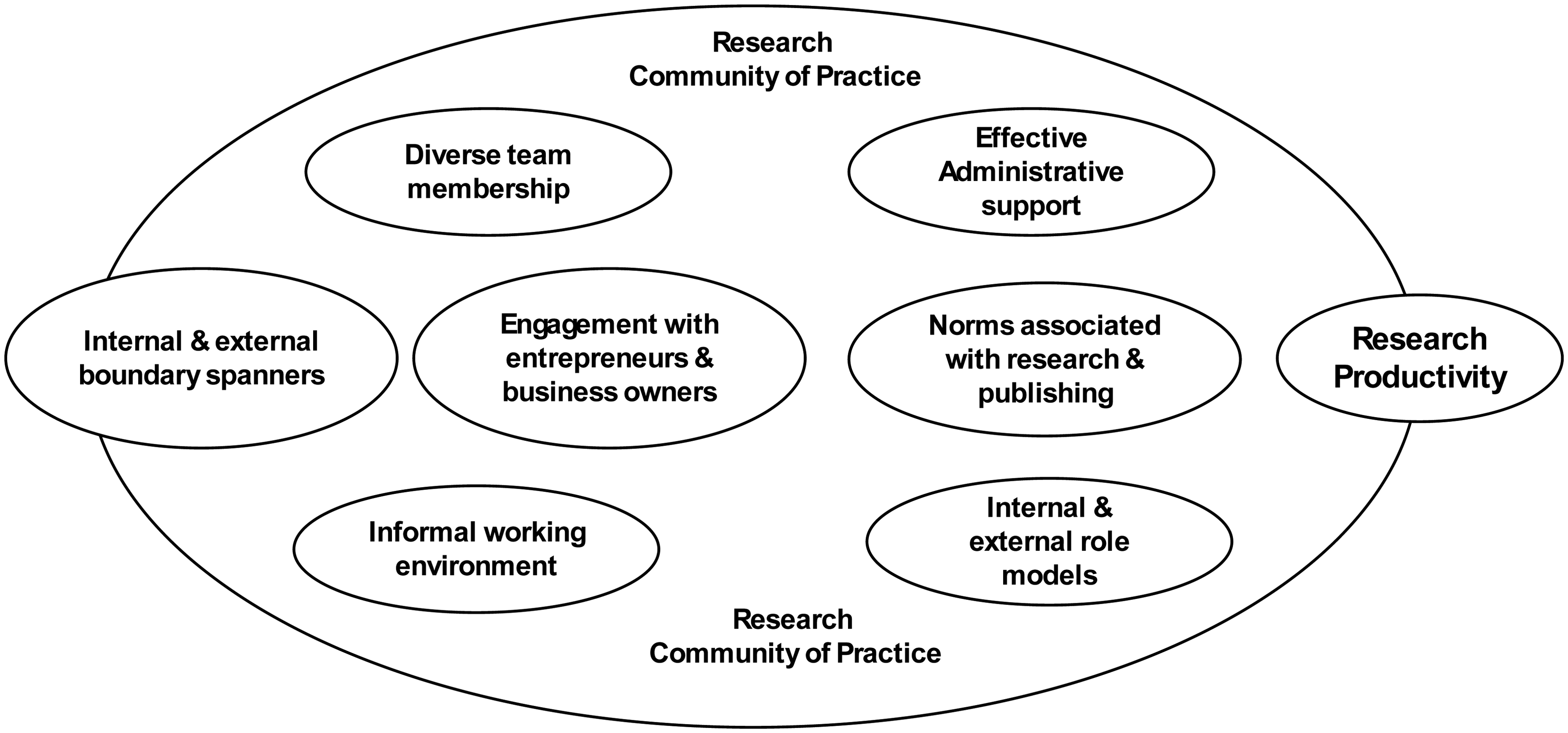
Entrepreneurship research community of practice.
The creation of an open research community of practice was central to the longer-term success of the CfE and of those individuals who have gone on to have productive academic and administrative careers (Table 1). Although most CfE funding came from practical projects aimed at helping disadvantaged entrepreneurs (NES) or improving the efficiency and competitiveness of small businesses (ERDF and ESF), staff were encouraged to use this engagement (Rossi et al., 2017; Whitehurst and Richter, 2018) as a basis for conference papers, working papers and journal publications. The CfE had an informal atmosphere with a collegiate management style (Baù et al., 2021; Torres Zapata, 2019), which helped reinforce the importance of translating practical engagement into tangible research outputs. Such informality was important in building a strong sense of community amongst the team, which had a positive impact on their research productivity (Henry et al., 2020; Torres Zapata, 2019). This sense of community helped establish norms and values related to the team's shared identities as researchers that reflected their interactions and values (Akkerman et al., 2008; Zhang and Watts, 2008). There were no formal targets related to publication, rather learning took place informally as new recruits participated in various group research-related activities (Handley et al., 2007; Lave and Wenger, 1991; Rigg et al., 2021).
In summary, it is important to state that the CfE was very different than most of the Enterprise Centres or University Research Centres discussed in the literature. Although the initial focus was on the delivery of practical projects (NES, ERDF and ESF), from the outset, CfE staff were encouraged to become active researchers and publishers. In general, literature on Enterprise Centres sees their roles as enterprise educators (Bell and Bell, 2016; Dolan et al., 2019) and encouraging students to develop entrepreneurial mindsets (Jones et al., 2021b; Secundo et al., 2020). Whereas the URC literature is primarily focused on knowledge transfer and knowledge sharing activities (Franco and Pinho, 2019; Lind et al., 2013; Noaman et al., 2022). Although located within MMUBS, the CfE was able to act as a quasi-firm (Etzkowitz, 2003) with little interference from either the dean or the vice chancellor. Equally, there were no external stakeholders and, consequently, staff had the freedom to publish while retaining their academic integrity (Noe and Alrøe, 2024).
The CfE case builds on early ideas associated with CoP, which focused on small occupational groups of learners (Lave and Wenger, 1991; Nicolini et al., 2022). The limited literature on research-based CoPs in higher education stresses the importance of overcoming intellectual isolation, building mutual trust, having a common purpose, undertaking collaborative research and having members with diverse backgrounds in educational and experience (Burt et al., 2022; Ng and Pemberton, 2013). As identified above, most literature on enterprise centres relates to building CoP amongst groups of students. The CfE case is unique in that it focuses on a research-based community of practice rather than education or knowledge-sharing. Figure 2 illustrates the important factors that contribute to a research-based CoP with a focus on publications. The model brings together seven factors central to the creation of an enterprise community of practice. One important issue which has had little research attention is the role of effective administrative support for the CoP (Tenhunen-Lunkka and Honkanen, 2024). Both programme managers were responsible for obtaining EU funding (PM1) and a long-term contract to deliver the NES programme (PM2). The programme managers were also involved in early research projects and contributed to several publications (Table 3).
Conclusions
Creation of the CfE in 2001 provided an opportunity to recruit staff to MMUBS who were committed to research and publishing. Initially, the Centre was entirely funded to help new entrepreneurs create viable businesses (Jayawarna et al., 2007b) and to improve the competitiveness of small firms (Jayawarna et al., 2007a). This practical engagement was the basis for a substantial number of publications by CfE staff (Table 3). Gaining experience of the problems faced by small firms helped staff from the Centre obtain a large ESRC grant to examine the evolution of business knowledge in SMEs (Scarbrough, 2008; Thorpe et al., 2005). As well as making a significant contribution to the 2008 RAE, most CfE staff have gone on to have successful academic and administrative careers (Table 1).
Several factors contributed to the remarkable performance of staff (both academic and administrative). Those employed in the early stages of the CfE (2001–2010) had diverse educational backgrounds (Table 2) and this diversity was reinforced by the creation of a community of practice (Brown and Duguid, 1991; Lave and Wenger, 1991; McDonald and Cater-Steel, 2017; Wenger and Snyder, 2000). As a result, team members were able to develop their academic identities by participating in group activities focused on research and publishing. Staff diversity also helped promote a creative environment which turned practical engagement into research outputs in the form of conference papers, working papers and journal articles. This is not necessarily a straight-forward process and it plays into the wider rigour-relevance debate (Harvey and Spee, 2024). Some authors suggest that it is not possible to undertake activities that are relevant to practitioners while producing academically rigorous research (Kieser and Leiner, 2009). While others believe that it is both possible and desirable to ‘interweave’ scholarship and practice (Spencer et al., 2022). From the outset, CfE staff were encouraged to translate their practical engagement with entrepreneurs and small firms into conventional academic outputs (Table 3).
Figure 2 extends existing ideas related to CoP by outlining the key elements of an enterprise CoP. This model has implications for knowledge, policy and practice. It would be useful to see this case study extended by examining the operation of a broader range of enterprise centres. For example, the underlying principles of Figure 2 could be applied to the sharing of best practices for engaging students in enterprise-related activities. From a policy and practice perspective, an important lesson from this case study is that there are no quick fixes for creating research centres. As demonstrated, above, the CfE was able to operate as a quasi-firm within MMUBS, which insulated staff from the day-to-day distractions associated with teaching and carrying out administrative duties.
It is a core element of qualitative research for authors to provide reflexive accounts in which they discuss ‘the process of knowledge generation in research and questioning taken-for-granted assumptions’ (Bell et al., 2022, p. 156). This is generally an acknowledgment by authors that qualitative research is influenced by the researcher's own values and biases. Other scholars are explicit in arguing that adopting a reflexive methodology is important in both social construction and abduction (Alvesson and Sköldberg, 2018; Dubois and Gadde, 2017). In practice, all types of empirical data are interpreted by researchers and, consequently, cannot be portrayed as definitive facts. According to Alvesson and Sköldberg (2018, p. 12) adopting a reflexive methodological approach should start at the beginning of a project and influence every stage of the research. This reflexive account is less ambitious and, although retrospective, it does outline the strengths and weaknesses of this study.
The narrative of events that occurred between 2000 and 2010 is supported by data provided in Tables 1–3, RAE results for MMUBS in 2001 and 2008 as well as information on ERDF/ESF and ESRC grants obtained by CfE staff (Jones et al., 2008). Some of the data in Table 3 is contemporary as it reports on the current roles of the original CfE members. Otherwise, the narrative relies on the author's account of activities that helped create the CfE's community of practice. These activities included the original recruitment strategy, building internal links with doctoral students and external links with BAM and ISBE, as well as various initiatives encouraging staff to begin their publishing careers. Nevertheless, this is a subjective account of how the CfE community of practice emerged and others would have a different view of the events described here. As outlined above, leading scholars argue that qualitative research cannot be judged by the same criteria as positivistic research (Bell et al., 2022; Dubois and Gadde, 2017; Morgan, 1983; Piekkari and Welch, 2018). To give authority to this account, the author relies on their standing within the entrepreneurial community to substantiate the ‘trustworthiness and authenticity’ of the study (Lincoln and Guba, 1986).
It is important to acknowledge that there are other limitations to this narrative about the emergence of a CoP. It could be hypothesised that the CfE's success was a ‘black swan’ event (Taleb, 2010) and it would be difficult to replicate the circumstances that brought together the original group. It would also have been impossible to predict that all those early members of the CfE as well as most of the first group of PhD students would go on to have successful academic careers. Equally, some original members benefitted from belonging to a group with diverse academic backgrounds while others would have been successful without joining the CfE. Another unique factor was that the CfE had a considerable amount of financial stability due, in part, to a long-term contract to deliver the New Entrepreneur Scholarship (Rouse and Jayawarna, 2006) and a 3-year ESRC project (Thorpe et al., 2005). Therefore, with one exception, the core academic members of the CfE remained in post for at least 8 years, which helped reinforce the principles underlying the community of practice.
To summarise, creating a genuine learning community of practice meant encouraging new staff members to work cooperatively as a group as well as with more experienced academics associated with the CfE. In addition, the new recruits were able to extend their personal networks, by joining key external institutions such as BAM and ISBE (Rosli et al., 2018). The experienced academics acted as mentors enhancing the know-what, know-how and know-who of less experienced staff (Seet et al., 2018).
Footnotes
Declaration of conflicting interests
The author declared no potential conflicts of interest with respect to the research, authorship, and/or publication of this article.
Funding
The author received no financial support for the research, authorship, and/or publication of this article.
