




Abstract
Over the last few decades, the rise of educational technologies has disrupted educational practices within universities. Routinely, edtech enterprises have received criticism that their product development is more aligned with service provision of software rather than pedagogically oriented products. This paper explores collaborative and contentious practices observed in a government-funded, large-scale innovation project that enabled edtech companies to work with university researchers in critically improving their products, processes and practices, in short, their ‘efficacy’. Drawing on and challenging the Community of Practice as a conceptual framework, the thematic and discourse analysis was conducted on the semi-structured interviews and written reports collected. In this Triple Helix space, the paper frames ‘moments of community’ as a construct that reveals what makes the joint enterprise, mutual engagement and shared repertoire work to drive the success of such innovation projects. Limitations of the study will also be outlined.
Introduction
Technology is increasingly enmeshed in educational contexts, to the point of being ubiquitous. The educational technologies (edtech hereafter) sector has witnessed significant growth and business expansion, particularly since the COVID-19 pandemic and consequent rapid reliance on digital education provision and software (EduGrowth, 2022a; EduGrowth, 2022b; HolonIQ, 2020; Vicentini et al., 2022). However, a prevailing concern within the educational community is the tendency of edtech products to prioritize service delivery over purposeful and pedagogically sound contributions (Bayne, 2015; Bayne and Gallagher, 2021; Selwyn, 2014; Selwyn et al., 2021; Williamson and Komljenovic, 2023).
One means of resolving this is through collaboration between academic experts in education and the edtech industry. However, in a systemic review of university-industry collaboration (UIC) in education, Zhuang and Shi (2022) observe that “the vast majority of studies on UIC are centred on joint research, technology transfer, construction of knowledge blocks, patent-related challenges, and other undertakings that manifest clear economic, societal, and institutional advantages” (p.1). Notably, these studies largely focus on tangible benefits to both university and industry while neglecting the potential of educational collaborations for improved learning experiences and outcomes. Moreover, Horta (2022) critically challenges the notions of trust and incentives across academic and innovation systems. He argues that academic research increasingly focuses on knowledge transfer and application with less trust and incentives; and that academic knowledge therefore needs to be carefully integrated for innovation to emerge with external actors, such as governmental bodies. This is also essential if universities are to contribute to productive societal and economic impacts for the future.
The “Triple Helix model of innovation” provides a means to recognise the interrelationship of academia, industry and government. Cai and Etzkowitz (2020: 196) describe its purpose as “foster [ing] regional economic growth and promot [ing] entrepreneurship, through understanding the dynamics of interactions between three institutional spheres of university, industry, and government”. While under theorised, it does offer a useful operationalisation of ways government can promote conversations between universities and industry. However, this does not take into account the particular sociocultural context of education, where a joint objective may be to improve learning experiences and outcomes, rather than ‘innovation’ or commercial outcomes. In order to understand the dynamic and often contentious convergence of the edtech sector, universities, and governmental entities, this paper therefore explores how innovative collaborations evolve when the prime objective is to improve learning experiences and outcomes within the context of a Triple Helix model of innovation.
While there is a body of existing literature exploring the complex nature of collaboration across global universities (Joughin et al., 2022; Larsson et al., 2005), this study focuses on the nature of multi-layered and contested collaboration across industry, government and knowledge creation institutions (i.e. universities) which has been under-theorised (Faisal et al., 2017; Horta, 2022; Zhuang and Shi, 2022).
With this in mind, this study is driven by the research question: How are practices negotiated across researchers, edtech companies, and government departments in collaborative processes? To address this question, and as a way of exploring the sociocultural dynamics within the innovative collaborations, we draw on Community of Practice (CoP) as a theoretical resource. CoP is a widely used framework for understanding social action, particularly when investigating the way in which a defined group of people within organisational units interact in the pursuit of a common goal. In this study, the application of CoP was intended to help us gain insight into the opportunities and challenges faced in rapid innovation collaborations situated at the nexus of a government sponsored, edtech driven, and university guided project.
Community of Practice (CoP) as a conceptual framework
CoP provides a theoretical framework to understand how practices are adopted, adapted, or changed within and across a group. CoP is complex, with a number of notable variations across the longstanding history. This paper adopts the framing of Wenger’s 1998 conceptualisation, which substantially differs from Wegner et al. (2002) approach (Henderson, 2015). Within this framework, practice is more than what we do. As Wenger (1998) noted: “Practice is, first and foremost, a process by which we can experience the world and our engagement with it as meaningful” (p.51). It is how we understand and interact with what goes on around us. At the same time, our identity is socially negotiated, balancing how we perceive ourselves and what is important to us with the social practices valued by the community (Henderson and Bradey, 2008). In this study, CoP permits us to conceptualise, explore and critically reflect on how innovation teams learn to work together at the heart of converging edtech, university, and government agendas.
CoP offers a sociocultural perspective on learning, emphasizing that learning occurs in social contexts through participatory engagement. The theory rejects the notion of knowledge as a mere commodity to be transferred from one person to another. Instead, Wenger (1998) argues that learning is an active, participatory process through three key points of engagement: mutual engagement, joint enterprises, and a shared repertoire. These ideas act as levers into exploring how innovation teams might function and we elaborate each in turn.
Joint enterprise is the shared concern, interest, or passion that brings the community members together. It may be explicitly articulated in a mission statement or goal, but it is often more tacit or a mixture of both. Joint enterprises are the activities and outcomes collectively understood as being valued or valuable. The responsibility of a community’s members goes beyond just completing tasks; it is about understanding and negotiating the community’s purpose. The joint enterprise evolves as the community pursues its shared interest. As this shared concern evolves, it also shapes how community members perceive their roles and the broader world. New practices that harmonize with this joint enterprise are more likely to gain traction. Conversely, those practices that deviate or challenge the community’s shared interest face resistance, as they might be seen as misaligned with the community’s core purpose.
Mutual engagement, meanwhile, speaks to the web of relationships and collaborations that bind members. This is not a mere alliance of convenience, but a deep-rooted system of interactions anchored in recognition of each other’s competencies and roles. It is through these consistent engagements that innovations are introduced, discussed, and either refined or repelled. The very nature of these relationships can expedite the adoption of certain practices, especially if they strengthen the communal bond. However, these interactions, laden with established norms, can also pose barriers. A tightly knit community, steeped in its historical traditions and interactions, might resist practices that disrupt the status quo.
Shared repertoire represents the community’s cumulative resources developed over time, encompassing routines, tools, symbols, and more. The shared repertoire is both a product of the community’s collective learning and a tool for future interactions. As members engage and negotiate meaning, they contribute to this repertoire. It also offers a foundation to assimilate or adapt new practices, ensuring they are contextually relevant. It can also serve, however, as a bulwark against change. Established tools and routines, revered in their familiarity, might challenge the entry of innovations that threaten to displace them.
It is useful to note, particularly in the context of this project, that the language of ‘joint’, ‘mutual’ and ‘shared’ should not be taken to mean that a community’s practices are always harmonious or homogeneous (Henderson, 2015). Participation could be marked by aggression, competition, friction, and a lack of emotional attachment. Despite this, such a community can still achieve cohesion (Wenger, 1998). In the same vein, conventional academic and professional narratives often suggest that a CoP is intrinsically tied to regeneration, innovation, purpose and reflexivity. However, a more nuanced understanding of CoP would acknowledge that it also involves the power dynamics inherent in maintaining the status quo alongside the evolution of practice (Henderson, 2015). The delicate interplay of a community’s shared interest, relational dynamics, and accumulated resources collectively determine the fate of new practices, guiding their acceptance or resistance.
CoPs are not isolated entities; they often interact with other CoPs. When members from different communities come together, the dynamics can become complex, revealing novel opportunities for learning and growth as well as challenges. For example, we need to be cautious of assuming that a tool, strategy, or process in one community can be transferred to another, even if it appears to meet the needs of the receiving community. The members of the community need to be able to imagine their use of the tool and negotiate how it fits with their shared repertoire, joint enterprise and mutual engagement.
Two concepts are particularly relevant in understanding how practices are mediated across communities: brokers and boundary objects (Wenger 1998). Brokers are individuals who connect multiple communities. These individuals possess the ability to introduce elements of one community into another. Brokers play a role in interpreting and translating these practices in a way that the receiving community can comprehend and assimilate. While brokers do not have to be full or established members of a CoP, they require “enough legitimacy to influence the development of a practice, mobilise attention, and address conflicting interests” (Wenger, 1998: p. 109).
Boundary objects, on the other hand, are artifacts, tools, processes or concepts that are bridges between CoPs. The same object, such as a reporting template, can be simultaneously used and understood differently by members of different communities (such as a reporting template used by the funding body and the edtech innovation team). As the CoPs come together to negotiate how to use, respond and communicate about the boundary object, new understandings and forms of participation can emerge. The boundary object serves as an interface through which both communities can experiment with how they come together (mutual engagement), what matters (joint enterprise), and how to achieve those goals (shared repertoire) (Wenger, 1998). When boundary objects are malleable enough to be adapted to the needs of different communities, they can aid in the assimilation of new practices. However, if a boundary object is too rigidly embedded in one community’s practice, it can act as a barrier. It may make it challenging for the community to see beyond its established use or meaning and hence resist new interpretations or practices associated with that object.
Case study: The Edtech Innovation Alliance project
The Edtech Innovation Alliance (EIA) was an innovative approach to edtech development, involving “… activation of testbeds or pilots; run efficacy trials of Victorian EdTech products, in Australian and international education settings, in a structured formal framework” (EduGrowth, 2022b). The EIA deliberately employed the “Triple Helix of innovation model” (Etzkowitz and Leydesdorff, 1995; Etzkowitz and Zhou, 2017; Viale and Etzkowitz, 2010), which can be broadly understood as “a metaphor for the relationship between university, industry, and government” (Cai and Amaral, 2021: 218). The program was funded by an arm of the Victorian state government, Global Victoria, and administered by an Australian non-profit educational technology industry hub, Edugrowth. A two-university consortium provided academic oversight of the efficacy trials with a view to capability building. Nine edtech companies successfully applied for funding provided by Global Victoria and participated in 6-month ‘sprints’ – where these sprint teams embedded their products into school or university environments – within an evaluation framework. Thus, the EIA brought together a government program, university expertise, the edtech industry, and their products.
The primary aim of this funding was to enhance the engagement of edtech companies with academic research and pedagogically-driven feedback, thereby facilitating the improvement of their digital resources and providing evidence of their efficacy. During the funding application process, industry organisations submitted applications detailing their needs, aspirations and objectives. After a rigorous evaluation process, winning organisations were chosen based on the merit of their applications.
The companies funded to participate in the EIA were diverse regarding product focus, maturity and size. The edtech products included technology-mediated feedback from students to teachers, analytics, and assessment and assessment management platforms—all required gathering of data from at least one international and one Australian context. Companies participated in workshops outlining a four-facet model of efficacy – namely, process, intended outcomes, acceptability and feasibility – that went beyond a simple ‘does it work or not’ approach. Subsequently, academics from four universities offered academic support – or became ‘research mentors’ - to the selected industry organisations.
The sprint teams then were supported by these academics to collect and analyse various educational data relating to their sprint while working with their partners in schools or universities to improve their products and efficacy. Each sprint team was required to submit sequenced templated reports (‘templates’) – a pre-sprint ‘needs analysis’, a baseline evaluation, a mid-sprint evaluation, an end-of-sprint evaluation, and a final report that reflected on the whole project. As per the governance structure of the EIA project the collaboration between each academic and industry team was overseen by a trio of senior academics from the two partnering universities, two of whom are authors on this paper. These senior academics liaised with Global Victoria and its delegates to guide and relay the program’s progress.
As noted in the final report, key achievements of the EIA include “…incorporat [ing] end-user feedback into product design; better understanding of education settings and their use of technology; understand [ing] product-use cases and hon [ing] go-to-market strategies; prov [ing] value of solution and evidence of effectiveness (EduGrowth, 2022b: 11).
Problematising the case
CoP as posited by Wenger (1998), underscores the dynamic interplay of shared interests, relational engagements, and accumulated knowledge in shaping practices within a community. This sociocultural perspective highlights the power of communal bonds and shared endeavours in driving change, while also acknowledging the potential challenges and resistances faced by disruptions to established norms. Building off this perspective, the authors of this paper were faced with an intriguing proposition within the EIA: melding the expertise of educational researchers with the practices of an edtech company. In the high-stakes realm of edtech, where user experience and market considerations often overshadow pedagogical integrity, an educational researcher can serve as a bridge. Acting as a broker, the researcher could illuminate the complexities of educational practices, ensuring that technological innovations are not just market-driven but are rooted in sound pedagogical principles and practices, including the generation and analysis of complex educational data. Such a partnership would not only infuse the edtech space with robust educational strategies but also foster a richer, more nuanced understanding of the potentials and challenges inherent in marrying technology with education.
As the landscape of educational technology evolves, so does the necessity for multifaceted partnerships that can navigate the complexities of research, industry demands, and governmental regulations. Such collaborations, while promising in potential, are rife with challenges and opportunities that hinge on negotiating practices across these diverse entities. Understanding these negotiations and relationships is pivotal not only for the success of such partnerships but also for the broader implications they hold for the edtech sector. Against this backdrop, this study of the EIA has sought to address the primary research question: How are practices negotiated across researchers, edtech companies, and government departments in collaborative processes?
Methods
In order to delve deeply into the multifaceted relationships, processes, and outcomes within its constituent partnerships, this paper presents a case study with the EIA as the unit of analysis, (Yin, 1992, 2009). Innovation partnerships spanned multiple countries, each with its unique socio-cultural, economic, and institutional contexts that could influence the nature and outcomes of industry-academic collaborations. A case study approach enabled a nuanced investigation into how these contextual factors interacted with the partnership dynamics in each setting while applying the CoP as a conceptual model for analysis.
Participants in the EIA were diverse, encompassing individuals from various academic disciplines and industries. This diversity was not just in terms of their professional backgrounds but also in terms of their roles and perspectives on the partnerships. Engaging with such a heterogeneous group required a method to capture the richness and complexity of their experiences, practices and insights. Furthermore, each sprint team within the study was unique in its objectives and outcomes and how the collaboration was structured and executed. Some teams were driven more by academic curiosity, while others were more oriented towards industry needs.
In light of these considerations, in-depth interviews with key participants in each sprint team were conducted, supplemented by document analysis of the final written reports. University research ethics committee approval was received; and all participants provided consent.
Interviewees
EIA project interviewees.

Data collection
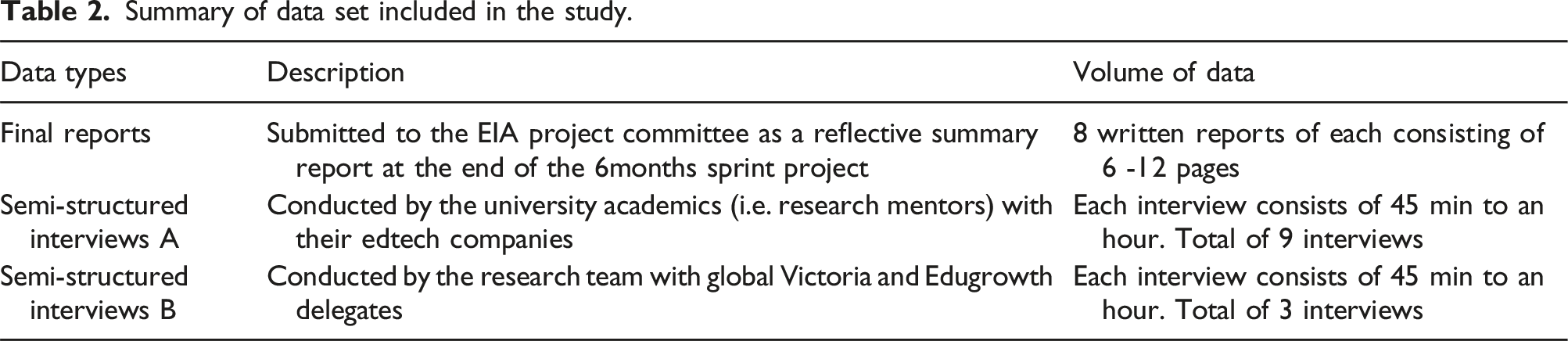
The data collection consisted of semi-structured interviews with key stakeholders, individual team reports, and the overall project final report. The interviews were conducted and recorded via online platforms. Given that most of these partnerships were cultivated and sustained in a digital environment, using online video interviews was a logical choice, aligning with their established mode of communication. Representatives from Global Victoria and Edugrowth were also approached for interviews by the research project team to gain a comprehensive perspective on the collaboration. Following the interviews, verbatim transcripts were generated to ensure accuracy in capturing the participants’ insights.
Summary of data set included in the study.
Data analysis
The data analysis was both inductive and deductive, largely drawing on from thematic analysis methods - in particular for reflexive thematic analytics (Byrne, 2022; Vaismoradi, 2013). In the inductive phase, interview transcripts and written reports were analysed to discern common and significant themes. As each new transcript and report was incorporated into the dataset, themes were inductively created from groups of codes and were iteratively reviewed. The research team then collaboratively and critically assessed these inductive themes, leading to further refinement. Subsequently, the deductive phase employed the Community of Practice conceptual framework to delve deeper into the data, providing an additional lens to interpret the entire data set more holistically.
Findings
The data revealed transient but meaningful connections between actors. These moments resonate with the concept of CoP (Wenger, 1998). The interaction in this study revealed how the sprint teams formed relationships and engaged in practices that, while temporary, were significant in the successful completion of the projects. However, the temporality and nature of interaction has led us to conceptualise these connections as ‘moments of community’ rather than CoPs, which are understood to be formed over and sustained through a period of time.
In drawing on CoP, and adopting a conceptual framing of ‘moments of community’, we observed six key dynamics that supported and troubled the sprint projects: i) the relationships underpinning these ‘moments of community’; ii) disconnected actors and communities that caused confusion and competing agenda; iii) generative conversations in developing ‘moments of community’; iv) other surrounding communities such as customers and end-users; v) the role of templates in supporting these moments; and vi) what could be inferred to persist beyond these moments.
Relationships underpinning ‘moments of community’
Complex and dynamic relationships were at play across multiple stakeholders and their communities. One prominent relationship was between the university academics acting as research mentors and their mentees, the ‘sprint team’ members of the edtech companies. Another significant relationship was between the edtech companies and the end users of their products – namely, teachers, students and administrators. In addition, there was a triadic relationship between the research mentors, sprint teams and the overall EIA project management team, who were from the small non-profit charged with oversight, enabling and managing all the relationships. All these relations were created temporarily within the constraints of the project and came together in different constellations for various activities and purposes across various times and places. One of the most significant constraints was time: edtech companies were required to complete the project in 6 months while engaging in meetings with mentors, negotiating the efficacy template, and producing multiple reports. Participants viewed this in different lights: Personally, some of the workload implications were quite hard….. at times time constraints felt quite challenging (Edtech company A) I’m really happy that the program was really short because it forced us to get it done quickly, and that way, we can get on with it. (Edtech company B)
This short-term intensity did not lend itself to developing a CoP in the deeper sense – with joint enterprise, mutual engagement and a shared repertoire - but rather, ‘moments of community’ where practices joined together in a microcosm, in service of the work that needed to be done in a timely fashion.
Disconnected actors and communities: confusion and competing agendas
‘Moments of community’ were built over time through goodwill and compromise. In the early stage of the project, a certain amount of confusion and uncertainty was expressed regarding the role of research mentors project processes and even the purpose of the partnership. Some of the edtech companies were not aware that they were going to be matched with research mentors. In contrast, others thought that the research mentors were going to be doing the ‘heavy-lifting’ of research by gathering and analysing the data to produce the reports and templates for edtech companies to evidence the efficacy of their product. I mean, maybe not resolved, we just accepted that there was a miscommunication in terms of the project or whatever (Edtech company A).
The lack of clear understanding of roles and associate expectations hindered collaborative work: I think the introduction of the research component of the Sprint was a source of frustration and again sort of realigning at my expectations with what was actually going to happen and how it was going to happen. And the way that was communicated to us initially, so that was a bit of a source of frustration (Edtech company B).
This required a certain level of trust and goodwill to persist with the EIA project. Most sprint teams eventually made sense of how they worked as a collective across various relationships with other stakeholders: I feel like this whole thing works well and brings out a really good result because we've got a good team working together, and everyone does their part really well in a sense, yes. (Edtech company C)
A sense of mutual engagement was formed through regular engagement, a relatively short timeline, and the genuine need for the mentors and mentees to work with each other to negotiate the efficacy template and reporting requirements. However, even though these moments of community indicated a recognition of each other, this did not mean the initial ‘miscommunications’ were necessarily ‘resolved’, but elided. Indeed, this willingness to work within a degree of ambiguity became a characteristic of successful moments of community. The temporality of these moments allowed for collaborations that might otherwise have stalled in the face of typical CoP dynamics of membership and the negotiation of participation.
Developing ‘moments of community’ through generative conversations
Generative conversations facilitated by research mentors played a vital role in contributing to ‘moments of community’ between university academics and sprint teams. This was seen as bringing value through a level of robustness and academic rigour to the project. Working with you (researcher) has been really helpful, I think, having just another pair of eyes and another sort of brain helping me expand the way I think about the collection of and analysis of data and working through. Obviously I’m not a researcher so working through some sort of different perspectives from, that has been really valuable and the consistency and the cadence of working with you has been wonderful (Edtech company E).
Over the course of the project, the research mentor had become recognised as a valued part or extension of the team. This legitimacy of participation enabled the mentor to broker new thinking and tools to the team, shaping the joint enterprise (what is valued) and expanding the shared repertoire (i.e. the tools to achieve it): We're focusing on the process and capacity building. Rather than the actual product, the process of you and I working together and how we've built each other's knowledge and capacity. Benefits of the project, benefits of the partnership (Edtech company D).
From the EIA project management perspective, the productive result of bringing researchers and edtech together was the primary purpose of this project because: …in my life experience, that commercial people rarely talk to researchers at all (Senior delegate Edugrowth).
While these conversations supported the creation of new knowledge through generative conversations, these were mostly ephemeral relationships, bounded by pre-arranged meetings and the completion of templates.
Although the ‘moments of community’ were brief, they were frequently marked by successful team dynamics, including a sense of solidarity across diverse relationships. These were punctuated by moments where all parties learnt together in intra-group dynamics: I really valued the Roundtable discussion, I would have, you know, enjoy doing another one just to get an idea of where you are kind of sitting with your experience and your process and how everyone else is travelling where similarities lie and some ideas around it's just really nice to even just to understand what the other projects are and how they're running them and how they're designing their research (Edtech company E).
In sharp contrast to the generative conversations, accountability exchanges took place between edtech companies and the EIA project management through mandatory monthly project catch-up meetings. These conversations involved completing a reporting template, which needed to be ‘ticked off’ as the project progressed - to be accountable to the governing and funding body in ensuring the progress and delivery. While pragmatic, there was little sense of a joint enterprise or shared repertoire here but an exercise in transactional accountability. A key difference between these transactional moments and the moments of community observed in the mentor-mentee teams was the degree of negotiability around the processes and the efficacy template which acted as a boundary object.
Customers and end-users: relationships with other communities
The sprint teams had a further set of joint endeavours with institutional customers through the EIA project. In this, they provided the edtech to end users, who were generally teachers and/or students. The edtech companies contributed a significant amount of energy to maintain good relations: I was burning quite a lot of social equity with these academics [customers] who I, spent a long time kind of building this relationship with them….. you know…success of pilots is having a strong relationship (Edtech company A).
Edtech companies were cognisant of the multiple relationships they were managing and interacting within the project. Some of those customer relationships already existed before the project, and were regarded as important leverage but also capital: We kind of already had relationships with the academics….those relationships simply already existed (Edtech company A).
Managing these multiple relationships took time and effort, and sometimes specific personnel: …essentially, we were focusing on engaging with the mentor partners - the education providers - and also with the mentors and mentees themselves, ensuring that all the mentoring sessions are going well (Edtech company C).
For the most part, the EIA project management team and the university academics did not interact directly with customers or end-users; these joint enterprises sat outside the overall project relationships despite being central to the EIA itself. However, the customers and end-users provided the quantitative and qualitative data, which translated their presence to university academics and the EIA project management via the reporting templates. This was not always successful: some edtech companies were unable to collect the requisite data due to technical issues with their product or timing/logistical issues in terms of usage. I mean part of the problem was that we weren’t able to get the survey done, the post-teacher survey done before the end of term which is what meant that we didn’t have some of this outcome data because teachers report that they made changes to their practice in response to the data. We just haven’t been able to ask the question yet (Edtech company F).
In short, these relationships indirectly related to the project teams and impacted the progress of the sprint team’s work, which was underpinned by set, tight timelines.
The role of templates in supporting ‘moments of community’
We interpret the research templates as a key means to guide those players towards these ‘moments of community’. They acted as boundary objects, legitimised by the brokers, by facilitating practices and interactions between the university academics and the sprint teams and the data derived from customers and end-users. On the other hand, the reporting templates appeared to act as a different set of boundary objects. For example, university academics were unaware of the project management monthly reporting templates, which meant that workload and cadence were not coordinated between these two types of templates. Thus, the second set of templates also served to interfere with the moments of community. The reporting was a bit, I felt, was a bit over the top in terms of the I guess in terms of what we needed into where, where it was adding value to the Sprint and to the overall project (Edtech company A).
From sprint team perspectives, the two sets of templates as boundary objects outlined the expectations of the project but also were means of evaluating their success. In short, they created boundaries for activities to occur in the project sequentially. Before I saw those templates, I had no idea really what the scope was. To me, it framed in my mind what the scope of this study was. (Edtech company C)
They structured the entire project: they mediated collective sense-making through negotiating how to deal with the data collected from customers and end-users. I started to realise that all the data being asked in those templates were really important for us to evaluate the efficacy of the program (Edtech company C).
Moreover, templates highlighted how the language of research was different between university academics and sprint teams: Even our language is really different. I’d read your reports and your use of language is quite different and ours is research academic language. I think we both learned from that, but that was probably one of the things that I wouldn’t have necessarily expected that our language would be quite so different (Edtech company D).
Boundary objects, such as templates in this case study, therefore can create a shared understanding of the work and practices, while at the same time, creating tensions on how the actors come together to participate in the joint enterprise.
What persisted past ‘the moments of community’
The connections between actors may have existed for short moments, but through these exchanges, the templates were written, which led to longer-term persistence for the sprint teams. They gained credibility through their collaborative processes: Because at the end of the day, without that proper academic rigour or perspective and input guiding the project, it just wouldn't lose, I think, total meaningfulness and its effectiveness as well and how much it's rated as well by the external world or the exporting countries that we are looking at in terms of the rigour and the evidence (Senior delegate GlobalVicroria). My one (aha moment) was just the value of having a framework that we will continue to follow in the future and constantly monitoring it and just the value of that. (Edtech company C). If I was to work with you again, it’d be a breeze and even if I was to work with someone else, I’d have a lot more idea than I had initially, but I agree that intro and the whole project is a first timer (Edtech company D).
The above illustrates that the temporality of moments of community can lead to a certain level of sustainability of their practices because of the situated learning that occurred within the EIA project. The sprint project’s short-term nature has created a new understanding and ways of conducting research for the longer term.
Discussion
In the novel learning context of the EIA where members of diverse expertise are forcefully or willingly brought together to work and deliver specific reports under tight time constraints, we saw collaboration was dynamic and momentary rather than fixed and focussed. We have called these collaborative exchanges, ‘moments of community’, so as to move away from our tendency to focus on a long-term and stable CoP. Indeed, we noticed multiple constellations of relationships across edtech companies, research mentors, a not-for-profit organisation managing the initiative and the government who funded it, as well as customers and end-users of students and teachers. By focusing on ‘moments of community’ we attend to the temporality of many dynamic relationships shaped by brokers who manage the project and boundary objects that mediated occasions of joint enterprise and mutual engagement.
These ‘moments of community’ are negotiated, enabled and hindered across a complex collaborative project. We noticed that the three components of community cohesion and participation – mutual engagement, shared repertoire, joint enterprise - emerge momentarily in a dynamic, non-linear and dialogic manner in conversation and collaboration with multiple players. For example, completing the templates provided intense moments of mutual accountability in the negotiation of joint enterprise; the regular meetings promoted relationships and a site of negotiating differences as mutual engagement; and through these activities, there developed a history of shared language and tools that enabled them to resolve problems and achieve goals as shared repertoire. These moments of cohesion are useful pointers to the types of activities which enabled the partners to learn about each other through working together. At the same time, as mentioned, there was not a sense that a CoP developed, but rather these were dynamic and momentary points of contact – however they were nonetheless productive.
Our findings also point to what enables and hinders productive moments of community – a set of practical implications for future practice and similar projects to be framed for successful collaboration. First, this type of agile, tightly controlled sprint project resonates with the business provision of the edtech industry’s product development. However, this was in tension with the time and resources needed to infuse academically and pedagogically driven educational research methodologies into such practices. This balance – between the need for speed and the slower time of research – was achieved for some teams and allowed them to harness the most from the experience. Second, in further thinking about successful collaborations across knowledge and business economies, the conceptualisation of moments of communities empowers future endeavours of research and collaboration within the field of digital education.
Third and finally, this work then builds on the Triple Helix model of innovation (Cai and Amaral, 2021; Cai and Etzkowitz, 2020) by offering a new conceptualisation of ‘moments of community’ to better understand units of activities and practices that enable and hinder collaboration and innovation. While the Triple Helix model usefully articulates the conditions and actors (such as the government, industry and university), this framework might give a simplistic perception of three strands being the sufficient ingredients for successful collaboration at the macro level. As Bychkova et al. (2015) suggest with respect to the Triple Helix: “The consequences of implementation of formal rules of usage are impossible to predict, because they are bound to collide with current informal practices.” This study suggests that a model that provides for the informal is appropriate but that we should not expect the development of stable CoPs. Rather, our framing of ‘moments of community’ allows a more granular analysis that dynamic relationships and interactions are at the heart of generative collaboration at the micro-level. We infer that it is those relationships among active participants within the innovation space that bring about innovation, rather than the seemingly orchestrated conditions created by funding bodies such as the government.
Limitations of the study
There are potential limitations of this study that need to be acknowledged. Firstly, the framing of this EIA project being ‘innovative’ to begin with might have influenced how participants thought about innovation. Second, the limited scope of this project involved nine sprint edtech teams along with the small number of stakeholders from the government and not-for-profit bodies set in a single context of the state of Victoria in Australia. Therefore, the findings from this study might have less relevance to other specific contexts of innovation and collaboration that evolve around edtech, universities and government. Further research would be beneficial to focus on the subsequent cases and contexts where those (moments of) communities and their practices may continue to evolve beyond the execution of ‘sprint’ innovation projects such as the EIA and evaluate its longer-term impact for the sustainability of professional learning that might have occurred.
Conclusion
In conclusion, this paper explored the potential and nature of collaborative innovative endeavours between edtech, universities and government through analysing the EIA project. By applying the conceptual lens of CoP as framed by Wenger (1998), the analysis allowed us to foreground and conceptualise the ‘moments of community’ at work in complex and transient projects. Importantly, this conceptualisation of a new construct, ‘moments of community’ constitutes our contribution to the existing body of literature surrounding CoP, challenging the aspects of long-term and stable collaboration within communities. This paper has therefore shed light on how researchers, government bodies, the edtech industry, and digital education practitioners experience and conceptualise the contested, collaborative spaces and practices involving technology, pedagogy and product development. Extending on the Triple Helix model, our hope is that this paper inspires and encourages those players and actors in the collaborative and innovative spaces to go beyond the macro-strands of conditions but also to carefully design for the generative ‘moments of communities’ that may help centre relationships and lead to innovation.
Footnotes
Acknowledgments
This particular research project received no funding, though the original Edtech Innovation Alliance project received funding by the Victorian Government, Australia. We are grateful for all the participants that contributed to our interviews and sharing their insights that allowed us to better understand and conceptualise how communities, and ‘moments of community’ work in the innovative and collaborative spaces. We would like to thank the participants, brokers and organisers associated with the EIA project in Victoria, Australia. While there was no specific grants or funding allocated to this research project, we acknowledge the funding body of the Victoria Government, Global Victoria who enabled the EIA project and this research project.
Declaration of conflicting interests
The author(s) declared no potential conflicts of interest with respect to the research, authorship, and/or publication of this article.
Funding
The author(s) received no financial support for the research, authorship, and/or publication of this article.
