




Abstract
Although science parks (SPs) play a crucial role in rural development, little is known about their core elements in the context of emerging markets, particularly those focused on rural areas. Reflecting on the fragmented ecosystem literature, this study suggests that the core components of SPs that influence their success include (i) early/pre-incubations, (ii) business incubations, (iii) accelerators, (iv) landing (larger and established) firms, and (v) universities/research institutions that collaborate closely with industry, local communities and governments, with all these bodies being interdependent and interacting. Revealing the unique idiosyncrasies of rural SPs (i.e. limited resources, lack of education, transport and infrastructure), we show how SPs incorporate those challenges and extend the ecosystem concept.
Introduction: Science parks in rural areas in emerging markets – a fragmented landscape
Science parks (SPs) 1 are defined as ‘organisations managed by specialised professionals, whose main aim is to increase the wealth of [their] community by promoting the culture of innovation and the competitiveness of [their] associated businesses and knowledge-based institutions’ (International Association of Science Parks). 2 SPs have been at the forefront of national development, as they successfully promote economic and regional growth (Hasan et al., 2020). They facilitate the creation and growth of start-ups by providing incubators and accelerators that help these start-ups gain access to training and mentoring programmes, advisory services and networking opportunities that accelerate their scaling-up. SPs are often part of entrepreneurial ecosystems (EEs) 3 because they usually serve as a bridge between research, innovation and community wealth (Abootorabi et al., 2021). There are increasing calls, as emphasised by Aarstad et al. (2022), to consider the geographical heterogeneity of a region (i.e. the population density of an area) in entrepreneurship studies, as in regions with lower population density (small cities) a collaboration between incubators and Research and Development (R&D) environments encourages a rise in entrepreneurs compared to cities/regions with a higher population (urban areas). Elkafrawi and Refai (2022) have also emphasised the necessity of distinguishing rurality in emerging markets from rurality in advanced markets, considering that rural environments deal with additional challenges for entrepreneurship (i.e. lack of financial resources, lack of skilled people, and lack of motivation). Indeed, the location choice of SPs in a country (or region/area) may foster or hinder entrepreneurial activities (and their success) in heterogeneous environments, such as an entrepreneurial ecosystem in rural areas influencing a firm's creation and growth.
Although there are some studies that have focused on isolated components of SPs in EEs, a more nuanced approach is necessary. This approach should move beyond individual entities to consider the broader, interconnected dynamics of key components of SPs to gain a deeper understanding of EEs. Most of the previous studies have predominantly focused on urbanised contexts in either advanced (e.g. Cohen, 2006; Motohashi et al., 2009) or emerging markets (e.g. Molina et al., 2011; Ringlever, 2012; Villegas & Pérez-Hernández, 2013). For instance, Abeuova (2022) explored accelerating ventures in Kazakhstan, while Nair and Blomquist (2020) examined Swedish incubators, linking them not only to the venture growth, but also to the value creation delivered to different stakeholders. Based on consideration of the context of a leading emerging market – Mexico – this research note unpacks the key elements of SPs in rural areas, 4 enriching and extending the ecosystem concept. I argue that, in emerging rural areas particularly (i.e. areas of deficiency regarding support, financial services, information, intellectual properties, and laws), SPs serve as connecting institutions where various (national and regional) innovation stakeholders can collaborate to foster and promote innovation.
Why do rural SPs in emerging markets such as Mexico matter?
Mexico is one of the fastest-growing emerging markets in North America and it ranked among the 15 largest economies in the world in 2023 (Statista, 2023). It is also a knowledge-based market where technology and innovation play a catalytic role in the competitiveness of its economy (Molina et al., 2011). Notably, the proportion of the entire population residing in a rural environment in Mexico was approximately 18.7% in 2022, although there was no notable change in this year compared to 2021 (OECD, 2024; Statista, 2024). I argue that SPs in emerging markets, and especially in resource-constrained environments (i.e. rural areas), could encourage business innovation and technological progress by bringing together start-ups and established (and larger) firms within specific sectors (i.e. nanotechnology, biotechnology, artificial intelligence, and agri-tech) in one location, and foster a culture of innovation and collaboration, which in turn may lead to the formation of specialised industrial clusters. These clusters tend to be developed only in the presence of larger (established) firms, and they can be particularly beneficial for (i) the development of new technologies and processes, (ii) new products and services (i.e. medicines) facilitating innovative solutions, and (iii) knowledge-spillover effects by facilitating the transfer and diffusion of knowledge. In rural areas, the key elements that comprise an entrepreneurial ecosystem often lack government support (McKague et al., 2017), and they need additional business support and advice to help their businesses, located within that ecosystem, to grow.
Rurality is often associated with a sense of community spirit and belonging among its members (Gaddefors and Anderson, 2019). In emerging contexts where people are facing poverty and inequality issues, job and income creation becomes even more important, as does not only the attraction but also the retention of talented staff. Indeed, SPs are positively associated with the attraction of R&D investments and innovation spillovers, irrespective of the expansion (or internationalisation) of local firms (Motohashi et al., 2009), and thus, the development of (new) SPs in rural areas may often serve as a key driver for regional economic growth and the growth of new technologies as well (Hasan et al., 2020).
Interdependencies of key players within a rural entrepreneurial ecosystem – a holistic approach
As shown in Figure 1, different components of an SP include (i) early/pre-incubations, (ii) business incubations, (iii) accelerators, (iv) landing (larger and established) firms, and (v) universities and research institutions. These key players form an integrated SP, while each component should be closely collaborating not only with universities/research centres, but also with industry, governments and local communities, facilitating the execution of initiatives aimed at developing rural areas and boosting entrepreneurial capital. SPs comprise diverse firms at various stages of their life cycle and they often deal with the dilemma of determining which type of firm (i.e. at which stage of growth) should be accommodated within them. I argue that all firms joining an SP have access to a series of advantages (we can see them as ‘inputs’ in the figure) such as (i) an affordable option of flexible space facilities (such as co-working space, meeting rooms, conference centre and educational and recreation facilities) encouraging the creation of new ideas, (ii) business support including mentorship programmes, workshops, developmental programmes, technology transfer support, legal consultancy and brand development, (iii) networking (i.e. strong ties), collaboration and interaction with other key players within SPs, (iv) access to funding opportunities (i.e. public grants, business angels, venture capital, investors, etc.), and (v) access to knowledge opportunities (synergies and collaborations with R&D institutions and knowledge sharing). Joining an SP offers several benefits – not only for the start-ups (e.g. validation of concepts and ideas and scale-up of start-ups) but also for the community and the economy (shown as ‘outputs’ in the figure), as it fosters university–industry partnerships, and supports job creation, among other advantages. In resource-constrained SPs, interdependencies and close collaboration among all key components of SPs become even more essential and vital for firm creation and growth, as firms can be considered as ‘living organisms’ (Abootorabi et al., 2021). Collaboration with industry, financial institutions, government, local communities, and universities is essential for ensuring the success of firms (Cohen, 2006). These interdependencies, in turn, may create a supportive and collaborative environment that drives innovation in rural areas and is crucial for the success of a growing EE (Ng et al., 2019).
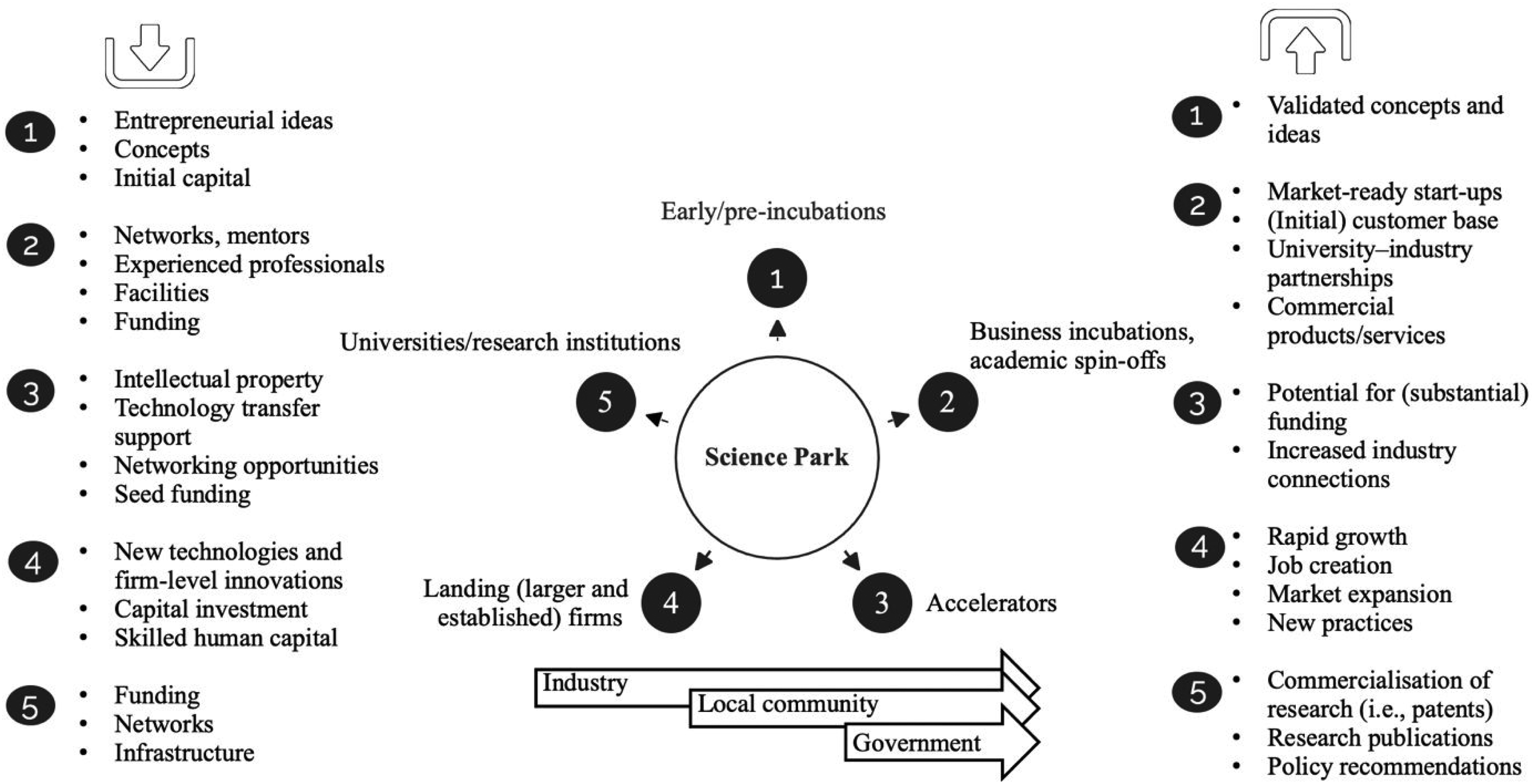
‘Inputs’ and ‘outputs’ of key components within a science park.
Conclusion: Extending the concept of SPs in a new direction
Considering that SPs promote technological innovation and foster regional development, policy-driven initiatives that take into account geographical characteristics are encouraged for the creation of new SPs in rural areas to foster local development. The location choice of SPs adds to the ecosystem perspective, as SPs can play a key role in developing and managing EEs (Ng et al., 2019), highlighting the importance of seeking external sources of knowledge, funding and information as a strategy to alleviate geographic barriers. Thus, implementing innovation policies in peripheral rural contexts may present challenges and necessitate specific adjustments. I argue that each key component of an SP is essential for rural development and addressing the challenges of rurality (i.e. lack of knowledge, information and education, limited access to infrastructure facilities, public transportation, etc.) thus suggesting that SPs are often even more important in rural contexts than in urban settings. The focus on rural areas reminds us of the urgent need for knowledge and funding institutions in rural areas, improving innovation outcomes of firms (i.e. the number of patents) within EEs. SPs should optimally ‘orchestrate’ all key players of EEs (early/pre-incubation, business incubation, accelerators, landing firms, plus the presence of universities/research institutions) to foster synergies and create value not only for society (i.e. job creation), but also for the environment (i.e. sustainable practices, and technologies that help firms to recover from exogenous shocks such as climate change, deforestation, etc.) in rural markets. I argue that rural SPs are dynamic hubs and self-organised communities that should not only incorporate start-ups and other types of firms in their spaces to boost their growth, but also offer a diverse range of educational opportunities. This can be achieved through degree programmes, entrepreneurship courses and many other educational initiatives in partnership with academic institutions (universities, research centres, laboratories, and innovation labs), thus generating intellectual property, patents and innovative technologies, and bridging the gap between rural areas and urban communities.
Footnotes
Declaration of conflicting interests
The author declared no potential conflicts of interest with respect to the research, authorship, and/or publication of this article.
Funding
The author disclosed receipt of the following financial support for the research, authorship, and/or publication of this article: This work was supported by the Foundation for Education and European Culture.
