




Abstract
This research note explores the concept of rural context within entrepreneurship research. We outline three distinct approaches to understanding rural context in entrepreneurship research, viewing rural as: (a) a given setting, (b) peripheral, emphasising its distinctions from urban contexts, and (c) rurality, underscoring its distinctiveness. We discuss how these three approaches have been used in entrepreneurship research and their implications for research focus, questions, and conceptualisation of the rural context. Ultimately, we advocate for the vital importance to uphold stringency and rigour in employing any of the approaches.
Introduction
During a seminar attended by esteemed scholars in rural entrepreneurship research we together embarked on a journey to unravel the essence of rural in entrepreneurship research. Each participant was encouraged to articulate their perspective, yielding a spectrum of viewpoints. However, as discussions progressed, it became evident that many, us included, tended to define rural in relation to urban settings, using terms such as remote, peripheral, and distant from urban centres. While these descriptors captured certain aspects of rural life, they also prompted us to ponder the validity of defining rural solely in opposition to urban areas, rather than appreciating its intrinsic values. Motivated by these reflections, we 1 initiated an exploration into how scholars approach rural context in entrepreneurship research.
This research note delves into three distinct approaches to understanding rural context in entrepreneurship research. Recognising the importance of context in comprehending entrepreneurship is a recurrent theme in academic discourse (Gaddefors and Anderson, 2017; McKeever et al., 2015; Welter, 2011). Discussions surrounding rural context are not new, they have been particularly prominent within the field of rural studies (e.g., Halfacree, 2006; Woods, 2010), which is closely linked to research on rural context in entrepreneurship (Gittins and McElwee, 2023). The emphasis on conceptualising rural context in entrepreneurship research has often revolved around defining rural entrepreneurship to demarcate its boundaries (e.g., Bosworth, 2012; Korsgaard et al., 2015b). Nevertheless, seeking to establish rural entrepreneurship as a distinct area of research represents just one approach to understanding rural context in entrepreneurship research. In line with McElwee (2022), we acknowledge that various conceptualisations of the rural context introduce diverse agendas when researching entrepreneurship. Authors need to be mindful of these differing perspectives, definitions, and research foci to uphold rigour in their work. Therefore, we advocate for the imperative of maintaining consistency (hence stringency and rigour) when engaging with these diverse conceptualisations of the rural context.
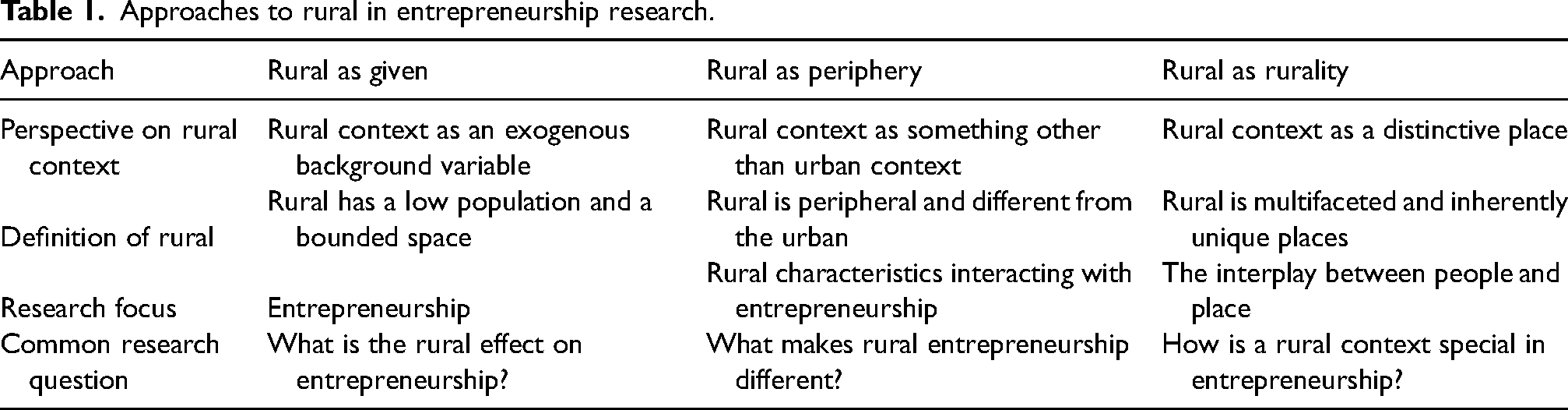
To facilitate a deeper understanding, Table 1 presents a summary of three distinct approaches identified in entrepreneurship literature. The subsequent sections provide detailed explanations of these perspectives, acknowledging that instances may arise where elements from multiple approaches coalesce within the literature.
Approaches to rural in entrepreneurship research.
Approaching rural as given
One approach perceives the rural as given, merely viewing it as a fixed backdrop and an inherent condition that entrepreneurs operate within (Bock, 2004; Dong et al., 2021). This approach tends to relegate the rural context to the status of an exogenous variable. This approach proves particularly advantageous in the investigation of entrepreneurship and its varying degrees of success (Ellis and Bosworth, 2015). The focus in research is for example on the psychological traits of rural entrepreneurs, the gender distribution within business participation, and success factors (Pato and Teixeira, 2016) or how the rural is affecting the performance of a business (Anderson et al., 2010). The utilisation of this ‘rural as given’ approach has captivated entrepreneurship scholars on a global scale, predominantly in the domain of surveys and statistical analyses, as critiqued by for example Gaddefors and Anderson (2019).
However, considering rural context solely as a given setting oversimplifies the dynamic interplay between entrepreneurship and its context. While suitable for quantitative studies, this approach overlooks the nuanced interactions that permeate entrepreneurial processes within rural settings. Furthermore, by treating rural context as a bounded space, often demarcated by municipal boundaries, these studies offer limited insights into the intricate socio-spatial processes that underlie entrepreneurial activities, a gap identified by Trettin and Welter (2011). As such, municipal boundaries fall short in encapsulating the intricate networks and relationships that extend beyond administrative lines. To gain a deeper understanding of entrepreneurship within rural settings, it is essential to consider the broader socio-spatial dimensions that encompass these regions.
Approaching rural as periphery
Another approach involves delineating rural areas from their urban counterparts, a perspective embraced by several participants at the mentioned research seminar. Scholars within this approach provide explanations such as ‘…a rural entrepreneur is someone living in a rural location and the difference between them and an urban entrepreneur may be found in the effects of rurality on the entrepreneurial process’ (Stathopoulou et al., 2004) and ‘The periphery is a location […] of otherness’ (Anderson, 2000). Rural areas are typically defined by characteristics not prevalent in urban settings, including lower population density (Ahl et al., 2023), expansive landscapes (Elkafrawi et al., 2022) and a slower pace of life (Stathopoulou et al., 2004). Consequently, discussions often frame the rural as lacking critical business resources such as capital, skills and networks necessary for successful business initiation and growth (Stathopoulou et al., 2004). Moreover, limited access to markets, suppliers and financing options are seen as posing challenges to entrepreneurs in rural areas. However, despite the apparent deficiency in business resources, the rural context excels in natural resources, presenting opportunities (Korsgaard et al., 2015a). Crucial resources on which our society relies, such as food, timber, minerals and energy, are produced and processed in rural areas. Thus, being non-urban, presents challenges and opportunities that entrepreneurship needs to navigate (Elkafrawi et al., 2022). Scholars within this approach focus on comprehending the rural setting and how the non-urban aspects of rural areas interact with entrepreneurship.
While engaging with the rural as periphery offers a more comprehensive perspective than viewing the rural as given, it also poses challenges (Arora-Jonsson and McAreavey, 2023). Elucidating a concept by simply stating what ‘it's not’ provides only a limited understanding. A cat is not a dog, yet a non-dog is not always a cat. Likewise, rural is not urban, yet non-urban is not always rural. Thus, explaining rural as different to urban oversimplifies its complexity, impeding researchers’ ability to fully grasp its essence. Numerous contexts diverge from an urban setting, and rural is just one among them. Furthermore, there are also multiple rural contexts, each with distinct characteristics. To show some extremes, rural Bangladesh accommodates 80% of the nation's 160 million citizens within an area about a quarter the size of France (McKague et al., 2017). Conversely, Russian indigenous reindeer herder communities (Gorbuntsova et al., 2018) and isolated islands represent contrasting examples (Burnett and Danson, 2022). Furthermore, a single area can exhibit elements of both rural and urban characteristics. Thus, defining rural solely in opposition to urban overlooks the intricate web of relationships, community dynamics and historical influences that form the foundation of rural entrepreneurship.
Approaching rural as rurality
A third approach addresses the rurality of rural contexts; moving beyond the rural–urban dichotomy to define rural in its own terms. This approach focuses on developing theories around entrepreneurship and unique characteristics of rural places (Bensemann et al., 2021; Roos and Gaddefors, 2022) gaining insight into factors such as geography, culture, economy and social bonds (Roos, 2021). Researchers have explored how business interactions within communities shape rural contexts (Johnstone and Lionais, 2004; Wilson et al., 2022), viewing rural contexts as multifaceted domains ripe for exploration, appreciation and focused investigation to uncover their distinctive qualities (Jørgensen and Mathisen, 2023).
Embracing the rurality in rural contexts enriches our understanding of rural communities and underscores their significance as vital components of our diverse societal fabric (McKeever et al., 2015). However, what has been identified as a concern is that scholars may idealise rural life, a phenomenon referred to as ‘romancing the rural’ (Gaddefors and Anderson, 2019), and disproportionately emphasise the significance of social ties within these communities. Moreover, as scholars delve into the uniqueness of rural contexts, this presents challenges in defining what truly constitutes as rural. This approach views each rural place as inherently unique, which complicates efforts to identify commonalities among different rural areas and consequently make assertions about ‘rurality’ difficult. Expanding on this discussion, the emphasis on uniqueness within rural contexts raises questions about the generalisability of findings and the applicability of theories across various rural settings.
Concluding discussion
Above, we have outlined three distinct approaches to understanding rural context in entrepreneurship research. While each of these approaches has its strengths and limitations, it is crucial to recognise that they complement each other in providing a holistic understanding of rural context in entrepreneurship research. The first approach, which treats rural context as a given setting, proves beneficial in examining success metrics; however, it overlooks the intricate socio-spatial processes underpinning entrepreneurship. Conversely, the second approach, which characterises rural areas as peripheral in contrast to urban centres, highlights some unique rural attributes but risks oversimplifying their multifaceted nature. Lastly, the third approach, centred on addressing rurality and the distinctive qualities of rural contexts, facilitates an exploration of the intrinsic aspects of rural life and acknowledges the varied landscapes within rural settings. Nonetheless, this approach presents challenges in crafting comprehensive frameworks and facilitating meaningful comparisons across diverse rural contexts. Striking a balance between acknowledging the uniqueness of rural areas and identifying overarching themes and patterns is crucial for advancing scholarly understanding and informing effective policy interventions in entrepreneurship and rural development.
However, regardless of the chosen approach, research must prioritise stringency, ensuring alignment between the perspective, definition, research focus and research question (see Table 1). For instance, if a scholar seeks to understand how rural factors impact entrepreneurship, focusing solely on the rural–urban dichotomy may yield incomplete answers. Furthermore, consider a study focusing on the interplay among natural resources, people and place (cf. Gaddefors and Anderson, 2017). In such cases, viewing the rural as given and predetermined would limit the study's ability to explore the intricate relationship between rural dynamics and entrepreneurship. Therefore, to uphold stringency, it is essential in this example to perceive the rural place as a unique context and consider all its diverse aspects when investigating its interplay with entrepreneurship. Thus, a lack of stringency in research poses a challenge for methodology and epistemology, impacting the overall rigour of the study.
Although all three approaches to rural context can be applied using diverse research methods, it is notable that the ‘rural as given’ approach is often utilised with quantitative research, while the ‘rural as rurality’ approach is preferred with qualitative research. Quantitative methods are well-suited for establishing statistical relationships and generalisations, which align well with the structured nature of the ‘rural as given’ approach. Traditionally, such methodologies have been central to epistemologies where the world is objectively understood (Alvesson and Sköldberg, 2018). Conversely, qualitative methods offer a deeper understanding of subjective experiences, cultural dynamics, and historical contexts, making them ideal for exploring the nuanced aspects of the ‘rural as rurality’ approach. This perspective leans more towards an epistemology viewing the world as socially constructed (Alvesson and Sköldberg, 2018), where entrepreneurship is interpreted within unique contexts to formulate local theories. Lastly, the ‘rural as periphery’ approach benefit from a combination of both quantitative and qualitative methods, to comprehensively examine the spatial and socio-economic disparities between rural and urban areas. Quantitative methods validate differences and similarities between rural and urban contexts through statistical analyses, leaning towards an objectivistic view. On the other hand, qualitative methods allow for a deeper exploration of subjective experiences and social constructions within rural communities, enriching our understanding beyond statistical measures. Consequently, the ‘rural as periphery’ approach results in a further demarcation of rural entrepreneurship as a distinct field.
However, it is evident that the ‘rural as rurality’ approach still has not received enough attention and has been underrepresented in terms of publications, thereby limiting its potential benefits within the research community. A shift towards further exploration of the rurality in entrepreneurship perceives rural areas as distinctive places, encompassing socio-cultural, economic and geographic factors. This shift fosters a more comprehensive understanding of entrepreneurial endeavours that unfold within rural contexts.
Contribution
This research note makes a significant contributing by underscoring the vital importance of upholding stringency in entrepreneurship research addressing rural contexts. What makes our contribution original is that we highlight the necessity of aligning perspectives, definitions, research focuses and research questions in entrepreneurship research concerning rural contexts to ensure methodological rigour.
Additionally, we advocate for increased adoption of a ‘rurality’ approach in researching entrepreneurship in rural contexts to counterbalance the prevailing ‘rural as given’ and ‘rural as periphery’ approaches. The ‘rurality’ approach focuses on intrinsic socio-cultural, economic and geographic factors, and holds promise in providing a more comprehensive understanding of rural contexts. Thus, by emphasising qualitative methodologies, researchers can delve deeper into the distinctiveness of rural areas and their profound impact on entrepreneurial endeavours while also adhering to stringency within the research.
Footnotes
Declaration of conflicting interests
The authors declared no potential conflicts of interest with respect to the research, authorship and/or publication of this article.
Funding
The authors received no financial support for the research, authorship and/or publication of this article.
