




Abstract
This study examines the characteristics of entrepreneurship in rural villages. It was conducted during ongoingeconomic and social crises in rural areas. We interviewed 23 entrepreneurs located in small rural communities, focusing on thedynamics between rural entrepreneurs and village communities. Four themes emerged from the content analysis: (1) The village relieson entrepreneurs to provide products or services, (2) the community and the entrepreneurs establish a pattern of combined paid andunpaid services, (3) entrepreneurs leverage a rural product or service into something greater than was previously provided in thevillage, and (4) tensions may arise between entrepreneurs and the village management as well as village members. Overall, thefindings show that small business entrepreneurs in rural villages are more embedded in the community compared with those in urbanareas.
Introduction
In many rural communities, small and medium enterprises (SMEs) are being established to meet the livelihood challenges of farming families and the changing agricultural economy. SMEs are characterized by their smaller relative size and are typically defined as having fewer than 250 employees (Ayyagari et al., 2011). The opening of the market to economic corporations, which took over large agricultural areas, coupled with the lack of sufficient government support, has endangered the survival of small farmers (Goldsmith, 1985; Park and Kim, 2020). Specifically, these policy changes to traditional support for farmers have generated a long-term multidimensional economic, demographic, and social crisis (Wilson et al., 2022). Other processes, such as mechanization and climatic change, have also contributed to a sense of insecurity and the realization that small farm owners cannot depend solely on agriculture as a source of revenue (Greenberg et al., 2018; Hoggart et al., 2014; Wilson et al., 2022).
A sense of economic security is known to encourage the development of commercial enterprises and types of employment beyond the scope of agriculture. SMEs have caused rural areas to become multidimensional, and, because of this, residents of urban areas are increasingly desiring to leave the hubs of large cities to live in countryside communities and enjoy closer proximity to nature (Crandall and Weber, 2004). Thus, the establishment of SMEs has contributed to demographic changes and revitalized rural villages with dwindling and aging populations (Schnell et al., 2017). Indeed, the arrival of a young population can energize a single village or even the entire surrounding rural area (Kulawiak et al., 2022; Schnell et al., 2017).
The literature lacks a comparison of entrepreneurs’ embeddedness in villages versus in cities. To address this, we hypothesize that entrepreneurs’ embeddedness in a place is more pronounced and crucial in rural localities than in cities. We examine the character of the relationships forged between entrepreneurs who establish their businesses in a rural community and the local population, asking whether the relationship is purely economic, or contains additional elements that influence the sense of security of both the entrepreneur and the local population.
Theoretical background
Changes in rural areas worldwide and Israel
Rural areas are generally defined as regions outside of towns and cities, characterized by low population density and a predominance of agricultural or natural landscapes (Cloke et al., 2006). Rural villages further narrow this definition, comprising small, close-knit communities that are often centered around agriculture or primary-sector activities (Pahl, 1966). Typically, people who live in rural communities close to large urban areas commute daily to a nearby city (Giménez-Nadal et al., 2020); however, in more remote rural communities commuting in this way is difficult, creating a livelihood challenge (Alañón-Pardo and Arauzo-Carod, 2013).
In Israel, rural communities such as moshavim, kibbutzim, and community villages each present unique sociocultural lifestyles and governance structures (Ben-Dror and Sofer, 2010; Sofer and Applebaum, 2012). Moshavim and kibbutzim, both established in the early 20th century, represent traditional and communal agricultural models, respectively. The moshav focuses on private agricultural enterprise, whereas the kibbutz is known for collective ownership and socialist principles. Community villages, in contrast, are typically nonagricultural and attract residents with white-collar occupations, emphasizing a shared lifestyle without the agricultural focus. Although these three types of rural communities differ from each other, they still involve a unique combination of agricultural development, community governance, and cooperative economics, and are deeply influenced by Israel's sociocultural and historical background (Sofer and Applebaum, 2012).
The ongoing economic upheaval of the 1980s devastated essential components of agriculture. Whereas the price of water, fertilizer, and other agricultural staples increased steeply, produce prices dropped due to the opening of the market to the international economy, where local agricultural produce faced competition with imported produce (Kimhi and Rapaport, 2004).
These fundamental changes endangered the small farmer's ability to thrive (Greenberg et al., 2018; Teff-Seker et al., 2022). Economic corporations took over large swaths of agricultural land, and the government all but abandoned support for independent farmers (Goldsmith, 1985; Park and Kim, 2020). Farms were condensed and harvests were reduced, together with the number of agricultural employees (Razin and Lindsey, 2017). In particular, about 60% of farmers reduced their agricultural activity and became hired workers (Kislev, 2021).
Parallel processes took place in villages in Israel and around the world. The next generation of farmers left for urban areas, and many family farms were sold to cover bank debts (Ben-Dror and Sofer, 2010). At the same time, the aging population in remote and peripheral areas began to see a reverse movement of counter-urbanization (Phillips, 2010; Schwake, 2021), where people view the countryside as a welcome opportunity to live in small communities and enjoy a high-quality life close to nature (Greenberg and Kurlander, 2023). Because of these changes, small commercial enterprises have grown in rural areas (Swain and Garasky, 2007).
Characteristics of commercial enterprises in the countryside
In the current study, rural entrepreneurship is defined as a process of creating and managing a business in a rural area that is characterized by a specific set of environmental, social, and economic conditions (Kulawiak et al., 2022). Entrepreneurial activity describes the creation of new enterprises or the expansion of existing businesses by individuals or teams. The importance of this definition lies in its reference to a change in veteran businesses, as well as the creation of new ones (Patel and Wolfe, 2023). An embedded business is integrated with its local community, environment, and economy, reflecting a relationship where both the business and its context mutually influence and benefit each other (Granovetter, 2018; Uzzi, 2018).
Entrepreneurship has also developed in rural villages farther away from large cities. The changes in agriculture and the dearth of job opportunities pushed many farmers into establishing commercial enterprises. Rural areas far from cities were perceived as ideal for weekend getaways and extended vacations for the urban population (Yang et al., 2021); therefore, most businesses in these areas initially focused on hospitality, rural lodging, and catering.
Wilson et al. (2022) challenged the notion that all rural enterprises add value to the rural economy. However, Markowska and Lopez-Vega (2018) found that to facilitate the creation of conducive conditions for entrepreneurial action within the context of regional identity, entrepreneurs engage in crafting regional identity stories. According to Newbery et al. (2017), rural entrepreneurship plays a key role in harnessing innovation, along with maintaining and developing communities while moderating the relationship between farming, land use, community, and economic development.
In practice, alongside a variety of development options and the commercial and economic lure of business entrepreneurs, individual entrepreneurs must still deal with issues associated with being distant from population concentrations. These issues include a relatively small number of consumers and customers, an old and decrepit infrastructure that makes transportation difficult, high transportation costs for supplies and products, a dearth of professional workers, and a significant shortage of specialist professionals (Berg and Ihlström, 2019).
These issues have been discussed by Wilson et al. (2022), who listed four types of relationships between businesses and the areas in which they are located. The authors differentiated between businesses that are highly connected to their environment, noting a dependency on agricultural produce and raw materials, local business connections, the ability to earn a livelihood, and future business growth as related to the locale. They highlighted that part of this mutual dependency involves the services these businesses provide to residents of the community and the area. On the other end, they defined businesses that are not connected at all to the place where they are located and could essentially be situated anywhere. Between these two types of businesses, they identified a range of organizations that maintain varying types and degrees of partial relationships with the place. In all four business types, the emphasis is on examining business growth, resource utilization, and business connections, and less on the relationship with and connection to the community. This situation prompts the need to examine the relations and collaborations between small businesses and the locale in which they operate, as well as the effect of these relations on the profitability and sense of security of both the entrepreneur and the business location.
Characteristics of social enterprises in rural areas
Social enterprises (SEs) have become an expanding phenomenon worldwide, including in Israel's rural sphere. SEs seek to combine business acumen with a response to social and environmental issues and the needs of the community in which they are based (Austin et al., 2006; Shumate et al., 2014). Unlike commercial enterprises, SEs focus on serving basic long-standing needs more effectively through community support (Anderson and Gaddefors, 2016). SEs give local residents a renewed sense of belonging that strengthens their connection to the place and revives the concept of community, which has been depleted in previous decades (Anderson and Gaddefors, 2016; Ganany-Dagan, 2022).
However, the monetary profit index, or the physical and financial capital, obtained from an SE is often small in relation to the investment and does not always explain the motivation of social entrepreneurs, as they continue to operate SEs when both investment and ongoing costs are high (Gimmon and Spiro, 2013). According to Austin et al. (2006), the people, context, deal, and opportunity framework can be applied to social entrepreneurship when the funding sources include individual contributions, foundation grants, members’ dues, user fees, and government payments. For the entrepreneurs themselves, operating an SE can provide emotional returns such as satisfaction and personal fulfillment (Anderson and Gaddefors, 2016).
Zahra and Wright (2016) characterized the types of impact that SEs have at the community level, and defined the index of wealth in social entrepreneurship as “overall wealth.” This concept combines social and economic wealth and includes both tangible economic dimensions such as products, number of customers, and profits, and intangible social dimensions such as well-being, health, and happiness (Zahra and Wright, 2016). Researchers have suggested that social entrepreneurship is designed to create four types of capital—physical, financial, human, and social—through which the impact of social entrepreneurship on the community can be measured (Lumpkin et al., 2018; Zahra and Wright, 2016). Hence, when based on the idea of community alongside a conceptual, physical, and human platform, social entrepreneurship can reward both the entrepreneur and the community.
The current study seeks to examine characteristics of the relationships forged between villages, communities, and entrepreneurs who have established their businesses in rural areas compared with those who operate in large urban areas. We focus on the mutual contributions from the village and its members to the entrepreneurs and vice versa. This includes business arrangements and their effect on the entrepreneurs, the community, and the village, in the ongoing economic crisis in Israeli rural areas.
Research question
In light of the above, we formulated the following primary research question: How do local SME owners experience business dynamics and social integration in rural areas? Significant secondary questions arose during the qualitative research which are thereafter examined: What effect does entrepreneurship in the village have on the rural community and local administration, as well as what are the possible advantages of being an entrepreneur in the village?
Methods
Study design
We used the phenomenological approach to examine the connections between small businesses and the village and community in which they are located. The phenomenological approach provides representations of people's experiences through an unbiased perspective (Sloan and Bowe, 2014). Interpretive phenomenology examines human experience, and, therefore, interpretation is critical (Creswell and Poth, 2016). The feelings and experiences of the interviewees constituted the data gathered in this study. Many interviewees had lived and worked in urban areas before arriving in the village and could, therefore, compare the two locations in terms of business connections to the community.
This study was approved by the Israeli Ministry of Space, Science, and Technology, and by the researchers’ institutional ethics committee. The interviewees were informed of the purpose of the research and the ethical guidelines that would be followed by the researchers, as well as were provided pseudonyms.
Semi-structured interviews allowed us to obtain general data about the businesses and the employees. The interview guidelines included 15 questions about (a) the business (location, years of establishment, reason for establishment, goals, challenges, organizational structure, number of employees, profit, and dealing with crises), (b) the interviewee's career or position (current position, development aspirations for the enterprise, values, factors that influenced the establishment of the business, career progress, and challenges), and (c) community and regional ties (identity as a professional and business owner, integration into the community, community support, and expectations from the community). Each interview was 60–90 min long. All interviews were audio recorded and professionally transcribed.
Participant characteristics
The sample consisted of entrepreneurs from rural villages in Israel's north periphery. SMEs were given the label of an SE (see Table 1) when a significant part of the business function involved contributing to the community (e.g. through income transferred to the community or a business activity adapted to the community's needs). All villages were at least a 1.5-h drive from any large city. Snowball sampling was used to recruit interviewees (Creswell and Poth, 2016), whereby initial participants were encouraged to introduce new participants to the study. Most business owners in the sample had families and were 30–50 years of age, and most of the businesses were in the low-tech field, including services, tourism, agriculture, and trade.
Data on the interviewed entrepreneurs.
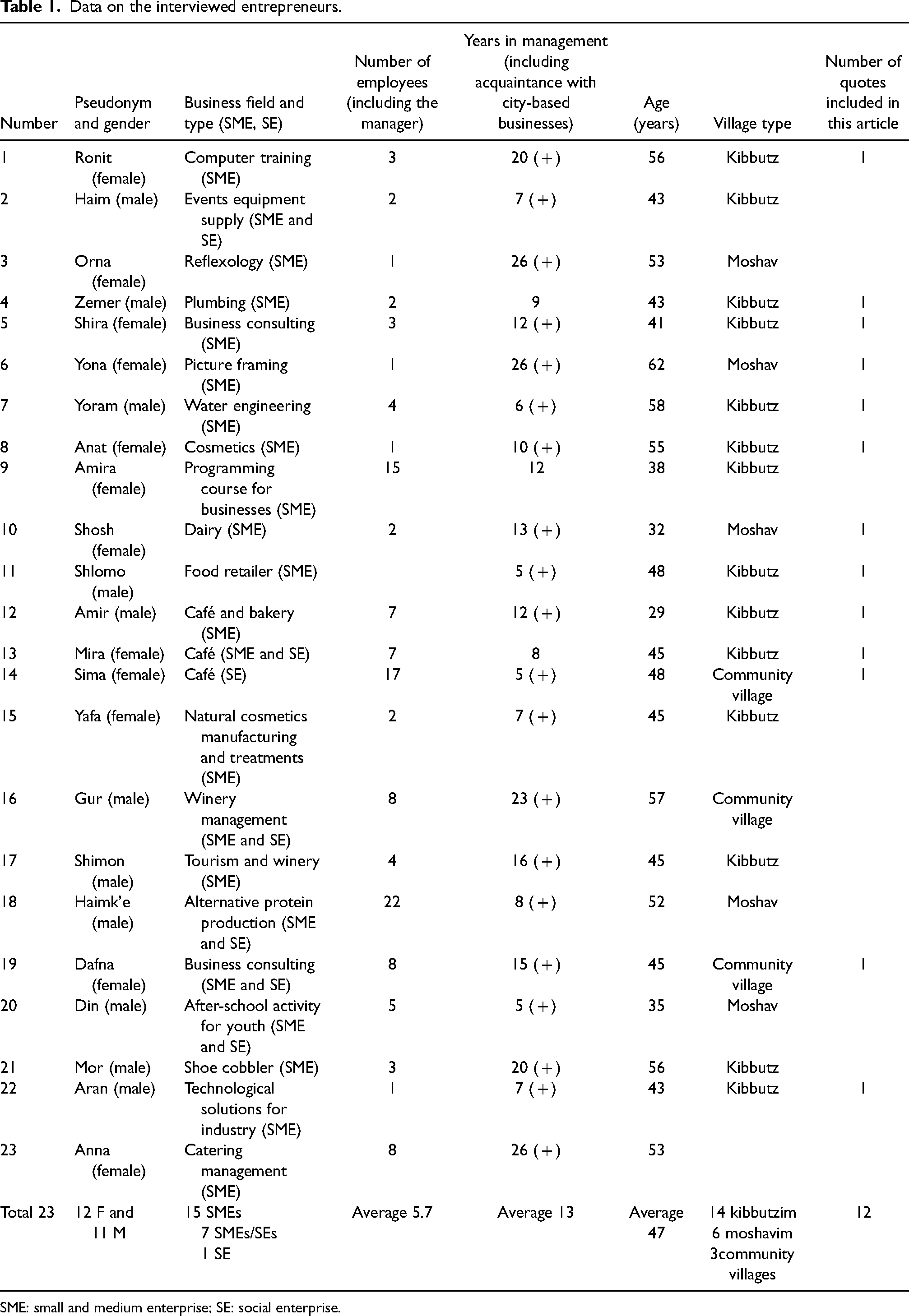
SME: small and medium enterprise; SE: social enterprise.
The study focused on three distinct types of rural settlements in Israel: kibbutz, cooperative moshav, and community village. The interviews were conducted with 40 small business owners (up to 50 employees) who lived and operated in 15 peripheral villages in northern Israel. We focused on 23 businesses that met the requirements for business longevity (over five years) and location (in a village). Most of the interviewees (20) had either owned a business in a city or had close dealings with a business in a city. The quotes were taken from 16 interviewees.
Data analysis
The data analysis was conducted in three stages, following Charmaz and Thornberg's methodology (2021). First, each researcher read all the interviews and compiled a list of codes related to the research questions, the characteristics of the research field and the interviewees, and the interview topics. The code frequency analyzed various aspects of business operations, reasons for business establishment, advantages and disadvantages of operating in peripheral areas, the nature of community connections, and the entrepreneurs’ perspectives. In the second stage, all researchers decided on the categories. This analysis linked events, sequences, and narratives together to create a foundation that was agreed upon by everyone. In the third stage, the categories were organized under agreed logical structures and definitions of each central theme as described by Creswell and Poth (2016). The identified codes were analyzed to create first-order theme sets, which were then linked to create second-order theme sets. This process was repeated until the emergence of third-order themes, thereby systematically identifying how themes are related to each other and entrepreneurship within villages. These themes form the basis for the “Results” section of the article.
Given the study's focus on a diverse range of entrepreneurs from Galilee and Golan Heights, our research team was deliberately composed of members from assorted communities, including rural areas. We also maintained reflexivity throughout the coding and analysis to mitigate any biases from the researchers relative to the research topic. This procedure is consistent with Charmaz and Thornberg's (2021) emphasis on reflexivity in qualitative research.
Results
We found four recurring issues that arose in the interviews, each involving the relationships among the village, the community, and the entrepreneurs’ business activities. Analysis of these themes presents a broad view of the characteristics of the relationship forged between villages, communities, and entrepreneurs who established their businesses in rural areas.
Theme 1: The village relies on entrepreneurs to provide products or services that it previously provided to residents through outsourcing
Of the enterprises examined, 60% were created as the result of joint dialogue between village administrators and entrepreneurs, representing a new configuration of services previously provided by the village. For example, a village may not have been able to fulfill certain demands or provide services such as catering, maintenance, leisure activities, or training; in these instances, commercial or economic restructuring was required. Encouraging the establishment of private entrepreneurial activity would then be the village's way of continuing to offer these service types to residents.
Anna opened her business with the kibbutz management's encouragement following the closing of the once-traditional kibbutz dining room. She described the connection between a service required in the village and her private enterprise as follows: The business relationship with the community includes renting the place (an equipped, industrial-sized kitchen which probably once served as the kitchen for an entire kibbutz population) … I have a steady relationship with a number of families—children who come—and I prepare lunch for them … and, in addition, I cook for the older adults, and … also use the kitchen for private matters, preparing meals for hospitality and supplying catering services. (I founded this in order to) contribute … and to strengthen the sense of belonging to the place (among the local youth) … to encourage a group belonging. I was really waiting impatiently for it to open … (so that) anyone can come … we started … a crowdfunding and fundraising campaign … (which still runs to this day).
Sima founded the project out of a need to fill a social vacuum that, in the past, would have been addressed by the village's council. Sima explained that the youth are paid for their part in maintaining the facility and that there is a slow but consistent growth in clientele. However, it is difficult to quantify the social return from this entrepreneurial activity.
Shosh described the success of an enterprise she built in her backyard, a cheese factory whose products are sold to the residents of the village and nearby areas: We have a ‘trust refrigerator’ here: people come, take, pay. So, first of all, it is a concept that is almost nonexistent in the country and it is successful here in Moshav, in the periphery.
The above findings show that entrepreneurs work alongside the community's recruitment efforts through business and social entrepreneurship and with the support of the village administration. The identification of a need by the village's management or by an entrepreneur serves as a trigger for the establishment or promotion of what will become an enterprise that responds to the residents’ needs and, at the same time, creates employment and a livelihood for the entrepreneur. These ventures exhibit the entrepreneurs’ connection to and familiarity with the needs of the village, and how the entrepreneurs contribute to the quality of life of different age groups by continuing to offer social services that were previously provided by the village. This theme can also be found in Lumpkin et al. (2018), who examined the types of social and human capital that social entrepreneurship provides.
Theme 2: The community and the entrepreneurs establish a pattern of professional entrepreneurship that combines paid community services and volunteer professional services
This theme involves an interaction between the community and the project manager. The picture that emerges is of a structured combination of paid services and involvement or volunteering in the village.
Zemer, a plumber, described how he offers informal help to community members in addition to his work as a paid professional: In the local community, I am mainly involved in business. People contact me at any time when there are problems … If it suits me in terms of time, I come and do it … I walk the dog in the morning, and there is always someone who needs me for some consultation, to ask, to find out; sometimes they need other professionals, so I give them (the) names and phone numbers of professional people I can recommend … It seems to me that, in the city, they wouldn’t feel so open and safe to ask these questions as they do here.
Yoram recounted that, after an organizational change in the cooperative village where he was employed (due to privatization and subsequent downsizing), he joined a large engineering office in a city but later embarked on entrepreneurship in the profession he had worked within as an employee in a kibbutz factory: In (my village), I provide planning services for water and sewer lines … for a fee … and, apart from that, I am on the planning committee (in a volunteer consultant role) … It's based on my professionalism … because of the whole infrastructure issue, I have a deep involvement in accompanying the people (who are building houses in the village).
Shira, a business consultant working as an entrepreneur in the northern region's villages and in Israel's urban center and abroad, dedicates part of her work to supporting women in the community: …about a third of my work is for them and for free—volunteer lectures, volunteer consulting, escorting them, etc. I give scholarships and they’re always for women….
Anat, an independent cosmetologist, described the significance of interpersonal relationships that characterize the rural village, and their effect on the growth of her enterprise: One customer is always bringing another, and also … (I have) a very strong relationship with people who have been coming to me for 10 years … I think that the very fact that I am part of this valley … and see everyone all the time … I go to the supermarket and then I see you and you say to me, ‘Oh, I need …’ (laughs) … You’re a kind of a walking memo (reminder) for what people need.
Theme 3: Entrepreneurs leverage a rural product or service into something greater than that previously provided in the village
Ronit recounted how she entered into a partnership with the village when the kibbutz (before privatization) suggested that she manage a branch of a nationwide computer company: Then … the business manager said to me, ‘Come on, there is something suitable; we want a partnership with a kibbutz.’ I got into it … we were the branch in the north … Since then, I took it upon myself. I bought the rights … somehow we (the kibbutz and I) reached a financial agreement, and it became my business after privatization.
Drora described her consulting service that began when she provided consultation to the local council and subsequently developed into a private enterprise of business consultation. She highlighted the difference between a village, where a small population is spread over a large geographical area, versus a city, where the population is larger and wealthier. These details can affect the amount and pricing of the consulting services she provides: I started meeting with people and understanding what the local needs are and what I can provide. I do it in the fields of education, agriculture, (and) tourism. I specialize in marketing via online content on social networks and the Internet.
Mira, the manager of a local café, noted the following: We got the old club, (and) there was a lot to renovate, and the kibbutz … gave us the place, initially free of charge; it helped us a lot at the beginning. Today, the café is used by many people from outside, but it is definitely also a local social place. People from the village sit here … sometimes for business meetings, (and) sometimes friends meet. It has become a central and significant place in the kibbutz. It seems to me that, for my village, this is a win–win.
The ongoing economic struggles and recovery processes (mainly the privatization of previously communal villages and their businesses) necessitated a structural change that resulted in a transition from institutionalized businesses managed by the village to entrepreneurial activity by private individuals. Enterprises were created and replaced the products and services that the village had supplied in the past. The new entrepreneurial activities respond to the residents’ needs and sometimes leverage them for additional activities. Although some entrepreneurs expect their clientele to come only from within the village, others expand their activities to recruit customers from further afield.
Theme 4: Tensions between entrepreneurs and the village
The fourth theme involves the complex situation that occurs when a new business based on individual entrepreneurship appears in a village. The intricacy of having compatible business expectations, contractual relationships, and social interactions between the entrepreneur and the business locale sometimes creates conflicts between the village management, the community, and the entrepreneur.
Aran described separating his relationship with the village as an organization from the people of the community as follows: Our connection to the community is on a personal basis only; we help our friends … (and) boys and girls (from the village) work with us, and we teach them to work.
Amir, who owns a coffee shop in the kibbutz, noted the following: There is no connection to the community. I didn’t want to connect with them either. I didn’t want to be a café inside a kibbutz; the kibbutz is not the target audience. The location is only for its beauty and interesting surroundings; we wanted to bring people from outside, and that's what we did. Today, after three years here, there are glitches with the regional authority and with the local council, but the kibbutz does not help us.
Similarly, for Shlomo, the difficulty in interacting with the village arises from differences in business cultures. We try not to work, not to do things for the kibbutz. We had a bad experience with that …. They ordered work from us and did not … pay the amount that was agreed upon in advance …. It used to be that in the kibbutz, you actually worked for them for free.
This theme raises the challenge of being an entrepreneur in the village as the familiarity and informality of the village can also create misunderstandings and tensions between the entrepreneur and the village administration and, sometimes, with the community. Such tensions affect the degree of cooperation, as well as the nature of the business relationship and other relationships between the enterprise and the place in which it operates. Some of the tensions are related to the traditional way of life in small communities and the centralized and voluntary form of management that, in the past, characterized these villages but are changing as entrepreneurs look for greater managerial independence (Schnell et al., 2017). Hence, the relationship between the entrepreneur and the community may differ from the relationship between the entrepreneur and the village management, as the residents and the village management may not necessarily agree upon the conduct and nature of entrepreneurship in the locality.
The findings suggest that, from the entrepreneurs’ perspective, a distinction exists between rural and urban entrepreneurs. For instance, the rural entrepreneur is crucial in helping rural settlements emerge from ongoing economic and social crises. Additionally, the services provided by these entrepreneurs partially substitute those previously offered by the community itself. The results indicate that coordination and a strong relationship with community managers and key stakeholders contribute to the precision of the business services, benefitting both the business and the community. Moreover, the interaction of the rural entrepreneur with the residents extends beyond mere commercial transactions and includes non-formal social relationships that enhance daily life in the village.
Discussion
The findings suggest that an embedded relationship exists between rural entrepreneurship and community dynamics, which has a great influence on social and economic aspects. Such an embedded relationship is a major distinguishing feature compared with city entrepreneurs.
Our findings reinforce the significance of businesses being connected to their local networks in rural communities (Granovetter, 2018; Patel and Wolfe, 2023), adding to the community layer of the taxonomy proposed by Wilson et al. (2022). Understanding the importance of social and business ties between entrepreneurs in villages and community management, as well as between entrepreneurs and residents. Regardless of whether the initiative to establish the venture came from the village administration or the entrepreneur, it had to meet both a business and a social need of the community. Economic crises required organizational and economic changes that translated primarily into privatizing what had previously been part of the collective (Goldsmith, 1985; Park and Kim, 2020). Thus, allowing and even encouraging entrepreneurs to market and supply services once supplied by the village ensured the continued existence of these services and the ongoing quality of life of residents (Greenberg et al., 2018; Swain and Garasky, 2007).
Entrepreneurs provide services and products to customers both internal and external to the village, benefitting from local residents who constitute an economic base and offer the entrepreneur some business security. The village profits from the convenience of products and services provided locally, and that are easily accessible to the rural population, as previous research has shown (Richter, 2019; Wilson et al., 2022). A novel finding that emerged from our results pertains to the mutual relations between the entrepreneur and the village management: The village management encourages the establishment of the business in the village, understanding that the enterprise's success in addressing the needs of the community raises the appeal and allure of that particular village. At the same time, these businesses help develop the region, adding employment opportunities and services that are readily available to the local population. Our findings echo those of Corcoran et al. (2010), who reported the significance of entrepreneurship and its impact on the development of social capital in the region.
Similar to Wilson et al. (2022), who found that crises can potentially improve entrepreneurial innovation, we found that entrepreneurial business and social creativity had taken place in rural areas based on direct and immediate feedback from residents and village management. In addition, professionals continued to operate in their chosen fields while developing their professional and commercial status (Ben-Dror and Sofer, 2010; Kimhi and Rapaport, 2004). As we showed, some entrepreneurs developed the business they initially received from the village into an even more empowered product or service. We also found a cultural change in the contract between the entrepreneurs and the village. Extant research has shown that formal contracts between enterprises and villages exist, but sometimes informal agreements are made based on historical relationships and familiarity with village cultural norms and on trusting relationships (Shamai et al., 2015). Our findings revealed that this phenomenon has changed, and informal agreements sometimes lead to conflicts between the developer and the village management. Therefore, the village often benefits from its association with a business more than the entrepreneur does.
The current research reframes the perception of rural entrepreneurs as innovators and catalysts for village development, which is a significant aspect of entrepreneurship in rural communities (Wilson et al., 2022). The research clarifies the entrepreneurial situation from the perspective of entrepreneurs in a village and in relation to targeted markets, both local and farther away. In the close marketing circle, the entrepreneur has mutual relations with local customers (Crandall and Weber, 2004; Daniel et al., 2022), and multidimensional acquaintances with fellow residents beyond their being merely a target audience for the business's products or services. This differs from the circle of customers in the city, with whom the entrepreneur usually does not have such mutual relations. Thus, an entrepreneur in the village can be a source of significant influence on the economy in its environment.
Implications and contributions
The novelty of this study lies in its examination of the unique benefits of rural entrepreneurs’ embeddedness from the perspective of entrepreneurs themselves, which differs from the community embeddedness of urban regions. First, entrepreneurial businesses become vital for rural residents by replacing services that were previously provided by community management. Second, entrepreneurs and their businesses bring new customers and drive economic growth in rural settlements, thereby contributing to economic well-being, employment, and the value of the place. Another contribution of the study lies in the interaction it revealed between entrepreneurs and village management: To establish village entrepreneurship in the postprivatization era, rural businesses must maintain a formal relationship between the entrepreneur, the village, and the community.
The current study extends the theory of Zenker and Kock (2020) by showing how SMEs, despite having limited resources, can quickly manage multiple innovation projects in response to a crisis and highlights the unique role of entrepreneurship in rural communities. Furthermore, our findings contribute to understanding the pronounced embeddedness of entrepreneurship in rural communities, which strengthens previous findings by Wilson et al. (2022). Wilson et al. (2022) showed that entrepreneurs, the community, and community management have mutual and multidimensional communication; they are partners in life in a place where there is overlap between various services and social activities. Wilson et al. (2022) asserted that a strong relationship between the enterprise and its location enhances the economic vitality of both the entrepreneur and the residents of the village. We found that this mutual contribution characterizes entrepreneurship in the rural space more than it does in urban areas. Researchers have previously found that the role of entrepreneurs in offering vital services in rural areas highlights their importance in meeting the community's needs (Greenberg and Kurlander, 2023; O’Toole and MacGarvey, 2003); consistent with this, we found that this role accentuates entrepreneurs’ belonging to the place, including their volunteer activity. The present study expands Zenker and Kock's (2020) theory of innovation as a crisis response from the perspective of entrepreneurs. Despite having limited resources (Wilson et al., 2022), SMEs can initiate and manage several innovation projects of different types and stages, both quickly and simultaneously, in response to a crisis.
We recommend that policymakers and community managers seek to fully understand and support small business efforts. Policies should acknowledge the distinct attributes of rural entrepreneurship, facilitating access to resources and providing training and support for innovative initiatives (Wilson et al., 2022).
Building on the research findings, rural entrepreneurs have a significant impact on recovering from the economic crisis in villages, with businesses becoming an income source for both the entrepreneurs and the residents working within them. Opening the village to customer traffic and business owners from outside the inner circle that existed before privatization has initiated organizational and cultural change processes that connect the village to the space outside it, metaphorically shortening the distance between the village and the city. Unlike their urban counterparts, village entrepreneurs play an additional role in developing their community. This approach contributes to the broader discourse on rural development and entrepreneurship in the village today. The study's findings underscore a paradigmatic shift in rural entrepreneurship catalyzed by economic upheavals. This transformation, characterized by a marked pivot to privatization, is not merely a reactive measure but signifies a strategic reorientation of rural economies. The economic crisis has necessitated organizational changes, which have had profound implications for the rural business landscape. These changes are now collectively shaping the future of rural entrepreneurship.
Conclusions
In summary, the findings show that small businesses at the periphery are a driving force for revitalizing villages economically and socially. They improve the quality of life of the rural population and contribute to its security by creating additional jobs and perhaps even contributing to the economic and social development of the rural area by increasing its appeal to potential residents. This process is encouraged and sometimes even supported by the village administrations and then gains momentum due to the efforts of the entrepreneurs. In this process, the rural entrepreneur should closely consider the needs of the local population when creating a business plan, even if this requires adjusting their products or services. These adjustments may encourage local support for the entrepreneur and stave off potential bureaucratic objections from the village management. For those holding administrative positions in rural villages, we suggest building a facilitating system for entrepreneurs who wish to establish commercial enterprises. Overall, this study highlights the advantages that village entrepreneurial businesses have over those in urban areas, especially when attempting to recover from an ongoing economic crisis.
Research limitations
The research is based on interviews with a limited number of entrepreneurs in rural Israeli communities, and thus may not fully represent the diversity of rural entrepreneurship across different regions and cultures. Thus, the findings might not be directly transferable to other geographical and sociocultural contexts. Future research could expand on these findings by including a broader and more diverse sample of rural entrepreneurs and by exploring similar dynamics in different cultural and economic settings. The findings may also be augmented by examining the opinions of rural residents concerning the enterprises in their villages.
Footnotes
Declaration of conflicting interests
The authors declared no potential conflicts of interest with respect to the research, authorship, and/or publication of this article.
Funding
The authors received no financial support for the research, authorship, and/or publication of this article.
