



Abstract
Samespace is a new coworking venue created in the aftermath of the COVID-19 pandemic. Located in a small town in North-East England, it was founded by an entrepreneur who wanted a better working environment to run his own business. The case focuses on sources of self-identified opportunity recognition and the transferability of entrepreneurial skills to address personal needs. As the business has become established, opportunities for the next phase of growth are explored in relation to the need for collaboration with different actors, including some whose business model may be quite far removed from one's own. The teaching note relates to the nature of opportunity and new venture creation as well as aspects of entrepreneurial growth. Drawing on coworking as a contemporary growth sector in the rural economy, it is suited to final-year undergraduate and masters’ level courses in entrepreneurship. The case study also provides a valuable example of entrepreneurship for students of rural development and rural economies in other disciplines such as geography, social and political sciences or economics.
Key learning outcomes
Understand the emergence of new working spaces in small towns and rural areas;
Recognise entrepreneurs’ own needs as a source of inspiration in the individual-opportunity nexus;
Critically assess the value propositions that customers are paying for;
Evaluate approaches through which entrepreneurs can integrate new business start-up alongside other work;
Analyse the importance of collaboration and embeddedness for entrepreneurial growth in emerging sectors like rural coworking.
Introduction
Samespace (www.samespace.work) was established in March 2022 in Hexham, a town of approximately 15,000 inhabitants in the Tyne Valley in Northumberland, UK. Like other coworking spaces, it provides shared workspace that can be rented on flexible terms by freelancers and remote workers from diverse sectors. These venues are typically designed to ‘encourage collaboration, creativity, idea sharing, networking, socializing and generating new business opportunities for small firms, start-ups and freelancers’ (Füzi, 2015: 462).
Hexham is approximately 20 miles west of Newcastle upon Tyne, connected by the A69 dual carriageway and a local railway line with journey times of 30–40 min. As a market town, Hexham serves a large rural hinterland across south-west Northumberland and has attracted a lot of commuters, seeking a rural lifestyle with the amenities and convenience of a town. The town regularly features in lists of the happiest and best places to live in the UK, coming top in 2019 and 2021 (Hexham Courant, 2022).
The founder of Samespace, Aidan Dunphy, is a strategy consultant and product manager and runs his own company Samepage Digital but after an extensive period of time working from home during the COVID-19 pandemic, he sought a different way of working. This case study explains the journey that led Aidan to launch a new coworking venue in a small two-storey building on the edge of the town centre, illustrated below (Figure 1). The information in the case is taken from a recorded interview conducted in the kitchen of the coworking space and draws on an earlier focus group where Aidan was one of six coworking professionals among the nine participants.
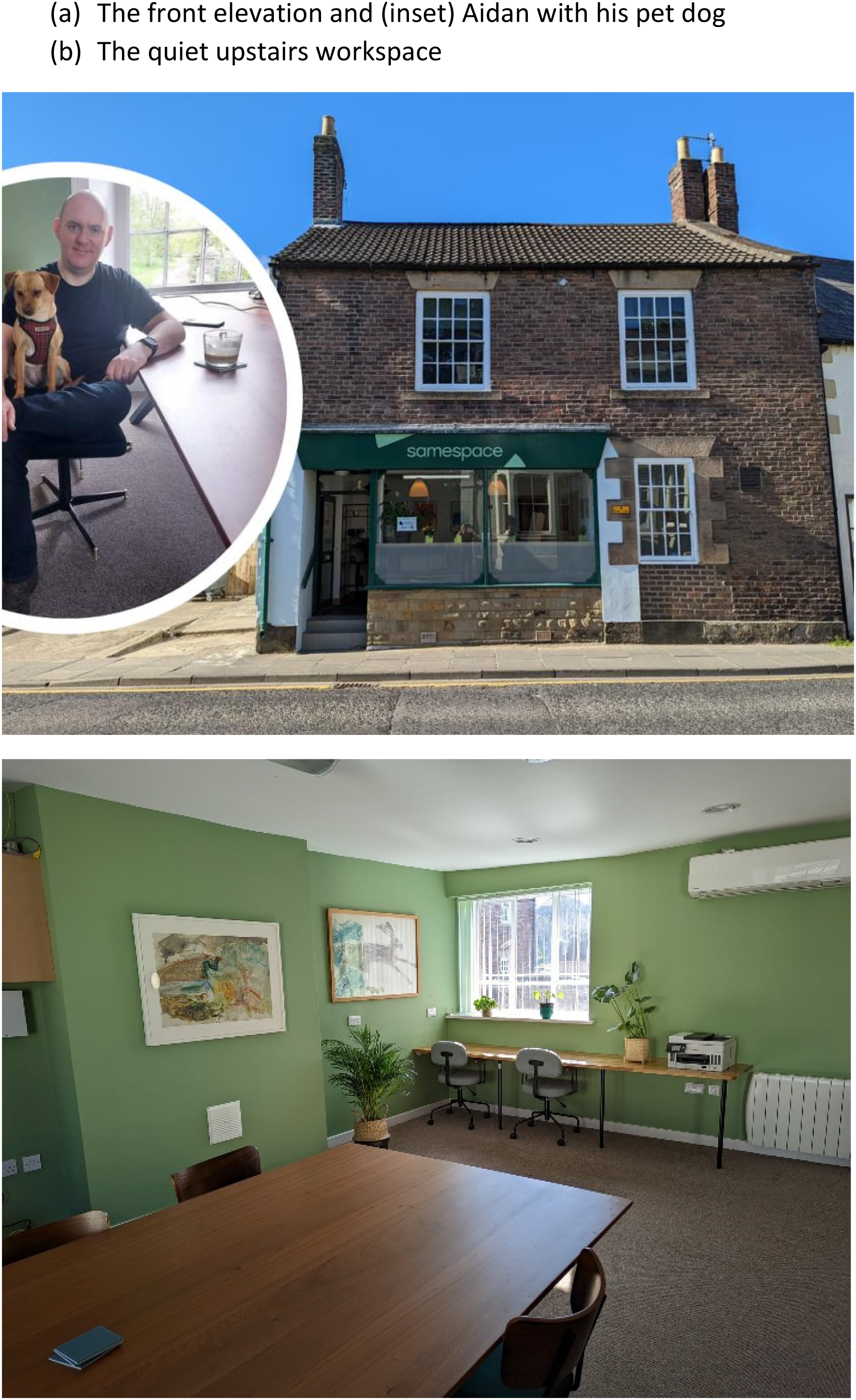
Samespace, Hexham. (a) The front elevation and (inset) Aidan with his pet dog, (b) The quiet upstairs workspace.
The small-town context and the fact that Samespace is part of an embryonic business sector in rural areas add to the distinctiveness of the case. Rural areas are frequently characterised by lower economic diversity and poorer access to large markets, finance, government support programs and information spillovers (Miles and Morrison, 2018; Xu and Dobson, 2019). Embeddedness in diverse networks, both locally and extra-locally, is therefore seen to be an important feature of rural entrepreneurship – both to support entrepreneurial ventures and to retain value within the rural economy (Gaddefors and Anderson, 2019; Jack and Anderson, 2002). The focus of the case, however, is the source of opportunity recognition so the next section reviews key theories of entrepreneurial opportunity before presenting Aidan's personal account of Samespace.
Theorising ‘opportunity’ in entrepreneurship studies
The focus on opportunities being at the core of entrepreneurship was pinpointed by Shane and Venkataraman's (2000) ‘nexus’, where both a profitable opportunity and an enterprising individual were recognised as equally essential components. Broadly, these opportunities then fall into two categories: either they are formed by exogenous shocks to pre-existing markets or they are formed endogenously by the actions of entrepreneurs themselves (Alvarez and Barney, 2020). In the case of Samespace, arguably the opportunity arose from both the exogenous shock of the COVID-19 pandemic that accelerate remote working patterns and the self-identification of particular needs from the entrepreneur himself. As Rae (2015), argues, taking an opportunity-centred view of entrepreneurship allows us to focus on the ways in which entrepreneurs learn through taking actions as part of a process of opportunity creation, planning and goal setting.
The way that opportunities emerge are, to some extent, dependent on the mindset of entrepreneurs and the interaction of their cognition, emotions and behaviours (Kuratko et al., 2021). Added to this, social networks, previous knowledge and experience each represent key elements in the opportunity recognition process (Phillips and Tracey, 2007). The different pathways to realising opportunities, whether through effectuation (Sarasvathy, 2001), serendipity (Dew, 2009) or bricolage (Baker and Nelson, 2005) can then be assessed in relation to the individual – elaborating the original nexus of opportunity and enterprising individual. Here, the notion of bricolage is particularly helpful as it captures the idea that entrepreneurs ‘make do’ with the resources to hand to seek innovative solutions without seeing the external environment as a limiting factor. They do not start from scratch but they apply available resources in new ways to develop creative solutions to problems and sometimes appearing to create something nothing (Baker and Nelson (2005). Bricolage has also been presented as a fundamental feature of resilience (Duarte Alonso et al., 2021) and in the example that follows, we can see how this is applied to enhancing the entrepreneur's personal resilience, not just business resilience (Branicki et al., 2018).
From personal need to entrepreneurial opportunity
The telling point in the foundation of Samespace was that the entrepreneur was not actively seeking new opportunities outside of his own business sector, but his own working needs combined with his entrepreneurial character sparked the new venture. A year in, Aidan is continuing to explore and create new opportunities in the coworking sector alongside his consultancy work. He would not call himself as a ‘portfolio entrepreneur’ but with two businesses he fits that definition and he is able to draw on skills developed in the earlier business. As well as personal skills of time management and networking, Aidan has applied his experience of understanding client needs, tracking market trends and creating distinctive products to help launch Samespace. However, the recognition of the need for a different type of workspace arose primarily from his personal experiences. Increased homeworking was impacting Aidan's mental wellbeing and juggling space in the home with other family needs was a challenge. This is a familiar story since a number of studies in the aftermath of the COVID-19 pandemic highlight that parents, particularly mothers, and people living in smaller apartments with limited outside space were worst affected (Platts et al., 2022; Reuschke and Felstead, 2020; Russell and Grant, 2020).
As Aidan explained, the solution did not present itself straightway: I didn’t immediately do this, I firstly rented an office for a year in Hexham, that was my first attempt to solve this problem. It had the kind of the buzz of being in the town that I wanted – I can hear people around … I have neighbours, all that kind of stuff. The problem was, it was just me in a room when I was still alone all the time so I could go the whole day when the only time I speak to anybody is when I’d buy a coffee from Costa. So that led me to think, why isn’t there something else that does this ….
The opportunity to move into the current premises arose through local networks and the recommendation of a local property company. Combined with supportive input from the computer shop down the road, Aidan saw the opportunity to create his ideal office space – it was just a question of whether others would share the same appetite for what he created. He explained, ‘I tried to strike a balance to make somewhere that's not home, but doesn’t feel like a grubby horrible office’.
Previous rural coworking research has revealed that self-identified needs are an important influence for operators in small community (Bosworth et al., 2023). Sometimes these needs were for network-building or entrepreneurial embedding and sometimes it was more about better workspace or technology than was available at home or in a single office. The responses of entrepreneurs represent a version of entrepreneurial bricolage, finding their own solutions through local networks and resources (Baker and Nelson, 2005; Korsgaard et al., 2021), but the emergence of Samespace is an example of something else too. The recognition of a personal need is not an uncommon source of inspiration for entrepreneurship, but it is an under-theorised aspect of the individual-opportunity nexus.
Entrepreneurship textbooks often talk about products being invented to solve problems, like James Dyson's bagless vacuum cleaner that did not lose its suction, or a number of baby-products invented by women frustrated by leaking baby cups or poor choices of baby foods (Parks, 2006). On one hand, Samespace did not fit a typical new product or service model because Aidan's ability to solve his own problem required others to become part of that community. For other inventors, they can prototype a solution and then try to market it to others who may also see a value in the product. However, in many ways, the process of carrying out market research and building awareness of the concept was very similar. As Aidan explained, he had a network of business people with similar experiences and he ‘Did market research [and] used his own professional expertise to arrange focus groups and analyse the market’. He also made an effort to create ‘local good news stories on social media’, so with quite a lot of publicity before he opened, he knew that he had people waiting to use it.
When Samespace opened, there was optimism that COVID-19 restrictions were over but there remained a degree of uncertainty about how quickly people would return to work as usual, or whether new working patterns would continue to evolve. We often teach that entrepreneurs thrive in uncertain conditions (Barreto, 1989), believing themselves to be able to spot trends more quickly than others. In Aidan's case, his market research had flagged that things were changing – coworking was no longer something just for freelancers in hipster city offices. About two-thirds of the interest came from employees who, for various reasons, were spending fewer days commuting to the old office but wanted the option of something other than the kitchen or spare bedroom to work from. A number of these were older than the stereotypical urban coworker too, although that was perhaps more a reflection of the demographic characteristics of the locality than a sea-change in coworking demand. Nevertheless, receiving this information, Aidan had to take account of the data and have faith in what he was seeing. It can be too easy to cling to pre-conceptions but, aware of the seismic changes in working patterns that were taking place, he backed himself to pursue a model that he felt was representative of the demand within his catchment area – and so far, it has worked.
At the outset, attracting a critical mass of people to generate the ‘buzz’ that people look for in a coworking space was challenging, but now that it is growing Aidan plans to reach out to some of the early users who felt it was too quiet. He has also started to notice other user types showing interest, particularly ‘digital nomads’ passing through, either while on holiday or in one case, while travelling on business. He cited a particular example of a Canadian air travel consultant whose job was to ‘advise very rich people how to get from A to B on a plane’. When this individual found the coworking venue, he commented that there are many similar places around the world which was both reassuring and an indication of a potential wider market that could be tapped into.
Growing the business: growing the concept
Having reached a profitable trading position within the first year of business, Samespace still has considerable scope for the growth needed to deliver a return on the initial investment. Simple steps have been taken, including the offer of additional paid-for services like registering their business address at Samespace, renting out meeting rooms and offering different packages for more and less frequent users. The next challenge is to increase understanding about what coworking is, because Aidan feels that many people are still unsure what coworking is, or how to do it. When you arrive at the venue, you first have to navigate the system of calling at the front door, which is locked, and then decide what to do when you walk straight into a kitchen area with no receptionist and no user manual in front of you. There could be a meeting taking place, you do not know if you can help yourself to the coffee machine and if you have not booked a space, you probably would not know how to pay for the ‘service’ provided.
In the early months, guest speakers and networking events helped to get people through the door but as the venue has got busier, these have become increasingly more difficult to fit into the calendar. In a small town like Hexham, the local business networks that frequent such meetings are quickly saturated too, so the next phase of growth may need to come from beyond the town – either digital nomads or commuters from the town's rural hinterland. Among the rural commuters, groups of homeworkers who do the school run and employees who do not want to pay the train fare or drive half an hour on the dual carriageway every day are obvious candidates, but if these people do not see the problem, it is hard to communicate the value of the coworking option. Just the same as the parent whose baby's cup does not leak, why would they be interested in the innovative alternative?
To communicate the value of coworking, Aidan advocates the idea that mental health can be seen in a positive light and uses slogans like ‘put a good walk between you and your work’ and ‘you need to get out more’ to promote the concept on social media and on his website. As with any business, it is essential to identify what customers are actually paying for. In Aidan's words: For some of them, It’s just very practical… it’s just internet. I’ve got a couple of customers … that’s certainly an issue as the software [they use] requires pretty good internet. Most of them though, I think it’s the separation of home and work. So another recent customer said the problem is I get up in the morning, sometimes I’m just really lazy. And I’ve got into this really bad habit of not really getting going until 10 o’clock, or 10.30… That’s the message I get from people, it’s less about the great Wi-Fi … I think that just has to be good, it’s more about it’s somewhere to go to do your work.
Interestingly, the opportunity for meeting potential clients or collaborators was not really seen as a major draw. Aidan described his customers as ‘pretty diverse … a constellation of interesting industries’ but although there were no direct connections between what they do, he was aware of some networking referrals happening and more general peer-to-peer support. Rather than a networking venue, Samespace is clearly branded as a workspace where the network benefits are secondary. This confirmed attitudes in our earlier study of rural coworking where active networking or salesmanship was only considered acceptable during organised events (Bosworth et al., 2023). Similarly, certain types of work are not conducive to coworking and maintaining the community dynamics requires sensitivity to the workspace needs of customers. So far this has not created a problem as people quickly understand whether they will fit in or not. For example, if people will be on the phone all the time doing sales work, the community-manager function of the owner-entrepreneur requires them to convey a clear message without creating negative feelings for the enquirer or disrupting the established community.
Armed with this knowledge of the reasons that people are attracted to coworking, and the needs of the community, the next phase of growth requires a concerted effort to raise awareness among potential new user groups. Given that coworking venues, particularly in rural areas, are unlikely to be in direct competition with each other, there is scope for operators to work together to raise the profile of the sector. Through engagement with the University, Samespace has already made connections with other coworking providers in the city where there could be mutual benefits from collaboration. Holding down a full-time consultancy job, however, restricts the scope for a full marketing campaign and a lot of new enquirers come from word-of-mouth and social media exposure.
Rural development agencies and local authorities are starting to show an interest in coworking, indicating that there will be opportunities for private ventures like Samespace to support public-sector initiatives as a means of raising their profile. The worry for private operators is that the experience that someone might have when attending a coworking day in a local village hall will be very different from being part of a community working from a professionally equipped venue. Somehow, entrepreneurs in the sector need to convey the ethos of their coworking venues while simultaneously embracing a range of other more experimental or occasional settings, such as village halls, pubs or community centres, that raise awareness of the broader concept of coworking.
For entrepreneurs who traditionally seek to control their own destinies (Goss, 2005), the need to build their own business identity while engaging in a wider movement to raise the profile of the sector may be a challenge. However, many entrepreneurs are good at seeing the bigger picture and as Aidan says, This is all about the mega trends… I think there’ll be more need for this in the future. And that seems to be happening. One pattern is people who’ve been working from home for some time realizing that it’s crap, and becoming aware that there are alternatives. I hope that this will continue to grow up to a sort of logical saturation point. Now, if it did, I might consider doing it again, somewhere else, but I’m not going to say that at the moment. It’s still an experiment, but it’s doing what I wanted it to do. And I like working here… My customers like working here.
With this outlook, it is clear that smaller operators like Samespace have to envision themselves as part of a network of venues that offer coworking options to a range of different customer types. Growing the market through promoting greater awareness and choice of venues is key to enabling coworking communities to develop their own distinctive identities. For both the founder and for his clients, the opportunities for collaboration within and beyond the coworking venue can be seen as an essential part of the infrastructure for supporting networks and embeddedness. Increasing the critical mass of entrepreneurial and professional networks in smaller towns can help to overcome some of the weaknesses attributed to rural business locations but, as this case shows, turning that offer into a fully profitable business model remains a work in progress. The fact that Samespace emerged as a result of a personal need and continues to support the owner's primary business operations appears to convey a degree of resilience that might otherwise be missing.
Conclusions
The journey of the entrepreneur in this case study is one of self-realisation leading to new venture creation and, perhaps most importantly, the creation of a new working community. Samespace is not just an office that provides essential facilities like good coffee, high-speed internet and a comfortable working environment (although it does all three), but it is a place where people can separate home and work, both spatially and socially. Unlike standard product innovation, it was not possible to make a prototype and start selling it on a small scale – the opportunity realisation required a critical mass of users from the outset. In essence, the entrepreneur's customers are integral to the solution to his needs.
As the venture grows, the next priority is to increase awareness of coworking in the wider region. This requires collaboration with different types of stakeholders and operators of different venues, which may be challenging for entrepreneurs, like Aidan, who are moving into a new sector with a business that is secondary to a more established venture. With limited time to commit to marketing and networking in the new sector, Aidan still sees Samespace as an experiment based around his desire for a better workplace, but he is also open to the idea that it could be scaled up in the future.
Returning to the question of entrepreneurial opportunities and their origins, this case integrates all three views of entrepreneurial mindsets, including cognitive, behavioural and emotional elements (Kuratko et al., 2021). The opportunity emerged as a result of the entrepreneur drawing on personal feelings and networks as well as inherent skills and knowledge to create a new coworking venture. From the case, we can highlight ‘self-identified’ needs as a particular source of entrepreneurial inspiration from where different approaches to enacting the opportunity may follow.
Footnotes
Declaration of conflicting interests
The author declared no potential conflicts of interest with respect to the research, authorship, and/or publication of this article.
Funding
The author received no financial support for the research, authorship, and/or publication of this article.
