




Abstract
This study explores the human and social dynamics of entrepreneurship in the context of disruptive crises, specifically COVID-19. It reveals how digital technologies enable a form of collaborative agency, which we term distributed bricolage, characterized by the emergent, voluntary collaboration of heterogeneous actors across global networks. These actors, motivated by a shared goal to address urgent needs, engage in designing, hacking, and producing necessary items through agile and responsive collective structures. Analysing the initiatives of six diverse and impactful groups, our research highlights the transition from individual to collective entrepreneurial agency, underscoring the ability of distributed networks to self-organize and implement innovative solutions with available resources. We contribute to the entrepreneurship literature by delving into the ‘make do’ attitude across initiatives, shifting the spotlight from individual agency to a network of distributed actors, who are capable of self-organizing and operating effectively. This study extends the bricolage concept by showcasing the networked, socialized nature of entrepreneurial action, moving beyond the traditional focus on individual agency to a more inclusive understanding of distributed and collaborative efforts afforded by digital technologies.
Introduction
We have heard staff say that they have been required to use one mask for days, and that in some cases they have had to use garbage bags because there weren’t enough gowns…. (Robyn Grant – quoted in Murray and Friedman, 2020)
An emerging body of literature focusing on entrepreneurial action under resource constraints has primarily examined the structures and resources within which entrepreneurs operate, their embedded intersections, and their effects on entrepreneurship (Refai et al., 2024). Borrowing wisdom from the concept of bricolage (Lévi-Strauss, 1966), entrepreneurship and innovation scholars have employed it as one theoretical lens in explaining the creative adaptation of existing resources, to solve a problem or exploit an opportunity ‘by applying combinations of the resources at hand to new problems and opportunities’ (Baker and Nelson, 2005: 333). Adopting a bricoleur mindset represents entrepreneurs’ refusal to accept the limitations of an environment characterized by scarcity and undertaking deliberate action to address these limitations (Baker and Nelson, 2005). Such entrepreneurial action undertaken with few resources, a lack of formal planning, often involving improvisation, may sometimes be accompanied by an experimentation process in which design and execution coincide (Di Domenico et al., 2010; Fisher, 2012; Scazziota et al., 2023; Senyard et al., 2014; Welter et al., 2016).
Davidsson et al. (2017) highlight the critical role of resourcefulness, especially in resource-constrained environments, setting the stage for our exploration of distributed bricolage during the COVID-19 crisis. Resource constraints understood as implying the lack of finance, technical or human resources, knowledge, skills, or even time (Witell et al., 2017) is a typical challenge while launching a new venture, innovating for established firms, or in confronting new challenges. The bricoleur's ability to enact creative entrepreneurial action despite resource scarcity has led to a spurt in research interest in the area. Bricolage practices can provide second-best solutions (Lanzara, 1999; Stinchfield et al., 2013) in getting the job done, or may even lead to true innovation (Banerjee and Campbell, 2009; Stenholm and Renko, 2016). Studies have explored bricolage practices by new ventures (Korsgaard et al., 2021; Senyard et al., 2014; Steffens et al., 2022), and by established firms (An et al., 2017; Garud and Karnøe, 2003; Simba et al., 2021). Bricolage has also been uncovered as a resource-gathering strategy in social entrepreneurship (Desa and Basu, 2013; Di Domenico et al., 2010; Sarkar, 2018; Simón-Moya and Rodríguez-García (2021); Tasavori et al., 2018). Yet, just as in much of the broader entrepreneurship literature, the predominant narrative is the agency of the lone actor or a central organization. The bricolage literature is silent on the interplay of multiple individual actors in the creative process, who can be geographically dispersed, often anonymous to each other, leveraging collective intelligence with strong local and regional impact. Our study focuses on this collaborative agency, as we consider how the ‘new materiality’ afforded by digital technologies can promote a distributed form of bricolage, involving multiple heterogeneous actors. The severe economic and social crisis provoked by COVID-19 provides us with the empirical framework from which to explore the emergence of distributed bricolage.
Crises provide an opportunity for scholars to explore the phenomenon of entrepreneurial disaster response (Callegari and Feder, 2022). Disruptive crises, such as COVID-19, do not usually allow for preparation (Lanzara, 1983: 72) and present themselves as ‘wicked problems’ (Stubbart, 1987), calling for extremely creative, flexible ideas and structures, with rapid execution (Evans and Bahrami, 2020; Sarkar, 2021). The crises provoked by COVID-19, besides completely upending our way of living, working, and organizing, created severe strains on health systems worldwide, leading to significant shortages in manufacturing and distribution of essential equipment for infection control such as personal protective equipment (PPE), ventilators, and other medical supplies. One response to these shortages has been via voluntary participation by networks of disaggregated actors, spread across the globe. Experts and non-expert volunteers stepped up to design, hack, produce, and distribute PPE and other medical supplies, not just for their local communities, but also for institutions and individuals anywhere. Digital platforms, such as Facebook, emerged as an operand resource to enable the creation of collective, responsive structures of multiple actors, supported on a distributed form of bricolage, which we term as distributed bricolage.
Our study aims to answer the following question – how does distributed bricolage unfold? To uncover this question, we investigate the actions of six different impactful groups who coalesced via social media or other online platforms, combining initiatives to fight shortages following the COVID-19 pandemic. These were born from spontaneous initiatives of individuals with a similar goal of galvanizing diverse, mostly – volunteer efforts to tackle medical supply shortages prompted the crisis, whereby a dynamic and heterogeneous collection of actors engage in the enablement of innovative solutions, using existing resources at hand.
What emerges from this distributed bricolage perspective is a networked and socialized view of actors, hitherto missing in the extant bricolage literature. Our study contributes to the bricolage literature in at least two distinct forms. First, we extend the traditional view of the bricoleur as a sole actor interacting with their repertoire of ‘resources at hand’, to one implying collaboration and transgressing geographical proximity. The bricoleurs address an emergent problem, through collaborations with diverse actors, forming a distributed bricolage agency. We introduce the affordances of digital technologies as an operand resource in the distributed bricolage process, the internet playing the role of the architecture, whereby a heterogeneous network of actors creates new products through the recombination and transformation of existing resources. This varied constellation of actors who connect via the affordance of digital technologies, constitutes the agency necessary to make-do with resources at hand, providing good enough solutions, or even crafting innovations, in a very short period. Second, we contribute to the still incipient conversation on how self-organized networks are able to effectively mobilize in times of crises, more rapidly and efficiently than established institutions and infrastructure, thus bringing an entirely new perspective on how to deal with disruptive crises. By exploring this question, we believe we open new possibilities that would increasingly be presented to researchers: what are the implications of pervasive digitization on how bricolage uncovers?
We have organized the rest of the article as follows. In the Theoretical background section, we present relevant background on bricolage, distributed agency, and digital technologies. We then move towards our methodology in the Method section. In the Findings: Distributed actor networking of responsive bricoleurs section, we present our findings, providing a narrative on the studied initiatives and the linked distributed bricolage concept. These findings are then discussed in the Discussion section which also highlights the main contributions of the studies. Finally, in the Limitations and future research section, we discuss some limitations of our work and provide future research recommendations.
Theoretical background
Bricolage
Bricolage, as a resource mobilization strategy was conceptualized as to ‘make do with whatever is at hand’ by Lévi-Strauss (1966: 17). Recently, bricolage has captured increasing interest from management researchers (Mateus and Sarkar, 2024). When searching for the term ‘bricolage’ (in titles) in the Web of Science database (Social Sciences Citation Index) as of March 2024, 360 results were yielded. Interestingly, most of these studies have been published in the last 10 years (279 – approximately 78%), with a significant peak since 2020.
Since Lévi-Strauss’ early conceptualization of bricolage, researchers have made important contributions towards refining the concept (Nelson et al., 2018). Baker and Nelson (2005) defined bricolage as ‘making do by applying combinations of the resources at hand to new problems and opportunities’ (333). The authors also brought further empirical-based insights, such as the refusal to be hemmed in by limitations and the creation of something from nothing resorting to available skills (Baker and Nelson, 2005). Some studies have defended that bricoleurs have a strong sense of identity, a resourcefulness mindset, a willingness to solve highly complex problems and improvise, as well as a keen sense of their clients’ needs. They are also aware of the importance of building a business reputation (Stinchfield et al., 2013). Thus, to guarantee a good interaction with the stakeholders, persuasive discourse is required (Di Domenico et al., 2010). These characteristics corroborate the suggestions of Baker and Nelson (2005) that a bricoleur could use other yet unidentified traits to put bricolage into practice. Recently, abilities such as self-taught skills, have gained ground in the literature, along with the intensive use of time, generally dedicated to learning and experimentation (Nelson and Lima, 2020; Sarkar, 2018). There has also been a call to operationalize bricolage as a nested concept, considering it as a higher-order construct with multiple first-order constructs to enhance the explanatory power of the capabilities’ role it requires (Witell et al., 2017).
Confronted by a problem, bricoleurs consider and reconsider a repertoire of available resources to craft a solution (Lévi-Strauss, 1966). Enacting bricolage may also imply second-best solutions, with ‘hybrid, imperfect, transient artifacts, which perhaps do not look very elegant’ (Lanzara, 1999: 347), but which are efficacious in getting the job done. A crisis provoked by a series of negative events, which prompts a new examination and revaluation of the problem at hand, can be a trigger for initiating bricolage (Baker et al., 2003). While in more advanced economies, bricolage is mainly seen as a strategy adopted during episodes of economic fragility, in emerging resource-constrained environments it constitutes an intrinsic and unconscious process in entrepreneurial action (Sarkar, 2018; Simba et al., 2021).
Bricolage enactment rests on the bricoleur's sense of intuition and skill for improvisation, along with the awareness that a ‘good enough’ solution may well be the optimal solution in a set of particular circumstances (Baker et al., 2003: 268). Bricolage has also proved to be more than a resource mobilization strategy, and can also act as a driver for innovation, serving as an important pathway to innovativeness in resource-constrained new firms (Senyard et al., 2014). Bricolage has also been found to be a creative force in social entrepreneurship for resource mobilization (e.g., Bacq et al., 2015). Although recent research on bricolage tends to focus on grassroots entrepreneurs (Linna, 2013; Wierenga, 2020), new firms (Reypens et al., 2021; Senyard et al., 2014) and social enterprises (Busch and Barkema, 2021; Sarkar, 2018; Tasavori et al., 2018), which operate under considerable resource constraints, there is also relevant work which discusses the role of bricolage on incumbent firms (An et al., 2017; Halme et al., 2012).
The bricolage literature continues to capture increasing attention among scholars, particularly since it serves as a useful lens to explore how entrepreneurial engagement can occur in resource-constrained contexts. Bricolage has now even been recently considered as a pragmatic philosophical orientation that values adaptive problem-solving and resource reconstitution as an entrepreneurial philosophy of action (Mateus and Sarkar, 2024). However, its boundaries have remained rather limited (Steffens et al., 2022), and have been largely confined to single entrepreneurs or organizations (Reypens et al., 2021; Sarkar, 2018; Simba et al., 2021) as the actors of bricolage. When scholars have discussed collaborative bricolage actions, they involve close geographical proximity where the networked partners take on a secondary role, of supporting the leading actor (Garud and Karnøe, 2003; Gurca and Ravishankar, 2016). We go further in holding that not only is the enthusiasm for bricolage in the literature not extensively addressed the collective dynamics of bricolage practices, but it is even more absent in the digital realm, where boundaries between individual and collective efforts are increasingly blurred. The lack of focus on the synergistic potential of multiple bricoleurs operating in a distributed manner points to a significant gap. This oversight undermines the complexity of resource mobilization strategies that are enhanced by digital technologies, where the accumulated wisdom and experimentation of a diverse and geographically dispersed community can lead to innovative solutions with far-reaching impacts.
Distributed agency
Agency as ‘the relation between a person and a course of action and its effects’ (Enfield and Kockelman, 2017: 7), is a temporally constructed engagement by actors (Emirbayer and Mische, 1998). Entrepreneurial action requires agency (Alvarez and Barney, 2007; Davidsson et al., 2020; Shane, 2003), involving the transformation of resources into an intended desirable outcome. There is now increasing recognition, particularly in the entrepreneurship literature, of a distributed form of agency whereby entrepreneurial action is spread across several actors (Tsoukas, 1996; Garud and Karnøe, 2003; Girard and Stark, 2002; Nambisan, 2017). This emergent stream in entrepreneurship research, considers opportunity formation to reflect fluid boundaries of entrepreneurial enactment (Nambisan, 2017).
Distributed agency represents the participatory action of multiple actors towards interactive emergence (Garud and Karnøe, 2005; Enfield and Kockelman, 2017). Emergent innovations are not the fruit of any single actor but result from interactions within a dynamic group of heterogeneous actors in complex socio-technical networks (Lyytinen et al., 2016). Distributed agency implies that entrepreneurial enactment does not exhaust itself within the confines of the formal boundaries of an organization, nor embodied in a single or in a small group, but can draw upon a range of actors over various domains, as well as geographical spaces. This emergent research stream where entrepreneurship engagement involves a more fluid and distributed agency, associated with digital entrepreneurship, is changing the assumptions regarding how innovation is enacted and entrepreneurial boundaries (Davidsson et al., 2020; Fernandes et al., 2022; Nambisan, 2017). Melin and Gaddefors (2023) provide a unique perspective on distributed agency in entrepreneurship, highlighting how agency is not solely human-centric but distributed between human actors and nonhuman (often digital) elements. This is echoed by Sarkar et al. (2023) who point out to the emergence of digital entrepreneurial ecosystems as a response to institutional voids. Such a posthumanist view underlines the interplay of various factors in entrepreneurial contexts, resonating with our findings on distributed agency's role in enabling effective responses during the COVID-19 pandemic. We now discuss the role of digital technologies as a facilitator of distributed agency.
Digital technologies
Digital technologies can be defined as ‘products or services that are either embodied in information and communication technologies or enabled by them’ (Lyytinen et al., 2016: 49). These offer abundant resources both in terms of material and immaterial, promoting entrepreneurial activity and boosting innovation processes (Ferreira et al., 2019). Social media, for instance, ‘can enable a variety of tasks, such as creating, managing, and distributing various types of content, establishing conversations and relationships between content providers, and providing content providers opportunities for self-promotion’ (von Briel et al., 2018; 50). Digital technologies as a transformational force, have the capacity to create a new environment in which the bricoleurs can interact and collaborate to solve problems, working as an operand resource in entrepreneurial action and innovation (Nambisan, 2013).
Digital technology infrastructure can play an important role in facilitating distributed agency (Nambisan, 2017), by combining novel and heterogeneous resources together, blurring ‘industry boundaries and enables new socio-technical ecologies’ (Lyytinen et al., 2016: 49). digital technologies’ ubiquity (Yoo et al., 2012) has prompted a distributed form of agency (Garud and Karnøe, 2005), where actors distributed globally across different domains actualize the affordances of the Internet (Majchrzak et al., 2013; Treem and Leonardi, 2013; Wellman et al., 2003). These also enhanced makerspace activity (Bouwma-Gearhart et al., 2021) towards solving immediate societal challenges (Majchrzak et al., 2012). Digital mediation of entrepreneurial activities allows for decentralized action, often organized through bottom-up initiatives. In such cases, a ‘decentralized mediator exercises little control for exchanges beyond match-making, but instead leverages the resources and innovation of its population of users’ (Sutherland and Jarrahi, 2018: 336). This arrangement may be particularly important when actors are highly motivated to work towards a strong common goal, as we aim to explore in this present scholarship. The enactment of such decentralized activities is undoubtedly promoted by digital technologies affordances, that is, ‘the potential for action’ perceived by and provided to users (Leonardi and Vaast, 2017: 152). By leveraging network effects digital platforms enable collaborative action and knowledge sharing among users (Evans and Gawer, 2016). Digital platforms also infuse a degree of generativity, that is, ‘a technology's overall capacity to produce unprompted change driven by large, varied, and uncoordinated audiences’ (Zittrain, 2006: 1980), and hence an extent of unpredictability and fluidity, into entrepreneurial outcomes.
Method
We study online communities which emerged, mobilized in the face of a disruptive crisis, COVID-19. Diverse actors, using digital platforms, mostly the social media Facebook platform, shared knowledge and experiences, leading to a collective intelligence that prompted the creation of efficacious solutions, mostly PPE, essential to tackle shortages following the outbreak of the virus. In line with our study aims, we rely on evidence-based research, following the strategy of aggregating and synthesizing findings (Rauch et al., 2014) on multiple case studies (Eisenhardt, 1989). Case studies provide unique information about specific contexts, aiming to gain understanding on specific behaviours (Rauch et al., 2014). Multiple cases are useful for establishing generalizability of inferences and for developing richer and more nuanced interpretations of a phenomenon (Eisenhardt and Graebner, 2007; Siggelkow, 2007). We constructed our case studies using secondary data, as there is a pool of rich information available online regarding these communities that emerged, as their operations were furthermore based on online interactions.
Empirical context
The COVID-19 outbreak, declared as a pandemic on 11 March 2020 by the World Health Organization (WHO), unleashed unprecedented and abrupt lockdowns and quarantines, bringing normal organizational activity to an abrupt standstill. The exponential spread of COVID-19 in a very short period of time, also highlighted the immediacy nature (Dutton, 1986; Sarkar and Osiyevskyy, 2018) of the crisis, with no lead time for decision making and enactment. In the face of shortage of essential equipment for infection control, such as PPE, ventilators and other medical supplies, the general population began to come together with ways and prototypes which could replace the lacking equipment. This process of using available resources to adapt existing products or/and create new products towards a common and social goal, was mediated by the sharing of knowledge and experience between actors, through distributed agency. This was accomplished locally in regional communities and at a national or even global level. For the two latter forms of collaboration, the affordances of digital technologies, specifically social media and other online platforms were essential for the success of the initiatives. We aim to understand who are the actors involved in these large-scale distributed communities, what were their accomplishments, and how were they able to mobilize for the production and distribution of essential PPE.
Data collection and analysis
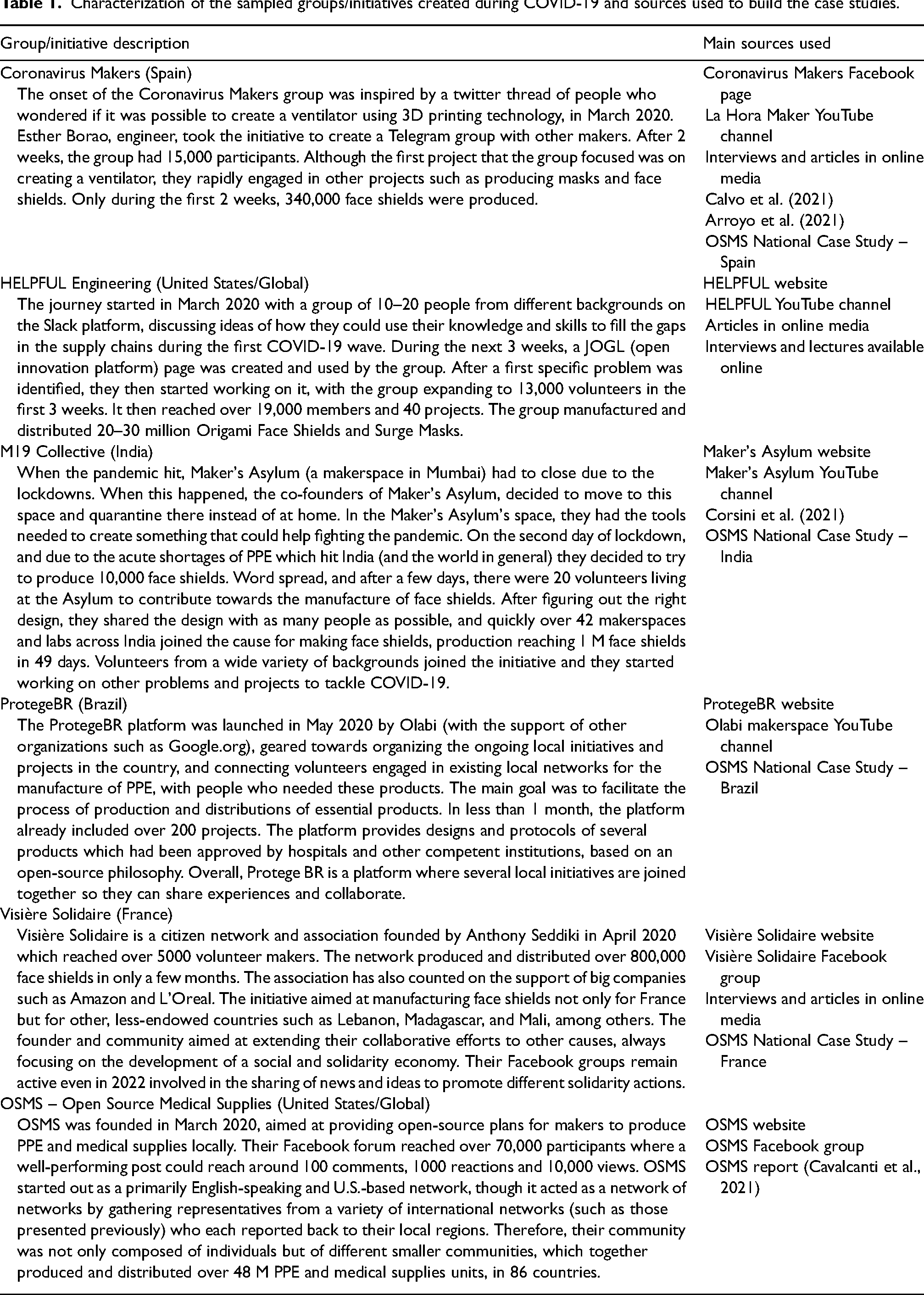
The first step in our evidence-based research was to conduct an online search to identify relevant initiatives or groups. For our case search, we used different combinations of search strings such as ‘makers’, ‘user innovation’, ‘PPE’ and ‘COVID-19’. Moreover, we had previous knowledge of the existence of the Open Source Medical Supplies (OSMS) initiative and started first with their website and report to get acquainted with other initiatives. After analysing the quality and quantity of information available for each initiative, we selected a final sample of six different global initiatives, representing distinct geographies. We chose a heterogeneous and substantive sample, thereby reducing the risk of reaching idiosyncratic conclusions and assuring that these results from common attributes are stronger (Ruebottom, 2013). We scanned the information available on the various groups’ websites, social media platforms, media coverage, reports, and research articles. Over the course of this research, the authors analysed over 200 min of video (interviews, talks, meetings, etc.), and scanned over 50 websites comprising personal testimonies of the participants and other relevant information. Besides individually scrutinizing each source of each group, we have also used post hoc data (for the data from Facebook groups) from CrowdTangle, a public insights tool owned and operated by Meta. CrowdTangle provided us with chronological analytics and helped highlight top-performing Facebook posts across public Facebook groups to assist in the identification of bricolage evidence. By covering different sources of information, we reduced the possibility of informant bias and performed data triangulation to achieve finer results (Glaser and Strauss, 1967; Miles and Huberman, 1994). We gathered and compiled relevant information on each initiative to build the different case studies (such as type of actors, collaborations, products created, technologies used, etc.). A summary of each group/initiative and the respective sources used to build the case studies are presented in Table 1. We then proceeded to analyse the data that we drew, focusing on ‘central organizing ideas’ (Rauch et al., 2014) during an iterative examination of each case and comparisons between the cases, while interrogating the emerging data with existing literature (Eisenhardt, 1989; Glaser and Strauss, 1967). This iterative scrutiny of each case and comparisons between them, enabled us to reach our first-order concepts. After that, a process of axial coding was performed resulting in second-order concepts (Locke, 2001; Strauss and Corbin, 1998). These were then abstracted into a higher-order dimension while constant comparison between the data and the emerging dimensions was carried out (Glaser and Strauss, 1967). We finally settled on ‘distributed bricolage’ as the collaborative creative process carried out by the actors in this context.
Characterization of the sampled groups/initiatives created during COVID-19 and sources used to build the case studies.
Findings: Distributed actor networking of responsive bricoleurs
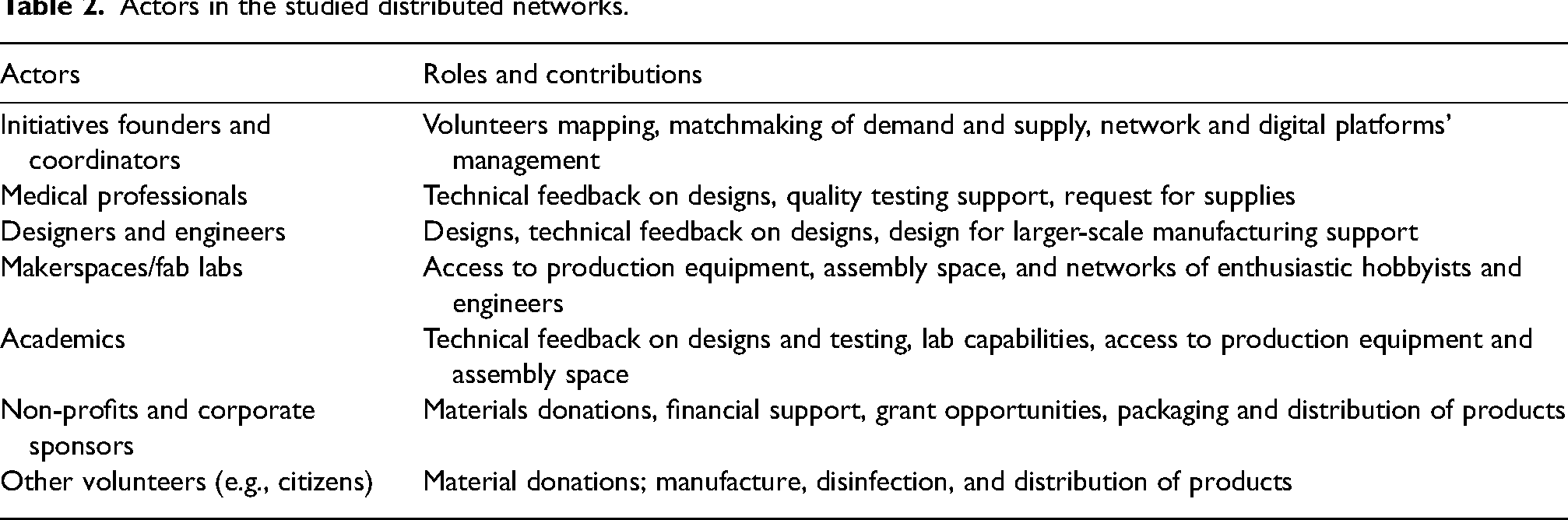
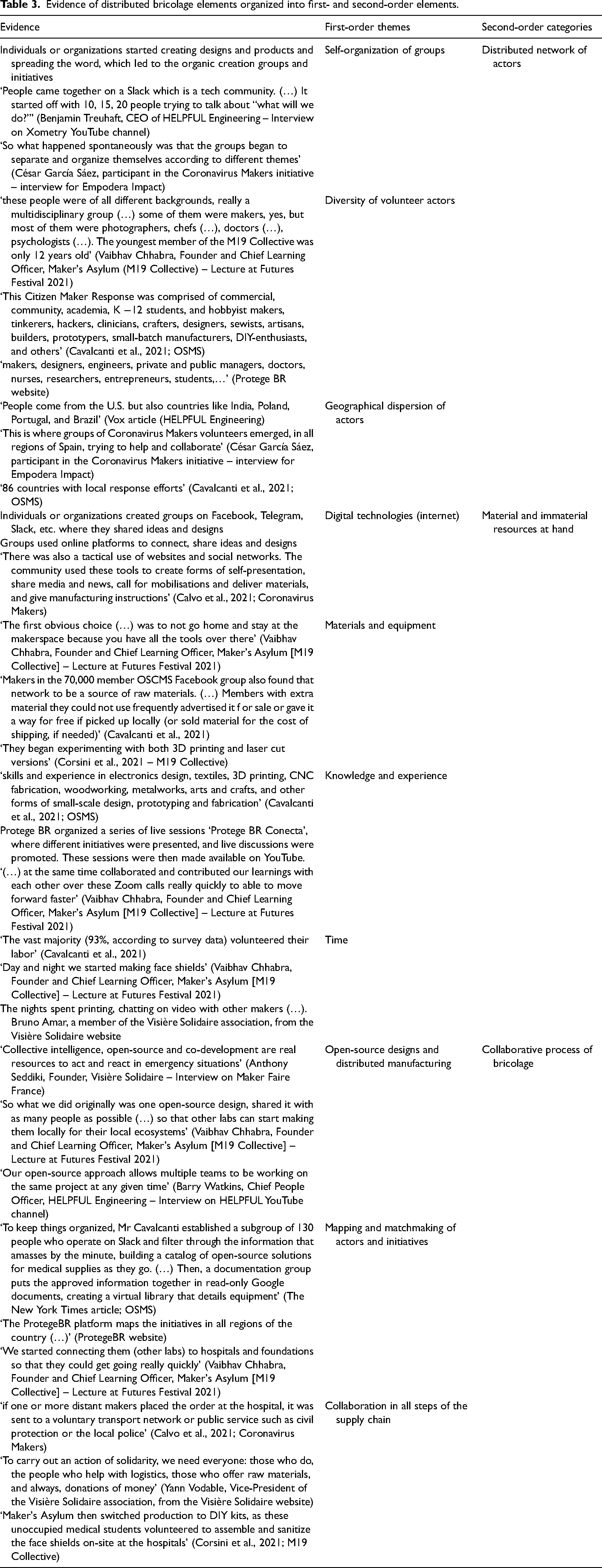
In what follows, we provide a narrative describing the various initiatives by interlinking their characterization with the phenomenon of distributed bricolage, which emerged from our analysis. Figure 1 and Table 2 schematize the organization of our findings, which are supported by the evidence depicted on Table 3.
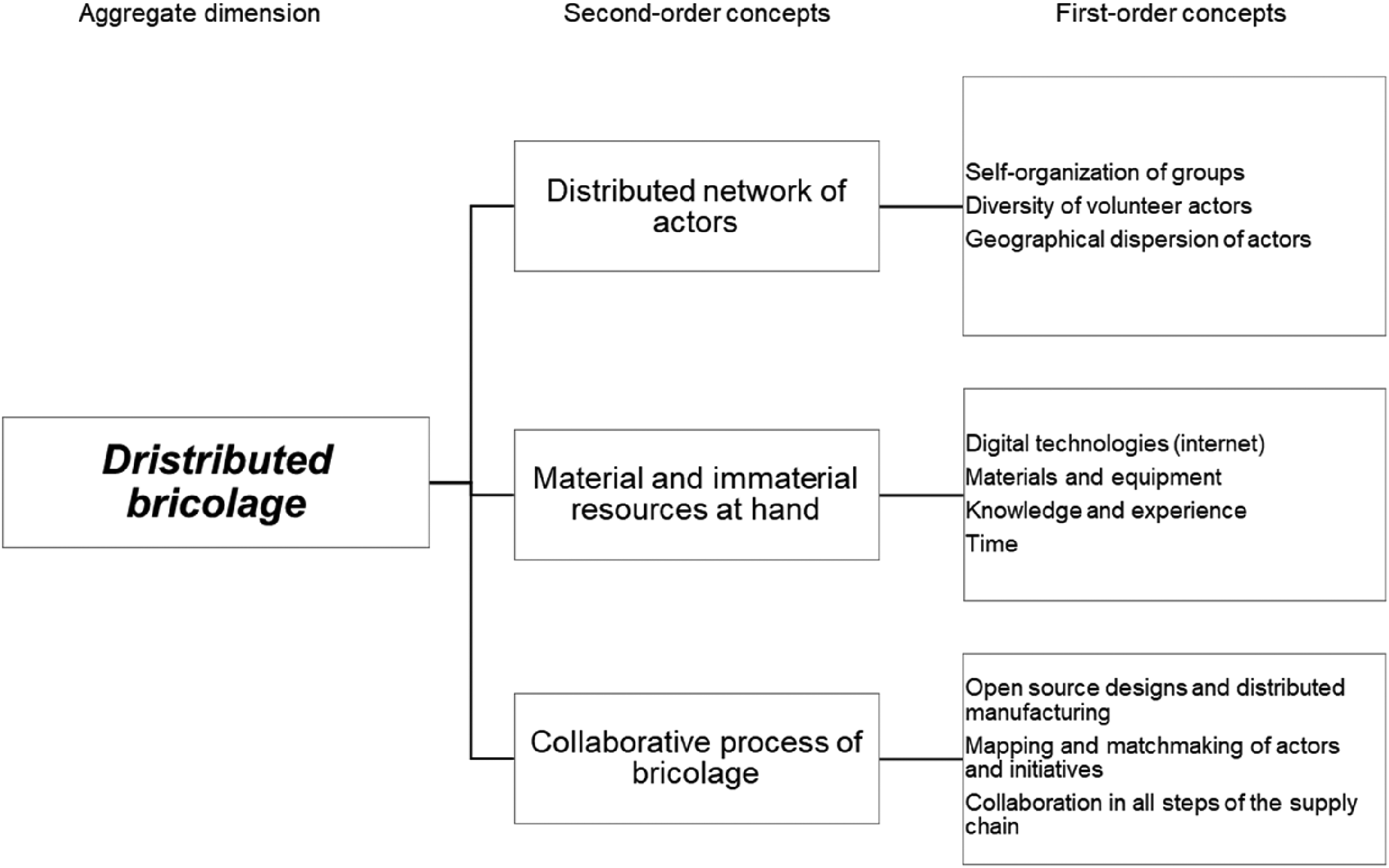
Distributed bricolage – findings summary.
Actors in the studied distributed networks.
Distributed network of actors
Over 42 cities, towns and villages have joined the cause and now we have pretty much all of India – east, west, north, south – making face shields. (Vaibhav Chhabra, Founder and Chief Learning Officer, Maker's Asylum – in a Lecture at Futures Festival 2021)
All initiatives, although geographically dispersed, began with the identification of similar needs: providing solutions to protect the population, especially (and initially) health professionals and the more vulnerable sections, following the huge spike in demand with the outbreak of COVID-19 and the resulting scarcity of PPE following acute bottlenecks in the global logistics systems (Cavalcanti et al., 2021). Aligned with the identified needs, a desire to help, and to ‘make do’ with available resources including expertise, became the principal drivers in the emergence of these maker initiatives. The participants of these initiatives were in general, volunteer individuals or groups who often had already been involved in the maker movement or had, at least, been experimenting with technologies such as 3D printing.
Makers are largely ‘highly specialized individuals, although not necessarily in technical matters; they are passionate about technology and innovation; a problem-solution approach characterizes their activity; they are flexible and adaptable, and they are highly entrepreneurial; On the other hand, the moral dimension of the makers’ profile is characterized by their interest in the common good, collective responsibility and social change’ (Arroyo et al., 2021: 27). While governments and institutions failed to take immediate action due to several reasons, including regulation, makers/bricoleurs refused to stand still and took action by using what was at hand to move on with their projects. Although makers’ proactiveness is an essential characteristic to make things happen, these initiatives would not be as successful, or might even fail to reach their objectives if they did not have the support of other citizens and companies which donated both materials, financial and other resources. For these initiatives to be successful, the mobilization of different human resources was essential, as knowledge in distinct fields was crucial, with time of crucial essence.
While many of the actors in the global response of ‘do it yourself’ (DIY) PPE kits were makers, particularly in the early period, they were quickly joined by other volunteer actors as well. These actions came from citizens, universities, independent groups, social organizations, groups of people which, moved by generosity, started to produce and deliver to a local hospital, to a family of a friend medical doctor, to a nurse of the neighborhood or community. (Gabriela Agustini, founder of Protege BR, on an interview to Agência Brasil – translated by the authors) It did not take long for an avalanche of willing to collaborate companies, public and private entities to join this citizen flow. In this adventure of solidarity not everyone is a ‘maker’ with a printer at home. There are also transport companies that offer to make the deliveries, journalists who offer to write the press releases and lawyers who make their experience available to the network to resolve the legal issues of patents. (El Periodico, regarding the Coronavirus Makers initiative – translated by the authors)
As populations in most countries were confined due to mandatory lockdowns, the mobilization of the necessary volunteers and skills was only possible due to the affordances of digital technologies, specifically social media and other online platforms. Hence, although the volunteer actors were connected through these networks, working on the same projects, or sharing ideas on different projects, they were still located in their hometowns, most of them focusing on meeting the local needs and demands, in a real distributed network form. It is however important to note that if it was not for the distributed actors’ willingness to ‘make do’ and ‘refusal to enact limitations’ as bricoleurs, the mere existence of the internet as a resource would not be enough to engage in these actions (Baker and Nelson, 2005: 334). I think it was in the flexibility and the willingness to collaborate with anyone in this common cause that really brought everyone together. (César García Sáez, member Coronavirus Makers initiative, interview for Empodera Impact) We had never really made PPE before this, so we didn’t know what we were doing. So we got to work, we stopped thinking, we started making. (Vaibhav Chhabra, Founder and Chief Learning Officer, Maker's Asylum [M19 Collective] – Lecture at Futures Festival 2021)
Examples of some of the volunteer actors and their contributions towards the success of the makers’ initiatives are presented in Table 2. Aligned with the same goal and using their existing and new contacts and networks, different people came together in many communities worldwide, feeling very connected despite being geographically dispersed. The nights spent printing, chatting on video with other makers, the family spirit that was created, the look in the eyes of the people we were able to help, has left an impression on me. (Bruno Amar, a member of the Visière Solidaire association, from the Visière Solidaire website – translated by the authors)
The material and immaterial resources at hand
My lab works in the area of frugal science, and we build low-cost tools for resource-limited areas. And now, we’ve realized that I don’t have to go that far. It's in our backyard, right? We need it now. So this is a plastic sheet I have – not too different from what you would get out from a 2-liter Coke or a soda bottle. I actually bought this from an art store. It's just sheets of PET, so we can cut these out. We are calling this an origami face shield, and it's the Level 1 protection. This is one idea. There are multiple different prototypes. (Saad Bhamla, Assistant Professor, Georgia Tech – in an interview for New York Times)
The lack of any extant infrastructure for the thousands of volunteers seeking to make PPE was a trigger for the volunteers to act. There was no pre-existing collection of open-source approved emergency medical supply designs; almost all were developed during the pandemic itself. There were also no platforms or meeting places for healthcare workers to submit their needs, with hospitals confined to procuring from a few known producers of medical suppliers. Confronted with these limitations, the bricoleurs engaged ‘making do’ with extant resources, in this case, also required a high degree of improvisation, as resources and time were scare and did not allow for the temporal separation of design and execution of the activities (Miner et al., 2001).
From the analysis of the selected cases, we find four main types of resources at hand involved in this collaborative and distributed bricolage process, as depicted in Figure 1. First, the affordances of digital technologies, namely social media and other online platforms. This was the main operand resource which allowed the establishment of the networks themselves. Without such a resource, it is very possible that the networks would have remained local, restricted to previous existing connections, most likely reducing the effectiveness of the process. Moreover, as much of the population worldwide were in lockdown, even the organization of local initiatives would be more difficult. The second are materials and equipment. When the pandemic broke out, there was not enough material available to produce the thousands and millions of PPE using the design for prototypical material. Therefore, designs were being constantly adjusted for the materials that were indeed available. For instance, the face shields developed by the M19 collective had 21 different designs, depending on the available materials (Corsini et al., 2021).
For the initiatives to succeed, a lot of material donations and purchases from local stores were necessary since the demand was too high and the global supply chains were disrupted. Regarding the equipment used, the most prominent were 3D printers. These were available not only at makerspaces and research labs, but also owned by individuals, enhancing the scale and productivity of the network.
The third and fourth resources were of an immaterial nature, those of knowledge and experience, as well as own users’ time. Although ‘very few of the individuals, groups, and businesses participating in this response had any experience producing medical supplies before the pandemic’ (Cavalcanti et al., 2021: 18), actors had experience in other fields such as electronics, 3D printing, CNC fabrication, metalworks, woodworking, among others. As such, they combined these different knowledge, and, with the collaboration of healthcare workers, were able to rapidly engineer effective solutions. Furthermore, no matter what the background or the form of contribution, one of the most valuable resources all actors gave was time. People were working on these solutions relentlessly, towards their common goal of PPE and other medical supplies to tackle the global pandemic. Although use of one's own time is often overlooked as a resource in literature, it is an essential resource for bricolage especially when material and financial resources are scarce (Sarkar, 2018) or when the needs to be met are urgent, such as in COVID-19.
Collaborative process of bricolage
Our open-source approach allows multiple teams to be working on the same project at any given time. Designer could create a CAD drawing of a part for a respirator in one part of the world. They can go to sleep and when they woke up somebody on the other side of the world had already printed the part out and was providing feedback on ways to improve it for the next round. (Barry Watkins, Chief People Officer, HELPFUL – in an interview on HELPFUL YouTube channel)
Although the initiatives are very widely distributed across the globe (the ones studied in this work were operated in France, Brazil, India, Spain, United States or globally), the processes leading to distributed collaborative creation are very similar. Most initiatives started with local volunteers (often makers) who had access to a 3D printer or other equipment and took the initiative to start producing some type of PPE. Realizing that the demand was abruptly increasing to numbers largely exceeding their manufacturing capacity, the makers turned to social media such as Facebook, Twitter, Telegram and Instagram or other online collaborative platforms such as Slack or JOGL, to mobilize their local community to participate, either by donation, by providing material or by participating in the production and distribution of PPE. Hence, these national or global initiatives started as smaller local initiatives which then expanded to build a bigger network. In the first 6 weeks of activity, OSMS reported an increase in output to a mammoth 653%, ranging from one-off projects, to small-batch production, to large-scale manufacturing (Cavalcanti et al., 2021).
The groups’ activities included diverse forms of collaboration largely based on making do with the available resources, involving sharing ideas and designs. The latter included the share of open-source designs, meetings and talks to share ideas and experiences, mapping local initiatives to facilitate matchmaking between both different initiatives but also between different actors to complete the supply chain (design, prototyping, testing, certification, manufacture, packaging and deliver), repurposing equipment and facilities to produce, test and distribute the products, among others.
Another common trait between the groups, is that designs and prototypes were constantly being updated during the first months, either to adapt to the available machinery and materials at each production point, or to enhance production efficiency (e.g., reduce time). Design adaptation according to geography and local environment was also extremely important as the resource challenges and conditions also differ greatly. Upgrades were done in a collaborative and open-source way, with ideas constantly flowing from different locations. The M19O2 went through multiple prototypes over 8 weeks to be able to put it together. However, what was super exciting about this concentrator was that over 30 labs worked together to make this happen across the country so it was simultaneous innovation going on which was is quite cool; simultaneous problem solving going on, understanding from each other; trying to figure out how to make this using local supplies. (Vaibhav Chhabra, Founder and Chief Learning Officer, Maker's Asylum [M19 Collective] – Lecture at Futures Festival 2021)
The difficulty of managing national and international groups was noted throughout our research. As groups were growing, the organization of the volunteers and projects were subject to main adaptations and, in most cases, a separation in smaller groups according to project focus and/or location was necessary to keep things running smoothly. Nevertheless, although there were smaller groups for most immediate connection and for logistics reasons, these smaller groups could still easily connect to one another to share information and experience. In the OSMS network, there was inclusively a sub-group of 130 people who were responsible for the filtration of the immense amount of information being published for building an ongoing catalogue of medical supplies (The New York Times, 2020). This modus operandi which has worked effectively shows relevance to a decentralized action. One of the most curious things is that it started with this idea of working on the ventilator, but it soon became clear that it was very difficult to collaborate 15,000 people in the same group. So what happened spontaneously was that the groups began to separate and organize themselves according to different themes: there were people who had more experience in ventilators, there were people with more experience in electronics, other people had experience in 3D printing … groups were organized organically, in a similar way to the territorial distribution of Spain. (César García Sáez, member of Coronavirus Makers initiative, interview for Empodera Impact)
Evidence of distributed bricolage elements organized into first- and second-order elements.
At the onset of these initiatives, most were focused on a specific problem or a particularly felt need for a scarce product. For instance, Coronavirus Makers started with the objective of designing and manufacturing a ventilator using 3D technology while other initiatives such as Visière Solidaire and M19 Collective were focused on face shields. However, as the communities started to scale up and connect, and as PPE demands began to evolve, most initiatives expanded to include other products such as masks, respirators, sanitizers, protection goggles among others. Many of these items represented novel usages of materials and/or production techniques and frugal redesigns of existing technologies, while some items – such as ear savers and intubation boxes – were novel inventions altogether. The Forbes Technology Awards even recognized ‘Makers’ as the 2020 Most Disruptive Innovator of the Year (Forbes, 2020). Thus ‘making do’ using available local material and equipment did not imply that the PPE produced were of low quality. Following the success of OSMS, the U.S. National Institute of Health decided to accept laypeople's designs for their medically reviewed 3D Print Exchange – but they lacked the capacity to meet demand for medical expertise when their platform experienced a 6000% increase in unique visitors to the site within a day of inviting makers to upload their own submissions. Following the surging popularity of 3D-printed PPE in the United States, three government agencies collaborated with the national 3D printing Manufacturing USA Institute to form the COVID 3D Trust in January 2021, in order to professionally compile, test, and evaluate 3D-printed PPE for clinical use (VHA 3D Printing Network COVID-19 Response, n.d.).
Discussion
The objective is sort and organize – as best as possible – the information about PPE production, which are decentralized, and help connecting the multiple actors which are working together in fighting the pandemic (makers, designers, engineers, private and public managers, doctors, nurses, researchers, entrepreneurs, students, …) in our country. (…) the ProtegeBR platform maps the initiatives in all regions of the country, provides contacts of health secretaries of states and towns and shares open-source projects which can be locally replicated by makers. (ProtegeBR website)
In their recent systematic review of the bricolage literature, Mateus and Sarkar (2024) find that bricolage emerges not only as an entrepreneurial strategy but also as a philosophy, ‘one that promises to transform narratives and redefine paradigms’ (p. 17). One such transformative narrative we hold, is that of distributed bricolage, a phenomenon that we uncover in this research. The onset of COVID-19 disrupted the way we live and work, provoking acute crises in healthcare systems worldwide, with significant shortages in PPE. Our analysis shows one response to these shortages via the voluntary participation of networks of disaggregated volunteers, professionals, and non-professionals, who enacted bricolage, designing, producing, and distributing PPE and other medical supplies. These networks represent responsive, agile and effective structures of self-organization and autonomous management, which may serve as an example to deal with other crises and even non-crisis situations. We followed the evidence of six different impactful groups that formed via social media or other digital platforms, each comprising a heterogeneous collection of actors who crafted innovative solutions, using existing resources at hand. We call this distributed bricolage, a perspective formed from the networked and socialized view of actors, hitherto missing in the extant bricolage literature.
While these networks rapidly emerged as a response to the COVID-19 crisis, some of them have also dissolved or reduced their interaction and activities after the need for the PPE was reduced or met by different initiatives. This fact brings out the question of whether the collaborative distributed bricolage that our study identifies, is associated with short term, emergency action or if it has the potential to endure in long-term action. It has been suggested by Arroyo et al. (2021) that these initiatives may be in the ‘hibernation phase’, meaning that their activity is suspended or reduced. From this, a ‘reactivation phase’ may occur if, even in a more organized way, if a new collective emergency occurs.
We observe that while some network initiatives have stopped their interactions, others such as OSMS perpetuated or been reinforced to contribute for other humanitarian crisis, such as the war in Ukraine. Another example is the M19 collective which, from April 2021 has been working towards tackling the low levels of oxygen in India, which has long been a problem, further exacerbated by COVID-19.
For these new goals, the actors ‘went from knowing very little about how oxygen concentrators work to actually building prototypes, making improvements, and building them using locally available materials and resources’ (Maker's Asylum YouTube channel). As the initiatives had to develop very quickly, the management aspects were not a priority. After the demand dropped, some initiatives tried to keep their network alive, and try to make them more structured to tackle other issues. For instance, Coronavirus Makers launched two associations to give continuity to further ideas and projects, in a more structured form. These examples give hope and may inspire other network initiatives to extend their collaborations beyond the initial crisis which have brought the actors together while building up trust in user-led innovation.
The bricolage literature has often identified the solutions generated as being ‘second best’ or ‘good enough’ (Lanzara, 1999; Steffens et al., 2022), with ‘lots of bugs and gaps, frictions, and unusable components’ (Steffens et al., 2022: 6). While much of the bricolaged solutions can be identified indeed as being second-best, they were also efficacious in not only getting the job done, but of sufficient quality to merit being truly innovative with lasting design impact. For instance, one of the earliest open-source face shield designs gained government certification, the Prusa RC1, invented by Czech 3D printer inventor Josef Prusa, who received Czech Ministry of Health approval on 16 March 2020. Prusa also got a European Union CE certification for his factory's 3D printing shields, and also provided guidance to others to obtain certification for their own makerspaces (Cavalcanti et al., 2021). Even though face shields are easily testable and not safety-critical devices, the U.S. OSMS community produced 739,000 unauthorized face shields starting in mid-March of 2020 before the FDA managed to provide formal legal protections for selling them, given their sufficiently high quality. On 9 April 2020, the U.S. FDA issued their first temporary Emergency Use Authorization to allow hospitals to use non-certified face shields for medical use, provided the face shields comply with certain guidelines and labelling requirements (FDA, 2020).
Based on our analysis of empirical data and a review of relevant bricolage literature, we develop a conceptual model of the ‘distributed bricolage’ concept (Figure 1). The enactment of distributed bricolage cannot be attributed to one individual actor, but to a multitude of diverse actors, who share ideas, designs, technology artefacts and material and immaterial resources, to enable the assemblage of the resources to devise effective solutions. Traditional bricolage discourse tends to focus on individual action. Although some studies have suggested a more collective action in bricolage (Garud and Karnøe, 2003; Gurca and Ravishankar, 2016; Sunduramurthy et al., 2016), the focus of action is still centralized on an individual or organization. As such, we bring new insights regarding distributed agency on bricolage. First, when collaborative or distributed bricolage was discussed in previous literature, it implied that the actors were geographically close and involved in already established networks. On the contrary, the maker groups that we identified and created with the outbreak of COVID-19, emerged spontaneously involving volunteer actors from diverse geographies. Although there might have been previous connections between some actors, most of each network was composed of actors who did not know each other. Secondly, although previous literature has explored collaborative action in bricolage, the types of collaborations were quite different from the ones we have observed. In extant literature, there is usually a central actor on the bricolage process with whom the different actors collaborate. It is a more structured collaboration where the central actor chooses and manages its collaborations. In the case of our study, the process is much more decentralized. The founder or leader of the initiative takes on a more secondary role of managing the platform where all the other actors freely interact and collaborate. This idea aligns with Sutherland and Jarrahi's (2018) definition of a decentralized digital mediator, which has little control on the control on the innovation process itself but instead facilitates the contact between sparsely distributed actors. This agility and flexibility is promoted by both technology and the ‘make do’ mindset of the actors, which can inspire organizations in their paths towards flexible structures (Sushil, 2015). Third, we attribute a main role for digital technologies, especially online platforms, in enabling the establishment of distributed bricolage, as an immaterial resource which has not been explored in previous studies. Regardless of these differences, it is important to note that the ‘distributed bricolage’ concept we present in our model of comparison is a fusion of contributions of extant literature on collaborative bricolage and our findings, and not a suggestion of substitution (Figure 2).
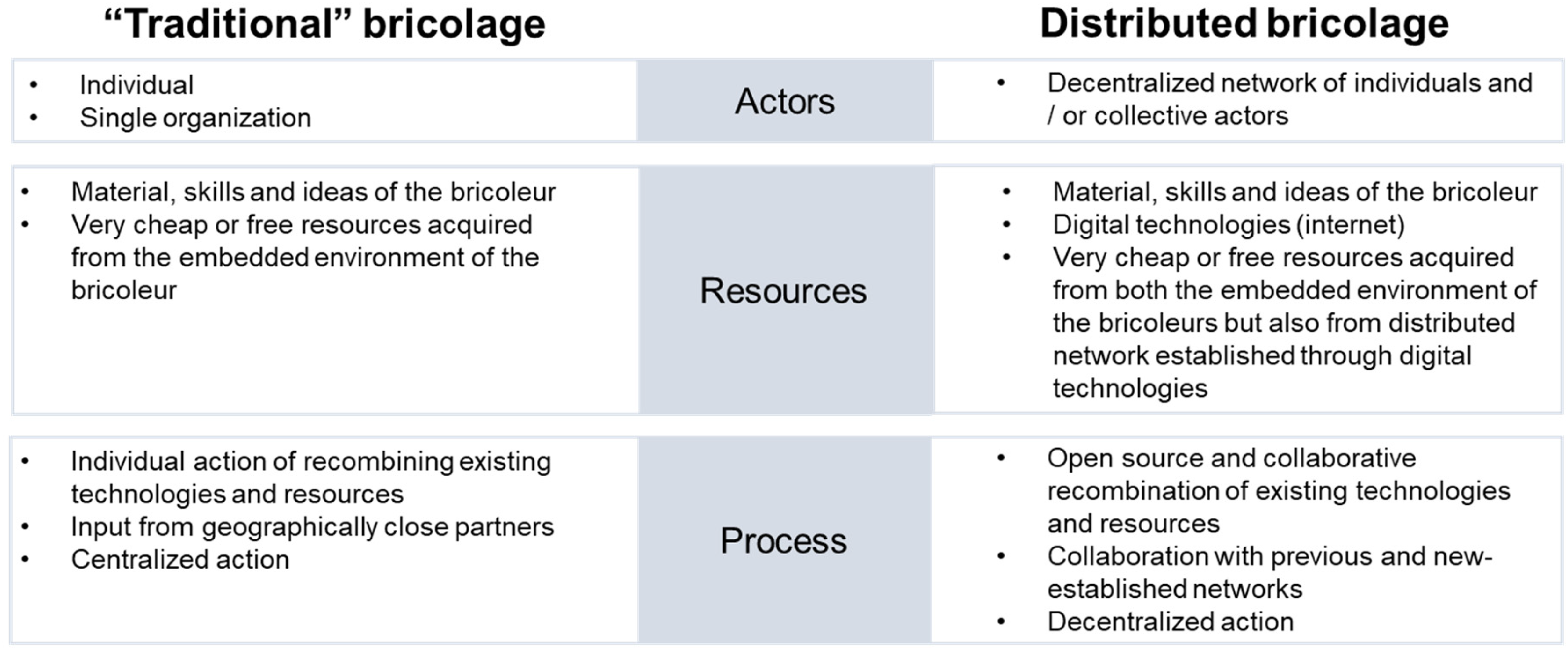
Model of comparison between ‘traditional’ bricolage and distributed bricolage.
We believe our study introduces a couple of important relevant contributions to both theory and practice. First, we bring digital technologies to the centre stage of bricolage, promoting its action in a distributed fashion. Digital technologies can potentially enable a rich variety of affordances to the historical bricolage process, an area hitherto overlooked in the literature. The digitalization of the material world makes the material and the immaterial interlinked, offering a chance for new kinds of material–non-material hybrids, as well as new ways to interlink the immaterial with the concrete materials of the physical world. In the current context, generativity refers to the capability of digital platforms to allow for a recombination of elements and for assembly, extension, and redistribution of functionality (Yoo et al., 2010). The use of digital technologies further allows to overcome the ‘tyranny of space’ (Lyytinen et al., 2016: 52), in entrepreneurial enactment. As society becomes more dependent on digital technologies, we believe it is of primary importance to explore their role on entrepreneurial practices, especially regarding strategies which were conceptualized during a period where this was not a reality, to continually improve and update concepts such as bricolage.
Second, we deepen the concept of collaborative and distributed bricolage by moving beyond the definition of collaborative actions based on pre-existing geographically embedded networks in proximity, to exploring the creation of geographically dispersed networks through easily available online platforms. Our research thus resonates the need to understand bricolage in the contemporary age. Davidsson et al. (2017) underscore the significance of resourcefulness in entrepreneurial bricolage, shedding light on the evolving nature of bricolage in contemporary entrepreneurial activities. This echoes our discussion on the adaptation of bricolage in the face of modern challenges.
Third, we contribute to innovation literature by moving away from the perspective of institutional leadership. We provide evidence that these networks of actors successfully operated in a decentralized and organic form where each actor was active in mobilizing resources and contributing for the greater objective, contributing with a fresh perspective of innovation networks. Echoing our observations, Melin and Gaddefors (2023) had advocated for a broader understanding of agency in entrepreneurship. Their study, which considers both human and nonhuman elements, complements our analysis of how distributed agency was pivotal in the spontaneous formation of effective responses to COVID-19.
The study's findings have significant practical implications, particularly for crisis management and entrepreneurial innovation. The demonstrated efficacy of distributed bricolage in addressing urgent, large-scale challenges suggests a model for future crisis response. Organizations and entrepreneurs can leverage digital technologies to mobilize diverse, global networks quickly. This approach can lead to rapid, innovative solutions, emphasizing the importance of agility, adaptability, and collaboration in entrepreneurial endeavors, especially in resource-constrained or emergency scenarios. Furthermore, from a practical lens, our investigation of the actor networks innovating protective devices during the COVID-19 crisis highlights a distributed agency in the form of bricolage, which is not restricted to efforts within organization boundaries. Hence, we uncovered that in an extraordinary crisis, it is the ingenuity and improvisation capacity of the multitude rather than the protective patents of oligopoly suppliers and the extended supply chains that they organize that can most speedily and effectively be of practical success. This study also adds to the topic of resource-constrained collective entrepreneurship (Refai et al., 2024) by demonstrating the possibility and power of collaboration with actors spread across the world, powered by the internet, moving beyond local collectivity. Yet, a critical reflection is warranted on how these technological affordances also bring to the forefront issues of accessibility, privacy, and data security. The acknowledgement of digital platforms in enabling collaborative action must be tempered with a consideration of how these platforms also perpetuate digital divides and may exacerbate existing socioeconomic inequalities. Furthermore, the emphasis on generativity and user-driven innovation must be balanced with awareness of the regulatory and ethical challenges posed by unrestricted digital engagement, highlighting the double-edged nature of digital technologies in the context of distributed agency and bricolage.
Limitations and future research
Our study does not come without limitations, calling for some caution when generalizing our findings. These limitations, in turn, create space for exploring new research directions, as we elaborate in this section. First, although we have tried to choose examples that represent different countries and contexts, we could not cover all. Despite considering that our sample enabled us to have a proper analysis of the phenomenon globally, it would be further interesting to study other examples and explore how they fit in our concept of distributed bricolage. While the selected cases provide a global perspective, they do not cover all possible scenarios. Future research could explore similar networks in different crises or non-crisis situations, and address challenges like quality control and user acceptability. We therefore believe that a potentially rich avenue for future research is the application of distributed bricolage to other types of phenomena, such as climate change mitigation, education, and decentralized manufacturing. This could involve studying how digital platforms enable collective action and resource mobilization across geographies and sectors, potentially leading to innovative solutions to global challenges. This expansion would enrich the understanding of distributed bricolage in varied entrepreneurial settings and under different environmental conditions. Second, we characterize distributed bricolage in the context of COVID-19. Being a health crisis, the response was urgent which may have been a crucial factor for these makers’ initiatives to succeed. Thus, the study's focus on initiatives related to the COVID-19 crisis, may not fully represent distributed bricolage in other contexts. Future research could explore similar networks in different crises or non-crisis situations, and address challenges like quality control and user acceptability. This expansion would enrich the understanding of distributed bricolage in varied entrepreneurial settings and under different environmental conditions. For instance, investigating how distributed bricolage influences ongoing innovation processes, business model development, and community engagement could provide valuable insights into its broader applicability and sustainability. Third, we have not addressed, regarded quality control, certification and, in part, user acceptability. It would be interesting to explore the action of similar networks not just in other types of crises, but whether this could exist outside the realm of crises. Is this way of innovation and collaboration a viable one, considering economical and managerial factors? Since these groups were mobilized by volunteers during lockdowns and pandemic peaks, is there a way to effectively establish these networks in different circumstances?
Footnotes
Declaration of conflicting interests
The authors declared no potential conflicts of interest with respect to the research, authorship, and/or publication of this article.
Funding
Soumodip Sarkar gratefully acknowledges the generic financial support received from the Fundação para Ciência e Tecnologia (FCT) through UIDB/04007/2020. The authors are grateful to the editors and anonymous reviewers for their very insightful suggestions, which greatly contributed to the improvement of this article.
