




Abstract
The rapidly changing digital landscape presents a new context highlighting growth strategies and organizational ambidexterity. This research explores the interaction between growth strategies of rural SMEs, digital orientation, and organizational ambidexterity during the COVID-19 pandemic. The survey data comprised 204 responses from Finnish SME owner-managers in the rural region of South Ostrobothnia in October 2021. The results from the ordinal regression analysis demonstrate that organizational ambidexterity positively influences the utilization of all growth strategies, serving as a mediator in the relationship between digital orientation and these strategies. Digital orientation is positively associated with applying a product/service development strategy, market development strategy, diversification, and business model development but not with market penetration strategy. These findings suggest that a digital orientation enables SMEs to strike a balance between exploration and exploitation, allowing them to effectively pursue both. Furthermore, digitalization offers rural businesses opportunities to implement more demanding growth strategies. Therefore, to ensure the long-term vitality of rural areas, society and policymakers must collaborate in providing robust digital infrastructure.
Introduction
SMEs play a crucial role in the global economy and are often referred to as the engine of growth (Obi et al., 2018). Firm growth is one of the most-studied topics in entrepreneurship research (Davidsson and Delmar, 2006; McKelvie and Wiklund, 2010; Shepherd and Wiklund, 2009): the individual factors that lead to SME growth are relatively well understood on a general level, but the relationships between factors less so (Garcia-Martinez et al., 2023). Small and medium-sized firms (SMEs) can apply different growth strategies in pursuing growth (e.g., Eide et al., 2021), and ubiquitous digitalization is changing the environment in which SMEs, particularly rural SMEs, operate (Klein and Todesco, 2021; Singh et al., 2021; Troise et al., 2022), but the level of digital maturity in SMEs varies (North et al., 2020). Further, while prior studies examine different strategic orientations in relation to performance and growth, such as entrepreneurial orientation (Ferreira et al., 2021; Ince et al., 2023) and market orientation (Presutti et al., 2023), so far, little is known about the relationship between growth strategies and digital orientation (DO), i.e., the strategic positioning of an SME to take advantage of opportunities offered by digital technologies. Growth strategies, i.e., market penetration, market development, product development, and diversification, are now applied in an increasingly digital world, but there is a gap in our understanding of how growth strategies interact with DO. Rapid digitalization also affords a new context within which organizational ambidexterity (OA), that is, the ability to explore new possibilities and exploit existing certainties simultaneously (March, 1991; He and Wong, 2004), is manifested. Prior studies suggest that digitalization changes the landscape of both exploration and exploitation, but the relationship between DO, OA, and growth strategies is not yet understood (North et al., 2020; Scuotto et al., 2020). Furthermore, firm growth and learning strategies of exploration and exploitation in rural areas warrant closer consideration since the most innovative rural SMEs are more likely to contribute to job creation in rural areas (North and Smallbone, 2000). Rural areas form a specific context for growth as some of the barriers to growth may differ between urban and rural areas (Lee and Cowling, 2015), and the growth motivation of rural SMEs can be limited (Galloway and Mochrie, 2006). Tunberg (2014) reports that the complexity of rural firm growth warrants more research.
In Europe, the countryside stands out from the cities with a lower income level but a better employment rate (European Commission, 2021). Longer distances and lower population density complicate the provision and availability of services in rural areas and affect SMEs’ opportunities and capabilities. Digitalization offers new market and product development opportunities, particularly in rural areas. Digital technologies can also transform how firms develop new business models and manage production chains (Belhadi et al., 2022). However, taking advantage of the opportunities offered by digital technologies requires deliberate positioning, that is, DO.
The objective of this paper is to analyse the effect of DO and OA on the growth strategies of rural SMEs during the COVID-19 pandemic. Quinton et al. (2018) define DO as “The deliberate strategic positioning of an SME to take advantage of the opportunities presented by digital technologies. This positioning includes the attitudes and behaviours that support the generation and use of market insight, proactive innovation, and openness to new ideas”. As a strategic position, DO can affect the decisions related to different growth strategies and building new business models. Prior research finds that DO fosters a simultaneous pursuit of exploitative and explorative innovation behaviours, that is, OA (Fengel et al., 2022). However, there is a gap in our understanding of how DO and OA relate to specific growth strategies. A similar gap exists concerning the relationship between OA and growth strategies. O’Reilly and Tushman (2013) define OA as “…the ability of an organization to both explore and exploit—to compete in mature technologies and markets where efficiency, control, and incremental improvement are prized and to also compete in new technologies and markets where flexibility, autonomy, and experimentation are needed”. Belhadi et al. (2022) view OA as a capability of an organization “to be simultaneously efficient in managing current business demands and adaptive to future perspectives”. OA affects firm growth and performance (Balboni et al., 2019; Choi et al., 2022; He and Wong, 2004; Zhang et al., 2019), but the relationship between OA and growth strategies is little understood. Furthermore, as exploration in the current technological states often involves exploration of digital technology applications (see, e.g., Gregory et al., 2015), the interplay between OA and DO (Belhadi et al., 2022; Fengel et al., 2022) is probable: thus, this study examines the mediation and moderation effects of OA on the relationship between DO and growth strategies.
The COVID-19 pandemic offers a specific context to test the relationships between DO, OA, and growth strategies in a crisis. Crises can lead to societal changes in people's behaviour and lifestyles (Menter, 2022). While the COVID-19 pandemic had a severe impact on many small businesses (e.g., Fairlie, 2020), the associated crisis also offered new opportunities for business innovation (Brown and Rocha, 2020) and boosted digitalization in some contexts (Bai et al., 2021; Tolba et al., 2022). This study contributes to our understanding of rural firm growth by showing the critical effect of OA and DO on growth strategies in a crisis.
Framework and hypotheses development
SME growth, growth strategies and the perspective of digital orientation
Penrose's (1959) seminal work highlights that the key to a firm's growth lies in the effective and innovative management of its resources and capabilities, creating a competitive advantage and resulting in the creation of economic value. However, as we now know, resources, capabilities, and structures are not the only drivers of growth. SME growth is also influenced by individual motivation and entrepreneurs’ perceptions of different institutional dimensions (Baum and Locke, 2004; Li et al., 2019). Growth intentions are an important factor, as is access to external resources (Saemundsson, 2003). The entrepreneurial and start-up ecosystem can also play a role, especially in the growth and performance of new ventures (Perdomo-Charry et al., 2023; Sarma and Marszalek, 2020); for example, disruptive financial innovations providing finance for early-stage growth firms can offer opportunities for small firms (Culkin et al., 2016). In addition, recent research shows that sustainable innovations can promote SME growth (Fernandes et al., 2023). Furthermore, the growth of a firm can be contingent upon the specific circumstances it operates within, and the factors contributing to its growth can differ across various contexts, such as urban, rural, developed, and developing countries. For instance, Farja et al. (2017) demonstrate that rural areas in developing economies require particular resources, such as funding and knowledge to foster growth. Galloway and Mochrie (2006) show that in rural areas, the motivation of SMEs to pursue growth can be limited and require a focus on entrepreneurial orientation.
Prior research investigates the pursuit of growth from two different perspectives: the first is based on growth modes, which include internal development, mergers and acquisitions, and partnerships (Ego, 2022) – also described as organic, acquisition, or hybrid modes (McKelvie and Wiklund, 2010). The second perspective is that of growth strategies (e.g., Kyläheiko et al., 2010; Watts et al., 1998). The latter is traditionally divided into four categories by Ansoff's (1957) matrix: market penetration, market development, product development, and diversification (Baker, 2010). The present study concentrates on growth strategies and utilizes Ansoff's growth matrix. Prior research shows that Ansoff's growth strategies of market penetration, market, and product development can all contribute to actual growth, but the growth strategy of diversification is challenging (Hussain et al., 2014). Prior research utilizes Ansoff's growth strategy matrix, for example, in examining the mediating effect of growth strategy on the linkage between market orientation and performance (Filatotchev et al., 2017), in relating growth strategies to growth history and expectations (Watts et al., 1998) and in classifying innovation (Gurcaylilar-Yenidogan and Aksoy, 2018). Verhoef et al. (2021) use Ansoff's matrix to identify new digital growth strategies. In addition, a company can develop new business models when pursuing growth (Wu et al., 2021), which involves a fundamental change in the logic and strategy of value creation, delivery, and capture (see Verhoeven and Johnson, 2017). Digitalization offers opportunities for business model development but also poses challenges as new business models often require new capabilities (Rachinger et al., 2019).
The connection between DO and firm growth is a relatively new area of research. Foroudi et al. (2017) show that the interplay between digital technology, tangible/intangible assets, and marketing capabilities is crucial for growth. Digitalization is also shown to significantly contribute to economic growth in society (Habibi and Zabardast, 2020). Digitalization provides opportunities to employ multiple growth strategies simultaneously: for instance, digital technologies can aid in marketing efforts to target new segments and to identify foreign markets, and in developing new products and services, as well as improving communication with existing clients (Matalamäki and Joensuu-Salo, 2022). However, DO is necessary to take advantage of those opportunities. A firm's strategic orientation shapes the way organizations create and adapt behaviours and resources (Kindermann et al., 2021), and DO is a firm's strategic orientation that “caters to changes induced by digital technology” (Kindermann et al., 2021).
Furthermore, Kindermann et al. (2021) state that DO has four different dimensions: digital technology scope, digital capabilities, digital ecosystem coordination, and digital architecture configuration. This study draws on the definition of Khin and Ho (2019) to view DO as an indicator of a company's commitment and openness to applying digital technologies when adopting digital transformation initiatives. Accordingly, a firm with a strong DO is more open and committed to using digital technologies. Prior research shows that DO has positive effects on firm performance (Nasiri et al., 2022; Wang and Bai, 2021) and that DO is related to the use of market insight, proactive innovation, and openness to new ideas (Quinton et al., 2018). Especially in rural areas, digital technologies can offer a way to compete in larger markets, as they enable a firm to implement differentiated digital solutions swiftly (Arias-Pérez and Vélez-Jaramillo, 2022). Tiwasing (2021) showed that rural SMEs participating in social media business networks tend to achieve higher turnover and demonstrate a greater inclination to increase sales when compared to both rural and urban SMEs that are not a part of these networks. The openness to digital technologies is also essential during a crisis, as was apparent during the COVID-19 pandemic when firms were forced to apply digital solutions to replace face-to-face meetings. Morris et al. (2022) note that as the COVID-19 pandemic has accelerated the shift of numerous business activities to the online realm, businesses with less dependable access to digital connectivity may face greater limitations in their capacity to maintain resilience.
DO can affect the use of different growth strategies, as strategic orientation is firmly connected with behaviours and resources (Kindermann et al., 2021). Furthermore, Matalamäki and Joensuu-Salo (2022) show that digitalization is visible in a firm's growth process and growth strategies; digitalization can be used in market penetration, product development, market development, and diversification. Similarly, Verhoef et al. (2021) demonstrate how digital platforms can be leveraged when employing Ansoff's growth strategies. Digitalization can also be a source for new business model innovations (Parida et al., 2019). As DO serves as a base for using digital technology in the different ways of pursuing growth, the following hypotheses are proposed:
H1a: DO has a positive relationship with the use of a market penetration strategy in SMEs.
H1b: DO has a positive relationship with the use of a product/service development strategy in SMEs.
H1c: DO has a positive relationship with the use of a market development strategy in SMEs.
H1d: DO has a positive relationship with the use of a diversification strategy in SMEs.
H1e: DO has a positive relationship with the use of a business model development strategy in SMEs.
Organizational ambidexterity and growth strategies
OA refers to a company's ability to explore and exploit simultaneously (O’Reilly and Tushman, 2004; O’Reilly and Tushman, 2013). Exploration and exploitation are tactics for organizational learning. As March (1991) notes, organizations must allocate resources between these two strategies of “exploring new possibilities and exploiting old certainties”. Both exploration (searching, experimenting) and exploitation (enhancing execution) are crucial for organizational success (Gibson and Birkinshaw, 2004). However, organizations with limited resources may need to strike a balance between these strategies and may have to rely more on one than the other (Cao et al., 2009). In fact, Kohtamäki et al. (2010) show that in small firms, exploitation – not exploration – has a crucial role in turning strategic plans into business performance. There is some debate on whether OA is the ideal balance between exploration and exploitation, a combination of both at high levels, or an optimal point on a continuum (Cao et al., 2009; Junni et al., 2013; Simsek, 2009). OA has effects on SME growth, depending on firm size (Choi et al., 2022), extra-industry ties (Zhang et al., 2019), and the firm's life-cycle stage (Balboni et al., 2019). Venkatraman et al. (2007) find in their longitudinal study that OA predicts sales growth as a main effect. Several studies examine the OA–performance relationship. Kassotaki (2022) summarizes the key findings from earlier work and states that OA has a positive relationship with 1) sales growth rate, 2) transition to scale, 3) profitability, 4) return on investment and market share, and 5) short-term and long-term firm performance. However, a gap remains concerning the relationship between growth strategies and OA.
Growth strategies may involve both exploration and exploitation; for example, market penetration needs the development of efficient existing customer relationships (exploitation) and, at the same time, the exploration of new innovative channels to reach customers. In addition, the development of new business models – especially digital business models – demands OA as a dynamic capability (see Dixon et al., 2017). Hence, it is argued here that OA is a base for using any growth strategy, and a high level of OA increases the use of different growth strategies.
In addition, Fengel et al. (2022) show that DO increases OA; thus, OA may affect the relationship between DO and growth strategies either by a moderation or mediation effect. Belhadi et al. (2022) find that OA mediates the relationship between industry 4.0 capabilities and performance. Hence, OA may also mediate the relationship between DO and growth strategies. Based on prior research and to test the moderation and mediation effect of OA, the following hypotheses are proposed:
H2a: OA has a positive relationship with the use of a market penetration strategy in SMEs.
H2b: OA has a positive relationship with the use of a product/service development strategy in SMEs.
H2c: OA has a positive relationship with the use of a market development strategy in SMEs.
H2d: OA has a positive relationship with the use of a diversification strategy in SMEs.
H2e: OA has a positive relationship with the use of a business model development strategy in SMEs.
H3a: OA moderates the relationship between DO and the use of growth strategies in SMEs.
H3b: OA mediates the relationship between DO and the use of growth strategies in SMEs.
Data and methods
Data collection
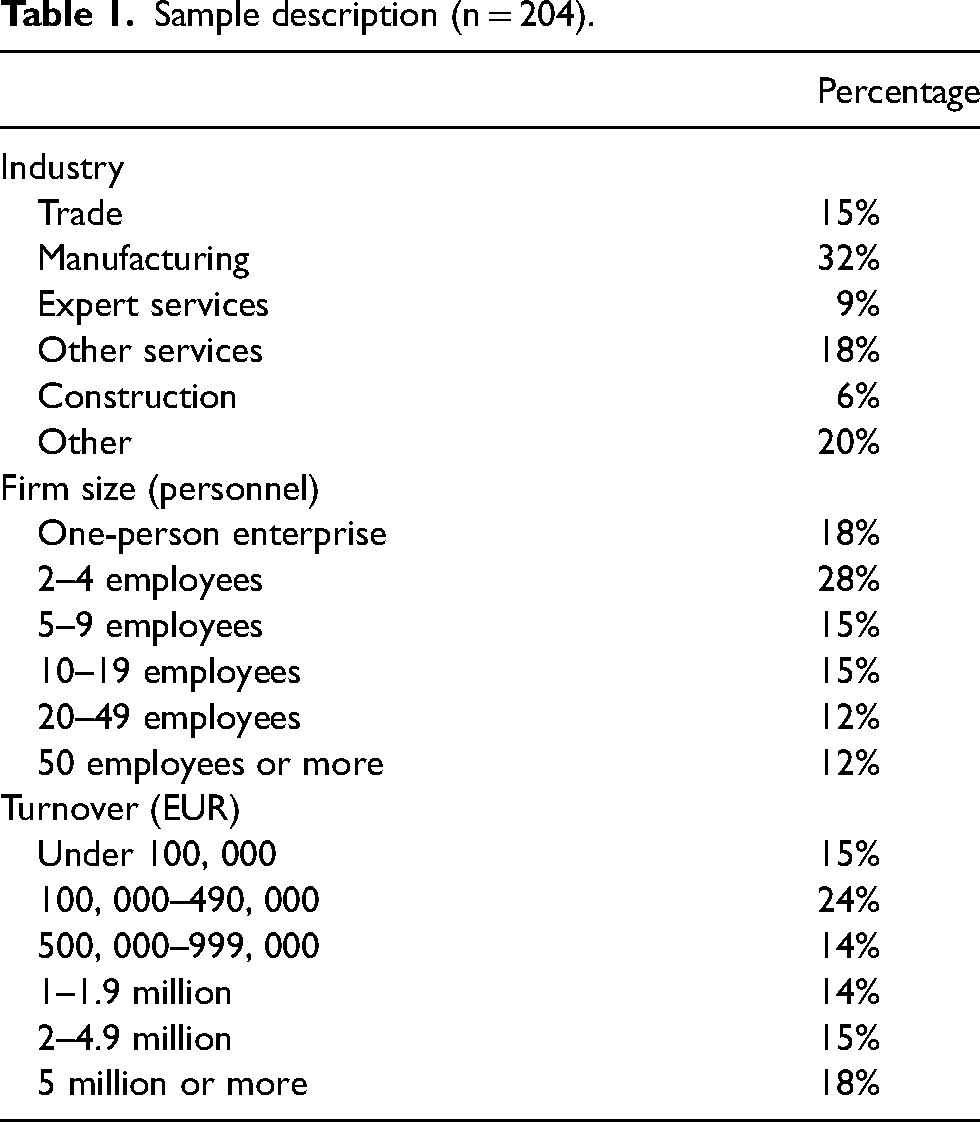
The survey data were collected in Finland from SMEs in the rural region of South Ostrobothnia in October 2021. Finland holds the top position among the 28 EU Member States in the Digital Economy and Society Index (DESI, 2022), indicating its status as a pioneering nation in the realm of digitalization. The study uses a purposive (also known as judgemental, selective, or subjective) sampling technique (Sharma, 2017) by selecting SMEs in South Ostrobothnia to represent rural Finnish SMEs. South Ostrobothnia has higher than 50% of its population living in rural areas (see EuroStat Urban-Rural Typology on NUTS 3 level), with the share of gross added value from agriculture classified as very high (Berchoux and Iadecola, 2022). Hence, this region was appropriate for the study. Judgemental sampling was further employed by selecting SMEs in the region that had collaborated with regional research organizations in the previous five years. Those SMEs were considered suitable to help address the research questions regarding the pursuit of growth and OA levels. Prior research documents the successful use of judgemental sampling (Dixit et al., 2021), the technique where researchers rely on their judgement to select the study's target audience and can justify generalizations (Sharma, 2017). The current research utilized a database of SMEs meeting the criteria, and a link to a web-based survey was emailed to all SME owner-managers, and researchers also contacted them by telephone. The data consist of responses from 204 SME owner-managers (response rate 23%). The SMEs represent various economic sectors, and their size in terms of personnel varied from one person to 240 employees (mean 17 employees). Most of the SMEs were small and employed fewer than 50 employees. The sample description is provided in Table 1.
Sample description (n = 204).
Variables
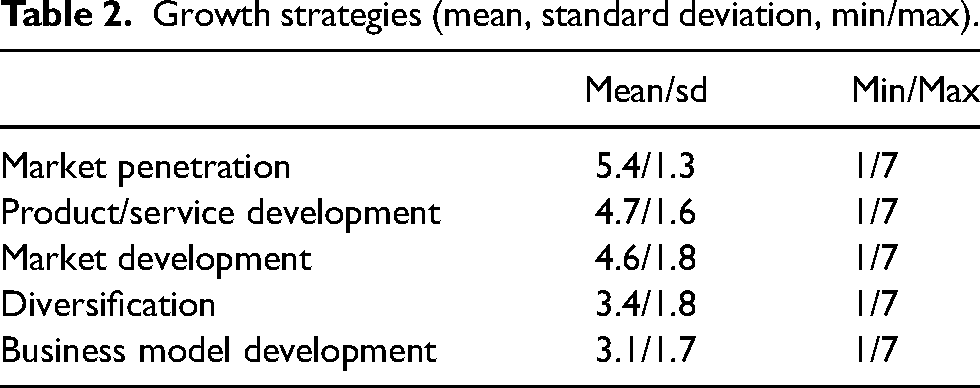
Growth strategies were measured using Ansoff's (1970) growth vector matrix, with the four basic alternatives being market penetration, product/service development, market development, and diversification, and the fifth growth strategy of designing new business models added. The respondents were asked to evaluate how well the following statements describe their strategies on a 7-point Likert scale anchored with not at all (1) and very well (7) (see Appendix A). Table 2 presents the means, standard deviations, and minimum and maximum values for growth strategies.
Growth strategies (mean, standard deviation, min/max).
DO was measured based on an instrument developed by Khin and Ho (2019). Respondents were asked to indicate their level of agreement or disagreement with the following statements on a 7-point Likert scale anchored with 1 = totally disagree and 7 = totally agree. Exploration and exploitation strategies were measured with an adapted instrument of eight items from He and Wong (2004). OA was calculated by multiplying the values of exploration and exploitation. Respondents were asked to evaluate the focus of their development practices in the next one to two years using a 7-point Likert scale anchored with not a focus at all (1) and a very strong focus (7). All items and their factor loadings are presented in Appendix A.
The reliability of the scales was acceptable. Composite reliability for DO was 0.94, Average Variance Extracted (AVE) 0.87, and factor loadings varied between 0.74 and 0.95. However, one of the items in the exploitation scale and one of the items in the exploration scale had low factor loadings and were omitted from the final scale (specifically, the items “enter new technology field” from exploration scale and “improve existing product quality” from the exploitation scale). After removing these two items, the factor loadings ranged from 0.64 to 0.81. The Average Variance Extracted (AVE) for the exploration scale was 0.50 (with composite reliablity of 0.75), and for the exploitation scale, it was 0.55 (with composite reliability of 0.78). Discriminant validity was evaluated through average shared variance (ASV) and maximum shared variance (MSV). The values were smaller than the average variance extracted (AVE) recommended by Hair et al. (2010), indicating good discriminant validity. Table 3 presents the correlations, means, standard deviations, and minimum and maximum values for these scales.
Correlations, means, standard deviations, and minimum and maximum values for the scales.
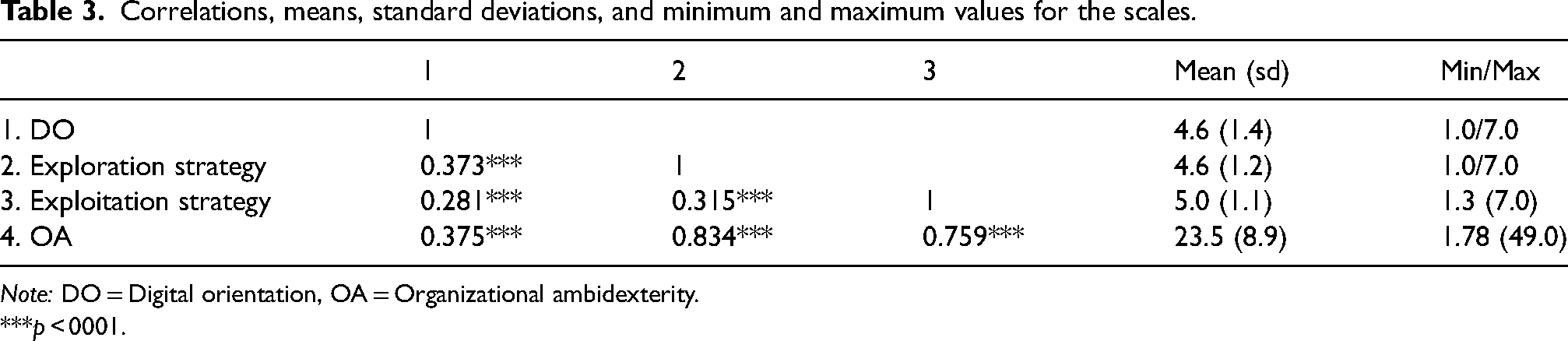
Note: DO = Digital orientation, OA = Organizational ambidexterity.
***p < 0001.
Firm size is incorporated as a control variable, drawing on prior research that suggests a potential relationship between firm size and firm growth (Bentzen et al., 2012), which may also be pertinent to the examination of growth strategies. Firm size (turnover) was transformed as a natural logarithm.
Analysis method
The possible problem of common method variance was examined by using Harman's one-factor test with principal axis factoring and unrotated factor solution as recommended by Podsakoff et al. (2003).
Kaiser's criterion for retention of factors was followed. The sample size appeared large enough for the factor analysis, at least based on the Kaiser–Meyer–Olkin measure of sampling adequacy (KMO = 0.83). Factor analytic results indicated the existence of several factors with eigenvalues greater than 1.0. The first factor accounted for 35 per cent of the variance. Since several factors, as opposed to one single factor, were identified. Because the first factor did not account for the majority of the variance, a substantial amount of common method variance does not appear to be present.
Ordinal regression analysis was used to test the hypotheses. The dependent variable (each growth strategy) was measured with an ordinal scale, and ordinal regression models specified in terms of cumulative probabilities are usually used when analysing ordinal data (Johnson and Albert, 2004). A regression model for each growth strategy was run with independent variables of DO, OA, and the control variable of firm size. The proportional odds (PO) model was used (see McCullagh, 1980). There are some assumptions for using the model. The dependent variable should be measured on an ordinal level, and independent variables should be measured on either a continuous, categorical, or ordinal level. There should be no multicollinearity, and the assumption of PO should be met (i.e., the effects of any explanatory variables are consistent or proportional across the different thresholds). The first two assumptions were met. For checking possible multicollinearity, we analysed variance inflation factors (VIF). All the VIF values were well below the threshold of 10 (from 1.094 to 1.226), which indicates no multicollinearity (Hair et al., 2010). The assumption of PO was examined with the test of parallel lines. It produced non-significant p-values varying from 0.160 to 0.692. Hence, all four assumptions for performing ordinal regression analysis were met. In testing the moderation effect, moderated ordinal regression analysis was used, and for testing mediation, a procedure recommended by Baron and Kenny (1986).
Results
The most used growth strategies were market penetration (mean 5.4) and product/service development (mean 4.7). About 23% were developing new business models (values 5–7). Table 4 presents the results from ordinal regression analysis explaining different growth strategies. Results show that DO and the control variable firm size are not related to the utilization of market penetration strategy. However, OA positively explains (p < 0.001) the use of a market penetration strategy. The model fit is good (Chi-Square 22.830. p < 0.001) with pseudo-R-Squared values of 0.118 (Cox and Snell) and 0.123 (Nagelkerke). Both OA (p < 0.001) and DO (p < 0.01) are related to the use of product/service development strategy. The control variable of firm size has no significant value in the model. The model fit is good (Chi-Square 71.283. p < 0.001), and pseudo-R-Squared values are 0.323 (Cox and Snell) and 0.331 (Nagelkerke).
Results of ordinal regression analysis.
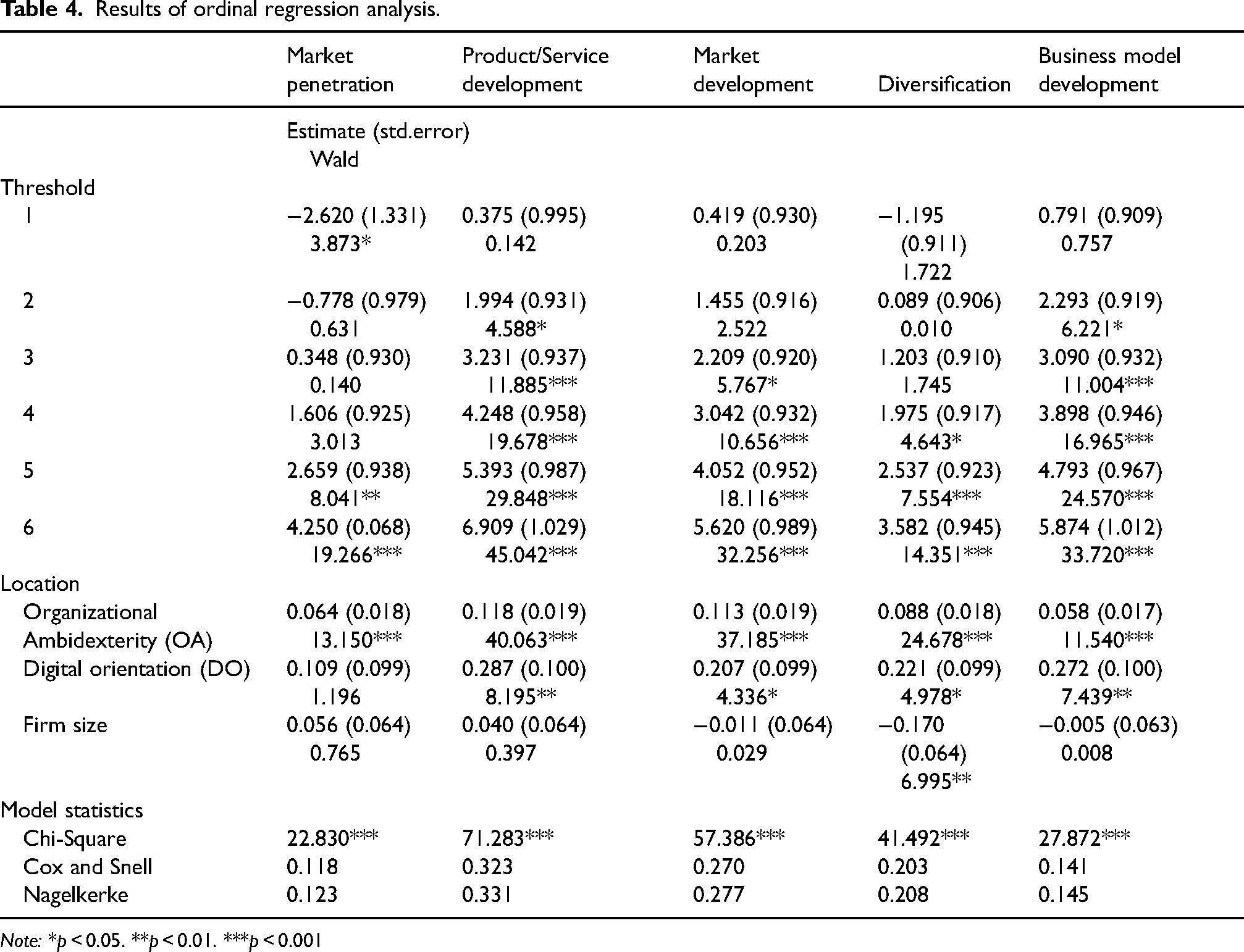
Note: *p < 0.05. **p < 0.01. ***p < 0.001
OA positively explains the use of market development strategy (p < 0.001) as does DO (p < 0.05). The control variable firm size exhibits no relationship with this strategy. Model fit is good (Chi-Square 57.386. p < 0.001), and pseudo-R2 values are 0.270 (Cox and Snell) and 0.277 (Nagelkerke). Diversification is related to both OA (p < 0.001) and DO (p < 0.05). Model fit is good (Chi-Square 41.492. p < 0.001), and pseudo-R-Squared values are 0.203 (Cox and Snell) and 0.208 (Nagelkerke). Business model development is also related to OA (p < 0.001) and DO (p < 0.01). Model fit is good (Chi-Square 27.872 p < 0.001), and pseudo-R-Squared values are 0.141 (Cox and Snell) and 0.145 (Nagelkerke).
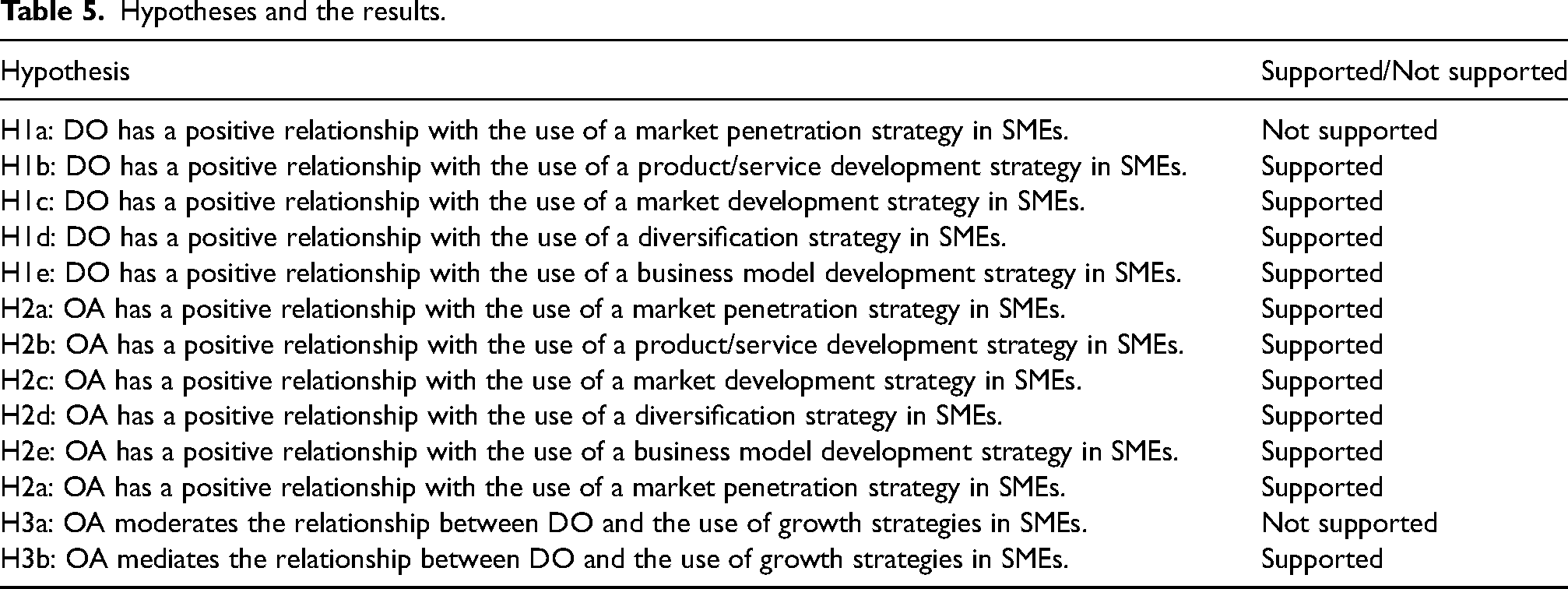
In summary, DO is positively related to a product/service development strategy, market development strategy, diversification, and business model development, findings that support hypotheses H1b, H1c, H1d, and H1e. However, hypothesis H1a is not supported.
OA explains the use of all growth strategies, supporting hypotheses H2a, H2b, H2c, H2d, and H2e. SMEs with high levels of OA utilize more growth strategies per se than SMEs with lower levels of OA. Hence, OA is positively related to the utilization of growth strategies in SMEs.
The control variable firm size does not explain the use of growth strategies except the growth strategy of diversification negatively. Larger SMEs do not use a diversification strategy as much as smaller SMEs. This is understandable as larger SMEs are usually companies with a long history, and there is no need to develop new products/services for unfamiliar markets. As an additional validation, we subjected the model to testing with the inclusion of the industry sector as a control variable; however, the industry sector demonstrated no discernible influence on the determined growth strategies.
Next, the possible moderation effect of OA on the DO-growth strategy relationship was tested with moderated ordinal regression analysis. However, no moderation effect was found. Accordingly, hypothesis 3a was not supported. For testing mediation, the procedure recommended by Baron and Kenny (1986) was followed. They propose a simple four-step approach in which several regression analyses are conducted, and the significance of the coefficients is examined at each step.
First, a significant relationship was found between DO and market penetration (estimate 0.270. Wald 8.781. p < 0.01), product/service development (estimate 0.525. Wald 30.721. p < 0.001), market development (estimate 0.435. Wald 22.017. p < 0.001), diversification (estimate 0.388. Wald 17.745. p < 0.001), and development of new business models (estimate 0.392. Wald 17.921. p < 0.001). Accordingly, DO has a significant relationship with all examined growth strategies. The next step was to test the relationship between DO and OA, which also proved significant (B 2.349. p < 0.001). In the third step, significant relationships were found between OA and market penetration (estimate 0.081. Wald 26.774. p < 0.001), product/service development (estimate 0.137. Wald 64.725. p < 0.001), market development (estimate 0.117. Wald 51.855. p < 0.001), diversification (estimate 0.080. Wald 28.038. p < 0.001), and development of new business models (estimate 0.065. Wald 19.389. p < 0.001).
In the Step 4 model, some form of mediation is supported if the effect of OA on a specific growth strategy remains significant after controlling for DO. If the effect of DO is no longer significant when OA is controlled, the finding supports full mediation. When DO remains significant (i.e., both DO and OA significantly predict growth strategy), the finding supports partial mediation.
The final step can be seen in Table 4 – the effect of DO fully disappears when OA is added to the model with the growth strategy of market penetration (this was additionally tested without firm size). The results indicate that OA fully mediates the effect of DO on market penetration strategy. With other growth strategies, the effect of DO remains after controlling OA. This suggests that OA partially mediates the effect of DO on growth strategies of product/service development, market development, diversification, and the development of new business models. Hypothesis 3b is supported: OA either fully or partially mediates the effect of DO on growth strategies. Figure 1 presents the empirical model, and Table 5 summarizes the results of the study.
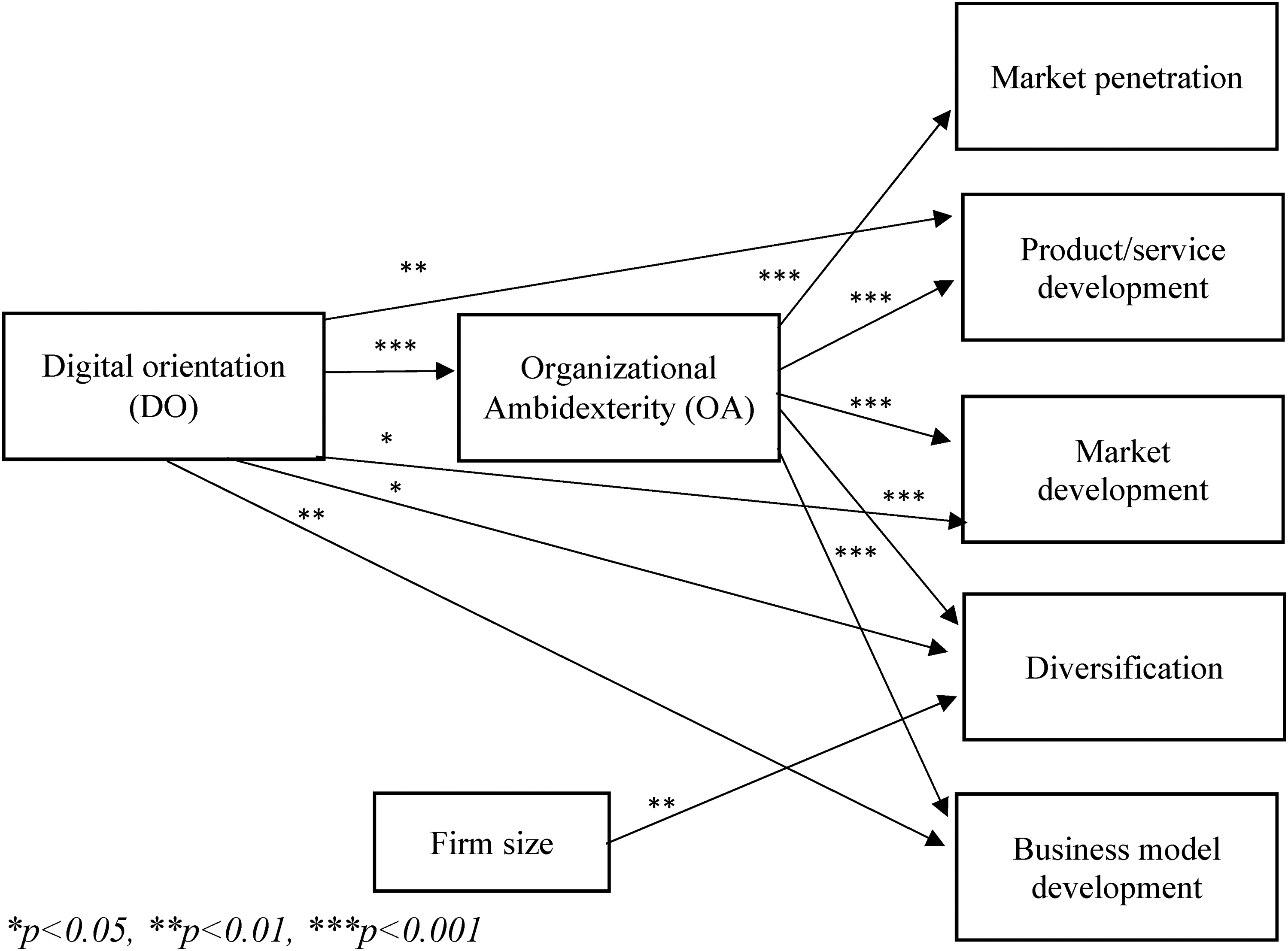
Empirical model.
Hypotheses and the results.
Discussion
The results indicate that in a time of crisis, rural SMEs tend to rely on market penetration, which is the easiest growth strategy as it does not require the development of new products or markets. However, some SMEs use the more demanding strategies of diversification and business model development, and such use is related to the SMEs’ DO. In addition, DO explains the utilization of product/service development strategy and market development strategy. This suggests that DO has a significant impact on the adoption of the most demanding growth strategies in Finnish rural areas. However, it should be noted that DO does not directly affect market penetration. This observation may stem from the prevalent utilization of market penetration strategy within SMEs. It is posited that this comparatively straightforward growth strategy exhibits limited distinctions between SMEs characterized by high and low levels of digitalization. Furthermore, this growth strategy represents a familiar terrain for SMEs, who possess expertise in customer service, outreach, and the deployment of marketing communications, without a specific emphasis on digitalization.
The direct impact of DO on the ambitious growth strategies of diversification and business model development, coupled with the product/service development strategy and market development strategy, implies that SMEs with a higher degree of DO are more inclined toward growth initiatives involving the revitalization of their business models and the exploration of new business domains, compared to their counterparts with lower levels of DO. In a digitally transformed society, these growth strategies are more likely to necessitate digitalization, as DO equips companies with technological scope, capabilities, and ecosystems (Kindermann et al., 2021). Additionally, it provides a broader perspective on consumers’ needs, desires, competitor tactics, capacities, and external influences (Hervé et al., 2020).
The results also support the findings of Foroudi et al. (2017), who show that digital technology plays an important role in growth together with marketing capability and tangible/intangible assets. As Quinton et al. (2018) state, DO gives SMEs a well-positioned place to take advantage of the opportunities presented by digital technologies as they adopt attitudes and behaviours supporting the generation and use of market insight and proactive innovation. The results are also in line with the findings of Matalamäki and Joensuu-Salo (2022), who show how digitalization is related to different growth strategies.
Interestingly, DO directly affects the product/service development, market development strategy, diversification, and development of new business models growth strategies but indirectly affects market penetration through OA. OA either partially or fully mediates the effect of DO on all growth strategies. Hence, DO has a strong linkage to OA. Cao et al. (2009) suggested that organizations with limited resources may choose between exploration and exploitation. Nevertheless, the findings here suggest that DO can provide SMEs with a means to balance these developmental efforts, enabling them to pursue both strategies effectively. The findings support those of Fengel et al. (2022), who show that applying DO to facilitate searching for and utilizing benefits from digital technologies fosters the simultaneous pursuit of exploitative and explorative innovation behaviours. Our results complement the work of Wang et al. (2023), who, while examining explorative and exploitative innovation separately, also identified a positive association between DO and these distinct forms of innovation. Thus, our results extend the understanding of the nuanced impact of DO on organizational strategies, emphasizing the concurrent pursuit of both explorative and exploitative dimensions. The results of the current study confirm that DO has a positive relationship with OA, and OA partially or fully mediates the effect of DO on growth strategies. Hence, DO has no direct effect on growth strategy of market penetration. Instead, the effect is mediated by OA, which in practice means that if an SME cannot simultaneously explore and exploit (i.e., it is not ambidextrous), a DO does not advance efforts to reach prospective customers, build stronger customer relationships, or increase sales by selling more to existing customers.
OA has a positive relationship with all growth strategies. Firms proactively seeking avenues for growth – regardless of the actual growth strategy – are also conscious of the need for both exploration and exploitation. This insight aligns with earlier research linking OA with growth and performance (e.g., Balboni et al., 2019; Kassotaki, 2022; Venkatraman et al., 2007). The results demonstrate the link between strategic focus choices and ambidextrous development approaches.
In the discourses of digitalization, rural areas are positioned as continuously catching up to urban areas in terms of the availability of the latest technologies but also as potentially benefiting from increased connectivity, assuming the required infrastructure is in place (Salemink et al., 2017). Rurality is in part understood through the characteristic of remoteness, implying a disadvantage vis-à-vis metropolitan regions (Gashi Nulleshi and Tillmar, 2022), yet the advantages of digitalization may overcome this characteristic to a degree for the rural areas that enjoy good access. Digitalization both brings new opportunities within reach and increases competition as isolated rural markets become accessible to online retailers and service providers. The COVID-19 pandemic may have provided an opportunity for renewal in many rural firms, but it has also greatly underlined the importance of the digital divide (e.g., Amankwah-Amoah et al., 2021; Lai and Widmar, 2021; Weeden and Kelly, 2021). The results presented here show that the infrastructure of digitalization alone is insufficient: growth strategies go hand in hand with DO and OA. In the digital age, even with sufficient infrastructures (see, e.g., Cowie et al., 2020), rural areas need firms that can proactively utilize the new possibilities. Furthermore, it is crucial to recognize that rural areas must be understood in their unique context (Martin et al., 2013).
Managerial and policy implications
First, in pursuing growth, rural SMEs should develop their capability for OA. As O’Reilly and Tushman (2013) state, OA lies in the capability to leverage the mature side of a business's existing assets and capabilities to gain a competitive edge in new domains. Owner-managers of SMEs can build that capability by developing structures and an organizational culture that fosters both exploration and exploitation. The capability can be traced back to each individual in the organization: how much time and effort is invested in exploring new ideas, new technologies, and new markets, and the extent to which the organization is capable of simultaneously developing quality and efficiency. Ambidextrous capabilities can also be strengthened through strategic partnerships. Collaborating with external entities, such as technology providers, industry experts, or research institutions, can bring in fresh perspectives and resources. These partnerships can facilitate the integration of innovative technologies and practices into the SME's operations, contributing to a more ambidextrous organizational structure. Furthermore, because OA mediates the relationship between DO and growth strategies, the positive impacts of DO are unlikely to be fully operationalized if OA is lacking. Second, DO enhances the use of different growth strategies by engaging the SME in exploring and using new digital technology in customer engagement, reaching new markets, developing new products and services, and building new business models. An SME owner-manager has a great influence on the DO of the company – if the attitude of the owner-manager towards using new technology is negative, DO is likely to be low.
Similarly, when owner-managers’ outlook on digital transformation is favourable, that offers a solid foundation for employees to venture into and implement novel technologies. Finally, it is apparent that because digitalization provides rural businesses with opportunities to implement demanding growth strategies, policymakers should strive to ensure broadband connectivity and robust infrastructure are available in rural areas to ensure long-term vitality. Morris et al. (2022) illustrate the scale of the issue in Great Britain, reporting that many businesses in rural areas of Wales lack reliable digital connections. While this issue is less pronounced in Finland (DESI, 2022), it should be acknowledged as a significant challenge in every country. As Tiwasing (2021) states, enhancing the performance of SMEs in rural areas will necessitate improvements to online business support ecosystems and upgrading digital infrastructure and connectivity.
Limitations and future research
In interpreting the results, one should note that the data were collected from one country and one region, which might have an impact on the results. Finland is ranked first in the Digital Economy and Society Index (DESI, 2022); thus, the context measuring DO differs from that in less digitalized countries. However, the region of South Ostrobothnia lags in digitalization compared to the country as a whole (Pk-yritysbarometri, 2022). Future studies should examine the interplay of DO, OA, and growth strategies in other countries and regions. Further, while our study did not examine the differences between industry types in DO, there is however some indication that some aspects of DO may be more emphasised in service firms compared to manufacturing firms (Saunila et al., 2021), and this warrants further attention. Furthermore, as the data of this study were collected in the context of a crisis, future studies should verify the results under less tumultuous conditions; based on theoretical reasoning, it is expected that the relationships between DO, OA, and growth strategies to hold also in more normal situations, but this should nevertheless be tested. Additionally, future research could delve into the long-term impact of DO and OA on the growth strategies of rural SMEs, especially in post-crisis recovery. Exploring how these factors contribute to organizational resilience and growth over time would offer valuable insights for practitioners and policymakers, enhancing our understanding of their enduring strategic implications. This study did not examine the effect of different growth strategies on growth or performance. Future research could investigate the association between the DO–OA relationship and realized growth.
Conclusions
In times of crisis and within rural SMEs, DO is needed, especially for the most demanding growth strategies of diversification and business model development. A crisis can offer rural SMEs an opportunity to develop new products and services and pursue new markets. This study shows how DO and OA relate to specific growth strategies during a crisis. Our results contribute to a deeper understanding of the nuanced impact of DO on organizational strategies, emphasizing the concurrent pursuit of both explorative and exploitative dimensions. OA, which involves a firm's capability to simultaneously explore and exploit, forms the foundation for the effective utilization of any growth strategy. Without this ability, a firm's pursuit of growth is hindered. For rural SMEs to enhance their resilience, it is imperative to concurrently develop their capacity for exploration and exploitation while embracing new technologies. The relationship between DO and OA is substantial; DO cultivates the proficiency to engage in both exploration and exploitation, both of which are essential for the effective implementation of growth strategies.
Footnotes
Declaration of conflicting interests
The authors declared no potential conflicts of interest with respect to the research, authorship, and/or publication of this article.
Funding
The authors received no financial support for the research, authorship, and/or publication of this article.

Appendix A. Items,factor loadings,average variance extracted (AVE) and composite reliability (CR) of the scales.
Items related to growth strategies:
We develop existing customer relationships and find new customers from existing markets (market penetration). We develop new products or services for existing markets (product/service development). We expand to new markets (new geographical markets or new customer segments) (market development). We develop new products or services for new markets (diversification). We develop new business models (business model development).
Items and factor loadings of the scales: