




Abstract
After Brexit, pandemics and through continuing global economic shocks, the rural third sector continues to navigate a landscape of crisis and challenge while serving communities. We examine Scottish Government policy for the rural third sector and policy implementation mechanisms. Our paper argues, and our evidence shows, that current policy is aspirational and there are deficiencies between rural third sector policy making, policy implementation and the voice of rural communities. Our critical review of Scottish Government documentation examined policy for the third sector in rural conditions, then continued to search government documentation for evidence of action plans and viable implementation strategies. We found that policy makers were aspirational, there are few mechanisms or action plans that support sustainable policy implementation and limited examples of ongoing community consultation. The concern is that while gaps exist between policy making and implementation, government policy will underperform leaving a rural third sector struggling to service their communities and deliver their social mission.
Keywords
Introduction
Rural spaces often exhibit a dichotomous reality. On one hand they evoke images of protective and supportive close-knit communities whose constituents live particularly fulfilling, happy, genuine (Carbó et al., 2013; Gaddefors and Anderson, 2019; Little and Austin, 1996), healthy, serene (Ceccato, 2016; Cloke and Milbourne, 1992; Little and Austin, 1996), thriving (Little and Austin, 1996; Shucksmith, 2018) environmentally harmonious (Bell, 2005; Carbó et al., 2013; Cloke and Milbourne, 1992), self-sustaining (Bostrom, 2003; Shucksmith, 2018) lives. And on the other hand, despite notions of this rural idyll, there are decades of evidence (Newbery et al., 2017; Roberts and Green, 2013; Shucksmith et al., 1996) to suggest that the reality of living in a rural space often comes with disadvantage, constrained resources and relative poverty (Bosworth et al., 2020; Willet, 2023). Governments do attempt to address the rural-urban divide, attracting new and viable businesses through economic policy and supporting infrastructure projects often delivered by third sector service providers (or public-private partnerships); however, this reinforces the understanding that rural economic conditions are not always attractive to the entrepreneur, to investment and conventional market structures (Lavelle, 2022; OECD, 2020; Wyper et al., 2016). The Scottish Government's vision is for a rural future involving green, sustainable, socio-economic solutions through community action, and to attract entrepreneurship in the third sector through enterprise projects and initiatives (Scottish Government, ndc). There is evidence to support the ideology of a vibrant rural third sector. Currently 33 percent of Scottish social enterprises are rural, despite just 17 percent of the country's overall inhabitants being rurally situated (Social Value Lab, 2021). In 2012, the Scottish Government undertook a literature mapping of the rural third sector and concluded there were extensive knowledge deficiencies such as definitional challenges and the role of local community, they identified several further challenges in relation to volunteering, service delivery and transport, and finally, called for further research into the rural third sector (Scottish Government, 2012). Therefore, if the devolved government in Scotland is committed to creating sustainable, vibrant communities and providing a positive environment for a rural third sector (Scottish Government, nda), then to be effective, there must be evidence of a coherent policy democratically informed and designed for third sector enterprise with rural communities and in rural conditions. Yet, and despite, there being extensive literature on neo-endogenous rural development, there remains concern that the government retains a dominant position in rural development, that community enterprise projects are shoehorned into a one-size-fits-all policy and rural third sector enterprise activities lack diffused power, and that gaps exist between policy making and implementation (Bosworth et al., 2020; Burnett and Danson, 2017; Shortall, 2008; Shucksmith, 2010; Willet, 2023; Zografos, 2007). We explore the rural third sector, our research provides an analysis of relevant policy, website and strategy publications and contributes to the understanding of the rural third sector in Scotland; demonstrating both its robustness and deficiencies. Specifically, we perform a content analysis on Scottish Government policy to answer our research question; is Scotland's Rural Third sector policy viable, sustainable and democratically driven.
We continue our paper with an examination of the broader rural canvas in a bid to examine rural third-sector activity and policy; we unpack the characteristics of rural third sector and create a conceptual framework for our analysis. We present our findings and then discuss the implications for Government and Scotland's Rural third sector; we consider the wider implications of sustainable and democratic policy making.
Characteristics of rural society and place
In 1988, the European Commission (EC) published a paper on ‘The Future of Rural Society’, (EC, 1988). Built on three pillars – socio-economic cohesion, agricultural adjustment and environmental protection. The commission sets out a road map for rural development and the support of rural society and future generations. The paper acknowledges that post war, the equilibrium in rural society had been disrupted, the balance of life which was so effective for generations had been tilted by post war industrialisation and migration from the rural to urban space, resulting in change to the institutional structures of rural organisation and economic markets (Dickson, 1980; DiMaggio and Powell, 1983; Smout, 2002). Moreover, the ecological equilibrium was disturbed, new farming patterns and changes in land usage were affecting the environment and not always positively. Most concerning, the socio-economic picture was skewed, an ageing rural population, shrinking communities, and according to EC (1988), half of the farmers in 1988 were over 55 years old without a successor. The resultant trends included rapidly changing demographics, and an emergence of new rural leisure activities, a downgrading of farming importance through a concentration of fewer farms with higher yields and an increase in outward migration (Cloke, 1993; Shucksmith et al., 1996; Symes, 1981). Subsequently, the effect on communities is higher levels of unemployment, lower incomes and increased levels of relative poverty. A community approach to these problems in rural society was considered fruitful. The Commission states that there must be tailored basic strategies, that they should be indigenous and respond to local socio-economic needs (Bock and Krzysztofowicz, 2021; Mceldowney, 2021), and finally, ‘…demand of the Community that it takes the proper action to ensure the development of rural society’ (EC, 1988: 14).
Despite this focus, and after a pandemic and Brexit, it is surprising how three and half decades on, socio-economic shocks and the narrative around rural challenges and disadvantages have remained surprisingly constant with repeating characteristics (Bosworth et al., 2020; Tenza-Peral et al., 2022; Willett, 2023). According to Tenza-Peral et al. (2022), continuing depopulation is diluting the viability of many neo-endogenous strategies and affecting viability of policy. Socio-economic cohesion requires effective relations between the community and institutions, and literatures show there are several ways in which these relations are being disrupted, through a sustained narrative around depletion and aging communities (Besser and Miller, 2013; Stockdale, 2006), the narrative supporting social innovation (Bosworth et al., 2020; Shortall, 2008), and repeated call for effective place-based policy and institutional approaches which are inclusive and locationally relevant (Bosworth et al., 2020; Burnett and Danson, 2017; Shortall, 2008; Shucksmith, 2010; Willet, 2023; Zografos, 2007). Unsurprisingly rural context remains a notable point of discussion especially in relation to understanding the situatedness of its social and economic assets and liabilities; interactions with context are different from one place to the next and rural entrepreneurship is enacted differently according to surroundings and uniqueness of social capital (Burnett and Danson, 2017; Gaddefors and Anderson, 2019; Halfacree, 1993, 1995; Lang and Fink, 2019; Shortall, 2008). Skerratt (2013) highlights resilience as being a frequently discussed characteristic of the rural community but signals that the concept is not yet understood in a way that is enabling and that scholars should continue to question and reframe this concept in the rural spaces. These characteristics of being in the rural create uniqueness and heterogeneity for each space and that creates the challenge to achieve equality and inclusivity for all stakeholders with homogenous policy approaches. Cerna (2013), Hudson et al. (2019), Karl (2002), Sausman et al. (2016) and Willett (2023) acknowledge there is a gap between regional development programmes and community expectations and highlight the need to involve local in institutional decision making for policy implementation to be successful; the chasm separating the local experience from the institutional rhetoric. Despite Bosworth et al. (2020)'s call for a mix of top-down and bottom-up approaches to rural entrepreneurship, this is inevitably a dynamic most find difficult to navigate, and there is little evidence of grassroots examples. However, a couple of grassroot examples can be found in the Nordic countries’ approach (Copus et al., 2017) as well as in EU funding approaches for ‘community-led local development’ (Atterton and Skerratt, 2017, p. 15). The Nordic countries feature a strong bond between the rural communities and their municipalities, with this having an effect onto their greater independence and freedom on their decision-making as well as actions which strengthen the trust between these actors (Copus et al., 2017). One bottom-up strategy example which attracted a noteworthy amount of attention is placed in one the rural municipalities of Denmark, Bornholm (ibid). Due to its shrinking population, the local business centre launched ‘Bright Green Island’ (ibid, p. 21) which is a testing zone for sustainable energy with its overarching aim to create an environmentally friendly society (Nordregio Projects, 2019). Slight differences between local public sector body functions and innovation strategies are observable when comparing the Nordic countries to Scotland (Copus et al., 2017). While the Nordic countries show grassroot, bottom-up movements, it is cautioned to utilise these interventions in a cookie cutter format, as rural and local contexts differ from place to place. Furthermore, in policy implementation literature, the previously mentioned mix is known as third-generation implementation approach (Barrett, 2004; O'Toole, 2000), and it attempts to synthesise top-down and bottom-up approaches incorporating their best qualities into a single model (Barrett, 2004; Matland, 1995; Sabatier, 1986). The disconnect, the democratic deficit and lack of intersection, or joined up thinking, between community and policy development that has haunted rural enterprise development for some time remains a topic under researched in terms of workable solutions (Shortall, 2008; Shucksmith, 2010; Tenza-Peral et al., 2022; Ward et al., 2005).
In the context of public policy development and implementation, the ‘top-down’ approach considers players at the top of the hierarchy the most relevant agents of change (Matland, 1995), hence the process begins with the formulation and validation of generalisable policies by central authorities, which are eventually translated into operational directives to be implemented at the local level (Barrett, 2004; Koontz and Newig, 2014; Matland, 1995; Sabatier, 1986). In contrast, the ‘bottom-up’ approach emphasises the importance of analysing the dynamics of the plethora of actors that interact at the local level in order to understand the implementation of public policies, since it is at this level that policies affect people, consequently the creation of plans to address community issues is assigned primarily to the Local Authorities (LA's) (Barrett, 2004; Koontz and Newig, 2014; Matland, 1995; Sabatier, 1986).
Building social value in rural places and spaces
With increasing calls for bottom-up strategies, the Scottish government has committed to bring forward legislation that support policies for Community Wealth Building (CWB) (Scottish Government, nda) an ideology originally designed in and for cities as a way of supporting urban regeneration. With the Economic Development Association Scotland (EDAS) driving the CWB agenda forward and a focus on ‘levelling up in rural economies’ (EDAS, 2023), it is unknown territory in terms of how CWB concepts will transfer from urban to rural context without a full institutional commitment to bottom-up development strategies (Redwood et al., 2022). Current solutions are driven through Community Planning Partnerships (CPPs) and several community-led socio-economic initiatives and include social enterprise, community buy outs, social innovation projects, social business, community organisations and community led action groups with rhetoric styled like bottom-up responses to unique place and space problems. Yet despite development attempts the rural remains at a socio-economic disadvantage with sustainability built on community resilience (Anderson and Lent, 2019; Smith and McColl, 2016; Steinerowski and Steinerowska-Streb, 2012). Steiner and Atterton (2015) discuss how rural resilience can be sustained through social enterprises activity and subsequently how rural characteristics are considered and effectively harnessed and addressed through community action and interaction, supporting the argument for a democratic process where communities respond to their unique challenges. Repeating patterns, and arguments in literature inform our framework of rural characteristics; situatedness of problem and asset ownership, lack of diffused power and missing community voices, homogeneous policy through a one-size-fits-all approaches, depopulation and narrow skillsets resulting in struggles with capacity building: an inclusivity and equality deficit through an urban and rural divide and finally, problematic success and performance metrics.
We address our research question – is Scotland's Rural Third sector policy viable, sustainable, and democratically driven? – by undertaking a critical analysis of Scottish Government policy and strategy documents as well as website content, we want to locate and examine evidence of action plans, viable implementation strategies and democratic processes.
Methodology
With the Scottish Government website providing accessibility to and availability of policy documentation, a content analysis deemed the most suitable methodological choice (Krippendorff, 1989), which uses a qualitative methodological design for contextual analysis of content datasets was chosen (Gaber and Gaber, 2007; Vaismoradi and Snelgrove, 2019). Indeed, Stemler (2015) stresses that this analysis technique can help in making large strides in the understanding in many diverse topics particularly when dealing with copious quantities of text.
We utilised Scottish Government documentation in relation to third sector and rural development in Scotland and from the following policy units, the Agriculture and Rural Economy Directorate, the Covid Recovery and Public Service Reform Directorate, which houses third sector policy including community empowerment and land reform and finally, Local Government and Housing Directorate. Navigation of these directorates content meant our search was purposeful and based on keywords: rural development and third sector. Inherently, we had to move between directorates and topics before navigating back to our main units of analysis. A total of 38 points of content were reviewed which came from the directorate websites, other content was derived from dated publications, reports and consultations; some content stemmed from the directorate website with no date (nd), other content from dated publications, reports and consultations.
Datasets were created from content across directorates, capturing evidence of stakeholder complexity and multiplicity, such as LAs, NGOs and charities roles in delivery; inherently, they signal competing agendas and extensive duality. These notions of complexity in the hierarchy of the policy development and the multiplicity of the actors make policy more cumbersome than it needs to be. Streamlining actors and administration processes, including different inputs with a grassroot ideology, freeing up space to engage with the communities themselves, could help in arriving at realistic, streamlined policy output. These notions of complexity and multiplicity are further discussed in the analysis section below.
For data management to take effect, we divided the content into categories which were ‘rural’, ‘third sector’ and ‘community’. These were an important part of the methodological pathway as they helped us to establish intersections and overlaps between documents through which we were able to visibly follow the rural characteristics in our documents. Each piece of content had to demonstrate direct linkage to one or more categories to ensure a consistent cohesion between methods and results (Morse, 2008). Lastly, we summarised, generalised and paraphrased the key information from the documentation. The rural characteristics developed in our literature review provided a framework to synthesis and develop our findings in a meaningful way and respond to our research questions, is there evidence of viable, sustainable and democratically driven policy? Table 1 below presents our methodological pathway and the synthesis of our data with the framework of rural characteristics.
Rural third sector characteristics: framework for policy effectiveness.
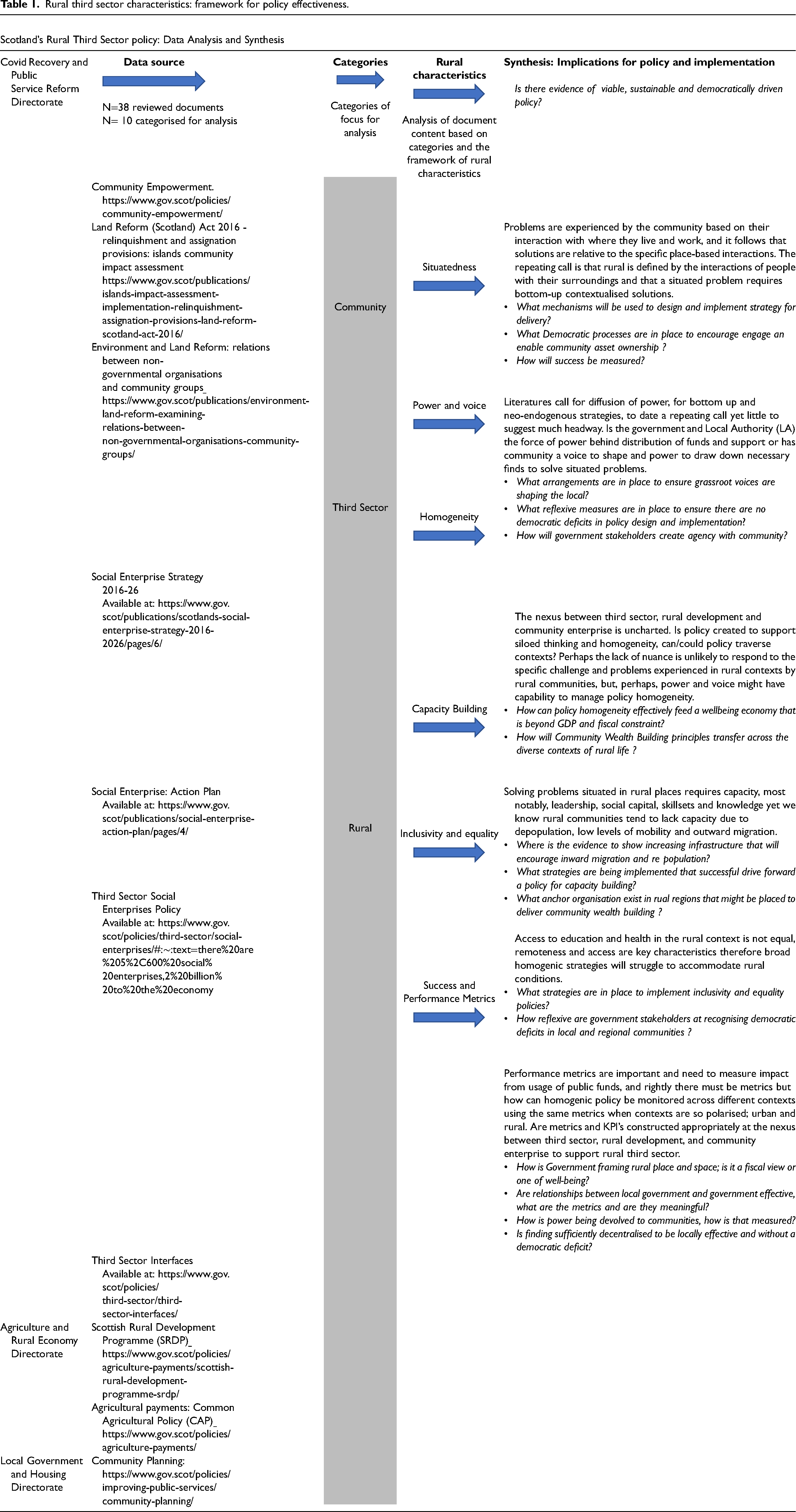
The following section evidences our concerns around the aspirational nature of policy, the viability of policy implementation and finally provides some insight into the democratic processes that currently underpin policy development and implementation for the rural third sector in Scotland. We collate the evidence-based gaps between implementation of aspirational polices, viable delivery mechanisms and weak democratic processes.
Discussion and implications for the rural third sector
Evidence from the study and content analysis of Scottish Government policy for the rurally located third sector informs an underpinning for three key arguments. We found that policy is aspirational, potentially over promising, but with limited mechanisms or action plans that would implement policy in a sustainable way, gaps in ongoing community consultation.
Scottish Government policy is without doubt written inspirationally, bold statements, visionary with ambitious trajectories and the policies remain broad and homogenic. Perhaps, aspiration is good for lifting the vision of a population but with increasing social complexity, fiscal constraints and lack of a clear road to implementation, policy is likely to underperform and instead become misplaced rhetoric. A good example of the Government's ambition is evident in Scotland's Food strategy, which includes a new vision for Scotland: that by 2025 Scotland will be: “a Good Food Nation, where people from every walk of life take pride and pleasure in, and benefit from, the food they produce, buy, cook, serve, and eat each day.” (Scottish Government, ndb)
A visionary bottom-up approach designed for place-based social enterprises to contribute more greatly to the economy is CWB (EDAS, 2023). The government has specific ambitions towards building onto existing initiatives, amongst others Buy Social and A New Future for Scotland's Town Centres. “To support Community Wealth Building we will provide an additional five hundred thousand pounds to help community third sector organisations to diversify their income streams through entrepreneurial activity. This will be money generated locally which in many cases is invested back into the communities in which they are based, helping communities to have more control of their local economy.” (Scottish Government, 2021b)
The argument is that aspirational policy creates gaps and the wider the gap between policy and implementation, the more policy is destined to underperform. Currently this is the challenge facing most Governments and particularly a challenge for the Scottish Government in terms of supporting a fiscally constrained third sector, rurally situated with limited implementation mechanisms.
We find that while Scottish Government documentation is consistently visionary, a democratic deficit exists, agency is missing between and instead there exists a raft of LA's with fiscal control and NGO's with fiscal constraints. An interesting case that demonstrates policy complexity is Land Reform in Scotland which is designed to enable communities to manage where they live; the complexity of community buyout but is made ever so challenging with limited agency dominated by fiscal constraint: “Overall, NGOs’ interviewed argue that from their perspective, change of ownership can negatively affect land management. The interviewees highlighted that Land Reform prioritises ownership over the type and style of management and that communities that come into land ownership often struggle to access resources for improving land management.” (Scottish Government, 2018) “A networked approach, whereby local assets and local knowledge is augmented by external assets and resources, is likely to be the most effective way to bridge the gap in resources and expertise when land is transferred to community groups. Creating place-based plans and developing community projects, that are created by and for the local community, are more likely to encourage sustained community buy in and engagement with the project, helping to ensure long-term viability. NGOs should engage in ‘bottom up’ communication as opposed to ‘top down’. Efforts should be made to engage the community as opposed to informing them of plans. This is particularly relevant in the context of designing public consultations.” (Scottish Government, 2018)
Community-led communication networks, seen as a viable way of engaging with the community groups, can also help in making these projects impactful in the long-term, whereby the NGOs are recommended to actively include the voices of the communities that they serve and invite them to the table instead of retrospectively informing these communities about the outcomes that were reached. In Scotland there are 32 CPPs, designed to create inclusivity and accessible to the community, a mechanism which should provide the agency; however, these are LA organisations, in legislative terms they are responsible for creating agency but there is little evidence to show how they include all community-based stakeholders: “Each community planning partnership must—
(a)consider which community bodies are likely to be able to contribute to community planning having regard in particular to which of those bodies represent the interests of persons who experience inequalities of outcome which result from socio-economic disadvantage, (b)make all reasonable efforts to secure the participation of those community bodies in community planning, and (c)to the extent (if any) that those community bodies wish to participate in community planning, take such steps as are reasonable to enable the community bodies to participate in community planning to that extent.” (Community Empowerment (Scotland) Act 2015)
It is unknown how the CPPs (who are governmental partners) create a strong understanding of the needs of their communities, as the approach is consistently top-down rather than a third-generation synthesised, networked approach; there is little evidence to show how reflexive CPP's are in their attempts to be inclusive and accessible, nonetheless, Scottish Government promotes equality and inclusivity into their visionary statements: “As community ownership is central to the powers of the Community Empowerment (Scotland) Act18, we expect to see an increase in community owned and controlled social enterprises over time as community asset transfer and participatory budgeting are used by communities to reshape local services and create empowered communities.” (Scottish Government, 2016c).
Our evidence is that funds for Community-led entrepreneurship which enable the community to have a larger decision-making ability, are held by the LA; the fiscal power does not sit with community. The Action Plan outlines some funding streams including 500,000 thousand to diversify income streams, and a mix of grant-based and repayable finance. In this vein, the Scottish Government set aside 25 Mio as part of the Third Sector and Communities Recovery Programme (which was launched in a bid to undo the negative effects of the COVID-19 pandemic) and were able to allocate another 14 Mio into this Programme between the years 21 and 22 for the same. The Scottish government recognises that there are difficulties around funding for the third sector who serve communities, the Social Enterprise Action Plan, states: “As a government we must ensure that activity supported under this action plan is efficiently delivered and designed with financial sustainability at its core. We recognise the mixed economy of resourcing that social enterprise needs whilst working with organisations to realise enterprise potential where viable. We will directly fund ongoing programme activity where it aims to provide a national level of support across the social enterprise sector, where there is evidence of effectiveness, and where it is central to the implementation of this action plan and consistent with its guiding principles. We will support pilot projects where there is likely to be significant national learning and/or a route to achieving sustainable outcomes.” (Scottish Government, 2021a).
CPPs, the current delivery mechanism, retain top-down power, albeit designed to bridge implementation gaps, it appears nothing more than an additional layer of local government complexity. Despite the ongoing concern around bridging implementation gaps that there are positive signals that future funding for the rural third sector will transpire, the recommendations are extensive and include relevant points that are impact based: “Impact
• For more entrepreneurial projects, consider a “payment by results” model that rewards community wealth building activities and access to ongoing funding for further growth.
• Tailor measurements of success to the goals of the project.
• Adopt a more formative or dynamic evaluation philosophy including forum for LAGS to peer support each other and help improve all delivery.
• Provide clear guidance to projects regarding different kinds of impact and how they can be measured.
• Consider mechanisms for recording ongoing impact after projects have concluded, particularly for projects that are initiating long-term change such as those with a social or environmental focus.” (Wilson et al., 2022)
It is interesting to note that rural entrepreneurship continues to be considered a critical mechanism for improving community well-being and providing solutions to rural challenges. Furthermore, it is imaginative and presents a breakthrough in understanding metrics and performance indicators by suggesting tailored impact metrics. There is a focus on local groups suggesting positioning towards neo-endogenous strategies and a strong signal that heterogenic strategies provide ways to enable nuance and uniqueness of pace and space to be at the forefront of projects. Insightful recommendations demonstrate that rural third sector characteristics can guide design for policy. Moreover, a long-term support structure suggests a sustainable approach to projects might mitigate the failure points so often recorded in cases of cyclical funding rounds that lead to project failure. This is a positive and coherent set of recommendations and may offer coherence and an escape from siloed thinking.
In the same vein, the Community Asset Transfer Membership is comprised of representatives from relevant authorities listed in schedule 3 of the Community Empowerment (Scotland) Act 2015 and various key stakeholders (taken from Community Empowerment Policy). Moreover, the policy documentation on the Third Sector, Scottish Government (ndd) states: “Third Sector Interfaces (TSIs) provide a single point of access for support and advice for the third sector within local areas. There is a TSI in each local authority (LA) area in Scotland.”
Nevertheless, included in the Social Enterprise Action Plan where the Scottish Government outlines that they have allocated funding as part of the Deliver our Investing in Communities Fund which aims at increasing support for place-based social enterprises that will address local priorities and needs, promote inclusion and build on the assets of local communities. The Scottish Government further recommends CPPs to make use of Participatory Budgeting whereby the community has a say in how funds are locally utilised and review the satisfaction of community involvement in decision-making with ongoing monitoring, evaluation and explanation. While a noteworthy recommendation which could have a positive effect on the local communities, it is unclear how frequently this approach is utilised in practice.
The success and impact metrics of policy outlined by the Scottish Government mainly comprise of key performance indicators (KPIs). In the Social Enterprise Strategy 2016–26 Policy, it states: “The implementation of this ten-year strategy will be facilitated by the Scottish Government's Equality, Human Rights and Third Sector Division. Delivery will be co-ordinated and progress reviewed by a multi-agency Social Enterprise Forum. The strategy will be implemented through a series of three-year Social Enterprise Action Plans setting out agreed actions, resource commitments, responsibilities, and deliverables. We will review progress annually against Key Performance Indicators included in the action plans, drawing on routinely collected performance information and an annual consultation with stakeholders. (…) This will be complemented by effective self-evaluation arrangements built into the design of all main policy programmes and initiatives. In doing so we will seek to better understand the contribution of our policies and re-orientate these, as necessary.” (Scottish Government, 2016b)
Shucksmith (2010) explains that rural development should be diffused and driven from those in the lived reality, arguing that it will be complex and challenging for the Government to realise. Oddly over a decade later and Brexit, our evidence shows that power remains in the hands of LA's and Government (Wilson et al., 2022). With regard to CWB, the Scottish Governments flagship policy (Scottish Government, 2021b) arguably the response to new governance for rural spaces requires investment in reimagining the idea of an anchor organisation, building a fiscal capacity in the third sector and empowering community to solve problems at grassroots level (Redwood et al., 2022).
Furthermore, our evidence is consistent, flawed democratic processes, implementation gaps and as such the inherent risk of underperforming policy. While the policy tries to reflect rural characteristics stemming from the literature, we find few examples and mechanisms that are sustainably viable. One piercing example of aspiration is highlighted in the Scottish Government's Social Enterprise Strategy 2016–26: “(…) through establishing viable business activity in underserved markets and in fragile local economies, social enterprises contribute to place and regional cohesion. The impact of social enterprise is particularly pronounced in the Highlands and Islands region where the sector plays a key part in a balanced economic strategy for the region8. Our investment in social enterprises can therefore help ensure that more parts of the country are benefiting from economic growth and prosperity, while supporting rural development, protecting fragile communities and promoting the Gaelic language.” (
Scottish Government, 2016a
: 15)
Conclusion: the rural Third sector
We set out to discover if the raft of current policy for Scotland's rural third sector can tackle the challenges and panoply of world events in recent times, examining whether policy is viable, sustainable, and democratically informed. Despite decades of literature calling for diffused power and neo-endogenous rural strategy, it is evident that government, LA's and NGO's retain power ‘over’ community initiatives and influence over inclusivity, project design, funding, and timing of funding packages. Communities without a voice to influence such matters are not empowered communities and, very quickly, grassroot ideas and bottom-up strategies lose traction and become a point of discontent. Wilson et al. (2022) suggest potential solutions through CWB principles to these democratic challenges, with recommendations of how policy might be shaped for meaningful community led development in rural areas; in the main, the recommendations are positive and well considered in relation to context and challenges of and for a rural third sector. Nonetheless, challenges remain with concerns around the current policy, by the lack of detail for delivery mechanisms, domination of local government and government agencies on community and third sector projects in rural spaces. Therefore, based on our study, it is evident that a progressive government seeking a sustainable future for rural communities involves a fiscally supported third sector anchor organisations that empowers grassroots CWB; government has the power to create conditions for CWB but is not inherently the community wealth builder (Scottish Government, 2019).
Our contribution is threefold, firstly our evidence supports concerns that policy is overly aspirational, lacks agency and detail for implementation and therefore is likely to underperform; a lack of prescription is rudderless policy. Secondly, current policy making for rural development is at risk of leaving third sector exposed and fiscally constrained yet this sector is ideally positioned to be the anchor organisations for CWB in rural places. Thirdly, relationships with stakeholders should be open to redefinition, power is out of balance and democratic deficits exist, there are missing voices. This means that some of the most vulnerable people in our society are not heard in some of the most remote places. The shared rural characteristics and governmental structures mean that for the Global North, there are shared concerns over the sustainability of rural development and government policy making in its current form. Future research into the rural third sector requires delineating sustainable policy delivery mechanisms. A vibrant rural third sector will engage with multiple stakeholders from the bottom-up and respond to top-down policy, reframing the ‘gap,’ as the ‘bit in the middle’ has scope for fruitful research.
Footnotes
Declaration of conflicting interests
The authors declared no potential conflicts of interest with respect to the research, authorship, and/or publication of this article.
Funding
The authors received no financial support for the research, authorship, and/or publication of this article.
