




Abstract
Rural entrepreneurship has recently been reconceptualised as engagement with contexts. However, our knowledge of the nature of this engagement remains limited. In this paper, we explore the engagement of entrepreneurs hired as part-time industry mentors at regional universities. Using a qualitative approach based on grounded theory and self-ethnography, we interviewed five entrepreneurs in adjunct positions and their academic counterparts at universities in Northern Norway. We also relied on our own experience as academics collaborating with industry mentors. Our findings demonstrate that the entrepreneurs’ engagement encompasses and combines the business, academic and spatial layers of the entrepreneurs’ context and that it unfolds in the form of knowledge-sharing practices. Our study makes several contributions. First, it contributes to the limited empirical research on rural entrepreneurship as engagement with context and gives a novel and detailed account of how this engagement unfolds in practice. Second, it contributes by adding new insight into how entrepreneurs relate to a layered rural context. In particular, we emphasise that the knowledge-sharing practices help in crossing boundaries between the layers. Third, our study offers some practical contributions for rural entrepreneurs, policymakers and actors in regional innovation systems and regional universities.
Keywords
Introduction
Recently, Gaddefors and Anderson (2019) have reconceptualised rural entrepreneurship as engagement with contexts. They contend that one can adopt a conceptually robust approach by examining the nature and extent of entrepreneurial engagement with the contexts that characterise the rural. Further, they argue that this is because “context(s) provide the resources to which entrepreneurs connect to create value; consequently, these entrepreneurial engagements are the phenomenon, the practices that carry explanatory power” (Gaddefors and Anderson, 2019: 162). The reconceptualisation draws out many interesting research topics, but our study is a further enquiry into one significant aspect of what Gaddefors and Anderson suggest in relation to their reconceptualisation: the nature of entrepreneurs’ engagement with their context.
Entrepreneurs’ engagement with their rural context has earlier been conceptualised, for example, as place attachment (Kibler et al., 2015), as identity work (Anderson et al., 2019), or by using a strong structuration perspective on gendered-local agency (Elkafrawi et al., 2022). In addition, such engagement has been seen as the enactment of local resources (see for example Korsgaard et al., 2015b, 2021; Müller and Korsgaard, 2018) or embeddedness (Jack and Anderson, 2002; Kalantaridis and Bika, 2006; Korsgaard et al., 2022; Roos, 2019). However, in line with Gaddefors and Anderson (2019), we argue that these conceptualisations often represent no or relatively passive forms of engagement. For example, research on embeddedness concerns entrepreneurs being anchored in the social structures of their context (Jack and Anderson, 2002) and is characterised by somewhat static, single-layered and binary notions (Wigren-Kristofersen et al., 2019). Entrepreneurs do not engage within a structure; their engagement involves agency (Gaddefors and Anderson, 2019) in their interactions with other people, local resources and places. Gaddefors and Anderson's reconceptualisation can complement our understanding of how rural entrepreneurs relate to their surroundings. This can improve the knowledge of the distinctive value rural entrepreneurs create and help in solving problems around inadequately adopted policy and supporting systems for entrepreneurship in rural regions, which is crucial for sustaining and developing the vitality of these regions (McElwee and Smith, 2014). However, little empirical research exists in this particular area and our understanding of how rural entrepreneurs engage with their immediate surroundings is still rather limited. Therefore, more empirical research is needed to explore details around this engagement and how it may unfold in practice.
Our study aims to explore how entrepreneurs engage with actors in their context when entering academia as industry mentors 1 at regional universities in Northern Norway. An industry mentor is a specific and formalised type of industrial adjunct professor (Fagrell et al., 2016). In Norway, this arrangement involves experienced people from industry taking up part-time positions at universities in addition to being employed by or running their own company. These arrangements exist in various programmes for regional innovation organised by the regional authorities, and they are fully funded by the public sector. Like others in such adjunct positions, the entrepreneurs in our study have “one foot in industry, the other in academia” (Galan, 2018: 433). As rural entrepreneurs and industry mentors, they are running their businesses and interacting with different actors within their particular layers of context, thereby contributing to the creation and revitalisation of places and people (Gaddefors and Anderson, 2018). To better understand entrepreneurs’ engagement with their rural context, we formulate the following research question: What is the nature of entrepreneurs’ engagement as industry mentors at regional universities?
To answer this research question, we start by introducing the theoretical perspectives forming the backcloth of the study. Then we present the methodology combining a constructivist grounded theory approach (Charmaz, 2014) with self-ethnography (Alvesson, 2003). The subsequent sections present the findings and discussion.
Theoretical perspectives
Rural entrepreneurship as entrepreneurs’ engagement
Rural entrepreneurship is a diverse and multifaceted phenomenon, and research on rural entrepreneurship is fragmented across a wide range of scholarly fields (Hunt et al., 2021). The rural and entrepreneurship dimensions of rural entrepreneurship mean different things to different people. It is therefore critical for us to further specify how we perceive rural entrepreneurship, rural entrepreneurs’ engagement and the rural as a multi-layered context.
We understand entrepreneurship research as concerned with why, when and how individuals identify and exploit opportunities (Shane, 2000; Shane and Venkataraman, 2001). We build on a broad understanding of rural entrepreneurial activities as identifying and exploiting opportunities in newly established firms or start-ups as well as in connection with the processes of business operations and development of incumbent enterprises in rural areas (Leick et al., 2021). A shortcoming of this understanding is that it fails to capture the potentially intimate link between the spatial context and the entrepreneurial activities (Korsgaard et al., 2015b). In their reconceptualisation of rural entrepreneurship as engagement with context, Gaddefors and Anderson underline that entrepreneurship can be better understood as a relational process, a process of connecting (Anderson et al., 2012). They argue that “to better understand rural enterprising, we must first look at the interactions (engagements) between the rural and the enterprising” (Gaddefors and Anderson, 2019: 163). We, therefore, add this relational perspective and investigate rural entrepreneurship as the connecting and relational processes between entrepreneurs hired as part-time industry mentors at regional universities and their immediate rural surroundings. In addition, we focus on entrepreneurs that all have a strong engagement with their local context, representing what Korsgaard et al. (2015b) label as the ideal type of “rural entrepreneurship”. The ideal type of rural entrepreneurship involves engagements with place, and especially the rurality of the place, and the environment. Thus, it involves an intimate relationship between the entrepreneurial activity and the place where it occurs. Korsgaard et al. (2015b) contrast this to another ideal type of rural entrepreneurship which they label “entrepreneurship in the rural”. Entrepreneurship in the rural represents lower levels of engagement with the rural context, including limited embeddedness and enactment of profit-oriented and mobile logics of space.
Engagement with a layered rural context
Research on rural entrepreneurship has gone hand in hand with an increasing focus on contextualisation in entrepreneurship research (Welter, 2011; Welter et al., 2019). If we turn to the rural entrepreneurship literature, we can identify two areas related to context that have been problematised. First, a major concern in Gaddefors and Anderson (2019) reconceptualisation of rural entrepreneurship is the tendency to romanticise the rural. The landscape is seen as idyllic and the rural life as a better way of living. They claim that romanticising the rural can influence how we conceptualise the rural and perhaps even mask the darker side of the rural. Second, the boundary between activities that we typically associate with urban and rural entrepreneurship has become less discernible (Hunt et al., 2021). This sometimes creates surprising juxtapositions that challenge scholarly boundaries and popular conceptions of what constitutes urban versus rural entrepreneurship. For example, today, rural entrepreneurs can be cowboy coders and urban entrepreneurs can be urban farmers. In our study, we principally focus on the rural context as multi-layered. Earlier research has demonstrated that entrepreneurs engage with different contextual layers in various different ways (Muñoz and Kimmitt, 2019). Researchers often perceive context as a sector or more narrowly as an industry, such as the agricultural sector (Fitz-Koch et al., 2017) or tourism (Dana et al., 2014; Lordkipanidze et al., 2005). Each layer of context has different resources; consequently, gaining a deeper understanding of the nature of the engagement entails relating practices to the enactment of these resources (Gaddefors and Anderson, 2019). To explore the nature of entrepreneurs’ engagement as part-time industry mentors at universities, we focus on their engagement in three layers of the rural context that we regard as especially important: the business, academic and spatial layers.
The business layer of the rural context provides entrepreneurs with some unique opportunities (Welter, 2011). Central to this layer is how entrepreneurs engage in their rural business environment, for example, in relationships with actors in the local industry and markets to exploit these opportunities. One example of this is how entrepreneurs interact with others in recruiting and retaining employees. The point of departure of our study is the academic layer and entrepreneurs’ engagement as industry mentors at regional universities. This necessitates consulting the industry–university collaboration literature, where the concept of academic engagement is introduced. Academic engagement reflects a specific type of engagement that refers to knowledge-related interactions between academic researchers and non-academic organisations (Perkmann et al., 2013). The research concerning academic engagement has exclusively focused on the academic side of the interaction. In our study, we view this engagement from the entrepreneurs’ perspective, representing non-academic organisations taking part in this type of collaboration. Finally, the spatial layer of the context includes geographical environments, such as communities and neighbourhoods, industrial districts and clusters (Welter, 2011). To analyse entrepreneurs’ engagement in this layer, we are inspired by literature in the field of economic geography, which has introduced the concept of regional engagement (Bürcher, 2017; Lengauer and Tödtling, 2010). This type of engagement is defined as active involvement in shaping the contexts and networks in which a firm is engaged (Lengauer and Tödtling, 2010). Regional engagement comprises both business-oriented activities and more philanthropic-oriented activities. Moreover, regional engagement is seen as a type of social capital related to a willingness to collaborate for the benefit of the regional business environment rather than that of the individual firm, and findings demonstrate that this engagement is higher in dynamic regions than in less dynamic, non-core regions (Bürcher, 2017; Bürcher and Mayer, 2018). Since we approach business engagement as a separate aspect of engagement in our study, we focus on more philanthropic activities, such as connecting activities, giving to charity or local organisations, and sponsoring cultural events.
Summarising our point of departure
To understand more about the nature of entrepreneurs’ engagement with their context, our paper emphasises the connecting and relational processes between entrepreneurs hired as part-time industry mentors at regional universities and their immediate rural surroundings. We focus on entrepreneurs that have a strong engagement, representing the ideal type of “rural entrepreneurship” (Korsgaard et al., 2015b). Through an empirical study based on grounded theory and self-ethnography, we investigate five entrepreneurs connection to three layers of the context that we regard as especially important: the business, academic and spatial layers.
Methodology
The layered rural context of this study
The entrepreneurs in this study were all living and working in the northernmost region of Norway. In this section, we describe the rural context of this study in terms of its business, academic and spatial layers, though there is some overlap. The business layer of this context, similar to that of other Nordic countries, is characterised by a relatively positive economic development. Entrepreneurs in Northern Norway generally come from small firms. Nearly 53,000 private companies are registered in the region, and around 46,300 of these have fewer than 10 employees (∼87%). Only 46 of these companies have more than 250 employees (Statistics Norway, 2020). Without trying to romanticise the rural (Gaddefors and Anderson, 2019), Northern Norway has rich natural resources which can benefit entrepreneurs by offering unique business opportunities, especially in industries such as tourism, fisheries and fish farming. However, in most of these small companies, the entrepreneurs suffer from liabilities of rurality with limited access to resources for productive entrepreneurship (Clausen, 2020). Although the numbers vary slightly across counties, industry in Northern Norway is characterised by much lower research and development intensity and fewer research activities carried out in industry compared to the average in Norway (The Research Council of Norway, 2019). Rural regions are characterised by thinness, meaning that they, among other things, are short on knowledge-generating and transmitting organisations, such as universities (Korsgaard et al., 2021; Tödtling et al., 2011). This thinness is also characterised by weaknesses in the endowment to build industry clusters and business networks and a lack of the necessary resources to build sustainable innovation systems (Leick and Gretzinger, 2020).
The entrepreneurs in this study were hired as industry mentors at two of the three universities located in this region. The first one, UiT – The Arctic University of Norway, has its main campus in Tromsø. This is a medium-sized research university which covers all classical subjects. UiT was established in 1968 and has about 15,500 students and 3300 employees. The second university is Nord University, established in 2016 through a merger between the University of Nordland and two regional colleges. Nord University has around 12,000 students and 1200 employees. The commonality of this academic layer of the context is that universities are young and small, they are mainly oriented towards teaching social sciences and humanities and they are not particularly entrepreneurial in terms of emphasising so-called third mission activities, such as the commercialisation of research (Etzkowitz, 2003; Etzkowitz et al., 2000). The third university, Sami University of Applied Science, was not engaging any industry mentors at the time of data collection.
The spatial layer of the context in Northern Norway is characterised by a sparsely populated region with roughly 484,500 inhabitants (as of 2020). Only five cities have more than 20,000 inhabitants. The area is 112,975 km2 and the distances between cities are considerable; for instance, there is approximately 530 km between Bodø and Tromsø, the two largest cities. A tough climate, especially during wintertime, influences infrastructure, such as transportation. Yet compared to other parts of Norway and similar to other rural regions, the land prices are lower and entrepreneurs have access to cheaper labour (Pallares-Barbera et al., 2004). In addition, the rural context of Northern Norway may offer specific relational and community dynamics which can support both community involvement in entrepreneurial ventures and a strong sense of community in the entrepreneurs (Korsgaard et al., 2021).
Research design
According to Gaddefors and Anderson (2019), achieving a better understanding of entrepreneurs’ engagement necessitates an interpretivist philosophy of science and a carefully selected research design. Therefore, we chose a design based on the constructivist version of grounded theory (Charmaz, 2014) in combination with a self-ethnographic perspective (Alvesson, 2003). Grounded theory methods consist of guidelines for collecting and analysing qualitative data to build theories from data themselves (Charmaz, 2014; Glaser and Strauss, 1967). The constructivist approach views theories as constructed rather than discovered, including what researchers and participants bring to them and do within them. We selected this approach because it would enable us to explore the nature of entrepreneurs’ engagement in a flexible and dynamic way. In addition, both authors have been (and still are) employed at one of the universities involved in this study, and we have both gained experience from collaborating with industry mentors. Thus, we adopted a self-ethnographic approach, a methodology for close up studies (Alvesson, 2003) and an insider academic research perspective (Brannick and Coghlan, 2007). This can provide information that would likely remain hidden to external observers (Bleiklie et al., 2015). Alvesson (2003) differentiates self-ethnography from auto-ethnography by clarifying that the former draws attention to the researchers’ organisational context rather than their deeply personal experiences. However, such an approach also calls for discretion, caution, and a special focus on research quality. Being personally involved in the organisational context of the study raised concerns about our ability to liberate ourselves from some taken-for-granted ideas or to view things objectively (Alvesson, 2003). To address these concerns, we followed the advice of Alvesson and Sköldberg (2000) to be systematic in our research procedures and use well-reasoned logic in interacting with the empirical material.
Participant selection and data collection
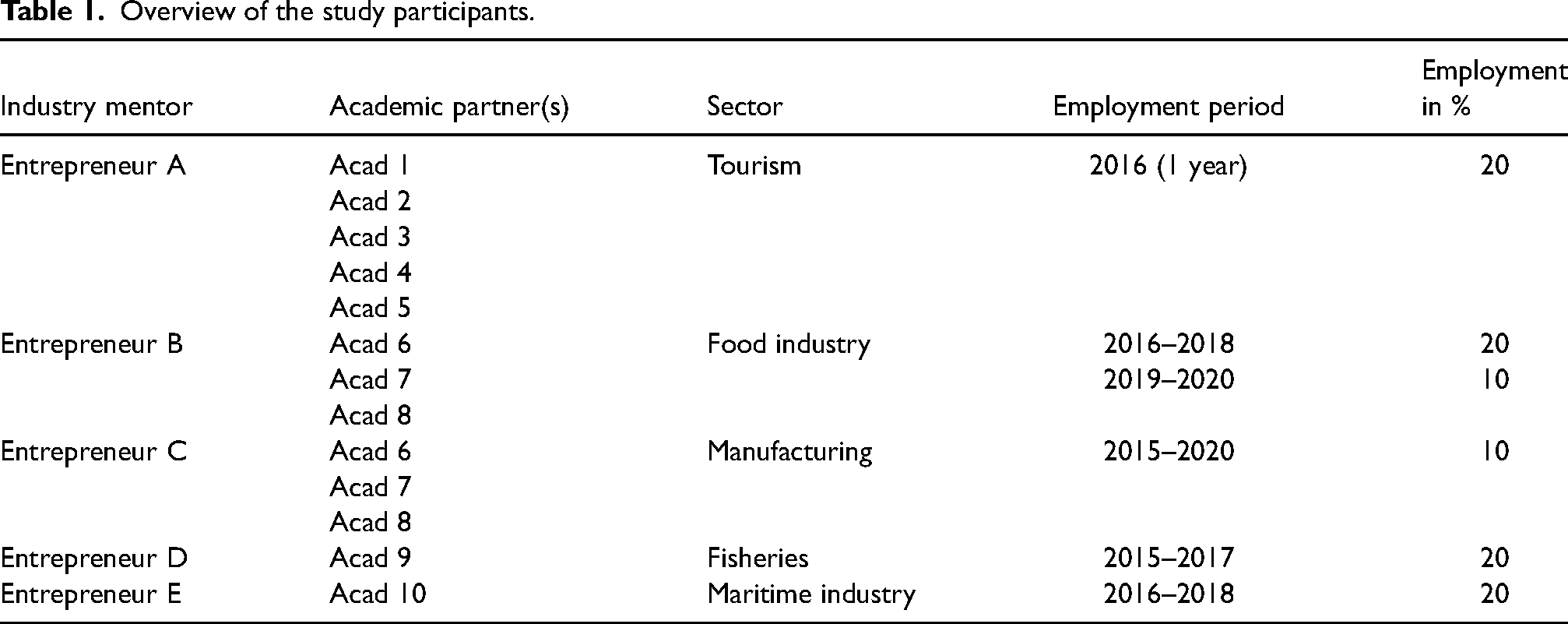
To select participants for this study, we used a theoretical sampling technique to choose individuals who were the best qualified to illuminate and define the properties, boundaries and relevance of their engagement (Charmaz, 2014). We first endeavoured to get an overview of all the hired industry mentors at universities in Northern Norway. This was rather difficult due to the number of short-term contracts, various application procedures and differences in the financing of mentor positions. At the time of data collection, we managed to identify about 25 persons in such positions in the region. Among them, we contacted 12 persons, but not all of them could be perceived as rural entrepreneurs because some of them had their main position outside the industry or outside Northern Norway. In line with our understanding of rural entrepreneurship and rural entrepreneurs, we wanted to select participants engaged in business opportunity development in newly established or incumbent companies located in rural Northern Norway (Leick et al., 2021; Shane and Venkataraman, 2001). In addition, we wanted the participants to have strong engagement in the local context, thus representing the ideal type of rural entrepreneurship (Korsgaard et al., 2015b). These selection criteria directed our selection of five rural entrepreneurs hired as industry mentors at universities in this study. Since we view entrepreneurs’ engagement as relational (Gaddefors and Anderson, 2019), we also interviewed their closest collaborative partners at the universities – 10 academics in total. Table 1 provides an overview of the entrepreneurs and academics who participated in this study.
Overview of the study participants.
We collected rich, in-depth data through loosely structured interviews. The interviews were carried out as conversations around common experiences related to university–industry collaboration. In total, we conducted 11 interviews, including both face-to-face interviews and interviews done via Skype or telephone. The length of the interviews varied from 45 to 90 min. The interviews were conducted between May 2017 and May 2019. All interviews were audiotaped and transcribed. We also collected information about the industry mentor arrangements through various documents, including announcements, applications, reports, e-mails, and publications on websites and in newspapers. All participants signed an informed consent form, and the project was approved by Norwegian Data Service for Social Sciences (ethical approval no. 58974).
Data analysis and theorising
The data analysis followed an iterative process including both coding and the constant comparative method (Charmaz, 2014; Glaser and Strauss, 1967). We coded the interview data using NVivo 12 Plus. Building on Charmaz (2014), we performed one initial and one focused round of coding. The initial coding was done according to the significance in relation to the research question. The data from all interviews were coded into one broad category – nature of engagement – and from this, we identified two main sub-categories – type of engagement and knowledge-sharing practices – as these were recurring themes illustrating the nature of the entrepreneurs’ engagement. In the following round of focused coding, we coded only the entrepreneurs’ data because we wanted to establish a sufficient focus on their perspectives. Our use of constant comparison involved concurrent comparisons of data, our own experiences, and theoretical perspectives until we reached a point of saturation. Saturation was achieved when no new data or rounds of interpretations sparked new insights (Charmaz, 2014). In this process, the self-ethnographic approach (Alvesson, 2003), focusing on our own experiences of the context, complemented other data and enhanced our interpretations of the nature of entrepreneurs’ engagement with their context.
Findings
Three layers of the entrepreneurs’ engagement
The entrepreneurs all showed strong engagement with what they were doing in their businesses, in their positions as industry mentors and in the geographical region in which they lived and worked. In our analysis, we labelled these the business, academic and spatial layers of their engagement. Table 2 gives an overview of the entrepreneurs’ engagement with the rural context.
The entrepreneurs’ engagement with context.
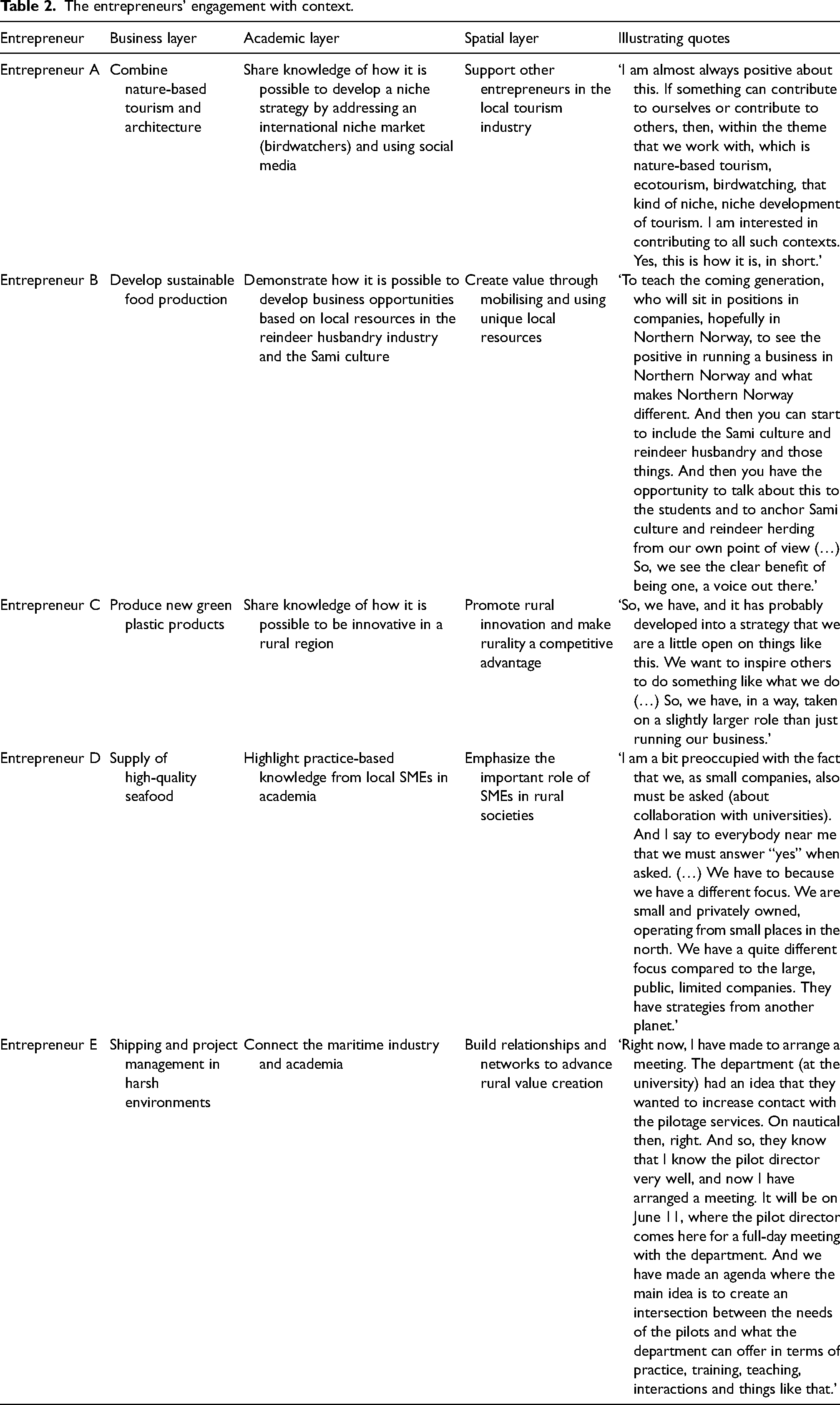
Entrepreneur A was an actor in the nature-based tourism industry. The business layer of A's engagement encompassed a strong passion for birdwatching combined with architecture. The company addressed an international niche market of birdwatchers and used social media to reach them. Novel ideas and ways of working had become important for Entrepreneur A and his company. The entrepreneur considered architecture a tool to protect and promote birds, wildlife and nature in sustainable ways. The company was developing small-scale architecture to support outdoor life and nature-based experiences in the Arctic, such as nature shelters and mini cabins. The academic and spatial layers of A's engagement built on this business passion but were combined with a wish to share knowledge of how to develop niches in tourism by addressing an international niche market (e.g., birdwatchers) and using social media to engage with students and academics as well as other tourism entrepreneurs.
Entrepreneur B was a serial entrepreneur concentrating on developing a company within the reindeer husbandry industry. The business aspect of B's engagement included sustainable food production, and the main rural resources in use were the uniqueness of reindeer meat, the reindeer husbandry industry, and the Sami culture. As the quote in Table 2 illustrates, Entrepreneur B combined this business layer with a strong wish to demonstrate for students and others that it is possible to create business opportunities in Northern Norway based on, for example, the reindeer herding industry and the Sami culture.
For Entrepreneur C, it was important to demonstrate that it is possible to be innovative from a rural location, distant from central business actors as customers and suppliers. C's business engagement encompassed developing a small factory to invent new plastic products continuously and rapidly. The academic aspect of C's engagement related to stimulating an interest in rural innovation among students. The main resources on which Entrepreneur C relied in doing this were openness, collaboration, some implementing capabilities to help the company undertake small and large projects, and an entrepreneurial spirit. C emphasised that the company, through its academic engagement, had taken on a larger role than just running the business.
Entrepreneur D was from a local family firm involved in seafood production. D's business engagement included supplying high-quality seafood products from the cold, clear waters of their Arctic location to a global market. The main idea of D's engagement as an industry mentor at the university was to highlight practice-based knowledge of local small and medium-sized enterprises (SMEs) in academia. The spatial aspect of the engagement comprised the important roles of local SMEs in the region and especially in academia. According to Entrepreneur D, small, locally owned companies possess another type of practice-related and contextualised knowledge compared to the knowledge in larger companies and the more theoretical knowledge in academia, which can be very important to regional universities. D's strategy to promote this practice-based and contextualised knowledge as an industry mentor was to participate in developing study programmes and courses with a practice component to emphasise local and contextualised knowledge in academia and to work towards decentralised education.
Entrepreneur E's academic engagement as an industry mentor differed slightly from that of the others because it involved a very explicit aim to connect the maritime industry and the corresponding academic milieu at the university. Entrepreneur E was the managing director of a company described on its homepage as “a harsh environment vessel operator”. E's business engagement related to ship management and project management services for third-party ship owners. Entrepreneur E was initially employed as an industry mentor for one year, but after this period of employment as industry mentor ended, the engagement was prolonged in the position of adviser. As illustrated in the quote in Table 2, the academic and spatial layers of E's engagement included being a gatekeeper organising new meeting places between actors from academia and industry, thus contributing to building relationships and networks for further regional value creation.
Engagement as knowledge-sharing practices
In addition to these layers of engagement, our data demonstrate that the engagement was essentially about participating in knowledge-sharing practices. Our findings reveal that the entrepreneurs, in their positions as industry mentors, engaged in three related and overlapping knowledge-sharing practices. The first was related to activities at the regional universities, the second to the industry and the third was related to connecting academia and industry. The knowledge-sharing practices taking place at the university were essentially about the entrepreneurs’ sharing of their practice-based and contextualised knowledge related to their businesses. Many of these activities were connected to teaching. In addition to responsibility for, or participation in, ongoing programmes and courses, the entrepreneurs gave lectures on topics according to their business engagements. They also contributed cases that were used in teaching or research, and they supervised students writing their theses. One example of this was when we, as researchers, in close cooperation with Entrepreneur C, used his company to conduct a single case study. The entrepreneur himself and employees in key positions were at our disposal for interviews. We employed the collected data to write a scientific publication in close cooperation with the entrepreneur. Entrepreneurs also engaged in consultancy when they were hired as industry mentors. Thus, they attended diverse meetings related to ongoing processes and projects at the universities, such as the process of developing new study programmes and courses. One example is the common development of a practice course aimed at giving students both practical and theoretical knowledge of the seafood industry, which included three weeks of practice in local companies. In the development of this course, Entrepreneur D participated both in the planning and implementation. Some of the entrepreneurs were also board members at the institutional, faculty or department level. In these activities, they represented the industry, and their engagement and willingness to share knowledge, according to one of the collaborating academics, contributed “extra development power and new thinking”.
In addition to knowledge-sharing practices at the universities, the entrepreneurs were engaged in transferring knowledge from the theoretical sphere to their industries or companies. Regarding these practices, the entrepreneurs were receivers of academic knowledge relevant to their companies and industries. An example from our own collaboration with an industry mentor is that of master's students identifying and using academic theory to solve practical problems in connection with a home exam. This was also the case when students wrote their theses based on theory and practical problems in the company and with the industry mentor as (co)supervisor.
Finally, we identified knowledge-sharing practices aimed at connecting the university and industry. For example, the entrepreneurs helped academics set up consortiums of partners in connection with research applications by using their networks of international and domestic industry partners and by being members of various reference groups. Another example is that Entrepreneur B, in cooperation with the academics, tried to establish an industry PhD. Further, the entrepreneurs participated in planning activities in connection with creating meeting points between actors at universities and diverse external partners. For example, for many years, Entrepreneur E was on the organising committee of an annual seminar intended to connect academics with local industry. The interviewed academics emphasised that the entrepreneurs’ openness and legitimacy were essential to the success of such door opening. One of the academics we interviewed said that the entrepreneurs were like “context ambassadors” – persons who understand both the university and industry contexts and can build bridges between them.
Discussion
Entrepreneurs’ engagement with a layered context
In this paper, we have emphasised that contexts are layered (Muñoz and Kimmitt, 2019; Welter, 2011). Our first main finding is that the entrepreneurs’ engagement as industry mentors at regional universities encompassed and combined three layers of the context: a business, an academic and a spatial layer. Our data highlight the business layer as the foundation of the entrepreneurs’ engagement. In the business layer, the entrepreneurs identified and exploited some rather unique opportunities connected to the resources of Northern Norway which could not be exploited outside this region. In the business layer, the entrepreneurs’ interacted with other actors in the industry to mobilise the necessary resources for exploiting these opportunities. Our study provides new insight by demonstrating the combination of this business engagement with both an academic and a spatial aspect not directly connected to opportunity exploitation. Our findings are thereby in line with literature on rural entrepreneurship that emphasises engagement which goes beyond the business aspect, such as the tightly interwoven connections between the business and the household and the use of family and kinship relations as a business resource base (Alsos et al., 2014). Taking account of what is emphasised in the literature on university–industry collaboration (Perkmann et al., 2013, 2021), we can identify an academic aspect of the entrepreneurs’ engagement connecting them to the academic contextual layer through their interactions with actors at the universities. Regarding the spatial layer of the context, our findings show that the content of the entrepreneurs’ regional engagement varied and connected the entrepreneurs to their region in quite different ways (see Table 2). The connections stretched from the development of niche strategies in tourism (Entrepreneur A), the use of unique resources, such as the Sami culture (Entrepreneur B), making northern rurality a competitive advantage in innovation (Entrepreneur C), emphasising the different but important role of SMEs (Entrepreneur E) and strengthening networks connecting industry and academia (Entrepreneur F). We can also see that this regional engagement, often in combination with business and academic engagement, may have taken place in all types of contexts but seems to have been particularly relevant in rural areas, where the regional universities are young, small and not very entrepreneurial, and the companies are small and not especially research incentivised.
Engagement as knowledge-sharing practices across contextual layers
Another important finding of our study is that engagement was essentially about knowledge-sharing practices including activities happening at the universities, in the industries and related to connecting academia and industry. These practices align with Gaddefors and Anderson (2019) idea that entrepreneurs’ engagement is essentially about the connecting and relational practices of entrepreneurial processes. The entrepreneurs in the present study also gave an empirically driven account of how their engagement unfolded, how it actually worked and the in-betweenness and everydayness of this engagement (Dodd et al., 2021; Welter et al., 2016). In addition, and perhaps more importantly, these practices clearly helped the entrepreneurs cross boundaries between the business, academic and spatial layers of their rural context. The university practices were essentially about the entrepreneurs’ sharing of contextualised and practice-based knowledge related to doing business in the rural north with actors in the academic layer of the context. Taking part in teaching, research, and consultancy helped the entrepreneurs cross boundaries from the rural business context to the academic context. Fundamentally, the industry practices were about bringing theoretical knowledge to the industry and into the companies, thereby connecting the academic and business layers of the context. Finally, we observe that employing connecting practices helped the entrepreneurs cross and integrate all layers of their context. The boundary crossing element corresponds well with ideas about university–industry collaboration as knowledge sharing across boundaries (Hayter et al., 2020). This is again inspired by Carlile (2004), who assumes that innovation occurs at disciplinary or speciality boundaries. The entrepreneurs’ ability to share knowledge across these layers made them context ambassadors capable of stimulating innovation not only in their own companies but also at the universities and at the regional level.
Contributions
We believe that our study makes several contributions. First, empirical research on rural entrepreneurship as engagement is still limited and this study gives a novel and detailed account of how this engagement unfolds in practice not previously covered by research. The adoption of the self-ethnographic approach (Alvesson, 2003) helped us see things that could be hidden from others and to constantly compare data and theory with our own experiences until we reached a point of saturation. Second, engagement in rural contexts is sometimes described as enacting the rural, where enactment is understood as the mobilisation and use of rural resources (Korsgaard et al., 2015b) explaining why entrepreneurs connect with their environments. We contribute to the literature on rural entrepreneurship by adding novel insight into how entrepreneurs relate to their rural context. In existing literature, embeddedness is sometimes seen as the link between entrepreneurs and their various contexts (Korsgaard et al., 2022). However, the research on embeddedness is often characterised by rather passive forms of engagement (Gaddefors and Anderson, 2018) and somewhat static, single-layered and binary notions (Wigren-Kristofersen et al., 2019). We argue that our study complements the insight on embeddedness by focusing more on agency than structure and by viewing the context as multi-layered. We perceive two central aspects of the nature of entrepreneurs’ engagement – that is, it encompasses and combines various layers of the rural context, and it plays out as knowledge-sharing practices that facilitate crossing boundaries between the layers. As illustrated in Figure 1 below, our main contribution is thus that we describe how the entrepreneurs connect with their layered context. The entrepreneurs in our study engage with the business, academic and spatial layers of their rural context and participate in different types of knowledge sharing practices to encompass and combine these layers. We also highlight that including the academic context represents a novel and important perspective on the rural context.
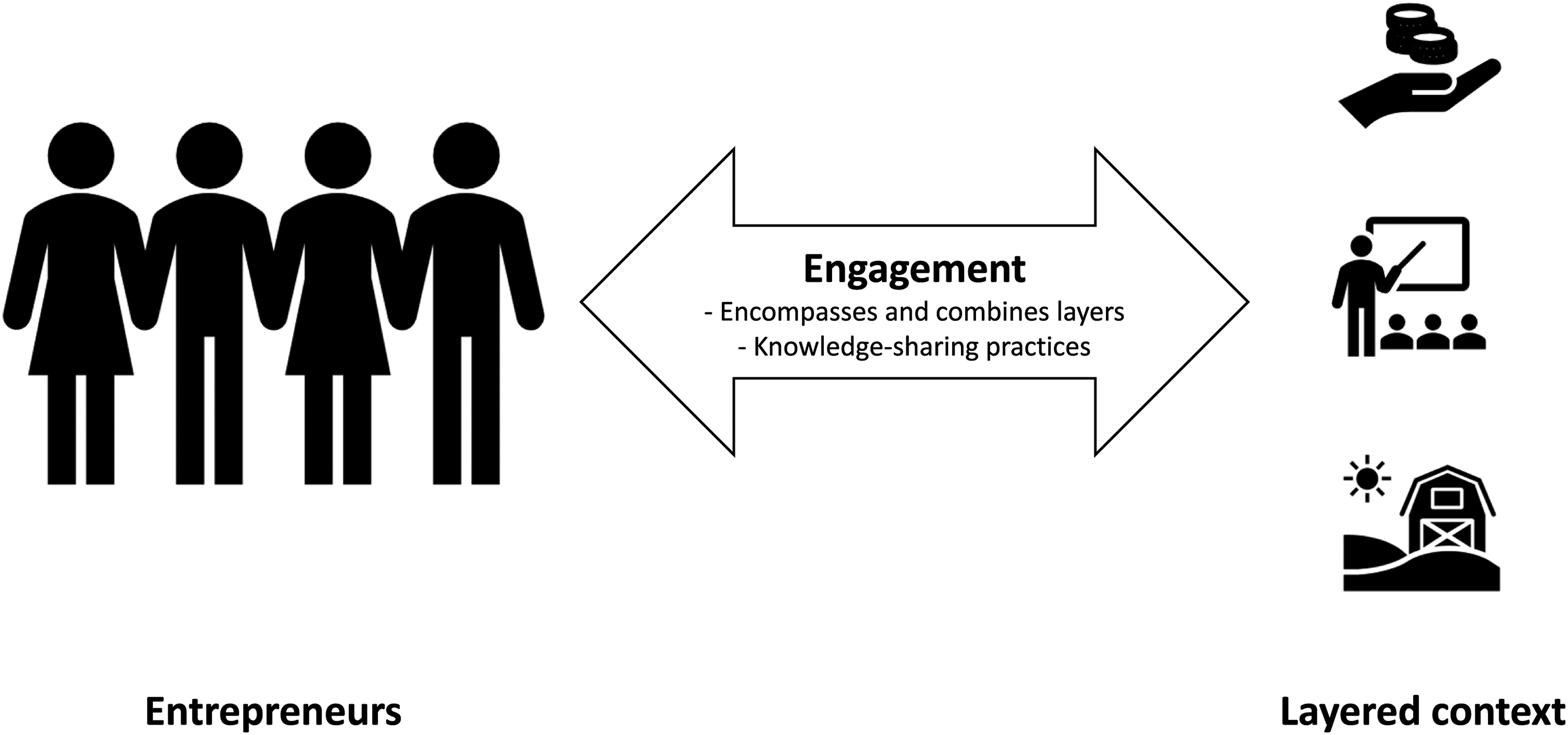
Entrepreneurs’ engagement with a layered rural context.
Third, we hope that our study also has some practical contributions for the entrepreneurs themselves, policymakers, and actors in regional innovation systems and the regional universities. Entrepreneurs create our tomorrows, and we all have a responsibility to comprehend and appreciate what they do (Dodd et al., 2021). However, it has been rather common to consider rural entrepreneurs as less growth-oriented, high-tech, and innovative than their more urban colleagues in “standard” or Silicon Valley entrepreneurship. In this study, we shed light on rural entrepreneurs, hired as industry mentors at universities, engaging with their context, which is unique and perhaps not possible to identify in more urban regions. More knowledge regarding the significance of such engagement can be of great importance for rural entrepreneurs’ identity and well-being. Policymakers, both at the national and regional levels, together with actors in regional innovation systems, need to solve problems around inadequately adopted policy and supporting systems for entrepreneurship in rural regions. Our experience is that policy and supporting systems are largely directed at the business layer of the context. However, our data show that the entrepreneurs’ engagement embraced and combined different layers of their rural surroundings. We, therefore, suggest that policy and support systems in rural regions need to be more directed to other layers, such as the academic layer, and help the entrepreneurs combine various layers. We also highlight that our study may have some practical contributions to regional universities in rural areas. Our findings indicate that hiring entrepreneurs as industry mentors in part-time positions helps to increase the quality of the universities’ teaching and research as well as third mission activities and regional engagement.
Further research
In this study, we endeavoured to understand more about the nature of entrepreneurial engagement. Gaddefors and Anderson (2019) argue that the extent or degree of such engagement is also relevant for understanding more about rural entrepreneurship. One possibility for further research, therefore, is to dig deeper into aspects of the extent and degree of entrepreneurs’ engagement in their rural context. A particularly interesting area for understanding more about degrees of engagement is studies comparing engagement in the local context between different types of entrepreneurs and between entrepreneurs and non-entrepreneurs. Our study revealed that entrepreneurs, as industry mentors at regional universities, encompass and combine different aspects of engagement. However, we recognise that entrepreneurs’ engagement in their rural layered context can have other aspects, such as engagement in culture or sports. Existing research underlines that rural entrepreneurs have community involvement that manifests in two related ways: drawing on local human capital (i.e., engagement in recruiting the local workforce) and collaboration with other local entrepreneurs, local stakeholders or community actors (Korsgaard et al., 2015a). To understand rural entrepreneurship better, further research is needed into the nature and extent of other aspects of engagement and how they are combined (or not) with entrepreneurs’ business engagement. Based on this study alone, it is not easy to state to what extent these findings can be transferred to other rural contexts or to the field of rural entrepreneurship in general. The discussion of our contributions above reveals that we agree with Gaddefors and Anderson (2019) that entrepreneurs’ engagement in context is a phenomenon with the power to explain rural entrepreneurship. However, only future research can clarify why and how.
Footnotes
Declaration of conflicting interests
The author(s) declared no potential conflicts of interest with respect to the research, authorship, and/or publication of this article.
Funding
The author(s) disclosed receipt of the following financial support for the research, authorship, and/or publication of this article: This work was supported by the Regional Research Fund North-Norway, (grant number 582640).
