




Abstract
This case focuses on the entrepreneurial use of multi-stakeholder value co-creation to emerge stronger from challenging trading conditions. In particular, it examines Pennine Pubs, a small-/medium-sized enterprise (SME) operating several rural public houses, which are licensed to sell food and alcoholic drinks to guests. Based in Northern England, it has adapted commercial strategies to mitigate government-enforced Covid-19 lockdowns. Pennine Pubs’ Managing Director is currently considering how to build upon the multi-stakeholder value co-creation strategy which emerged quickly immediately before and during the first lockdown period, when customers were prohibited from visiting pubs. He expects the outcome to be a more refined and sustainable commercial strategy which retains the most significant benefits of his lockdown-period innovations. The case considers how co-creation is applied as a reaction to unforeseen business challenges, and how it can underpin proactive strategies to capitalise upon favourable trading conditions. The concept is explored in the context of rapidly evolving, unpredictable and highly problematic constraints upon retail trade, and the ‘new normal’ of customers returning to retail premises, albeit with expectations modified by recent experiences. Finally, the case considers the impact of SMEs collaborating with suppliers, customers and other stakeholders to co-create mutual, commercially sustainable value.
Learning outcomes
Understanding: The case study context helps students to understand how value co-creation can benefit different stakeholders.
Application: Students participate in evidence-based discussions in which they apply the theory of value co-creation into the context of SME entrepreneurship.
Analysis: Students analyse how entrepreneurial SME strategists pursue innovative co-creation during times of commercial flux.
Evaluation: Students evaluate holistically what constitutes value co-creation, which stakeholders should participate, and how it may be implemented.
Creation: Students can create a value co-creation strategy based upon commercial innovation, and upon stakeholders’ expectations of innovation.
Introduction
This case enables students to engage critically with the theory of co-creation of value, and to analyse it in a real-life context. The case focuses on the manner in which value co-creation can support an entrepreneurial strategy, reducing the psychic distance between organisations and their stakeholders. In particular, the case explores how value co-creation has been adopted by an organisation which needed to pivot its activities to survive and thrive through extremely challenging market conditions. Additionally, the case challenges more utopian interpretations of value co-creation by demonstrating how value no-creation, and even value co-destruction (Makkonen and Olkkonen, 2017), are also possible. In doing so, the aim is to encourage students to embed aspects of co-creation within their understanding of entrepreneurial approaches, but to do so reflexively and with caution rather than considering all inter-stakeholder collaboration to be constructive. Semi-structured phenomenological interviews and panel discussions with 18 regional pub landlords were conducted as part of a broader qualitative research project exploring how pubs and breweries innovatively pivoted their business models to adapt to lockdown trading conditions. Pennine Pubs and its Managing Director were part of this sample of participants and were particularly noteworthy for their high degree of entrepreneurship and innovation. Therefore, after textual analysis of a transcript of the first interview and identification of emerging themes, we conducted a second interview with him specifically to explore how value co-creation contributed to this innovative entrepreneurship and stakeholder engagement. The transcript of this interview was also subjected to textual analysis and the thematic development which underpins this case study.
In the field of value co-creation research, previous literature has generally focused on collaborations between organisations and their customers, rather than cooperation between manufacturers and retailers or between other stakeholders (Singh et al., 2022). In addition, it has only recently been acknowledged that effective value co-creation requires actors to combine their knowledges, resources and ideas (e.g. – Babu et al., 2020; Loureiro et al., 2020). A tension within the literature is that the divergence of different stakeholders’ goals within the value co-creation process is also known to create conflict and stifle the generation of value (Apostolidis et al., 2021; Hollebeek et al., 2020). Consequently, several recent studies have explored the role of innovative stakeholder network engagement to cope with disruptive events such as the loss of resources or markets and collapses in demand or supply (e.g. – Cankurtaran and Beverland, 2020; Crick and Crick, 2020). Value co-creation can be the outcome of interactions between a multiplicity of actors, and therefore benefit a broader network of stakeholders (e.g. – Barile et al., 2020; Lacoste, 2016; Pera et al., 2016; Singh et al., 2022). Moreover, if ‘innovation and entrepreneurship meet in a space of curiosity’ (Kromidha et al., 2022: 3), and value co-creation partially depends upon the curiosity of each stakeholder into the domain of another stakeholder, there is much untapped potential to analyse how innovation, entrepreneurship and value co-creation co-exist synergistically.
Value co-creation
Value co-creation was conceptualised as an outcome of ‘high quality interactions’ (Prahalad and Ramaswamy, 2004: 7) undertaken by networked parties (Dey et al., 2019). Most theorists have studied how suppliers and customers collaborate through equitable exchange, each partner contributing towards a mutually beneficial result. Typically, they have observed how larger organisations such as Ikea and BMW have involved customers and fans in product and service ideation and design. However, co-creation is equally applicable to SMEs, within business-to-business markets, and between partner (but also competing) organisations. SMEs employ fewer than 250 people (Gilman and Salder, 2021), and account for approximately 99% of all UK and EU businesses (UK Government website, 2022). Research on ‘coopetition’, that is, the simultaneous cooperation and competition between rival firms competing organisations to create value, has become a prominent research area and an integral part of many organisational agendas (Gernsheimer et al., 2021). In the context of coopetition, value is created by integrating more effectively complementary resources belonging to competing firms (Bengtsson & Kock, 2014), which can lead to mutual benefits, but also trigger opportunistic behaviours, knowledge leakage and tensions and vulnerable relationships among stakeholders (Gernsheimer et al., 2021; Raza-Ullah and Kostis, 2020). Moreover, the entrepreneurship which often propagates business collaboration and value co-creation, especially within SMEs, is more likely to be stimulated in times of socio-economic crises (Santos et al., 2021), such as the first Covid-19 lockdown period (Zighan et al., 2021), than in less turbulent times.
Drinkers have for many centuries helped publicans to generate additional custom by making music, telling stories and, in doing so, contributing to the attractiveness of the ‘servicescape’ (Booms and Bitner, 1982) in which the pubs’ products and services are sold and consumed. However, those actions do not constitute value co-creation in its purest form, not being explicitly intended by customers to benefit their supplier. Likewise, many of the longstanding collaborative activities between pubs and their supplying brewers, such as joint promotions or pooled inventory management, are simply routine functions of the manufacturer-retailer business partnership. Instead, value co-creation is an outcome of inventive resource and knowledge integration – synergistic efforts employing novel, perhaps extraordinary, techniques and perspectives – which is typically undertaken to overcome resource-constrained scenarios. Lockdown conditions presented pubs and brewers first with stock pressure, as perishable goods needed selling quickly, then unprecedented barriers to market access as their customers were unable to visit the established place of sale.
The concept of value co-creation stems from Prahalad and Ramaswamy's (2000: 79) previous concept of organisations ‘co-opting customer competence’, suggesting that customer contributions are expressly and strategically invited by organisations. Vargo and Lusch’s (2008) conceptualisation of service-dominant (S-D) logic brought a paradigmatic shift which solidified co-creation, as it prioritised the exchange of service in interactions between businesses, customers and stakeholders (Vargo and Lusch, 2016). Different entities adopt various roles in co-creation processes (Dey et al., 2019) and have diverse motivations for participating in value creation and consumption (Fujita et al., 2020), but a mutual expectation of equitable exchange and shared benefits is key (Ballantyne and Varey, 2006). Value evades financial measurement, being subjective and derived from consumers’ individual experiences (Nobre and Ferreira, 2017). Within the context of the hospitality industry, value co-creation between organisations and stakeholders (including customers and consumers) can improve economic performance (Lambert and Enz, 2012), reduce waste (Apostolidis et al., 2021), help to attract and retain customers (Junaid et al., 2020; Yen et al., 2020), and confer wellbeing and empowerment upon consumers (Sigala, 2019).
Value co-creation is increasingly recognised by theorists and practitioners (Sklyar et al., 2019), and most scholars agree on the importance of multi-stakeholder engagement (Babu et al., 2020). However, despite its increasing importance and relevance to organisations, there is scant research into how value co-creation can help organisations to overcome existential threats, and very little discussion of types of engagement, actors and beneficiaries (Singh et al., 2022). Indeed, Hollebeek et al. (2020) asserted that stakeholders’ divergent value-creating aims and goals can generate conflict, undermining co-creation and potentially resulting in value non-creation or value co-destruction (Rahman et al., 2019). Recognising pubs’ unique role in combining retail with the development of social capital and community cohesion (Cabras and Mount, 2017; Hubbard, 2019), Singh et al. (2022) studied how UK pubs and breweries instigated multi-stakeholder value co-creation for survival and sustainability during the Covid-19 period. In doing so, they interviewed owners and managers of SMEs, which often have limited resources and thrive by leveraging community and business networks (Bryson et al., 2017). The authors explored how SMEs could heed previous calls (e.g. – Cankurtaran and Beverland, 2020; Crick and Crick, 2020) to survive critical commercial challenges by harnessing stakeholder network engagement to generate innovative solutions.
Pennine pubs
Public houses (usually called pubs within the UK), sell alcoholic and non-alcoholic beverages and food to customers for consumption on the premises. Pubs may be ‘tied houses’, which are contractually obliged to source at least some of their beer from a specified supplier, or ‘free houses’, which can buy beer from any supplier or combination of suppliers. ‘Tenanted pubs’ or ‘managed pubs’ are owned by pub chain operators (which are often brewing companies), so managers often have little or no choice of which beers to stock. This case study focuses on a small, family-run chain of ten pubs, whose owner/managing director selects products for each pub, including a selection of ‘real ales’ – beers produced by small, independent breweries, and stored and served using traditional methods (Thurnell-Read, 2018). This independence enables the owner to innovate tactically and strategically. Pubs are usually the focal point of British communities and are particular valued as community assets within rural settlements, where they are usually the most popular places for local residents to relax, socialise, drink and eat (Cabras and Reggiano, 2010; Mount and Cabras, 2015; Wells et al., 2019).
Bob Woodsmith is the Managing Director and founder of Pennine Pubs, a family-owned SME business operating ten public houses in rural areas of Northern England. (NB: the individual's name and company name have been changed at his request.) Mr Woodsmith's pubs are in picturesque village locations, and attract local residents, holidaymakers and day-trippers. Each establishment serves real ale from permanent suppliers and guest breweries, and sells other alcoholic and soft beverages, snacks and meals. Around 70% of their income is from ‘wet sales’ (drinks and bar snacks), and 30% from ‘dry sales’ (produce from the kitchen, predominantly full meals).
Like other pubs in the UK, Pennine Pubs’ inns sell alcoholic drinks for consumption on the premises, and this is their core business, although drinking to excess is discouraged. Each pub is a hub of local community life, along with the church and the village hall, providing a common social space in which residents meet, socialise and relax. Most of the pubs are over 200 years old and host darts teams, quiz nights, fund-raising events and private functions such as wedding receptions. The pubs are also popular with hikers, cyclists and sightseers, and all but one site has a ‘beer garden’ enabling customers to eat and drink al fresco during agreeable weather conditions.
Company background
Pennine Pubs is a private limited company founded by Bob Woodsmith in 1983, when he purchased his first public house. It focuses on rural pubs in the Pennines – a scenic and moderately affluent region of agricultural communities, which attracts visitors from surrounding industrial areas, such as Leeds and Sheffield. Its core strategy has been to reduce reliance upon ‘wet sales’ (i.e. – drinks and bar purchases) by diversifying and developing additional revenue streams. Most notably, the company has extended most properties in its portfolio to increase kitchen and dining capacities and has landscaped external spaces into informal dining areas and beer gardens, thereby generating very profitable ‘dry sales’ of prepared meals. Additionally, it has repurposed previously underutilised building spaces into ‘boutique’ guest accommodation, currently averaging around £125 per night for a double room with breakfast, or £150 with dinner also included. By hosting regular real ale festivals, folk music gigs and vintage car rallies, its pubs have been successful in broadening their appeal to a customer base which is increasingly diverse, both socially and geographically, whilst retaining their loyal local custom. As Bob explains, Locals seem to like the vibrancy and bustle of our pubs, whereas visitors tend to find them relaxing and quiet so, by being somewhere in the middle, we provide something of value to both customer types.
Pennine Pubs has evolved constantly to address changing consumer expectations and shifting socioeconomic factors. Whilst its first acquisitions had predominantly ‘ageing, male clientele who just wanted to drink beer, smoke and talk about cows’, Bob jokes that his pubs have developed ‘like The Woolpack on Emmerdale’ (i.e. – the fictional pub in a long-running UK television soap opera set in a Pennine farming community). He explains, We still have those customers, and we value them very highly, but nowadays we get far more young adults, women, couples, hikers, bikers and cyclists, tourists wanting meals or to have a relaxing rural experience to unwind from work. Families too, especially in the summer. And dogs – lots of dogs.
Pennine Pubs’ premises occupy prominent positions in well-known villages. Their exteriors are typified by local architectural materials, clipped hedges and hanging baskets, and their interiors by solid stone or wooden floors, plush upholstery, ambient lighting, open fires and gentle background music. Their drinks offering has steadily grown to comprise mass-produced beers and lagers, independent brewers’ real ales, ciders, spirits, wines, soft drinks, cocktails, non-alcoholic ‘mocktails’, teas and coffees.
Pennine pubs’ entrepreneurial use of value co-creation during Covid-19 lockdowns
Pennine Pubs tried to find additional ways to co-create value with its suppliers in anticipation of the first lockdown. As the UK government communicated the first lockdown deadline several days in advance, pubs and brewers tried to sell as much perishable stock as possible before that date. This was especially true of real ale – traditionally produced ales which have a short shelf-life as they are unpasteurised and must mature in the cask barrels used to transport them. Particularly popular with older, rural, financially comfortable, male drinkers, well-served real ale attracts considerable custom to country pubs. Bob explains that, although we knew that, by overstocking pubs, we risked having leftover product which we couldn't sell when lockdown started, we worked with our main brewers to do that anyway, because it stopped us running out before the deadline and disappointing loyal customers. On average, our pubs had to give away about £500 worth of beer in containers to customers a few minutes before lockdown, and the brewers and Pennine Pubs absorbed that cost between us rather than try to charge customers. It was easier, it generated goodwill, it helped us say ‘thank you and we’re here for you’, and it meant we could continue trading right up to midnight. Win-win really.
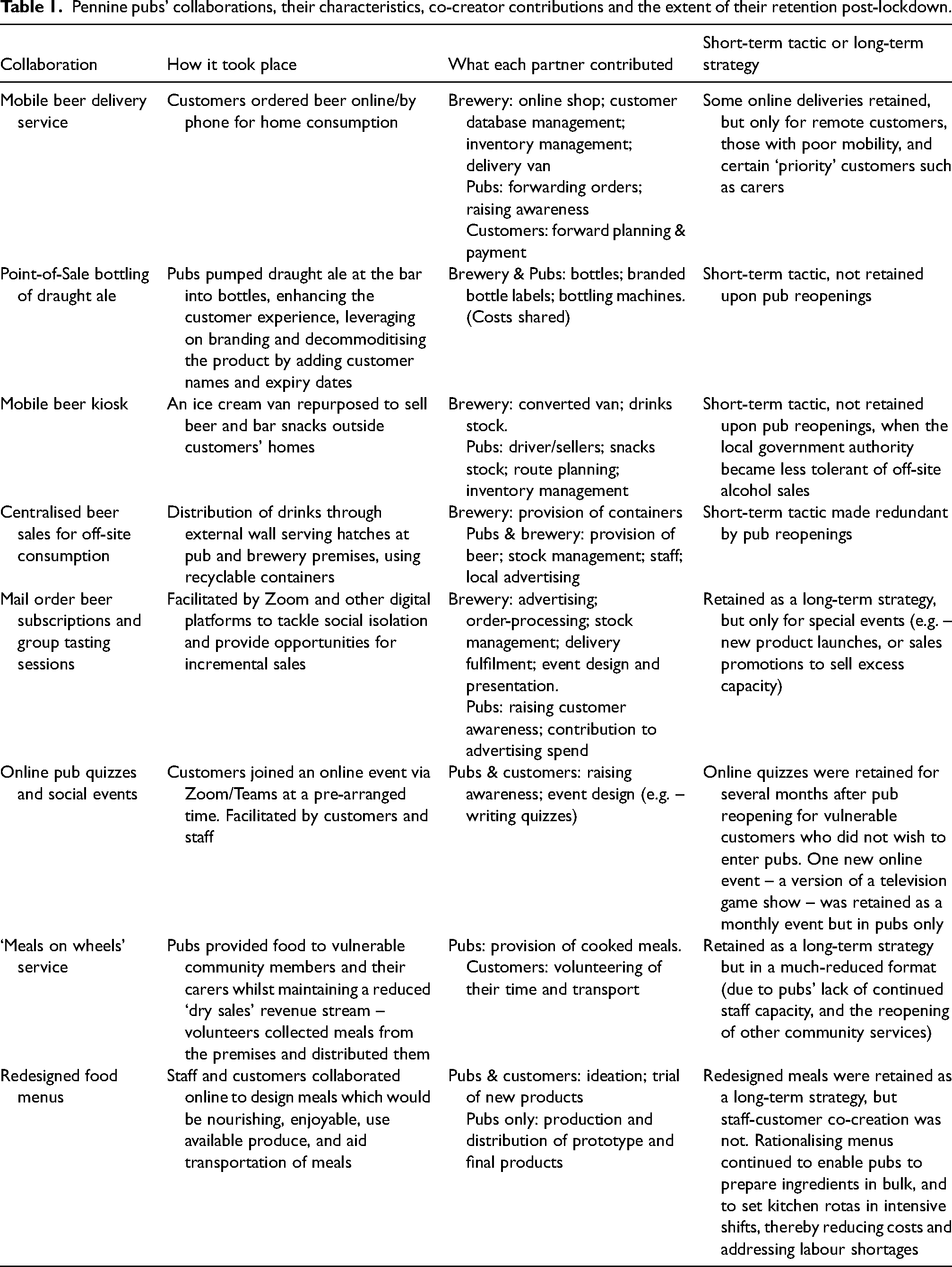
However, as lockdown commenced and communities dealt with the restrictions, Pennine Pubs and its suppliers instigated more unusual, entrepreneurial collaborations with external stakeholders for mutual benefit, including those shown in Table 1.
Pennine pubs’ collaborations, their characteristics, co-creator contributions and the extent of their retention post-lockdown.
The dilemma between expanding co-creation strategies for potential mutual benefits or limiting them to mitigate the risk of value co-destruction
A major issue which has presented itself to Pennine Pubs and its brewers is the need to adapt to ‘the new normal’ – post-lockdown socioeconomic conditions (Singh et al., 2022). Although early indications suggest that nearly all pre-lockdown consumer practices will resume or have resumed, customers’ experiences of lockdown conditions and of innovative co-creation initiatives have shaped their preferences and expectations. Bob regretted that his entrepreneurial approach to food production and distribution during lockdown might result in his customers demanding its continuation, undermining his more profitable pre-lockdown methods:
I’d built up my knowledge of their little foibles over many years, so I knew what to provide for them before Covid came around. I quickly learned what to provide for them and how to provide it during lockdown. But even as we emerge, it's very difficult to know exactly what customers will want in the future. Some customers already want hot food in takeaway boxes like during lockdown, but I want them to dine in like before. On-site diners buy other stuff and pay more because they’re getting the experience I’ve invested in over the years. I don’t want to undercut my own restaurant trade. I’m not a takeaway operator, and it would leave the communities much poorer places too. Diners create an atmosphere which brings others to the pub.
At first glance, this initiative seems positive – especially as people who receive social support from their network (e.g. – carers) may provide material assistance to entrepreneurs in their networks (Nielsen, 2020). However, Bob worries that, by co-creating value with volunteers to provide meals for delivery to vulnerable customers, he may have inadvertently created a long-term demand which cannibalises his more profitable pre-existing revenue stream. More ironically, this temporary co-creation initiative to help isolated, needy customers and foster community spirit risks driving a permanent change which isolates those customers even more and undermines the economic and social sustainability of a cherished community asset. This misalignment of goals may produce destruction, not creation, of value. This phenomenon is known as ‘value co-destruction’, and is attributed to factors such as conflicting goals, system failures, opportunism, lack of competency and (intentional or unintentional) misuse of resources (Apostolidis and Brown, 2021; Echeverri and Skålén, 2011; Findsrud et al., 2018; Plé and Cáceres 2010).
Value co-creation asserts that ‘value-in-use’ should be prioritised above ‘value-in-exchange’ – co-creation partners should prioritise what value a product or service delivers whenever it is used or experienced, rather than the economic value realised by selling that product or service. It is therefore particularly unfortunate that a community-minded initiative could unintentionally encourage beneficiaries to adopt a more transactional stance towards product provision which endangers the value of service, experience and community. Pennine Pubs’ main brewing partner also helped customers by selling barrels of beer to consumers who hosted al fresco parties in gardens and gazebos during lockdown, but is reluctant to continue this model post-lockdown for similar reasons to Bob's.
In dealing with this issue, Pennine Pubs and its brewing partners have undertaken both formal and informal local market research to ascertain emerging customer expectations, co-creating a number of free gigs and events in pubs to reconnect the three major stakeholder groups (manufacturer, retailer and consumers), thereby reminding customers of the socio-cultural value which cannot be replicated off-site. However, they realise that concessions to the ‘new normal’ are necessary, and probably fruitful for all parties, so are exploring the viability of partnering with local council authorities, carers and community groups to provide meal deliveries to vulnerable villagers and, in partnership with a local minibus taxi firm, a ‘dial-a-bus’ service to transport immobile customers to and from participating pubs at selected times. As Bob quipped, If I’m not careful, we’ll end up doing customers’ washing and ironing! Seriously though, it has been an incredible process this last few years, finding out how a business like ours can do more than pull pints, and perform functions within the local community which you’d traditionally associate with the council or the church. And to use that to make the business stronger and the customers happier. I’m all for it.
Summary
Bob and Pennine Pubs now face an important decision as they navigate into the ‘new normal’ by co-creating value with their brewer and members of their local communities: Should Bob seek to expand his pubs’ value co-creation activities yet further or should he pursue a return to his ‘traditional’ pre-lockdown trading practices? Expanding its innovative collaborations would help Pennine Pubs to adapt to the evolving microenvironmental landscape, increase customers’ allegiance to the business, and produce a sustainable, ‘future-proofed’ trading model. However, it may result in the business under-resourcing development of its largest, most established income streams, and could raise customers’ value expectations to unachievable levels. This case is useful in demonstrating the nuanced, constantly evolving business landscape in which value co-creation occurs, the interconnectedness of multiple stakeholders’ value requirements, and the thin dividing lines between value co-creation, value no-creation and value co-destruction. It advances our understanding of the roles which innovative value co-creation strategies can play in rural and SME entrepreneurship.
Questions
Understanding: To what extent did Pennine Pubs, the brewery and local community members benefit from value co-creation initiatives undertaken during and immediately before government lockdowns?
Application: Is it commercially sustainable for Pennine Pubs to retain and expand its collaboration with carers to supply cooked meals to vulnerable community members off premises?
Analysis: What would be the potential advantages and disadvantages to Pennine Pubs and its main brewer in providing a ‘dial-a-bus’ service to transport immobile customers to, from and between participating pubs?
Evaluation: How might value co-creation contribute towards Pennine Pubs’ objective of achieving gradual revenue growth through selective diversification of its business activities?
Creation: Compile a list of strategic actions which Pennine Pubs and its community members could undertake to co-create value in its food offerings and its ‘wet sales’ of drinks and bar items.
Footnotes
Authors’ note
This case was made possible through the generous cooperation of the participant (whose name and identifying details have been changed at his request). The case is intended as a basis for class discussion rather than to illustrate either effective or ineffective handling of management situations. The authors also wish to thank the anonymous peer reviewers for their constructive guidance.
Declaration of conflicting interests
The authors declared no potential conflicts of interest with respect to the research, authorship and/or publication of this article.
Funding
The authors received no financial support for the research, authorship and/or publication of this article.
