



Abstract
Business research has rarely explored service innovation for the traditionally conservative legal industry. Using a resource-based and practice-based view blend as its theoretical backbone we develop an understanding of the parameters underpinning law firm innovation as a facilitator of operations management enhancement and possible source of entrepreneurship. The paper presents a survey answered by 106 legal professionals from 19 countries exploring four thematic areas referring to human capital, social capital, knowledge and technology transfer that were hypothesised to define innovation. Ordered probit regression modelling was used. Evidence is presented that cybersecurity threats, inadequate and limited training on IT, excessive paperwork and lack of efficient teamwork, collaboration and communication are key challenges to innovation adoption, which is a pathway to sustainable, inclusive and resilient firm growth. Firm size and internationalisation are innovation-altering factors; SMEs differ from large global firms in their ability to operate ‘outside-the-box’. Our results recommend that legal enterprises need to adopt innovation as a robust transformation-enabling toolkit that could facilitate a performance-enhancing business ethos.
Keywords
Introduction
Professional service firms (PSFs) are businesses with specialised workforce that provide non-material, intangible, knowledge-intensive and highly customised services to clients (Heirati et al., 2019). These are for example the legal, accounting and management consulting firms whose human resources are difficult to imitate by competitor firms and their services cannot be easily evaluated from customers (Muzio and Kirkpatrick, 2011). PSFs constitute a critical pillar for socio-economic prosperity; knowledge-based services alone generate more than five times as much value added for the UK economy as advanced manufacturing (Abreu et al., 2010). PSFs have high intellectual value-adding capabilities and require significant investments in technology and in knowledge transfer to stay or become innovative (d’Antone and Santos, 2016) which for them is a key success factor.
Legal PSFs are often characterised as agents of internationalisation and entrepreneurship with an important, but neglected, role on the global service economy scene (Warf, 2001). Legal PSFs face challenges in their capacity to innovate due to financial reasons that are restricting their ability to pay high wages to their employees and due to regulatory environment restrictions (Bello et al., 2016). Innovation is a source of leverage for legal enterprises, since it can help them utilise their high knowledge intensity and highly professionalised workforce (Von Nordenflycht, 2010) and transform their human capital into a competitive asset.
Bourke et al. (2020) describes innovation as “a tool creating business value”. Innovation is positively linked, actively interacts and can effectively facilitate entrepreneurship (Zhao, 2005); both phenomena are characterised by recognition of new market opportunities, endurance to face challenges and strive for success (Oksanen and Rilla, 2009). Despite these qualities, the legal sector has been typically characterised by a slow innovation adoption rate (Susskind, 2017), something not in line with its high socio-economic value for society and the emergence of technology in areas that could help to improve the legal service provision. The reasons behind this lack of innovation are rarely discussed in the literature.
This study contributes by filling in this gap, through testing whether key forms of innovation like: i) the improvement of educational and training opportunities; ii) the more effective management (and engagement) of human resources iii) the establishment of knowledge exchange platforms and synergies with academia and other firms; and iv) the adoption of new technologies, including AI-based interventions, could improve service delivery.
This paper therefore adds value to the service innovation literature by identifying problems and proposing solutions underpinning innovation adoption in legal PSFs. Specifically, our explicit research objectives are about:
examining how innovation relates with a firm's approach to human capital, social capital, knowledge transfer and technology transfer; identifying the impact of firm size in legal service innovation and whether legal professional experience affects how staff perceive their companies’ ability to innovate; proposing evidence-based solutions that improve innovation adoption by legal PSFs.
Section 2 presents the limited legal PSF innovation literature, introduces the theoretical background of the study and generates our research hypotheses. Section 3 describes the survey. Section 4 presents our statistical analysis, followed by section 5 which is a discussion that benchmarks our key findings against relevant literature and articulates solutions to the problems identified. Section 6 summarises the paper's original contributions and suggests future research directions.
Background
The legal sector is the backbone of the business eco-system globally and provides services around: formal agreements on torts, patents, and product liability; employment law and antidiscrimination ordinances; tax law; trade agreements; venture capital negotiations; joint venture agreements; technology transfer protocols; corporate mergers, acquisitions, and takeovers; and intellectual property rights (Warf, 2001).
Despite serious technological developments in service provision, that reflect the unprecedented growth of IT, and better business models, most legal PSFs are conservative in the way they operate. The legal service industry lacks an (or rather ignores its) ability to modernise with the one exception being the entrance of the alternative business structure (ABS) entrepreneurship model allowing non-legal professionals to co-own legal firms. Legal services, in general, are characterised by excessive paperwork and outdated working practices from senior legal professionals that lead to productivity declines, duplication of effort and resistance to change (Susskind and Susskind, 2015). Brexit, for the UK and European contexts, and financial uncertainties globally, have created complications for the day-to-day business that limit firms’ capacity and desire to prioritise innovation-centric investments. Also, technological change in legal PSFs is incremental, something that now, because of COVID-19 and the resulting pivot to remote and hybrid operations, needs to change in a shorter timeline than what was ever anticipated.
Legal service innovation
Innovation for PSFs relates to the entrance of new technological tools, the effective management of employees, business transformation and the conversion of employees’ knowledge into services (Bourke et al., 2020). Scholars focusing on innovation implementation in the law services sector see it as “process change” or as “improved ways of delivering legal services” (Desyllas et al., 2018). Michalakopoulou et al. (2021) approaches innovation as a diverse legal service improvement mechanism that creates positive firm change based on technology uptake, human factor management, organisational reform and knowledge transfer. Understanding the key issues that innovation needs to tackle and how this can be adopted by businesses is increasingly important for managers and crucial for the sustainable growth of firms looking to create a competitive advantage over their rivals and new business opportunities (Di Guardo and Cabiddu, 2015). Thus scholars should try to understand better innovation's challenges and the answers to those.
Many legal sector problems can be solved through technology, but inadequate technology adoption could also be a barrier. Firms opt for adopting the newest technologies and products to leverage over the competitive market (Ottenbacher and Harrington, 2008) but transition is not always easy for lawyers who resist change (Susskind, 2017). The entrance of artificial intelligence (AI) in legal PSFs and the risks it has to human employment rates (Huang and Rust, 2018) are contributing to a growing debate. Legal PSFs may start to utilise a high degree of AI in the management of their everyday operations (Rust and Huang, 2014) investing in ‘labour-saving’ technologies that can act smarter, faster and make predictions using big data (Astorino et al., 2019).
The human element is critical for the successful implementation of innovation. A firm's culture may encourage or deter the adoption of new approaches, strategies and technologies. For instance, Christensen et al. (2013) argued that AI and big data science solutions can only be supported through the human capital development. The human factor also refers to the activities that the senior managers are responsible for managing, in terms of operations and personnel. Tacit knowledge that lies among these resources is the key asset for a firm's competitive advantage and it can be transferred through teamwork, organisational processes and communication (Fu, 2013).
Resource-and practice-based view theory blending
The resource-based view (RBV) is a leading theory supporting inquiries about how firms can successfully withstand competition (Khurana and Farhat, 2021) and is central to the field of operational research (Seepana et al., 2021). Our work adopts RBV, as its primary theoretical cornerstone, recognising the significance of resources in the provision of legal services. It is necessary for the knowledge intensive legal PSFs to find sources of competitive advantage within their own capabilities by assembling resources that work together to create organisational capabilities (Mitrega et al., 2017).
The practice-based view (PBV), on the other hand, is another powerful theory that acknowledges ‘practice’ as a process that legal PSFs could employ and focuses on imitable activities or practices amenable to transfer across firms (Bromiley and Rau, 2014). Our prior qualitative studies (Michalakopoulou et al., 2021) allowed us to recognise that legal PSFs may accelerate innovation by utilising knowledge and technology transfer practices adopting approaches proven to be successful in other sectors. Giannopoulou et al. (2014) agreed that practices, as reflected by PBV, are the actions that individuals do for value creation and thus could serve as performance accelerators for firms. These practices can adequately describe and capture a company's external process-oriented activities like working to attract talent (Maritz and Donovan, 2015) for innovation adoption.
Thus, this study's theoretical benchmark is a hybrid model primarily set around RBV and its human factor and social capital resources that also incorporates knowledge and technology transfer, elements typically associated with PBV. The theory therefore is well-aligned with our four underpinning themes and our research objectives per se. Figure 1 illustrates how our research hypotheses, described in detail in 2.4, line up with our theorical benchmark.
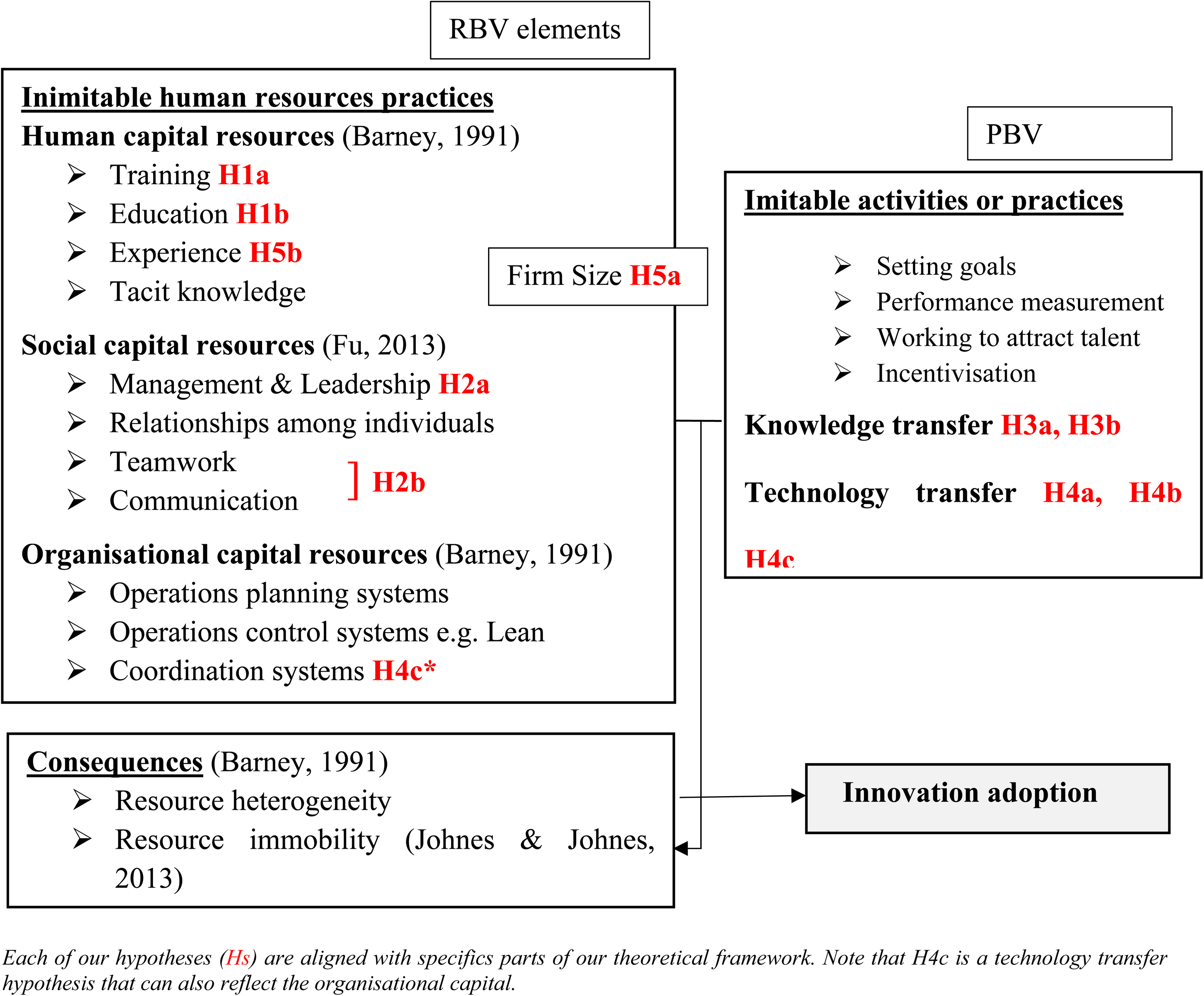
Theoretical underpinning. Each of our hypotheses (Hs) are aligned with specifics parts of our theoretical framework. Note that H4c is a technology transfer hypothesis that can also reflect the organisational capital.
Hypotheses development
Our hypotheses mapped through an inductive reasoning of theory testing (Mourougan and Sethuraman, 2017) have been developed, as illustrated in Figure 1, around the management of human capital, social capital, knowledge transfer and technology uptake and around working experience and firm size in line with our first two research objectives.
Does enhanced training and education affect legal firms’ innovation uptake?
It is typical that in knowledge-intensive industries, like legal PSFs, competences in information and knowledge management, project management, collaboration and communication, and business involvement are likely to improve an organisation's ability to innovate (Gordon and Tarafdar, 2007). Firms deploying human capital for innovation purposes tend to be more successful, since task-related and interdisciplinary training on the one hand, and educational attainment, quality and diversity on the other, support innovation (Caloghirou et al., 2018). Investments in employee training programmes enable the identification and assimilation of knowledge at the firm level, the development of professional skills and expertise, and the generation of ideas (Minbaeva et al., 2014). This is in line with Laosirihongthong et al. (2014) who argued that exploitation of human resources for knowledge development can lead to innovation. Education also develops transferable skills that go beyond discipline specifics such as technical knowledge, intelligence, abstract thinking, problem-solving and creativity (Koellinger, 2008).
There is limited research on legal service innovation and human capital as this is expressed through training and education. These led us to test the hypotheses:
Does social capital management affect legal firms’ innovation uptake?
Social capital is a form of open innovation that can lead to better idea creation, self-motivation and skills enhancement. Social capital refers to communication and collaboration among individuals in a firm (Chuang et al., 2016) and is primarily about teamwork and the management of human resources. Managing and leading employees effectively encourages teamwork and collaboration among co-workers and creates an eco-system embracing innovation (Greenhalgh et al., 2008). For this reason, the social capital for knowledge-intensive enterprises, like legal PSFs, is key for their growth. The firm culture, that is defined by its management and leadership practices, is vital for innovation adoption including the uptake of new technologies (Bello et al., 2016) and also affects the decision-making, the design and the implementation of operations and innovative approaches within an organisation. Thus, the firm leadership, the management of employees and the collaboration among team members may promote innovation adoption in legal services. These lead us to test the hypotheses:
Does knowledge transfer affect legal firms’ innovation adoption?
The relationship and the engagement with external parties can result in innovation (Laursen and Salter, 2014). External party relationships refer among others to partnerships with universities, engagement with competitor or collaborating legal firms, synergies with IT or project management companies including outsourcing and knowledge transfer (Alexander and Childe, 2013), and exchange activities such as workshops or conferences that lawyers and legal professionals may attend. Knowledge transfer may take place in a legal/academic setting or in a legal/legal setting (Pérez-Luño et al., 2019) so it is worth testing the following two hypotheses:
Does technology adoption affect legal firms’ innovation uptake?
Technology adoption is a key innovation element for legal firms that enable them to build a competitive advantage. Firms that adopt modern technologies are having a leverage over competitors (Zaefarian et al., 2017) because these smart tools can optimise their operations. Legal technology experts recommend the adoption of AI and integrated technological software looking at customer relationships management (CRM) and data analytics (Newby et al., 2014) and warn about the financial risks associated with a lack of technological change. Nevertheless, few legal PSFs have adopted fully digital transformations, as they may lack knowledge about how to successfully integrate them (Oskamp and Lauritsen, 2002) or are reluctant to embrace a new disruptive and controversial technology. The reasons behind this have not been yet explored systematically by the literature and will be investigated through testing three technology-centric hypotheses referring to cybersecurity issues, techno-training and excessively paperwork-based operations.
Does size and employee experience affect legal firms’ innovation adoption?
The ability of social and human capital to shape firm innovation in service providers might be related to firm size (Haar et al., 2021) making this a factor worth further examining in the under-explored context of legal PSFs. Large size means that a firm may have access to superior resources (not least financial), which should enable it to better leverage existing conditions (utilising social and human capital potential) towards developing service innovations, while small size may translate to firm flexibility that could facilitate in some cases more successful pathways to innovation (Haar and Spell, 2008). SMEs need to be innovative to overcome relatively limited resources, vulnerability to uncertainty, turbulence in business environments and extensive customer and supplier power (Beyonon et al., 2020).
Size matters in legal firms not only in pure human resource terms but also reflects accurately their ability to provide services internationally. Firms have to be large at home in order to build even a moderate overseas practice and become global (Fletcher, 2004) meaning that economies of scale are critical in legal PSFs, and large size often translates to an ability to be genuinely multinational. This work will test whether size and internationalisation (large companies in our sample are all global providers) foster innovation as a quality reflecting and affecting performance enhancement and entrepreneurship opportunities. This is because there is evidence that internationalisation is a performance-changing factor (Ozdemir and Upneja, 2016) linked with innovation acceleration (Ripolles Meliá et al., 2010) and firm size is positively correlated with knowledge and technology transfer innovation activities (Arvanitis et al., 2011).
We will also test whether the professional experience of legal employees underpins their assessment on whether their firm is able to innovate. This is important since longer tenured employees and more experienced staff have more firm-specific and broad knowledge respectively and thus may be less inclined to seek outside knowledge (Bogers et al., 2018) or perhaps consider that their company lacks innovation.
Methodology
Survey design
Our previous work, an in-depth thematic analysis study, revealed four areas that were of particular interest when exploring legal firm innovation and these are the ones we negotiate here: education and training; leadership, management and team collaboration; knowledge transfer activities; and technology uptake. The survey adds the ability to make generalisations about these elements underpinning innovation adoption within legal PSFs. This quantitative process enables the proposition of innovative solutions that could improve the service offerings and operational effectiveness of legal PSFs.
The questionnaire was organised in three main sections: human factor and process changes; technological innovation; and education trends and knowledge transfer practices. The participants’ years of working experience, their country of employment and the size of their firm were also data collected. Legal professionals had to complete our survey based on their perceptions, insights and experiences. The use of a consistent five-point Likert scale was employed for every non-demographic survey item ranging from strongly disagree (1) to strongly agree (5).
Data collection and method of analysis
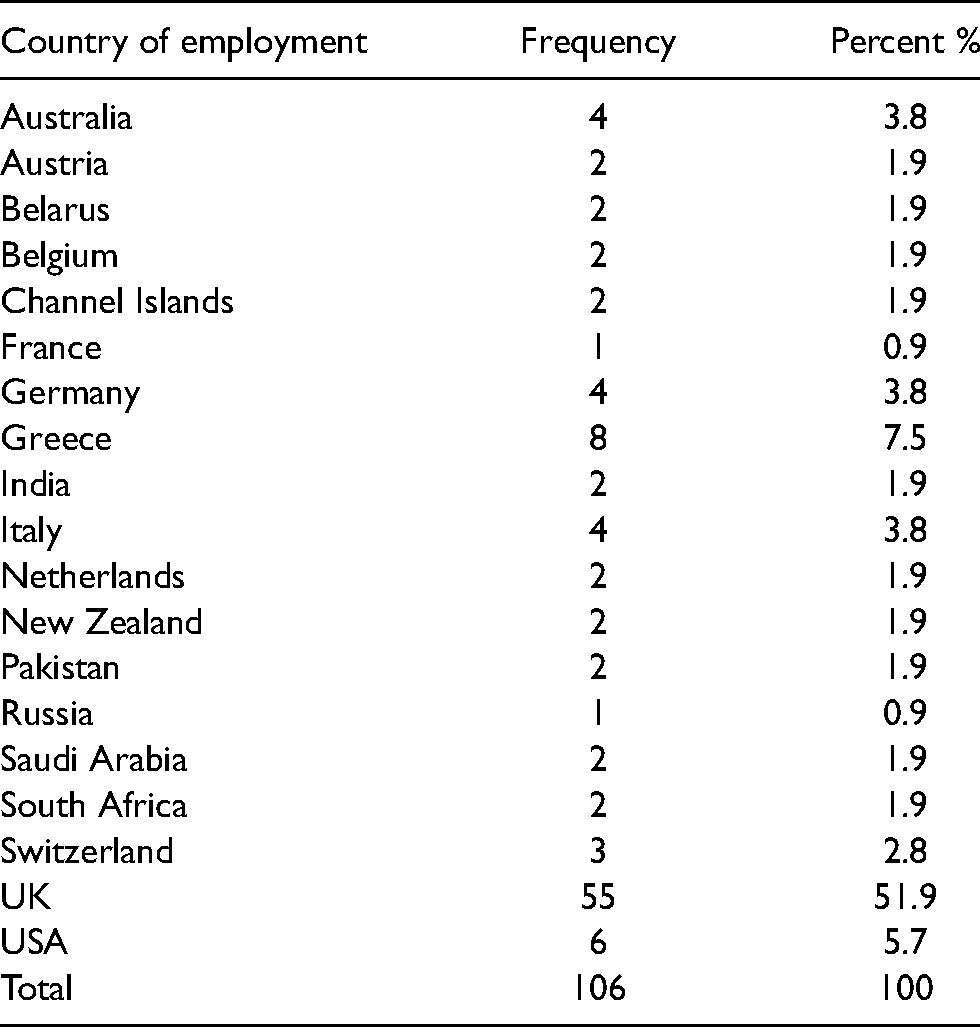
Legal professionals from 19 countries answered the survey (see Appendix). Specific county selection was not a pre-requisite, as this study aims to explore the operations of legal services and not their legal systems that are quite different, per se. A snowball sampling technique where participants were selected based on their employment profile and were then asked to forward the survey to their colleagues was used. The survey was also published in legal professional social media groups in LinkedIn. This approach was selected as legal specialists are a difficult sample to reach; these referrals and exposure approaches increased the study's response rate.
For response bias avoidance we monitored weekly the participants’ answers to determine any fluctuations in their views on the statements. This process allows inclusion of those that did not answer in full the survey in the total sample (Creswell and Creswell, 2017). Partial responses were very few. The researchers coded these responses as zero to eliminate any potential ‘missing’ data for the statistical analysis. All the data were analysed in SPSS 24 and later in Stata.
Sample specifics
The sample consists of 106 legal professionals that work (or at some point worked) in a legal PSF. The participants were firm partners, attorneys/lawyers, in-house lawyers, barristers, trainee solicitors, legal IT experts and legal administrators. The participants’ responses were eligible when they fulfilled the following criteria: i) working in a regulated legal firm and ii) being either qualified solicitors/attorneys, barristers or trainee solicitors. Legal professionals were asked to answer the questions from their experience working within a specific law firm and not on a personal basis per se so that their results could be to a degree more consistent, broadly generalisable and able to reflect more generic firm insights.
Results and analysis
Profile of the survey respondents
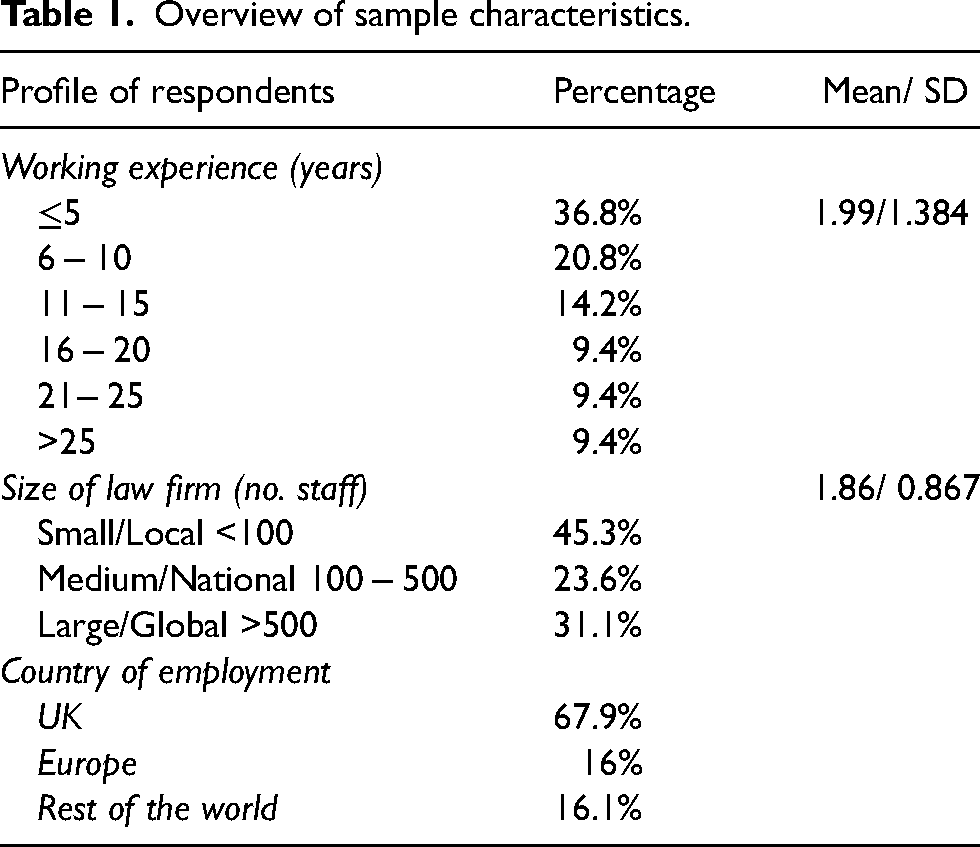
Summarising the key characteristics of the respondents (Table 1) is essential as the working experience, firm size and country of the legal professionals may define how they view innovation. The Solicitors Regulations Authority (SRA) (2021) estimated a total number of 207,926 registered European and foreign lawyers in the UK legal market per March 2021. The UK has the largest legal market in Europe accounting for around 7% of the global market for legal services and many of these firms are global, justifying the higher participation of UK-based respondents in this study.
Overview of sample characteristics.
Descriptive statistics
Dependent variable: Lack of innovation
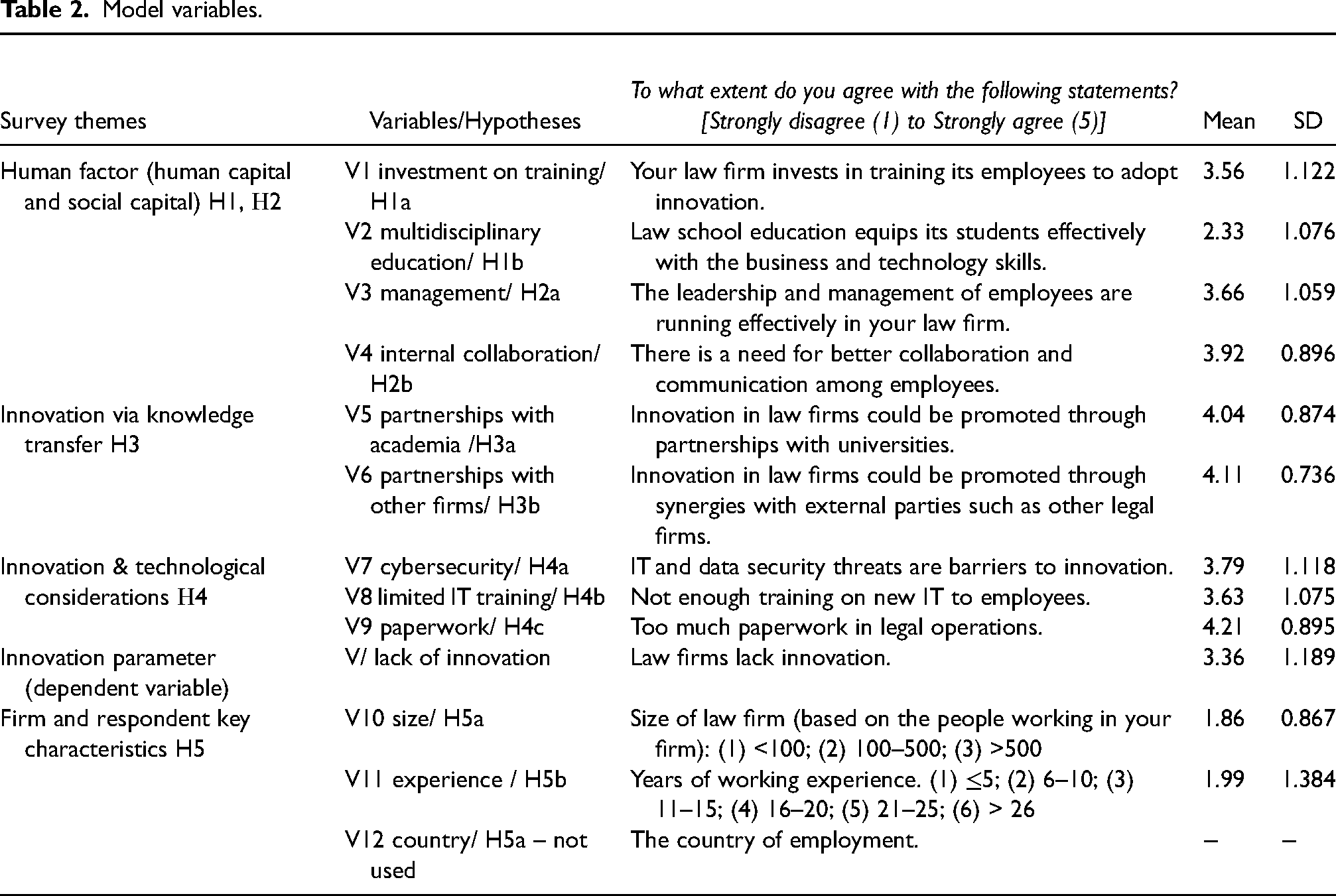
As developing an understanding of the legal PSFs’ ability to innovate is the most critical determinant in fulfilling the research objectives of this work, the dependent variable is the one assessing the participants’ views on whether ‘their law firms lack innovation’. The participants’ responses are marginally positive with a mean of 3.36 indicating that many legal firms despite their knowledge-intensive capital may still lack innovation. However, there is a moderate variation in the responses (SD = 1.189). Specifically, 51.9% of the legal experts agreed or strongly agreed with the statement, while 30.2% of them disagreed or strongly disagreed and 17.9% were neutral.
Independent variables: The survey items
Table 2 presents the mean acceptance of the participants’ responses per survey item. Note that each independent variable is linked directly with research hypotheses.
Model variables.
Key crosstabulations
To initially test our hypotheses in a linear way, the dependent variable V (lack of innovation) was crosstabulated with the independent variables that are most relevant to our hypotheses (Table 3) and are later used in our probit regression model. Their values are portrayed as disagree = 0 and agree = 1. In this binary approach the ‘disagree’ scale encompasses the initial points ‘strongly disagree’, ‘disagree’ and ‘neutral’, while the ‘accept’ scale includes the ‘agree’ and ‘strongly agree’ responses. Most participants’ responses ranged between the ‘agree’ and the ‘neutral’ point. As the ‘disagree’ group tends to be significantly lower in numbers than the ‘agree’ group, the authors added the ‘neutral’ option in the former set to form two groups for the crosstabulations and the regression model in line with previous published regression modelling studies (Nikitas, 2018). This is consistent with best statistical practice (Murad et al., 2003) suggesting that collapsing categories in small sample groups with sparse cell counts can improve asymptotic approximations used for testing hypotheses.
Key crosstabulations.

Regression analysis
Binary response regression models are usually estimated by the ordered probit or ordered logit models. While the former uses the normal distribution to compute the parameters of the model, logit models use the logistic distribution. Probit models employ the cumulative Gaussian normal distribution for calculating the probability of being in one category or not (Greene, 2000). In order to establish a link between our dependent and independent variables, we ran both a logit and a probit model. As would be expected the coefficient estimates of the probit and logit models were algebraically different. However, the predicted probabilities from both models and the marginal effects generated by these models were quite similar. Only the results from the probit model are reported - the estimates from logit are available on request The probit regression model is employed to estimate the probabilities that the law firms lack innovation based on several factors (independent variables). The parameters of the probit model are estimated by the method of likelihood. Maximum likelihood estimates are robust in the presence of heteroscedasticity and autocorrelation (Adrangi and Macri, 2019). The decomposition of the model estimates is not sensitive to the choice of the innovation-based variables, the combination of the Likert scale variables and to whether probit or logit is used.
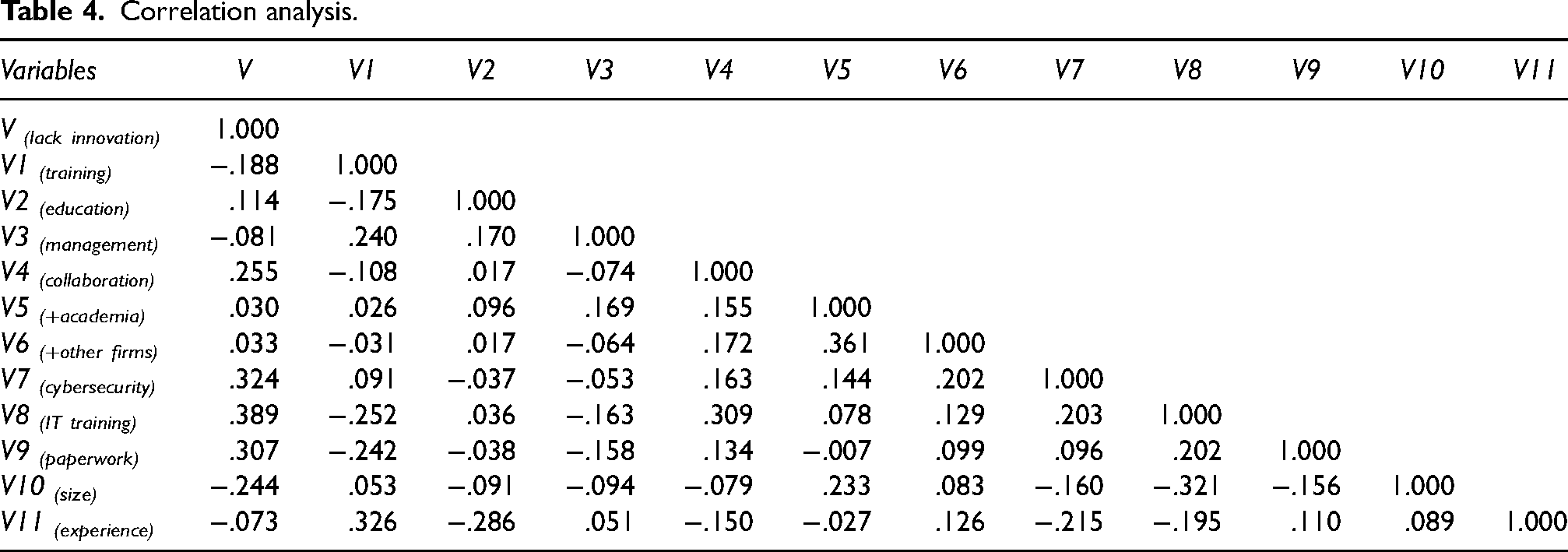
Correlation analysis
The Pearson correlations analysis (Table 4) quantifies our variables relations. The correlation matrix indicates that the dependent and 11 independent variables have, in most cases, a significant relationship. All independent variables have low correlation (below the r < 0.7 threshold); thus there is little threat of multicollinearity.
Correlation analysis.
Probit regression model
Table 5 presents the estimates from the probit model with the dependent variable being ‘law firms lack innovation adoption’. The country of employment was not included in the final regression model since there was no statistically significant relationship with the dependent variable in any of the exploratory regression models we tried.
Probit model.
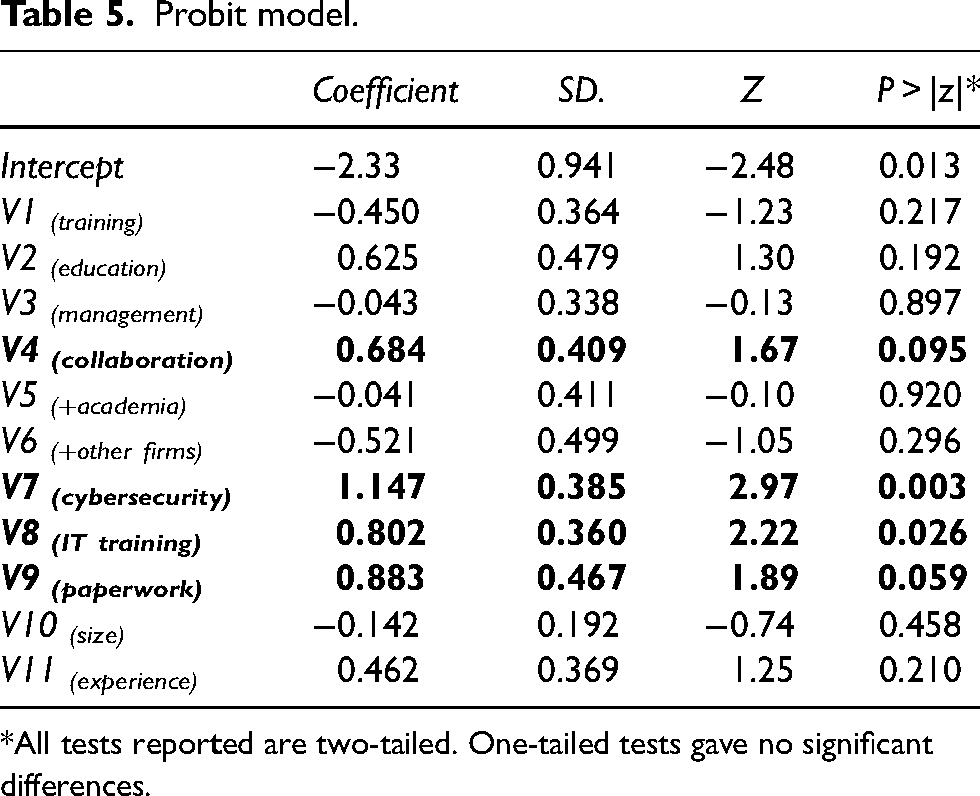
*All tests repor
The results show a positive relationship between the independent variables V2, V4, V7, V8, V9 and V11 and the dependent variable V. The other independent variables (V1, V3, V5, V6 and V10) are negatively correlated with V. A positive coefficient indicates that higher scores on the predicted variable are associated with higher likelihood of lack of innovation. Apart from V2 all the relationships have the expected sign matching the hypothesis direction we suggested in our hypothesis development section. However only four factors yielded statistically significant results and are decisive in determining the probability of innovation in a legal firm.
Cybersecurity (V7) and lack of IT training (V8) are positive and statistically significant (at the 1% and 5% level respectively) predictors of lack of innovation. Lack of internal collaboration (V4) and excessive paperwork (V9) are positive and statistically significant (at the 10% level) predictors of lack of innovation. For a one unit change in V4, the probability for a firm to lack innovation increases by 0.684. On the other hand, a one unit increase in V7, V8 and V9 would cause the probability for a firm to lack innovation to increase by 1.147, 0.802 and 0.883, respectively.
Thus, achieving a good level of cyber security, providing more and enhanced IT training initiatives, improving teamwork, collaboration and communication among staff and switching paperwork with digitised, online and automated operations could facilitate improved innovation adoption. Investments on training (V1) and education (V2), leadership and management (V3), partnerships with academia (V5) and other firms (V6) for knowledge transfer, firm size (V10) and employee experience (V11) are not significant predictors in the model.
The log likelihood value of the probit analysis is −47.545 for 95 observations. The Wald Chi-Square statistic is 36.60 and it is statistically significant (p < 0.05) suggesting that the model fits the data well. The pseudo R2 is 0.277. We also evaluated the robustness of the model by means of post estimation using the Pearson R Hosmer Lima goodness-of-fit test The result of the test shows that prob>χ2 is greater than 0.05, which is an indication that our model fits the data well.
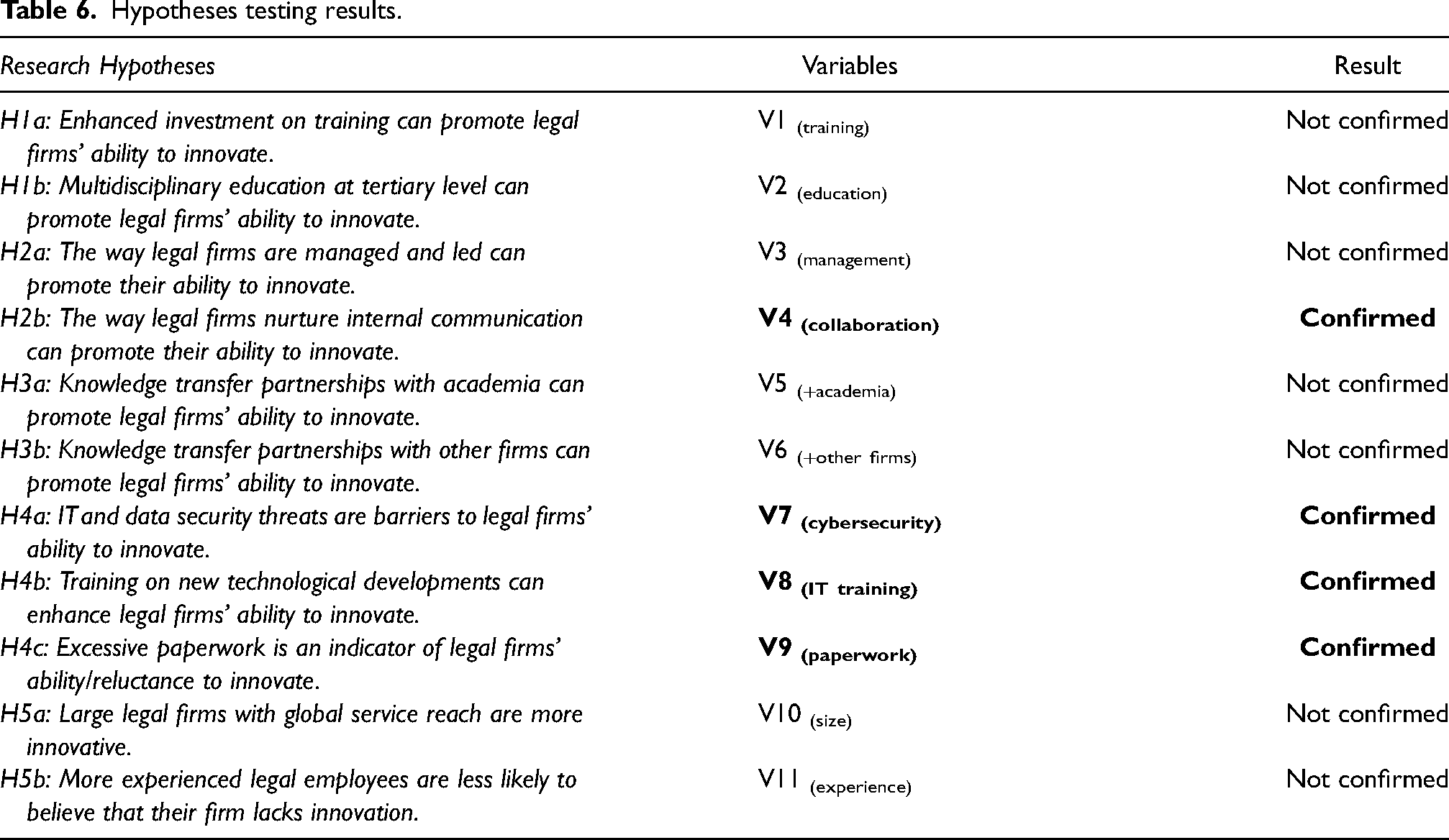
Hypotheses testing results
Table 6 below maps the key modelling results against the hypotheses developed. Hypotheses H1a to H4c refer to objective (i) and H5a and H5b to objective (ii).
Hypotheses testing results.
Discussion
We contribute to the state of the art by addressing the knowledge gap that exists in understanding the underpinning mechanisms that foster or prevent innovation in the severely understudied legal service industry (Susskind, 2017). Service innovation, a collective process of idea generation and implementation that provides value to a firm resulting in competitive advantage, superior performance and entrepreneurship competency (Prajogo and Oke, 2016), in principle builds upon resources, skills, and personnel within firms. Here we tried to understand these key relationships.
The paper explores how innovation in legal PSFs is affected by elements underpinned by our blend of RBV and PBV theories referring to: human capital (i.e. training, education and employee experience); social capital (i.e. management and leadership, teamwork, collaboration and communication); technology transfer (i.e. cybersecurity, IT training and excessive paperwork); knowledge transfer (i.e. partnerships with academia or other firms); and also firm size (∼internationalisation). All these factors were used as independent variables in our analysis and are discussed here in detail making this a crucial step in addressing our research objectives.
The relationships that are identified to have the strongest impact on innovation and its uptake by law firms, which in all four cases is a negative impact, are those referring to lack of effective teamwork, communication and collaboration, cybersecurity problems, scarcity of IT training and excessive amount of paperwork in day-to-day operations.
Legal employees who think that their law firms do not nurture effective teamwork, communication and collaboration are more likely to recommend that their law firms lack innovation. Thus, improving the ethos and practices of staff engagement within a legal firm would advance its ability to innovate. Research in a different service sector (tourism) supports this evidence-based recommendation suggesting that interorganisational communication and leadership support on collaboration for innovation is a key source of advantage for value creation (Zach, 2016). Although the relationship of leadership and management with innovation generation is not statistically significant, findings from other service sectors imply that strong transformational leadership positively affects service innovation (Gomes et al., 2021). Social capital as a whole, has been found to cultivate the power of innovation (Tang et al., 2015).
None of the two human capital hypotheses tested are confirmed. However, the survey provides some tentative evidence that legal professionals working in law firms that invest in staff training are more likely to think that their firm does not lack innovation. We can assume therefore that additional investment on training initiatives promotes a legal firm's ability to innovate. This is in line with the wider business literature (Sung and Choi, 2014) suggesting that training and development investments of an organisation and promoting internal learning practices, positively affect its innovative performance.
Surprisingly many legal professionals who believe that law schools equip their students with IT and business management skills to a level that could help them succeed in the legal profession generally think that their law firms lack innovation. This implies perhaps that multidisciplinary law school education alone cannot promote innovation uptake for law service providers or that legal professionals think that their firms lack professionals with this type of diverse educational background. Multidisciplinary legal education however has a role to play in the era of globalisation for firms and professionals since it helps to address the blurring of boundaries between the law and other disciplines that defines business competition today (Daly, 2002). Human capital is found to be positively related to the creation of innovation advantage in service operations (Prajogo and Oke, 2016) since, as Chen and Huang (2009) indicate, strategic human resource practices improve innovation performance.
Technology transfer is the area most conducive to innovation according to our study since all three technology related hypotheses are statistically confirmed. This is in line with the widely embraced assumption that the application of AI and emerging technologies are poised to transform the way value is created and captured in legal services (Armour and Sako, 2020). On the one hand technology innovation will empower lawyers to work more efficiently, deepen and broaden their areas of expertise, and provide better services to clients (Alarie et al., 2018) but on the other it will disrupt traditional models of law service operations changing the markets and promoting a new globalised context (Ryan and McFall, 2020).
According to our results, legal professionals who think that cybersecurity is a serious barrier to innovation are more likely to think that their firms lack innovation. Thus, cyberthreat phobia or concern is a critical barrier to innovation. Achieving a good level of cybersecurity in the firm level and training employees to detect, avoid or handle cyberthreats and IT problems referring to hacking and data exploitation could be seen as a facilitator for embracing digitisation, automation and other high-tech trends nurturing techno-innovation. This is in line with the wider service operations literature (e.g. Tweneboah-Koduah et al., 2017) stating that the rise of cyberattacks coupled with the system inherent vulnerabilities is a key challenge for business vendors and customers and the only way to reap the potentials of transformative technology and drive innovation is to ensure user confidence by enhancing their abilities as users and making the infrastructure systems more resilient.
Training for enhancing IT skills needs to become an organic procedure for legal PSFs going forward because scarcity of such training initiatives came up as a barrier to innovation per se. Tailored training, including alternative didactic approaches and methods (Higgins and Refai, 2017), provides better chances of successful innovation adoption that fits the needs of employees and according to del Valle et al. (2009) technology-empowering initiatives positively influence company performance.
Legal employees who feel that there is excessive paperwork in their day-to-day operations are more likely to see their firms suffering from lack of innovation. This means that the potential transition to digitised and online documentation practices, and eventually to semi-automated, automated and AI-based operations (including text scanning and mining), could be a key for improved innovation. Gordon et al. (2012) makes the case that the rapidly evolving legal service marketplace shaped by new technologies and e-spaces must abandon outdated trends in service delivery like paperwork-based operations. The increasingly borderless and e-based legal services of today need to consider the digital transformation of actors, structures, practices, values, and beliefs that change, threaten, replace or complement existing rules of the game within organisations and fields (Hinings et al., 2018). This technology-centric change however, cannot succeed as a monoculture, because this industry is about people first and foremost
Tentative evidence is provided about the impact of knowledge transfer and the synergetic effects that can be achieved through partnerships with academia and practitioners. Legal professionals who think that external partnerships are an innovation-enhancing tool are more likely to feel that their firms innovate. Innovation that leads to sustainable growth, according to Paton and McLaughlin (2008), is based upon identifying, supporting, exploiting, and embodying value-adding knowledge transfer within and across industry. Also, Pérez-Luño et al. (2019), in their service operations work, found a curvilinear relationship between knowledge exchange and innovation, while Tajeddini et al. (2020) suggested that creating a culture enabling knowledge exchange is innovation-friendly. Collaboration with universities in particular has been found to helping firms to innovate and improve their operations (Zhang et al., 2019).
Although the relationship between innovation and firm size is not statistically significant, we found that our participants working for larger firms with international operations are less likely to experience lack of innovation in their work. This could mean that companies with large scale operations have an improved capacity to innovate due to the richness of their human resources, better funding avenues and greater access to technologies; SMEs, in many cases, have less opportunities for collaborations and knowledge exchange, scarcer resources and limited funding for R&D (Badillo et al., 2017). The literature suggests that larger firms with international network membership may invest more in building role relationships that nurture innovation (Fu, 2015) meaning that company size is a differentiating element in innovative behaviour favouring usually larger companies (Aguilar-Fernández and Otegi-Olaso, 2018). One notable exception may be that smaller firm managers have more flexibility to shape their firm course (Protogerou et al., 2017).
Our results suggest that legal staff with less exposure to the profession are more likely than those with substantial experience (i.e. 10 years or more) to believe that their companies lack innovation. This suggests that senior legal employees do not identify lack of innovation within their working environment perhaps because they feel at ease with their firms’ current innovation practices (Boggers et al., 2018) and are less likely to be familiar with high-tech approaches that could further innovation (Ershova et al., 2020). Non-legal research suggests however that senior, older and longer-tenured staff do not engage in less innovation-related behaviour than their younger early-career counterparts (Ng and Feldman, 2013).
Figure 2 shows the factors underpinning innovation through a solution-based lens and addresses our last research objective that was about identifying feasible answers to the innovation challenges identified. Figure 2 provides a solution matrix with innovation-enabling recommendations for legal PSF managers.
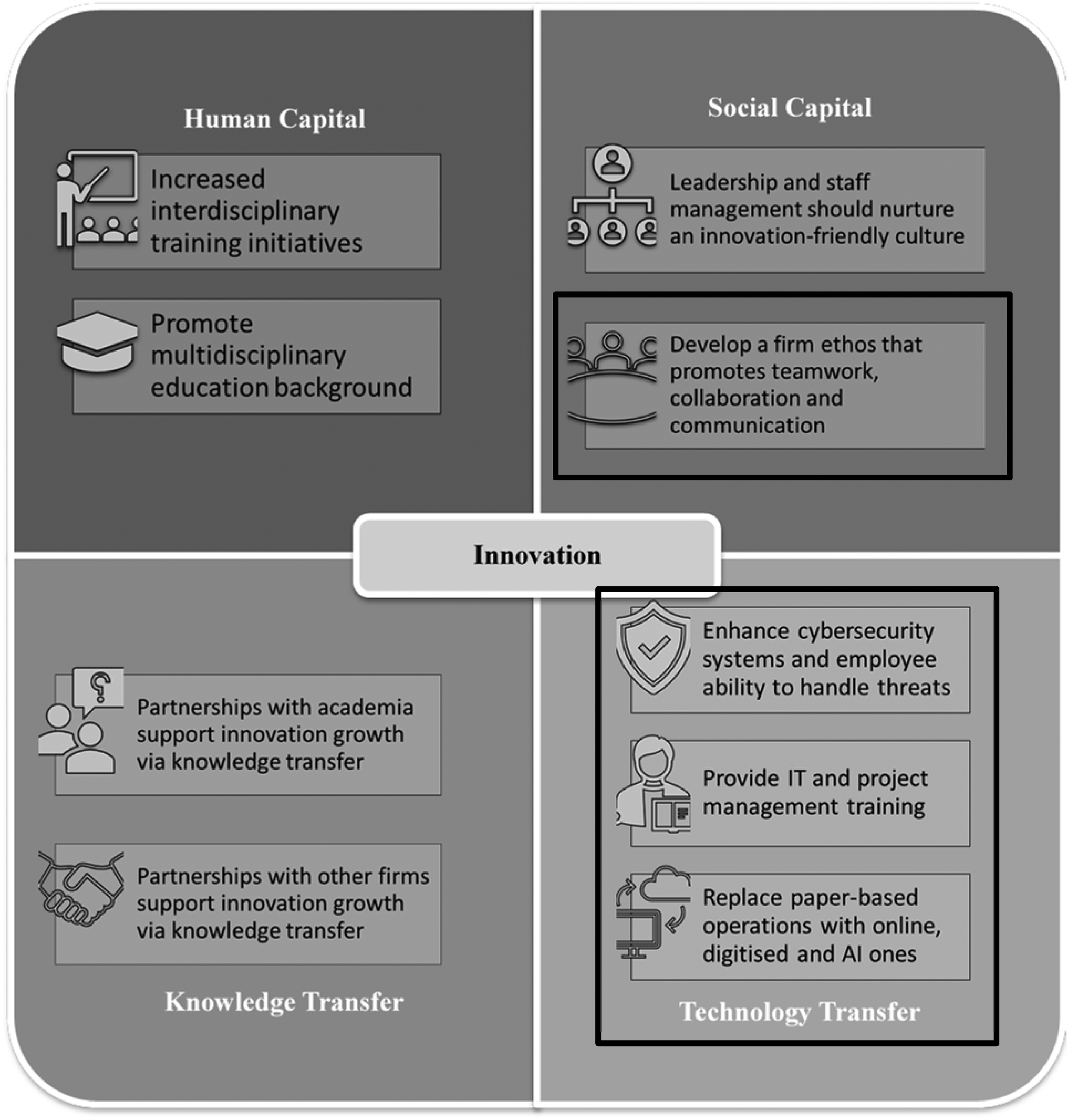
Legal service firms’ innovation adoption paradigm (key priorities highlighted, i.e. our statistically significant results).
Conclusions
We explored four themes referring to human capital, social capital, knowledge and technology transfer that were hypothesised to underpin innovation in legal PSFs. We used as our theoretical compass a hybrid framework that blends RBV and PBV, two well-established theories in operations management research. Firm size was also ‘measured’ as an innovation facilitator.
We find that the legal industry is still conservative. Legal PSFs remain, in many cases, inflexible and tradition-bound although innovation could be ultimately critical for their long-term resilience and growth. Our results suggest that cybersecurity concerns, inadequate and limited training on IT activities, excessive paperwork and inefficient collaboration patterns are currently the key barriers to innovation adoption. Also, less experienced legal staff working in SMEs are more likely to experience lack of innovation than more experienced legal professionals working in global firms. Legal enterprise managers, therefore, need to adopt innovation in their growth models by enabling better internal interaction, providing multidisciplinary training with an emphasis on IT learning, investing on hardware and people-centric cybersecurity solutions and nurturing an ethos that promotes technology as a helper and allows more digitised and automation-based operations to be the mainstream. These are our original contributions.
Our future research will examine the impact of the pandemic in legal service innovation with an emphasis on teleworking.
Footnotes
Declaration of conflicting interests
The author(s) declared no potential conflicts of interest with respect to the research, authorship, and/or publication of this article.
Funding
The author(s) received no financial support for the research, authorship, and/or publication of this article.

Appendix
| Country of employment | Frequency | Percent % |
|---|---|---|
| Australia | 4 | 3.8 |
| Austria | 2 | 1.9 |
| Belarus | 2 | 1.9 |
| Belgium | 2 | 1.9 |
| Channel Islands | 2 | 1.9 |
| France | 1 | 0.9 |
| Germany | 4 | 3.8 |
| Greece | 8 | 7.5 |
| India | 2 | 1.9 |
| Italy | 4 | 3.8 |
| Netherlands | 2 | 1.9 |
| New Zealand | 2 | 1.9 |
| Pakistan | 2 | 1.9 |
| Russia | 1 | 0.9 |
| Saudi Arabia | 2 | 1.9 |
| South Africa | 2 | 1.9 |
| Switzerland | 3 | 2.8 |
| UK | 55 | 51.9 |
| USA | 6 | 5.7 |
| Total | 106 | 100 |