




Abstract
Higher education institutions promote academic entrepreneurship through organizational arrangements such as innovation programs, incubators, and accelerators aimed at implementing the third mission of the university. While research has examined how these multi-professional arrangements support entrepreneurial efforts, less is known about their individual level implications which emerge as researchers are exposed to different professional values and practices. This article draws on a longitudinal qualitative study on an innovation program to investigate through what kinds of identity processes nascent academic entrepreneurs construct their professional identities and how as part of these processes they position themselves in relation to different professional domains. The analysis demonstrates three identity construction processes (hybridization, rejecting hybridization, and transitioning) and their associated identity work tactics (compartmentalizing, protecting, and reframing) at the boundaries of professional domains. Our contribution is in demonstrating how nascent academic entrepreneurs’ identity construction processes are influenced by internally and externally oriented identity work and their interactive dynamics. Moreover, the findings advance our understanding of how individuals can purposefully mould the fluidity of domain boundaries through identity work by making boundaries bridgeable, impermeable, or permeable. These findings have value for those developing organizational arrangements for the promotion of academic entrepreneurship and entrepreneurial identities.
Keywords
Introduction
The push for universities to become entrepreneurial is transforming higher education institutions (Etzkowitz, 2014; Kleinman and Osley-Thomas, 2014; Oliver and Sapir, 2017). Universities engage in entrepreneurial activities through technology transfer, science parks, incubators, and other programs and processes aimed at implementing the third mission of the university (Perkmann et al., 2019; Rothaermel et al., 2007; Shane, 2004; Siegel and Wright, 2015; Smith and Zhang, 2012; Wynn and Jones, 2019). The objective of these organizational arrangements is to facilitate knowledge exchange between academic researchers, business professionals, and investors. As a result, new hybrid regimes emerge where different normative systems coexist and where commercial norms blend with academic science (Lam, 2010; Lockett et al., 2002; Owen-Smith, 2003; Shibayama, 2012). Hybrid organizational arrangements, such as incubators, can be impactful as they create multi-sector and multi-professional social spaces where academic entrepreneurs receive support to develop their business ideas, entrepreneurial skills, and networks (Busch and Barkema, 2020; Kitagawa and Robertson, 2012; Stephens and Onofrei, 2012).
While research has examined how these organizational arrangements support academic entrepreneurship (Busch and Barkema, 2020; Mian et al., 2012; Kitagawa and Robertson, 2012; Stephens and Onofrei, 2012), less is known about their individual level implications. For example, as researchers are exposed to different professional values and practices, they may begin to modify their academic professional identities (Lam, 2010; Ylijoki and Ursin, 2013). In fact, cross-sector, multi-professional organizational arrangements can be conceptualized as hybrid spaces that intensify interactions and knowledge sharing across professional domains to the extent that the participants develop hybrid professional identities (Birds, 2015; Lam, 2011, 2018; O’Kane et al., 2020). Hybrid professionals are individuals who straddle the boundaries between domains and through hybrid identity work construct hybrid identities that draw on elements from distinct domains (Lam, 2020).
Although most prior studies on how academic entrepreneurs construct their identities ignore hybrid identity work in hybrid spaces, they do shed some light on the role of professional domains in identity construction processes (Jain et al., 2009; Karhunen et al., 2017; Miller et al., 2018). A study by Jain et al. (2009) shows how academic entrepreneurs, by separating work tasks in academic science and business, can develop a focal academic self and a secondary commercial persona. In a study on scientist-entrepreneurs in Finland and in Russia, Karhunen et al. (2017) find that Finnish scientists integrate the two professional roles by combining entrepreneurial and academic activities, whereas Russian scientists identify with their academic role and distance tasks in this domain from commercial involvement. In these studies, the impact of different professional domains on identity construction is discussed mainly from the perspective of differing levels of engagement in scientific and entrepreneurial activities. This, coupled with choosing research subjects from among established academic entrepreneurs, means that the studies struggle to fully capture the complex, dynamic, and evolving nature of professional identities (Ashforth, 2001; Lepisto et al., 2015). Relatedly, there have been calls to explore the deeper meanings of professional domains in identity construction by drawing attention to both internally and externally oriented identity work tactics and their interactive dynamics (Ashforth and Schinoff, 2016; Lam, 2020; Watson, 2008).
To advance research on identity construction among academic entrepreneurs, we take a longitudinal perspective to examine (1) through what kinds of identity processes nascent academic entrepreneurs construct their professional identities and (2) how they position themselves in relation to different professional domains using internally and externally oriented identity work. Nascent academic entrepreneurs—those academics who engage with entrepreneurship for the first time and are in the process of potentially becoming academic entrepreneurs—are more likely to reveal the complexities associated with professional identity construction than those who have relative security in given professional domains. We track the development of their identity construction processes in a multiyear innovation program that brings together experts from different professional domains—academia, medicine, business, and entrepreneurship—and promotes interactions and knowledge exchange between them.
Based on our analysis of three rounds of interviews with nascent academic entrepreneurs, we identify three identity processes—hybridization, rejecting hybridization, and transitioning—and their associated identity work tactics—compartmentalizing, protecting, and reframing—at the boundaries of professional domains. We aim to show how these identity construction processes are influenced by internally and externally oriented identity work and how individuals can purposefully mould the fluidity of domain boundaries through identity work. Our findings contribute to research on academic entrepreneurs and their professional identities as well as offer practical implications for the design of multi-professional programs that seek to promote academic entrepreneurship.
Conceptual framework
A person's identity consists of personal and social elements that form a complex and dynamic whole: personal identity is a person's understanding of the self, whereas social identity refers to a sense of belonging to a group (Stets and Burke, 2000). Professional identity is a sub-category of social identity in that it refers to the identification of a person with the work she does (Pratt et al., 2006; Reay et al., 2017). It also provides a self-in-a-role whose boundaries demarcate which elements and activities belong within them, thereby providing a sense of stability (Ashforth et al., 2000). Despite efforts to maintain this sense of stability, professional identities are constantly evolving as people experience expected or unexpected career changes (Ashforth, 2001; Lepisto et al., 2015). These change processes can be seen in academia where entrepreneurial values and practices are affecting how academics conduct their work and perceive their professional identities (Clegg, 2008; Ylijoki, 2013). Traditionally, however, academic identities are seen as enduring because they involve a long socialization process and are embedded in disciplinary cultures and academic institutions (Clegg, 2008; Henkel, 2005). The stability of academic identities is being questioned as the boundaries between academia and entrepreneurship become blurred, leading to diversified academic identities, work practices, and values (Lam, 2010; Ylijoki and Ursin, 2013).
The notion of identity work is seen as a useful analytical tool when making sense of how academic entrepreneurship pushes academics to modify their professional identities (Jain et al., 2009; Johnson, 2017; Karhunen et al., 2017; Meek and Wood, 2016). Identity work signifies the activities individuals engage in “to create, present, and sustain” their identities (Snow and Anderson, 1987: 1348). According to Sveningsson and Alvesson (2003: 1165), it is also about “forming, repairing, maintaining, strengthening, or revising” identities so that they are coherent. Empirical studies on academic entrepreneurs’ identity construction through identity work tend to show how academic entrepreneurs balance elements from science and entrepreneurship by, for example, delegating, buffering, combining, and distancing work tasks in the two domains (Jain et al., 2009; Karhunen et al., 2017).
Such findings suggest that professional domains and their boundaries are important resources for identity work in professional identity construction processes. Professions, such as academics, endorse strong domain boundaries as they require a long socialization process that includes profession-specific elements, knowledge, and expertize (Abbott, 1988; Clegg, 2008; Gieryn, 1983; Henkel, 2005; McGivern et al., 2015). Medical professionals similarly use their expertize, skills, socialization processes, and ethical norms to maintain clear domain boundaries (Pratt et al., 2006). Among powerful professions the crossing and balancing of professional domains is difficult because they evoke values, goals, and interaction styles that are associated with a particular professional role (Ashforth, 2001; Caza et al., 2018; Kulkarni, 2020; Pratt et al., 2006). This suggests that individuals differ in the degree to which they are able to draw on elements across different professional domains and integrate them in a single role (Ashforth, 2001; Johnson, 2018). Moreover, it implies that some boundaries allow individuals to move between professional domains whereas others pose an impermeable physical, cognitive, or emotional barrier (Ashforth et al., 2000; Johnson, 2018; Kreiner et al., 2006).
Such notions suggest that identity construction processes are profoundly concerned with both outward and inward directed reflection (Watson, 2009). According to Brown (2017), there is a dialectic relationship between an internal sense of identity and an external development of socially motivated identities. As such, there are calls to recognize the ongoing interactive dynamics between internally and externally oriented identity work (Ashforth and Schinoff, 2016; Watson, 2008). In a recent study on artist-academics, Lam (2020) develops these ideas and uses the term hybrid identity work, which refers to identity work that involves the mixing of two different professional identities and their elements to form a single hybrid identity. This research provides further nuance to the concept of identity work by showing how artist-academics engage in both internal identity work, which is concerned with the self, and external boundary work, which is concerned with different professional and knowledge domains (Lam, 2020).
Following in the footsteps of these scholars, we study how nascent academic entrepreneurs construct their professional identities and position themselves in relation to academia, medicine, and entrepreneurship using internally and externally oriented identity work. Next, we explain the research setting and methodology, which allow us to address our research questions.
Methodology
Research setting and data collection
This article is based on a two-year qualitative study to track the professional identity development of scientists and medical professionals who participated in an innovation program. The program was developed at an American research university, but it has since been implemented in universities across the globe. It was launched in Finland with the goal of promoting the commercialization of discoveries in the fields of science, technology, and medicine and the program offered its participants educational webinars, online courses, and mentoring from business professionals and investors. Those who were selected into the program were screened for the quality and potential of their discovery and their willingness to learn entrepreneurial skills.
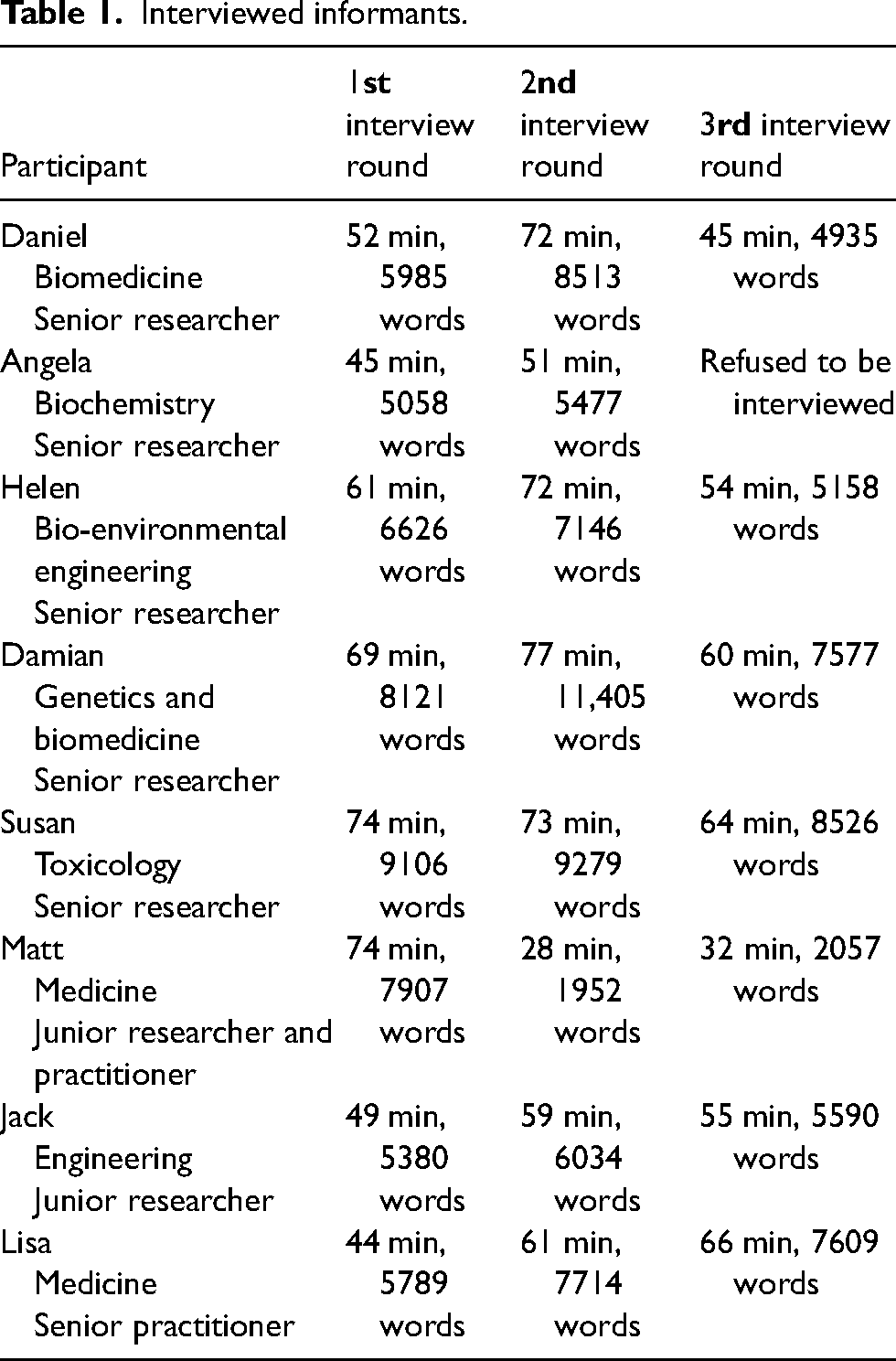
The primary data consists of three rounds of interviews with the same informants (see Table 1). When the program was implemented in Finland, we contacted a key member from each of the 12 projects selected for admission in its first year; eight of these agreed to take part in our study. The first interviews were conducted in 2018, when the informants had participated in the innovation program for about six months. As the objective was to understand identity construction processes, we employed a biographical interview method in the first round of interviews (Atkinson, 1998; Merrill and West, 2009). Although biographical and narrative approaches are popular in the social sciences and especially among those studying identity construction processes (Chamberlayne et al., 2000), there are surprisingly few studies on identity construction among academic entrepreneurs that utilize these methods (see Karhunen et al., 2017). Compared to thematic interviews, the benefit of the biographical approach is that it embeds the identity construction processes as part of the informants’ life histories and social contexts (Yitshaki and Kropp, 2016). This feature of the method supports our interest in internally and externally directed identity work.
Interviewed informants.
In the first round of interviews using the biographical approach, we captured the informants’ work-life course from their educational background to when and how they had made the discovery they were commercializing, as well as their growth as professionals during the development of the discovery (Atkinson, 1998; Chase, 2005). In practice, the course of the interview was selected by the interviewee and our role as the interviewers was to direct the interview so that key themes relevant to the research problem were covered (Cope, 2005). The informants discussed their professional identities and how they were evolving in relation to the past (who they had been), the present (who they were now), and the future (who they were becoming) (Hytti, 2005).
The second and third round of interviews were more semi-structured in form as, after capturing the informants’ biographical information, we sought to explore specific themes prompted by our preliminary findings from the first round of interviews (Gudkova, 2018). The interview protocols included questions on how the informants’ professional identities were shaped by their efforts to commercialize their discoveries, but also more general questions on changes in work practices, collaborative networks, motivation to engage in commercialization activities, and perceptions of the next steps in the project.
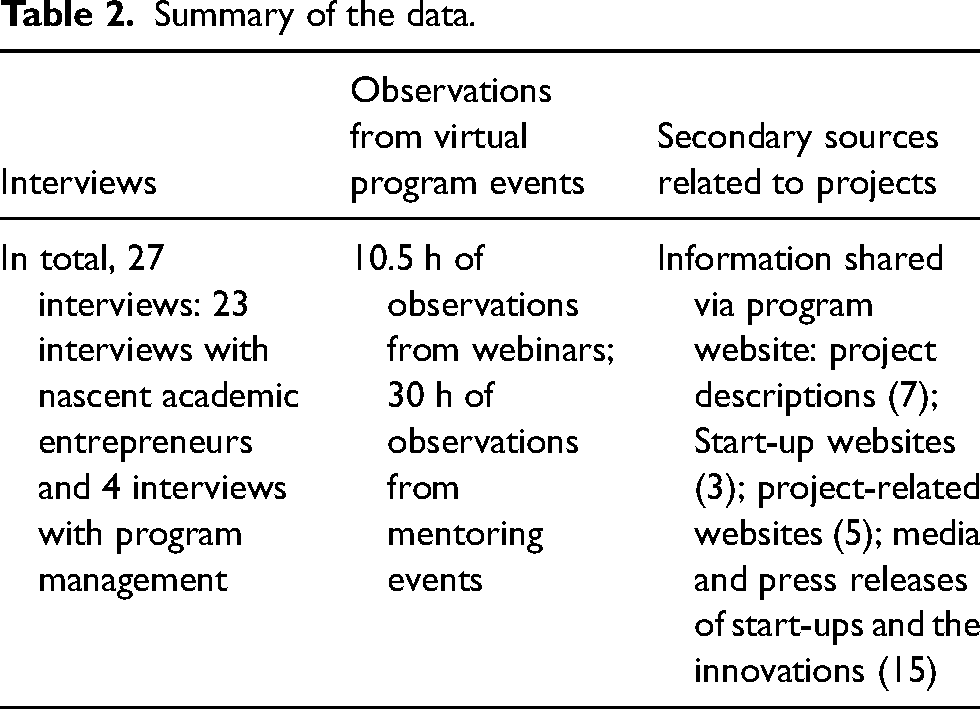
To ground our findings from these interviews, we gathered material from the webpages of the projects and later the spin-off companies as well as media and press releases. We interviewed program managers to gain an understanding of the research context and the goals and activities of the program. In the fall of 2020, we were invited to observe the program's virtually organized webinars and mentoring events, which helped us understand the program's vision. All these data are used to contextualize and deepen our primary analysis of the interview data. Table 2 provides a summary of all the data gathered for the present study.
Summary of the data.
Data analysis
The analysis followed an abductive approach where we shifted between the data and literature in three stages (Shepherd and Sutcliffe, 2011). In the first stage, we studied all the interview transcripts to identify general patterns and themes. This stage was quite inductive as it required several iterations, discussions as a team, and going back and forth between data, emerging themes, and literature (Glaser and Strauss, 1967; Strauss and Corbin, 1998). We noticed early on patterns in how the informants talked about their professional identities in relation to professional domains, which seemed to affect their perceptions of who they were becoming as professionals.
In the second analytical stage, we focused our attention to concepts from the literature and used them to advance our understanding of the emerging themes (Shepherd and Sutcliffe, 2011). Prior research suggests that identity work is likely to reveal internal and cognitive as well as external, domain-related dimensions (Ashforth and Schinoff, 2016; Lam, 2020; Watson, 2008). Building on this and our analysis of the interviews, we started by identifying “domain talk” and “boundary talk” (for example, “I still have one foot in each camp, the university and the company”). In line with prior research, we soon observed that identity work at professional boundaries was also related to internal identity processes. This observation further guided our analysis, and we began to identify instances of both internally and externally oriented identity work and explore the connections between them.
At the third analytical stage, we interrogated the data for identity construction processes across all the interviews by utilizing the constant comparison approach (Bryant and Charmaz, 2007; Shepherd and Sutcliffe, 2011). Through these comparisons, the aim was to see how the different identity work tactics could be abstracted to composite identity processes (Willis, 2019). After going back and forth across the interviews and the informants’ use of identity work, we arrived at three composite identity processes. Each of them is developed based on 2–3 informants’ interviews, which we selected because of the similarities in how they utilized identity work and made sense of who they were. Instead of obscuring the informants in the identity processes, we include interview excerpts from all the selected informants in each identity process and are open about both the similarities and differences in the individual stories and how they connect to the composite identity processes.
Nascent entrepreneurs’ identity construction processes at professional domain boundaries
To address our research questions directed at understanding nascent academic entrepreneurs’ identity construction processes, we present three composite identity construction processes that demonstrate the evolving nature of identities through longitudinal data (Ashforth, 2001; Lepisto et al., 2015) and the ways in which individuals navigate the boundaries between professional domains through internally and externally oriented identity work (Ashforth and Schinoff, 2016; Lam, 2020; Watson, 2008).
Hybridization
We first describe an identity process where informants engaged in identity work at the boundary of academia and entrepreneurship to become hybrid professionals, in our case academic entrepreneurs. The informants relied on identity work tactics where they talked about compartmentalizing the different elements from academia and entrepreneurship both internally and externally. By using such identity work tactics, they were able to affect the fluidity of the boundary making it bridgeable.
For all the informants experiencing this identity process, the priority had been to do high quality research, which had unexpectedly led to findings that showed commercial potential. The hybridization process became activated when they joined the innovation program and began pursuing the commercialization of their discoveries. As they began to work at the boundary of academia and entrepreneurship, they realized that academia was not necessarily supportive of entrepreneurial efforts, which made them question its salience to their professional identities: This [academic] culture is a bit different, you have to apologize why you do this [commercialization], or I don't know, maybe I am over-analysing it, but I have felt that way […] It would be helpful if it [commercialization] weren't seen as a threat but as something that benefits all of us in some way, it requires a change in the culture.
(Helen, bioenvironmental engineering)
Using a critical tone, the informants described how their academic background had prepared them poorly for entrepreneurship. As one said, “If I think about my own education, the university didn't in any way support innovative, product, or service-oriented thinking” (Daniel, biomedicine). Such externally oriented reflections allowed them to question the salience of academia for their evolving identities and distance themselves from it.
As the commercialization process advanced, the competing demands from academia and entrepreneurship intensified: “There are a lot of deadlines and not enough time for everything. I need to do two jobs at the same time” (Daniel, biomedicine). This pressure resulted in identity work that was simultaneously directed toward external practices and internal processes at the boundary of the two domains. On the one hand, finding a balance required externally oriented identity work tactics like the reorganization of work tasks by taking a sabbatical from research or dividing time between academic and entrepreneurial work. One informant described how he advanced the commercialization of his discovery during the evenings and weekends and took personal time off to travel to meet potential investors (Daniel, biomedicine). On the other hand, the combination of academia and entrepreneurship required internally oriented identity work, which one informant described as a need to cognitively “compartmentalize these things in your head” (Helen, bioenvironmental engineering). The following excerpt demonstrates the identity work strategy of compartmentalizing elements from academia and entrepreneurship particularly well: I still have one foot in each camp, the university and the company. My day job is research. I have planned my research so that it moves in parallel [with the company] so that I do not have to disperse my thoughts too widely. Running a business is completely different from research. Now I take full days to work on the firm and do research so that I can actually focus on each. Although this is possible, I am still a full-blooded academic.
(Daniel, biomedicine)
Perceiving academia and entrepreneurship as separate but parallel allowed the informants to mould the boundary between the domains by making it bridgeable. They could move between the two domains and ultimately develop a hybrid professional identity.
When the informants felt comfortable in the hybrid role, they began to imagine a position in the future start-up. Yet it was important for them that these positions were scientific in nature leaving business focused responsibilities for other experts. They noted, “I can commercialize this discovery, but you need to have people involved from the business world, for example a CEO and a marketing team” (Angela, biochemistry) and “I see that my role will be in scientific leadership. As the plan is to go abroad, there are better business developers in this area than me” (Daniel, biomedicine). These reflections about their future professional selves revealed domain-oriented identity work but also some self-oriented understandings of who they were as professionals. Moreover, these scientifically oriented roles that they imagined allowed the informants to maintain a bridgeable boundary between academia and entrepreneurship further supporting the hybridization of their professional identity.
At the end of our study period, one nascent academic entrepreneur began to describe the commercialization process as a profound professional transformation noting that, “this [entrepreneurship] is my world” and “there is no going back” (Helen, bioenvironmental engineering). This suggests that she was moving from a hybrid professional identity toward a single domain identity in entrepreneurship. Due to external validation, she gladly took on the entrepreneurial identity: “People at the university have told me many times that I work like an entrepreneur. I have noticed this in myself too, so I thought, why not” (Helen, bioenvironmental engineering). This highlights the dynamic nature of professional identities, they are never stable but always evolving.
Rejecting hybridization
The second identity construction process we discovered was one where individuals rejected any hybridization in their professional identity. This process included identity work at professional boundaries in the form of protecting academia from entrepreneurial influences. The individuals’ identity work was directed at demonstrating how academia was incompatible with entrepreneurship both at the domain and at the personal level. Through this identity work the individuals were able to create an impermeable boundary between academia and entrepreneurship which ensured that their professional identities in academia remained intact.
Although the informants experiencing this identity process had voluntarily applied to the innovation program, they immediately began to see the boundary between academia and entrepreneurship as something that was to be maintained and protected. Specifying who they were and who they were not personally in relation to this boundary was a central identity work tactic. One noted, “I do not see myself as an academic entrepreneur. What does it even mean? For me, it doesn't mean anything positive. So definitely not” (Susan, toxicology). Reflecting on the commercialization of the discovery he had made, another informant contrasted academic and commercial interests and positioned himself specifically within academia: I couldn't care less if in two years I make money out of this product. That's not the interesting part for me. When that thing that we have developed, when it comes to the market, it will pass completely beyond my horizon. I’m not interested in that [side of things]. I’m a scientist and I’m not after the money.
(Damian, genetics and biomedicine)
Through these reflections, academia was described as an authentic and entrepreneurship as a false representation of who they were. Working in academia was important to them, as one noted, “What is most important is that I get to change the world for the better in this new area of biology” (Susan, toxicology). Academic science also gave them pleasure and resonated with who they were: “I do science for a very hedonistic reason. I enjoy it and I resolved quite early in my life that there is only one reason for living: being curious. Nothing else” (Damian, genetics and biomedicine). This dynamic between externally and internally oriented identity work stressed the impermeable quality of the boundary between academia and entrepreneurship protecting them from hybridization.
Later in the commercialization process, the informants began to contemplate the conditions in which they would be willing to explore their professional careers beyond academia. When the commercialization of their scientific discoveries began to show signs of success, the informants reflected on the question of what was going to be their role in the future company. One of them noted, “So, the idea is that if we will get to a point of establishing a company and if it will be successful, I will put myself into the shoes of the Chief Scientific Officer” (Damian, genetics and biomedicine). At the same time, he continued to explain why he would never leave academia: I am realizing that these kinds of ventures succeed if you are personally highly motivated to jump into that world, which is not the case for me. It is obvious to me that this is an enjoyable incident, but I will never jump into that world and become a company person. My role in this process is to quit the moment I establish the spin-off. I will be happy to establish the spin-off but then I will retreat. It is not my job.
(Damian, genetics and biomedicine)
In a similar manner, another informant specified, “Strictly speaking I am not interested in establishing a company” (Susan, toxicology). They both perceived their participation in the innovation program and the commercialization of the discovery as a temporary interesting experience, “an enjoyable incident” as Damian described, but it was only one episode in their careers. It had a clear ending meaning they could retreat from the entrepreneurial process and keep their academic identities intact.
Transitioning to entrepreneurship
Finally, we discovered a third identity process where the informants sought to fully transition from their existing professional domain, academia or medicine, to entrepreneurship. To make the transition, they relied on internally and externally oriented identity work to reframe the boundary as less contentious and more permeable. Ultimately, they were able to move toward an entrepreneurial professional identity, but the transitions were not without tensions.
To reframe the boundary between their existing domain and entrepreneurship as permeable, the informants positioned themselves in relation to the domains in ways that allowed them to build distance to academia and medicine and suggest that the relationship between these domains and entrepreneurship was not so contentious as was generally thought. One informant who had completed a degree in medicine and several years of doctoral studies identified himself as “a medical school dropout” and said, “I was a CEO even before becoming the official CEO” (Matt, medicine). He suggested that academic medicine was never the field he identified with and that entrepreneurship was his calling already when he was only developing the innovation in medical school. Similarly framing the boundary between academia and entrepreneurship as permeable, another informant said there were close connections between the domains as academia was a stepping-stone in the process of becoming a successful entrepreneur: At least in a medical company, the knowledge must be published to be credible; it has to be peer-reviewed. Getting the articles published is more like a marketing strategy. The fact that the research will become a dissertation later is an additional bonus.
(Jack, engineering)
As the identity process of transitioning to entrepreneurship evolved, participation in the innovation program became another important externally oriented identity work tactic. The informants described the innovation program as being “a door opener” (Jack, engineering) and providing them with “a sense of community” (Matt, medicine). In many ways, the program was the context in which the identity transition happened, as one observed, “It has been great to see how our, the researchers’, confidence as businesspeople grow” (Matt, medicine).
Such accounts over the course of the identity process were accompanied with internally oriented identity work directed at their personal values and characteristics. As one said, “If you are transitioning from a researcher to an entrepreneur [you need to think] what you are and what you want to be, what motivates you and what you value, for me, these things are related to the company” (Matt, medicine). They also reflected on how they had been innovative throughout their lives, one saying, “When I was younger, I thought it would be great to invent something that could be patented” (Jack, engineering). Others said, “I have always been a developer type” (Lisa, medicine), and “I have a desire to create something new, something that I have developed, something that is valuable and useful” (Matt, medicine). Because of these characteristics, transitioning to entrepreneurship was described as aligning with their true selves (Ibarra and Barbulescu, 2010; Kulkarni, 2020).
While the other informants had experience in both academic research and medical practice, one informant's background was only in medical practice, which made it difficult for her to reframe the boundary between medicine and entrepreneurship as permeable. Without research experience, it was hard for her to distance from the existing professional domain and move closer to entrepreneurship. Describing her position between professional domains, she said: I am an expert in my own field, in patientcare, but in product development I am a lay person, and in research work too […] For me this experience has been like Alice in Wonderland. But this is a whole new world to me, and I could not have imagined what I can and need to do. I have been all thumbs and too shy to contact anyone for help.
(Lisa, medicine)
Differently from those who felt that the program supported their transition to entrepreneurship, Lisa described how she was the oddball in the program: “Everybody looks at me like I am a monkey in a cage.” Moulding the boundary between medicine and entrepreneurship to become more permeable required both externally and internally oriented identity work. Lisa made concrete changes such as cutting down her hours in patientcare, taking on more administrative duties, and expanding her professional network. This paid off as she was able to find an academically oriented collaborator, who had the skills and expertize to advance the development of the innovation. These new connections to the domain of entrepreneurship allowed her to engage also in internally oriented identity work: Little by little I am beginning to see myself as a business professional. My identity is starting to change, soon I will see myself as a business professional. I have perceived the business side as my weakness, I have thought about studying at a business school to make it in this business, but I am doing okay.
(Lisa, medicine)
Discussion
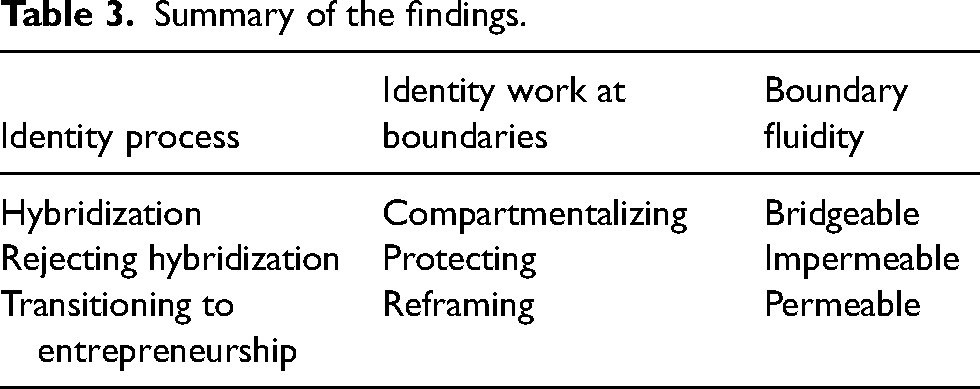
The objective of this study was to investigate the identity processes through which nascent academic entrepreneurs construct their professional identities and how, as part of these processes, they position themselves in relation to different professional domains through identity work. We identified three identity construction processes—hybridization, rejecting hybridization, and transitioning—each of which was associated with internally and externally oriented identity work that allowed the individuals to affect the fluidity of domain boundaries. In the identity process of hybridization, individuals engaged in compartmentalizing elements from academia and entrepreneurship both at the personal and professional level creating a bridgeable boundary between the domains. In the identity process of rejecting hybridization, individuals engaged in protecting their academic identities and the domain of academia from entrepreneurial influences so that the boundary between the two domains would remain impermeable. Finally, in the process of transitioning, individuals engaged in reframing the boundary between academic science or medicine and entrepreneurship as permeable by perceiving the two domains as compatible and their personal characteristics as increasingly entrepreneurial. Table 3 provides a summary of these findings before we move to reflecting on their broader implications.
Summary of the findings.
First, these findings depart from existing research on how academic entrepreneurs construct professional identities by suggesting that there are no universally understood professional identities in academia, even in specific national or institutional contexts (Henkel, 2005; Jain et al., 2009). Similarly to Karhunen et al. (2017), we argue that the discovered identity construction processes question prior notions that suggest there is an enduring traditional academic identity that is based on longstanding academic values and norms, which is now threatened by the promotion of academic entrepreneurship (Clegg, 2008; Henkel, 2005; Ylijoki, 2013; Ylijoki and Ursin, 2013). While such notions were not completely absent in the accounts we analysed—especially among those who rejected hybridization and hence academic entrepreneurship—there was evidence that academic and entrepreneurial roles can coexist in a balanced way and even lead to a harmonious role transition from academia toward entrepreneurship. Such findings depart from prior studies, which emphasize the difficulties associated with constructing entrepreneurially oriented identities in academia (Jain et al., 2009; Meek and Wood, 2016).
Second, our findings advance research on how academic entrepreneurs draw on externally and internally oriented identity work when constructing their professional identities (Jain et al., 2009; Karhunen et al., 2017). The hybrid space of the innovation program activated the processes through which the informants began to reflect on who they were as professionals. This aligns with prior research on how hybrid spaces can provide individuals with resources for engaging in identity work that can produce identity modifications (Birds, 2015; Whitchurch, 2009). In the regularly organized webinars and mentoring events, the participants were exposed to professional domains beyond academia or medicine and their efforts to advance the commercialization of their discoveries brought them into contact with experts beyond their own professional domain.
These encounters at professional boundaries activated not only externally oriented identity work but also internally oriented reflections about professional identities. Lam’s (2020) research on artist-academics similarly indicated that engaging with different knowledge domains through externally oriented identity work was likely to trigger internal identity work. In our study, those who appeared to be developing into hybrid professionals engaged in externally oriented identity work by focusing on the substantive elements of academia and entrepreneurship. While their identity processes revealed some internally oriented reflections on what it was like to be constantly, so to say, split into two, the emphasis was on compartmentalizing work tasks in a balanced way similarly to what has been found in prior studies (Jain et al., 2009; Karhunen et al., 2017). Interestingly, internally oriented identity work seemed to be most present among those who rejected hybridization or transitioned toward entrepreneurship. These two identity construction processes seemed to mirror each other as those who rejected entrepreneurship perceived academia as part of their authentic selves and those who transitioned toward entrepreneurship described academia as conflicting and entrepreneurship as aligning with their true selves. This finding may relate to how these informants constructed their professional identities by specifying who they were not as opposed to who they were (Karhunen et al., 2017; Watson, 2009). As such, our findings suggest that identity processes that are concerned with separating from and letting go of a professional domain may highlight internally oriented identity work.
Finally, our findings advance existing understandings of the dynamic relationship between identity work, domain boundaries, and hybridization (Birds, 2015; Lam, 2010, 2020; O’Kane et al., 2020) by demonstrating how individuals’ agentic efforts to use internally and externally oriented identity work at the boundaries of professional domains can shape boundary fluidity. As the fluidity of domain boundaries affects movement at and across professional boundaries, we suggest that it can be used to explain hybridization processes in identities. Lam’s (2020: 858) findings showed that individuals’ interpretive agency, which emerged through identity work, allowed them to “mobilize and reconstitute resources across contexts” thus enabling the construction of hybrid identities. The academic entrepreneurs in our study who were developing into hybrid professionals relied on similar identity work tactics and moved back and forth between academia and entrepreneurship. In contrast, our findings also demonstrate how identity work tactics and domain boundaries were used to reject hybridization as well as transition from one professional domain to another. Such findings highlight individual agency in boundary making and the explanatory power of boundary fluidity in identity construction processes.
Conclusion
As part of their efforts to promote academic entrepreneurship and the commercialization of science-based discoveries, universities establish hybrid organizational arrangements, such as innovation programs, incubators, accelerators, and knowledge transfer partnerships. While research sheds light on how they support academic entrepreneurship (Kitagawa and Robertson, 2012; Mian et al., 2012; Stephens and Onofrei, 2012), we know little about the identity construction processes they are able to activate. By investigating the identity processes through which nascent academic entrepreneurs constructed their professional identities in the context of an innovation program, this study contributes to research on academic entrepreneurship and academic entrepreneurs’ identity construction processes at the boundaries of professional domains. A better understanding of how different domains and their boundaries contribute to the professional identities of academic entrepreneurs will lead to a timelier understanding of academic entrepreneurship in contemporary universities.
These findings have practical implications for universities and their stakeholders developing and implementing innovation programs, incubators, accelerators, and knowledge transfer partnerships to advance academic entrepreneurship. Academic entrepreneurship requires significant modifications to existing professional identities and careers. As our findings showed, these are intense identity construction processes with varied identity outcomes, and they demand continuous identity work strategies to manage potential identity conflicts. Understanding these processes can form a better understanding of how an entrepreneurially oriented professional identity can work within the university context and enable the development of hybrid organizational arrangements that are able to support those researchers interested in exploring entrepreneurial opportunities.
As with all research, our study has limitations. We conducted the study over the course of two years with eight informants, but, despite the limited number of informants and time frame, could identify dynamic identity construction processes. We suspect that a larger number of informants and a longer time frame would capture even more changes in identity processes, provide more insights on the connections between identity work and professional domains, and increase the validity of the identity construction processes we identified. Yet this topic is an important area for future research on entrepreneurial identity formation as it is through domains and boundaries that individuals make sense of the elements affecting their professional identities and their own professional aspirations.
Footnotes
Acknowledgements
We are grateful for the organizers and the participants of EURAM 2020 session “Entrepreneurial Education, Academic Entrepreneurship and Entrepreneurial University” for their helpful feedback on this manuscript. We would also like to thank the Foundation for Economic Education for their support for “The Emergence of Health and Life Science Innovations” project.
Declaration of conflicting interests
The author(s) declared no potential conflicts of interest with respect to the research, authorship, and/or publication of this article.
Funding
The author(s) disclosed receipt of the following financial support for the research, authorship, and/or publication of this article: This work was supported by the Foundation for Economic Education.
