




Abstract
We study whether business incubator management collaboration with R&D milieus affects incubated entrepreneurs to also collaborate with R&D milieus in different regional contexts. Empirically, we analyse 281 Norwegian entrepreneurs in 32 different business incubators. Incubator collaboration with R&D milieus increases entrepreneur collaboration with R&D milieus in sparsely but not densely populated regions. Also, education level increases collaboration with R&D milieus (plus investor milieus and international customers). Entrepreneur collaboration with R&D milieus is positively associated with market orientation and perceptual performance but tends to delay enterprise development.
Introduction
In entrepreneurship research, there is a growing literature on business incubators, which have a mission to provide critical resources, including collaboration opportunities with R&D milieus, for entrepreneurs (Kitagawa and Robertson, 2012; Lee and Osteryoung, 2004; McAdam and McAdam, 2006; Nair and Blomquist, 2020; Pellinen, 2014). Other research examines entrepreneur collaboration with R&D milieus as a means to boost product and organisation development (van Stijn et al., 2018), innovation performance and firm growth (Baum et al., 2000). However, despite the importance R&D collaboration has for entrepreneurs, Pettersen et al. (2016) conclude that findings in an incubation context are mixed. Specifically, they report that incubator-provided network resources tailored at entrepreneurs, including access to information and knowledge from R&D institutions, are not critical for leveraging a new business. Hence, although entrepreneur collaboration with R&D milieus has proven crucial for success (Baum et al., 2000; van Stijn et al., 2018), incubators do not always act as a crucial catalyst to foster them adequately for entrepreneurs (Pettersen et al., 2016).
Responding to this mismatch between incubator-provided R&D networks and their utilisation by entrepreneurs, we speculate whether the regional context in which an incubator is located explains this. Our motive is grounded in research showing that entrepreneurs behave differently in different regional contexts (Aarstad and Jakobsen, 2019; Rypestøl and Aarstad, 2018), which may also affect how they respond to incubator engagement in R&D collaboration. Specifically, we study if incubator management collaboration with R&D milieus affects entrepreneurs to collaborate with R&D milieus and if the regional context of location moderates the association. Thus, the research question concerns whether incubator collaboration with R&D milieus has a strong effect on entrepreneurs to collaborate with R&D milieus in some regional contexts, while a weak or absent effect in others. Also, we assess if entrepreneur collaboration with R&D milieus reflects genuine resources regarding market orientation, perceptual performance and enterprise development. We define an entrepreneur as a person engaged in realising one or more business ideas or opportunities (Davidsson and Honig, 2003; Shane and Venkataraman, 2000), and an R&D milieu as a constellation or entity, affiliated or unaffiliated with an educational institution, involved in basic research, applied research or development.
Our research question is important because R&D collaboration can provide entrepreneurs with organisational resources (Baum et al., 2000; van Stijn et al., 2018), which we also test empirically. Moreover, the research question is important because the literature lacks a coherent explanation of why incubators do not always succeed in acting as a catalyst in providing entrepreneurs with relevant resources in general and resources related to R&D collaboration in particular. Finally, addressing this research question may provide stakeholders with crucial information about managing business incubators as catalysts of relevant entrepreneur resources for R&D collaboration. Hence, in some regional contexts, incubator collaboration with R&D milieus may play a pivotal role by stimulating entrepreneurs to collaborate with R&D milieus, while it may be less important in others.
We ground our study in the paradigm of regional innovation systems (RISs), which are a local constellation of private and public actors – persons, firms and institutions – that formally or informally interact in the pursuit of creating or improving products, services or processes to gain economic advantage at an individual and collective level (Benneworth et al., 2009; Cooke, 1998). The literature makes a distinction between the so-called ‘thick’ and ‘thin’ RISs. Thick RISs are urbanised spaces with a strong presence of industry clusters and R&D milieus (Isaksen and Trippl, 2016), while thin RISs are less urbanised spaces that host similar milieus to a lesser extent (Karlsen, 2013). By applying the contextual framework of thick versus thin RISs, we study whether it increases or decreases the effect incubator collaboration with R&D milieus has on entrepreneurs to collaborate with R&D milieus.
Empirically, we research population density of Norwegian labour market regions as a proxy for thick versus thin RISs, which is in accordance with other research (Aarstad and Jakobsen, 2019; Research Council of Norway, 2011; Strand et al., 2017). Labour market regions also represent a variety of geographical contexts (Aarstad and Jakobsen, 2019; Research Council of Norway, 2011; Strand et al., 2017). Additionally, we analyse survey data of 281 entrepreneurs hosted by 32 different business incubators in numerous labour market regions. Socioeconomically and culturally, Norway is a homogeneous research context. Simultaneously, the country is heterogeneous geographically speaking, representing urbanised densely populated regions and rural sparsely populated regions. As such, Norway is an ideal context to study our research question.
Theory
Business incubation and RISs
As noted, Pettersen et al. (2016) conclude that incubator-provided network resources tailored at entrepreneurs, including access to information and knowledge from R&D institutions, are not critical for leveraging a new business. One reason may be that ‘incubators often generalize their network support without considering that firms may develop different networks based on their needs’ (Soetanto and Jack, 2011: 127), which may limit their perceived value (Stephens and Onofrei, 2012).
However, Pettersen et al. (2016), and other studies to which they refer, are largely carried out in urbanised contexts. Consequently, we do not know if incubated entrepreneurs in rural regions share similar perceptions, concerning business incubator-provided network resources, as their colleagues in city regions. On the other hand, we know that the regional context matters for entrepreneurs concerning leveraging a new business. For example, Rypestøl and Aarstad (2018) find that entrepreneurs in urban regions emphasise developing novel and innovative products and services to a greater extent than entrepreneurs in rural regions. Furthermore, Aarstad and Jakobsen (2019) find that entrepreneurs in rural regions emphasise a causation logic by focusing on predefined goals, while entrepreneurs in urban regions emphasise an effectuation logic by focusing on the means at hand (for further readings on causation and effectuation, see Sarasvathy, 2001).
A common thread in the studies by Rypestøl, Aarstad and Jakobsen is that they anchor the discussion of entrepreneurs in the paradigm of RISs. Drawing upon this perspective, we argue in the following that location in thick versus thin RISs moderates the effect incubator collaboration with R&D milieus has on entrepreneur collaboration with R&D milieus. Specifically, we elaborate that the effect is weak in thick RISs but strong in thin RISs.
Analytical and synthetic knowledge bases in thick versus thin RISs
Thick RISs, with a strong presence of R&D milieus, predominately have an analytical knowledge dominated by scientific and codified skills (Asheim and Coenen, 2005; Jensen et al., 2007; Laestadius, 1998). Knowledge creation ‘is often based on cognitive and rational processes, or on formal models’ where ‘[b]oth basic and applied research, as well as systematic development of products and processes, are relevant activities’ (Asheim, 2007: 225). As such, an analytical knowledge emphasises ‘the application of known scientific principles and methods’ (Asheim, 2007: 225).
Thin RISs, on the other hand, hosting fewer R&D milieus, to a lesser degree have an analytical knowledge, and to a larger degree has a synthetic knowledge dominated by tacit and practical skills (Asheim and Coenen, 2005; Jensen et al., 2007; Laestadius, 1998). Knowledge creation in such a context often ‘occurs [through a novel combination of existing knowledge] in response to the need to solve specific problems that emerge in interaction with clients and suppliers’ (Asheim, 2007: 225).
In thin RISs, incubator management collaboration with R&D milieus may strongly act as a catalyst for entrepreneurs to collaborate with R&D milieus due to an otherwise limited analytical knowledge there. For instance, incubator collaboration with R&D milieus can act as a door-opener for entrepreneurs in need of an R&D-based competence. Even though actors with an R&D-based competence are not prevalent in thin RISs (Isaksen and Trippl, 2016; Karlsen, 2013), incubator collaboration with R&D milieus may accelerate entrepreneur collaboration with such milieus all the more. Hence, the incubator management may be a critical factor in a regional context, which otherwise has limited access to R&D resources and analytical knowledge. In other words, incubator collaboration with R&D milieus may substitute for a limited analytical knowledge in thin RISs. Thus, we conclude that incubator collaboration with R&D milieus in thin RISs positively affects entrepreneur collaboration with R&D milieus.
Conversely, in thick RISs, we may assume that incubator management collaboration with R&D milieus to a lesser degree acts as a catalyst for entrepreneurs to collaborate with R&D milieus, due to an otherwise abundant analytical knowledge there (Isaksen and Trippl, 2016; Karlsen, 2013). Analytical knowledge is often inherently idiosyncratic (Becker and Dietz, 2004), implying that expertise in one field is not necessarily transferable to another. Thus, incubator managers are merely able to collaborate with R&D milieus that are either generic or specific and not tailored to most entrepreneurs’ need for particular R&D competence. Accordingly, we assume that incubator management collaboration with R&D milieus is less relevant in thick RISs for entrepreneur collaboration with R&D milieus, as it may not optimally suit the idiosyncratic needs for R&D resources and analytical competence. Overall, we conclude that incubator management collaboration with R&D milieus in a thick RIS affects entrepreneur collaboration with R&D milieus to a low degree.
Regional population density as a proxy for RISs
Densely populated regions represent thick RISs with analytical knowledge and a strong presence of R&D milieus (e.g. Asheim and Gertler, 2005; Belderbos et al., 2014; Siedschlag et al., 2013; Smith et al., 2002; Yang and Hayakawa, 2015). Concerning this paper's national context, the Research Council of Norway (2011: 57) likewise asserts that ‘R&D activities in Norway are geographically concentrated in the university cities and surrounding areas … [The] counties with the largest cities [i.e., the most densely populated areas] and the biggest educational actors also have the highest proportion of employees with higher education’. Similarly, other research from Norway asserts that public and private R&D investments are concentrated in densely populated regions (Strand et al., 2017). Therefore, we argue that regional population density is a relevant indicator of thick RISs.
In contrast, sparsely populated regions represent thin RISs, as they have limited R&D-intensive and analytical knowledge (Research Council of Norway, 2011; Strand et al., 2017). Hence, we conclude that densely populated regions represent thick RISs, while sparsely populated regions represent thin RISs.
A conceptual model and research hypothesis
Drawing upon these arguments, we theorise that incubator management collaboration with R&D milieus in sparsely populated regions has a strong positive effect on entrepreneur collaboration with R&D milieus. The reason is that incubator management collaboration with R&D milieus strongly acts as a catalyst for entrepreneurs to collaborate with R&D milieus due to otherwise limited analytical knowledge in sparsely populated regions. Conversely, we theorise that incubator collaboration with R&D milieus in densely populated regions to a lesser degree affects entrepreneur collaboration with R&D milieus. The reason is that because of abundant analytical knowledge in densely populated regions, it is more appropriate for entrepreneurs to acquire R&D-based competence independent of the incubator management's collaboration with R&D milieus.
The above arguments imply that regional population density negatively moderates the association between incubator collaboration with R&D milieus and entrepreneur collaboration with R&D milieus (Figure 1). That is, as the regional population density decreases (increases), the effect of incubator collaboration with R&D milieus on entrepreneur collaboration with R&D milieus increases (decreases). Put simply, incubator collaboration with R&D milieus has a stronger (weaker) effect on entrepreneur collaboration with R&D milieus the more sparsely (densely) populated is the region. Concurrent with our theorising, we hypothesise as follows.
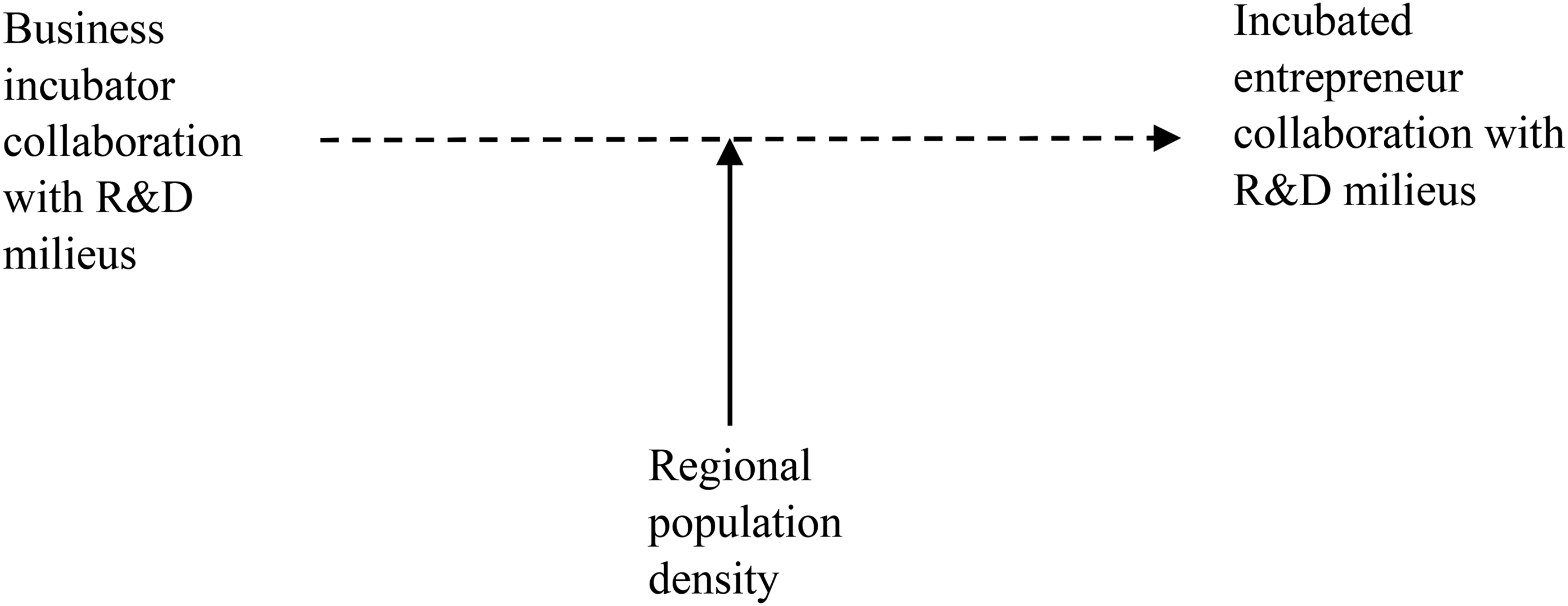
A conceptual model.
Potential direct effects and a two-by-two matrix
We do not deny that incubator collaboration with R&D milieus may have a direct positive effect on entrepreneur collaboration with R&D milieus, nor that regional population density may also have a direct positive effect. However, we argue that the concepts substitute for each other, as illustrated in Figure 2. Quadrant 1 shows that high incubator collaboration with R&D milieus substitutes for limited analytical knowledge in low population density regions. Conversely, quadrant 4 shows that abundant analytical knowledge in regions with high population density substitutes for low incubator collaboration with R&D milieus. Quadrant 2 shows that as population density substitutes for incubator collaboration with R&D milieus, and vice versa, there are no additive effects. Finally, quadrant 3 shows that entrepreneur collaboration with R&D milieus is low when both population density and incubator collaboration with R&D milieus are low.
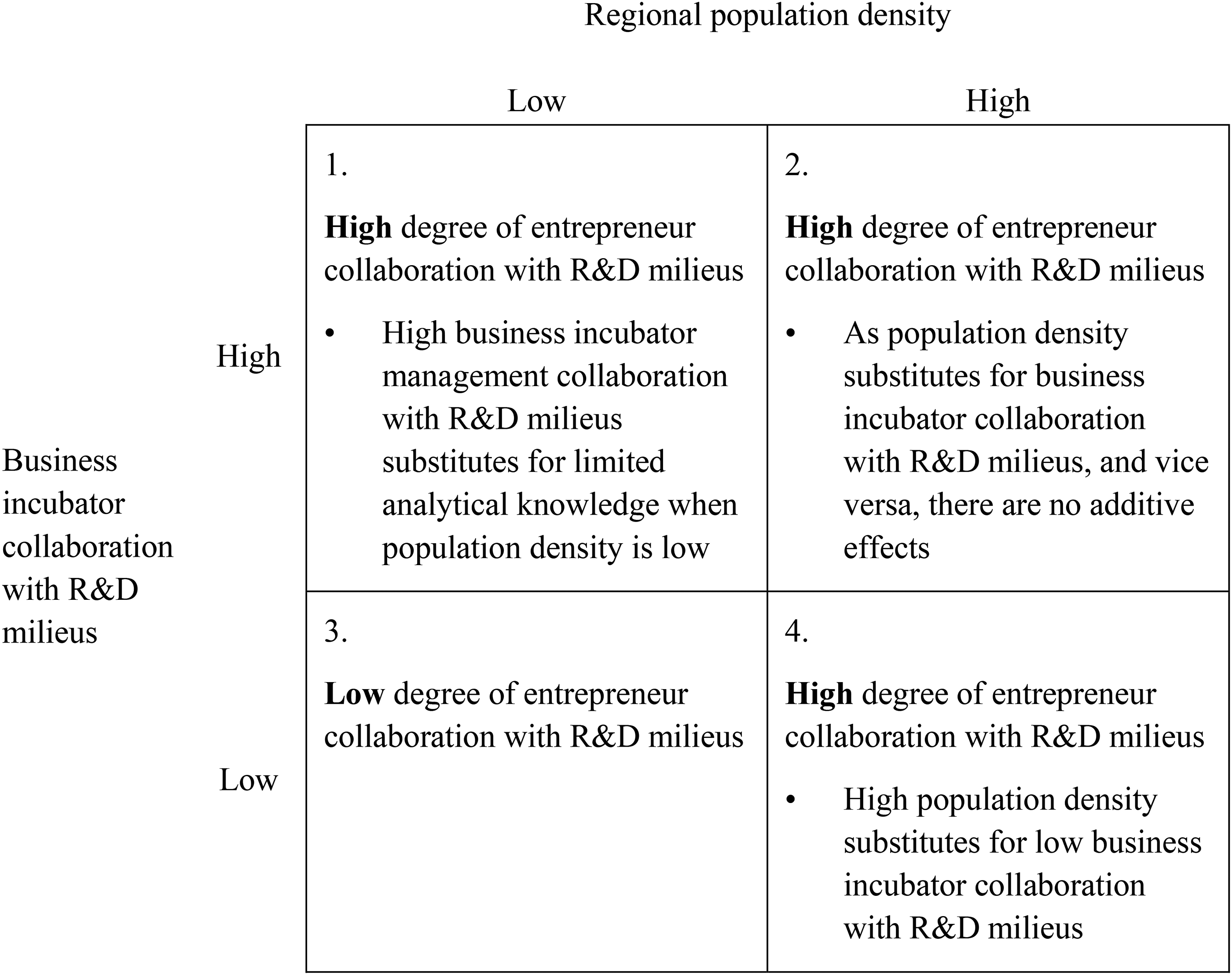
Two-by-two matrix.
Methods
Context, data and multilevel analyses
To test the hypothesis, we used data from a national evaluation of Siva's business incubator programme in Norway. 1 All entrepreneurs incubated in Siva incubators have developed a genuine business idea with growth potential. At the time of data gathering, Siva operated around 35 business incubators throughout Norway.
An electronic survey was used to gather data from incubator managers and entrepreneurs. We gained usable data from 32 incubator managers and 281 entrepreneurs. Each entrepreneur surveyed was the newly established firm's CEO; hence, only one entrepreneur per firm was exposed to the survey. Furthermore, each entrepreneur was uniquely incubated in one of the 32 incubators. The survey was performed in December 2016, with a 40% response rate among the entrepreneurs.
In addition to the survey data, Statistics Norway provided data on the population and geographical size of labour market regions to model regional population density. All analyses were conducted in Stata 15, and we carried out multilevel regression, which we explain below.
Dependent variable
In the survey of the entrepreneurs, the following text was presented: ‘Collaboration is a relationship with a certain duration and with a certain commitment between two or more firms, or between firms and other types of organisations/actors. The collaboration can be both formal and more informal concerning written contracts. With which actors has your [entrepreneur] firm been collaborating over the last three years?’ (all translations are ours). Among items listed were ‘R&D and educational actors in the region’, ‘R&D and educational actors nationally’ and ‘R&D and educational actors internationally’. For each, respondents could indicate ‘not at all’ (coded 1), ‘to a little extent’ (2), ‘to some extent’ (3), ‘to a large extent’ (4) and ‘to a very large extent’ (5).
The reason we included the phrase ‘collaboration can be both formal and more informal’ was to emphasise that we did not necessarily limit collaboration to written formal contracts. For example, when the CEO of the biotech firm Centocor was presented with a list of its formal agreements, the reaction was: ‘[This is just] the tip of the iceberg – it excludes dozens of handshake deals and informal collaborations, as well as probably hundreds of collaborations by our company's scientists with colleagues elsewhere’ (Powell et al., 1996: 120). Hence, below formal ties, there are many informal, and if we ignore these, valuable information can be lost.
Principal component analysis confirmed that the responses to the items concerning collaboration regionally, nationally and internationally loaded on a single factor (the eigenvalue was 2.06 for a one-factor solution and 0.615 for a two-factor solution). A Cronbach’s (1951) alpha value of 0.772 further showed that the responses were strongly correlated. Taken together, these analyses indicated that entrepreneur collaboration with R&D milieus was a one-dimensional construct. Accordingly, we used the items’ average score to measure entrepreneur collaboration with R&D milieus as a dependent variable. 2
Independent and control variables
The incubator managers’ responses were a higher-level variable. In other words, they were a constant for entrepreneurs incubated in a particular incubator, yet the responses naturally varied between the incubators. In the survey of the incubator managers, the following text was presented: ‘With which regional actors have you [as a business incubator] been working over the last three years?’. Among items listed was ‘R&D and educational milieus’, to which incubator managers could indicate ‘not at all’ (coded 1), ‘to a little extent’ (2), ‘to some extent’ (3), ‘to a large extent’ (4) and ‘to a very large extent’ (5). The responses were used to model each incubator's collaboration with R&D milieus as an independent variable.
Regional population density was another higher-level variable. It implies that regional population density was a constant for entrepreneurs located in a particular region, yet the concept naturally varied between them. To model regional population density, we divided each region's population size by its geographical size in square kilometres (cf. Aarstad et al., 2016). Because the variable was skewed, the natural logarithm was applied.
To test the hypothesis, we included a moderation term between the two independent variables (explained above). Following Cronbach’s (1987) recommendation, they were mean-centred.
We controlled for entrepreneur education level, the motive being that the higher, the more likely it was the firm was affiliated with an R&D milieu. For instance, an entrepreneur with a master's or PhD degree may have continued collaborating with the supervisor(s) at the academic institution from which (s)he graduated, while an entrepreneur with less formal education may have had a weaker affiliation. Similarly, an entrepreneur with higher-level education may have thought to leverage a new firm by working on R&D projects at the academic institution where s(he) studied, while an entrepreneur with less formal education may have come to this idea through industry experience. In the survey of the entrepreneurs, the following question was presented: ‘What is your highest level of completed education?’ Respondents could indicate ‘completed elementary school’ (coded 1), ‘high school’ (2), ‘some higher education’ (3), ‘3–4 years of higher education’ (4) and ‘master's degree or PhD’ (5). The responses were used to model the education level as a control variable. 3
Findings
Descriptive statistics and correlations
It is noteworthy that incubator collaboration with R&D milieus was stronger the more densely populated was the labour market region of location (Table 1). In addition, entrepreneur education tended to be higher the more densely populated the labour market region, but not robustly.
Descriptive statistics and correlations.

Conservative two-tailed tests of significance.
†p < 0.10; *p < 0.05; **p < 0.001. N = 281.
Modelling
As noted, this was a multilevel study in which incubator managers’ responses concerning collaboration with R&D milieus and regional population density were higher-level variables. The dependent and the control variable were lower-level variables.
We carried out a multilevel linear random-intercept analysis with two nested levels: entrepreneurs and entrepreneurs nested in incubators.
4
The reason was to account for potential dependency in entrepreneur responses within incubators and regions. Formally, our multilevel model is expressed as follows:
Multilevel linear random-intercept regression. Entrepreneur collaboration with R&D milieus is the dependent variable.
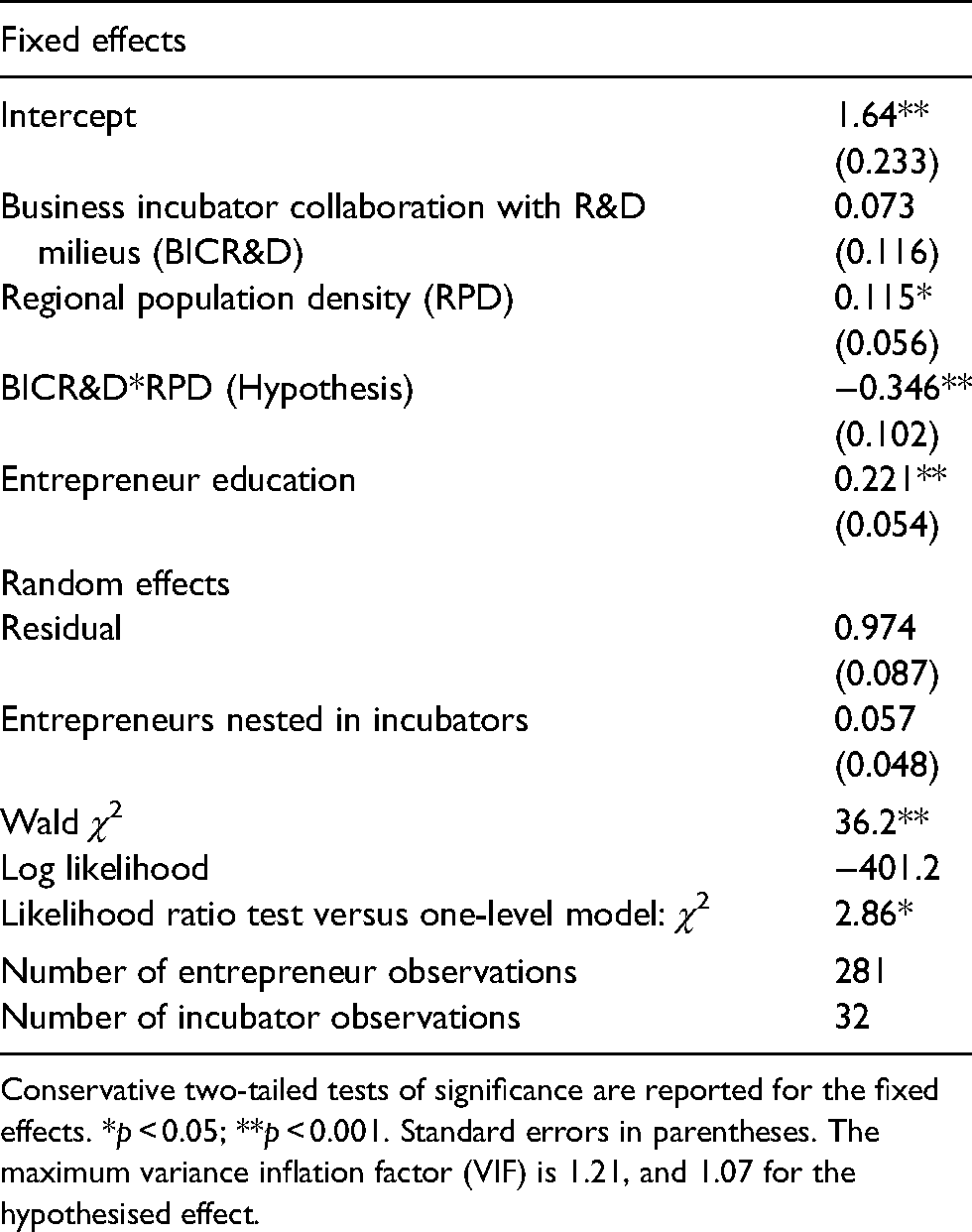
Conservative two-tailed tests of significance are reported for the fixed effects. *p < 0.05; **p < 0.001. Standard errors in parentheses. The maximum variance inflation factor (VIF) is 1.21, and 1.07 for the hypothesised effect.
Results
In Table 2, entrepreneur collaboration with R&D milieus is the dependent variable. Fixed effects report regression coefficients, and random effects report entrepreneur and incubator effects not accounted for by the independent variables. The significant likelihood-ratio test indicates less entrepreneur variation of the dependent variable within incubators than between them.
Incubator management collaboration with R&D milieus had a positive direct, albeit non-significant, effect on the dependent variable, while population density had a significant positive effect. The moderation term between the concepts had a strongly significant negative effect, which implies empirical support for the hypothesis. In the next subsection, we explain the results’ substantial interpretation.
Entrepreneurs’ education level as a control variable significantly affected the dependent variable, in line with previous arguments. Significant χ2 implies robust model fit, and a significant likelihood-ratio test implies that entrepreneur collaboration with R&D milieus is more prevalent in certain incubators than in others. The maximum variance inflation factor (VIF) was 1.21 and 1.07 for the hypothesised effect. The low VIFs imply that multicollinearity was not a problem (cf. O’Brien, 2007).
Results explained
The significant moderation term providing empirical support for the hypothesis implies that as the population density decreased (increased) by one unit, a one-unit increase of incubator collaboration with R&D milieus increased (decreased) the effect on entrepreneur collaboration with R&D milieus by 0.346 units. Put simply, incubator collaboration with R&D milieus had a stronger (weaker) effect on entrepreneur collaboration with R&D milieus the more sparsely (densely) populated the region of localisation.
Graph A in Figure 3 is based on Table 2. It illustrates the average marginal effects of incubator management collaboration with R&D milieus on entrepreneur collaboration with R&D milieus for different population density values. In a region of minimum (maximum) population density, a one-unit increase in incubator management collaboration with R&D milieus on average increased (decreased) entrepreneur collaboration with R&D milieus by about 1.2 units. The negative effect in a region of maximum population density (right side of Graph A) may be surprising. However, an interpretation is that the effect of population density on entrepreneur collaboration with R&D milieus substituted for or outplayed the effect of incubator collaboration with R&D milieus. In other words, incubator collaboration with R&D milieus was crucial for entrepreneur collaboration with R&D milieus in sparsely populated regions (left side of Graph A), but not in densely populated regions (right side of Graph A).
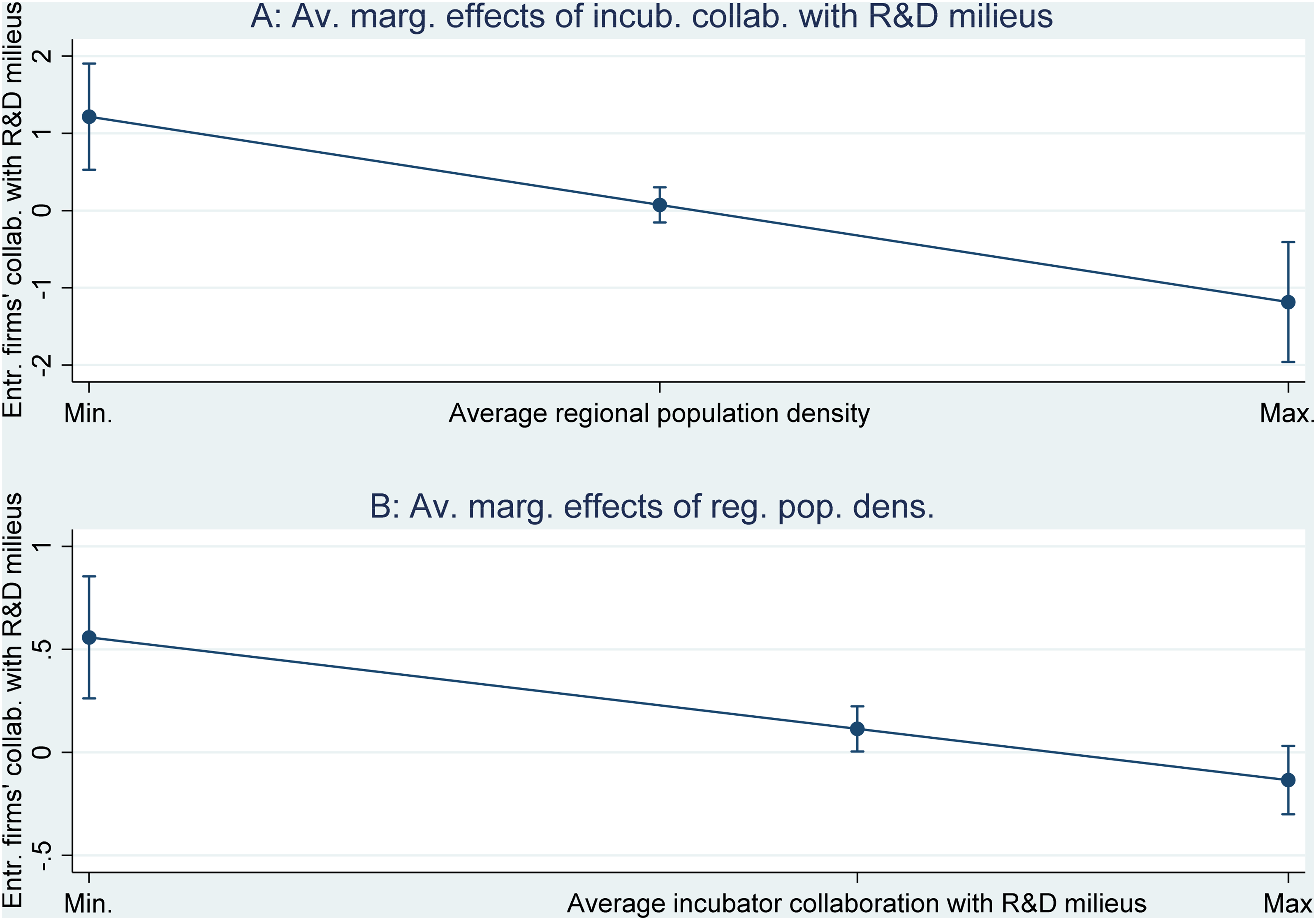
(A) Average marginal effects of incubator management collaboration with R&D milieus on entrepreneur collaboration with R&D milieus as a function of regional population density. (B) Average marginal effects of regional population density on entrepreneur collaboration with R&D milieus as a function of incubator collaboration with R&D milieus. 95% confidence intervals in brackets.
Graph B in Figure 3 further elaborates on the above arguments. Its right side illustrates that (increasing or decreasing) population density had a non-significant effect on entrepreneur collaboration with R&D milieus for those in incubators with maximum R&D collaboration. The non-significant effect implies that location in densely populated regions substituted for incubator collaboration (while incubator collaboration substituted for location in sparsely populated regions). Moreover, the left side of Graph B indicates that population density significantly affected entrepreneur collaboration with R&D milieus for those in incubators with minimum collaboration with R&D milieus. It implies that entrepreneur collaboration with R&D milieus tended to be low in sparsely populated regions if the incubator downplayed collaboration with R&D milieus (and tended to be high in densely populated regions as population density substituted for incubator collaboration).
Summarising the results
The findings are reflected in the two-by-two matrix in Figure 2. Entrepreneur collaboration with R&D milieus was high in low population density regions if the incubator collaboration with R&D milieus was also high (quadrant 1). It illuminates that incubator collaboration with R&D milieus is a critical catalyst for entrepreneurs to collaborate with R&D milieus in sparsely populated regions.
Furthermore, entrepreneur collaboration with R&D milieus was high in high population density regions, independent of whether incubator collaboration with R&D milieus was high or low (quadrants 2 and 4, respectively). In other words, if the population density was high, it substituted or downplayed the effect of incubator collaboration with R&D milieus regarding entrepreneur collaboration with R&D milieus (quadrant 2). It implies that entrepreneur collaboration with R&D milieus was not a function of incubator collaboration with R&D milieus, but instead a function of being located in a densely populated region. Finally, the data show that entrepreneur collaboration with R&D milieus was low in low population density regions if the incubator collaboration with R&D milieus was also low (quadrant 3).
Overall, the study demonstrates that incubator collaboration with R&D milieus played a crucial role for entrepreneurs to collaborate with R&D milieus in sparsely populated regions. In contrast, incubator collaboration with R&D milieus did not alter entrepreneur collaboration with R&D milieus in densely populated regions.
The study also reveals that entrepreneur education level increased collaboration with R&D milieus. Furthermore, unreported analyses found that entrepreneur education level increased collaboration with international customers and investor milieus regionally, nationally and internationally.
Market orientation, perceptual performance and enterprise development
We have referred to studies finding that entrepreneur collaboration with R&D milieus provides resources fostering product development and early growth (Baum et al., 2000; van Stijn et al., 2018). Analyses in Table 3 partly confirm them, showing that entrepreneur collaboration with R&D milieus was significantly associated with market orientation (Model 1) and perceptual performance (Model 2) but tended to delay enterprise development (Model 3). 5
Bootstrapped ordinary least square (OLS) regressions (Models 1 and 2) and ordinal logistic regression (Model 3).
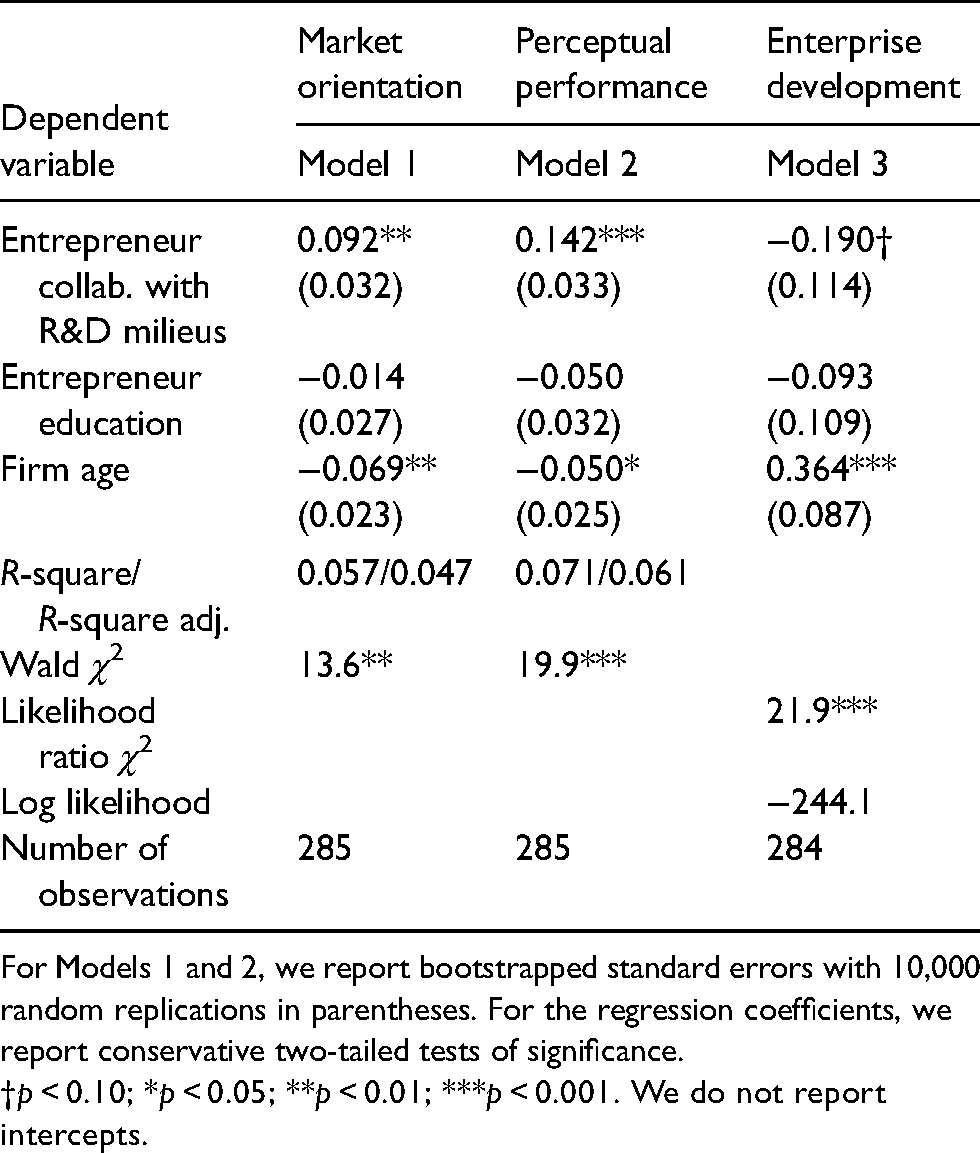
For Models 1 and 2, we report bootstrapped standard errors with 10,000 random replications in parentheses. For the regression coefficients, we report conservative two-tailed tests of significance.
†p < 0.10; *p < 0.05; **p < 0.01; ***p < 0.001. We do not report intercepts.
Conclusion
Theoretical implications
Finding that incubator collaboration with R&D milieus increased entrepreneur collaboration with R&D milieus in sparsely but not densely population regions, our study makes four contributions. First, it contributes to research on entrepreneurs in incubators. Despite increasing research in the field (Høvig et al., 2018; Kitagawa and Robertson, 2012; Lee and Osteryoung, 2004; McAdam and McAdam, 2006; Nair and Blomquist, 2020; Pavlin et al., 2016; Pellinen, 2014), we demonstrate how incubator management affects entrepreneurs differently across regional contexts. Second, it similarly explicitly contributes to the entrepreneurship literature in a regional context. This field shows that the regional context affects entrepreneurs concerning innovation performance and causation and effectuation logics (Aarstad and Jakobsen, 2019; Rypestøl and Aarstad, 2018). Our study adds to this literature as it further confirms that the link between incubator management and entrepreneurs’ behaviour is a function of the regional context.
Third, our study contributes to the literature studying the association between R&D and entrepreneurship (Baum et al., 2000; van Stijn et al., 2018) because it reveals that the regional context matters concerning the factors that may trigger an entrepreneur to collaborate with an R&D milieu. Consistent with Baum et al. (2000) and van Stijn et al. (2018), we also indicate that entrepreneur collaboration with R&D milieus provides resources as it is positively associated with market orientation and perceptual performance. However, entrepreneur collaboration with R&D milieus tends to delay enterprise development, but the result is unsurprising as R&D indicates novelty needing a relatively long time to be introduced at the market. Also, novelty is associated with uncertainty that may further delay enterprise development.
Fourth, our study contributes to the RIS and economic geography literature (Isaksen and Trippl, 2016; Karlsen, 2013) because it shows that the regional context matters concerning the relationship between incubator and entrepreneur collaboration with R&D milieus. As such, ‘one size does not fit all’, as incubator collaboration with R&D milieus leverages entrepreneurs to collaborate with R&D milieus in sparsely populated regions, as a proxy for thin RISs, but not in densely populated regions, as a proxy for thick RISs.
Policy implications
We have shown that incubator collaboration with R&D milieus is stronger in densely than in sparsely populated regions (Table 1). It may not be surprising, as the access to analytical knowledge and R&D resources is relatively prevalent in densely populated regions (Research Council of Norway, 2011; Strand et al., 2017). Nonetheless, the study's major findings reveal the paradox of strong incubator collaboration with R&D milieus in densely populated regions where it matters least and less collaboration in sparsely populated regions where it matters most. Consequently, a policy implication is that incubator managers in sparsely populated regions should prioritise collaboration with R&D milieus. In addition, the study elucidates the vital role of higher education as an enabler for entrepreneurs to collaborate with R&D milieus, investor milieus and international customers.
Limitations and future research
Regarding internal validity, a limitation is the study's cross-sectional research design. Nonetheless, it is more likely that the moderation term between regional population density and incubator management collaboration with R&D milieus affects the dependent variables than the other way round. Moreover, the empirical results are not subject to common method bias or variance (cf. Malhotra et al., 2006), as the dependent and the independent variables were gathered independently through different sources; that is, indicators measuring the dependent variables were gathered from entrepreneurs, while independent variables concerning the hypothesis testing were gathered from incubator managers and Statistics Norway.
Another limitation concerns applying a single-item variable to measure incubator managers’ collaboration with R&D milieus. However, using three indicators to measure entrepreneur collaboration with R&D milieus shows strong intra-correlations loading on a single factor, which indicates that the use of a single-item versus a multi-item variable provides similar information.
In addition, the wording of the items differed slightly for the entrepreneurs and incubator managers; the entrepreneurs (incubator managers) were framed with the wording R&D and educational actors (R&D and educational milieus). Ideally, the wording should be identical. A related limitation is that the incubator managers responded in the range between ‘to some extent’ (3), ‘to a large extent’ (4) and ‘to a very large extent’ (5) concerning collaboration with R&D milieus. It may be argued that a variable with limited variation is a potential limitation, and future research should aim to develop items that empirically cover both minimum and maximum values. That said, the hypothesis testing showed a robust effect (p < 0.001; conservative two-tailed test of significance).
A further limitation is that our items do not distinguish between the degree of formality in R&D collaboration, nor do they inform about multiplexity in R&D collaboration. For example, have the partners formulated a written contract or do they merely collaborate by using a relational contract, is the collaboration related to basic or applied research, is it related to design, software programming, product development, process development, or to other forms of collaboration? These issues may influence the content and the outcome of the collaboration beyond the relatively simplistic items we have applied. Future research, therefore, should aim to unpack further the implications that formality and multiplexity in R&D collaboration may have.
Also, future research should aim to expand further the knowledge about mechanisms that affect entrepreneur collaboration with R&D milieus as a function of regional and incubator management characteristics. For instance, concerning incubators, a distinction could be made between specialised versus those that are not. Concerning regions, industry structures may well be examined. Altogether, we trust that the current study has laid a useful base for future research that can profit from qualitative as well as quantitative methodologies to scrutinise further entrepreneur collaboration with R&D milieus in different regional contexts.
Finding that entrepreneur R&D collaboration is positively associated with market orientation and perceptual performance (Table 3) is in line with prior research (Baum et al., 2000; van Stijn et al., 2018). However, using perceptual measures in a cross-sectional design is a limitation concerning the results’ construct and internal validity. Consequently, future research should aim to validate the findings by using register data in a longitudinal research design or by using appropriate instrumental variables. Yet having said this, we are, nonetheless, a bit ambivalent concerning using performance measures as indicators of validating the success of entrepreneur R&D collaboration. The reason is that R&D can represent both an upside and a downside for enterprise development. On the one hand, it can enable the development of novel products or production processes. On the other hand, it can preclude enterprise development, in line with our findings (Table 3), as novel products or productions processes have both a market risk (of failure) and a product development risk (of delay or failure). Future research, therefore, should investigate further the appropriateness of when entrepreneurs should engage in R&D collaboration, and when not to. For this reason, we do not deny that incubator collaboration with R&D milieus in some cases mistakenly may have encouraged entrepreneur collaboration with R&D milieus. Thus, future research should investigate further the appropriateness of encouraging entrepreneur collaboration with R&D milieus and the outcome of such activities. Finally, given that we only report Norwegian data, we encourage future scholars to undertake similar research in other national contexts to assess external validity further.
Footnotes
Declaration of conflicting interests
The authors declared no potential conflicts of interest with respect to the research, authorship and/or publication of this article.
Funding
The authors disclosed receipt of the following financial support for the research, authorship, and/or publication of this article: This work was supported by the Norges Forskningsråd.
