




Abstract
This case study describes the embedding of the Scrum project management framework as an innovation and operational improvement tool within a manufacturing Small to Medium Enterprise (SME) in the UK. The teaching notes inform 1) other UK manufacturing SMEs with novice teams, and 2) students at undergraduate and postgraduate level exploring innovation and operations management/improvement. The case advances our understanding of how small family-run manufacturing businesses can use contemporary frameworks such as Scrum to improve business operations and innovation.
Deluxe Beds Ltd is a family SME manufacturing beds and mattresses with a technically novice workforce mainly with no formal educational background.
Keywords
Introduction
The purpose of this case study is to explore how a small business enterprise like Deluxe Beds which works in a traditional manufacturing industry could achieve management innovation using Scrum, an agile project management framework. Contrary to technological innovation (e.g. product and process innovation), management innovation is a complex process due to the need for new structural and organisational arrangements, management practices, and administrative systems, all of which create resistance to change in SMEs (Birkinshaw et al., 2008; Hervas-Oliver et al., 2016). Moreover, while management innovation is used in SMEs to complement their lack of resources to adopt technological innovation, the approach generally draws on ad hoc initiatives that may result in failures and higher costs (Hervas-Oliver et al., 2016; Rammer et al., 2009). This case study allows students to explore how management innovation can be implemented through borrowing from established fields such as agile project management and the benefits that SMEs would gain. This case study relates the experiences of an organisational Change Manager Dr Sammar Javed and the implementation of elements of the Scrum framework to enhance innovation, improve operational processes, and embed savings within a UK manufacturing SME: Deluxe Beds Ltd. Here Scrum has been used as a facilitation framework to introduce a continuous improvement and an open innovation culture.
According to the EU Guide (SME User Guide, 2016) definition at 103 workers Deluxe Beds Ltd is a medium sized manufacturing SME. It has undergone significant transformations since it began trading in 1985 and currently trades with £6.5 m (2019) turnover. The company principally draw its employees from the local community (more than 80% of employees are residing within Huddersfield) which is an economically deprived industrial area. 80% of employees do not speak English as a first language, and only half can have basic conversations in English, which has created communication issues. Languages spoken by Deluxe team includes Urdu, Punjabi (various dialects), Gujrati, Arabic, Hungarian, Polish, and English. The IT literacy rate is only 18 employees out of 102 which has been linked to issues with accepting new innovations (e.g. automating processes, using new machinery to cut costs, etc) that the management have tried to adopt.
After the sudden passing of Mr. Abdul-Razak, the company’s founder, in 2013, his widow, Mrs. Abdul-Razak (Khatiza Bibi) with no formal business experience, or any formal education took on the leadership of the business which brought with it some of the challenges typical to succession in a family business (Weismeier-Sammer and Hatak, 2014).
The manufacturing processes at Deluxe beds, in common with the majority of SMEs in the Bed industry, are almost entirely manual (Hunter and Wynn, 2010). This reflects the characteristics of a cottage industry which lags behind with the adoption of technological advancements. The production stations at Deluxe Beds are shown in Figure 1. The manual manufacturing processes are mainly facilitated by the use of compressed air handheld staple guns and work in progress is transported manually through the factory. As Deluxe Beds 1 have positioned themselves as a producer of high quality, handmade beds, this method of manufacture has been turned into a unique selling point for the company.
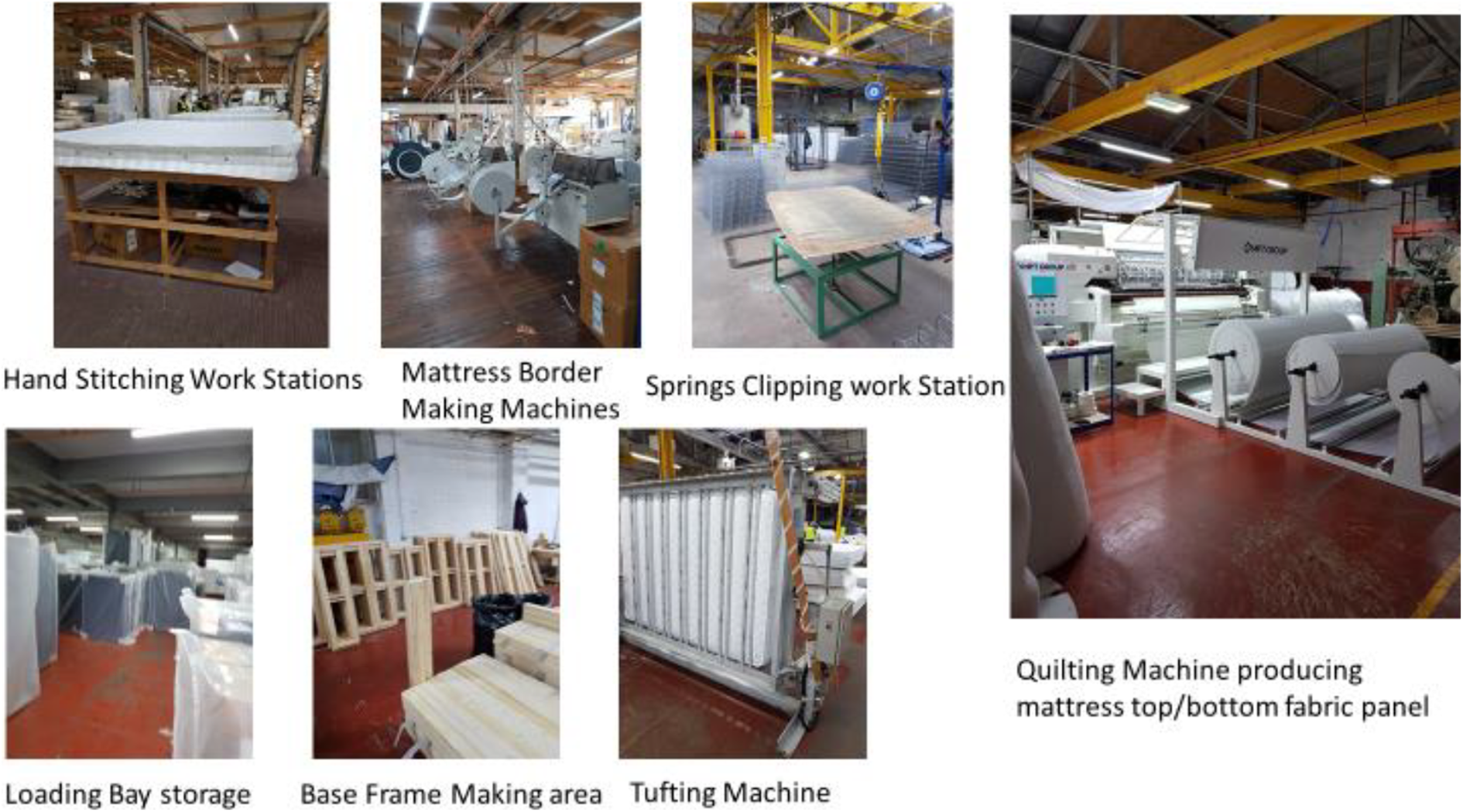
Production stations at Deluxe Beds.
Lean (operations managed to minimise waste) (Dale et al., 2016), Agile (the ability to quickly react to changing markets and customer needs) (Schwaber and Sutherland, 2017), Total Quality Management (everyone in the organisation is responsible for quality and errors must be corrected at the source) (Dale et al., 2016), and Big Data (the use of extremely large datasets) (Ahmed et al., 2017) were not concepts that the Board of Directors and the workforce were familiar with at the beginning of this innovation journey. Agile Project management will be discussed later.
What Mrs Razak was looking for was an innovative approach to project management that would enable her small business to develop innovative manufacturing processes for the production of traditional products, the development of new products, and to reflect the industries move towards delivery on demand for the client (made to order) rather than made to stock.
Deluxe Beds’ challenges
Upon appointment, Sammar identified that although Deluxe Beds has identified that it can drive business growth through continuous improvement and innovation, there were a number of key challenges: The lack of a communication strategy to inform all staff about key decisions and progress towards strategic goals. This is important to foster a collaborative working culture. The lack of a formal change management policy to facilitate the transformation from a small family-run business to one with formalised cross-business processes capable of facilitating sustained growth. Implementing such a policy raises the real risk of conflict due to extent of the required change. The apparent lack of capacity and capability at all levels to plan, make decisions, monitor processes, and collaborate to develop as an expert workforce.
Management innovation in SME’s
Innovation has been acknowledged as being an important factor in the creation of value and sustainable competitive advantage for organisations in an ever more complex and constantly fast changing competitive environment (Bilton and Cummings, 2009). In a management context, Birkinshaw et al. (2008) introduce management innovation as ‘a difference in the form, quality, or state over time of the management activities in an organisation, where the change is a novel or unprecedented departure from the past’ (p. 826). As such, SMEs can reflect upon their practices and compare with practices that have been implemented elsewhere to explore whether they can be adapted and implemented in their own context.
Innovations in SMEs can be achieved in almost every area or activity that an organisation is involved in (Beynon et al., 2020). For example: the development of new technology products or services, the development of new production technology and processes, and new organisational structures or administrative systems, among others. (Ottenbacher and Harrington, 2008). Ali and Park (2016) propose that these innovations can be divided into three categories: product, process, and managerial.
From the above categorisation, the innovation that Deluxe Beds undertook as part of this case study (primarily consisting of a new approach to project management) would fall into the Managerial Innovation category in that it optimised decision making processes within the organisation (Vaccaro et al., 2012), which can facilitate technological innovation (Su et al., 2018) and develop competitive advantage (Volberda et al., 2014).
This case study will show how Scrum can not only be seen as a management innovation in and of itself, but also as an innovative and agile project management framework which can lead to other management innovations.
Scrum as an innovative and agile project management framework
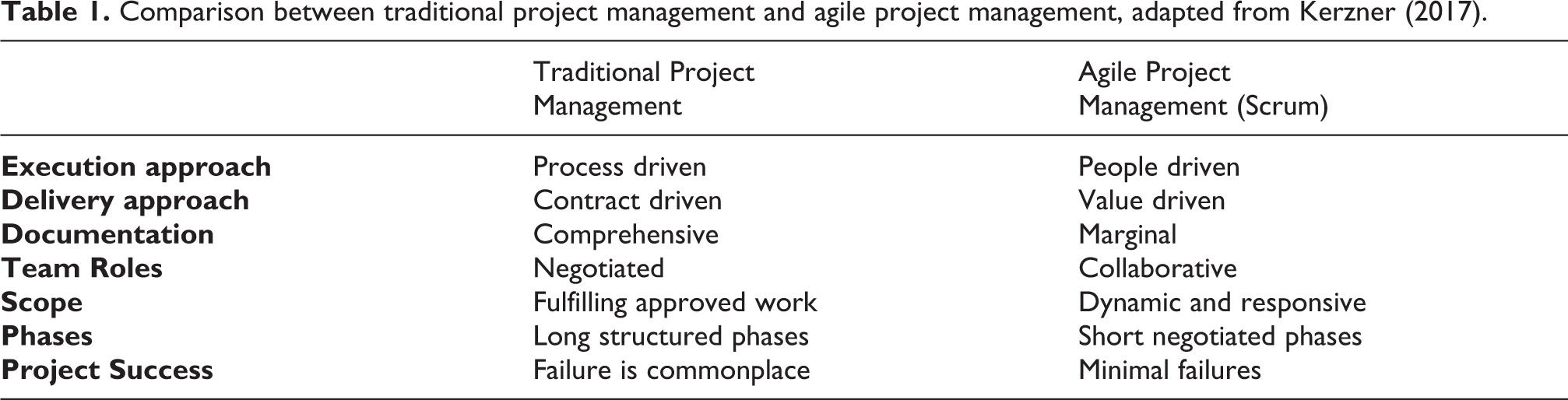
Scrum differs from the traditional approach to project management as it is a design-oriented approach which relies on constantly recurring feedback to the client. Feedback takes the shape of small recurring project life cycles (Stettina and Hörz, 2015), as shown in Figure 2. This allows for intermediate results to be realised during the course of the project in contrast to the more linear and plan-driven approaches of traditional project management where key deliverables are generally realised towards the end of the project (Dybå and Dingsøyr, 2008). This reflects the recent trends in product/service development that focuses on highly customised and customer-focused end results and has led to project management approaches that are able to cope better with unexpected changes and uncertainties. Table 1 below shows a comparison between traditional and agile project management.
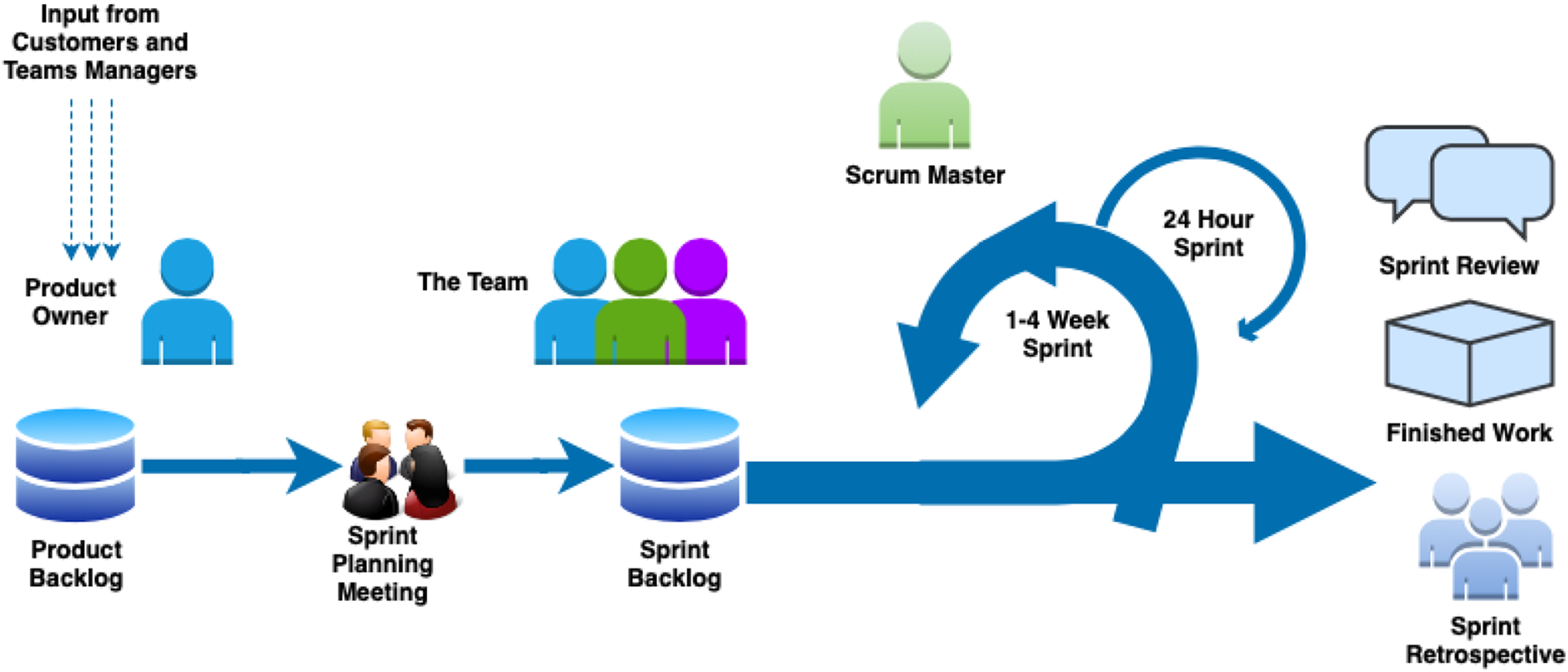
Agile project management.
Comparison between traditional project management and agile project management, adapted from Kerzner (2017).
Scrum has several key components: (1) product backlogs, (2) sprint backlogs, (3) Scrum boards and (4) daily meetings (Dingsøyr et al., 2018). A product is built through a series of iterations lasting between 2 and 4 weeks, called Sprints. These break down large and complex projects into bite-sized pieces and reduces risk and costs. Scrum teams prepare a list of requirements, features, specifications, and functionalities for the product to be developed in what is called a ‘Product backlog’. This works as a running to-do list in which the development team prioritises which functionalities to work on in the next Sprint. In the Sprint, the development team works on a number of activities on a regular basis known as Sprint Ceremonies which includes Sprint Daily Meetings, Daily Stand-ups or Daily Scrums, Sprint Reviews and Sprint Retrospectives (Schwaber and Sutherland, 2017). A sprint starts with a Sprint Planning Meeting to decide on how the team will work on the functionality and complete it within the Sprint Duration (2–4 weeks). The team then meets every day in a Daily Stand-up Meeting, these normally take just 15 minutes and are important to keep the team at the same pace and ensure any concerns are immediately heard and dealt with. Salem et al. (2005) propose that visualisation, daily huddle meetings/toolbox meetings/Scrum meeting etc. are underdeveloped and require procedural details for effective implementation.
Towards the end of the Sprint, the team join a Sprint Review to demonstrate the product functionalities that have been accomplished and get the Product Owner to sign off the release. The Sprint finishes with a Sprint Retrospective where the development team discusses and documents what worked well and what did not, what obstacles they faced, and any issues related to tools, techniques, people and relationships. The Five key values of Scrum Teams are: 1) focus, 2) courage, 3) openness, 4) commitment, and 5) respect (Schwaber and Sutherland, 2017). These values eliminate the need of structural formality and communication hesitation among the Scrum team.
Examples of Scrum implementation at Deluxe Beds Ltd
With Deluxe Beds Ltd. there was, historically, a communication gap between the Senior Leadership Team and the rest of the organisation, as well as between the offices and the factory floor. There existed a culture of trying to avoid holding meetings, thus limiting opportunities for further effective communication. Sammar had previously attempted to move the organisation to a more open culture by attempting to establish a framework of effective and efficient communication throughout the organisation, but these efforts had failed due to resistance from the Senior Management Team. This raised the need to try alternative approaches, for example, injecting the word ‘Scrum’ into meetings at every opportunity to raise interest and awareness of it. The importance of Scrum was reinforced by Sammar’s participation in a 3-day Scrum Master Course. The newness of the term Scrum and the attendance on the course successfully captured the interest of the Senior Management Team. Following a review meeting after the course the Managing Director, Mrs Razak picked up the terminology and said we will be doing a ‘Quick Scrum’ for the agenda in hand. Although this was said in light-hearted manner, the phrase was picked up by two of the other Directors, and the assimilation of Scrum at Deluxe Beds began.
Getting the directors on board
The Senior Management Team at Deluxe Beds quickly began to absorb the concept of Scrum, initially as a communication framework which also facilitated rhythmic sprints and cycles of team activity. One of the directors is fond of sport and to him the analogy of Scrum Meetings being the same as the huddles that players have before a match helped him to accept the usefulness and importance of this way of working, and although initially he was unable to recall the word ‘Scrum’ he explained it as ‘what the players do before a match’. Mrs Razak (The Managing Director) began to call ‘Scrum Meetings’ on important operational issues and this began to embed the concept of Scrum within the Senior Management Team, who began to do quick ‘Scrums’ on any emerging ideas and also when meeting routinely to define strategic developments. The Directors began to utilise the term when working with their teams and then began to actively roll out the concept on the manufacturing floor with wider workforce.
Market survey reports
As an early, high visibility, experiment to prove the potential usefulness of the Scrum framework, Sammar conducted ‘day start’ and ‘day closing’ Scrums with two work experience students from Huddersfield Business School (HBS) who were tasked with producing Market Survey Reports for two potential new geographical markets. The key challenge here was that the students had little understanding of the industry or company and little practical experience, requiring extensive supervision. These meetings were very successful in focusing their efforts and provided a natural rhythm and pace to their work. In addition to their Market Survey Reports, they were also able to produce a contact list of potential customers in these two countries and contact three customers to explore potential sales. Once again, the technical terminology of Scrum was not used, but the underlying concepts were visibly validated within Deluxe Beds Ltd.
Morning meetings
Another of the changes initiated following the Scrum Master course was the initiation of daily Morning Meetings. At the start of each working day a meeting is held on the manufacturing floor with all directors, managers and supervisors to share the previous day’s issues and discuss any challenges to completing the production and delivery schedule for that day. At the start it was challenging to stick to time and gather participants from the manufacturing floor, but gradually it was embedded within the workforce. These Morning Meetings have resulted in better operational control and coordination despite a lack of formal procedures, automated systems, digital platforms or connectivity, a dependency on paper-based orders, and the tacit knowledge of the experienced team members. The Morning Meetings have emerged as a knowledge sharing platform which has improved productivity. The team has taken ownership of this meeting and it is now part of the culture of Deluxe Beds Ltd., although no Scrum terminology or jargon is employed, these meetings are supporting productivity improvement and process innovation in the same way as the daily Scrum meetings described above.
Toolbox talks
Another aspect of Scrum (Salem et al., 2005) which has been successfully embedded at Deluxe Beds Ltd. is the Toolbox Talks conducted by the Factory Manager every Monday for the Manufacturing Team. The need of organisational culture change to facilitate adherence towards Health and Safety regulations, reducing waste, compliance to organisational policies, and educating and training the workforce had reinforced the need for more regular interactions with the team. These meetings were initially conducted by the Health and Safety Officer as required to ensure adherence to Health and Safety regulations. Later on, these Toolbox Talks were taken over by the Stock Manager and have improved over time. The whole Senior Management Team is now involved in creating and sharing the agenda. The challenge to embed this within the systems was coaching and training the Scrum team to effectively plan and present the talks. This has also ensured that the focus is fixed on holding the Toolbox Talks regularly (every Monday Morning without fail), the defined agenda is kept to, and that accurate records kept of the decisions made.
Partial Scrum implementation?
Initially it was envisioned that Scrum would only be adopted in order to improve the product development process considering its theoretical nature and what it had historically been used for. However, a project work plan was developed which would utilise Scrum as a holistic improvement framework where the whole team would work as a unit to reach a common goal, challenging the assumptions of the more ‘traditional and sequential’ approaches to process development, testing and manufacturing improvement. This would enable the teams to self-organise by encouraging close collaboration of all team members, as well as daily face-to-face communication among all team members and ‘disciplines’ involved.
Sammar’s initial lack of experience of the bed manufacturing industry combined with the routine and traditional nature of mattress and bed related products, and the risks involved with the introduction of new designs in the industry initially left little margin for experimentation with the use of Scrum for the new product development process. However, one of the key objects of the improvement project was the building of more effective teams and enhancing communication among the workforce, and this shaped the plans for Scrum implementation. The project planned to set up Scrum teams to embed support of new operational methods and knowledge. During the course of the project several sub-projects were organised (for example: new product development, IT upgrades, strategy development, funding bid preparations) based on the Scrum framework and utilising the idea of its rhythmic sprints of action.
From an organisational perspective Scrum was part of an organisation wide improvement project that generated cost saving in excess of £1,800,000. It is impossible to accurately state what proportion of the savings directly resulted from the use of Scrum, but both Sammar and Mrs Razak firmly believe that this organisational improvement project would not have been anywhere near as successful without the use of Scrum.
Key learning points for Deluxe
The 3 key learning points from the Scrum training and Sammar’s experience during this project are: (1) the importance of keeping the team intact, (2) keeping the moral positive, and (3) maintaining rhythmic behaviour within the teams. Sammar firmly believes that (1) it is possible to more than double productivity by adhering to the underlying concepts of the Scrum mind set, (2) everyone’s inclusion is required, and (3) Scrum is an efficient gap identification method and helps prevent the development of a blame culture. The idea that Scrum is lightweight, simple to understand and difficult to master (Schwaber and Sutherland, 2017) was proved in the case of Deluxe Beds Ltd. as the team understood and absorbed the key concepts easily and now the challenge is how to master them!
Teaching note
Deluxe Beds is family run manufacturing SME which is engaged with the improvement of its manufacturing and other operational processes. It has chosen to adopt and adapt Scrum project management as a framework to facilitate a new organisational culture of continuous improvement and open innovation. The key discussion point is the appropriateness of the partial Scrum implementation approach adopted by Deluxe Beds Ltd. This case study will enable students to consider the benefits that SMEs will accumulate from the adoption of a novel concept like Scrum (mainly used in software industry) for their operation’s continuous improvement and open innovation culture. This is exceptionally important for SMEs with a novice workforce who may resist changes that involve technical and management innovations. It is aimed at both undergraduate and postgraduate students studying operations management.
Learning outcomes
The case enables students to consider the implementation of Scrum as a communication strategy to help align SME’s culture around sustainable growth.
The case provides insights to students for partial Scrum implementation as a continuous improvement framework.
The case provides students an opportunity to analyse the engagement of novice workforces in the implementation of innovative and non-standard approaches such as Scrum.
Discussion questions
How can Scrum framework enable SMEs’ sustainable growth?
By adopting Scrum, SME’s remain flexible, responsive and resilient while addressing constant changes by clients or changes in external business environment. Deluxe Beds realised that listening to the customer’s voice and delivering better quality beds requires seamless communication, coordination, and technical skills which were embedded in the company using Scrum. Deluxe Beds, using Scrum, introduced computers on the manufacturing floor, deployed attendance monitoring biometric clocks, and bar code scanners to support the introduction of automated stock control programs. This has significantly reduced the waste that goes to landfill, reducing environmental impact and waste disposal costs. Before Deluxe Beds implemented Scrum, while improvement was on the firm’s agenda, poor communication stalled progress.
What would Deluxe Beds have to do in order to fully implement Scrum?
Students can think of a range of recommendations. Deluxe Beds could think about the right number of team members that can be used optimise their processes. They could also devise sustainability metrics and targets to focus team efforts on the issues that are essential to success. Adopting an agile manufacturing approaches at Deluxe Bed would facilitate a quicker pace of change and allow changing products and deliverables within a shorter time frame. This also ensures communication channels are streamlined so that employees adapt to the changes smoothly. Deluxe Beds could use a formal ‘yet accessible and easy to use’ system of knowledge management that allows for information to be communicated seamlessly. For example, using mobile applications that capture video and audio with automatic captions to store manufacturing stories. Finally, Deluxe Beds may adopt a reward system that allows for Scrum champions to be acknowledged in a bid to get buy-in for more customised scrum techniques.
What are the potential advantages and disadvantages of the partial implementation of Scrum approach that has been applied at Deluxe Beds?
This case helps students understand how SMEs can benefit from a framework that has been adopted and adapted from a completely different industry. Students might also recognise the disadvantages of partially implementing Scrum in SMEs.
The Deluxe Beds team took a very cautious approach to the partial adoption of Scrum, which could potentially reflect the very cautious nature of the Scrum Master (Sammar). A good example of this is the decision to avoid the use of the technical Scrum terminology and jargon. Initially this was based on two factors: 1) The lack of confidence in use of technical terminology by the Scrum Master and 2) The assumption that novice workforce teams with issues such as a lack of formal qualifications and difficulty with the English language, would result in potential misunderstandings.
The key advantage from this approach was that there were no problems, issues, questions, or confusion caused by the technical Scrum terminology and jargon. The adoption was never forced, and its adoption appeared to be natural to the Scrum Teams and the Senior Management Team. This could almost be termed ‘Scrum by Stealth’ as the managerial team remain unaware the key Scrum Jargon and technical terms. Whether or not this may cause problems in the future remains to be seen as the management team will not be able to reflect on ‘Scrum’ activity and its benefits as that is not how they think of these activities.
The key disadvantage of the partial implementation of Scrum is that potentially the full benefits have not been realised. Sammar’s opinion is that the ‘cautious approach towards Scrum has limited the benefits and the implementation could have stretched the company further to gain greater benefits but fear of failure didn’t allow this’. This view is supported by the research of Sutherland et al. (2009) who found that partial implementation by Scrum teams only accomplished modest results.
What areas of the company should Deluxe Beds target next with their continuous improvement plans?
From the case study, the Scrum framework adopted at Deluxe Beds has been used in the following areas of its operations: manufacturing process improvements, IT implementation, marketing reports, strategy development, bid preparation, and new product development.
This question allows student to identify areas of manufacturing SMEs where the Partial Scrum Framework adopted by Deluxe Beds could be successfully employed and then justify their suggestions. Areas that they may consider include production planning and scheduling. Although this has been mentioned in the sections on Toolbox talks, as presented in the case study, these only deal with short term (daily) planning. Demand forecasts could be utilised more strategically to plan to match activity to demands. This would potentially reduce wage bills (through a reduction on overtime pay) and reduce purchasing and raw material costs (through better negotiation and planned spending). Another area Deluxe Beds may target is distribution. No mention has been made of the distribution of the finished product to the customers. Improvements in this area could increase agility of production planning and scheduling, improve customer satisfaction, reduce breakages etc.
Footnotes
Declaration of conflicting interests
The author(s) declared no potential conflicts of interest with respect to the research, authorship, and/or publication of this article.
Funding
The author(s) received no financial support for the research, authorship, and/or publication of this article.
