



Abstract
Small- and medium-sized enterprises (SMEs) rely on each employee to be innovative, and understanding how employees can be supported in their innovative behavior is a crucial factor. This study draws on managerial coaching (MC) literature to examine the dynamics of how leadership behaviors impact employees’ innovative work behavior (IWB). In an attempt to disclose the mechanism through which MC can impact the IWB of employees, we particularly expected work engagement to mediate the relationship. Accordingly, we operationalized IWB as a four-dimensional construct to show whether MC and work engagement equally affect all of the dimensions of IWB. We collected survey data (N = 4418) from 88 Finnish SMEs and found that MC was positively related to each dimension of IWB, and that work engagement mediated the linkages. Interestingly, the importance of MC (both directly and when mediated by work engagement) grows as the employee moves from idea exploration to implementation. This study sheds light on the mechanism through which leadership behavior can impact the IWB of employees in SMEs.
Introduction
Creativity and innovation are crucial for the performance and survival of small- and medium-sized enterprises (SMEs) in existing dynamic business environments (Bodlaj and Čater, 2019; Jalil et al., 2022; Riviere and Upson, 2023). A key resource is employee innovativeness, which is an outcome of human capital (Ababneh, 2022). Employee innovative work behavior (IWB) has been seen to be needed across the organization and in all kinds of jobs (Harari et al., 2016). It has been described as “the intentional creation, introduction, and application of new ideas within a work role, group or organization, in order to benefit role performance, the group, or the organization” (Janssen, 2000: 288). Thus, a focal question is how to promote employee innovativeness in SMEs.
Recent research has revealed two influential factors which either support or inhibit IWB in companies. These are managers’ activities and behavior (Anderson et al., 2014; Hughes et al., 2018) and employees’ work engagement (Ababneh, 2022; Wu and Wu, 2019). Notably, work engagement has been suggested to play a key role in innovation. It acts as a mediator that explains how different job resources can affect employees’ willingness to use their creative skills (Huhtala and Parzefall, 2007; Kwon and Kim, 2020). Thus, we argue that it is important to understand the dynamics of managerial influence and work engagement when promoting IWB in SMEs. In contrast to previous studies that have measured IWB one-dimensionally (e.g. Ali et al., 2020; Knezović and Drkić, 2021), we pay attention to the fact that behaviors in the different phases of the innovation process are quite different (Perry-Smith and Mannucci, 2017), and therefore, we examine the effects of managerial coaching (MC) and work engagement on four dimensions of IWB. By MC, we refer to a leadership style that applies a coaching approach to leadership (Beattie et al., 2014).
In the SME context, entrepreneurs and top managers play an important role in fostering or preventing innovative behavior among employees (Aaltonen and Hytti, 2014; Akbari et al., 2021). Among the few studies on this topic, Knezović and Drkić (2021) show that in addition to CEOs, supervisors are also important influencers of IWB in SMEs. Especially, given that they are usually in the closest contact with the employees, they have at least some power to influence workplace practices and can therefore have a concrete impact on a daily basis (Son, 2019). Consequently, we argue that more research attention should be paid to the role of those managers who are immediate supervisors for employees.
Most studies on the relationship between supervisor's influence and employee behavior in SMEs have utilized established leadership theories such as transformational leadership (e.g. Mesu et al., 2012) or authentic leadership (e.g. Bai et al., 2022). Such an approach has been typical in the research between management and innovativeness (e.g. Bednall et al., 2018). Thus, applying a more down-to-earth leadership model has been called for when examining the supervisory support experienced by employees in work communities (Alvesson and Einola, 2019). Therefore, we adopted the concept of MC as one of the most recent leadership approaches (see Carvalho et al., 2021), which has been recognized as a beneficial approach, particularly in SMEs (Dolores Vidal-Salazar et al., 2012). It combines elements of leadership and management, which in literature have been seen as synonymous, partly overlapping, or a continuum, or differentiated from each other as different kinds of activities or orientations (see Collins et al., 2023). The modern view of MC assumes that in contemporary complex and ever-changing business environments, supervisors need to implement management and leadership; that is to say, to provide both continuity and change, both structure and autonomy, as well as short and long-term orientation (Dhar, 2022).
Our research question is: “Does managerial coaching influence four dimensions of IWB equally and does work engagement mediate the relationship?”. All in all, our aim in this study is to gain a more detailed understanding of the impact of MC on IWB. More specifically, we explore the relationship between MC and employees’ IWB, taking its different dimensions into consideration. Moreover, we examine the mediating effect of work engagement between MC and IWB. With this study, we aim to contribute to the development of a theoretical model for MC for innovation. The contribution of this study is analyzing the mediating role of work engagement. As such, this study represents, to our knowledge, one of the first attempts to disclose the black box of the mechanism through which supervisors’ behavior—here MC—can impact the IWB of employees in SMEs. Understanding these mechanisms of influence, and in particular the role of managers in promoting IWB, is important for the renewal and vitality of enterprises, and innovation in business requires the input of all employees. To clarify, we use the term “manager” to refer to any person in a supervisory position in an organization who leads their subordinates to make things happen in their area of responsibility.
We conducted the empirical study in Finland, which scores among the top five innovation leaders in the EU (Hollanders et al., 2020). SMEs play a crucial role in the Finnish economy. 99% of all employers are small and medium-sized, they employ 64% of the workforce in the Finnish labor market, and they are responsible for nearly 60% of the total turnover of Finnish companies (Statistics Finland, 2022).
The survey data was collected from 88 SMEs representing different business fields, with 4418 employees from those companies completing the survey.
The theoretical framework of this study consists of three constructs and related academic discussions. The first is the construct of IWB modelled by de Jong and den Hartog (2010), which consists of idea exploration, deliberate introduction, championing, and the implementation of novel and useful ideas, processes, products, or procedures. The second is the construct of MC as a leadership style. This model refers to a two-way reciprocal process between a supervisor and a subordinate, where a person in a managerial position applies distinctive leadership behaviors such as providing constructive feedback, clarifying objectives, supporting cooperation in teams, and facilitating creative thinking as part of everyday routines and activities at work (Ellinger et al., 1999; McCarthy and Milner, 2020). The third construct is the job demands-resources (J D-R) theory, according to which job resources such as MC initiate a motivational process in an employee that leads to work engagement, and consequently to better performance including innovativeness (Bakker and Demerouti, 2007; Kwon and Kim, 2020).
Next, we build the theoretical framework and hypotheses. Thereafter, we address the methodological questions. Finally, we provide the discussion and conclusion sections incorporating theoretical and practical implications, the limitations of this study, and suggestions for future research.
Theoretical background and hypotheses
Innovative work behavior
IWB includes the recognition of opportunities or problems, the generation of novel and useful ideas, the promotion of ideas and a search for sponsorship, and the implementation of new ideas (de Jong and den Hartog, 2010; Hughes et al., 2018) constituting the four sequential stages of the innovation process (de Jong and den Hartog, 2010). New ideas may relate not only to new processes, products or procedures, but also to improvements in current products, services, and processes (Basadur, 2004). Thus, innovation can be any solution to an identified problem in the organization (de Jong and den Hartog, 2010) that is novel and feasible, and which benefits role performance, the group, or the organization (Janssen, 2000).
IWB is defined as the intentional behaviors of individuals (Janssen, 2000), separated from arbitrary reactions. Because individuals come up with new ideas and implement them (e.g. Janssen, 2000; Scott and Bruce, 1994), IWBs can be said to be the microfoundations of organizational innovation (Ryan et al., 2018). Creativity is a concept closely related to innovation (Amabile, 1988), and has been lately defined as the initial, critical phase of the innovation process (Do et al., 2018).
Managerial coaching and innovative work behavior
MC is an employee-centered managerial approach where line managers and supervisors actively implement coaching practices to support individuals and teams in improving their skills, competence, and performance (Beattie et al., 2014; Hagen, 2012). Some of the day-to-day tasks that managers can engage in are empowering employees to seek and find solutions to problems themselves and to make their own decisions; encouraging employees to question existing ways of doing things and to express new ideas to get better results; and enabling employees to learn and develop their work-related skills and abilities (Ellinger et al., 2008; McCarthy and Milner, 2020). These behaviors can be seen as highly beneficial in supporting employees in their innovative endeavors.
In addition to the individual level, MC also captures the manager's support for group-level cooperation. To help groups coordinate their work better, coaching managers assist team members in openly analyzing performance, discussing problems, and working towards solutions together (Wageman, 2001). Managers can also identify how the group can improve its performance and skills, facilitate collaboration in the work group, and generate a sense of security in the team (Hagen and Gavrilova Aguilar, 2012). As innovation is generally thought to be a team effort (Hülsheger et al., 2009; Van Knippenberg, 2017), a manager must be skilled at directing the work of the entire team.
Theoretically, MC seems to foster better in-role performance (Huang and Hsieh, 2015), but the empirical evidence on the relationship between MC behaviors and IWB—as one dimension of job performance (Harari et al., 2016)—is still scarce. Ali et al. (2020), found a direct connection between MC and IWB, and Wang (2013) showed a positive relationship between MC and innovative behaviors. But in both studies IWB was measured one-dimensionally, and therefore, they are unable to determine whether MC is equally impactful in all of the dimensions of IWB. Accordingly, we hypothesize:
H1a: Managerial coaching is positively associated with idea exploration.
H1b: Managerial coaching is positively associated with idea generation.
H1c: Managerial coaching is positively associated with idea championing.
H1d: Managerial coaching is positively associated with idea implementation.
Work engagement and innovative work behavior
According to the JD-R theory, work engagement is “a positive, fulfilling, work-related state of mind that is characterized by vigor, dedication, and absorption” (Schaufeli et al., 2002, p. 74). In literature, job resources such as social support, performance feedback, and supervisory support, have been suggested to initiate a motivational process that leads to work engagement, and consequently to better performance (Bakker and Demerouti, 2007; Kwon and Kim, 2020). To explain the relationship between different managerial practices and various employee outcomes, researchers have often applied the JD-R theory (e.g. Breevaart et al., 2015; Lee et al., 2019). Recent empirical studies exist on the topic, and the results show that work engagement is positively related to IWB, indicating that the more engaged employees are, the more innovative behavior they demonstrate (Agarwal, 2014; Aryee et al., 2012; Koroglu and Ozmen, 2022; Wu and Wu, 2019). Thus, we hypothesize:
H2a: Work engagement is positively associated with idea exploration.
H2b: Work engagement is positively associated with idea generation.
H2c: Work engagement is positively associated with idea championing.
H2d: Work engagement is positively associated with idea implementation.
Managerial coaching and work engagement
Several studies have shown that positive leadership approaches positively affect the work engagement of followers. So far, these studies have leaned on traditional, relatively abstract leadership approaches such as transformational-transactional, charismatic, authentic, and servant leadership (Decuypere and Schaufeli, 2020). However, research leaning on the more down-to-earth and practice-oriented MC approach to work engagement is sparse, especially in entrepreneurial contexts. One of the few examples is the study by Tanskanen et al. (2019), which indicated a positive connection between MC and work engagement. In contrast, Ladyshewsky and Taplin (2018) found a positive indirect relationship between MC and work engagement, and a positive organizational learning culture mediated the link. Thus, we hypothesize:
H3: Managerial coaching is positively associated with work engagement.
Work engagement as a mediator between managerial coaching and IWB
Previous studies have indicated that work engagement acts as a mediator between leadership and innovative behavior (Aryee et al., 2012). In their recent literature review, Kwon and Kim (2020) proposed an integrated conceptual framework that refines the original JD-R model and describes the dynamics of job resources, employee engagement, and IWB. They suggest that job resources exist at the organizational, team and individual level. Leadership styles such as transformational and charismatic leadership are seen as team-level resources. Thus, according to the motivational process of the JD-R model, leadership behaviors serve as a potential job resource (Lee et al., 2019).
Previous research has found that work engagement mediates the relationship between different leadership frameworks, such as transformational leadership (Aryee et al., 2012) and engaging leadership (Rahmadani et al., 2020), and IWB. To our knowledge, no empirical studies on the role of work engagement as a mediating mechanism between MC and IWB exist. However, based on previous research (Tanskanen et al., 2019) which has found a link between MC and work engagement, it can be assumed that by promoting positive motivational states among employees, such as work engagement, managers can promote IWB. Hence, we hypothesize:
H4a: Work engagement mediates the positive association between managerial coaching and idea exploration.
H4b: Work engagement mediates the positive association between managerial coaching and idea generation.
H4c: Work engagement mediates the positive association between managerial coaching and idea championing.
H4d: Work engagement mediates the positive association between managerial coaching and idea implementation.
The conceptual research model for this study and the hypothesized relationships between the chosen variables are shown in Figure 1.
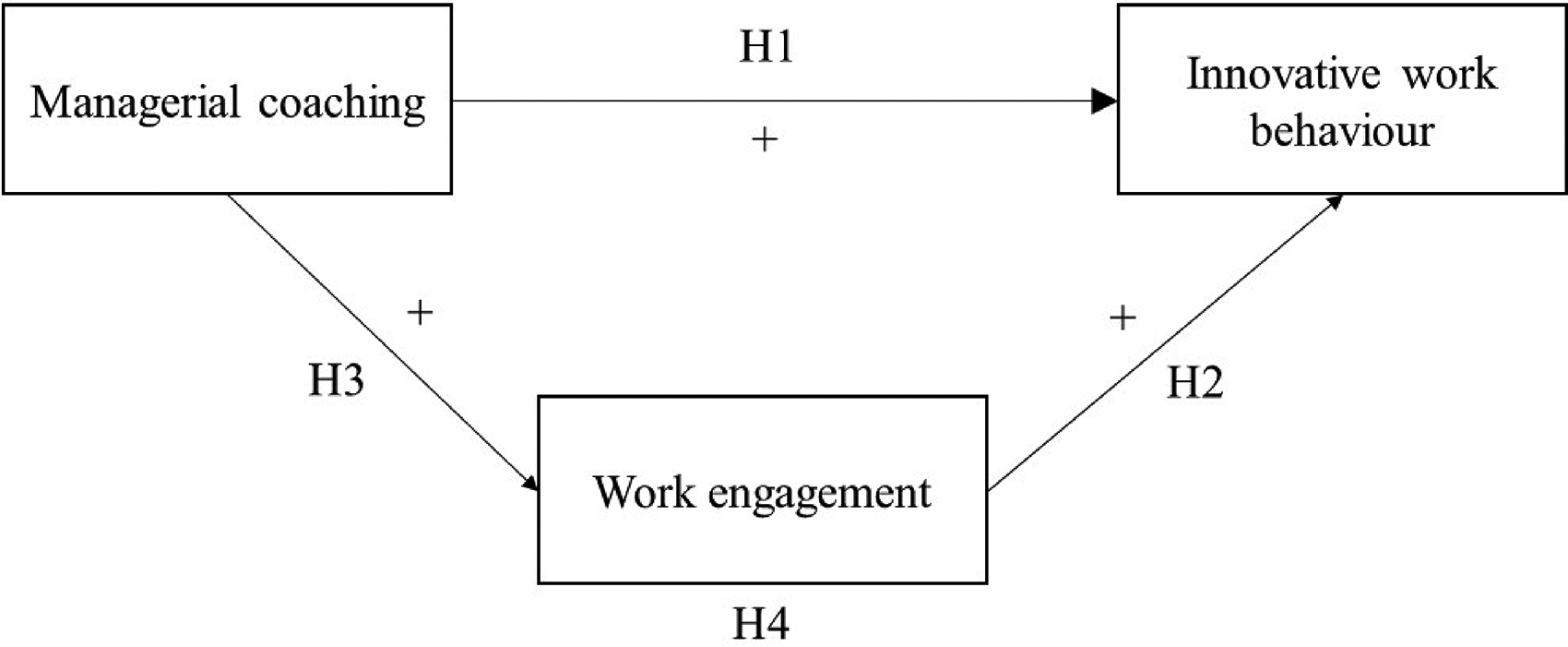
Proposed research model.
Methodology
Sample and procedure
The survey data were gathered via questionnaires offered in electronic and paper format from employees in 88 companies in different industries and located in different parts of Finland. The size of the companies varied between 20 and 250 employees. According to Statistics Finland, there are around 19,800 SMEs in Finland, and thus our sample represents around 0.4% of the total.
We used convenience sampling and originally selected a total of 100 SMEs from regional business lists that were made publicly available. Our criteria were: (1) the selected companies represented the variety of SME businesses in Finland as well as possible in terms of the industries and their location; (2) the CEO allowed the researchers to gather data from all of the employees in the company. The researchers contacted the CEO of each company by telephone and introduced the research procedure. In such cases where the electronic survey was difficult to execute, a researcher visited the company in person to collect the data, which was often carried out in meetings where further clarification could be given if needed. About one-third of the companies received the questionnaire in paper form. The questionnaires were available in Finnish, Swedish, and English. The collection of the data took 15 months.
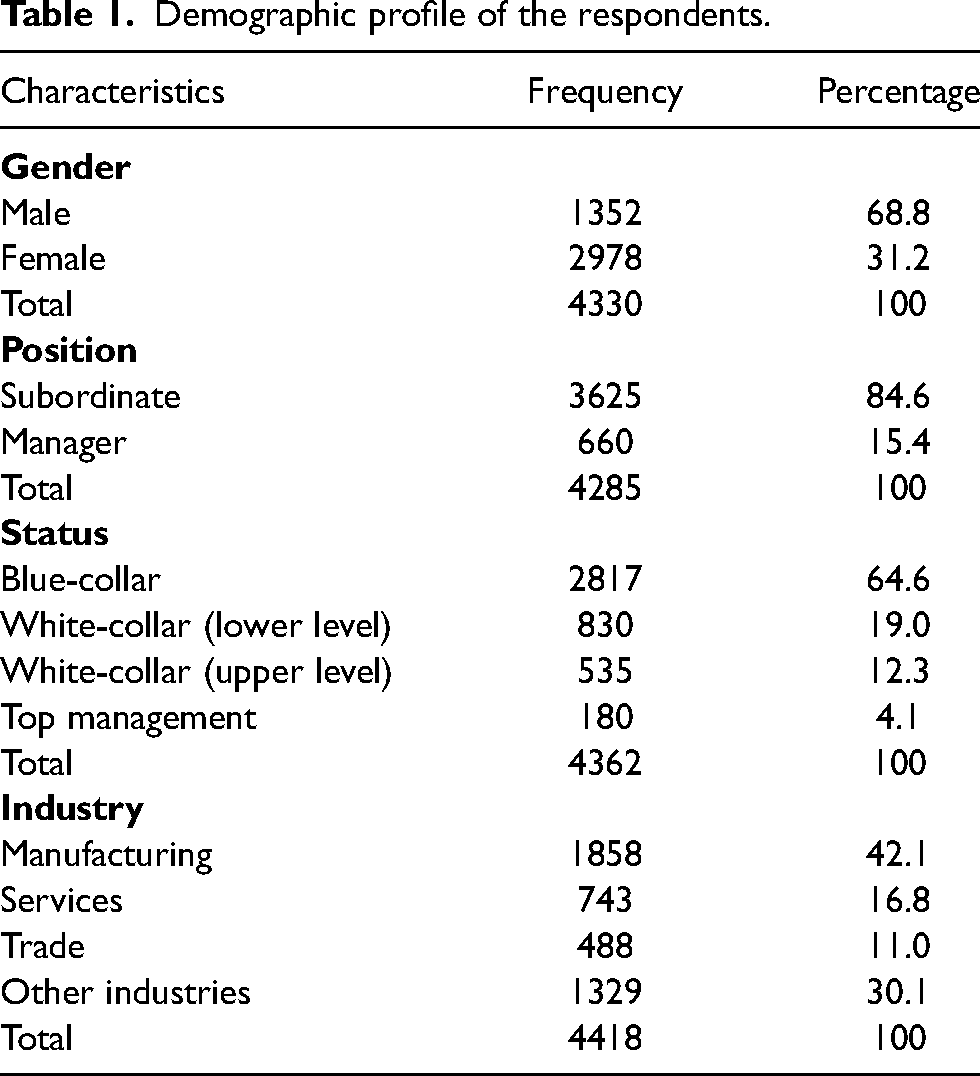
The final sample consists of 88 SMEs representing a wide variety of businesses such as IT, manufacturing (e.g. metal, wood, and food manufacturing), service businesses (e.g. cleaning, consulting, and hotel and restaurant businesses), retail (e.g. sales of cars, hardware, and pharmaceutical products), construction, education, and banking. Questionnaires were distributed to a total of 10,434 employees, and we received 4418 valid returns constituting a response rate of 42.3%. The majority of the respondents (68.8%) were male, which accurately represents the gender distribution in the private sector in Finland. Regarding position, 84.6% of participants were subordinates, and the remaining 15.4% were in a management role. A total of 64.6% of the respondents were blue-collar workers, and the rest were white-collar workers (lower level, upper level, and top management). 42.1% of participants worked in manufacturing, 16.8% in services, 11% in trade, and 30.1% for other industries. Manufacturing is slightly overrepresented in the material (Statistics Finland 2022). The demographic profile of the respondents is presented in Table 1.
Demographic profile of the respondents.
A questionnaire survey method using structured questions was adopted to test the proposed hypotheses, and the questionnaire was pre-tested (N = 7) before the actual data collection.
Measurements
Innovative work behavior
A 10-item scale from de Jong and den Hartog (2010) was used to measure the dimensions of IWB. All items were reworded from manager ratings to employee self-assessments, and participants rated their performance on a 7-point scale anchored with never (1) and very often (7). The idea exploration dimension was measured with two items, an example item being, “At your workplace, how often do you pay attention to issues that are not part of your daily work?” The Cronbach's alpha for this dimension was .733. Idea generation was measured with three items, an example item being, “At your workplace, how often do you generate original solutions to problems?” The Cronbach's alpha for this dimension was .915. Championing was measured with two items such a, “At your workplace, how often do you attempt to convince people to support an innovative idea?” The Cronbach's alpha was .917. Implementation was measured with three items; an example item is, “At your workplace, how often do you put effort into the development of new things?” The Cronbach's alpha for this dimension was .876.
Managerial coaching
A validated 7-item scale developed by Tanskanen et al. (2019) was used as a measure for MC. The respondents were asked to evaluate their supervisor's leadership activity on a 7-point scale anchored with strongly disagree (1) and strongly agree (7). Examples of the included items are “My manager ensures that everyone is capable of doing their tasks” and “My manager facilitates mutual cooperation in the group.” The Cronbach's alpha for this area was .948.
Work engagement
Work engagement was measured using the Utrecht Work Engagement Scale (UWES), originally developed by Schaufeli et al. (2002). For this study, the validated Finnish version UWES-9 (Seppälä et al., 2009) was selected. The 7-point response scale was anchored with never (0) and every day (6); an example item being “I am enthusiastic about my job.” The Cronbach's alpha for this area was .945.
Control variables
We used gender, position (manager vs. subordinate), and job status (blue-collar vs. white-collar) as control variables because they have previously been tested as controls in relevant studies (e.g. De Spiegelaere et al., 2015; Sarwar et al., 2020). In addition, we controlled for industry. For hypothesis testing, the control variables were modified to dummy variables.
Analysis strategy
The data analysis was conducted using SPSS Statistics 26.0 and Amos 26.0 statistical software. Before testing our hypotheses, confirmatory factor analysis (CFA) was carried out to assess the possibility of common method variance, and to ensure the discriminant validity of the scales used. Discriminant validity was also tested using the heterotrait–monotrait criterion. Harman's single-factor test, common latent factor approach and average variance extracted (AVE) analysis were used to further establish the validity and reliability of the scales. Hierarchical regression analysis was used to investigate the hypothesized associations (Hypotheses 1a–1d, 2, and 3a–3d). Hayes (2013) PROCESS macro version 3.5 (model 4) was used to test the mediating effect of work engagement on the relationship between MC and innovative work performance in terms of exploration, generation, championing, and implementation (Hypotheses 4a–4d). We extracted 5000 bootstrap samples to obtain the 95% bias-corrected confidence intervals (CIs) and to examine the statistical significance of the hypotheses.
Results
Analyses of factor structure and common method variance
Table 2 illustrates the comparison between the three different CFA structures. First, we analyzed a one-factor baseline model, wherein MC, UWES, and IWB were set to load on a single factor. This model did not adequately fit the data (χ2 = 55,967.91; df = 299; p < .000; RMSEA = .205; CFI = .448; TLI = .352) as it did not reach the commonly used cutoff values for model fit (Marsh et al., 2004). Second, the three-factor model was specified by setting the loadings onto the respective three factors. Compared to the previous model, the three-factor model (χ2 = 12,034.61; df = 296; p < .000; RMSEA = .095; CFI = .884; TLI = .862) showed an improved, albeit still inadequate, fit to the data. Third, the hypothesized six-factor model was specified by setting the loadings of IWB onto the four respective factors. This model was contrasted with the one-factor and three-factor models. The results indicate that the hypothesized model (χ2 = 6728.63; df = 289; p < .000; RMSEA = .072; CFI = .936; TLI = .921) clearly outperformed the previous models.
Results of confirmatory factor analyses.
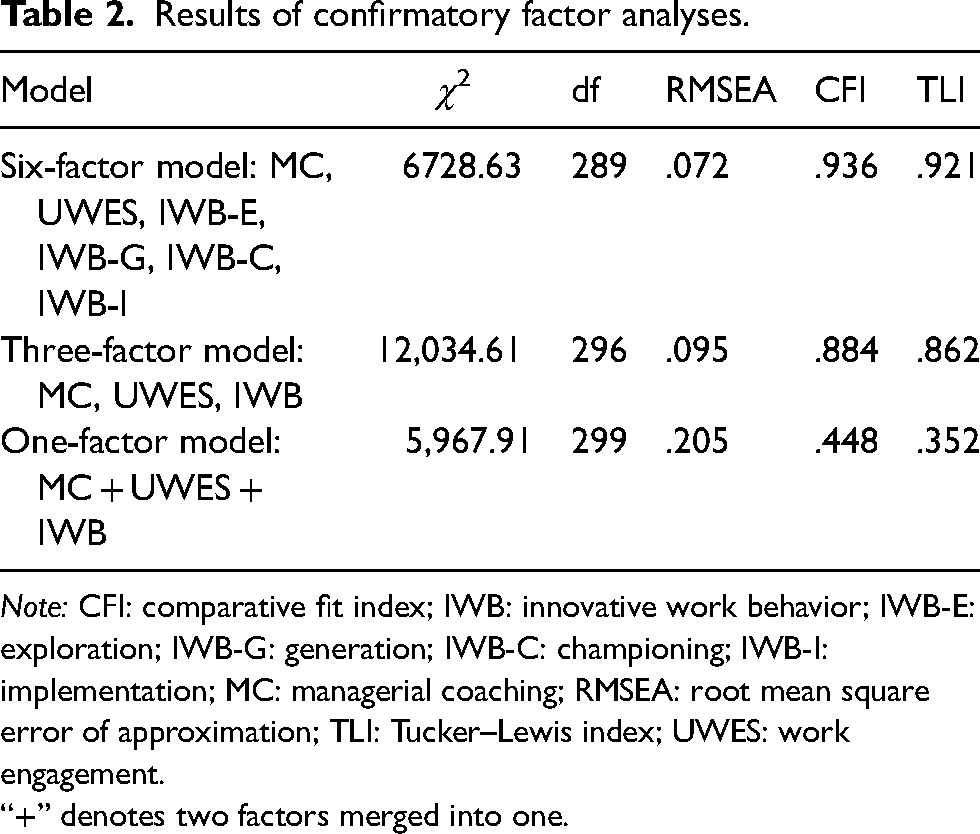
Note: CFI: comparative fit index; IWB: innovative work behavior; IWB-E: exploration; IWB-G: generation; IWB-C: championing; IWB-I: implementation; MC: managerial coaching; RMSEA: root mean square error of approximation; TLI: Tucker–Lewis index; UWES: work engagement.
“+” denotes two factors merged into one.
Owing to the use of cross-sectional self-reported data and the collection of all of the data from the same source survey, our data is potentially susceptible to common method variance (Podsakoff et al., 2003). A Harman's single-factor test was conducted to address the threat of common method variance (see, e.g., Curado, 2018). Table 2 shows the results of the CFA and indicates that the six-factor model showed a better fit than any of the competing models, thus suggesting that common method variance does not pose a problem in our results. In addition, we tested for common method bias using the common latent factor analysis. The common variance is .62. In our study, the common method variance is not caused by the model being simple, which may be a source for common method bias. We had several variables in the questionnaire and the respondent could not have been aware which relationships we will test. Thus, the relationships tested in this paper were not likely to be part of the respondent's cognitive maps. In this context, Harrison et al. (1996, p. 248) refer to the cognitive miser principle, which we considered when planning the survey.
Assessing validity and reliability
Our measurement constructs showed high reliability, as the Cronbach's alphas for each scale exceeded the generally accepted level of .7. The composite reliability (CR) of the constructs ranged from .759 to .948 (see Table 3), thus exceeding the required threshold of .70 (Hair et al., 2014) and attesting to the strong internal consistency of the constructs.
Measurement model summary.
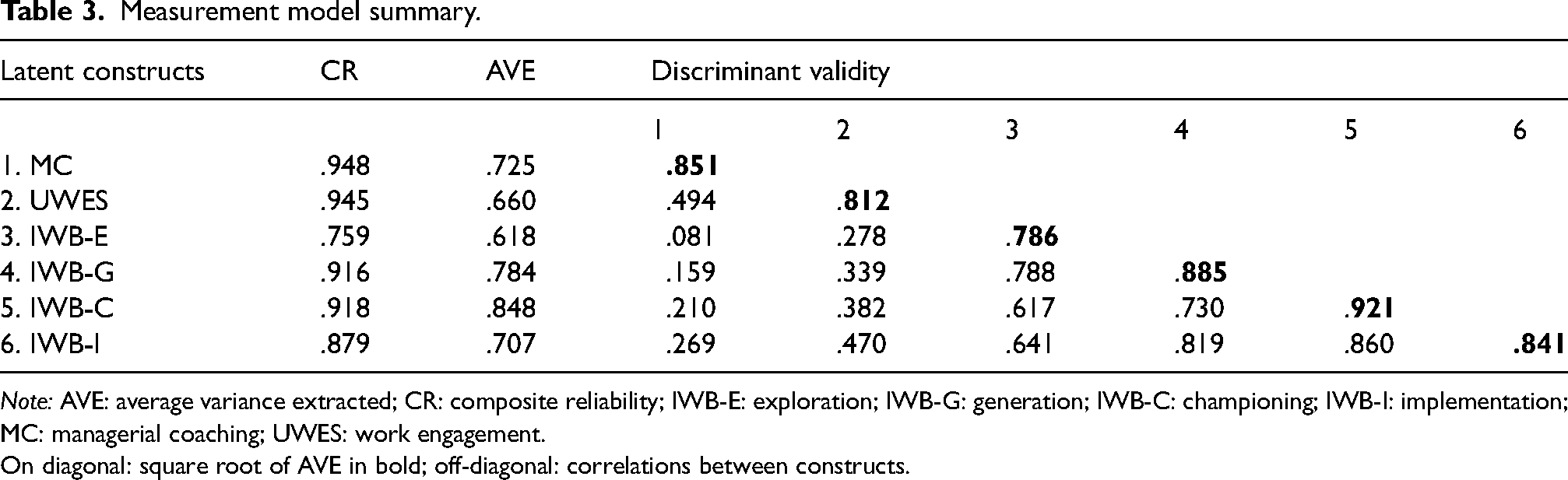
Note: AVE: average variance extracted; CR: composite reliability; IWB-E: exploration; IWB-G: generation; IWB-C: championing; IWB-I: implementation; MC: managerial coaching; UWES: work engagement.
On diagonal: square root of AVE in bold; off-diagonal: correlations between constructs.
To assess the convergent validity of the constructs, the AVE was computed for each construct (see Table 3). All of the AVE values were above the cutoff value of .50 recommended by Fornell and Larcker (1981), and each factor loading was also above the generally accepted level of .50. The discriminant validity of the constructs was assessed by comparing the square roots of the AVE values with the construct correlations. For adequate discriminant validity, the correlations between constructs should be smaller than the square roots of the AVE values. The results shown in Table 3 indicate a good discriminant validity and construct independence for each scale. Furthermore, as illustrated in Table 4, the heterotrait–monotrait results do not show any concerns regarding discriminant validity, because the values were satisfactorily below the heterotrait–monotrait threshold value of 0.90 (Gold et al., 2001).
Discriminant validity: heterotrait–monotrait criterion.
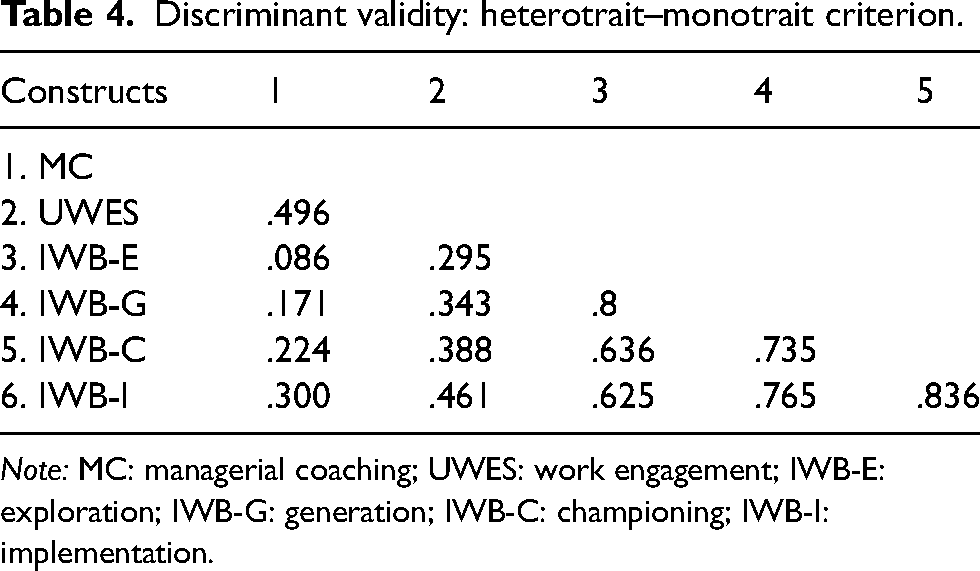
Note: MC: managerial coaching; UWES: work engagement; IWB-E: exploration; IWB-G: generation; IWB-C: championing; IWB-I: implementation.
Descriptive statistics
Table 5 shows the means, standard deviations, and correlations between the study variables. All of the correlations showed an expected direction and were significant at the p < .01 level. The relationship between MC and work engagement was positive (r = .464). MC was also positively related to all of the dimensions of IWB (r. = .060–.245). In addition, the relationships between work engagement and IWB dimensions were positive (r = .246–.433).
Mean, standard deviation, and correlation for the scale variables.
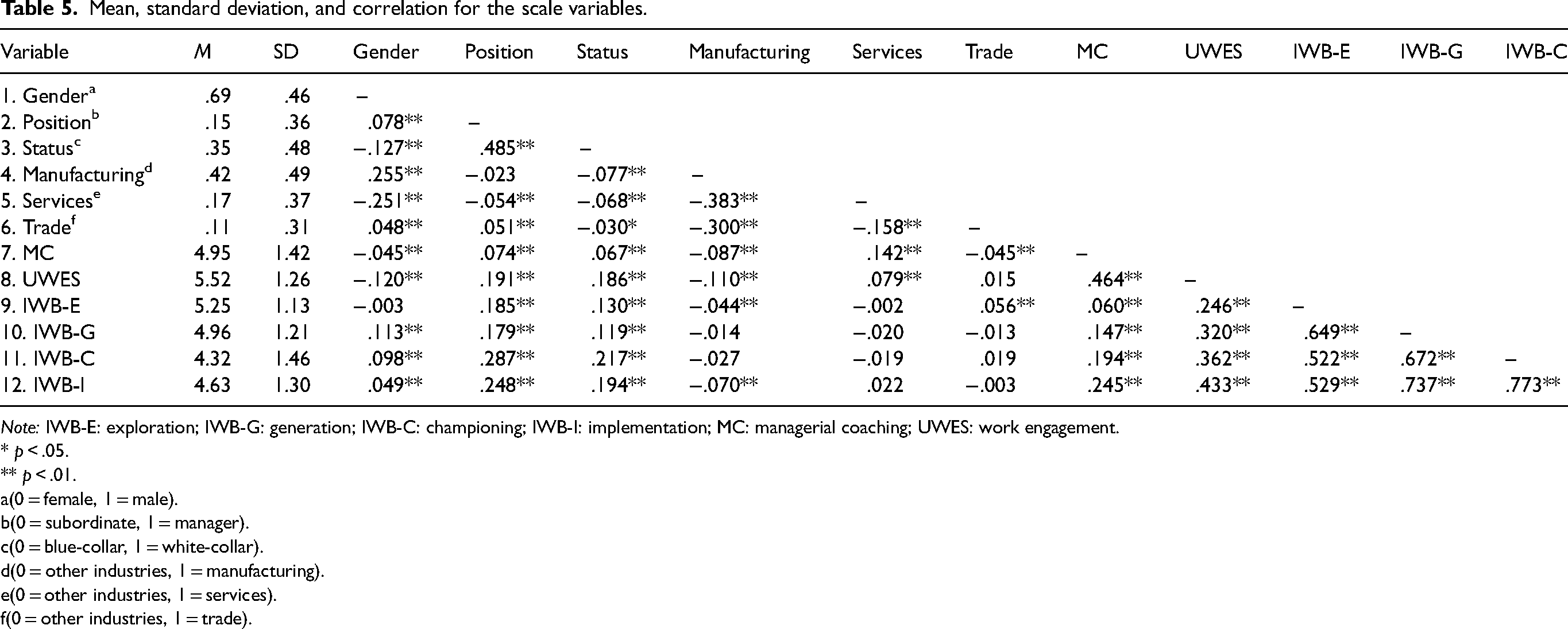
Note: IWB-E: exploration; IWB-G: generation; IWB-C: championing; IWB-I: implementation; MC: managerial coaching; UWES: work engagement.
* p < .05.
** p < .01.
(0 = female, 1 = male).
(0 = subordinate, 1 = manager).
(0 = blue-collar, 1 = white-collar).
(0 = other industries, 1 = manufacturing).
(0 = other industries, 1 = services).
(0 = other industries, 1 = trade).
Hypothesis testing
Table 6 shows the results of the hierarchical regression analysis predicting the dimensions of IWB. The results indicate that MC has a direct positive relationship with each dimension of IWB—exploration (Model 2: β = .040, p < .05), generation (Model 2: β = .135, p < .001), championing (Model 2: β = .165, p < .001) and implementation (Model 2: β = .218, p < .001)—after gender, position (manager/subordinate), job status (white/blue-collar) and industry (manufacturing/services/trade/others) were controlled for. This result provides support for Hypotheses 1a–1d.
Results of hierarchical regression analyses predicting innovative work behavior.
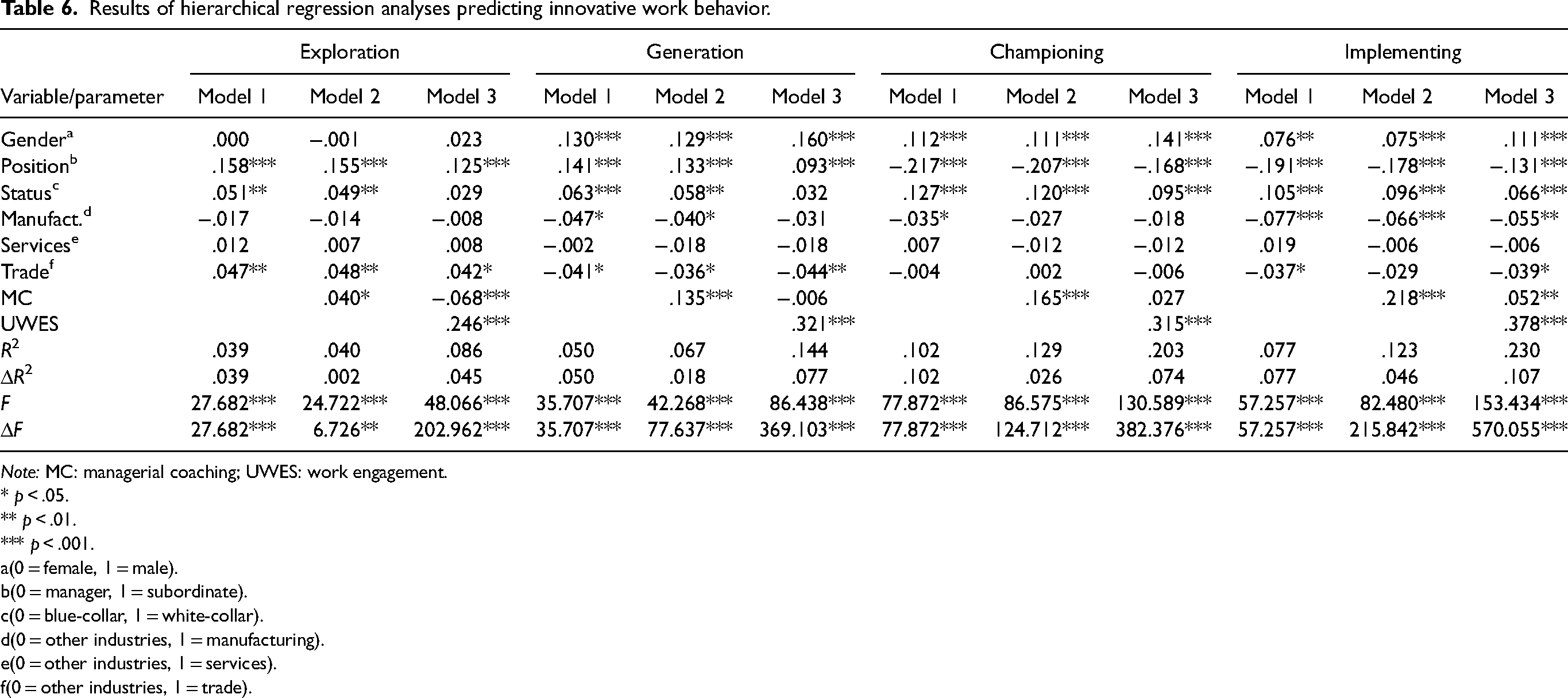
Note: MC: managerial coaching; UWES: work engagement.
* p < .05.
** p < .01.
*** p < .001.
(0 = female, 1 = male).
(0 = manager, 1 = subordinate).
(0 = blue-collar, 1 = white-collar).
(0 = other industries, 1 = manufacturing).
(0 = other industries, 1 = services).
(0 = other industries, 1 = trade).
The results in Table 7 illustrates the positive relationship between work engagement and the dimensions of IWB—exploration (Model 3: β = .246, p < .001), generation (Model 3: β = .321, p < .001), championing (Model 3: β = .315, p < .001) and implementation (Model 3: β = .378, p < .001)—after gender, position, job status and industry were controlled for. This result provides support for Hypotheses 2a–2d. Table 4 further show that MC has a positive relationship with work engagement (Model 2: β = .440, p < .001) after controlling for gender, position, job status and industry; thus, Hypothesis 3 is supported.
Results of hierarchical regression analyses predicting work engagement.
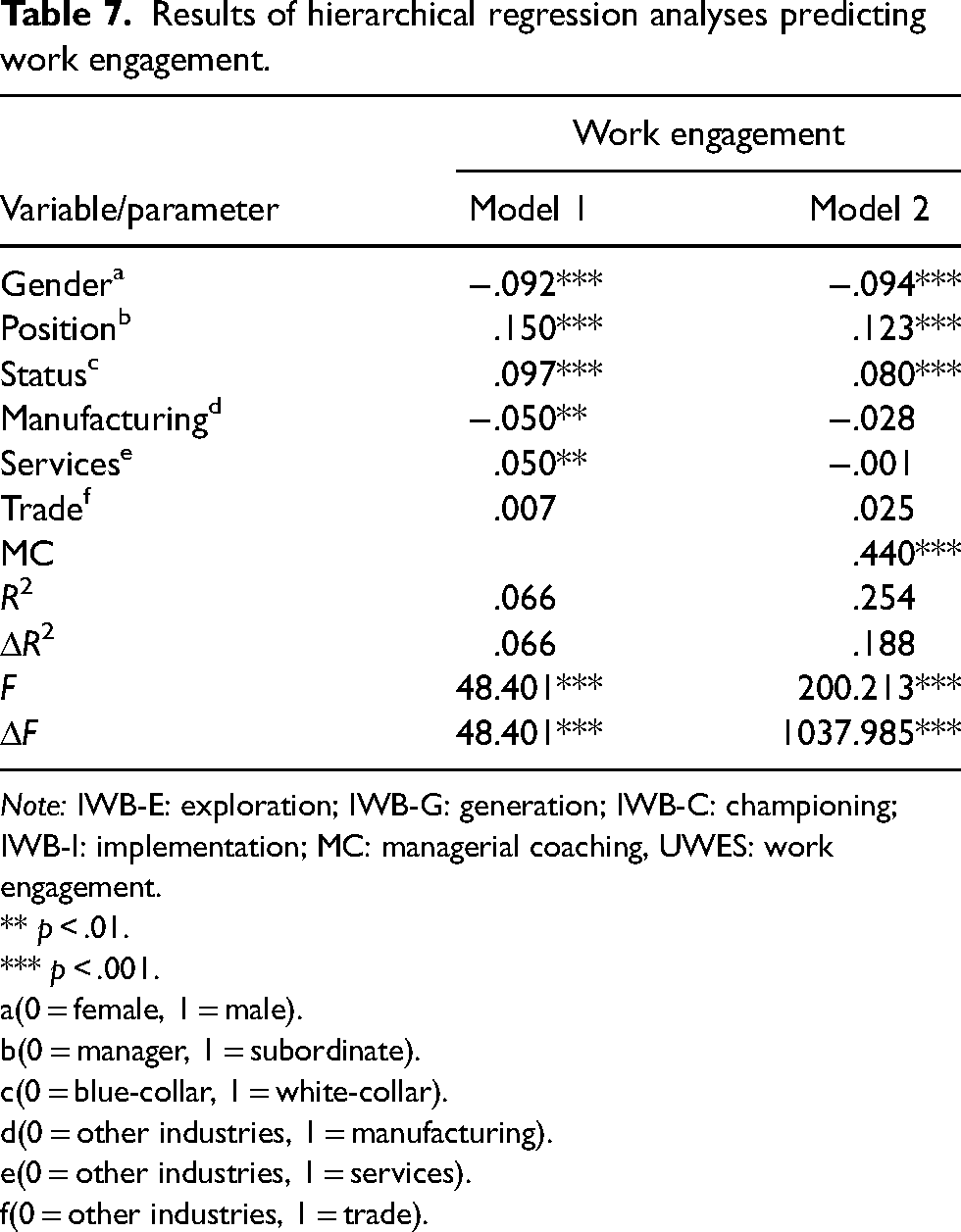
Note: IWB-E: exploration; IWB-G: generation; IWB-C: championing; IWB-I: implementation; MC: managerial coaching, UWES: work engagement.
** p < .01.
*** p < .001.
(0 = female, 1 = male).
(0 = manager, 1 = subordinate).
(0 = blue-collar, 1 = white-collar).
(0 = other industries, 1 = manufacturing).
(0 = other industries, 1 = services).
(0 = other industries, 1 = trade).
The Hayes PROCESS macro was used to test the mediation hypotheses (Hypothesis 4a–4d). The results depicted in Table 8 show that work engagement mediates the relationship between MC and exploration (effect = 0.0866, boot SE = 0.0078, 95% bootstrap CI = [0.0714, 0.1024]). Thus, Hypothesis 4a receives support. With regard to generation, the findings show that work engagement mediates the relation between MC and generation (effect = 0.1204, boot SE = 0.0086, 95% bootstrap CI = [0.1041, 0.1372]) providing support for Hypothesis 4b. For championing, the results show the mediation effect (effect = 0.1426, boot SE = 0.0092, 95% bootstrap CI = [0.1245, 0.1607]) and provide support for Hypothesis 4c. Finally, the results show the mediating role of work engagement between MC and implementation (effect = 0.1532, boot SE = 0.0088, 95% bootstrap CI = [0.1366, 0.1709]). Thus, Hypothesis 4d receives support. Table 8 demonstrates that the mediating effect of work engagement strengthens as the innovation process goes further.
Results of the bootstrap for the indirect effects of managerial coaching on innovative work behavior via work engagement.
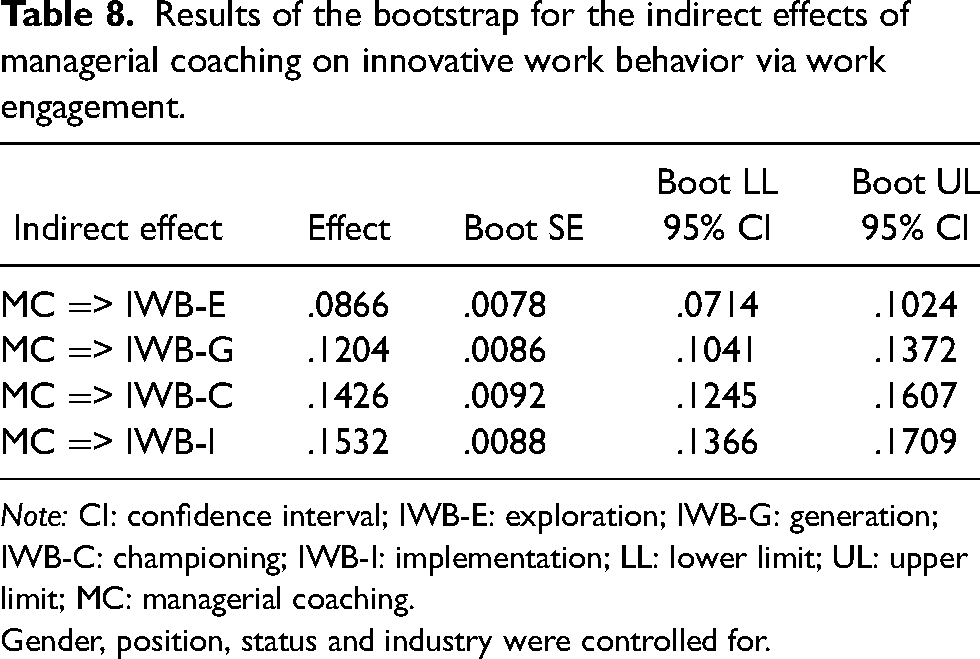
Note: CI: confidence interval; IWB-E: exploration; IWB-G: generation; IWB-C: championing; IWB-I: implementation; LL: lower limit; UL: upper limit; MC: managerial coaching.
Gender, position, status and industry were controlled for.
Discussion
The aim of this study is to improve the understanding of the connection between leadership and innovativeness in SMEs, where the challenge is to activate all employees to participate in the continual renewal and innovation of the business (Musneh and Roslin, 2021; Pasha et al., 2022). Especially, we investigate the connection between MC and employees’ IWB, taking four different dimensions into consideration, and examine the mediating effect of work engagement in those connections. Our results reveal that MC is positively associated with IWB, which reinforces previous observations of MC as a factor in improved employee performance (Huang and Hsieh, 2015). Our results also show a clear connection between MC and IWB, which is an increasingly important dimension of job performance (Harari et al., 2016) in SMEs. As far as we can ascertain, our study is the first to test this model.
We found that while MC has a positive effect on all dimensions of IWB (both directly and also when mediated by work engagement), the effect is not uniform. Instead, it grows in strength as the innovation process advances. In both cases, the connection is the weakest in the first dimension (idea exploration) and the strongest in the last dimension (idea implementation). We suggest that the increase in impact is due to the nature of the MC approach, where the ultimate goal of the manager is always to support employees in exceeding their previous performance level (Hagen, 2012). Concerning the innovation process, the championing and implementation stages manifest innovative performance in a more concrete way than the other two dimensions. They may also be experienced as “harder” work than exploring and generating ideas, and therefore managerial support is more necessary in these stages. Typically, the championing stage involves selling the idea to acquire resources or support it, and building a coalition to help move the idea toward realization. The implementation stage usually requires a working team that builds a prototype (whether tangible or intangible) and which manages the execution (de Jong and den Hartog, 2010.) These stages necessitate involving more people and managing a plan; something that many employees could use their manager's help with. Furthermore, idea championing and implementation are closer to team innovation than individual innovation. This interpretation makes sense in light of the activities that a coaching manager engages in, many of which have to do with facilitating collaboration in the workgroup (Hagen and Gavrilova Aguilar, 2012; McCarthy and Milner, 2020).
Our results also demonstrate that work engagement mediates the connections between MC and IWB. However, an interesting question is why the positive effect of MC on IWB seems to be stronger through the mediating effect of work engagement than on its own. Innovations rarely happen by accident, and demand both motivation and effort from employees (Yuan and Woodman, 2010). Engaged employees tend to use their creative potential compared to those who are not engaged (De Spiegelaere et al., 2015), and because they feel stimulated and motivated to devote time and effort at work, they see their tasks as significant and meaningful, and are fully concentrated on carrying out their work (Schaufeli et al., 2002). In so doing, they often have to go beyond their traditional roles and routines, which is essential for innovation performance in SMEs (Gu et al., 2019). Collectively, these findings broaden our understanding of the motivational process through which MC leads to innovative behavior among subordinates.
Theoretical implications
Our research offers two key contributions to advance the development of a theoretical model towards leadership for innovation. First, prior leadership research has demonstrated the overall effect of leadership actions on employee IWB (Hughes et al., 2018). Further, IWB has been conceptualized as consisting of several phases (de Jong and den Hartog, 2010; Janssen, 2000; Kleysen and Street, 2001; Krause, 2004). Although it has been suggested that some leadership styles are more conducive to idea generation, and others idea implementation (de Jong and den Hartog, 2007), the field still lacks a theoretical understanding of the role of leadership in promoting the different stages of innovative behavior (Hughes et al., 2018). Although some earlier studies have suggested that different antecedents could have different effects on the various dimensions of IWB (Hughes et al., 2018; Perry-Smith and Mannucci, 2017), previous research has mostly examined innovative behavior as a one-dimensional concept (Newman et al., 2018; Odoardi et al., 2015). We add to previous work by showing that while MC has a positive effect on each dimension of IWB, the effect is not uniform but grows in strength the further the innovation process advances. Our research results further imply that various leadership behaviors may need to be applied in the different phases of the innovation process in SMEs (Rosing et al., 2011). Thus, we extend the leadership literature by suggesting that the appropriate leadership behavior is contingent on the phases of the innovation process.
Second, by analyzing the role of work engagement as a mediator, this study provides a theoretical insight into the mechanism that allows leadership to influence the IWB of employees. Although the motivational process depicted in the JD-R theory (Bakker and Demerouti, 2007) has been extensively studied within leadership research (e.g. Lee et al., 2019), the observed effects of leadership on in-role performance outcomes such as task performance (Breevaart et al., 2015; Christian et al., 2011), or on extra-role outcomes such as organizational citizenship behaviors (Christian et al., 2011; Salanova et al., 2011) may not be directly applicable to IWB, which according to Kwon and Kim (2020) cannot be directly classified as in-role or extra-role activities. Instead, IWB has been said to represent a distinctive form of organizational behavior fostered by work engagement. As a distinctive type of behavior, the factors influencing it are likely to differ from previously discovered findings (Kwon and Kim, 2020). Therefore, it is surprising that the role of work engagement as a mediating construct between leadership and IWB has not previously been empirically tested. Therefore, we contribute by providing an understanding of the mechanisms through which the managerial coaching of supervisors manifests itself in the IWB of subordinates.
This study has responded to a call by Hughes et al. (2018) who stated that more research on the relationship between leadership and IWB is still needed, and that research should examine actual leadership behaviors rather than styles. In this sense, MC is an especially relevant leadership approach as it particularly illustrates supervisors’ tangible activities and behaviors. We argue that MC as a leadership construct combines the important managerial activities needed in modern SMEs that seek efficiency, continuous development, and innovation (Musneh and Roslin, 2021). Moreover, the scholarly discussion on MC in the theoretical framework of the JD-R theory has so far been relatively sparse.
The current study especially illuminates the motivational process explained by JD-R theory, where a job resource (managerial support, among others) leads to work engagement that leads to improved work performance (Bakker and Demerouti, 2007). In doing so, our study extends the previous research on leadership for innovation by examining an additional potential mediator that has not been empirically investigated, and that is theoretically relevant to fostering individual innovation (Kwon and Kim, 2020). As such, our study brings us closer to understanding the mechanism through which managers can, through concrete actions, enhance the IWB of their employees.
Our study surveyed 4418 employees from 88 SMEs in Finland. In general, our findings add to the few previous studies on the topic conducted using smaller samples in Asian countries (Ali et al., 2020; Wang, 2013), which offer evidence that the more MC employees experience, the more they exhibit IWB. So although our focus in this paper was not on comparing cultural contexts, it does suggest that MC seems to boost IWB in different cultural environments.
Practical implications
We believe that one of the most important tasks for organizational researchers is to seek answers to the fundamental question of how the innovative potential of employees can flourish and be utilized in a way that benefits both the work engagement of employees and the innovative performance of organizations and SMEs in particular. The more that routine tasks are digitalized or automated, the more human resources will be able to focus on problem solving and innovation. Therefore, understanding how employees can be encouraged and cultivated to display innovative behaviors is very important in SMEs (Musneh and Roslin, 2021).
This study has important implications for both researchers and practitioners. Particularly, the current study should help to build an understanding of the dynamics in this construct by showing that managers can impact the IWB of their employees both directly and through work engagement, and that the impact may be greater on championing and implementing innovations than on the stages of exploring and generating them. This observation suggests that companies must develop MC capabilities to boost their work engagement and innovativeness. However, the findings challenge the HRM function in particular, and not just its leadership development activity. Therein, managers’ task descriptions (job design), target setting, rewards, and recruitment are seen as essential HR practices through which MC can be supported in companies, and building leadership that supports IWB must be considered as a strategic choice in an increasing number of SMEs. Thus, our conclusions underline the fact that innovativeness plays a special role in the pursuit of a sustainable competitive advantage in the industry, especially from the point of view of SMEs, as also indicated by Musneh and Roslin (2021) and Pasha et al. (2022).
Limitations and future research
Despite the important contributions of this study, there are some limitations that warrant attention. The first relates to the data, which, albeit based on a large sample and being well representative from the perspective of Finnish SMEs, is single-source data. Self-report questionnaires can create a potential risk of common method variance, and accordingly, future studies could obtain a measure of MC from subordinates and a measure of subordinates’ IWB from the manager. Second, our cross-sectional data does not allow us to draw conclusions about the constructs’ causal relationships. We can only speculate on the form of the connections between MC, work engagement and IWB from a theoretical basis. Accordingly, more research (especially research of a longitudinal nature) is needed to explore whether contextual factors may impact all three of these constructs simultaneously. As a third consideration, our data were collected in SMEs in Finland and did not reflect the situation in other European countries. Thus, further research in different countries would be required to see if the findings from the current study recur in other countries and business contexts.
A further research avenue would be to compare of leaders’ and followers’ perceptions of MC, IWB and work engagement. This would provide a more comprehensive understanding of how innovativeness, leadership and work engagement in SMEs are perceived by different actors. Furthermore, it would be insightful to compare the experiences of the phenomena in question among companies representing different fields in the SME sector. This would provide important information about the generalizability of the results. Additionally, examining the importance of organizational culture and other contextual factors of SMEs could bring further understanding about these factors and the connections between them.
Conclusion
Our study shows that MC is not only an important job resource in SMEs, but also that its importance grows as we move from idea exploration through the generation, championing, and implementation of ideas. We also demonstrate the role of employees’ work engagement as a mechanism through which managers may enhance the innovative behavior of their employees. Overall, our findings provide significant implications that achieving innovation in SMEs requires the development of MC.
Footnotes
Acknowledgements
The authors warmly thank all of the researchers who participated in the data gathering: Riitta Forsten-Astikainen, Katja Ekman, Pia Heilmann, Jenni Kantola, Susanna Kultalahti, Helena Kosola, Mikko Luoma, Sanna Skyttälä, and Timo-Pekka Uotila. They would also like to thank Jussi Tanskanen for his help with the statistical analysis.
Declaration of conflicting interests
The author(s) declared no potential conflicts of interest with respect to the research, authorship, and/or publication of this article.
Funding
The author(s) disclosed receipt of the following financial support for the research of this article: This work was supported by the Academy of Finland, Business Finland, the Finnish Work Environment Fund, and the Foundation for Economic Education.
