



Abstract
What factors drive trade-harmful protectionist policy interventions enacted by European Union (EU) member states? Although EU trade policy is placed under supranational competence, we highlight that trade policy decisions differ within and across the EU national governments. We explain this variation by building on the New New Trade Theory and argue that sectors dominated by highly productive ‘superstar exporters’ are less likely to receive protectionist support, yet governments with greater fiscal capacity are more likely to support these same sectors through non-tariff instruments such as subsidies – and, occasionally, even tariffs. Using data from the Global Trade Alert (2012–2022) and relying on Poisson regression analyses, we find support of our argument. These findings contribute to the literature on EU trade policy, New New Trade Theory and the domestic foundations of trade policy under supranational governance by highlighting the interaction between sectoral competitiveness and fiscal capacity.
Introduction
Are there differences in the extent to which European Union (EU) member states are open to world trade? If so, what explains variations in their trade policy decisions? Given that with the entry into force of the Treaty of Rome in 1957 European governments fully delegated to the European Commission (EC) the power to conduct external trade, creating a customs union and developing a Common Commercial Policy, they cannot define their trade policy independently (Gstöhl and De Bièvre, 2017). As De Bièvre (2023: 3) nicely put it, ‘the Treaties effectively render it impossible, illegal in fact and under the strict jurisdiction of the European Court of Justice, for individual member states to conduct their external trade policy’.
Yet this does not mean that there are no differences in the degree to which EU member states are open to trade with the rest of the world. First, the setting of one common external tariff or the imposition of an anti-dumping measure by the EU does not mean that all EU member states are equally affected by these supranational trade policy measures. As shown in previous works (Ehrlich, 2009, 2011), trade policy changes under the Common Commercial Policy have differentiated impacts depending on the trade profile of each member states. For instance, a tariff or an anti-dumping measure targeting steel imports would likely affect Germany and Italy far more significantly than it would impact smaller economies that do not import steel products – for example, Malta. Second, there are many trade-related policies that member states can independently adopt outside of the Common Commercial Policy that can impact, at least indirectly, their trade flows with the rest of the world. Member states’ decisions regarding domestic subsidies, government procurement rules or inward foreign direct investment (FDI) screening, for instance, have an impact on such countries’ trade flows and are influenced by sectoral characteristics. Third, national representatives play a key role in the EU trade policymaking process both formally, by defining the mandate of and approving the agreements negotiated by the EC, and informally, by representing the demands voiced by various trade-related domestic constituencies (Dür et al., 2020). Therefore, despite the supranational character of its trade policy, shedding light on cross-national differences in the degree of trade openness within the EU is of crucial relevance to understand the politics of trade policymaking in the EU.
In this article, we aim to shed light on the important question of how the enactment of protectionist measures varies both within and across EU member states. To explain cross-sectoral variations in the intensity of protectionist trade policy interventions across EU member states, we start developing our argument, relying on the New New Trade Theory approach. Drawing on the seminal work of Melitz (2003), a growing body of research highlights the importance of firm-level differences in size and productivity in shaping gains from trade liberalization (Baccini et al., 2017, 2022; Melitz, 2003; Bernard et al., 2012; Melitz and Ottaviano, 2008). According to the New New Trade Theory approach, the benefits of trade liberalization are disproportionately captured by a small number of so-called ‘superstar exporters’. This term refers to the small subset of exceptionally productive large-scale firms that dominate exports in their sector due to competitive advantages. 1 These superstar exporters dominate markets, whereas smaller and less productive firms often struggle to compete, experiencing declining sales or being driven out of the market entirely. We leverage the New New Trade Theory approach to understand why EU member states are more likely to supply protectionist policy interventions for some economic sectors than others. Specifically, we posit that sectors with a high share of superstar exporters tend to exhibit lower levels of tariff barriers to trade. This is primarily because such firms’ structural importance in a sector can be expected to produce strong political incentives for sector-level tariff-based trade liberalization at the supranational level that enables these firms to continue reaping the gains stemming from their ability to successfully compete in foreign markets.
However, we also contend that this relationship is contingent on member states’ fiscal capacity, which increases the likelihood of non-tariff measures that governments may adopt at the national level with respect to sectors dominated by such superstar exporting firms. Given that EU member states lack control over tariff policy – since tariffs are negotiated collectively and imposed at the supranational level – national governments rely on non-tariff measures to support their domestic firms. In this context, governments with greater fiscal capacity are better positioned to extend this selective support to reinforce the competitive position of key firms in international markets. As a result, while the presence of superstar exporters is associated with lower levels of tariff-based protectionism, fiscally capable governments will adopt domestic trade-distorting measures such as export subsidies that benefit dominant firms.
Empirically, we start by mapping different trade policy interventions reported by the Global Trade Alert dataset (Evenett and Fritz, 2020), which provides fine-grained information on trade policy changes worldwide since the Global Financial Crisis. These data enable us to capture both within-country and cross-national variations in the use of a comprehensive array of trade-distorting measures used by EU member states. These not only include tariffs, tariff rate quotas (TRQs) and trade defence instruments but also non-tariff measures such as subsidies, government procurement or localization rules. While these are mainly studied in the field of industrial policy, these measures provide financial support for the domestic firms with trade-distorting effects at the disadvantage of foreign competitors. Thus, we consider them a form of protectionism.
Findings from Poisson regression analyses on EU member states between 2012 and 2022 including country and year fixed effects largely support our argument. To begin with, we find that sectors displaying a larger number of superstar exporters are consistently less likely to receive protectionist interventions across the board, on average, everything else being equal. This finding indicates that indeed, highly international, globally oriented exporting firms reduce incentives for the adoption of protectionist tariff measures. Moreover, we also find that EU member states with higher fiscal capacity are more likely to support their superstar exporting firms by adopting new trade-relevant measures. Thus, when governments have the capacity to provide strategic protectionism, they can rely on various instruments including financial grants, state loans and export subsidies. More specifically, we find evidence for our argument that more fiscally capable governments are supporting sectors with higher shares of superstar exporting firms through export-related subsidies. Surprisingly, this also holds for import tariffs. In the Online appendix, we present additional analyses with alternative operationalizations of variables and models that largely confirm the robustness of our findings.
Our results speak to the literature on domestic foundations of trade policy under conditions of supranational governance by highlighting the interaction between sectoral competitiveness and fiscal state capacity. We subsequently make three main contributions. First, we reveal that significant heterogeneity in protectionism exists within the EU, despite the unifying framework of the Common Commercial Policy. Second, by moving beyond tariff-focused analyses and incorporating non-tariff measures, we capture a broader and more contemporary understanding of trade protectionism. Third, we offer a novel theoretical contribution by linking firm-level dynamics to macro-level policy outcomes, showing how national fiscal capacity and sectoral structure interact in shaping trade policies. This novel application bridges the gap between individual-level attitudes towards globalization (as shown by Kiratli, 2022) and macro-level trade policy outcomes. We posit that while the presence of superstar exporters in a sector reduces the overall level of protectionism, governments with greater fiscal resources use targeted interventions to support their most competitive firms. Studying the EU as a ‘least likely’ case of protectionism, this article provides new insights into the domestic foundations of trade policy in integrated economic blocs and the conditions under which governments selectively bypass supranational constraints to shield globally competitive firms.
Differentiated protectionism in the EU: The argument
The politics of trade in the EU has attracted much scholarly attention. Such attention should come as no surprise: the EU is the world's largest trading bloc – ranking first both as a trader of manufactured goods and services and as a destination and source of international investments – and has traditionally played a pivotal role in international trade relations. The delegation of national powers to conduct external trade policy at the supranational level at the very beginning of the European integration project was one of the key factors contributing to the EU acquiring such formidable trade power. However, the supranational character of trade policy in the EU also had an impact on how the scholarly debate about the politics that underpins it has developed over time. Indeed, such an institutional configuration of EU trade policymaking has contributed to the polarization of EU trade policy around two sets of analytical perspectives.
The first highlights the bottom-up processes through which domestically organized societal groups shape EU trade policy choices. These works have drawn attention to how the EU trade policymaking process is substantively shaped by the policy preferences and patterns of political mobilization of trade-related business groups such as export-oriented, import-competing and import-dependent producers and civil society organizations (see Dür et al., 2020, for an overview). The second sheds light on the top-down mechanisms enabling EU institutions to influence EU trade policy independently of societal pressures or in conjunction with them. These contributions have drawn attention to how the bureaucratic and ideological preferences of the EC (Elsig, 2007; Elsig and Dupont, 2012; Garcia-Duran and Eliasson, 2017; Jacoby and Meunier, 2010; Siles-Brügge, 2011), or the political processes unfolding within the European Parliament (Meissner, 2016; Servent, 2017), can impact EU trade policymaking.
EU member states have remained largely marginal in this debate, which is problematic for at least two important reasons. First, even though EU trade policy was placed under supranational competence from the very beginning, member states play a crucial role in the making of EU trade policy decisions, both formally, by defining the mandate of and approving the agreements negotiated by the EC, and informally, by representing the demands voiced by various trade-related domestic constituencies. Studying EU member states is therefore key to understanding the bottom-up processes through which domestic societal demands come to be aggregated and channelled in the EU trade policymaking process (Dür, 2008; Elsig, 2010), as well as the extent to which various configurations of member states’ preferences affect supranational institutions’ ability to independently influence such processes in a top-down fashion (Da Conceição-Heldt, 2011; Da Conceição-Heldt and Meunier, 2014; Larsén, 2007).
Secondly, there are significant differences within the EU regarding the degree to which national markets are open or closed to world trade. On the one hand, there are a wide array of policy instruments that fall outside the scope of the Common Commercial Policy that EU member states can put in place and that have a substantial impact on their trade with the rest of the world. These policy measures include domestic subsidies, government procurement rules and rules on inward FDI. On the other hand, common external tariffs do not have the same trade effects across EU member states: some are protected by tariffs because they import a substantial share of goods that such tariffs apply to, while for others, such tariffs have no de facto protectionist impact because they do not import those goods.
This article addresses a key research gap by exploring why EU member states, despite operating under the Common Commercial Policy, differ in their use of protectionism. While prior research has shown that differences in tariff levels can be explained by institutional access points (Ehrlich, 2009; Ehrlich, 2011), we advance this literature in two ways. First, we move beyond traditional at-the-border measures to examine behind-the-border protectionist policies, which have become increasingly relevant. Second, we expand the focus to a key sectoral characteristic – namely, the presence of superstar exporters – and the fiscal capacity of governments to explain variation in protectionism, thus casting new light on the domestic politics of trade in the EU.
We develop our theoretical framework by drawing on the so-called New New Trade Theory approach, also known as heterogeneous firm theory. Building on the seminal work of Melitz (2003), an increasing number of studies show that firm-level differences in size and productivity are crucial in determining which firms can enter and remain profitable in export markets (Baccini et al., 2017, 2022; Ballor and Yildirim, 2020; Bernard et al., 2012; Melitz and Ottaviano, 2008). In a nutshell, the New New Trade Theory posits that superstar exporting firms within each sector reap the lion's share of the gains from trade opening: only the largest and most productive firms benefit from market liberalization, while middle- and low-productivity firms either see their sales decline or are forced to exit the market altogether. This model highlights how trade opening may generate distributive conflicts, not only between owners of factors of production or economic sectors but also between firms with different levels of productivity. Most importantly, this approach challenges the conventional wisdom that all firms in export-oriented sectors gain equally from trade liberalization: the benefits accrue to a tiny subset of highly productive firms, while the costs are borne not only by import-competing firms but also by the vast majority of firms with lower-than-superior productivity in export sectors (Flaherty and Rogowski, 2021).
Building on this theoretical foundation, we argue that the presence of superstar exporters plays a key role in shaping the level of protectionism across the EU. Specifically, we posit that sectors with a high share of superstar exporters tend to exhibit lower overall levels of protectionism. This is primarily because such firms’ structural importance in an economy incentivizes policymakers to keep free and open markets, and superstar firms have positive spillover effects that discourage broad-based protectionist policies. However, we contend that this relationship is contingent on the fiscal capacity of member states, which moderates the free-trade impact of these firms. Governments with greater fiscal capacity dispose of the means to extend selective support to reinforce the competitive position of key firms and are more likely to engage in targeted interventions. Specifically, we expect that fiscal capacity moderates the liberalizing impact of superstar exporters because it incentivizes EU member states to provide domestic support to reinforce the global dominance of their most competitive firms. We outline the mechanism driving this relationship below.
Superstar firms across economic sectors
We start by outlining the baseline expectation that a higher share of superstar exporters in a country's economic sector is associated with lower levels of protectionism. This relationship stems from three underlying mechanisms. First, previous research has shown that superstar exporters are among the strongest advocates of trade openness and liberalization. Since these firms disproportionately benefit from global market access, they can be expected to actively push for the reduction of trade barriers in reciprocal trade negotiations (Ciuriak et al., 2015; Osgood et al., 2017). This is so because, in the logic of these reciprocal negotiations, they have all the interest in offering lower domestic tariff barriers to foreign producers, which are irrelevant for them, in exchange for the reduction of foreign tariff barriers to trade. Existing studies support this view, showing that globally oriented export firms politically mobilize to maintain trade liberalization commitments and lobby against introducing new trade barriers (e.g., Anderer et al., 2020; Hanegraaff et al., 2024; Zeng, 2021). Their economic and political influence makes it costly for policymakers to adopt broad protectionist policies that could undermine their global competitiveness. In the face of strong presence of such firms, this means that policymakers are likely to receive political demands that tend to oppose trade protectionism. Political mobilization by European businesses in support of the EU–Mercosur trade agreement offers illustrative evidence. Industry groups representing agrochemical producers and the broader chemical sector, such as the European Chemical Industry Council (CEFIC), have publicly endorsed the agreement, emphasizing its importance for export growth and regulatory alignment (CEFIC, 2019). Similarly, sectoral lobbies including Italy's Confindustria and representatives of the European automotive industry have urged EU institutions to finalize the deal, underscoring their broader pro-liberalization stance (Nouvian, 2024; Semeraro, 2025).
Second, superstar exporters are not only economically dominant but also key drivers of innovation, productivity and wage growth. Previous works have shown that high-growth exporting firms pay higher wages, stimulate productivity gains and generate knowledge spillovers that benefit other firms in the economy (Du and Vanino, 2019; Mason and Brown, 2013; Parsley and Halabisky, 2008; Stangler, 2010). Given their structural importance, policymakers thus have strong incentives to maintain a trade-friendly environment, avoiding protectionist interventions that could disrupt these economic spillovers and diminish national competitiveness.
Third, the presence of superstar exporters fosters pro-globalization sentiment among both policymakers and the broader public. Recent studies highlight how high-growth exporting firms shape positive attitudes towards globalization, making protectionism politically less viable (Kiratli, 2022; Lee and Liou, 2022). By highlighting economic prosperity through export markets, growth and sustaining global trade networks, these firms influence public discourse and reinforce political preferences that align with maintaining trade openness. Taken together, these mechanisms suggest that the presence of superstar exporters creates structural, economic and political incentives that deter protectionist interventions.
H1: EU member states are less likely to adopt protectionist policies in sectors with a high share of superstar exporting firms.
Superstar firms and fiscal capacity
While we argue that the presence of superstar exporters leads to lower levels of protectionism, we also expect this relationship to be mediated by EU member states’ fiscal capacity. Fiscal capacity means that governments dispose of resources to support domestic producers, either to reinforce firms’ global competitiveness or to compensate those losing market shares due to increased foreign competition. On the one hand, we expect that fiscal capacity should have no significant impact on the degree to which the presence of superstar exporters in a sector affects the likelihood of tariff protectionism in such sector. As already argued, EU member states lack control over tariff policy – since tariffs are negotiated collectively and imposed at the supranational level. Moreover, considering that these firms are already present in export markets, whether governments dispose of resources to support them or not should not affect their support for low domestic tariff barriers to trade.
On the other hand, we contend that whether EU member states have high levels of fiscal capacity or not may have a non-negligible impact on how the presence of a high share of superstar exporters influences the likelihood of other, less traditional, forms of protectionism. The relationship between fiscal capacity and trade policy has been widely explored in political economy research. One prominent view suggests that higher fiscal capacity enables governments to sustain open trade policies by compensating those negatively affected by globalization (Cameron, 1978; Katzenstein, 1985; Rodrik, 1998). However, fiscal capacity also allows governments to deploy trade-distorting measures, such as targeted export subsidies, which often serve as functional substitutes for tariffs (Rickard, 2012). Thus, fiscal capacity can make it easier for governments to use non-tariff measures such as subsidies, not to shield declining industries or to compensate losers from trade liberalization, but to strengthen the international standing of their leading firms (Ciuriak et al., 2015; Helpman et al., 2010). Since these measures may have trade-distorting effects that can strengthen the international standing of domestic firms at the expense of foreign ones, we consider them a form of protectionism.
These types of interventions are particularly viable in countries with high fiscal capacity, where governments have the financial resources to support key industries and invest in policies that enhance their firms’ market position (Du and Vanino, 2019; Stangler, 2010). This is also relevant for EU member states. Indeed, while all member states must comply with EU competition law, which also includes detailed rules on state aid, the general prohibition of trade-distorting aid is qualified by several exceptions and additional considerations, which leaves significant room for discretion to implement measures with trade-distorting effects (Stöllinger and Holzner, 2017). Therefore, although EU state aid law imposes important restrictions, it also permits considerable discretion due to broad treaty-based exemptions, EC latitude and flexible implementation practices. Notable exceptions include aid for regional development in economically weaker areas, projects of common European interest and the development of specific activities or sectors (Blauberger, 2009; Schmitz et al., 2025). In other words, as Blauberger noted ‘European state aid rules do not establish a full-fledged European state aid policy. The EC cannot oblige national governments to spend state aid on particular purposes… [and] Member States still enjoy significant choice between different types of admissible aid when it comes to specific targets’ (Blauberger, 2008: 22).
This implies that in the EU, too, governments with greater fiscal capacity may have an interest in subsidizing domestic firms, not necessarily to shield declining industries but to reinforce the global dominance of their most competitive firms. Anecdotal evidence showcases this mechanism. For example, Spanish auto parts exporter Gestamp recently received over €100m in grants from the Spanish government under the Strategic Projects for Economic Recovery and Transformation (PERTE) initiative to support its operations and strengthen its global competitiveness (Invest in Spain, 2023). Similarly, the German government announced a €920m subsidy to support semiconductor giant Infineon Technologies AG in building a new factory in Dresden (Westerheide, 2025). These cases highlight how fiscally capable governments provide direct support to internationally competitive firms, reinforcing their global position rather than shielding them from trade.
More fiscally capable governments are therefore better positioned to deploy such instruments in ways that enhance the competitive standing of superstar exporters. In short, we expect that EU member states’ fiscal capacity should not influence the extent to which the presence of a high share of superstar exporters in a sector reduces the likelihood of tariff-based protectionism but should moderate its negative effect on the likelihood of protectionism in the form of export subsidization. On net, therefore, fiscal capacity should moderate the negative impact of superstar exporters on the likelihood of protectionist interventions in a given sector.
H2: Higher fiscal capacity reduces the negative effect of superstar exporting firms on adopting protectionist measures, leading to more protectionism. H2a: Higher fiscal capacity does not impact the effect of superstar exporting firms on adopting import tariffs. H2b: Higher fiscal capacity reduces the negative effect of superstar exporting firms on adopting export subsidies.
Research design
To investigate the use of protectionist trade measures, we rely on the Global Trade Alert dataset (Evenett, 2019; Evenett and Fritz, 2020). It categorizes each trade-related policy intervention (state act) depending on the trade effect compared to the last recorded entry: red for distorting, green for liberalizing and amber for likely threatening interventions. 2 State acts can be narrow or broad – the latter containing multiple interventions often affecting various sectors. We select the trade-distorting interventions and reshape the data based on unique interventions, the year of the announcement of the policy change, 97 sectors (harmonized system, HS two digits) and the specific intervention measure. Before starting the analyses, we want to draw attention to the relevance of the de facto impact of EU-level trade policies in the dataset. Changes in tariff levels, trade defence measures and other import restrictions, such as TRQs, are enacted at the supranational level; nonetheless, their effects vary significantly across EU member states. This aligns with previous findings by Ehrlich (2009), which highlight that tariff measures, despite being implemented uniformly across the EU, have differentiated impacts depending on the trade profile of each member state. This phenomenon, termed the ‘meaningful trade effect’ 3 in the Global Trade Alert handbook, underscores the unequal burden or benefit that supranational policies can have on individual member states.
Thus, we analyse only the protectionist policy interventions with an actual impact on trade flows, offering a more detailed view of the distribution of trade policy effects. This explains why, even for tariffs and other supranational trade measures, we observed heterogeneities across member states. In addition to traditional trade policies – tariffs, TRQs and defence measures – we also consider trade-related non-tariff measures that, at least indirectly, can have a trade-distorting effect and thus impact member sates’ trade flows. We exclude all policy changes not directly linked to the trade of goods, such as migration and intellectual property measures. We operationalize our dependent variable as the number of distinct protectionist trade-related interventions taken by country, sector and year. For this, we aggregate, when necessary, the product codes to the sectoral level (HS, two digits), and starting with the value 1, we count the number of distinct protectionist intervention IDs adopted towards other countries in a given country, sector and year. If no protectionist intervention occurred, the variable takes over the value 0. For example, in 2022, the EU negotiated a tariff package that increased import tariffs (1) and introduced export quotas (2) for the chemical sector (HS 23). Given the financial difficulties faced by German industries in the aftermath of rising gas prices following the Russian war of aggression on Ukraine, the German government announced a subsidy package, which includes state aid (3) and financial assistance in foreign markets (4) to support the production of firms operating in the chemical sector. Thus, the count variable for protectionism in the chemical sector in Germany in 2022 is the number of different interventions (4) times the affected countries. Now, assume that Greece does not have any chemical production, so they are not affected by the import tariff (no meaningful trade effect) and neither did the Greek government adopt support packages. The count variable for protectionism in the chemical sector in Greece in 2022 is therefore zero.
As discussed in our theoretical framework, we expect sectors with a higher share of superstar exporters to experience lower levels of broad-based protectionism conditional on fiscal capacity. First, to estimate the effect of superstar exporters within a given sector, we rely on the Trade by Enterprise Characteristics (TEC08, EUROSTAT) data, which account for the share of trade conducted by different types of firms. We calculate the sectoral share of firms exporting more than 75% of their turnover in each sector. As the data rely on voluntary reports, it does not cover all member states consistently. In the Online appendix, we provide an alternative operationalization using the share of exports by sector–country–year, employing trade data from the Base pour l'Analyse du Commerce International (BACI) dataset (CEPII, Gaulier and Zignago, 2010). We run additional analyses relying on a balanced panel dataset covering 27 EU member states from 2009 to 2022 using this proxy variable for the share of superstar exporters. These additional analyses ensure that the findings are not driven by a subset of countries or sensitive to operationalization (see the Online appendix). Second, we test the probability of protectionist changes conditional on a country's fiscal capacity, employing the percentage share of tax revenues of GDP from EUROSTAT. In the Online appendix, we provide an alternative estimation using logged GDP (constant US dollars) from the World Development Indicators.
We include several controls that may impact member states’ propensity to employ protectionist trade policies. At the sectoral level, we account for the strategic relevance of sectors as defined in the critical entities directive by the EU, following Invernizzi (2025). The strength of this operationalization lies in its institutional legitimacy and in the appealing argument made that military defence is not the only security matter anymore. Thus, we measure the strategic importance of a sector through a binary variable that equals 1 for the critical infrastructure that is required for ‘vital societal functions’ according to the EU's classification (EC, 2023). Please see the Online appendix for details on the operationalization of this variable as well as an alternative based on a previous classification. In line with the literature, we also control for the effect of trade (import and export) shares of sectors within member states. We calculate the share of sectoral trade compared to total trade by sector–country–year using the BACI dataset (CEPII, Gaulier and Zignago, 2010).
At the national level, we control for the coordination of labour market institutions, the political orientation of cabinets and governments and the level of globalization and unemployment (logged). For the potential role of labour market institutions (Baccini et al., 2022), we rely on the Integrated Database on Institutional Characteristics of Trade Unions, Wage Setting, State Intervention, and Social Pacts (ICTWSS, Visser, 2019). 4 This measure captures the presence of coordinated wage-bargaining institutions (on a scale from 1 to 5) in which smaller actors align their actions with decisions made by more influential players (Visser, 2019: 6). Thus, in contrast to centralization, which emphasizes the hierarchical structure of wage negotiations, coordination focuses on the alignment and synchronization of pay policies across different bargaining units (Visser, 2019). Moreover, we use the Parliaments and Governments Database (Döring et al., 2022) for a left–right positioning of the party composition of national cabinets to estimate its effect on the likelihood of protectionist trade-related policies. Lastly, we control for trade openness using the KOF Globalization Index (KOFGI, Gygli et al., 2019) and the percentage of the labour force that is unemployed and actively seeking employment as a proportion of the total labour force (World Development Indicators).
For better data coverage, we focus on 11 EU member states announced across 97 sectors. The sum of trade-related protectionist policy interventions at the country–sector–year level affecting each trading partner is almost 300,000 between 2009 and 2022. As reported in the Online appendix, approximately half of these are import tariffs. We employ the following panel Poisson regression model, including country- and year-fixed effects:

In equation (1), Yi,t,n stands for the dependent variable, measured as the count of announced protectionist trade-related policy interventions for country i, year t and sector n. β1 is the coefficient for the variable SupExpi,t,n, which captures the share of superstar exporters (measured in turnover value), β2 is the coefficient of the interaction term between superstar exporters and fiscal capacity (measured as the share of taxes as a percentage of GDP, i.e. tax revenue). The coefficient for the constant is β0, and β3 is the vector of coefficients for the relevant control variables, Zi,t,n. In the Online appendix, we employ a one-year lag to account for potential delays in the response to our explanatory variables. The model incorporates country fixed effects γi to control for time-invariant country-specific characteristics and year fixed effects λt to account for global shocks or trends common across all countries for each year. The error term ɛi,t,n captures unobserved influences. This framework allows us to isolate the relationship between the explanatory variables and the likelihood of protectionist policy announcements, while controlling for both observable and unobservable heterogeneity across countries and over time.
Results
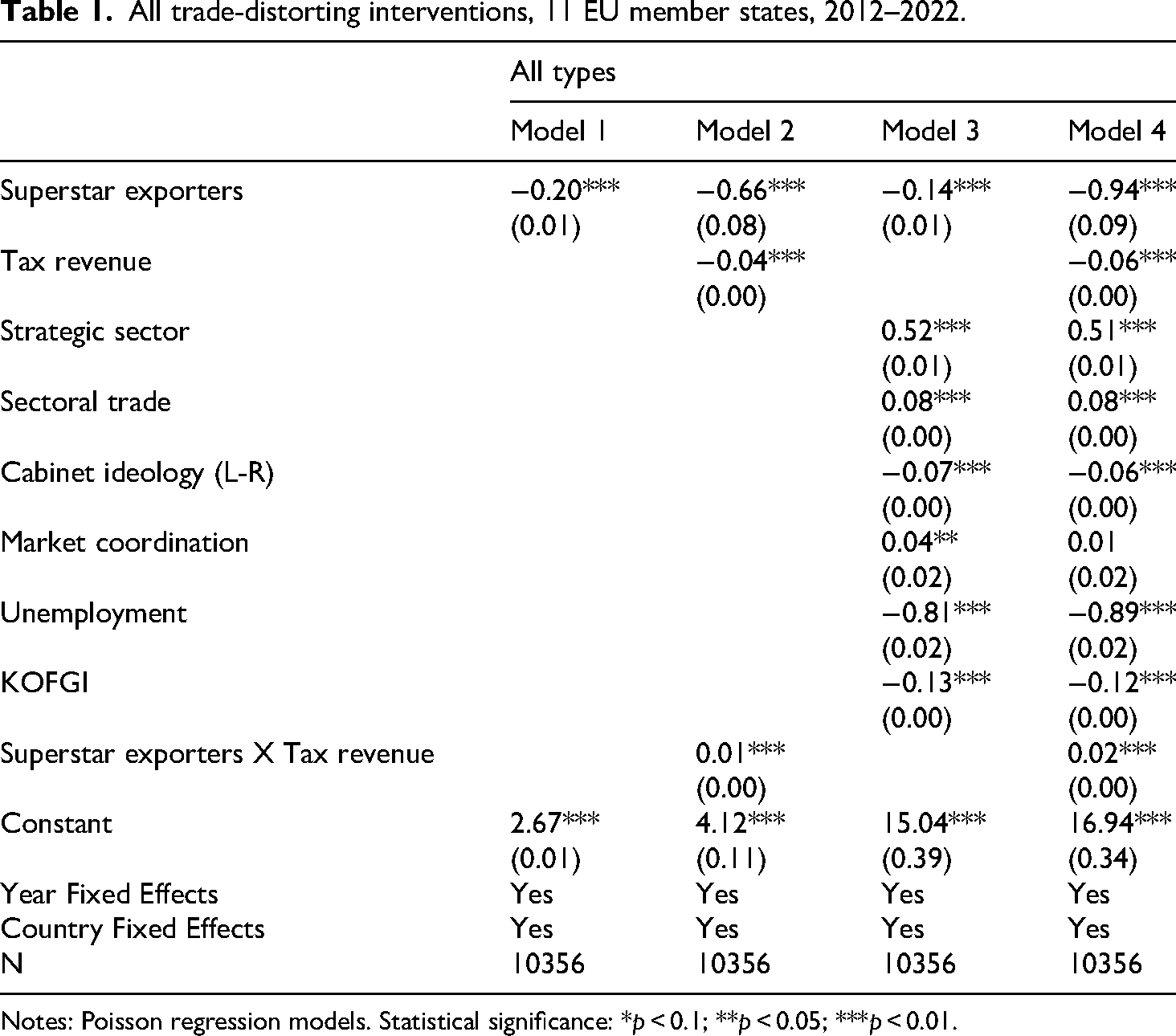
This section presents the findings from our Poisson regression analyses on the determinants of announced trade-distorting interventions for 11 EU member states between 2012 and 2022. Table 1 includes four models with the main variables of interests (models 1 and 2) and the controls (models 3 and 4) while accounting for year and country fixed effects. To preview, the empirical findings support our main hypotheses: across the full range of protectionist measures, higher shares of superstar exporters are associated with fewer protectionism (H1), though the strength of that relationship weakens as fiscal capacity increases (H2).
All trade-distorting interventions, 11 EU member states, 2012–2022.
Notes: Poisson regression models. Statistical significance: *p < 0.1; **p < 0.05; ***p < 0.01.
We start by showing that the correlation between the number of protectionist interventions and the share of trade enacted by superstar exporters (measured as turnover size) is negative and statistically significant (model 1). These effects remain highly statistically significant when including sector- and country-level controls (model 2). Thus, the results show that a higher share of superstar exporters turnover is, on average, associated with lower levels of protectionism, confirming H1. This suggests that sectors with a higher concentration of superstar exporters tend to advocate for more open trade policies due to their global competitiveness and reduced reliance on trade barriers.
The interaction between the share of superstar exporters and tax revenue influences the adoption of protectionist policies, as indicated by the statistically significant coefficient for the interaction term. The coefficient for superstar exporters indicates that, holding tax revenue and everything else constant, a higher share of superstar exporters is associated with less protectionism. The negative coefficient for tax revenue suggests that, when the share of superstar exporters and everything else is held constant, a higher tax revenue is linked to fewer protectionist interventions. However, the interaction term shows that these two effects are not independent: a higher fiscal capacity weakens the negative effect of superstar exporters on protectionism. The effect is robust to the inclusion of sector- and country-level controls (model 4). While higher shares of superstar exporters by sectors are generally associated with lower protectionism, in countries with higher tax revenues, the effect diminishes, supporting H2.
When comparing the magnitudes of coefficients across variables of the full model, the presence of superstar exporters is among the most substantively influential predictors. More specifically, a one-percentage-point increase in the share of sector-level turnover accounted for by superstar exporters is associated with an expected 61% decrease in protectionist interventions, holding all else constant. Similarly, a one-percentage-point increase in tax revenue as a share of GDP is associated with an expected 5.5% decrease in protectionist measures. Yet the positive interaction term indicates that these effects are not additive: for each additional percentage point of tax revenue, the negative association between superstar exporter presence and protectionism becomes less pronounced.
Figure 1 shows that the marginal effect of superstar exporters conditional on fiscal capacity is positive (based on the coefficient of Table 1, model 4). In fiscally capable member states, governments are more likely to implement protectionist trade policy interventions to support sectors with higher shares of superstar exporters, ultimately mitigating the liberalizing pressures of superstar exporters. This finding aligns with our argument that wealthier states leverage protectionist policies to reinforce the competitive advantage of their dominant firms through trade-related measures.
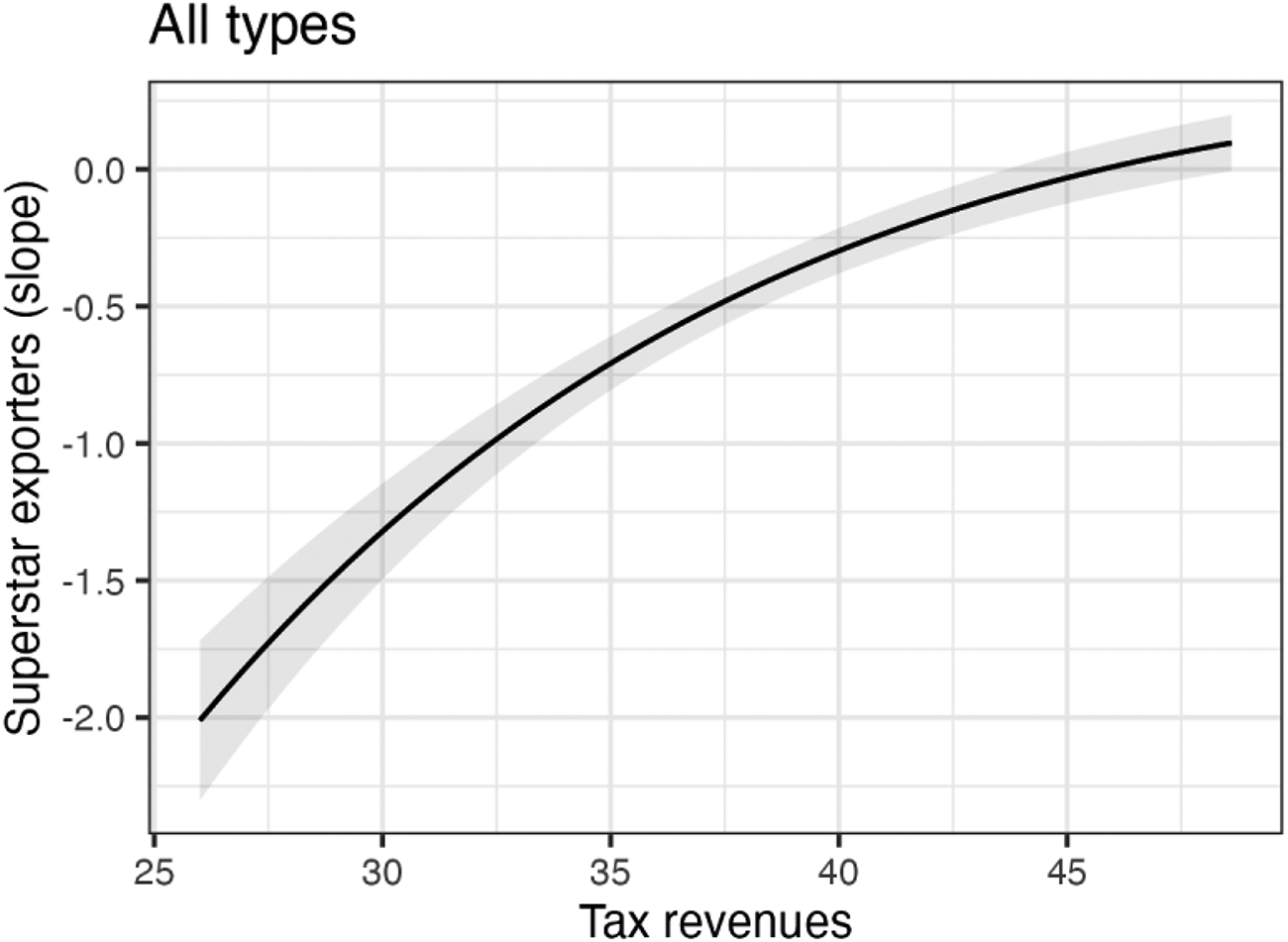
Marginal effects plot of the likelihood of all trade-distorting interventions conditional on fiscal capacity and superstar exporters.
The effects of the control variables are mostly in line with previous literature. Starting with the sector-level variables, we find that the effect of sectors deemed strategic based on a recent legislative act of the EU is positive. This indicates that sectors classified as critical are more likely to be subject to protectionist trade policies, underscoring the broader geopolitical trend of shielding critical industries from foreign competition. We also find that the coefficient of sectoral trade is positive and highly significant across all models. This confirms that protectionism is used to protect the largest trading sectors. These effects are robust to the inclusion of year and country fixed effects.
On the national level, we find that the coefficient of market coordination is statistically significant and positive in model 3 whereas it changes sign in model 4. This suggests that member states with higher levels of market coordination are less likely to pursue protectionist policies when controlling also for the conditional effect of tax revenues. Thus, a strong wage coordination decreases the demand for protectionism (see Baccini et al., 2022). As expected, the political ideology of cabinets emerges as a significant predictor of protectionism. The negative coefficient indicates that left-leaning governments are more likely to adopt protectionist policies compared to their right-leaning counterparts. This finding supports the enduring divisions among political parties in trade politics, where left-leaning parties tend to advocate for protectionist policies, particularly those that benefit labour, while right-leaning governments are generally more supportive of trade liberalization. The negative coefficient of KOFGI confirms that more trade openness leads to less protectionism, on average, all else being equal. The negative coefficient of unemployment suggests that member states are less likely to resort to protectionist measures with higher unemployment shares, even controlling for year and country fixed. effects. This may be due to a preventive rather than curating use of protectionist measures to balance the loss of competitiveness of firms, which in turn may lead to higher unemployment.
Types of protectionism
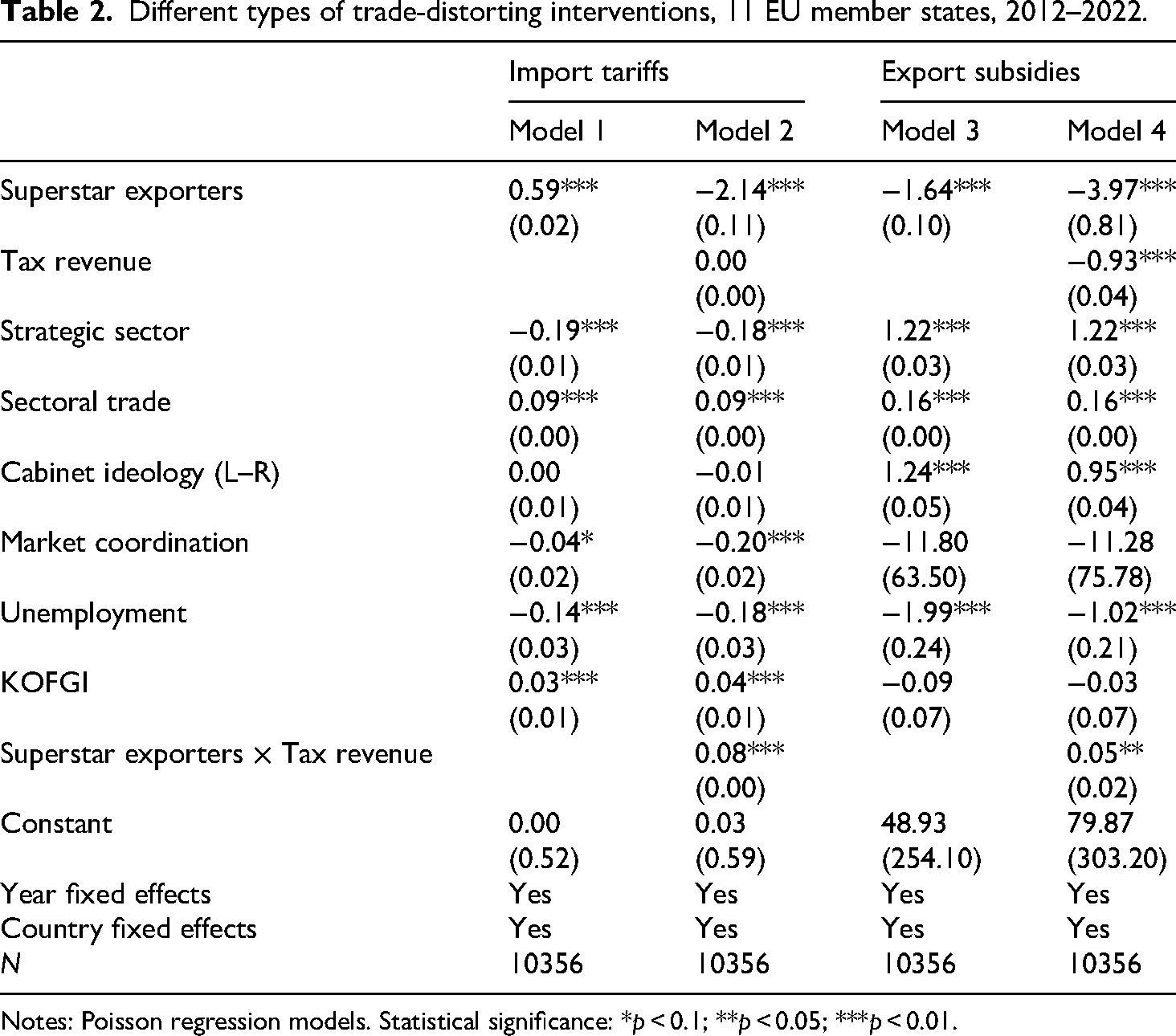
After finding support for our first hypothesis, we disentangle the effect of superstar exporters and fiscal capacity on various types of protectionist interventions. To provide greater analytical clarity and a deeper understanding on the use of protectionist interventions in the EU, we differentiate between the two largest categories of protectionist measures. Our dependent variable is the number of tariff-based (models 1 and 2), or export subsidy (models 3 and 4) interventions announced for our unit of analysis (country–sector–year). The Online appendix contains detailed information on the number and types of interventions. Table 2 presents the results of the Poisson models applied to the subsets of export subsidies and import tariffs in 11 EU member states between 2012 and 2022.
Different types of trade-distorting interventions, 11 EU member states, 2012–2022.
Notes: Poisson regression models. Statistical significance: *p < 0.1; **p < 0.05; ***p < 0.01.
The findings are in line with H2b, as shown by the positive interaction coefficient between superstar exporters and tax revenues. This indicates that higher fiscal capacity reduces the negative relationship between superstar exporters and export subsidies, on average, all else being equal (model 4). Contrary to H2a, we find that fiscal capacity, measured through tax revenues, mediates the negative effect of superstar exporters on the use of import tariffs (model 2). In other words, the conditional effect of superstar exporters on protectionist tariffs weakens constantly with higher fiscal capacity. Thus, sectors with higher shares of superstar exporters receive more protectionist tariff conditional on fiscal capacity, suggesting that governments continue to employ tariff-based protectionism for superstar exporters. One potential explanation is that receiving subsidies makes exporting firms less interested in supporting low import tariff barriers. Since fiscal capacity allows them to obtain domestic support in the form of export subsidies, they are less interested in tariff liberalization because the higher costs of increased tariffs would be compensated by export subsidization. In short, these results suggest that, for superstar exporters, domestic export subsidies may act as policy substitutes for low tariffs. We find that the coefficient for import tariffs is positive rather than negative when we do not control for fiscal capacity (model 1). One plausible explanation for this unexpected finding is omitted variable bias: without accounting for fiscal capacity, the model may conflate the presence of superstar exporters with broader national policy strategies in which governments use tariffs to actively support their most competitive sectors.
We provide more information on key variables and additional analyses to assess the robustness of our findings in the Online appendix. First, we display the summary statistics, correlation matrix and descriptive information on trade-distorting measures, strategic sectors and labour market coordination. Second, we test the validity of our analyses using alternative models, variables and subsets. The results are robust to (a) an alternative operationalization of strategic sectors, which relies on an EU classification published in 2008 instead of 2022; (b) an alternative operationalization of fiscal capacity, using logged GDP per capita instead of tax revenues; (c) the inclusion of three-way fixed effects, which account for sector, country and year variation; (d) a one-year lag of unemployment, tax revenues, market coordination and globalization levels; (e) a full EU sample. For the latter analysis on the 27 EU member states, we employ the share of sectoral exports as a proxy, as the data for superstar exporting firms are not available for all member states. The results from these additional analyses are largely in line with our main findings and provide additional support to our hypotheses. 5
Third, we control for the effect of the two major economic crises that the EU experienced in the time under analysis – the European Sovereign Debt Crisis in the early 2010s and the COVID-19 pandemic beginning in 2020. These crises involved markedly different policy instruments – fiscal austerity and consolidation in the former and expansive state support for key industries in the latter – which may have influenced trade policy in divergent ways. To account for the possibility that some protectionist measures were crisis specific, we conducted robustness checks excluding the early years (2012–2013) and, separately, the pandemic period (2020–2022). The direction and statistical significance of our main results remain largely stable. 6 This suggests that our core findings are not driven solely by crisis-induced trade policy responses but reflect broader structural relationships.
Conclusion
With the second Trump administration imposing unprecedented tariffs and major economies rolling out large subsidies for domestic firms, the international trade system is facing challenging strains, fuelling debates over trade policy. As the world's largest trading bloc, it is important to understand what drives trade-distorting policies within the EU. What explains the diversity of trade-related interventions among EU member states, despite the formal centralization of trade policy under the Common Commercial Policy? We address this question by exploring both the de jure constraints and the de facto flexibility EU member states possess in shaping their trade openness. While import tariffs fall under supranational control, national governments retain autonomy over a range of non-tariff measures. We argue that understanding these variations is essential to grasp the dynamics of trade politics within the EU, particularly in an era marked by increased economic nationalism and heightened geopolitical tensions.
Building on the New New Trade Theory approach, we developed a theoretical framework to explain the variations in the intensity of protectionist trade policy interventions within and across member states. On that basis, we hypothesized that sectors dominated by highly productive superstar exporters are less likely to adopt protectionist measures (H1) and that fiscal capacity mitigates this relationship (H2), as higher tax revenues allow for more support of these same sectors through non-tariff measures, particularly export subsidies (H2b). Findings from fixed-effects Poisson regression models on the likelihood of protectionist interventions for 11 EU member states across 97 sectors between 2012 and 2022 support our hypotheses. The results show that indeed a larger presence of superstar exporters is associated with a lower likelihood of protectionist trade policy interventions and that fiscal capacity mitigates such overall effect, especially for export subsidies. However, contrary to our expectations, we found that fiscal capacity also mitigates the negative effect of superstar exporters on the incidence of tariff-based protectionism, suggesting that domestic export subsidies may act as policy substitutes for low tariffs for superstar exporters. All together, these findings align with the idea that in low-tax environments, superstar exporters might not have the leverage to demand subsidies, but in high-tax environments, they may successfully lobby for government support. This highlights the importance of considering fiscal capacity when analyzing the role of dominant firms in shaping trade policy. We expect the findings to generalize outside of the EU, especially considering that the EU is a ‘hard case’ due to it being the largest trading block and its historical preference for trade liberalization.
This article makes several contributions. First and most obviously, our analysis demonstrates that, under the seemingly unifying umbrella of the Common Commercial Policy, there are significant variations in the use of protectionism both within and across member states. In doing so, we highlight the nuanced nature of national trade related policy decisions under supranational governance. Mapping and understanding these variations are particularly important in the context of ongoing discussions about the causes and consequences of rising globalization backlash (Broz et al., 2021; Colantone and Stanig, 2018; Mansfield et al., 2021; Walter, 2021) and the return of industrial policy and the geopoliticization of trade policy (Meunier and Nicolaidis, 2019; Schmitz and Seidl, 2023; Haroche, 2023; Yildirim, 2025). Our analysis contributes to the understanding of the conditions under which these phenomena can incentivize the use of protectionist policy initiatives and, hence, produce a more fragmented global economic order (Rickard, 2022). Moreover, our study covers the poly-crisis period (Schimmelfennig and Winzen, 2022; Zeitlin et al., 2019), which starts with the financial crises and is defined by multiple and sometimes co-occurring crisis events. We show that EU member states are responding to the hardship experienced in the last decades by relying on different policy interventions, such as non-tariff measures. While the experienced poly-crisis may turn into an opportunity for change (Skowronek, 1982), the EU should provide a long-term plan to better coordinate national responses, as stated in the so-called Draghi (2024) report on the future of European competitiveness: ‘[…] no Member State can address key competitiveness challenges alone or compete with Europe's main global competitors’ (p. 307).
Second, our analysis broadens the empirical scope of previous works addressing similar issues. While earlier works had exclusively focused on tariffs (Ehrlich, 2009, 2011), we extend this analysis by investigating non-tariff measures, which have grown in importance in recent years (Durusoy et al., 2015). We thus examine non-tariff measures, such as subsidies and government procurement rules, which allows us to capture a broader set of protectionist policy instruments employed by member states. Further, we expand the national perspective (Ehrlich, 2009; Rogowski, 1987; Rickard, 2012) and argue that the variation in the use of protectionist measures within EU member states is driven by sectoral factors. Our article shows that while Ehrlich's insights on heterogenous tariff implementation across member states remain relevant, the broader use of non-tariff measures adds new layers of complexity to the recent use of protectionist measures.
Lastly, and perhaps most importantly, we make a theoretical contribution to the study of EU trade policymaking by integrating insights from the New New Trade Theory to explain variation in EU member states’ trade policies, demonstrating that the presence of superstar exporters deters broad protectionist tendencies while enabling targeted, strategic interventions in fiscally capable states. Kiratli (2022) showed at the individual level that citizens in regions with greater concentration of high-growth superstar firms are more likely to support globalization – essentially capturing the demand side of open-trade policies. We build on this logic to analyze trade policy outcomes at the country level and thus make a case that the supply side of policies is also influenced by the presence of exporting firms. We posit that while the presence of superstar exporters in a sector reduces the overall level of protectionism, governments with greater fiscal resources use targeted interventions to support their most competitive firms.
The following three avenues for future research may provide useful insights and address potential limitations of this study. For one, our study exclusively focuses on trade-distorting policy interventions announced at the national level. Yet the EU and its member states make vast use of liberalizing trade interventions. Further research could try and shed theoretical and empirical lights on the important question of what explains variations in the use of protectionist compared to liberalizing trade policy interventions as well as the dynamics between supranational and national trade-related policy. Second, future studies would benefit from exploring the differences in trade policy interventions depending on partner countries. This would involve investigating whether systematic differences arise in how member states approach trade with strategic or historical allies versus rivals. A dyadic analysis could reveal whether political or security alliances influence the nature and dynamics of recent trade policies. Given the increasing geopoliticization of trade, one might expect the EU, and EU member states, to implement more protectionist measures against rivals. Third, superstar exporters’ lobbying efforts may differ from other business interests and may vary in the type of intervention – loan, export subsidy or import tariff. Future research could explore whether superstar exporters, given their global orientation and perhaps even public visibility, tend to favour more discreet or indirect forms of trade-distorting support – such as export financing – over overt protectionist measures like tariffs. This could help explain why we observe lower overall protectionism in sectors with a strong superstar presence, while still seeing selective, often less visible, support measures.
Overall, our study underscores the need to move beyond examining European trade policies solely at the supranational discretion of the EU, focusing instead on the nuances of trade-related policy interventions. By doing so, we account for the conditional effect of fiscal capacity and superstar exporting firms on the use of protectionist measures in the EU since the Global Financial Crisis. These findings contribute to broader debates in the political economy of EU trade policy, highlighting the complex interplay between country-level and sector-level factors that drive recent protectionism under the unifying umbrella of the EU's Common Commercial Policy.
Supplemental Material
sj-docx-1-eup-10.1177_14651165251396435 - Supplemental material for Differentiated protectionism in the European Union: The role of superstar exporters and fiscal capacity
Supplemental material, sj-docx-1-eup-10.1177_14651165251396435 for Differentiated protectionism in the European Union: The role of superstar exporters and fiscal capacity by Alessia Invernizzi, Aydin B. Yildirim and Arlo Poletti in European Union Politics
Supplemental Material
sj-zip-2-eup-10.1177_14651165251396435 - Supplemental material for Differentiated protectionism in the European Union: The role of superstar exporters and fiscal capacity
Supplemental material, sj-zip-2-eup-10.1177_14651165251396435 for Differentiated protectionism in the European Union: The role of superstar exporters and fiscal capacity by Alessia Invernizzi, Aydin B. Yildirim and Arlo Poletti in European Union Politics
Supplemental Material
sj-zip-3-eup-10.1177_14651165251396435 - Supplemental material for Differentiated protectionism in the European Union: The role of superstar exporters and fiscal capacity
Supplemental material, sj-zip-3-eup-10.1177_14651165251396435 for Differentiated protectionism in the European Union: The role of superstar exporters and fiscal capacity by Alessia Invernizzi, Aydin B. Yildirim and Arlo Poletti in European Union Politics
Footnotes
Acknowledgements
We thank the editor and the anonymous reviewers for their invaluable feedback. Invernizzi thanks the Heinrich Böll Stiftung for its support via a doctoral scholarship.

Authors’ contribution
All authors contributed equally.
Funding
The authors received no financial support for the research, authorship and/or publication of this article.
Data availability statement
All data used in this paper are already public and can be downloaded from the respective websites. We provide the merged dataset and code in the supplemental material.
Supplemental material
Supplemental material for this article is available online.
Notes
References
Supplementary Material
Please find the following supplemental material available below.
For Open Access articles published under a Creative Commons License, all supplemental material carries the same license as the article it is associated with.
For non-Open Access articles published, all supplemental material carries a non-exclusive license, and permission requests for re-use of supplemental material or any part of supplemental material shall be sent directly to the copyright owner as specified in the copyright notice associated with the article.
