



Abstract
The evolution of the European Commission and its functioning has sparked a broad scholarly debate. However, we know little about how individual Commission members communicate policies. We propose a theoretical framework that presents time pressure as a critical communicative resource to indicate priority and discuss its function for members of the European Commission. Using a comprehensive mixed-methods design that combines state-of-the-art quantitative and qualitative text analysis methods, this article examines how institutional roles, evolving authority, and contextual factors, such as crisis periods, affect the communicative behavior of members of the European Commission. It focuses on the case of migration and asylum policy. We find key differences in how Commission Presidents and responsible Home Affairs Commissioners communicate and invoke time pressure. While Presidents have long emphasized urgency, Commissioners have historically downplayed time pressure. More recently, however, they have also increasingly stressed similar urgency. The qualitative analysis highlights distinct target audiences and framings of the time pressure invocations of Presidents and Commissioners.
Introduction
The European Commission, as the EU's central agenda-setter and executive authority, has been the subject of extensive academic debate. Scholars have examined the institution through various lenses, including its increasing presidentialization and the centralization of power in the hands of the Commission President (Dimitrakopoulos et al., 2024; Kassim et al., 2013, 2016). Others focus on the politicization of the Commission's functioning (Kassim and Connolly, 2018; Wille, 2012), highlighting implications for responsiveness (Rauh, 2019; Van der Veer and Haverland, 2018) and concerns over democratic legitimacy (Bartolini, 2006). While these debates provide key insights into the Commission's role in policymaking, they have largely centered on policy outputs.
In contrast, research on the Commission's public communication remains limited, despite its growing importance. As the institution's competencies have expanded and politicization has increased, communication has become vital for shaping perceptions, securing legitimacy, and addressing criticism (Rauh, 2023). Existing work explores the Commission's responsiveness to public interests in policy debates (De Bruycker, 2017; Röth et al., 2025), media representation (Bijsmans and Altides, 2007), and the use of social media platforms (Aagaard, 2023; Özdemir and Rauh, 2022). Another strand examines communication styles, showing that commissioners often adopt passive messaging in politically charged contexts (Müller et al., 2022) or rely on technical language that clashes with politicized environments (Pansardi and Tortola, 2022; Rauh, 2023).
However, few studies differentiate between actors within the Commission. Most treat the institution as a unitary actor or neglect the internal hierarchies that shape communication. No study, to our knowledge, bridges research on the Commission's organizational evolution with the communicative practices of its members. This is a crucial gap. We propose an actor-centered approach, treating time pressure as a communicative resource that reveals competing institutional logics. We ask: How do individual Commission members communicate under time pressure, and what does this reveal about how the institution balances demands for accountability and efficiency?
We present a unitary theoretical framework centered on responsiveness under politicization, arguing that time pressure invocations reflect organizational roles, problem pressure, and legal authority. Time pressure is more than issue salience. It signals urgency, agency, and strategic positioning (Röth et al., 2024). Its invocation reveals who is seeking to steer the agenda, and why.
Empirically, we analyze migration and asylum communication by Commission Presidents and Home Affairs Commissioners from 1990 to 2024 using a mixed-methods approach that combines computational text analysis with qualitative insights. Our findings show that Presidents invoke time pressure more frequently, particularly in moments of crisis, using it to exert political pressure on member states. Commissioners have historically downplayed urgency but have increasingly adopted more assertive framing following the Lisbon Treaty and the 2015/16 refugee crisis. Qualitative evidence reveals divergent communicative strategies: Presidents project authority to compel action, while commissioners engage a broader set of internal and external audiences in conciliatory tones. These findings demonstrate how institutional roles and political contexts shape the Commission's internal communication dynamics.
Time pressure as a communicative resource
In contemporary governance, actors operate under a regime of social acceleration, facing chronic time constraints and an intensified pace of decision-making (Hassan, 2009; Rosa, 2013). In this context, communicating urgency becomes critical. Political actors frequently invoke time pressure not just to signal importance, but to frame issues as requiring swift action (Röth et al., 2024; 2025). These invocations are strategic. By emphasizing crises, imminent deadlines, or the need for rapid reform, leaders create a sense of urgency that justifies decisive measures and limits opposition (Cortell and Peterson, 1999; White, 2019). This reflects what White (2019) terms the “politics of necessity,” where urgency framing enables actors to assert authority and mobilize support (Bunea, 2020).
Urgency narratives also resonate with the fast tempo of modern politics. Time constraints narrow cognitive focus, pushing decision-makers toward quick, often satisficing solutions (Ordóñez et al., 2015). Democratic theorists note that “time-poor” environments favor intuitive, fast thinking over deliberation (Stoker et al., 2016). While such framing can enable rapid responses, it also risks oversimplification and reduced decision quality. Still, invoking high time pressure remains a powerful communicative tool used to spur reform, assert leadership, or defend the status quo under perceived threat (Boin et al., 2009; Hassan, 2009).
In contrast, political actors can invoke low time pressure as a deliberate communicative strategy of patience and prudence, or to even dismiss the idea that an event is a crisis (Boin et al., 2009: 84; Jones et al., 2021: 1527). Rather than urging haste, this mode emphasizes the availability of time, the importance of deliberation, and the need for thoroughness or broader consultation before action. Crucially, low time pressure invocation is not simply the absence of urgency. Rather, it is an active communicative stance with its own rationale and effects. Leaders employing this communication may explicitly counsel against rash decisions, arguing that complex issues require more time for reflection, consensus-building, or analysis. Such appeals highlight the virtues of deceleration and inclusive processes in democratic life (Saward, 2017). This mode of communication can reassure audiences that policy choices are given adequate gestation and that leaders are not panicking under the clock. Indeed, even amid acknowledged crises, officials may purposefully downplay urgency, for example, by insisting that “we must not rush and get this right,” aiming to maintain credibility or to resist external pressure. Moreover, toning down the language of urgency can also serve as a way to minimize political or institutional conflicts (Pansardi and Tortola, 2022). Interdisciplinary research on temporal politics suggests that multiple speeds of governing can coexist, and that slower, more deliberate approaches have an important place alongside urgent ones (Saward, 2017). Thus, communication that acknowledges the availability of time as a resource for legitimacy represents a distinct repertoire, rather than treating time solely as a ticking bomb. Political actors either request fast or slow action within a single statement; therefore, the distinction in one statement is one of a difference in kind. However, both temporal invocations might also be combined on the speech or document level, making it ultimately a matter of degree in a more aggregate perspective.
Importantly, we treat these high-versus-low time pressure invocations as a dependent variable in our analysis—that is, as a communicative output shaped by deeper forces of institutional role and context. Prior work indicates that perceptions and uses of “political time” vary systematically across different actors and settings. For example, Commission officials may sometimes heighten temporal pressure, explicitly calling for swift action, yet in other instances seek more time for reflection, despite acknowledging time pressure (Röth et al., 2024). Such variation underscores that the choice to invoke urgency or patience is not random but conditioned by who the speaker is (their position and authority) and the situation they face (crisis vs. routine, political stakes, etc.). In other words, time pressure invocations are a communicative resource.
Time pressure communication by Commission members under politicization
The European Commission is at the heart of the EU’s responsiveness debate, which involves its communication. Blame and praise of the EU, whether initiated by populists, partisans, or national governments, are typically directed towards the Commission. The Commission has traditionally been portrayed as the engine of integration by stealth (Meunier, 2017), where technocrats attempt to depoliticize. In such a view, it would be unexpected that the Commission frequently and publicly invokes time pressure. Similar expectations could be built on the bureaucratic reputation literature that stresses the strategic attempts for a consistent communication that protects the integrity and reputation of the organization (Binderkrantz et al., 2024; Müller et al., 2022). For commissioners, it has been shown, this means predominantly to signal technical expertise in complex issues and little politicization attempts (Müller et al., 2022; Rauh, 2023). However, the Commission is also suspected of being a proliferator of politicization by making excessive use of time pressure invocation and playing the emergency script for maximizing its own competence (Kreuder-Sonnen and White, 2022; White, 2019: 127–146; Blom-Hansen et al., 2025). The literature of presidentialization, which implies that time pressure could reflect the Commission President's monopolization of time-setting (Dimitrakopoulos et al., 2024; Kassim et al., 2013; Kassim et al., 2016), complements this view.
Against the backdrop of diverging expectations, our aim is to provide a more integrated set of expectations that considers the importance of the roles of the President and the commissioners in the context of the communicative adaptations brought about by the rising authority and politicization of the post-Lisbon period in the European migration discourse. We develop this framework in three parts. First, we consider the Commission's internal organizational dynamics, notably the relationship between the President and individual commissioners, and how these shape communication choices. Second, we examine how politicization as a result of increased problem pressure (the urgency and salience of migration challenges) can amplify or alter the Commission's messaging. Third, we assess the role of political authority and competences, recognizing that the Commission's voice on migration is conditioned by the formal powers it holds (or lacks) in this policy domain. These three theoretical strands jointly inform our hypotheses. Taken together, they depict a Commission that is strategic in its communications: sensitive to internal politics, responsive to external crises, and constrained by institutional mandates. We elaborate each in turn before synthesizing how they collectively underpin our expectations for Commission time pressure communication on migration.
Internal organization
The Commission is far from a monolithic entity. Its internal organization, divided along directorates-general (DGs) and overseen by a powerful President and a college of Commissioners, is marked by coordination challenges and occasional turf disputes. Disagreements between DGs or commissioners over competences, leadership, or framing of issues are common, and actors often seek to protect or expand their authority (Senninger et al., 2021). These internal dynamics shape the Commission's capacity to present a unified stance and influence who takes the lead in communication on contentious issues. As Hartlapp et al. (2014) and others have documented, consensus-building and bargaining within the Commission are frequently influenced by such intra-institutional competition. Although Commissioners bring their own political backgrounds and national affiliations (Wonka, 2007; 2008), and many are seasoned political figures (Bürgin, 2018; Wille, 2013), these individual factors play a secondary role in the patterns of communication observed. Rather than acting as neutral technocrats, Commissioners often consider national and public interests (Rauh et al., 2020), but the dominant logic remains shaped by the institutional setup and internal power struggles. Such disputes may also affect public communication, as commissioners attempt to assert control over a policy domain or claim credit in politically salient moments. This means that under conditions of problem pressure, multiple actors, including both commissioners and the President, may seek to project urgency, leading to overlapping or competing signals in public communication.
Yet, research on the role of the President paints a slightly different picture of what drives communication choices. As the head of the college, the President has a broad EU-wide mandate and a strong incentive to project unity and leadership (see Tömmel, 2019). The President's prominence means that, especially on high-profile issues, they can act as the Commission's public face, a tendency that has grown with the “political Commission” under recent presidents (see Pansardi and Tortola, 2022). Indeed, the President enjoys agenda-setting influence inside the college and can direct or coordinate communications for maximum effect. Recent studies confirm that the Commission's internal coordination and communication are often driven by reputational concerns (Blom-Hansen and Finke, 2020; Müller and Braun, 2021). In other words, when an issue is salient to important audiences (e.g., EU citizens or member states), the Commission's leadership is more likely to centralize and manage the messaging tightly. While both the President and commissioners may engage in high-pressure communication during crisis periods, the President is uniquely positioned to speak with institutional authority, aiming to preserve unity and credibility in the face of politicized scrutiny (Davies, 2025; Kreuder-Sonnen and White, 2022). This implies that on politically visible issues, the President will exert greater control to ensure a coherent line, leaving less room for national politics to influence the choices made by commissioners. Nonetheless, commissioners may still speak forcefully when defending their portfolios under pressure, particularly when reputational stakes are high or leadership within the issue area is contested (Hartlapp et al., 2014; Senninger et al., 2021).
Building on these insights, we argue that internal dynamics shape the Commission's communication in two distinct ways, depending on the level of politicization. Under routine, non-politicized conditions, communication is primarily handled by the commissioner responsible for the relevant policy portfolio (Müller et al., 2022). Drawing on the literature on reputation management, we expect such communication to invoke low time pressure, emphasizing deliberation, responsibility, and representative policymaking. By contrast, when the political salience of an issue increases, we expect the President to more directly and visibly take control of the message. In these high-stakes contexts, communication is more likely to rely on invocations of high time pressure, signaling urgency, leadership, and resolve. This shift reflects the growing presidentialization of the Commission (Dimitrakopoulos et al., 2024; Kassim et al., 2013; Kassim et al., 2016; Goetz, 2014), whereby internal hierarchy becomes more pronounced under pressure. In such moments, the President “owns” the issue publicly, while individual commissioners play a supporting role. This pattern aligns with findings from outside the EU context, where crises are shown to empower executive leaders (Young, 2013). While the literature on reputational management and on presidentialization might seem to offer competing views, we contend that these capture different facets of the same institutional logic. The balance of communicative authority within the Commission is not fixed but contingent on context: it shifts from decentralized and portfolio-based in routine times to centralized and presidentialized when political stakes are high. Accordingly, we expect the different roles to be reflected in communication styles, with the President's communication more likely to emphasize high time pressure and urgency, whereas commissioners tend to adopt a more balanced tone and more frequently refer to low time pressure. H1a: Commission Presidents are more likely than Commissioners of Home Affairs to invoke high time pressure in their policy statements regarding migration. H1b: Commissioners of Home Affairs are more likely to invoke low time pressure in their policy statements regarding migration.
Problem pressure
Beyond internal politics, the pressure of the problem itself is a powerful driver of the Commission's communication behavior. This is because, in times of crises, actors “strategize and fight to have their frame accepted as the dominant narrative,” (Boin et al., 2009: 82). Crisis-induced pressure heightens public scrutiny and demands for action, politicizing an issue and prompting the Commission to respond. There are strong theoretical reasons to expect the Commission to communicate more actively and assertively when problem pressure is high. Some accounts suggest that supranational actors seize crises as windows of opportunity to expand their influence (Kreuder-Sonnen and White, 2022; White, 2019). The Commission has historically acted as a policy entrepreneur in times of crisis (Baracani and Sarotto, 2023) or as defender of European integration (Yordanova et al., 2025: 770; Jones et al., 2021: 1527). Crises arguably create a push for common European solutions, encouraging the Commission to step forward and shape the narrative. The Commission is also suspected of making undue use of politicization by making excessive use of time pressure, thus creating or extending the perception of crisis intensity and length (Kreuder-Sonnen and White, 2022; White, 2019; Blom-Hansen et al., 2025). We anticipate that high problem pressure will spur greater and centralized communication efforts from the Commission's leadership, aiming to inform, reassure, and rally support for EU-level action.
At the same time, problem pressure can be a double-edged sword for Commission communication. Yes, greater urgency empowers the Commission to justify bold proposals and to call for unity, as presidentialization allows for better exploitation of windows of opportunity (Becker et al., 2018). On the other hand, highly salient and politicized problems can make the Commission cautious to avoid blame or backlash (Davies, 2025). Rauh (2019) documents how, as European integration became politicized, the Commission started paying much closer attention to public reactions and media coverage. Similarly, Van der Veer and Haverland (2018) demonstrate that domestic political contestation influences Commission behavior. Under increased problem pressure, the Commission must tread carefully: it needs to communicate urgency and assertiveness to address the crisis yet do so in a way that does not tie its hands, alienate member states, or fuel further public controversy (Rauh et al., 2020).
One way to navigate this tension is through framing and tone. Even if problem pressure compels members of the Commission to speak up more, it can modulate how it speaks depending on the political climate. Some research has found that commissioners are far more likely to “speak up” on technically complex regulatory issues, where showing the Commission's expertise is advantageous, than on politically divisive ones (Müller et al., 2022). In other words, when an issue is highly charged, a commissioner's communication may become more cautious or nuanced to minimize potential reputational damage. We expect actors in the Commission to strike an urgent tone emphasizing the need for collective action, while also carefully calibrating messages to avoid overt blame or admissions of failure. Higher problem pressure will lead to more frequent and prominent communication by the Commission on the issue. This includes not only greater volume (more speeches or statements), but also stronger problem framing: depicting the problem as an urgent European challenge requiring decisive EU action. At the same time, as noted, such heightened communication will be managed so as to protect the Commission's reputation and unity amid a politicized environment. We cannot forget, however, that the literature on turf wars (Hartlapp et al., 2014) also implies that crises are periods of contested leadership, which might lead commissioners and Commission Presidents to raise time pressure invocations to signal agency. Thus, arguments of contested leadership, presidentialization and organizational reputation would all expect commissioners and the President to strike a similarly high level of time pressure invocation during crises. H2: Crisis situations in the field of migration and asylum led to an increase in high time pressure communication by both Commission Presidents and Home Affairs Commissioners, with a particularly strong effect for the President due to the presidentialization of crisis leadership.
Political authority and competences
A third pillar of our framework is the recognition that what the Commission says is conditioned by what it can do. The post-Lisbon Treaty era significantly expanded the European Commission's formal authority (Bürgin, 2018; Eckhardt and Wessels, 2018). The Treaty of Lisbon abolished the old pillar structure and communitarized Justice and Home Affairs, bringing the entire policy domain fully under the EU's supranational framework (Hampshire, 2016; Kaunert and Léonard, 2012). In response, the Commission reorganized internally to match its new competences (Lavenex, 2020). These structural changes signaled the Commission's intent to maximize its expanded mandate, consistent with its broader propensity to seek an enlarged policy role (Heldt, 2018) and maximize its competences (Pollack, 2003: 35–36).
However, Lisbon's empowerment of the Commission did not wholly erase intergovernmental instincts. Member states remained wary of full supranationalism and jealously guarded core sovereignty concerns (Hampshire, 2016). Even a decade after Lisbon's reforms, governments proved reluctant to utilize the treaty's communitarization potential (Lavenex, 2020; Vaagland and Zaun, 2025). In practice, cooperation post-Lisbon continued to rely on a transgovernmental mode, blending supranational elements with intergovernmental coordination among national authorities (Hampshire, 2016). Thus, while Lisbon was a turning point that equipped the Commission with unprecedented tools, it also provoked counterbalancing by sovereign states, ensuring that the Commission's new authority had political limits.
Classic integration theories often portrayed the European Commission as a unitary, technocratic actor. However, contemporary research highlights the internal diversity of the institution, shaped by both organizational structures and political dynamics. While the College of Commissioners collectively tends to pursue competence expansion in line with the Commission's pro-integration ethos (Pollack, 2003), the institution is composed of multiple directorates and portfolios that operate with varying priorities and logics (Franchino, 2007; Wonka, 2007). Commissioners occupy a dual role, as guardians of European interests and as actors embedded in complex administrative and political environments, which can lead to differentiated patterns of action and communication. Rather than viewing the Commission as a singular actor, we approach it as a multi-centered organization, in which internal dynamics condition how it responds to external pressures and frames its public communication.
Bringing this expanded authority in line with the expectations spelled out previously, we can observe how the heightened role of the commission interacts with periods of heightened politicization. Such times subject the Commission to heightened expectations—and risks—in its role as agenda-setter and crisis manager (Müller et al., 2022; Rauh, 2023). On one hand, greater public contestation creates pressure on Commission leaders to speak clearly and forcefully about challenges, demonstrating that the EU is taking urgent action. A growing demand from citizens for EU-level responses effectively pulls commissioners into more visible and direct communication (Rauh, 2019). Politicization thus offers an opportunity for the Commission to assert leadership and rally support; a chance to bolster integration by showing responsiveness. Yet, this may come with reputational costs. If Commission officials overplay the urgency or make bold commitments, they risk raising expectations that cannot be met or provoking political backlash from member states and Eurosceptic audiences. They must therefore manage institutional risk, calibrating their messages to avoid blame or institutional damage. Empirical studies, such as that by Rauh (2019), indeed find that EU politicization entails both chances and risks for supranational actors. It incentivizes broader public engagement but also forces caution due to anticipated pushback from domestic veto players. As such, we expect commissioners to show a dual communication strategy: to invoke time pressure and urgency to signal commitment and spur action but also modulate the intensity of such rhetoric to maintain credibility and flexibility in negotiations.
Given the Lisbon-driven expansion of the Commission's role and the subsequent politicization of migration, we expect a notable change in how EU executives talk about time and urgency in this policy area. Greater formal competences and responsibility in migration policy likely embolden commissioners and Commission Presidents to reference tight timelines, deadlines, and the need to act swiftly. In particular, the Commissioner for Home Affairs, endowed post-Lisbon with a more precise portfolio and facing constant political scrutiny on migration, should be most prone to emphasize time pressure as part of their policy narrative. H3: Increased competences post-Lisbon led to more time pressure invocations (both low and high), particularly by Home Affairs Commissioners, reflecting their expanded responsibilities and the growing political demands for action in migration policy.
Research design—case selection, data, and methods
To investigate how institutional roles and contextual changes translate into the communicative behavior of Commission members, we conduct a mixed-methods analysis of policy communication by Presidents and the Commissioners of Home Affairs on migration and asylum between 1990 and 2024. We rely on state-of-the-art computational quantitative and qualitative text analysis to gain a comprehensive and nuanced understanding of the roles played by different members of the Commission in communicating policies. The combination of these complementary methods allows valuable insights but is also an extensive endeavor. To achieve the objectives of this article and provide an in-depth analysis, we focus on a specific policy area—migration and asylum.
Case selection
Studying the case of migration and asylum policy is well-suited for our purposes for several reasons. First, the European Commission has seen a steady and substantial evolution in its competences in migration and asylum, from an intergovernmental framework toward a stronger supranational logic (Balch and Geddes, 2011; Lavenex, 2020). These changes strengthened the Commission's role, allowing it a more central position in legislative and policy initiatives (Boswell, 2008; Lavenex, 2020).
Second, migration and asylum have been a politically contested and salient issue for a long time, often perceived and administered as a “crisis” on a routine basis (Moreno-Lax, 2023). Political actors in the EU thereby face a variety of social dynamics, such as regulating labor migration, managing asylum flows, preventing irregular migration, or promoting integration. This comes with a strong need and demand for action (Lutz, 2024). This applies particularly to the Commission as the executive of the EU. Consequently, key Commission members, such as the President and Home Affairs Commissioners, have long prioritized the issue. Their speeches and statements on migration and asylum are closely followed by political actors, journalists, and the broader public. This sustained attention allows for the collection of fine-grained and relevant communication data over a long period.
Third, in migration and asylum, time pressure invocations are a suitable lens for studying policy communication. As discussed above, migration and asylum are of high political salience, and this is reflected in the volume of speeches on this issue by relevant Commission members. To observe differences in communicative behavior between Presidents and commissioners one must therefore look beyond simple salience or volume of communication and focus on how policymaking is communicated. Here, the invocation of time pressure with varying manifestations is a highly suitable concept.
Overall, we consider migration to be a least likely case before the Lisbon treaty as the expected variability of invocations are only activated through the rising authority, politicization and presidentialization that followed the treaty changes of Lisbon. After Lisbon, we can think of migration as a most likely case, because there is hardly another European policy issue with the same degree of politicization, in particular when problem pressure is high. Thus, the generalizability of our findings rests on the attributes of other policy domains, to show high degrees of European authority (such as for example climate mitigation or competitiveness) as well as a high degree of politicization inflated by problem pressure. Importantly, our case spans both pre- and post-Lisbon periods, covering moments when EU authority in migration and asylum was still contested and evolving. This temporal variation strengthens the case's analytical leverage, allowing us to observe how the Commission communicates under conditions of both limited and expanded authority. As such, our findings may also speak to other low-authority domains, particularly when crisis salience is high but institutional capacity remains fragmented.
Data and methods
In the analysis, we combine quantitative and qualitative text analysis to gain comprehensive insights by leveraging the strengths of each approach and mitigating the respective limitations.
First, we apply a state-of-the-art quantitative text analysis method to analyze the invocation of time pressure by various members of the European Commission. When political actors communicate time pressure, they signal that a problem is given priority. In principle, political actors can communicate high time pressure and call for fast action or communicate low time pressure and ask for slow action (Röth et al., 2024). Those invocations are defined by the implicit and explicit mentioning of time related words and a call for action. As implicit and explicit invocations follow different semantic logics, we can think of a classification task that involves five different categories: (1) Time pressure high explicit, (2) time pressure high implicit, (3) time pressure low explicit, (4) time pressure low implicit, and (5) time pressure neutral language. For example, “we urge the member states to implement the solidarity mechanism immediately,” involves a call for action as well as a clear demand for its immediacy, invoking time pressure explicitly (see the Online appendix). As discussed above, how political actors invoke time pressure, both low and high, are crucial for policymaking and public perceptions. Political actors may sometimes aim to accelerate processes and demonstrate swift responsiveness to problems. At other times, they may seek to moderate demands for quick action and advocate careful and deliberate consideration.
In this article, we use a transformer-based BERT model (Devlin et al., 2019), an NLP approach recently applied to text classification in political science. For this article, we fine-tuned and validated a BERT model on a hand-coded “gold-standard” to measure the presence of the two types of low and high time pressure invocations (see Röth et al., 2024). Such a model learns from the training data by not only searching for keywords or word-embeddings, but by detecting even equivalent expressions that do not exist in the training data (by exploiting the attention mechanism) (Vaswani et al., 2017). Thus, the classification via BERT detects invocations that follow our semantic definitions of explicit and implicit time pressure in separate classification tasks. We use the fine-tuned model to predict invocations of time pressure in a full sample of all publicly available speeches by Commission Presidents and Home Affairs Commissioners on migration and asylum from 1990 to 2024 (number of speeches = 908; number of sentences = 74,899, see the Online appendix). The high performance of the LLM indicates a valid classification of the time pressure concept (F1 scores detailed in the Online appendix, ranging from 0.95 to 0.96). Given the high validity of the classification, we use high time pressure (implicit and explicit) as one dependent variable and low time pressure invocation (implicit and explicit) as a second dependent variable. Following our hypothesis, our independent variables are the roles within the Commission (President versus commissioner) in interaction with pre- and post-Lisbon (before and after 12/2009) and in interaction with the crises period (2015–2016).
Second, our analysis delves into selected speeches to provide qualitative insights into the communicative behavior of Presidents and the responsible commissioners. Based on the selection of so-called “pathway cases,” (Weller and Barnes, 2016) combined with temporal matching, we investigate 23 key speeches between April 2015 and May 2016. Pathway cases are cases that are selected based on their properties in the large-n design. In simple terms, pathway cases are cases that drive the statistical effect of interest, where the observation of the mechanism at work is most likely. This is because pathway cases are selected by the maximization of reduced residuals comparing the full and a reduced-form model. The latter is the same model as the full model but without the key independent variable of interest (in this case the role of speaker during crises). A high difference in residuals indicates that the key variable of interest drives the effect and makes the observation of pathways (mechanisms) likely. We are thus able to further disentangle the different roles of Commission members in communicating time pressure and the temporal dimension of policymaking during the 2015/16 refugee crisis. The qualitative analysis is used to understand not only how each actor relied on invocations of time pressure, but also who the targets of their communications are and how these invocations were framed. Furthermore, this analysis allows us to engage with personal leadership and communication styles of the President and commissioner at the time (Juncker and Avramopoulos, respectively) as potential confounders, as our primary interest lies in understanding how institutional roles and crisis-related context shaped the communication strategies of the President and Commissioner.
Results
Quantitative analysis
The computational text analysis allows us to investigate the invocation of low and high time pressure by Presidents and commissioners, as well as the development of their communicative behavior over time. Figure 1 visualizes the communication of low and high time pressure by Presidents and commissioners from 1990 to 2024. While some patterns are relatively similar, the conceptual distinction between low and high time pressure invocations—and their relationship to topic salience (the number of migration-related speeches)—highlights several noteworthy differences. First, commissioners invoke low time pressure, emphasizing careful consideration over swift action or normalizing dynamics, more often than Presidents, especially during the 2015/16 refugee crisis (see Figure 1A). This aligns with the expectation that commissioners are generally expected to take a more careful approach to policymaking than Presidents, focusing on stability and feasibility rather than prioritizing rapid responses. In contrast, Presidents rely comparatively strongly on high time pressure invocations, communicating urgency and calling for fast action (see Figure 1B). However, after the Treaty of Lisbon entered into force in 2009, and especially during the 2015/16 refugee crisis, commissioners increasingly began to invoke high time pressure more frequently. In general, both Commission Presidents and commissioners seem to respond to changes in authority and the increased politicization of migration and asylum by delivering more migration-related speeches, what we refer to as volume expansion, and by invoking both low and high time pressure more frequently. However, this shift is much more pronounced in the case of commissioners.
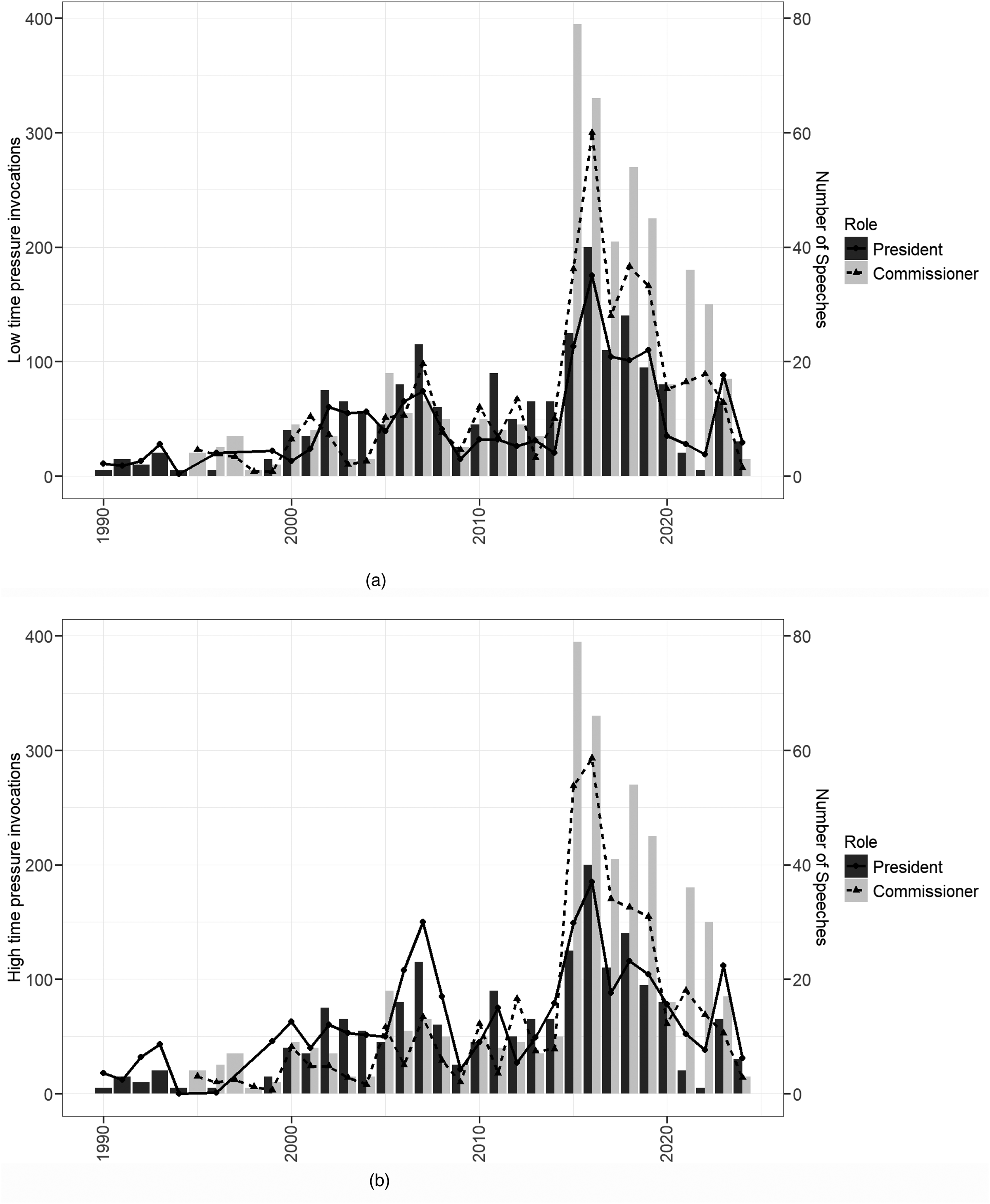
To further investigate these dynamics, we employ binomial mixed effects models on the quantitative data to estimate the probability that speech sentences contain low and high time pressure invocations. This enables us to analyze differences between Presidents and commissioners, as well as the influence of the Treaty of Lisbon and the refugee crisis on the prevalence of time pressure invocations in their speeches. The selected modeling strategy allows to account for the nested structure of our data set via the inclusion of random effects. 1
First, we can examine the probability of low time pressure invocations appearing in sentences from all migration-related speeches (see Figure 2A). The results indicate a higher probability of low time pressure invocations for commissioners compared to Presidents across all examined periods (consistent with the descriptive findings above), though the observed differences are not statistically significant. Commissioners tend to emphasize careful consideration over fast action more often, seeking to normalize dynamics, supporting Hypothesis 1b. Furthermore, the regression models show that crisis periods, like the refugee crisis in 2015/16, and the increased authority following the Treaty of Lisbon have no substantial effect on the prevalence of low time pressure invocations in speeches by either the President or the Commissioner for Home Affairs. Thus, while we see volume expansion of low time pressure invocations during these periods (see Figure 1), their frequency within individual speeches does not rise.
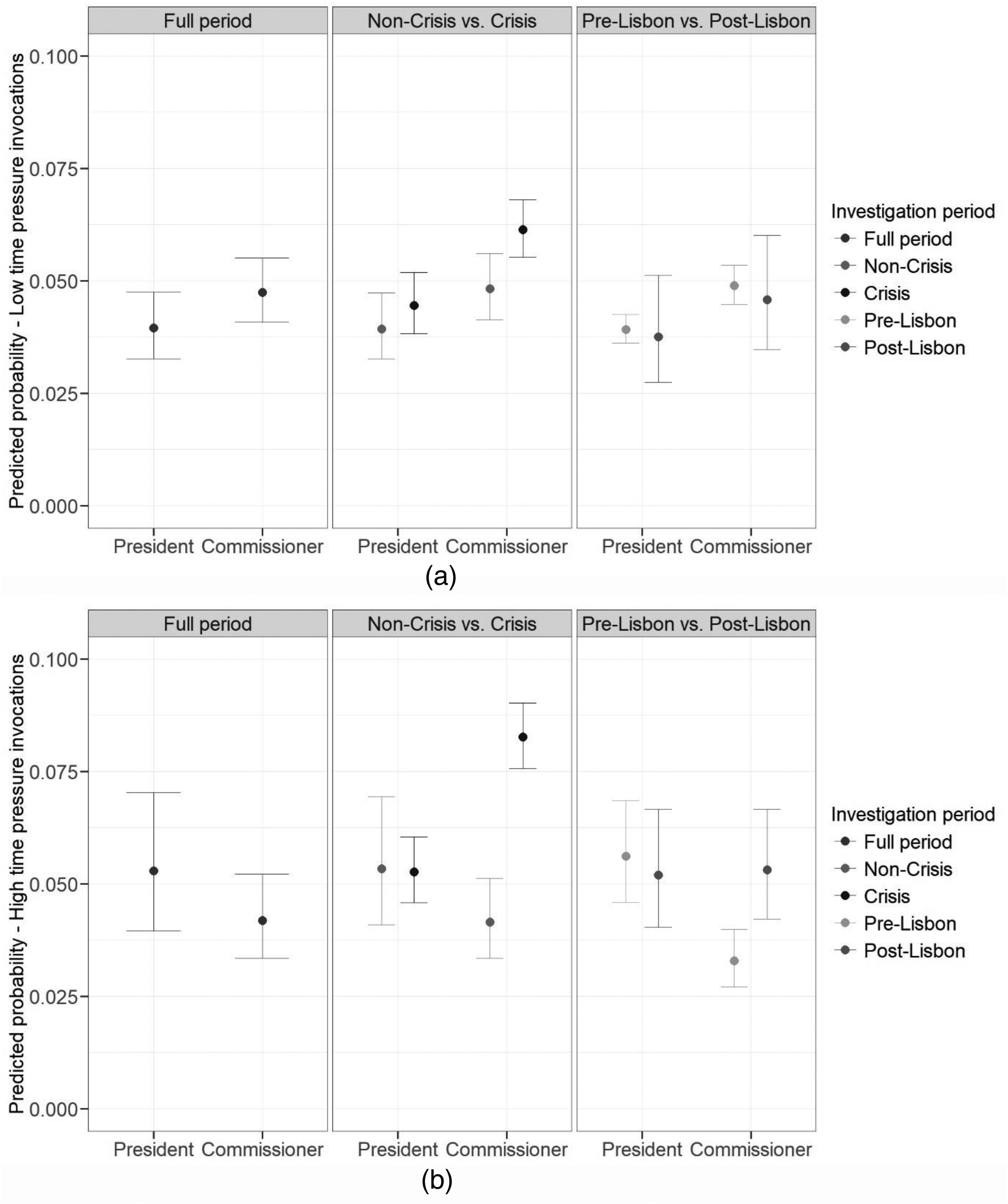
However, the patterns shift when analyzing high time pressure invocations (see Figure 2B). Overall, Commission Presidents exhibit a higher likelihood of using high time pressure invocations in sentences from migration-related speeches than commissioners (see Figure 2B, “Full period”), but this effect is not statistically significant and varies considerably across periods. Thus, Hypothesis 1a, which expected more high time pressure invocations from Presidents than commissioners, is only partially confirmed. The reasons for this lie in shifts in the communicative behavior of Home Affairs Commissioners during the 2015/16 refugee crisis and after the Treaty of Lisbon entered into force.
During the refugee crisis, the prevalence of high time pressure invocations in President speeches did not increase. Thus, the observed higher absolute number of time pressure invocations (see Figure 1) primarily results from the President addressing problem pressure and demand for action by delivering more migration-related speeches, but not from an increased prevalence of high time pressure invocations within individual speeches. For the commissioner, however, we find a clear increase in absolute numbers and a statistically significant increase in the probability of high time pressure invocations during the refugee crisis (see Figure 2B, “Non-Crisis vs. Crisis”). Hypothesis 2 anticipated more high time pressure communication by both Commission Presidents and Home Affairs Commissioners during crisis periods, with a particularly strong effect for the President. While the first part of this conjecture is supported by our findings, the second is not.
Similar patterns emerge in how the increased authority over migration and asylum granted by the Treaty of Lisbon has influenced the communicative behavior of Presidents and Commissioners. While the probabilities of high time pressure invocations for the President remain relatively consistent after the Treaty of Lisbon entered into force (see Figure 2B, “Pre-Lisbon vs. Post-Lisbon”), the probability of high time pressure invocations increases for commissioners. Thus, Home Affairs Commissioners not only increased the number of speeches on migration and asylum but also raised the prevalence of urgency and high time pressure within individual speeches after the Treaty of Lisbon, reflecting their enhanced role in EU policymaking. This finding confirms Hypothesis 3. 2
Qualitative analysis
The results of the quantitative analysis suggest that increasing politicization and authority over migration and asylum have increased Home Affairs Commissioners’ communication of urgency, particularly during the refugee crisis. In contrast, Presidents maintain a consistent likelihood of invoking time pressure but deliver more migration-related speeches during crises. Thus, a key finding from the large-n analysis requiring further explanation is how commissioners’ communication during crises has evolved compared to that of the President. Based on our results, crises appear to be the central driver of changes in the usual hierarchy of urgency in Commission discourse. Given that urgency rhetoric in these contexts can serve as both a functional tool for rapid policy coordination and a strategic mechanism to consolidate authority, a qualitative analysis is necessary to examine how actors frame crises, justify emergency action, and assert institutional leadership within the EU's governance system. These readings allow us to consider how communicative choices are shaped not only by formal position, but also by evolving inter-institutional dynamics and individual communication strategies.
Since Commission President Jean-Claude Juncker and Home Affairs Commissioner Dimitris Avramopoulos delivered 150 speeches during our defined crisis period (01.04.2015–31.05.2016), we use “pathway cases” to narrow the selection for in-depth analysis. Thus, in the qualitative part, we are interested in a deeper understanding of the differences in crisis communication; this includes a better understanding of the context and type of time pressure rhetoric and framing of the crises. Therefore, we further split the crisis period into three phases. The first is the immediate crisis response phase (01.04.2015–30.11.2015), defined by the initial realization and early response to the asylum development in Europe. Second, we define an interim period, which is marked by the search and communication of ad hoc solutions (01.12.2015–28.02.2015), the realization that winter will not bring down numbers and ends with one of the key ad hoc solutions, the EU-Turkey Statement. The third and last period is defined by the Turkey deal taking effect, with asylum-seeker numbers starting to decrease again (01.03.2016–31.05.2016). The list of speeches and all materials adding to the transparency of production, analysis and data can be found in the Online appendix. Process observations used in the qualitative part for inferences are referenced with running numbers per period and speaker as detailed in the supplementary material.
Period 1: Immediate crisis response, 01.04.2015–30.11.2015
There was a steady increase in asylum applications starting in 2013, but numbers surged in spring and summer 2015 (see Figure 3). Initially, the Commission, particularly Home Affairs Commissioner Avramopoulos, acknowledged the developments but treated them as challenges for member states (COM_I_1). Commission President Juncker was largely silent on migration in March and April. Early on, the Commission did not communicate as though it faced a full-blown European refugee crisis.
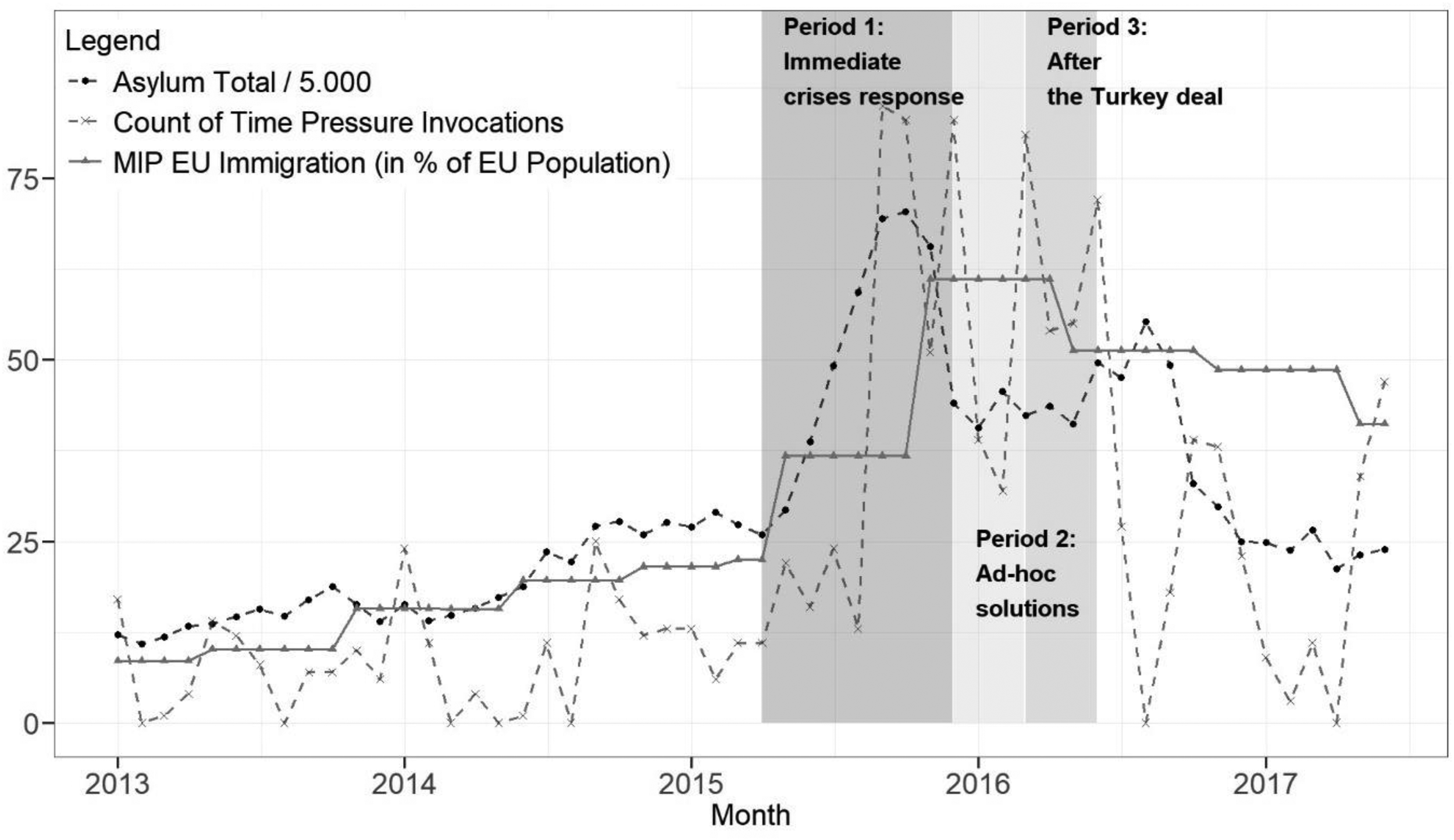
Asylum numbers, public opinion, and time pressure communication.
From mid-April, Avramopoulos increasingly acknowledged that frontline states would be overstretched, signaled solidarity, and organized emergency EU support (COM_I_2). 3 Juncker entered the debate on 29 April, echoing Avramopoulos’ framing: this was a difficult situation requiring European solidarity (Pres_I_1). Citing shifting public opinion, both figures justified the need for swift action (Pres_I_1; Com_I_4). Indeed, concern about immigration rose from ∼20% at the beginning of April to over 35% by its end, and around 60% in November (see Figure 3).
Not only did Juncker finally declare the asylum situation a crisis, but he also voiced dissatisfaction with member states’ reluctance to support a common approach based on burden-sharing and relocation quotas (Pres_I_1). He saw a chance to reform the asylum system but was frustrated by key member states’ resistance (Pres_I_2). Avramopoulos remained more conciliatory (COM_I_3), expressing hope that the European Agenda on Migration, combined with emergency help and temporary relocation, would yield results (COM_I_4).
Two developments soon became clear: member state support was limited and hopes that winter would bring a drop in asylum seekers proved unfounded. In September, the Commission passed an emergency relocation mechanism and expanded the hotspot approach. Numbers fell slightly in October, prompting some optimism in Avramopoulos’ speeches (COM_I_5). Yet by November, both he and Juncker acknowledged that progress was insufficient. They called on member states to act more decisively (COM_I_6).
Juncker, in particular, took a sharper tone. He emphasized that the Commission had done all it could, but its ability to act depended on member state budgets. He highlighted the Turkey deal, expected to cost €3 billion, against a €250 million EU budget (Pres_I_3). He strongly criticized the member states for being too slow: “the member states are still moving slowly at a time when they should be running” (Pres_I_3). He even linked budget flexibility under the Stability and Growth Pact to refugee contributions (Pres_I_3). By late 2015, both Juncker and Avramopoulos framed the asylum challenge as a long-term structural issue, and member state reluctance as a symptom of Europe's ongoing fragmentation (Pres_I_9).
Period 2: Interim crisis period, 01.12.2015–28.02.2016
The experience of struggling to implement quick solutions shaped the rhetoric of both Juncker and Avramopoulos in winter 2015–2016. Expected drops in arrivals due to cold weather failed to materialize. In January, Avramopoulos underlined that there would be no winter lull (COM_II_1; COM_II_2; COM_II_3). Both he and Juncker argued that the absence of a coherent EU response endangered Schengen (Pres_II_1), European unity (COM_II_16), and fed populist backlash (COM_II_4).
Time pressure was now clearly directed at member states. This shift stemmed from the September 2015 relocation mechanism, which had been mired in intergovernmental disagreement. Juncker, in December, criticized governments for wasting time pointing fingers at each other or at Brussels (Pres_II_2). One month later, he reiterated that the Commission had proposed solutions, but that member states had failed to act (Pres_II_3). Avramopoulos also ramped up criticism, repeatedly stating that Commission efforts were being stalled by national inaction (COM_II_1; COM_II_2; COM_II_4).
There was now little daylight between Juncker and Avramopoulos in tone or content. Both emphasized that the Commission had fulfilled its duties, and the crisis persisted due to member state paralysis. Their rhetoric was marked by strong, coordinated pressure and a shared warning that the Union itself was at risk.
Period 3: Anticipating the effects of the EU-Turkey statement, 01.03.2016–31.05.2016
As talks with Turkey progressed, the third phase of the crisis began. A hopeful tone emerged, especially in Avramopoulos’ speeches, while Juncker largely maintained his previous pressure-oriented rhetoric. In March 2016, Avramopoulos noted that the EU–Turkey Action Plan was yielding results (COM_III_1). He began emphasizing sustainable reforms, stating that the refugee crisis had served as a catalyst for deeper changes (COM_III_3). While he acknowledged the crisis was not over, he looked ahead to structural improvements (COM_III_1).
His pressure messaging remained but was more future-oriented. For example, speaking before the EESC, he appealed for solidarity from stakeholders across society: “More than ever, we need solidarity […] I count on your experience and support to work together” (COM_III_2). He also warned that smugglers were exploiting weaknesses in the EU system (COM_III_5). Notably, his speeches now downplayed blame, focusing instead on consensus-building and reform.
Juncker's tone remained forceful. He too pointed to smugglers exploiting weak points (Pres_III_2), but he directly blamed national governments: “They have exploited a patchwork of national rules to make a fortune from human suffering” (Pres_III_2). In March, he criticized capitals for failing to implement their own legislation (Pres_III_1), reiterating that only a collective response could work: “It is because there is not enough Union in the European Union […] only a European response can solve a Europe-wide problem” (Pres_III_1). In May, he again attacked the dominance of national politics over European solidarity: “listening exclusively to their national opinion” (Pres_III_3), repeating the idea that migration was a European problem requiring a European solution.
Avramopoulos focused on coalition-building to advance policy reform. Juncker maintained high-level political pressure, aiming to reinforce supranational authority and discredit national go-it-alone approaches. While the crisis appeared to be easing, the communication of both leaders continued to reflect different institutional imperatives: one of negotiation and policy shaping, the other of power assertion and public leadership.
Discussion and conclusion
This article set out to deepen our understanding of how different institutional roles and contexts shape the communicative behavior of European Commission members. To this end, we analyzed the full corpus of Commission speeches on migration and asylum from 1990 to 2024 using computational text analysis, complemented by in-depth qualitative reading of selected speeches. In light of the unified theoretical framework presented, and using the lens of time pressure invocations, we gained important insights into how Commission Presidents and Home Affairs Commissioners communicate, whom they address, and how they frame issues in terms of urgency in the context of migration and asylum.
First, we find clear differences in how Commission Presidents and commissioners invoke time pressure, consistent with Hypothesis 1 and our expectations about internal organizational roles. Commission Presidents have traditionally emphasized high levels of time pressure and the need for swift action, whereas Home Affairs Commissioners have tended to downplay urgency and present migration and asylum dynamics in more normalized terms. This baseline pattern reflects the President's broader agenda-setting mandate, in which signaling urgency can rally prompt action, versus the commissioner's portfolio-focused role, which often calls for a cautious, problem-normalizing tone.
Second, acute problem pressure in the form of a crisis profoundly influences Commission communication. The refugee crisis of 2015/16, for example, prompted both Presidents and commissioners to invoke high time pressure more frequently, narrowing the gap in urgency communication between them and challenging the traditional assumption of their distinct roles. This dynamic provides partial support for Hypothesis 2. As anticipated, a highly politicized crisis spurred both the Commission President and the Home Affairs Commissioner to adopt more urgent rhetoric; however, the President did not exhibit a dramatically greater surge in urgency than the commissioner, contrary to a strictly presidentialized crisis-leadership scenario. In essence, crisis conditions temporarily blurred the usual role-based distinctions in tone as the institution's members collectively stressed the need for swift EU action.
Moreover, our qualitative analysis of crisis-period speeches further illustrates how these role differences were flattened under extreme pressure and then reasserted as the crisis abated. During the peak of the 2015/16 refugee crisis, commissioner Avramopoulos adopted language that closely resembled President Juncker's, with both framing migration as a European challenge requiring urgent collective action and even openly blaming member states for delays in responding. As the prospect of a resolution emerged (e.g., the EU-Turkey Statement in early 2016), Avramopoulos pivoted back toward a more measured, technocratic tone focused on long-term reforms and coalition-building, whereas Juncker maintained a confrontational crisis narrative to press for European-level solutions. This divergence in the later phase of the crisis illustrates how institutional roles reassert themselves once immediate pressures begin to ease: the commissioner returned to a traditional, bureaucratic-guardian framing, while the President continued to act as a political agenda-setter emphasizing the stakes of member state inaction. In sum, crisis conditions can temporarily align a commissioner's communication with the President's, but they ultimately reaffirm the President's enduring position as the most prominent and assertive voice in high-stakes moments.
Third, the expansion of the Commission's formal authority in migration policy also reshaped communication patterns. After the Treaty of Lisbon's entry into force in 2009 expanded the EU's competences in asylum and migration, Home Affairs Commissioners began invoking high time pressure more frequently, further narrowing the gap with Presidents even outside of crisis periods. This finding supports Hypothesis 3: as a commissioner's portfolio gains greater authority and political salience, their communication tends to become more urgency-driven, reflecting heightened responsibility and responsiveness. In other words, increased competence and politicization can not only reinforce the President's leadership role but also elevate the profile of the responsible commissioner, moving their communication closer to the President's in terms of expressed urgency.
Together, these results indicate that Commission communication is adapted to both internal dynamics and external pressures. They reinforce our theoretical argument that time pressure appeals serve as a communicative resource through which EU leaders signal priorities and navigate the twin pressures to act swiftly yet remain accountable. Beyond these substantive insights, our study contributes to broader debates on the Commission's political development and communication strategies. First, our findings offer new insights into the internal differentiation of roles within the College of Commissioners and how these evolve under shifting conditions (e.g., Bauer et al., 2021; Dinan, 2016; Hartlapp et al., 2014; Kassim et al., 2016). They highlight the interplay between internal leadership structures and external pressures, such as crises or shifts in formal authority, in shaping who speaks for the Commission and with what tone. This aligns with research on turf wars and internal competition for visibility and agenda control (Senninger et al., 2021), as well as with studies of (technocratic) responsiveness to public and political demands (Van der Veer and Haverland, 2018). Taken together, the findings reinforce a view of the Commission as an internally differentiated institution that adapts its public voice strategically in response to both internal politics and external cues.
Second, we demonstrate that examining invocations of time pressure is a fruitful approach to capture how political actors frame policy urgency (Röth et al., 2024; Röth et al., 2025). The invocations of high time pressure, or conversely, calls for patience and normalization, reveal how actors define problems, call for action (or justify inaction), and address specific audiences in high-salience policy areas. Finally, this mixed-methods analysis highlights the value of combining large-scale computational text data with qualitative case analysis. Such an approach enables us to identify broad patterns in elite communication while also unpacking the nuanced temporal dynamics behind those patterns.
Despite these contributions, our study has certain limitations that open avenues for future research. First, focusing on a single policy area (migration and asylum) provides depth but limits generalizability. The EU's multi-level governance operates with different rules, competences, and levels of politicization across policy domains. Our findings are likely most relevant to highly integrated and politicized domains—such as climate change or economic crisis management—in which the Commission faces similar pressures to act visibly and decisively. In these contexts, communication strategies reflect not only structural constraints but also discretionary choices that reveal strategic intent. However, the variation captured in our case, particularly during the pre-Lisbon period when the Commission operated with more limited formal authority, also makes our findings relevant for lower-authority or lower-salience fields. In such settings, the Commission may still invoke urgency selectively, using communication as a tool to assert relevance or leadership in the absence of strong legal competencies. Second, while we concentrated on the Commission's public communication, future work should examine how these communicative strategies relate to other stages of the policy process, such as policy formulation, inter-institutional negotiation, and decision-making. Finally, we centered our analysis on institutional roles and context rather than the personal characteristics of officeholders. Individual factors like ideology, leadership style, or career ambition may also influence communicative behavior. Investigating these personal and interpersonal dynamics could further enrich our understanding of strategic communication in the European Commission and help determine how generalizable our findings are beyond the migration case.
Supplemental Material
sj-docx-1-eup-10.1177_14651165251395315 - Supplemental material for Presidents, commissioners, and time pressure: A mixed-methods analysis of migration communication by the European Commission
Supplemental material, sj-docx-1-eup-10.1177_14651165251395315 for Presidents, commissioners, and time pressure: A mixed-methods analysis of migration communication by the European Commission by Radu-Mihai Triculescu, Leonce Röth, Christoph Ivanusch and Klaus H. Goetz in European Union Politics
Supplemental Material
sj-zip-2-eup-10.1177_14651165251395315 - Supplemental material for Presidents, commissioners, and time pressure: A mixed-methods analysis of migration communication by the European Commission
Supplemental material, sj-zip-2-eup-10.1177_14651165251395315 for Presidents, commissioners, and time pressure: A mixed-methods analysis of migration communication by the European Commission by Radu-Mihai Triculescu, Leonce Röth, Christoph Ivanusch and Klaus H. Goetz in European Union Politics
Footnotes

Author contributions
The authors contributed equally to the article.
Funding
This article is part of the ERC Advanced Grant SYNCPOL—Synchronised Politics: Multiple Times and Political Power (Number 101054122), funded by the European Union. Views and opinions expressed are however those of the author(s) only and do not necessarily reflect those of the European Union or the European Research Council. Neither the European Union nor the granting authority can be held responsible for them.
Data availability statement
All data and replication material are accessible via Harvard Dataverse: https://doi.org/10.7910/DVN/AL3GYH.
Supplemental material
Supplemental material for this article is available online.
Notes
References
Supplementary Material
Please find the following supplemental material available below.
For Open Access articles published under a Creative Commons License, all supplemental material carries the same license as the article it is associated with.
For non-Open Access articles published, all supplemental material carries a non-exclusive license, and permission requests for re-use of supplemental material or any part of supplemental material shall be sent directly to the copyright owner as specified in the copyright notice associated with the article.
