



Abstract
This study examines the empirical implications of national and supranational signals for the separation of powers in legal European integration. The rulings of the European Court of Justice do not only resolve specific cases, but its dispositions also shape the scope of legal doctrine, requiring to anticipate the implications of rulings for future classifications of case facts by national courts. Drawing on data from the preliminary reference procedure, we estimate how the direction and strength of signals sent to the European Court of Justice shape the crafting of dispositions for legal European integration. Our findings show that strong supranational signals from the Commission and the Advocate General play a decisive role for crafting broad dispositions with clear thresholds for legal doctrine. Importantly, this influence holds regardless of the pro- or anti-integrationist direction, while signals from member states exert only a marginal impact for legal European integration.
Keywords
Introduction
The European Court of Justice (ECJ), the highest judicial authority within the Court of Justice of the European Union (CJEU), plays a central role in advancing legal European integration (e.g., Alter, 1998; Blauberger and Schmidt, 2017; Burley and Mattli, 1993). Guided by the principle of effet utile, the ECJ’s landmark rulings in Van Gend en Loos (C-26/62) and Costa v. ENEL (C-6/64) not only provided guidance for resolving specific legal disputes but also established foundational doctrines affirming the direct effect and primacy of supranational over national law (Rasmussen, 2012; Weiler, 1991). As Garrett (1995: 173) puts it, the ECJ functions as a ”strategic rational actor” whose ”primary objective [is to] extend the ambit of European law”—a perspective associated with pro-integrationist judicial activism (Grimmel, 2012; Ovádek, 2021; Weiler, 1994).
This influential role of the ECJ has sparked enduring debate over the separation of powers in legal European integration, particularly regarding the capacity of member states to constrain pro-integrationist ECJ activism through sending national signals as threats of legislative override (e.g., Alter, 1996; Burley and Mattli, 1993; Carrubba et al., 2012; Garrett, 1995; Larsson and Naurin, 2016; Martinsen, 2015; Mattli and Slaughter, 1995, 1998; Stone Sweet and Brunell, 2012). Central to this debate is whether and how override threats of member states can effectively preserve national sovereignty. Recent work emphasizes the informational demands of ECJ decision-making under uncertainty (Larsson and Naurin, 2016), demonstrating that override threats of member states are effectively shaping court rulings (Carrubba et al., 2008; Cheruvu and Krehbiel, 2022; Larsson et al., 2017; Lindholm et al., 2025; Schroeder, 2024).
How judicial preferences are formed under uncertainty is a central question in the case-space approach, which models their formation as encompassing not only a specific legal case but also the broader legal doctrine that guides future lower court dispute resolution (e.g., Ainsley et al., 2021; Cameron and Kornhauser, 2017; Fox and Vanberg, 2014; Landa and Lax, 2008). Accordingly, courts craft dispositions—broad or narrow—that set doctrinal thresholds for interpreting case facts. Dispositions partition case facts into equivalence classes, such as yes versus no, winner versus loser, national versus supranational, etc. (Lax, 2012: 769). A broad disposition reduces future discretion about the classification of case facts by clearly partitioning doctrinal categories, while a narrower one leaves more interpretive space (Ainsley et al., 2021). For high courts in particular, a key objective is to minimize misclassification, that is, the probability that a ruling will introduce ambiguity into the interpretation of case facts of future lower court dispute resolution (Lax, 2012: 771).
When the consequences of a ruling for “bundles of case facts” are uncertain, courts require information to form expectations about how those facts should be classified in a legal process that structures information transmission (Lax, 2012: 767). While much of the case-space literature focuses on modeling the formation of individual judicial preferences to understand collegial court decision-making (e.g., Ainsley et al., 2021; Fox and Vanberg, 2014; Kornhauser, 1992), our procedural perspective highlights the empirical implications of this information transmission process for the court’s decision on the legal doctrine. Specifically, we examine how types of signals from different actors shape the court’s decision to adopt broad or narrow dispositions for legal doctrine. We expect that not only the direction but also the strength of signals is important for crafting broad or narrow dispositions.
We contribute to existing research on the separation of powers in legal European integration, which thus far has ‘‘centred on the Court and Member States’ tug-of-war over preliminary rulings’’ (Schroeder, 2024: 2989), by also considering the Commission and the Advocate General as supranational senders of signals that provide information about the classification of case facts in the legal process. Rather than treating their supranational signals merely as controls (e.g., Carrubba and Gabel, 2015; Cheruvu, 2025; Larsson and Naurin, 2016), we assess their explanatory power—alongside the national signals of the member states—for shaping doctrinal dispositions in the preliminary reference procedure. Statistically, we introduce a combined model that accounts for the direction and the strength of signals, specifying the conditions under which the ECJ crafts broad or narrower doctrinal dispositions in the legal process.
For the empirical analysis, we draw on the IUROPA CJEU Database (Brekke et al., 2023), which comprises over 5,000 legal questions from more than 2,000 preliminary rulings between 1995 and 2011. We estimate Bayesian hierarchical ordinal probit models with a parameterized dispersion component to disentangle the influence of signal direction and strength under conditions of ‘‘the more realistic incomplete information scenario’’ (Larsson and Naurin, 2016: 385). We compare our combined model to a conventional location-only model, which implicitly assumes that all signals are equally informative for the formation of expectations (Liddell and Kruschke, 2018; Tutz and Berger, 2017). We show that explicitly modeling dispersion increases predictive power and substantially improves model specification. Our Bayesian framework further allows to assess the full posterior distribution, enabling analysis of the combined effects of signal direction and strength, and the derivation of variance ratios and model fit indicators with uncertainty intervals, yielding substantive insight into the effectiveness of national and supranational signals for legal European integration.
Our results yield four key insights on the separation of powers that refine the predominant view of the relative importance of national signals from member states and pro-integrationist judicial activism of the ECJ. First, strong supranational signals from the Commission and Advocate General are the most decisive predictors of broad doctrinal dispositions. Compared to counterfactual scenarios with only strong national signals from the member states, adding a strong supranational signal makes broad dispositions, on average, at least 2.5 times more likely. Second, although the strength of member state signals is statistically significant, its substantive effect on advancing legal doctrine is marginal. Third, we find a striking symmetry in the direction of ECJ rulings, indicating that the ECJ follows the supranational signals of the Commission and Advocate General in both anti- and pro-integrationist directions. Lastly, contrary to claims that the ECJ pursues an overall pro-integrationist agenda (e.g., Garrett, 1995; Weiler, 1994), we can disentangle the specific conditions for a pro-integrationist bias of the ECJ. Together, these findings contribute to the literature on European legal integration by offering a more nuanced account of the separation of powers in the legal process of the preliminary ruling procedure.
The case-space approach and legal integration
In studies on the separation of powers in legal European integration, which focus on the relationship between court rulings and national signals of the member states, a central methodological challenge lies in measuring override threats (e.g., Carrubba et al., 2012; Larsson and Naurin, 2016; Stone Sweet and Brunell, 2012). In the preliminary reference procedure, member states may submit amicus curiae briefs, which serve as national signals either aimed at preserving sovereignty, expressing ambivalence, or supporting further European integration. These ambivalent, pro- or anti-integrationist briefs are conceived as threats of override, which imply formal legislative actions that may revise, nullify, or circumscribe the legal effects of court rulings (Larsson, 2021). 1 Courts are sensitive to these threats because override cannot only alter legal outcomes but also pose a challenge to their judicial authority in the separation of powers (Epstein and Knight, 1997).
To assess the empirical implications of override threats for the separation of powers, most quantitative studies employ location-only models to investigate the relationship between the pro- or anti-integrationist direction of amicus curiae briefs and case-specific rulings, that is ‘‘the Court and Member States’ tug-of-war over preliminary rulings’’ (Schroeder, 2024: 2989). In this tug-of-war of case-specific preferences for court rulings, the court can strategically accommodate override-prone anti-integrationist preferences while continuing to pursue a pro-integrationist agenda (Ferejohn and Weingast, 1992; Larsson et al., 2017). Hence, if the court is responsive to override threats and can accurately assess their risk, case-specific override outcomes will be rare, raising questions about observational equivalence: the absence of observable overrides does not imply the absence of credible override threats (Carrubba et al., 2012).
In addition to the directional relationship between the court and the member states in the separation of powers, the case-space approach shifts attention to the question on how to interpret case facts, recognizing that rulings do not merely resolve a specific case but also shape the evolving legal doctrine. In particular high courts, such as the ECJ, craft dispositions that define doctrinal thresholds, thereby structuring how lower courts will classify case facts in future dispute resolution. The goal of high courts is then to minimize the risk of misclassification, that is, the likelihood that lower courts will interpret case facts differently in future dispute resolution.
In our view, this forward-looking perspective on future dispute resolution underscores the court’s informational demand to form expectations about the classification of case facts, particularly through the transmission of information in the legal process. The preliminary reference procedure structures this legal process, in which the ECJ receives signals from different actors, most notably from the Commission and the Advocate General in addition to the member states, regarding their interpretation of ‘‘bundles of case facts.’’ Depending on the source and the type of signal, the empirical question is which signals influence under what conditions the ECJ to craft broad or narrower doctrinal dispositions.
Information transmission in the legal process
In the context of legal European integration, Article 267 TFEU empowers courts of the member states to refer questions to the ECJ for a ruling in the preliminary reference procedure. This mechanism is essential for ensuring the uniform interpretation and application of supranational law across the member states. Lower courts and tribunals may seek clarification, while the national high courts of last instance are, in principle, obliged to do so unless the correct application is beyond reasonable doubt. Although the ECJ cannot formally annul national legal provisions, its rulings under this procedure effectively determine whether such provisions are compatible with supranational law, obliging national courts to set aside conflicting norms (Stone Sweet and Brunell, 2012).
The legal process begins with the referral of a question concerning the interpretation or the validity of acts of the supranational institutions, bodies, offices, or agencies of the European Union, initiating a written phase in which the member states, the Commission, and the parties to the main proceedings may submit observable opinions on the legal question (Brekke et al., 2023). After this phase, the Advocate General, unless the ECJ dispenses with this step, delivers an independent, non-binding opinion evaluating the legal merits of the case before a ruling (Carrubba and Gabel, 2015). This sequence defines a structured legal process in which the court collects information about competing interpretations of case facts, while potentially formulating dispositions that shape the doctrinal space of legal European integration.
Although ECJ rulings in the preliminary reference procedure are formally binding only on the referring national court, dispositions articulated in these rulings carry de facto erga omnes authority. This interpretation is explicitly affirmed by the ECJ itself, as illustrated in International Chemical Corporation (C-66/80, paras.12-13) and Kühne & Heitz (C-453/00, para.27). Thus, ECJ rulings effectively function as precedent, exerting broader influence on the development of the legal doctrine. In general, this doctrinal impact is characteristic of high court rulings, which not only resolve specific legal cases but also anticipate the doctrinal implications of their rulings for future adjudication (Ainsley et al., 2021; Cameron and Kornhauser, 2017).
Our study refers to the case-space approach because it provides a reasonable understanding of the court’s motivation to consider the opinions of other actors for the formation of expectations about the classification of case facts in the legal process (Ainsley et al., 2021; Cameron and Kornhauser, 2017; Fox and Vanberg, 2014; Kornhauser, 1992; Lax, 2012). The formulation of such dispositions is a defining feature of adjudication—one that sets courts apart from legislatures, bureaucracies, and executive agencies (Cameron and Kornhauser, 2017). As a high court, the ECJ decides about crafting doctrinal dispositions that provide thresholds for the classification of case facts, thereby structuring future lower court dispute resolution.
Under uncertainty about the implications of case facts, we posit that the ECJ collects information to form expectations about the classification of case facts in the legal process. To examine the formation of the ECJ’s expectations, we investigate the preliminary reference procedure because it structures this legal process, in which the court receives information from different actors about their opinions to classify case facts. We suppose that this information enables the court not only to resolve the specific legal case but also to form expectations about the distribution of future cases. 2
Actors and positions in the preliminary reference procedure
In the legal process of the preliminary reference procedure, member states usually favor rulings that preserve national sovereignty (Cheruvu and Krehbiel, 2022). However, their submitted amicus curiae briefs can only serve as imperfect proxies for anti-integrationist override threats, as relatively few briefs are submitted in most cases (Stone Sweet and Brunell, 2012). The modal number of submissions is one, typically from the member state where the case originated. This pattern is strongly correlated with member state size, as larger states tend to receive a greater volume of cases before their national courts (Dederke and Naurin, 2018). Despite the limited coverage and uneven distribution of member state briefs, a growing body of studies conclude that override threats matter, stating that ‘‘the significance of override has been underestimated, and that it is indeed one of the factors determining the CJEU’s strategic space’’ (Larsson and Naurin, 2016: 405). 3
In addition to the member states, the preliminary reference procedure offers the Commission to submit an opinion prior to the ECJ’s judgment. Compared to the member states, the Commission uses this opportunity in nearly all cases (Dederke and Naurin, 2018). Mandated as the guardian of the treaties, the Commission interprets case facts on their compatibility with the acquis communautaire. Operating independently of direct electoral accountability, Commission officials share a supranational identity that insulates them from domestic political pressures (Alves et al., 2021). Although this suggests that the Commission—similar to the European Parliament—pursues pro-integrationist preferences (Ovádek, 2021), the Commission advocates limiting national sovereignty in only 28% of cases, while supporting its preservation in 21% (Larsson et al., 2022). This pattern mirrors findings from compliance research on the Commission’s strategic behavior, indicating that observable Commission positions may be calibrated to member state preferences (Fjelstul and Carrubba, 2018; König and Mäder, 2014).
At the outset of each preliminary reference procedure, the First Advocate General assigns one of the eleven (eight prior to 2020) Advocate Generals to deliver an independent and impartial legal assessment of a case following the conclusion of the oral phase (Brekke et al., 2023). Politically sensitive cases are often allocated to Advocate Generals from member states with moderate preferences to ensure judicial legitimacy (Hermansen, 2020). Advocate Generals are functionally judge-like and assist the court in clarifying the legal merits of a case. As legal experts unaffiliated with litigants or third parties, they operate independently from national or supranational agendas (Carrubba and Gabel, 2015). When treated as a unitary actor, the ECJ tends to align with the Advocate General on the pro-integrationist side of the spectrum (Ovádek, 2021). Confirming findings on Advocate General heterogeneity (Frankenreiter, 2018), they advocate limiting national sovereignty (24%) more frequently than preserving it (18%) (Larsson et al., 2022). In recent years, the submission rate of Advocate General opinions has declined from nearly 100% in the 1990s to about 60% by 2010, driven both by an increasing case backlog (Fjelstul et al., 2023) and by reforms to the CJEU’s statute in April 2003 that granted the court discretion over whether to request such an opinion (Lindholm et al., 2025).
Following the case-space approach, we expect that a strong supranational signal of the Commission and the Advocate General provides valuable information for the classification of case facts. In addition to the Commission, which classifies case facts with respect to the acquis communautaire, eventually considering member state preferences, the Advocate General evaluates the legal merits for future dispute settlement. This evaluation of the legal merits concerns the underlying legal facts – rather than political, strategic, or procedural considerations. In contrast to the Commission and the Advocate General, we expect that member state briefs, which are shaped by shorter time horizons and national political interests (Alter, 1998), are less informative for the classification of case facts and the future distribution of cases, and thus only exert a marginal impact on court rulings.
Research design: Cases, positions and signals
Before introducing our data and measurement, we clarify our research design for the underlying data-generating process with a directed acyclic graph (DAG). The DAG in Figure 1 illustrates the procedural structuring of information transmission in the legal process of the preliminary reference procedure. It outlines the central assumptions of our modeling, which compares the effects of two primary independent variables for the formation of judicial expectations, supranational and member state signals. In the DAG, nodes represent variables, and arrows denote their directional relationships (Pearl, 2009). 4 Due to missing randomization, we do not claim to estimate causal effects in a strict sense, but the DAG shows how we identity the direct effect of supranational and member state signals following the flow of information in the legal process. To exclude reverse causality for the identification of the direct effects, the DAG reflects the temporal ordering of the information transmission in the preliminary reference procedure. The process begins with a referral of a legal question from a national court and ends with the ECJ decision that crafts a broad or narrower disposition for legal European integration.
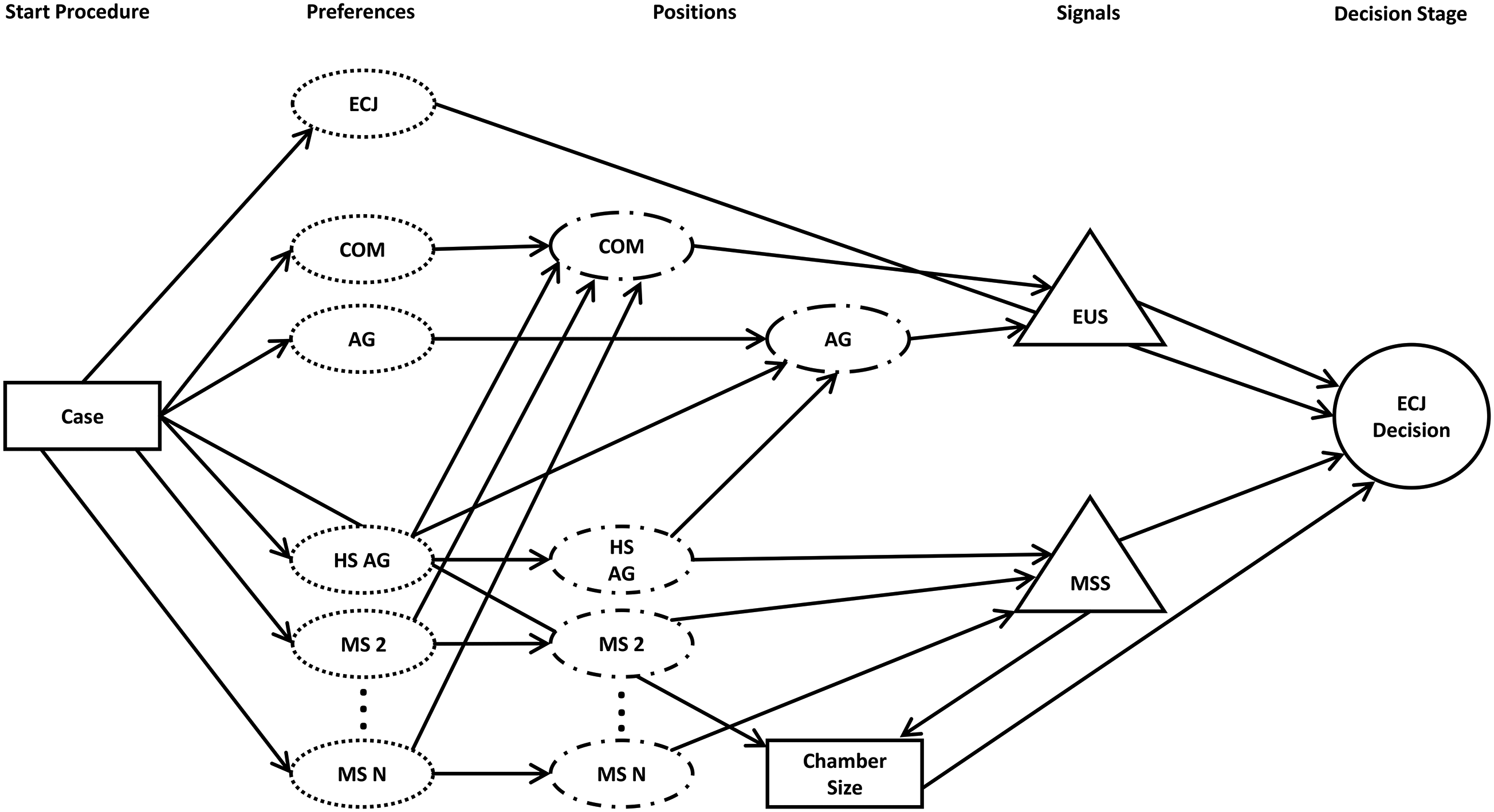
Directed acyclic graph of legal process in preliminary reference procedure.
Legal process and modeling information transmission
Consistent with demands to incorporate case-level characteristics (Dyevre, 2024), we posit that preferences are functions of case characteristics. One key case-specific indicator is chamber size, commonly interpreted as a proxy for the political sensitivity or doctrinal importance of a case (e.g., Larsson and Naurin, 2016). After arrival of a legal question, we assume all preferences depend at least partially on case characteristics, though these ‘‘true’’ preferences remain latent and unobservable (dotted ellipses). Within two months after case referral, the member states and the Commission may submit their positions by written amicus curiae briefs. These positions are partially observable (dotted-dashed ellipses) because most member states abstain from submissions and strategic incentives may lead the Commission to conceal true preferences. In accordance with compliance research, which posits that the Commission considers the distribution of member state preferences (see Fjelstul and Carrubba, 2018; König and Mäder, 2014), we add arrows connecting member state preferences to the Commission’s observable position.
At the conclusion of the oral phase, the assigned Advocate General delivers an independent legal opinion, having reviewed both the Commission’s and the member states’ submitted positions. Reflecting this temporal ordering, we place the Advocate General slightly to the right of the Commission and member states in Figure 1. Formally, the Advocate General is required to issue an opinion unless the court decides otherwise, but due to increasing case backlogs and prior litigation this position is only partially observable. Following evidence from previous studies (e.g., Carrubba and Gabel, 2015; Frankenreiter, 2018), an arrow controls for potential political influence or strategic alignment of the Advocate General with their respective home state government.
While it is temporally possible that the Commission’s position could influence the Advocate General’s position, we have neither a theoretical nor empirical foundation for assuming this relationship. If we nevertheless were to assume such an influence, solving an adjusted DAG indicates that the two direct effects remain identifiable. We also note that although the Commission’s position—submitted simultaneously with member state positions but eventually anticipating their preferences—and the Advocate General’s position—delivered after observing all briefs—occur post-treatment, controlling for these variables does not induce post-treatment bias. This follows from the fact that these positions are imperfect proxies for latent preferences (Carrubba et al., 2012). Consequently, controlling for the supranational signal of the Commission and the Advocate General when estimating the impact of the member state signal does not yield a conservative estimate but rather an unidentified one due to omitted variable bias.
As already mentioned, chamber size is widely understood as an indicator of the political sensitivity of a case (e.g., Larsson and Naurin, 2016). Cases in which member states signal a stronger pro-integrationist position are more likely to be assigned to smaller panels, which tend to follow the Advocate General’s opinion and favor supranational norms (Cheruvu and Krehbiel, 2022). Smaller panels also increase the likelihood of pivotal judges falling outside the court’s median preference, thereby increasing the variance in court rulings (Fjelstul, 2023). In Figure 1, this relationship is represented by the path from case characteristics through member state positions to chamber size, which in turn may influence the ECJ decision. To maintain the procedural timeline, we position the chamber size decision at the same horizontal level as the Advocate General position, as both occur at the conclusion of the oral stage. The backward-pointing arrow from member state signals to chamber size does not represent a chronological sequence but rather the aggregation logic used in our empirical model.
To identify the direct effects of national signals of the member states and supranational signals of the Commission and the Advocate General on ECJ decisions, that is, effects not transmitted through intermediate variables, we control for chamber size, which functions as a mediator, given that member state signals may influence ECJ decisions both directly and indirectly via panel assignment. If the objective were to estimate total rather than direct effects, one would simply omit chamber size from the set of control variables. We further control for a pool of other case characteristics to block backdoor paths through latent ECJ preferences via random intercepts. Finally, we control for the respective other signal to eliminate remaining open backdoor paths that may arise due to unobservable preferences of member states or the Advocate General’s home state. If one rejects the notion of a supranational signal, it still remains necessary to control for the positions of the Advocate General and the Commission separately.
Data and measurement
To examine the empirical implications of different types of signals for ECJ decisions on the legal doctrine, we draw on data from the IUROPA CJEU Database Version 2.0 (Brekke et al., 2023). Our analysis specifically relies on the database’s Issues and Positions component, which documents the legal questions referred by national courts to the ECJ between 1995 and 2011 (Larsson et al., 2022). This dataset records the observable positions of all relevant actors on 5,333 legal questions nested within 2,233 preliminary reference procedures, including the member states, Commission, Advocate General, and the ECJ. Given that the Report for the Hearing, the primary source of member state positions, is no longer available, this dataset offers the most comprehensive coverage of ECJ decision-making available to date (Larsson et al., 2022).
The Issues and Positions component codes actor positions along the European integration dimension into three categories, indicating whether the actor interprets the case facts of the legal question at hand in a way that should preserve national sovereignty, have a competing effect on it, or restrict it. There are two subsidiary categories: one for uncertain positions, where the actor’s stance is incomprehensible, and another for positions that are not applicable, where the actor’s position would have no effect on national sovereignty. 5 As agreement rates are lower between the categories of competing effect and not applicable, we combine them into a single category, following common practice.
For the operationalization of the dependent variable, we thus collapse the not applicable and competing effect categories into a single category. We drop 63 legal issues where the ruling was coded as uncertain and an additional 31 legal issues with missing values on the dependent variable. The dependent variable is thus an ordinal variable with three disposition categories: Preserve Sovereignty (PS), Ambivalent, and More Europe (ME). Since our main interest lies in the court’s responsiveness to signals in legal questions concerning legal European integration, including not applicable cases—where questions of legal European integration are irrelevant—is not fully satisfying. Therefore, we remove cases where all actor positions (ECJ, Advocate General, Commission, and member states) were coded as not applicable. This reduces the sample size to a final dataset of 3,931 legal issues nested within 1,837 preliminary reference procedures. The Online appendix provides summary statistics of all variables for the full sample.
Following prior research, we operationalize the direction of member state signals (MS Direction) by weighting submitted amicus curiae briefs according to member states’ voting power in the Council, as measured by the Banzhaf power index, thereby assigning greater weight to larger states (see Larsson and Naurin, 2016). We then calculate the final measure (Weighted MS Net Preferences) by subtracting the weighted number of anti-integrationist observations from the weighted number of pro-integrationist observations, thereby accounting for institutional changes stemming from the 2004 and 2007 enlargement rounds and post-Nice Treaty reforms to Council voting rules. The Online appendix shows the distribution of Weighted MS Net Preferences, which peaks at 0 and leans toward anti-integrationist signals. As an alternative operationalization, we construct two separate variables capturing the absolute number of briefs favoring to preserve national sovereignty (
Rather than controlling separately for the positions of the Commission and the Advocate General, we define a composite supranational directional signal as a nominal variable with six categories (EU Direction): (a) Ambivalent, the reference category, where neither supranational actor provides a clear pro- or anti-integrationist signal; (b) EU Both PS, where both advocate preserving national sovereignty; (c) EU Single PS, where only one adopts such a position and the other is absent, unclear, or ambivalent; (d) EU Contradictory, where the Advocate General and Commission take opposing stances; (e) EU Single ME, where one actor supports a pro-integrationist ruling and the other is ambivalent, unclear, or absent; and (f) EU Both ME, where both are in favor of deeper legal European integration.
Beyond signal direction, we specify the informational environment by considering signal strength. We define signal strength as the total number of clearly articulated positions per type of actor, regardless of direction. For supranational signals, we distinguish three ordered categories (EU Strength): (a) No Strength, where both actors send no, unclear, or ambivalent signals; (b) Weak Strength, where only one actor provides a clear signal; and (c) Strong Strength, where both actors provide clear signals in either direction. For member states, we construct a simple count variable (MS Strength) summing the number of clear positions, in line with findings that larger states do not necessarily produce more informative signals (Larsson et al., 2017). In the Online appendix, we present a histogram of member state signal strength, showing that most cases involve either zero (32%) or one (28%) clear member state signal.
We measure chamber size as the proportion of all ECJ judges participating in a ruling (Share Judges), adjusted for the 2004 and 2007 enlargement rounds in accordance with the one-judge-per-state principle. To aid interpretation and the specification of priors in the Bayesian models, all interval- and ratio-scaled variables are standardized. The standard deviation of Weighted MS Net Preferences is 0.1, meaning that a one-standard-deviation shift toward a pro-integration ruling corresponds substantively to the combined shift of one large and one medium-sized member state, for example, France and Austria.
Results
We estimate Bayesian hierarchical ordinal probit models to analyze how the ECJ classifies legal questions in preliminary reference procedures. The three ordered outcome categories are assumed to reflect an underlying latent dimension, with probabilities determined by two flexible thresholds. Unlike conventional ordinal probit models, which fix dispersion at a constant value, our specification includes both a location component that captures the expected direction of court rulings and a dispersion component that captures the expected breadth of court rulings. This extension allows us to assess not only whether the court follows the direction of supranational or member state signals, but also the extent to which signals of varying strength press the court to advance legal doctrine irrespective of their direction. To account for the nesting of multiple legal questions within the same procedure, we incorporate random intercepts, thereby addressing unobserved heterogeneity across procedures such as substantive issue domain or the extent of prior litigation. Technical details of the empirical model, the choice of prior distributions, and convergence diagnostics are reported in the Online appendix. 6
Table 1 summarizes the results from the estimated Bayesian hierarchical ordinal probit models. Column 1 reports estimates based solely on signal direction, following previous quantitative analyses employing location-only models (e.g., Carrubba et al., 2008; Larsson and Naurin, 2016). Consistent with existing research, the credible intervals for both supranational and member state signals exclude zero and point in the expected direction: pro-integrationist signals increase the likelihood of a broad disposition in favor of more Europe, while anti-integrationist signals increase the likelihood of a broad sovereignty-preserving disposition. EU contradictory supranational signals have no discernible effect on the direction of a court ruling compared to the baseline of an ambivalent signal. Moreover, the supranational signal coefficients suggest a slight pro-integrationist bias of the ECJ, as the effect of EU pro-integrationist signals exceeds that of EU anti-integrationist ones.
Summary results of Bayesian hierarchical ordinal probit models.
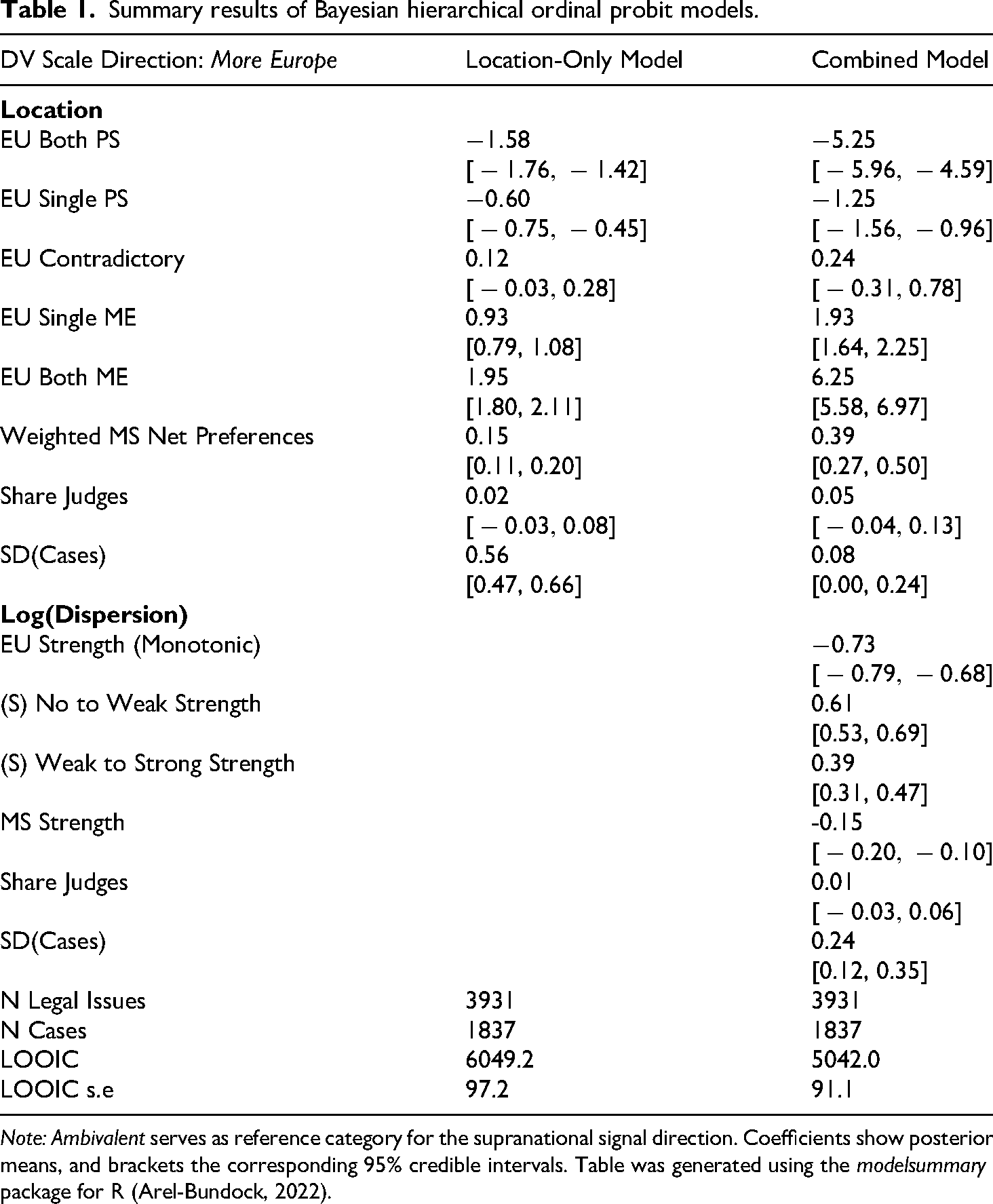
Note: Ambivalent serves as reference category for the supranational signal direction. Coefficients show posterior means, and brackets the corresponding 95% credible intervals. Table was generated using the modelsummary package for R (Arel-Bundock, 2022).
The right column in Table 1 presents results from the estimation of our combined model that incorporates the effects of signal strength via the dispersion component. An intuitive interpretation of the strength effects is that for positive values of a variable in the dispersion term, positive coefficients indicate a tendency toward a distinct outcome category, as determined by the location component, while negative coefficients indicate a tendency toward extreme outcome categories (Tutz, 2022). Since all covariates in our dispersion term are non-negative, negative coefficients indicate a greater likelihood of a broad disposition. The results show that, holding other factors constant, stronger EU supranational signals further increase the probability of broad dispositions that advance the legal doctrine in either direction.
Specifically, the posterior mean of the monotonic effect for supranational signal strength is about five times larger than the effect of a one-standard-deviation increase in member state signal strength (
Incorporating dispersion also changes the relevance of case-level variation. While heterogeneity in case characteristics becomes negligible in the location component, it plays a major role in the dispersion component (0.08 vs. 0.24). This suggests that cases are not inherently more pro- or anti-integrationist. Instead, some cases present features that favor broad dispositions advancing the legal doctrine in any direction, while others lend themselves to narrower dispositions that leave greater discretion for future dispute settlement by national courts. We also note that case-specific characteristics seem to exert a slightly stronger influence on doctrinal development than member state signal strength (0.24 vs.
Model performance and specification
As a first step, we assess model performance using the leave-one-out information criterion (LOOIC), which estimates out-of-sample predictive accuracy via leave-one-out cross-validation and is asymptotically normally distributed (Vehtari et al., 2017). In nontechnical terms, this procedure omits each observation in turn, fits the model to the remaining data, predicts the omitted value, and evaluates predictive accuracy. Lower LOOIC values indicate better model fit. The results at the bottom of Table 1 show that including the dispersion component substantially improves model performance relative to the location-only model, reducing the LOOIC by more than 1,000 – over ten times the corresponding standard error.
In a second step, we examine whether including dispersion improves model specification, not just predictive power. Because the outcome is ordinal, conventional residual analysis is unsuitable. We therefore employ randomized quantile residuals, which approximate a standard normal distribution, yielding a straight diagonal line in a quantile-quantile plot for correctly specified models, while deviations indicate misspecification (Dunn and Smyth, 1996).
7
The residuals of the location-only model in the top panel of Figure 2 indicate clear signs of misspecification, as evidenced by a double S-shaped curve and a notable absence of observations along the diagonal. By contrast, the residuals from the combined model in the bottom panel of Figure 2 closely follow the diagonal, especially within the central range of the distribution. While we still find deviations at the extremes, the over 95% of observations that fall within the
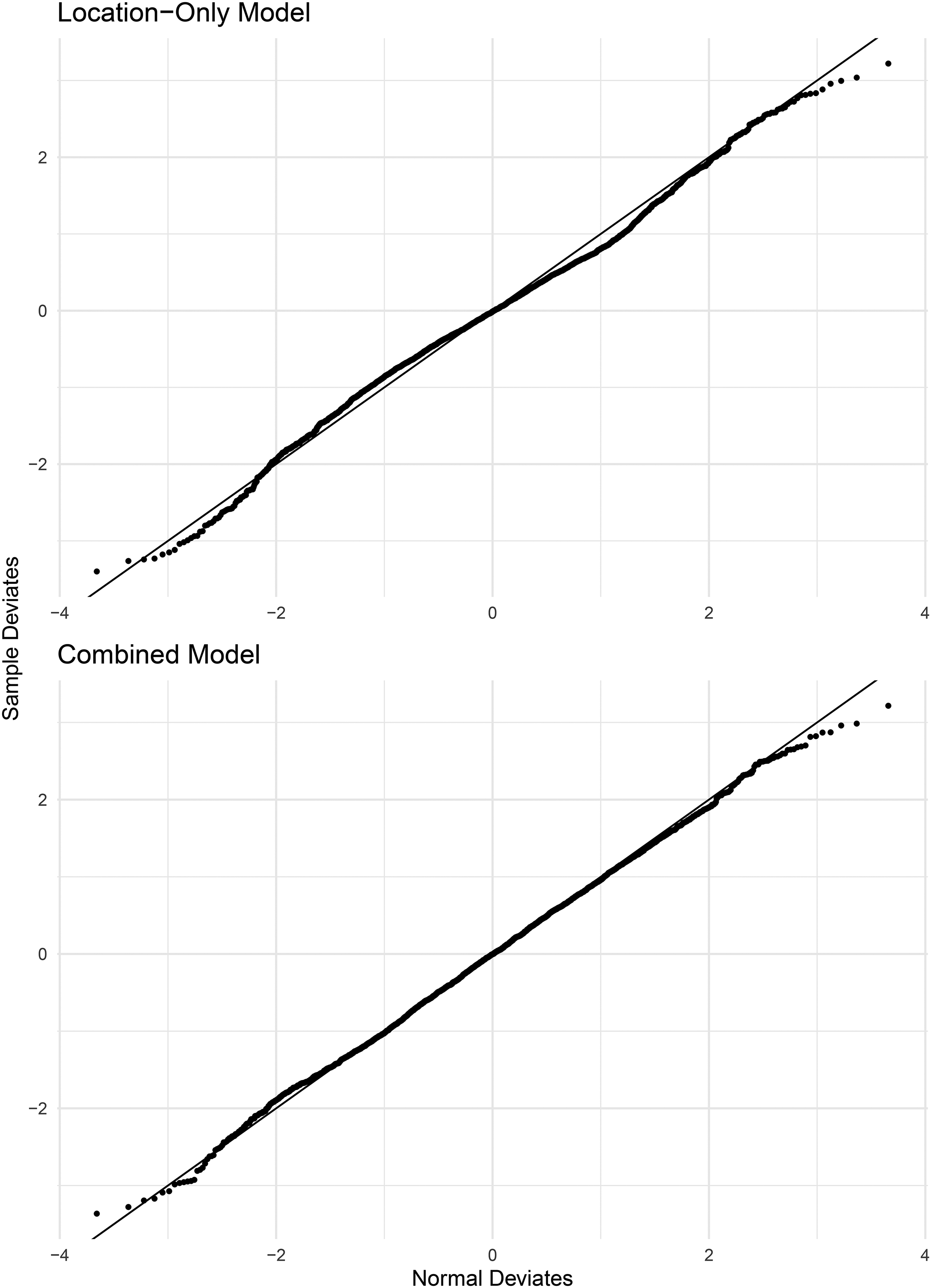
Quantile–quantile plots of randomized quantile residuals.
Taken together, these results suggest that the combined model not only increases predictive power but also improves model specification. Consequently, coefficients from location-only model should be interpreted with caution. However, the complexity and nonlinearity of our model constrain the interpretation of regression coefficients to their direction, relative magnitude, and whether their credible intervals exclude zero. To provide a more substantive understanding of our findings, we present a set of quantities of interest derived from posterior predicted probabilities across a range of scenarios that vary both the direction and strength of national and supranational signals.
Combined impact of signal direction and strength
To examine the combined impact of signal direction and strength on outcomes, Figure 3 presents the resulting posterior predicted probabilities across 18 combinations of supranational and national signals.
8
In each panel, the center row reflects predicted probabilities at the observed level of Weighted MS Net Preferences (Observed Net), while the top and bottom rows represent counterfactual shifts of two standard deviations in the anti- and pro-integrationist directions, respectively (
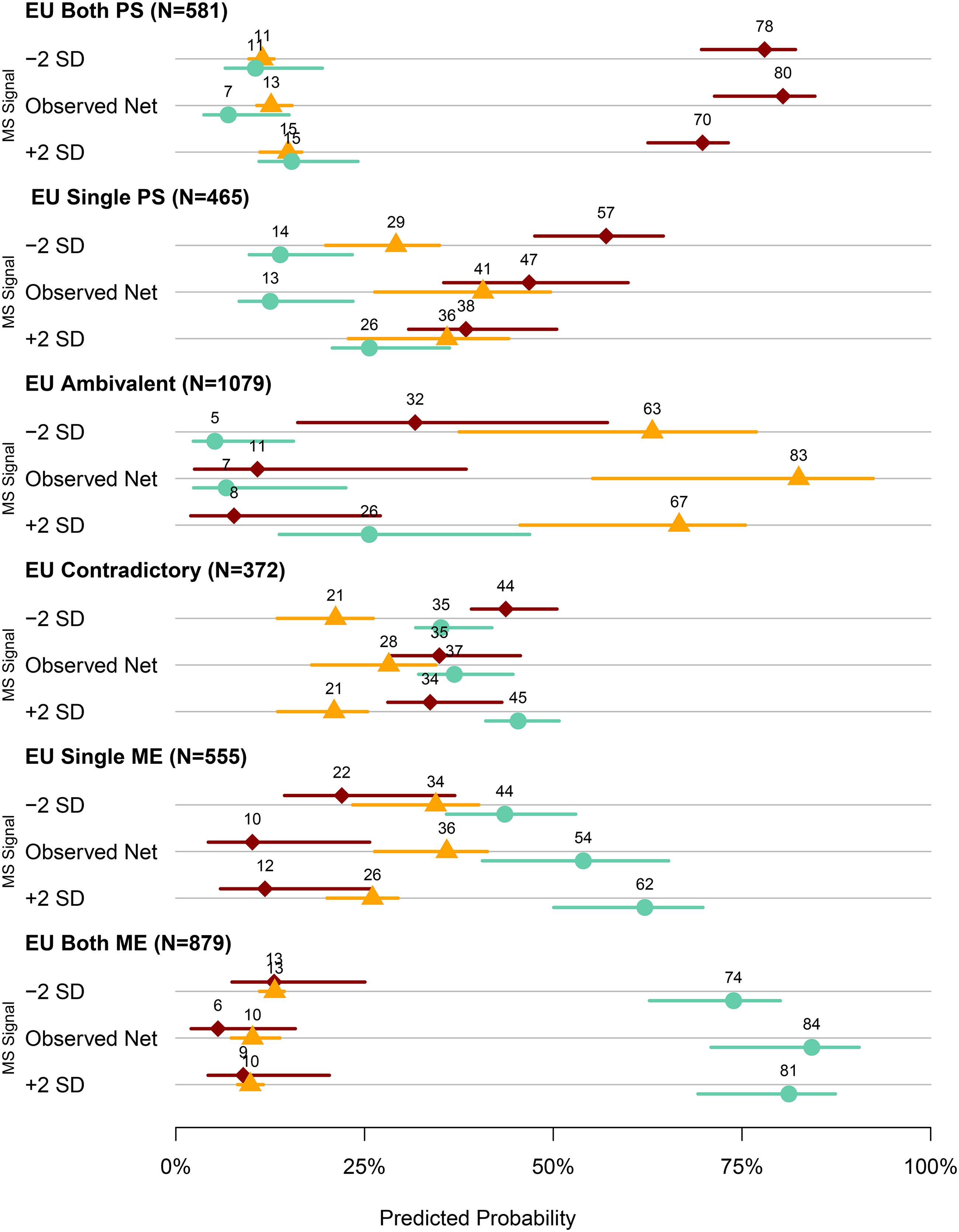
Posterior predicted probabilities across different types of signals.
In scenarios featuring a weak supranational signal (EU Single ME/PS), the most probable dispositions still align with the direction of that signal. However, the court’s pro-integrationist bias becomes evident in the asymmetry of the 95% credible intervals. When a single supranational signal favors more Europe (EU Single ME), the predicted probabilities for Ambivalent and More Europe dispositions exhibit minimal overlap, indicating a high degree of confidence in a pro-integrationist disposition. By contrast, under single supranational Preserve Sovereignty conditions, there is substantial overlap between the Ambivalent and Preserve Sovereignty categories, suggesting greater judicial reluctance to fully endorse sovereignty-preserving dispositions.
In low-information environments—where supranational actors issue no clear signals—the court predominantly issues narrow dispositions with ambiguous implications for the legal doctrine. When national signals are held constant at observed values, the predicted probability of an Ambivalent disposition averages 83%. Even when national signals are shifted by two standard deviations in either direction, the resulting changes remain modest: Ambivalent outcomes continue to dominate, with predicted probabilities averaging 63% to 67%. These findings reinforce the limited capacity of member state signals to shape legal doctrine in the absence of clear supranational guidance.
As shown in the Online appendix, the location-only model presents a more ambiguous picture, offering clear predictions only when both supranational actors send aligned signals (EU Both ME/PS). Under weaker or contradictory supranational signals, the model predicts Ambivalent dispositions to be nearly as likely as those aligned with the supranational signal’s direction—an artifact of inferior fit and predictive performance. The starkest divergence between models arises in the presence of contradictory supranational signals. Whereas the location-only model shows virtually no distinction between ambivalent and contradictory supranational signal scenarios, the combined model suggests that such contradictions prompt the court to take decisive action—advancing legal doctrine in either direction rather than preserving ambiguity for future dispute resolution.
Predictiveness of national versus supranational signals
Predicted probabilities offer critical insight into the relative likelihood of the three disposition categories. However, in some scenarios, overlapping credible intervals make it challenging to evaluate the substantive effect of different types of signals for the separation of powers. To address this issue, we generate predicted values that explicitly incorporate the fundamental uncertainty inherent in the stochastically modeled legal process. Specifically, we compute the modal predicted outcome for each legal question based on 6,000 posterior draws from the combined model.
Figure 4 presents the resulting distribution of predicted dispositions across 18 combinations of supranational and national signals. In each panel, the center column holds Weighted MS Net Preferences at their observed values, while the left and right columns shift them by two standard deviations in the anti- and pro-integrationist directions, respectively. The plot reveals a striking symmetry in the distribution of predicted outcomes across combinations of supranational signals, yielding four key findings.
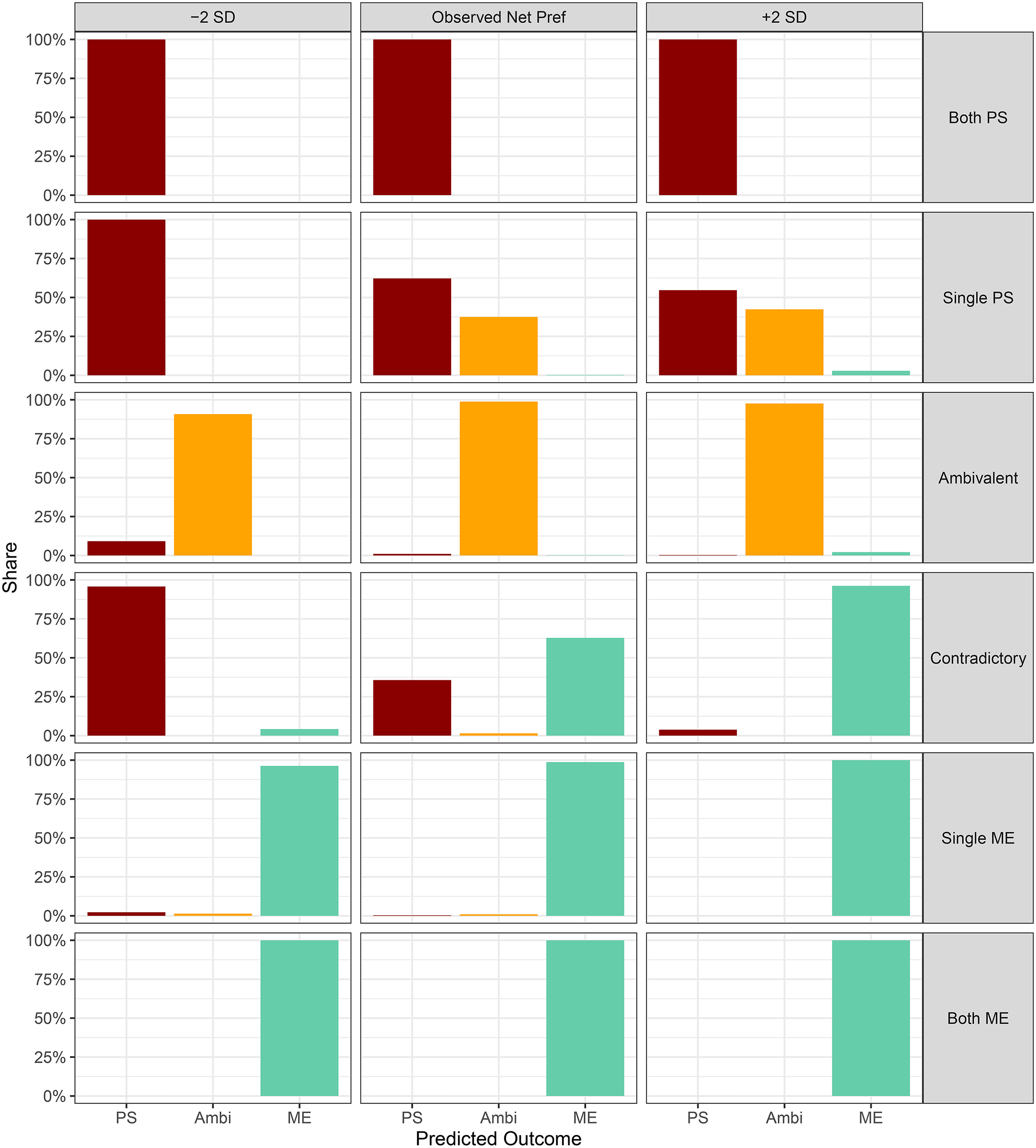
Posterior outcome predictions across different types of signals.
First, when both supranational actors issue strong supranational signals in the same direction—whether pro- or anti-integrationist—the predicted outcome aligns completely with that direction. Notably, this alignment persists even in the presence of strong opposing national signals of member states: no legal question in such scenarios is predicted to result in an outcome reflecting member state positions, or even an Ambivalent outcome. This underscores the dominant influence of supranational consensus in shaping legal doctrine in both directions.
Second, in scenarios featuring only a single supranational signal, a pro-integrationist bias of the court becomes apparent. When member state signals are held at observed values, a single pro-integrationist supranational signal almost always results in an outcome favoring More Europe. In contrast, a single anti-integrationist supranational signal results in alignment with an outcome of Preserving Sovereignty in only about two-thirds of legal questions. A similar pattern arises in scenarios with contradictory supranational signals: the court favors the pro-integrationist More Europe direction in roughly two-thirds of cases, compared to one-third for the anti-integrationist Preserving Sovereignty side. An additional analysis, not shown here, indicates that the results remain unchanged when distinguishing among legal questions with weak supranational signals, where either the Commission or the Advocate General sends a clear signal while the other remains ambivalent.
Third, in low-information environments—where neither supranational actor provides a clear signal—the court tends to issue narrow rulings. In the absence of supranational information, Ambivalent outcomes dominate, accounting for nearly 100% of predicted outcomes when member state signals are held at observed values. The influence of strong member state signals in such cases is limited and asymmetric: a shift toward Preserve Sovereignty alters the predicted outcome in roughly 10% of cases, whereas a shift toward More Europe has virtually no effect. This asymmetry suggests that anti-integrationist national signals of the member states carry greater weight than pro-integrationist ones, challenging earlier claims – based on location-only models—that ‘‘friends of the Court carry more weight than foes’’ (Larsson and Naurin, 2016: 390).
Fourth, member state influence is marginal in most scenarios, with two notable exceptions where national signals may alter outcomes. When the court receives a weak anti-integrationist signal from supranational actors, a shift in national signals increases the probability of an outcome preserving national sovereignty from roughly two-thirds to nearly 100%. By contrast, member state signals show little effect in scenarios with weak pro-integrationist supranational signals. Furthermore, under contradictory supranational signals, national signals can tip the balance toward the member states’ preferred outcome. Yet this effect should not be overstated. An additional analysis, not shown here, indicates that when distinguishing among contradictory supranational signals by the direction advocated by the Advocate General and Commission, the court most often follows the Advocate General’s recommendation, thereby vastly reducing the impact of member state observations.
These results highlight the conditional nature of member state influence on the trajectory of legal European integration. While the findings lend some support to arguments that the ECJ pursues a pro-integrationist agenda (Burley and Mattli, 1993; Garrett, 1995), the conditionality of the court’s bias suggests a more nuanced interpretation, in line with insights from historical and qualitative research (Rasmussen, 2012).
Impact of signal strength on legal doctrine
To further investigate the relationship between national and supranational influence on legal European integration, we focus on the dispersion component of our combined model, which captures signal strength. Specifically, we assess how variation in the strength of national and supranational signals affects the ECJ’s likelihood of issuing narrower dispositions—leaving greater discretion to national courts—versus broad dispositions, which set firm doctrinal thresholds, independent of direction. Our primary quantities of interest are posterior variance ratios, which allow us to compare the effect of signal strength across scenarios. Variances are calculated by squaring the inverse of the exponential of the posterior draws from the logged dispersion parameter, that is,
Figure 5 displays these variance ratios across four signal-strength scenarios, offering an intuitive visualization of the relative effectiveness of strong versus weaker supranational and national signals on shaping legal doctrine. Each panel presents the posterior cumulative distribution of variance ratios. The point at which a line crosses the threshold value of 1 (marked by a dashed horizontal line) indicates the posterior share of cases in which the signal in the denominator of the comparison is more likely to result in a broad disposition. Since higher variances on the latent scale correspond to a greater likelihood of broad dispositions, the vertical axis shows the relative influence of one signal compared to another on advancing legal doctrine.
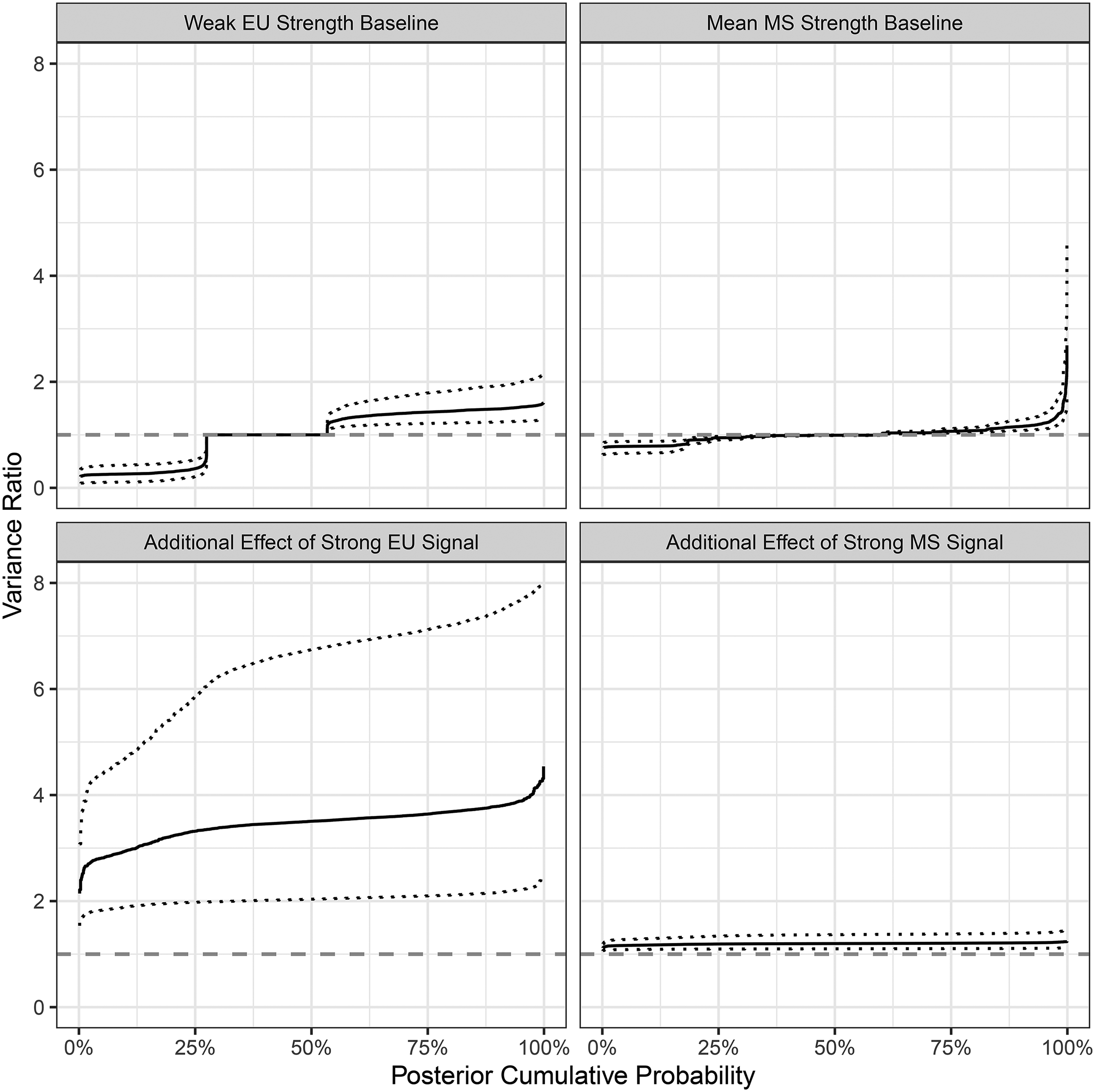
Posterior variance ratios across signal strength.
The top row of Figure 5 compares the effectiveness of national and supranational signals of varying strength, holding the signal strength of the other actor at observed levels. In the top-left panel, we can see that supranational signals with no strength—those at the left side of the distribution—are, on average, three times less effective at shaping legal doctrine compared to the baseline of a weak supranational signal. The 95% credible intervals suggest a plausible range of factors between two and five. Strong supranational signals, shown on the right side of the distribution, yield an additional effect, with an average variance ratio of approximately 1.5 relative to weak supranational signals. These effect sizes are consistent across legal questions, as reflected in the relatively flat slope of the cumulative posterior distribution.
In contrast, the top-right panel that holds the supranational signal at observed values, reveals that member state signal strength has minimal influence on the likelihood of broad versus narrower dispositions. Across the distribution, variance ratios relative to the mean signal strength remain close to 1, indicating negligible effect size. Only a small subset of cases—those with unusually high number of clearly articulated member state submissions—exhibit any discernible increase in signal effectiveness on the right hand side of the distribution.
The bottom panels of Figure 5 explore whether strong signals from one actor exert additional influence when the other actor’s signal is already strong. The bottom-left panel shows that adding a strong supranational signal significantly increases the likelihood of broad dispositions, even in cases where member state signals are already strong. The average variance ratio exceeds a factor of three, and the 95% credible intervals indicate that this effect is never less than double, with three out of four legal questions showing an effect size potentially sixfold or higher. In sharp contrast, the bottom-right panel demonstrates that adding a strong national signal of member states, operationalized as a two-standard-deviation increase, has only a marginal effect when supranational signals are already strong. Variance ratios remain only slightly above 1, and the flat cumulative distribution suggests this negligible impact is consistent across legal contexts.
Taken together, these results reinforce our earlier findings: strong supranational signals are highly effective in shaping legal doctrine. While our previous simulations of combined signal direction and strength still indicated that national signals of member states may (marginally) influence the direction of dispositions under specific conditions—namely when supranational signals are weak anti-integrationist or contradictory—this analysis adds a critical nuance in the evaluation of national signals for the separation of powers. Across most plausible counterfactual scenarios, member state signal strength has little impact on whether the ECJ adopts broad or narrower dispositions. The power to shape doctrinal development, as distinct from merely influencing its direction, appears to rest primarily with the more informative supranational signals issued by the Commission and the Advocate General.
Robustness checks
To evaluate the robustness of our main findings, which challenge existing insights into the importance of threats of overrides signaled by the member states, we conduct five additional analyses. First, we re-estimate the combined model using unweighted counts of member state briefs advocating either the preservation of sovereignty or ‘‘more’’ integration, in place of the Weighted MS Net Preferences measure employed in the main specification. Second, we assess the extent to which member state signals are redundant for the predictive power and fit of the combined model by excluding them. Third, we expand the sample to include previously excluded legal questions for which European integration was unlikely to be substantively relevant. Fourth, we address potential Advocate General bias by excluding cases that involve submissions from the Advocate General’s home member state (Carrubba and Gabel, 2015; Frankenreiter, 2018). Fifth, we estimate an extended specification that includes random intercepts for the year in which a case was lodged (Year Lodged), thereby capturing potential temporal heterogeneity—particularly around periods of treaty negotiation (Castro-Montero et al., 2018). 10
The detailed results of these robustness checks are reported in the Online appendix. Across all specifications, the substantive conclusions remain unchanged. Three results merit particular attention. First, and consistent with results by Castro-Montero et al. (2018), the inclusion of year-level random effects reveals substantial variation in the dispersion component across years, suggesting that the ECJ is more likely to formulate broad dispositions in specific political contexts. Second, among the additional case characteristics, only those implicating the direct effect doctrine exhibit a significant association with the direction of dispositions, increasing the likelihood of More Europe outcomes. Third, and perhaps most intriguingly, omitting member state submissions results in only a marginal decrease in model fit. The corresponding increase in the LOOIC value lies within a single standard error, indicating that the informational contribution of member state signals is substantively negligible for the formation of judicial expectations under uncertainty.
Before concluding, we acknowledge several limitations. Although the case-space approach models the formation of individual judicial preferences, our model treats the ECJ as a unitary actor. This simplification is necessitated by the court’s provision of issuing judgments per curiam, without disclosing individual votes or dissenting opinions (Brekke et al., 2023). Individual judges may, of course, pursue distinct pro-integrationist agendas (Malecki, 2014) or respond to signals from appointing governments (Cheruvu, 2024, 2025), yet other provisions of the court limit opportunities for pivotal deviations. For example, the ECJ president assigns sensitive cases to judges from member states with moderate preferences to preserve judicial legitimacy (Hermansen, 2020), and anti-integrationist member state briefs increase the probability that a case is heard by an enlarged chamber (Cheruvu and Krehbiel, 2022), both of which contribute to convergence around the court’s median preference (Fjelstul, 2023). Given these provisions, we focus on collective decision-making rather than unobservable individual preferences.
Our study also has temporal limitations. It covers the period from 1995 to 2011, relying on the IUROPA CJEU Database—the most comprehensive source of coded legal positions to date (Brekke et al., 2023). However, this period excludes early landmark rulings on direct effect and supremacy, as well as more recent cases addressing pressing issues such as migration, climate change, and digital regulation. These omissions stem from the discontinuation of the Report for the Hearing, the primary source for the database, after 2011 (Larsson et al., 2022). A related limitation concerns the declining issuance of Advocate General opinions, which dropped from near-universal coverage in the 1990s to roughly 60% by 2010 (Brekke et al., 2023). Like the recent delegation of preliminary references in selected policy domains (e.g., VAT, excise duties, emissions) to the General Court, this trend appears to be driven by docket pressure, as Advocate General opinions lengthen deliberation time (Fjelstul et al., 2023). Consequently, the ECJ increasingly receives only one supranational signal, and strong supranational signals from the Commission and Advocate General have become rarer. While these trends may affect the relative frequency of specific signal types, we are confident they do not undermine the substantive conclusions of our analysis.
Discussion
Our analysis offers key contributions to the understanding of the separation of powers between supranational and national actors in legal European integration, focusing on how the ECJ forms expectations to craft dispositions under uncertainty. By modeling both the direction and strength of signals in the legal process of the preliminary reference procedure, we demonstrate that supranational actors exert a disproportionately large influence on legal European integration, particularly in crafting broad dispositions that shape legal doctrine. Strong supranational signals from the Commission and the Advocate General make broad dispositions, that is, those setting clear thresholds for the classification of future case facts, on average at least 2.5 times more likely than comparably strong national signals from member states. While national signals are statistically significant in analyses of large datasets, we show that their substantive impact—both in terms of direction and scope of court rulings—remains limited. This finding stands in contrast to earlier quantitative analyses of the separation of powers between the member states and the ECJ, which employed directional (location-only) models (Carrubba et al., 2008, 2012; Carrubba and Gabel, 2015; Larsson and Naurin, 2016).
In addition, beyond the explanatory power of strong supranational signals, we find evidence of a systematic pro-integrationist bias when the Commission or the Advocate General deliver weak supranational signals. In contrast to the claim of general pro-integrationist judicial activism grounded in the doctrine of effet utile (Pollack, 2017; Rasmussen, 2012), our results identify the specific conditions under which such a bias emerges. When a weak supranational More Europe signal favors deeper legal European integration, the court is more likely to align with it compared to instances involving a single supranational Preserve Sovereignty signal. This finding corroborates recent spatial analyses that locate the ECJ only marginally closer to the supranational pole of the European integration scale (Larsson and Naurin, 2019; Ovádek, 2021). Compared to scholarship emphasizing political backlash (Blauberger and Martinsen, 2020) against a court no longer ‘‘tucked away in the fairyland Duchy of Luxembourg’’ (Stein, 1981), our results suggest that the ECJ responds to supranational information about the classification of case facts, which may affect future legal dispute resolution—offering a more dynamic account of legal European integration.
Finally, our study advocates a procedural perspective with a more systematic methodological and statistical analysis on the legal process of the preliminary reference procedure that structures the ECJ’s informational environment. Using a DAG, we show that controlling for post-treatment variables need not necessarily induce post-treatment bias—particularly when signals are imperfect proxies for latent preferences. While member states rarely send national signals, the Commission is capable of anticipating latent national opposition, a finding evidenced by compliance studies (Fjelstul and Carrubba, 2018; König and Mäder, 2014). Additionally, we introduce a statistical model that accounts for the informational environment in court decision-making. Whereas location-only models implicitly assume that all signals are equally informative, we relax this assumption by parameterizing a dispersion component that captures variation in signal strength. Ignoring dispersion can severely bias seemingly unrelated location estimates due to the nonlinearity of the employed models (Liddell and Kruschke, 2018; Tutz and Berger, 2017). In addition to explicitly modeling both the location and dispersion parameters for signals when analyzing decision-making under uncertainty, our Bayesian framework may stimulate future research that goes beyond the interpretation of coefficient estimates and takes model specification and performance more seriously.
Supplemental Material
sj-pdf-1-eup-10.1177_14651165251395303 - Supplemental material for The European Court of Justice and legal European integration
Supplemental material, sj-pdf-1-eup-10.1177_14651165251395303 for The European Court of Justice and legal European integration by Thomas König and Stefan Eschenwecker in European Union Politics
Supplemental Material
sj-zip-2-eup-10.1177_14651165251395303 - Supplemental material for The European Court of Justice and legal European integration
Supplemental material, sj-zip-2-eup-10.1177_14651165251395303 for The European Court of Justice and legal European integration by Thomas König and Stefan Eschenwecker in European Union Politics
Footnotes
Acknowledgements
For their excellent comments, suggestions, and support on earlier drafts of this article, we would like to thank George Vanberg, David Hilpert, Richard Traunmüller, Philipp Schroeder, the editor Gerald Schneider, and three anonymous reviewers.

Author contributions
TK conceived the research idea and developed the theoretical framework. SE designed the modeling strategy and carried out the data analysis. Both authors contributed to drafting the manuscript, with TK having primary responsibility for the final framing and revisions.
Funding
The authors received no financial support for the research, authorship, and/or publication of this article.
Declaration of conflicting interest
The authors declared no potential conflicts of interest with respect to the research, authorship, and/or publication of this article.
Data availability statement
All materials required to replicate the results of this study are publicly available in a Dataverse repository at https://dataverse.harvard.edu/dataset.xhtml?persistentId=doi:10.7910/DVN/IQZYGC (König and Eschenwecker, 2025).
Supplemental material
Supplemental material for this article is available online.
Notes
References
Supplementary Material
Please find the following supplemental material available below.
For Open Access articles published under a Creative Commons License, all supplemental material carries the same license as the article it is associated with.
For non-Open Access articles published, all supplemental material carries a non-exclusive license, and permission requests for re-use of supplemental material or any part of supplemental material shall be sent directly to the copyright owner as specified in the copyright notice associated with the article.
