




Abstract
What is the relationship between crisis management strategies and democratic attitudes in a supranational economic union? We analyse the process of policy convergence within the European Union (EU) in the handling of the economic crisis induced by the COVID-19 pandemic, comparing countries with different conditionality experiences during the 2010 sovereign debt crisis. Unlike in 2010, the strategy for managing the 2020 crisis reflected institutional efforts towards greater fiscal solidarity at the supranational level and policy responsiveness at the national level. We argue that this policy shift has improved attitudes towards democracy. Using quasi-experimental evidence from an unexpected event analysis during Eurobarometer 93.1 fieldwork, we show that the announcement of the Recovery and Resilience Facility (RRF) in 2020 increased satisfaction with democracy (SWD), particularly among individuals who experienced strict conditionality during the 2010 crisis.
Keywords
Introduction
In 2020, the European Union (EU) was hit by a severe adverse economic shock following the outbreak of the global COVID-19 pandemic. As national governments engaged in large compensation programmes to avoid an economic downturn, doubts emerged about the effects of those substantial increases in public spending on the EU economy and the stability of the Eurozone. Those initial concerns resembled the fears during the 2010 sovereign debt crisis, which revealed the institutional fragility of its economic currency area (De Grauwe, 2010), exposed the economic vulnerability of a group of countries and increased the risk of financial contagion within the Eurozone (Mody, 2018; Pisani-Ferry, 2014). The severity of the 2010 sovereign debt crisis forced European Monetary Union (EMU) leaders to find new remedial solutions that went beyond the existing financial correction mechanisms, and the preferred crisis management strategy resulted in the imposition of unprecedented policies based on the provision of financial assistance in return for extensive policy conditionality (Beramendi and Stegmueller, 2020; Walter et al., 2020).
However, during the management of the crisis induced by the COVID-19 pandemic, European political leaders reacted very differently from how they reacted in 2010. On 21 July 2020, relying on the European Central Bank (ECB) precedent of effectively acting as a lender of last resort, EU and EMU leaders agreed to create the Recovery and Resilient Facility (RRF), a new instrument for providing financial assistance to countries in need. A crucial difference between the approach implemented by the RRF and the European Financial Stability Facility (EFSF), created in 2010, is that the latter was characterised by the imposition of strict policy conditionality, where the priorities of supranational institutions trumped the preferences of national economies. In contrast, the 2020 economic recovery strategy relied on agreed-upon policy conditionality, where countries and supranational institutions sought room to reconcile national preferences with supranational priorities (Armingeon et al., 2022; Bokhorst and Corti, 2024). This new crisis management instrument increased solidarity among EU member states (Maurizio Ferrera and Ronchi, 2021) and showed the renewed capacity of the EU to respond to the adverse consequences of financial shocks with policy innovations (Rhodes, 2021). Ultimately, the adoption of the RRF reflects how EU leaders learned from their policy decisions in 2010 (Ladi and Tsarouhas, 2020).
In this article, we argue that this converging crisis management strategy has contributed to ameliorating individuals’ levels of disappointment with democracy, which characterised the period in which financial assistance programmes were being implemented (Armingeon and Guthmann, 2014), with citizens reacting negatively when policy responsiveness was overruled by economic responsibility, a process termed ‘democracy under strain’ by Ruiz-Rufino (2025). In particular, we argue that RRF adoption represents a different, conciliatory approach to crisis management, one in which EU leaders chose a path where policy responsiveness could co-exist alongside commitments to economic responsibility. Under these conditions, we expect citizens to assess democracy in a more positive manner compared to how they did in the 2010–2014 period.
There is an extensive literature documenting the negative effects of the management of the 2010 sovereign debt crisis on citizens’ attitudes towards democracy (Armingeon et al., 2016; Devine, 2021; Devine and Turnbull-Dugarte, 2023; Ruiz-Rufino and Alonso, 2017; Schraff and Schimmelfennig, 2019). Given the unprecedented nature of the COVID-19 pandemic, there has also been a substantial body of work examining the nature of policy responses (Armingeon et al., 2022; Genschel and Jachtenfuchs, 2021; Wass and Rittberger, 2024), the preferences for furthering fiscal integration (Bremer et al., 2023), or how exposure to the pandemic affected political support (Bol et al., 2021). There are also thorough analyses of how the COVID-19 pandemic affected the legitimacy and performance of democracy in Europe (Goetz and Martinsen, 2021). However, little attention has been paid to examining citizens’ assessment of democracy in reaction to the 2020 economic recovery plan.
Our article fills this gap by documenting quasi-experimental evidence demonstrating how RRF adoption translated into positive shifts in satisfaction with the way democracy works. Furthermore, we show that such increases are particularly relevant among citizens of countries that received financial assistance after 2010. This finding suggests that the RRF contributed to a process of attitudinal convergence around the functioning of democracy that contrasts with the well-known process of attitudinal divergence that followed the management of the 2010 sovereign debt crisis observed within EMU.
This article contributes to the discussion on the exceptionality of the 2010 Eurozone sovereign debt crisis. The literature has extensively documented how much political change this economic shock produced, but it has not focussed on comparing the attitudinal shifts related to this change with how citizens’ attitudes changed when a different crisis management strategy was implemented in 2020. Moreover, we provide potential mechanisms that can explain why attitudes towards democracy should be different when these two models of crisis management are compared (Walter et al., 2020). Finally, our findings add to a relevant debate in empirical theory of democracy discussing the relationship between procedures and outcomes. In this regard, this article reinforces the main claim made by Claassen and Magalhães (2022) regarding how assessments of democracy are correlated with effective government.
One union, two crises, and two different solutions
Until 2010, the EU had successfully dealt with significant macroeconomic deviations from its member states by relying on the presence of correction mechanisms, such as the financial monitoring instruments incorporated into the Stability and Growth Pact. In this regard, between 2002 and 2008, the European Commission initiated excessive deficit procedures (EDPs) in France (2003–2007), Germany (2002–2007), Greece (2004–2007), Italy (2005–2008), the Netherlands (2002–2005) and Portugal (2005–2008). These corrective procedures effectively involve incorporating supranational requests into national policy decision-making, and countries are expected to comply with these requests as part of their institutional commitments to the union (Heipertz and Verdun, 2010).
However, the sovereign debt crisis observed after 2010 challenged the overall stability of EMU, as it revealed significant design faults within EMU’s institutional architecture (De Grauwe, 2013). Consequently, this part of the EU split into two groups of countries. On the one hand, some resilient economies experienced financial stress to their banking system; on the other hand, other countries showed deeper economic vulnerabilities, revealing severe macroeconomic imbalances that put them on the brink of financial collapse (Lo Duca et al., 2017).
In the absence of ECB support and given the increasing level of financial contagion (Arghyrou and Kontonikas, 2012), EMU leaders first chose to rely on the responsibility of national governments to manage their finances. 1 However, when these actions proved insufficient, a different, broader crisis management strategy was adopted (see Walter et al. 2020 and Ruiz-Rufino 2025 for a detailed account).
The unprecedented policy solution chosen by EMU leaders to handle this severe economic shock consisted of the creation of a series of funds that would be used to provide financial assistance to vulnerable countries: the European Financial Stability Facility (EFSF) and the European Financial Stabilisation Mechanism (EFSM). However, this financial assistance was accompanied by the imposition of severe policy conditionality that included not only fiscal adjustments but also structural reforms. 2 This crisis management strategy was unprecedented for different reasons. First, it created new instruments for managing financial shocks, thus assuming the ineffectiveness of existing correction mechanisms such as the EDP 3 . Second, more importantly, these new instruments were not the result of compromises among the countries that had dominated the creation of the EU in general and EMU in particular. Rather, they were the result of a particular economic view that was reflected in the preferences of governments of resilient countries (Brunnermeier et al., 2016; Walter et al., 2020). Finally, for countries that received financial assistance, the adoption of these remedial policies involved replacing national governments with supranational institutions in the decision-making process. Policies were determined not by electoral mandates but by supranational requests, as national governments had no choice but to accept economic responsibility over policy responsiveness.
The management of the 2010 sovereign crisis contrasts with how EU leaders handled the financial shock induced by the COVID-19 pandemic. In 2020, the net levels of lending and borrowing among Eurozone members fell similarly for the two groups of countries asymmetrically affected by the 2010 sovereign debt crisis. Critically, however, exposure to volatile international financial markets was drastically reduced in the Eurozone in 2020 compared to 2010. One reason for this difference is institutional. After the 2010 sovereign debt crisis, the Eurozone was reinforced with different structural reforms, but more importantly, the ECB initiated (but did not use) a credible programme of outright monetary transactions (OMTs) in 2012; through this programme, the ECB effectively became a lender of last resort. This ECB decision became a credible signal to international investors, which reduced the pressure on bond yields, an effect that lasted over time (De Grauwe, 2022) and that was particularly evident in the management of the 2020 crisis (Quaglia and Verdun, 2023). This is important given that EU and EMU countries implemented large financial aid packages to support individuals and firms that needed to halt their economic activity following the imposition of lockdowns (Valla and Miguet, 2022). This sudden spending decision created severe macroeconomic imbalances that could have raised the financial risk profile of some member states. However, even vulnerable countries did not experience the same level of stress in national bond markets as that experienced in 2010. Moreover, international financial markets had no incentives to speculate on sovereign bonds, as they were aware of the active role that the ECB could play to counteract such speculation.
The existence of such effective institutional safeguarding mechanisms facilitated the opening up of new cooperative spaces to find suitable solutions to restore economic stability within the Eurozone. This policy convergence process was also determined by other factors. The first factor was the empirical confirmation that austerity, which had characterised the imposed policies of the economic adjustment packages implemented between 2010 and 2014, slowed rather than accelerated economic recovery (Blanchard and Leigh, 2013; Blyth, 2013). The second factor was a shift towards policy responsiveness endorsed by member states. This shift reduced the emphasis on economic responsibility which played a pivotal role in consolidating the imposition of strict conditionality during the 2010 sovereign debt crisis. Wass and Rittberger (2024) explain, for example, how Germany embraced the idea of European fiscal solidarity when it introduced new instruments to combat the economic shock induced by the COVID-19 pandemic. Similarly, Armingeon et al. (2022) show how the EMU policy response was an attempt to correct the imbalances that were exacerbated during the 2010 sovereign debt crisis.
As a result of this deliberative policy convergence process, the EU adopted an economic recovery package in which economic responsibility aligned with policy responsiveness. To send a quick signal to international financial markets, on 21 July 2020, EU leaders agreed to create a large financial instrument that provided financial assistance to countries in need. One important difference between the approach implemented by the RRF approved in 2020 and the EFSF that was in place after 2010 was that the latter was characterised by imposed policy conditionality, while the RRF applied a negotiated policy conditionality. Thus, as the main financial instrument of the NextGenerationEU (NextGenEU) programme, the RRF gave countries flexibility to apply for large grants as long as their proposed projects matched the strategic dimensions identified by the EU.
In summary, the response of the EU to the economic crisis that originated as a consequence of the COVID-19 pandemic represents a point of departure from the management of the sovereign debt crisis observed in 2010. In both cases, national governments used their capacity to manage these crises at the domestic level in the early moments of the crises. In 2009, Keynesian programmes were implemented in some EMU economies (Cwik and Wieland, 2011), and in 2020, countries initiated large compensatory programmes. In both situations, the overall economic stability of the Eurozone was threatened but at different levels of intensity. In 2010, the severity of the sovereign debt crisis revealed a faulty supranational institutional design that led EMU leaders to choose a particular crisis management pathway characterised by choosing economic and institutional responsibility over policy responsiveness. This choice led to a financial assistance programme with strict policy conditionality. In 2020, institutional failure was not a salient issue, and consequently, countries could find cooperative spaces where economic responsibility was reconciled with policy responsiveness.
Assessing democracy
Were citizens’ perceptions of democracy affected by this new crisis management strategy? We argue that the conciliatory crisis response adopted in 2020 contributed to improving citizens’ satisfaction with democracy (SWD), especially among those disaffected by the management of the 2010 crisis. To justify the logical validity of this theoretical argument, consider the core ideas of the European permissive consensus on which much of the EU intellectual project rests. A fundamental principle of these ideas concerns reconciling two opposing concepts of political representation: agency drives electoral mandates, while actions taken by supranational institutions are endowed with trust. Doubts about the current validity of this consensus notwithstanding (Hooghe and Marks, 2019), we should still be able to argue that European citizens agreed to the transfer of national sovereignty in return for economic security (Alonso and Sánchez-Cuenca, 2022; Armingeon et al., 2016; Duch and Stevenson, 2010). This agreement also involves the acceptance of supranational constraints in the management of domestic matters (Tallberg, 2002).
This conclusion is important, as it allows us to understand the intensity of the political consequences of how the EU manages adverse economic shocks. To illustrate this idea in more detail, consider the following two scenarios.
In the first scenario, there is an adverse economic shock of such a magnitude that the application of existing ordinary adjustments is sufficient to restore economic stability. By ‘ordinary adjustments’, we mean the use of distinct safeguarding mechanisms that are already present in different treaties and pacts. In the EU context, such usage could involve situations in which internal macroeconomic deviations are handled via existing correcting arms, such as the EDP mentioned above.
In the second scenario, there is also an adverse economic shock, but it is one with the credible potential to increase the level of financial insolvency of a particular member state or states. Given the high level of economic interdependence among member states, particularly those sharing fiscal and monetary policies, the risk of financial contagion increases, threatening the overall economic stability of the union. In this situation, the application of ordinary remedial safeguarding mechanisms may be insufficient, and new ad hoc extraordinary adjustments may be required to control the shock. By ‘extraordinary’, we mean the implementation of new economic recovery solutions that deviate from the existing remedial policies included in agreed-upon ordinary adjustments.
One option for pursuing the adoption of such extraordinary adjustments is imposition. Here, a majority of selected member states, supported by supranational officials, choose to design financial assistance programmes that are provided only in return for extensive policy conditionality. Given the commitments of member states to the union, national governments that must request financial assistance have no choice but to accept such a mandate, as not doing so would be seen by external actors as a sign of poor credibility. However, for affected countries, the acceptance of these extraordinary adjustments involves assuming extensive policy conditionality, which effectively biases the domestic decision-making process towards the preferences of those financing and imposing the programme. In general terms, this characterisation describes the dynamics detailed in the memoranda of understanding that accompanied the different financial assistance packages implemented in Greece, Ireland, Portugal and Spain between 2010 and 2018 (Walter et al., 2020). 4
However, a second option is to adopt extraordinary adjustments through convergence. Under this solution, national and supranational actors engage in a deliberative process to find feasible solutions that accommodate national preferences while honouring supranational commitments. One way to achieve this goal is to link the provision of financial assistance with conditionalities agreed to by national governments. Through this link, the bias in policy decision-making does not entirely disappear, but it is re-balanced, as policy decisions are now informed by a combination of national preferences and priorities, with supranational obligations observed.
This characterisation generally aligns with the functioning of the RRF, which is expected to last until 31 December 2026. As explained by Bokhorst and Corti (2024), the RRF combines ‘balance solidarity’ with ‘financial solidity’. This is done by, for example, linking the adoption of financial plans to conditionalities already reflected in the country-specific recommendations included in the European Semester. Most importantly, although this process is designed to be hierarchical and to be led by supranational institutions, Bokhorst and Corti (2024) show how the RRF actually facilitates and prioritises the participation of national governments.
We expect these two ways of handling severe adverse economic shocks to have different impacts on how citizens assess democracy. In situations in which ordinary adjustments are implemented, one should expect limited or no attitudinal shifts. In this scenario, agency and trust are not expected to be in conflict. Citizens observe the application of corrective mechanisms as part of their commitments to the union (Hobolt, 2012).
In contrast, the implementation of extraordinary adjustments is expected to trigger significant attitudinal change. In the presence of adjustments that respond to extraordinary circumstances, we argue that citizens are not blind to the implementation of such crisis management strategies and that they use the details of the policy as information shocks to re-assess their perceptions of how democracy works. This new information consists of not only the concrete policies to be implemented but also how policies originate and the particular narratives used to justify the extraordinary adjustments (Brunnermeier et al., 2016; Walter et al., 2020).
Citizens use this new information to update their prior beliefs on how democracy works. In the case of extraordinary adjustments adopted through imposition, Ruiz-Rufino (2025) not only details how this political update process takes place but also shows that the imposition of extraordinary adjustments negatively affects individuals’ levels of assessment of democracy and that it does so asymmetrically. Within the context of the 2010 sovereign debt crisis, this means that the imposition of financial bailouts triggered a significant political updating process among citizens receiving financial assistance, while it had a limited impact on citizens of countries where no assistance was needed (Ruiz-Rufino, 2021). In this particular context, the imposition of extraordinary adjustments revealed the capacity of supranational institutions to choose economic responsibility over policy responsiveness as the leading principle in the domestic policy decision-making process.
However, when extraordinary adjustments are adopted through a decision-making process characterised by convergence, we argue that a positive reaction to the assessment of democracy should be observed. Consider again the two strategies used within the EU to face the economic adversities observed between 2010 and 2015 and in 2020. In stark contrast to the list of conditions imposed in the different financial assistance packages during the 2010 sovereign debt crisis, the RRF was an instrument characterised by movement towards greater levels of solidarity among member states (Maurizio Ferrera and Ronchi, 2021). Compared with the crisis management strategies adopted after 2010, extraordinary adjustments through convergence, as exemplified by the RRF, restored the importance of policy responsiveness in the domestic decision-making process without compromising member states’ previously agreed-upon commitments to maintain fiscal responsibility.
Again, citizens use this new information about how institutions handle adverse economic shocks to update their prior assessments of democracy. When the crisis response is based on collective efforts to design policies that include national preferences and reconcile fiscal solidarity with financial responsibility, we expect an increase in SWD. This positive reaction is linked to the capacity of supranational leaders to find solutions that accommodate agency and trust in the presence of circumstances that require extraordinary adjustments. Thus, our first hypothesis is proposed as follows:
Hypothesis 1 (H1): Crisis management strategies adopted through convergence should increase SWD.
Finally, consistent with the dynamics observed after 2010, this positive effect of extraordinary adjustments through convergence on individuals’ levels of assessment of democracy should be asymmetrical. Since individuals from countries that received financial assistance in the 2010–2018 period experienced a substantial political update, they should also have a larger space to converge towards the overall mean. In other words, the potential for a positive update is higher among individuals who previously experienced the imposition of extraordinary adjustments than among individuals from countries that did not receive any financial aid during the 2010 sovereign debt crisis. Our second hypothesis is proposed as follows:
Hypothesis 2 (H2): Crisis management strategies through convergence should increase SWD more noticeably amongst individuals who previously experienced the consequences of imposed crisis management policies.
Crisis management and assessment of democracy: Quasi-experimental evidence
Setting
We start the empirical test of our theoretical claims by exploiting a natural experiment that took place during Eurobarometer 93.1 fieldwork between 1 July 2020 and 31 August 2020. 5 These dates include a critical date for our empirical strategy: the RRF was agreed upon on 21 July after an extraordinary meeting of all EU heads of state or government as well as EU political leaders. 6
We treat this critical moment as an unexpected event during survey design (UESD) that provides exogenous variation that can be used to make valid causal estimates (Muñoz et al., 2020). In this case, we use this quasi-experimental setting to support the claim that the agreement on RRF adoption effectively triggered a positive shift in attitudes towards democracy. This shift was noticed across the entire sample but was particularly evident in citizens of countries that received financial assistance between 2010 and 2018.
A UESD is a type of natural experiment that aims to provide valid causal estimates of theoretically relevant shocks (Muñoz et al., 2020). Our identification strategy consists of exploiting the occurrence of such unexpected event – the announcement of the RRF – during the fieldwork of this particular survey to compare attitudes towards democracy between individuals who were interviewed before the announcement (control group) and individuals who were interviewed after the announcement (treatment group). Thus, our design relies on the use of cross-sectional survey data in which time provides exogenous variation in a substantively relevant variable. Due to the exogenous assignment to treatment and control groups and because of the reliance on ‘natural’ events not manufactured by researchers and the use of a single survey, UESDs are generally expected to yield valid causal estimates. While the absence of true random assignment and the lack of control by researchers pose challenges, the validity of causal identification in this type of design depends on several identifying assumptions, notably excludability and temporal ignorability. Below, we describe the event in detail and discuss the estimation strategies and robustness checks that we use to lend credibility to the causal estimates.
Figure 1 shows the descriptive statistics for the distribution of interviews during fieldwork in each country, as well as average daily levels of SWD, our dependent variable, before and after the announcement. These descriptive data reveal that the survey fieldwork varied across countries. Figure 1(a) shows that much of the fieldwork was completed before the announcement in countries such as Belgium, the Netherlands, Greece, and Spain, whereas the opposite can be seen in countries such as Luxembourg, Ireland, and Finland. A more balanced distribution can be observed in Germany, Italy, and Portugal. Importantly, as illustrated in Figure 1(b), daily levels of SWD do not show a clear trend across countries in the period observed, but almost all countries exhibit substantial daily variations in citizens’ average SWD levels. To ensure that potential country-level differences, sampling imbalances, and time trends do not affect our models, we perform extensive robustness testing in line with the best practices for this type of quasi-experimental design.
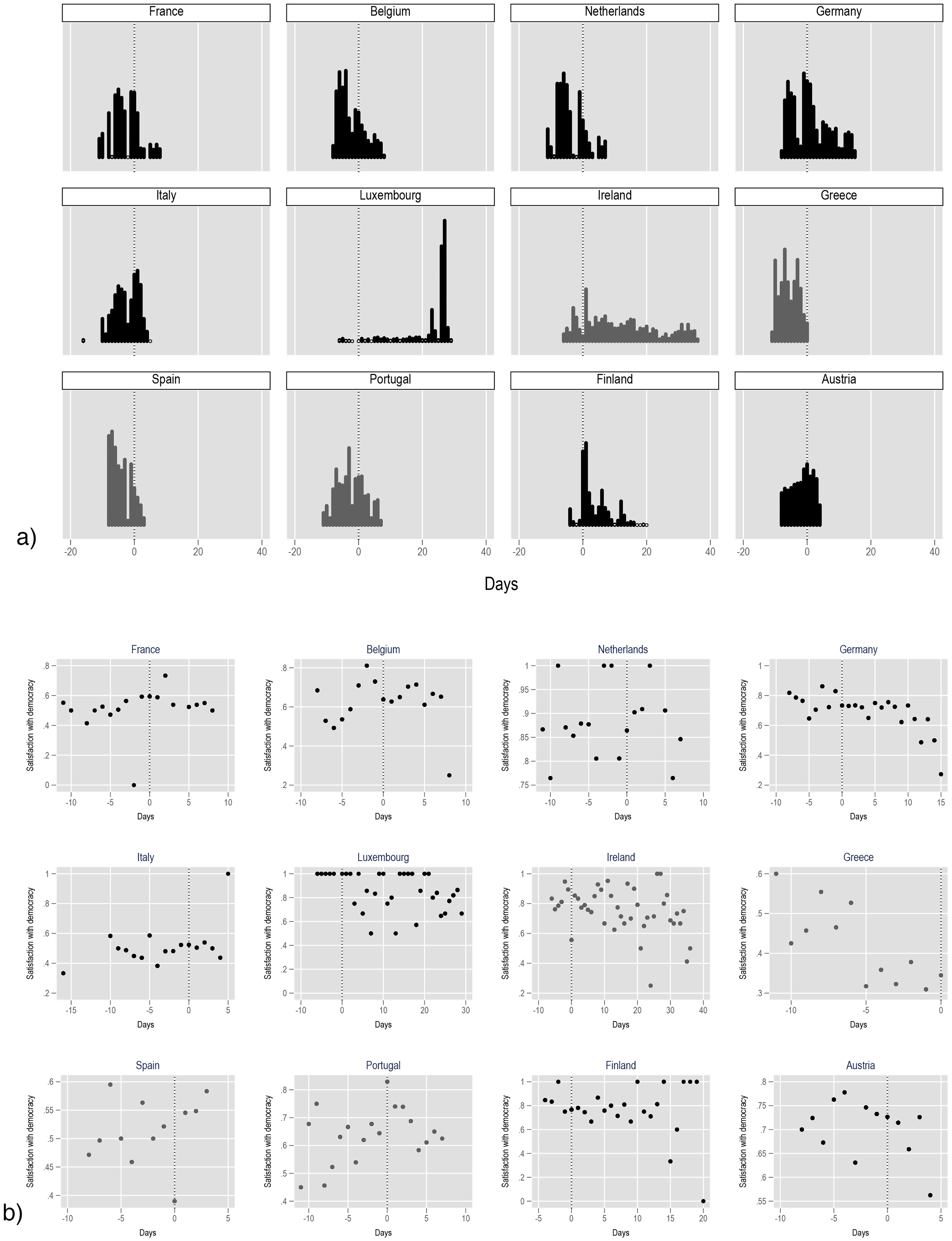
Data distribution. (a) Interviews per day during fieldwork by country and (b) Average daily levels of SWD during fieldwork by country.
Moreover, proving the relevance of the announcement of the RRF is crucially important because it allows us to assess the likelihood of non-compliance (Muñoz et al., 2020). We demonstrate the saliency of this event by examining the media exposure and coverage of this decision. We do so in two ways. First, we analyse the internet search trends during the survey fieldwork. In the Online appendix, we show a Google Trends analysis of several key terms related to the RRF in the period around 21 July 2020 throughout Europe. The internet search trends during the fieldwork reveal a clear spike in the number of searches related to this topic when the NextGenEU package was announced.
Second, we examine the media coverage of the event in the 12 countries included in our sample. Based on the newspaper archives of the Factiva database, 7 we analyse how many newspaper articles that contained terms related to the RFF were published during the fieldwork. Figure 2 shows that media interest in the topic grew in the days and weeks leading up to the event, when negotiations among EU leaders intensified and the potential conditions of the recovery plan were being discussed. Media attention then peaked on the day that the agreement on the RRF was announced. At that moment, a total of 1183 newspaper articles covering this event were published in the twelve countries considered in this study.
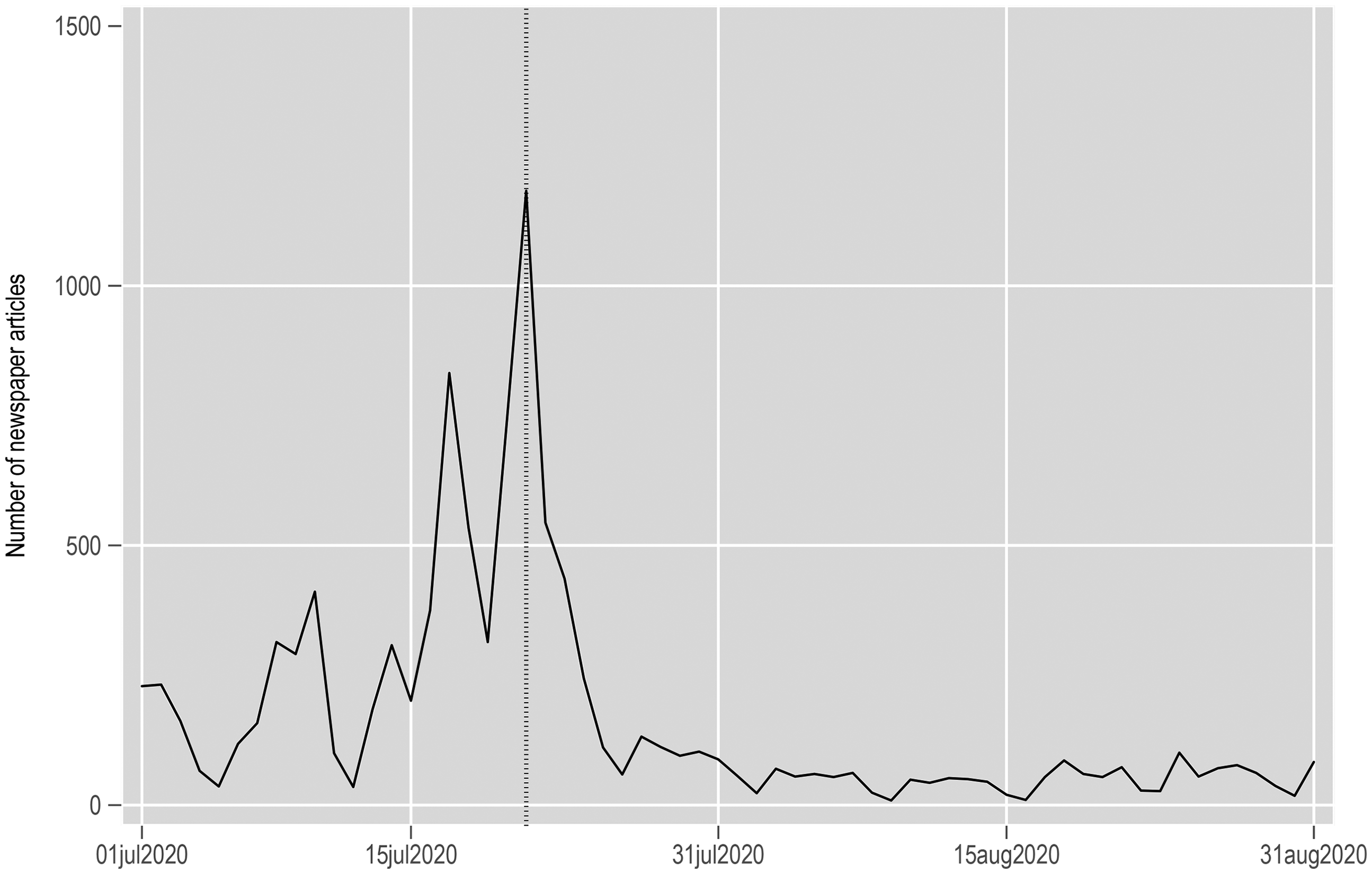
Media coverage of the event during the survey fieldwork.
This analysis confirms not only that the approval of the RRF was a salient event attracting public interest but also that the media in the relevant countries devoted considerable attention to the topic, covering the discussions and negotiations that took place before European leaders announced their agreement on the conditions of this recovery package. Based on these data, we assume that citizens in EMU countries were both aware of the political agreement on the RRF and informed on the details of the recovery plan. Specifically, we argue that citizens were conscious of the profound change that this recovery package involved with respect to the previous policy paradigm. This was the case because the new agreement reached by EU leaders to implement, for the first time, a joint borrowing and risk-sharing financial instrument was discussed extensively in the press and was called, for example, ‘historic’ and a ‘turning point’ in several media reports. 8 This argument is in line with the empirical findings reported by Miró (2022) and Mayo-Cubero et al. (2023), who show how the media discourse surrounding the NextGenEU programme was marked by a generally pro-European sentiment and a focus on European solidarity, especially in Southern European media.
In summary, the announcement of the RRF is a random, relevant unexpected event that is suitable for effectively testing how citizens react to the collective decisions of EU leaders to design policies that include national preferences and that reconcile fiscal solidarity with financial responsibility. Crucially, our analysis does not test citizens’ reaction to the implementation of the NextGenEU package, which is taking place at the national level between 2021 and 2026. Rather, the analysis tests citizens’ reaction to the announcement itself.
Estimation and findings
Our empirical analysis is conducted in several steps. First, to identify the overall size of the effect, the following model is estimated:

Next, to determine the effect of the adoption of this economic recovery package on individuals from countries that received financial bailouts after 2010, we estimate a second model:

The relevant coefficient in both equations 1 and 2 is
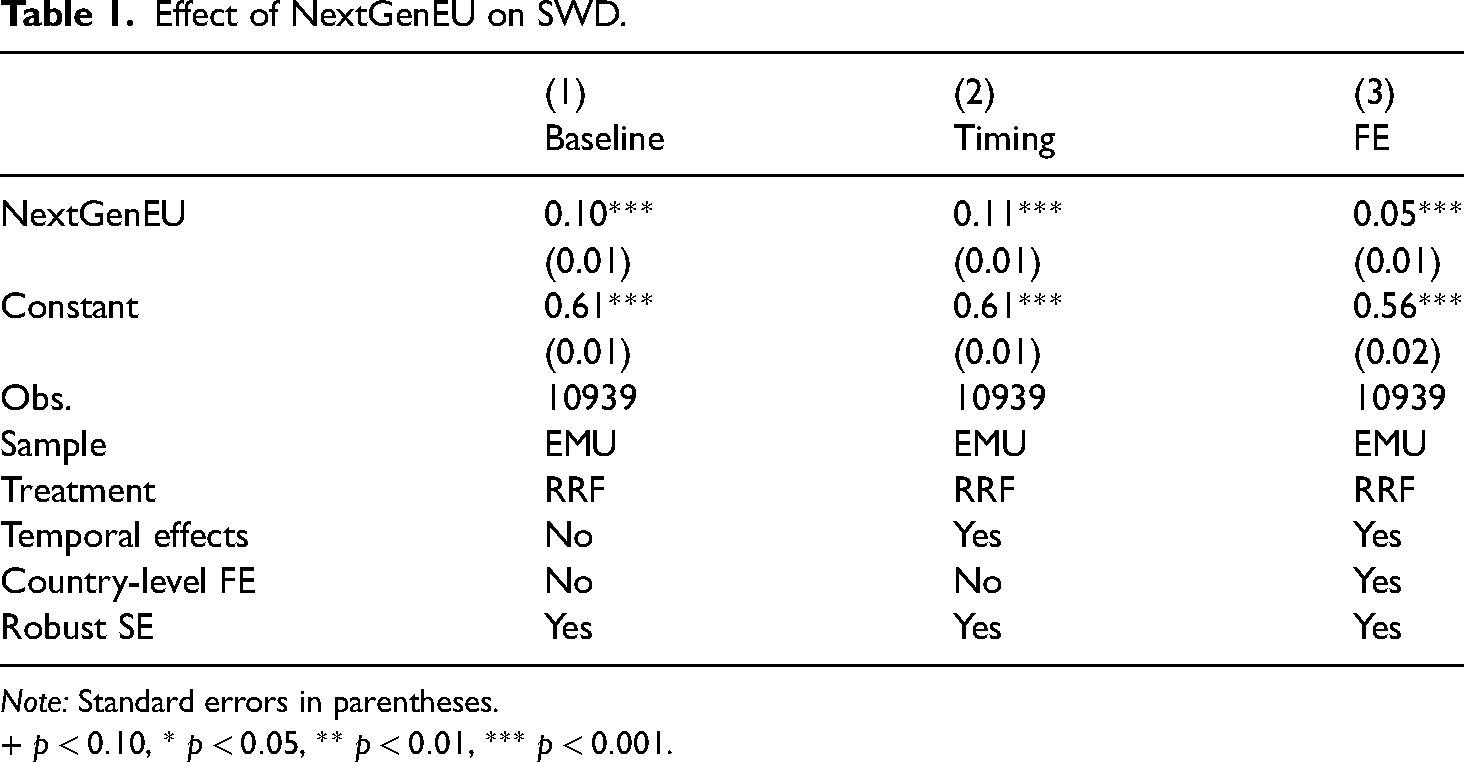
Table 1 provides the estimates for equation 1. Across all models, we observe a positive and statistically significant effect of the announcement of RRF adoption on SWD. Model 1, our main estimation, shows that the size of the effect is higher than 0.1, a magnitude that is substantial given that SWD is measured on a 0–1 scale. 10
Effect of NextGenEU on SWD.
Note: Standard errors in parentheses.
+
Table 1 also shows two relevant robustness tests. Model 2 controls for time effects by including a linear variable that counts the number of days since the beginning of the fieldwork in each country. This time control accounts for potential pre-existing time trends in SWD. Model 3 additionally includes country-level fixed effects. This restriction does not affect our causal identification, as the date of the announcement is uncorrelated with unobserved country-level determinants. However, the model accounts for potential unobserved factors from individuals within a country. Even under these strict constraints, the size of
This finding is relevant, as it confirms the theoretical expectation stated in Hypothesis 1. In this hypothesis, we proposed that in the presence of a severe adverse shock, crisis management strategies seeking the convergence of national and supranational actors should improve levels of SWD.
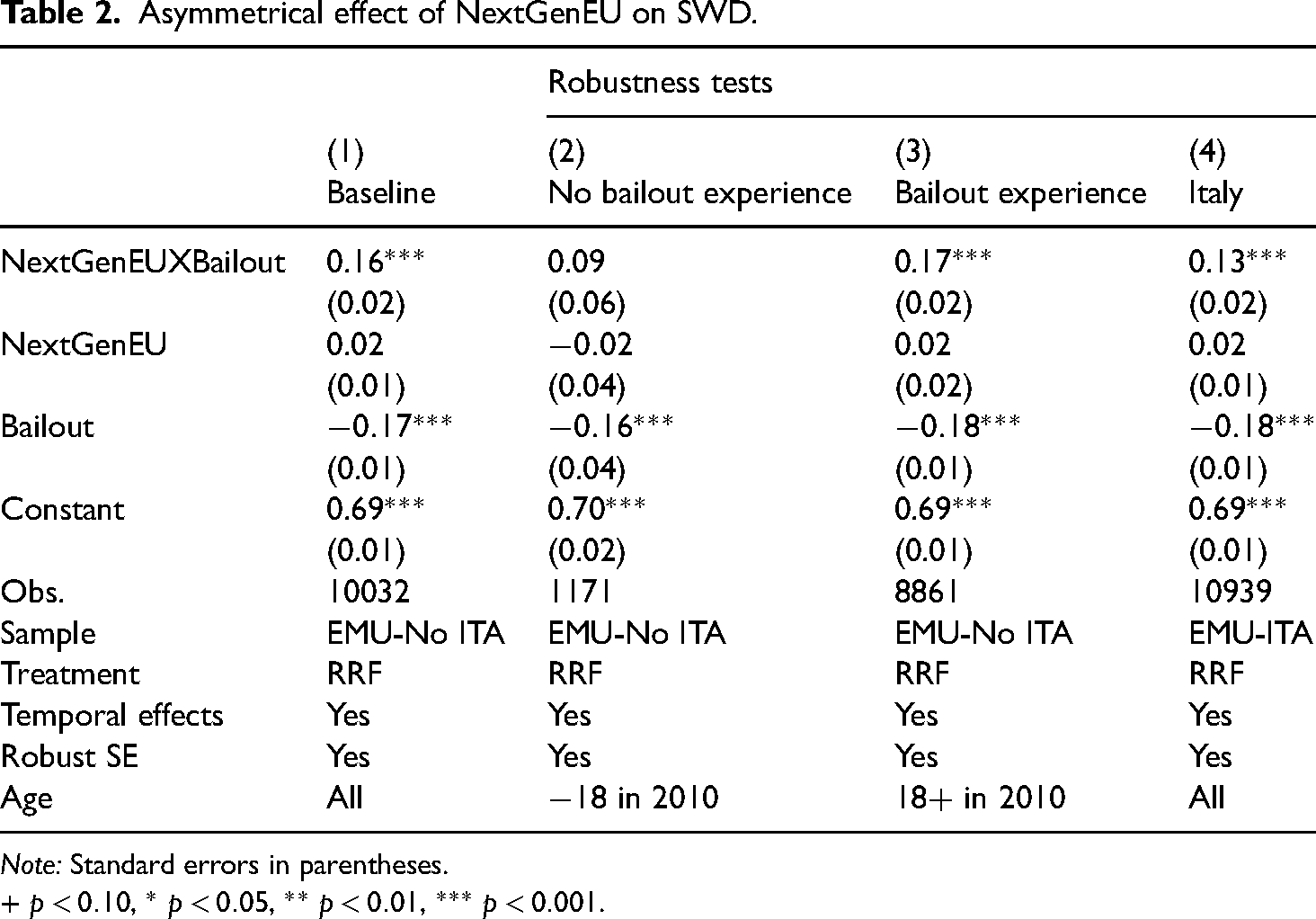
As we proposed in Hypothesis 2, this positive effect should be more noticeable among individuals who experienced the consequences of the imposed policy conditionality during the management of the 2010 sovereignty debt crisis. Equation 2 tests this claim, and Table 2 shows the results of different estimations.
Asymmetrical effect of NextGenEU on SWD.
Note: Standard errors in parentheses.
+
Model 1 in Table 2 shows our main estimation. Different from Model 1 in Table 1, Italy is excluded from the analysis. This exclusion is justified because the level of policy imposition that Italy experienced during the 2010 sovereign debt crisis is unclear. In 2010 and, in particular, during 2011, Italy received significant policy conditionality even though it did not receive any financial assistance (Ruiz-Rufino, 2025; Walter et al., 2020). The
In our theoretical discussion, we suggest that a process of political updating takes place in these critical moments and that in 2020, the room for updating in individuals who experienced policy conditionality after 2010 was larger than that in individuals who did not. To show further evidence of this phenomenon, we estimate two additional models. In the first, we examine the behaviour of individuals who were younger than 18 years old in 2010. In the second, we analyse the behaviour of individuals who were at least 18 years old in 2010. The purpose of this comparison is to assess how individuals react to the 2020 conditions given that they had experienced (or not) the 2010 policy imposition at an age at which they could vote. We expect that adult individuals who experienced the policies imposed by the financial bailouts will have larger room for updating than will individuals who did not.
Models 2 and 3 in Table 2 confirm this expectation. The coefficient in Model 2, which examines the behaviour of individuals who were younger than 18 in 2010, is not statistically significant, but the coefficient in Model 3 is in line with that reported in Model 1. In other words, there are no relevant differences in levels of SWD among those who were under 18 in 2010 regardless of the country of residence. However, Model 3 shows that adult respondents who, after 2010, learned about the imposition of policies in return for financial assistance express higher levels of SWD as a consequence of RRF adoption than do adult respondents who did not have such experience.
Finally, Model 4 adds Italy to our estimation. In this case, we treat Italy as if it had effectively been the recipient of imposed policies during the management of the 2010 sovereign debt crisis. Adding Italy to our estimation does not change the result reported in Model 1 in Table 2.
This discussion also confirms our theoretical claim proposed in Hypothesis 2. The analyses above show not only that the RRF announcement generated an immediate positive reaction to how democracy was assessed but also that this reaction was more intense among individuals who directly experienced the imposed conditions attached to the different financial assistance programmes implemented during the 2010 sovereign debt crisis.
Further robustness tests
In this section, we proceed to adopt a series of additional empirical strategies and perform robustness tests to ensure that there are no potential violations of the assumptions of excludability and temporal ignorability (Muñoz et al., 2020). First, the Online appendix shows that the treatment and control groups are imbalanced in several pre-treatment covariates. This is the case both when the full sample is examined and when we analyse the reduced sample of citizens who were 18 or older in 2010. In both samples, individuals in the treatment group are more educated and are more likely to be male, to be employed, and to show low cooperation during the interview than are individuals in the control group. In the age-adjusted reduced sample, the respondents in the treatment group are also younger. These imbalances are a potential threat to the temporal ignorability assumption, as they point to a bias in survey sampling between the two groups. To address the potential violation of this assumption caused by the presence of imbalanced data, we rely on entropy balancing. We report the distribution of the observable covariates with and without the entropy balancing weights in the Online appendix. The variables included in these balance tests are used to re-weight the observations in our analysis.
In Figure 3(a), Panel A summarises the naive baseline estimations of our two models in the full sample, testing for the direct effects of the NextGenEU programme on SWD (black markers) and for an interaction effect of the treatment with former bailout countries (grey markers). Panels B and C replicate the same models correcting for the lack of balance and adding country-level fixed effects. Panel B shows estimates based on the full sample, and Panel C reports coefficients obtained based on the sample of individuals who experienced the 2010 sovereign debt crisis as adults. The findings are consistent with those reported in Panel A, confirming that our results are robust to covariate adjustment through entropy balancing. This outcome indicates that the assumption of temporal ignorability can be sustained.
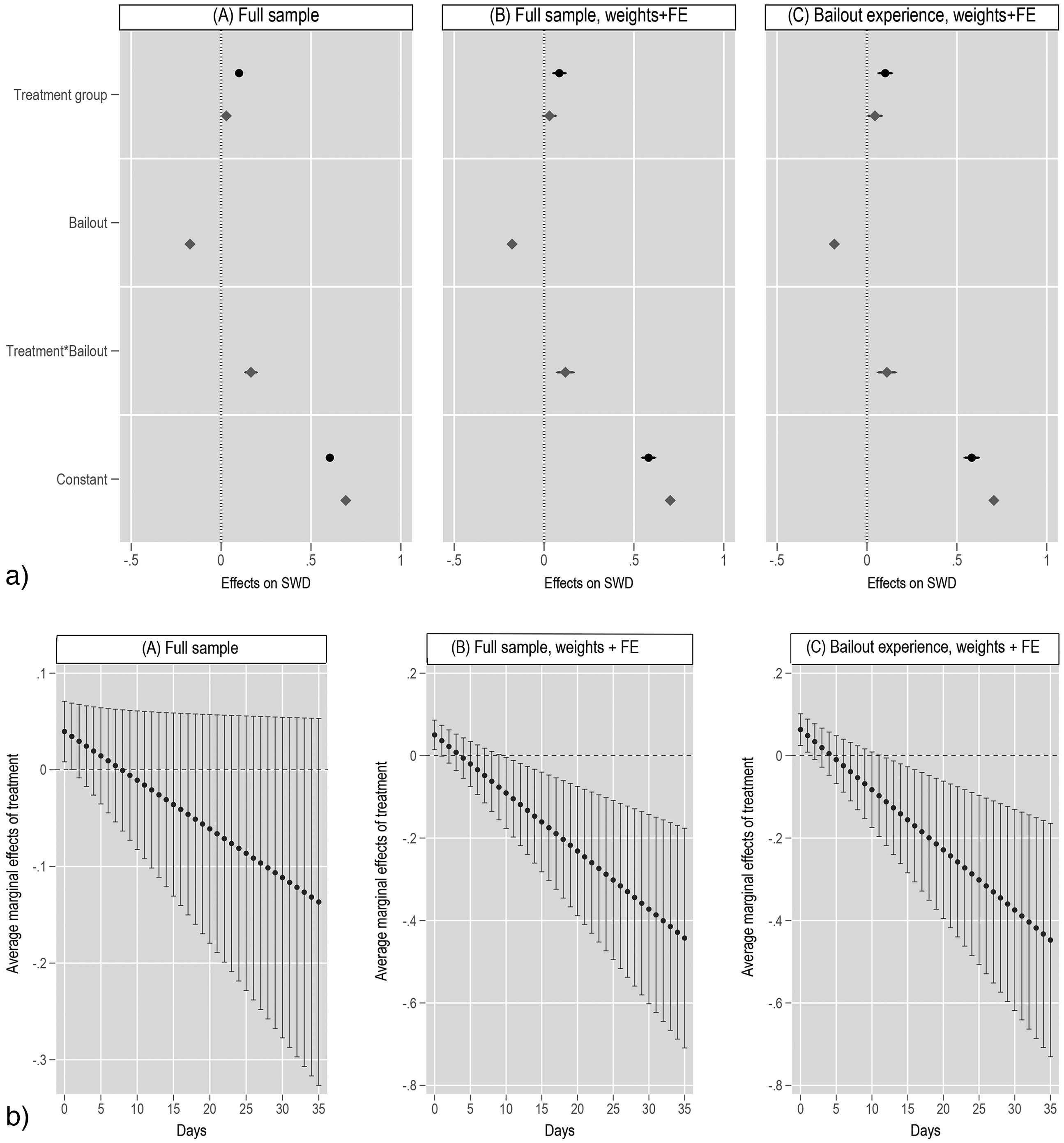
Effect of NextGenEU on SWD: control variables and covariate adjustment. (a) Direct and interaction effects of treatment and (b) marginal effects of treatment over time.
To examine excludability, Figure 3(b) summarises the marginal treatment effects over time based on a model that includes an interaction term between the treatment and a time variable that counts the number of fieldwork days before and after RRF adoption, with 0 corresponding to 22 July 2020. Panels A, B and C report these marginal effects via the different model specifications described above. This model helps us determine whether significant changes in levels of SWD occurred immediately following the announcement of the RRF or whether these attitudinal changes took place at a later time. We see that the marginal effects of the treatment indicator are significant and positive immediately after the event, which implies that levels of SWD increased as a direct result of the announcement. As more days pass, the treatment effect becomes insignificant. These findings confirm our hypotheses that a political updating process took place as soon as citizens learned about the agreement on the RRF. This model also helps reinforce the assumption of excludability by establishing that changes in levels of SWD were indeed the direct result of the announcement and did not occur in the days after the event due to other potential confounding factors.
Finally, we conduct additional robustness tests, which are described in detail in the Online appendix. These tests include the use of multiple bandwidths as well as a placebo treatment employed to test the plausibility of the temporal stability assumption. Finally, we perform falsification tests using alternative outcomes. Overall, none of these extensive robustness tests indicate any serious violations of the key assumptions of ignorability and temporal excludability (Muñoz et al., 2020) that could not be mitigated by our empirical strategies.
Conclusion
In this article, we examine the relationship between the process of policy convergence during the financial shock induced by the COVID-19 pandemic and levels of SWD. Our main finding reveals that citizens reported higher levels of SWD once they learned not only that the EU would play a pivotal role in the economic recovery of their economies but also that the EU would do so in a responsive way.
This finding constitutes a relevant point of departure when one considers the management of the 2010 sovereign debt crisis. The handling of this adverse economic shock was characterised by externally imposed policies that were tied to extensive financial conditionality, which prioritised economic responsibility over national policy autonomy. These measures, implemented through financial assistance programmes, effectively overrode national democratic mandates, fostering negative public perceptions of democracy, particularly in affected states. This approach exposed critical deficiencies in the EU’s institutional framework, revealing its inability to harmonise supranational objectives with domestic political preferences. The literature has well documented that this crisis management strategy triggered a wave of popular discontent, which led to record-low levels of SWD, particularly in countries where financial assistance packages were imposed (Ruiz-Rufino, 2025).
In contrast, the EU’s management of the 2020 COVID-19 crisis marked a departure from the strategy used in 2010. The decision-making process that led to the establishment of the RRF embodied a more inclusive and cooperative strategy, one that emphasised policy convergence and fiscal solidarity. This approach not only demonstrated institutional learning from the 2010 crisis but also reflected a deliberate effort to restore trust by aligning national and supranational priorities. The RRF allowed for negotiated policy conditionality, balancing economic imperatives with greater policy responsiveness at the national level.
We argue that this new crisis management strategy has resulted in an improvement in citizens’ SWD, particularly in countries that had previously endured the stringent conditionality of the 2010 crisis. The quasi-experimental results discussed in this article suggest that collaborative, solidarity-driven crisis management strategies can positively influence democratic evaluations, even among those historically disillusioned by EU interventions.
The article concludes that the EU’s adaptive crisis management has bolstered democratic resilience by illustrating the union’s capacity for institutional innovation and responsiveness. The findings above underscore the critical importance of integrating national preferences into supranational governance frameworks to sustain democratic legitimacy in member states and, ultimately, to maintain citizens’ trust in and commitment to the European project.
Supplemental Material
sj-pdf-1-eup-10.1177_14651165251340209 - Supplemental material for Crisis management and attitudes towards democracy: The case of the COVID-19 recovery plan in Europe
Supplemental material, sj-pdf-1-eup-10.1177_14651165251340209 for Crisis management and attitudes towards democracy: The case of the COVID-19 recovery plan in Europe by Lea Heyne and Rubén Ruiz-Rufino in European Union Politics
Supplemental Material
sj-zip-2-eup-10.1177_14651165251340209 - Supplemental material for Crisis management and attitudes towards democracy: The case of the COVID-19 recovery plan in Europe
Supplemental material, sj-zip-2-eup-10.1177_14651165251340209 for Crisis management and attitudes towards democracy: The case of the COVID-19 recovery plan in Europe by Lea Heyne and Rubén Ruiz-Rufino in European Union Politics
Supplemental Material
sj-zip-3-eup-10.1177_14651165251340209 - Supplemental material for Crisis management and attitudes towards democracy: The case of the COVID-19 recovery plan in Europe
Supplemental material, sj-zip-3-eup-10.1177_14651165251340209 for Crisis management and attitudes towards democracy: The case of the COVID-19 recovery plan in Europe by Lea Heyne and Rubén Ruiz-Rufino in European Union Politics
Footnotes
Acknowledgements
The authors would like to thank Pedro Magalhães and Ignacio Jurado for detailed comments on earlier versions of this article. They are also very grateful to all the comments they received in several workshops at the Institute of Social Sciences in Lisbon and the Juan March Institute/Universidad Carlos III in Madrid. Lastly, they want to thank the anonymous reviewers for their helpful feedback and suggestions, which have substantially improved this article.
Declaration of conflicting interest
The authors declare no potential conflicts of interest with respect to the research, authorship, and/or publication of this article.
Funding
The authors disclosed receipt of the following financial support for the research, authorship, and/or publication of this article: This work has been supported by the FCT - Fundação para a Ciência e a Tecnologia under grant agreements EXPL/CPO-CPO/0506/2021 and 2020.01281.CEECIND.

Data availability statement
Supplemental material
Supplemental material for this article is available online.
Notes
References
Supplementary Material
Please find the following supplemental material available below.
For Open Access articles published under a Creative Commons License, all supplemental material carries the same license as the article it is associated with.
For non-Open Access articles published, all supplemental material carries a non-exclusive license, and permission requests for re-use of supplemental material or any part of supplemental material shall be sent directly to the copyright owner as specified in the copyright notice associated with the article.
