



Abstract
We provide the first individual-level test of whether holding supranational elections in the European Union fosters satisfaction with European Union democracy. First, we examine whether participation at the European Parliament election fosters satisfaction with democracy and whether, among those who participated, a winner–loser gap materializes at the EU level. Second, we examine under which conditions participating and winning in the election affect satisfaction with European Union democracy, focusing on the moderating role of exclusive national identity. Our approach relies on panel data collected during the 2019 European Parliament elections in eight countries. We demonstrate that while participating and winning increase satisfaction, such positive boost does not materialize among those with exclusive national identity. These findings hold an important message: elections are no cure to deep-seated alienation.
A key argument in favour of electoral democracy is that people will accept (and consent to) a political authority only if they have been given the opportunity to choose who will govern. In line with this argument, democratic theory expects elections to boost system support, commonly measured with satisfaction with democracy, among those who have participated in the election regardless of whether they have won or lost since elections ‘have a legitimizing capacity strong enough to counter the negatives associated with defeat’ (Esaiasson, 2011: 103). This represents ‘the essence of democracy: rule of the people by the people’ (Lindberg, 2006: 1). The ‘winner–loser gap’ literature further tells us that those who supported a party now in government express even higher levels of satisfaction with democracy. There is plenty of evidence supporting the so-called ‘winner effect’ on political legitimacy and system support (e.g., Anderson and Guillory, 1997; Blais and Gélineau, 2007; Dahlberg and Linde, 2017).
There are also expectations — albeit few empirical tests — about the fact that the fundamental linkage between electoral democracy and political legitimacy is crippled at the supranational level. This is mainly due to the fact that, compared to first-order national elections, supranational elections have far less at stake. This is broadly expected to be true especially with respect to European Parliament (EP) elections. Since, historically, EP elections are not followed by a process of government formation and fail to engage the public in a Europe-wide event (Marsh and Mikhaylov, 2010), neither holding elections nor winning elections is expected to lead to higher satisfaction with democracy (see also Singh et al., 2012).
In this study, we propose the first systematic test of whether or not holding democratic elections fosters citizens’ satisfaction with European Union democracy (SwEUD) during the 2019 EP elections. We do so by building bridges between democratic theory and the winner-loser gap literatures with research on supranational elections that have thus far remained largely isolated. In particular, this study tests two contending arguments. The first argument examines whether or not, in line with democratic theory, participation in the EP elections per se fosters citizens’ satisfaction and whether the winner–loser gap materializes at the European Union (EU) level, as it does in first-order national elections. We expect a weak but positive effect of the 2019 EP elections on SwEUD. The positive effect is mainly due to the circumstances under which the 2019 EP elections have been held (Marsh, 2020). Specifically, while European citizens vote directly to elect their representatives that will sit at the EP since 1979, the actual powers of the EP have been greatly expanded by successive treaty amendments (Hix et al., 2007; Rittberger, 2005). In addition, European election campaigns have started to become increasingly more salient in the media and a strategic arena for political parties to position themselves on EU issues (Van der Brug and Vreese, 2016) and this seems particularly true in 2019 (De Wilde, 2020). Hence, we expect on the one hand that those who participate in the EP elections display a higher degree of satisfaction than abstainers. Furthermore, among voters, those who supported a winning party will be more satisfied than those who voted for a losing party.
Our second argument specifies the boundary conditions with respect to this positive effect of elections. In particular, we test the argument that deep-seated alienation and hence lack of European identity limits the positive effect of participating and also of supporting a winning party on SwEUD. What is more, EP elections commonly foster the politicization of Europe (Grande and Hutter, 2016) and provide visibility to anti-EU parties (Halikiopoulou et al., 2012; Van Elsas et al., 2019); this means that EP elections may actually expose Europe’s weaknesses rather than fostering the European idea (Beaudonnet and Franklin, 2016). From this perspective, those alienated with the EU, its institutions and ideal are reminded about Europe’s weaknesses, hence nullifying the positive effects of holding elections.
To test our expectations, we make use of panel data in eight countries. Although the evidence presented in this article is only correlational, the panel data allow us to measure satisfaction with democracy pre and post election and hence observe changes in satisfaction between the two waves. Our findings show that while participating and winning produce positive changes in satisfaction, there is no such boost among those who identify exclusively with their country. The study discusses the meaning of our results for the wider debate about EU political legitimacy.
Accepting electoral defeat, celebrating victory?
Is there an increase in satisfaction with democracy when people vote? According to democratic theory the answer is a resounding ‘yes’. Elections give voters the opportunity to hold the government accountable and choose the representatives that will rule the countries for years to come. As such, elections have the potential to confer legitimacy to the political system and the existing literature shows that both winners and losers react positively to elections with a significant post-election increase in satisfaction with democracy (Esaiasson, 2011). Pushing it even further, using 24 panel studies, Kostelka and Blais (2018) demonstrated that voter turnout affects citizens’ satisfaction and not the other way around. In other words, elections increase satisfaction with democracy among those who vote, and especially those who win the election. The fact that the latter group, i.e., the winners, will show higher levels of support than the losers, known in the existing literature as the ‘winner-loser gap’, is one of the most robust findings in social sciences (e.g., Curini et al., 2015; Dahlberg and Linde, 2017). In national elections, the winner group includes all those voters who have voted for the parties forming the government after the elections (Anderson and Guillory, 1997).
Now, is this true for supranational elections too? In other words, should we observe an increase in satisfaction with democracy after the EP elections for voters but not for non-voters and for winners more than for losers? To the best of our knowledge, the expectations of neither the democratic theory nor the winner-loser gap theory have been systematically tested at this level. Thus far, the few studies that have looked into the question of satisfaction with democracy beyond the national level have either focused on district level results — albeit still in the context of national elections (e.g., Blais and Gélineau, 2007; Henderson, 2008) — or have compared presidential vote choice with that at the congressional (district) level in the United States (Anderson and Lotempio, 2002). Such studies show that winning in a district is rather unimportant, but the results are mixed: for example, Blais and Gélineau (2007) find an independent effect of winning at the district level whereas Anderson and LoTempio (2002) and Henderson (2008) do not. Lastly, there exists some literature on the winner-loser gap in EU referendums in Germany, Finland, and the Netherlands (Brummel, 2020) and in the Brexit referendum (Nadeau et al., 2019; Schaffner, 2020). Albeit not directly focused on satisfaction with democracy, these studies suggest a moderate but positive effect of winning a referendum on support for direct democracy and the acceptance of the referendum result.
The existing literature on European politics would suggest a null effect of elections for at least two reasons. First, the presence of election campaigns with no real ‘European’ content (Hix, 2008; Franklin and Hobolt, 2011; Mair and Thomassen, 2010) means that EP elections are so detached from the average voter that we should not observe an effect on satisfaction with democracy. Second, studies report that voter preferences expressed in EP elections have little impact on decision-making in the EP, and voters are reminded of this every five years (Beaudonnet and Franklin, 2016). EP elections generally fail to motivate public interest (De Vreese et al., 2006; Reif and Schmitt, 1980) resulting in low turnout and vote choice based on national, rather than European, policy concerns (Hobolt, 2012). Consequently, we should not expect turning out to vote or winning to enhance SwEUD.
Yet, recent trends suggest that voting or winning at the EP election could increase citizens’ satisfaction. A series of changes have enhanced the relevance of the electoral process at the EU level. First, recent studies have provided evidence of an emerging European party system at the EP level, based on left-right ideology rather than national considerations (Hix et al., 2006). Second, EU institutions have grown in importance for the policy-making process at the national level (Schmitt, 2005). Third, the EP, whose composition is at stake during the EP elections, has expanded its policy competences over the years (Hix et al., 2007; Rittberger, 2005). In addition, since 2014 and precisely in response to the EU ‘democratic deficit’ (Weiler et al., 1995), the EP has attempted to strengthen ‘the political legitimacy of both Parliament and the Commission’ by ‘connecting their respective elections more directly to the choice of the voters’ (European Parliament, 2012), with the so-called Spitzenkandidaten process. On the basis of this system, the nominated lead candidate (‘Spitzenkandidat’) of the party with the largest number of seats in an EP election is supposed to become President of the European Commission. The Spitzenkandidaten process was introduced to enhance the democratic legitimacy of the EU by establishing a direct relationship between the outcome of the election and the presidency of the European Commission and by reducing the ‘second-orderness’ of EP elections (Hobolt, 2014). Last but not least, the amount of attention EP elections receive from the media has increased substantially over the past 10-15 years (Van der Brug and Vreese, 2016). Clark and Rohrschneider (2009) find a surprisingly strong effect of EU-level factors on electoral choice already in the 1999 EP election. For the first time ever, in the 2019 EP elections turnout levels have gone up in many EU countries reversing long-term declining trends. To sum up, although we do not claim here that EP elections are now first-order elections, it makes sense to hypothesize that recent trends have led to both increased satisfaction, in line with democratic theory, and a winner-loser gap in the 2019 EP election.
In particular on winning, an increase in SwEUD may come from both the performance of the supported party at the national level and the performance of the European party to which that party is affiliated to at the European level. Although EP elections are less relevant than national elections with respect to their consequences for the actual distribution of power (Beaudonnet and Franklin, 2016), the ‘winner–loser gap’ literature expects a boost in satisfaction with democracy among winners not just because voters have obtained a prize from the elections. An increase in satisfaction with democracy can be linked to election outcomes through several mechanisms: first, winners might expect to get more utility from the system than losers (in terms for example of implementation of public policies), second, winning can generate positive emotions, and third, winners’ drive for cognitive consistency may motivate them to adjust legitimacy beliefs about the system that supports their political views (Anderson et al., 2005). In this regard, Plescia (2019) found many supporters of parties excluded from government after the elections interpreting the election outcome as a win for their party due to a good showing in the election. The peculiarity of the EP elections is that they are run by national parties within a European arena, which affords both parties and voters the opportunity to proclaim themselves winners if they are the largest party in either the European or the national election competition or have performed well at either one of these two levels. In particular, because the national-level electoral dimension counts during EP elections (Van der Eijk and Franklin, 1996), the result can be an extrapolation of experience in EP politics from the national political arena (Harteveld et al., 2013). All in all, we put forward the following hypotheses: H1a: Electoral participation increases SwEUD. H1b: Winning or performing well – in either the national or the European level competition - increases SwEUD.
Catalyst of love or alienation effect?
Democratic theory tells us that the group of voters and the group of non-voters should differ, but no distinction is made within both groups. The winner-loser gap literature tends to disregard non-voters and simply compares winners with losers of elections. More recent works have started taking the within winner group differentiation into account noticing that the effect of winning is more pronounced among those with an attachment to their party (Singh, 2014). Similarly, others have found that the impact of winning on satisfaction is moderated by the relative performance of the party that one supports (e.g., Curini et al., 2015) or by political sophistication (Nadeau et al., 2019). None of these studies, however, has taken into account a crucial differentiation among all citizens, namely the initial level of attachment to and perceived legitimacy of the democratic regime. We contend this aspect is crucial and especially so in EP elections. In the context of EP elections, we posit attention to the concept of ‘exclusive national identity’ (Hooghe and Marks, 2004).
While support for the EU has been measured in a number of different ways in the literature (see Boomgaarden et al., 2011), its identity dimension has received growing attention in recent years (Hobolt and De Vries, 2016). In particular, prior research has found that the relationship between national and European is double-edged. On the one hand, national and European identities may reinforce each other (Citrin and Sides, 2004; Klandermans, 2014), on the other, a strong national attachment can weaken support for European integration precisely because the European project undermines national borders (Carey, 2002). As explained by Hooghe and Marks (2005), much will depend on whether national identity is ‘exclusive’ or not (Hooghe and Marks, 2004): when national identity is exclusive, it is a strong obstacle that prevents not only people from supporting the European integration but also from trusting and having confidence in the EU project (Krouwel and Abts, 2007).
We argue that such principled and ideological opposition to the EU will impede the voter-abstainer and the winner–loser gaps to materialize among exclusive nationalist citizens for several reasons.
First, while elections are overwhelmingly assumed to be ‘a public demonstration of the legitimacy of the regime’ (Gilison, 1968: 814) because ‘through participation citizens legitimize a regime’ (Le Duc, 1996: 344), citizens holding an extreme, enduring and profound rejection of the ‘ideal’ of the EU, do not vote to legitimize the EU but to ‘protest’ against it (Krouwel and Abts, 2007). Hence, electoral participation is unlikely to make the system more legitimate in their eyes. Second, and relatedly, EP elections foster the politicization of Europe itself (Grande and Hutter, 2016), providing visibility to anti-EU parties’ rhetoric and nationalist parties (Halikiopoulou et al., 2012). The visibility that anti-EU parties’ rhetoric receives during the EP elections is likely to resonate especially well among exclusive nationalist citizens, which are also those more commonly supporting nationalist, anti-EU parties in the first place (De Vries and Edwards, 2009). The anti-EU rhetoric during election times may fuel anti-EU sentiments similarly to the popularity of populist parties, which has been shown to sustain political dissatisfaction (Rooduijn et al., 2016). Hence, a better performance of the supported party provides exclusive nationalist citizens with cognitive consistency with their perceived rejection of and non-attachment to the EU. There is thus the distinct possibility that participating and winning do not boost satisfaction with democracy among citizens with exclusive national identity. H2a: Electoral participation does not increase SwEUD among citizens with exclusive national identity. H2b: Winning or performing well does not increase SwEUD among citizens with exclusive national identity.
Methodology
We use data from a panel election study conducted for the RECONNECT project in Austria, Denmark, France, Germany, Hungary, Italy, Poland, and Spain. 1 Hence, we can include countries in the north, south, west, and east of Europe. The survey comprises two waves, with about 2000 respondents in the pre-election questionnaire conducted during the period from April 2 to 21 and about 1000 in the post-election questionnaire conducted after the election, i.e., from May 27 to June 24, 2019. The quota-based survey conducted online guarantees that the samples in each country are representative of the (national) population under study with regard to age, gender, education, and region (see the Online appendix for a detailed comparison between key characteristics in the sample (respondents in wave 1 and 2) and the country population). Both waves include a question asking respondents how satisfied they are with the way democracy works in Europe on a 0 to 10 scale where ‘0’ means ‘completely unsatisfied’ and ‘10’ means ‘completely satisfied’. The only exception is Austria where satisfaction was measured on a 1 to 5 scale where ‘1’ means ‘completely unsatisfied’ and ‘5’ means ‘completely satisfied’. For consistency we recode the satisfaction variable for Austria to range from 0 to 10. These data allow us to compare satisfaction before and after the EP elections for the same respondents.
The dependent variable is the change in satisfaction between the two waves (pre minus post), which may range from –10 to +10 (mean (M): .09; standard deviation (SD): 1.97). Figure 1 illustrates the distribution in each of our eight election studies. Mean satisfaction is about 0.09 point higher after the election. This is a small but significant (at p < 0.001) increase. The overall level of satisfaction, therefore, does slightly increase after the election. There is, however, a good amount of variation across countries. In Austria, Denmark, France, Germany, and Poland, there is an increase in satisfaction after the election — albeit only significant in Austria (at p < 0.001). In three cases only, namely Hungary, Italy, and Spain, there is a slight albeit non-significant decrease.
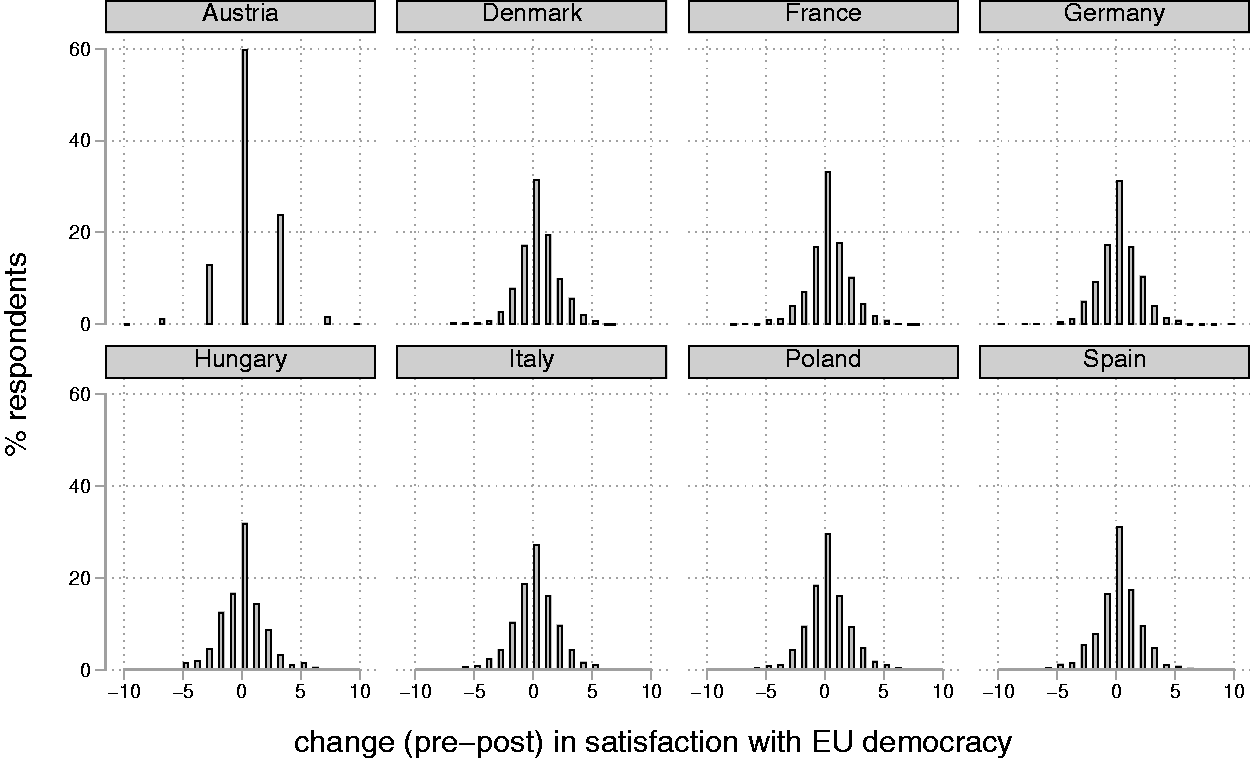
Change in SwEUD across eight European countries.
To test the relation between turning out to vote and satisfaction with democracy, we created a dummy variable taking a value of 0 if the respondent did not vote at the EP election and 1 if she did (M: .80, SD: .40). Turnout ranges from about 73% in Hungary to 87% in Germany, clearly above the actual rate, which in all countries was considerably lower. This is an unfortunate but very common problem of existing survey data since turnout measures a socially desirable behaviour that tends to be systematically overestimated in survey data (e.g., Blais and Daoust, 2020). The overestimation is not, however, a major problem for our inference purpose. This is due to the fact that existing studies using validated turnout demonstrate that ‘researchers will rarely be grossly misled by using any of these three sources [intention to vote, reported vote or validated vote]. The same variables tend to be influential in all three, and their relative proportions are usually (though not universally) unchanged’ (Achen and Blais, 2016: 206). Don’t knows and refusals are dropped from our analyses. 2
To test H1b and H2b, we need to operationalize winning, which is less straightforward at the EU level compared to national elections. Winners are usually classified as those individuals who voted for ‘the actual party in power’ (Anderson and Guillory, 1997: 72), the party that formed the government following the election (or parties in the case of coalition governments). As already discussed in previous sections, while there is no national government at the EU level, for the EP elections, one must take into account whether citizens voted for the largest party either at the national or the EU level. For instance, in Italy, one of our cases of study, the League was overwhelmingly considered in the media as the winner of the elections in Italy, 3 but the European party the League was affiliated to only ranked fifth in the 2019 EP election in terms of overall performance. In light of this consideration, we rely on different operationalizations of the variable winning. This will also afford us an opportunity to study what winning really means at the EU level. First, since the largest party is the one voters often identify as winner (Singh et al., 2012), we rely on a dummy measure that takes the value of 1 when the respondent voted for the party that received the largest amount of vote separately at the national (M: .27, SD: .44) or the European level (M: .19, SD: .40) and 0 otherwise. For example, in Italy the national-level winners are the voters of the League, which was the party receiving the largest amount of votes in the country; the winners at the European level are the supporters of the party affiliated with the European People’s party group receiving the largest amount of votes at the European level namely the supporters of Go Italy. We also follow recent works on satisfaction with democracy and use a numerical indicator of electoral performance, namely the percentage of votes obtained by the party supported by the respondent, again considering separately the national (M: 20.48, SD: 12.65) and the European outcome (M: 13.67, SD: 6.13). Specifically, for the European level, we consider the performance of the European party group the national party is affiliated to. 4 Non-voters are dropped from this part of the analysis.
To capture the profound rejection of the EU in its core or identity, we follow Hooghe and Marks (2005) among others and rely on the concept of exclusive national identity. To measure exclusive national identity we combine two survey questions asking our respondents ‘How close do you feel to Europe?’ and ‘How close do you feel to COUNTRY?’, respectively, using a scale from 0 to 3 where 0 stands for ‘not at all’ and 3 stands for ‘very close’. Exclusive national identity is the difference between these two variables in the form of national identity – Europe identity. The variable displays increasingly larger values the more people feel exclusively national and increasingly smaller values the more they feel exclusively European with a 0 value when they are equally attached to their country and Europe. While the original variable can theoretically range from –3 to +3, we standardize it to range from –1 to +1 (M: .195; SD: .337). Figure 2 illustrates the distribution of the variable in the countries analyzed. Exclusive national identity is particularly high in Denmark (M: .347; SD: .308), followed by France (M: .265; SD: .308), and significantly lower in countries such as Spain (M: .085; SD: .325) and Hungary (M: .067; SD: .365). Figure 2 shows there is conspicuous variation across countries. 5
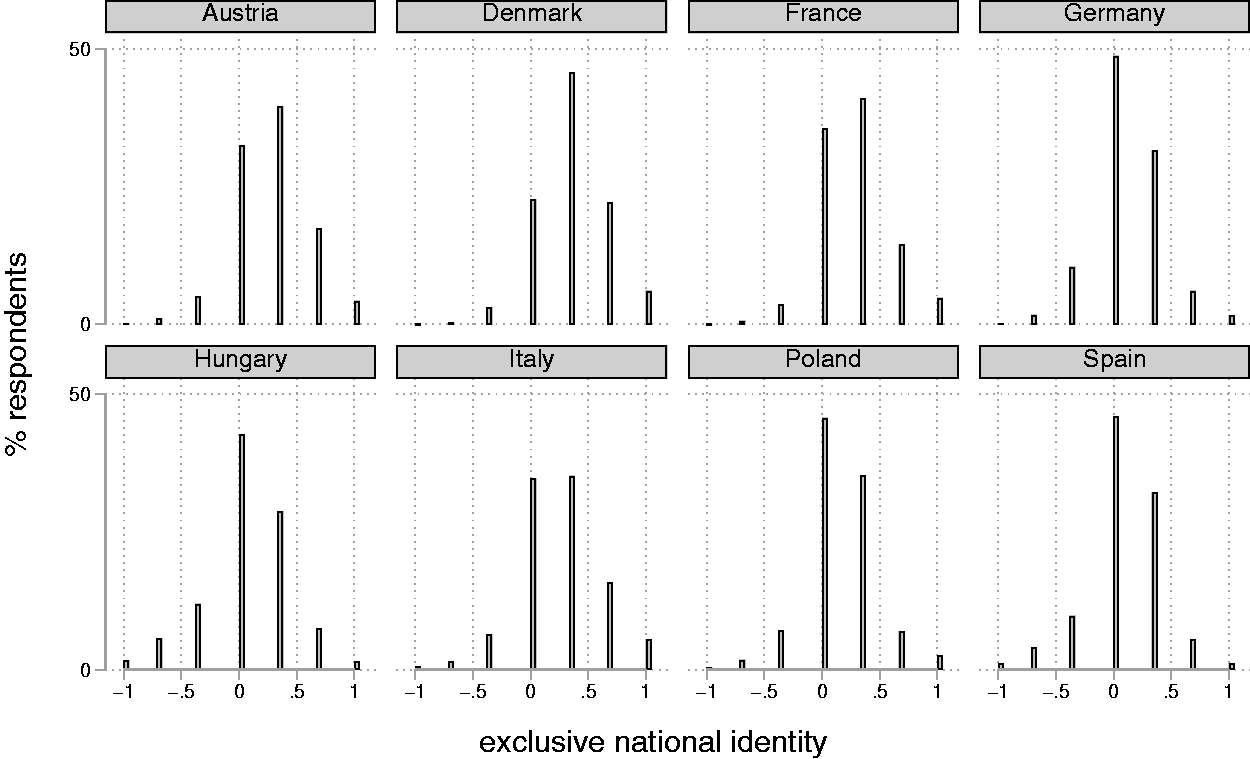
Distribution of exclusive national identity across eight European countries.
In all our models, we control for the level of satisfaction in the pre-electoral survey to neutralize floor and ceiling effects (Blais and Gélineau, 2007); this setup allows us to compare SwEUD of winners to that of losers, relative to their levels before the election. In doing this, we closely follow the existing literature studying satisfaction with democracy at the national level (Blais et al., 2017; Singh et al., 2012). As it is standard in the existing literature to assume a relation between mass support at the national and at the EU level — albeit the direction of causation remains disputed (Kritzinger, 2003; Rohrschneider, 2002), we control in our models for satisfaction at the national level (Pearson r correlation between satisfaction with democracy at the EU and national level is 0.33 in wave 1 and 0.40 in wave 2). Also, it is known that those who are interested in the elections are more prone to participate, know more about the EU, and have higher levels of SwEUD (Karp et al., 2003), hence we control for both interest in the EU election and political efficacy (both internal and external) (e.g., Karp and Banducci, 2008). 6 We also control for gender, age, and education. Importantly, all our control variables are measured in the pre-electoral wave. Descriptive statistics for all our variables are presented in the Online appendix.
Empirical findings
We start by examining the impact of electoral participation and winning on changes in satisfaction. We then examine the moderating role of exclusive national identity.
Voting, winning, and satisfaction with democracy
Model 1 in Table 1 shows that voting (versus abstaining) has a statistically significant impact on changes in satisfaction (our dependent variable) albeit the coefficient is substantially quite small. Specifically, all else being equal, voting slightly increases satisfaction by about 0.17 point on a scale from –10 to +10 among voters when compared to abstainers. Figure 3(a) shows the predicted change in satisfaction for abstainers and voters. The effect is remarkably similar to what prior research has found in the context of national elections, i.e., an effect of about 0.2 point on a scale from -10 to +10 (e.g., Kostelka and Blais, 2018). This provides overall support for H1a.
Turnout and winning and changes in SwEUD (Ordinary Least Square models).
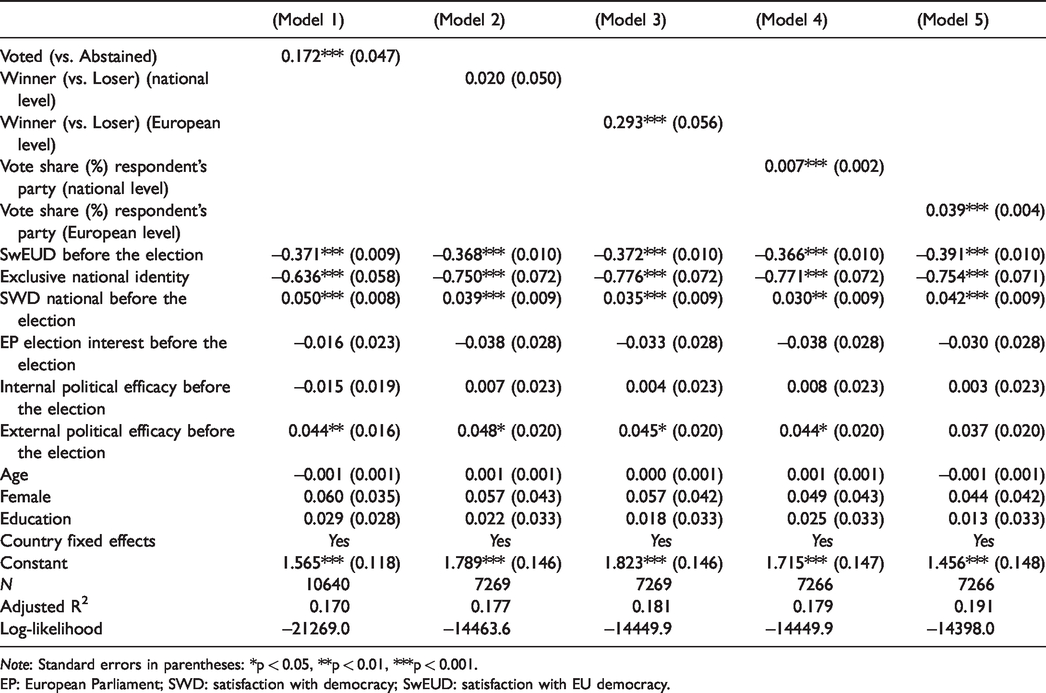
Note: Standard errors in parentheses: *p < 0.05, **p < 0.01, ***p < 0.001.
EP: European Parliament; SWD: satisfaction with democracy; SwEUD: satisfaction with EU democracy.
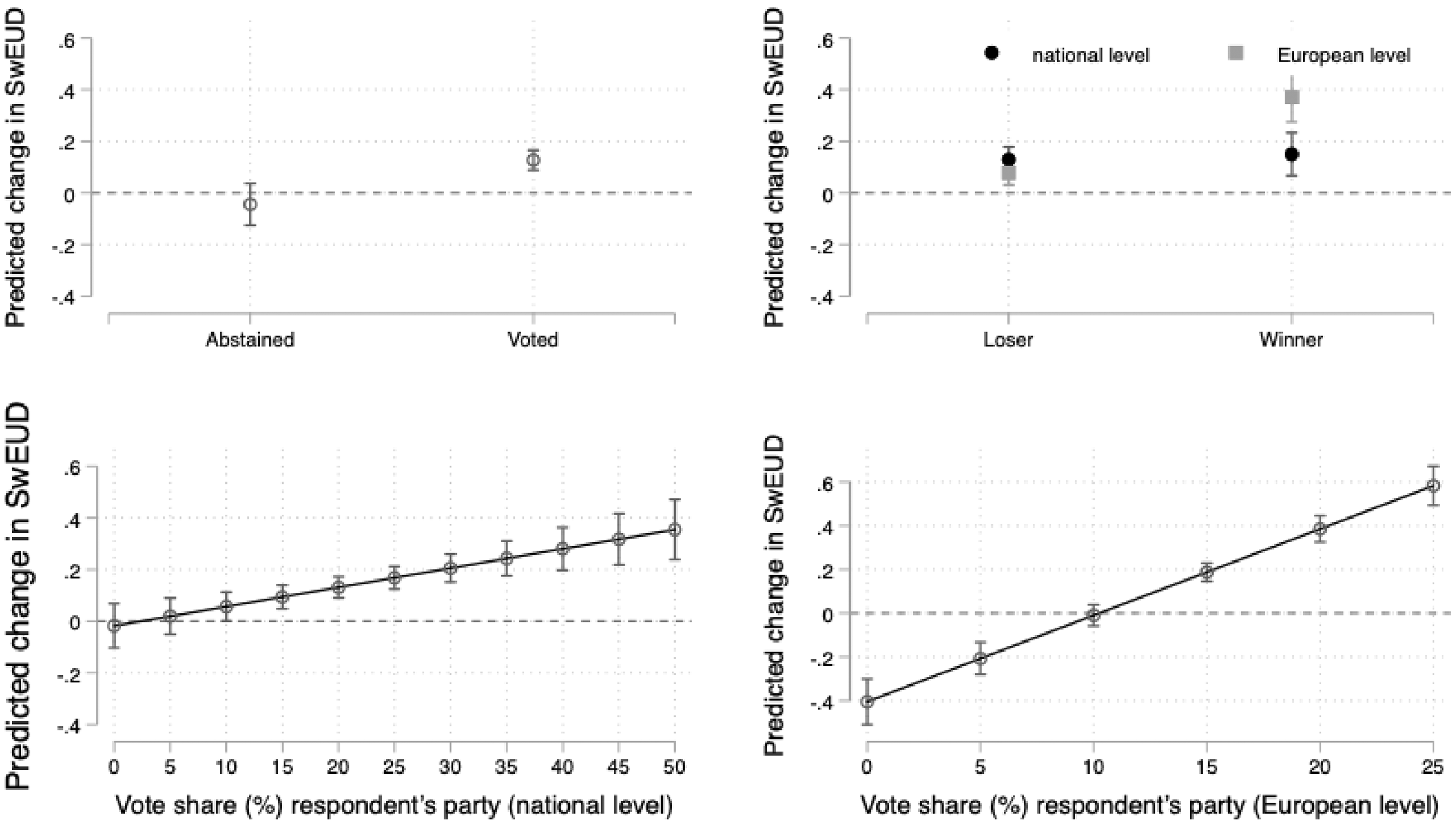
Predicted change in SwEUD (with 95% confidence intervals).
Moving to winning, Models 2 and 3 in Table 1 display the effect of winning at the national and European level, respectively. All else being equal, winners at the national level are about 0.02 point more satisfied after the election (on a scale from -10 to +10) compared to losers; the effect is, however, much stronger when we consider the winners at the European level in which case, all else being equal, winners are about 0.29 point more satisfied after the election compared to losers. Figure 3(b) shows the predicted change in satisfaction for losers and winners. The graph clarifies that while losers display consistently lower levels of changes in satisfaction after the election than winners, the changes for winners at the European level are statistically significantly different from those of winners at the national level.
When interpreting the results of Models 2 and 3 in Table 1, namely that winners at the national level are not more or less satisfied after the election compared to losers while the effect is much stronger when we consider the winners at the European level, two important aspects shall be considered. First, our empirical models examine those who voted at the EP elections, who tend to be quite interested in EU politics in the first place (Van der Eijk and Oppenhuis, 1990). One reason why the variable ‘EU winner’ is significant is that those who care to vote in the election are particularly interested. Second, the country-level results presented in the Online appendix, indicate that the impact of national-level wins are positive and significant in all countries (as expected by H1b) except for France, Italy, and Hungary. The national level winners are in these cases Le Pen’s National Rally in France, Salvini’s Lega in Italy, and Orban’s Fidesz in Hungary. So the results of Model 2 in Table 1 are driven by the fact that there is no increase in SwEUD for national-level wins in these three countries.
Models 4 and 5 in Table 1 display the effect of a one percentage point vote increase on changes in satisfaction respectively for the national-level party and the European party group. Starting with the former, we find that, after the election, satisfaction is .007 point higher on a –10 to +10 scale compared to before the election when one’s party’s vote share is one percentage point higher. In other words, for every 10 percentage point increase in the vote share of a supported party, satisfaction with democracy is expected to increase by 0.07 point on a scale from –10 to +10 (see Figure 3(c)). The effect is somewhat smaller compared to what for example Kostelka and Blais (2018) found in the case of national elections, where the equivalent increase is 0.15 point. When we consider the performance of the European party group, we find that satisfaction is .039 point higher after an election when one’s party’s vote share increases by 1 percentage point (see Figure 3(d)). This is slightly larger than what has been found in the context of national elections. Taken together, the results provide support for H1b. 7
Since there could be some concerns related to the inclusion of Hungary and Poland due to the recent events and threats to liberal democracy in these countries, we re-ran the models presented in Table 1 dropping these two countries. The results presented in the Online appendix show that the findings are remarkably consistent and robust to the inclusion or exclusion of these two countries. The country-individual analyses shown in the Online appendix confirm our main findings. 8 We have also cross-checked the results by implementing a diff-in-diff propensity score matching estimator. This estimator brings several advantages avoiding functional form assumptions (see Emmenegger et al. (2017) for a recent application). The results in the Online appendix clearly validate those presented in the article. There are no consistent differences between those with low and high interest in the EP elections, between those with low and high knowledge of parties’ position on a pro-unification/integration vs. anti-unification/integration scale and between those with low and high factual knowledge about EU institutions (full results are presented in the Online appendix). 9
The moderating role of exclusive national identity on changes in satisfaction with democracy
The models in Table 1 indicate a direct negative impact of exclusive national identity on changes in satisfaction, which suggests that those with an exclusive national identity feel less satisfied with EU democracy after the elections. The next figure illustrates the marginal effect of voting and winning on changes in SwEUD after the election among people with different levels of exclusive national identity (full results available in the Online appendix). Starting with voting, Figure 4(a) indicates that the substantial effect of voting is almost exactly the same, that is, small but positive, across degrees of exclusive national identity. The relationship becomes statistically non-significant at the extremes simply because of the smaller number of observations, but the effects remain remarkably similar. Given that the interaction is non-significant for turnout suggesting that the impact of voting is not weaker or stronger among those with exclusive national identity, we reject H2a.
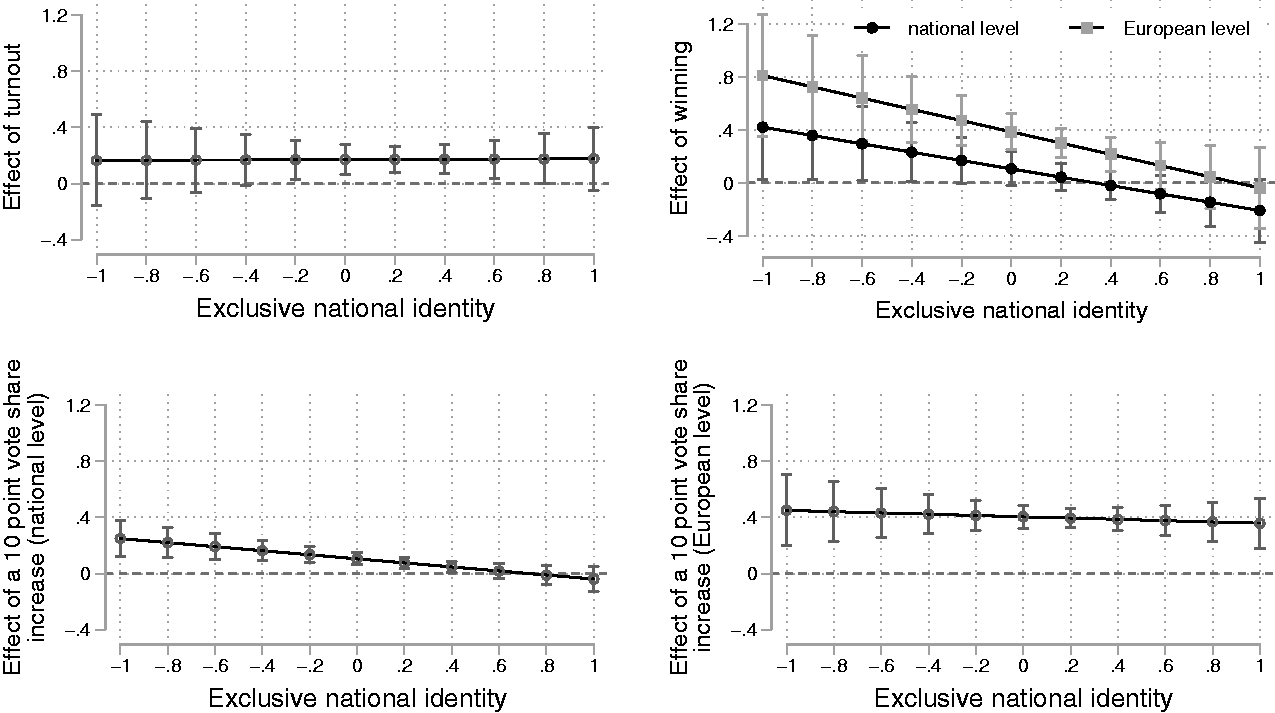
The moderating role of exclusive national identity (with 95% confidence intervals).
Figure 4(b) presents the results of the interaction between winning and exclusive national identity to provide a direct test of H2b. The plot shows a significant and negative interaction indicating that winning has basically no effect when people are alienated with the EU. The results are consistent if we consider party performance. Specifically, Figure 4(c) shows the impact of a 10 percentage point vote increase at the national level for different levels of exclusive national identity. It shows that the higher exclusive national identity the lower the impact of party performance on SwEUD, which is in line with H2b. In other words, while an increase in the vote share of the supported party has a positive effect among those that do not have an exclusive national identity, party performance at the national level has basically no effect when people are alienated with the EU. Exclusive national identity, however, does not seem to moderate the effect of the performance of the European party group on SwEUD. 10 We discuss the implications of these findings in the conclusion.
Conclusion
Holding elections means giving ordinary citizens an opportunity to voice their preferences and have a say in the actual political government of an institution. Stable findings in the existing literature demonstrate that holding elections increases satisfaction with democracy at the national level for voters more than for abstainers and for winners more than for losers. In this study, we address the following question: Does the legitimizing effect of elections materialize at the supranational, EP election level? More precisely, we aimed to assess whether people became more satisfied with the way democracy works at the EU level if they participate in the EP election and their party performed well.
We make three important contributions. First, this is the first study to test the expectations of the democratic theory and winner-loser gap literatures at supranational elections. While the existing literature might suggest a null effect, because of the low stakes and the absence of a direct relationship between the outcome of the election and the governing body, our hypotheses were that turnout and party performance would play a role in the EP 2019 elections due to the changing circumstances these elections have been held in 2019. We do find that citizens are slightly more satisfied when they participate in the elections and more satisfied when they win the election and when their party receives more votes – albeit the effects are small.
Second, our study shows that the extent to which election outcomes influence democratic satisfaction depends on individual-level exclusive national identity. For those more alienated towards the EU, it does not matter whether their party performed well or poorly in the election; they remain highly critical.
Third, our research design, more precisely the use of a panel survey, allows us to measure the specific impact of the election, by comparing pre- and post-electoral satisfaction. This approach has been used in prior research (e.g., Singh et al., 2012) but, to our knowledge, this is the first systematic comparative study that includes pre- and post-election measures of satisfaction with democracy at the EU level.
Our results also help clarify the meaning of winning at the EU level. Our findings suggest that party performance at both the national and the European level matter. This is likely due to the fact that national parties often use EP election results as a barometer of their national-level strength. In this regard, EP elections provide the parties with the opportunity to proclaim themselves winners either if they won the European contest of the EP election or if they were the top performing party at the national level. It is clear however, that winning at the national level only matters when there is an initial support for the EU in the first place. Future work should look into the moderating role of media in framing who the winners and losers of EP elections are.
A number of implications can be derived from our study. One implication is that voting and winning at the EP level have similar positive effects as compared to national elections in fostering satisfaction with democracy. An obvious future line of research is to look at how long this positive effect lasts possibly leveraging on panel data spanning more than one EP election. Another important implication relates to the moderating effect of exclusive national identity. Our measure of exclusive national identity reports over 16% of respondents fully alienated with the EU. Given that turnout remains rather low at EP elections and those alienated with the EU are unlikely to tune in during the elections, we can conclude that in line with previous findings (Beaudonnet and Franklin, 2016), the positive effect of EP elections is unlikely to be broadly felt by the population. For this group of citizens in particular, we find that a better party performance does not produce greater satisfaction with the state of EU democracy. In this regard, longitudinal panel data can also provide the opportunity to study what it means to be a repeated loser in EP elections. It is possible, in fact, that the lack of an increase in satisfaction with democracy for exclusive nationalist voters is due to an alienation with electoral victories over time. In short, EU elections do contribute to slightly increase the legitimacy of the EU at least among those who participate, but not among those who completely reject that legitimacy to start with. Mission not quite accomplished.
Supplemental Material
sj-pdf-1-eup-10.1177_1465116520970280 - Supplemental material for Do European elections enhance satisfaction with European Union democracy?
Supplemental material, sj-pdf-1-eup-10.1177_1465116520970280 for Do European elections enhance satisfaction with European Union democracy? by Carolina Plescia, Jean-François Daoust and André Blais in European Union Politics
Supplemental Material
sj-zip-2-eup-10.1177_1465116520970280 - Supplemental material for Do European elections enhance satisfaction with European Union democracy?
Supplemental material, sj-zip-2-eup-10.1177_1465116520970280 for Do European elections enhance satisfaction with European Union democracy? by Carolina Plescia, Jean-François Daoust and André Blais in European Union Politics
Footnotes
Acknowledgements
A previous version of this paper has been presented at the seminar series of the Department of Political Science at the University of Padova. We would like to thank all the participants for their useful comments and in particular Paolo Roberto Graziano. We would also like to thank Andreas Goldberg, Sylvia Kritzinger and Thomas Meyer for their helpful suggestions on previous versions of this paper and Tanja Schüberl for her assistance with the data used in this paper.
Funding
The author(s) disclosed receipt of the following financial support for the research, authorship and/or publication of this article: This research was carried out as part of the RECONNECT project, which has received funding from the European Union’s Horizon 2020 research and innovation programme under Grant Agreement no 770142. The information in this article reflects only the authors’ views and the European Union is not liable for any use that may be made of it.

Notes
References
Supplementary Material
Please find the following supplemental material available below.
For Open Access articles published under a Creative Commons License, all supplemental material carries the same license as the article it is associated with.
For non-Open Access articles published, all supplemental material carries a non-exclusive license, and permission requests for re-use of supplemental material or any part of supplemental material shall be sent directly to the copyright owner as specified in the copyright notice associated with the article.
