




Abstract
Does the framing of crises shape public support for inter-state solidarity? We focus on three dimensions that have been salient in the characterisation of European Union crises and may affect public support for solidarity more generally: (a) how country-specific or common a crisis is; (b) whether policymakers are seen as responsible for the crisis or not; and (c) how existential or manageable the threat posed by a crisis appears. We employ a pre-registered factorial vignette experiment conducted in 15 European Union countries to assess how characterising a hypothetical crisis affects voter support for fiscal and financial solidarity. Our results show that exposure to different crises frames shapes public support for risk-sharing in the European Union. Changes in solidaristic attitudes vary significantly with the means of fiscal risk-sharing proposed.
Introduction
Does the framing of crises shape public support for inter-state solidarity? This is a question for federations or compound polities generally, but nowhere as pressing as in the European Union (EU) after a long decade of crises. In the wake of the euro area (EA) crisis, many scholars argued that the policy response was strongly influenced by the way in which the crisis was portrayed, paving the way for fiscal austerity and labour market reforms (e.g., Blyth, 2013; Schmidt, 2021). An initial frame was that the crisis was in essence fiscal, notably due to mismanagement by successive Greek governments, quietly tolerated by the Council despite warnings from Eurostat (European Commission, 2010: 12–16). The adjustment programmes treated the crisis largely as a country-specific matter, for which entrenched national policies were responsible and which did not pose an existential threat to the currency union if contagion could be reined in (Schelkle, 2017: 195). Scholars suggest that this public account of the EA crisis reduced the potential for solidaristic reforms, such as introducing a joint debt instrument or giving means-tested transfers (Matthijs and McNamara, 2015).
The frame of a country-specific, containable crisis did not gain traction during the coronavirus disease 2019 (COVID-19) pandemic. There were attempts to renew allegations of moral hazard, notably when the Dutch finance minister insinuated that the Spanish government may have insufficiently prepared for the pandemic (Khan, 2020). Leading politicians, experts, and the media in Europe engaged in a very public debate about the crisis diagnosis until a consensus on a common, existential threat for which nobody was responsible emerged (Ferrera et al., 2021; Truchlewski et al., 2021). Scholars noted that an initial reflex to close borders and control exports in mid-March was followed by a surprising willingness to extend cross-border fiscal solidarity (Genschel and Jachtenfuchs, 2021). However, so far, few contributions specify how voters respond to different perceptions of a crisis and what forms of solidarity they would support.
In this paper, we ask whether and which crisis frames affect public support towards fiscal integration and financial solidarity in the EU. We try to identify, theoretically and empirically, a pattern that can account for variation between crises and what follows in terms of political support for tangible solidarity. Theoretically, we discuss how collective action theory can rationalise why these dimensions are relevant for the supply side of crisis management. From the vantage point of EU policy-makers, our research question can be formulated as under which circumstances are citizens amenable to inter-state solidarity? We hypothesise that three traits of a crisis affect public support for solidarity between EU member states: (a) how common or country-specific a crisis is; (b) how attributable or not the crisis is to policymakers’ decisions in the past; and (c) how existential or containable the threat posed by the crisis appears to be for the EU. These traits matter for the collective action problems that policymakers have to solve in order to manage a crisis, as we will outline in the theory section. Policymakers reveal their diagnoses of a crisis when they negotiate collective responses to an emergency and communicate it to the public, through the crisis measures themselves, through public statements or through the media. This is the link we assume that connects the supply side of the policy process, captured by the scenarios in the experiment, and the perceptions on the demand side, i.e., the responses to the treatment.
Theory does not provide us with a definitive answer about how each configuration of these traits affects voter support, for instance, whether a serious common crisis for which responsibility can be attributed to policies of the past leads to more or less support for solidarity. To find out, we devised a factorial vignette experiment as part of a larger survey, conducted in 15 EU countries. 1 Our experiment randomly exposes respondents to different crisis frames that combine the three traits. This ensures that we properly identify the causal effect of framing on attitudes. The survey was fielded at the end of June 2021. Our results indicate that citizens’ solidaristic opinions are in fact responsive to how a crisis is portrayed. In particular, a greater emphasis on the commonality of the crisis, the attribution of responsibility for its origin and possibly dire consequences for the stability of the Union positively make citizens’ approval of fiscal integration in times of crisis more likely. At the same time, we show that these frames have a more heterogeneous effect on citizen attitudes towards other forms of fiscal-financial risk sharing among EU member states.
Our study is part of recent research efforts to identify the sources of public support for risk sharing in the EU (e.g., Baccaro et al., 2021; Bechtel et al., 2014; Daniele and Geys, 2015; Vasilopoulou and Talving, 2020). Research has also found that, in times of crisis, citizens’ support for European fiscal integration is conditional on the specifics of risk-sharing instruments (Beetsma et al., 2022; Bremer et al., 2021; Vandenbroucke et al., 2018). Our analysis adds to this research. For one, by exploring the basis for this malleability of citizens’ preferences: a set of generalisable characteristics arguably shapes attitudes towards solidarity in the EU. Moreover, we provide a theoretical underpinning for this empirical research in public attitudes, based on an account of collective action problems in a multi-level political system like the EU.
The next section conceptualises three generalisable dimensions of crisis frames. Section three presents the design of the pre-registered survey experiment and discusses the findings. The final section summarises the implications of our study.
Crisis frames and collective action
Motivation
In moments of high uncertainty, typical of a crisis situation, framing can acquire a powerful role. This is emphasised by discursive institutionalists, who conceive discourse as the process by which policy ideas are constructed and conveyed to the public by a wide range of political actors (Schmidt, 2008). A host of studies suggest that the way in which the EA crisis was framed early on, namely as a Greek or Southern European problem, played a crucial role in orienting the process of crisis resolution, possibly constraining the potential for inter-state solidarity in this context (Blyth, 2013; Jones, 2015; Matthijs and McNamara, 2015). However, these studies have not provided empirical evidence that framing had an effect on the solidaristic attitudes of EU citizens.
A focus on public opinion is particularly consistent with the post-functionalist theory of European integration. This theoretical framework posits that the post-Maastricht period is characterised by the presence of a ‘constraining dissensus’ in the EU: anticipated opposition in parts of the public hinders the European integration process (Hooghe and Marks, 2009: 5). The growing tension between an expanding functional involvement of the supranational level and the largely national scope of political community causes increasing politicisation of EU-related issues, which limits the potential for inter-state solidarity in the EU. Accordingly, post-functionalism sees the response to the EA crisis as rooted in the dynamics of domestic politics and public opinion. The rise of nationalist opposition to European integration has petrified governments and prevented solidarity even as the economic costs of inactivity rose (Hooghe and Marks, 2018: 109). Policymakers here take national identities as a given and refrain from policy measures that would risk a political backlash at home.
The EU's response to the COVID-19 pandemic is difficult to interpret through this post-functionalist lens (Schimmelfennig, 2018). As Genschel and Jachtenfuchs (2021: 351) put it, the COVID-19 crisis ‘expanded expectations of community to the transnational level as empathy with the worst affected member states led to vocal calls for more EU solidarity and leadership’. The authors interpret this as a ‘reversal’ of the post-functionalist trade-off between the functional scale of governance and the territorial scope of community. The fragmentation of national identities seems to have played a less constraining role in the ability of policymakers to manage collective action problems in the presence of functional pressures generated by the pandemic. Thus, it appears that contingent factors that trigger empathy with neighbours can help expand the expectations of community to the transnational level. This responsiveness to contingent factors is at odds with strong notions of identity-based solidarity that is confined to traditional communities. 2 Solidarity can also be based on generalised, reciprocal self-interest as in Baldwin (1990) and national policymakers often appeal to such enlightened self-interest when asking for support for international commitments.
In this vein, Cicchi et al. (2020) provide evidence that the characteristics of a crisis are an important factor shaping EU solidarity in hard times. For instance, they find that voters are more inclined to support their European neighbours in a natural disaster than in a refugee or a debt crisis. However, their study does not analyse the underlying features which could explain the variation in solidaristic attitudes. For instance, do European voters see solidarity as more pertinent in a natural disaster because they perceive crisis-stricken countries as not responsible for their misfortune? Why should this be different for a surge in asylum seekers where support is not as forthcoming? Or because they empathise with the existential threat of such a natural disaster, which could explain the difference to a refugee crisis? We do not know the answer.
Crises are multi-faceted and we ask which dimensions and their combinations affect the public's willingness to share risks with others. In contrast to much of the literature that relies on implicit assumptions about salient traits of a crisis, we derive the relevant dimensions from the theory of collective action. In the EU, a union of democracies, policymakers must communicate and portray crises while coordinating their policy responses. We assume that voters take their cues from such public communications (Chong and Druckman, 2007). The effect of framing on attitudes of voters has been shown for government expenditure (Jacoby, 2000), trade preferences (Ardanaz et al., 2013), redistribution (Harrel et al., 2016), attitudes towards austerity (Barnes and Hicks, 2018), macroeconomic imbalances (Ferrara et al., 2021) and support for the euro (Baccaro et al., 2021). Our analysis takes such framing effects therefore as well-established and goes a step further: whether, and if so which, features of a crisis that policymakers portray in public affect solidaristic attitudes of those who listen.
Collective action problems of crisis management
Why should we expect that certain characteristics of a crisis matter for the willingness of decision-makers and citizens to share risks with neighbouring countries in the EU? We give an answer that has its roots in the political economy of collective action: In a situation of decision-making, actors are primarily concerned with the costs and benefits of particular policy measures, even though institutional opportunity structures and ideational predispositions play their role in the background. Solidarity requires overcoming collective action failures (Moss, 2002: 36–52; Schelkle, 2017: 46–56). Sharing of risks, such as systemic bank failure and a contagious disease, calls for cooperative institutions, i.e., agreed, or at least tolerated, interventions to support those afflicted by an adverse incident. EU policymakers use crisis frames to justify their preferred course of action and, after an agreement, to make the case for the compromises found. The measures reveal a certain interpretation, for instance when a member state in trouble is forced into one-sided adjustment with strings attached to the concessional bailout loan: it is that country's problem, possibly attributable to past mistakes, but it could spill over to us if we don’t help. The rationale of crisis measures must be communicated in the media and national parliaments.
Here are just three examples for such communications. The first European Council after a Greek bailout had been decided in May 2010 states the agreed diagnosis as follows: ‘11. The present rules on budgetary discipline must be fully implemented. [..] 16. The European Council agrees that member states should introduce systems of levies and taxes on financial institutions to ensure fair burden-sharing and to set incentives to contain systemic risk’ (European Council, 2010). It conveys that fiscal policies in some member states are to blame, but that there is a huge potential to make this an existential (systemic) threat through financial contagion that is a matter of national responsibility and effort (incentives) to control. Fast forward to March 2020, the letter signed by nine member states demanded a Eurobond with the following rationale: ‘The case for such a common instrument is strong, since we are all facing a symmetric external shock, for which no country bears responsibility, but whose negative consequences are endured by all’ (Wilmès et al., 2020: 3). This resonated with later official statements on the recovery fund that rebuffed Eurobonds in favour of an EU-wide instrument of solidarity. Shortly before taking over the EU Presidency in summer 2020, German Chancellor Merkel gave an interview that was simultaneously published in six national newspapers across the EU: ‘[T]he coronavirus pandemic is confronting us with a challenge of unprecedented dimensions. It has struck us all indiscriminately. […] For Italy and Spain […], the coronavirus pandemic signifies a huge burden in economic, medical and […] emotional terms. In these circumstances, it is only right for Germany to think not just about itself but to be prepared to engage in an extraordinary act of solidarity. It was in that spirit that French President Emmanuel Macron and I made our proposal [for a recovery fund]’ (Merkel, 2020). The commonality of a shock for which nobody can be made responsible but that is a serious threat to all was acknowledged.
What interests us ultimately is how crisis frames influence electorates’ willingness to support or resent solidaristic measures. This can add nuance and specificity to the ‘constraining dissensus’ that post-functionalist theory has identified. It would also give us an idea of how aligned the necessities of effective crisis management are with voters’ support for them (Ganderson, 2023). We assume, in line with many public opinion researchers, that most voters take their cues from official frames and that, in turn, political officeholders try to be responsive to voters’ concerns as expressed in the mainstream media or by members of parliament (Hobolt and De Vries, 2016: 421–423; Steenbergen et al., 2007). We refer to an inter-state context and use the term risk-sharing and insurance interchangeably, as a form of solidarity by which fortunate states compensate, at least partially, unfortunate states. We identify three frames that were used in the examples of communications above: the commonality of a crisis, how attributable it is to policymakers’ decisions rather than bad luck and whether it is existential. For each crisis frame, we derive a political economy argument on why it should or should not increase support for solidarity. We are open about the fact that economic and political considerations can point in different directions, and thus generate uncertain hypotheses.
The first important consideration is whether the incidence of a loss is country-specific or common. Country-specific crises are most easily insurable but the fortunate ones who should share their good fortune may renege on their commitment. Commonality can be purely random, like in a pandemic that arrives due to open borders from another part of the world, or systemic because of the decision to promote market integration. Private insurance cannot cover highly correlated risks as the insurer would go bust. Social insurance can insure such risks through public debt, i.e., by making contemporaries who were lucky enough to recover and future taxpayers pay. Obviously, this latter way of risk-sharing is a bone of contention between governments and states of different fiscal constitutions and dispositions. Another way of sharing a common loss is to redistribute from the richer to the poorer members of the risk pool, exploiting the fact that while all are unfortunate, members may have different capacities to deal with their bad luck. This may be resented by governments and citizens of well-off countries as they would have to pay at a time when they themselves struggle. Hence, we think that the frame of a common crisis has, on its own, a theoretically ambiguous effect on the solidaristic attitudes of the public.
A second important consideration is whether responsibility can be attributed to somebody's (in-)action. Solidarity through insurance presupposes that the incident is random, i.e., that it was due to bad luck, not bad behaviour. This is often a matter of contention between the fortunate and the unfortunate members of a risk pool. The fortunate have incentives to renege on their commitment to risk-sharing and accuse the claimants of misbehaviour. The unfortunate may indeed have had incentives to misbehave in the sense of taking on more risks in the knowledge that downside risks can be shared with others, as part of an integration scheme to which all agreed. Knowing each other's incentives, it is easy to accuse the other side of a lack of empathy and of moral hazard, respectively. This is all the more likely in a union of democracies where governments change regularly. Current administrations may resent being held responsible for their predecessors’ commitments to insurance or for past risk-taking. 3 Witnessing these debates, we expect the general public to be more solidaristic if a frame stresses the purely random, non-attributable character of a crisis.
Finally, the seriousness of the threat is a relevant consideration for solving the collective action problem of insurance. The perceived intensity of the threat influences the perceptions of the costs and benefits of inter-state solidarity and it is hard to predict how the net balance appears to each member. We hypothesise that the result is a critical juncture: when the stability of the risk pool is at stake, considerations of the overall benefit can take precedence over the pursuit of short-term advantage, triggering efforts of pool maintenance. 4 It is compatible with our hypothesis that the frame of an existential threat facilitates solidarity in the short term. But it can also give rise to attempts at limiting interdependence in the future in order to not be exposed to an existential crisis. Yet, this becomes harder the more tightly knit a polity is and therefore insurance benefits arise as an implicit benefit of membership. On the whole, we assume that the characterisation of a crisis as existential makes voters inclined to adopt a more solidaristic attitude.
Our list of considerations, derived from well-known collective action problems, is deliberately parsimonious. We have, for example, not included how sudden, unprecedented or uncertain the crisis situation is (portrayed to be). 5 The distinction between risk and uncertainty is important for the design of risk-sharing schemes, for instance, coverage should be less precisely defined if there is high uncertainty. But the distinction is beyond most politicians and citizens who are not professionally concerned with insurance and have a tendency to treat any crisis as a matter of uncertainty. Hence, we hypothesise that this feature does not determine solidaristic attitudes as such even though it may be invoked by politicians to demand more comprehensive instruments.
We are also interested in how the configurations of the three characterisations work together. Interaction effects can be stated in principle but the overall effect on the public's attitudes cannot be predicted by theory alone. For instance, the commonality feature can interact with the second feature of attribution. Politically, a common shock makes members aware that they are part of a community of risk in which each member can identify with the situation of being unfortunate (Baldwin, 1990: 24–31; Ferrera, 2005). This may be different if a crisis has become common because it spread from a member's past policies that others may have pursued as well. Blaming the victim is then a distinct possibility. Even so, the fear that, if left alone, the spillover from a crisis of some may become an existential threat for all presumably contains blame attribution and supports solidarity of the tough-love variety. This was arguably the evolution of the EA crisis in a nutshell. Other scenarios are possible, and our experiment provides a systematic attempt at finding out their impact.
Finally, the solutions around which executives frame a crisis is likely to affect the solidaristic responses of the public (Beetsma et al., 2022; Cicchi et al., 2020). We assume that risk-sharing through insurance-type arrangements based on bad luck are more acceptable form of solidarity than redistributive transfers based on limited capacity. Insurance promises every member of a risk pool to become a beneficiary at some point while transfer schemes tend to have ex-ante predictable beneficiaries. Both a joint debt instrument and taxes to pay for eventualities are insurance-type arrangements, although taxes are a more immediate cost of insurance; joint debt has to be paid back primarily by those who were lucky enough to recover well from a crisis. We, therefore, expect that public debt is most conducive to solidarity. Transfers and taxes are less so, and the empirical outcome may depend on whether respondents expect to benefit or pay for transfers.
In short, we think that commonality of a crisis is an ambiguous feature for the public's support of solidarity but hope that the particular policy measures make a difference for this support. From a functional policy point of view, joint debt would be a way of sharing risks with future contributors, so public support would facilitate crisis management. We expect non-attributable crises (exogenous shocks) to have a positive effect on solidaristic attitudes, irrespective of the form of the measures used to share the risk. An existential crisis should also raise support for measures to rein it in; in the case of transfers, however, it is likely to depend on respondents’ expectations of whether they would be net beneficiaries or net contributors, so we expect heterogenous country effects here.
Crisis frames and solidarity: experimental evidence
We assess how different crisis frames affect support for solidarity at the EU level by making use of a pre-registered factorial vignette experiment. The experiment was conducted in 15 countries 6 and is based on a total sample of 12,228 respondents. We asked respondents to imagine a future crisis scenario in the EU and randomly varied whether the crisis was portrayed as common or idiosyncratic, with attributable responsibility or not, and threatening or non-threatening for the EU polity. The risk of this approach is that it is demanding to think about one's own reaction to the plight of others in the abstract. We therefore ground possible answers in concrete proposals for solidaristic risk-sharing, such as paying higher taxes or guarantee other countries’ debt.
In the next subsection, we describe the pre-registered design of our experiment and econometric model. The Online appendix provides a more detailed description of the structure and features of the survey we fielded in 15 EU countries, as well as a discussion of the operationalization of the dependent and control variables used in the analysis.
Design
To assess the causal impact of different crisis frames on solidaristic attitudes, we designed a 2 × 2 × 2 factorial vignette experiment presenting variations in the future, hypothetical crisis scenario. Each vignette differed along three factors (i.e., frame dimensions) having two different levels each. We combined these three factors and randomly varied each level within them to generate our experimental 377 vignette.
The first factor was related to the degree of commonality attributed to a crisis. The two levels this factor could take were (a) ‘common’ and (b) ‘idiosyncratic’. Accordingly, based on whether the respondent was randomly exposed to a ‘common’ frame or to an ‘idiosyncratic’ frame, the first part of the vignette read as follows:
‘Common’ and ‘idiosyncratic’ frame: We will now ask you to imagine a possible scenario taking place in the future. Imagine you are in 2024. The EU falls into an economic crisis. The media and most experts expect the crisis to hit [..] The media and most experts expect the crisis to hit
The second factor had to do with the extent of attributability of the crisis to decisions made by politicians in the affected member states. The factor varied based on the emphasis on the self-inflicted nature of the crisis, and most notably the influence of past political decisions in generating the current crisis context. The two levels this factor could take were (a) ‘attributable’ and (b) ‘non-attributable’. The second, randomised piece of text of the vignette was one of the two sentences below:
‘Attributable’ and ‘non-attributable’ frame: According to media and experts, the crisis is primarily caused by [..] the crisis is primarily caused by a
The third factor was related to the intensity of the threat posed by the crisis for the integrity of the EU polity. The variation in this factor was given by the degree to which the crisis was presented as an existential threat for the integrity and stability of the EU polity. The two levels this factor could take were (a) ‘existential’ and (b) ‘non-existential’. Thus, the third randomised piece of text of the vignette was one of the two sentences below:
‘Existential’ and ‘non-existential’ frame: Due to the severity of the crisis, media and experts point out that there is a Despite the severity of the crisis, media and experts point out that there is
The combination of the three pieces of text, which were randomised across the two levels of each factor, generated an experimental vignette that was presented to each respondent. As an example, if a respondent was randomly assigned to a crisis scenario with the three frames (a) idiosyncratic; (b) attributable; (c) non-existential, she read the following vignette: We will now ask you to imagine a possible scenario taking place in the future.
Imagine you are in 2024. The EU falls into an economic crisis. The media and most experts expect the crisis to hit
According to media and experts, the crisis is primarily caused by
Despite the severity of the crisis, media and experts point out that there is
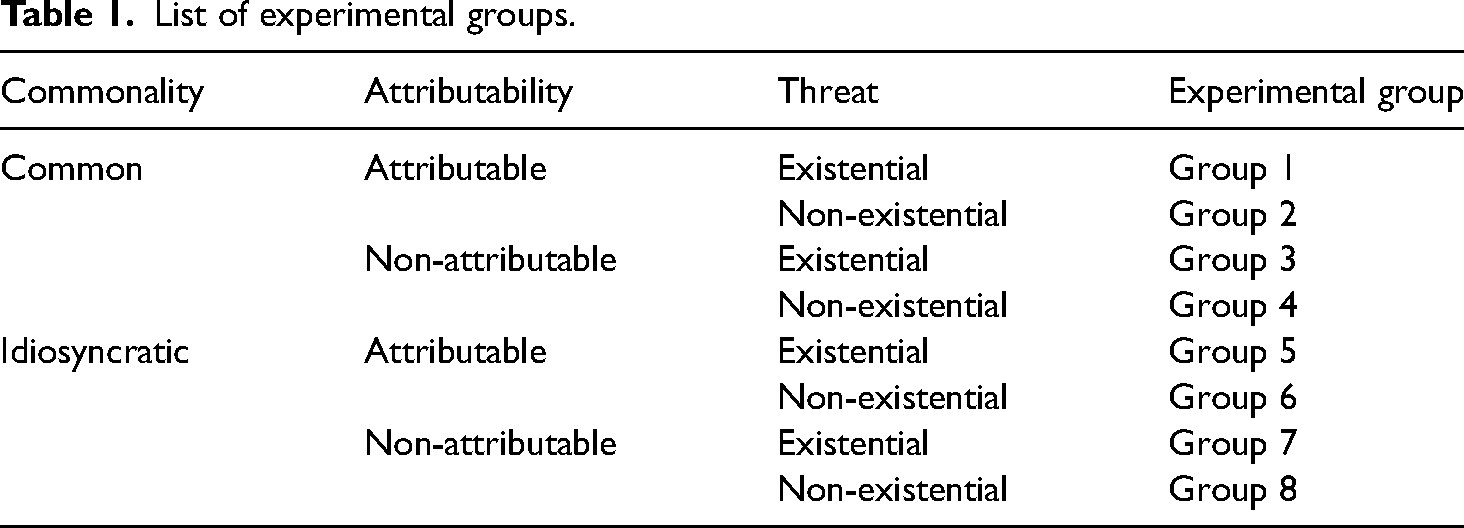
The resulting 2 × 2 × 2 factorial design yielded eight different scenarios, as shown in Table 1 below.
List of experimental groups.
After being exposed to one of the eight vignettes, respondents were asked to answer four questions that were used to create the dependent variables of our analyses. First, we asked whether they agree with a hypothetical proposal of the Commission to issue common debt to tackle the crisis scenario they had read about. The second question concerned their approval to provide financial help to other member states facing difficulties in the hypothesised crisis scenario. The third question regarded their willingness to contribute to helping other member states in need with a personal contribution from their taxes. The fourth question was about their vote in a hypothetical EU referendum under the crisis scenario that we had presented to them. The exact wording of the four questions is provided in the Online appendix. In each of the 15 EU countries in which the survey was fielded, the experiment was administered to around 800 respondents. This yielded a final total sample of 12,228 respondents for our analysis.
Guided by the pre-analysis plan, in the next subsection, we evaluate both the effect exerted by each frame separately and the joint effect exerted by combinations of frames.
Results
Our collective action theory of transnational solidarity gives us the following hypotheses for the single variation in crisis features, compared to the baseline scenario where a crisis is framed as idiosyncratic, attributable, and non-existential:
7
Changing from idiosyncratic to common: We expect either to generate no difference in attitudes towards solidarity (everybody fighting for themselves; in insurance terms: Common risk cannot be shared) or to produce more support for solidarity (self-interest in containment, if loss-absorbing capacity differs and risk can be shared with future generations); this scenario is therefore theoretically ambiguous. Changing from attributable to non-attributable (ceteris paribus idiosyncratic and non-existential): We expect this scenario to turn a case for charity into one of insurance, which increases the chance of support for solidarity since insurance promises reciprocate. Changing from non-existential to existential (ceteris paribus idiosyncratic and attributable): We expect this scenario to promote support for solidarity, e.g., in order to contain the threat for oneself by way of a firewall, at least in the short run.
We also expect support for inter-state solidarity to be dependent upon the type of fiscal and financial solutions for which governments presumably communicate these frames. Insurance schemes (joint debt, uniform tax increase) should be more favourably received than a redistributive scheme (financial help) although the latter may depend on whom the respondent imagines as the beneficiary. Nonetheless, our collective action theory does not give us a strong steer on how the variations act in combination with changing solidaristic attitudes
8
and on a referendum vote, respectively.
In our empirical analysis, the effect of each frame or combination thereof is compared to that of its opposite (i.e., ‘common’ vs. ‘idiosyncratic’, ‘non-attributable’ vs. ‘attributable’, ‘existential’ vs. ‘non-existential’). All the dependent variables considered in our analysis are ordinal, categorical or dichotomous. In our main analyses, we estimate ordered logit models for ordinal variables, multinomial logit models for categorical variables and logit models for dichotomous variables.
Figure 1 shows the effects of the eight variations to the baseline scenario for the average responses in 15 countries. Guided by the pre-analysis plan, we replicate these results in the Online appendix including a set of pre-specified control variables and country-fixed effects in the analysis. Additionally, we replicate the baseline results making use of OLS models, clustered standard errors, and a dummy specific to countries hit by the EA crisis (Greece, Ireland, Italy, Portugal, Spain). These robustness tests produce qualitatively unchanged findings (see Online appendix).
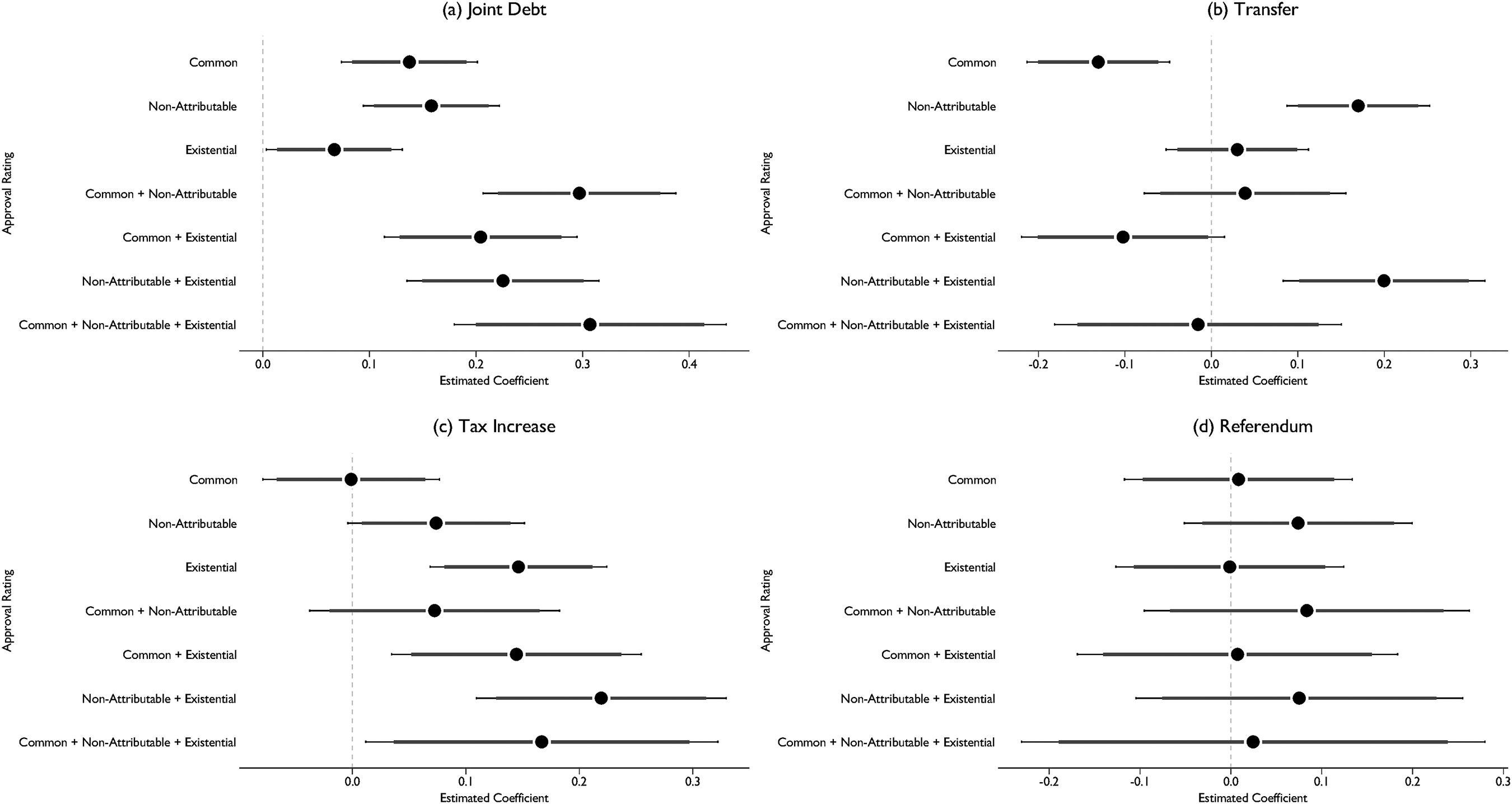
Treatment effects of crisis frames on solidaristic attitudes and membership vote.
If solidarity takes the form of a jointly guaranteed debt instrument, both a common and a non-attributable crisis (compared to the baseline scenario) solicit more solidarity (‘joint debt’, Figure 1(a)). This makes surprisingly rational sense in insurance terms for a common crisis (as it is sharing the burden with future generations who are not affected by a contemporary crisis). By contrast, the existential character of a crisis, as a single deviation from the baseline scenario, is weaker than we expected. All combined variations of the baseline scenario create more support for solidarity in the guise of a common debt instrument: idiosyncratic, attributable and non-existential is really the least favourable framing for a solidaristic attitude.
If solidarity is proposed to take the form of a transfer (‘financial help’, Figure 1(b)), the common character of a crisis turns into the opposite, dampening solidaristic attitudes. In fact, this is so strong that commonality neutralises the other two features in combination. In such a situation, the average respondent presumably supports the idea that financial help is better deployed at home. This should surprise us considering the COVID-19 pandemic reforms. The existential character of a crisis makes no difference, while the fact that a crisis is non-attributable (and idiosyncratic) solicits a solidaristic response, also in combination with an existential character. Our finding here suggests that the crucial feature of the pandemic response was its exogenous character, not the common experience.
If solidarity requires a personal contribution in terms of a flat rate tax increase, the existential character of a crisis becomes the driver for more solidarity (Figure 1(c)). Respondents are on average ready to contemplate this form of solidarity to avoid disaster. This solidarity-soliciting effect of an existential crisis under a tax scenario holds in combination with other features, although it is almost neutralised in the full variation of the baseline scenario. The common character of a crisis makes no difference to the baseline and that a crisis is non-attributable barely does so either. Sharing of the tax base is obviously the most demanding form of transnational solidarity.
Our assumption that the type of risk-sharing proposed makes a difference is strongly confirmed (see the difference between Figures 1(a), (b) and (c)). Attitudes depend on what form solidarity is supposed to take. Thus, studies that ask for solidarity in response to different kinds of crises, without specifying what this solidarity entails, possibly provide only a partial picture of this phenomenon. This is not to say that collective action theory gives the full answer: we are puzzled by the finding that, in an existential crisis, respondents are more likely to respond positively to tax-based solidarity than to one-off financial help. This amounts to accepting long-term interdependence even when a crisis is otherwise country-specific and attributable to policies in the past.
Our last finding concerns the attitude towards solidarity in times of crisis being distinct from the attitude towards remaining or leaving the EU (Figure 1(d)). It is striking that neither Leavers nor Remainers mix up the two questions and not a single or combined variation of the baseline scenario makes a significant difference to their hypothetical referendum votes. This would imply that policymakers do not have to fear that solidaristic institution-building gives rise to more Euroscepticism. The insignificance of different crisis scenarios for a membership vote is compatible with the view that seeing benefit in cooperation and collective action in the case of Remainers, or not in the case of Leavers, does not change with particular crisis scenarios.
In sum, how do these findings compare to our theoretical expectation? First, the responses to a common frame are as ambiguous as we expected, strongly conditioned by the fiscal instrument proposed. A transfer has a negative effect on solidaristic attitudes, joint debt a positive, in line with our assumption that insurance schemes are more favourably received than ex-ante redistributive transfer schemes. The expected ambiguity translates into absence of a significant effect for a tax increase. Our expectations for the change to non-attributable are confirmed, slightly stronger than expected for transfers (financial help). The findings for a change to an existential crisis are less strong for joint debt and more strongly favourable for a proposed tax increase; both have the right sign. Our expectation that the attitude towards solidarity in the form of a transfer depends on which side the respondents see themselves on is compatible with no significant effect insofar prospective recipients and prospective contributors may cancel each other out.
Conclusion
This article asks how the way crisis episodes are framed potentially affects public support for inter-state solidarity. We operationalised this question by identifying three general dimensions of crisis communication that capture the multi-dimensional nature of actual crises. Theoretically, we expect that crisis communications reflect collective action problems, which governments in the EU had to tackle when financial markets panicked or COVID-19 arrived in Europe (Schelkle, 2021). Hence, we focused on three dimensions and their interactions: (a) idiosyncratic/country-specific or common; (b) attributable to past policies or not; (c) existential or not. The findings in our experiment either align with or clarify our hypotheses.
We find that crisis frames not only have an impact on the willingness of the European public to support solidarity, but also that their impact varies with the instrument of solidarity ((a) joint debt; (b) financial help; (c) tax increase). In the context of joint debt, all frames increase solidarity relative to the baseline scenario ((a) country-specific; (b) attributable; and (c) non-existential). In the case of one-off financial help, only the non-attributable frame spurs more solidarity. For a uniform tax increase, only the existential frame and to a lesser extent the non-attributable frame increase solidarity. Our findings also suggest that various combinations of these frames have different impacts on solidarity conditional on the instrument being used. Moreover, the impact of the frames varies with three European regions ((a) North; (b) South, and (c) Others). Northern European respondents reacted most strongly to variations of the baseline scenario with more support for solidarity, albeit starting from a lower level of support on average than in the other two country groupings.
Our findings have important implications. First, regarding conceptualisations of solidarity: solidarity in a diverse European polity may not be as ‘hard-wired’ as identity-based accounts lead us to expect (Banting and Kymlicka, 2017). Public support for extending solidarity at the European level may be more dependent on the frames used in policy communication and in the negotiations leading to European solutions. As a result, policymakers can, and by default do, shape support for policy solutions. This qualification extends to the post-functionalist theory of electoral cleavages and voter behaviour (Hooghe and Marks, 2009). Policymakers may have more agency and are able to shape voters’ solidaristic attitudes than the notion of a ‘constraining dissensus’ on further European integration suggests.
Second, regarding policymaking, our findings imply that the expressed willingness to extend solidarity is not informative as long as the shape that solidarity is supposed to take is not specified. For instance, instruments, such as financial help, can antagonise the public towards solidarity during a common shock, while the same frame has a very positive effect on solidarity if the instrument proposed is joint debt. This finding speaks to the literature on the political sociology of policy instruments (Lascoumes and Le Galès, 2007), according to which policy instruments produce their own effects (here, on solidarity) and structure public policy according to their own logic. To paraphrase the message of Schattschneider (1935): ‘policies create politics’.
Our article opens avenues for further research. There is first the variation between different macro-regions of the EU. The willingness to extend solidarity seems to differ across Northern and Southern Europe and a mixed group that stretches from Ireland to Romania. The Northern countries have the lowest baseline solidarity and the strongest effects of changing frames. Is this pattern due to a non-linear trajectory of solidarity as the textbook conceptualisation of economic preferences suggests? Or is it due to the fact that Northern respondents see themselves instinctively in the net payer position (lower baseline) but can be moved by scenarios in which any country can receive insurance (joint debt, tax on all)?
Our frames had the weakest effect on respondents in the Southern and Other group of countries. However, their willingness to extend solidarity is high in the baseline scenario. The non-responses are somewhat surprising for financial help and tax increases. At least governments in Central and Eastern European countries (part of Other) generally refuse to pay for solidarity because they perceive themselves as poorer. 9 So, in a simple interest-based account, we would expect a positive reaction to financial help and a negative one to tax increases. It would be compatible with the average respondent from a country in the Other group that they see themselves as net beneficiary of fiscal solidarity. But the economic development of some of these countries may be such that citizens can envisage a time in which it is no longer so clear who contributes and who receives support.
Another avenue for research is the crucial link between crisis communications of governments and voter attitudes that our collective action theory of transnational solidarity presupposes. The well-known ‘rallying-around-the-flag’ phenomenon suggests that cue-taking can be non-partisan, at least in the early stages of a crisis. However, it is likely that there is a partisan element in this link, i.e., primarily voters supportive of the government take their cue from these frames. How does this affect support for solidaristic institutions in the long run?
A related question is whether the responsiveness to crisis frames we found remains robust when crises are not communicated as analytically as in our experiment. For instance, the needs of large numbers of humanitarian migrants are acknowledged as a common crisis in some receiving countries but not in others. Why is that? The fear of freeriding by some receiving countries may be part of the explanation. Further research would be welcome to understand one of the greatest policy dilemmas of our times.
Supplemental Material
sj-docx-1-eup-10.1177_14651165231184641 - Supplemental material for What difference does the framing of a crisis make to European Union solidarity?
Supplemental material, sj-docx-1-eup-10.1177_14651165231184641 for What difference does the framing of a crisis make to European Union solidarity? by Federico M Ferrara, Waltraud Schelkle and Zbigniew Truchlewski in European Union Politics
Supplemental Material
sj-doc-2-eup-10.1177_14651165231184641 - Supplemental material for What difference does the framing of a crisis make to European Union solidarity?
Supplemental material, sj-doc-2-eup-10.1177_14651165231184641 for What difference does the framing of a crisis make to European Union solidarity? by Federico M Ferrara, Waltraud Schelkle and Zbigniew Truchlewski in European Union Politics
Supplemental Material
sj-doc-3-eup-10.1177_14651165231184641 - Supplemental material for What difference does the framing of a crisis make to European Union solidarity?
Supplemental material, sj-doc-3-eup-10.1177_14651165231184641 for What difference does the framing of a crisis make to European Union solidarity? by Federico M Ferrara, Waltraud Schelkle and Zbigniew Truchlewski in European Union Politics
Supplemental Material
sj-doc-4-eup-10.1177_14651165231184641 - Supplemental material for What difference does the framing of a crisis make to European Union solidarity?
Supplemental material, sj-doc-4-eup-10.1177_14651165231184641 for What difference does the framing of a crisis make to European Union solidarity? by Federico M Ferrara, Waltraud Schelkle and Zbigniew Truchlewski in European Union Politics
Supplemental Material
sj-doc-5-eup-10.1177_14651165231184641 - Supplemental material for What difference does the framing of a crisis make to European Union solidarity?
Supplemental material, sj-doc-5-eup-10.1177_14651165231184641 for What difference does the framing of a crisis make to European Union solidarity? by Federico M Ferrara, Waltraud Schelkle and Zbigniew Truchlewski in European Union Politics
Supplemental Material
sj-docx-6-eup-10.1177_14651165231184641 - Supplemental material for What difference does the framing of a crisis make to European Union solidarity?
Supplemental material, sj-docx-6-eup-10.1177_14651165231184641 for What difference does the framing of a crisis make to European Union solidarity? by Federico M Ferrara, Waltraud Schelkle and Zbigniew Truchlewski in European Union Politics
Supplemental Material
sj-pdf-7-eup-10.1177_14651165231184641 - Supplemental material for What difference does the framing of a crisis make to European Union solidarity?
Supplemental material, sj-pdf-7-eup-10.1177_14651165231184641 for What difference does the framing of a crisis make to European Union solidarity? by Federico M Ferrara, Waltraud Schelkle and Zbigniew Truchlewski in European Union Politics
Supplemental Material
sj-pdf-8-eup-10.1177_14651165231184641 - Supplemental material for What difference does the framing of a crisis make to European Union solidarity?
Supplemental material, sj-pdf-8-eup-10.1177_14651165231184641 for What difference does the framing of a crisis make to European Union solidarity? by Federico M Ferrara, Waltraud Schelkle and Zbigniew Truchlewski in European Union Politics
Supplemental Material
sj-pdf-9-eup-10.1177_14651165231184641 - Supplemental material for What difference does the framing of a crisis make to European Union solidarity?
Supplemental material, sj-pdf-9-eup-10.1177_14651165231184641 for What difference does the framing of a crisis make to European Union solidarity? by Federico M Ferrara, Waltraud Schelkle and Zbigniew Truchlewski in European Union Politics
Supplemental Material
sj-pdf-10-eup-10.1177_14651165231184641 - Supplemental material for What difference does the framing of a crisis make to European Union solidarity?
Supplemental material, sj-pdf-10-eup-10.1177_14651165231184641 for What difference does the framing of a crisis make to European Union solidarity? by Federico M Ferrara, Waltraud Schelkle and Zbigniew Truchlewski in European Union Politics
Supplemental Material
sj-pdf-11-eup-10.1177_14651165231184641 - Supplemental material for What difference does the framing of a crisis make to European Union solidarity?
Supplemental material, sj-pdf-11-eup-10.1177_14651165231184641 for What difference does the framing of a crisis make to European Union solidarity? by Federico M Ferrara, Waltraud Schelkle and Zbigniew Truchlewski in European Union Politics
Supplemental Material
sj-pdf-12-eup-10.1177_14651165231184641 - Supplemental material for What difference does the framing of a crisis make to European Union solidarity?
Supplemental material, sj-pdf-12-eup-10.1177_14651165231184641 for What difference does the framing of a crisis make to European Union solidarity? by Federico M Ferrara, Waltraud Schelkle and Zbigniew Truchlewski in European Union Politics
Supplemental Material
sj-pdf-13-eup-10.1177_14651165231184641 - Supplemental material for What difference does the framing of a crisis make to European Union solidarity?
Supplemental material, sj-pdf-13-eup-10.1177_14651165231184641 for What difference does the framing of a crisis make to European Union solidarity? by Federico M Ferrara, Waltraud Schelkle and Zbigniew Truchlewski in European Union Politics
Supplemental Material
sj-pdf-14-eup-10.1177_14651165231184641 - Supplemental material for What difference does the framing of a crisis make to European Union solidarity?
Supplemental material, sj-pdf-14-eup-10.1177_14651165231184641 for What difference does the framing of a crisis make to European Union solidarity? by Federico M Ferrara, Waltraud Schelkle and Zbigniew Truchlewski in European Union Politics
Supplemental Material
sj-pdf-15-eup-10.1177_14651165231184641 - Supplemental material for What difference does the framing of a crisis make to European Union solidarity?
Supplemental material, sj-pdf-15-eup-10.1177_14651165231184641 for What difference does the framing of a crisis make to European Union solidarity? by Federico M Ferrara, Waltraud Schelkle and Zbigniew Truchlewski in European Union Politics
Supplemental Material
sj-pdf-16-eup-10.1177_14651165231184641 - Supplemental material for What difference does the framing of a crisis make to European Union solidarity?
Supplemental material, sj-pdf-16-eup-10.1177_14651165231184641 for What difference does the framing of a crisis make to European Union solidarity? by Federico M Ferrara, Waltraud Schelkle and Zbigniew Truchlewski in European Union Politics
Supplemental Material
sj-pdf-17-eup-10.1177_14651165231184641 - Supplemental material for What difference does the framing of a crisis make to European Union solidarity?
Supplemental material, sj-pdf-17-eup-10.1177_14651165231184641 for What difference does the framing of a crisis make to European Union solidarity? by Federico M Ferrara, Waltraud Schelkle and Zbigniew Truchlewski in European Union Politics
Supplemental Material
sj-pdf-18-eup-10.1177_14651165231184641 - Supplemental material for What difference does the framing of a crisis make to European Union solidarity?
Supplemental material, sj-pdf-18-eup-10.1177_14651165231184641 for What difference does the framing of a crisis make to European Union solidarity? by Federico M Ferrara, Waltraud Schelkle and Zbigniew Truchlewski in European Union Politics
Supplemental Material
sj-pdf-19-eup-10.1177_14651165231184641 - Supplemental material for What difference does the framing of a crisis make to European Union solidarity?
Supplemental material, sj-pdf-19-eup-10.1177_14651165231184641 for What difference does the framing of a crisis make to European Union solidarity? by Federico M Ferrara, Waltraud Schelkle and Zbigniew Truchlewski in European Union Politics
Supplemental Material
sj-pdf-20-eup-10.1177_14651165231184641 - Supplemental material for What difference does the framing of a crisis make to European Union solidarity?
Supplemental material, sj-pdf-20-eup-10.1177_14651165231184641 for What difference does the framing of a crisis make to European Union solidarity? by Federico M Ferrara, Waltraud Schelkle and Zbigniew Truchlewski in European Union Politics
Supplemental Material
sj-pdf-21-eup-10.1177_14651165231184641 - Supplemental material for What difference does the framing of a crisis make to European Union solidarity?
Supplemental material, sj-pdf-21-eup-10.1177_14651165231184641 for What difference does the framing of a crisis make to European Union solidarity? by Federico M Ferrara, Waltraud Schelkle and Zbigniew Truchlewski in European Union Politics
Supplemental Material
sj-pdf-22-eup-10.1177_14651165231184641 - Supplemental material for What difference does the framing of a crisis make to European Union solidarity?
Supplemental material, sj-pdf-22-eup-10.1177_14651165231184641 for What difference does the framing of a crisis make to European Union solidarity? by Federico M Ferrara, Waltraud Schelkle and Zbigniew Truchlewski in European Union Politics
Supplemental Material
sj-pdf-23-eup-10.1177_14651165231184641 - Supplemental material for What difference does the framing of a crisis make to European Union solidarity?
Supplemental material, sj-pdf-23-eup-10.1177_14651165231184641 for What difference does the framing of a crisis make to European Union solidarity? by Federico M Ferrara, Waltraud Schelkle and Zbigniew Truchlewski in European Union Politics
Supplemental Material
sj-pdf-24-eup-10.1177_14651165231184641 - Supplemental material for What difference does the framing of a crisis make to European Union solidarity?
Supplemental material, sj-pdf-24-eup-10.1177_14651165231184641 for What difference does the framing of a crisis make to European Union solidarity? by Federico M Ferrara, Waltraud Schelkle and Zbigniew Truchlewski in European Union Politics
Supplemental Material
sj-pdf-25-eup-10.1177_14651165231184641 - Supplemental material for What difference does the framing of a crisis make to European Union solidarity?
Supplemental material, sj-pdf-25-eup-10.1177_14651165231184641 for What difference does the framing of a crisis make to European Union solidarity? by Federico M Ferrara, Waltraud Schelkle and Zbigniew Truchlewski in European Union Politics
Supplemental Material
sj-pdf-26-eup-10.1177_14651165231184641 - Supplemental material for What difference does the framing of a crisis make to European Union solidarity?
Supplemental material, sj-pdf-26-eup-10.1177_14651165231184641 for What difference does the framing of a crisis make to European Union solidarity? by Federico M Ferrara, Waltraud Schelkle and Zbigniew Truchlewski in European Union Politics
Supplemental Material
sj-pdf-27-eup-10.1177_14651165231184641 - Supplemental material for What difference does the framing of a crisis make to European Union solidarity?
Supplemental material, sj-pdf-27-eup-10.1177_14651165231184641 for What difference does the framing of a crisis make to European Union solidarity? by Federico M Ferrara, Waltraud Schelkle and Zbigniew Truchlewski in European Union Politics
Supplemental Material
sj-pdf-28-eup-10.1177_14651165231184641 - Supplemental material for What difference does the framing of a crisis make to European Union solidarity?
Supplemental material, sj-pdf-28-eup-10.1177_14651165231184641 for What difference does the framing of a crisis make to European Union solidarity? by Federico M Ferrara, Waltraud Schelkle and Zbigniew Truchlewski in European Union Politics
Supplemental Material
sj-csv-29-eup-10.1177_14651165231184641 - Supplemental material for What difference does the framing of a crisis make to European Union solidarity?
Supplemental material, sj-csv-29-eup-10.1177_14651165231184641 for What difference does the framing of a crisis make to European Union solidarity? by Federico M Ferrara, Waltraud Schelkle and Zbigniew Truchlewski in European Union Politics
Supplemental Material
sj-r-30-eup-10.1177_14651165231184641 - Supplemental material for What difference does the framing of a crisis make to European Union solidarity?
Supplemental material, sj-r-30-eup-10.1177_14651165231184641 for What difference does the framing of a crisis make to European Union solidarity? by Federico M Ferrara, Waltraud Schelkle and Zbigniew Truchlewski in European Union Politics
Supplemental Material
sj-r-31-eup-10.1177_14651165231184641 - Supplemental material for What difference does the framing of a crisis make to European Union solidarity?
Supplemental material, sj-r-31-eup-10.1177_14651165231184641 for What difference does the framing of a crisis make to European Union solidarity? by Federico M Ferrara, Waltraud Schelkle and Zbigniew Truchlewski in European Union Politics
Supplemental Material
sj-r-32-eup-10.1177_14651165231184641 - Supplemental material for What difference does the framing of a crisis make to European Union solidarity?
Supplemental material, sj-r-32-eup-10.1177_14651165231184641 for What difference does the framing of a crisis make to European Union solidarity? by Federico M Ferrara, Waltraud Schelkle and Zbigniew Truchlewski in European Union Politics
Supplemental Material
sj-r-33-eup-10.1177_14651165231184641 - Supplemental material for What difference does the framing of a crisis make to European Union solidarity?
Supplemental material, sj-r-33-eup-10.1177_14651165231184641 for What difference does the framing of a crisis make to European Union solidarity? by Federico M Ferrara, Waltraud Schelkle and Zbigniew Truchlewski in European Union Politics
Supplemental Material
sj-r-34-eup-10.1177_14651165231184641 - Supplemental material for What difference does the framing of a crisis make to European Union solidarity?
Supplemental material, sj-r-34-eup-10.1177_14651165231184641 for What difference does the framing of a crisis make to European Union solidarity? by Federico M Ferrara, Waltraud Schelkle and Zbigniew Truchlewski in European Union Politics
Supplemental Material
sj-r-35-eup-10.1177_14651165231184641 - Supplemental material for What difference does the framing of a crisis make to European Union solidarity?
Supplemental material, sj-r-35-eup-10.1177_14651165231184641 for What difference does the framing of a crisis make to European Union solidarity? by Federico M Ferrara, Waltraud Schelkle and Zbigniew Truchlewski in European Union Politics
Supplemental Material
sj-r-36-eup-10.1177_14651165231184641 - Supplemental material for What difference does the framing of a crisis make to European Union solidarity?
Supplemental material, sj-r-36-eup-10.1177_14651165231184641 for What difference does the framing of a crisis make to European Union solidarity? by Federico M Ferrara, Waltraud Schelkle and Zbigniew Truchlewski in European Union Politics
Supplemental Material
sj-r-37-eup-10.1177_14651165231184641 - Supplemental material for What difference does the framing of a crisis make to European Union solidarity?
Supplemental material, sj-r-37-eup-10.1177_14651165231184641 for What difference does the framing of a crisis make to European Union solidarity? by Federico M Ferrara, Waltraud Schelkle and Zbigniew Truchlewski in European Union Politics
Footnotes
Acknowledgments
For helpful discussions, the authors are grateful to members of the SOLID team and seminar participants at the virtual CES conference 2020 and the Max-Planck Institute for the Study of Societies, in particular our discussant Konstantin Vössing.
Author Contributions
The authors contributed equally to the article.
Declaration of Conflicting Interests
The author(s) declared no potential conflicts of interest with respect to the research, authorship, and/or publication of this article.
Funding
The author(s) disclosed receipt of the following financial support for the research, authorship, and/or publication of this article: This work was supported by the H2020 European Research Council (grant number ERC_SYG_2018 Grant no. 810356).

Supplemental material
Supplemental material for this article is available online.
Notes
References
Supplementary Material
Please find the following supplemental material available below.
For Open Access articles published under a Creative Commons License, all supplemental material carries the same license as the article it is associated with.
For non-Open Access articles published, all supplemental material carries a non-exclusive license, and permission requests for re-use of supplemental material or any part of supplemental material shall be sent directly to the copyright owner as specified in the copyright notice associated with the article.
