




Abstract
This article assesses whether women face the same challenges in the European Commission as men by examining the career paths to top political and administrative positions. Drawing on a unique dataset, it investigates whether and, if so, how and when, women are disadvantaged. First, we analyze the characteristics and experience of all Commissioners and Directors General (2004–2019) to delineate the career paths to the top positions in the organization. Secondly, we compare pathways to find that men outnumber women in all pathways. For Commissioners women are very significantly under-represented in one of three pathways and for Directors General in two of three pathways. We identify how women are disadvantaged and the extent to which the results support arguments in the comparativist literature on gender.
Introduction
Albeit from a low base, the European Commission has made significant progress in addressing the lack of female representation among Commissioners and Directors General. Since the first women Commissioners were appointed in 1989 and the first female Director General in 1990, there has been a substantial improvement in the gender balance at both leadership levels. While around a third of the members of the Barroso, Juncker, and Von Der Leyen Commissions, were women, the proportion of female Directors General has grown from 12% under Barroso I to 36% under Juncker to near parity in 2024 under Von Der Leyen (Chappel and Waylen, 2013; Hartlapp and Blome, 2022; Hartlapp et al., 2021; Kassim, 2021) (see Figure 1). However, the dramatic reduction in the number of women initially nominated for the Von Der Leyen II Commission reveals that the trend is not monotonic. In any case, headline percentages only tell part of the story. Although a necessary indicator, they say little about whether it is as easy for women to advance their careers as men, whether they have the same characteristics and experience, or whether they had to be better or more highly credentialized than their male counterparts to reach the top.
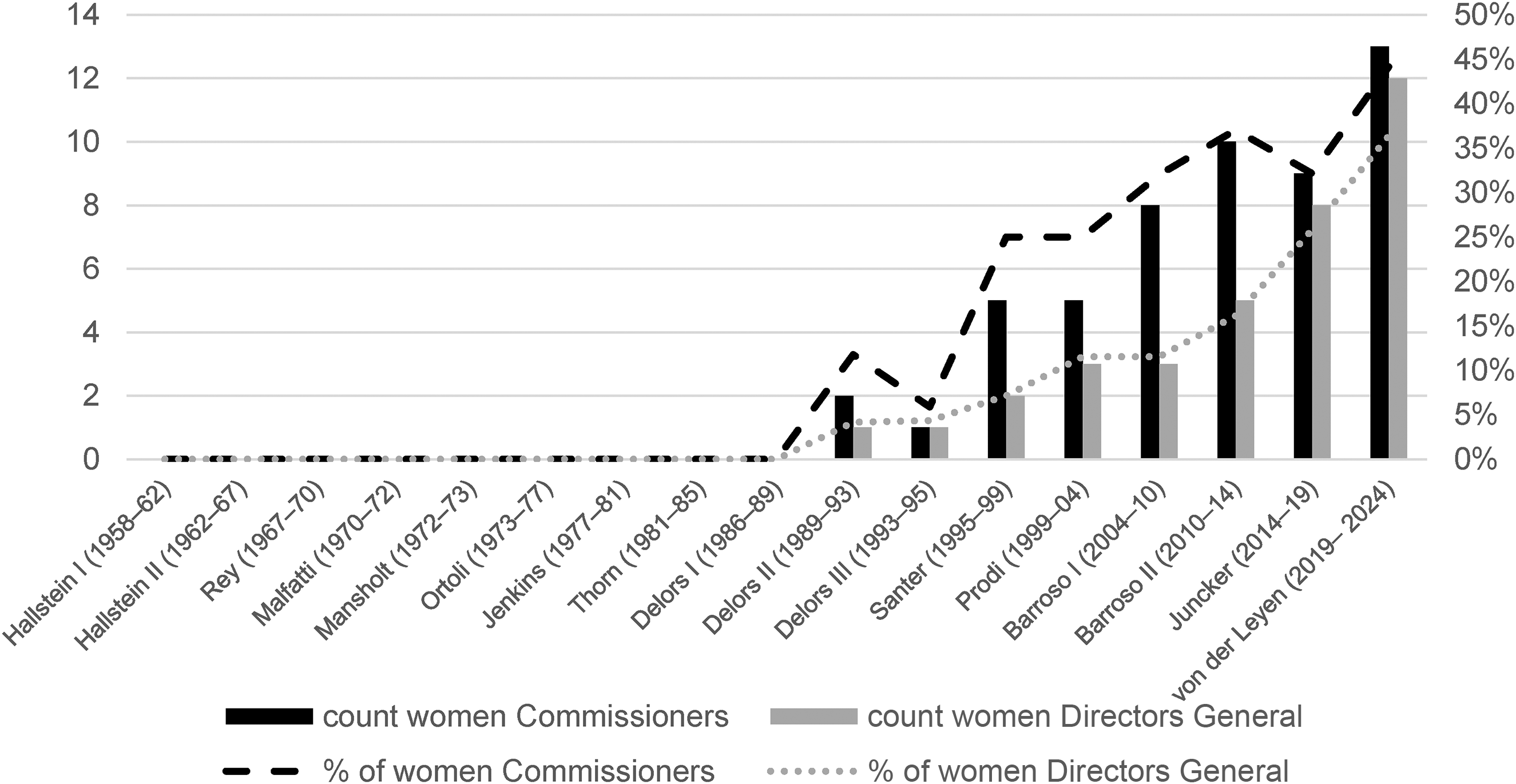
Percentage of women Commissioners and Directors General. Notes: The number of terms served by women: 53 as Commissioners and 35 as Directors General. Includes double entries for women who served in more than one commission. Source: Updated from Hartlapp and Blome (2022: 62).
This article addresses these questions through a systematic mapping and comparison of the routes taken by men and women to the top offices in the European Commission. It aims to fill an important gap in the literature in two ways: by examining the individual traits and characteristics of top officeholders, their experience before and after joining the Commission, and the impact of formal rules, informal norms, and processes in their selection, and by investigating their career paths as a succession of career stages. Thus we address the four questions posed in the introduction to the special issue (Frech, 2025); that is, where we find evidence of female disadvantage, we seek to identify what they are, whether they arise from individual choices or organizational rules, structures or norms (who?), in which career phase they arise (when?), and the processes at work (how?).
The Commission is an important subject for such an analysis. Occupying a central position in the European Union (EU) system, the Commission has a high political profile and far-reaching influence. It has also sought to promote gender equality within the Union and internationally, and since the mid-1990s, to reduce vertical segregation within its ranks. Efforts have been directed both at political level, where Commission Presidents have urged national capitals to include more women when they forward their nominees for the college, and toward the administration, where through successive gender action programs, it has attempted to increase the number of women serving as Directors General (Hartlapp and Blome, 2022; Hartlapp et al., 2021). More broadly, while scholars have focused on gender and parliaments, the career paths and under-representation of women in executive institutions remain under-researched (but see e.g. Annesley et al., 2019; Paxton et al., 2010; Sabharwal, 2015).
The article utilizes a two-step approach to examine routes to the top. The first step investigates the traits and experience of all Commissioners and Directors General (2004–2019) to determine if there are distinct pathways leading to these positions. The second considers whether men and women are equally represented on each pathway. This approach offers two advantages over the existing literature. There is no presumption that men and women take dissimilar routes or that women are disadvantaged. Rather, it treats as empirical questions any differences in the levels of success between men and women, and the disadvantages that (if any) women face. Furthermore, institution-specific characteristics, such as rules, processes, and organizational culture, are factored into the research design. Whether, for example, the institution recruits only the highly educated or specialists rather than generalists, is taken into account by examining the career pathways of all top officeholders, whether they are men or women.
Drawing on a comprehensive dataset that includes information on background, experience, and careers across three Commission Presidencies from Barroso I (2004–2009) to Juncker (2014–2019), the article investigates the career paths of the institution's political leadership and its top administrators. As well as providing a holistic view of how gender-equal or not the Commission as an institution has become, the scope of the analysis makes it possible to address theoretical expectations concerning both female politicians and bureaucrats. Although there is significant common ground between the literatures on politics and administration, there are also specific arguments that relate to the differing demands and career requirements of each.
The analysis of the career paths to the posts of Commissioner and Director General shows that there are three distinct routes to each position, differentiated by educational and professional backgrounds, and by pre-Commission and in-Commission experience. Moreover, not only are there more men than women in all pathways, but the preponderance of men is especially marked in one of the Commissioner pathways and two of the Directors General pathways. In other words, men significantly outnumber women on no fewer than half of the routes to top positions. Furthermore, the career pathways to political and administrative leadership positions are both gendered, but they are gendered in different ways for reasons.
The contribution of the article to existing scholarship on gender, careers, and the EU institutions is fourfold. Empirically, the article advances understanding of the career dynamics of Commissioners and Directors General, and how they are gendered. Methodologically, our examination demonstrates the benefits of examining the career paths taken by all top officeholders in an institution, before comparing the experiences of male and female officeholders. By advancing understanding of both the conditions that enable a successful career and the barriers that can impede career development, it highlights in practical terms, how a more gender-equal Commission is possible. Theoretically, the study shows that, in the Commission's case at least, the gender narratives in the comparativist literature only partially apply, suggesting that greater attention needs to be directed toward specifying the conditions under which the mechanisms identified in the existing scholarship come into operation and whether they apply in an international context.
Gender and careers in the European Commission and beyond
Although the comparativist literature on gender and scholarship on gender in the European Commission have considerably advanced our understanding, each leaves important areas unexplored.
Scholars in the comparativist literature tend to fall into two schools. The first highlights individual factors, such as personal traits and backgrounds, contending that individual capital (party experience, connections, and educational qualification) drives careers. According to this school, women with comparable qualifications or experience to men generally wait longer before they are appointed or promoted, and typically need greater experience or better educational credentials than their male counterparts (Verge and Astudillo, 2019).
Another individual factor is partisan orientation. Ideology influences how group orientation is approached, with left parties offering greater support to women (Caul, 1999; though see Childs and Webb, 2012; Wäckerle, 2020). Partisan positions also matter when they lead to networking opportunities and the chance to accumulate political capital. Men have been “more likely to enjoy fast-tracked political careers” (Murray, 2010: 445).
A second school emphasizes the importance of institutional factors. According to this school, women are treated differently in selection, the allocation of tasks, and promotion, which shapes experience and opens or closes pathways to top positions. Informal norms, as well as formal rules on recruitment and promotion, define the pathway to the top. Portfolios can be gendered, with responsibility for “male” policy areas (economic affairs, defense, employment, equipment, and budget) reserved for men, while health, social welfare, education, family, culture, and consumer affairs, are considered “female” (see also Krook and O’Brien, 2012: 842).
Specialization is also a factor. In specialist systems, such as the Netherlands, Finland, France, and the United States, ministers are recruited because of their expertise. In generalist systems—the UK and other Westminster-style systems—mobility between portfolios is common, and fewer women tend to occupy executive office (Davis, 1997: 38–65; Siaroff, 2000: 199).
Partisan ideology is not only an individual trait but matters where parties and party politics structure career opportunities. Leftist governments are more likely to nominate women (Erzeel and Celis, 2016; Däubler et al., 2025), implement internal quotas (Krook, 2010), and choose female candidates, deputies (Davidson-Schmich, 2014), and ministers (Claveria, 2014). The partisan pattern holds in the European Parliament (EP) where party positions interact with national interests (Sundström and Stockemer, 2022). However, conservative parties more often promote women to senior positions (Santana and Aguilar, 2018).
The organizational and institutional context also embeds wider societal norms. Responsibilities associated with management can create biases against women managers (Eagly and Karau, 2002), especially when effective leadership is linked to male characteristics. More general cultural factors affect female representation when they influence (political) institutions (Inglehart and Norris, 2003: 140–141). More women are present in the executive in well-established democracies with longer trajectories of femocratic cultural factors such as egalitarian role models (Tremblay, 2007: 544) and civil liberties (Paxton et al., 2010). Yet, even here “politics is still very largely viewed as a ‘man's world’” (Jalalzai and Krook, 2010: 19).
Although it highlights important reasons for the under-representation of women, the comparativist literature tends to rely on analysis of a single career point, such as candidate selection, rather than how careers develop over several phases—the starting point of this special issue. The separation into two schools increases the reluctance to embrace both individual and organizational factors in modeling how career trajectories are shaped. Moreover, the domestic focus of the comparativist literature leaves open the possibility that the mechanisms or effects that operate at the national level do not apply in the same way in an international context (see Holmes et al., 2019).
For example, in an international environment, education abroad or foreign policy expertise may count as important individual capital. Similarly, for a mission-driven or technocratic organization, which is often the case for international organizations, the subject rather than the higher credentials may be more important. On the organizational side, portfolios may be gendered differently in an international body, either because international institutions are more distant from prevailing societal norms or because certain responsibilities are considered more or less powerful. In the case of the Commission, the perception of a male and female portfolio could be linked to an EU-specific division of competence and powerful portfolios (Hartlapp and Blome, 2022: 59). At the limit, the co-existence of multiple national cultures could work to dilute or redefine the influence of traditional gender stereotypes. A further dimension is the role played by member states in the appointment of top officeholders, since their decisions may also be gendered.
Like the comparativist literature, scholarship on the European Commission also offers important insights, but gender and careers are often examined separately. Scholars focusing on the first have investigated gendering and gendered practices concerning the Commission as an institution (Hartlapp et al., 2021), as well as leadership and leadership performance (Müller and Tömmel, 2022), gender mainstreaming (Hafner-Burton and Pollack, 2009), and antidiscrimination (e.g. Kantola, 2010). They have considered how women have organized and exerted influence through “velvet triangles” (Jacquot, 2015; Woodward, 2004), and the role of key women Commissioner and administrators (Müller and Tömmel, 2022). Gender has featured in some studies of personnel and administration within the institution (Ban, 2013; Kassim et al., 2013; Spence and Stevens, 2006). However, scholars investigating gender in the Commission have not generally examined career paths.
Meanwhile, scholarship on the careers of top officeholders in the Commission does not always highlight gender. Work on Commissioners, for example, has tended to focus on their education, previous occupation, and party affiliation (Spence and Edwards, 2006). In regard to Directors General, the main scholarly question has been the extent to which careers are “European” rather than national (Eymeri-Dozans and Georgakakis, 2008; Georgakakis and Lasalle, 2008; Page, 1997). With few exceptions (Hartlapp and Blome, 2022; Kassim et al., 2013), scholars of careers in the Commission rarely address gender.
Top offices in the European Commission
The Commission is a hybrid political and administrative body, organized into two levels: the College, a collective body that constitutes the political leadership of the institution, and the permanent administration or “services,” organized into departments or Directorates-General (DGs), each with a three-level management hierarchy of Director General, Director, and Head of Unit. Before mapping the routes of officeholders to these positions, it is important to outline their respective duties and method of appointment.
The selection process for Commissioners
The College, composed since 2004 of one Commissioner from each member state and headed by the President of the Commission, embodies the Commission's mission to transcend narrow national perspectives by taking decisions collectively in the general interest of the EU. Commissioners represent the public face of the institution to other EU bodies, governments, third countries, and other actors. The role of Commissioners is essentially political, though not formally partisan. The cabinets—the private offices that advise, assist, and support each Commissioner also carry out “political work” (Mérand, 2021). Cabinet members are selected by the Commissioner, subject to rules requiring multinational composition and the inclusion of a certain number of Commission official.
The procedure by which Commissioners are appointed has evolved significantly since Maastricht (Kassim, 2021). The Commission President is nominated before, and independently of, other members of the Commission by the European Council. The Lisbon Treaty, which came into effect in 2009, calls on the European Council to “take into account” the results of the elections to the EP. Commissioners are formally selected by the incoming Commission President, who also decides on the allocation of portfolios (Kassim et al., 2013; Hartlapp et al., 2021), but there is an important limitation: the Commission President is a “constrained selector” (Scherpereel, 2021: 1) since he or she can only select Commissioners from the nominees put forward by each national capital. Although since Romano Prodi (MacRae, 2012: 310), candidate Commission Presidents have publicly requested that member governments include more women, the reluctance to do so on the part of national capitals has perpetuated a gender imbalance (Kassim, 2021).
Once chosen by the President, candidate Commissioners undergo parliamentary hearings before the EP. Members of European Parliament (MEPs) can and do reject candidates if they are not persuaded of their suitability or for political reasons. Only after this the EP votes to approve the incoming College or not.
Since national governments have a key role in the process, how they choose their nominees and whether their choice is gendered is of key relevance. Individual factors, such as education, partisan affiliation, or prior experience in national politics, are potentially significant. The inclination to nominate women is also likely to be influenced by prevalent cultural norms in each member state, which may also reflect or be reflected in national gender regimes—the extent to which women are present in political office, public sector employment, or active in the labor market. By contrast, the distribution of responsibilities is in the hands of the Commission President. The extent to which women appointed to the College are allocated “female” or “male” portfolios by the candidate Commission President, or whether a different form of gendering is in evidence in the Commission, is also important.
The selection of Directors General
Although their work also has a political dimension, Directors General, including the Secretary General—the Commission's top official—are senior civil servants. They provide policy advice to the Commissioner, they oversee the development of policy initiatives, policy management, and implementation, and they organize and manage a department.
The Commission administration was established as a meritocratic civil service, where the ambition was that laureates from a competitive entrance exam—the “concours”—would join the services and work their way up the hierarchy throughout a career (Kassim et al., 2024). Although the pure career model was compromized historically (Kassim, 2018), appointments to senior management positions are internal decisions, made primarily based on technical and administrative expertise.
An important feature of the Commission administration is that an overwhelming majority of its staff—no fewer than 97% (Connolly and Kassim, 2019)—have worked somewhere else for 5 years or more before joining. Some senior managers are appointed to the Commission in mid-career, so do not make their way up through the ranks from entry-level. Others are recruited externally to senior management roles, either as part of the recruitment that accompanies enlargement ensuring that accession states are represented across the administrative hierarchy or to “open” positions.
Mapping the career pathways of Directors General makes it possible to determine which of these routes have been taken, and to identify their characteristics and experience. Since the Commission has sought to improve gender balance at senior levels through gender action plans and other measures (Hartlapp et al., 2021), comparing career pathways makes it possible to determine whether it is as easy for women to advance their careers as men and whether there is evidence that women are disadvantaged.
Empirical patterns in career pathways
The empirical analysis is based on detailed data on the backgrounds and organizational experience of the entire population of Commissioners and Directors General over 15 years.
Data
The Position Formation in the EU Commission (PEU) database, which includes information on persons and positions in the Commission (1957–2021) (Hartlapp, 2021), has been supplemented by detailed career data from publicly available sources such the CVs on personal and EU institution websites, which includes information on the educational background (level, discipline, and international orientation) and professional experience (sector, mandates, and portfolio). The unit of analysis is the positions held by Commissioners and Directors General.
The rationale for focusing on the last three full Commissions is that the number of female Commissioners only approached levels of significance in the first Barroso Commission—9 of 27 (see Figure 1). The dataset comprises 114 Commissioner and 135 Directors General positions.
For each individual, the key career data include age or cohort, educational background, subject of highest qualification, prior professional experience, mobility within the Commission and cabinet membership. Features relating to personal background and pre-Commission political careers are stable for an individual, while those that concern the career path inside the Commission change with each new position inside the organisation. Therefore, Commissioners who have served in different Commissions or Directors General who have led more than one Directorate- General are included in the data twice or more. There is a total of 14 active variables with 36 (Commissioners) and 41 (Directors General) modalities.
The analysis investigates the most important career paths to administrative and political top positions to identify what is typical for the Commission against expectations from the comparativist literature on professional paths and gender representation. To avoid the possibility that the clusters could be defined by gender rather than by the career paths taken, gender and nationality were excluded from the data used to identify the number and the composition. Once the career paths have been identified, it is then possible to look at their gender composition and, where women are under-represented to address the “what?”, “who?”, “when?”, and “how?” questions outlined above.
Analysis
Multiple Correspondence Analysis (MCA), a method to describe large qualitative datasets, was chosen for the analysis of data that covers a small but exhaustive population with a limited number of women. Other methods, such as a logit regression, would not be sufficiently robust and would require knowledge or priors on the career pathways. In the absence of evidence on common career pathways, MCA makes it possible to identify and explore commonalities or associations among variables’ modalities—in this case, career information—and the main polarizations among statistical individuals that result for a population of the size of Commissioners and Directors General. The technique is a form of factor analysis for qualitative variables, which identifies groups or clusters that share characteristics. MCA gathers individuals sharing the same characteristics and opposing individuals with distinct features, creating clusters of statistical individuals from the population of Commissions and Directors General. Where clusters overlap, the identification of individuals with a particular cluster is based on a hierarchical clustering algorithm which groups statistical individuals that are more alike.
MCA, performed with the FactoMinerR and missMDA packages, is applied to the two datasets. The active variables are either standard descriptors of individual-level career properties, such as educational attainment, or characteristics that are particularly important for career paths in the Commission, such as international orientation or stints in cabinets (see the Supplemental Appendix for a list and further discussion). The origin of the figure describes a (hypothetical) average Commissioner or Director General. Features that are widely held by individuals are situated closer to the origin.
MCA generates “axes” that are linear combinations of all variables’ modalities in our initial dataset—“meta-variables” in short—as interpreted through the analysis of modalities contributions. In the analysis, only the first two axes that contribute most to the explanation of similarities and differences in the dataset are retained. MCA also generates an “individual cloud”, which complements the axis-based analysis, and gives a better sense of “who is in this social space”. A hierarchical clustering algorithm is then applied to gather statistical individuals that are more alike. Researcher judgement is used to identify the number of clusters among those proposed. Here, clusters are groups of individuals sharing a similar pathway to leadership positions in the European Commission.
The analysis shows, first, that there are three main career pathways each for Commissioners and for Directors General and, second, that the routes are gendered. Men dominate, that is, they account for more than 50%, in all six career pathways both administrative and political. Among Commissioners, women account for 30% over the entire period. One path overwhelming favors men (86%), while in the other two women are present in the same proportion as their overall presence among Commissioners (32% and 33%). In the case of Directors General, male advantage over the whole period is even more substantial: they account for 81%. Two administrative pathways are overwhelmingly dominated by men (91% and 87%). On the remaining pathway—the most favorable in terms of female representation—women account for just under a third (31%).
Commissioners
Table 1 shows the background descriptives for the entire population of Commissioners from 2004 to 2019. The average age on entering the Commission is 52. They are highly educated—57% have a Master's degree and 37% have a PhD—and just over a third (35%) have a background in economics. A similar proportion has a background in law (see Thomsen and King, 2020 for a comparison with pathways to political office in the United States). In terms of pre-institutional experience, just over two-thirds had worked in the private sector. 61% had served in national administration for an average of 11 years and 28% had worked in an EU-related portfolio while in national administration. A large majority had held political office, in parliament or government, and 21% in the EP.
The education and professional backgrounds of Commissioners, 2004–2019.
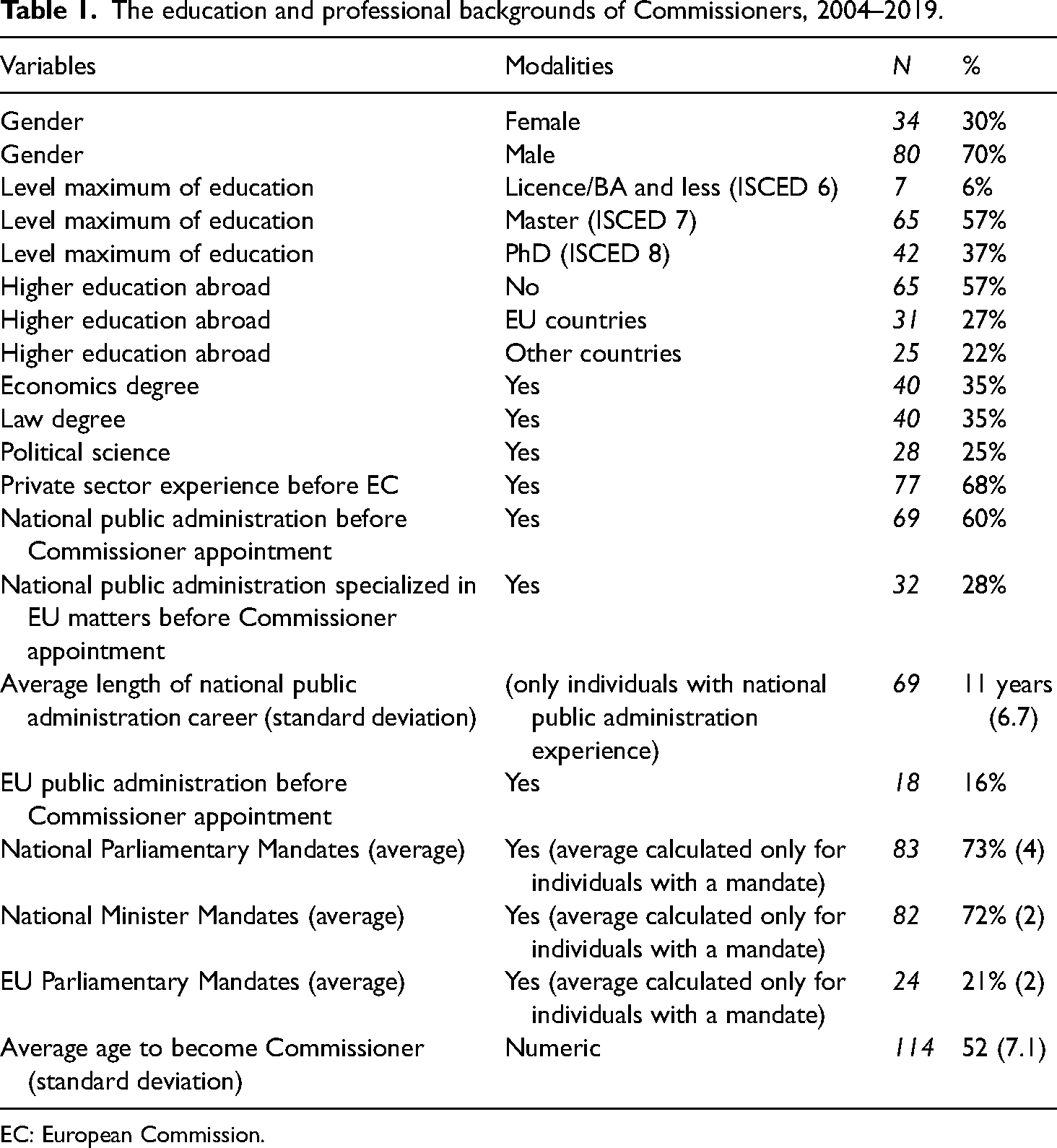
EC: European Commission.
Figure 2 shows the results of the MCA analysis of career paths for Commissioners. The horizontal axis shows more political versus more administrative pathways. Political career paths typically feature a postgraduate qualification in law, as well as partisan positions, with multiple mandates in national parliament and stints in government. Individuals enter the Commission as Commissioners and have little or no experience of administration. By contrast, the administrative route includes an economics degree and a PhD. The pre-institutional career phase is longer and spent mainly in national administration, while partisan affiliation is short if it exists at all. Inside the Commission, these individuals have held office in the social and environmental policy fields or have moved between different areas. The vertical axis shows private and public career profiles. Public sector career paths—shown toward the top of the figure—typically include a postgraduate qualification in law, are longer and include experience in EU and foreign affairs. Private sector experience is more prominent toward the bottom and is often combined with training in economics. Consequentially, the upper left quadrant features political and public sector careers more likely to have qualifications in law, the upper right quadrant are public sector and administrative careers more likely to be highly qualified (PhD in Economics), the lower right quadrant are administrative careers with private sector experience and more likely to be qualified in economics, and the lower left quadrant are political careers with private sector experience (Masters in law).
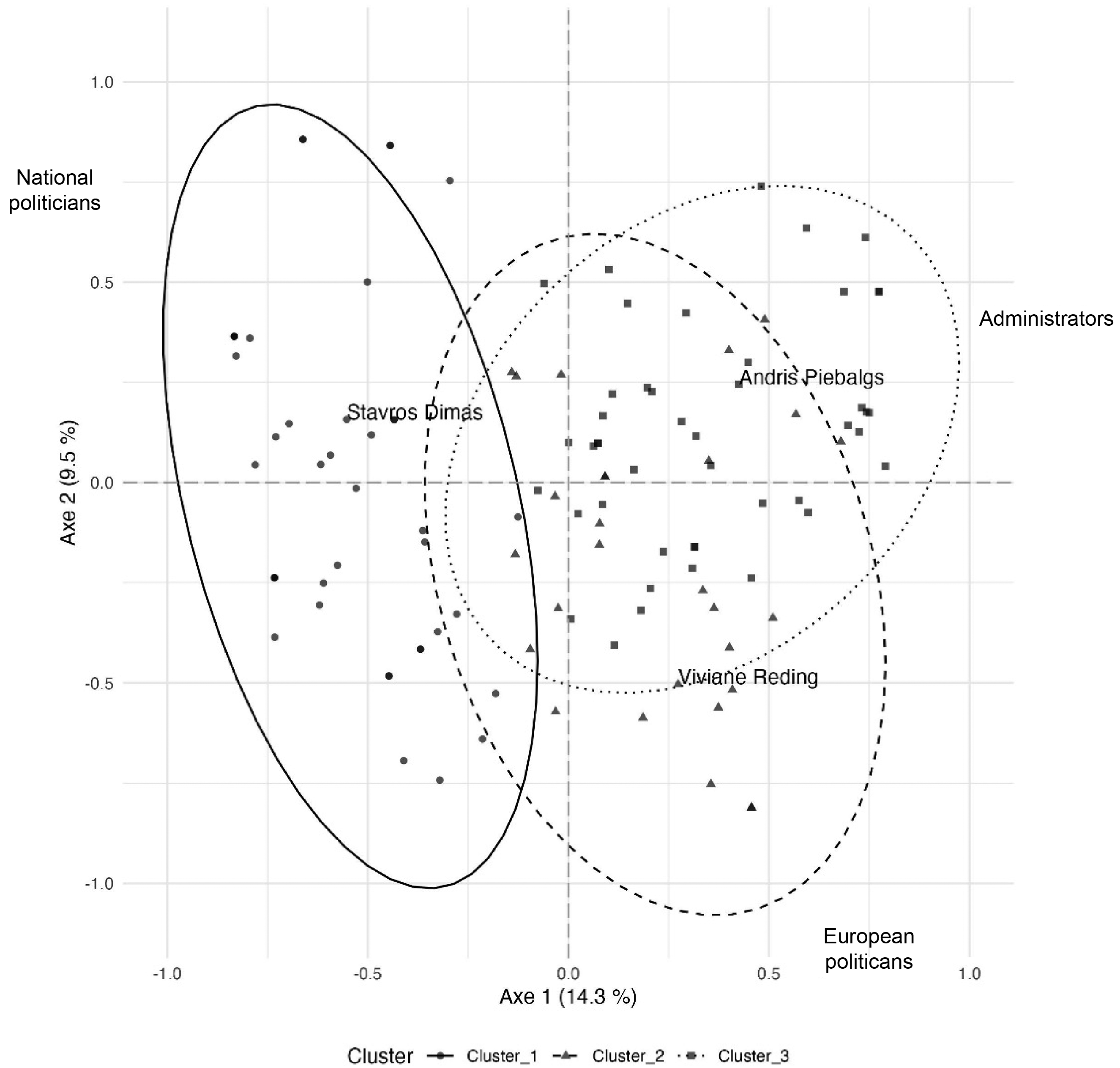
Clusters of commissioners 2014–2019, including statistical paragons (Multiple Correspondence Analysis, MCA).
Three clusters, each designating a career path, can be distinguished in Figure 2. The name of a Commissioner acts as a statistical paragon that best exhibits the characteristics of the cluster (see the Supplemental Appendix 3 for details).
Cluster 1, “ Cluster 2 includes “ Cluster 3 are “
In short, women are under-represented in all three Commissioner clusters, substantially so in the first, and to a significant (though lesser) extent in the second and third.
Contrary to the expectations from the individual characteristics school in the comparativist literature, the results do not suggest that women are older when they are appointed to the college or more experienced than their male counterparts. They are least well represented among “National politicians” where the average age at appointment to Commissioner was oldest. However, women are most strongly present in the two clusters with the highest levels of educational attainment—“European politicians” and “Administrators.” Since 12 out of 20 female Commissioners were nominated by left parties (for their first term), there is some support for the claim of the institutional school that left parties are more likely to nominate women. Further analysis is needed to control for nominations by left governments and coalition governments. Men tended to hold the most powerful trans-sectoral or general portfolios, with the exception of competition, and the most important sectoral responsibilities. Fisheries were the only sectoral portfolio where there was gender balance.
Directors General
Table 2 indicates that, over the period studied, women account for 19% of Directors General. Directors General (like Commissioners) are highly educated. Almost half (47%) have a background in economics, while 1 in 10 studied at the College of Europe in Bruges. Three quarters have worked in national administration, though more than a third have private sector experience (36%). Many started their career in the Commission at an early age—33, which is near to the average age for staff joining the Commission—and the average age at which they were appointed to the position of Director General is 54. Just under 60% had served in a Commissioner cabinet, thereby gaining experience of “political work” (Mérand, 2021).
Educational and professional backgrounds of Directors General, 2004–2019.
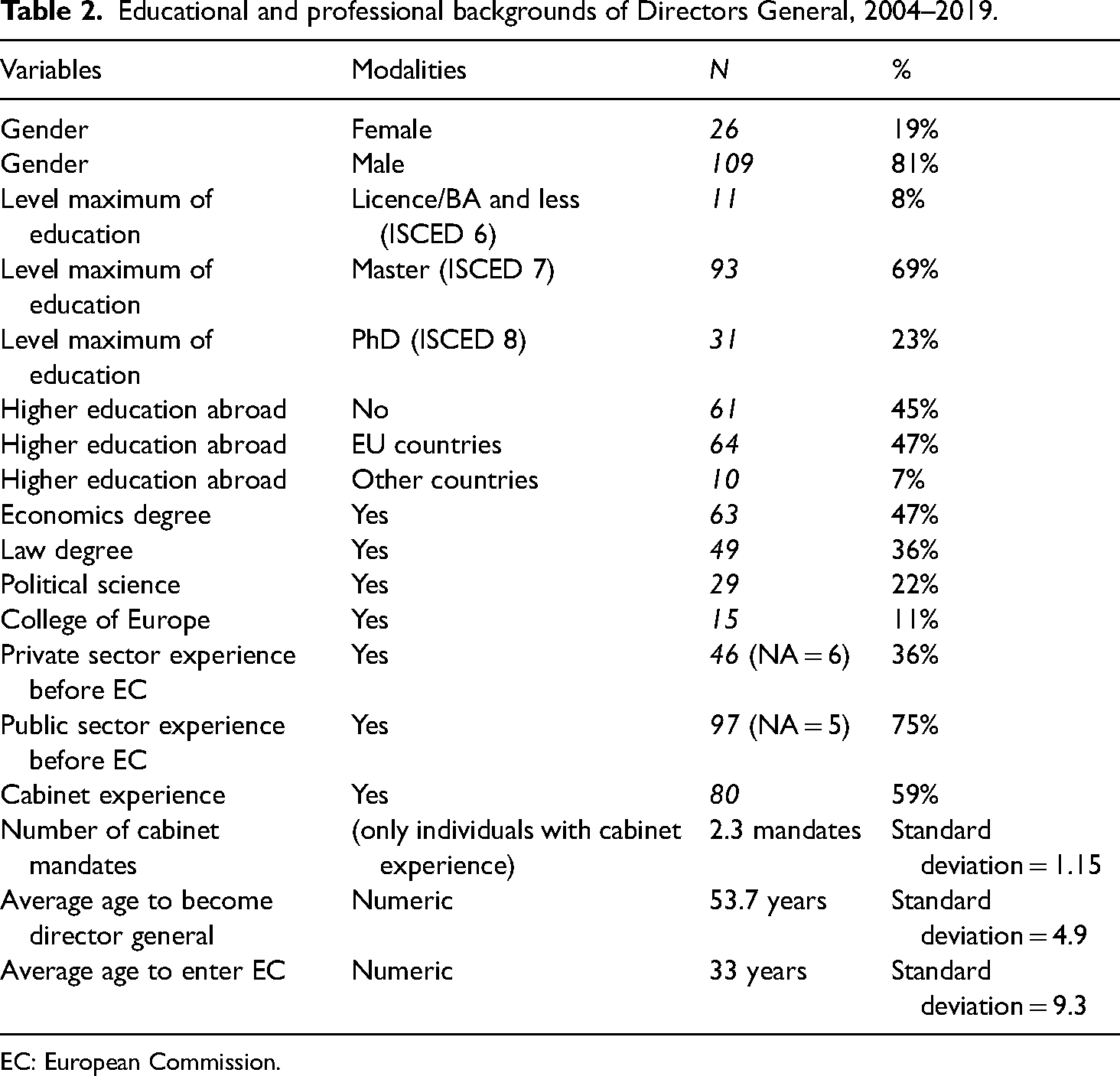
EC: European Commission.
Figure 3 shows the characteristics of career paths for Directors General. To the left of the horizontal axis are individuals that entered the Commission from the national administration later and with a shorter career inside the Commission before their appointment. Cross-departmental mobility and cabinet experience are limited. Toward the right are long-term EU bureaucrats with shorter pre-Commission careers, greater experience of horizontal mobility, which includes more (traditionally understood) “female” policy areas, and service in cabinets. The vertical axis contrasts two routes to the top. They also show the difference between two distinct generations. While many of those at the top have PhDs, and entered the Commission later in life, having worked typically in public administration, those toward the bottom hold Master's degrees, enter earlier, and have less pre-institutional experience. The Commission phase of their careers is longer and features some horizontal mobility. Thus, the upper left quadrant describes older and long careers in national administration, the upper right older and long careers in EU, the lower right quadrant younger and careers in EU, the lower left younger and careers in national administration.
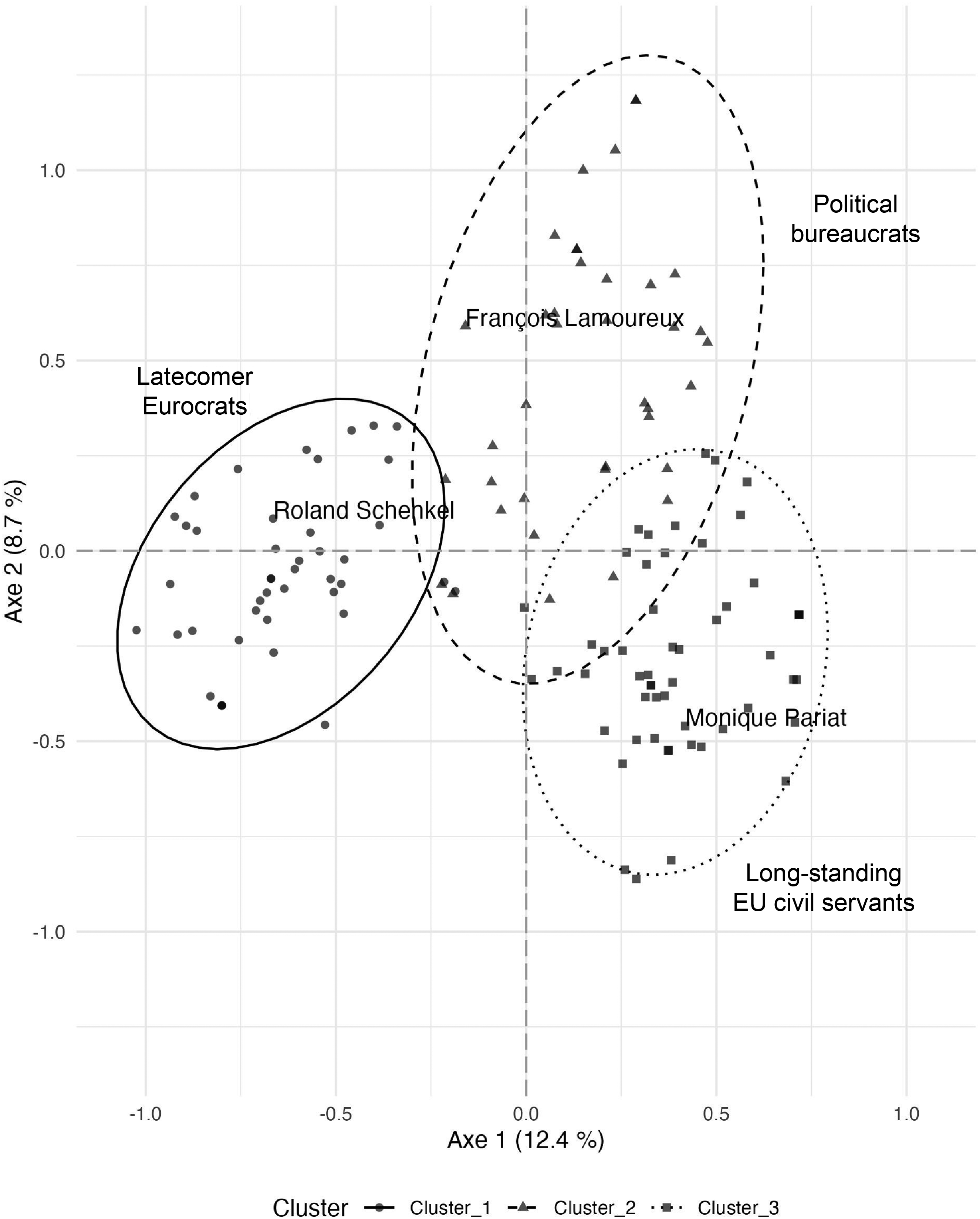
Clusters of directors general 2014–2019, including statistical paragons (Multiple Correspondence Analysis, MCA).
Three types of career paths can be identified in Figure 3.
Cluster 1 are “ Cluster 2, “ Cluster 3, “
Women are not only under-represented overall, but they are also outnumbered in all pathways and only have a significant presence in one. In the most female cluster, “Long-standing EU civil servants,” women served longer in the Commission than their male counterparts before becoming Director General, in line with the expectation of the individual characteristics school that women are older and more experienced when they reach leadership positions. More generally, across all 3 clusters, female Directors General are more mobile than their male counterparts: 2 DGs for women, 1.5 for men among “Latecomer Eurocrats”; 4 DGs for women, 3.4 for men among “political bureaucrats”; and 4.2 DGs for women, 3.3 for men among “Long-standing EU civil servants.” International education is also an important marker among women who became Directors General. Since it mirrors the findings for Commissioners, this suggests that internationalization is a marker of female career paths across political and administrative careers, and that women are differently credentialized by their international education.
Since the share of women Directors General is lower than for Commissioners, the working culture in the Commission appears to constitute a particular challenge. The expectation that women are more likely to lead in female portfolios appears to be supported by the data. Of the 19 female Directors General all but four—Sabine Weyand (DG at TRADE), Nadia Calvino (DG BUDG), Helga Schmid (EEAS), and Ditte Juul Jørgensen (ENER)—became Directors General for the first time in a “female” portfolio: JUST, SANTE, and internal services.
Finally, “Long-standing EU civil servants”—the most female cluster—is characterized by a high percentage of individuals with cabinet experience. Like the “political bureaucrats” cluster, which is substantially more male, the share of individuals with cabinet experience is much greater than in the Commission as a whole for the period in question. Notably, 62% of Directors General in the Juncker Commission (N = 31) had worked in cabinet, while only 8% of other individuals with equivalent (or longer) experience of working in the Commission had done so (author's calculation using data collected as part of the 2018 survey of Commission staff Where now? Where next?.
Discussion
It is significant that in a powerful organization like the Commission, there is mixed support for some of the classic narratives on gender and careers. This holds for the theorized effects of individual level factors as well as for organizational and institutional factors on career paths.
For Commissioners, there is indicative evidence that women are more likely to be nominated by governments on the left. While three countries (Bulgaria, Denmark, and Sweden) have only had female Commissioners over the 3 mandates, no fewer than 11 member states—Croatia (joined the EU in 2013), Estonia, Finland, France, Germany, Hungary, Latvia, Malta, and Portugal, Slovakia and Spain—have had only male Commissioners. The link between left ideology and support for female careers theorized for national parties as selectors in the representation chain (e.g. Caul, 1999; Claveria, 2014; Davidson-Schmich, 2014) receives tentative support from our analysis in the case of the Commission. Also, in line with the expectations of the comparativist literature, career pathways for women are more specialized. Female Commissioners are more likely to have held political positions in EU and/or foreign policy. If not over-credentialized, they are differently credentialized. Also, there is strong evidence of differences between career paths relating to pre-institutional experience with evidence that the route via politics rather than via the private sector or national administration, is significantly less available to women than to men. On average, the political experience of female Commissioners is shorter than for men: just over 15 years as opposed to 19 years.
Turning to Directors General, women are far less likely to have advanced on career paths characterized by long pre-institutional service in public administrations, or very high educational attainment. More typically, these pathways include study abroad, which reflects either the self-selection of internationally oriented individuals or that studying abroad, whether inside or outside Europe, serves as an important signal for an international organization. It also includes private sector experience and long service in the Commission.
On organizational and institutional level factors, the findings present a more nuanced picture. There is some evidence of gendering of portfolio responsibilities (for the EP, see Dodeigne et al., 2025). The first senior management position for female Directors General (15 of 19) tends to be to a “female” portfolio in the traditional sense. However, while in the domestic context, holding a female portfolio can have a scarring effect, limiting women to less important and influential policy responsibilities, this is not the case in the Commission. The Commission's mobility policy makes it possible to move into “male” portfolios, since senior managers are encouraged to change department every 5 to 7 years.
Findings are also nuanced in relation to specialization. Female Directors General tends to have been more mobile than their male colleagues, and perhaps less specialized in terms of portfolio content. While work culture is likely to be more important for Directors General, due to the time that they serve in the institution, the environment does seem to favor generalists and, unlike at the national level, is not an obstacle to female advancement. However, although cabinet experience is a significant feature of the careers of all Directors General, only 50% of women who have made it to the top have served in a cabinet compared to 61% of men. The successive efforts of Commission Presidents to improve the gender balance in the private offices of Commissioners since Prodi have been highly significant.
In sum, careers are gendered both for Commissioners and for Directors General, but not necessarily in line with gender narratives in the comparativist literature. For individual level factors, there is little evidence that women need to be better qualified than their male counterparts, and other aspects of educational experience, especially study abroad, appear to matter more. In terms of organizational and institutional explanations, and also, contrary to the observation made in the comparativist literature, the career pathways of women in the Commission are not specialized in the ways that are often observed in national bureaucracies. Women have served longer in the Commission and their first senior management position is more likely to be a female portfolio. However, they are not bound to careers in female portfolios and are more mobile across portfolios than their male counterparts in the Commission or than senior role holders in national bureaucracies with more specialized career paths. At the same time, the career pathways taken by women tend to be less politicized than by men, with shorter periods in partisan positions at the national level (Commissioners) and fewer stints in cabinets (Directors General).
Conclusion
Although the number of women occupying leadership positions in the Commission has increased substantially, exploration of the career paths taken by men and women reveals the extent to which routes to the top remain gendered. This is all the more relevant as illustrated by the nominations for Von Der Leyen II. Trends observable in simple head counts can be easily reversed. We have therefore engaged more broadly with the factors that drive gendered career paths. Drawing on a dataset of all the individuals appointed over the course of three Commission mandates, this article shows that there are distinct pathways to the positions of Commissioner and Director General, and that women are under-represented on all.
In relation to the questions outlined by Frech (2025), the analysis shows that women do confront significant challenges. In the case of Commissioners, the two career pathways on which women are most present have the highest levels of educational attainment, while one—the “European politics” routes—includes private sector experience and national parliamentary experience, and in the other—the “Administrator” route—the public sector features strongly. Therefore, individual educational and professional choices partly answer the “who?” and the “what?” while “pre-institutional” experience provides an answer to “when?”. National governments are also part of the “who?” and the “how?” on account of their role in the selection process. The national pipeline has a strong influence in shaping who serves in national parliaments and government office in the pre-Commission phase, domestic opportunity structures therefore need also to be investigated to provide a full answer to the “who?” and the “how?” of the challenges faced by women.
For Directors General, the challenge confronting women is even more formidable, since a female presence is only significant on one of the three pathways—“long-standing EU civil servants.” The routes via national administration—“latecomer Eurocrat”—or “political bureaucrat,” which combines a PhD with higher education abroad and cabinet service, are taken by far more men than women. In these two cases, the “who?” and the “what?” challenge comes from individual choices over education and organizationally defined opportunities for entry (the “how?”). The “when?” in turn is influenced by the pre-institutional career phase for “latecomer Eurocrats” and by the core institutional phase for “political bureaucrats.”
The article has contributed to the existing literature on gender and careers in four ways. Empirically, it has provided the first systematic mapping of career pathways to leadership positions in the Commission. Methodologically, it has introduced an approach to examining career pathways that can be used to explore whether and how women can advance their careers as easily as men without presuming female disadvantage. Theoretically, our results highlight that organizational features and appointment procedures specific to the EU interact with individual-level characteristics. Female career paths in the Commission are distinct from national-level career pathways since they are shaped by the EU opportunity structure and more specifically by those in the Commission. This is most clearly visible for education where the subject and location (international) matter more than the level of education alone. But it is also notable that politicization and specialization matter less in an organizational structure where gendered portfolios and mobility play out differently. These findings are significant given the dearth of theorizing in regard to EU career paths. It also underlines how the EU is a distinct political system (Hix, 2011) with its own (European) political class (Dodeigne et al., 2024). Thus, although understanding (female) career paths in the EU can draw to some extent from theorizing in comparative politics, the specificity of the EU context must also be acknowledged (Fortin-Rittberger, 2025). Practically contribution is in showing where and what action needs to be taken if gender parity is to be achieved. Importantly, national capitals need to demonstrate their commitment to gender balance. Nominations for Von Der Leyen II show how changes in the political environment in member states can lead to reverses. With Directors General, since the main route for women is through long service in the Commission, the institution needs to take measures to improve the internal pipeline or actively seek to broaden the pool from which it recruits senior managers.
The above discussion suggests avenues for future research. How gender interacts with nationality, especially given the importance of national politics and administration as a pipeline, need to be further explored. Also, although individual choices are an important factor, the extent to which structures of opportunity, especially relating to education and training, or horizonal mobility within the Commission, are gender neutral requires further investigation. Moreover, while the above analysis has addressed a single institution, similar investigations could be undertaken of the career pathways in other EU bodies and institutions. In particular, it would be interesting to examine the extent to which internationalized education and specialization in EU or foreign affairs that matter for successful women in the Commission also apply in the case of senior officeholders elsewhere in the EU system, and indeed in other administrations—international, national, and subnational. Finally, this article has only considered developments up to the first Von Der Leyen Commission. Analysis of ongoing developments will reveal whether, beyond the headline percentages that institutions employ as indicators, career paths have really changed, and what action has been taken to address the challenges described above.
Supplemental Material
sj-docx-1-eup-10.1177_14651165241300650 - Supplemental material for Still struggling to reach the top? Women officeholders and gendered career pathways in the European commission
Supplemental material, sj-docx-1-eup-10.1177_14651165241300650 for Still struggling to reach the top? Women officeholders and gendered career pathways in the European commission by Pierre Alayrac, Sara Connolly, Miriam Hartlapp and Hussein Kassim in European Union Politics
Supplemental Material
sj-zip-2-eup-10.1177_14651165241300650 - Supplemental material for Still struggling to reach the top? Women officeholders and gendered career pathways in the European commission
Supplemental material, sj-zip-2-eup-10.1177_14651165241300650 for Still struggling to reach the top? Women officeholders and gendered career pathways in the European commission by Pierre Alayrac, Sara Connolly, Miriam Hartlapp and Hussein Kassim in European Union Politics
Footnotes
Declaration of conflicting interests
The authors declared no potential conflicts of interest with respect to the research, authorship, and/or publication of this article.
Funding
The authors received no financial support for the research, authorship, and/or publication of this article.

Supplemental material
Supplemental material for this article is available online.
References
Supplementary Material
Please find the following supplemental material available below.
For Open Access articles published under a Creative Commons License, all supplemental material carries the same license as the article it is associated with.
For non-Open Access articles published, all supplemental material carries a non-exclusive license, and permission requests for re-use of supplemental material or any part of supplemental material shall be sent directly to the copyright owner as specified in the copyright notice associated with the article.
