



Abstract
The European political arena, particularly the European Parliament, is considered a more favourable environment than the national political spheres for women. However, nearly half a century passed before a woman was appointed president of the European Commission. Women remain underrepresented in both the European Parliament and the Council. Against this backdrop, this special issue offers a comprehensive analysis of women's political careers in the European Union addressing barriers to gender equality and examining their influence on political representation. By bringing together distinguished scholars and new insights from two previously rather separate research areas—political careers in the European Union and gender representation studies—this issue sheds new light on the challenges women face. This introduction presents a multidimensional framework addressing who, what, when and how regarding key challenges women face as political leaders in the EU, such as legislated gender quotas, gendered norms, and societal stereotypes. The articles in this special issue reveal that women in European Union politics face challenges from individual and collective actors, with party gatekeeping and institutional structures playing critical roles. Gendered stereotypes and the multilevel nature of European Union politics significantly impact women's career trajectories, highlighting the need for reforms at both the European Union and national levels.
Gendered EUropean careers? Careers, challenges, and representation
The European political sphere has been known for decades to be relatively women-friendly. For several decades, women's representation in the European Parliament (EP) has been higher than in national parliaments in many countries (Kauppi, 1999). Furthermore, the steady increase in women commissioners to a level of approximately 30% is well above the average number of women in ministerial positions in national governments (Kantola, 2010). However, it took approximately 50 years for a woman to become the president of the Commission. Currently, women members of the EP (MEPs) remain clearly underrepresented in leadership positions in the EP (see Kopsch, 2024; Müller and Tömmel, 2022). This special issue raises the question of why the political representation of women in the European Union (EU) is still suboptimal. The assembled articles demonstrate how the descriptive and substantive representation of women in Europe can be improved. Answering this question is vital because representation may be crucial in addressing the democratic deficit of the EU (Hix, 2008), which has steadily gained power in recent decades.
To understand what prevents women from taking on leadership positions and responsibilities in the EU, the authors of this special issue analysed the gendered nature of political careers in the EU. The career perspective on gender in the EU is based on the concept of political careers as a combination of interconnected career phases. To understand the gendered nature of these political careers in the EU, the articles in this special issue identified the primary challenges faced by women politicians in specific career phases or at the transition between two phases, explaining how these challenges relate to the current, past, and future career phases. The articles collectively provide a comprehensive overview of the challenges in various EU institutions and career phases: pre-institutional, institutional, and post-institutional.
This special issue is unique in that it combines two previously separate fields of literature: research on political careers in the multilevel EU system and insight from gender and representation scholars who have analysed the EU. Moreover, this special issue offers a comprehensive understanding of women's political careers in the EU by consolidating studies that examine careers across EU institutions. Further, it provides analyses focusing on different career stages and the transitions between them. The contributions employ a broad variety of methods, ranging from interview research (Högenauer, 2025) and multiple correspondence analysis (Alayrac et al., 2025) to ‘before and after’ research designs (Hermansen, 2025) and multivariate statistical analyses (Dodeigne et al., 2025). However, all articles are empirical and perform their analyses based on primarily large, detailed datasets of EU politicians and their detailed careers, political success, or behaviour. With the broad variety of datasets used, the special issue also serves as a rich data source for future studies.
Despite their different institutional foci and analysed career phases, the articles in this special issue share a common goal: providing a comprehensive analysis of women's careers in the EU by identifying the challenges faced by women politicians. This framework paper builds on previous career research to conceptualise political careers in the EU. Furthermore, it draws from prior studies on gender and representation and is based on feminist institutionalist ideas (see Mackay et al., 2010) to develop a theoretical framework to analyse gendered careers. A multidimensional typology is proposed regarding the challenges that women encounter on their political career paths. These challenges can be rooted in individual or more collective factors, spanning from formal to informal aspects and affecting various career stages via diverse processes.
In summary, the theoretical framework asks who (agency) causes what (formality) type of challenge for women in politics, when (timing) in the career, and how (processes). The first dimension focuses on agency, identifying individual or collective agents causing the challenges, based on the premise that collective challenges may be more resistant to change. The second dimension examines the formality or type of challenge, ranging from formal institutional processes to informal barriers, positing that informal challenges may be more entrenched. The third dimension assesses when or the timing of challenges across career phases, including pre-institutional, institutional or post-institutional phases. The fourth theoretical dimension examines the processes by which the challenge in question disadvantages women.
This special issue scrutinises the intricate challenges in women's political careers in the EU, finding that challenges and actors are diverse and occur in every stage of a political career. For instance, formal types of challenges, such as those caused by legislated gender quotas (Hermansen, 2025) and electoral systems (Gouglas et al., 2025), shape candidate selection and substantive representation in the EU. However, the authors also identify informal challenges, such as the informal aspects of candidate selection based on gendered values and practices that could potentially affect women's career trajectories and representation (Daeubler et al., 2025). At the individual level, professional and educational choices can influence women's careers (e.g. Alayrac et al., 2025). Collective actors, such as political parties (Frech, 2025) and EU institutions (Alayrac et al., 2025), exert their influence on a larger scale.
The results presented in this special issue demonstrate that many of the most challenging hurdles for women in EU politics operate on a collective level, such as an institution or, more broadly, society (see also Erikson and Freidenvall, 2024). These challenges manifest at different career stages, with pre-institutional hurdles related to such factors as gendered educational choices (Alayrac et al., 2025), core institutional barriers (e.g. tied to a nongender-sensitive organisation of work; Dodeigne et al., 2025; Högenauer, 2025) and post-institutional challenges represented by electoral systems (Frech, 2025; Gouglas et al., 2025).
The special issue highlights how the multilevel structure of EU politics critically shapes women's political careers. Various domestic factors, such as a ‘national pipeline’ of candidates (Alayrac et al., 2025), candidate selection processes (Hermansen, 2025) and electoral systems at the national level (Gouglas et al., 2025), affect women's representation and career opportunities in the EU. This connection underscores the interdependence between the EU and national political arenas, revealing that, although the EU is relatively women-friendly, national-level barriers and fewer opportunities persist. The special issue identifies the need for reforms at both levels to address gender inequalities.
Amid these complexities, pervasive gender-related stereotypes and societal expectations (Daeubler et al., 2025; Högenauer, 2025) are at the root of many challenges, shaping the working environments and leadership norms women face across institutions. These informal, often subtle barriers are more difficult to identify and address than formal institutional barriers, making them particularly persistent. When these challenges stem from collective agents, such as societal norms or institutional structures, reform processes tend to be slower and more challenging to implement. Identifying the career stage at which specific obstacles arise for women politicians provides crucial information about potential influences on political representation. Thus, the proposed theoretical framework and special issue serve as a guide for future research and a tool for policymakers to design reforms that address these complex, multilevel challenges.
Prior research is summarised in both fields before conceptualising political careers, identifying challenges previously noted for women political leaders and politicians in the EU. The theoretical framework describes the political careers of women in terms of the challenges they face. Finally, the introduction describes how the articles in this special issue contribute to a better understanding of why and the degree to which political careers are gendered in the EU, summarising the intricate challenges in women's political careers in the EU.
The shoulders we stand on
This work is based on previous research on political careers and studies in the gender and politics field. The integration of these two perspectives provides a comprehensive understanding of the genderedness of political careers in the EU and the challenges faced by women political leaders and politicians.
As demonstrated in the following paragraphs, a substantial corpus of literature covers political careers and ambitions, both in general and in the context of federal states and the EU. However, although these studies clarify how careers (in multilevel systems) work and which types of careers exist, gender aspects have largely been neglected. As evidenced by the articles in this special issue, the prior experiences, challenges, and career opportunities of women diverge from those of men. These discrepancies are linked to the quality of democratic representation. Help for the missing gender focus in career research comes from gender and politics scholars, who have amassed considerable knowledge regarding the representation of women and the challenges they face in politics. However, much of the literature relates to national politics, and focuses on one career step or the effect of one institution (see description below). By combining experts and knowledge from both fields (career research and gender scholars), this special issue closes substantial gaps and provides a comprehensive overview of the political careers of women across EU institutions in different career stages.
Political careers in the European Union
Some of the first studies on political careers were conducted in the United States in the 1960s (Polsby, 1968; Schlesinger, 1966). Research in this area has immensely grown since then and comprises a myriad of studies, including comparative studies on many European countries and beyond (e.g. Best and Cotta, 2000; Gallagher and Marsh, 1988; Norris, 1997; Patzelt, 1999). Within the broad area of literature on political careers, many studies have analysed specific career steps, such as the (s)election of candidates to parliament (Gallagher and Marsh, 1988; Rahat and Hazan, 2001) or the experiences and appointment to specific offices, such as (prime) ministers (e.g. Davidsson and Baeck, 2009; Dogan, 1979; Kenig and Barnea, 2009). Furthermore, researchers have identified different types of political career paths in national political arenas (e.g. Ohmura et al., 2018) and for MEPs (e.g. Scarrow, 1997).
Concerning challenges, political career research has highlighted the importance of the party as a ‘primary career facilitator’ (Ohmura et al., 2018: 169) and gatekeeper (Fortin-Rittberger and Rittberger, 2015). Further determinants of political careers or important career steps include the institutional context (Borchert, 2011) and some more coincidental factors, such as electoral swings (Gouglas et al., 2018).
In recent decades, an increasing number of researchers have focused on political careers in multilevel or federal systems (e.g. Borchert, 2011; Edinger and Jahr, 2015; Fiers and Noppe, 2015; Stolz, 2003). Given their emphasis on a multilevel structure, this newly emerging subfield and its theories are pertinent to the study of women's political careers in the EP. Borchert (2011) presented a theoretical framework for the analysis of multilevel political careers, distinguishing different career paths and noting the importance of institutional opportunities. However, research on multilevel political careers has concentrated on single federal countries (e.g. Docherty, 2011; Fiers and Noppe, 2015; Santos and Pegurier, 2011) or comparisons between countries (e.g. Detterbeck, 2011). The EU has largely been absent from this research agenda.
The number of studies examining the political careers of MEPs has been growing (e.g. Daniel, 2015; Scarrow, 1997). However, there is still a dearth of research on the political careers in the European Commission (as an exception, see Kassim et al., 2013) and the European Council (see Georgakakis and Bordet, 2025). The seminal work by Susan Scarrow (1997) provides an overview of the pre-EP experiences of British, German, Italian and French MEPs between 1979 and 1989. In recent years, the field has shown renewed interest in European careers, putting the predictions and career types of Scarrow (1997) to the test (Hausner, 2017; Marzi and Verzichelli, 2023; Salvati, 2016).
In addition to descriptions of EU career paths and career types, a significant and expanding group of EU researchers has focused on one career phase or a specific career decision (see Beauvallet and Michon, 2010; Daniel, 2015; Meserve et al., 2009; Van Geffen, 2016). As is the case with our understanding of the factors influencing the course of national political careers, these studies underscore the significance of political experience (Aldrich, 2018; Hobolt and Hoyland, 2011) and the role of the national party in shaping the trajectory of European careers (Frech, 2025; Pemstein et al., 2015).
The effects of individual variables, such as personal career ambitions, educational background, and seniority, on the actions and achievements of MEPs have been examined in several studies (Beauvallet and Michon, 2010; Daniel, 2015; Hoyland et al., 2019; Meserve et al., 2009; Van Geffen, 2016). Additionally, other factors, such as the financial resources available to candidates, have been identified as significant in the context of EU studies (Gherghina and Chiru, 2010).
However, although these insights assist in comprehending the functioning of political careers in the EU, studies have largely overlooked the role of gender. Do the political careers of EU politicians exhibit systematic gender differences? In each phase of a political career, which specific challenges do women face, and can these challenges explain representational differences? These and further questions remain open and are covered in this special issue. Therefore, consulting gender and representation scholars is crucial to answering these questions.
Gender studies and the European Union
In contrast to career research, gender scholars focus on the different opportunities for men and women in politics. The literature on gender and politics is vast and has massively increased during the past decades. Gender scholars have been and continue to be interested in two predominant issues: descriptive and substantive representation. Furthermore, for many national contexts (e.g. Switzerland), several studies have analysed the representation of women in various (local, regional, or national) domestic parliaments (e.g. Ballmer-Cao and Wenger, 1989; Fuchs, 1996; Pluess and Rusch, 2012). Closely connected to descriptive representation, another vital strand of gender literature deals with gender quotas and their adoption and effects (e.g. Aldrich and Daniel, 2019; Catalano Weeks and Baldez, 2015; Franceschet et al., 2012; Krook, 2004; O’Brien and Rickne, 2016; Schwindt-Bayer, 2011).
This field of study has yielded significant insight into the challenges women face in national (or subnational) politics. The literature has shed light on the reasons behind the phenomenon of women being less likely to run as candidates (Fox and Lawless, 2004; Lawless and Fox, 2010). Additionally, studies have identified gender gaps among party members and leaders (Barnes and Cassese, 2017). Political parties are crucial actors for women in politics, and parties treat women differently than their male counterparts when it comes to selecting political leaders or distributing ministerial portfolios (see Baumann et al., 2019). In addition, the limited research on post-parliamentary careers has indicated that political party affiliation plays a significant role in women's transitions out of political office (Vanlangenakker et al., 2013). Studies have demonstrated that women encounter significant challenges in securing prominent positions in the private sector following their tenure in politics (Claessen et al., 2020). Moreover, studies have elucidated the gender-based disparities in the attainment of executive positions, emphasising the influence of gender-related beliefs and values in society. Furthermore, studies have underscored the varying requirements for women, particularly in terms of prior career experience, and have identified the moderating influence of party ideology (Barnes and O’Brien, 2018; Goddard, 2019; Verge and Astudillo, 2019).
Over the last decade, the scholarly interest in gender in the EU has dramatically increased (Kantola, 2010). The question of the gendered nature of EU institutions has recently been explored in academic research. Studies have studied women in the European Commission (Hartlapp et al., 2021), EU Council (Abels, 2021), and EP (Dingler and Fortin-Rittberger, 2022). Müller and Tömmel (2022) provided a comprehensive analysis of gender and leadership across all EU institutions (e.g. the European Court of Justice: Guth, 2022) and examined the leadership performance of women in prominent political, administrative and expert roles in the EU. However, their work does not explicitly address the relationship between gender and political careers.
Particularly for the EP, a large volume of research has studied the representation of women and identified numerous challenges for women political leaders and politicians (e.g. Fortin-Rittberger and Rittberger, 2015; Luhiste and Kenny, 2016). Like studies on other parliaments, the EU gender scholars have identified national parties as powerful gatekeepers for women (Fortin-Rittberger and Rittberger, 2015; Luhiste, 2015). Kantola and Miller (2022) mentioned the national party delegations in the EP as a hidden gendered structure and identified gendered norms and practices as essential challenges for women in EP political groups. Furthermore, several factors impeding the success and behaviour of women MEPs in the EP have been identified (e.g. party group leadership and parental leave policies; Kantola and Rolandsen Agustin, 2019). This field of research can provide many valuable insights into the political lives of women; nevertheless, most studies have focused on one career step, such as candidacy (Fortin-Rittberger and Rittberger, 2015) or the effect of one institution (Euchner and Frech, 2022). This special issue contributes to EU gender research by offering insight from career research, providing a more integrated view of women's political careers.
Who, what, when, how: Challenges for women's political careers
Building on classical theories of political careers (Herzog, 1975; Schlesinger, 1966), the studies in the special issue divide political careers of European political leaders into three phases: the pre-institutional phase (e.g. pre-parliamentary), where future politicians choose an occupation and gain their first political experience; core phase in the political institution (e.g. as EU commissioner); and post-institutional phase (e.g. post-parliamentary), where politicians leave the institution, retire, or attain a well-paid position outside of parliament (see Bailer et al., 2013; Ohmura et al., 2018). The transition between these phases is of special interest, particularly when a politician is (s)elected to an institution for the first time. Because of the crucial importance of (re)selection, it is unsurprising that this step has gained substantial scholarly attention and has even been viewed as a separate career phase (see Herzog, 1975). In the EU multilevel system, ‘the ensuing career moves cut across institutions and levels of government’ (Borchert, 2011: 117). Politicians can serve multiple terms in parliament or as a commissioner, taking breaks in between or transitioning between various organisational levels, such as from a local to a national parliament or from the European to a national parliament. Furthermore, it is not uncommon for politicians to transition between various EU institutions. For instance, an individual may move from the EP to the European Commission.
In contrast to the conventional approach to career research (Borchert, 2011; Herzog, 1975), this special issue shifts the focus of its definition of political careers away from the sequential nature of careers, where one step is assumed to be a presupposition of the subsequent step. Instead, this theoretical framework conceptualises political careers as a combination, order or progression of phases where the individual configuration of each phase, the individual choices and steps taken affect the next phases. Hence, the authors of this special issue provide a comprehensive understanding of the political careers of women in the EU by studying the challenges in or across women's career phases and explaining how these challenges affect further career phases.
In alignment with the idea that individual career steps or choices have a bearing on subsequent career trajectories, and with due consideration for prior career research, this theoretical framework posits that career choices are informed by weighing the (perceived) advantages and disadvantages of various career paths or positions, within the context of the prevailing political and institutional environment and the opportunity structure (Borchert, 2011). Therefore, the trajectory of a political career is shaped by the complex interplay and combination of individual traits, personal context and opportunity structures shaped by the broader political and institutional contexts. This definition of political careers is used to varying degrees of explicitness in all contributions to this special issue. Individual traits that drive political careers include personal motivation, ambition, but also education and experiences. In addition, the personal context, such as social background, personal relationships and family, may also play a significant role in political careers. Given that gender is a fundamental aspect of social relationships and shapes social roles and expectations, it is reasonable to expect gender differences in political careers, such as those in the EU.
The theoretical framework and contributions of this special issue draw on feminist institutionalist ideas to analyse gender differences in political careers in the EU. Feminist institutionalism provides a ‘prism through which we can apply a gendered lens to’ analyse how institutions matter for politics and policies (Mackay et al., 2010: 573). Gender is understood as a component of every social relationship and interaction because of the ‘perceived (socially constructed and culturally variable) differences between women and men’ (Mackay et al., 2010: 580). Feminist institutionalists have contended and demonstrated that both formal institutions (see Kantola, 2006) and informal political institutions (see Erikson, 2019; Waylen, 2017) are gendered, meaning that they have distinct and consistent influences on men and women.
Laswell (1936) analysed politics through the distribution of resources using the famous questions on who gets what, when, where, and how. To understand the disparities between the political careers of men and women, we ask the same questions in this special issue: Who causes what type of challenge for women in EU politics, when (in their career), and how? Challenges refer to circumstances, factors or institutions that are gendered and thereby disadvantage women, contributing to different careers or career opportunities for women in politics compared to those of their male counterparts. Understanding the challenges faced by women in politics is essential to address career disparities and to understand and enhance democratic representation and policy outcomes. Hence, the proposed theoretical framework serves to capture, classify, and understand these challenges. Beyond the feminist institutionalist formality of institutions (What type of institution?), we must analyse challenges for women on three further dimensions: the agency (Who causes the challenges?), timing (When does this occur during their political careers?), and the process that imposes the challenge (How are women being challenged?).
Knowing about the agency is critical to understanding the challenges of a political career. This dimension asks who primarily causes, drives, or affects the challenges for women. The concept of agency is considered with the challenges at hand, to identify the critical agents responsible, who would need to change or could introduce changes to alleviate these challenges. The response to this issue can be situated on a graduated scale between individual agents (who may include the politicians themselves or any other individuals) and collective agents, such as an entire society. Challenges at the level of the individual may include the personal background, education, or family status of a parliamentarian or politician. If the agency in question is situated at a more collective level, the term ‘institution’ is typically employed to describe it. For instance, a parliament would be considered an institution with a rather collective agency. At the extreme, agency lies with society as a whole. As with the next dimension, the agency is not dichotomous but falls on a scale from a very small group (i.e. one individual) to a large group (e.g. a country). Examples of challenges with collective challenges include a national party's candidate selection rules, informal practices in a parliamentary fraction to hold meetings in the evenings or attitudes held toward gender equality by society.
Following arguments posited by feminist institutionalism, the challenges confronting women politicians can be situated on a continuum between formal and informal. This continuum is pertinent to the question of formality or the ‘what type’ in question. Formal challenges, such as the electoral system or formal education, are observable and related to formal processes or institutions. In contrast, informal challenges, such as gendered values or informal candidate selection rules, are more challenging to observe and often consist of habits or informal processes. These informal challenges are frequently related to (gender-related) values or views held by individuals or groups. For example, a party might have the informal rule to select a male lead candidate because they view men as more suitable or because they assume the voters do. Challenges might range between formal and informal; for example, challenges might include openly stated rules that do not appear in written form. Erikson and Freidenvall (2024) proposed a very similar dimension for classification focusing on institutional constraints for women in Nordic politics.
The third essential dimension of challenges for women in politics is the ‘when’ question about the timing of the challenge in the political career. Although this dimension may present differently when the theoretical framework is applied to a different topic, the timing of women's careers is categorical and correlates with the three primary phases of political careers previously described. The challenge may, for instance, emerge in or from the pre-institutional career phase, during which women may possess less pertinent political experience. The special issue situates the identified challenges in the broader context of careers and identifies challenges that reappear in multiple career phases (e.g. electoral systems) or that are particularly pertinent to a specific phase.
Finally, the theoretical framework describes the process of how women are challenged. Unlike the other three dimensions, the answer does not fall into a dimension or a category. How women can be challenged or disadvantaged widely varies. A detailed description of the challenge and the process by which it emerges provides a thorough understanding of the nature of the challenge.
Figure 1 applies the theoretical framework to women's careers in Europe and provides a three-dimensional typology classifying the challenges identified in the special issue. The authors of the special issue classify all identified challenges according to the agency, formality, and timing. Figure 1 provides an overview of the identified challenges for women in the EU to propose possible reforms or changes to address these challenges.
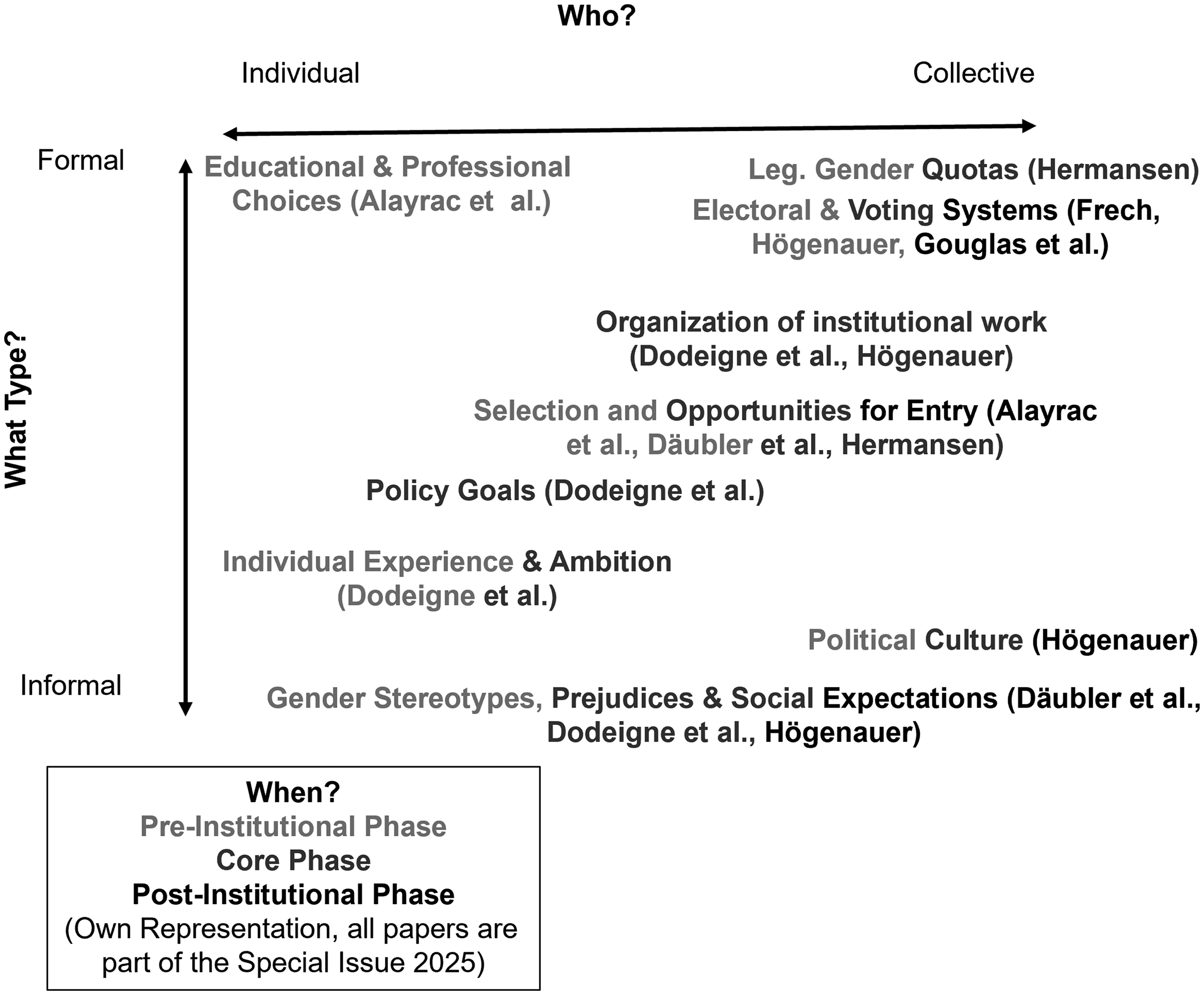
Typology of women's political career challenges.
European political careers and gendered representation: The challenges
This special issue examines gendered representation in the context of the EU and the ways in which it is manifested. The studies complement each other by focusing on different EU institutions and the career movements across and between them. Furthermore, the studies focus on various career steps and combine several career phases (e.g. pre-parliamentary experience and parliamentary office). Moreover, the papers employ a range of research methods and analytical techniques. Based on their differences, the articles in this special issue collectively provide an innovative overview of the complete political careers of women in the EU.
This issue highlights many of the challenges that women face during their political careers in the EU. The identified challenges for women's representation and political careers range from very individual ones (e.g. personal beliefs or education; Alayrac et al., 2025) to collective ones (e.g. societal expectations; Daeubler et al., 2025). They are formally institutionalised, such as a country's voting system (Gouglas et al., 2025), or very informal and difficult to observe, such as gender stereotypes (e.g. Dodeigne et al., 2025).
Furthermore, the contributors to this special issue have uncovered challenges for women in each stage of their political careers. Partisan positions in the pre-institutional phase matter for a career as an EU commissioner (Alayrac et al., 2025). The organisation of institutional work matters for women in the core phase (Högenauer, 2025), and the electoral systems (Gouglas et al., 2025) and parties (Frech, 2025) play an essential role in reselection and post-parliamentary careers.
Who? Agency of challenges
In characterising and summarising the wide range of challenges women encounter during their political careers (in the EU), we must first ask who causes, drives or influences these challenges. This dimension, mapping the gendered challenges, identifies the agency of those causing the challenge. As political gatekeepers, parties are typical examples of agents shaping gendered inequality (e.g. in candidate selection; Luhiste, 2015). When considering the challenges that women face in their political careers, the potential actors and obstacles must be approached with the question of how these difficulties can be reduced or eliminated. The level of agency involved is crucial because challenges caused by individual decisions made by the politician (e.g. obtaining a certain educational degree) are fundamentally different from those stemming from beliefs held by society (e.g. gender norms).
The studies in this special issue identify a wide range of actors that drive or influence the gender differences in EUropean careers. This range spans from the individual MEP to the collective or societal level. Individual MEPs with their education, previous experience (e.g. Alayrac et al., 2025), ambition and individual policy orientation (Dodeigne et al., 2025), differing by gender, have been identified as drivers of representational differences. However, collective actors (e.g. parties or party groups; Hermansen, 2025) or even county-level variables, such as legislated gender quotas (Hermansen, 2025), voting systems (Gouglas et al., 2025) or societal expectations (Daeubler et al., 2025) have also been identified as drivers for representational differences between men and women in EU politics.
To gain a comprehensive understanding of representation, it is essential to consider not only the factors influencing a group's inclusion but also those affecting their subsequent exit. In the study conducted by Gouglas et al. (2025), the rates of turnover in various national parliaments and those in the EP were compared to determine whether there is a higher probability of departure for women than for men in each parliament. The findings underscore the challenges inherent in a collective rather than an individual agency. In certain electoral systems, where the personal vote is strong and district magnitude is high, women parliamentarians are required to exert greater effort than their male counterparts to maintain their position in parliament. Moreover, the departure of women from the parliamentary arena is attributed to electoral volatility, with notable differences observed between national parliaments and the EP. However, the authors emphasise that, in general, women and men MEPs are ‘more equal than different’ in terms of the incumbency exit rate (this finding aligns with the conclusions of Frech, 2025). In the EP, the exit rate of men is, according to Gouglas et al. (2025), higher than that of women, while there is no significant difference in national parliaments. This may be regarded as favourable in terms of the descriptive representation of women in the EP and suggests the existence of gender-based differences in career progression between political levels. Like other articles in this special issue, this paper emphases the importance of the multilevel structure of European careers.
Dodeigne et al. (2025) provide an illustration of an analysis that emphasises the significance of a combination of diverse levels of causal agents in shaping women's legislative conduct and, consequently, influencing the substantive representation of women. The authors examine written questions in the EP and identify gendered patterns: women MEPs are more likely to ask questions in ‘female’ policy areas while men deal with more ‘male’ topics. They posit that these differences can be attributed to individual-level factors, such as varying ambitions and policy goals, as well as to the influence of stereotypes and expectations of gender-attitudes held by political parties and their supporters. They conclude that the gendered organisation of parliamentary work can be overcome with seniority, implying that women learn to adapt their actions and conduct to align with the norms of male behaviour with increasing experience. In conjunction with the findings of Gouglas et al. (2025), which indicate that women possess an exceptional capacity for remaining in the EP, this may foster optimism regarding the prospect of gender equality in Europe.
What type? Formality of challenges
The challenges women encounter during their political careers in the EU vary in quality and type. Studying gendered institutions, feminist institutionalists contend that formal and informal political institutions can be a source of gender inequality (Mackay et al., 2010). The authors of this special issue demonstrate that formal political institutions, such as legislated gender quotas (see Hermansen, 2025) and informal norms and practices (e.g. gender stereotypes, see Högenauer, 2025), can influence women's career prospects and representation in the EU. Candidate selection is a potential formal challenge for women in the EU because of eligibility and selection opportunities and an informal challenge because of gender stereotypes held by the party selectorate (see Alayrac et al., 2025; Daeubler et al., 2025; Hermansen, 2025).
Hermansen (2025) contributes to a better understanding of the formality of challenges for women's political careers, asking how formal political institutions like gender quotas interact with informal challenges like gender norms in candidate selection. This study uses detailed data and a ‘before-after’ design with a control group to study the most famous political institution with regard to gender: (legislated) gender quotas. The paper explains that political recruitment to the EP is biased in favour of men: women elected from parties or countries without a gender quota put greater value on office and are more talented than other MEPs because they had to pass a higher hurdle. When quotas are imposed by law, Hermansen (2025) finds, that while the share of women does not increase, women react to the increased uncertainty by increasing their efforts in parliament and subsequently profit more from their good performance in re-election. This study contributes to a better understanding of how gender quotas affect substantive representation: gendered norms and practices in parties linger, leading them to doubt quota women's quality as legislators. This is particularly true if quotas are legislated and hence involuntary. As a result, parties focus on women's legislative records more, which incentivises women to invest additional effort into their legislative work.
The study by Daeubler et al. (2025) examines the potential impact of public attitudes, particularly their change, on the selection of female candidates for EU elections. The authors employ a difference-in-difference design to analyse a substantial data set of candidates for multiple EP elections. Their findings indicate that, on average, party selectorates do not respond to shifts in public attitude, and there is no discernible variation in the selection behaviour of parties of different orientations. The authors explain their findings with a potential heterogeneity of effects of public attitudes on candidate selection over time and space. If public attitudes and stereotypes pose a challenge for women in EU politics (see also Dodeigne et al., 2025; Högenauer, 2025), this finding is a cause for concern, as it suggests that parties may be sluggishly reacting to changes in public attitudes.
In her article, Högenauer (2025) examines the gender differences in the political careers of Maltese and Luxembourgian MEPs. By integrating career data with interview findings, the author finds that the EP is a more appealing option to women than the national parliaments of the two small European member states. However, she identifies a combination of formal (e.g. electoral system, see also Gouglas et al., 2025) and more informal (e.g. the traditional societies of the two societies) challenges for women MEPs from Malta and Luxembourg that makes it difficult for women to leverage their experience from the EP as a stepping stone into national politics (Högenauer, 2025). The study demonstrates how the political career trajectories of women MEPs can be shaped by formal institutional constraints, such as the part-time nature of regional (and, in the case of Malta, even national) politics. This places women, particularly mothers, at a disadvantage (see also Frech and Kopsch, 2024 for a study on parents in the EP). In conclusion, Högenauer (2025) corroborates the findings of other papers in this special issue (e.g. Alayrac et al., 2025) regarding the significance of institutions and opportunities not only at the EU but also at the national level for the cases of Luxembourg and Malta.
When? Timing of challenges
A final crucial problem to be considered when examining the challenges women face in the EU political sphere is determining in which career phase women typically encounter challenges, or which phase is most challenging. This special issue reveals that women face challenges in every phase and that transitions between phases (e.g. being (s)elected to an institution) can be the biggest challenge (see Alayrac et al., 2025; Dodeigne et al., 2025; Frech, 2025; Gouglas et al., 2025; Hermansen, 2025). Furthermore, the overview (Figure 1) illustrates that challenges in the pre-institutional phase, such as education (Alayrac et al., 2025) or individual ambition (Dodeigne et al., 2025), are predominantly caused by individual actors or are individual. In contrast, challenges women encounter during the core phase or in the post-institutional phase, for example, the political culture (Högenauer, 2025) or electoral system (Frech, 2025), are of collective nature. Challenges identified by multiple contributions include gendered stereotypes and social expectations. This challenge is particular because it appears to hold women back in every career phase, from attitudes towards gender bias in the selection of candidates (Daeubler et al., 2025) to a potential disadvantage of women in national politics in their post-institutional careers (Frech, 2025).
There are few comparative studies of the career paths to high offices of men and their women counterparts. Even fewer compare both political and administrative office holders within the same executive. The article by Alayrac et al. (2025) undertakes both comparisons. Based on detailed data, including information on all Commissioners and Directors-General across three Commission presidencies, and using multiple correspondence analysis (MCA), the authors find not only that there are several identifiable paths to the top, but also that they are gendered and that women tend to have fewer paths to the top available to them. Contributing to the structure versus agency debate, the authors highlight the importance of agency in overcoming these structural challenges. For Commissioners, the pre-Commission phase (e.g. party positions held) is important, with educational and professional choices appearing as challenges for women, but national governments and the national pipeline of women also determine women's chances to attain leadership positions. In contrast, women in managerial positions, such as Director Generals, struggle in both the pre-institutional and the core Commission phase (Alayrac et al., 2025).
Frech (2025) not only analyses whether women have the same chances of staying in office (in the core phase) (see also Gouglas et al., 2025), but also sheds light on the gendered nature of MEPs’ post-parliamentary careers. The results contradict the wisdom from comparative, national studies of women's political careers and seem to confirm the gender-friendly nature of the EP: not only do women incumbents have similar overall chances of returning to the EP and being reselected by their parties as their male colleagues. They are even more likely to be re-elected if re-selected by the party. Moreover, women MEPs do not differ significantly from men in terms of their chances of continuing their careers in national politics. In addition, the paper highlights parties as critical gatekeepers for women in politics (see also Daeubler et al., 2025; Dodeigne et al., 2025). Under the right circumstances, of which the EP could be an example, this pivotal role of parties can also be turned into an advantage rather than a disadvantage. The paper highlights electoral institutions as a critical mediating power between the different actors and as a potential challenge for women in the EU institutions. Overall, Frech (2025) paints a slightly more positive picture of the role of national parties than previous studies on this topic (e.g. Vanlangenakker et al., 2013) and highlights the importance of considering the interaction between agency and institution to understand gender differences in political careers.
Conclusions
This special issue studies the complex challenges shaping the political careers of women in the EU, drawing on a structured framework that incorporates multiple analytical dimensions. Analysing women's challenges along these dimensions explores who causes what type of challenges in EU politics along with how and when in the career. The first dimension, that of agency, identifies the agents or actors causing the challenge. This dimension spans from individual to collective agency and assumes that the more collective the cause of a challenge for women's careers, the more difficult it might be to change it. The second dimension captures the quality or type of challenge. Challenges can be caused by formal processes or institutions, and they can be very informal or fall between these two extremes. The theoretical framework holds that more informal challenges might be more challenging to change than formal ones. The third dimension of the framework of challenges for women in politics explores the timing of challenges in the career phases (pre-institutional, institutional or post-institutional).
The obstacles encountered by women in politics must be determined not merely to understand and address political career imbalances but also to study and improve democratic representation and policy outcomes. The proposed theoretical framework is designed to be of value to scholars engaged in the study of political careers, gender, and politics and to a broader audience comprising students and scholars with an interest in representation, institutions, democracy, political leadership, parties, and other topics. Moreover, the theoretical framework and special issue aim to guide policymakers who advocate for gender equality, facilitating more effective decision-making and informing policy reforms designed to enhance women's representation.
The articles in this special issue reveal that challenges for women in EU politics often stem from varying levels of agency. Individual factors, such as personal beliefs, education, and policy positions, can influence women's careers (Alayrac et al., 2025). Moreover, collective actors, such as political parties, party groups, EU institutions, and societal attitudes, play crucial roles (e.g. Daeubler et al., 2025). Parties are critical gatekeepers for women. However, the studies in this special issue have discovered a more detailed, positive role of parties in the EU context (see Frech, 2025) than previous research has. Parliaments or their organisations are critical agents who can decisively disadvantage women (Dodeigne et al., 2025; Högenauer, 2025).
Moreover, the challenges are situated along a continuum between formal and informal. Formal challenges include electoral systems and legislated gender quotas, affecting candidate (re)selection and substantive representation (see Gouglas et al., 2025; Hermansen, 2025). Informal challenges encompass gendered norms and practices and informal candidate selection rules in political parties (e.g. Daeubler et al., 2025; Dodeigne et al., 2025; Högenauer, 2025).
Timing matters, as challenges manifest in various career phases. In the pre-institutional phase, the limited relevant political experience can pose hurdles (e.g. Dodeigne et al., 2025; Högenauer, 2025). In the core institutional phase, gendered political cultures and societal attitudes toward gender equality present common challenges (Alayrac et al., 2025; Högenauer, 2025). Post-institutional transitions also create unique obstacles, such as electoral and voting systems and gender stereotypes of the selectorate of the post-institutional job (Frech, 2025; Gouglas et al., 2025).
Finally, this special issue demonstrates that the processes by which challenges emerge are diverse and complex. Challenges can emerge as an intended or unintended result of formal institutions (e.g. Gouglas et al., 2025; Hermansen, 2025). Other challenges result from differential requirements based on gender, a recurring theme in this issue. Women often encounter distinct educational and policy portfolio requirements compared to men (e.g. Högenauer, 2025) when pursuing high-level positions in the EU. These requirements can vary depending on the specific position and institution, further underscoring the multidimensional nature of challenges faced by women.
Crucially, gender-related stereotypes, prejudices and social expectations related to gender emerge as a common theme across multiple papers (e.g. Daeubler et al., 2025; Dodeigne et al., 2025; Högenauer, 2025). These stereotypes affect many actors in all EU institutions and shape the working environment in institutions and the leadership norms women encounter. Even (formal) institutional challenges may be rooted in stereotypes and prejudices.
Furthermore, the multilevel structure of EU politics links the studies in this special issue and re-emerges as a critical factor in women's political careers in the EU. This special issue demonstrates that gender equality and the gender sensitivity of institutions and contexts in the national and regional political arena are decisive for women's political careers in the EU. The studies in this special issue mention the national ‘pipeline’ of women and eligible candidates for EU institutions (Alayrac et al., 2025), formal and informal selection of candidates at the national level (Daeubler et al., 2025; Hermansen, 2025), electoral systems for European elections, which are determined by the member states (Frech, 2025; Gouglas et al., 2025), and fewer political opportunities at the national and regional political levels (Frech, 2025; Högenauer, 2025). This complex interdependence of political levels is of utmost importance for an understanding of women's careers in the EU and highlights the necessity for reforms on the European and national levels (see Högenauer, 2025). Hence, the insight and identified challenges also pertain to the national and regional political arenas.
However, the interdependence of political levels in the EU highlights the reason the EU is specific and appears to be more women-friendly than domestic arenas (see e.g. Frech, 2025; Gouglas et al., 2025). Gouglas et al. (2025) found that women have a lower incumbency exit rate than men in the EP, whereas across national legislatures, they observed the opposite. These differences highlight the importance of studying political careers in the EU context. By exploring the complex challenges women face in their political careers in the EU from multiple perspectives, this issue highlights the critical sources of gender disparities, identifies challenges in multiple political contexts and provides valuable insight for future reforms addressing these multifaceted problems.
Footnotes
Acknowledgements
The author would like to express gratitude to the editor, Gerald Schneider, and his team at European Union Politics for their support with this introduction and the special issue. Additionally, the author is indebted to the four anonymous reviewers for their constructive feedback on the papers included in this special issue. Their comments, along with those provided by Stefanie Bailer and Ulrich Sieberer, have contributed to the improvement of this framework article.
Funding
The author disclosed receipt of the following financial support for the research, authorship, and/or publication of this article: The author was supported financially by the University of Bamberg (Germany) for the research, authorship, and/or publication of this article. She is particularly grateful for the support by the ‘SPOT’ programme of the Women's Representative of the University of Bamberg.

Data availability statement
Data sharing not applicable to this article as no datasets were generated or analyzed during the current study.