



Abstract
This forum article provides an overview of the sampling and survey design of the publicly available InterCov dataset. The two-wave cross-country survey includes items on lobbying mobilisation, strategies, access and influence after the outbreak of the COVID-19 pandemic, and other measures of organisational factors. We discuss design choices considering our interest in lobbying dynamics following a focusing event, the responsiveness of organisations and political gatekeepers to external shocks, and the role of timing in lobbying. We address our bottom-up sampling approach, draw lessons from the implementation of a second survey wave and provide an overview of survey items. We hope that this forum article is useful for scholars aiming to use our dataset and those starting new data collection efforts.
Introduction
Survey and interview-based research is an indispensable ingredient in the study of lobbying. Despite recent progress in lobbying transparency at both the European Union (EU) level and in several member states (Chari et al., 2020), available data on lobbying in Europe are very limited in comparison to data available under the United States’ Lobbying Disclosure Act. 1 One of the important tasks of European lobbying research has therefore been to make data available by carefully mapping the activities of interest organisations through extensive elite surveys with representatives of organisations (e.g., Allern et al., 2023; Beyers et al., 2014b; Binderkrantz et al., 2020; Dobbins et al., 2023; Rasmussen et al., 2018). Such data on interest representation is essential for the evaluation of potential biases in the participation of interest groups in policymaking. In doing so, lobbying research contributes to the assessment of the quality of democracy and the legitimacy of its outputs when external interests are involved.
We argue that this potential watchdog function of lobbying research is ever more important in politically turbulent times (Ansell et al., 2017). When sudden crises break out, such as a global pandemic, but also war and the associated energy crisis hitting European democracies in recent years, it is arguably especially important to evaluate whether interest representation can keep up with the fast pace of new developments. When states need to act quickly, and policymakers cannot immediately rely on an electoral mandate, experts and interest groups are likely becoming frontline players. Perennial academic questions of group politics are therefore especially relevant under such circumstances, including those related to whether an appropriate set of actors has a say when new arising policy problems need to be addressed.
The InterCov project was born with this purpose in mind and builds on the assumption that crises represent both disruptions and opportunities for interest groups’ involvement in policymaking (Crepaz et al., 2022; Junk et al., 2022). When the World Health Organisation declared the state of the pandemic in March 2020, it quickly became apparent that individuals, organisations, as well as governments across the world were facing extreme physical, economic, social and psychological effects of the spread of the virus and lock-down restriction policies. As scholars of interest groups and lobbying, we found ourselves naturally interested in (and worried about) how the mobilisation and political expression of economic and societal interests would play out and inform policies under such circumstances.
In June 2020, we therefore fielded the project's first cross-country survey in 10 European polities (Austria, Denmark, Germany, France, Ireland, Italy, the Netherlands, Sweden, the United Kingdom and the EU) to map the activities of a stratified random sample of interest organisations. 2 One year later, a second wave of the survey was conducted to follow up on the medium-term effects of the crisis in eight of the 10 initially included polities.
What characterised our approach in the implementation of these surveys was a focus on the dynamic course of interest mobilisation and lobbying activities in relation to the new arising policy problems. Existing research has typically mapped biases, for instance in arena-specific access (Binderkrantz et al., 2015), or issue-specific lobbying activities and success (Dür et al., 2015; Rasmussen et al., 2018). However, most large-n studies have been largely static and have paid little conceptual or empirical attention to longitudinal dynamics of interest group activity, as well as responses to trigger events.
We posit that survey-based research holds promise in capturing such dynamics, particularly when structured to coincide with the onset of a crisis or another significant event that influences the interest organisation community (cf. Kingdon, 1995). In the following, we summarise the dataset gathered through the project and discuss our insights as to how survey-based research can help understand lobbying dynamics.
Bottom-up sampling of interest groups and firms
Important first considerations in designing any research project on interest representation concern the types of actors that are included, and which are classified as interest groups. Widely used definitions focus on (a) organised actors with (b) political interests and (c) a private status (Klüver, 2013), thereby putting them apart from political parties or social movements. This said, existing definitions of interest groups vary on several dimensions, including whether they focus on specific organisational characteristics, or on observable policy-related behaviour (cf. Baroni et al., 2014), and whether they include or exclude firms that lobby on their own behalf (Aizenberg, 2021).
Our definition in the InterCov project includes a broad set of actor types by spanning non-governmental organisations (NGOs), labour unions, associations of professionals, business associations as well as individual firms. We were interested in drawing a sample of the population of existing interest organisations for these categories in each of the 10 polities under investigation, regardless of whether they had been active on pandemic-related policies or not. Therefore, we drew bottom-up samples (cf. Berkhout et al., 2017) from existing overviews of the interest group community and the largest firms in each country and at EU level. To do so, we used lobbying registries in countries where these exist and drew on other research projects that have mapped the interest group community in others (Aizenberg and Hanegraaff, 2020a; Aizenberg and Hanegraaff, 2020b; Binderkrantz et al., 2020; Crepaz and Hanegraaff, 2020; Naurin and Boräng, 2012; Pritoni, 2019).
Based on these lists, we opted for a stratified random sample, whereby organisations are randomly selected within pre-defined subgroups or ‘strata’, in our case the different organisation types. The general sample frame was to include approximately 150 organisations for each of five organisational categories (strata), namely business organisations, public and ideational organisations, professional organisations, trade unions and firms in each of the countries (see details in Online Appendix A). 3 Such a stratified approach helps to obtain a sample that reflects the diversity of the interest group population more accurately than a random sample, ensuring that less populous group types (e.g. trade unions) are equally included, improving the precision of the estimates and allowing to examine variation between group types (see e.g. Mutz, 2011).
Our bottom-up sample of existing interest organisations in each polity means that our sample includes organisations irrespectively of whether they were active on political issues – in our case, pandemic-related policies. In contrast, top-down approaches identify politically active organisations with a focus on specific policy issues (Berkhout et al., 2017), which is a widely used design in studies on interest groups influence (e.g. De Bruycker and Beyers, 2019; Rasmussen et al., 2018), whereas bottom-up samples are common in studies of mobilisation and group populations (e.g. Hanegraaff and Pritoni, 2019; Heylen and Willems, 2019). We argue, however, that a dynamic view of lobbying mobilisation and influence in reaction to a crisis or focusing event can immensely benefit from a bottom-up sample.
Figure 1 shows our conceptualisation of the influence production process, where a focusing event or other trigger for agenda change hits the existing interest group community, potentially driving organisations into activity. On the path to lobbying influence, problems can arise at several stages: during mobilisation, strategy use, political access and ultimately, political influence. Any of these problems may result in organisations dropping out from the influence production process, which top-down approaches do not sufficiently cover. From this perspective, even an ultimate interest in lobbying influence requires an understanding of second-order mobilisation on new arising policy problems. As a result, a mere focus on politically active organisations runs the risk of ‘filtering out’ organisations which did not manage to mobilise their potential concerns collectively, or remain politically inactive for other reasons, such as free-riding or a division of labour with other organisations.
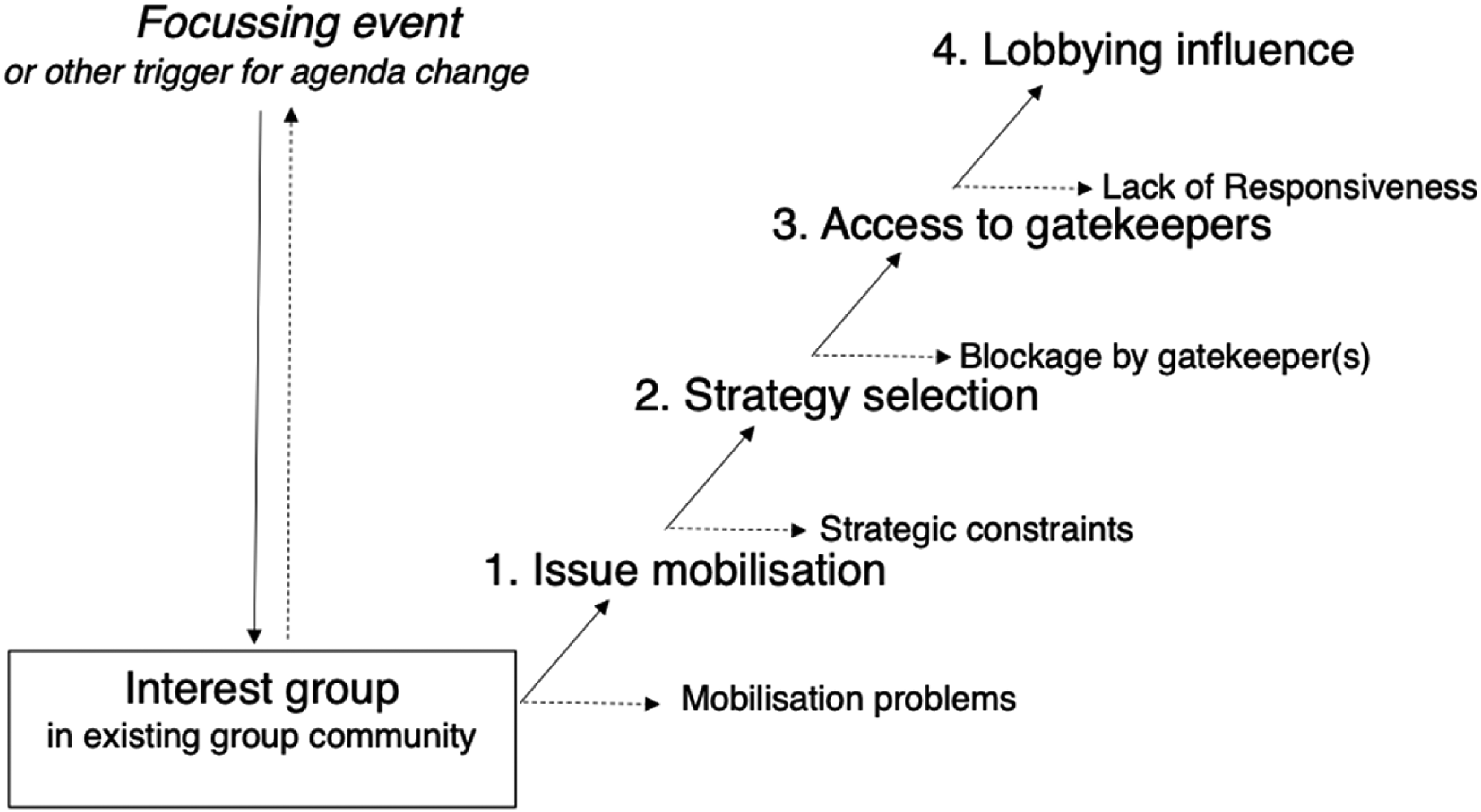
Influence production process on a new (set of) policy issue(s).
Of course, the bottom-up approach also has downsides. That is, it can lead to the inclusion of many organisations that do not even see their raison d'être as advocates of political interests on the topics that researchers are interested in. In addition, as the sampling procedure is not connected to issues, controlling for issue characteristics, such as salience, scope or complexity is more difficult to apply in this approach.
However, if surveys are designed around system-wide focusing events, meaning that the event has (at least theoretical) implications for diverse organisations across different sectors, such drawbacks can be reduced because it is assumed that all interest organisations have, to some extent, experienced the shock. The pandemic, the outbreak of war, economic crises or the mass-rollout of new technologies for example related to generative AI are all potential instances, for which survey participation of a broad set of organisations is meaningful, irrespective of the groups’ actual involvement in lobbying related to the shock. Such events are therefore suitable cases to assess the responsiveness of the system of interest representation to emerging societal disturbances.
To illustrate our point, all interest groups in our study experienced the consequences of the pandemic but there is considerable variation in both their affectedness by and level of mobilisation on pandemic-related issues. A total of 25% of survey respondents indicated not to have lobbied on Covid-related policies at all in the first wave of our survey, and 12% indicated to have lobbied only once since the start of the pandemic. Still, as Figure 2 illustrates, some of these inactive organisations still saw themselves as highly affected (compared to other organisations in the country). This makes it relevant to include their experiences in a survey and understand why they remain inactive. Moreover, the general salience of the pandemic and its far-reaching implications also meant that inactive organisations had meaningful positions on pandemic-related issues and could rate their policy satisfaction and preference attainment on these issues.
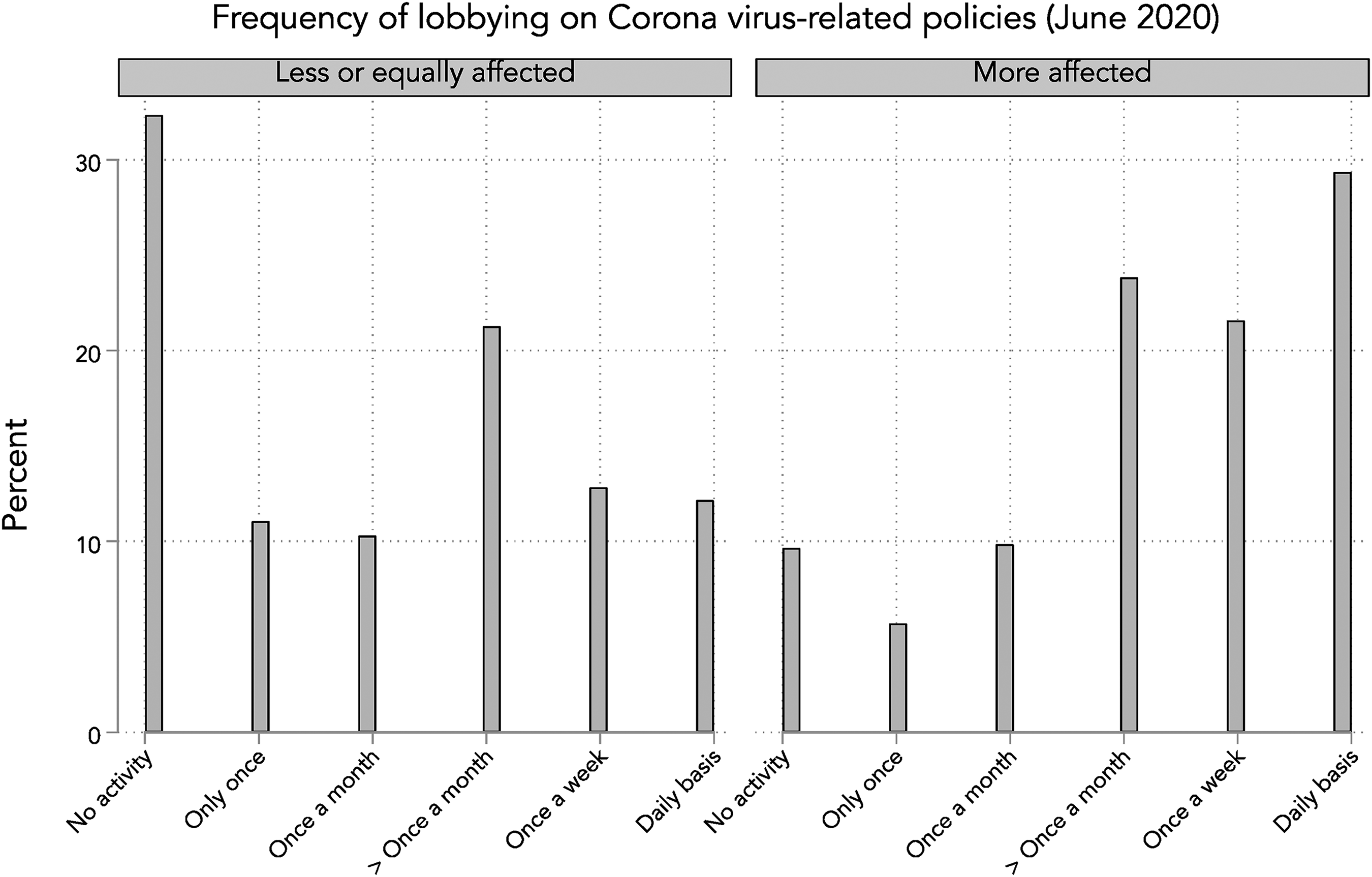
Variation in the frequency of lobbying across different levels of affectedness.
System-level focusing events and a ‘time zero’ in lobbying
The design around a system-level focusing event also allows an unprecedented focus on changes in lobbying patterns. In our case, the spread of Covid-19 placed a set of completely new policy problems on the agenda, meaning interest groups began to mobilise on issues on which they had never lobbied before. Such attention to a focusing event is especially conducive to the study of the temporal dynamics in lobbying, including when we wish to evaluate the ability of both interest organisations and political gatekeepers to respond to external shocks (Junk et al., 2022).
The ideal scenario is of course one where organisations are surveyed before and after the event in question. However, in most cases, this is not only difficult due to resource constraints but also impossible due to researchers’ lack of precognition about future developments. Therefore, we recommend including survey items that cover the strategies and access of organisations both before and after the shock (see the Online appendix). Such items enable establishing a pre-event benchmark and assess the changes in lobbying strategies and/or access following the event of interest. As long as these events do not lie long in the past, organisational leaders should be able to report on their activities at clearly demarcated points in time.
In addition, the existence of a plausible ‘time zero’ for the focusing event – in our case the declaration of the pandemic – allows capturing the timing of lobbying mobilisation on new policy issues. In our survey, we asked respondents to identify the precise week since time zero, in which political activities on issues related to the pandemic were initiated (see the Online appendix). Based on this, we were able to identify first movers in lobbying and distinguish them from different types of late movers (Crepaz et al., 2023).
There is more material related to such dynamic reactions in the InterCov dataset. In our second survey wave, for instance, we capture whether interest groups perceive themselves as initiators or followers of government activities, and whether their sources of income have changed since the start of the pandemic (see the Online appendix). We see these as potentially fruitful avenues for future research in the study of interest representation with the InterCov data.
Additional survey waves to assess long(er)-term impact
The dynamic approach undertaken with the InterCov project also makes its data relevant for exploring the short, medium and long-term consequences of focusing events. To do so, the project was designed with the aim of conducting multiple survey waves. The first wave was fielded in June 2020, a few months after the outbreak of Covid-19 in Europe. Wave two was conducted one year after the first wave, in July 2021. Table 1 summarises the samples, completed surveys and response rates by country in both waves.
Sent surveys and responses by polity. 6
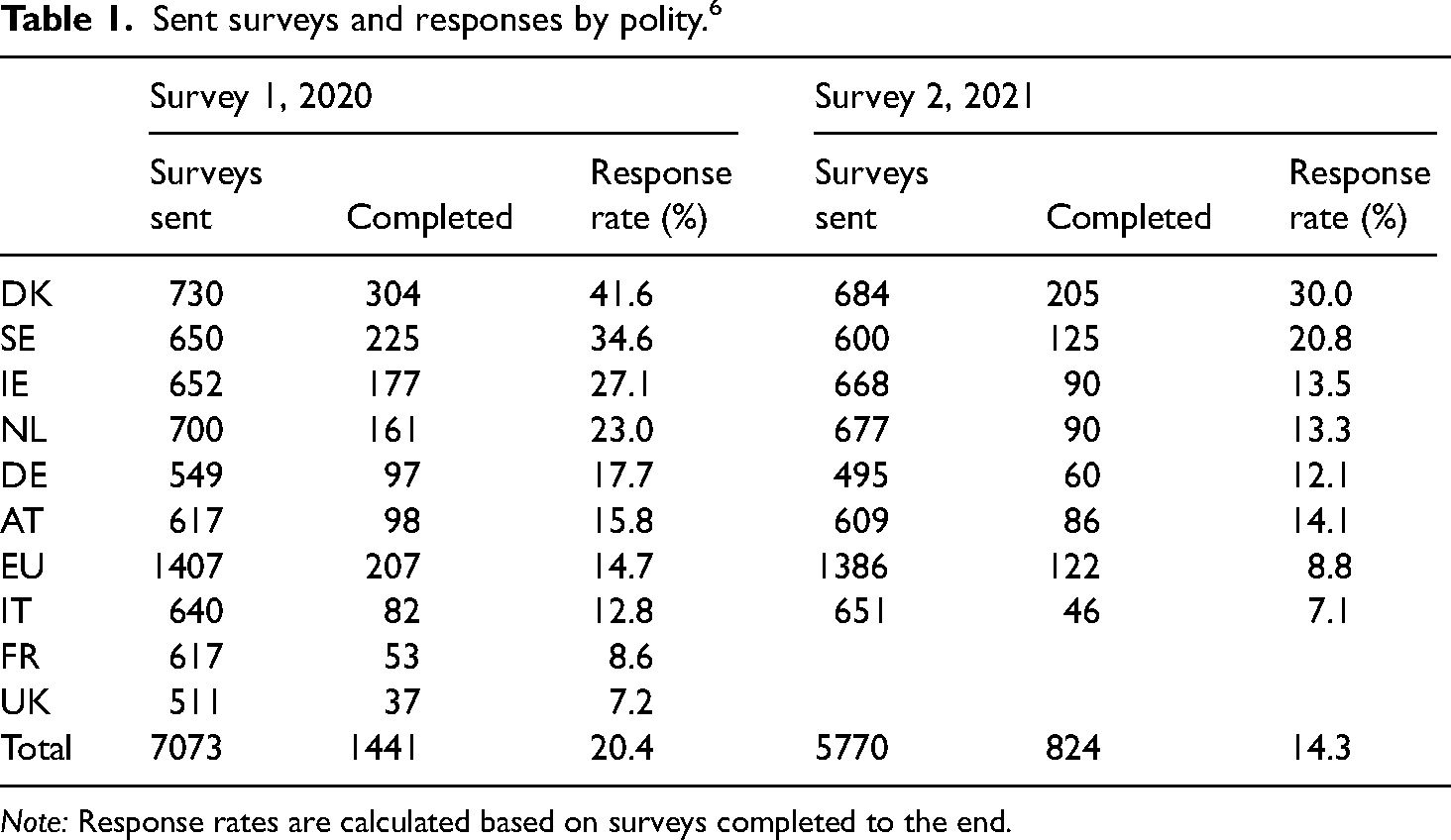
Note: Response rates are calculated based on surveys completed to the end.
Unfortunately, as Table 1 shows, in our two-wave strategy we were not able to complete the second survey in France and the United Kingdom. The decision to exclude these countries from the second survey was the outcome of a combination of resource constraints related to providing a country-sensitive translation of the survey (to French), and the inability to mobilise respondents in the UK and France. This experience speaks more generally to the difficult considerations regarding country inclusion or exclusion researchers face. Some countries, such as France, have notoriously lower response rates in comparative elite surveys (Eising, 2007), and their inclusion is resource intensive and drags the overall response rate down. At the same time, it is not desirable that survey research only focuses on countries with high response rates, because it is important to probe potential differences in the resilience of different interest group systems to external shocks (see for instance Crepaz et al., 2022).
While we were unable to do so in this project, we see it as imperative that the interest group field in general makes attempts to expand the focus beyond ‘usual suspects’ both within Europe and beyond (see for instance Dobbins et al., 2023; Rozbicka and Mahrenbach, 2023). From this perspective, it is also important that journal editors and reviewers do not overly penalise low response rates, even below 10% completion rates (cf. discussions in: Marchetti, 2015), especially when attained in countries that are scarcely researched.
Beyond the patterns in Table 1 for our included countries in Western, Northern and Southern Europe, it is notable that ca. 500 organisations participated in both surveys. A set of survey questions relevant for capturing longitudinal dynamics were identical in both waves. What these data show, for instance, is that political influence has a strong path dependency with self-perceived influence in both survey waves being highly correlated at 0.55 (p < .001). Moreover, it demonstrates that organisations’ lobbying access levels at the start of the pandemic varies significantly from their access one year later, with an overall drop in the frequency of access. Quite intuitively, levels of an organisation's affectedness by the pandemic and mortality anxiety have also decreased over time. Moreover, the data indicate that some organisations (16%) have downsized their lobbying capacity (measured as staff employed in public affairs) while others were able to expand it (17%) in the one-year time frame we compare. We argue that these are all important temporal dimensions worth investigating in interest groups research.
When addressing temporal dimensions of interest group activity, potential response instability is a relevant challenge to consider. Yet, we see this as less problematic in our elite survey, compared to public opinion research. In the case of self-reported activities, access or staff size, we assume organisational professionals to be well-equipped to report on them, and their responses should be less affected by framing or top-of mind effects than public opinion (Zaller, 1992). Still, there are inconsistencies that interest group research needs to consider. Comparing self-declared organisational type in our survey, we noticed, for instance, that 11% of firms, 8% of unions and around 17% of public groups (NGOs and citizen groups) taking our first survey, ‘mislabel’ themselves in the second survey in our detailed actor type classification. This points to problems with the group type classification that is commonly used in interest group research, but that practitioners might struggle with. In any survey, the wording of questions, the potential aggregation of responses into coherent subgroups, and the interpretation of results need to take such potential problems into account.
Another related concern when it comes to several survey waves is potential respondent fatigue, where respondents gradually drop out over time. More specifically, our lower response rates in wave 2 across all countries could be explained by a pandemic fatigue in June 2021, compared to June 2020. 4 One way around this problem might be linking subsequent waves to new focusing events or relevant societal developments, while at the same time following up on the original issue. Another way to cope with this issue involves allocating additional resources specifically to implementing the second wave in comparison to the first. When interest in the issue(s) wanes, a strategically timed telephone call can incentivise respondents to actively participate, hereby increasing the response rate of the second wave.
Question wording and key operationalisations
More substantively, a central feature of our bottom-up approach structured around a focusing event is that it requires a focus on salient issues. Yet, we know from previous research that lobbying patterns vary considerably depending on issue characteristics (Dür et al., 2015; Rasmussen et al., 2018). Hence, it is important to consider how issue variation can still be included when relying on a bottom-up sample.
In our project, we attempted to include issue variation by differentiating between Covid-related and non-Covid-related issues in the questions we asked (see Table 2, Survey 2). We covered the levels of activity on both types of issues at three points in time, as well as the frequency of access to various gatekeepers, and levels of preference attainment and perceived influence for both types of issues. A downside, however, is that the category of non-Covid-related issues is very broad and was therefore difficult to narrow down in our analyses beyond cross-tabbing these with the organisations’ sectors of activity. In future endeavours, we recommend including an open text box asking respondents to briefly list some of these issues. Machine learning approaches make it more feasible to subsequently analyse such responses (Velez, 2023).
Overview of question items.
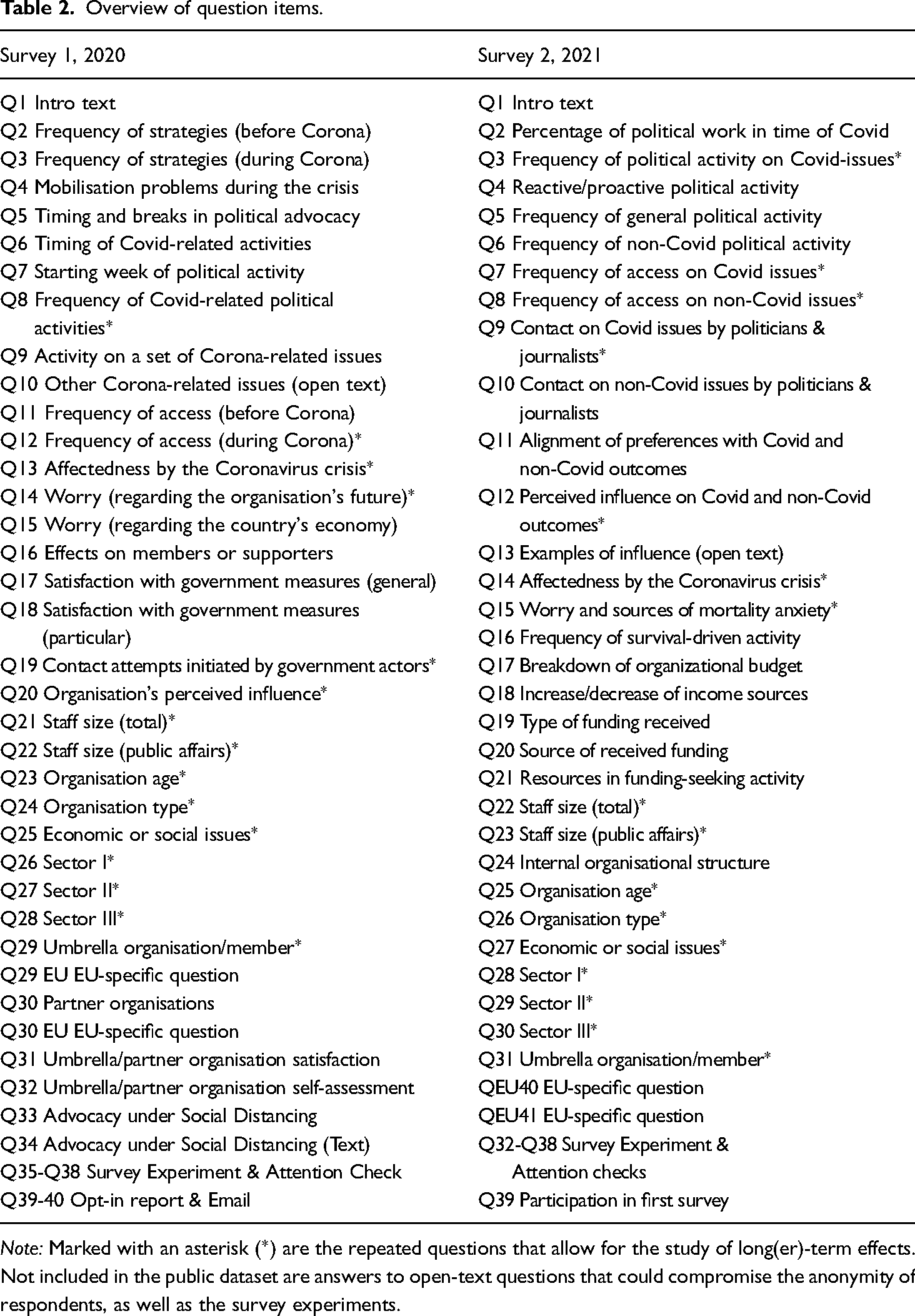
Note: Marked with an asterisk (*) are the repeated questions that allow for the study of long(er)-term effects. Not included in the public dataset are answers to open-text questions that could compromise the anonymity of respondents, as well as the survey experiments.
Table 2 provides a general overview of the question types included in the respective survey. Full question wording is available in the Online appendix. 5
When designing the survey questions, we included a number of frequently used outcomes of interest, such as questions probing the use of different strategies (cf. Dür and Mateo, 2013), venue-specific access (cf. Binderkrantz et al., 2015), issue-specific perceived influence (e.g. Binderkrantz and Rasmussen, 2015; De Bruycker and Beyers, 2019) and mortality anxiety (Hanegraaff and Poletti, 2019; Witjas et al., 2020).
In addition to these, we included several novel measures to capture the different steps in the influence production process. Table 3 provides an overview of the measures we employed for our most important outcomes of interest. It indicates both the more common operationalisations and newer operationalisations which the project developed. These include a focus on mobilisation pace, survival-seeking strategies, demand-driven access and policy satisfaction of interest groups.
Overview of dependent variables to operationalise stages in the influence production process.
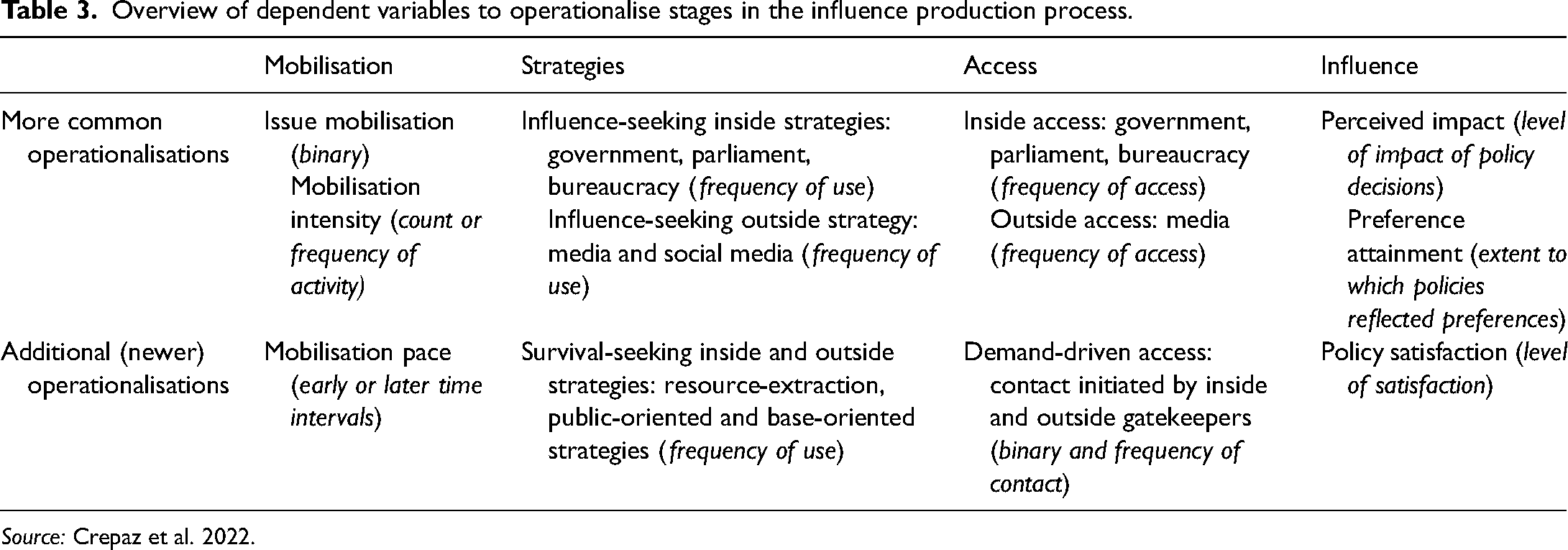
Source: Crepaz et al. 2022.
We believe that studying these new measures can significantly contribute to lobbying research in the future. There is first evidence that timing and pace matters in lobbying (Crepaz et al., 2023), that organisational strategies are not solely policy oriented, and that policymakers initiate higher-quality access (Junk et al., 2022), but these remain underexplored foci in studies of lobbying. Finally, measures of interest groups’ policy satisfaction can complement studies of lobbying influence (Crepaz et al., 2022) by focusing on support for and the acceptability of decisions, which can have important implications for the functioning of modern democracies when it comes to interest group input.
Although this forum article focuses on survey-based research, we also see potential in building on these new operationalisations with other data sources, such as automated coding of primary sources (cf. Aizenberg and Binderkrantz, 2021; Dwidar, 2022; Klüver, 2009). Moreover, interviews with lobbyists and gatekeepers can provide details about actor activities and motivations, as well as contextual factors that are difficult to cover in survey research alone (cf. Beyers et al., 2014a; Leech, 2002).
In the InterCov project, we complemented our surveys with online focus group interviews, which we see as a useful tool to understand interactions between organisations (Berkhout et al., 2023; Junk et al., 2024a). These focus groups conducted in between the two survey waves also offered a way to receive feedback on the survey and inform the design of the next wave. Respondents raised, for instance, a concern about patterns in funding availability after the outbreak of the pandemic, sharing anecdotes that some organisations were showered in funds, while others were hit by cuts. A key benefit of this approach is that we could adjust the second wave of our survey to these responses (see Q19-21).
More generally, a key quest in both survey design and follow-up was to generate tangible value for respondents. This aim also informed subsequent dissemination activities including a respondent report published a few weeks after closing the surveys, as well as online country-level webinars conducted after the survey and our public book launch, where respondents could engage with our findings. Based on their feedback, we learned that interest group leaders value this kind of research projects. Organisations could relate to its findings and have in some instances expressed intentions to ‘change their strategies’ based on our findings. The feedback, however, also urged us – and researchers in general – to engage in more detail with the hands-on challenges organisations face. For example, respondents would have liked us to engage more with the online advocacy challenges and the use of technology during the pandemic and found our few questions in this (see Q33-34, Survey 1) too superfluous. It is a challenging endeavour to design surveys that are both engaging for respondents and generate academic insights. In this forum article, we have shared our experiences with implementing the project that we hope can be useful for researchers that want to use our data, expand it or start similar projects.
Conclusions
In this forum article, we summarised the sampling and survey design considerations underlying our publicly available InterCov dataset, which spans lobbying mobilisation, strategies, access and influence after the outbreak of the Covid-19 pandemic. We discussed how and why system-wide focusing events offer special opportunities to address the dynamics behind lobbying mobilisation and the influence production process. Furthermore, we argued that a bottom-up sample strategy has several advantages when wanting to understand the responsiveness of interest group systems to external shocks. Finally, we discussed our considerations regarding conducting additional survey waves and presented an overview of survey items, including some of our most focal outcome measures.
Considering the particular characteristics of lobbying in Europe with patchy data availability and a multiplicity of organisations involved, we believe that surveys are an indispensable part of researchers’ methodological toolkit to identify broad patterns of variation over time, issues and contexts. At the same time, surveys, of course, have widely discussed shortcomings, such as problems with non-response and social desirability biases (Marchetti, 2015), which need to be addressed diligently when interpreting survey-based research.
As we see it, a key characteristic of survey research that makes it both valuable – and challenging and volatile – is the dependency on the willingness of large numbers of diverse survey respondents to participate. Addressing issues that organisations do no longer see as important can be unattractive to respondents, although highly valuable for the researcher. In addition to offering our detailed research design considerations that we hope will be useful for researchers, we identified what we see as productive avenues for future research employing our data. These relate, amongst others, to interest group inactivity, the tracing of the influence production process, the study of change in lobbying outcomes and the development and use of new operationalisations for these outcomes.
As we highlighted throughout this forum article, in times of turbulent politics (cf. Ansell et al., 2017) surveys can be designed around particular events that affect entire polities and interest group populations. In our project, the global pandemic as a case has offered us a rare yet highly useful research design feature to study interest groups dynamically across countries in Western, Northern and Southern Europe. Still, there remain many unanswered questions about policymaking both in the pandemic case and in other ‘turbulent times’, such as the big question of how and when crisis circumstances narrow the civic space for interest groups in ways that weaken participation and are associated with democratic decline. By making the InterCov survey data accessible and summarising our insights in this accompanying forum article, we hope to contribute to such research agendas, as well as help inform entirely new data collection efforts.
Supplemental Material
sj-docx-1-eup-10.1177_14651165241274046 - Supplemental material for Understanding lobbying dynamics through survey research: An introduction to the InterCov dataset
Supplemental material, sj-docx-1-eup-10.1177_14651165241274046 for Understanding lobbying dynamics through survey research: An introduction to the InterCov dataset by Wiebke Marie Junk, Michele Crepaz, Ellis Aizenberg, Joost Berkhout and Marcel Hanegraaff in European Union Politics
Supplemental Material
sj-zip-3-eup-10.1177_14651165241274046 - Supplemental material for Understanding lobbying dynamics through survey research: An introduction to the InterCov dataset
Supplemental material, sj-zip-3-eup-10.1177_14651165241274046 for Understanding lobbying dynamics through survey research: An introduction to the InterCov dataset by Wiebke Marie Junk, Michele Crepaz, Ellis Aizenberg, Joost Berkhout and Marcel Hanegraaff in European Union Politics
Footnotes
Acknowledgements
The research team is grateful to all colleagues that have supported the InterCov project, for instance Anne Binderkrantz, Daniel Naurin and Andrea Pritoni for making population lists available, as well as our team of student assistants who helped update these lists, including Mikko Damgaard Sørensen, Klara Steen Henriksen, and Joshua Meijer. The authors also thank the anonymous reviewers for excellent comments on this forum article.
Author contributions
The authors contributed equally to the article.
Funding
The author(s) disclosed receipt of the following financial support for the research, authorship, and/or publication of this article: This work was supported by Danish Society for Education and Business (DSEB) [Tietgenprisen awarded to Wiebke Marie Junk in 2020].

Data availability statement
The dataset presented in this article is available in the Harvard Dataverse, https://doi.org/10.7910/DVN/FNY3XA (Junk et al., 2024c).
Supplemental material
Supplemental material for this article is available online.
Notes
References
Supplementary Material
Please find the following supplemental material available below.
For Open Access articles published under a Creative Commons License, all supplemental material carries the same license as the article it is associated with.
For non-Open Access articles published, all supplemental material carries a non-exclusive license, and permission requests for re-use of supplemental material or any part of supplemental material shall be sent directly to the copyright owner as specified in the copyright notice associated with the article.
