



Abstract
In recent decades, fiscal integration in Europe has manifested through restrictive rules. However, the consolidation of public finances often encounters citizens’ resistance. International obligations can raise public support for costly domestic policies that are consistent with the obligations’ terms, but can European fiscal pledges influence public opinion and boost support for austerity? I fielded an original survey experiment in Italy and manipulated information about the existence of a new fiscal rule, national or European, mandating austerity measures. In stark contrast with extant research, I find no evidence that the source of the fiscal rule matters when measuring respondents’ support for austerity. This result suggests that the effect of international pledges on garnering public support for costly domestic measures wanes if these measures directly burden citizens’ financial well-being. Moreover, relinquishing fiscal autonomy in favour of new European rules appears unlikely to aid politicians in winning public endorsement for an austerity agenda.
Introduction
Over the past decades, despite the lack of a fiscal union, European and European Union (EU) countries have taken further steps towards fiscal integration, within and outside the EU architecture itself. Fiscal integration has often manifested in the form of new stricter rules and instruments, permanent constraints on national fiscal policymaking. A prime example is the mandatory balanced budget rule enshrined in the intergovernmental Treaty on Stability, Coordination and Governance in the Economic and Monetary Union of 2012, also known as the ‘Fiscal Compact’. The NextGenerationEU initiative stands out for its focus on expansive fiscal policies, marking a step towards joint borrowing to finance a recovery package to help member states bounce back from the pandemic downturn. Yet, the recent reform of the Stability and Growth Pact indicates a return to rigidity over flexibility.
These developments suggest that in Europe, fiscal policy will be increasingly managed at the supranational level. At the same time, European integration hinges more than ever on citizens’ support. In contrast to the era of ‘permissive consensus’, wherein political elites could pursue integration without facing public opposition, the contemporary landscape is characterised by a ‘constraining dissensus’, marked by more intense public contestation to integration (De Vries, 2018; Hooghe and Marks, 2009). These changes have sparked academic research on the democratic constraint posed by citizens’ fiscal preferences to a more centralised fiscal system in Europe (Beramendi and Stegmueller, 2020), on popular support for expanding EU fiscal capacity (Beetsma et al., 2022), and on how public opinion affects European negotiations on fiscal integration (see Bremer et al., 2023). Nonetheless, amidst advancing integration and persistent debates on how to reform the EU's fiscal governance framework, there remains a notable research gap on how European fiscal pledges, in turn, may influence public opinion regarding fiscal policies.
The diffusion of international norms causes domestic policy shifts (Dobbin et al., 2007), but the emphasis in the literature has often been on political elites’ responses to international norms (e.g. see Egeberg, 1999; Hooghe, 2005). As Linos (2011) cautions, this presumes that shifts in leadership positions automatically result in changes in domestic policy, overlooking citizen preferences and thereby running counter to democratic theories.
In response to this criticism, a growing body of literature in law and political science addresses the impact of international norms and institutions on public opinion (Chaudoin, 2014; Chilton, 2014; Greenhill, 2020; Grieco et al., 2011; Strezhnev et al., 2019; Tingley and Tomz, 2020; Tomz, 2008; Wallace, 2013), indicating that international rules have the potential to reshape the political preferences of the public. Citizens may view compliance with international rules as a moral obligation, fear the consequences of non-compliance or want to reciprocate other countries’ efforts (Brewster, 2009; Tingley and Tomz, 2020; Tomz, 2008). Moreover, international institutions can powerfully signal what policies are desirable (Chapman and Reiter, 2004; Grieco et al., 2011; Linos, 2011).
Previous research on international commitments has predominantly been carried out in the United States, investigating public opinion towards foreign and trade policies (Chaudoin, 2014; Tomz, 2008), the use of military force (Chapman and Reiter, 2004; Grieco et al., 2011), respect for human rights (Chilton, 2014), the use of torture (Chilton and Versteeg, 2016; Wallace, 2013), policies of welcoming refugees (Greenhill, 2020; Strezhnev et al., 2019), and environmental policies (Tingley and Tomz, 2020). These studies utilise surveys and survey experiments to gather micro-level evidence, revealing that domestic policies required by international norms are easier to ‘sell’ to the public as international obligations boost public support for domestic policies that guarantee a country's compliance with its international commitment (Simmons, 2009).
Public support increases even when policies entail domestic costs. Tingley and Tomz (2020) observe that public backing for costly climate change mitigation policies in the United States rises upon informing survey participants of the country's decision to join the Paris Agreement. However, when compliance implies a too-high rise in household energy costs, this effect diminishes (Tingley and Tomz, 2020). Likewise, fiscal policies aimed at curtailing government budget deficits, known as austerity, directly impact citizens’ finances by diminishing their disposable income through tax hikes and/or reductions in public spending (Jacques and Haffert, 2021). Additionally, austerity has distributive consequences, contributing to widening inequalities and fostering polarisation among the European public (Agnello and Sousa, 2014; Hübscher et al., 2023).
This raises unaddressed questions about the effectiveness of international fiscal norms in boosting support for austerity measures. Do Europeans update their fiscal policy preferences when receiving signals from European rules on desirable policies? Do they become more supportive of costly fiscal policies after learning that their government is bound by an international fiscal rule? And under what conditions?
Studying the influence of international norms on citizens’ preferences provides insights into political decision-making dynamics, specifically how politicians’ constraints and incentives change. When politicians are responsive to citizens (Burstein, 2010), a shift in public preferences caused by fiscal norms generates a compliance-pull (Dai, 2005), shaping governments’ behaviour. On the incentive front, politicians can more easily persuade citizens about the desirability and merits of a domestic measure when they demonstrate that it is required to comply with an international commitment (Simmons, 2009). Indeed, political communication can influence preferences (Druckman, 2014), a particularly relevant aspect when politicians must implement unpopular policies to be responsive to a supranational institution, as often in the EU context.
Qualitative evidence indicates that European politicians often view fiscal rules as instruments for cushioning the potential electoral losses of austerity. Time and again, they blamed compliance with external EU constraints in an attempt to mitigate the unpopularity of their fiscal policies (Eihmanis, 2018; Wenzelburger, 2011: 1168). The governing coalition in Italy in 2018 threatened to violate the EU budget rule that imposes a fiscal deficit of no more than 0.8% of GDP. Under EU pressure, the government then had to lower the planned budget deficit, but managed to shift blame to Brussels having deliberately threatened non-compliance before (Kriegmair et al., 2022). In Latvia, in the aftermath of the crisis of 2008, the government was even more neo-liberal and pro-austerity than required by the European Commission, but would still justify its choices in light of the EU's fiscal policy requirements (Eihmanis, 2018). To determine whether supranational fiscal norms exert influence beyond facilitating blame avoidance tactics, gathering micro-level experimental evidence regarding the shifts in public opinion following a commitment to an international rule mandating austerity is essential.
Hübscher et al.'s (2021a) study finds evidence for this link between external constraints and popular support for austerity. Employing a survey experiment to investigate the impact of International Monetary Fund's (IMF) intervention on voters’ reaction to austerity, it shows that in most of the countries surveyed, voters are more likely to approve fiscal consolidation in the presence of IMF's intervention (Hübscher et al., 2021a). The finding concerns people's preferences towards fiscal crisis management, when external intervention is limited in time to avoid the country's default and citizens acknowledge that adjustment is necessary with or without the IMF. However, the implications of supranational fiscal commitments on preferences for fiscal policies during non-crisis periods hold equal importance for European political leaders.
This is particularly true under the mounting pressure on governments to increase military spending. While the current external threat landscape may ease the public's constraint on funding defense (DiGiuseppe et al., 2023), room for fiscal manoeuvre is often curtailed by high debt burdens and fiscal rules. The public's traditional opposition to austerity further puts politicians between a rock and a hard place. Given its potential impact on public sentiment, fiscal integration in the form of stringent new fiscal regulations could be viewed as a means to overcome domestic hurdles to consolidation.
This study theorises about and, for the first time, empirically investigates, the impact of international fiscal rules on fiscal policy preferences. Carrying out a pre-registered survey experiment in Italy, it stands as one of a few studies on the causal effect of exogenous international commitments on public opinion conducted outside the United States. Respondents read a fictitious newspaper article on the adoption of a new national or European restrictive fiscal rule and were told that Italian public debt is too high under the new rule. This design allows investigating whether their support for public debt reduction depends on the international source of the rule. While research on public opinion towards environmental policy, foreign policy, trade, and human rights reveals a significant increase in support for policies required by an international rule, I find no statistically significant difference in support for consolidation between the two experimental groups.
The absence of evidence for a meaningful effect of international fiscal obligations on public opinion does not determine whether external fiscal rules can serve as politicians’ scapegoats. Nonetheless, it casts serious doubts upon the ability of international fiscal rules to shape citizens’ long-term preferences and help political elites advance a fiscally conservative agenda. It also indicates that when citizens’ financial well-being is visibly and directly affected and the public is polarised, international commitments may not suffice to boost public support for costly domestic actions.
International commitments and public support for domestic action
With his logic of the ‘two-level game’, Putnam (1988) illustrated the constraint posed by domestic preferences on national policymakers during international bargaining. In turn, the agreed international rules can be strategic tools in the hands of policymakers to influence national policymaking (Büchs, 2008). The link between international institutions and radical domestic policy shifts has often been explained by the effect of international norms on political elites (Egeberg, 1999; Dobbin et al., 2007; Hooghe, 2005). However, in line with the theories of democracies, many scholars assume that politicians’ preferences cannot translate into domestic policy shifts unless international norms affect the public in the same direction. Therefore, their research agenda has focused on the effect of international institutions on domestic politics through their impact on public opinion (Chapman, 2007, 2009; Chaudoin, 2014; Greenhill, 2020; Grieco et al., 2011; Strezhnev et al., 2019; Tingley and Tomz, 2020; Tomz, 2008; Wallace, 2013).
This strand of research has yielded micro-level empirical evidence through surveys and survey experiments that international institutions impact public endorsement of domestic policies. The experiments usually measure support for various policies while experimentally manipulating information on the existence of international norms or pledges. The results show that international commitments shift public opinion in the direction of greater compliance by up to 20 percentage points, as reported in Chilton and Linos’ (2021) meta-study.
Beyond its empirical contributions, this literature has advanced theoretical understanding by elucidating the potential mechanisms through which the international source of a norm shapes public opinion. These mechanisms, reviewed below, can be summarised as the ‘logic of consequences’ (which I also refer to as the ‘credibility’ mechanism), the signalling mechanism, the ‘logic of appropriateness’ (or ‘moral duty’ mechanism), and the reciprocity mechanism.
Fears of retaliation can incentivise higher compliance and induce citizens to believe that compliance is instrumentally important. Tingley and Tomz (2020) refer to this as the ‘logic of consequences’: support for policies mandated by international law increases in light of citizens’ apprehensions about the repercussions of non-compliance, including reputational costs (Brewster, 2009). Consistent with this logic, Tomz (2008) claims that the reputational costs of reneging on an international agreement explain why citizens are more reluctant to side with foreign policies that would violate international laws compared to identical policies not in conflict with any international rule.
International norms can affect preferences even when consequences for non-compliance are highly unlikely (Chilton, 2014). When an international institution adopts a policy, it signals to voters that the policy is desirable (Chapman and Reiter, 2004). That is due to voters facing uncertainty about the consequences of domestic policies, even when informed. Learning that an international institution has backed a policy can make it more appealing in the eyes of the public (Anjum et al., 2021; Linos, 2011). Grieco et al. (2011) show that international institutions’ endorsement translates into higher popular support for the use of military force because institutions provide a valuable ‘second opinion’ to citizens.
Next, citizens may feel that compliance is normatively important and therefore their government is morally obliged to comply with the international rules it has committed to, while not living up to existing commitments would be inappropriate (Chilton and Linos, 2021). Tingley and Tomz (2020) argue that this ‘logic of appropriateness’ is behind increased support for costly policies to fight climate change among respondents who are informed that the United States has joined the Paris Agreement. Additionally, Bechtel and Scheve (2013) find that individuals exhibiting pre-treatment reciprocal behaviour are more willing to support international climate change efforts, but it remains still unclear whether international pledges deepen or dampen the reciprocity mechanism (Tingley and Tomz, 2020: 18).
Compelling implications for the behaviour of political elites stem from these findings. Given the increased public support for domestic policies mandated by international rules (Simmons, 2009; Tingley and Tomz, 2020) and the influence of elites on public opinions, including attitudes towards fiscal policy (Barnes and Hicks, 2018; Del Ponte, 2021), international norms may be strategically wielded by politicians to persuade citizens about the desirability of a policy and enact domestic changes that otherwise would not occur. Chilton (2014) proves empirically that by affecting public opinion, international human rights legislation increases politicians’ chances of successfully implementing reforms. Policies become easier to ‘sell’ to the public especially when governments can indicate that sociocultural peers have adopted the same policy (Simmons and Elkins, 2004).
Can international fiscal rules serve this purpose, making some fiscal policies more popular? The extant literature spans from foreign policy (Chapman, 2007, 2009; Chapman and Reiter, 2004; Grieco et al., 2011; Tomz, 2008) to trade (Chaudoin, 2014), human rights (Anjum et al., 2021; Chilton, 2014; Chilton and Versteeg, 2016; Wallace, 2013), migration policies (Greenhill, 2020; Strezhnev et al., 2019), and environmental policies (Tingley and Tomz, 2020) However, experimental evidence on the impact of international fiscal agreements specifically on public opinion remains scarce.
Theoretically, the mechanisms uncovered by existing studies may all apply to fiscal policymaking. The signalling mechanism becomes more pronounced when citizens are uncertain about the consequences of domestic policies. This is the case for fiscal policies, characterised by intricate budgetary trade-offs (Adolph et al., 2020). The complexity is further compounded by the uncertainty surrounding how public debt influences the future costs borne by citizens (Bremer and Bürgisser, 2023), making it challenging for individuals to assess both the effects and overall desirability of such policies. International fiscal rules can potentially mitigate uncertainty by serving as signals to European citizens, communicating that austerity policies are desirable. Evidence supports that the signal mechanism can work even when a domestic measure concerns tax increase. A study on the influence of international models on citizens’ opinions in the United States reveals that citizens’ readiness to pay higher taxes to introduce maternity leave increases when the United Nations recommend this measure (Linos, 2011).
Next, citizens may fear the consequences of breaking European fiscal rules (‘logic of consequences’ or credibility mechanism), both when non-compliance brings the threat of judicial intervention or just a reputational price. Regardless of the costs of non-compliance, citizens may feel a moral duty to live up to their country's fiscal commitments, supporting domestic austerity to comply with the agreed terms (‘logic of appropriateness’ or moral duty mechanism). Furthermore, a rule that binds together multiple countries spreads the costs of action, thereby triggering the reciprocity mechanism. Led by the desire to reciprocate the efforts of other countries in favour of fiscal stability, or by the threat of reciprocal non-compliance (Morrow, 2014), citizens may become more supportive of austerity.
In addition to these mechanisms, the collective commitment of multiple countries through a common European fiscal rule can trigger an ‘effectiveness mechanism’ by fostering the perceived effectiveness of domestic fiscal policies. Previous crises of public finances, notably the Eurozone crisis, have shown that fiscal instability can be contagious (Constancio, 2012) and that fiscal coordination is needed. As a result of the rule increasing the perceived effectiveness of domestic actions, citizens may be more willing to adopt austerity measures to achieve fiscal stability.
To sum up, the extant literature indicates that the international source of a rule can impact public opinion for domestic action through various mechanisms, including by instigating concerns about potential retaliation or reputational costs, signalling the desirability of such action, through the perceived moral obligation to live up to international obligations, and/or by fostering a willingness to reciprocate the efforts of international counterparts. I apply this theoretical framework to the context of international fiscal policymaking, adding that international fiscal rules can amplify the perceived effectiveness of austerity, and, consistent with previous research, I test the following hypothesis:
H1: Support for austerity measures increases when fiscal consolidation is adopted to comply with an international commitment.
However, fiscal rules are substantively different from other policy areas, especially those requiring the consolidation of public finances as they have a direct and tangible impact on citizens’ economic welfare (Jacques and Haffert, 2021). Austerity typically encompasses tax increases, public spending cuts and reforms affecting citizens’ disposable income, the quality and size of public services they benefit from, and their overall economic well-being. Additionally, austerity frequently entails distributive effects, creating a perceived sense of winners and losers as certain groups may bear a disproportionate burden of the economic adjustments (Agnello and Sousa, 2014; Ball et al., 2013; Matsaganis and Leventi, 2017). This divisive nature of austerity and the heightened salience it has gained within the public and political discourse have contributed to the formation of robust and often polarised opinions among citizens (Hübscher et al., 2023), as evidenced by mass protests, particularly in Southern Europe (Rüdig and Karyotis, 2014). The politicised context in Europe, where the ‘frugal’ North takes its distance from the ‘spendthrift’ South, adds complexity to public perceptions and may have crystallised preferences.
In contrast, legislation on human rights, which expands individual liberties and protections, may not have such direct adverse effects on citizens’ pocketbooks and has a more egalitarian nature as it seeks to provide universal protections without inherently creating economic winners and losers. Similarly, climate and trade regulations may affect industries and employment, yet the effect of these regulations on individual economic well-being may be less evident.
Compared to these international regulations, the more direct and visible economic costs attached to austerity, coupled with its salience and heightened polarisation, pose greater challenges for fiscal rules to influence public opinion and mobilise support. Empirical evidence is especially needed within the European context, where supranational and domestic rules on budget, debt, and expenditures proliferate (Davoodi et al., 2022) and the EU undergoes a reassessment of its economic governance. Constrained fiscal space can force several governments to adopt austerity, despite its unpopularity and electoral risks (Bojar et al., 2022; Hübscher et al., 2021b; Lee et al., 2020; Nyman, 2014; Talving, 2017). 1 On the contrary, governments usually lean towards policies that grant them the most votes and lower the chances of losing popularity, being responsive to public opinion (Burstein, 2010; Downs, 1957) for both instrumental (elections) and non-instrumental motives (Esaiasson and Wlezien, 2017). Testing H1 provides evidence on whether international fiscal rules can come in handy enhancing the popularity of austerity.
The public's view of the institutions’ members
A question remains: does the public respond uniformly to the effect of an international pledge? Not all people do. In Chapam's (2007, 2009) research, the influence on the public of decisions of international security organisations such as the United Nations Security Council is conditional on how favourably or unfavourably the public views the institutions’ members. Individuals who are more inclined towards the international institutions promoting the rule or individuals presenting a cosmopolitan social identity are more strongly manipulated by treatments of international obligations (Bayram, 2017).
This argument is echoed in later studies and has been corroborated with experimental evidence. Grieco et al. (2011) find that the significant impact of an international institution on support for the use of force is limited to those respondents with a positive view of the institution in question as they value its ‘second opinion’. Similarly, in Anjum et al. (2021) the treatment effect of the UN's endorsement on support for policy reforms vanishes as respondents’ confidence in the UN decreases. In Linos (2011), citizens’ favourable views of countries that are part of an international agreement positively moderate how strongly international norms influence the public.
2
In my experiment the counterparts in the international fiscal agreement are other European democracies, therefore I test the following hypothesis:
H2: The effect of an international commitment on support for austerity measures is stronger among respondents with a favourable opinion of the governments of the other democracies in Europe.
Unlike other international organisations, however, the EU is experiencing a higher degree of politicisation (Hobolt and De Vries, 2016: 416), coupled with growing levels of contestation (De Vries, 2018). Due to the design constraints outlined in the Research Design section, which prompted the treatment to be worded as European rather than an EU fiscal rule, I do not measure sentiments towards the EU directly, but towards European countries. Yet, the two measures should be highly related. An unfavourable opinion of other European democracies indicates less openness and more nationalism, highly correlated with Euroscepticism (Halikiopoulou et al., 2012). On the contrary, a favourable opinion indicates a more positive attitude towards supranationalism and therefore towards EU integration. More importantly, attitudes towards European and EU integration should moderate the effect of the international treatment on public opinion in the same direction. Those holding an unfavourable opinion of their European counterparts and Eurosceptics should both oppose domestic policies mandated by a rule established at the European/EU level, with the opposite applying to the case of respondents with a favourable opinion and strong Europhilia.
The Italian case: A chronicle of a long-standing relationship with austerity
Italy has steadfastly adhered to fiscal discipline for more than three decades, achieving primary budget surpluses since the early 1990s (Storm, 2019). This commitment was especially pronounced under the pressure to meet public finance targets outlined in the Maastricht Treaty to qualify for the Eurozone (Sapir, 2018). Shortly after, with the Great Recession in 2007 and the subsequent Eurozone crisis, Italy, along with other Southern European countries and Ireland, implemented harsh austerity measures that contributed to a widespread perception of economic hardship among citizens (Fazi, 2018). Despite enduring comparatively higher surpluses than other Eurozone member states in the post-crisis period, austerity, particularly under the technocratic government led by Mario Monti, has left a lasting impact on its unpopularity. This sentiment is reflected in a recent study, which reveals that, notwithstanding the overall popularity of the euro, Italians express a preference to dissolve the eurozone rather than endure further austerity (Baccaro et al., 2021).
Offering a baseline of anti-austerity preferences among its public, Italy emerges as an unlikely candidate for increasing public support for austerity. Choosing an unlikely case is an ideal choice for two reasons. First, if an effect of the international treatment is present in the least likely case, then we can reasonably anticipate an effect in other European countries alike. Second, while we lack evidence on whether and how existing theory applies to fiscal policy, previous research shows that the costs of domestic compliance, particularly pronounced in the specific case of austerity in Italy, moderate the effect of international norms on public support (Tingley and Tomz, 2020). Italy offers a baseline where austerity is conspicuously viewed as costly, providing an invaluable lens to explore the impact of international fiscal rules on public support for usually unpopular domestic policies.
Research design
Politicians can selectively adopt measures when they anticipate public support. In observational studies, this ‘strategic selection bias’ complicates the process of identifying a clear cause-and-effect relationship between policy decisions and public opinion, misleading empirical research (Hübscher et al., 2021b). Joining an international agreement may indeed be an endogenous choice. In response to this challenge, researchers in political science have growingly relied on survey experiments that randomise the presence/absence of international commitments (Chilton and Tingley, 2013).
Accordingly, I utilised a pre-registered survey experiment, recruiting a sample of 1218 respondents through an online panel provided by the survey company Netquest. The sample is representative of the Italian population aged 18 and over by age, gender, macrogeographic area, and educational attainment. 3 I randomly exposed respondents to a fictitious newspaper article about a new domestic (Figure 1) or European (Figure 2) fiscal rule. 4 After the treatment, respondents were told that in practice the new rule requires Italy to lower its level of public debt and were asked about their support for austerity. The three outcome questions state: ‘To be compliant with the new fiscal rule, the government [should reduce the level of public debt/should reduce the level of public debt even if this implies cutting public spending/should reduce the level of public debt even if this implies increasing taxes]’. The possible responses are: strongly agree, agree, neither agree nor disagree, disagree, strongly disagree.
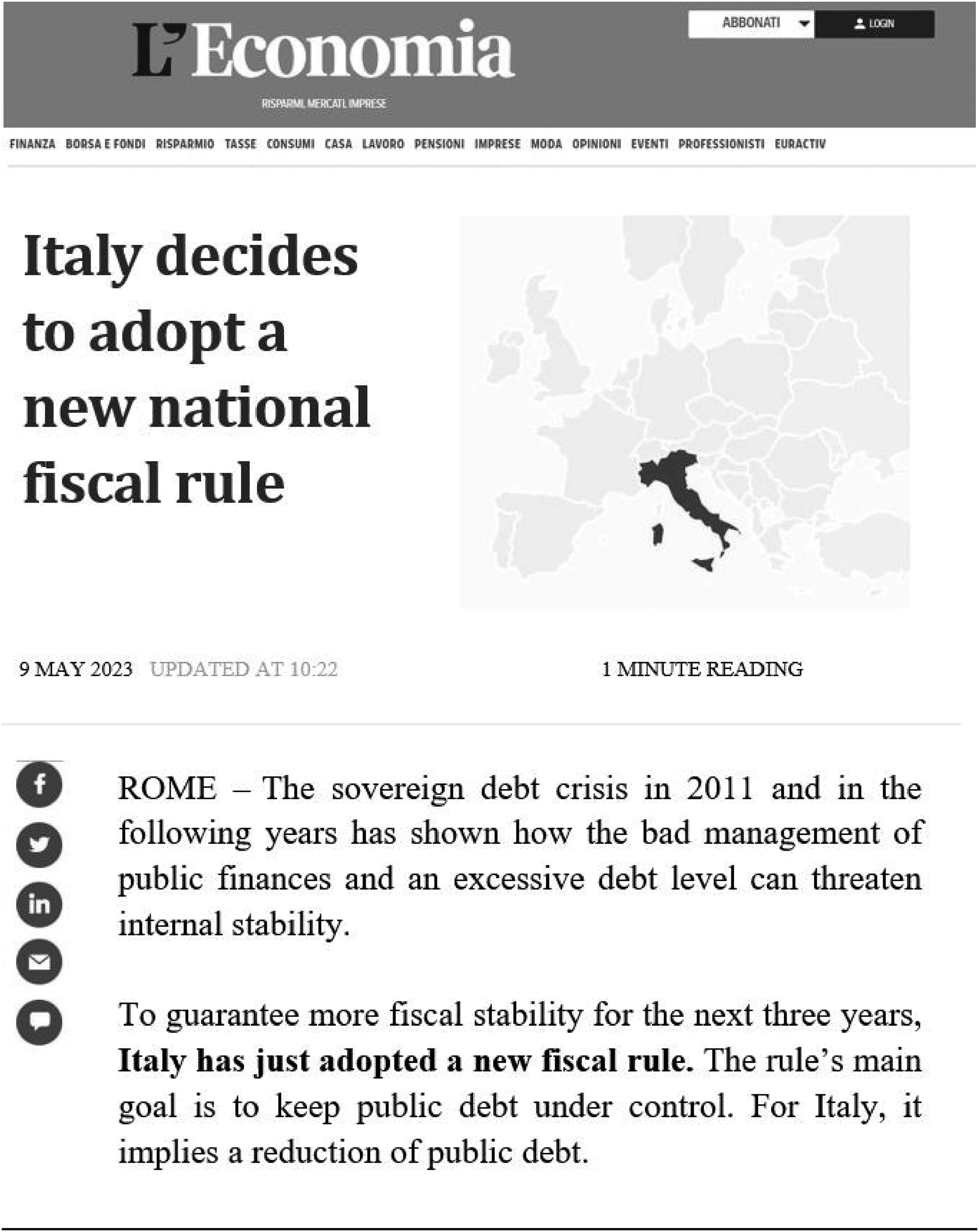
Domestic vignette. 10
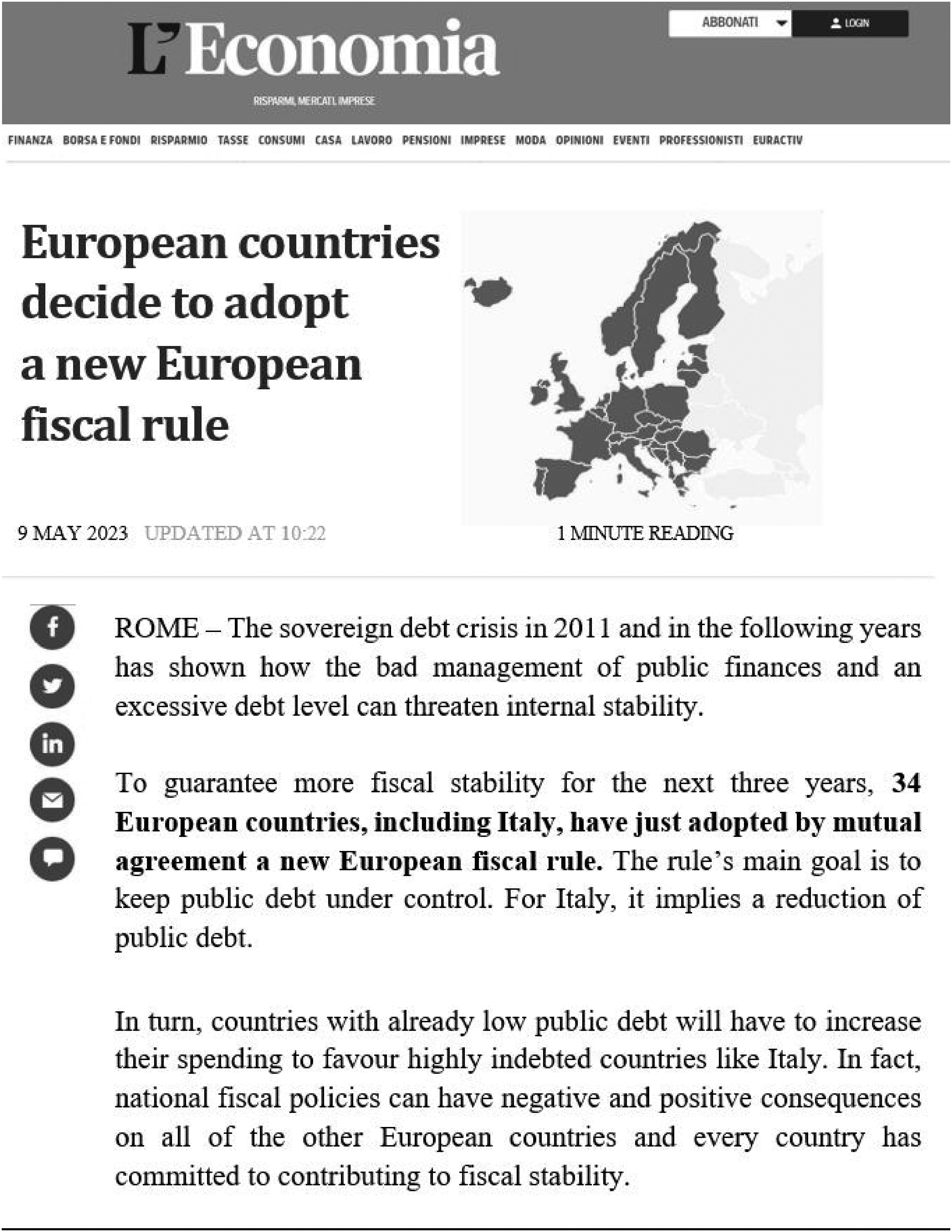
International vignette.
These questions are inspired by Bremer and Bürgisser (2023), who show that support for austerity depends on whether respondents are confronted with budgetary trade-offs and what type of trade-offs. I collect the three responses from each respondent and combine them in a single composite dependent variable to capture the multidimensionality of austerity.
The European level proves suitable for the experiment because European countries are economically integrated and, more importantly, it has already produced fiscal rules, while there are no institutions on a higher level able to constrain Italian politics in the same way. In aiming for a realistic yet hypothetical scenario, I referred to an intergovernmental agreement between 34 European rather than 27 EU countries. Any mention of the EU could prime respondents to think of existing EU rules, undermining the advantage of the experimental approach which guarantees that the rule is exogenous to citizens’ preferences. Presenting a plausible but hypothetical scenario effectively mitigates concerns about respondents integrating into their assessment prior information that cannot be controlled and would not be exogenous to the experiment. 5
In the same vein, I refrained from specifying the terms of the rule. Attempting to anchor people's understanding of the rule's terms with detailed legal requirements, such as numeric thresholds or debt reduction targets, could potentially prompt respondents in the domestic group to recall existing European rules, thereby diluting the distinctions between the international and the domestic group. Moreover, people may compare the rule's content with what they recall of existing rules. As an example, a debt ceiling of 120% of GDP may communicate the need for reducing public debt to those knowing Italy's debt is 155% of GDP, or that fiscal space has doubled to those recalling the current EU's limit of 60%. Furthermore, mentioning any tax increases and spending cuts would anticipate the trade-offs that are separately presented in the outcome questions. Hence, the vignette informs respondents that the new domestic/international rule requires Italy to reduce its debt without delving into the specifics of the criteria. Furthermore, specifying a short-term horizon of three years communicates that the burden of adjustment lies with the current generation rather than being deferred to future ones.
Unambiguously distinguishing among the specific underlying mechanisms behind the influence of international rules is challenging in an experiment, as these are not mutually exclusive and often overlap (Tingley and Tomz, 2020). However, as an exploratory analysis, I asked respondents Likert scale questions to investigate if they feel that Italy is morally obliged to comply with the new rule (logic of appropriateness) and reciprocate other countries’ efforts (reciprocity), if they are concerned about the consequences of non-compliance (logic of consequences), perceive the new rule as effective (effectiveness) or desirable (signalling). The effect of an international fiscal rule, if any, should be reflected in the variations observed in the responses between the two experimental groups.
Lastly, I decided not to design a pure control group. This study primarily centres on whether the international source of a fiscal rule affects domestic support similar to the demonstrated influence of international norms in various other domains. Compared to a scenario of discretionary fiscal policy, with no domestic rule, the international vignette would introduce a double treatment, as respondents would simultaneously learn about the existence of a rule that constrains fiscal space and about its international origin. Therefore, comparing a pure control with an international treatment group would only allow to investigate the effect of learning about a rule, but not its source. This would prevent any conclusion about the theoretical framework presented on the potential impact of an international rule on domestic support for austerity by multiple mechanisms operating at the international level.
Furthermore, the operationalisation of the outcome variables, support for domestic austerity specifically ‘to comply with the new rule’, necessitates a baseline wherein a rule exists but lacks an international dimension. Attempting to measure the same outcome in a hypothetical scenario devoid of any rule but characterised by unrestricted discretionary fiscal power would be impractical and, more importantly, lacks real-world relevance, given the prevalent budgetary constraints in European countries. Consequently, studying the impact of international fiscal rules in contrast to a scenario of fully discretionary spending would yield limited informative value and marginal added insight. 6 These points reinforce the choice of Italy as a case study. Being a pure control group absent, I opted for a country characterised by widespread opposition to austerity.
A timer in the survey ensured that participants spent at least 12 seconds reading the article before proceeding to the next question. The opening paragraph sets the context leading to the adoption of the new rule and elucidates why high public debt is problematic in the first place, designed to align people's initial understanding. The second paragraph consists of the experimental manipulation. In the international group, the additional third paragraph serves a dual purpose. First, it makes clear that the new rule requires every country to take action, ensuring reciprocity, rather than targeting only a few nations with high public debt levels concentrated in the South. Otherwise, given the North–South divide and the ‘frugal four’ countries’ notorious reluctance to share the debt burden in Europe, respondents might perceive the European rule as a dictation from the North of Europe to the South, or even as an attempt to punish highly indebted countries. Consequently, I mitigated the potential risk of respondents rejecting austerity measures a priori. Second, the paragraph highlights that preserving fiscal stability necessitates collective action and that, due to externalities, it is advantageous to address fiscal instability at the European level. Drawing a contrast with environmental policy, where the need for and the advantage of multilateral action to combat climate change are apparent, the effects of fiscal policies may be perceived as confined to national boundaries. This would dampen the effect of the international commitment treatment.
Heterogeneous treatment effect
The effect of international commitments may not be homogeneous, but rather contingent on individuals’ views of other members of an agreement. As pure randomisation does not guarantee that a treatment is randomly distributed across important moderators, I used block randomization (Cavaille, 2019). To measure respondents’ perceptions of the other countries involved in the European fiscal agreement, at the beginning of the survey respondents were asked to rate their opinion of the governments of the other democracies in Europe as ‘very favourable’, ‘somewhat favourable’, ‘somewhat unfavourable’ or ‘very unfavourable’.
Results
Figure 3 presents the distributions of the three outcome variables individually. Tingley and Tomz (2020) claim that respondents are more likely to support domestic action to comply with a rule when the costs of compliance are not too high. Tax-based austerity can be less popular (Bremer and Bürgisser, 2023) or carry larger electoral costs (Alesina et al., 2024) than spending-based austerity, suggesting that tax-based austerity is perceived by citizens as more costly. Figure 3 aligns with this interpretation as a majority of respondents tend to oppose reducing public debt if it entails tax hikes. Responses are heavily left-skewed in the question on the taxes trade-off (on the right), consistent with Bremer and Bürgisser's (2023) finding on the unpopularity of tax-based consolidation.
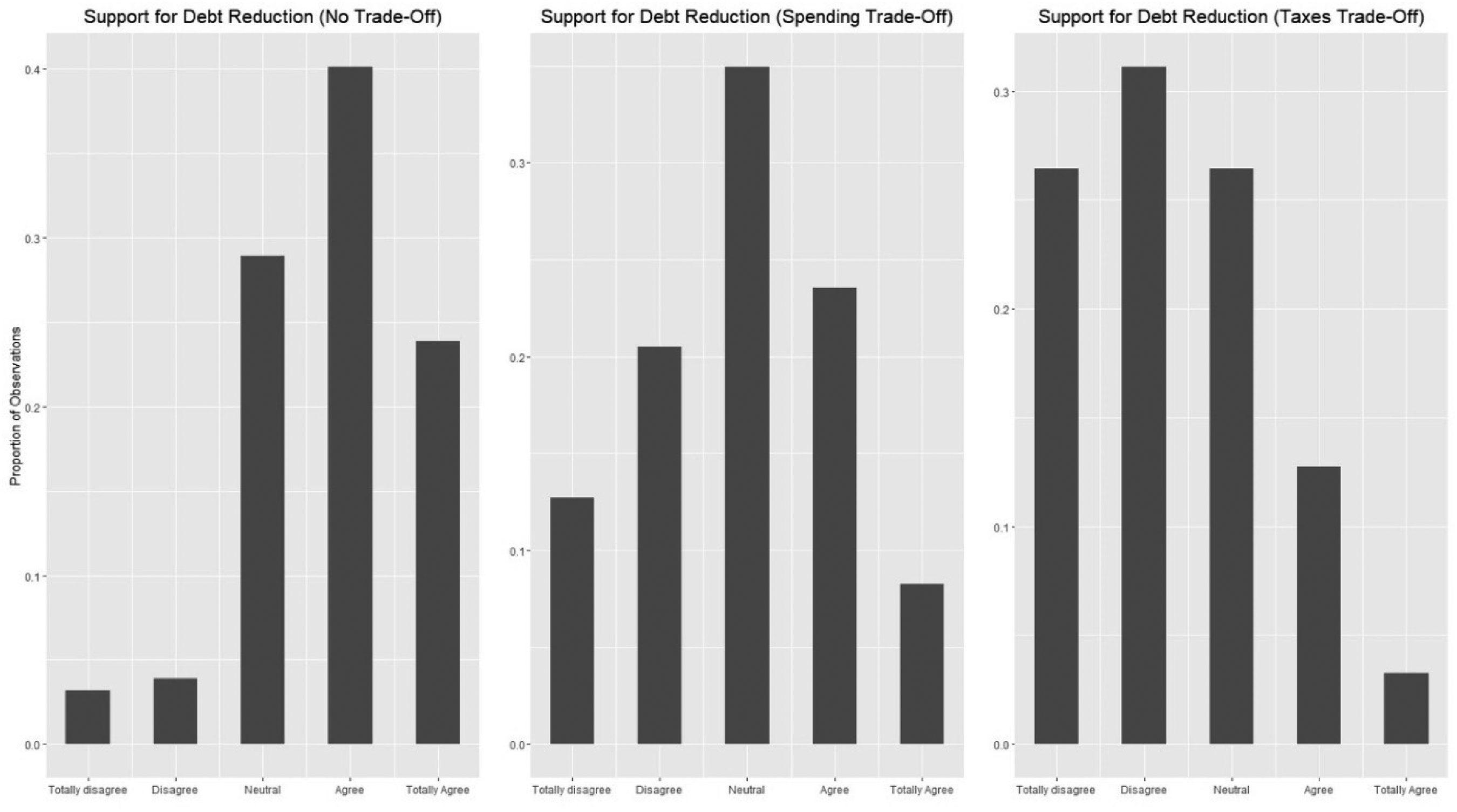
Distribution of responses to the survey experiment outcome questions: ‘to be compliant with the new fiscal rule, the government should reduce the level of public debt’ (left), ‘to be compliant with the new fiscal rule, the government should reduce the level of public debt, even if this implies cutting public spending’ (centre), ‘to be compliant with the new fiscal rule, the government should reduce the level of public debt, even if this implies increasing taxes’ (right).
The dependent variables are constructed from responses to the three outcomes questions, each assigned a value ranging from 0 (‘totally disagree’) to 4 (‘totally agree’), thus encompassing five possible values for each answer. These three variables are summed in a composite dependent variable for a more realistic measure of preferences towards austerity, capturing the multi-dimensional budgetary trade-offs of fiscal policy. All four variables are then rescaled to range from 0 to 1.
Figure 4 reports the coefficients of the international treatment on support for austerity measures, for the composite outcome variable as well as for each outcome question separately. For each dependent variable, higher values indicate higher support for austerity. Each model, estimated using ordinary least squares (OLS) (see the Online appendix for ordinal logistic regression) includes the following covariates: age, gender, region of residence, and educational attainment. Despite expecting a positive and significant effect of the international treatment, I do not find any statistically significant difference in support for austerity measures between the domestic and the international experimental groups.
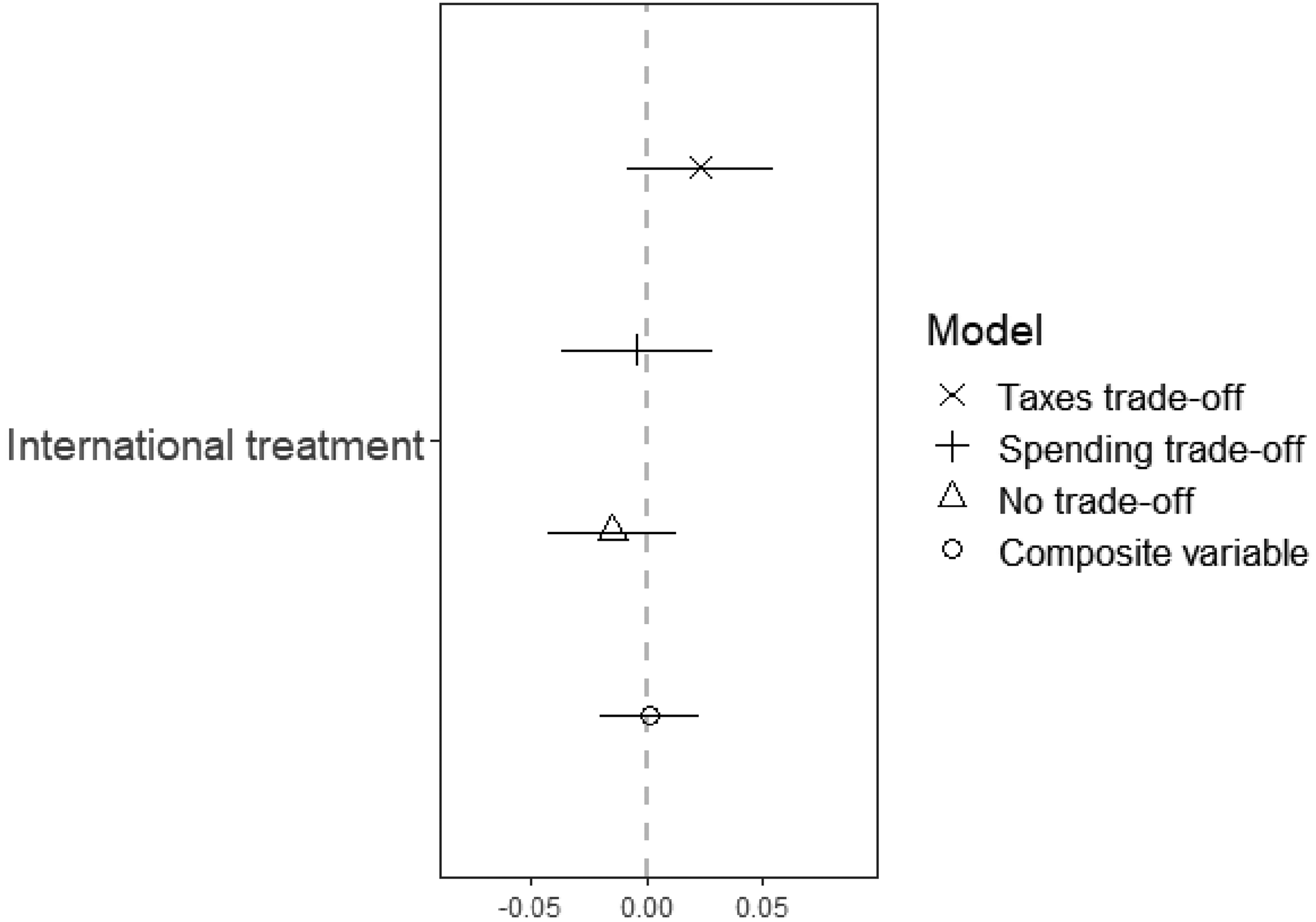
Results of OLS regression for the composite variable and each outcome question separately.
It is never possible to show that an effect is exactly zero, but that it is too small to be theoretically interesting (Lakens, 2017). I use equivalence testing to test whether the effect size falls within a range of values considered practically equivalent to the absence of an effect, called the equivalence range (Bauer and Kieser, 1996). Studies on the impact of international norms on public institutions find effects ranging from 0.05 to 0.20 (Chilton and Linos, 2021: 4). Therefore, I set the lower and upper equivalence bounds to −0.05 and 0.05 respectively. Based on the equivalence test, for both the composite and the three separate outcome variables it is possible to reject the presence of effects more extreme than −0.05 to 0.05. 7
The moderating effect of citizens’ opinion
Failing to find evidence in support of H1, I proceed to test H2 on the moderating effect of opinions about governments in other European democracies. The variable measuring respondents’ overall opinion has a statistically significant effect on support for austerity. As the opinion improves, support for austerity increases, especially when tax-based (see the Online appendix).
Figure 5 displays the marginal effect of the international treatment on support for austerity, measured by the composite variable, across varying opinions about other European governments. Full regression results, including for the other dependent variables, and different model specifications are presented in the Online appendix. As shown, evidence in support of H2 is limited. There is a borderline significant (at the 10% level) positive effect of the international treatment on support for austerity among those with a very favourable view of other European governments and a borderline significant negative effect among those with a very unfavourable view.
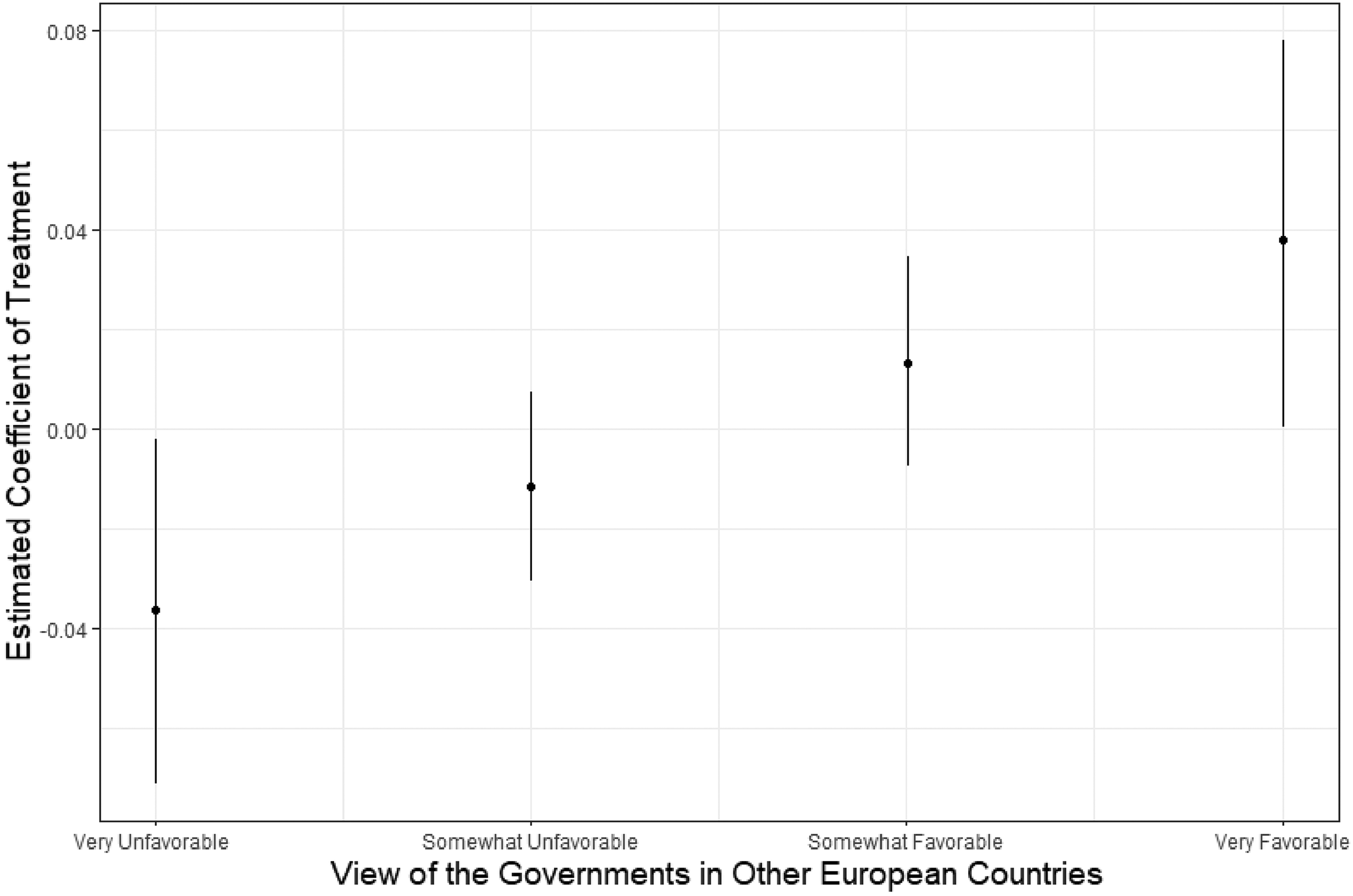
Effect of an international fiscal rule on support for austerity (as measured by the composite-dependent variable) by a linear measure of respondent's view of European countries, controlling for age, gender, region, and education.
Mechanisms
Post-treatment, I measured on a scale from 0 (‘totally disagree’) to 10 (‘totally agree’) whether respondents perceive reducing public debt as a moral obligation (logic of appropriateness), as a duty vis-à-vis other European countries (reciprocity), as desirable (signalling), effective (effectiveness), or if respondents differ in their perception of risks associated with not reducing public debt for Italy's credibility (logic of consequences). Even if there is no evidence for an overall effect of the international obligation on respondents’ support for austerity, if any effect existed, the international treatment would influence respondents’ perceptions through one or more of these mechanisms.
Using OLS, I regress the international treatment on each mechanism. Figure 6 shows the results (see the Online appendix for the full regression results). Starting from the signal mechanism, described as a key in the literature (Chapman and Reiter, 2004; Grieco et al., 2011; Linos, 2011), respondents generally agree that ‘right now reducing public debt is necessary’. However, I do not observe any significant influence of the rule's source on the perceived desirability of public debt consolidation. Similarly, while the rule is perceived as binding in both experimental groups, with respondents agreeing that ‘Italy has a moral duty to reduce its level of public debt’, there is no significant difference between groups. On the contrary, respondents disagree with the statement ‘Italy can effectively reduce its level of public debt’, indicating scepticism regarding Italy's ability to reduce its debt, but regardless of the experimental group. Insignificant is also the effect of the international treatment on the perceived risks for Italy's credibility associated with non-compliance.
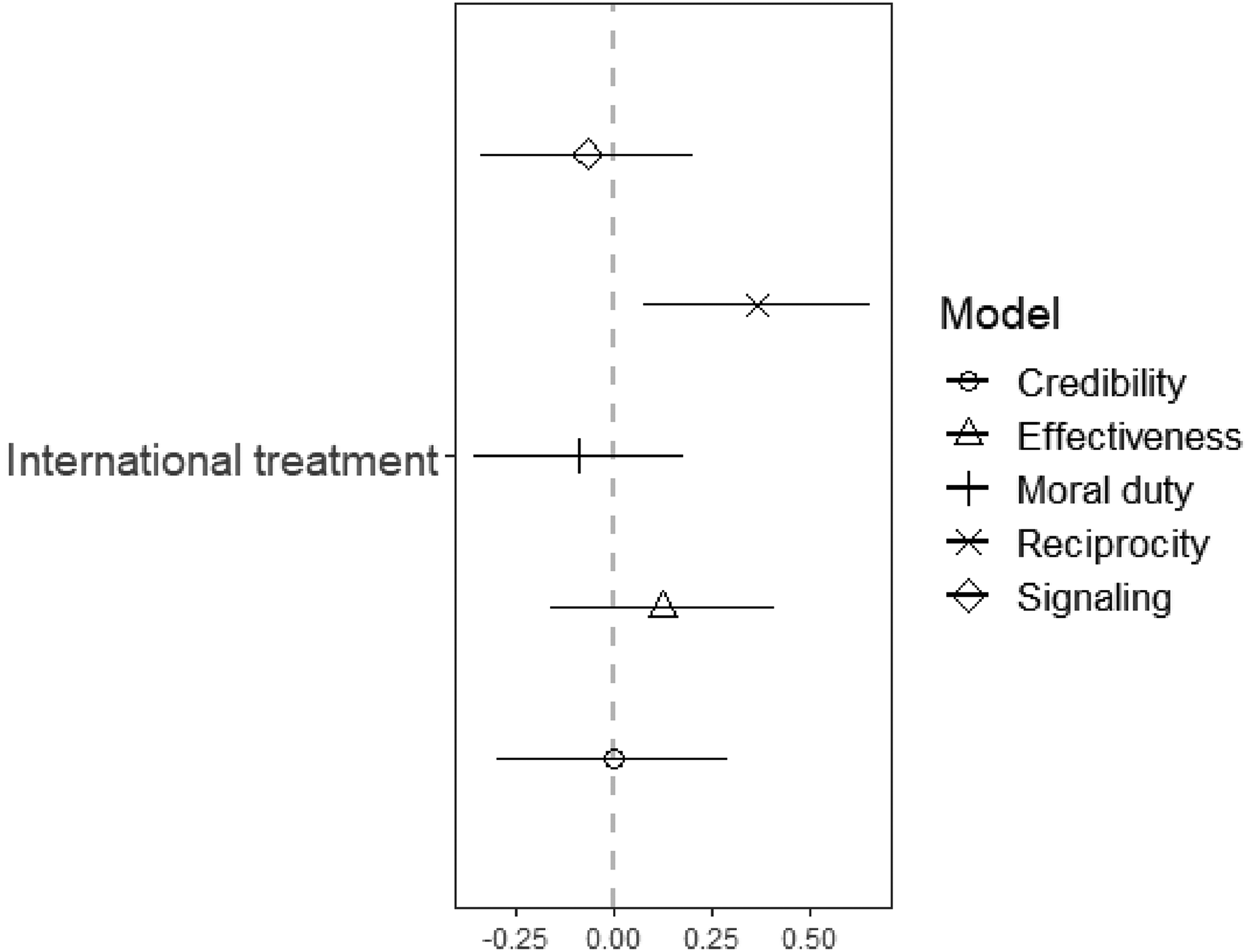
Results of five separate OLS models estimating the relationship between the international treatment and each of the five mechanisms, controlling for age, gender, region, and education.
The evidence collected is consistent only with the reciprocity mechanism. Respondents in the international treatment group are more likely to agree that Italy has a moral obligation towards other European countries to reduce its public debt. This result is interesting given that the literature is still debating in which direction and whether international pledges affect reciprocity (Tingley and Tomz, 2020: 18–19) and might be due to the emphasis on reciprocity in the fictitious newspaper.
Discussion and conclusion
Previous literature shows that learning about international legal obligations makes citizens up to 20% more supportive of policies that ensure compliance with the agreed terms (for a review, see Chilton and Linos, 2021). Citizens are more likely to support costly domestic action if it is required by an international commitment, but is it the case when costly action means implementing austerity, which directly hurts citizens’ pocketbooks? In this study, the evidence collected through a survey experiment in Italy does not corroborate the presence of a causal link between restrictive European fiscal rules and popular support for austerity.
Rather than a genuine absence of effect, the lack of increased support for austerity in the international experimental group may be explained by pre-treatment effects. Respondents are not always blank slates as researchers assume (Druckman and Leeper, 2012) but might have been exposed to earlier information on domestic and European rules and recall it during the experiment. Anticipating this issue, at the beginning of the survey I asked respondents to self-assess their fiscal policy knowledge. There is no evidence that prior knowledge affects the influence of the international treatment on public support for austerity. 8
Notably, I find evidence of heterogeneous effects tied to respondents’ views of other European democracies’ governments. Respondents holding a favourable opinion are more inclined to endorse austerity. Among those respondents, the international treatment has a positive effect. This effect resonates with the claim that the influence of an international pledge is stronger among more cosmopolitan citizens holding a favourable opinion of their foreign counterparts (Linos, 2011). While this finding suggests that international fiscal pledges can influence certain segments of society, it has severe limitations. The effect is significant only at the 10% level and disappears when isolating support for spending-based and tax-based austerity.
I embedded the fiscal rule within a European rather than EU framework, due to design constraints outlined in the Research Design section. However, in the specific EU context attitudes towards EU integration may be a powerful moderator. The EU increasingly relies on public support, particularly when policies are as polarised as austerity. The shift from the acquiescent public of the years of ‘permissive consensus’ to the public contestation of the era of ‘constraining dissensus’ means that rules produced by the EU may encounter public opposition (Hooghe and Marks, 2009). However, if Euroscepticism moderates the influence of European rules, the effect should move in the same direction as tested in H2, as both unfavourable attitudes towards the EU and other European countries display less openness to regional integration and higher nationalism.
Moreover, Eurosceptic citizens should oppose the European fiscal rule itself, rejecting regional integration and the delegation of sovereignty in fiscal policy. Yet, not only support for the rule is high in both experimental groups and statistically indifferent, but I also find that respondents are significantly more likely to recognise the legitimacy of fiscal rules when originated from the European level. 9 I analysed support for the rule and perceived legitimacy when testing the local democracy theory hypothesis that public support decreases as the distance from the policymaking centre increases (Berezin and Díez-Medrano, 2008). The results, inconsistent with this alternative hypothesis, suggest instead a welcoming attitude towards measures addressing high public debt and reveal that despite resistance to austerity, European-level fiscal rules mandating austerity do not lead to backlashes against forms of European policymaking.
Concluding that international fiscal rules do not consistently boost public support for restrictive fiscal policies cautions against generalising the existing theoretical framework across all policy areas. Specifically, austerity differs from international norms in other areas investigated in previous literature because it directly and visibly affects citizens’ economic well-being, has distributive consequences, and is highly polarising. These distinct characteristics of austerity may affect the influence of international fiscal norms.
Unpopularity and heightened polarisation have marked both spending-based and tax-based austerity in Italy (Baccaro et al., 2021; Bremer and Bürgisser, 2023), possibly influenced by three decades of enduring austerity, unique to Italy in its severity among European countries (Storm, 2019). Italy may therefore appear as a standing-out country with crystallised anti-austerity preferences. However, similar repercussions of austerity – increased living costs, rising poverty, and heightened inequality – have been observed in other European countries such as Spain, Greece, and Portugal, culminating in massive anti-austerity protests (Perez and Matsaganis, 2021). While these are the usual suspects, austerity has proved unpopular in Nordic countries as well (Talving, 2017). Further research should assess the implications of European fiscal integration on public opinion in countries where austerity is less criticised and has proved more effective in stabilising public finances than in Italy. Moreover, future research should disentangle the effects of international norms on various tax-based and spending-based austerity plans, given that popular reactions to austerity vary across different designs.
Amidst burgeoning military expenditures, limited fiscal space, and mounting pressure to adhere to stringent fiscal reforms, austerity remains a looming spectre on the political horizon of Europe. Addressing a pressing need for further research on the influence of European fiscal policymaking on austerity's political feasibility, this paper timely underscores that stricter rules are unlikely to help politicians secure domestic support for a fiscally conservative agenda.
Supplemental Material
sj-docx-1-eup-10.1177_14651165241271048 - Supplemental material for International fiscal rules and domestic support for austerity
Supplemental material, sj-docx-1-eup-10.1177_14651165241271048 for International fiscal rules and domestic support for austerity by Alessia Aspide in European Union Politics
Supplemental Material
sj-zip-2-eup-10.1177_14651165241271048 - Supplemental material for International fiscal rules and domestic support for austerity
Supplemental material, sj-zip-2-eup-10.1177_14651165241271048 for International fiscal rules and domestic support for austerity by Alessia Aspide in European Union Politics
Supplemental Material
sj-zip-3-eup-10.1177_14651165241271048 - Supplemental material for International fiscal rules and domestic support for austerity
Supplemental material, sj-zip-3-eup-10.1177_14651165241271048 for International fiscal rules and domestic support for austerity by Alessia Aspide in European Union Politics
Footnotes
Acknowledgements
I am sincerely grateful to the four anonymous reviewers and the editor for their insightful comments. Additionally, I thank Ben Ansell, Björn Bremer, Cecilia Ivardi Ganapini, Matthew Di Giuseppe, and Kathleen J Brown for their precious feedback on previous drafts of this manuscript. I am also indebted to the participants of EPSA's 13th annual conference and ECPR General Conference 2023 for their valuable input.
Funding
The author disclosed receipt of the following financial support for the research, authorship, and/or publication of this article: This work was supported by the HORIZON EUROPE European Research Council (Grant No. 852334).
Data availability statement
Replication Data for this article can be found in Harvard Dataverse at https://doi.org/10.7910/DVN/BHG3WX.

Supplemental material
Supplemental material for this article is available online.
Notes
References
Supplementary Material
Please find the following supplemental material available below.
For Open Access articles published under a Creative Commons License, all supplemental material carries the same license as the article it is associated with.
For non-Open Access articles published, all supplemental material carries a non-exclusive license, and permission requests for re-use of supplemental material or any part of supplemental material shall be sent directly to the copyright owner as specified in the copyright notice associated with the article.
