



Abstract
This article provides an analysis of the temporal development of interactions within SOLVIT, the European Union's problem-solving internal market network. Adopting an agency-based, rationalist approach, we hypothesize that temporal development depends on cross-border interdependence, institutional homogeneity, SOLVIT centre caseload and Brexit. Testing these hypotheses, we control for members’ resources, perceptions of SOLVIT and endogenous network dynamics. The ensuing model is tested using stochastic actor-oriented models on interactions in 2011 and 2018, thus yielding a panel-data analysis. Our main finding is that SOLVIT interactions are remarkably stable over time. This is mostly due to the strong effect of interdependence, which is rather constant over time. Strikingly, we find no effect for institutional homogeneity, case load and Brexit. In sum, our analysis reveals that European Administrative Networks can develop into stable patterns of interactions, driven by rather structural features of interdependence.
Keywords
Introduction
The European Union (EU) is commonly depicted as a system of indirect implementation: member states are responsible for the transposition, application and enforcement of supranational law within their territory. For quite some time, indirect implementation was considered the default model, notable exceptions being competition policy and merger control (Hofmann et al., 2011: 11–13). Yet, indirect implementation has proven untenable in face of widespread non-compliance by the member states and the Commission's limited personnel resources and inspection powers. To fill the ensuing gap in the EU regulatory state (Eberlein and Grande, 2005; Maggetti, 2014), the EU institutions have pieced together a European Administrative Space (EAS): an area in which national administrations jointly exercise powers delegated to the EU in a system of shared sovereignty (Hofmann, 2008: 671). The key objective of the EAS is to strike a balance between supranational legislation and national control over its implementation. Given this compromise character, an important topic of analysis is the temporal development of the EAS and its key components – networks and agencies (Levi-Faur, 2011; Mastenbroek and Martinsen, 2018; Mathieu, 2020; Trondal and Bauer, 2015). The EAS is constantly ‘changing and reinventing itself’ (Levi-Faur, 2011), which warrants in-depth analysis (Boeger and Corkin, 2017: 981). This process of order formation (Trondal and Bauer, 2015) has attracted ample academic attention. Much of this work has concerned European Administrative Networks (EANs): ‘networks that consist of institutional representatives of national executives – primarily departments and/or agencies – with tasks in the realm of national implementation or enforcement of EU policies’ (Mastenbroek and Martinsen, 2018: 423). This innovative institutional form has attracted quite some academic attention, because of its explicit compromise nature: EANs are intermediate solutions between central regulation and member state control. Because EANs serve the needs of both supranational actors (the Commission or agencies) and national governments, they can be seen as double-hatted agents that may be confronted with opposing steering signals, just like the agencies that compose them (Eberlein and Newman, 2008; Egeberg and Trondal, 2009). As a consequence, EANs are claimed to fall prey, ultimately, to processes of centralisation, in the sense that they are replaced by agencies (Héritier, 2007) or subjected to strengthened oversight by the Commission (Mathieu, 2020). Others, however, have noted that many EANs are remarkably resilient (Boeger and Corkin, 2017). The networked character of EANs often endures, even if they are replaced by new, seemingly more centralised institutional forms like EU agencies (Boeger and Corkin, 2017; Levi-Faur, 2011; Thatcher and Coen, 2008).
Strikingly, the literature's focus on the development of institutional forms within the EAS, has come at the expense of analyses of development within institutional forms, such as EANs. With the exception of Vantaggiato (2022) and Schrama et al. (2024), we lack systematic empirical work on the question of intra-network development. A key reason for this gap in research is that studying this type of network development requires solid information on interactions gathered at various points in time. Such panel data are difficult to collect, as they require long-time investments and research agendas. Accordingly, we are faced with an important gap in our understanding of EAN development and impact. Firstly, adequate intra-network development is an important prerequisite for effectiveness. Networks that successfully adjust to institutional pressures, either exogenous or endogenous in nature, may be more effective than networks that do not adjust to a changing environment. Secondly and relatedly, networks consisting of stable interaction patterns are difficult to break down, especially when powerful members have a stake in them (Boeger and Corkin, 2017). They can develop into a ‘horizontal self-sustained equilibrium’ (Jordana, 2017) that averts the ‘ever-present threat of centralization’ (Boeger and Corkin, 2017: 980) and provides an alternative to agencies (Thatcher, 2011). Thus, the themes of the development of and within networks are intimately-related.
This article addresses the topic of intra-network development by analysing and explaining the temporal development of interactions within SOLVIT, the EU's flagship internal market network. SOLVIT is a network of national administrations in the field of the internal market, in which they seek to solve cross-border problems of misapplication of internal market law. These problems are identified by citizens or business in the EU that want to do business, to live or to work in another member state (European Commission, 2024). To solve these problems, so-called national SOLVIT centres in the member states concerned seek to solve the problem on behalf of these businesses or citizens through a formalised problem-solving procedure – hence the name SOLVIT. On top of this formal institutional infrastructure for solving specific problems of misapplied internal market law, informal interactions take place in the network: SOLVIT members interact to engage in general discussions on SOLVIT's operations and exchange ideas and best practices on internal market issues with one another. 1
These informal interactions were mapped out by a previous study (Hobolth and Martinsen, 2013). By repeating this survey, we are able to go beyond a ‘snapshot’ analysis of EAN functioning (Vantaggiato, 2022) and provide a rather unique panel data analysis of network development (Hennig et al., 2012: 55). Selecting SOLVIT provides us with a chance to complement the first longitudinal social network analysis (SNA) study on EAN development by Vantaggiato (2022). This latter study focuses on the effect of changing network functions on interaction patterns – an argument deduced from the broader literature on institutional development within the EAS (e.g. Boeger and Corkin, 2017; Mathieu, 2015). SOLVIT, by contrast, is an interesting case because it is relatively mature: its functions and operations have been rather constant over time. In addition, it operates in one of the oldest, most institutionalised EU policy areas, the internal market. However, while SOLVIT's mandate has stayed relatively constant over time, network dynamics may shape the development of SOLVIT's inner workings. The relative maturity allows us to trace more subtle drivers of endogenous institutional development, in addition to a key exogenous factor: the impending exit of the United Kingdom (UK), a central player in SOLVIT. Finally, SOLVIT merits our attention because it is the key tool for dispute resolution in the internal market.
To explain the temporal development of interaction patterns in SOLVIT, we combine insights from social network theory and previous academic work on EAN interactions. Crucially, we argue that networks may develop stable interactions over time, in line with the stability of cross-border interdependence (H1) and institutional similarities (H2) – two key drivers of interactions in EANs. Yet, changes in member states’ perceptions of problem pressure (H3) and the exit of key institutional players (H4) are hypothesized to lead to changes in network interactions. While testing these four hypotheses, we control for members’ administrative capacity, members’ perceptions of the importance of SOLVIT and the autonomous impact of network structure. This latter variable has two aspects: networks’ innate tendency to become denser over time and the closing of triads.
To test our hypotheses, we examine the changes in ties constituting informal interactions between SOLVIT members between 2011 and 2018. We do so using SNA and stochastic actor-oriented models (SAOMs), a method for analysing network panel data. As indicated by our analysis, SOLVIT indeed displays rather stable interaction patterns, which are contingent on the structural interdependence between its members. These interactions also prove robust to an imminent threat: the exit of the network's most central player, the UK. Our findings thus show that EANs have the potential to develop into durable features of the EAS.
The case of SOLVIT
SOLVIT was established in 2002, as a ‘problem-solving’ network with the specific task to solve cases where internal market law has been misapplied by national authorities (Schrama et al., 2024; Vifell and Sjögren, 2014). Applying Slaughter's (2004) network typology, SOLVIT is an enforcement network, given its tasks in promoting the correct application of EU law in other member states. It does so primarily by enabling the bilateral resolution of cases of misapplication of EU internal market rules (Schrama et al., 2024). Let us consider an example of a SOLVIT case. A British company manufacturing medical scales wanted to sell its product in France. Even though these scales were compliant with EU rules, the French authorities required the company to perform additional tests before being allowed to the French market. After a case was filed, SOLVIT was able to help the British company to get the scales approved in France, in line with EU law. Other examples include physicians and nurses with EU citizenship awaiting professional recognition so that they can practice their occupation in another EU member state. Such delays in recognition have serious consequences for individuals as they jeopardise their cross-border employability, just as other cases of misapplication may restrict the free movement of services, goods, or capital.
The bilateral resolution process in such cases functions as follows. If EU citizens or businesses find that EU law is not applied correctly in another member state, they may refer the case to the SOLVIT centre in the member state where they reside or are established. This SOLVIT centre then is to contact the SOLVIT centre in the member state where the alleged misapplication took place. As a next step, the two SOLVIT centres must examine the case. They are jointly responsible for case-handling. Representatives of the two SOLVIT centres thus must interact when a case is filed with them.
Alongside these formal case-based interactions, SOLVIT members engage in more informal interactions (Schrama et al., 2024). While SOLVIT provides members with a formal institutional infrastructure for solving potential problems in the implementation of EU internal market law, it also facilitates and inspires informal interaction among SOLVIT centres to discuss matters beyond specific cases of misapplication, such as EU internal market developments or the organisation and functioning of SOLVIT. For instance, in 2020 fourteen member states jointly provided input for the Commission's long term action plan on implementation and enforcement, arguing that the Commission should use SOLVIT data to pursue structural and recurrent cases of misapplication and thus fill the gap between SOLVIT and the infringement procedure (Belgium et al., 2020). In 2021, furthermore, a thinktank of SOLVIT members from 11 member states developed recommendations on the future of SOLVIT (National Board of Trade Sweden, 2022).
Such informal interactions among SOLVIT centres can take various forms. Firstly, they may interact bilaterally. For instance, members may call with their counterparts or visit them with a delegation (personal communication with SOLVIT representative, June 2018). Secondly, SOLVIT members may meet in subgroups to put matters concerning SOLVIT or the internal market more broadly on the agenda of the Commission (National Board of Trade Sweden, 2022). An example of such interactions was the establishment of a working group in which a number of members jointly prepared a proposal to improve enforcement of internal market law, as revealed in a personal communication with a SOLVIT representative in June 2018). Another example is a working group within SOLVIT discussing how to strengthen SOLVIT (National Board of Trade Sweden, 2022: 7). Finally, SOLVIT regularly organises network meetings and workshops, aimed at exchanging information, best practices or advice on SOLVIT governance and internal market issues. For example, one such a workshop aimed to spread a best practice by the Swedish SOLVIT centre: the development of an internal market guide for its national authorities to improve compliance with internal market law (Vifell and Sjögren, 2014: 472). In sum, on top of the formal case-based resolution dynamics, a more informal network has developed over time, which is central to our study of interactions taking place within the network.
In formal institutional terms, SOLVIT is a rather stable and mature network. Ever since its inception in 2001, the network has had the same mandate: the bilateral resolution of cases of alleged misapplication of internal market law brought by individual citizens or business. As has been shown by a steady flow of evaluations, discussion papers and action plans published over the years, this original mandate still is firmly in place. Equally so, the procedure for addressing these matters has been constant. Improvements – both planned and realised – are mostly of an operational nature, for example, increases in resources or staffing, improved training and better promotion of SOLVIT – especially among business (Kokolia, 2018; Lottini and Drake, 2016). The background to this stability in mandate and functions is with SOLVIT's ‘unquestionable’ effectiveness (Lottini and Drake, 2016: 135). SOLVIT is seen as an effective tool (Egan and Guimarães, 2017: 305; Hobolth and Martinsen, 2013). Instead of suggesting centralisation and increasing supranational control, a dynamic seen for other EANs, the European Commission (2020: 13) aims to develop SOLVIT into the default tool for single market dispute resolution. However, while SOLVIT's mandate has stayed relatively constant over time, there is potential for change in a behavioural sense. As reflected in the informal interactions between SOLVIT centres, the network is still in development from a member perspective. Different working groups emerge to discuss such matters on a more informal basis and dynamics such as increasing caseload and change in membership may affect the development of the network's inner workings. This combination of SOLVIT's stable mandate and procedures with the potential for change in network interactions allows us to study the effects of behavioural, agency-based drivers of interactions, which are discussed in the next section.
Theory and hypotheses
In order to explain the temporal development of network interactions, we focus on the ties that compose the network: informal exchanges between two network members (nodes). Even in case of strongly organised networks, interactions between members of EANs tend to vary: some members are more active, central or influential than others (Maggetti and Gilardi, 2011). The reason for this variance is that network members are not able to maintain relations with all of their counterparts (Boeger and Corkin, 2017; Mastenbroek et al., 2022; Van Boetzelaer and Princen, 2012; Vantaggiato, 2019), as is the case in social networks more generally (Leifeld and Schneider, 2012). Accordingly, network members must make conscious decisions to invest time and resources into developing and maintaining relations with others.
We adopt an agency-based, rationalist perspective on tie formation, assuming that partner selection is a rational decision, contingent on the incentives of network members (Boeger and Corkin, 2017: 975; Efrat and Newman, 2018; Maggetti and Gilardi, 2011; Martinsen et al., 2021a, 2021b; Mastenbroek et al., 2022; Mathieu, 2015; Van Der Heijden, 2019; Vantaggiato, 2019). In specifying these incentives and accompanying hypotheses, we distinguish two types of variables: actor attributes and relation characteristics (Ingold and Fischer, 2014; Vantaggiato, 2019). Crucially, some of these characteristics are stable over time: the reasons that gave rise to tie formation then continue to exist (Thelen, 2003). Other characteristics, however, may change over time and spur changes in interactions, for instance in times of exogenous shocks (Schrama et al., 2024) or domestic political change (Mastenbroek et al., 2022; Mathieu, 2020: 994; Zaun, 2017). Furthermore, we account for the autonomous impact of network structure on tie formation (Ingold and Fischer, 2014: 93): the structure of interactions at a certain point in time will have an impact on later interactions.
Hypotheses on network stability
A first factor driving interactions is rather stable over time and operates at the level of ties: the degree of interdependence between member states in the policy sector regulated (Van Boetzelaer and Princen, 2012; Vantaggiato, 2019). The more a member state depends on another member state for the realisation of its policy priorities, the higher the need to interact with it, for instance by ensuring common norm-setting, problem-solving, implementation or enforcement of common policies. In many policy sectors, such patterns of interdependence are rather structural in nature, as they are contingent on more or less immutable factors. For instance, countries sharing a border typically are more interdependent than non-bordering countries, due to flows of citizens, goods, capital or services. In the realm of the internal market, which is central to our article, this is also the case: interactions patterns are partly contingent on trade and citizen mobility stemming from a member state, which is likely to be rather stable over time. Similarly, interactions in the realm of the internal market are more likely to occur between border countries, which are stable features as well. These durable interdependencies between member states will lead to durable network interactions and thus result in rather stable interactions over time.
Patterns of cross-border interdependence drive member states’ interactions in a European Administrative Network.
A second hypothesis also operates at the level of ties. As demonstrated by Vantaggiato (2019), national units that are a part of EANs are likely to interact with like-minded peers: network members that are institutionally similar to them. EAN members seek out peers coming from comparable institutional contexts as they face similar challenges (Lazega et al., 2017; Papadopoulos, 2018, Van Der Heijden, 2019) and are more likely to understand each other (Efrat and Newman, 2018). This homophily effect has been evidenced across the board by studies of social networks (Cranmer and Desmarais, 2011; Ingold and Fischer, 2014; McPherson et al., 2001) and corroborated by several studies on EANs (Efrat and Newman, 2018; Maggetti and Gilardi, 2011; Martinsen et al., 2021a, 2021b; Mastenbroek et al., 2022). Given the relative stability of institutional features (Thelen, 2003), this variable results in rather stable interactions over time. This leads us to hypothesize the following:
Member states’ institutional similarity is likely to drive member states’ interactions in a European Administrative Network.
Hypotheses on network change
The two previous hypotheses point towards stable interactions. Yet, network interactions may also have a more dynamic component. The key to this is with actors’ incentives to engage in network interactions. Crucially, EANs enable member states to solve common problems, obtain best practices, pool capacities or seek to affect other members’ behaviour. However, member states’ need for these functions may fluctuate over time, depending on sudden changes in perceived problem pressure. This problem pressure is highly policy-specific. An example is the sudden influx of large numbers of refugees in 2015/2016, which incentivised member states to become more active in the European Migration Network, exchanging information on EU policy implementation with each other (Mastenbroek et al., 2022). Although the area of internal market between 2010 and 2018 has not been characterised by such dramatic events affecting case load, members’ case load in SOLVIT varies substantially over time (European Commission, 2021). Hobolth and Martinsen (2013) showed how the number of SOLVIT cases enables network members to expand their problem-solving capacity and to learn from one another. So, increases in the number of cases requiring cross-border resolution are expected to increase the need to interact in the network. Vice versa, decreases in caseload may lower the need to interact in the network.
Increases in member states’ caseload have a positive effect on their activity in a European Administrative Network.
Exogenous shocks to a network, furthermore, may also affect network interactions (Provan and Lemaire, 2012). A key exogenous shock that can affect member states’ networking strategies is the exit of a central player (Bakker et al., 2012). This is a highly relevant factor for analysing the development of SOLVIT interactions: the tumultuous Brexit negotiations are likely to have posed a veritable shock to the network, given the strong centrality of the UK (Hobolth and Martinsen, 2013; Schrama et al., 2024). Previous studies have shown how the UK has lost significance in network interactions among Council members rapidly since the 2016 Brexit referendum (Huhe et al., 2018; Johansson, 2021). The uncertainty posed by the impending Brexit is likely to have put strain on interactions within SOLVIT as well. Not only was the UK among the best performing SOLVIT centres with regard to solving cases of misapplication of internal market law, but it was also the centre most turned to for the exchange of views and best practices on all SOLVIT-related matters (Hobolth and Martinsen, 2013). Such a shock to the core of the network may have a huge impact on the structure of the network to the extent that it may disintegrate (Albert et al., 2000; Borgatti et al., 2014; Duijn et al., 2014; Provan and Lemaire, 2012). This is especially the case when central, powerful actors leave the network, such as the UK (Lecy et al., 2014; Provan and Lemaire, 2012). Networks with a skewed degree distribution, that is networks displaying a core of actors with many connections and a majority of peripheral actors with few connections, are particularly vulnerable to disruption. In sum, the impending or effectuated exit of a highly central actor may negatively impact network cohesion and even cause the network to collapse (Albert et al., 2000; Borgatti et al., 2014; Provan and Lemaire, 2012). At the same time, institutional arrangements like networks may prove resilient to historic breakups (Thelen, 2003). In the case of EANs, the question is whether other central players, such as Germany and France for SOLVIT, are able to exercise their influence in the network and to prevent the collapse of the network by strengthening their position in the network. Such actors are expected to respond to the UK's exit by investing in replacing lost ties with new ones, and assuming the exiting player's role in the network (Schrama et al., 2024). Accordingly, changes at the level of interaction may positively reinforce a network's longer term resilience to exogenous shocks.
The impending exit of a central player within a European Administrative Network will incentivise other central players to build new ties.
Finally, we control for three endogenous factors: capacity, perceived importance and autonomous impact of network structure on interactions. First, network interactions require the investment of resources and incur transaction costs (Leifeld and Schneider, 2012; Vantaggiato, 2019). Crucially, the required resources should be in balance with a member state's ambition for the network: the stronger its needs for interactions, the more capacity is required, in terms of personnel and required expertise. In turn, sufficient resources enable member states to engage in interactions, resulting in increased tie formation over time. Second, we take into account the extent to which SOLVIT centres value the network. Member states that perceive the network as more important for information exchange, capacity building and improving the application and legal implementation of Internal Market rules, are more likely to invest their resources in network interactions. Third, we control for the autonomous impact of network structure on tie formation (Ingold and Fischer, 2014: 93). To begin with, networks have an innate tendency to become denser over time (Eberlein and Newman, 2008). Socialisation and training develop domestic administrative capacity so that networks will foster trans-governmental collaboration. Vantaggiato (2022) defines these collaborative relations as social capital and found that through the development of this social capital EANs interactions become more densely knitted over time. Another autonomous effect is the overall tendency of network actors to close triads – a widely reported pattern in social networks (Snijders et al., 2010: 47), policy networks (Ingold and Fischer, 2014: 93) and European regulatory networks (Vantaggiato, 2019). Transitivity can be considered the social glue that holds networks together. Simply put, this effect captures the pattern of SOLVIT centres being more likely to interact with those centres with which they have partners in common.
Method
Social network analysis and stochastic actor-oriented models
To study the drivers of network governance, our primary units of analysis are the bilateral ties that connect EAN members. In accordance with social network research, we assume that the development of interactions is neither merely the result of the individual attributes of the network's members, nor solely the result of the characteristics of the network as a whole (Borgatti et al., 2014). We argue that it is precisely the interplay between individual differences and network constraints that accounts for the way a network develops over time. SNA allows us to study agency and structure simultaneously and brings the bilateral interactions among network members to the front of our analysis.
More specifically, we employ SAOMs (Snijders and Pickup, 2017) to test our hypotheses regarding the evolution of SOLVIT. SAOMs enable us to determine what shapes the network by evaluating network interactions at different points in time. Panel data are difficult to gather for such networks, but offer the most reliable way to ascertain network dynamics over time (Hennig et al., 2012: 55). We use a SAOM to model the change process that led to the network we observed in 2018, conditioned on the network as we observed it in 2011. We examine the effect of relational effects (structural interdependency and homophily), actor effects (increased problem pressure), exogenous shocks (Brexit) and network dynamics (increased density), hypothesized to drive the evolution of network interactions between 2011 and 2018. We model these effects stochastically and estimate the parameters that affect the probability of each network member choosing to (a) add a certain contact; (b) drop a certain contact; or (c) change nothing at all. The parameters are estimated with a Markov model, treating panel data as repeated snapshots of a process that evolve in continuous time (Snijders and Pickup, 2017). The modelling of these effects is done using the RSiena package, version 1.3.0.1 (Ripley et al., 2011). A well-fitted model allows us to examine what drives the evolution of interactions within SOLVIT.
Data collection
A key hurdle for conducting cross-time SNA is data collection. For the most part, network studies rely on surveys of self-reported bilateral ties among network members. However, more so than in other types of surveys, the response rate for a reliable SNA is crucial (Kossinets, 2006). Furthermore, in regard to studying network development, the survey needs to cover at least two time points. Our study on SOLVIT offers a rather unique opportunity to make use of data on the interactions among SOLVIT centres and relevant organisational characteristics collected in a survey in 2011 (Hobolth and Martinsen, 2013). In 2018, we were able to repeat this same survey among the same network members plus Croatia (see the Online Appendix). The response rate was 100% in 2011 and 97% 2 in 2018, which is more than sufficient to accurately model the network as if it were complete (Borgatti et al., 2006). The data on SOLVIT centre interactions and SOLVIT centre characteristics from both time points allow us to study the development of the network in a crucial and turbulent period, during which one of the key members, the UK, was preparing to exit.
Network interactions
The main dependent variable of our analysis is a tie, defined as informal contact between two SOLVIT centres. In our survey we asked respondents to indicate with which other SOLVIT centres they were in contact with. To capture the informal character of interactions, we explicitly stressed that such contact ‘(…) can take the form of general discussions, exchange of views or informal advice on a SOLVIT-related matter’. It should hence be distinguished from the formal interactions between SOLVIT lead and home centres in specific SOLVIT cases. In other words, our survey focuses on the informal network that developed on top of and around the formal interactions concerning specific cases. Both in 2011 and 2018, the data on self-reported contact between SOLVIT centres were collected by asking each SOLVIT centre which other centres they had contact with in the previous year. 3 Respondents could tick a maximum of five boxes, each referring to an individual SOLVIT centre. 4 Accordingly, our data contains information on only the strongest connections among SOLVIT centres. Merluzzi and Burt (2013) demonstrate that five reported contacts are sufficient to provide reliable results on network characteristics like density and centralisation in many situations and network structures. However, we do need to be cautious when interpreting the integration of the network as the cap on the number of reported ties may artificially inflate degree centrality and reduce the possibilities of network interactions becoming denser. As a result, we potentially underestimate change, or network integration, in our analysis.
In analysing these reported ties, we make the following assumptions. First, all interactions are treated as non-directed. For example, if the SOLVIT centre in Denmark indicated that it was in contact with the Dutch SOLVIT centre, we assume that both centres were involved in this relationship, no matter who initiated it. Secondly, we model interactions under the assumption that newly established contacts need to be confirmed by the recipient, while confirmation is not required for the dissolution of a tie. 5 Accordingly, we assume that when a SOLVIT centre seeks to initiate a tie with another SOLVIT centre, the latter needs to answer this, while losing contact is seen as instantaneous. The specification of this assumption on tie formation or dissolution for non-directed network ties is needed, because SAOMs take an actor-oriented perspective. To explain what shapes the evolution of the network, each possible choice concerning network ties of an actor at a given point in time is estimated by modelling the probability of adding new ties, dropping existing ties or doing nothing. These decisions are a function of the combination of network drivers and these parameter estimates need to be considered together.
Network drivers
In line with H1, we test whether SOLVIT interactions are driven by other forms of interdependence between the network's members, mostly to geographic proximity, trade or internal mobility. To this end, we include corresponding dyadic covariates. Geographic proximity is a matrix of countries that either share a border or do not do so. We measure main trade partners as a matrix of countries that are among the top three other countries involved in intra-EU exports of goods (1) or not (0). Data on the export of goods among member states were taken from 2017 from Eurostat. Similarly, EU mobility is a matrix of countries receiving citizens from other member states as residents, measured as a percentage of their total population. Data on internal mobility were taken from 2017 from Eurostat.
To test whether institutional similarity drives network interactions (H2), we take account of homophily effects based on institutional similarity 6 between SOLVIT centres, as captured by the variety of capitalism typology. This characterises distinct types of capitalism based on how firms tend to coordinate their market through industrial and inter-firm relations (Hall and Soskice, 2001). Following Vantaggiato (2019), we expand the original typology in such a way to include all EU and EEA member states and differentiate between five varieties of market economy: liberal (the UK and Ireland), coordinated (Austria, Belgium, Germany, Liechtenstein, Luxembourg, the Netherlands and Slovenia), social-democratic (Finland, Iceland, Denmark, Sweden and Norway), mixed (Spain, Greece, Italy and Portugal) and dependent (Bulgaria, Croatia, Cyprus, the Czech Republic, Hungary, Malta, Poland, Romania and the Slovak Republic).
To test whether increases in members’ caseload affects network interactions (H3), we take the difference in caseload of SOLVIT centres between 2010 and 2018 as our variable. Caseload comprises both cases taken on as the lead centre (country where the problem occurred) and as a home centre (country where the citizen resides). Overall, caseload has increased since 2010 for all SOLVIT centres, though for some more than others. Data on caseload were taken from the (2018) Single Market Scoreboard (European Commission, 2018).
To assess the effect of the impending exit of the UK (H4), we account for two factors. First, we created a UK dummy variable, where the UK was coded as 1 and all other member states were coded as 0. Additionally, the variable central player 7 takes into account whether other central actors have an increased likelihood of becoming even more engaged in the network because of their high number of contacts. This effect tells us more about how centralised the network is, and therefore, how vulnerable to disruption.
Moreover, we control for a number of additional variables that may influence the probability that a SOLVIT centre reaches out to other centres. First, to gauge the effect of changes in caseload we take into account whether or not they had sufficient staff levels to reach out to their peers. Sufficient staff levels range from 0 (not sufficient) to 1 (sufficient) and are an average across years as reported in the Single Market Scoreboard (European Commission, 2018). Staff sufficiency reported in the Single Market Scoreboard is based on the continuity of case handlers, staff adequacy in relation to caseload, operationality of the centre, staff engagement in awareness-raising activities and staff availability for policy development and trainings.
Next, we take into account centres’ perceived importance of SOLVIT. This variable is an index based on equally weighted items measuring how important our survey respondents find SOLVIT for improving (a) information exchange; (b) administrative capacity; (c) national application; and (d) national legal implementation. Levels of importance were measured on a Likert scale, comprising the values 0 (not at all important), 1 (slightly important), 2 (moderately important) and 3 (very important). Concerning the first autonomous network effect, we include a variable capturing the effect of general activity in establishing contacts to examine whether interactions among SOLVIT centres became denser over time. General activity is based on the degree, that is the number of contacts, of SOLVIT centres (log of degree) and accounts of the fact that the network has a skewed degree distribution. 8 Finally, we operationalise transitivity by a term called ‘geometrically weighted edgewise shared partners’ (GWESPs). This term is commonly used to measure transitivity in advanced social network models as it accurately takes into account a declining positive impact for each additional shared partner (Snijders et al., 2006).
Findings
Descriptive analysis
To see how the network was structured in 2011 and in 2018, Table 1 provides some indicators on network structure. First, we see that the network has become slightly less dense over time. Second, we see that degree centralisation has diminished. This means that the number of contacts has become more evenly distributed over time. Still, the network appears rather centralised in general. Third, while the network has become less dense and less centralised, it has become more transitive. This means that SOLVIT centres are increasingly more in contact with those that they are already indirectly connected to.
Network descriptives for SOLVIT in 2011 and 2018.
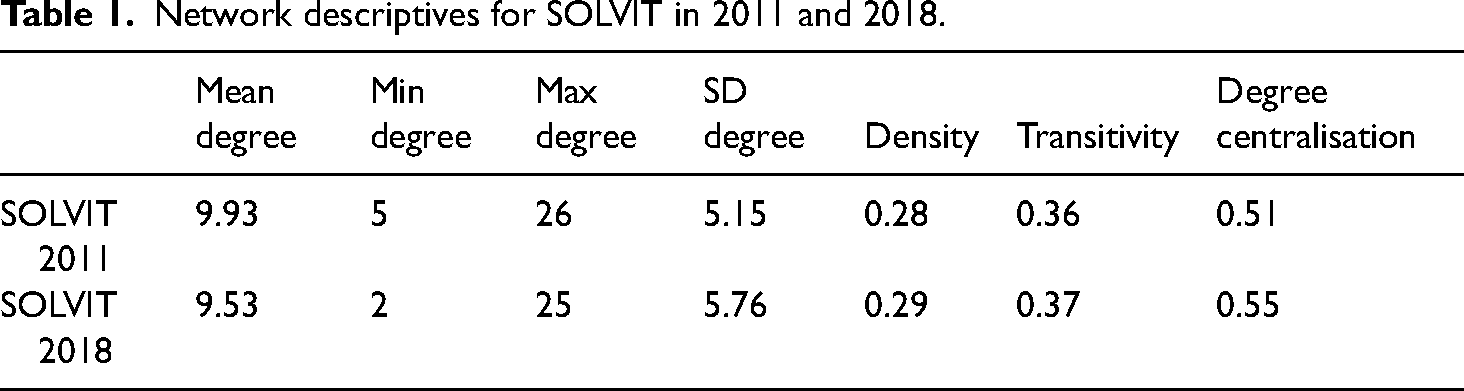
When we visualise the network (Figure 1(a) and (b)), we see that the network has not developed into a structure with separate clusters of members. This consistently dense network structure contrasts with previous studies on other EANs, which showed that network interactions tend to be heavily clustered (Martinsen et al., 2021a, 2021b; Vantaggiato, 2019). While we do see that some members remain more central than others, the network remains a rather horizontal tool for governance that facilitates dense interaction across the board, albeit with a few key members in the centre.
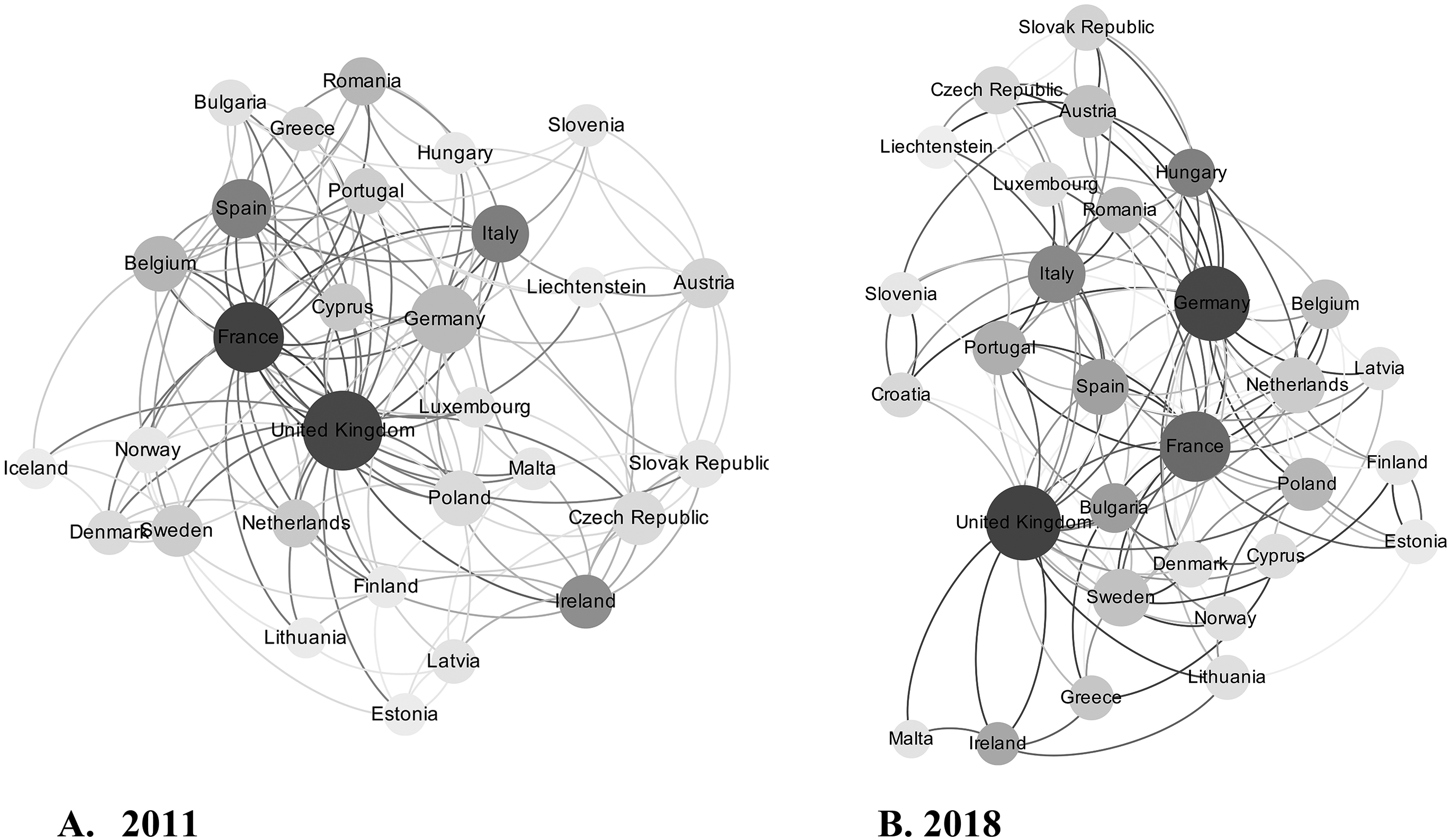
Observed SOLVIT network in 2011 (a) and 2018 (b).
Looking more closely at the core of the network, we find that the UK was the most central actor in 2011. Due to its high degree centrality, it held a powerful position in the network in terms of having better access to resources and more influence over the network. Acting as a hub, it was in the position to influence the overall network. Actors in that position are particularly important for a network's resilience (Duijn et al., 2014), especially since the network seems to have a skewed degree distribution, with a relatively small percentage of actors having a large number of links. Therefore, the UK's exit could potentially harm the functioning of the network seriously.
Although the Brexit negotiations do not appear to have affected the UK's central position negatively, its exit from the network could put its immediate relations at risk of isolation. As shown in Figure 1(b), we see that Brexit would drive Malta, Ireland, Greece and Lithuania to the periphery of the network. However, the question is whether these members would stay relatively isolated from the rest of the network or whether other core members would be able to take over the UK's central role. The 2018 survey results bear evidence of this ability. Germany increased its centrality from 20 contacts (2011) to 25 (2018), up to the point of sharing its central position – in terms of number of connections – with the UK. Interestingly, both the UK and Germany stand out in terms of increased caseload. This is not the case for France, which had the highest number of cases in 2011, while its caseload increased to a much lower degree. Thus, while the network could be seriously disrupted by the departure of the UK as the result of Brexit, we see that other core members, particularly Germany, previously stepped up and reached out to more network members than before, which bears evidence of their ability to compensate for Brexit. If needed, they could take over the role from the UK and stabilise the core of the network. Germany, notably, is likely to take over the central position of the UK. These observations are indicative of a rather resilient network that is able to adapt to external shocks such as the sudden departure of one of its key actors (Newig et al., 2010). Through the stabilisation of the core, these network dynamics prevent a breakdown of the network (Provan and Lemaire, 2012).
Explanatory analysis
To determine which hypothesized evolutionary processes shaped the network as observed in 2018, we fitted two SAOMs. The coefficients in Table 2 represent the log odds ratios of the probability that an actor establishes a tie creating a certain configuration, instead of the alternative state (either no change in ties or the creation of a tie formatting another configuration). These coefficients are conditional log odds ratios, representing network tendencies to the existence, or not, of the network characteristics that they indicate. Choices are based on their own attributes (e.g. being a key player), the attributes of the dyad (e.g. being main trade partners) and the structural opportunities or constraints of the network (e.g. transitivity). The first model takes into account geographic proximity, whereas the second model takes into account main trade partners, as both variables could not be estimated in the same model due to high correlation. Goodness of fit tests of both models show that the simulations upon which estimations are adequately representing the observed network (see the Online Appendix).
Stochastic actor-oriented models.
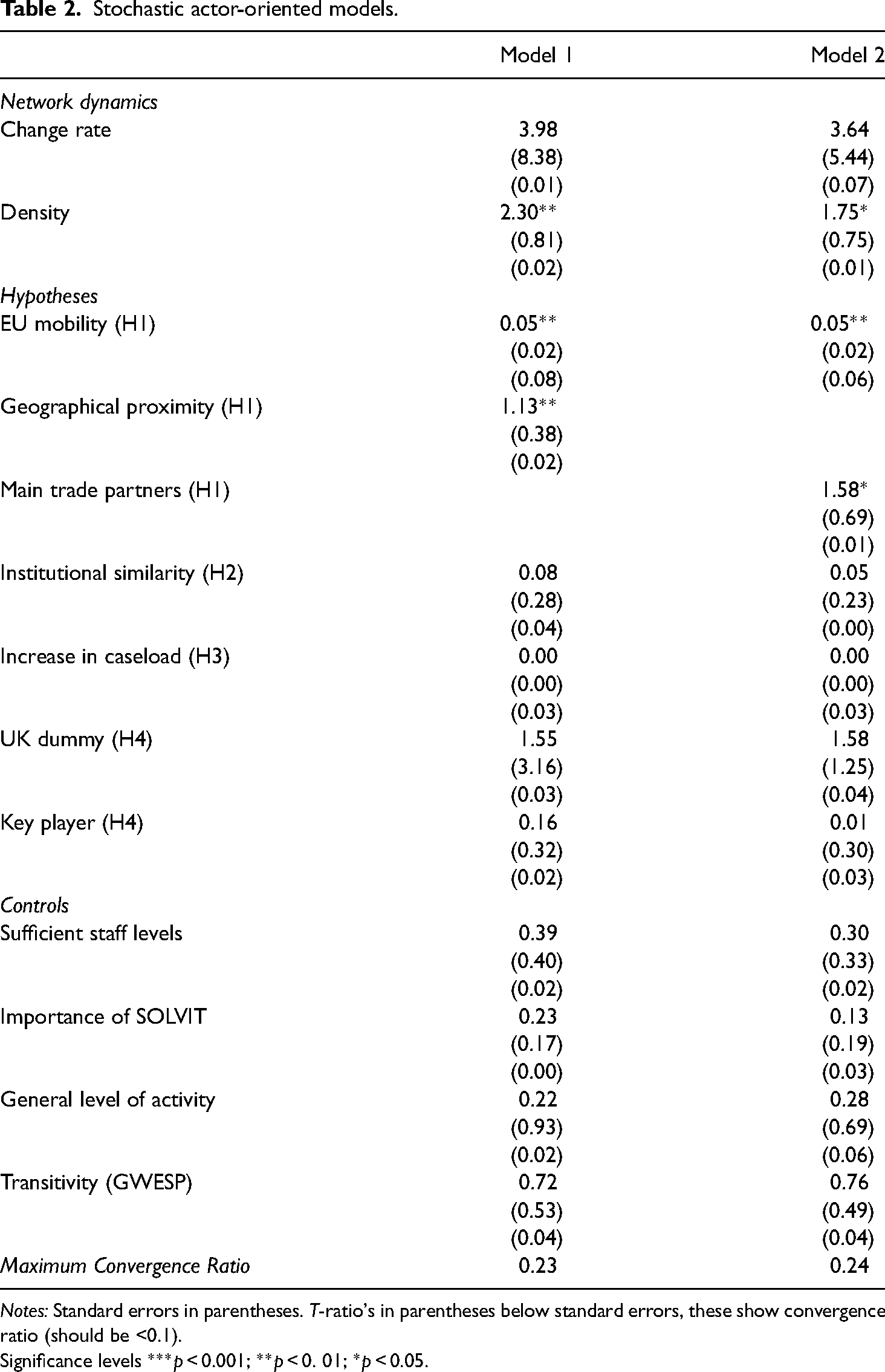
Notes: Standard errors in parentheses. T-ratio's in parentheses below standard errors, these show convergence ratio (should be <0.1).
Significance levels ***p < 0.001; **p < 0. 01; *p < 0.05.
The strongest effects on tie formation are exerted by SOLVIT members’ interdependencies (H1). When two countries share a border, they tend to engage with each other in SOLVIT. The odds of contact being established among previously disconnected SOLVIT centres increases by a factor of three. Moreover, centres in countries that are main trade partners tend to establish informal ties on SOLVIT-related issues. Contact among previously disconnected SOLVIT centres is four to five times more likely when they are main trade partners. In addition, we can observe a clear effect for the third type of interdependency: SOLVIT interactions strongly mirror inter-state mobility flows. The more citizens migrate from one member state to the other, the more their SOLVIT centres tend to interact. Each one point increase in migration from another member state, measured as percentage of their total population, increases the probability of SOLVIT centres to establish contact with 5% when they were previously disconnected. These results reflect the problem-solving character of the network and demonstrate that many of the interactions in the network are demand-driven and stable in nature.
At the same time, the results do not show a homophily effect: SOLVIT centres do not tend to establish contacts with centres from states that belong to the same variety of capitalism (H2). Perhaps relations with like-minded actors are not the preferred strategy in a network that is more focused on the resolution of problems that occur due to discrepancies in domestic arrangements according to internal market rules. An alternative explanation may be that SOLVIT centres typically are rather detached from political steering. The relevance of policy differences may be overshadowed by a common interest in operating the network effectively, by SOLVIT centres that are dedicated to this task.
Furthermore, member states’ need to interact in SOLVIT appears to be rather stable and not conditional on changes in caseload. We find no effect of increased caseload on SOLVIT interactions (H3). While the overall caseload increased over time, there is considerably variation across member states (see Figure 2). On the one hand, we see that particularly central SOLVIT centres, such as Germany, France and the UK, tend to deal with a higher caseload than others to begin with. On the other hand, caseload is rather stable for most SOLVIT centres. This may explain why we find no significant effect.
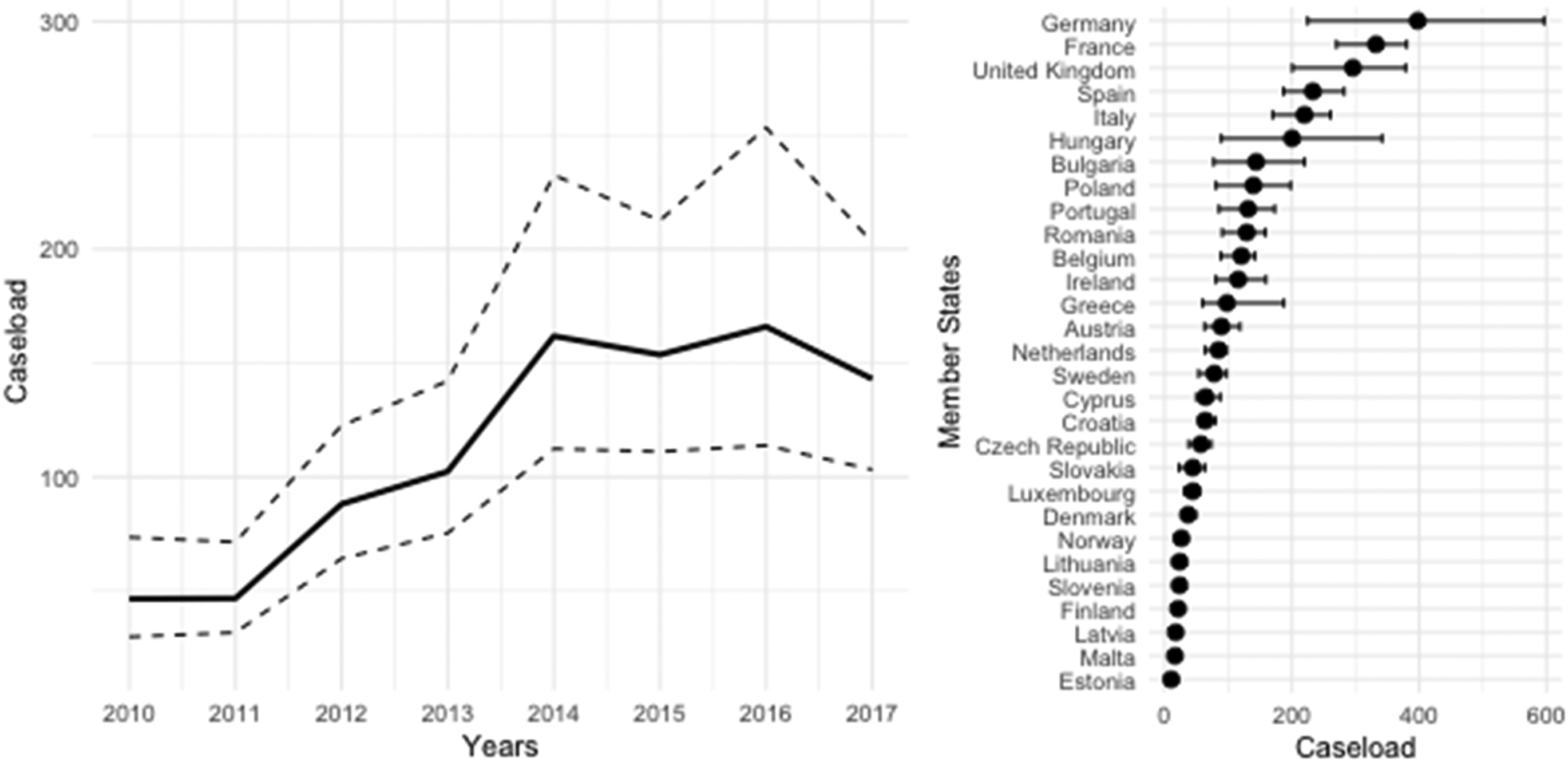
SOLVIT caseload over time (bootstrapped with 0.95 confidence intervals).
Our model does not point towards a disruptive effect of the impending Brexit on the network (H4). First, there is no significant effect for the UK dummy variable, which indicates that the UK is not driving the network to a larger extent than other key actors like Germany and France. Neither is there a tendency among key actors (those with a high degree centrality) to become even more central in the network. With Brexit looming, the network did not become more centralised: both central and marginal players maintained their contacts in the network. This result demonstrates that the network is in fact not developing into a centralised network with a relatively small percentage of actors having a large number of connections. Network interactions overall seem rather stable, making the network rather resilient to the eventual exit of one of its key players.
Finally, we find that staff availability in relation to caseload does not matter when controlling for the other variables and endogenous network effects. Furthermore, we find no effect of member states’ perceived importance of SOLVIT on their network interactions. Those SOLVIT centres that assign a comparatively greater importance to SOLVIT for capacity building, exchange of information and improving the national application/implementation, did not become more active in the network from 2011 to 2018. Neither did network interactions vary in density over time; actors’ general level of activity proved rather stable. 9 A possible explanation for this could be that the network was already more or less consolidated in 2018, 16 years after its establishment, leaving little room for the development of more social capital. The presence of social capital in the network is demonstrated by the slightly significant tendency of SOLVIT centres to close triads, that is interact with those centres that are already connected to indirectly.
Discussion and conclusion
The EAS is work in progress. As evidenced by the manifold transitions between its key institutional forms, the EAS is constantly ‘changing and reinventing itself’ (Levi-Faur, 2011). Yet, some EAS components stand out as beacons of stability and effectiveness. A case in point is SOLVIT, an EAN tasked with the resolution of cases of misapplication of internal market rules by member state authorities. SOLVIT has developed into an effective and stable institution, displaying a dense web of interactions and high effectiveness. On top of formal case resolution dynamics, an informal network of inter-state contacts concerning SOLVIT operations has developed. This article reports a rather unique explanatory study on the temporal development of these informal network interactions (also see Schrama et al., 2024).
Using network panel data, the article produces the first longitudinal study of EAN interactions. Comparing survey-derived network data from 2011 and 2018, the analysis shows that SOLVIT interactions are rather stable over time. The network is well-connected and rather dense, although some network members are slightly more central than others – notable the larger member states, Germany, France and the UK. In addition, the network's level of activity and density remained rather stable, which further sustains the image of a consolidated, mature network. One source of endogenous change, however, is the members’ tendency to close triadic relations, that is interact with the ties of centres one is already connected with. Yet, this effect is relatively small, which indicates that the network is rather saturated.
In theorising the antecedents of change or stability in network interactions, this article employed an actor-based rationalist perspective. In line with the literatures on social networks, policy networks and EANs, it distinguished four hypotheses on the development of interactions. Starting with actor characteristics, firstly, we theorised that interdependencies between two states drive interactions. Because of the structural character of such interdependencies – geographical proximity, trade patterns and mobility – we expected network interactions to display temporal stability. Our second hypothesis held that institutional homogeneity between network members drives interactions, leading to stability as well. The third hypothesis was dynamic in nature and held that interactions are contingent on SOLVIT members’ caseload, a variable likely to vary over time. Fourthly, we hypothesized that the impending Brexit, as a key exogenous shock to the network, would upset the network and result in new ties established by other network members. In addition, we controlled for three factors at the network member level: sufficient capacity, perceived importance of SOLVIT, and endogenous network effects, namely endogenous densification of the network and the closing of triads.
Utilising stochastic actor-oriented longitudinal modeling, a novelty in the EAN literature, we found strong evidence for the effect of interdependencies. Interactions closely mirror structural interdependencies between member states, based on trade flows, mobility and geographical proximity. Surprisingly, we did not find evidence for policy homogeneity between member states: the different variants of capitalism do not drive interactions. This finding stands in marked contrast with recent studies on interactions in networks in the realms of health and energy policy (Martinsen et al., 2021a, 2021b; Vantaggiato, 2019) and with the key finding of homophily in SNA more broadly. This may be related to the fact that SOLVIT is a problem-solving network, which is based on the principle that states interact across the board, in the context of the formal resolution of cases of misapplication. Furthermore, it may relate to the fact that the SOLVIT centres are rather practical in their orientation and operate in detachment from the policy departments, which renders them less subjective to policy-substantive steering. Fourthly, our analysis shows SOLVIT's network structure to be resilient to the impending exit of the UK, a central player: the closely knitted interactions enable other key players to take over the UK's role. In addition, less central players still were fairly well connected, which reduces the risk of becoming isolated in the network. Yet, this finding does not necessarily mean that the UK's exit does not have a qualitative impact on the network – something we cannot ascertain with our data.
In sum, SOLVIT displays a remarkable degree of stability in its interactions, which is mostly caused by structural interdependencies between the member states in the realm of internal market policy. This underscores previous findings that the establishment of EANs is driven, primarily, by policy-specific patterns of interdependence. It shows that networks can become a durable instrument for member states seeking to adequately respond to interdependencies without transferring supervision or problem resolution responsibilities to the EU level. The findings also indicate that SOLVIT is a rather mature network, in that it is well-connected and resilient to external shocks, such as the impending exit of a key player. Yet, this conclusion comes with a caveat. The period studied was one of relative political stability as well. Brexit had not yet materialised and public support for the internal market was fairly stable. This situation contrasts with a recent study by Mastenbroek et al. (2022), which showed that political dynamics, notably changes in public support for the policy at hand, can affect members’ interactions in the network. For this reason, in an adjacent study we also modeled the effects of the actual effectuation of Brexit and the Covid crisis that unfolded later (Schrama et al., 2024). That study bears further evidence of SOLVIT's stability and its capacity to absorb the effects of exogenous crises.
Finally, let us reflect on the implications of these findings for the role and future of SOLVIT. How is the twin finding of stability and density linked to the broader question of institutional change? As indicated at the outset of this article, stable patterns of interaction can become self-sustained equilibria that are difficult to break down by external forces, especially when powerful members have a stake in them (Boeger and Corkin, 2017; Jordana, 2017). SOLVIT seems a case in point: well beyond its maiden period, it has evolved into a dense network of informal interactions on top of the effective formal infrastructure for case-based problem resolution. In line with the literature on historical institutionalism, we can conclude that the SOLVIT network has engendered stability (Pierson, 2000) and ordered, patterned regularity (Lieberman, 2002). This finding underscores the Commission's (European Commission, 2020) ambition to render SOLVIT the default tool for single market dispute resolution.
Supplemental Material
sj-docx-1-eup-10.1177_14651165241268080 - Supplemental material for Temporal dynamics of interactions in European Administrative Networks: The case of SOLVIT
Supplemental material, sj-docx-1-eup-10.1177_14651165241268080 for Temporal dynamics of interactions in European Administrative Networks: The case of SOLVIT by Ellen Mastenbroek, Reini Schrama and Dorte Sindbjerg Martinsen in European Union Politics
Supplemental Material
sj-zip-2-eup-10.1177_14651165241268080 - Supplemental material for Temporal dynamics of interactions in European Administrative Networks: The case of SOLVIT
Supplemental material, sj-zip-2-eup-10.1177_14651165241268080 for Temporal dynamics of interactions in European Administrative Networks: The case of SOLVIT by Ellen Mastenbroek, Reini Schrama and Dorte Sindbjerg Martinsen in European Union Politics
Footnotes
Acknowledgements
A previous version of this paper was presented at the panel ‘Effective EU governance in times of contestation’ at the 2021 Netherlands Institute for Governance General Conference, held in Utrecht, the Netherlands. The authors benefited from the comments made by this panel's participants, in particular by discussant Esther Versluis. They also thank the three anonymous reviewers of European Union Politics for their helpful comments and suggestions.
Author contributions
All three authors contributed to the acquisition of the data used for this article, development of the theory and design of the study. Dorte Sindbjerg Martinsen was responsible for collecting the 2011 data in joined work with Mogens Hobolth. Ellen Mastenbroek developed the substantive positioning of the article. Reini Schrama conducted the empirical analysis. Ellen Mastenbroek and Reini Schrama interpreted the results of the analysis and drafted and critically revised the article.
Funding
The authors disclosed receipt of the following financial support for the research, authorship and/or publication of this article: This work was supported by Danish Council for Independent Research (Grant Number DFF-7015-00024).

Data availability statement
Supplemental material
Supplemental material for this article is available online.
Notes
References
Supplementary Material
Please find the following supplemental material available below.
For Open Access articles published under a Creative Commons License, all supplemental material carries the same license as the article it is associated with.
For non-Open Access articles published, all supplemental material carries a non-exclusive license, and permission requests for re-use of supplemental material or any part of supplemental material shall be sent directly to the copyright owner as specified in the copyright notice associated with the article.
