



Abstract
In surveys, Europeans routinely express high levels of support for a common security and defence policy of the European Union. Do these responses reflect real demands or superficial support that would crumble if the issue was politicised? This article provides new answers to this question. We conducted pre-registered survey experiments with more than 40,000 respondents from 25 European countries in which we randomly varied whether respondents received information about potential costs of two hypothetical cooperative activities: military operations and defence procurement. Support for these activities was systematically lower when costs were mentioned. We conclude that, in the event of politicisation, there is considerable potential for shifts in opinion and that caution is required in deriving a mandate for specific activities from high approval rates for cooperation in general.
Introduction
Security and defence policy remains one of the least integrated areas in the European Union (EU) (Leuffen et al., 2022). While EU actors like the European Commission and the High Representative of the Union for Foreign Affairs and Security Policy have repeatedly pushed for more supranational cooperation (Hoeffler and Hofmann, 2024), EU member states are often not even willing to commit to intergovernmental cooperation (Hofmann, 2013). At the same time, opinion polls consistently show strong support for more cooperation in this area (Brummer, 2007; Mader et al., 2020; Peters, 2014; Schilde et al., 2019). Does this mean that the relatively low level of cooperation is due to the reluctance of elites rather than to public opposition? The answer to this question depends crucially on the nature of public opinion on the issue, which is interpreted differently in current research.
In one view, the high approval rates for more cooperation reflect real demands, as public attitudes are ‘based on knowledge about the consequences and costs of such policy’ (Schilde et al., 2019: 165). For policy makers interested in deepening cooperation, there would then be no reason to fear the politicisation of initiatives pursuing this goal because public opinion would have already priced in reasons against such policies. Other researchers voice the suspicion that public opinion on this issue is ‘superficial, not substantial’ (Brummer, 2007: 183) and ‘likely to crumble in the face of […] costs’ (Mader et al., 2020: 552). In this interpretation, the survey results mentioned above should not be seen as a mandate for more cooperation, as support is likely to drop in the case of politicisation of concrete initiatives. Which of these views is correct remains unclear.
In this article, we shed new light on this issue. The basic idea is to use experiments to gauge the extent to which public attitudes towards common EU security and defence policies are based on cost considerations. We asked Europeans about their support for two hypothetical cooperative activities that are often discussed in the context of EU security and defence policy, varying randomly whether respondents received information about the potential costs of these activities. This research design allows insights into the extent to which such costs are priced into public opinion on these issues: if citizens routinely consider costs, confronting them with information about them should not alter their attitudes significantly. Specifically, we consider two different activities (military intervention and defence procurement) and examine the effects of mentioning two different types of costs, which we believe are fairly straightforward and obvious for citizens to consider. One is budgetary costs, as cooperation activities mean a commitment for expenditure from state budgets. The other is non-budgetary costs – casualties in the case of military interventions and job losses in the case of joint defence procurement. 1 The two experiments were fielded in 24 EU member states (and the United Kingdom) with a total sample size of more than 40,000 respondents.
The results show that in the isolated setting of our experiments, mentioning costs decreases support for the cooperative activities. We conclude that even basic cost-related considerations are not (completely) factored in when citizens think about these issues. The effect sizes, however, are moderate – support ‘crumbles’ but does not collapse, at least in the context of these experiments. The implications for public opinion in the real world, where the information environment is more complex and citizens usually evaluate multiple policy options simultaneously, are discussed in the conclusion. Other important findings are that the differences in effect sizes between countries are substantial and the differences between individuals are small. We discuss and outline potential explanations for the observed (non)variation. In doing so, we offer novel empirical insights and open conceptual lines of inquiry to study the public's reaction when being made aware of the costs associated with further cooperation in the area of security and defence.
Cost considerations and EU security and defence cooperation
Decisions to engage in security and defence cooperation have cost implications. International cooperation implies a commitment for expenditure from state budgets, which in turn creates opportunity costs and distributional effects. Furthermore, governments face negotiation costs (Leeds, 2003), a trade-off between opportunism and governance costs (Lake, 1996), and cooperation may incur sovereignty costs (Abbott and Snidal, 2000). In short, cost considerations are ubiquitous when policy makers decide on cooperation.
It is less self-evident that cost considerations play a prominent role among citizens. Taken at face value, survey data suggest that there is high and stable public support for the general idea of (more) EU security and defence cooperation. In almost all EU member states, 60% or more of the population continuously support an EU security and defence policy (Mader et al., 2020; Peters, 2014; Schilde et al., 2019). The current war in Ukraine has not changed this; on the contrary, under the impression of an increased threat, support has (possibly temporarily) even increased (Fernández et al., 2023; Genschel et al., 2023; Mader, 2024, Wang and Moise, 2023). A conjoint experiment conducted after the invasion shows that this support goes beyond the symbolic level (Burgoon et al., 2023). Accordingly, Western Europeans favour ‘maximalist’ policy packages over ‘minimalist’ ones, that is supranational over intergovernmental cooperation. They prefer, for example, the replacement of national armies by a European army to the joint financing of national armed forces, majority decisions to the consensus principle and the prohibition of opt-outs to differentiated integration.
However, prior research questions whether those figures imply a clear political mandate for decision-makers. The general notion of a common EU policy says nothing about the content of that policy, so citizens may agree that more cooperation would be desirable but disagree about specific cooperative activities (Irondelle et al., 2015). Furthermore, surveys might not measure real attitudes but near-random responses. According to one study, how four out of five Europeans respond to questions about European common foreign and security policy comes ‘suspiciously close to the random end of the real-to-random continuum’ (Sinnott, 2000: 131). High levels of public support – whether regarding common security and defence in the abstract or specific proposals – could thus reflect spontaneous sentiment rather than profound reasoning about costs and benefits (Brummer, 2007). In contrast, Schilde et al. (2019) present findings that indicate coherent and stable attitudinal structures on the topic of European security and defence cooperation and, on this basis, arrive at a more positive assessment of the ‘realness’ of high public support levels on this issue.
We argue that evidence of constraints in mass opinion on European security and defence cooperation says little about how the public reacts when costs are made explicit. Citizens can coherently evaluate policies without factual knowledge by drawing on core postures, value orientations, and elite cues (Feldman, 1988; Hurwitz and Peffley, 1987; Zaller, 1992). That does not mean that attitudes are ‘based on knowledge about the consequences and costs of such policies’ (Schilde et al., 2019: 165), nor that public opinion will not change if the public salience of the costs associated with these activities increases. Note that this is not to say that citizens consider costs only when they are made explicit, or that current public opinion on European security and defence cooperation does not consider costs at all. 2 The key question is whether the importance of these considerations increases (and support subsequently decreases) when citizens are directly confronted with the cost aspect, as they likely would, through politicisation, once European policy makers seriously pursue a deepening of EU cooperation (Angelucci and Isernia, 2020; Hooghe and Marks, 2009). Against this background, it is promising to complement existing findings with direct evidence on how citizens react to information on the cost implications of European security and defence cooperation projects.
We can draw on established theories of attitude formation to derive a broad, baseline hypothesis about the likely impact of communicating costs to the public. We start from the notion that citizens form attitudes based on the set of considerations that are psychologically accessible at a given point in time. Attitudes are hence conceived of as constructions, built by weighing favourable and unfavourable considerations against each other (e.g. Zaller and Feldman, 1992). Beliefs about the costs of a given international cooperative activity generally constitute unfavourable implications, implying that the mentioning of costs leads to a lower level of support (Brutger and Clark, 2023). Whilst the public can become aware of costs through various channels, elite messages are one important source: policy makers can influence attitude formation by providing citizens with additional information or by increasing the subjective importance of already accessible ones (Chong and Druckman, 2007; Sniderman and Theriault, 2004). Thus, as long as citizens do not have crystallised attitudes about this issue – and the existing evidence, reviewed above, suggests that only few do – we can expect the following regarding the impact of cost frames:
H1: Citizens are less supportive of cooperative activities when exposed to information about the costs of their country's participation in these activities.
We treat this hypothesis as a baseline and explore how much effects differ across countries and individuals. Theoretically, heterogeneity arises when a message does not affect the building blocks and process of constructing attitudes from considerations in the same way for all citizens in all countries. Some citizens might already factor cost implications in, rendering information about costs in communication inconsequential. Furthermore, individuals might vary in their sensitivity to costs. Some might ignore them because they support or oppose a policy for expressive reasons, or their worldviews endow them with a particularly high or low tolerance for a given type of cost. We, hence, explore differences in the way the public responds to the mentioning of costs, both on the country and individual level.
Potential factors on the country level are national strategic cultures and collective memories (Irondelle et al., 2015; Meyer, 2006). For example, citizens from more interventionist countries whose collective memories are anchored in their countries’ colonial histories might be used to discussions about potential casualties associated with military interventions, and hence react less to casualty frames. Or their memories of former (Soviet) occupation informs their higher tolerance. Similarly, the geographical position of a country and associated threat perceptions may render the effect of mentioning costs more or less pronounced (Starr, 2005). For example, the publics of countries located on the EU's Eastern flank may be more resilient to cost calculations due to the increased and more immediate threat perception. The economic situation of a country could also play a role, as citizens from less well-off countries could be more critical of further budgetary costs due to security policy activities than citizens from wealthier countries (Carrubba and Singh, 2004).
On the individual level, we explore a range of characteristics that can influence sensitivity to the mention of costs, including attitudes towards the EU, militant internationalism, and political knowledge about the EU. Generally, frames change opinions less if they are inconsistent and hence resonate less with individual predispositions (Brewer, 2001; Chong and Druckman, 2007). The cooperative activities we study resemble those pursued by the EU in this policy domain, so general attitudes towards the EU and the principle of cooperation might influence the processing of information about these specific policies. EU supporters and militant internationalists might engage in motivated reasoning and prove to be particularly resistant to the cost information; alternatively, they might be particularly reactive because the experimental setup employed here (and described in detail below) forces them to engage with these considerations for the first time, triggering particularly large shifts in attitudes. Similarly, information about costs might influence knowledgeable citizens either less, because they already consider them when forming attitudes, or more, because they are better at processing the information provided in the frame (Chong and Druckman, 2007; Druckman and Nelson, 2003). Due to the ambiguity in how factors on the country and individual level might influence the public's reaction to costs, we do not propose directed interaction hypotheses but check for conditional effects in an exploratory fashion by asking the following research question:
R1: Do framing effects vary across individuals and countries?
Research design
The empirical analysis draws on two survey experiments conducted as part of an online survey of more than 40,000 respondents from 24 EU member states (all except Cyprus, Luxembourg, and Malta) and the United Kingdom. The survey was conducted by IPSOS in October 2020, using nation-specific online panels. The respondents were recruited based on gender, age, education, and regional quotas to ensure a representative sample. Our sample consists of 2000 persons in France, Germany, Italy, Poland, Spain, and the United Kingdom, and 1500 persons in the remaining 19 countries.
The experiments focus on two key security and defence activities: joint military interventions and defence procurement. These issues are substantively important, European governments routinely (consider to) address them together, and they are tangible enough to capture the interest of public opinion. Multilateral military crisis management operations have been the main operational activity of European governments in the area of defence since the 1990s; from 2003 to today the EU has launched 37 missions and operations, out of which 21 were ongoing in 2022 (EEAS, 2023). The decision by governments to participate or continue military operations in places such as Afghanistan, the Balkans, Congo, Chad, or the Gulf of Aden regularly spark domestic debates and are linked to public opinion (Baum and Potter, 2015; Berinsky, 2009). Defence procurement is a similarly tangible and easy-to-understand topic that is a recurring subject of public inquiry and debate (Hoeffler and Mérand, 2016; Krotz, 2011).
Both of these activities come with a price tag, and confronting citizens with the associated costs may affect their (dis)approval of their government's decision to participate. Our survey experiments on joint military interventions and defence procurement include treatments referring to budgetary and non-budgetary costs. To specify the costs, we take inspiration from the literature and the current situation in European security and defence. The public's assessment of military engagements and war is sensitive to casualties (Eichenberg 2003; Gelpi et al., 2009; Mueller, 1973), their implications on trade ties or military expenditures (Gleditsch et al., 2019), and whether they are financed through taxes or debt (Flores-Macías and Kreps, 2017). When it comes to arms spending, citizens may make trade-offs between ‘guns and butter’ (Carrubba and Singh, 2004; Wlezien, 1995) and procurement questions often revolve around the cost-effectiveness as well as the implications for national defence industries and jobs (Hoeffler and Mérand, 2016; Ringsmose, 2013; Uttley and Wilkinson, 2016).
Against this background, we differentiate whether cooperative activities are financed through national or pooled budgets. This reflects two core financing mechanisms in the EU. For example, whereas ‘common costs’ of EU military missions (e.g. the setting up and running of headquarters, barracks and lodging) are financed with a pooled budget through the European Peace Facility, other costs are financed on a ‘costs lie where they fall’ basis (e.g. personnel costs), that is through the national budgets of the participating member states (European Parliamentary Research Service, 2021). Similarly, with regards to procurement, the participation of actors from at least three different EU member states in a joint capability project is one of the pre-conditions to receive funding through the European Defence Fund. For non-budgetary costs, we focus on casualties in the case of a military intervention due to the riskiness of the operation and on job losses in the context of joint defence procurement as, for example, some components of an aircraft may no longer be manufactured in the country. Taken together, these design decisions in terms of activities and costs offer a realistic experimental set-up that both speaks to the situation in European security and defence and to factors that are salient for the public (Table 1).
Wording of the survey experiments.
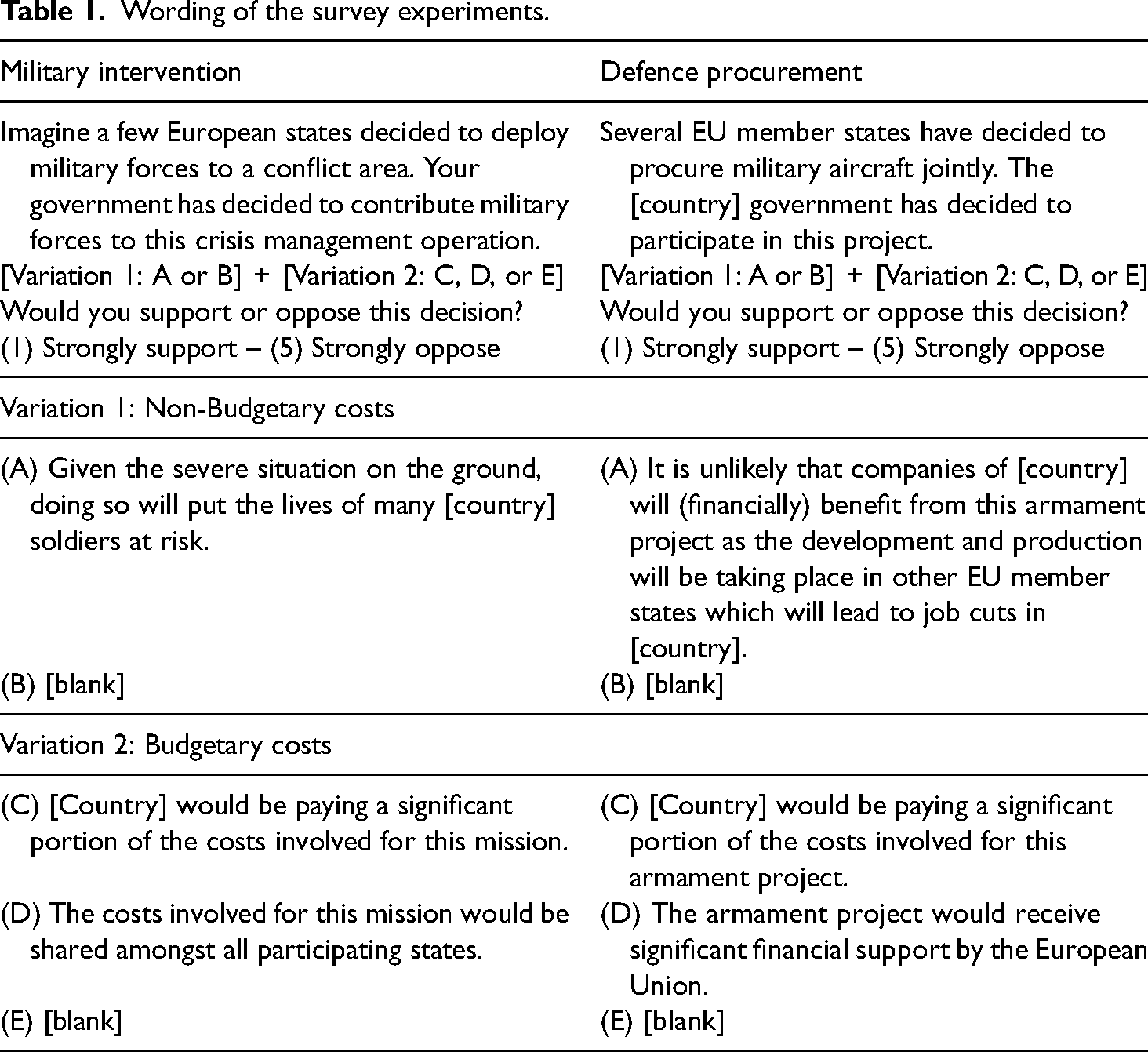
The specific design of the experiments was as follows. In both experiments, all respondents were informed about a hypothetical decision of their government to participate in a cooperative activity at the EU level – a military intervention in one case, defence procurement in the other. 3 They then were randomly assigned to a control group that received no additional information or one of two treatment groups that received additional information about budgetary and non-budgetary costs. Finally, we asked respondents to indicate on a five-point scale whether they support or oppose their government's decision to participate in these activities. This setup allows us to establish the baseline support or opposition for the two activities within the control group and study the effects of mentioning costs by manipulating the provision of additional information within the treatment groups.
Additional survey-based measures are used to explore the heterogeneity of treatment effects on the individual level. As noted, we focus on EU attitudes, postures towards militant internationalism, and political knowledge about the EU. EU attitudes are measured using a thermometer-type item with an 11-point response scale. We measure postures towards militant internationalism with an additive index of two items on the role of the armed forces in international politics used in prior research (Gravelle et al., 2017). Political knowledge is measured through four statements revolving around the EU, for which respondents have to indicate whether they deem these to be true or false. We create an additive index that indicates the number of correct answers. Details on question wording and coding can be found in the Online appendix.
We use linear regressions to estimate the treatment effects. 4 We estimate the main treatment effects using dummy variables indicating membership in one of the treatment groups and country dummies to estimate country-fixed effects. To explore heterogeneous treatment effects at the country level, we estimate the regressions for each country sample separately. To explore heterogeneous treatment effects at the individual level, we additionally specify interactions between treatment dummies and individual characteristics. In these, we consider attitudes towards the EU, postures towards militant internationalism, and political knowledge. To ease interpretation, we transform all variables to a scale ranging from 0 to 1. We exclude respondents who answered ‘don’t know’ from the analysis. This applies to about 10% of respondents for each experiment, a common figure of item nonresponse for this type of survey question (Kleinberg and Fordham, 2018).
Results
Before presenting the results of the experiments, we show the baseline levels of support for or opposition against the two cooperative activities with no costs mentioned. Table 2 shows the support for the two cooperative activities in the control groups of the experiments, respectively, resulting in 6045 (military operation) and 6243 (defence procurement) respondents. In both cases, many more respondents support than oppose the two measures, and despite more than one-fourth of the sample registering ‘neither support nor oppose’, there is still (slim) majority support for the joint defence procurement (53%) and plurality support for the cooperative military operation (42%). These figures are in line with prior descriptive work, which has shown that favourability of specific measures of European cooperation is lower than the general idea of a joint security and defence policy (Irondelle et al., 2015; Mader et al., 2020; Peters, 2014). Beyond this, the levels of support can be assessed differently. Considering that the item on military intervention contains no detail about the mission, it is remarkable that so many respondents agree at all – the cooperative nature of the mission likely has a positive effect here (an otherwise identical unilateral mission might receive significantly less approval). Given the large share of respondents without clear preferences on these issues, the room for politically relevant information effects may be particularly large.
Baseline support for cooperatives security and defence activities.
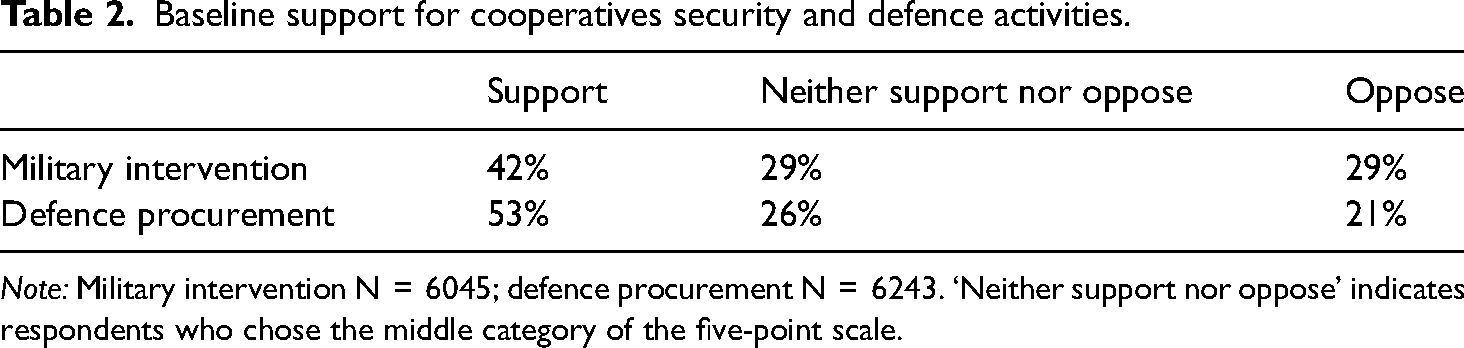
Note: Military intervention N = 6045; defence procurement N = 6243. ‘Neither support nor oppose’ indicates respondents who chose the middle category of the five-point scale.
The breakdown of these distributions by country shows a considerable degree of variation (Figure 1). Support for a common military operation shows differences of almost 40 percentage points between the most supportive (Portugal) and least supportive public (Hungary). Again, this is in line with prior work showing that the use of force is particularly contested (Hofmann, 2013; Peters, 2014). There is less variation on the issue of the common aircraft procurement, with two notable exceptions: support in Italy and Slovenia is considerably lower than in other countries. 5 The figure also demonstrates that the share of respondents who neither support nor oppose the activities is very similar between countries. Variation between countries primarily refers to explicit support for or opposition to the activities. Hence, while the share of citizens most likely to be turned into opponents by cost frames is similar across countries, changes in these percentages are more meaningful in some countries than others. In Poland, for example, the idea of a joint military intervention receives comfortable majority support, and if cost frames increased the share of opponents by a couple of percentage points, this would not change the majority position. In other countries, where no clear majority position exists, even small shifts can be politically significant. We return to the substantive relevance of shifting preferences in reaction to mentioning costs below.
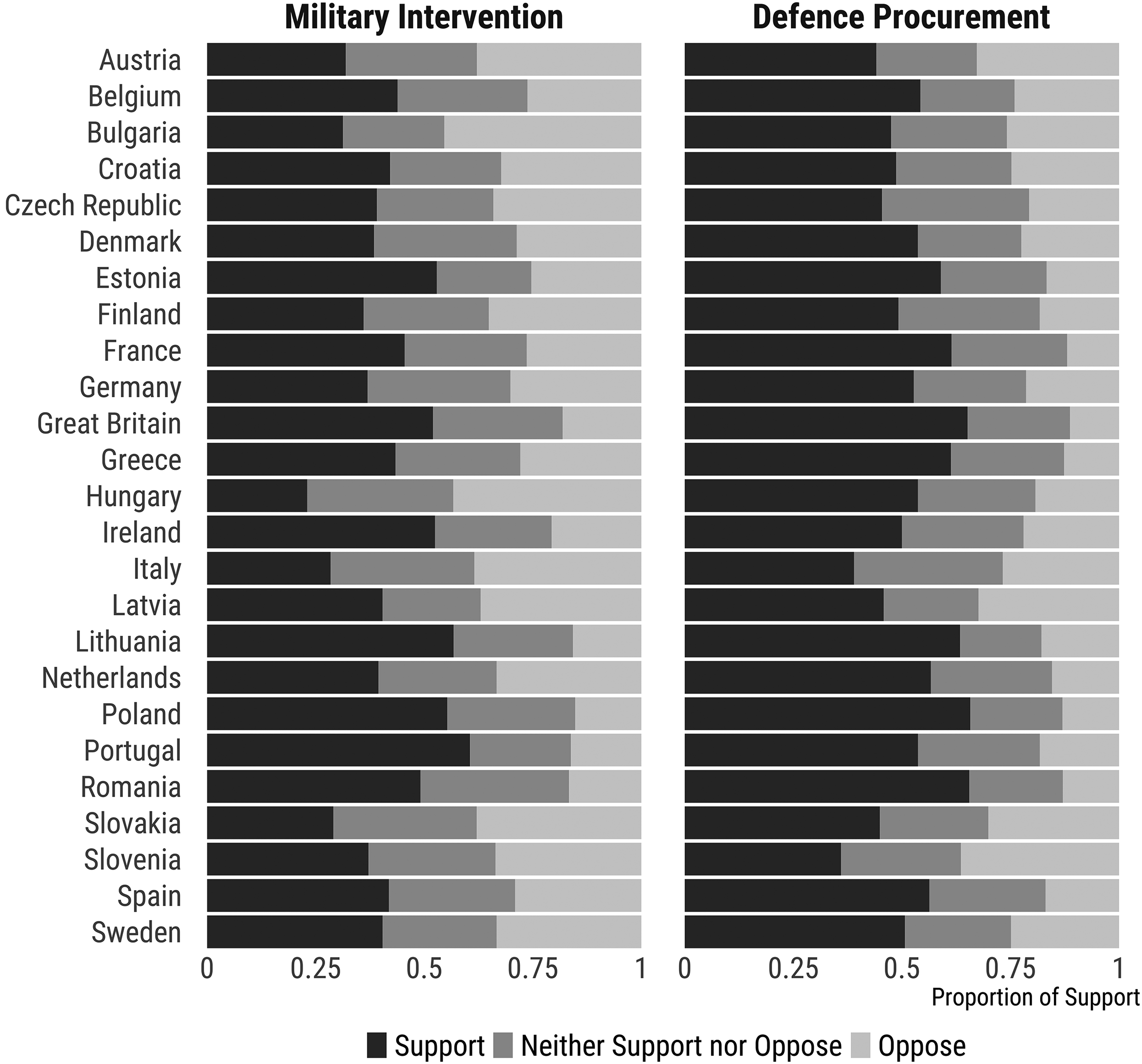
Baseline support for security and defence policies by country.
After the descriptive analysis, we now report the results of the two experiments. Figure 2 shows the average effects of mentioning both budgetary and non-budgetary costs on the aggregated sample, compared to the control group. 6 Negative effects indicate lower levels of support, while positive effects suggest higher levels of support. In line with our hypothesis, we see that pointing to the non-budgetary costs of casualties and job loss, respectively, decreases support levels. The same holds for providing respondents with the information that their own country would have to pay a significant portion of the costs. Although these estimates are highly significant in a statistical sense (p < 0.001), effect sizes are small. The implication for the national budget and non-budgetary costs decreases support for the military intervention by about 0.04 on a scale ranging from 0 to 1. For the defence procurement, the financing through national budgets decreases support by about 0.07 and the reference to job losses by about 0.12.
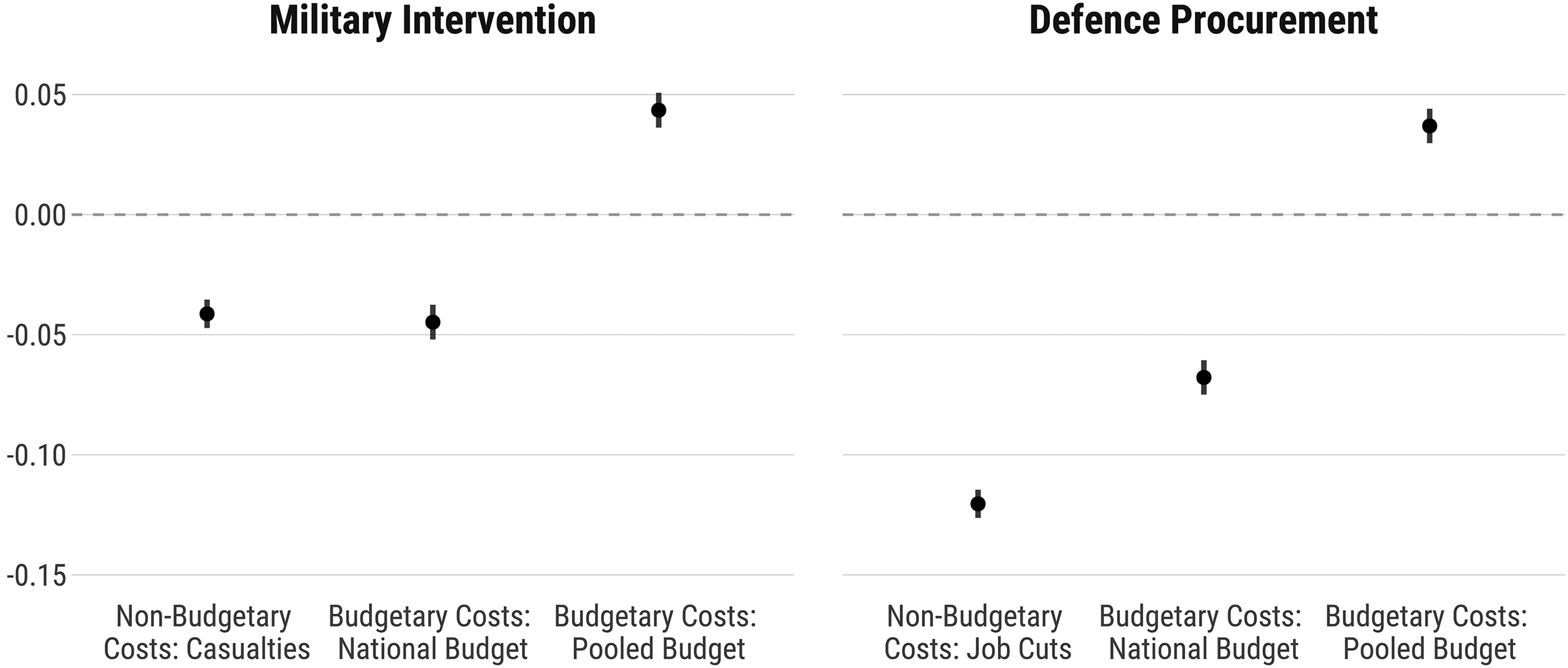
Average treatment effects at the European level.
Pointing to pooled costs increases support for both policies by 0.04, which is unexpected. We can only speculate about the thought processes that lead to this effect. Perhaps not realising that national governments ultimately fund pooled budgets, too, respondents might interpret the pooled-cost frames to mean that their country has little or nothing to pay – when in fact there is no simple deterministic relationship between how an activity is funded and how much it costs a particular country. They might also take the information of pooled budgets as cues on how strong the consensus among participating countries and hence the prospects of eventual success are, on the urgency of a problem, or they (wrongly) assume that pooled budgets are necessarily fairer in terms of burden sharing. Whatever the mechanism, this result points to a way for political elites to shape public opinion in favour of cooperative activities – or at least cushion backlash against budgetary cost frames that stress national costs. We come back to this issue in the discussion below.
As mentioned above, treatment effects might differ between countries. To investigate whether this is the case, we estimated the regression model used above separately for each country. Figure 3 provides the results. The pattern of coefficients is complex, as always when looking at multiple effects for many countries. Based on purely random variation alone, the analysis will produce differences in coefficients across countries – even if the true effects were identical. Separating random variation from ‘true’ variation is hard. We approach this task by first identifying general patterns and then delving into individual findings.
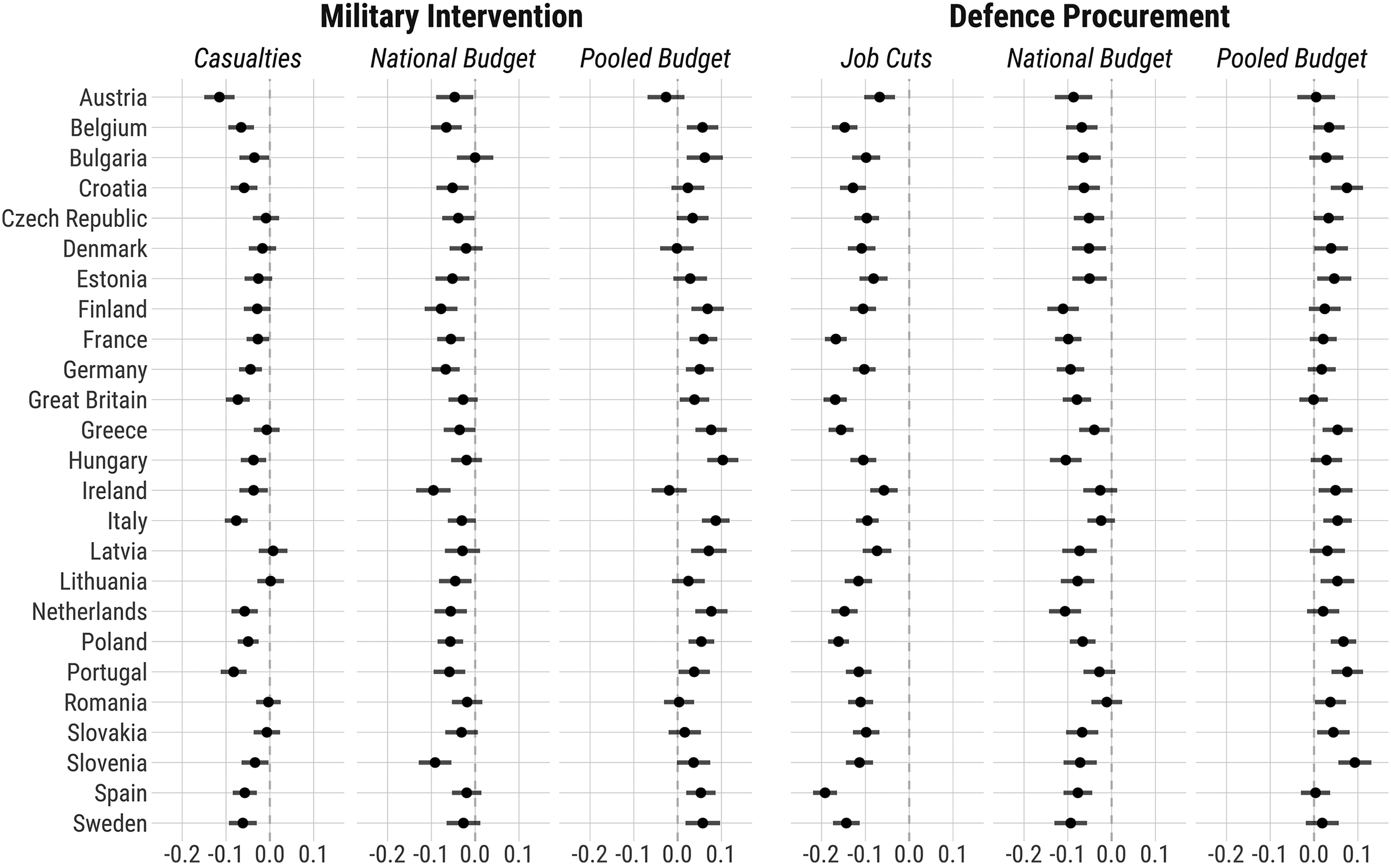
Average treatment effects by country.
By and large, the country-level analysis replicates the results of the pooled analysis. Much more often than not, the pattern of treatment effects in a given country corresponds with that of the pooled analysis, even if the individual effects do not always reach the conventional level of statistical significance. Put differently, we do not see that the pooled results are driven by extremely large effects in one (small) group of countries, with the rest of the sample showing no or even adverse framing effects. Furthermore, deviations from the general pattern in one respect do not seem to correlate with deviations in others. Hence, viewed from a bird-eye's perspective, the general effects of mentioning costs seem to hold across European countries.
Zooming in, however, reveals noteworthy deviations from the general pattern. First, we observe that the mentioning of casualties has no or negligible effects in some of the countries under investigation, for example in Latvia and Lithuania. This may be rooted in more acute threat perceptions regarding Russia's territorial ambitions (e.g. Mader, 2024) and an awareness that military conflict implies casualties. Citizens in these countries might consider the possibility of casualties by default, so making these costs explicit does not shift public opinion (further). By implication, public support for European cooperation may be considered less superficial in these countries, and hence represents more of a public mandate than in countries where opinions prove more malleable. Second, priming potential job losses tends to have a particularly large effect in countries that have been especially affected by the economic crisis and austerity in the past 15 years, such as Spain and Greece. These experiences may have made the respective publics particularly sensitive to such costs. We admit to the ex-post character of these interpretations and submit them to further scrutiny. Careful case studies considering the pre-treatment environment will be a fruitful route to a deeper understanding of this contextual heterogeneity of cost sensitivity.
Figures 2 and 3 focus on change in support, regardless of where on the continuum between strong disapproval and strong approval that change occurs. But shifts from support to opposition arguably have greater practical and normative significance than shifts from strong to very strong opposition. Accordingly, we next look at the experimental effects from a somewhat different perspective by asking whether the information about costs affect the group sizes of opponents and supporters – and perhaps even the majority position in the population. Figure 4 contrasts the share of supporters in the control group (y-axis) with the share of supporters in the treatment group (x-axis) for each country. 7 Dots on the diagonal represent countries in which the respective frame does not change the group size of supporters; dots above the diagonal represent countries in which the respective cost frame reduces the share of supporters; dots below the diagonal represent countries in which the frame increases the share of supporters. The larger the deviation from the diagonal, the larger is the group size difference.
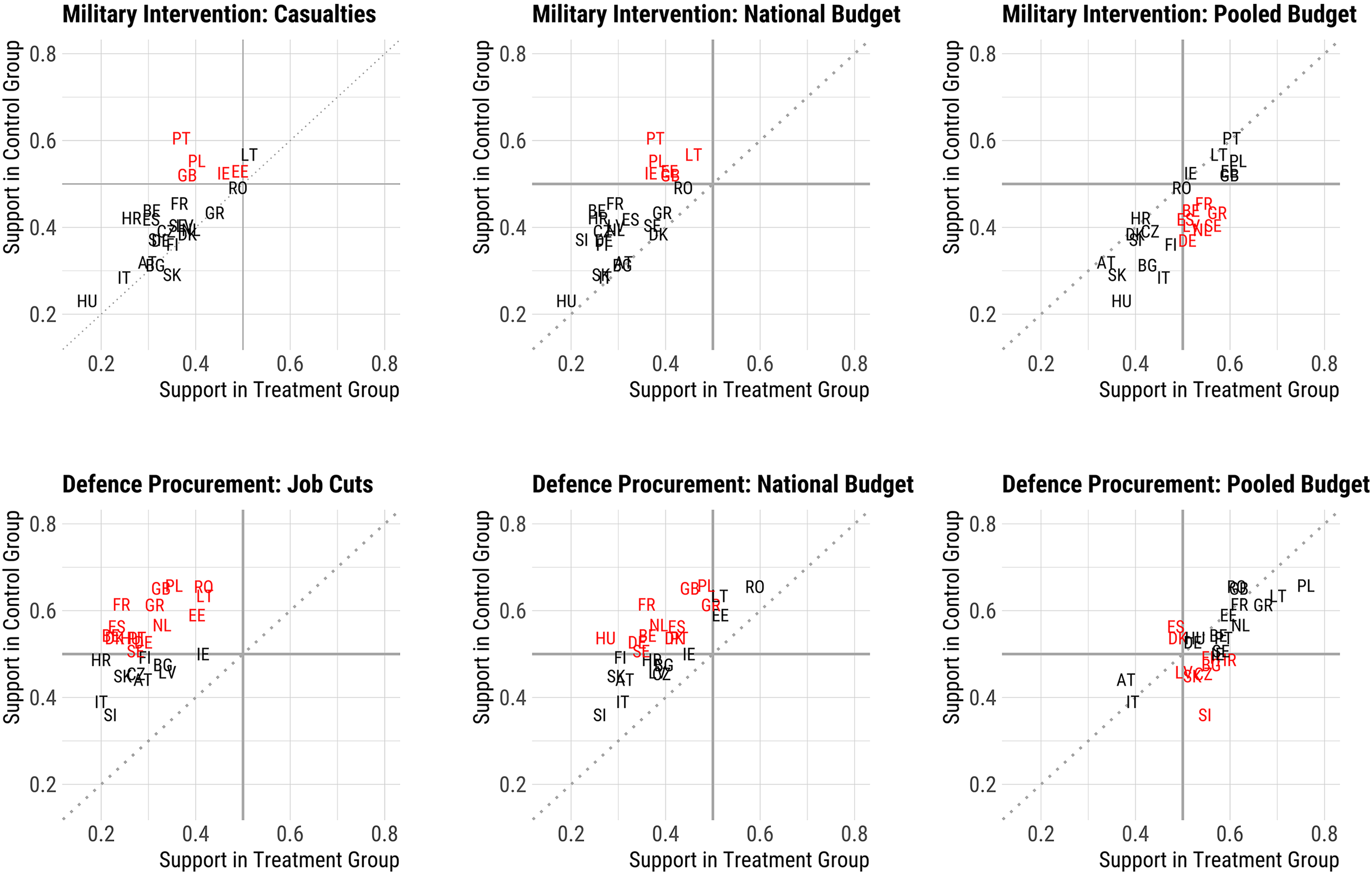
Proportion of supporters per country, control versus treatment.
The results suggest that cost frames have indeed the potential to change the proportion of supporters in the population. Analogous to the previous findings, in most countries the share of supporters in the treatment group decreases when national budget costs and non-budgetary costs are mentioned, whereas it increases when pooled costs are mentioned. Importantly, the frames do not only change the proportion of supporters, in some instances they also change supporters from being the majority to a minority (top-left quadrant in each plot) or vice versa (bottom-right quadrant in each plot). Particularly on the issue of joint defence procurement, cost frames that focus on the negative impact on government budgets and the economy have significant potential to shift the majority position.
In the final step of the analysis, we address the question of whether personal characteristics of citizens influence how they respond to budgetary and non-budgetary costs. For this purpose, we again estimate the regression model known from Figure 2 but add interaction terms between treatment group and EU attitude, militant internationalism, and political knowledge about the EU, respectively. Based on these regressions, Figures 5 and 6 depict the predicted support for the two cooperative activities across treatment groups and levels of these individual-level variables. Each line represents an experimental group and shows how support for a policy (y-axis) is associated with the individual-level variable (x-axis) in that group. Treatment effects are hence indicated by the gap between lines at a given value of the x-axis, and differences in treatment effects by differences in the slopes of the lines.
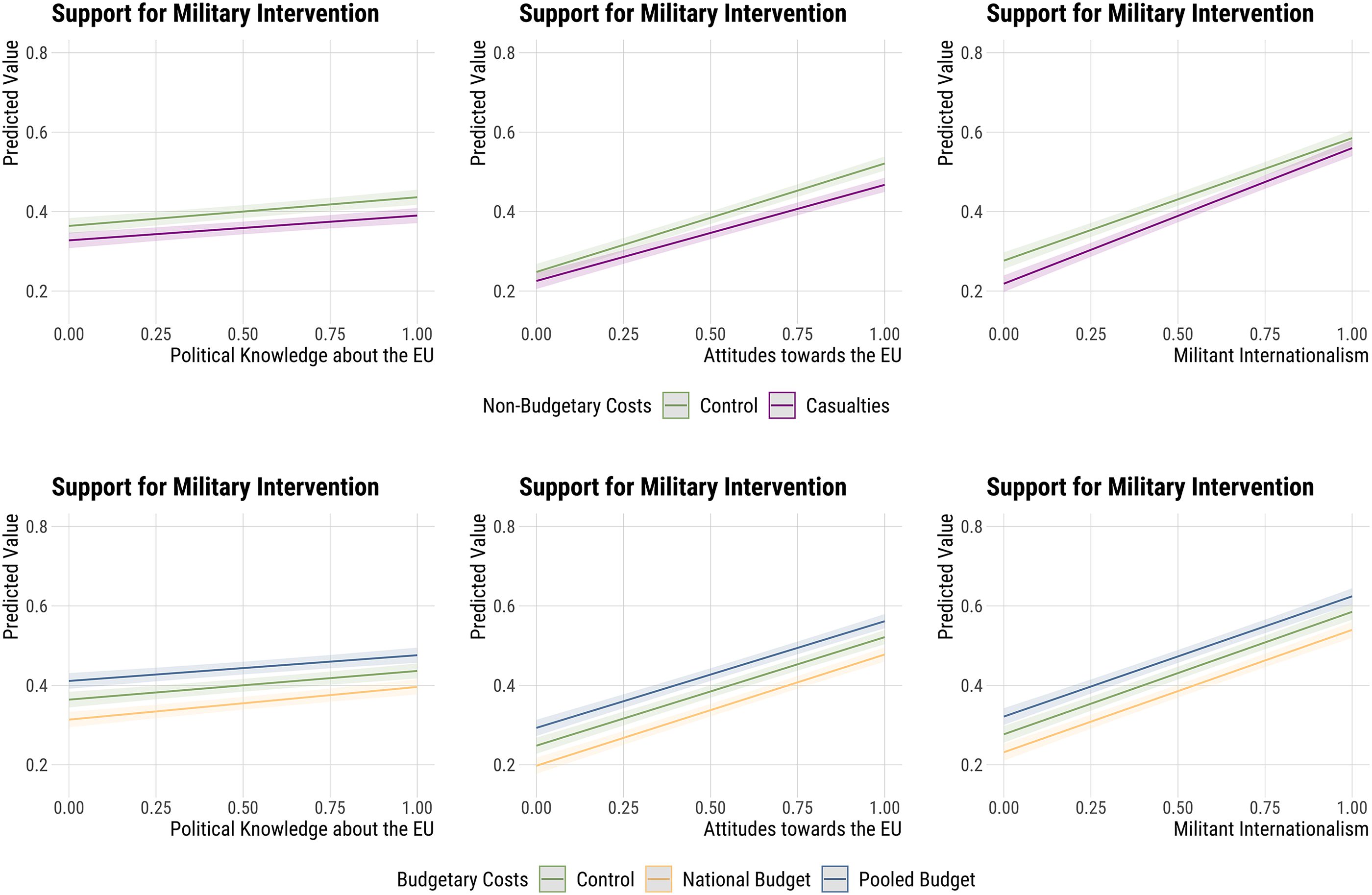
Individual-level heterogeneity: military intervention.
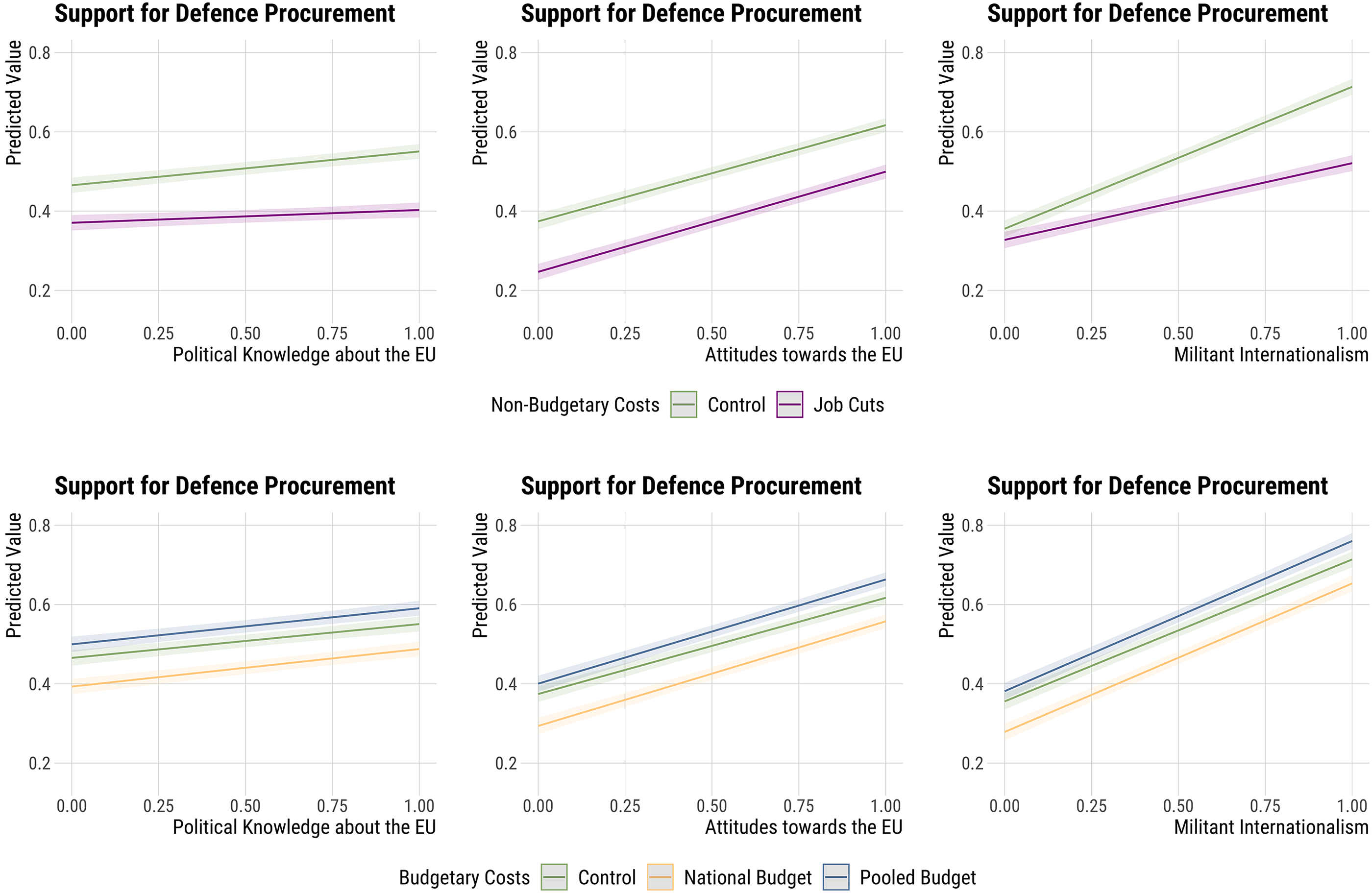
Individual-level heterogeneity: defence procurement.
As with country differences, we first identify general patterns and then zoom in on noteworthy exceptions from these patterns. Overall, we find little variation across subgroups. The individual characteristics considered here have little effect on how individuals respond to the frames, as shown by the parallel slopes for the respective experimental groups. We do observe some significant differences in a strict statistical sense, for example, in the top-middle and top-right panels of Figure 6. However, these interactions are negligible because they only translate into (small) differences when we compare respondents at the minimum with those at the maximum of the two moderating variables.
One notable exception is the interaction between levels of militant internationalism and pointing to the negative economic effects of the joint aircraft procurement (Figure 6, top-right panel). Mentioning of possible job cuts does not lead to a drop in approval among respondents who are generally critical of the use of military force as a foreign policy instrument; these respondents oppose procurement anyway, presumably because they see no point in procuring weapons they oppose using. In contrast, the procurement proposal is popular among respondents scoring high on militant internationalism when no costs are mentioned but receives much less support once potential job cuts are made explicit. This ‘cheap militant internationalism’, which is favourable to the use of military means but unwilling to bear the cost of acquiring them, deserves further investigation. More generally, this finding shows that different reactions to cost frames can occur, even if we see such variation in only one instance, which in turn suggests effect heterogeneity to be the exception rather than the rule.
Discussion and conclusion
Our experiments show that respondents’ support for important EU security and defence activities is much lower when they are exposed to information about the costs of cooperation, and that these effects occur largely consistently within and across member states. While there is some evidence that certain contextual conditions favour internalisation, overall, the results suggest that Europeans do not (fully) price in the costs when evaluating cooperation activities. A Eurosceptic politicisation strategy that places costs at the centre of the debate could therefore lead to public opinion on cooperation being more sceptical than the support levels routinely measured in surveys such as the Eurobarometer suggest. This drop through cost-based politicisation may even lead to support for cooperation changing from a majority to a minority position, especially if the majority of support is narrow when politicisation begins.
There are important qualifications to this headline result. Firstly, support ‘crumbles’ in the experiments in that support is lower when respondents are confronted with costs, but this crumbling takes place in rather small chunks. The effect sizes are moderate, and not all cost frames prove relevant across the board. ‘Crumbling’ is therefore perhaps too dramatic a term to describe what is happening. At the same time, we must be cautious in generalising from the experimental setting to actual political discourse. What would be the impact of a real political debate on the costs of a particular cooperative activity? A cost-based campaign could have larger effects because citizens would be confronted with persuasive messages repeatedly during the campaign (not just once, as in our experiments). Political entrepreneurs would also use stronger frames than we did, which could further increase their impact. 8 From a post-functionalist perspective (Hooghe and Marks, 2009), the perceived threat to national identity posed by supranational cooperation is particularly relevant. Since security and defence policies affect core state competencies (Genschel and Jachtenfuchs, 2014), the politicisation of sovereignty costs might reduce support more than the type of costs considered here. Conversely, one could argue that our experiments overestimate real-world effects. In the controlled environment of the experiment, respondents are more likely to receive the treatments (messages) than in everyday life, where citizens often pay little attention to politics (Druckman and Lupia, 2016). Furthermore, selective exposure and motivated reasoning may be more prevalent in the real world – for example, credibility assessments of the sender typically moderate the effectiveness of persuasion (O’Keefe, 2016). In short, our experiments show that cost-based communicative interventions can influence citizens’ attitude formation, but not how large this effect would be if they took place in public discourse.
The second and perhaps more important caveat is that politics usually revolves around competing policy proposals, with interested parties simultaneously exchanging arguments about the pros and cons of both alternatives (Sniderman and Theriault, 2004). Champions of cooperation would probably point out that unilateral or isolationist policies are also costly. Unilateral and isolationist policies of EU member states might incur reputation costs, for example, decreasing a country's ability to realise its goals in the future. The same applies to debates within the cooperation camp about the best institutional setting for cooperation. Alternatives to EU cooperation, such as NATO or minilateral cooperation, are also associated with costs. Our research design, which looks at the attitude object of EU cooperation and its costs in isolation, is hence simplistic. We cannot say whether citizens evaluate other policy options as much or as little based on their costs, or how they assess relative costs. We therefore emphasise that our results imply the possibility, not the necessity, of ‘crumbling’ public support if the costs of collaboration were to become politicised. Further studies that employ more complex experimental designs are needed to study the impact of competing frames on multiple policy options.
These caveats notwithstanding, our results have important implications for the question whether there is a public mandate for deepening EU cooperation in security and defence. Our findings strengthen the position of those who warn against deducing such a mandate from survey results indicating high public support for the general idea of more cooperation (Brummer, 2007; Mader et al., 2020; Peters, 2014; Sinnott, 2000). If citizens have not (or not fully) considered the costs of cooperation when forming their preferences, and if politicisation could shift public opinion from support to opposition, it is much harder to derive a normative obligation for responsiveness. It is clear that democratic politicians should implement genuine demands from the public. But does such an obligation also arise from public opinion that may change as soon as concrete proposals are put on the table and politicised? We believe that public opinion, if it has not been formed against the background of a salient political discourse on concrete policy proposals, can provide direction, but not a mandate in the strict sense. For that, a test would be required, that is, whether majority support would persist if an ambitious plan for more European cooperation were proposed and seriously pursued.
While such a test may be desirable from a normative perspective, European decision-makers are hesitant to conduct it. 9 Given our findings, this behaviour appears quite reasonable. Even though elites generally have incentives to respond to public opinion in the area of security and defence (Schoen, 2008), vote-seeking politicians are bound to evaluate whether proposing a policy will benefit or hurt them politically. The crucial question hence is how decision-makers assess latent public opinion on the issue, that is, future opinion that citizens will hold in response to elite communication and decision making (Zaller, 2003). Leaders might ignore opinion polls if they assume that public opinion will shift from support to opposition at some point during the policy cycle. Given the cost sensitivity citizens displayed in our experiments, our research suggests that policy makers stalling initiatives to deepen EU security and defence cooperation may display a good sense of latent public opinion.
Supplemental Material
sj-zip-2-eup-10.1177_14651165241236777 - Supplemental material for Crumbling in the face of cost? How cost considerations affect public support for European security and defence cooperation
Supplemental material, sj-zip-2-eup-10.1177_14651165241236777 for Crumbling in the face of cost? How cost considerations affect public support for European security and defence cooperation by Matthias Mader, Moritz Neubert, Felix Münchow, Stephanie C Hofmann, Harald Schoen and Konstantin Gavras in European Union Politics
Supplemental Material
sj-docx-3-eup-10.1177_14651165241236777 - Supplemental material for Crumbling in the face of cost? How cost considerations affect public support for European security and defence cooperation
Supplemental material, sj-docx-3-eup-10.1177_14651165241236777 for Crumbling in the face of cost? How cost considerations affect public support for European security and defence cooperation by Matthias Mader, Moritz Neubert, Felix Münchow, Stephanie C Hofmann, Harald Schoen and Konstantin Gavras in European Union Politics
Footnotes
Author contributions
MM, MN, SCH, HS and KG contributed to the conception and acquisition; FM and KG analysed the data; MM, MN and FM drafted the article; and SCH and HS provided feedback.
Funding
The authors disclosed receipt of the following financial support for the research, authorship, and/or publication of this article: This project has received funding from the Volkswagen Foundation under the “European Common Defence and Shared Security in an Age of Brexit and Trump” project (grant agreement no. 94760,  ).
).
Data Availability Statement
Supplemental material
Supplemental material for this article is available online.
Notes
References
Supplementary Material
Please find the following supplemental material available below.
For Open Access articles published under a Creative Commons License, all supplemental material carries the same license as the article it is associated with.
For non-Open Access articles published, all supplemental material carries a non-exclusive license, and permission requests for re-use of supplemental material or any part of supplemental material shall be sent directly to the copyright owner as specified in the copyright notice associated with the article.
