




Abstract
Free movement is simultaneously widely acclaimed and strongly contested in the European Union. To address this apparent contradiction, we unpack European Union freedom of movement into its different transnational rights and argue that opposition is unequal across entitlements. Using evidence from a unique survey conducted in the United Kingdom in 2017, we show that citizens mainly contest welfare access. This transnational right implies costs for the host country and taps into perceptions of belonging and deservingness. Due to its association with ideas of national community and solidarity, access to welfare is more contested even among those who, in principle, should be favourable to such entitlements: inclusive national identifiers and European integration supporters. Our findings underscore the challenge of creating a sense of European community that could underpin all transnational rights implied by the Union's principle of freedom of movement.
Introduction
The free movement of people is a fundamental principle of the European Union (EU). European citizen status, symbolised by the famous burgundy passport, allows its holder the right to move and reside freely in any EU member state, independently of one's country of origin 1 , while the freedom of movement for workers 2 constitutes one of the four pillars of the single market. Such a direct link between a transnational community and its members’ rights is unprecedented and sets the EU apart from other international organisations (Maas, 2007). EU citizens consistently point to freedom of movement as the most positive outcome of European integration and overwhelmingly support its principle (Eurobarometer, 2021). 3 Paradoxically, however, its effects have also constituted one of the flashpoints for Euroscepticism in recent years. EU mobility has featured prominently in the narratives of both Eurosceptic political entrepreneurs and mainstream political leaders in several member states, including Austria, Denmark, Germany, and the Netherlands (Barbulescu, 2017; Blauberger and Schmidt, 2014; Karstens, 2020a; Ruhs, 2017; Ruhs and Palme, 2018). The politicisation of EU citizens’ rights perhaps reached its pinnacle during the Brexit referendum campaign in the United Kingdom (UK) (Hobolt, 2016; Vasilopoulou, 2016).
Against this background, we address the puzzle of why the principle of freedom of movement is simultaneously widely acclaimed and strongly contested (Lutz, 2021). Existing scholarship has examined attitudes towards freedom of movement in the EU with a focus on immigration perceptions (Lutz, 2021; Lutz and Karstens, 2021), the impact of different levels of economic prosperity (Vasilopoulou and Talving, 2019), the character of national welfare institutions (Mårtensson et al., 2023), relative deprivation (Ferrera and Pellegata, 2018), European identification (Karstens, 2020a), as well as media (Meltzer et al., 2021) and framing effects (Karstens, 2020b). So far, however, this literature has focused on citizens contesting the general principle of EU freedom of movement. Yet, the freedom to move within the EU involves different economic and social entitlements, including the right of EU citizens to live, work, do business, and, when conditions are met, reside long-term and access the welfare provisions in another EU member state. 4
We posit that opposition to freedom of movement is unequal across its different entitlements. Specifically, citizens mainly contest the transnational right to access welfare because of the tension it generates with nationally embedded notions of social solidarity (Geddes and Hadj-Abdou, 2016). While other entitlements could also become contested when linked to debates on migrant labour implications, the rights to work or do business imply contributions to the national economy. On the other hand, access to welfare insinuates direct costs for the host country, tapping into perceptions of belonging and deservingness. Due to its association with notions of national community and solidarity, this transnational right is not fully embraced even among those who, in principle, should be in favour of such entitlements: citizens who identify as Europeans or support EU membership.
To test our expectations, we analyse evidence from a unique online cross-sectional survey on attitudes towards the different entitlements under the EU's freedom of movement principle. We focus on the UK, a country where transnational rights associated with EU freedom of movement have become salient in public debates. Thus, citizens are more likely to have activated preferences (Zaller and Feldman, 1992: 616) about these rights, which makes it an appropriate context for developing a study into attitudes towards transnational rights. The original survey was conducted by YouGov in June of 2017, coinciding with the official start of the Brexit negotiations. By analysing the structure of these attitudes as multidimensional and with a focus on their association with EU membership support and European identification, our article makes a three-fold contribution. First, by empirically examining freedom of movement through its multiple dimensions, we contribute to the literature on attitudes towards EU mobility (e.g. Lutz, 2021; Lutz and Karstens, 2021). We show that citizens primarily contest transnational access to national welfare systems. In contrast, other entitlements related to EU freedom of movement are widely supported. Second, we demonstrate that scepticism towards transnational access to welfare aligns, to some extent, with the demarcation side of the demarcation/integration societal fault line (Kriesi et al., 2006; see also Teney et al., 2014). The character of national identification is particularly relevant in structuring these attitudes. We find, however, that even individuals on the integration side of the societal cleavage remain relatively sceptical of transnational welfare rights despite their support for other rights associated with EU freedom of movement. Third, we contribute to the broader literature on European public opinion (Hobolt and De Vries, 2016) by showing that while the character of national identity structures individual attitudes towards most transnational rights to some extent, its impact is most pronounced for perceptions of welfare access among EU membership supporters. While supporters of EU membership are, in principle, in favour of transnational rights, the character of their national identification splits them into two significantly different groups on the issue of welfare access. EU membership support is associated with acceptance of welfare rights only for individuals who identify as Europeans. In contrast, purely national identifiers tend to oppose transnational welfare rights, independent of their stance on EU membership. This underscores the challenge of creating a sense of EU community that could underpin all transnational rights implied by the principle of freedom of movement.
Unpacking transnational rights under the EU's free movement principle
Freedom of movement, as an essential component of the European common market, has constituted the cornerstone of European integration since its inception (Favell, 2014; Recchi, 2015). European institutions actively promote it as an element of a virtuous circle of EU citizenship and belonging, where membership status, rights, the use of these rights, and the feeling of belonging are often conflated (Damay and Mercenier, 2016). However, while the flows of goods and capital have steadily increased, the degree of intra-EU mobility remained relatively stable even after introducing EU citizenship in 1993 (Recchi, 2015). This changed in the early 2000s when workers’ mobility from the Central and Eastern European (CEE) member states increased significantly (Recchi, 2015; Recchi et al., 2019). Post-2008, greater mobility was also observed from the EU's Southern Periphery (Lafleur and Stanek, 2017). Accordingly, public salience of free movement within the EU remained low until the increased mobility from CEE member states and the aftermath of the economic crisis created a fertile ground for politicisation (Barbulescu, 2017; Ruhs, 2017; Schmidt et al., 2018).
When exploring the effects of such politicisation, it is important to account for the fact that attitudes towards EU freedom of movement are – by definition – multidimensional. Freedom of movement is not a single policy on which citizens make up their minds independently of its varied implications. Rather, it involves different economic and social entitlements, such as the right of EU citizens to live, work, do business, and receive welfare across the Union. Among these rights, we argue that welfare rights carry a greater potential for politicisation than other entitlements. Admittedly, other rights, such as the right to work or do business in another EU country, could potentially be linked to debates triggered by the far right on the risks of migrant labour such as unfair competition to the local population (see also Vasilopoulou and Zur, 2022 for the role of the EU issue in far-right party success). However, non-nationals working or doing business in the country also necessarily imply contributions to the national economy. Such contribution-based rights facilitate perceptions of deservingness and tend to be more easily accepted by the citizens of the receiving state (Reeskens and Van Oorschot, 2012).
Welfare access primarily implies costs and can trigger concerns about the limited character of national resources or even perceptions of threat due to alleged free riding. Because of its association with nationally defined and often limited resources, contestation is thus more likely to be observed in relation to EU citizens’ welfare rights. While the EU legal framework guarantees the non-discrimination of EU nationals in the destination country, it establishes their access to national social benefits and services only as residents. However, the right to reside in a country for longer than 3 months is conditional on one's employment situation or other sources of income for those economically inactive (Bruzelius, 2019). Despite such conditionality, EU citizens’ transnational access to welfare provisions has often been the focal point of debates on the implications of European integration. There is an inherent tension between the provision of equal treatment for EU citizens across the EU on the one hand and national welfare systems that emphasise residence-based social rights on the other (Barbulescu and Favell, 2020; Bruzelius, 2019; Geddes and Hadj-Abdou, 2016; Mårtensson et al., 2023; Schmidt et al., 2018).
Politically, the principle of non-discrimination of EU citizens can be framed as undermining the national bases of solidarity necessary for within-state redistributive policies (Geddes and Hadj-Abdou, 2016). Debates on who should access welfare can also evoke notions of deservingness among nationals, with benefit recipients often being negatively portrayed (Kootstra, 2016). Economically, access to social services by those with limited contributions to the system puts its sustainability at risk, potentially resulting in a race to the bottom in social standards (Kvist, 2004). The heterogeneity of national welfare systems in the EU allows for the emergence of fears of EU citizen welfare migration (Blauberger and Schmidt, 2014; Geddes and Hadj-Abdou, 2016; Schmidt et al., 2018). For citizens, questions related to welfare, i.e. who should be entitled to the collective goods of the state, cut across many other political issues, including the economy, security, and borders, and can also appeal to their sentiments towards foreigners (Vasilopoulou, 2016).
Due to its nature, therefore, access to welfare can be highly divisive. The politicisation of welfare has become especially salient in the tactics of far-right parties in Western Europe, which have increasingly relied on economic nationalism and welfare chauvinism to broaden their appeal (Halikiopoulou and Vlandas, 2019). Mainstream political leaders have also questioned the principle of non-discrimination in Austria, Denmark, the Netherlands, and the UK (Ruhs, 2017; Ruhs and Palme, 2018), calling for restricted access for EU workers to welfare benefits (Ruhs, 2017). In Germany, for example, the Christian Social Union (CSU) in Bavaria used the spectre of ‘poverty migration’ and ‘welfare tourism’ to mobilise its electorate (Geddes and Hadj-Abdou, 2016: 232). This ties in with findings that citizens living in wealthier EU member states tend to express scepticism regarding the legitimacy of non-nationals’ access to economic and social rights (Vasilopoulou and Talving, 2019).
H1: Individuals are less likely to support welfare access compared to other freedom of movement rights.
Individual variation in attitudes towards transnational welfare rights
We have argued that public contestation of EU freedom of movement may be observed primarily on welfare rights. However, not all citizens are equally likely to support or oppose transnational access to welfare or other rights. We turn to scholarship that explores social reactions to European integration and globalisation to understand this variation. This literature highlights the diverging attitudes and behaviour of those who support integration and the opening of national borders in contrast to those who oppose these processes due to perceived economic and/or symbolic threats and often seek refuge within national demarcation processes (e.g. Kriesi et al., 2006; Teney et al., 2014).
Studies that explore the material roots of such divisions suggest that individuals who do not enjoy or perceive the benefits of integration due to their uncompetitive location within the labour market are more likely to exhibit negative views of the EU (Díaz-Lanchas et al., 2021). The principle of free movement tends to create more opportunities for citizens with higher levels of human capital (Favell, 2008). Therefore, individuals with a more precarious economic or labour market position could perceive intra-EU mobility as a threat (Ferrera and Pellegata, 2018; Mårtensson et al., 2023).
Furthermore, national identification exclusive of attachment to Europe constitutes another key element of this divide and a robust predictor of negative EU attitudes (Hooghe and Marks, 2009). And, although EU freedom of movement primarily relates to policymaking and implementation, it is also substantively symbolic, which suggests a strong link between supranational identification and support for EU citizens’ freedom of movement (Karstens, 2020a).
Taken together, the integration/demarcation divide, understood both as individual socio-economic differences and the open/closed character of national identification, allows us to understand the roots of variation in individual attitudes towards transnational rights under EU freedom of movement.
H2: Individuals positioned on the demarcation side of the demarcation/integration cleavage are less likely to support freedom of movement transnational rights than those on the integration side.
While we expect a general divide over transnational rights along the lines of the integration/demarcation cleavage, we also anticipate that the structure of attitudes towards transnational access to welfare is likely to differ. First, redistribution tends to be tied to notions of national community and social solidarity, as formulated in the post-war European welfare state context, conceived as the social component of national citizenship (Barbulescu and Favell, 2020). EU freedom of movement could be seen as eroding the national bases of solidarity that sustain redistributive policies (Geddes and Hadj-Abdou, 2016). As noted above, intra-EU mobility is also sometimes portrayed as facilitating ‘welfare tourism’ (Geddes and Hadj-Abdou, 2016: 232), potentially hindering citizens’ access to the collective goods of the state and posing a threat to the long-term sustainability of national social protection systems. Thus, welfare rights for mobile EU citizens constitute a direct challenge to the traditionally closed character of the national welfare state both for political and economic reasons (Schmidt et al., 2018).
Second, freedom of movement is core to EU citizenship (Siklodi, 2020), as the latter is often considered a vehicle for greater European identification (Kaina and Karolewski, 2013). Research on support for welfare provisions indicates that perceived closeness between those providing support and those being supported is key for the acceptance of welfare policies, with groups perceived as closer to oneself considered as more deserving (Oorschot, 2000). Citizens who identify to some extent as Europeans (inclusive national identifiers) tend to have a more open notion of the (national) community and perceive other EU nationals as closer to themselves compared to individuals who identify exclusively with their nation state. Accordingly, inclusive national identifiers should be more willing to grant welfare access rights to EU citizens than those who identify exclusively as nationals. We thus expect that the character of identity, i.e. inclusive versus exclusive, is relevant to explaining diverging views of transnational welfare access under EU freedom of movement.
H3: The effect of identity is more pronounced for welfare access support than for other freedom of movement transnational rights.
The interplay of identity and EU membership support in structuring attitudes towards transnational welfare rights
This article focuses on the UK, a country where transnational rights associated with EU freedom of movement have become salient in public discourse. Alongside Germany and Austria, the UK is one of the top hosts of working-age EU citizens and has experienced one of the most significant increases in intra-EU mobility since the late 2000s (European Commission, 2017). While assessments of the fiscal effects of immigration to the UK have been positive (Dustmann and Frattini, 2014), and the country is also an ‘exporter’ of mobile EU citizens (D’Angelo and Kofman, 2018; Recchi, 2015), EU freedom of movement was politicised in the run-up to the 2016 Brexit referendum.
Restrictions on the rights of EU migrants claiming welfare benefits in the UK featured prominently within the British Prime Minister's renegotiation agenda with the EU. Although the deal with the EU secured at that time a temporary requirement that EU citizens should live in another member state for four years before having full access to welfare benefits, EU citizens’ access to welfare remained a key issue during the Brexit referendum campaign. The UK Independence Party's (UKIP) message focused on the welfare threat implied by EU membership, including the preservation of national healthcare and the supposed inability of the UK to control its national borders (McManus, 2021). Τhe Vote Leave campaign's infamous Brexit bus proclaimed that funding allocated to the EU should be redirected to the National Health Service (NHS), further focusing the debate on the limited character of national resources. This was also depicted in the campaign's ‘Which NHS would you vote for today?’ TV ad that presented the NHS as being ‘at a breaking point’ due to EU membership (Vote Leave, 2016). Such focus on the threat to public health services resonated with the British public, which placed limiting benefits for EU migrants in their EU negotiation wish list as the second priority after increasing control of borders and immigration from the EU (Shakespeare, 2015). Accordingly, opposition to EU migration constituted a strong predictor of the Leave vote (Vasilopoulou, 2016). At the same time, Brexit also inspired an unprecedented pro-EU mobilisation and activated an awareness of the ‘right to have rights’ as part of EU citizenship (Brändle et al., 2018: 812).
Considering such a high degree of politicisation of EU membership in the UK context, as well as the strong focus on the deservingness of rights in those debates, we anticipate an interaction effect between identity and EU membership support in structuring attitudes towards transnational welfare rights. Overall, while we might expect that viewing EU membership favourably should by itself entail acceptance of transnational rights associated with EU citizenship, such an apparently straightforward picture becomes more complex when we consider the multidimensionality of EU attitudes. As Kaina and Karolewski (2013) note, simply supporting EU membership is not equivalent to a sense of community. Supporters of EU membership could be driven by utilitarian considerations (specific support based on concrete benefits from EU policies) or by a more stable, diffuse support for European integration, which implies a sense of community.
The latter is closely related to a sense of identity and membership of the community, central to support for welfare access as suggested by our theoretical framework. As anticipated by our H2 and H3, inclusive national identifiers, i.e. citizens who identify as both nationals and Europeans, should be more willing to grant welfare access rights to EU citizens than those who identify exclusively as nationals. Therefore, we cannot expect that division over transnational welfare rights will simply map on the EU supporters/opponents divide. We argue that identity drives support for welfare rights also among EU membership supporters (Karstens, 2020a). In contrast, among those who have become mobilised on the rejection of the EU and voted to leave the Union, such division could be less relevant as demarcation preferences become activated through Eurosceptic political cues, also among inclusive identifiers. We thus anticipate a heterogenous effect of identity across the two groups.
H4: The effect of identity on support for transnational welfare access is greater among EU membership supporters than among those who oppose it.
Data and methods
We rely on original data from a large-N cross-sectional population study (n = 1699) conducted in the UK. The sample is representative of the general British population in terms of age, gender, education, social grade, region, political attention, party preference, and EU referendum vote. The survey was fielded by YouGov on 28 to 29 June 2017. The timing of the survey coincides with the official start of the Brexit negotiations (17 June 2017), i.e. approximately one year after the Brexit referendum and a few years before the country left the block on 31 January 2020. During that time, EU membership in general, and the issue of intra-EU mobility in particular, were very salient among the electorate. We consider this an appropriate context for a study into these attitudes, as citizens are more likely to have activated preferences (Zaller and Feldman, 1992: 616) about these rights.
Dependent variables
Our central argument refers to the multidimensionality of freedom of movement and the expectation that some of its associated transnational rights might be more contested than others. Our survey design allows us to examine attitudes towards EU freedom of movement in detail, going beyond the Eurobarometer question wording, which lacks specificity. The question routinely included in the Eurobarometer is ‘What is your opinion on each of the following statements? Please tell me for each statement, whether you are for it or against it. The free movement of EU citizens who can live, work, study and do business anywhere in the EU’ (Eurobarometer, 2021), thus conflating its different implications in a single item. To capture citizens’ attitudes towards the different rights implied by freedom of movement, we asked: ‘Thinking about the following, where would you place your views on the scale below?’ ‘As part of the Brexit deal, EU/UK citizens should [NOT] have the right
To live in the UK/EU
To work in the UK/EU
To do business in the UK/EU
To access welfare in the UK/EU’
Answers were given on a scale where 0 = should not have the right, 10 = should have the right. 5 Since these entitlements have a reciprocal character, we gauge the level of support for each of these four individual rights for UK citizens in the EU as well as measure the extent to which respondents are willing to grant EU citizens these rights in the UK.
Independent variables
We use two separate variables to operationalise the integration/demarcation cleavage. First, we use respondents’ national identification, where the original scale includes 1 = British only, 2 = British and European, 3 = European and British, 4 = European only, and 5 = Other. Because our interest lies specifically in the inclusive versus the exclusive character of identification (H2), the variable was recoded to 1 = exclusive national identity (n = 873) and 0 = inclusive national identity (n = 610; categories 2, 3, and 4). We exclude respondents who chose the option ‘Other’ (n = 180), as we cannot determine the exact meaning of that category, which could include both regionally focused types of identity (such as Scottish), as well as non-British nationals. These possibilities would have different (possibly contrary) theoretical implications for our argument. Second, we use level of education as a proxy for human capital, where 1 = low (n = 457), 2 = medium (n = 705), and 3 = high (n = 470).
To measure EU membership support, we utilise a question asking respondents to indicate how they voted in the 2016 EU referendum. We create a new variable coded as 1 for those who voted Leave (n = 697) and as 0 for those who voted Remain (n = 774). Respondents who could not recall how they voted or did not vote in the referendum were excluded from the analysis.
Our models include several control variables. We first introduce immigration attitudes as a control to isolate the effects of identity. Even though intra-EU mobility is distinct from immigration from countries outside the EU, citizens often conflate these flows and oppose migration in general (Blinder and Markaki, 2019). Consequently, perceptions of migration tend to be associated with attitudes towards freedom of movement (Lutz, 2021), and we can expect them to shape individual attitudes towards transnational rights similarly. To measure migration attitudes, we composed an index using two questions: whether immigration is good/bad for the British economy and whether immigration is good/bad for British culture. The index runs from 0 to 20, where larger values indicate more negative attitudes. Other control variables include work status (1 = working, 0 = not working); self-reported left-right ideology (on a scale from 1 to 11) and left-right ideology squared to account for its possible non-linear effects; age in years, and gender (0 = male, 1 = female). Descriptive statistics of all variables are reported in the Online appendix. The variance inflation factor (VIF) is 3.48–3.5 for our main models, indicating a moderate correlation between variables but no serious multicollinearity concerns.
To test our hypotheses, we regress support for the four transnational rights on the listed independent and control variables. To account for the structure of our survey data, we estimate regression models with standard errors clustered in regions (n = 12). 6 All independent and control variables are recoded on a scale from 0 to 1 to allow us to compare the magnitude of their effects.
Results
Descriptive analysis: Support for freedom of movement transnational rights
To evaluate our first hypothesis that expects public support of EU freedom of movement to be lower for transnational welfare access than for other rights, we examine descriptive statistics of public attitudes towards the four transnational rights. Figure 1 below displays the proportion of people who gave a negative (‘against’: values 0 to 3 on the original scale), neutral (‘neutral’: values 4 to 6 on the original scale), and positive response (‘for’: values 7 to 10 on the original scale) to questions about the right to live, work, do business, and receive welfare transnationally.
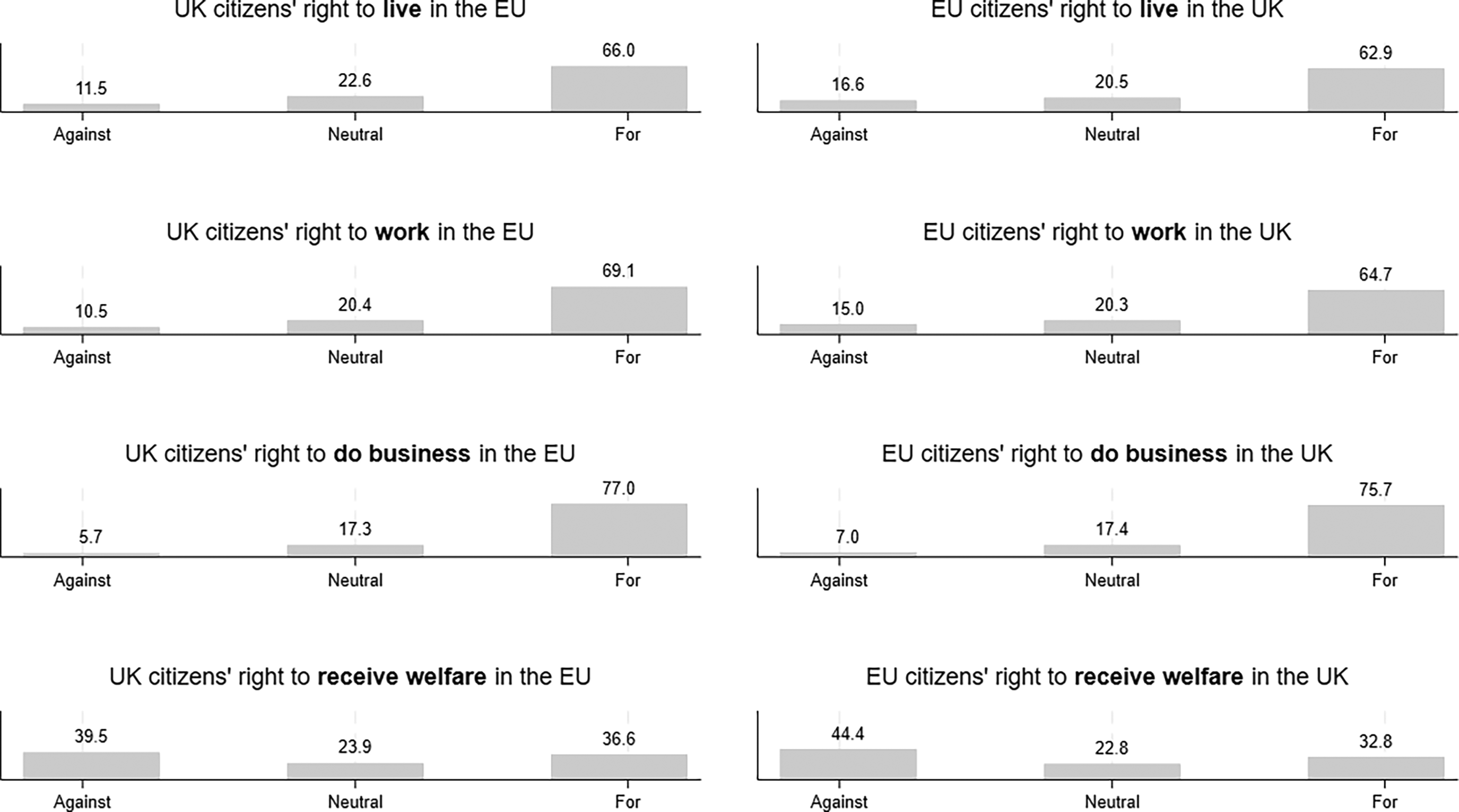
Support for transnational rights for UK citizens in the EU (left panel) and EU citizens in the UK (right panel).
Our data make it possible to account for the reciprocal nature of transnational rights and explore attitudes towards rights for oneself abroad and for others in the country. First, we explore citizens’ support for transnational rights for themselves (left panel, Figure 1). A clear majority believes that they should have the right to live (66%), work (69.1%), and do business (77%) in the EU. The right to receive welfare, on the other hand, gains significantly less acceptance, with only 36.6% agreeing that they should be entitled to it in the EU. In comparison, almost 40% oppose this right, and nearly one in four (23.9%) has not made up their mind, making it the highest percentage of neutral scores across all four rights.
We also see strong agreement among survey respondents with the idea of granting the same set of rights to EU citizens in the UK (right panel, Figure 1). Despite the negative politicisation of EU freedom of movement in the UK, a majority of respondents believe that EU citizens should have the right to live (62.9%), work (64.7%), and do business (75.7%) in the UK. However, the right to receive welfare stands out again, with more people rejecting (44.4%) than supporting (32.8%) it, and, yet again, with the most significant proportion of neutral answers (22.8%) out of four rights surveyed.
It should be noted that the share of neutral views is close to or over 20% for all four rights, indicating a rather high degree of indecision on the issue of transnational rights, even in a context where these have become very salient in public debates. Still, among respondents who have made up their minds, welfare access is the only aspect where we find more people rejecting it than supporting it. On all other transnational rights, opposition remains marginal, with a maximum of 16.6% against EU citizens’ right to live in the UK.
Mean values (Figure 2) further confirm that welfare attitudes are significantly different from attitudes towards other transnational rights. Therefore, it becomes clear that access to welfare constitutes a potential flashpoint for contestation, even when it would technically provide benefits for oneself and allow access to other EU member states’ resources.
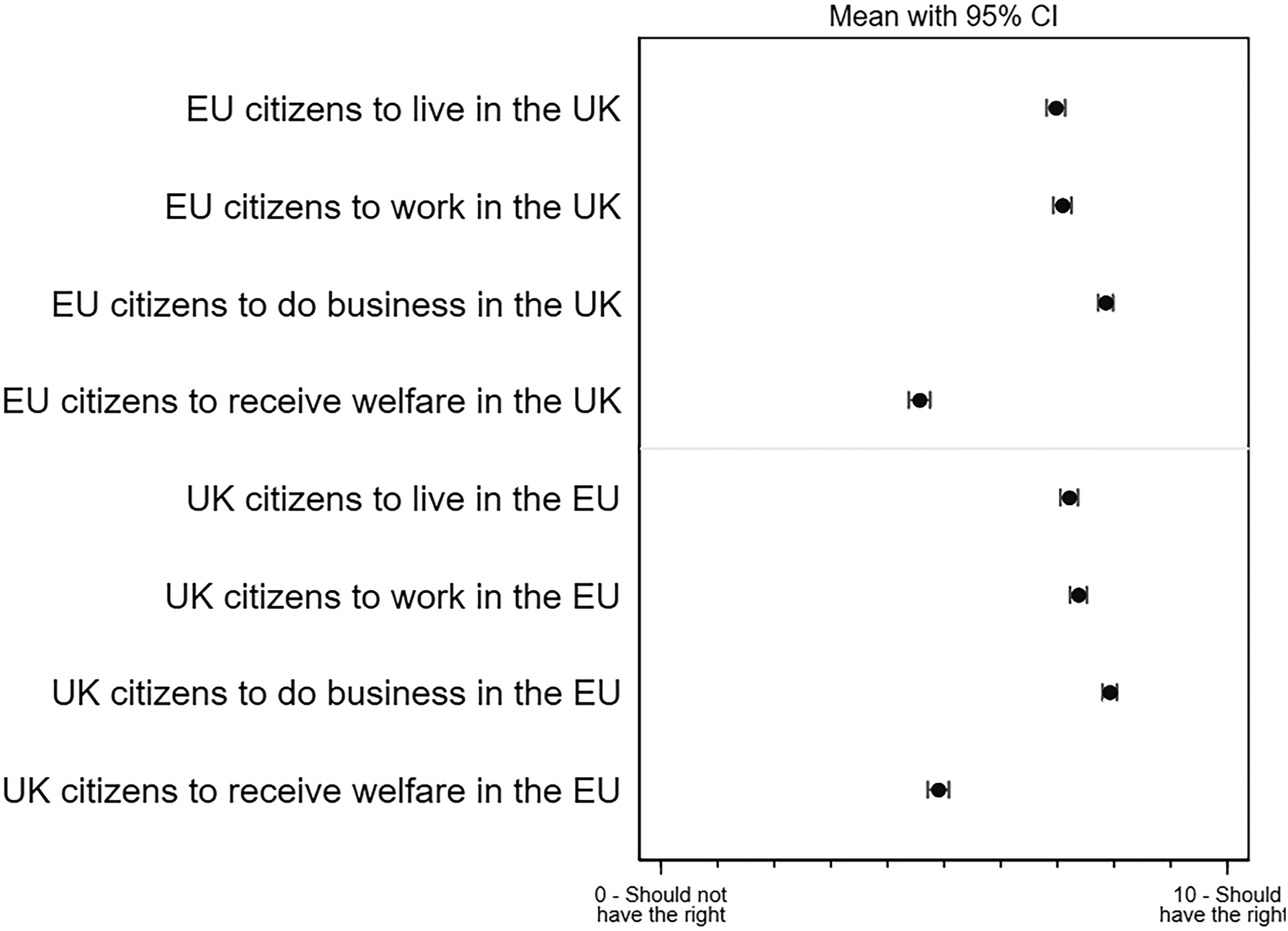
Mean values of attitudes towards transnational rights, with 95% confidence intervals.
Finally, we should note that the aggregate level of citizens’ expectations of rights for themselves tends to match that of the rights they would be willing to grant others. Attitudes also follow the same order regarding the overall level of support, i.e. the right to do business receives the strongest endorsement, and welfare access is the least supported right. Furthermore, the differences between support for one's own rights in the EU versus the rights of EU citizens in the UK on different rights are barely a few decimals. Therefore, our data suggest that individuals’ views on transnational rights are principled and remain congruent. In other words, people tend to see these rights as reciprocal rather than egoistically supporting one's own rights over the rights of others. Such evidence of an overall congruence in attitudes towards transnational rights goes against studies suggesting that preference for one's own rights over granting these rights to others lies at the root of the inherent ambivalence in public perceptions of freedom of movement (Lutz, 2021).
Since we find that the levels of support for UK citizens’ rights in the EU and the rights of EU citizens in the UK are similar on all four rights, we focus on the latter in the remainder of this article. From the standpoint of the demarcation/integration cleavage, transnational rights for mobile EU citizens should be the key point of contention. 7
Our descriptive findings suggest that we should not think of freedom of movement as a single issue. Instead, we must consider its different dimensions. In particular, the potential for contestation lies predominantly in the question of welfare, providing preliminary support for H1. To further evaluate the difference in attitudes towards welfare access compared to the rest of the transnational rights, we graph support levels for the rights of EU citizens in the UK across the key indicators of the integration/demarcation division (Figure 2; see also the Online appendix). We know from the literature that exclusive national identification correlates with stronger polity and policy Euroscepticism (Hooghe and Marks, 2005, 2009) and, therefore, expect this to matter (H2), especially for attitudes towards transnational welfare rights (H3). For this reason, we distinguish between people who identify exclusively as British (51.4% of respondents) and those who indicate an identification inclusive of the European element (British and European, European and British, or European only; 35.9%). We also differentiate between three educational levels: lower (28%), medium (43.2%), and higher (28.8%). By zooming in on these groups, we can verify the extent to which the integration/demarcation cleavage structures support for EU citizens’ transnational rights.
The dashed line in Figure 3 represents the mean level of support in the overall sample, and dots indicate means for different identity and education groups in our survey. We observe, in line with H2, that people with inclusive identity are more supportive of EU citizens’ rights compared to those who identify exclusively as British. Confidence intervals confirm that the differences between these groups are statistically significant for all four types of rights (see the Online appendix). However, despite clearly differing views on all four transnational rights, both groups’ attitudes are much more negative when it comes to welfare access. While people with inclusive identity overwhelmingly support EU citizens’ right to live, work, and do business in the UK (mean values from 8.5 to 8.8), their support for welfare access is comparatively much lower (mean value of 6.1). Therefore, among inclusive identifiers, support for EU citizens’ welfare access is closer to that of exclusive identifiers’ views of other transnational rights (live, work, do business – mean values from 5.7 to 7.1). Analogous patterns appear across education levels. People with higher education are more supportive of EU citizens’ right to live, work, and do business in the UK, compared to other education groups. But when it comes to access to welfare, their support drops to levels similar to how lower-educated individuals feel about all other rights.
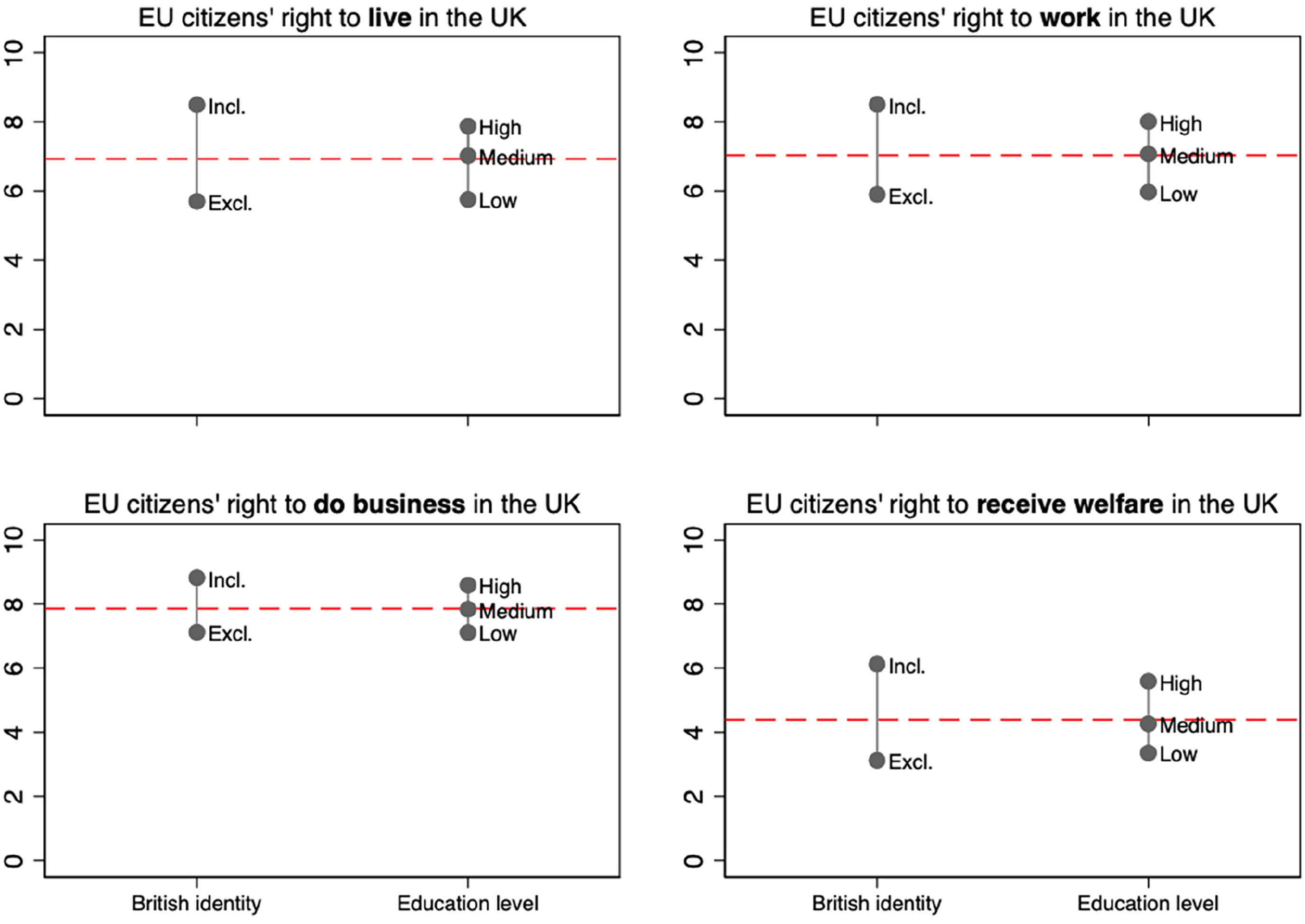
Support for transnational rights for EU citizens in the UK, by national identification and level of education.
Taken together, our descriptive analyses provide support for H1, which expects public contestation to be higher on welfare rights compared to other types of transnational rights under the EU's freedom of movement principle. This is further supported when we examine the reciprocal character of the four rights. Our findings also indicate that while the integration/demarcation cleavage seems to structure attitudes towards free movement to some extent, welfare access is the most polarising transnational right, even for individuals placed on the integration side of the societal divide.
Explanatory models of support for freedom of movement transnational rights
We turn to explaining attitudes towards transnational rights (Table 1). The results lend only partial support for H2: indicators used to operationalise the integration/demarcation cleavage are not consistently correlated with attitudes towards the different transnational EU rights. Only exclusive national identification constitutes a robust predictor of attitudes towards most EU citizens’ rights. However, it has a much larger negative effect on attitudes towards EU citizens’ right to receive welfare in the UK than their right to live or work in the UK. Identity does not seem to correlate with support for EU citizens’ right to do business in the UK. This corroborates H3, according to which the character of national identity is more strongly linked to welfare access than other transnational rights. Holding all other variables constant, the predicted mean value for welfare rights’ support is 4.79 for inclusive and 4.02 for exclusive identifiers, on a scale from 0 to 10. This effect with the size of −0.77 is much larger than the effect of identity on the right to live (−0.24) or work (−0.26) in the UK. Importantly, regression results confirm what we already observed in descriptive analysis, i.e. individuals with an inclusive identity are also relatively sceptical of welfare rights (predicted mean 4.79 on a scale from 0 to 10), despite expressing positive views on other transnational rights (predicted mean value of 7.25 for the right to live, 7.38 for the right to work, and 8.09 for the right to do business in the UK). Second, the results for education also indicate that welfare rights are differently structured compared to other transnational rights. Educational attainment is only correlated with attitudes towards welfare access. Compared to those with medium education, higher- and lower-educated individuals are more likely to support welfare rights. While the direction of the latter effect is somewhat surprising given the well-documented positive association between lower education levels and Euroscepticism (Hakhverdian et al., 2013), it further illustrates the key finding of the paper: welfare attitudes are significantly different from other transnational rights. These differences are reflected in the overall lower support for transnational welfare access, as well as in how they relate to the key socio-economic differences in the population.
Models of support for EU citizens’ rights in the UK.
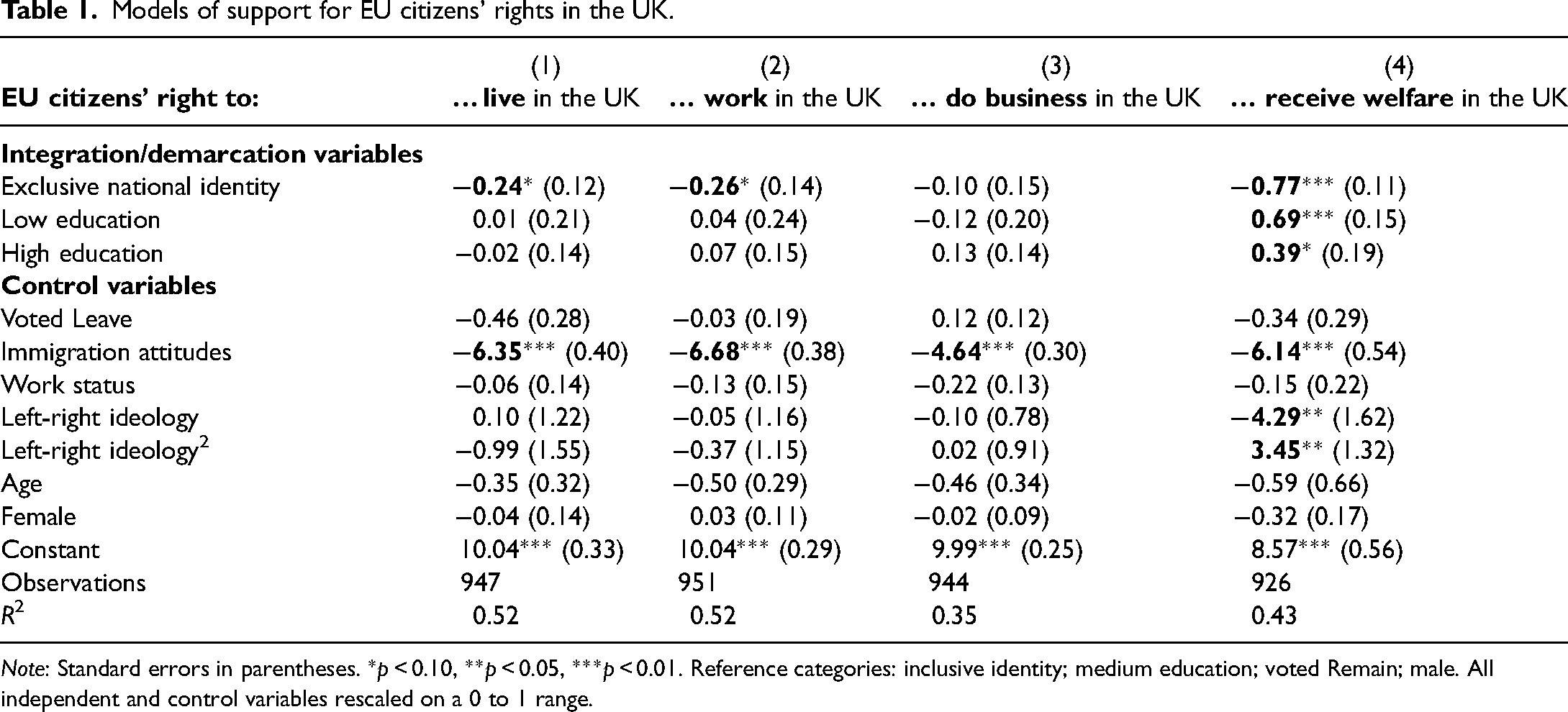
Note: Standard errors in parentheses. *p < 0.10, **p < 0.05, ***p < 0.01. Reference categories: inclusive identity; medium education; voted Remain; male. All independent and control variables rescaled on a 0 to 1 range.
Among control variables, immigration attitudes strongly correlate with support for transnational rights in our models. 8 Moving from strongly positive to strongly negative migration views, support levels decrease by anywhere between −6.7 points for the right to work and −4.6 points for the right to do business, on an 11-point scale. Such a strong correlation is not surprising, given that intra-EU mobility and migration from outside the EU are often conflated. Political ideology only helps explain attitudes towards welfare access, and – given that the relationship appears U-shaped – especially for those on the extremes of the political spectrum. Furthermore, ideology is only significantly correlated with welfare attitudes, further substantiating our finding on the differential character of these attitudes in comparison to the remaining transnational rights.
Interaction effects: Identity and EU support
Finally, we investigate the heterogeneous effects of identity for transnational welfare access across supporters and opponents of EU membership to test H4. We interact EU membership support (voted Leave vs. voted Remain) with national identity. All individual-level control variables are also included in these models and maintain their statistical significance and direction of effects as in the main models. The interaction term is statistically significant – but only when it comes to welfare access and not for the other types of rights (see the Online appendix).
The interaction effects are illustrated in Figure 4. The results point to interesting tendencies. Although individuals who voted to remain in the EU should, in principle, be supportive of the EU and thereby also favour the transnational rights implied by EU membership, we observe a significant division in that group based on the character of national identity. Although a potentially counterintuitive category at first glance, EU supporters (Remainers) who identify exclusively as British, 9 are strongly opposed to transnational welfare access: the predicted mean support for transnational welfare rights is 3.94 on a scale from 0 to 10. To compare, for EU supporters with inclusive identity, the predicted mean value is 5.03 (a difference of 1.09 points). Our model also indicates that exclusive national identifiers among Remainers are virtually as opposed to welfare rights as are exclusive identifiers among Leavers (predicted mean 3.94 and 3.92, respectively). This suggests that acceptance of transnational welfare rights is associated with the inclusive character of national identity only when paired with EU membership support, indicating a heterogenous effect of identity, in line with H4.
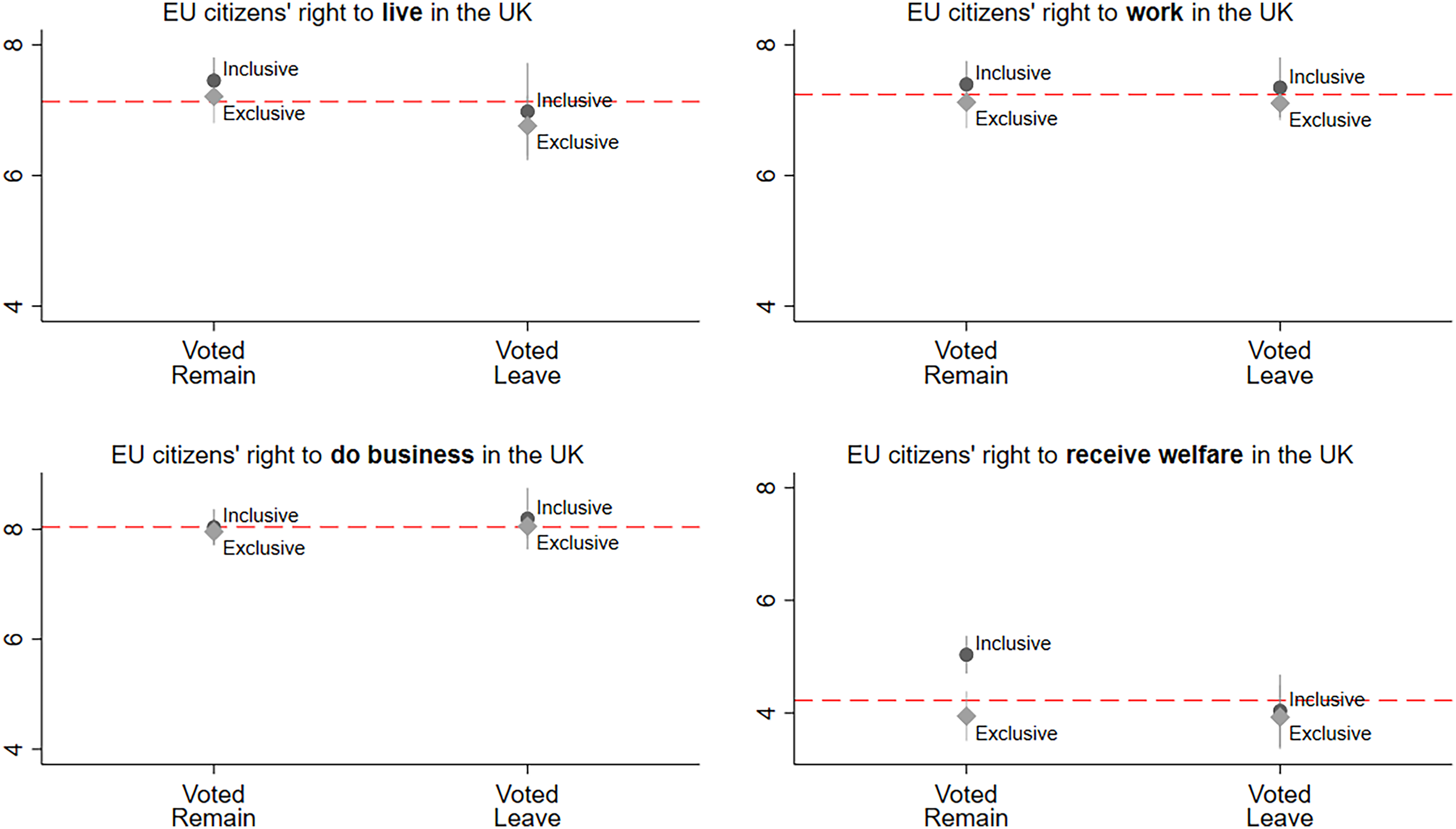
Interaction effects of national identification and Euroscepticism on EU citizens’ welfare rights in the UK.
Inclusive national identification correlates with more positive welfare attitudes among EU membership supporters, but not among Brexit supporters. Although the Leave vote is often associated with exclusive Britishness, there are 75 respondents in our sample who voted Leave in the EU referendum but have an inclusive identity, i.e. consider themselves as European to some extent. The predicted mean support for welfare access is 4.04 among this group, rendering the differences with Leavers with exclusive identity (3.92) very small. In other words, individuals who oppose EU membership are against transnational welfare rights, no matter the character of their national identification.
Discussion
In this article, we depart from the literature by focussing on how citizens view the different transnational rights implied by the EU's free movement principle. Our empirical strategy accounts for the multidimensionality of these attitudes. We measure support for four different transnational rights (to live, work, do business, and access welfare transnationally) and differentiate between support for transnational rights for oneself in the EU and support for such rights for EU citizens in the UK. This approach allows us to zoom in on attitudes towards different facets of transnational solidarity. We observe a high degree of congruence between levels of support for UK citizens’ rights in the EU and the rights of EU citizens in the UK on all four rights. This finding stands in contrast to existing literature, which posits a difference in both attitudes, supposedly driving an inherent ambivalence to the idea of freedom of movement (i.e. Lutz, 2021). We show that transnational access to welfare stands out as the most strongly opposed right, even among those who in principle should be in favour of such transnational entitlements: inclusive national identifiers and supporters of EU membership. It is noteworthy that British respondents, famous for their low levels of enthusiasm for the European project, are relatively supportive of the other EU mobility rights, including the right to live, work, and do business transnationally. It is, therefore, crucial to break down freedom of movement into its constituent rights, as not all of them are inherently contested.
Exploring the mechanism of such contestation, we find that attitudes towards freedom of movement are, to some extent, structured along the integration/demarcation cleavage. This applies primarily to attitudes towards transnational welfare rights, which remain closely linked to the underlying notion of national/European community. However, even individuals on the integration side of the cleavage are more sceptical of welfare rights relative to the other rights associated with freedom of movement. Moreover, exclusive national identification is strongly associated with transnational welfare access contestation, driving negative attitudes also among those who are in principle supportive of EU membership. This highlights the challenges that lie ahead for European integration. Support for EU membership does not necessarily entail automatic endorsement of proposals, which might imply pooling or sharing resources that have thus far been nationally framed. In these terms, EU membership supporters’ relative opposition to transnational welfare points to the limits of creating a political community at the EU level, without feelings of commonality, belonging, and transnational solidarity.
We have focused our empirical analysis on the UK case, where EU freedom of movement has been widely debated due to Brexit. We expect that our findings may be generalised to other cases, notably, the richer Northern and Western European countries that have also been destinations of intra-EU migration and where similar processes of politicisation related to freedom of movement can be observed, e.g. Austria, Denmark, Germany, and the Netherlands. The way in which EU citizens’ rights have become politicised in the UK reflects some of the debates in other migration destination countries in the EU, suggesting that the underlying mechanisms could be similar (Blauberger et al., 2023). Future research could also test our expectations in low salience environments, such as in Southern or Central Eastern Europe, where the perceived benefits from EU mobility are also potentially different (Blauberger et al., 2023; Vasilopoulou and Talving, 2019). We also do not know whether individuals living in member states with comparably less-developed welfare states are willing to share their welfare resources with other EU citizens (Mårtensson et al., 2023; Vasilopoulou and Talving, 2020). Furthermore, we should further disentangle whether citizens are equally supportive of transnational rights regardless of whether we refer to South European, Eastern European, or Northern European mobile EU citizens.
Notably, our findings indicate that despite the overall positive effects of intra-EU migration on domestic economies (e.g. Dustmann and Frattini, 2014), the public sees mobile EU citizens as potentially putting pressure on the welfare state. Future research should try to unpack further what people understand when thinking about EU freedom of movement, e.g. by improving existing survey questions to account for such multidimensionality, gauging support for even more rights (for instance the right to study), or by introducing open-ended questions in surveys. It would also be helpful to know whether citizens understand the conditional nature of transnational access to welfare and the extent to which requirements for legal residence constitute a significant constraint on these rights. Furthermore, individuals might view EU citizens’ access to the welfare state differently depending on the latter's employment situation or whether they have contributed to the welfare state.
Our focus on the different dimensions of transnational rights improves the understanding of the public opinion on freedom of movement and the underlying mechanism of its contestation, thus at least partially addressing the puzzle of a Eurosceptic reaction to a widely supported EU policy. In short, we find that questions related to who should be entitled to the collective goods of the state are more likely to trigger public contestation. Welfare taps into economic and identity considerations and can often be framed through zero-sum calculations. More broadly, when it comes to EU integration, welfare solidarity should become central to discussions about the future of the EU as it presents the potential to undermine public support for one of the most cherished achievements of the integration process.
Supplemental Material
sj-docx-1-eup-10.1177_14651165231215440 - Supplemental material for Free to move, reluctant to share: Unequal opposition to transnational rights under the EU's free movement principle
Supplemental material, sj-docx-1-eup-10.1177_14651165231215440 for Free to move, reluctant to share: Unequal opposition to transnational rights under the EU's free movement principle by Aleksandra Sojka, Liisa Talving and Sofia Vasilopoulou in European Union Politics
Supplemental Material
sj-png-2-eup-10.1177_14651165231215440 - Supplemental material for Free to move, reluctant to share: Unequal opposition to transnational rights under the EU's free movement principle
Supplemental material, sj-png-2-eup-10.1177_14651165231215440 for Free to move, reluctant to share: Unequal opposition to transnational rights under the EU's free movement principle by Aleksandra Sojka, Liisa Talving and Sofia Vasilopoulou in European Union Politics
Supplemental Material
sj-png-3-eup-10.1177_14651165231215440 - Supplemental material for Free to move, reluctant to share: Unequal opposition to transnational rights under the EU's free movement principle
Supplemental material, sj-png-3-eup-10.1177_14651165231215440 for Free to move, reluctant to share: Unequal opposition to transnational rights under the EU's free movement principle by Aleksandra Sojka, Liisa Talving and Sofia Vasilopoulou in European Union Politics
Supplemental Material
sj-png-4-eup-10.1177_14651165231215440 - Supplemental material for Free to move, reluctant to share: Unequal opposition to transnational rights under the EU's free movement principle
Supplemental material, sj-png-4-eup-10.1177_14651165231215440 for Free to move, reluctant to share: Unequal opposition to transnational rights under the EU's free movement principle by Aleksandra Sojka, Liisa Talving and Sofia Vasilopoulou in European Union Politics
Supplemental Material
sj-png-5-eup-10.1177_14651165231215440 - Supplemental material for Free to move, reluctant to share: Unequal opposition to transnational rights under the EU's free movement principle
Supplemental material, sj-png-5-eup-10.1177_14651165231215440 for Free to move, reluctant to share: Unequal opposition to transnational rights under the EU's free movement principle by Aleksandra Sojka, Liisa Talving and Sofia Vasilopoulou in European Union Politics
Supplemental Material
sj-dta-6-eup-10.1177_14651165231215440 - Supplemental material for Free to move, reluctant to share: Unequal opposition to transnational rights under the EU's free movement principle
Supplemental material, sj-dta-6-eup-10.1177_14651165231215440 for Free to move, reluctant to share: Unequal opposition to transnational rights under the EU's free movement principle by Aleksandra Sojka, Liisa Talving and Sofia Vasilopoulou in European Union Politics
Supplemental Material
sj-do-7-eup-10.1177_14651165231215440 - Supplemental material for Free to move, reluctant to share: Unequal opposition to transnational rights under the EU's free movement principle
Supplemental material, sj-do-7-eup-10.1177_14651165231215440 for Free to move, reluctant to share: Unequal opposition to transnational rights under the EU's free movement principle by Aleksandra Sojka, Liisa Talving and Sofia Vasilopoulou in European Union Politics
Footnotes
Acknowledgements
Previous versions of the paper have been presented at the ECPR General Conference (University of Wroclaw, 2019), as well as at the workshops ‘Exploring the Link between Inequality and Euroscepticism’ (Copenhagen Business School, 2021) and ‘How Europeans Understand Reciprocity, Fairness and Cohesion’ (University of Darmstadt, 2021). The authors are grateful for the generous feedback received at these events. We would also like to thank the journal Editor and the four anonymous reviewers for their helpful comments on the earlier versions of the paper.
Author contributions
All authors contributed equally.
Funding
The authors disclosed receipt of the following financial support for the research, authorship, and/or publication of this article: This work was supported by the Economic and Social Research Council (grant number ES/N001826/1), the Spanish Ministry of Science and Education (Juan de la Cierva-Incorporación, grant number IJC2019-040070-I9), and the research project UE-MEASURE-CM-UC3M, which has been funded by the call “Estímulo a la Investigación de Jóvenes Doctores/as" within the frame of the Convenio Plurianual con la UC3M (UE-MEASURE-CM-UC3M) and the V PRICIT (V Regional Plan for Scientific Research and Technological Innovation).

Data availability statement
The data that support the findings of this study are openly available in the Harvard Dataverse at https://doi.org/10.7910/DVN/8JCDI4.
Supplemental material
Supplemental material for this article is available online.
Notes
References
Supplementary Material
Please find the following supplemental material available below.
For Open Access articles published under a Creative Commons License, all supplemental material carries the same license as the article it is associated with.
For non-Open Access articles published, all supplemental material carries a non-exclusive license, and permission requests for re-use of supplemental material or any part of supplemental material shall be sent directly to the copyright owner as specified in the copyright notice associated with the article.


