



Abstract
Tendencies of European disintegration – culminated in Brexit – have laid bare the lack of a future plan for Europe. Few extant studies contain a future outlook and often lack a public opinion perspective, albeit the latter’s relevance in the ‘constraining dissensus’ between citizens and political elites about European integration. Focusing on European Union–non-European Union relations, this study presents comparative evidence on peoples’ preferences for the future of EUrope and their underlying reasons. We map citizen preferences using original open-ended survey question responses across eight European countries from within and outside the European Union. Our results show that non-European Union citizens’ preferences deviate more strongly from the status quo compared to those of European Union citizens. In contrast, risk-taking attitudes play no role for citizen preferences.
Introduction
Scholarly interest in European integration has grown considerably in recent decades, in parallel with the growing relevance of the European Union (EU) as a political institution. Notwithstanding a rich literature about public opinion towards European integration on the one hand (e.g. De Vries, 2018; Hooghe and Marks, 2005; McLaren, 2006), and various theoretical approaches explaining European integration and institutional outcomes on the other hand (e.g. Hooghe and Marks, 2019; Jachtenfuchs, 2001), ‘public attitudes within the integration process are still underestimated’ (Di Mauro and Memoli, 2021: 2). The latter holds particularly for the future trajectory of the integration process. Brexit revealed the need to overcome missing links between citizens’ opinion towards the current EU and related preferences for future changes in the institutional relationship with the EU. Although a majority of Brexit voters agreed that the present (relationship with the) EU was not functioning well, they had different preferences for what should be altered. This lack of a plan was no peculiarity of the United Kingdom (UK) case, as in general little is known about European citizens’ preferences for the ‘Future of EUrope’. 1 In addition to internal EU relations, EU–non-EU relations are particularly relevant as ongoing international crises such as the COVID-19 pandemic, the war in Ukraine, refugee movements into Europe or climate change put a spotlight on cooperation between European countries – within and beyond the EU.
Extant studies on EU public opinion – including contributions from non-member states – are helpful in evaluating present levels of support for, or criticism of, the EU or European integration more broadly. However, most commonly used survey measures do not go further than evaluating the past or present situation by, for example, asking citizens what their ‘ideal’ EU (relationship) looks like. It remains largely unclear whether citizens have preferences when it comes to future trajectories of Europe and if so, which. Conceptually, one may question the existence of strong public opinions about EU–non-EU relations because the topic is (a) about institutional design which most citizens do not care about; (b) includes a future rather than a current perspective, which makes it difficult to relate to; and (c) concerns a system of multilevel governance. Yet, recent research shows that people are capable of forming consistent and meaningful opinions towards international cooperation (Jurado et al., 2022) and regarding preferences for future internal EU relations (Goldberg et al., 2021a, 2021b).
The main goal of this article is to open the black box of public opinion about the future of EUrope. In contrast to studies looking at EU–non-EU relations from only one side – and often lacking a public opinion perspective – we cover both inside and outside EU perspectives. This enables us to compare respective citizen preferences and to identify differences across countries. In a related goal, we are interested in why citizens prefer certain EU–non-EU relations. While being a citizen of an EU versus non-EU country may already influence individual preferences, we further focus on the influence of risk-taking attitudes and socio-demographic characteristics on attitudes about the future of EUrope. Studies analysing the Brexit vote – a prominent example of citizens expressing their preferences for their country’s relationship with the EU – found a particularly strong influence of risk-taking attitudes in the decision to vote ‘Leave’, trumping the effects of various more commonly studied aspects such as immigration attitudes, national identity or feelings towards the EU (Clarke et al., 2017; Henderson et al., 2017; Morisi, 2018). This matches the broader claim that risk perceptions matter for voters when facing ‘major “polity-shaping” events’, including EU membership (Clarke et al., 2017: 445). By analysing the influence of risk-taking attitudes on citizen preferences for future EU–non-EU relations more generally, we thus contribute to the growing literature examining different outcomes affected by risk attitudes, such as political behaviour, support for institutional change, policy preferences or attitudes towards globalization (e.g. Berinsky and Lewis, 2007; Bowler and Donovan, 2007; Ehrlich and Maestas, 2010; Liñeira and Henderson, 2021; Steenbergen and Siczek, 2017).
Our research is based on original survey data collected across eight countries (five EU countries: Denmark (DK), Germany (DE), Hungary (HU), the Netherlands (NL) and Spain (ES); three non-EU countries: Norway (NO), Switzerland (CH) and the United Kingdom (UK)) in the summer of 2021. We asked respondents (
EU–non-EU relations
In light of developments in Europe in recent years – for example, Brexit, climate change challenges and the war in Ukraine – European cooperation beyond the EU becomes ever more prevalent. Especially, the UK’s leaving of the EU has illustrated the need for a plan for the future of Europe, while bringing the EU–non-EU relations to the foreground. Moreover, and notwithstanding their membership of institutional arrangements such as the European Free Trade Association (EFTA) or the Nordic Council, relations with the EU are most central for European non-EU countries. In the words of Risse (2010: 102), ‘(t)here is no way that European states can ignore the EU, even such devoted non-members as Switzerland’. For instance, as a consequence of the UK joining the group of countries outside the EU, traditional non-members such as Switzerland or Norway feared their established tailored relationships with the EU may come under threat (Oliver, 2016). Hence, internal Swiss discussions did not only acknowledge the need to rethink future relations with the EU, but also highlighted the need for a more public debate about the relations (Grünenfelder et al., 2018). Yet, one of the recent attempts to settle the future EU–Switzerland relations, the negotiations about the EU–Swiss Institutional Framework Agreement, failed. Both the UK and Swiss relations with the EU are thus under ongoing (public) debate in the respective countries, with various obstacles to reaching a satisfactory solution for both countries and the EU.
After Brexit, several studies examined the possible future of EU–UK relations and related economic, social and political prospects for both involved parties (e.g. Dhingra and Sampson, 2016; Hix, 2018). Similarly, there are studies about the relations of the EU with single European countries such as Switzerland, Turkey or Norway. For the Swiss case, early studies offered future outlooks of Swiss–EU relations based on historical reviews (Emmert, 1998), which are complemented by more recent studies focusing on economic factors (Grünenfelder et al., 2018) or various legal options (Linder, 2013). An array of studies stemming from the FEUTURE project (Saatçioğlu et al., 2019) portray possible futures for Turkey–EU relations (see also Reiners and Turhan, 2021). Others regard the future relations between the EU and Norway (e.g. Kux and Sverdrup, 2000) or discuss current and future relations between the EU and the three EFTA states Iceland, Norway and Switzerland (Bąba, 2018). Other than these and other case studies on EU–non-EU relations, little is known about the general prospects of the future of EUrope, that is challenges that regard future EU–non-EU relations beyond specific countries.
Going beyond single country relations and in order to make sense of European countries’ variation in the extent of their (institutional) integration, including EU members and non-members, scholars have come up with different analytical tools and explanations (Hooghe and Marks, 2019). Among more recent approaches that consider European integration beyond the EU are the concepts of EU external governance (e.g. Lavenex, 2004; Lavenex and Schimmelfennig, 2009) and differentiated (external) integration (e.g. Leruth and Lord, 2015). EU external governance seeks to capture the extension of EU rules and policies on third countries, which in the long run may lead to patterns of differentiated (external) integration (Lavenex, 2004). In the context of Brexit, Schimmelfennig (2018) advanced the concept into ‘differentiated disintegration’ as a wish of countries to selectively reduce the level and scope of integration (see also Gänzle et al., 2020). Partly due to their recency, little is known about public support for different schemes of external differentiated integration (Chiocchetti, 2021; but see Schuessler et al., 2023). The lack of a public opinion perspective on EU–non-EU relations is a more general phenomenon, which is, for example, also the case for the aforementioned studies on the future of EUrope. This stands in contrast to the seminal study of Hooghe and Marks (2009) on a constraining dissensus over European integration, which highlights the relevance to study public opinion towards (dis)integration within Europe.
Finally, while many studies inventory public attitudes towards the current EU and the integration process as it currently unfolds, they usually lack a future perspective. Noteworthy exceptions are studies that examine public preferences towards (future) widening or deepening of the EU (Hobolt, 2014; Karp and Bowler, 2006), the desired speed of European integration (Malang, 2017), institutional reforms (Schäfer et al., 2023) and future scenarios for internal EU relations (Goldberg et al., 2021a, 2021b). Similarly, Raines et al. (2017) analyse the differences in attitudes towards the EU among the elite and public focusing on options for differentiated integration in Europe. Given the diverse and sophisticated opinions expressed by the public (and political elites) in Raines et al.’s (2017) study, we assume that there are comparably insightful opinions about the future of EU–non-EU relations.
Citizen preferences for the future of EUrope
Supranational politics is fairly distant to citizens’ everyday experiences. This means that most ordinary citizens do not possess extensive knowledge about it, including the specific aspect of EU–non-EU relations. Therefore, and given the (partly) exploratory nature of this study, we use an open-ended question format to explore the scope and direction of preferences among citizens. While more demanding for respondents to come up with a reasonable answer, this approach is beneficial as it does not bias respondents’ answers by providing pre-defined answer options from which respondents can easily choose one. Because of the rather complex issue of EU–non-EU relations and the related variety of options, people may refer to extant options including simply the status quo, but also to options that are new to the debate, or simply indicate that they have no preference. This approach promises to extend the state-of-the-art of research about the future of EUrope. To our best knowledge, there are no general closed-ended questionnaire items about preferences for the future relations between European non-EU and EU countries. Rather, single-case studies provide issue-specific items used in the context of referendums such as Brexit (e.g. Vasilopoulou, 2016). By inductively uncovering public preferences for the future of EUrope, we aim to provide a more general, comprehensive picture in terms of public preferences to be used in future studies as well.
In the absence of a known set of preferred relations, it is difficult to theorize about underlying motivations for single types of EU–non-EU relations. Instead, we pose exploratory research questions which are complemented by hypotheses relating to the broader set of preferences people may have. The latter distinguishes between why citizens prefer the status quo (or options not deviating much from it) and preferences that deviate more strongly from the status quo in either direction, that is, towards closer or less close relations. Following the logic of De Vries’ (2018) benchmark theory, citizens may evaluate different EU–non-EU relations and opt for the one with the highest perceived benefits, including a potential bias towards the status quo given the uncertainty of alternative relations.
Preferences across countries (EU vs. non-EU)
Citizen preferences regarding future EU–non-EU relations may first relate to the country context a person lives in. Especially asymmetric levels of dependencies between the EU and non-EU countries may put the relations higher or lower on the respective political agendas and related public debates. For EU countries, European cooperation, trade, etc. may most importantly focus on internal EU relations and only occasionally regard third-country relations, for example, following Brexit or important (bilateral) treaty signings. This may result in EU citizens having less specific preferences on how the current EU–non-EU relations should evolve, that is, citizens may use more general descriptions without having clear scenarios or institutional setups in mind. In contrast, the aforementioned high relevance of the relations among non-EU countries (e.g. Risse, 2010) may result in non-EU citizens having more specific preferences, albeit not all pointing in the same direction. In the first step, we thus aim to explore preference patterns across countries and potential differences between EU and non-EU countries by posing the following research question: RQ1: What preferences for future EU–non-EU relations do citizens have across countries (EU vs. non-EU)?
Following the presumably more specific preferences in non-EU countries, we formulate more specific hypotheses for them by starting from an institutional perspective. Norwegian relations with the EU have been stable since the establishment of the European Economic Area (EEA) in 1994, while Swiss–EU relations have been under continuous renegotiation during the last decades, including the recently failed attempt to stabilize relations with the Institutional Framework Agreement (Mazzoleni and Dardanelli, 2021). Despite these differences between the two countries, there is an analogy in the evolution of public opinion over time in Norway and Switzerland, both of which became increasingly anti-European after their unsuccessful referendums on EU/EEA membership in the 1990s (Hix, 2018). Survey data from the ‘Future of Europe – Views from outside the EU’ Flash Eurobarometer from 2017 (European Commission, 2017) shows a (slight) majority of respondents in Norway (50%) and Switzerland (54%) with a negative view of the EU. Yet, an almost equal share has opposing positive views (Norway 45% and Switzerland 43%), indicating polarized opinions.
The situation may be even more polarized in the UK, with Leavers aiming for no, or the least possible, institutional links with the EU and Remainers aiming for close bonds including the future possibility to re-join the EU. Specific to the UK case are the not yet established relations with the EU, which may make the status quo an especially undesirable and unsustainable option. In contrast, the status quo may be a desirable option for citizens in Norway and Switzerland when the economic dimension is taken into account. Because of the economic benefits of access to the single market for both countries – in fact, they benefit much more from it than most EU countries (Mion and Ponattu, 2019) – Norwegian and Swiss citizens may have strong incentives to prefer the status quo. Following these opposing views depending on the dimension (and country) under consideration, we formulate two complementary hypotheses: H1a: The preferences of non-EU citizens, particularly in the UK, deviate more strongly from the status quo, including very close and almost absent bonds, than those of EU citizens.
H1b: Non-EU citizens, particularly in Norway and Switzerland, have stronger preferences for maintaining the status quo of current EU–non-EU relations than EU citizens.
Preferences across individuals (risk-taking)
In addition to country-level differences, individual-level characteristics are important to consider as factors related to preferences for future EU–non-EU relations. As a first exploratory step to examine different preferences across individuals, we consider several variables to map differences in socio-demographic characteristics, political ideology and risk-taking attitudes. For socio-demographics, we study differences in terms of age, sex and education. Various studies have repeatedly shown the influence of these factors on European integration attitudes, including studies with a focus on (future) deepening or widening of the EU (e.g. Hobolt, 2014; Malang, 2017) or different future institutional setups of the EU (e.g. Goldberg et al., 2021a). The same goes for political ideology, which has been shown to affect various aspects of European integration, including outcomes such as EU enlargement or the EU’s future institutional setup (e.g. Goldberg et al., 2021b; Karp and Bowler, 2006). Finally, we consider risk-taking attitudes, which played a crucial role in explaining the Brexit vote (e.g. Clarke et al., 2017; Henderson et al., 2017; Morisi, 2018). Given that the latter decision to stay in the EU or set up a different relationship with the EU is very close to our interest in future preferences for EU–non-EU relations, we focus especially on risk-taking attitudes in a subsequent hypothesis. Yet, for this first exploratory step and in the context of limited knowledge about the general role that individual-level variables may play for preferences for future EU–non-EU relations, we pose a second research question: RQ2: What preferences for future EU–non-EU relations do citizens have across individual-level characteristics?
Turning to risk-taking attitudes in more detail, we follow the literature by defining risk-taking as an individual predisposition towards accepting or rejecting risks (Dahlbäck, 1990; Morisi, 2018; Steenbergen and Siczek, 2017). Such attitudes are a general and enduring predisposition instead of being linked to specific situations (Liñeira and Henderson, 2021; Nicholson et al., 2005; Weinstein and Martin, 1969), meaning that risk-taking may matter for decision-making processes in various domains (Steenbergen and Siczek, 2017) and especially when facing decisions about uncertain futures (Nadeau et al., 1999). For our study, we treat the formulated preferences for EU–non-EU relations as equivalent to decision-making processes such as for referendum votes in which the mentioned preferences would be up for a real vote. The preference formation is said to differ between citizens with risk-acceptant persons evaluating anticipated costs and benefits of different options, whereas risk-averse persons typically focus on the potential worst-case outcome and potential losses induced by change (Dahlbäck, 1990; Liñeira and Henderson, 2021; Nadeau et al., 1999). Overall, this commonly results in a status quo bias in which individuals disproportionately prefer the status quo compared to uncertain alternative options (Morisi, 2018). Hence, when triggered by a survey question such as ours about possible (changing) future EU–non-EU relations, respondents may behave in line with Liñeira and Henderson’s (2021: 543) argument that ‘(p)olitical change makes risk explicit, which prompts the connection between the status quo bias and the notion of risk’.
Studies link risk-taking attitudes to a diverse set of (political) outcomes and related status quo preferences, for example, institutional and constitutional change (Bowler and Donovan, 2007; Henderson et al., 2014), prospects of globalization (Steenbergen and Siczek, 2017), policy preferences (Berinsky and Lewis, 2007; Ehrlich and Maestas, 2010) or different types of voting, including referendums (Morisi, 2018). Strongly related to our outcome of interest, Vasilopoulou and Wagner (2017) examine citizens’ preferences for a re-ordering of the UK’s relationship with the EU before the Brexit referendum, while focusing on emotions linked to risk-taking attitudes. They confirmed that risk-taking (angry) citizens were more in favour of cutting ties with the EU, compared to risk-averse (anxious) citizens who preferred to re-negotiate EU membership terms, that is, staying much closer to the status quo. Other evidence from the Brexit vote confirms the important role that risk-taking played, with risk-acceptant people as more likely to (intend to) vote ‘Leave’ (e.g. Clarke et al., 2017; Henderson et al., 2017; Morisi, 2018). These studies also highlight the strong relative importance of risk tolerance compared to other explanatory factors.
An inherent feature of referendum votes such as Brexit, but also independence votes in Scotland or Quebec (Liñeira and Henderson, 2021; Nadeau et al., 1999), is the restricted choice between the status quo and usually only one alternative option. Thus, the evidence from Brexit that risk-taking voters voted ‘Leave’ may also be related to the substantive outcome of the change option, namely cutting ties with the EU, and may have less to do with our more general argument that risk-taking increases the likelihood of choosing any change from the status quo, regardless of direction. Looking at the opposite case, namely voting in referendums to join the EU, can thus provide evidence for a more general mechanism. The study by Sjöberg (1996) does exactly this by analysing the relationship between risk perceptions and attitudes towards EU membership before Sweden’s 1994 referendum. Similar to the Brexit vote (with less close bonds to the EU as the possible outcome), Sjöberg (1996) finds that risk perceptions were also the most important determinant of EU membership attitudes in Sweden (with stronger bonds to the EU, that is, becoming a member, as the possible outcome).
Following the argument for a general status quo bias and related relevance of risk-taking attitudes for both closer and less close bonds in EU referendum voting, we expect that risk-taking is also important for status quo versus change preferences in the context of EU–non-EU relations more generally. H2: The preferences of more risk-taking respondents deviate more strongly from the status quo than the preferences of more risk-averse respondents.
Data and method
Country selection
The country selection includes both member and European non-member states of the EU to cover opinions towards future EU–non-EU relations from both sides involved. To reduce the complexity of the multitude of possible EU relations with the heterogeneous group of European non-member countries – especially relevant when asking citizens about their related preferences – we restrict the focus on countries on a level playing field by all being potential (non-)members of the EU. This includes all European countries that either are current EU member states or theoretically could join the EU due to their economic and political situation (following Art. 49 of the Maastricht Treaty and as set out in detail in the ‘Copenhagen criteria’), that is, all EFTA states and the UK. 2 In detail, we include the five EU countries Denmark, Germany, Hungary, the Netherlands and Spain to warrant within-EU differences due to aspects like membership length, country size, geography or dependency on the EU, among others. As non-EU countries we cover the United Kingdom, Norway and Switzerland by equally varying within non-EU differences such as the countries’ established versus not yet established relationships with the EU, economic and political power, country size and geography.
Sample
The study was conducted by Kantar TNS and involved Kantar subsidiaries in each country. The main target group was adult citizens (age 18 and older). Within each of the countries, sampling was stratified on population ratios (population values retrieved from Eurostats) according to birth year (three cohorts: 1987–2003, 1967–1986 and 1910–1966), sex (male/female), region (first- or second-level NUTS classifications) and education (recoded national degrees into three ISCED level categories: zero to two, three to four and five to six). 3 The recruitment of survey respondents happened via portal/forum invitations of panel members: survey invitations were put in a portal and panel members could choose surveys to participate (and were rewarded accordingly by their survey agency). This makes it impossible to calculate response rates.
The fieldwork was conducted from 28 July until 20 August 2021. The sample of completed interviews consisted of N = 4807 participants. After data cleaning and removing respondents who refused a final consent for the use of their data, the final sample consists of N = 4548 individuals, with the following number of respondents per country: NDK = 579, NDE = 582, NHU = 547, NNL = 571, NES = 546, NUK = 582, NCH = 579 and NNO = 562. The respective national compositions according to sex, age and education in our sample and in the population are depicted in the Online appendix. Due to slight differences between the two, we weighted our survey data based on these socio-demographic variables to match the population for all descriptive analyses and include respective variables directly in all regression models.
Open-ended question to measure citizen preferences
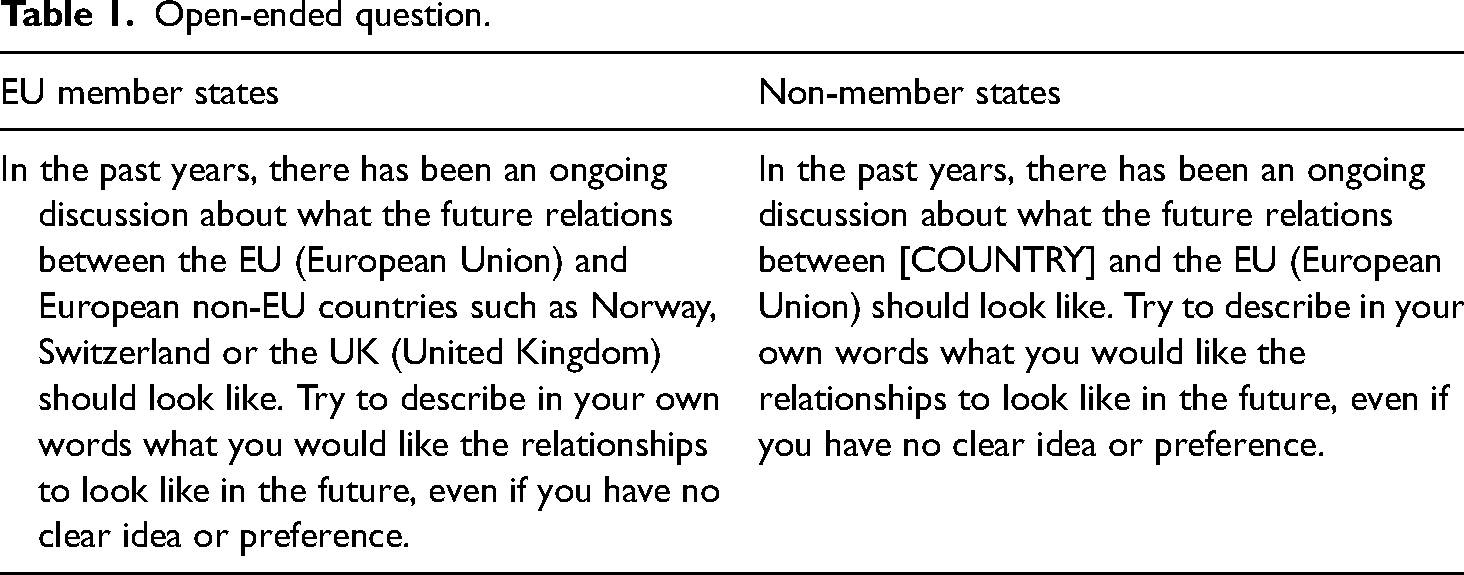
Participants from both EU and non-EU countries were asked for their respective opinion about the future of EUrope, which they could answer in an open-answer field with a limit of 250 words (in the respective national languages). Participants were not forced to respond, as after a pop-up reminder to please fill in an answer, respondents could leave the text box empty and still continue the survey. Yet, only around 5% (or 234 respondents) either left the text box empty or entered the minimum of one letter/symbol. The question wording differed between EU and non-EU countries as portrayed in Table 1 due to the different perspectives. That is, we asked EU respondents about the relations with non-EU countries more broadly, while for the non-EU states the question focuses on that country’s relation with the EU. These different wordings are unavoidable for examining EU–non-EU relations beyond single case studies when taking into account both perspectives simultaneously. 4
Open-ended question.
For a quantitative content analysis of the open answers, we first carry out a qualitative content analysis of the material resulting in an inductive category formation (Mayring, 2014): we analyse a random 10% of the open answers of each national sub-sample and inductively reduce the textual data by summarizing the answers into categories. After a final revision, the codebook consists of 18 main categories, two of them split into 22 detailed subcategories. All respondents stating not to have an opinion as well as those with empty/no answers are coded as don’t know (18.5% in total), whereas all answers that do not correspond to the content of the question or contain meaningless letters or numbers are categorized as wrong/inadequate answer (11.5%) (see the Online appendix for complete codebook and open answer examples). Following criteria for workable scenarios for subsequent quantitative analysis, the aim of this manual classification was to have categories or scenarios that are relevant (regardless of how realistic they are), internally consistent and differentiated by covering the whole spectrum of potential future EU–non-EU relations (Schoemaker, 1995). Importantly, we classify the open-ended answers to differ in a vertical (i.e. closeness of relations) and horizontal sense (i.e. type/focus of relations). Furthermore, open answers are not restricted to fit only one category, but could be classified into various categories, although the majority of the answers fit only one. 5
The codebook serves the subsequent quantitative content analysis of the textual data. This step is carried out with the help of additional native-speaking research assistants (all students of the University of Amsterdam). Because bilinguals were able to code two of the languages, a total of five coders carried out this analytical step. All coders participated in coder training before the analysis, including a pre-test to check for inter-coder-reliability (ICR). Due to the multinomial logic of several ICR measures for binary coded data (as answers could fit into multiple categories), we rely on an Average Percentage Agreement measure to assess the reliability between coders (for a similar approach see also Goldberg et al., 2021b). The ICR computation was carried out using the online tool ReCal3, which allows for the analysis of ICR with nominal data and more than three coders (Freelon, 2010). The results are satisfactory, with the mean percentage agreement between the coders throughout all categories being 98%, ranging from 85.2% to 100% for single categories. We use the manually coded categories in as much detail as possible in our statistical analysis, but partly had to merge similar categories to enable the respective statistical tests, for example, to have sufficient cases for single categories to run regression models. We explain this for the respective analyses below.
To approximate respondents’ ability to indicate their preference for the future of EUrope, we assess the answer sophistication through the number of digits (i.e. characters) used per answer. This measure is an adaption of the concept of sentence length by words to measure the sophistication of text (e.g. Benoit et al., 2019). The answers in our data are made up of an average of 58.51 digits (with a standard deviation of 81.21).
Explanatory variables
At the contextual level and for the first, more descriptive part (RQ1), we group the countries according to their EU membership status into members (DE, DK, ES, HU and NL) versus non-members (CH, NO and the UK). Given the formulated, more detailed within block differences in H1a/b, we keep all countries separately for the respective regression analysis, that is, we include country dummies with Germany as the reference category. These country-fixed effects also serve as important controls for the individual-level estimates. As our main explanatory variable at the individual level for H2, we measure risk-taking attitudes by asking ‘How willing are you in general to take risks?’ with a seven point answer scale ranging from one ‘not at all willing to take risks’ to seven ‘very willing to take risks’, in line with similar operationalizations in extant studies (Morisi, 2018; Steenbergen and Siczek, 2017). Additionally, we include self-placement on an 11-point left–right scale and basic socio-demographics, including age (linear), sex (female dummy) and education (national degrees presented on logic of seven ISCED levels), as individual-level controls in the models. The same variables – recoded into groups – are also used to explore preference patterns across individuals as stated in RQ2. In detail, except for sex (two groups: female vs. male), we always form three groups to examine related differences across individuals. The groups are split as follows: age/birth year (1910 to 1966, 1967 to 1986 and 1987 to 2003), education (ISCED levels zero to two; three to four; five to six), left–right (zero to three, four to six and seven to 10) and risk-taking (one to three, four and five to seven).
Results
Evidence across countries
We start with descriptive differences between answer patterns of citizens of EU member states and those of non-EU countries (RQ1). These differences are portrayed by the relative proportions of all categories with at least 2% mentions in either EU or non-EU countries in Figure 1 (total proportions may exceed 100% as multiple categories per answer/respondent are possible; the Online appendix presents detailed numbers). Both groups mentioned good or fair cooperation most frequently and gave high importance to cooperation in trade. However, in opposition to EU citizens, non-EU participants stated a clear tendency towards the status quo as well as to EU accession. Moreover, they generally scored higher in most other categories, indicating more nuanced and heterogeneous ideas about future relations between their country and the EU compared to EU citizens. EU citizens, in contrast, scored comparably low in most categories, with strong support only for the unspecific good or fair cooperation category as well as trade. The Online appendix offers more detailed insights by displaying the top 10 categories for the whole sample and separately for each country.
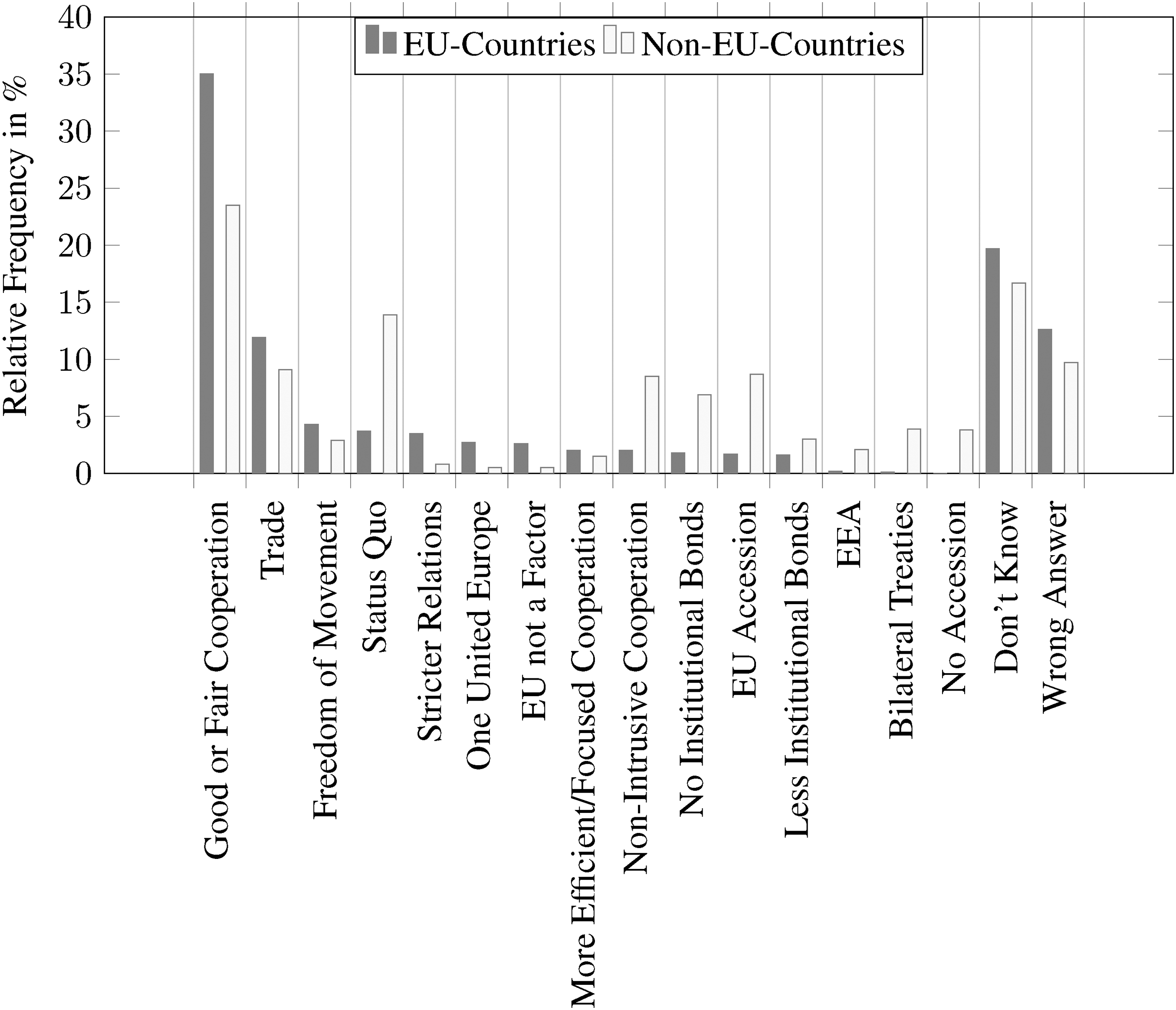
Proportion of categories with at least 2% mentions in either European Union (EU) or non-EU countries.
In a related step, we calculate logistic regression models with the preferred EU–non-EU relations category as dependent variable. We use the same models to examine H1a/b and H2 by including both country dummies to examine contextual differences between EU and non-EU countries (H1a/b) and risk-taking attitudes as our main individual-level explanatory factor (H2). We further control for sociodemographics (age, sex and education) and left-right self-placement. The simplest modelling strategy would be to run separate simple logistic regression models with the dependent variable as the respective category vs. ‘all others’ (excluding don’t know and wrong/inadequate answers). Yet, this poses the problem that one merges opposite preferences into the respective reference group of ‘all others’. 6 To circumvent this problem, we run a multinomial logistic regression model, in which we compare the preferences simultaneously with each other. 7 To simplify the model, that is, to reduce the number of nominal categories, we merge similar preferences into a total of 11 categories (see detailed explanation in the Online appendix). To further ease the interpretation, we plot average marginal effects, which are based on the complete multinomial regression results displayed in the Online appendix.
Figure 2 displays marginal effects of being a citizen of the different countries on the articulated preferences (with Germany as reference category). Overall, we see that the four other EU countries are relatively similar to Germany – that is, few and rather small marginal effects – with the exceptions of strong preferences for the good or fair cooperation category in Hungary and Spain. Interesting for H1a/b are the results for the three non-EU countries, which display overall stronger differences, especially for Switzerland and Norway. Both show the expected strong preference to keep the status quo (supporting H1b), and to a lesser extent also to arrange specific institutional arrangements such as bilateral treaties or the EEA setup. In contrast, UK respondents prefer the status quo option less (in line with some of the EU countries such as Hungary or Spain), and rather have a significant preference for getting back into the EU, which implies the strongest deviation of the status quo towards closer bonds. Yet, UK respondents do not display significant preferences for less or no institutional bonds, that is, H1a is at best partly supported for the UK. In fact, Norwegian respondents show a pattern most in line with our expectations for relations deviating more strongly from the status quo. They prefer both the category of a United Europe/EU accession and the opposite of less or no institutional bonds more than EU citizens. Overall, Norwegian preferences are the only ones lending support to both H1a and H1b.
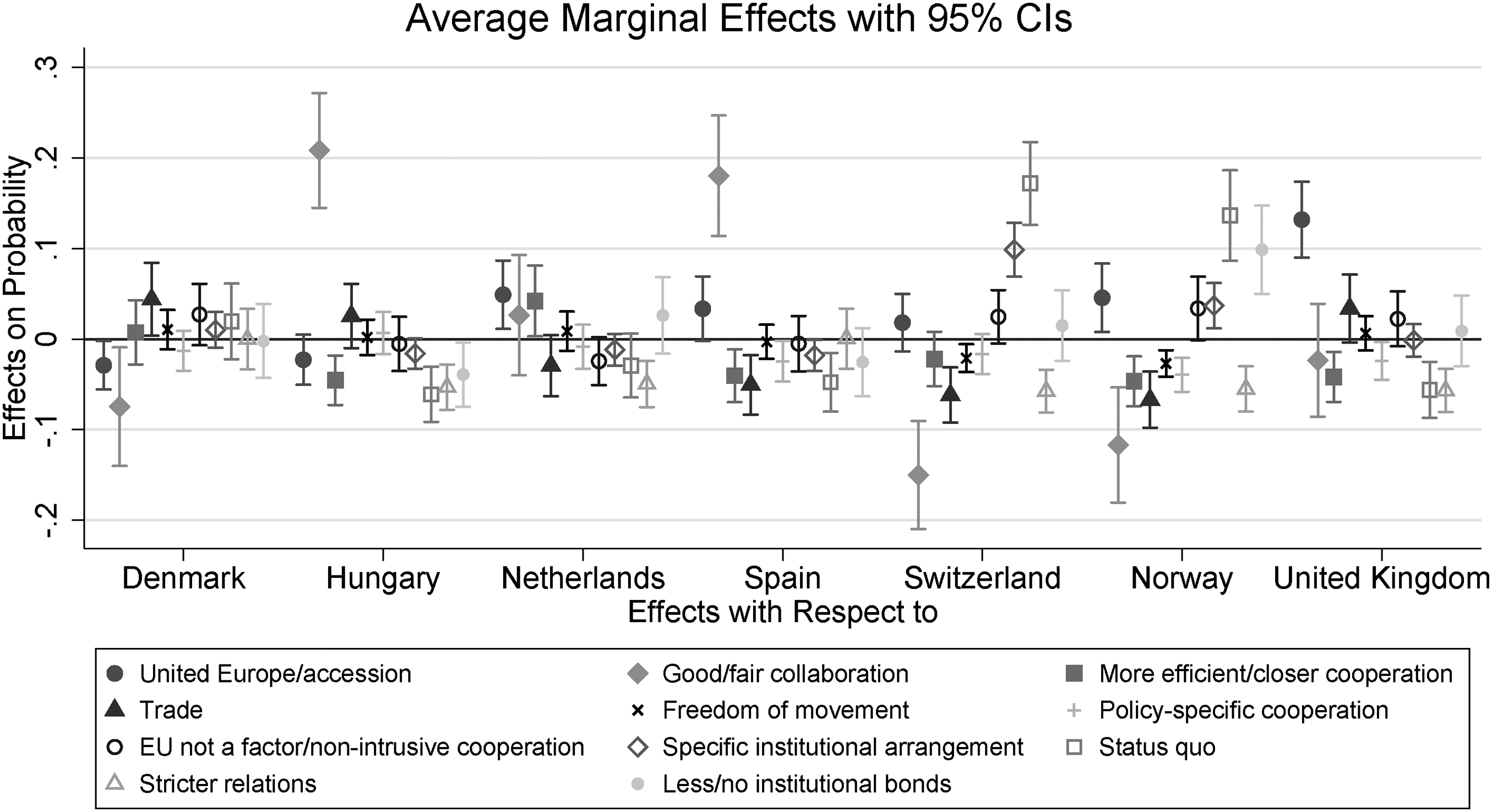
Marginal effects of country on preferences (based on Table A6 in the Online appendix).
Evidence across individuals
Turning to the individual level, we first examine descriptive preferences across socio-demographics (education, age and sex), political ideology and risk-taking attitudes (see also the Online appendix). Starting with education, highly educated individuals (ISCED levels five and six) stated more preferences for specific scenarios, whereas lower educated individuals gave less specific answers with a higher share of don’t know and wrong answers. This indicates more nuanced visions for the future of EUrope – without a clear tendency towards closer or less close relations – among the highly educated. Similarly, the oldest age group (1910–1966) was more specific and diverse in their preferences, without a clear directional tendency. The youngest age group (1987–2003), in contrast, scored highest in more general categories and don’t know and wrong answer. Sex, in contrast, displays mostly small differences. Some noteworthy patterns concern men with overall stronger preferences for categories that deviate more strongly from the status quo such as less or no institutional bonds, but also for EU accession of non-member states. In contrast, women favoured good and fair cooperation more generally, but were also often unsure (don’t know). Differences across political ideology display a somewhat clearer picture. The left generally preferred good and fair cooperation, but to some extent also a United Europe. The right preferred, relatively speaking, the trade and status quo categories, but also specific (less close) options such as non-intrusive cooperation and no institutional bonds. Respondents from the centre tended to be less clear about what they want.
Finally, the patterns across risk-taking attitudes are rather similar with only small differences, mostly in the unspecific good or fair cooperation and trade categories as well as status quo (Figure 3). In a second step, we put these few and comparatively small differences to a stricter analytical test, by controlling also for the other individual-level variables and country-fixed effects. The conducted multinomial regression model (see again the Online appendix) and respective marginal effects displayed in Figure 4 provide evidence for the absence of different preferences due to risk-taking attitudes. We observe no statistically significant effect of risk-taking on any of the preference categories. This means that we find no support for our second hypothesis (H2). In contrast, the regression model shows significant coefficients for all other individual-level variables, that is, the absence of significant effects for risk-taking attitudes is not due to model misspecifications.
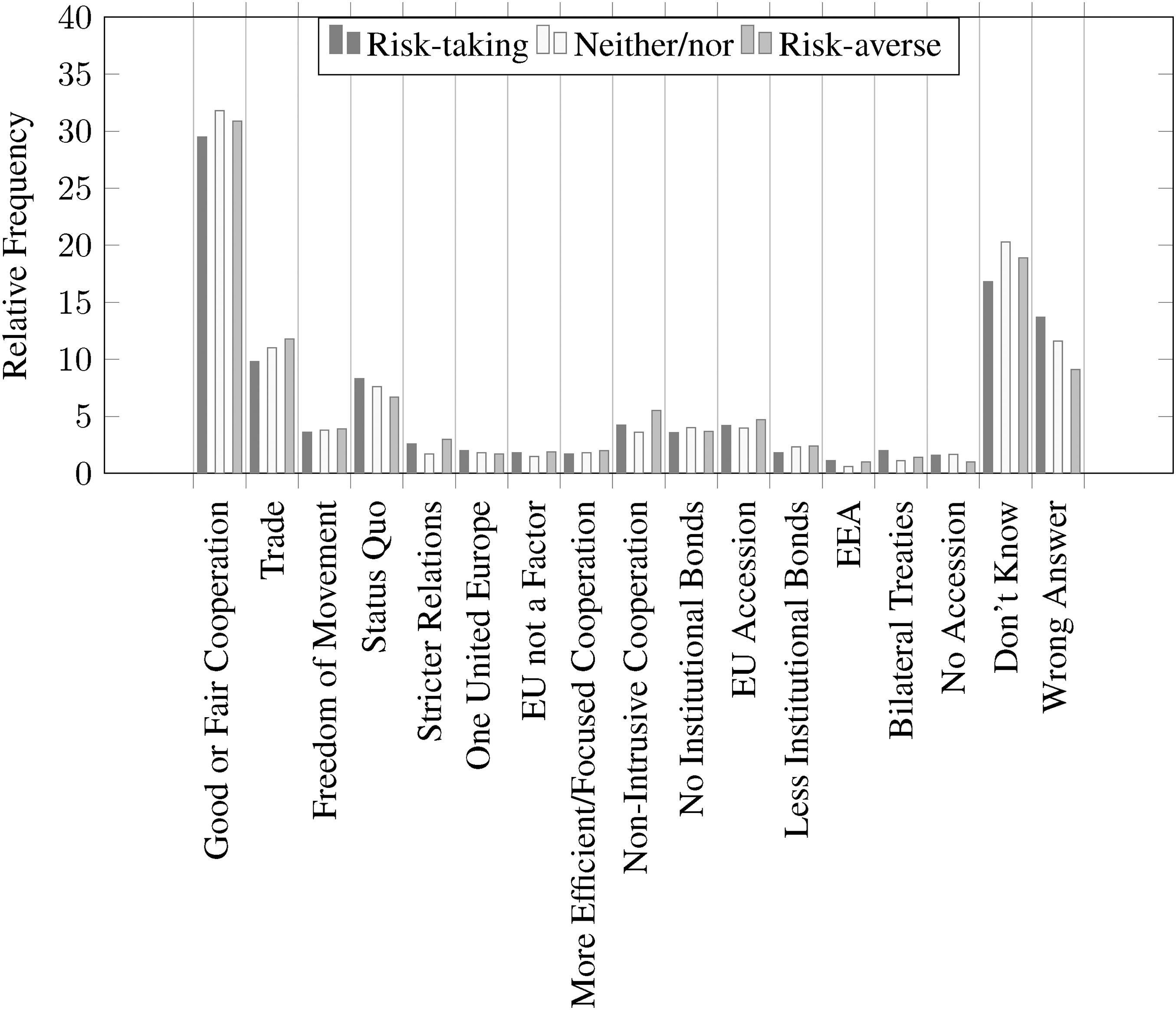
Proportion of categories with at least 2% mentions in each risk category.
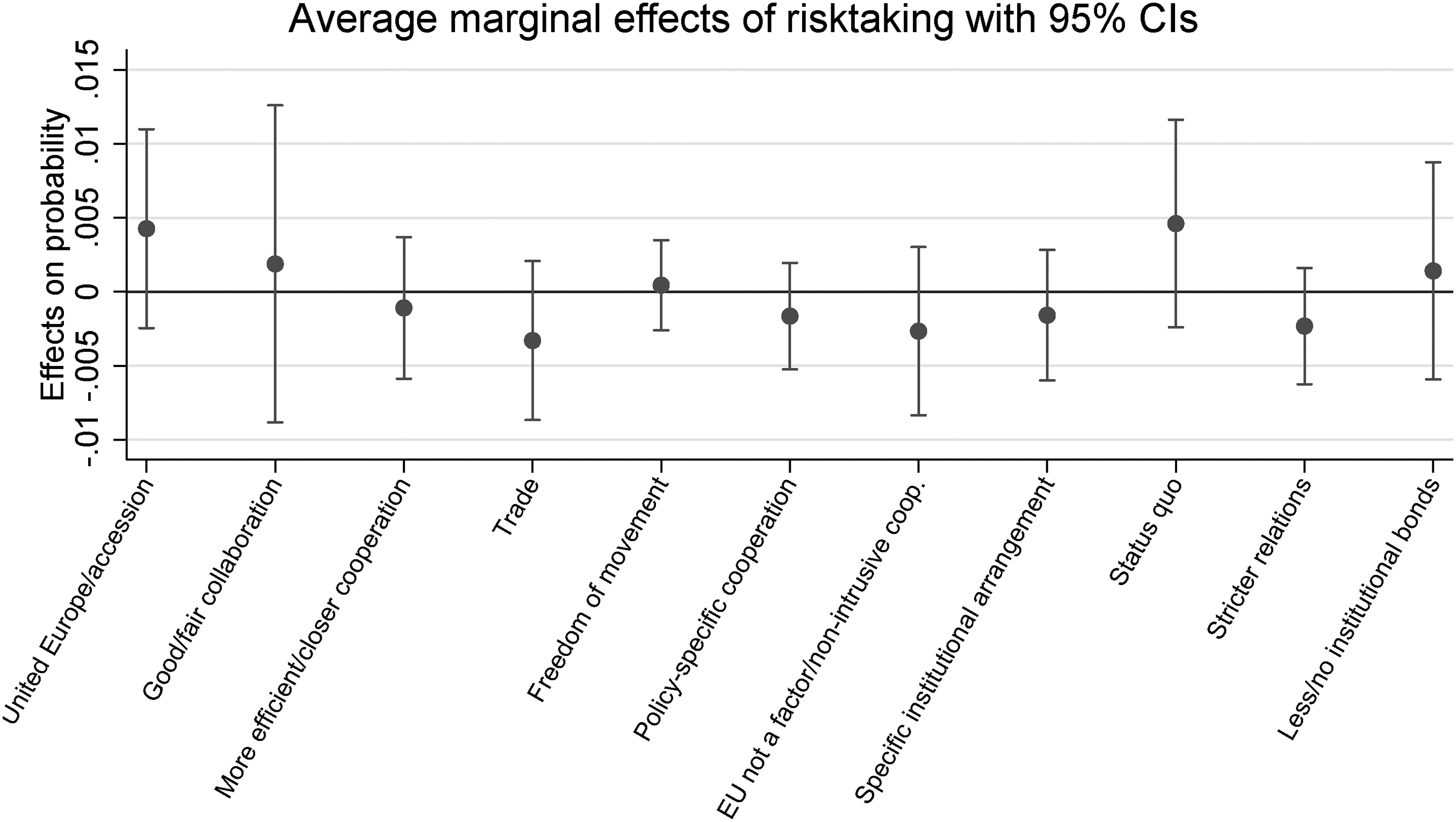
Marginal effects of risk-taking on preferences (based on Table A6 in the Online appendix).
Discussion
This article set out to explore and examine public opinion about the future of EUrope. Taking a comparative approach, we show that the majority of both EU and non-EU citizens are capable of formulating their visions for future EU–non-EU relations. In the context of the rather demanding task for respondents to formulate their opinions without pre-defined answer options, we consider the number of around 30% meaningless answers (including don’t know and no answer) as a promising result, both for future studies in this research area, but also substantively. That is, the results emphasize citizens’ capability to be involved in the process of developing the future of EUrope, for instance in initiatives like the recently concluded Conference on the Future of Europe. Our results further confirm previous findings on citizens’ knowledge to state their opinions on the future of the EU (Goldberg, 2021a, 2021b) – and are in line with the EU politicization literature (Grande and Hutter, 2016; De Wilde, 2011).
Complementing studies highlighting the impact of situational factors on EU politicization (e.g. Hutter and Kriesi, 2019), our study contributes new insights from a cross-country perspective: Respondents from non-EU countries provide more detailed and heterogeneous preferences for the future relations compared to less specific and more homogeneous preferences among EU citizens. Compared to the latter, preferences in non-EU countries follow a more tripolar distribution, with both stronger preferences for significant deviation from the status quo and stronger preferences for the status quo. In detail, while Norwegians mention preferences to deviate from the status quo in any direction, that is, cutting all ties with the EU or joining it, UK respondents rather mention preferences to rejoin the EU. However, non-EU citizens also strongly support the status quo, especially in Norway and Switzerland. The more detailed and heterogeneous views among non-EU respondents may be due to the greater involvement of citizens in non-EU countries and the generally greater importance attached to EU–non-EU relations. Following Brexit and ongoing debates about the relations with the EU in Switzerland, the debate on the future of EUrope is more salient in non-EU countries compared to EU countries, where debates on external European relationships compete with internal relations or those with global partners. The findings for the UK, Switzerland and Norway are thus an interesting parallel to the asymmetric levels of dependencies found for instance between the EU and the West-Balkans (Wöhlert, 2013). Moreover, unlike the focus on EU politicization in times of specific crises (Hutter and Kriesi, 2019), our survey was conducted during summer of 2021, in a time without (immediate) trans-European crises or particularly high issue salience, that is, after the peak of the debates surrounding the COVID-19 pandemic and Brexit, but before the war in Ukraine. The small impact of situational factors may result in a more general image of public opinion towards future EU–non-EU relations.
At the individual level, we found different preference patterns across socio-demographics and political ideology. In contrast, we did not find any systematic patterns for risk-taking attitudes, that is, risk-taking respondents do not prefer EU–non-EU relations that deviate more strongly from the status quo than risk-averse respondents. This result stands in contrast to findings in (EU) referendum votes, where risk-taking attitudes usually predict voting for (uncertain) change as compared to the status quo (e.g. Henderson et al., 2017; Morisi, 2018). The absence of significant results may be due to both substantial and measurement issues. First, the risk-taking attitude measure may be a too simple one-item measure – although commonly employed in the literature this way – with more nuanced measures of risk-taking doing better justice to the complexity of the concept (e.g. Liñeira and Henderson, 2021). Second, risk-taking attitudes may be less relevant for more hypothetical and abstract preferences, and for preferences towards a large set of possible outcomes. In a real referendum setting, following an intense media campaign and strong elite cues – such as for Brexit (e.g. Steenbergen and Siczek, 2017) – risk-taking may matter more than in our setting where people may have answered more rationally. Third, and related, due to the self-formulation of preferences by respondents, the preferences may be also perceived as less risky to begin with, in contrast to actual change options in referendum votes that often come with more uncertainty. Finally, the effect of risk-taking may be also more complex than the direct effect we test. For instance, Liñeira and Henderson (2021) show that politically more knowledgeable people are better in predicting consequences of political outcomes, which reduces the effect of risk attitudes on their final choice, in contrast to a stronger influence of risk-taking among politically unaware voters.
Future research might tackle such more complex relationships involving risk-taking. Similarly, and to improve the overall explanation of EU–non-EU relation preferences, one should examine additional determinants of such preferences in a comprehensive model. A starting point could be common factors from the EU integration literature, for example, utilitarian considerations, economic aspects, being a winner or loser of globalization or perceived cultural threats. One might equally go into more detail to explain cross-country differences, especially between non-EU countries. While we provide some first insights and related explanations for variations within the group of non-EU countries, future research might focus on contextual differences between non-EU countries that have different institutional setups and histories with the EU.
Notwithstanding the discussed options how to advance research about public opinion regarding future EU–non-EU relations and European integration more broadly, our study offers important evidence that such endeavours are feasible. That is, the claim by Di Mauro and Memoli (2021) that public attitudes regarding European integration are underestimated cannot be dismissed with arguments that citizens would not be able to contribute. While such a stronger involvement of the public may be good news for the democratic acceptance of the European project, the partly highly diverging preferences for the future path may pose a serious obstacle to satisfying citizens, or as nicely put by Costa (2019: 796), ‘(t)he more politicization spreads beyond institutional arenas, the more difficult will [sic] be for core actors in the decision-making process to keep the genie in the bottle’.
Supplemental Material
sj-pdf-1-eup-10.1177_14651165231214415 - Supplemental material for Peoples’ perspectives on the ‘Future of Europe’ – A comparative study from within and beyond the European Union
Supplemental material, sj-pdf-1-eup-10.1177_14651165231214415 for Peoples’ perspectives on the ‘Future of Europe’ – A comparative study from within and beyond the European Union by Andreas C Goldberg and Lukas Benedikt Hoffmann in European Union Politics
Supplemental Material
sj-xlsx-2-eup-10.1177_14651165231214415 - Supplemental material for Peoples’ perspectives on the ‘Future of Europe’ – A comparative study from within and beyond the European Union
Supplemental material, sj-xlsx-2-eup-10.1177_14651165231214415 for Peoples’ perspectives on the ‘Future of Europe’ – A comparative study from within and beyond the European Union by Andreas C Goldberg and Lukas Benedikt Hoffmann in European Union Politics
Supplemental Material
sj-do-3-eup-10.1177_14651165231214415 - Supplemental material for Peoples’ perspectives on the ‘Future of Europe’ – A comparative study from within and beyond the European Union
Supplemental material, sj-do-3-eup-10.1177_14651165231214415 for Peoples’ perspectives on the ‘Future of Europe’ – A comparative study from within and beyond the European Union by Andreas C Goldberg and Lukas Benedikt Hoffmann in European Union Politics
Supplemental Material
sj-rmd-4-eup-10.1177_14651165231214415 - Supplemental material for Peoples’ perspectives on the ‘Future of Europe’ – A comparative study from within and beyond the European Union
Supplemental material, sj-rmd-4-eup-10.1177_14651165231214415 for Peoples’ perspectives on the ‘Future of Europe’ – A comparative study from within and beyond the European Union by Andreas C Goldberg and Lukas Benedikt Hoffmann in European Union Politics
Supplemental Material
sj-csv-5-eup-10.1177_14651165231214415 - Supplemental material for Peoples’ perspectives on the ‘Future of Europe’ – A comparative study from within and beyond the European Union
Supplemental material, sj-csv-5-eup-10.1177_14651165231214415 for Peoples’ perspectives on the ‘Future of Europe’ – A comparative study from within and beyond the European Union by Andreas C Goldberg and Lukas Benedikt Hoffmann in European Union Politics
Supplemental Material
sj-dta-6-eup-10.1177_14651165231214415 - Supplemental material for Peoples’ perspectives on the ‘Future of Europe’ – A comparative study from within and beyond the European Union
Supplemental material, sj-dta-6-eup-10.1177_14651165231214415 for Peoples’ perspectives on the ‘Future of Europe’ – A comparative study from within and beyond the European Union by Andreas C Goldberg and Lukas Benedikt Hoffmann in European Union Politics
Supplemental Material
sj-dta-7-eup-10.1177_14651165231214415 - Supplemental material for Peoples’ perspectives on the ‘Future of Europe’ – A comparative study from within and beyond the European Union
Supplemental material, sj-dta-7-eup-10.1177_14651165231214415 for Peoples’ perspectives on the ‘Future of Europe’ – A comparative study from within and beyond the European Union by Andreas C Goldberg and Lukas Benedikt Hoffmann in European Union Politics
Footnotes
Acknowledgements
Previous versions of this article were presented at the 2022 European Political Science Association conference in Prague and the 2022 Interdisciplinary Trans-Nordic Conference on European Differentiated Integration in Kristiansand. We thank all participants as well as three anonymous reviewers and the editor at EUP for their valuable feedback. We also thank Pieter de Wilde for his helpful comments on earlier drafts of this article and our (student) assistants Adnan Leal Dura, Andreas Finsen, Dániel Komáromy, Roemer de Ruiter, Mónika Simon and Emma Tram during the translation and coding phases of the data collection.
Author contributions
The authors contributed equally to the article.
Data availability statement
Data sharing not applicable to this article as no datasets were generated or analysed during thecurrent study.
Declaration of conflicting interests
The author(s) declared no potential conflicts of interest with respect to the research, authorship, and/or publication of this article.
Funding

Supplemental material
Supplemental material for this article is available online.
Notes
References
Supplementary Material
Please find the following supplemental material available below.
For Open Access articles published under a Creative Commons License, all supplemental material carries the same license as the article it is associated with.
For non-Open Access articles published, all supplemental material carries a non-exclusive license, and permission requests for re-use of supplemental material or any part of supplemental material shall be sent directly to the copyright owner as specified in the copyright notice associated with the article.
