




Abstract
The European Commission has shown efforts to strengthen citizens’ participation in its policy formulation processes through public consultation opportunities. However, we currently lack a systematic analysis of the factors that drive citizens’ participation in the formulation stages of supranational policymaking. This study provides important insights into this research gap and considers whether and how policy context matters for the levels of citizen engagement in the European Commission's open consultation opportunities based on the associated costs and benefits of participation. The analysis shows an increase in citizen activity for public consultation opportunities associated with initiatives in the pre-formulation stage of policymaking and for public consultation opportunities associated with less complex consultation documents.
Introduction
Including stakeholders in policymaking processes can create a more responsive procedure and decrease the distance between public opinion and policies proposed by the European Commission (Binderkrantz et al., 2022; Bunea and Nørbech, 2022; Røed and Hansen, 2018). The concept of stakeholder refers here to all third parties who want to contribute to policymaking (Vetulani-Cęgiel and Meyer, 2020) which may include both citizens and interest groups (Bunea, 2019). However, most recent research on stakeholder participation and diversity in policymaking focuses mainly on interest groups (but see Bunea, 2019; Bunea and Nørbech, 2022), even though the ability of interest groups to represent the policy preferences of the general public is frequently challenged. This bias in representation extends further, as citizen preferences are more likely to align with interest groups representing diffuse interests, which face significant collective action problems that limit their ability to mobilise on behalf of citizens and their constituencies (Olson, 1971). Furthermore, while there exists evidence of overlap between the preferences of the general public and interest groups, recent research indicates that they are aligned only approximately half of the time (Flöthe and Rasmussen, 2019). This could indicate that relying solely on interest groups to represent citizens would result in a significant share of citizens’ preferences not being reflected in policymaking. Building on these two observations, it is reasonable to argue that citizens’ participation in policymaking offers decision-makers a unique opportunity to get direct information about the public's preferences that might otherwise be difficult to obtain due to the observed bias towards concentrated interests and the imperfect representation of citizens’ preferences by interest organisations. Furthermore, increased citizen participation could potentially counterbalance the dominant presence of business interests. From a normative perspective, a common assumption is that citizen engagement in policymaking is preferable for several reasons. One of them is that it increases the likelihood that policies reflect citizens’ preferences, builds trust in decision-makers and improves policy support among the general population (Irvin and Stansbury, 2004). In light of this, and given that citizen participation in policymaking is a fairly new development, a systematic empirical inquiry into the levels of citizen engagement in policymaking is timely and highly relevant. To address this gap in the research, I examine whether policy context, a key framework for studying stakeholder mobilisation and diversity, matters for citizen engagement and ask: to what extent does policy context explain the level of citizen engagement across public consultation opportunities in the European Commission's policy formulation process?
To answer this question, I examine the total number of citizens participating across public consultation opportunities and argue that this is explained by key characteristics of the policy initiatives on which stakeholders are consulted. In this study, the term ‘public consultation opportunity’ refers to all possibilities of open public participation through the policy formulation processes. This includes both the longstanding online open public consultations (OPCs) and the feedback opportunities (FOs) introduced by the Commission as part of its 2015 Better Regulation reform. This excludes the targeted consultation formats, which require an invitation to participate, and limits the scope to consultations that are open to all interested stakeholders and rely on a self-selection mechanism for participation. A ‘policy initiative’ denominates any proposed substantial or procedural change in policy that the Commission formalises, which may lead to a public consultation opportunity.
This study builds on two strands of literature: the literature on interest group participation in consultations (in the European Union (EU)) (Berkhout et al., 2017; Beyers and Arras, 2019; Bunea, 2014, 2017; Rasmussen et al., 2014; Røed and Hansen, 2018) and the literature on citizen participation in politics and policymaking from a rational choice perspective (Downs, 1957; Fowler, 2006; Gerber et al., 2008). The theoretical framework builds on the assumption that policy context is important for stakeholder participation (Klüver et al., 2015) since it will influence the associated costs and benefits of participation. I assert that the contexts which promote interest group pluralism will also be relevant for the levels of citizen participation. Importantly, I argue that there are three main ‘environmental conditions’ that impact citizen participation: the formulation stage, public salience and technical complexity (Pagliari and Young, 2016). The expectation is that initiatives that invite public participation during the pre-formulation stages, which are marked by a high public salience and are accompanied by less complex consultation documents, encourage citizen participation.
Theoretically, the article contributes to the literature on stakeholder participation in public policymaking by applying a classic theoretical framework to a type of stakeholder that has received little previous attention. It also contributes to the literature on citizen participation in policymaking by examining the degree to which policy context matters for citizen engagement. Empirically, the study is innovative in three ways: first, the study expands the analysis of stakeholder participation in EU policymaking by examining public consultation opportunities associated with policy initiatives at both the pre- and post-formulation stages in the policymaking process. Second, the study focuses on citizens, which is an often overlooked and under-researched stakeholder type. Third, the study employs a novel dataset of 1663 public participation opportunities from 2016 to 2021.
The results of the analysis show that policy context explains to some extent the levels of citizen engagement. Public consultation opportunities early in the policymaking process show a significant increase in citizen participation. Citizen participation is also higher in public consultation opportunities on less complex policy initiatives. However, there is no significant effect of public salience on the levels of citizen engagement. This tells us that contexts which promote stakeholder diversity show some degree of overlap with increased citizen participation, but that there might be a need for a more developed theoretical framework to fully examine and explain the drivers of citizen engagement in EU policymaking.
Public consultation opportunities in the European Commission's consultation regime
In the White Paper on European Governance, published in 2001, the Commission emphasised the importance of consulting with stakeholders during the early stages of the EU legislative process (Bunea, 2017). Stakeholder participation was further emphasised with the Better Regulation Agenda of 2015, which also brought forth a new pillar in the Commission's public consultation regime in addition to OPCs, namely the feedback opportunities.
OPCs consist of an online survey questionnaire with mostly closed-ended items (European Commission, 2017). For the OPCs, the Commission has considerable autonomy in deciding which initiatives will be consulted on, how the consultation is framed and what to do with the results (Alemanno, 2020). The OPCs were introduced with the aim of institutionalising interactions with stakeholders, while also making public participation in policymaking easier and more inclusive, addressing biases in participation that were traditionally favouring business actors (Bunea, 2017). The Commission can design the OPC to pinpoint the issues it wants input on, and the results are easier to quantify. In contrast, FOs offer stakeholders the opportunity to voice their opinions in their own words but also pose a challenge for the Commission in terms of systemising and utilising the open-text feedback (European Commission, 2017). The format allows less control for the Commission regarding stakeholders’ inputs.
Despite the differences discussed above, the two types of public consultation opportunities share similarities on the most important dimensions according to the literature on public participation in governance (Fung, 2006; Nabatchi, 2010). The two formats are similar in terms of the selection of participants, interaction with decision-makers and deliberative features. I, therefore, argue that the two formats of public consultations present important similarities that justify their joint analyses as public consultation opportunities in supranational policymaking.
The degree to which citizens can expect to achieve their desired outcome and whether the Commission will listen to their inputs is a key, yet currently unexamined, empirical question. Based on their study of citizen volunteers for the Department of Energy's citizen engagement initiative in the United States (US), Young and Tanner (2022) show that bureaucratic discretion matters more for decision-making compared to citizen participation. Nevertheless, the Commission has been shown to align its policies more with the public interest (citizens or organisations representing the EU public) in order to increase input legitimacy on politicised issues (Bunea, 2019). As an unelected actor, the Commission has a strong incentive to consider citizens’ views to protect its legitimacy (Haverland et al., 2018) as being responsive to the general public is an important aspect of input legitimacy (Meijers et al., 2019). The Commission has also been shown to respond to public pressures in matters of legislative withdrawal, showing that it understands the necessity of listening to citizens (Reh et al., 2020). In its explanatory memoranda for legislative proposals, the Commission will typically refer to the number of citizen participants to the same degree as it refers to the number of interest group participants in OPCs. Finally, citizen participation has been encouraged by the Commission, and dismissing the input it receives could therefore potentially damage its reputation, fuel public distrust and deepen its perceived democratic deficit. I, therefore, argue that it is reasonable to assume that the Commission has incentives to consider very seriously the input received from citizens who engage in public consultation opportunities.
The public consultation opportunities offer stakeholders the chance to give feedback on specific policy initiatives. Throughout the policymaking process, each initiative can go through several rounds of public feedback. Figure 1 shows public consultation opportunities offered by the Commission for each initiative; however, it should be noted that not all initiatives will necessarily go through all the stages. Firstly, stakeholders are offered the opportunity to comment on a consultation document in the form of a roadmap or inception impact assessment (IIA). Here, the Commission presents the problem the initiative will address, as well as its potential impacts (European Commission, 2017). This may be followed by an OPC, where the Commission asks for input on more specific issues through an online questionnaire. Finally, stakeholders are offered another feedback opportunity concerning the draft policy initiative, which can be either a legislative (legislative proposal) or a non-legislative act (delegated/implementing act). Feedback received on the legislative proposal is summarised and included as a letter to the European Parliament and the Council to inform their decision-making (European Commission, 2017). For delegated and implementing acts, the feedback is gathered on the final draft, and a summary of stakeholder inputs is mentioned in an explanatory memorandum or summary report.
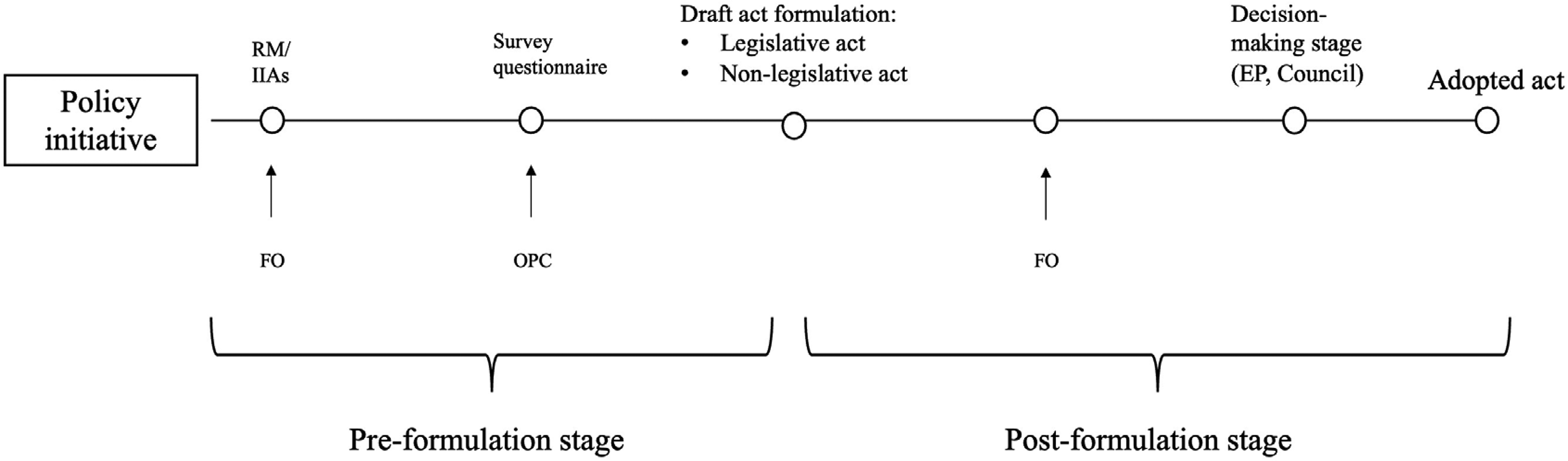
Policy stages and public consultation opportunities in the Commission's policy formulation processes.
Building on Judge and Thomson (2019), I discern between a pre-formulation stage and a post-formulation stage of the Commission's policy formulation processes. However, I expand on their study by including a feedback opportunity which is available in the post-formulation stage and where stakeholders can give feedback on the draft act (legislative proposal or delegated/implementing act). The public consultation opportunities connected to roadmaps and IIAs, as well as the OPCs, gather stakeholder feedback before the draft policy document is written. I argue that roadmaps/IIAs and OPCs are consultation opportunities that belong to the pre-formulation stage. 1
Citizens as stakeholders in the Commission's public consultations: current literature
While there are several existing studies of citizen participation in the Commission's consultations, they tend to be descriptive and/or restricted to examining participation on specific topics, such as the EU copyright policy (Vetulani-Cęgiel and Meyer, 2020), the REACH chemical policy (Persson, 2007) or an assessment of GMO products (Ferretti and Lener, 2008; Steffek and Ferretti, 2009). The existing studies show variation in citizen participation in consultations, yet they do not propose a cohesive framework for explaining this variation based on policy context. Most of this research reports low levels of mobilisation (Coglianese, 2006; Persson, 2007), with the following exception. Vetulani-Cęgiel and Meyer (2020) conduct a longitudinal study of citizen participation in the Commission's consultations on copyright policies between 2004 and 2019 to gain insight into the efforts of the Commission in engaging citizens within this policy area. They find increasing citizen participation in the copyright policy initiatives over time, although they also observe variation across the analysed consultations. This suggests that characteristics of the specific policy initiatives could influence the number of participating citizens as well as a general increase in citizen mobilisation over time. Similarly, Marxsen (2015) examines whether consultations can give a voice to citizens and studies the levels of participation in all consultations conducted in 2011 with available results published. His study finds that business and industry organisations are the most prominent stakeholder participants across consultations and that citizens will participate en masse as part of a campaign or if a questionnaire is provided by the Commission (Marxsen, 2015). Persson (2007) finds generally low citizen participation in consultations on REACH chemical regulations, which is potentially due to the high complexity of that policy issue. Hierlemann et al. (2022) explore citizen participation in EU consultations held in the period from 2015 to 2018, and while they do not test any hypotheses in their analysis, they do argue that consultations on issues salient to the public are characterised by higher citizen participation. They also note that public consultations that use complex or technical language make it difficult for citizens to participate. As for studies on consultations at the national level, Coglianese (2006) finds quite low levels of citizen participation in US rulemaking procedures but notes an increase in participation on salient issues. Fink et al. (2021) find lower citizen participation when more complex language is used in policy documents in their analysis of consultations on electricity grids in Germany. In summary, while the aforementioned studies show variation in citizen participation in consultations, they do not propose a cohesive explanatory framework based on policy context.
Another relevant strand of research investigates different aspects of interest group participation in EU consultations and policymaking (e.g. Beyers and Arras, 2019; Bunea, 2017, 2018, 2019; Bunea and Chrisp, 2022; Bunea and Nørbech, 2022; Rasmussen et al., 2014; Røed and Hansen, 2018). This strand of research focuses mainly on explaining variation in the types of interest groups participating in the Commission's public consultations, in most cases without even identifying citizens as a separate category of stakeholders (for exceptions see Bunea, 2019; Bunea and Nørbech, 2022). However, this strand of research is useful in understanding the key drivers of stakeholder participation in EU public consultations. Rasmussen et al. (2014) examine interest group activity in the Commission's online consultations, arguing that the extent of interest group mobilisation depends on supply- and demand-side factors, as well as the public salience of policy areas. They find that interest groups mobilise more on issues within salient policy areas and issues that are more consequential for public budgets (Rasmussen et al., 2014). Røed and Hansen (2018) adopt a cost-benefit perspective and investigate interest group participation bias in 350 European Commission online consultations organised between 2001 and 2012. They hypothesise that issue characteristics such as salience and complexity will influence interest group participation bias, and their findings support their hypotheses. Beyers and Arras (2019) seek to explain stakeholder diversity in consultations organised by EU regulatory agencies across multiple policy domains. They argue that key consultation-level characteristics such as early-stage consultations, those phrased in layman's terms and those with a standardised response format will increase stakeholder diversity (Beyers and Arras, 2019). While their findings show that contextual factors at the agency level tend to have a larger influence on stakeholder diversity than consultation-level factors, lower complexity and consultations in the early stages of the policy process were also found to have a low but significant effect (Beyers and Arras, 2019). While these studies seek to explain participation patterns in EU consultations based in part on the policy context, to the best of my knowledge, no study has applied a similar framework to explain citizen engagement in consultations.
Explaining citizen engagement in public consultation opportunities
One dominant theoretical approach in the literature explaining interest group participation in consultations emphasises the importance of the cost-benefit calculations stakeholders engage with before deciding whether to participate or not (e.g. Beyers and Arras, 2019; Haber and Heims, 2020; Røed and Hansen, 2018). Furthermore, the cost-benefit framework has also been applied to citizen participation in policymaking (Fink et al., 2021; Sjoberg et al., 2017). Building on this literature, I consider the cost-benefit framework a good starting point for constructing the theoretical framework. Similarly, classic theories of citizen political participation rely on a cost-benefit framework in the calculus of voting, which is used to explain citizen turnout (Downs, 1957). According to the calculus of voting, a citizen will turn out to vote if

Policy context: formulation stage, salience and complexity
A classical approach for studying stakeholder mobilisation and diversity builds on the supply and demand factors of population ecology models (Gray and Lowery, 1996; Messer et al., 2011), while an equally established approach focuses on the importance of the contextual aspects of policymaking (Klüver et al., 2015). While interest groups have a ‘population’ which varies based on supply and demand factors, and therefore may facilitate the diversity of participants in consultations, it would be difficult to make a similar claim about citizens. The theoretical framework therefore builds on the assumption that policy context, which matters for lobbying in the EU (Klüver et al., 2015) and the diversity of interest groups in particular (Pagliari and Young, 2016), can also be applied to explain levels of citizen participation. More specifically, Pagliari and Young (2016) point to four main ‘environmental conditions’ that influence the diversity of interest group participants in regulatory policymaking: technical complexity, salience, institutional context and policy stage. I argue that the level of citizen participation is likely to increase in policy contexts that promote more interest group pluralism. I will therefore examine the degree to which these environmental conditions shape citizen mobilisation and engagement with policymaking. Pagliari and Young (2016) argue that institutional context will influence the diversity of interest groups participating; specifically, the transnational level of policymaking experiences lower interest group diversity. Since the present study analyses citizen participation in supranational policymaking, the institutional context variable mentioned by Pagliari and Young (2016) is held constant. However, the remaining three environmental conditions vary across policy initiatives and related public participation opportunities. These environmental conditions have been used to explain interest group mobilisation or diversity at the EU level (Beyers and Arras, 2019; Rasmussen et al., 2014; Røed and Hansen, 2018), but little is known about the effect of policy contextual conditions on levels of citizen engagement in policymaking.
Given the assumption that citizens are more likely to participate if they can increase the chance of influencing policy outcomes, I argue that this likelihood is higher when participating in public consultation opportunities in the pre-formulation stage of the policymaking process when the actual text of the legislative/non-legislative acts is still not written down and formalised. Pagliari and Young (2016) argue that the early stages of policymaking will see less interest group diversity due to the ‘first mover advantage’ of more resourceful actors. On the other hand, theories of ‘early lobbying’ in the EU state that it is easier for the policymaker to incorporate feedback into the policy proposal when the documents are less formalised (Bouwen, 2009). I follow this latter reasoning and argue that, in the pre-formulation stage, the details of the policy initiative are less defined, and the Commission is likely more inclined to use the feedback received from citizens and other stakeholders in the shaping of its policies. Therefore, when considering the potential benefits of engaging in public consultation opportunities, it is expected that citizens will want to have a say early in the process. In the post-formulation stage, the details of the initiative are more concrete, and how the feedback received from stakeholders can inform and shape the final version of the adopted act is less clear and certain. This could disincentive participation in consultation opportunities associated with the post-formulation stage.
At the same time, the formulation stage could also influence the costs of participating. Beyers and Arras (2019) argue that the discussion points at earlier stages in the consultation process tend to be less technical and this in turn should facilitate the participation of a diverse set of stakeholders. Furthermore, the scope of the policy will likely become narrower as the process moves on, leading to more bias and less diversity in interest representation towards the end of the policymaking process (Berkhout et al., 2018). Therefore, it seems likely that the costs of participating in the pre-formulation policy stage will be lower than in the post-formulation stage. I therefore argue that the early, pre-formulation stages of EU policymaking have a lower participatory cost and higher potential benefits for citizens, which could make participation more likely for citizens.
Citizen engagement is higher in public participation opportunities in the pre-formulation stage of the policymaking process.
A second environmental condition that could influence who participates in policymaking is issue salience. Gormley (1986: 598) defines salience in the following manner: ‘A highly salient issue is one that affects a large number of people in a significant way’. Policymakers might be more likely to respond to public opinion (i.e. citizen preferences) on issues that are publicly salient (Aizenberg, 2022; De Bruycker, 2017). On these issues, there is more public scrutiny and accountability, and the literature shows that the advantage of interest groups’ resources on influence decreases (Stevens and De Bruycker, 2020). Conversely, issues with lower public salience are more likely to be captured by narrower business interests (Culpepper, 2011). On these issues, there tends to be less public scrutiny and accountability which in turn increases the chances that policymakers respond to private, business interests (De Bruycker, 2017; Chalmers, 2020).
Building on the work of Røed and Hansen (2018), I argue that an important goal of participation in EU consultations is the chance to influence the policymaking process. For citizens, this chance is likely to be higher for publicly salient issues, where policymakers are more inclined to respond to public opinion (Aizenberg, 2022; De Bruycker, 2017). Similarly, if the issue is impactful on citizens’ daily lives, the potential benefit of achieving their desired policy outcome is higher. Finally, increased familiarity with a topic could also result in lowering the costs associated with attaining substantial knowledge of the topic. As this study examines only citizens as stakeholders in consultations, the focus will be on topics that are salient to the public (Beyers and De Bruycker, 2018; Beyers et al., 2018).
Public consultation opportunities for policy initiatives on publicly salient topics will generate higher citizen participation.
A third environmental condition that can influence stakeholder participation is technical complexity (Pagliari and Young, 2016). According to Gormley (1986: 598): ‘A highly complex issue is one that raises factual questions that cannot be answered by generalists or laypersons’. From a resource-exchange perspective, highly technical issues allow specialised interests to signal their expert knowledge (Aizenberg and Müller, 2021). For citizens, complex policies could therefore decrease the potential benefits of participation in consultations as the probability of changing the policy outcome might be lower in light of expert competition. Complex policies can have the consequence of increased transaction costs regarding the cognitive capacities required on behalf of the participant to read, process and understand the policies (Hurka et al., 2021). These transaction costs will be increased by the difficulty of the language they are communicated in, and, for citizens especially, this could have negative effects on their ability to engage with more complex policies (Hurka et al., 2021). Therefore, it seems unlikely that citizens will participate in high numbers on technically complex issues, which require more time and resources, and with lower chances of potential benefits.
Public consultation opportunities for policy initiatives characterised by lower complexity will have higher citizen participation.
Research design
The dataset consists of 1744 public consultation opportunities spanning from 2016 to 2021. 2 The data were gathered as part of the CONSULTATIONEFFECTS project from the European Commission's ‘Have Your Say’ online portal. I measure the levels of citizen engagement in policymaking through consultations based on the total count of citizens participating in each public participation opportunity initiated by the Commission. A greater number of participating citizens likely allows the Commission to get a more accurate estimate of citizen opinion. 3 This is relevant because a stated objective of the Commission's consultation regime is to enable it to consider the input and views of citizens, thereby increasing the Commission's ability to promote the interest of the general public in its policy initiatives (Hierlemann et al., 2022). The dependent variable measures the number of citizens participating in each public consultation opportunity, which can be an OPC or FO. The value of the variable ranges from 0 to 5816, with a mean of 55.27 and a median of 0. For feedback opportunities, the variable was created by aggregating the number of written feedback instances per stakeholder. For the open public consultations, this was based on either the statistics provided by the Commission on the consultation website or the numbers provided in official documents summarising the results of open public consultations. When excluding the public consultation opportunities related to initiatives for which complete information on all relevant variables was unavailable, the total number of observations is reduced to 1663. The categories of EU citizens and non-EU citizens were collapsed for this study. Most public consultation opportunities had no citizen participation (n = 903), skewing the dependent variable towards zero. Among observations with citizen participation, most had a low number of participants, while a few outliers involved thousands. The average number of citizen participants varied across policy topics, with ‘justice and fundamental rights’ and ‘migration and asylum’ having the most participation and ‘fraud prevention’ and ‘EU enlargement’ having the least. This is shown in Figure 2.
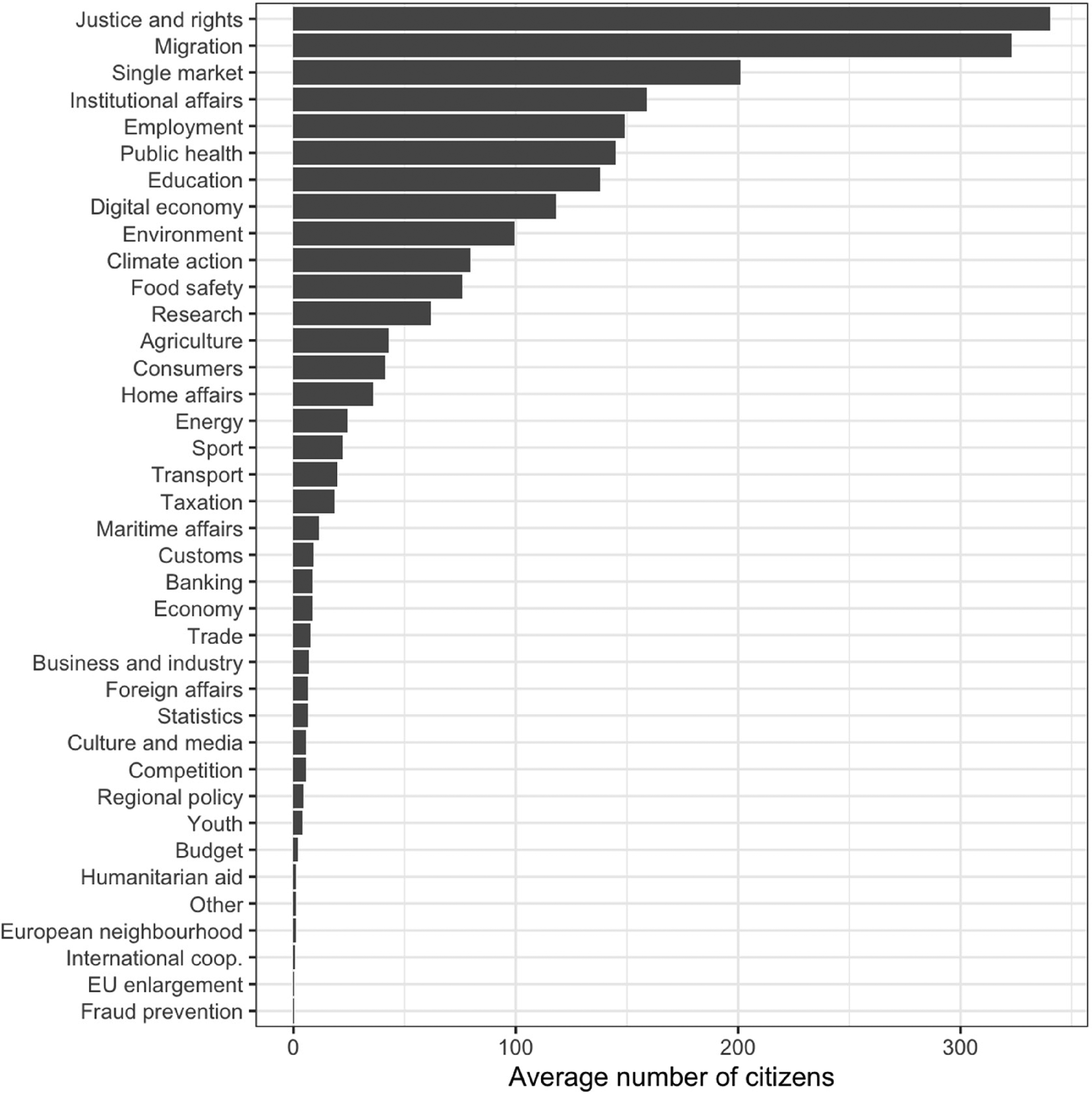
Average citizen participation by policy topic.
The first explanatory variable labelled ‘pre-formulation stage’ is a binary variable that discerns between public consultation opportunities taking place during the pre-formulation (1) and post-formulation stage (0) in the policymaking process. As such, the public consultation opportunities preceding the drafting of the legislative proposal or of the delegated/implementing act (viz. FOs on roadmaps and IIAs and OPCs) are coded as 1 (n = 730) while the FOs on legislative proposals and delegated/implementing acts are coded as 0 (n = 933).
While several studies rely on media salience to capture issue saliency (see e.g. Røed and Hansen, 2018; Stevens and De Bruycker, 2020), it has been emphasised in the literature that salience is actor-oriented and that the salience of issues varies for different types of actors (Beyers et al., 2018). As the research question considers public participation, the study is interested in the effect of public salience. More precisely, the assumption is that issues that are important for European citizens correspond with the salient issues for citizens participating in EU policymaking. The measure is therefore based on what European citizens consider to be the most important issues in the Eurobarometer each year from 2016 to 2021. 4 The Eurobarometer is based on a representative sample of 1000 citizens per member state and is conducted at least twice a year (Haverland et al., 2018). The coding of the variable labelled ‘publicly salient topic’ follows the approach adopted by Rasmussen et al. (2014). The result of the Eurobarometer survey provides the percentage of citizens that consider each policy issue to be among the two most important issues currently facing the EU. As the Eurobarometer issues do not overlap completely with the policy topic of the public consultation opportunities, the issues were manually matched with the closest corresponding policy topics (see Online appendix). For the topics that did not correspond to the Eurobarometer categories, 117 observations were manually assigned to the closest-matching policy topic based on the title of the policy initiative, while the remaining 445 observations were coded as ‘other’. To ease interpretation, the variable is standardised by subtracting the mean and dividing by two standard deviations. This method of standardisation allows the coefficient to be interpreted similarly as a binary input variable, by roughly equalling a change from the low to the high end of the variable's numeric range (Gelman, 2008). The standardised variable ranges from −0.56 to 1.83 with an average of 0.
The coding of the policy complexity variable follows the approach of Røed and Hansen (2018), where the measure is based on the readability of consultation documents. This study follows their example using the Flesch reading ease score (FRE) to determine complexity. This is arguably one of the most frequently used measures of textual complexity (Hurka, 2022). The assumption is that more technically complex policy initiatives will be accompanied by documents with more complex language (Røed and Hansen, 2018). For each public consultation opportunity, the corresponding consultation document of the policy initiative was gathered and analysed. For open public consultations, stakeholders are not presented with a consultation document but a survey questionnaire. For these observations, the section on the Commission webpages titled ‘Why we are consulting’ was used to measure complexity. This text provides citizens with crucial information about the given initiative and helps them decide whether to participate. The substantial content and length of this section also vary considerably between the OPCs. The variable labelled ‘policy complexity’ is created using the function for calculating the FRE score provided by the quanteda R package (Benoit et al., 2018). The variable ranges from −47 to 57, with a median of 19.99. Higher values imply higher readability and values under 30 are considered very difficult to read, which indicates that the majority of consultation documents are considered to be difficult to read. This variable is also standardised as above to ease interpretation. The standardised variable ranges from −3.17 to 1.82, with a mean of 0.
I also control for several important factors. Firstly, I control the type of policy area based on the topics of the policy initiatives. Bunea et al. (2021) argue that interest group diversity is more extensive in policy area types that are more integrated into EU policymaking, like the regulatory and distributive policy areas. The variable ‘policy area type’ is coded based on the scheme of Bunea et al. (2021) and the initiative's topic. The most frequent policy area in the data is regulatory (n = 1192), followed by distributive (n = 174), other (n = 138), interior (n = 98) and finally foreign (n = 61). 5
Vetulani-Cęgiel and Meyer (2020) find variation in citizen participation in consultations over time, even within the same policy issue. Therefore, it seems necessary to control for time trends, as it is likely that participation will increase over time as the public becomes more familiar with the Commission's online participation portal. In addition, policy complexity is also shown to increase over time (Hurka et al., 2021), meaning that time could be a potential confounder for the relationship between policy complexity and the number of citizens. The labelled ‘time trend’ ranges from 1 to 6 and increases by one for each year in the period of study.
Previous literature points to mass comment campaigns (MCC) organised by interest groups as drivers for citizen participation (Marxsen, 2015). The European Commission treats these campaigns differently than the unique feedback it receives and typically considers them equivalent to a single feedback occurrence in its explanatory memoranda that accompanies a proposal (European Commission, 2017). I therefore control for these campaigns. I identified campaigns in two ways. For OPCs, the Commission identifies campaigns and states this either on its consultation page or in the summary documents. For FOs, the Commission does not indicate the presence of campaigns. I, therefore, studied the individual feedback texts on policy initiatives with more than 20 citizen contributions to identify whether there existed more than two comments with the exact same content, which is a sign of an MCC (European Commission, 2017). This variable is labelled ‘campaigns’ and indicates the presence of such MCCs in the public consultation opportunity.
I further control for open public consultations. While I argue that the OPCs and FOs are similar along the dimensions of Fung (2006), there are some inherent qualities of the OPCs that could be confounding drivers of increased citizen participation. Importantly, OPCs constitute a more long-standing pillar in the Commission's consultation regime, so that citizens may be more likely to know of its existence. Secondly, the survey questionnaire format could have an impact on participation. Previous studies found higher citizen participation in public consultations when the citizens were provided with a survey (Marxsen, 2015; Quittkat, 2011). It can be argued that it is more costly to formulate feedback in an open format, compared to answering a closed-ended questionnaire (Beyers and Arras, 2019; Quittkat, 2011). For these reasons, I control for open public consultations to examine whether this consultation format is the sole driver of participation in the pre-formulation stage.
Finally, I control for the type of legislative act. I include a categorical variable coded based on the information available on the Commission websites. The variable ‘legislative act type’ indicates whether the initiative is a proposal for a regulation (n = 309), a directive (n = 104) or a decision (n = 33). The remaining public consultation opportunities are coded as other (n = 1217). Directives are often considered to be more important and complex (Golub, 2007). However, there have also been several important and controversial regulations (Blom-Hansen et al., 2022).
Analysis
To account for the over-dispersed dependent variable, a negative binomial model is used for the analysis. The coefficients of a negative binomial regression show the change in log counts on the dependent variable for a one-unit change in the explanatory variables. As the effect size can be hard to interpret, Table 1 shows the marginal effects of the negative binomial models. 6 The marginal effects indicate the change in the dependent variable, after a one-unit change in the explanatory variables, keeping the other variables at their means or modes (Fernihough, 2014). The models in Table 1 show support for H1 and H3; however, they show only limited support for H2.
Citizen participation across public consultation opportunities.
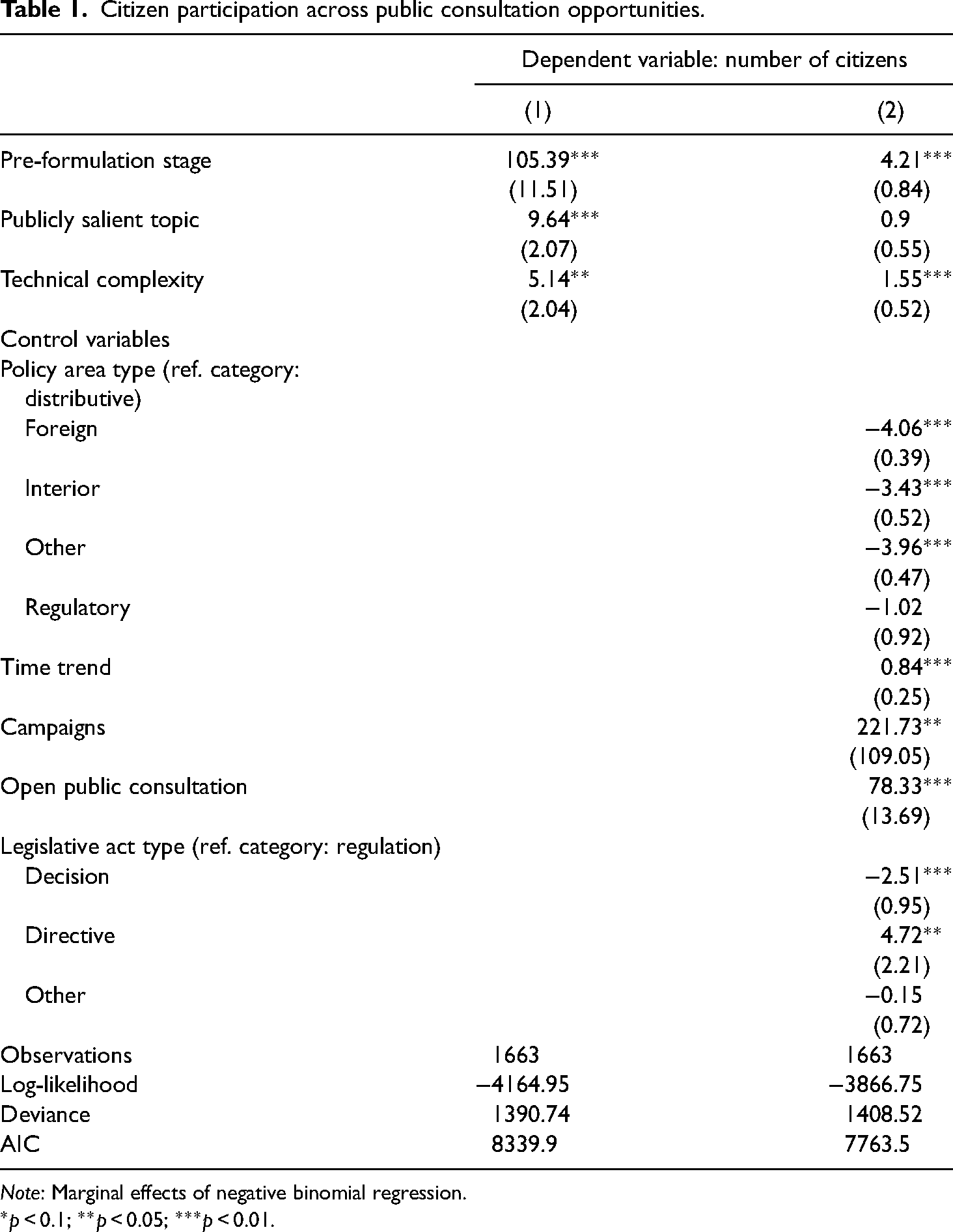
Note: Marginal effects of negative binomial regression.
*p < 0.1; **p < 0.05; ***p < 0.01.
In line with H1, the results show that citizens are significantly more likely to participate in consultations during the pre-formulation stage of policy initiatives. Before controlling for OPCs, the analysis shows an increase in the count of citizens of around 105. While still statistically significant, the substantial effect is reduced to approximately 4 when controlling for OPCs although the increase in the count is still significant. Considering that the average participation in public consultation opportunities other than OPCs is quite low (with an average of 3.3), an increase of 4 is comparatively substantial. Therefore, the increase of citizen participation in the pre-formulation stage does not seem to be driven exclusively by OPCs but also potentially by the benefits of getting involved early in the policy formulation stage as found in the lobbying literature (Bouwen, 2009). Beyers and Arras (2019) find more stakeholder diversity at the early agenda-setting stage of the policy cycle, which resonates well with the results of this study.
The results provide limited support for H2. Model 1 shows a significant increase in citizen count of 9 for two standard deviation changes in public salience. Yet when the control variables are added in Model 2, both the effect and the significance of the salience variable are reduced. This finding contrasts with analyses of interest group mobilisation in EU policymaking such as Rasmussen et al. (2014), who find broader mobilisation on issues of public salience. It stands also in contrast to studies using a different operationalisation of public salience (Røed and Hansen, 2018). The results may suggest that citizens could have different priorities when it comes to what is important for them in terms of broader topics at the EU level and the more specific policy initiatives the Commission consults on.
The results show support for H3 with a significant increase in citizen count of 5 in Model 1 and of 1.5 in Model 2 for two standard deviation changes in policy complexity. This indicates that policy initiatives with more comprehensible consultation documents see an increase in citizen participation, although the substantive effect is rather weak. This finding corresponds with the results of studies on interest group diversity in consultations like Beyers and Arras (2019) and Røed and Hansen (2018), who find less interest group diversity on more complex issues. It is also consistent with observations on citizen participation in EU consultations made by Persson (2007) and Hierlemann et al. (2022) and the findings of Fink et al. (2021) in German consultations on infrastructure. Among the control variables, time trend, OPCs and directives have a significant positive effect on citizen participation.
The Online appendix provides some further robustness tests, including a different coding of the policy area variable, exclusion of outliers and a hurdle regression. The robustness checks show no major changes to the results.
Conclusion
This study examines whether and how policy context matters for the level of citizen engagement in public consultation opportunities in the Commission's policymaking, based on a cost-benefit theoretical perspective. Specifically, the study aims to examine the effect of ‘environmental conditions’ like the formulation stage, the public salience of an issue and the complexity of the policy initiative (Pagliari and Young, 2016). The analysis shows that citizens participate in greater numbers in initiatives in the pre-formulation stages of supranational policymaking, as well as in initiatives associated with documents formulated in less complex text. These findings draw some similarities with the cost-benefit calculations of interest groups and their mobilisation patterns in consultations, where complexity leads to more biased interest group participatory patterns (Beyers and Arras, 2019; Rasmussen et al., 2014; Røed and Hansen, 2018) and lower citizen participation in particular (Fink et al., 2021).
However, this study finds no clear relationship between publicly salient initiatives and increased participation, departing from the findings of Rasmussen et al. (2014), Coglianese (2006) and Røed and Hansen (2018). While the measure of salience is perhaps not fine-grained enough to capture the salience of each unique policy initiative, the null finding still has interesting implications suggesting that the general public and the participating citizens could have differing priorities. It is also probable that other factors not included in the analysis interact with salience. In line with the free-rider dilemma, it is possible that salience alone is not enough to mobilise citizens. A certain level of conflict regarding policy solutions and outcomes in addition to the salience of an issue could be relevant. However, it should be noted that while there is considerable variation in citizen participation across the public consultation opportunities, the majority of the analysed consultations elicit low or no citizen activity. The effect of the main explanatory variables is also relatively low while control variables such as OPCs and campaigns have a much stronger positive impact on citizen engagement. This may indicate that while policy context seems to matter, this is perhaps not the sole or main explanation for citizen engagement. Other potentially important drivers of citizen mobilisation could therefore be outside mobilisation (e.g. campaigns), a more established, structured format of stakeholder engagement (OPCs) or more controversial and important policies (directives). However, it should be noted that the models reported in the article do not account for potential confounders of these control variables.
This study contributes to the literature on stakeholder participation in EU consultations by focusing on citizens, an often-overlooked stakeholder type and expanding the framework of Judge and Thomson (2019) to include public consultation opportunities in the post-formulation stage. The literature on citizen participation in policymaking contributes by applying an explanatory framework based on a cost-benefit analysis of policy context. Further, the study contributes to the literature on citizen participation in complex governance, by testing empirically how citizens mobilise in a participatory venue that relies on self-selection, with little interaction between participants (Fung, 2006). The study also provides insights to policymakers in offering a systematic analysis of citizen engagement across different public consultation opportunities. Policymakers who wish to increase citizen engagement in regulatory policymaking may benefit from increasing mobilisation efforts aimed at increasing citizen participation towards the later stages of the policymaking process. This approach may involve a clarification for participants as to why feedback at this late stage is valued and how it can still impact the final decision and policy implementation. Moreover, simplifying the language used in policy documents might be beneficial, as the language used by the Commission, in general, is very complex, even when communicating with the public through press releases and public statements (Rauh, 2022). An important caveat is that complex language might be the result of the latent complexity of the policy issue, which could persist as a barrier to citizen participation despite adopting simplified terminology. In other words, simplifying language and encouraging citizen participation in the less accessible stages of policymaking may be valuable in enhancing the quality of public participation in policymaking. An important avenue for further research would be to examine who the citizens who participate in EU policymaking are. The self-selection mechanism, as well as the relatively high cost of participation, decreases the likelihood of representative citizen participation. While little demographic data are available on citizen stakeholders, future research could consider the expressed opinions of the citizens in consultations to learn more about the group. For example, this could be done by looking at when the citizens’ preferences deviate from, or overlap with, different types of interest groups. Future research should also empirically examine the factors that explain the participation of citizens relative to that of other types of stakeholders and investigate how policymakers deal with input from citizens compared to input from interest groups. Another potential avenue for future research could look at how media plays a role in the mobilisation of citizens in EU consultations.
Supplemental Material
sj-docx-1-eup-10.1177_14651165231208995 - Supplemental material for Does policy context matter for citizen engagement in policymaking? Evidence from the European Commission's public consultation regime
Supplemental material, sj-docx-1-eup-10.1177_14651165231208995 for Does policy context matter for citizen engagement in policymaking? Evidence from the European Commission's public consultation regime by Idunn Nørbech in European Union Politics
Supplemental Material
sj-xlsx-2-eup-10.1177_14651165231208995 - Supplemental material for Does policy context matter for citizen engagement in policymaking? Evidence from the European Commission's public consultation regime
Supplemental material, sj-xlsx-2-eup-10.1177_14651165231208995 for Does policy context matter for citizen engagement in policymaking? Evidence from the European Commission's public consultation regime by Idunn Nørbech in European Union Politics
Supplemental Material
sj-r-3-eup-10.1177_14651165231208995 - Supplemental material for Does policy context matter for citizen engagement in policymaking? Evidence from the European Commission's public consultation regime
Supplemental material, sj-r-3-eup-10.1177_14651165231208995 for Does policy context matter for citizen engagement in policymaking? Evidence from the European Commission's public consultation regime by Idunn Nørbech in European Union Politics
Footnotes
Acknowledgements
First and foremost, I would like to thank Adriana Bunea, Reto Wüest and the three anonymous reviewers for their invaluable feedback. Furthermore, I am grateful for all the comments I received on earlier versions of the manuscript as part of the EPSA 2022 general conference, the ECPR 2022 general conference, and the 2022 National Conference in Political Science. Finally, I would like to thank my colleagues at the Department of Comparative Politics in Bergen for creating a supportive academic environment and for all the feedback received during the Solstrand seminars.
Declaration of conflicting interests
The author declared no potential conflicts of interest with respect to the research, authorship and/or publication of this article.
Funding
The author disclosed receipt of the following financial support for the research, authorship and/or publication of this article: This article is part of a project which received funding from the European Research Council (ERC) under the European Union's Horizon 2020 research and innovation programme (ERC StG 2018 CONSULTATIONEFFECTS, grant agreement no. 804288). H2020 European Research Council.

Supplemental material
Supplemental material for this article is available online.
Notes
References
Supplementary Material
Please find the following supplemental material available below.
For Open Access articles published under a Creative Commons License, all supplemental material carries the same license as the article it is associated with.
For non-Open Access articles published, all supplemental material carries a non-exclusive license, and permission requests for re-use of supplemental material or any part of supplemental material shall be sent directly to the copyright owner as specified in the copyright notice associated with the article.
