



Abstract
European integration scholars have paid little attention to the visual dimension of Europeanization. We fill this gap by analysing how European Union integration reshapes political parties’ most visible symbols: their logos. We examine 579 party logos in Central, Eastern and Southern Europe before and after countries became European Union members, obtained the status of candidates or joined the European neighbourhood policy. Our difference-in-differences models show that European Union integration corresponds to a decrease in extremist and nationalist symbols as well as national flag colours. This ‘visual Europeanization’ process, prompted by population ecology and rebranding, cannot be solely explained by democratization or economic growth. Our analysis considers potential mechanisms that explain this correlation, including Europarty membership and normative diffusion, and discusses implications for the Europeanization literature.
Introduction
Europeanization literature extensively debates whether European Union (EU) accession prompts convergence between the parties of new member and candidate states in regions like Central and Eastern Europe (CEE) and their Western counterparts. According to several scholars, CEE parties have emulated parties in Western Europe across several dimensions, including programs and internal procedures (Aylett et al., 2013; Gherghina and Von Dem Berge, 2018; Von Dem Berge and Poguntke, 2013). Even though some research focuses on the Europeanization of political communication and the activities of political parties in the emerging European public sphere (Kriesi et al., 2007), the visual dimension of this process receives limited attention. Cultural and communication studies leverage the concept of Europeanization to examine convergences in European movies (Halle, 2014) and humorous discourses like memes (Enverga, 2018). While political scientists have examined the presence of European symbols like the EU flag on political parties’ manifestos (Popa and Dumitrescu, 2017), there is no systematic research on whether parties’ visual communication has experienced a broader Europeanization process.
International relations theorists have studied how images ‘speak security’ (Hansen, 2011: 51), examining artefacts ranging from comic strips to advertisement (Bleiker, 2018). Social movement researchers have examined the visual dimension of political mobilization strategies and grassroots activism (Sawer, 2007), while scholars of comparative politics have considered online political communication (Kariryaa et al., 2020), electoral campaign posters (Freistein and Gadinger, 2020; Fox, 2018), public images of authoritarian leaders (Bush et al., 2016) and even street art (Lerner, 2021). In the realm of EU studies, scholars have also started to examine EU institutions’ visual communication strategies (Lynggaard, 2019, 2021), the design of artefacts like euro banknotes, EU buildings and the EU's flag (Fornäs, 2012; Salgó, 2017), how group pictures of European leaders reveal state hierarchies (Lundgren, 2018), and how visual discourses shape citizens’ feeling of belonging to Europe (Bruter, 2009; Cram and Patrikios, 2015). Even the aesthetics and identity politics of pop culture events like the Eurovision song contest have been examined at length (Press-Barnathan and Lutz, 2020).
Fewer scholars, however, have addressed how European integration affects the visual communication of national actors (Dumitrescu and Popa, 2016; Popa and Dumitrescu, 2017). Moreover, no research to date has systematically studied the visual artefacts that most clearly identify political parties: their logos. Reproduced in posters, flags and stickers, logos are omnipresent in the political arena. Furthermore, logos typically symbolize parties in the most pivotal moment of the electoral competition: the marking of voters’ preference on ballot sheets. Nonetheless, apart from some sporadic reference within existing studies of individual parties’ (re)branding strategies and chromatic choices (Casiraghi et al., 2022; Marland and Flanagan, 2013; Yalley, 2021), logos have largely remained hidden in plain sight.
Our article seeks to fill both gaps. By analysing how national party logos have evolved at different stages of the European integration process, we provide the first comprehensive study of party logos and systematically examine the effects of Europeanization on parties’ visual communication. To that end, we collect 579 individual party logos from recent EU member states, countries that obtained EU candidate status and states that only participate in the European Neighbourhood Policy Eastern Partnership (EaP). We employ a difference-in-differences (DID) model to investigate how the logos used by political parties change before and after the countries where these parties operate entered the EU, obtained candidate status or joined the EaP.
Our results show that EU membership, and to a lesser extent achieving candidate status, triggers significant visual effects, leading to a sharp decrease in the use of nationalist and extremist symbols and national flag colours. This effect – which we call ‘visual Europeanization’ – is largely absent in Eastern European countries that solely participate in the EaP. Visual Europeanization trends are the outcome of both population ecology – the disappearance of old parties and the creation of new ones with different logos – and rebranding, namely, the adoption of new logos by existing parties. Our results remain robust when we control for other factors that may affect parties’ visual communication strategies, such as democratization, economic growth, electoral systems, and dynamics of party competition at the national level, as well as individual parties’ ideology and vote-share.
Our findings have implications not just for the party politics literature but also for our understanding of Europeanization. Contra pre-conceptions of Europeanization as ‘downloading’ of specific ideas and master frames from the EU (in our case, of explicit pro-EU symbols in party logos), the Europeanization of visual communication plays out as multiple parallel national processes of moving away from nationalist imagery. These processes seem triggered by countries’ increasing proximity to the EU. As such, visual Europeanization can be best conceptualized as a form of ‘cross-loading’, whereby national actors converge to a common average influenced by their interactions within the EU sphere (Aggestam and Bicchi, 2019).
Institutional isomorphism, Europeanization and party logos
Logos are visual, value-making systems that serve as marks of quality assurance differentiating one's products from competitors (Oswald, 2012) but also act as ‘a flag which expresses the values and intention of the organization it represents’ (Heilbrunn, 1997: 176). Hence, the use of a specific logo by an organization is a symbolic act (Cusumano, 2021), a signalling device showcasing the organization's commitment to adhere to the prevailing norms of the environment in which it operates. Logos often contain symbols, which serve as powerful devices binding individuals together and serve psychological needs associated with developing and expressing social identities.
Institutionalist scholarship has stressed that public and private organizations alike engage in a process of isomorphism, converging in the use of similar structures and strategies to cope with uncertainty and increase their legitimacy (DiMaggio and Powell, 1983). While isomorphism should not be understood as a deterministic process, organizations operating in a competitive field but failing to obtain legitimacy are more likely to struggle and eventually succumb. Socialization, strategic emulation and population ecology should therefore prompt isomorphic convergence across all organizations operating in the same field (DiMaggio and Powell, 1983). Material constraints, mimetic tendencies and expectations of conformity with existing logics of appropriateness should be substantive as well as symbolic (March and Olsen, 1989; Meyer and Rowan, 1977). Building on these insights, marketing scholars have argued that firms emulate successful competitors’ structure and visual attributes alike. Accordingly, the logos and names of companies operating in certain sectors have become increasingly similar (Cusumano, 2021).
The same tendency may apply to political parties. As politics has witnessed a process of marketization, parties increasingly behave like business organizations, seeking to attract voters like firms compete for customers (Pich and Neumann, 2020). Scholars have long held that parties mobilize around the same deep-seated cleavages, borrowing programs and organizational models from each other (Bartolini and Mair, 1990). Consequently, both voting distribution across Europe (Caramani, 2012) and the structures and strategies of European parties have increasingly converged (Gherghina and Von Dem Berge, 2018; Lewis, 2015; Von Dem Berge and Poguntke, 2013). According to several scholars, European integration has strengthened this tendency, prompting a Europeanization of political parties.
The Europeanization of political parties
Featherstone and Radaelli (2003: 3) define Europeanization as the ‘domestic adaptation to the pressures emanating directly or indirectly from EU membership’. As such, the notion of Europeanization encompasses several dimensions and is simultaneously understood as a historical phenomenon, a form of cultural diffusion and a process of institutional and policy adaptation. Political scientists have mostly focused on the latter, demonstrating that EU institutions stimulate policy transfer by expediting isomorphic processes across government bureaucracies (Radaelli, 2000). Political parties, by contrast, only comprise less than 5% of the first wave of Europeanization research (Featherstone and Radaelli, 2003).
Eventually, scholars increasingly examined how parties adapt their legislative behaviour and organization to European integration (Aylett et al., 2013). However, EU influence on national parties has been largely considered to be limited and indirect (Ladrech, 2015). Moreover, studies testing the Europeanization of parties provide mixed results, showing high ideological cohesiveness across European party families, but also limited longitudinal convergence (Camia and Caramani, 2011). Nevertheless, scholars agree that political parties in new member states have experienced some form of Europeanization. As summarized by Lewis (2015: 526), ‘the requirements of democratic conditionality and the adherence to the Copenhagen criteria that the EU demands of perspective members have meant that parties […] have been subjected to the steady influence of the EU’. Indeed, CEE parties have become increasingly similar to their Western European counterparts in both their programs and their internal structure (Gherghina and Von Dem Berge, 2018; Lewis, 2015).
Scholars have mainly explained this convergence as a process of socialization and strategic emulation. Already during the Cold War, political foundations and transnational institutions brought European parties closer (Dakowska, 2002), and this process gained momentum with European integration. As democratizing countries in Southern, Central and Eastern Europe applied for EU membership, ‘transnational federations and parties affiliated with them provided assistance to kindred parties, and parties in newer democracies became members of established party families’ (Wolinetz, 2015: 470).
To be sure, not all CEE parties have embraced European integration. However, the largest party federations – the European People's Party, the Party of European Socialists and the Alliance of Liberals and Democrats in Europe – expect at least some support for European integration as a sine qua non for membership (Von Dem Berge and Poguntke, 2013; Wolinetz, 2015). Having their credentials confirmed by Europarties offers national parties the opportunity to secure their position, enhance their status and obtain financial support from Brussels. In a context of high electoral volatility and low party institutionalization like CEE, these advantages may be decisive for survival and electoral success, giving CEE parties’ incentives to at least show some tepid endorsement for EU integration (Casal-Bertoa and van Biezen, 2017).
Operationalizing visual Europeanization
Strategic incentives for emulation, norm socialization and population ecology should prompt CEE parties to at least engage in some surface isomorphism (Zucker, 1988), signalling adherence to prevailing European norms in order to obtain leverage in Brussels, material resources and legitimacy. According to Schimmelfennig and Sedelmaier (2006: 92), reforms initiated by ruling liberal–democratic parties in order to access the EU ‘raised the stakes in democratic consolidation and increased the costs of any potential future reversal. Their illiberal rivals therefore adapted their political goals in order to preserve the achieved benefits of integration’. If this holds true, we should expect political parties to engage in some form of visual Europeanization.
Europeanization is a concentric process, which varies in intensity depending on the extent to which actors are exposed to European norms and the incentives attached to compliance (Lavenex and Schimmelfennig, 2009). Accordingly, we should expect visual Europeanization to have the strongest effects on EU members. The EU, however, is also known to have a strong leverage on states that are candidates to membership, which should therefore engage in a process of anticipatory compliance (Borzel and Risse, 2014; Schimmelfenning and Sedelmeier, 2004). Political parties in candidate states also ‘respond to EU leverage by adopting agendas that are consistent with qualifying for membership’ (Vachudova, 2008: 861). Their logos should therefore be subjected to European influence as well. Although parties in countries that participate in the EaP may also have some incentives to adhere to European visual logics of appropriateness in order to obtain support from political foundations and gain acceptance within Europarties, these may be too weak to have meaningful and long-lasting effects.
Cultures and national identities are formed through, and reflected by, visual communication (Dumitrica, 2019; Wagner and Marusek, 2021). While the exact contours of the European identity remain disputed, existing literature provides some expectations on its main features. First, European integration stems from the rejection of the aggressive nationalism that triggered the two world wars (Risse, 2010). Although some noted that European integration and nationalism are not incompatible since countries may construe EU accession as a form of national pride (Jáuregui, 2000), most scholars agree that Europeanization should reduce exclusionary nationalist postures. Subotic (2011), for instance, argues that European integration softened nationalist tendencies in new EU members like Slovakia and Croatia. Conversely, the same process did not take place in Serbia, where Europeanization was less intense. This decrease in nationalist discourses should also have a visual component, prompting parties in member states and candidates to relinquish the use of imagery like national flags, flag colours and coats of arms tapping into a militaristic past fraught with conflict between European countries. As shown, such symbols activate nationalist, ideological or identity feelings, and such types of emotional attachment to the nation state may be incompatible with European integration.
Moreover, and as showcased by EU treaties, European identity should be predicated upon human rights and democracy (Manners, 2002; Risse, 2010). Indeed, democratic governance, human rights and a functioning market economy form the core of the Copenhagen criteria for EU membership. This accession conditionality had strong effects on countries that joined the EU in 2004 (Borzel and Risse, 2014; Schimmelfennig and Sedelmeier, 2004). Accordingly, we should expect parties in new EU member states to relinquish the use of symbols associated with extreme ideologies at both ends of the political spectrum. Swastikas, fascets and Celtic crosses should therefore disappear, alongside hammers and sickles.
Besides prompting the disappearance of nationalist and extremist symbols from party logos, European integration should also increase the presence of EU symbols. For instance, Bruter (2009) shows that symbols of European integration, as well as news about Europe, inform the identity of citizens and institutions in new member states. Previous research has shown that pro-European parties are more likely to showcase the EU in their manifestos, more so if a majority of the electorate supports EU integration (Popa and Dumitrescu, 2017).
As citizens in applicant countries have consistently welcomed integration and its benefits (Casal-Bertoa and Van Biezen, 2017; Rohrschneider and Whitefield, 2010), parties in recent and prospective members may have strong incentives to showcase their pro-European stance. Parties in new members and in candidate countries may therefore display symbols like the EU stars in their logos to both claim credit for the benefits of integration before their electorates and signal their pro-European credentials to EU party federations and institutions.
In accordance with these insights, we have therefore developed three formal hypotheses:
H1: European integration decreases the presence of nationalist and extremist symbols. H2: European integration decreases the presence of national flags and flag colours. H3: European integration increases the presence of European symbols.
Alternative explanations and mechanisms
Pinning down causality is a well-known problem in Europeanization studies (Lewis, 2015). Rather than occurring due to European influence, visual Europeanization, too, may be informed by other factors, which, in turn, facilitate European integration, thereby reflecting a causal process that goes in the opposite direction. We therefore test our argument against different competing explanations. First, the disappearance of extremist and nationalist symbols may occur naturally as countries democratize, creating ‘a strong pro-reform societal constituency’ (Noutcheva, 2016: 691), and enhancing EU integration prospects. Hence, validating our visual Europeanization argument requires discarding the competing explanation that logo change mainly correlates with democratization.
Alternatively, logos may change primarily because of countries’ economic development, which facilitates EU integration, boosts the education levels of national electorates and helps parties acquire the economic resources and expertise required for more professional electoral campaigns. Furthermore, party-level factors may play a role in shaping the propensity to showcase certain types of imagery. Right-wing parties, for instance, may be less willing to relinquish the symbols of their recently acquired national independence, especially in times when their core voters may consider the sovereignty and national identity threatened (Howe et al., 2021). By contrast, left-wing parties may have developed strong incentives to abandon the symbolic apparatus of communism already after the demise of the Soviet Union (Grzymala-Busse and Luong, 2002; Wolinetz, 2015).
In addition, as noted by marketing scholars, firms entering a market for the first time have a higher propensity to develop unconventional logos that depart from traditional chromatic and visual schemes in order to stand out and differentiate themselves from more established competitors (Labrecque, 2020). The same may be true in political markets, where larger and more successful parties may rely on more conventional symbols and colours, whereas smaller ones might adopt more original visual features to stand out in the electoral arena (Holtzbacha, 2005). Consequently, we also assess the effects of party ideology and vote-share. Next, since the political system in which parties compete informs their electoral strategies (Shomer, 2017), we also consider the type of electoral system and the number of political parties in the national parliament as factors that may influence parties’ visual choices.
Finally, we also test an alternative mechanism that could trigger visual Europeanization to different degrees. When new members join the EU, not all parties have the same incentives to Europeanize, as already mentioned regarding some of our control variables related to parties’ postures and ideologies. In this context, instead of considering all parties in new members as ‘treated’, we also fit an alternative model where our treatment group consists solely of parties that join one of the four major European Parliamentary (EP) groups, namely, the European People's Party, the Alliance of Socialists and Democrats, Renew Europe and the Greens. By doing this, we focus on the role of those political forces that are most committed to European integration and should have stronger incentives to modify their logos in accordance with European visual logics of appropriateness. This enables us to investigate the intensity of visual Europeanization depending not only on the countries where individual parties are based but also on the ideological family to which parties belong (Chryssogelos, 2021).
Data and method
Concerning our data, we focus on European regions where countries share relatively similar histories and symbolic apparatuses, and we collect all logos of parties in Central, Eastern and South Europe that were able to gain at least one seat in any of the elections that occurred within our timeframe. As we explain in the Online appendix, we code the official version of each logo by triangulating different sources. We also rely on the Krippendorff's alpha coefficient to test inter-coder reliability as additional coders recoded a random 10% sample of our logos. The results of the agreement are robust (see Online appendix).
We collect the logos used by each party in the two general elections before, and the two elections after, different European integration thresholds. For countries that became EU members, we consider the logos used in the two elections that took place before the year of the official membership and the logos employed in the two elections thereafter. For countries that are candidates to EU membership, the obvious turning point is the official issuance of their candidacy. We also check whether participation in the EaP has any effect by examining party logos in the two elections before and after 2004, when the EaP was created. Figure 1 presents all the countries in our dataset and their respective thresholds. A complete list of all elections is included in the Online appendix.
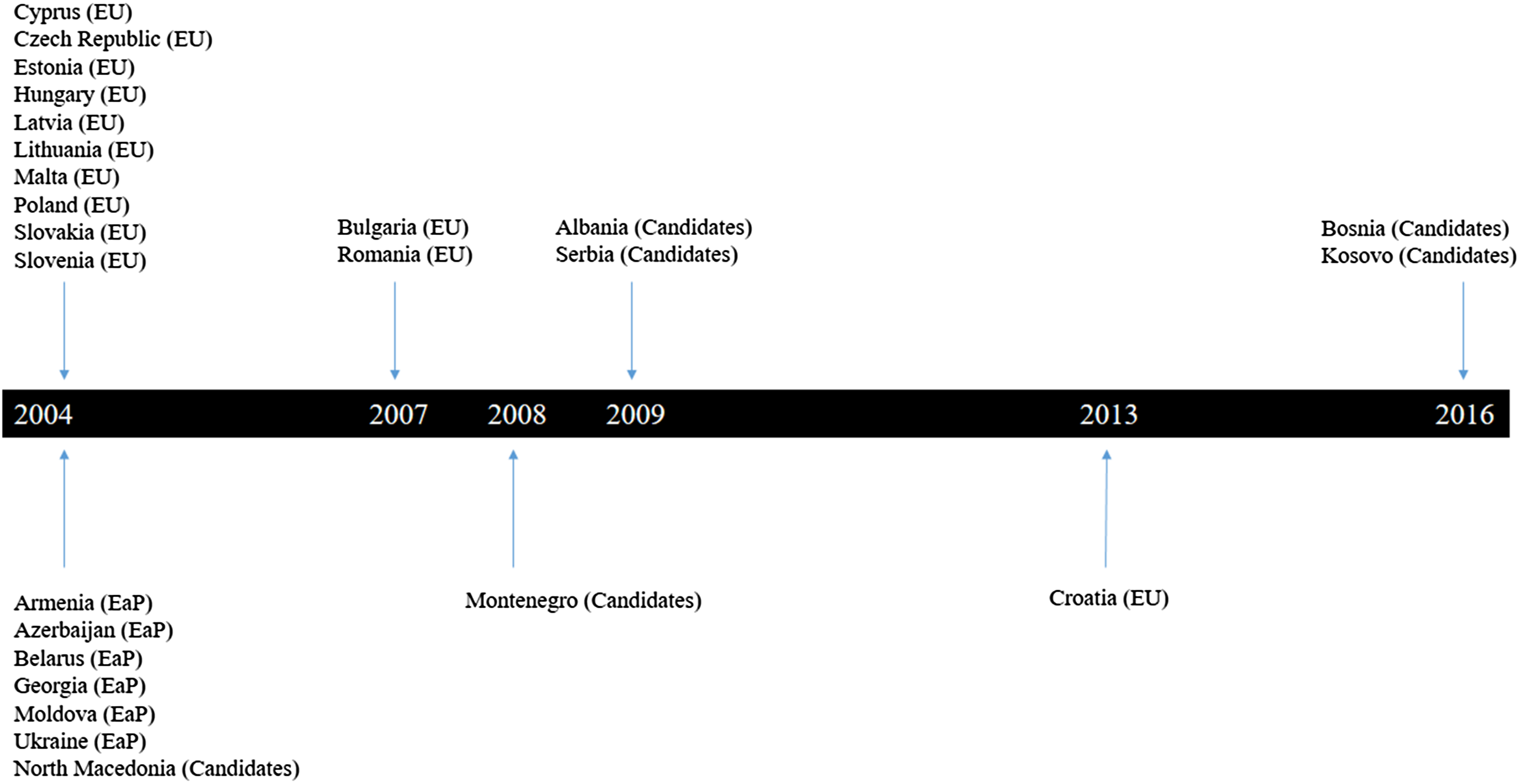
Countries and thresholds.
We examine how logos change across four different elections to address potential problems of endogeneity and effect estimation. This includes observations from the second most recent election before the treatment reduces potential distortions of endogeneity because, as discussed above, parties may anticipate integration by changing their logos before obtaining membership or candidate status. As for effect estimation, incorporating data from the second election after the treatment allows for an assessment as to whether visual Europeanization occurs in the short or medium term.
While multicausality and endogeneity are widespread problems in Europeanization research, mapping visual Europeanization entails some additional challenges. Images are often polysemic, sharing multiple meanings that vary depending on the cultural background of the observer and their subjective perceptions. Logos, however, have a lower information bandwidth than most images. Moreover, we restrict our focus to those visual items within party logos that can be coded and quantified most objectively. Specifically, using three dummy variables, we operationalize the intensity of visual Europeanization by measuring the presence or absence of (a) nationalist and extremist symbols; (b) national flags and flag colours; and (c) EU symbols.
Visual symbols are artefacts where ‘positions, strategies, and meanings are made particularly obvious because they are stylized, codified, and more or less ritualized’ (Foret, 2009: 141). As such, visual symbols are often used as a resource for political objectives (Lynggaard, 2021), thereby serving as relatively unambiguous cues activating political attitudes and signalling parties’ standing on vital issues (Popa and Dumitrescu, 2017). As shown in the Online appendix, we created a list of all the symbols that we expect to observe before the coding. For instance, eagles, lions and swords are typically found in coats of arms and associated with nations’ foundational myths, serving as symbols of militaristic nationalism. Flags and the colours therein are also a conspicuous symbol of national identities that is often used by parties and other political organizations to showcase their nationalist stance (Dumitrica, 2019; Wagner and Marusek, 2021). Swastikas, hammer and sickles are extreme ideology symbols, while yellow stars and the map of Europe are intuitively EU symbols (Foster, 2015). When we found symbols that do not fit such pre-established groups, we conducted detailed research on the heraldry and political history of the country where each party operates to understand in which of these categories, if any, they belong. We offer examples of this coding strategy in the Online appendix.
Since our investigation focuses on an effect that should take place after a certain threshold, a DID model stands out as an ideal tool to analyse party logos before and after European integration milestones (Botosaru and Gutierrez, 2018; Donald and Lang, 2007). As we have three country groups, we merge candidates and EU members in a single treatment group, since we expect that, as argued in our theoretical discussion above, candidate countries’ parties should engage in some form of anticipatory visual Europeanization. In any case, results remain solid even when we merge candidates and EaP countries in one single control group (see Online appendix). In addition, we fit logit models in the Online appendix keeping the three groups separated, in order to show the different intensity of different degrees of European integration.
We rely on the most widespread approach to DID, whereby the key variable in our dataset is treatment, which divides the treated observations (namely, all party logos in countries after they joined the EU or became official candidates) from all the others (namely, party logos of EaP countries and of EU members and candidates before the threshold). We then add a time-trend variable, pre–post, which divides all observations before the threshold from those thereafter to ensure that any observable effect is not simply due to time trends. Next, we compute a control group variable that divides parties in two groups – those in countries that join the EU or are candidates versus parties in EaP countries – to control for the inherent differences between these two groups (Ding and Li, 2019; Glynn and Kashin, 2017).
There are some caveats regarding our DID model. First, and concerning the stable unit treatment value assumption (SUTVA), obviously our population of parties experiences some changes through elections, as new parties emerge, old parties disappear and some others merge. However, considering that (a) the most successful parties tend to be mostly stable over time; (b) political parties are in general very similar in terms of organization and behaviour among each other; and (c) we do compare the average of our dependent variables at the election level in our DID, these changes should not distort our results. Second, variation in treatment timing may be a problem for effect estimation in DID model (Callaway and Sant’Anna, 2021; Goodman-Bacon, 2021). Since our data are not fine-grained enough to run effective, reliable balance tests or to rely on an alternative event-history model, we decide to complement our DID model with a series of logistic models with country-level clustered standard errors, keeping the three country groups separated and then comparing the size and direction of the effect across the groups. Our results remain solid (see Online appendix).
Lastly, regarding the parallel trends assumption, different countries across Europe, even if we focus on CEE only, inevitably present some differences in terms of, for instance, democratization processes and economic development, so this assumption must be somehow relaxed, as we of course cannot assume perfect exchangeability between our treatment and control groups. We take this into account by focusing on more than two points in time (two elections before and two elections after the treatment) and by also fitting logit models, through which we can show more detailed results regarding trends in different countries and populations of parties.
For what concerns additional details of our model, as mentioned above, we employ various control variables. Country-level indicators include democracy and population as reported by the Polity V index, the year of the election considered and the GDP per capita as reported by the World Bank. Party-system factors include the ideological position of parties on the left–right spectrum and their vote-share as measured in the Comparative Manifesto Project, the electoral system (a dummy for proportional versus mixed and majoritarian voting) and the number of parties in parliament from the IDEA dataset. As parties may be subjected to European influence more or less depending on the size of their country, we also control for state population.
The ideological positions, international networks and political aims of different political families may play an important role in parties’ visual behaviour. Hence, since we have party logos nested in party families nested in countries, we fit a mixed-effects logit model, specifying a random intercept at the country level and a random coefficient effect for party families. As we show in the Online appendix, our results remain solid when we rely on different specifications, such as linear models with country and party–family fixed effects.
Results
Figure 2 shows the percentage of (a) nationalist and extremist symbols; (b) flags and flag colours; and (c) EU symbols (over all party logos) in the two elections before and after the thresholds for our three groups. In particular, data here show the percentages of each symbol across all parties in all countries in a specific election, for instance, the first one before our threshold. Right after the first election, parties in new EU members, candidates and EaP countries have a fairly similar percentage of nationalist and extreme symbols, as well as flag colours, something that warmly support our parallel trends assumption. After the treatment, however, trends significantly diverge: nationalist and extremist symbols and flag colours decrease in new members and candidates, while they increase in EaP countries. A moderate growth in the use of EU symbols is apparent in all three groups, although candidates show the largest increase. Such an effect may be due to parties’ attempt to leverage the expectations arising from future EU integration and turn them into electoral capital, a tendency that is arguably less pronounced in countries that have already joined the EU or have few prospects for future membership like EaP members.
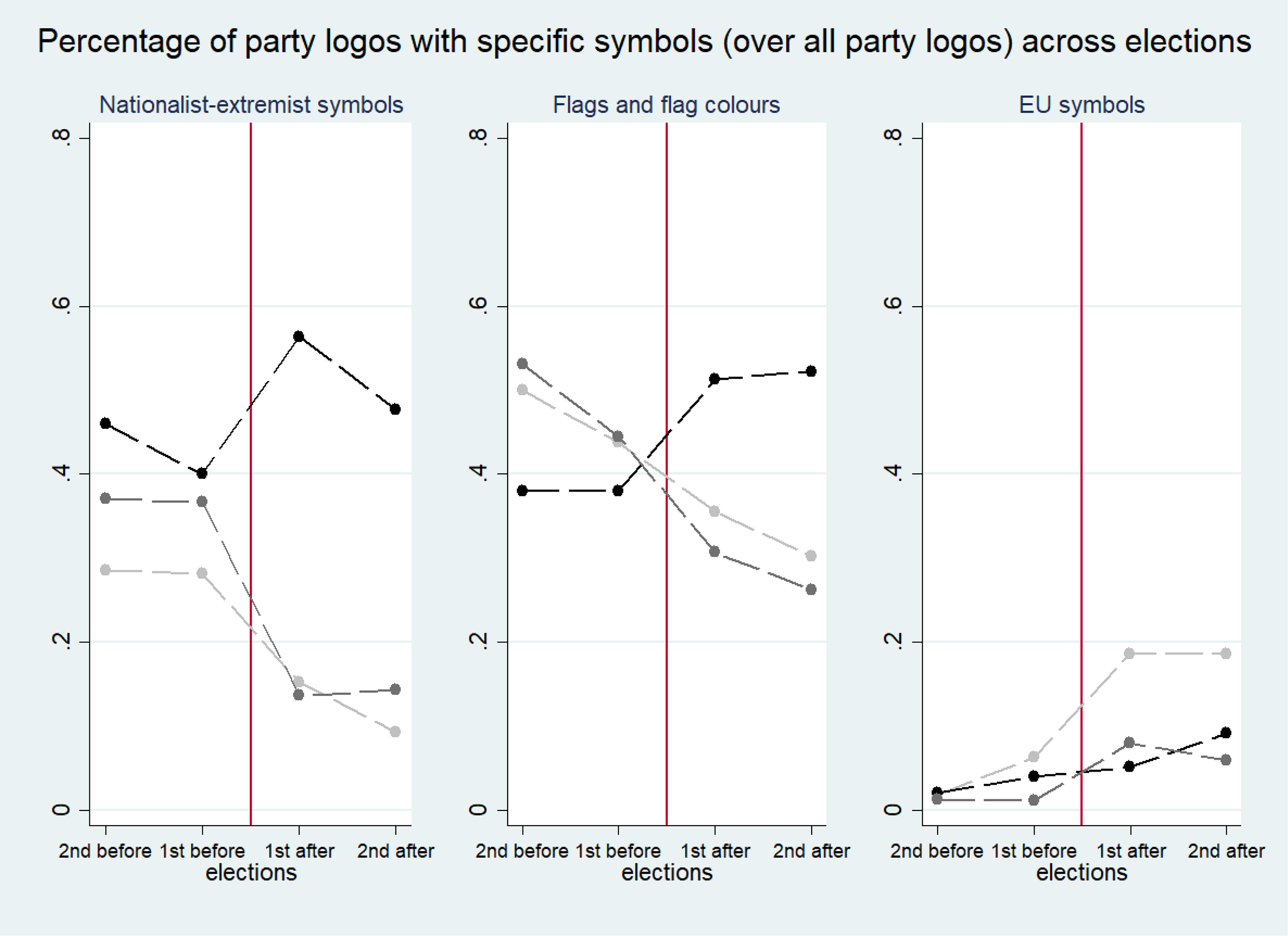
Symbols and colours showcased in party logos before and after the threshold. Note: EU members’ parties are in dark grey, candidates in light grey and EaP members in black.
These findings, buttressed by Models 1 and 2, confirm our main expectations. The time trend and control group variables are not significant in either model (only weakly significant for the control group in Model 1), which suggests that the visual Europeanization effect we observe descends from the treatment we have identified rather than differences in time trends or across groups. In particular, the average presence of nationalist and extremist symbols, flags and flag colours in the party logos in countries that joined the EU is significantly lower compared to party logos in the control group (the mean is 1.25 lower for the former and 1.42 lower for the latter). Model 1, however, shows that other factors contribute to logo transformation. Unsurprisingly, democratization in particular reduces the overall presence of nationalist and extremist symbols, but the size of the coefficient is lower (0.14) than that of our treatment variable.
Conversely, our treatment variable emerges as the only strongly significant factor that explains the decrease in the use of flags and flag colours in party logos in Model 2. Model 3, however, does not support the hypothesis that EU integration translates into a broader employment of EU symbols. Although some increase in the presence of EU symbol is apparent from Figure 2, this trend is too small to be statistically significant. The only significant finding is that European symbols are overall more frequent in our treatment group, consistent with the expectation that visual Europeanization, like Europeanization at large, is a concentric process that varies in intensity according to countries’ varying levels of integration. (Table 1).
Mixed-effects logit model (DID).
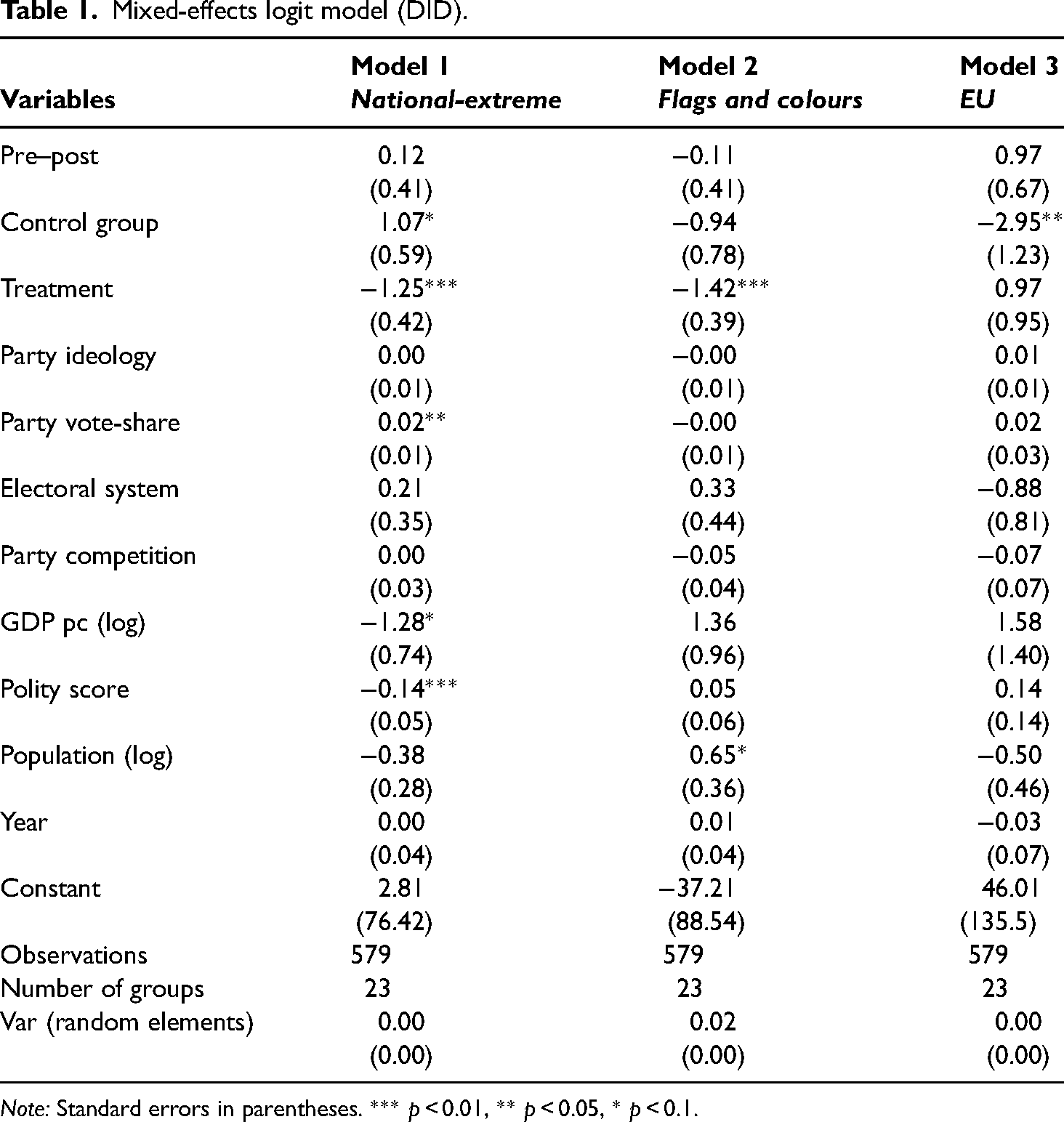
Note: Standard errors in parentheses. *** p < 0.01, ** p < 0.05, * p < 0.1.
Our results also show that larger parties with better electoral performance showcase a slightly more intense reliance on nationalist symbols. This tendency could illustrate the enduring relevance of nationalist cues in countries’ domestic landscape, as well as the unsurprising fact that successful, established parties may see rebranding as a costly strategy. However, and similarly for our democracy variable, we observe significant differences only between extreme values of the independent variables. Hence, such divergences mostly rely on unlikely predictions, for instance, a party that gains more than 70% of the vote-share or countries that are classified as significantly authoritarian. This consideration further supports the importance of Europeanization in explaining under what conditions parties engage in rebranding activities.
Moreover, neither party ideology – from extreme left (−50) to extreme right (+50) – nor the number of parties and type of electoral system significantly influence visual behaviour. Parties from similar ideological families do sometimes showcase similar visual patterns. For instance, EU symbols are more frequent in the logos of liberal parties, as we show in the Online appendix. However, the impact of ideology remains largely insignificant.
These findings are robust across different model specifications (see Online appendix). In particular, DID linear models with country and party–family fixed effects present very similar results, and the same holds true for DID mixed-effects logit models that have candidates in the control group. In addition, the logit models that keep the three country groups separate show that the visual Europeanization effect is more prominent in EU members than candidate countries. This confirms our initial expectations on the concentric intensity of visual Europeanization processes. Although other factors like democratization certainly influence parties’ visual behaviour, Europeanization plays a pivotal role in reshaping party logos in new EU members and, to a lesser extent candidate countries, an effect that is absent among EaP countries. Finally, we do not find support for the alternative mechanism whereby parties that join pro-European EP groups are more interested in visual Europeanization dynamics compared to parties that do not join any of these groups. This lack of significance does not change when we fit a model with only parties in countries that joined the EU, whereby the treatment is whether such parties joined an EP group or not (see Online appendix).
Discussion: Europeanization and the transformation of party logos
Our findings demonstrate that Europeanization has a visual dimension, showcased by a transformation of party logos in new EU members and candidate countries. Rather than amounting to the introduction of new, European imagery into party logos, this process consists of the disappearance of symbols that do not resonate with European logics of appropriateness. The decrease in the use of such symbols derives from both rebranding and population ecology. In EU members, 22 parties with nationalist or extremist logos disappeared entirely, while nine parties that do not use any nationalist symbols in their logo entered the national parliaments after EU membership. The effect of population ecology was complemented by 16 cases of rebranding where parties removed nationalist symbols, flags and national colours from their logo after the threshold.
These statistically significant effects raise the question of what the exact mechanisms underlying this visual convergence are. The Europeanization literature identifies two broad mechanisms of diffusion of EU practices and ideas: interest-driven adaptation and socialization into new norms. A more specific subset of that literature examines the ability of the EU to influence politics and societies outside of its borders, and it has demonstrated how the conditionality of credible promises of enlargement spurs external Europeanization. Finally, Europeanization literature identifies different directions of the influence and interaction between the EU and the national level: national actors can project their preferences and ideas to the EU level (uploading), absorb policies, practices and norms from the EU (downloading), and horizontally influence each other by sharing practices and ideas and induce mutual convergence to common standards (cross-loading) (Wong and Hill, 2012).
Our findings speak in different ways to these insights. First, it is clear that visual Europeanization dynamics do not consist of a general downloading of European standards like EU symbols in party logos. In this sense, there is no Europeanization of party competition across national borders, and political parties appear to operate largely within national arenas and with a focus on national audiences and issues, as argued more than 20 years ago by Mair (2000). To the extent that such acceptance of visible EU norms and values would indicate something more than instrumental interest-driven adaptation, its absence leads us to consider that the Europeanization dynamics we do observe are primarily driven by cost/benefit calculations rather than sincere socialization.
We have triangulated our statistical findings with a set of semi-structured interviews with officials working for the two major Europarties in Brussels, the centre–right European People's Party and the centre–left Party of European Socialists. All officials agree that there is minimal direct input from Western European national parties or Europarty headquarters on the branding and communication strategies of member parties from post-communist EU member states and associated parties from the neighbourhood. 1 The insights of these interviewees belie also any expectation that membership of likeminded ideological party networks like transnational European party federations is a pathway of diffusion of European standards and ideas. This is the second implication of our analysis for Europeanization, especially of party politics.
Third, and in a further confirmation of the rational interest-driven perspective of Europeanization, our findings speak to the external Europeanization literature insights about the importance of enlargement as a source of conditionality and influence over prospective member states. The dynamics of visual Europeanization we observe are weaker in the outer concentric circle of the EU neighbourhood, where political elites and citizens know that the prospect of EU accession ranges from weak to virtually non-existent in the immediate future. With few incentives to adopt EU standards, political parties there use imagery that conforms less to European appropriateness.
Our statistical findings, corroborated by discussions with European party officials, hint at fundamentally interest-driven and opportunistic party strategies as the source of new forms of visual communication. In the terms used by the Europeanization literature to describe the two main theoretical mechanisms it studies, it seems that for the visual communication of parties the rationalist cost/benefit logic of consequences is more important than socialization in the logic of appropriateness, particularly at times when states approach EU membership. However, visual Europeanization does not take place in terms of a convergence around EU-inspired symbols. Rather, it sees multiple national parties following distinct courses away from extremist and nationalist imagery and symbols. Thus, more than dictating what visual symbols should be used, visual Europeanization has mainly restricted the range of visual artefacts employed by parties, inhibiting the display of nationalist and extremist symbols.
This suggests that, transmitted through interest-based motives, European integration has a subtle yet crucial impact on the visual dimension of party competition, indirectly transforming the national politics of visibility and invisibility (Bleiker, 2018) by reshaping the boundaries of what symbols can or cannot be displayed in political party logos. As suggested by Manners (2006: 71), ‘symbolic taboos are constitutive of what the EU is and what it is not’. Research on EU institutions’ communication strategies has shed light on the visual dimension of these taboos by highlighting the Commission's unsurprising reluctance ‘to visualize social and political domination’ (Lynggaard, 2021: 1226). Nationalist and extremist visual cues are inconsistent with the core norms that are constitutive of the EU and the European identity, such as peace, democracy, freedom and human rights. The gradual disappearance of such symbols from logos forcefully illustrates how European integration reshapes parties’ logics of appropriateness by diffusing a number of visual taboos.
If these conclusions are correct, the visual Europeanization of party politics hints at dynamics that can be understood in terms of cross-loading: multiple parallel processes of departure from strong nationalist practices fostered through interaction within the EU sphere, but without necessarily adopting fully genuinely pan-European identities and norms. This pattern of Europeanization is arguably closer to the dominant mode of EU integration today, which eschews massive transfers of power to the supranational level, yet sees national sovereignty steadily erode as member states are bound together by ever-tighter rules and practices of coordination. By the same token, political parties feel compelled to abandon strong nationalist imagery in their visual communication, yet without adopting EU identities and values outright in the form of European symbols and logos. This finding is in line with a new wave of research on Europeanization that increasingly shifts emphasis from vertical forms of uploading and downloading to horizontal and informal practices as the main mechanism of convergence inside the EU (Aggestam and Bicchi, 2019).
Conclusion
By comparing logos before and after countries in Central, South and Eastern Europe obtained EU membership as well as candidate status, our article provides the first systematic analysis of the influence of EU integration on national parties’ political logos, thereby documenting the unexplored visual dimension of Europeanization. We demonstrate that party logos change significantly before and after countries join the EU and, to a lesser extent, obtain candidate status. Owing to both population ecology and rebranding, party logos here show fewer extremist and nationalist symbols as well as flag colours but only a slight increase in European symbols. Conversely, party logos in Eastern European countries that only participate in the EaP did not experience the same transformation. The fact that the magnitude and timing of this shift cannot be solely explained by democratization, economic development, ideology or other party-level factors provides support for our argument that a visual Europeanization process occurs. In new members and in candidate countries, European integration transforms national politics of visibility and invisibility, reshaping the boundaries of what party logos should or should not showcase.
These findings have important implications for European studies. The fact that even visual artefacts like party logos witness some form of isomorphic convergence by dropping nationalist and extremist symbols provides yet another illustration of the pervasiveness of Europeanization. Visual Europeanization mechanisms, however, differ significantly from the dynamics often sketched by the existing literature. Scholars stress that parties are subject to ‘the steady influence of the EU’ (Lewis, 2015: 526), highlighting the importance of European party federations and political foundations as vehicles of norm socialization and diffusion (Von Dem Berge and Poguntke, 2013; Wolinetz, 2015). The visual processes we investigate, however, reveal that convergence across European political parties occurs short of any direct influence from Brussels or Western countries, let alone explicit conditionality from Europarties or EU institutions. Visual Europeanization does not consist of a top–down adoption of uniform ‘European’ visual norms and imagery (i.e., the development of similar logos by likeminded national parties) but reflects multiple, parallel synchronization processes of the visual logics of appropriateness underlying party competition at the national level.
However, more research is needed to corroborate our findings and flesh out the causal dynamics we identify. Future scholarship should expand the diachronic dimension of our study, including countries that became EU members before 2004, but also examine the evolution of party logos within EU member states long after membership. Scholars with an interest in visual politics should examine whether the democratic backsliding in several CEE countries prompts a relapse to nationalist and extremist symbols in party logos in recent elections. Relatedly, scholarship on political parties should assess the extent to which logo change reflects a substantive transformation in programs and ideology and a genuine support for European integration or whether it is merely a form of surface isomorphism. In that case, logo change may amount to a visual instance of organized hypocrisy, reflecting a decoupling of organizations’ visual discourse and symbolic apparatus from their substantive behaviour in the attempt to pay lip service to prevailing norms.
Supplemental Material
sj-docx-1-eup-10.1177_14651165231207088 - Supplemental material for European integration and political party logos: A ‘visual Europeanization’?
Supplemental material, sj-docx-1-eup-10.1177_14651165231207088 for European integration and political party logos: A ‘visual Europeanization’? by Matteo CM Casiraghi, Eugenio Cusumano and Angelos Chryssogelos in European Union Politics
Supplemental Material
sj-dta-2-eup-10.1177_14651165231207088 - Supplemental material for European integration and political party logos: A ‘visual Europeanization’?
Supplemental material, sj-dta-2-eup-10.1177_14651165231207088 for European integration and political party logos: A ‘visual Europeanization’? by Matteo CM Casiraghi, Eugenio Cusumano and Angelos Chryssogelos in European Union Politics
Supplemental Material
sj-do-3-eup-10.1177_14651165231207088 - Supplemental material for European integration and political party logos: A ‘visual Europeanization’?
Supplemental material, sj-do-3-eup-10.1177_14651165231207088 for European integration and political party logos: A ‘visual Europeanization’? by Matteo CM Casiraghi, Eugenio Cusumano and Angelos Chryssogelos in European Union Politics
Footnotes

References
Supplementary Material
Please find the following supplemental material available below.
For Open Access articles published under a Creative Commons License, all supplemental material carries the same license as the article it is associated with.
For non-Open Access articles published, all supplemental material carries a non-exclusive license, and permission requests for re-use of supplemental material or any part of supplemental material shall be sent directly to the copyright owner as specified in the copyright notice associated with the article.
