




Abstract
Both political parties and differentiated integration (DI) play an ambivalent role in regard to democratic backsliding. Parties’ positioning towards democratic backsliding has not always been straightforward, and DI has been seen as facilitating it. We analyse whether party actors view democratic backsliding as a problematic issue for the EU, if they think DI facilitates it, and how they consider the EU should respond to it. Drawing on thirty-five interviews and a survey of forty-two party actors in seven member states, we show that many do view backsliding as problematic. Moreover, around half worried that DI could facilitate backsliding, though others did not link the two. Finally, almost all considered it legitimate for the EU to address democratic backsliding. Although centre-of-left actors are most likely to worry about democratic backsliding and favour EU intervention, actors across the political spectrum are sceptical about accepting DI in matters pertaining to Article 2.
Introduction
This article analyses political party views on democratic backsliding and its relationship with differentiated integration (DI). Democratic backsliding consists of “a retreat by an incumbent government from democratic values and practices with the intention of curtailing criticism and inhibiting democratic opposition.” 1 Rather than seizing power by undemocratic means, incumbents in backsliding countries pursue their illiberal policies with electoral backing and legal measures that progressively undermine the foundations of democracy. 2 DI involves a member state either opting out of, or being excluded from, participating in a given EU policy or abiding by a certain agreed EU standard. 3 DI may arise for either sovereignty reasons—such as claims that the EU measure clashes with a member state constitutional norm or infringes a core state power; or capacity reasons, as when a state is deemed not to meet the economic criteria required to participate in the policy or requests an exemption for the same reason. 4 As the fundamental democratic values enshrined in Article 2 TEU have come under attack due to democratic backsliding in several Central and Eastern European member states, 5 a debate has arisen as to whether DI might inhibit the EU taking action against such states if they could invoke sovereignty reasons to opt out of these fundamental norms. 6 This article engages with how party political actors perceive of the EU’s role as regards democratic backsliding and its relationship to DI.
Political parties have played an ambivalent role in regard to democratic backsliding. Most recent literature has noted how in the European Parliament (EP), the European People’s Party (EPP) and (to a lesser extent) the European Conservatives and Reformists (ECR), backed by some of their constituent domestic parties, have undermined efforts by other parties in the EP as well as the European Commission to address democratic backsliding in Hungary and Poland. 7 However, research has also shown that political parties can exert peer pressure on backsliding parties, and help bring them back into the democratic fold. 8
DI has been viewed by some as having a similarly ambivalent relation to democratic backsliding. For example, Daniel Kelemen and Laurent Pech have argued that the doctrine of constitutional pluralism can justify DI with regard to Article 2, providing backsliding governments with legal tools to justify their practices. 9 Indeed, the Polish government has drawn on such reasoning to justify its controversial reform of the judiciary, 10 while the Hungarian Constitutional Court has deployed similar arguments to assert its power to override EU law on grounds of “constitutional identity.” 11 However, Richard Bellamy and Sandra Kröger 12 argue that constitutional pluralism and DI reflect the values of equal concern and respect at the heart of constitutional democracy. 13 They cannot be legitimately deployed to justify a retreat from those very values, but could legitimise the exclusion of backsliding member states through what they term “value DI.”
This paper focuses on how political party actors conceive of the EU and DI’s role in matters of democratic backsliding, and what factors motivate their views. Drawing on thirty-five semi-structured interviews and a survey of forty-two political party actors in seven EU member states (Austria, Denmark, Germany, Greece, Hungary, Portugal, Romania), we address three questions: 1. Do party actors perceive domestic democratic backsliding as a problematic issue for the EU? 2. Do party actors think that DI facilitates democratic backsliding? 3. How do party actors think the EU should respond to democratic backsliding?
Addressing these questions is important for three reasons. First, establishing whether party actors consider domestic democratic backsliding problematic for the EU (and for which reasons) is essential if the EU is to be able to take action to uphold the fundamental values in Art. 2 of the EU Treaty. The language used in EU Treaties is by definition very vague, especially so far as common values are concerned. Establishing whether democratic backsliding is perceived as a political problem is a necessary step in translating these abstract norms into practice. This process of translation and problem definition also helps clarify how far (if at all) political parties such as Fidesz are accepted and acceptable as members of mainstream Europarties, such the EPP, able to access EU funding and positions of power. Second, political party actors (either as part of national governments and legislatures or as MEPs) are involved in debating and taking decisions on DI. Consequently, their views can provide important cues concerning the likelihood of DI being used to facilitate democratic backsliding. If party actors do not see a possible link between the two, they may adopt a more positive view of DI than is warranted and not guard against cases where it allows for democratic backsliding. Conversely, if they are aware of the possible link between DI and democratic backsliding and consider the latter problematic, they will adopt a more critical stance towards forms of DI motivated by sovereignty concerns. In this case, DI may still be a valuable form of integration, albeit within certain boundaries. Third, studying the views of political party actors on the EU’s role in addressing democratic backsliding sheds light on what kind of EU action, if any, might generate sufficient support amongst mainstream parties in both the EP and the Council (given the same party families are represented there). The persistence of pockets of authoritarianism in federal systems depends not just on legal factors, but also on political ones. 14 Analysing the views of political party actors helps us gauge how far a failure to act against backsliding member states is dictated by a lack of political will and how far by a lack of means to act (or both).
We found almost all of our party actors think democratic backsliding is a problematic issue (question 1), and most consider that EU action against it in order, especially by legal and economic sanctions (question 3). Actors from the centre, centre-left and far-left are more likely to consider democratic backsliding a problematic issue and favour EU intervention against it. The results are more mixed regarding question 2, where only 59 percent thought DI should not be permitted with regard to the Rule of Law, although 50 percent agreed DI can facilitate democratic backsliding. This ambivalence suggests the potential link between DI and democratic backsliding may not be clear to all our respondents. We also observe that while respondents who oppose DI tend to connect DI and democratic backsliding, actors from across the political spectrum reject DI in matters pertaining to Article 2.
The text unfolds as follows. We start by identifying the party-political factors that have stood in the way of EU intervention and discussing how they may shape political party actors’ views concerning the relationships between the EU, DI and democratic backsliding. We then explain our methodology and our subjective approach that focuses on party actors’ views. The ensuing empirical analysis engages with their views in regard to democratic backsliding and its link with DI. The conclusion discusses the findings’ wider implications for the EU.
Democratic Backsliding and the European Union
Following recent developments in Hungary and Poland, democratic backsliding has emerged as a key matter of concern in European politics. The Fidesz—Magyar Polgári Szövetség (Fidesz—Hungarian Civic Alliance, Fidesz) government led by Viktor Orbán in Hungary and the Prawo i Sprawiedliwość (Law and Justice, PiS) government in Poland have both retreated from the “minimum” democratic principles of free and fair elections, civil and political rights, judicial independence and respect for the Rule of Law. 15 In Hungary, following a landslide election victory in 2010, Viktor Orbán used his 2/3 parliamentary majority to make sweeping constitutional changes and introduce an electoral law favouring his party. 16 Orbán also introduced a series of measures curtailing freedom of speech, media independence, political and civic rights such as the freedom of association and minorities rights, and the organisation of opposition. Additionally, he changed the laws on judicial appointments so he could pick judges favourable to his cause. 17 In Poland, backsliding has been somewhat more limited due to PiS’s inability to win an electoral majority comparable to Fidesz’s. 18 However, the government managed to introduce a controversial reform of the judiciary that turned the Constitutional tribunal from “an effective, counter-majoritarian device to scrutinise laws [ . . . ] into a positive supporter of enhanced majoritarian powers.” 19
Despite democratic backsliding challenging its effectiveness and legitimacy, the EU’s response has been hesitant, leading scholars to ask why it has not intervened more forcefully. 20 They highlight the political factors that allow democratic backsliding to go virtually unchallenged, including political parties’ behaviour. We draw on the respective literature to develop some expectations concerning political party actors’ views on whether democratic backsliding is a problematic issue, if DI can be linked to it, and how it should be addressed.
Party political strategic and ideological considerations occupy a prominent place in the literature explaining the EU’s slow response to democratic backsliding. From a strategic perspective, researchers note how some parties have stood in the way of further EU intervention against backsliding due to concerns that this would harm them politically. 21 The case of the EPP is telling: while the party group has been reluctant to support EU action against Hungary, it has been much keener to support intervention in Poland. The difference in approach is due to Fidesz having been a member of the EPP until March 2021 while PiS is a member of ECR and thus does not enjoy the protection of the largest fraction in the EP. These weak responses have been attributed to the EU’s incomplete politicisation and inhibitions about trespassing on national sovereignty. 22 On the one hand, EU politics are sufficiently politicised for mainstream parties to gain from having the votes of MEPs from backsliding member states, but not sufficiently so to create the space for domestic opposition to their support for autocratic regimes. 22 On the other hand, political parties remain reluctant to intervene in the domestic affairs of other member states due to concerns about sovereignty. 23 Therefore, we would expect members of the EPP and ECR to be less willing to acknowledge democratic backsliding as a problematic issue, as doing so might reduce their numbers and weaken their position in the EP. Conversely, we would expect political parties that are not part of the EPP or of the ECR groups to be significantly more willing to address democratic backsliding, as they would benefit politically from any weakening of these competitor party groups.
With regard to ideology, scholars have found that parties on the right of the green-alternative-libertarian / traditional-authoritarian-nationalist (GAL/TAN) or “cultural” Left/Right scale 24 oppose EU intervention. Maurits Meijers and Harmen Van den Veen 25 and Lise Herman, Julian Hoerner and Joseph Lacey, 26 for example, show that TAN and Eurosceptic parties are more likely to oppose EU intervention than GAL and pro-EU actors. The former typically have less qualms about democratic backsliding in virtue of their authoritarianism, and/or consider EU intervention to be damaging to the national sovereignty of individual member states. Conversely, the latter normatively oppose a slide towards authoritarianism, 27 and/or consider EU action to be justified because of the negative implications of democratic backsliding for European integration. As a result, we may expect political parties whose ideology is nationalist and authoritarian, such as far-right parties, 28 to be less inclined to view democratic backsliding as a problematic issue than parties of the centre or the left.
It is harder to set expectations concerning how political parties conceive of DI’s role regarding democratic backsliding. Both actors opposed to democratic backsliding and those engaged in it might link the two, albeit for different reasons. Strategically, backsliding governments (and their enablers) may view it as a legitimate tool to justify their undemocratic practices and seek opt-outs from Article 2. Poland’s reform of the judiciary provides one such example. While it was an obvious violation of the principles enshrined in Article 2, the Polish government insisted on its right to derogate from common rules, including fundamental values, on grounds of constitutional identity. 29 Conversely, the actors who oppose them may object to allowing DI in such policy areas, as they are aware of the risks it might entail. Ideological factors may reinforce these tendencies. Consequently, one might expect parties and groups from the EPP and ECR and on the TAN side of the spectrum to be more willing to accept DI in areas relating to Article 2, viewing even adherence to liberal democratic values as an expression of national sovereignty, while respondents from other political groups and GAL parties more committed to liberal democratic values would consider DI should not be allowed in matters pertaining to Article 2 as this would facilitate backsliding.
Most notably, TAN parties may be more willing to accept DI in all areas, viewing it an expression of national sovereignty, while GAL parties may prefer to limit DI because of their commitment to fundamental liberal-democratic values. Therefore, we might expect party actors from the EPP and ECR and on the TAN side of the spectrum to be more open to using DI in all policy areas, including fundamental values. Conversely, we would expect respondents from other political groups and GAL parties to consider DI should not be allowed in matters pertaining to Article 2 as this would facilitate backsliding.
However, this latter groups’ views on DI in general may also influence their view of DI as facilitating democratic backsliding. Parties opposed to democratic backsliding but generally supportive of DI may understate the link between DI and democratic backsliding and argue that using DI to justify democratic backsliding is illegitimate. By contrast, parties opposed to both DI and democratic backsliding may draw upon evidence of a member state using DI to justify democratic backsliding to motivate or double down on their opposition to DI. Because of this, we would expect actors critical of DI’s effects on the uniformity of EU law 30 and on the EU’s values to be more likely to connect it with democratic backsliding.
Finally, strategic and ideological factors can be expected to shape how political party actors think the EU should address democratic backsliding, or even whether they consider it should intervene at all. Scholars have noted that while the EU may legitimately act in areas member states have conferred power to it and accepted to be bound by its rules, 31 its intervention may still risk being perceived or construed as illegitimate. 32 Proponents of federal solutions requiring EU intervention recommend relying on (refined) EU instruments to address backsliding. 33 Others hold that democratic backsliding would be better addressed by national and independent institutions. 34 Political party actors from the EPP and ECR groups, as well as those from TAN and Eurosceptic parties, may be expected to oppose further EU intervention and recommend national solutions to prevent the EU from excessively impinging on national sovereignty or diluting their power in the EP. Conversely, one would expect political party actors from other EP party groups, or of a GAL and pro-EU ideological disposition, to be more likely to support stronger EU intervention to counter democratic backsliding.
Methodology
To understand political parties’ views of democratic backsliding and its relation with DI and the EU, we opt for a pragmatic 35 and “subjectivist” 36 research strategy that places political party actors’ views and perceptions front and centre. Pragmatism rejects ontological realism and the correspondence theory of truth. From a methodological standpoint, this has two implications. First, a pragmatic research study cannot follow a deductive research strategy because “if it is true that the subject is always implicated in the constitution of the object, then there can be no direct testing against reality.” 37 As such, it invites to use more exploratory and interpretive approaches rather than testing pre-defined hypotheses. 38 Second, its main aim cannot be to arrive at generalisable findings. This does not mean that nothing can be explained or that the findings are not transferrable 39 : rather, they should be understood as situated in time and context, and hence as not automatically applicable to other situations. 40
Conceptually, pragmatism shares many of the assumptions of social constructivism. Social constructivism holds that social structures and human behaviour do not exist independently of their context and the interpretations actors place on it, 41 through which institutions and actions acquire certain meanings. 42 Perceptions come to acquire a key role in this perspective. As Charles Kurzman put it, opportunity is “ultimately, what people make of it,” 43 what political actors perceive as appropriate and necessary plays a key role in their decision to act (or not), and how. We adopt this approach to gauge the extent to which political actors consider EU intervention in matters of democratic backsliding appropriate, and the perceived role of DI in facilitating or responding to it. By analysing these perceptions, we do not ignore the legal reality and possibilities for intervention in matters of backsliding; rather, we supplement these perspectives with an understanding of whether political actors are likely to seize upon these opportunities and why.
Our analysis draws on 35 semi-structured interviews as these are uniquely well-suited for studies focused on “meaning-making” 44 and on understanding views on specific issues. The interviews were collected in the framework of a project on DI in the European Union and were conducted online or over the phone between March and June 2020. 45 Political party actors in seven member states (Austria, Denmark, Germany, Greece, Hungary, Portugal, Romania) were interviewed to gauge their views on DI. While these countries were selected because we considered them well-suited to offer an overview of key cleavages which could be expected to influence views and understandings of DI, 46 they also provide a reasonably diverse set of countries to study views of democratic backsliding in. While the sample may not be representative or allow for generalisation, it does provide us with a potentially diverse set of viewpoints by including countries from the main geographical macro-regions (North, South, East), from both rich and poor countries, and includes the main democratic backsliding offender (Hungary). 47 Including a country that has experience of democratic backsliding is important because respondents in this country are likely to hold strong views on the issue, and may have a different perception of its relationship with DI to respondents from countries where democratic backsliding is not much of a problem.
For each country, we contacted all parties scoring above 5 percent in the most recent national or EU elections. 48 As a result, our respondents came from across the political party spectrum (see annex 1 for a list of interviewees), thereby enabling us to observe how parties with different ideologies and strategic interests perceived of democratic backsliding and its link with DI and the EU. Instead of focusing solely on MEPs, our respondents were MPs (usually members of the European Affairs Committee of their national parliament), MEPs, and EU affairs advisors of parties. We considered including domestic political actors important as they may influence EU action through their representatives in government and may be viewed as better placed to address issues of backsliding, especially in their countries. 49 For each party, we sought to speak to two actors. However, this was not always possible.
Though our interviews centred exclusively on DI, they remain well-suited to our interest in the relationship between the EU and democratic backsliding. First, because the interviews focused on DI, they help us gauge the extent to which democratic backsliding spontaneously comes up as a problematic issue for political party actors and how they frame it. Furthermore, given the literature is divided on whether DI facilitates democratic backsliding, they provide information on the extent to which political party actors view the two as connected. Finally, by asking respondents how member states who do not want to respect key common principles should be sanctioned, the interviews provide insights into how backsliding may be addressed. 50
To triangulate the findings from our interviews, we fielded a follow-up survey of five questions focusing more specifically on democratic backsliding, the EU, and DI. For this follow-up survey, we contacted both our original interviewees (twenty-five of whom agreed to take the survey), as well as additional respondents from our selected countries. The sample consists of forty-two respondents. Whilst the survey asked respondents to indicate their party affiliation, the majority of respondents chose not to do so, rendering it impossible to meaningfully speak about party affiliation as regards the survey.
The EU, DI and Democratic Backsliding: The View of Party Actors
What do political party actors think about the relationship between democratic backsliding, DI and the EU? This section tackles this question empirically by looking at three issues: 1. Do party actors address democratic backsliding, and do they consider it a problematic issue? 2. Do they view DI as part of the problem? 3. How, if at all, do they propose that the EU deal with democratic backsliding?
Is Democratic Backsliding a Problematic Issue, and Why?
Democratic backsliding is a concerning development for the EU because it can undermine it from within. 51 The EU relies heavily on its member states and their courts to achieve its objectives, meaning that the decline in mutual trust arising from backsliding can severely affect its functioning. 52 In addition, the inclusion of backsliding member states in EU decision-making processes challenges the core values of European integration and hinders the EU’s already flimsy democratic legitimacy. 53 In what follows, we explore whether party actors agree that democratic backsliding poses a problem for the EU.
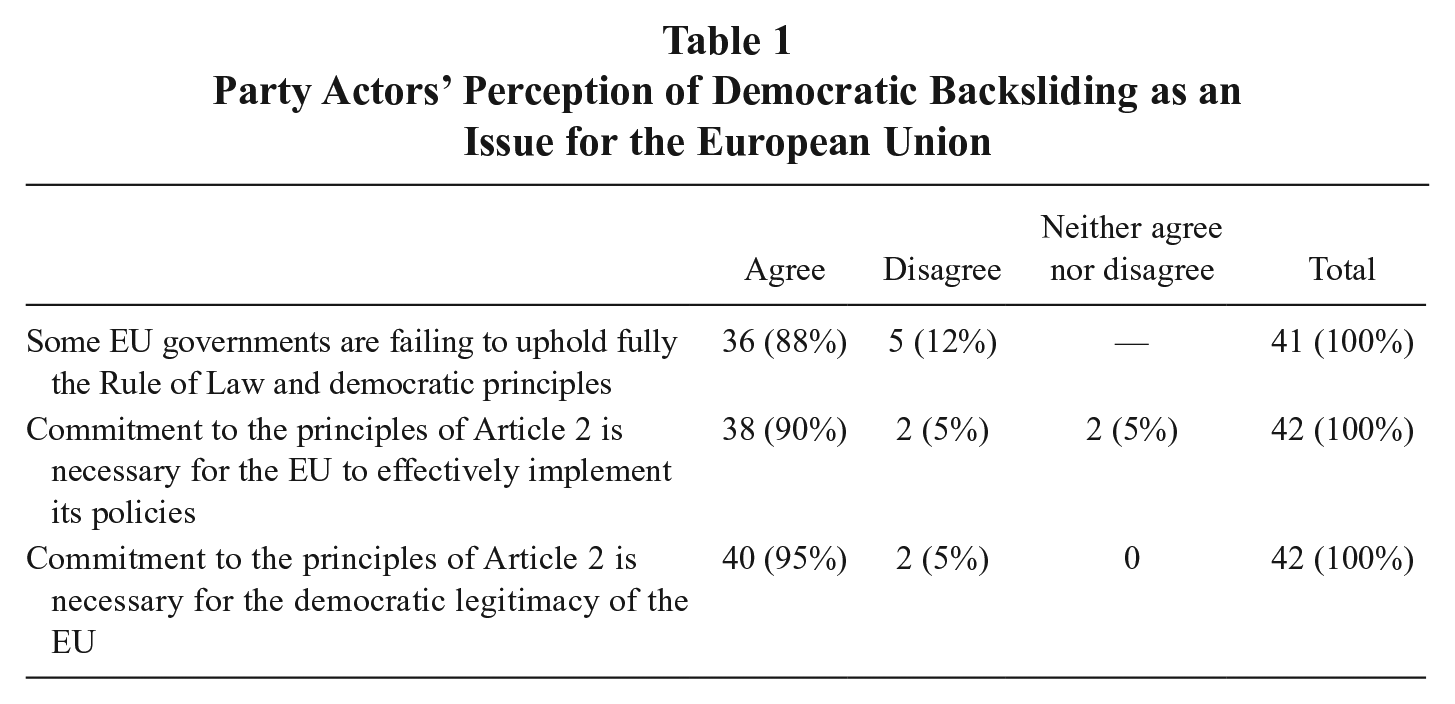
Our survey indicates that most political party actors take the view that democratic backsliding is taking place. Out of forty-two, thirty-six respondents (88 percent) considered that some EU governments were “failing to uphold fully the Rule of Law and democratic principles such as free and fair elections, basic civic and political rights and judicial independence,” while only five thought this was not the case and one chose not to answer. Furthermore, most actors considered this to undermine the EU’s effectiveness and its democratic legitimacy. Thirty-eight respondents (90 percent) agreed with the proposition that “a commitment on the part of all member states to the principles of Article 2 is necessary for the EU to effectively implement its policies” and forty (95 percent) thought that “a commitment on the part of all member states to the principles of Article 2 is necessary for the democratic legitimacy of the EU.” Only two respondents (5 percent) disagreed with the above statements, and two (5 percent) neither agreed nor disagreed with the first of the two statements. Table 1 summarises party actors’ perception of democratic backsliding as an issue for the European Union.
Party Actors’ Perception of Democratic Backsliding as an Issue for the European Union
Our interviews on DI likewise indicate that concerns about democratic backsliding are widespread. Twenty-two interviewees spontaneously mentioned the existence of democratic backsliding at one point or another in our interviews. Given respondents were not asked directly about democratic backsliding, the issue clearly preoccupied them. Worries were spread across countries, with no significant differences emerging between respondents from Hungary and those from elsewhere with no experience of backsliding.
As expected, concerns about democratic backsliding arose most frequently in interviews with centre (six), centre-left (seven) and far-left (four) political parties, while only three out of the eight EPP-affiliated respondents spontaneously addressed it. Although most centre-left and centre respondents mentioned democratic backsliding and viewed it as a problematic issue, three far-left respondents did not mention it at all, while one strongly criticised the EU’s attempts to intervene against it. However, this may be due to some far-left parties having a strong sovereigntist streak, that leads them to oppose EU intervention in domestic matters. While we only interviewed three respondents from far-right parties, contrary to our expectations two of them raised concerns about democratic backsliding. Whereas our respondent from the Alternative für Deutschland did not discuss it, both Jobbik respondents addressed the issue. This discrepancy is most likely explained by strategic factors. Jobbik is part of the opposition to Fidesz and therefore negatively affected by democratic backsliding. Most recently, it has also deradicalized and softened its political message. 54
Respondents raising concerns about democratic backsliding noted first and foremost that some member states were violating the fundamental principles enshrined in Article 2 TEU. While some respondents shied away from identifying culprits explicitly, those who did so brought up Hungary and Poland. Several respondents worried these member states were not respecting civil and political rights, including human rights and media freedom. A far-left respondent from Portugal and a centre-left one from Austria, for example, depicted Hungary as a “dictatorship” (Respondent 29, Left Bloc) and “a kind of authoritarian regime” (Respondent 16, Social Democratic Party of Austria).
While most respondents referred to general violations of fundamental principles, a handful of respondents focused more specifically on the Rule of Law. One centre-right Danish respondent, for example, considered that some member states were trying to “bend it over the limit” (Respondent 7, Conservative People's Party), while a centre-right Greek respondent noted with dismay how the EU had failed to protect democracy and argued that one should cut funds “to countries that have been condemned by the European Court of Justice repeatedly about Rule of Law violations.” He continued that he was speaking “specifically about Hungary, but it’s not only Hungary [ . . . ] I mean, Hungary is not a democracy anymore, let’s be frank” (Respondent 23, New Democracy).
Some of our interviewees also discussed why they thought democratic backsliding is concerning for the EU, noting how it harmed its effectiveness and put its survival as a community of values at stake. As a centre-left Hungarian respondent put it, if a Polish court cannot apply European law in one area, because it is not independent it means that the European law as such does not exist in Poland. [ . . . ] It’s really about the fundamental question of whether somebody who is a national of any member state, [ . . . ] can you count on a Polish court to apply the same rules as you would be able to do at home? And if the answer is no, then we have a big problem. (Respondent 6, Democratic Coalition)
The findings above show that political party actors considered democratic backsliding to be a problematic issue. They echoed the concerns of scholars who consider it threatens the quality of democratic decision-making and the legal functioning of the EU. 55 As expected, political parties of the centre and left tended to politicise democratic backsliding more significantly than others, although parties of the far- and centre-right raised concerns about it too.
Does DI Facilitate Democratic Backsliding?
A number of scholars have charged DI with facilitating democratic backsliding, arguing that the EU’s increasing acceptance of flexibility provides backsliding member states with ammunition to justify their behaviour. 56 Because our interviews focused on DI, we are uniquely placed to explore whether political party actors draw that link and perceive the EU as enabling (however unwittingly) such behaviour.
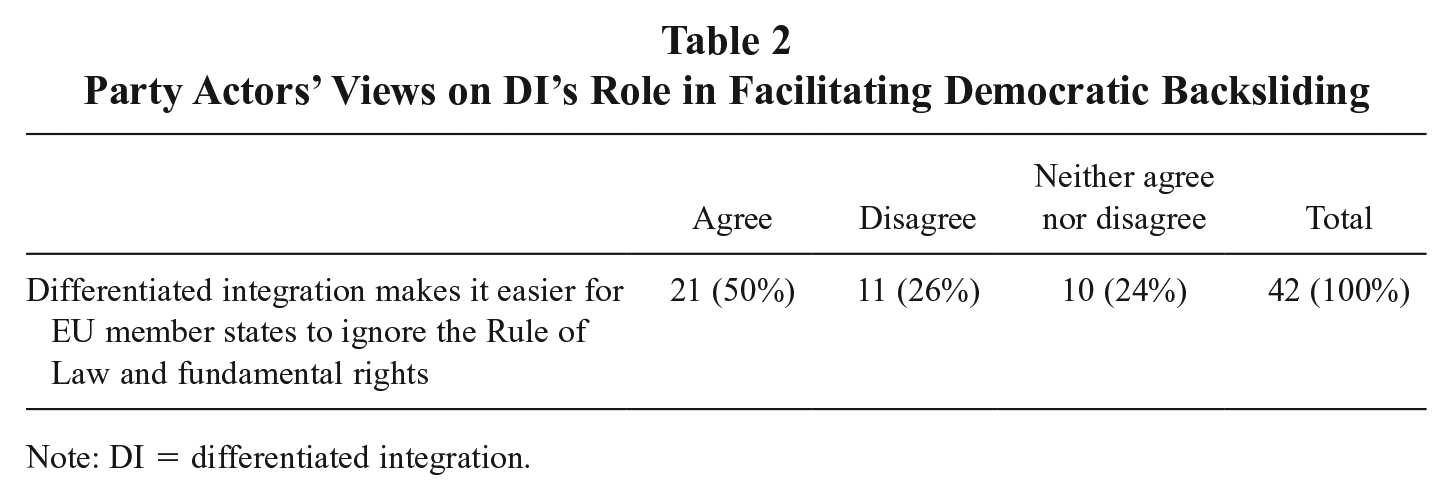
Our survey shows that some political party actors are concerned that DI could facilitate backsliding (table 2). When asked whether they thought “flexible integration makes it easier for EU member states to ignore the Rule of Law and fundamental rights,” twenty-one respondents (50 percent) agreed with the statement, with the remaining respondents evenly split between eleven who disagreed (26 percent) and ten who neither agreed nor disagreed (24 percent).
Party Actors’ Views on DI’s Role in Facilitating Democratic Backsliding
Note: DI = differentiated integration.
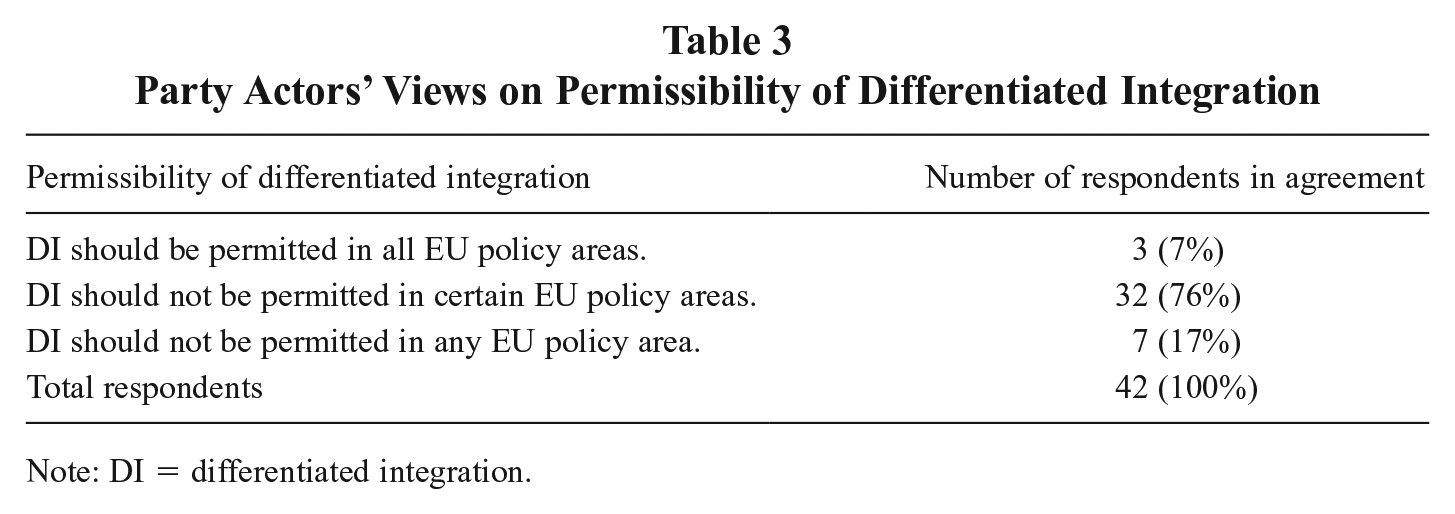
To probe further into the relationship between DI and democratic backsliding and the likelihood of opt-outs to Article 2 being acceptable, we looked at whether party actors thought DI should not apply in certain cases. Survey respondents doubted democratic backsliding could be justified in terms of DI (table 3). Indeed, while three respondents (7 percent) thought that DI should be permitted in all EU policy areas, and seven (17 percent) that DI should not be allowed in any policy areas, thirty-two (76 percent) considered that DI should not be permitted in certain EU policy areas, and twenty-five of those respondents (59 percent) indicated the Rule of Law and Fundamental Rights as areas which should not be subject to DI. Overall, therefore, 76 percent would not permit DI with regard to Article 2.
Party Actors’ Views on Permissibility of Differentiated Integration
Note: DI = differentiated integration.
The interviews presented a somewhat different picture. Concerns about DI facilitating democratic backsliding were not particularly widespread among our interviewees: only nine out of 35 considered DI could facilitate it, and four of these respondents were from Hungary. Confirming our view that parties not belonging to the EPP were the most likely to link the two, centre-left respondents were the most likely to do so, with four out of nine centre-left respondents considering it possible. Two out of six far-left and two out of three far-right actors also saw a link between the two, as did one respondent for the centre-right. None of our seven centrist respondents linked them, and one openly challenged the idea that DI could cause democratic backsliding. Of the nine respondents who worried about DI facilitating backsliding, two were generally favourable to DI, while the remaining seven tended to oppose it. As we discuss elsewhere, 57 considering sixteen of our respondents opposed DI while nineteen were generally supportive of DI, it appears the connection with democratic backsliding was made most frequently by those sceptical of DI.
Those respondents who worried about DI leading to democratic backsliding thought that DI might be used to avoid following key rules, although they also acknowledged that this would depend on how it was designed. Thus, while a centre-left Hungarian respondent claimed that DI would “support a government which does not really want to work in a democratic way” (Respondent 5, Democratic Coalition), and a social-democratic German respondent noted that there was a risk that DI could be used to benefit from EU integration without subscribing to its fundamental values (Respondent 15, Social Democratic Party of Germany), a far-left Greek and a far-left German respondent thought that its effects depended on its design. The former considered that DI would have negative implications if “opting out means what Orbán is doing” (Respondent 26, Coalition of the Radical Left), while the latter suggested that flexibility touching upon fundamental principles would jeopardise the democratisation of EU structures (Respondent 30, The Left).
Amongst those most concerned about DI facilitating backsliding were Hungarian respondents, who had the very specific case of the European Public Prosecutor’s Office (EPPO) in mind. While actors in other member states hardly mentioned the EPPO, for four out of six of our Hungarian interviewees it represented a deeply troubling development and one in which their concerns about DI and backsliding overlapped. The EPPO was introduced in 2017 as an enhanced cooperation of twenty-two member states. Amongst those not taking part is Hungary, and the actors we interviewed were highly critical of this choice. Coming from opposition parties, they considered it unacceptable that Hungary was able to opt out of a policy that could have investigated Orbán’s misuse of EU funds. As one respondent explained, We are an immensely corrupt state and clearly Viktor Orbán wants a prosecutor who is dependent on the government. And he doesn’t want anyone else to look into the finances of the government and how money is distributed in Hungary. And this is something that should not be allowed. (Respondent 8, Jobbik)
Convinced that Orbán’s regime was propped up by the misuse of EU funds, 58 and that his crony government would have trouble surviving without the EU’s money, these critics thought that the EPPO should have been a compulsory policy for all rather than a form of enhanced cooperation. As a centrist Hungarian respondent put it, reflecting views expressed by others as well, “the European Public Prosecutor’s Office is a very good example of a policy which must be compulsory” (Respondent 5, Democratic Coalition).
Whereas interview respondents were less likely than survey respondents to think that DI facilitated democratic backsliding, they seemed to share similar views concerning whether opt-outs from Article 2 should be allowed. In line with the findings from our survey, most interviewees thought that DI should not be used in certain areas of policy, with twenty-six interviewees explicitly mentioning areas pertaining to Article 2. This view was widespread across party families. All far-left actors mentioned these areas specifically, as did several centre-left and centre respondents. All centre-right actors also mentioned this point, suggesting that even EPP members who did not spontaneously comment on the existence of democratic backsliding in the interviews looked at DI in these areas with suspicion. As anticipated, none of our far-right actors argued that DI should not be allowed in areas pertaining to Article 2. These findings indicate that although a backsliding member state may demand an exemption from certain elements of Article 2, such arguments would be unlikely to gain acceptance from other states.
Both the interviews and survey suggest political party actors share academic concerns about DI facilitating democratic backsliding, especially among those generally against DI. Governments drawing on DI to justify backsliding would have problems selling their argument since most respondents, irrespective of their views on DI or political affiliation, consider these areas inappropriate for DI. Therefore, while for some there is a perceived link between DI and democratic backsliding, this is not necessarily down to DI itself, but rather to how it is being (mis)used. 59
How Should Democratic Backsliding be Addressed?
Our final question explores how democratic backsliding should be addressed. The existing literature has considered a variety of economic, political and legal solutions. However, scholars disagree over the legitimacy and appropriateness of intervention by the EU. 60 How do party actors answer this question?
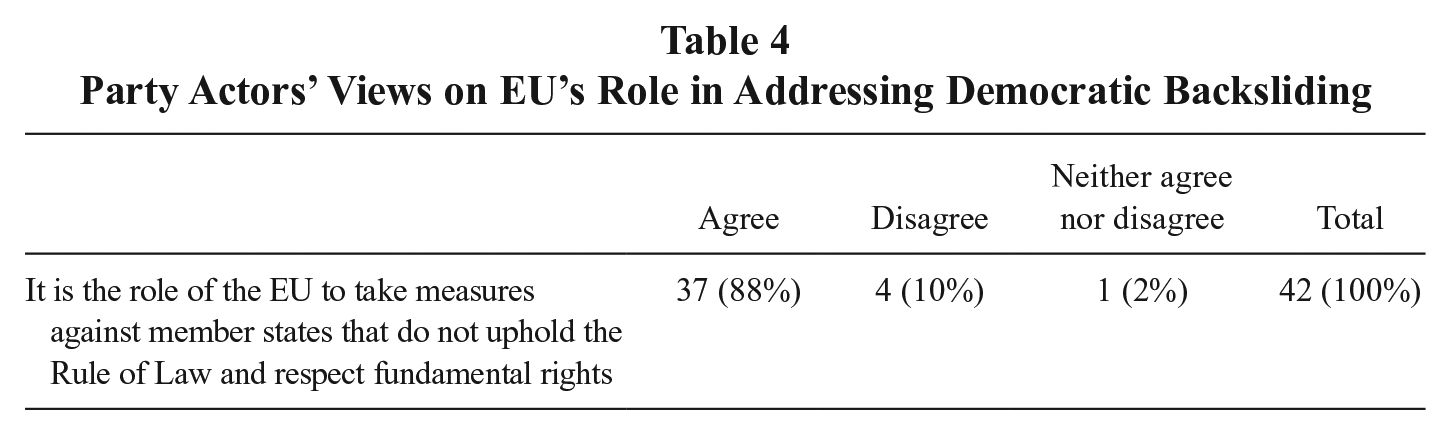
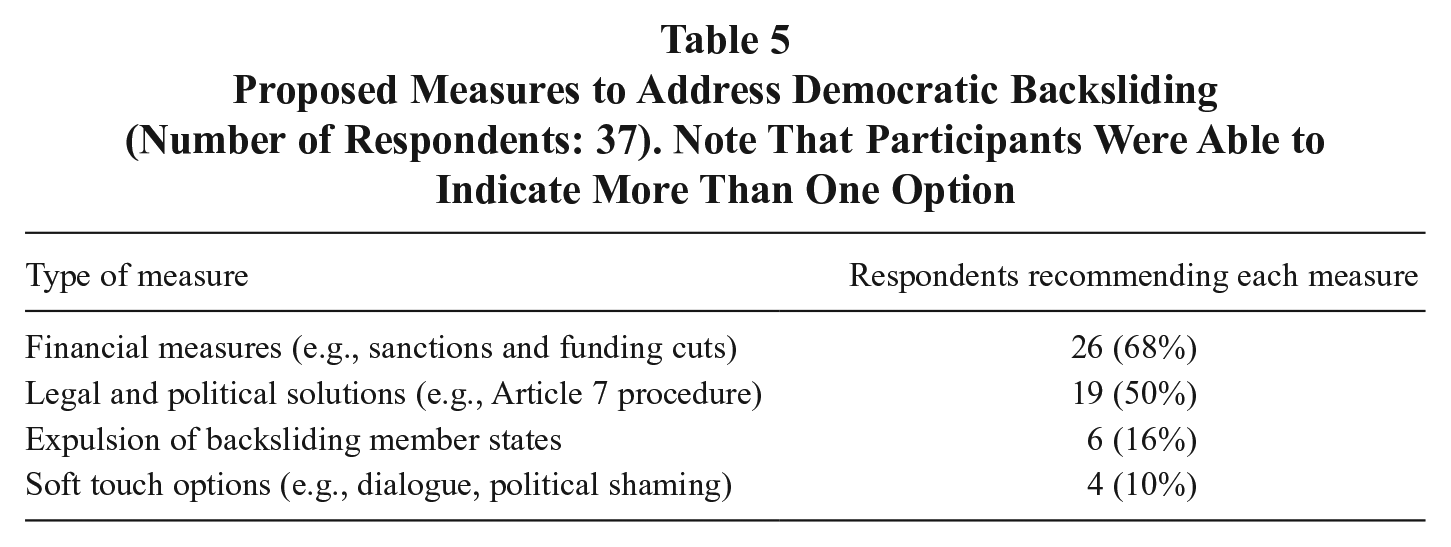
Most survey respondents thought the EU had the legitimacy to enforce the principles of Article 2. As table 4 shows, 37 of our 42 respondents (88 percent) agreed that the EU should take measures and 26 (68 percent) considered that the EU should resort to financial measures such as the suspension of EU funding and sanctions for non-compliant member states. One respondent insisted that these sanctions should only target the individuals responsible and considered that citizens, businesses and NGOs engaged in fighting democratic backsliding at the national level should receive direct funding from the Commission. Nineteen (50 percent) recommended legal and political solutions, including infringement procedures, Article 7, and the suspension of voting rights in the Council. Only four (10 percent) opted for more soft-touch options such as dialogue, political shaming and encouraging democratic responses at the national level. Six respondents (16 percent) considered that the expulsion of offending member states should be on the table. Only four (10 percent) thought that the EU should not be policing these matters. These respondents believed it should be down to the Council of Europe, national courts, and national electorates to respond to democratic backsliding. Table 5 summaries party actors’ proposed measures to address democratic backsliding.
Party Actors’ Views on EU’s Role in Addressing Democratic Backsliding
Proposed Measures to Address Democratic Backsliding (Number of Respondents: 37). Note That Participants Were Able to Indicate More Than One Option
Our interviews brought up similar findings on this issue. Asked how the EU should respond to member states that do not wish to join compulsory policies, 18 respondents discussed a variety of options.
At the EU level, legal solutions appeared popular, with 11 respondents recommending infringement procedures against backsliding countries and measures such as the suspension of voting rights as per Article 7. A handful of respondents also thought that in more extreme cases, expulsion should be considered, while one respondent suggested a new EU without backsliding member states be founded. As foreseen, these respondents were almost exclusively from pro-EU centre, centre-left and far-left parties, while only one EPP member supported these measures. Unlike academic accounts that suggest there should be a new independent court or supervisory body charged with monitoring compliance with Article 2, 61 these respondents looked to existing EU institutions as best placed to make these judgements.
Only one centre-left respondent from Hungary thought that DI might help address issues of democratic backsliding. Echoing Bellamy and Kröger’s idea of “value DI” as a system to exclude backsliding member states from key decision-making processes, 62 the respondent thought that DI could help “insulate” the EU from the influence of backsliding member states and enable it to “defend itself from these fragmentation forces. If you cannot convince these countries, then you have to put them in a pocket where they cannot infect the rest or where they don’t destroy things that [ . . . ] are absolutely important for the other counties” (Respondent 6, Democratic Coalition).
Eight respondents considered economic sanctions would be appropriate and recommended cutting funds for member states that failed to uphold the rules. A Danish conservative respondent suggested “you must use the money as a way to discipline a state who deviates on the Rule of Law” (Respondent 7, Conservative People’s Party). These respondents worried that EU funding enabled the political survival of backsliding governments. For example, one Hungarian centre-left respondent noted that his country experienced “a huge amount of corruption” by the government of Viktor Orbán and stressed how “one of the backbones of this corruption is that he can maintain and finance his own companions through EU funds” (Respondent 4, Hungarian Socialist Party). As before, it was mostly actors from the centre, centre-left and far-left raising these points. However, two of our EPP respondents also thought economic sanctions could be introduced to respond to demands for flexibility in core EU policies. They believed cutting EU funds would help address this issue. It is worth noting, however, that funding cuts were not unanimously accepted, with a small number of respondents indicating that this solution would actually create legal uncertainty by breaking the EU’s own rules.
While the solutions discussed above are more institutional and EU-driven, five interviewees mentioned political and national solutions. These included encouraging dialogue with backsliding member states, the expulsion of backsliding governments from EP party groups, or simply waiting for regular democratic processes to yield new (non-backsliding) majorities. No discernible trend was observable here, as the five respondents came from across the political spectrum. Similar solutions have been mentioned in the literature as well. 63
Summing up, our analysis suggests that the EU is by and large perceived as well-placed to respond to democratic backsliding, although, as expected, much of this support came from the centre, centre-left and far-left. The solutions proposed were in line with EU competences, and supported (stronger) legal and financial sanctions.
Conclusion
This article analysed political parties’ views of democratic backsliding and its perceived relation to DI and the EU. It looked at whether DI facilitated it, and how they thought democratic backsliding should be addressed.
Our findings showed that democratic backsliding is perceived as a problematic issue, with party actors sharing many of the concerns raised in the existing literature on DI. Like many scholars, 64 the actors we spoke to worried about democratic backsliding and its potential implications for the effectiveness and democratic legitimacy of the EU. Mirroring the findings from existing research on MEPs responses to democratic backsliding, 65 party actors from the centre, centre-left and far-left were most perturbed by democratic backsliding, although we found it also troubled the Hungarian far-right party Jobbik as well as some centre-right actors.
The views of party actors, like those of researchers, 66 also differed regarding the connection between DI and democratic backsliding. While for some, DI had only a limited role in facilitating democratic backsliding, the survey in particular suggested that many political actors considered that it could enable it. However, all regarded DI as unacceptable in areas pertaining to Article 2, suggesting that the problem was less with DI itself than with how it was being used to justify dubious practices. Whereas centre-left respondents sceptical of DI in general were most likely to link DI and democratic backsliding, opposition to using Article 2 to justify democratic backsliding came from supporters and opponents of DI from across the political spectrum.
Finally, aligning with those who have argued for further EU intervention in matters of democratic backsliding, 67 our interviews and survey indicated that the EU was perceived as well placed to tackle backsliding. Respondents in our survey mostly thought the EU had the right to take measures against member states that failed to uphold the Rule of Law and respect fundamental rights. Interviewees presented a variety of EU level institutional responses to democratic backsliding and revealed a certain sensitivity to national sovereignty and the need not to punish opposition groups when penalising backsliding governments.
Taken together, these findings suggest that some of the academic scepticism about DI facilitating democratic backsliding may be misplaced, as most actors regard such uses of DI illegitimate. Most importantly, they show that stronger EU intervention against democratic backsliding would be welcomed. Whereas at the time of our research, we found support for further EU action against backsliding especially in parties left of centre, recent developments may lead to the EPP also supporting such interventions. Indeed, since Fidesz has now left the group, the EPP may have a stronger interest in addressing democratic backsliding. Given these circumstances, political inaction on the part of the EU may become increasingly costly, while stronger action against backsliding governments may be perceived as both legitimate and welcome.
Finally, our findings indicate future avenues for research on party actors’ approach to democratic backsliding. One aspect we did not consider concerns the link between party actors’ views of the causes of democratic backsliding and their views on how it should be addressed. Depending on whether they see democratic backsliding as a deliberate political strategy or the result of structural factors, actors may come to different conclusions as to if and how the EU should address it, and the extent to which DI is part of the problem.
Supplemental Material
sj-docx-1-eep-10.1177_08883254221096168 – Supplemental material for Party Views on Democratic Backsliding and Differentiated Integration
Supplemental material, sj-docx-1-eep-10.1177_08883254221096168 for Party Views on Democratic Backsliding and Differentiated Integration by Richard Bellamy, Sandra Kröger and Marta Lorimer in East European Politics & Societies and Cultures
Footnotes
Acknowledgements
We would like to thank the reviewers for their comments.
Funding
This work was supported by the European Union’s Horizon 2020 Research and Innovation Programme under Grant Agreement 822304.

Supplemental Material
Supplemental material for this article is available online.
Notes
Supplementary Material
Please find the following supplemental material available below.
For Open Access articles published under a Creative Commons License, all supplemental material carries the same license as the article it is associated with.
For non-Open Access articles published, all supplemental material carries a non-exclusive license, and permission requests for re-use of supplemental material or any part of supplemental material shall be sent directly to the copyright owner as specified in the copyright notice associated with the article.
