




Abstract
In Europe, more and more parties and governments are led by a pair of leaders. What consequences does the presence of duos have on voter preferences? I argue that voters have less discriminatory preferences against untraditional candidates when they choose two leaders instead of only one. However, discriminatory preferences do not entirely vanish; rather, traditionally excluded candidates are often relegated to secondary positions, and there exists a certain threshold of tolerated ticket diversity. Through a novel combined conjoint experiment, I find relative support for this conjecture, especially in the case of ethnic minority candidates. In view of the increasing number of new types of leadership, the results of this study have important implications for the study of political behaviour and elite diversity.
Introduction
Leaders rarely walk alone in politics. From the time of the Romans, through the reign of Isabella of Castile and Ferdinand of Aragon, to the co-leadership of many Green parties in Europe, politics frequently plays out in pairs.
In recent decades, Europe has witnessed a resurgence of duos. 1 The prominence of recent deputy prime ministers attests to this phenomenon. Probably due to a combination of factors, such as the presidentialization of politics and the participation of populist parties in coalition governments, seconds-in-command have now emerged as key players in some governments. The most visible faces of this process are likely to be recent populist deputy ministers such as Pablo Iglesias (Spanish Podemos), Heinz-Christian Strache (Austrian FPÖ) and Matteo Salvini (Italian Five Star Movement) or Luigi Di Maio (Italian Five Star Movement), whose presence was comparable to that of their running mates Pedro Sanchez, Sebastian Kurz and Giuseppe Conte, respectively. Another example is the spread of collective party leaderships – usually of two – which are no longer exclusive to Green parties but are adopted by left-wing (e.g. German SPD, the Swiss SP, Irish S-PBP), liberal (i.e. Latvian LA) and even radical right-wing parties (e.g. German AfD). This phenomenon has dominated the politics of some countries to the point that in contexts such as Germany, most of the major parties have adopted co-leadership (only CDU/CSU and FDP maintain one-man leadership).
Notable differences exist between the role of deputy prime ministers and co-leadership within parties (Heenan and Bennis, 1999). Firstly, the appointment of a deputy prime minister is dependent on the prime minister's decision during cabinet formation negotiations, whereas parties with collective leadership structures typically involve leaders sharing equal power. Secondly, the involvement of voters differs. In the case of parties, leadership selection lies within the hands of the selectorate, while in governments operating under proportional representation (PR) systems, voters generally have limited influence on the composition of the final leadership duo. However, both cases share a common characteristic: the presence of multiple leaders, often two, who possess shared salience in the media and must coordinate for decision-making. This shared leadership dynamic can influence the voting preferences of selectors and voters alike, depending on their assessment of the duo and their desire to contribute to the (re-)election of these leadership tandems.
Despite the growing influence of these political couples, political leadership studies remain overly one leader-centric (Metz, 2021). This translates into one fact: little is known about voters’ preferences for duos. From the elitist point of view, we have intuitions on how parties strategically choose these seconds-in-command. Research in presidential systems such as the United States and Latin America gives us some hints of a balancing strategy. This means that parties propose a combination of candidates with profiles attractive to different segments of the electorate. In this sense, it has been found that age, race and even ideology are elements to be considered when designing the candidate pair (Lopes, 2020; Pignataro and Taylor-Robinson, 2019; Uggla, 2020). This argument is very much in line with the ticket-balancing strategy that parties in PR systems use when designing their lists (Hennl and Kaiser, 2008).
From the voters’ perspective, accumulated knowledge about preferences for political candidates has grown by leaps and bounds in the last decade. Thanks to the flourishing of conjoint experiments, it has been discovered that in advanced democracies, citizens have solid preferences for female politicians while discriminating against sexual orientation (LGBTQ) and non-white candidates (Magni and Reynolds, 2021; Schwarz and Coppock, 2021). However, all of these studies focus on preferences for individual candidates, even in countries with PR systems where citizens typically choose from lists of groups of candidates. Only a few recent studies draw attention to how the confluence of more than one identity impacts voting (e.g. Everitt and Horvath, 2021; Magni and Reynolds, 2021). Intersectional perspectives on politics have resulted in an expansion of knowledge about how elements such as gender and sexual orientation or gender and ethnicity of politicians interact with voter preferences. Despite this growing interest in diversity among candidates, little is known about preferences for diversity when there is more than one candidate.
This study aims to contribute to this literature by focusing on preferences for two types of duos: in the party and in the government. To that end, an original experiment is conducted with 2343 Germans. The sample is divided into four groups that vary according to whether they have to choose the leadership of a party vs. a government or a single leader vs. a duo of leaders. Respondents who have to select tandems face a novel design called a combined conjoint experiment. It assumes that respondents have to choose between pairs of profiles that vary randomly on issues of diversity – gender, ethnicity, sexual orientation – and other controls. While the controls are revealed in the form of text, the diversity characteristics are elicited by pre-tested artificial intelligence images of people's faces. This type of visual treatment allows for the elimination of priming effects and thereby the knowing of the unconscious preferences of citizens (Abrajano et al., 2018).
The experiment I conduct shows that although prejudice is lower when choosing two candidates, choosing two candidates does not come without discriminatory costs. In fact, underrepresented candidates appear to be relegated to second positions or discriminated against when sharing a ticket. These results are especially strong in the right-wing electorate, which shows a particular aversion to ethnic minority candidates. On the other hand, regardless of ideology, voters seem to prefer tickets on which the leaders do not share the same attribute (i.e. two women or two men). What does seem to be conditioned by ideology is the tolerable number of intersections of traditionally excluded group memberships. Overall, the study provides insights into how voters may behave in a context increasingly governed by collective leadership and the consequences this phenomenon may have for diversity.
Duos in politics: Not new, but rising
The existence of political duos is anything but a new phenomenon. According to the classical definition of the term, shared leadership means a pair of ‘truly exceptional deputies’ (Heenan and Bennis, 1999: 6) sharing leadership responsibilities. This tradition started at latest in 270 BC when the Romans added two censors, two praetors, two aediles and two quaestors to the pair of consuls who led the government to complete the bureaucracy (Sally, 2002). Yet, the Romans must not have been the only ones who thought that two heads are better than one. Examples of executive tandems, for reasons of various kinds, follow one after the other throughout history with the powerful joint reigns of Henry II of England and Eleanor d’Aquitaine or Isabella of Castile and Ferdinand of Aragon as emblematic examples (Campus et al., 2021a).
A close observation of the political transformations in PR systems reveals a revival of political tandems. If we look at national executives, in recent years many seconds-in-command have emerged at least as famous as the heads of the government. While it is true that some historical one-color government duos, such as González–Guerra in Spain or Blair–Brown in the United Kingdom, have produced deputy prime ministers of great importance, the increasing personalization of politics and the growth of coalition governments may explain the renewed attention to these figures. As a result of coalition pacts, it is common for the leader of the first minority coalition partner, regardless of its size, to be granted deputy leadership (Andeweg, 2000; Carroll and Cox, 2012). To this, Langer and Sagarzazu (2018: 10) add that the media might devote special coverage on these seconds-in-commands for ‘their potential newsworthiness as voices of intra-coalition conflict and dissent’.1 This tendency could be reinforced in recent coalition governments because of the inclusion of populist leaders as seconds-in-command. It is no coincidence then that populist deputy prime ministers such as Pablo Iglesias, Heinz-Christian Strache, Luigi Di Maio and Matteo Salvini gathered as much or more public interest than the prime ministers with whom they governed (Pedro Sánchez, Sebastian Kurz and Giuseppe Conte, respectively). This is illustrated in Figure 1, which shows how all four seconds-in-command garnered as many, or more, searches during their terms in office, than their major coalition partners – Pedro Sánchez, Sebastian Kurz and Giuseppe Conte, respectively. This is consistent with the power of these three seconds-in-command who, for different reasons, have been able to unleash government crises (Eberl et al., 2020; Poli, 2021; Vallín, 2021).
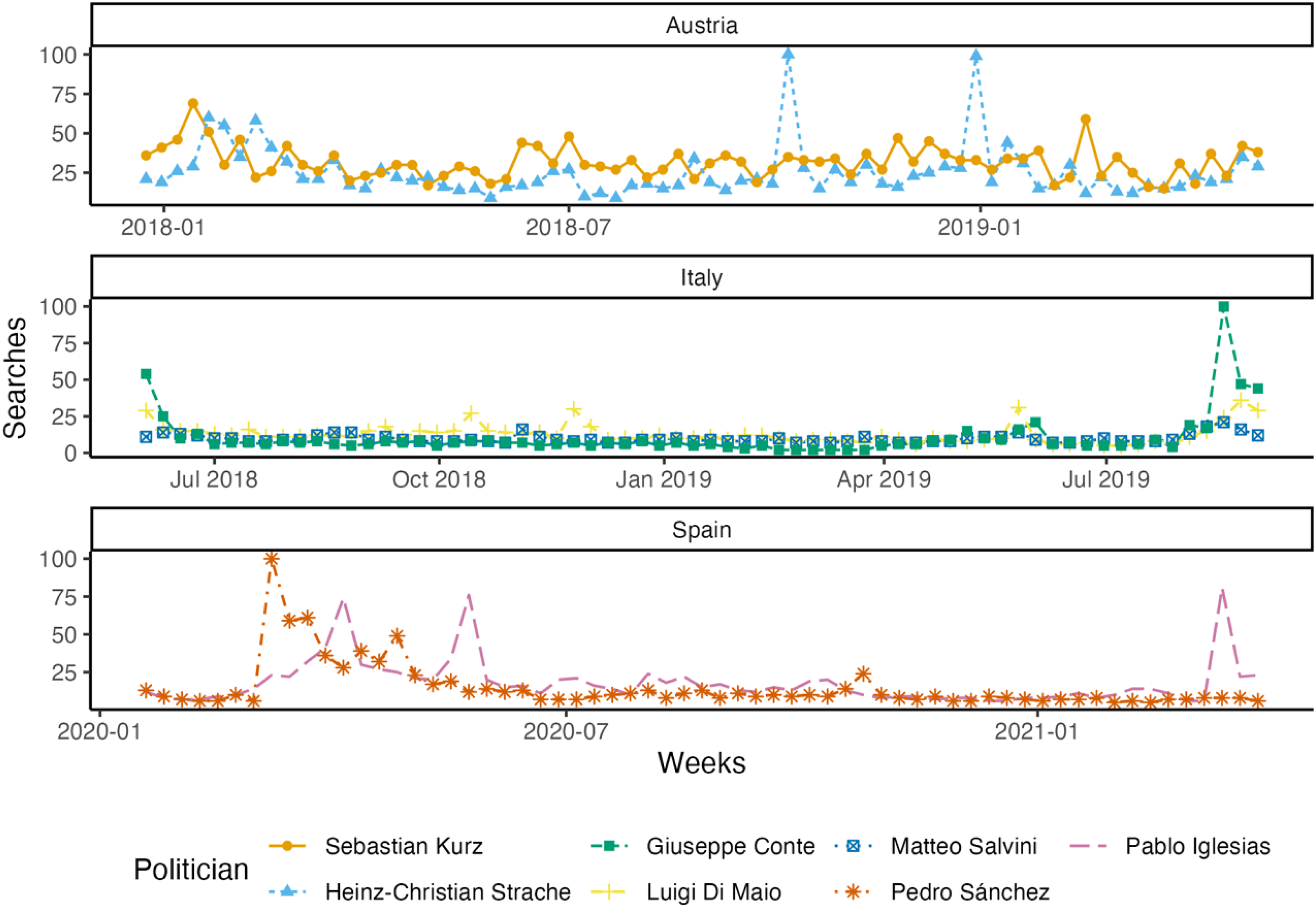
Google searches for each of the politicians during the time they shared office in the government. Sebastian Kurz and Heinz-Christian Strache from 18 December 2017 to 22 May 2019. Luigi Di Maio and Matteo Salvini from 1 June 2018 to 5 September 2019. Pedro Sánchez and Pablo Iglesias from 13 January 2020 to 31 March 2021.
If there is a context in which duos have gained popularity, it is through the extension of party co-leadership. Since the German Greens pioneered the shift to shared leadership in 1980 (Campus et al., 2021b; Poguntke, 2017), as many as 13 European parties of the same family have followed this model. 2 To these Green parties, the leaderships of six radical left parties must be added; four social democratic parties, one liberal and one radical right party. 3 The trend has been reinforced in recent years, as more parties than ever have joined this trend, including parties from distant geography, 4 generating contexts in which the predominant model is that of co-leadership. This is the case in Germany, where all major parties are led by two co-leaders, except for the CDU/CSU and FDP, which to this day are still single-leadership parties.
Preferences for two leaders vs. one leader
The effect of having more than one leader has received scant academic attention despite the growing importance of these tandems. On the contrary, knowledge about citizens’ preferences for individual political candidates has grown enormously in recent years, even in contexts where elections are typically a matter of choice of lists (Christensen et al., 2021; Dahl and Nyrup, 2021; Lavezzolo et al., 2021; Mares and Visconti, 2020; Ono and Yamada, 2020; Wüest and Pontusson, 2022). One of the most robust findings of this literature has to do with gender. Through a meta-analysis of 67 conjoint studies, Schwarz and Coppock (2021) conclude that female candidates tend to enjoy a two-point advantage over men, although this advantage is reduced, or even reversed, in contexts in which gender equality is a major concern. This finding is not incompatible with the underrepresentation of women in politics even today (Fulton, 2012; Thomsen and King, 2020) and only holds in contexts where gender equality has reached enough success (Schwarz and Coppock, 2021). 5 The (dis)advantage experienced by political candidates from other traditionally excluded groups has recently received attention. Despite optimistic results for some of these groups (Carnes and Lupu, 2016; Reher, 2021), the reality is less positive for candidates belonging to ethnic, sexual and gender minorities (Everitt and Horvath, 2021; Magni and Reynolds, 2021; Martin and Blinder, 2020; Portmann and Stojanović, 2021). Magni and Reynolds (2021) find that lesbians, gays and especially transgender candidates suffer an electoral penalty in three experiments in the United States, United Kingdom and New Zealand. This pattern is reinforced by the finding that gay and lesbian candidates need to adopt heteronormative life choices such as getting married and having kids to be penalized (Everitt and Horvath, 2021). Martin and Blinder (2020) find consistent results of discrimination against ethnic minority candidates in the United Kingdom, especially those associated with Islam. This is corroborated in Switzerland, where it is shown that voters use a variety of strategies to discriminate against candidates with a foreign name in the ballot box (Portmann and Stojanović, 2021).
Should we expect the same pattern when voters choose a duo? The related literature suggests a no with nuances as an answer. This is because while making individual decisions forces parties and citizens to reveal their biased preferences, this is not necessarily the case when choosing two (or more). From the elite perspective, we know that in presidential systems the composition of the presidential duo is influenced by a so-called balancing strategy (Lopes, 2020; Pignataro and Taylor-Robinson, 2019; Uggla, 2020). This strategy assumes that selectors choose vice-presidents with the intention that they complement the profile of presidents based on various criteria such as ideology (Uggla, 2020), gender (Lopes, 2020), geography (Lopes, 2020) and policy expertise (Pignataro and Taylor-Robinson, 2019). This modus operandi resonates with the ticket-balancing strategies of parties in which they pick candidates that represent distinct voter groups for their electoral lists or design the composition of the government (Annesley and Gains, 2010; Franceschet and Thomas, 2015). Likewise, the fact that co-leaders have to be a male–female pair in some Green parties obeys the same representative principle (Rihoux, 2016). A representative principle, as is obvious, also pursues an electoral purpose of appealing to several constituencies at the same time (Ceyhan, 2021; Hennl and Kaiser, 2008; Valdini, 2012).
Evidence from the demand side suggests that voters do appreciate some balance as well. In fact, research on gender and politics shows that although not always and not in the same proportion, voters tend to appreciate a certain parity between men and women in office (Dolan and Sanbonmatsu, 2009; Fox and Oxley, 2005). This can be exemplified with findings from the United States, which show that the ideal proportion of women in 2009 as officeholders is 40% (Dolan and Sanbonmatsu, 2009). Also, in state-level elections, among other factors, voters tend to appreciate that there is a woman on the ticket to serve as a lieutenant governor (Fox and Oxley, 2005). There are reasons to think that this openness towards parity is transferable to other diverse groups in advanced societies. This is not only because there is evidence of increasingly open attitudes towards people from historically discriminated groups such as LGBTQ (Abou-Chadi and Finnigan, 2019) but also because these attitudes translate into more inclusive positions towards non-traditional candidates. This explains why recent research finds that large proportions of the electorate support candidates that are ethnically (Street, 2014) or sexually (Magni and Reynolds, 2018) diverse. All these research arguments lead us to develop the following hypotheses:
H1: Respondents prefer women but prefer less LGBTQ candidates and non-white candidates.
H2: Respondents show less discriminatory preferences (against female/LGBTQ/non-white-looking candidates) when choosing two candidates than when choosing one.
It is important to note that in duos, one figure does not necessarily have to dominate the other. However, this scenario often occurs due to either the institutional design of political offices, as seen in the case of prime ministers and deputy prime ministers, or because of the de facto reality (as is the case with the leadership of some parties 6 ). Be it one way or the other, these asymmetries give parties and voters the opportunity to express their biases as to which profile is best suited to carry the baton of command and what profile is best to accompany the ‘first’ leader. This can have consequences not only in terms of representation but also in terms of visibility and who is sacrificed in difficult times. The case of the Swedish Greens is paradigmatic. After a scandal that especially affected the then co-leader Kaplan, it was the female leader Romson who ended up paying the political price of being forced to resign by the party's selective committee (Bolin and Aylott, 2019). This particular case exemplifies a recurring pattern rather than an isolated occurrence. Indeed, female candidates are often seen as having less leadership capability (e.g. Eagly and Carli, 2007). As a consequence, women are more likely to be ‘sacrificial lambs’, i.e. more likely than men to be the party's candidate in districts where their party has little chance of winning (Thomas and Bodet, 2013), and more frequently have male running mates (Hennings and Urbatsch, 2015). If this is a bias present in party elites, it will be even more so among the citizenry which is often less cosmopolitan by comparison (Strijbis et al., 2019). With ethnic, sexual and gender minorities, should they achieve leadership positions, everything points to the fact that they are also likely to end up as the seconds-in-command. According to the social acceptance hypothesis, unfamiliarity is a disadvantage that is only alleviated when untraditional candidates acquire political space (Fox and Oxley, 2005; Thomas and Wilcox, 2014). Given that both LGBTQ and non-white candidates are far from getting their fair share of representation, it is to be expected that voters would prefer to give them second positions as is the case with women:
H3: Respondents relegate female/LGBTQ/non-white-looking candidates to second positions to a greater extent.
Diversity: Within and across
It has been previously predicted that people should have more inclusive attitudes when electing two candidates at the same time, even if they might relegate untraditional candidates to a second position. But what if the two leaders belong to a traditionally excluded group? Whereas to the best of my knowledge, there is no research on across-the-board diversity preferences, in the last two decades, research has begun to look at this issue from the perspective of individual candidates. Such studies, framed under the intersectionality approach, have for the first time given visibility to attitudes towards, for example, black female candidates or lesbian candidates (for a review, read Cassese, 2019), both groups crossed by two ‘intersections’. Thus, we have learnt that, although group interactions do not have a linear effect on prejudice, they often pose an added barrier to their careers (Rosette and Livingston, 2012; Sanchez-Hucles and Davis, 2010). From an across-the-board diversity perspective, intersectionality can mean that each of the leaders belongs to a different, the same or many traditionally underrepresented groups at the same time. It is essential to recognize that each intersection represents a unique set of experiences and perspectives (Hancock, 2007). Consequently, voters are likely to have a threshold for the level of diversity they are willing to accept. This threshold is suggested by research on the acceptable representation of women in elections (Ditonto and Andersen, 2018; Hennings and Urbatsch, 2015), as well as recent evidence regarding the impact of the triple intersection of gender, race and sexual orientation (Magni and Reynolds, 2018):
H4: The more diverse a tandem, the higher the discrimination of voters against this candidacy.
Ideology matters
Regardless of how much diversity there is on a ticket, there is consistent evidence that ideology has a fundamental impact on people's views towards untraditional politicians (e.g. Everitt and Horvath, 2021; Magni and Reynolds, 2021; Martin and Blinder, 2020; Street, 2014). In a recent article, Cuevas and Dawson (2021) review the strong association of right-wing ideology and markers of religious belief, authoritarianism and prejudice towards diverse groups in Western countries. They find that both socio-psychological theories and individual-level psychology explain the mechanisms that bind political beliefs and prejudice together.
Indeed, right-wing ideology is related to the idea that certain minorities should be in a subordinate position or excluded from society because conservatism is rooted in the need to maintain the existing social order (Kreindler, 2005; Whitley, 1999). This leads people on the right to express prejudice against groups that are considered to violate traditional values such as LGBTQ people, ethnic minorities and women in leadership positions:
H5: Right-wing voters hold a more prejudiced view of female, LGBTQ and non-white candidates compared to left-leaning voters.
Context
I conduct a survey experiment with a nationally representative sample in Germany. Choosing this case offers the opportunity to investigate tandem preferences in a country that ranks average in attitudes towards diversity in Western Europe. For example, asked whether immigrants make the country a better place on a scale of 1 to 10, Germans report intermediate values (6.2, mean 6.1) between the two extremes, with Sweden being the most positive (7.2) and Italy the most negative towards immigration (4.6) (ESS, 2020). Another example is attitudes towards the possibility of gays and lesbians being able to adopt children. Here, again, Germany is in the middle (2.6 out of 4; the average is 2.5) between the most favourable country (Netherlands, 3) and the most unfavourable (Italy, 1.4) (ESS, 2020).
The study focuses on diversity through three intersections: gender, ethnicity and sexual orientation. Although there is still a long way to go for a fair representation of these groups, there is evidence of German politicians belonging to all three groups. Germany has reached a women proportion close to 35.1% in the Bundestag in recent years, far from Sweden's 46.4%, but also higher than Greece's 21% (Inter-Parliamentary Union, 2022). With regard to ethnic minority representation, the narrative is also mixed. Although it is one of the countries with the highest number of parliamentarians from this group (18 in the period from 2017 to 2018), in proportional terms according to population, only France is more under representative of these minorities (Aktürk and Katliarou, 2021). In terms of sexual orientation, gays, lesbians and bisexuals are still a minority of 2% in the German Bundestag (11 members in total). This is a low figure compared to the United Kingdom, which has reached 8%, with 52 queer members of the British parliament being open of their sexual orientation/gender identity (Moreau, 2020). However, it is higher than in other neighbouring Western European countries such as Finland, where only two openly gay men are visible in parliament (1%) (Juvonen, 2020), and close above the 1.7% represented by the Spanish LGB 7 in their Congress of Deputies (Lopez, 2020).
When it comes to gender dissidents, which includes trans and non-binary politicians, the number of candidates and representatives is even lower (Casey and Reynolds, 2013). Only recently has a non-binary first-order politician been known in the United States (Armus, 2020). Germany, however, is a good context to study attitudes towards non-binary candidates. Legislative developments in 2018 made the country one of the first to legally recognize the existence of non-binaries under the label ‘Diverse’. Although the registration system is arduous, this is a step that only two other countries in the European context (Iceland and Malta) have taken (ILGA Rainbow, 2021).
Two sub-contexts: Government and party
The study explores preferences for duos in two sub-contexts where these tandems have a particular impact: governments and parties. Germany is an ideal case in these two sub-contexts. First of all, Germany is a country with a long tradition of coalition governments. In these governments, the junior coalition partner typically receives the second most important position in the government, namely, that of the vice-chancellor. This gives the vice-chancellor the reinforced power to control the fulfilment of the coalition pact and the eventual attention of the rift-hungry media among the coalition partners (Carroll and Cox, 2012; Langer and Sagarzazu, 2018). This could elevate the figure of seconds-in-command beyond their already crucial role in single-color governments (Barnes, 2009; Kirkup and Thornton, 2017). Moreover, in Germany, this post is usually accompanied by the ministry considered the most important: foreign affairs (Müller-Rommel, 2018). Only rarely, by personal choice of the junior partner's leader, has the vice-chancellery been accompanied by another ministry. This was the case of the previous vice-chancellor (now chancellor), Olaf Scholz, who occupied the finance ministry (Müller-Rommel, 2018).
Secondly, Germany is the country with the highest proportion of parties that have adopted co-leadership in the world. Since the Greens used this formula in 1980, all parties except the FDP and the CDU (both centre–right) have joined this trend. The first to join the Green scheme was Die Linke (radical left) in 2007. Then, in 2013, the AfD (extreme right) was founded as a party headed by three co-leaders (which since 2017 have become only two). Finally, SPD (centre–left) joined the trend in 2019, inaugurating a ‘new era’ of the party. Although this co-leadership trend is catching on in many other countries, the fact that Germans are largely familiar with this formula makes the country a good context for testing realistic preferences.
Research strategy
The survey was conducted in the spring of 2021, included 2343 Germans and was pre-registered in AsPredicted. 8 It was administered online by Dynata, which ensured that the sample was representative of the German population with quotas for gender, education, age and geography.
To assess voters’ preferences for individual leaders and tandems, I placed a conjoint experiment in the survey. This conjoint experiment is not the same for all respondents. Respondents are divided into four groups exposed to four slightly different informational scenarios. As explained in Tables 1 and 2, two groups were asked to choose a leader, while two others had to choose pairs of leaders. At the same time, two groups had to choose the leadership of the national government, and two groups had to choose the leadership of their party. This allows us to discover how similar the preferences are when choosing a leader vs. a duo and government vs. party leadership. Each respondent had to complete five forced conjoint tasks in a row. This results in a final count of 23,430 observations if we count the chosen and discarded candidates.
List of combinations of experimental groups.

Example of a conjoint task of group A2.
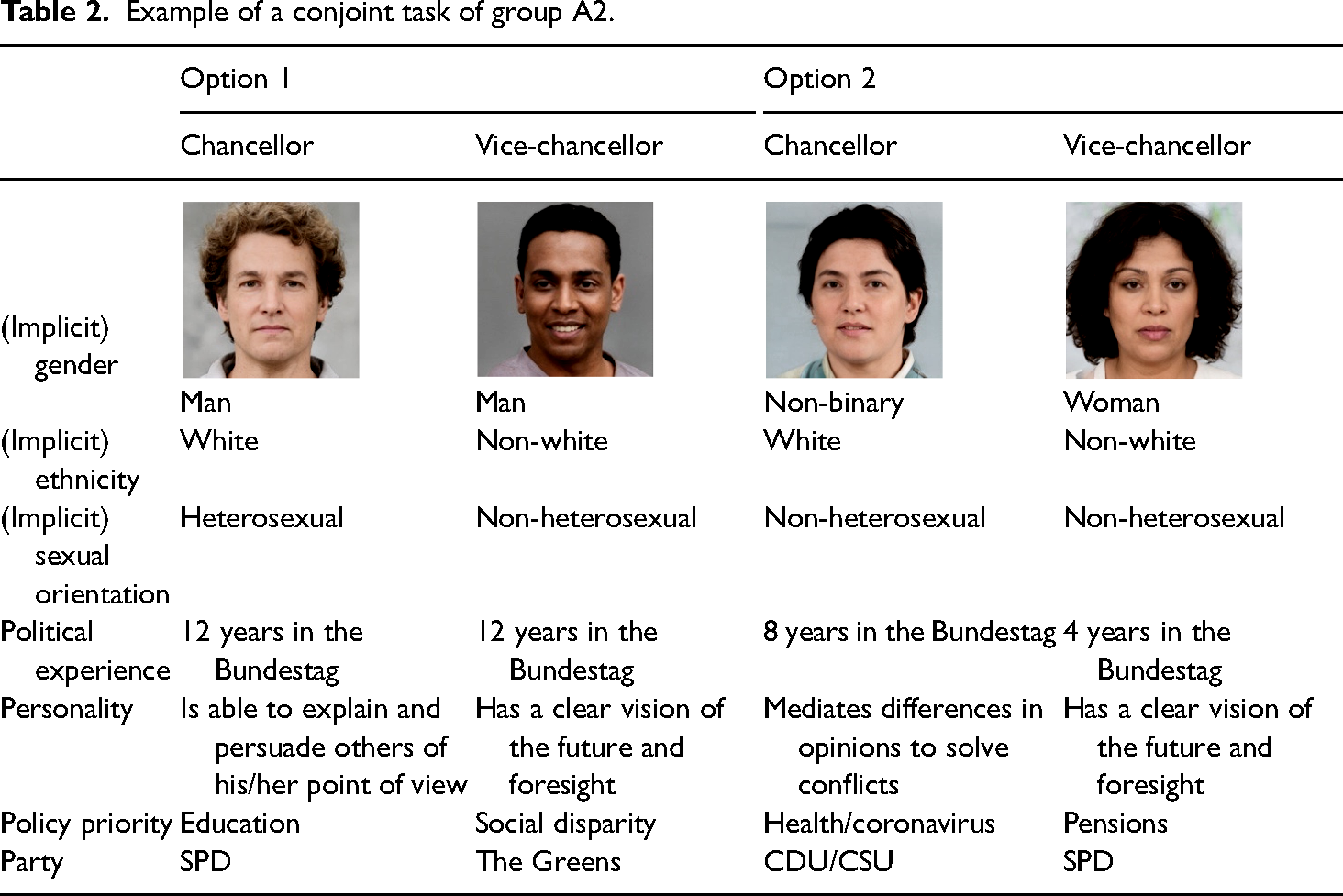
This study introduces a variant of traditional conjoint experiments. While groups A1 and A2 are exposed to traditional ‘candidate A vs. candidate B’ tasks, groups B1 and B2 face choices between ‘candidate A and candidate B vs. candidate C and candidate D’. To my knowledge, it is the first to exploit this possibility, which opens the opportunity to add combinations of more numbers, something that could be useful for multiple theoretical contexts. An important difference between party (A1 and B1) and government (A2 and B2) groups is the presence of partisanship. Respondents in groups A1 and B1 are asked to choose the leadership of their preferred party. Respondents in groups A2 and B2 are asked to choose the leadership of two-colour coalition governments of the parties most likely to enter the next government according to the polls: CDU/CSU, SPD and the Greens. This methodological decision compromises the one-to-one comparison between the two groups A1–B1 vs. A2–B2. Therefore, it is important to consider the presence (or absence) of partisanship in each case when interpreting the results. The positive side of this decision is that it prioritizes external validity given that it conforms to the normality of each sub-context in each case. While pairs in government are typically from different parties (as is the case in Germany since 1982), by definition, party co-leaders are members of the same party.
Apart from partisanship, the profiles presented to the respondents of each group have identical conditions. These profiles contain information regarding gender (male, female, non-binary), sexual orientation (homosexual, bisexual, heterosexual), ethnicity (white, non-white), personality (persuasive, visionary, mediator, listener), political experience (four, eight, 12 years in the national parliament) and policy area priority (education, foreigners/integration/refugees, social disparity, pensions, environment and health/coronavirus). 9 The levels of each of the information categories vary randomly, showing different profiles (or pairs of profiles) each time. Herein lies one of the main advantages of conjoint experiments. Since the hypothesized profiles vary randomly, the design allows for the estimation of the effect of specific characteristics on the vote. Even though the attributes correlate with each other, this design is able to isolate the marginal effect of each of them (Horiuchi et al., 2020).
Variables other than those strictly related to diversity are included to mitigate social desirability bias. If only the categories of gender, sexual orientation and ethnicity were included, respondents might exhibit socially acceptable attitudes. By including variables such as personality, party, political experience or policy priority, the weight of possible unacceptability is reduced. Respondents can internally justify their decision (influenced by, for example, ethnicity) based on other variables like leaders’ personality. This possibility inherent in conjoint designs encourages honest and reality-like voting decisions involving multiple intertwined variables.
To minimize social desirability even further while increasing external validity, a visual conjoint experiment has been chosen (for an example in our experiment, see Figure 3). This means that some of the variables included are represented visually with faces instead of text. In this case, they are represented by faces that vary according to three categories of information: gender, sexual orientation and ethnicity. This makes the decision much more similar to what happens in reality, where people learn these traits by observation. For this purpose, in a previous study, 500 Germans were asked to evaluate a total of 200 AI-generated faces. 10 Of these 200, 53 faces were selected that were comparable in terms of valence and attractiveness but that varied by unambiguous perceptions of ethnicity, gender and sexual orientation, three categories of information that research has found to be elicited from faces (Dotsch et al., 2011; Rule et al., 2008, 2009). In measuring the levels of our categories of interest, several decisions were made. Being non-binary is associated with being perceived as gender ambiguous. With ethnicity, respondents were asked whether they thought the faces were those of people of German or Turkish origin (the main ethnic minority in the country). Although these are two different things, I believe that in both cases the interest in voters’ perceptions justifies the decision. Similar experiments previously conducted show that visual information generates effects in the same direction (Abrajano et al., 2018). What varies is the level at which unconscious biases manifest themselves. While in text experiments respondents can control them, in picture experiments this is not the case (Abrajano et al., 2018). This makes ethnic discrimination stronger when the information is conveyed with an image. 11 It is shown then that using visual information in experiments has the advantage of disclosing more reliable effects of information than otherwise.
Results
There are typically two empirical strategies when analysing the results of a conjoint experiment. Given that each respondent answered five tasks, the most commonly used option is to run ordinary least squares (OLS) regressions with cluster-robust standard errors. The levels of each category are completely independent because they are randomized individually. This makes OLS regressions produce unbiased estimates of average marginal component effects (AMCEs) (Hainmueller et al., 2014).
Based on the same assumptions of independent randomizations, Leeper et al. (2020) more recently propose to analyse conjoint experiments using marginal means (MMs). The reasoning behind the use of MMs is that they report estimates without having to consider a reference category. The interpretation of the results is more consistent because it is not committed to the arbitrary decision of the chosen reference category. The advantage of marginal means is especially important in comparisons between subgroups of survey samples, where comparisons of AMCEs are often more misleading (Leeper et al., 2020). For the sake of concision, the visual results corresponding to the MMs will be presented in the following. However, the regression tables with AMCEs estimates are included in the Online appendix.
When choosing MMs as the main measure of analysis, the null effect is at 0.5 and is represented by a vertical line. Sometimes comparisons are made between respondents of different ideologies or different experimental groups. In these cases, the difference between the marginal means of the subpopulations is calculated, and therefore the null hypothesis is at zero, also represented by a line. In the graphs, the darker lines demark 90%, and the lighter ones 95% confidence intervals. The results are presented in the order of the hypotheses, with the exception of H5, which cuts across other dimensions and will, therefore, be discussed throughout the entire results section.
The first hypothesis (H1) drawn from findings in previous studies is that voters discriminate against ethnic, sexual and gender minority candidates while favouring female candidates. The first column of Figure 2 presents the results on the overall preferences of our sample. It aggregates the data for all respondents, regardless of whether they were choosing a single candidate or a duo or their own party or the government. The results confirm the findings of previous studies. In fact, it can be seen how, unlike men and non-binary candidates, preferences towards women are significantly positive. The preference for white candidates over non-white candidates is also significant. Regarding the differences between heterosexuals and LGB, no differences were observed in our study of the general population.
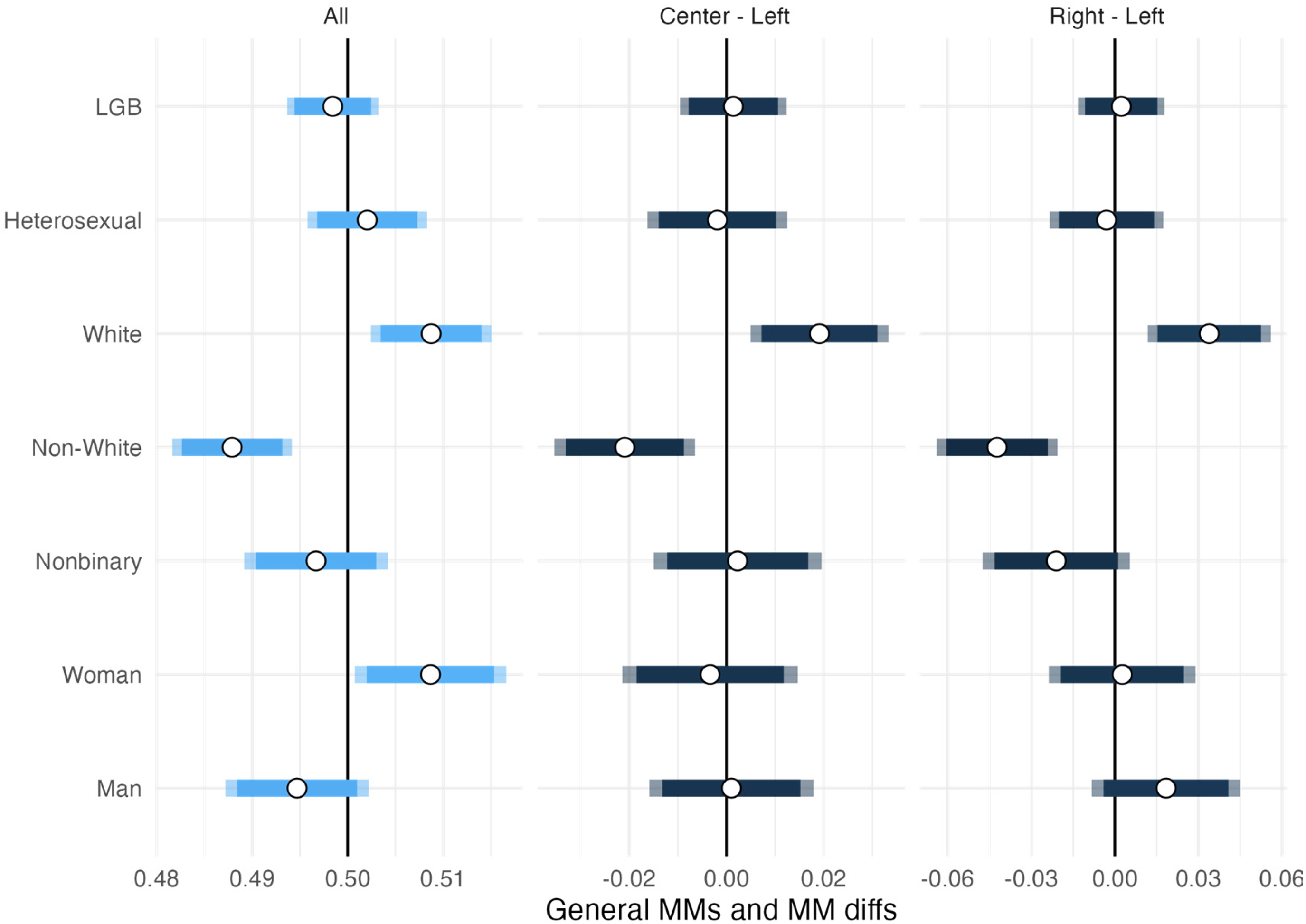
General MM (all) and MM differences; results by ideology.
One aspect that tends to affect preferences for untraditional candidates is the ideology of the voters. The second and third columns of Figure 2 describe the causal differences between the preferences of centrist and leftist respondents (second column) and the differences between the preferences of right-wing and left-wing respondents (third column). When the values are positive, it means that centre (or right) voters have stronger preferences for a certain category. Negative values mean just the opposite: centre (or right-wing) voters have less strong preferences for that category. What the results show is that ideology does indeed matter in the case of both ethnicity and gender. In the case of ethnicity, centre and right-wing respondents clearly show a more unfavourable view of non-white candidates compared to left-wing subjects. Although the results are not as emphatic in the case of gender, they seem to suggest that right-wing subjects are more unfavourable to non-binary candidates than their left-wing counterparts. These results are significant at the 10% level. If we look at the same results divided according to whether respondents were choosing candidates to lead their party or the government, we find only small differences in right-wing respondents who seem to prefer women to lead their party and men to lead the government.
One of the main hypotheses of this study is that choosing a single leader is not the same as choosing a tandem of two (H2). Figure 3 is intended to shed light on this question. To do so, it shows the differential values between the experimental groups that chose leaders in one-on-one elections and the groups that chose pairs of candidates. While the first column shows the results for the general population, the next three columns represent the three ideological groups (left, centre, right). In this case, positive (negative) value differences mean that an attribute is more (less) appreciated when only one candidate is chosen compared to when two candidates are chosen at the same time.
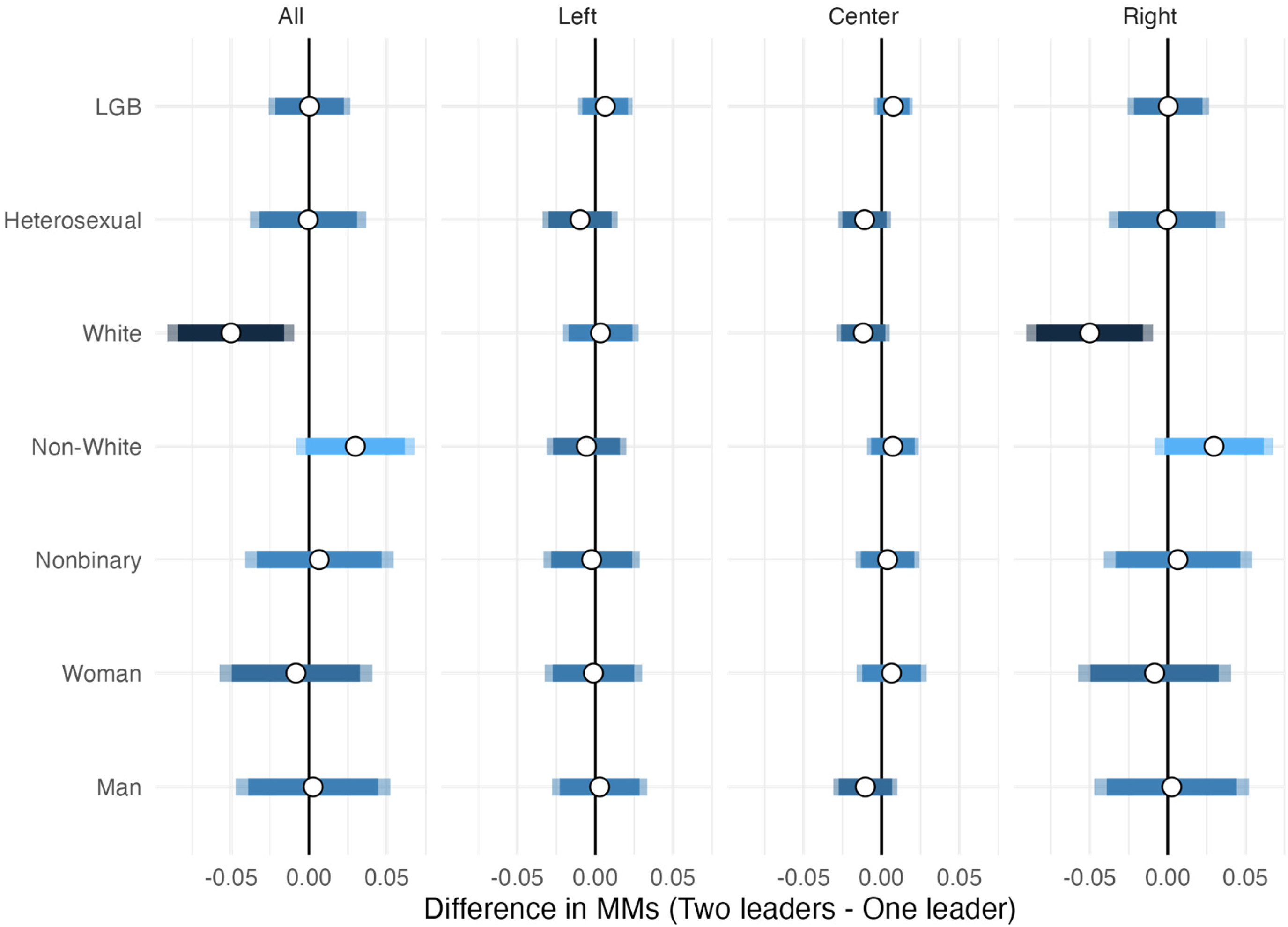
MM differences; results by (co)leadership and ideology.
What emerges from the analyses is that ethnicity is the most differential trait. Indeed, looking at the overall results, it can be seen that white candidates are less preferred when pairs of candidates are chosen. These results hold only in the right-wing subgroup and to a lesser extent the centre subgroup. This outcome is noteworthy since it demonstrates that, while right-wing respondents tend to be less supportive of non-white leaders, as illustrated in Figure 3, their opposition towards them decreases significantly when they choose pairs of candidates. As far as gender and sexual orientation are concerned, no major differences emerge from the results.
One way to check if respondents have different preferences when choosing a leader in a duo is to see if there is a ‘natural liking’ for combinations of different profiles. This possibility would be interesting because it would mean there is a meta-preference for diversity beyond the specific characteristics of the candidates. Figure 4 reveals the effect of tandem profiles being identical or different on the preference for each candidate’s attributes. The results are again divided by ideological groups and, while not conclusive, do suggest a possible preference for difference. This is at least what emerges from the overall results (first column). For ethnicity, sexual orientation and gender, different attributes always have positive values compared to when the attributes are the same, although results are only robustly significant in the cases of ethnicity and gender. When we look at the differences by ideology (second and third columns), no clear pattern seems to be found. The only thing that stands out is that right-wing voters are the only ones who show a significant preference for gender combinations (Figure A6). These results suggest that the preference for diverse tickets may not follow the usual ideological patterns as is the case with other dimensions of diversity. Again, no substantive differences are observed between choosing government and party leaders (Figure A7).
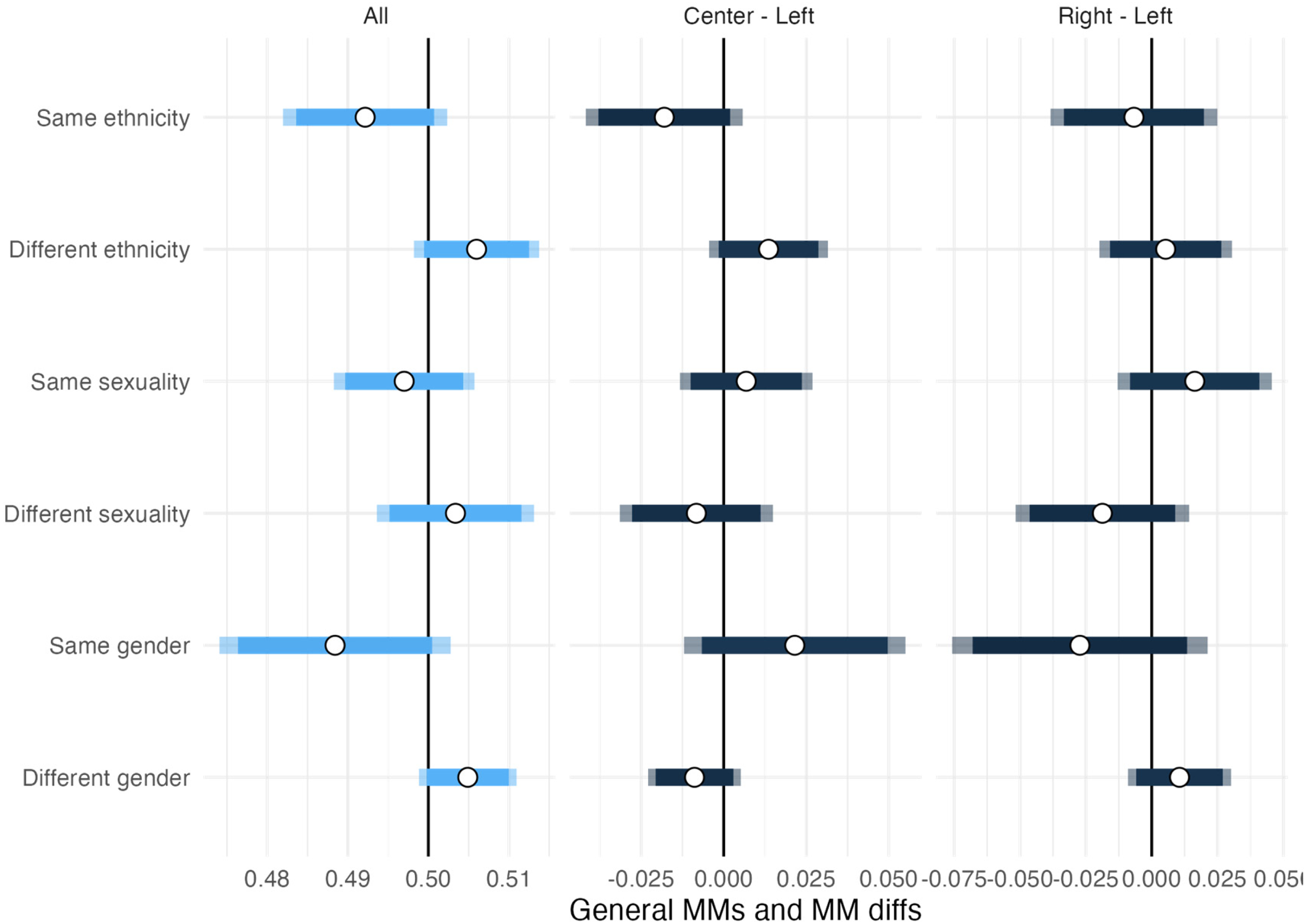
MM differences; results by same vs. different attribute and ideology.
This paper yields the hypothesis that the position in which candidates run matters. In this sense, it has been hypothesized that candidates from historically excluded groups are well regarded when they occupy the second position, but not so when they are the front-runners or occupy both leadership positions (H3). Figure 5 depicts preferences for the various combinations of attributes. In addition to the overall results (first column), the differential results by ideology are given (second and third columns). The results are largely confirmatory of theoretical expectations, especially with regard to ethnicity.
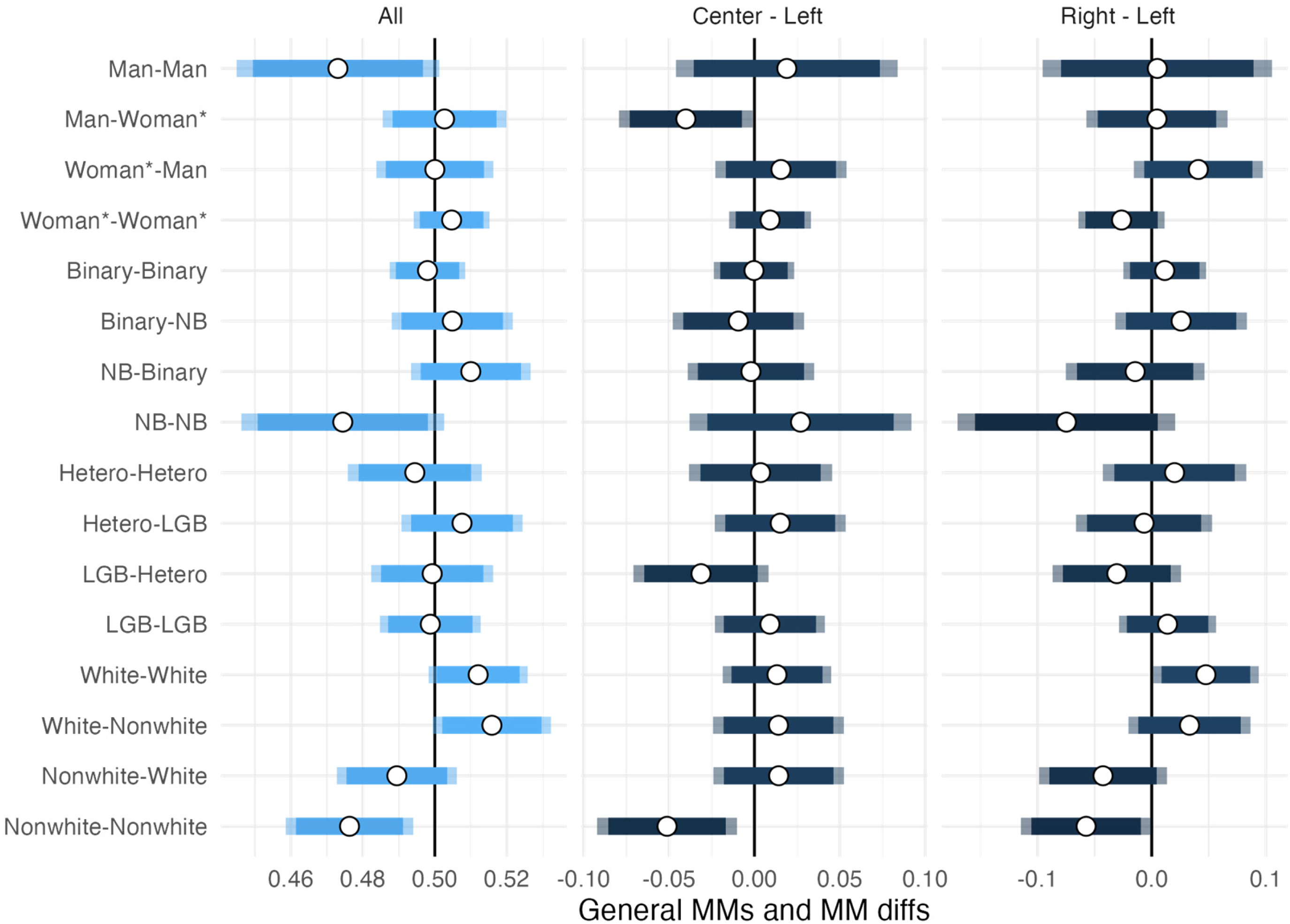
MM differences; results by same vs. different attribute and ideology.
Focusing on the overall results, white leader couples are marginally preferred (α = 0.10). However, the results are not very different from those of white–non-white pairs. The narrative that emerges is totally different when the non-white candidate is the first leader or both positions are held by non-whites. Negative values for these types of couples suggest respondents penalize tandems led by non-whites, although duos that have a white candidate as a second-in-command do not reach acceptable levels of significance. If we turn our attention to ideological differences, we find the expected. Left-wing respondents do not have as positive (negative) views on white-led (non-white) candidacies as right-wing subjects. Among all other types of leaders, only pairs of two male candidates and two non-binary candidates seem to be met with respondents’ disapproval. From an ideological point of view, the results hold across all three groups although leftists seem to have fewer negative views against non-binary pairs compared to rightists. Only the latter shows a significant rejection of non-binary candidate couples (see Online appendix). The results are mostly consistent across party and government sub-contexts.
In this article, however, I ask how voters react when the pair of leaders not only shares the same group but when several groups intersect at the same time (H4). To answer this question, a strategy is followed. Points are awarded according to the number of memberships in underrepresented groups. In this sense, it is taken into account that diversity in the second leadership does not have the same impact. Consequently, memberships in underrepresented groups are given half the weight in the model. Otherwise, the impact of diverse co-leadership would certainly be inflated. With this in mind, the effect of the number of intersections on respondents’ voting decisions is studied. Figure 6 shows the results of this model. In this case, there are three rows representing the (a) overall results (first row); (b) differences between left and centre subjects (second row); and (c) differences between left and right subjects (third row).
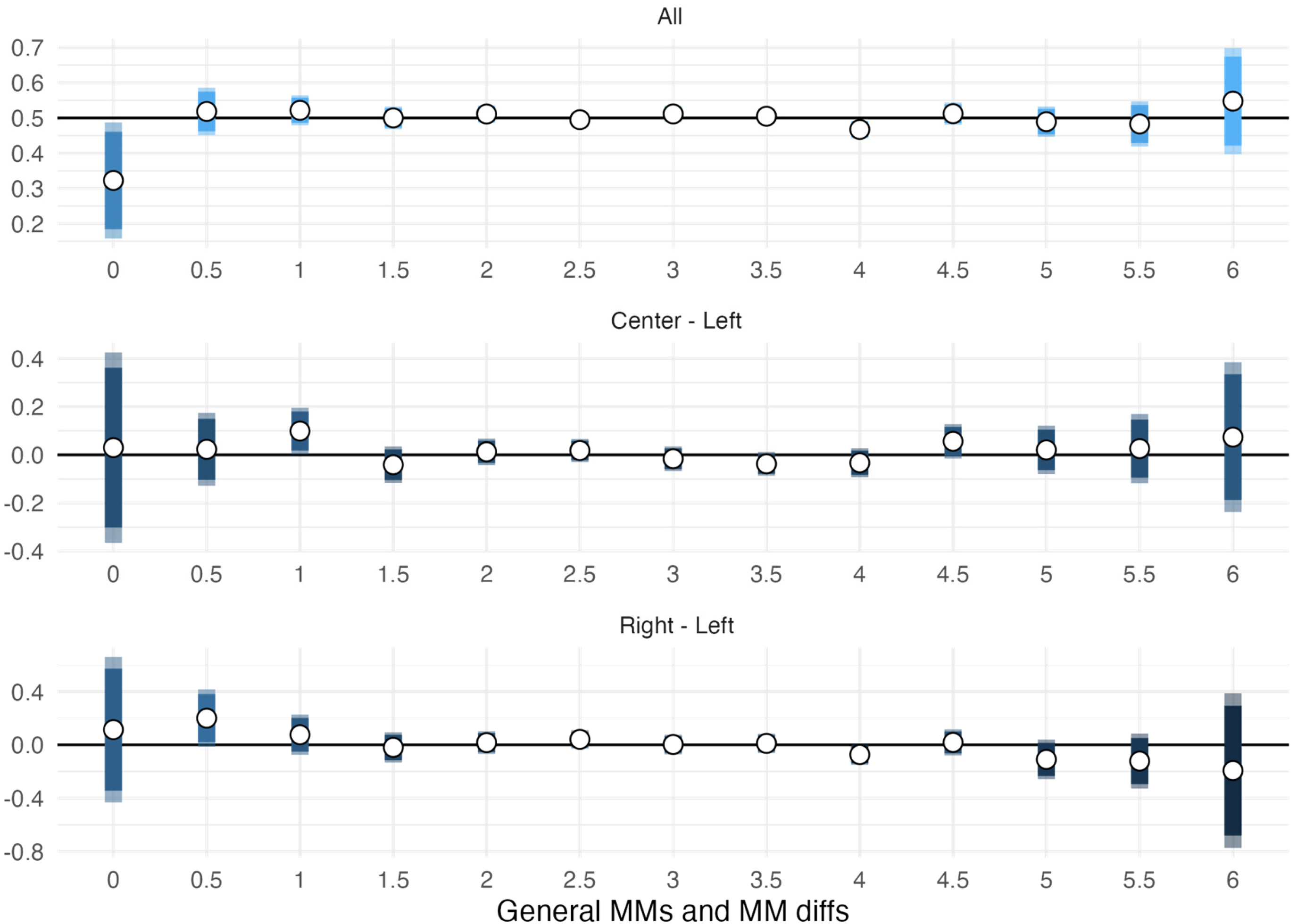
MM results by the number of intersections in duos and by ideology.
The overall findings indicate that respondents, in general, do not oppose higher levels of intersectionality. Interestingly, the lowest-scoring duos, specifically white heterosexual male couples, receive the least support, while other groups maintain values close to the null hypothesis. Analysing the results by ideological groups reveals intriguing outcomes. Although there are negligible differences between the behaviour of centre and left-wing respondents, significant variations exist between left-wing and right-wing participants. The findings suggest that right-wing and centrist respondents may exhibit greater reluctance in embracing candidates with multiple intersections compared to left-wing respondents. For instance, centre and right-wing respondents significantly prefer candidates with low levels of diversity compared to left-wing respondents (α = 0.05 and 0.10, respectively). These results hold true for both government and party leadership elections, with no substantial discrepancies observed.
Discussion
This article for the first time puts spotlight on voter preferences regarding an emerging phenomenon in Europe: political tandems. To that end, it speculates on the reasons why citizens may behave differently when they elect two leaders at the same time instead of one. Drawing on literature on diversity preferences as well as intersectional research, a set of expectations is developed.
The first is that voters have less discriminatory preferences against traditionally excluded groups when electing two candidates in the case of ethnicity, but not so for gender and sexual orientation. Voters tend to discriminate less against non-white candidates when they have to choose duos, something that has a particular impact on the right-wing electorate. Added to this are results suggesting that voters of all ideologies prefer leadership with parity of each attribute (i.e. white–non-white, heterosexual–LGB). Given that cases of duos are growing in number, this finding is important because it could mean that we are moving towards more diverse mandates. Such a transformation could have profound implications, particularly in right-wing governments and parties. With greater diversity in descriptive terms, there could be a greater willingness to adopt more inclusive stances towards underrepresented groups.
My second expectation is that voters relegate candidates from underrepresented groups to second positions. The results show that voters do in fact punish candidacies in which it is the candidate from the underrepresented group who leads with similar unfavourability rates as duos in which the two candidates belong to the same of certain underrepresented groups. This is the case for non-white and, to an extent, non-binary candidates. These patterns of discrimination are shown to be especially relevant in centre and right-wing electorates. The results speak to the literature explaining underrepresentation and the limits minorities face in reaching positions of power in politics. This study demonstrates that in addition to supply-side barriers, there are also demand-side barriers to these leaders unless they occupy a second position.
This article also contributes to studies of intersectionality by studying how much is too much diversity in political tandems. The findings highlight that the general population does not inherently oppose higher levels of diversity. Nevertheless, significant differences emerge based on ideology. Specifically, right-wing individuals appear to be less willing to support a ticket as the level of diversity increases. Conversely, the results indicate that right-wing voters would only reject dual tickets at exceptionally high levels of diversity (four intersections in total). This finding suggests that party selectorates have an opportunity to appoint non-traditional candidates to hierarchical positions without incurring negative consequences.
This study aims to contribute to the advancement of experiments in the literature on candidate selection. It is the first to propose the study of joint candidacies using a combined conjoint experiment. In this case, its use is more than justified because in no other way could one study the multidimensional preferences of duos of leaders. Thus, I argue that this design is applicable to many other contexts such as the study of coalitions, inter-country agreements or joint political policy. The challenge in these cases is not to saturate the interviewees with too much information. In this sense, the possibility of conveying part of the information with visual cues, as this experiment does, has advantages. On the one hand, it reduces the time respondents need to digest the information. On the other hand, it gives greater external validity to the experiments insofar as that the information is usually received visually, thus limiting the possibility of conscious biases distorting the results.
In this experiment, the use of visual conjoint has also had its disadvantages. While visual information about faces reveals ethnicity with sufficient clarity, this is not the case with gender, let alone sexual orientation. The effect regarding LGBTQ people in this study could be very conservative given that suspecting LGBTQ membership is not the same as knowing it. A promising research ground for future studies would be to study how different levels of certainty about disadvantaged group membership affect discrimination against individuals (whether LGBTQ or not).
Supplemental Material
sj-xls-1-eup-10.1177_14651165231206388 - Supplemental material for Do political duos diminish discriminatory voter preferences? Evidence from a combined conjoint experiment
Supplemental material, sj-xls-1-eup-10.1177_14651165231206388 for Do political duos diminish discriminatory voter preferences? Evidence from a combined conjoint experiment by Alberto López Ortega in European Union Politics
Supplemental Material
sj-r-2-eup-10.1177_14651165231206388 - Supplemental material for Do political duos diminish discriminatory voter preferences? Evidence from a combined conjoint experiment
Supplemental material, sj-r-2-eup-10.1177_14651165231206388 for Do political duos diminish discriminatory voter preferences? Evidence from a combined conjoint experiment by Alberto López Ortega in European Union Politics
Supplemental Material
sj-xls-3-eup-10.1177_14651165231206388 - Supplemental material for Do political duos diminish discriminatory voter preferences? Evidence from a combined conjoint experiment
Supplemental material, sj-xls-3-eup-10.1177_14651165231206388 for Do political duos diminish discriminatory voter preferences? Evidence from a combined conjoint experiment by Alberto López Ortega in European Union Politics
Supplemental Material
sj-rdata-4-eup-10.1177_14651165231206388 - Supplemental material for Do political duos diminish discriminatory voter preferences? Evidence from a combined conjoint experiment
Supplemental material, sj-rdata-4-eup-10.1177_14651165231206388 for Do political duos diminish discriminatory voter preferences? Evidence from a combined conjoint experiment by Alberto López Ortega in European Union Politics
Supplemental Material
sj-xlsx-5-eup-10.1177_14651165231206388 - Supplemental material for Do political duos diminish discriminatory voter preferences? Evidence from a combined conjoint experiment
Supplemental material, sj-xlsx-5-eup-10.1177_14651165231206388 for Do political duos diminish discriminatory voter preferences? Evidence from a combined conjoint experiment by Alberto López Ortega in European Union Politics
Supplemental Material
sj-docx-6-eup-10.1177_14651165231206388 - Supplemental material for Do political duos diminish discriminatory voter preferences? Evidence from a combined conjoint experiment
Supplemental material, sj-docx-6-eup-10.1177_14651165231206388 for Do political duos diminish discriminatory voter preferences? Evidence from a combined conjoint experiment by Alberto López Ortega in European Union Politics
Footnotes
Acknowledgements
The author would like to extend his heartfelt gratitude to his thesis supervisor, Dr Oliver Strijbis, for his invaluable guidance throughout this process. He also wishes to express his appreciation to Christian Bencid for his assistance in reading and providing inspiration for thorough writing and revision of this paper. Additionally, he would like to acknowledge the anonymous reviewers and editor whose feedback significantly contributed to enhancing this paper.
Declaration of conflicting interests
The author declared no potential conflicts of interest with respect to the research, authorship and/or publication of this article.
Funding
The author received no financial support for the research, authorship and/or publication of this article.

Supplemental material
Supplemental material for this article is available online.
Notes
References
Supplementary Material
Please find the following supplemental material available below.
For Open Access articles published under a Creative Commons License, all supplemental material carries the same license as the article it is associated with.
For non-Open Access articles published, all supplemental material carries a non-exclusive license, and permission requests for re-use of supplemental material or any part of supplemental material shall be sent directly to the copyright owner as specified in the copyright notice associated with the article.
