



Abstract
How do citizens understand political authority within multi-level systems? We use original survey data from six European Union member states to assess the roles of political identity and interest in shaping citizen attitudes towards political authority in the European Union. We find that citizens with a greater interest in politics are more likely to express views on the authority of the European Union. These individuals are less likely to be uninformed. Interest does not necessarily mean that individuals hold correct perceptions. A substantive number of voters are misinformed about the power of Brussels. We find that citizens with an exclusively national identity are more likely to hold misperceptions than those who think of themselves as both members of their nation and as Europeans.
Introduction
Multi-level systems complicate accountability judgements for voters because political authority is exercised at subnational and supranational levels (Hooghe et al., 2016; Hooghe and Marks, 2009). Elections as a mechanism of democratic accountability in multi-level systems rely on citizens being informed about decisions that are being made at these different levels of government (Banducci et al., 2017). Levels of information are related to turnout, especially at the level above the nation state, e.g., in European Parliament (EP) elections (Bhatti, 2010; Marquart et al., 2020). It is, however, not just a lack of information that can create challenges for democracy; misperceptions about the political authority of an organisation can be even more consequential. The prevalence of misperceptions about multi-level political authority likely contributed to the outcome of the United Kingdom's Brexit referendum (Carl et al., 2019; Clarke et al., 2017; Hobolt, 2016; Stoeckel et al., 2021). While Brexit attracts the most attention, misperceptions about European Union (EU) political authority are not a distinctly British phenomenon. In this article, we examine two key aspects of citizens’ factual beliefs on political authority in six EU member states: (a) the prevalence of misperceptions of the authority of the EU, and (b) mechanisms that might explain why some citizens come to hold misperceptions about political authority within the EU.
Our work follows from a rich literature on (biased) information processing and belief formation. The cornerstone of our theoretical foundation is Zaller's (1992) ‘receive-accept-sample’ (RAS) model. Those interested in politics are more likely to ‘receive’ EU related information, but ‘acceptance’ of these messages may be conditional on politically relevant attitudes or identities. This approach generates expectations about who is likely (and who is not likely) to register a factual belief within the survey context (versus reporting ‘don’t know’). For those who report factual beliefs, we can additionally identify expectations about the content of those beliefs. In other words, this approach allows us to consider three distinct groups when it comes to perceptions of EU authority: the accurately informed, the uninformed, and the misinformed (Kuklinski et al., 2000). Accordingly, we expect that citizens with higher levels of political interest are less likely to be uninformed. Nevertheless, citizens with high levels of political interest might still be misinformed.
In particular, we expect that the extent to which citizens are Eurosceptic or pro-European will influence citizens’ beliefs about political authority (Hobolt and Tilley, 2014). We instantiate an identity-based approach by looking at exclusionary versus inclusive national identities and beliefs about EU political authority. We expect that the accuracy of beliefs about political authority will be different for those who identify as exclusively a member of their own nation (exclusionary identity) and those who identify as both a member of their own nation and as a European (inclusive national identity). We examine this expectation across three areas of EU authority perceptions: (a) whether the European Commission (EC) can pass laws against the will of EU member states; (b) whether the EC can override the position of the EP; and (c) and whether members of the EP are directly elected. While the exact proportions vary by country and issue, the combined share of the uninformed and misinformed are often more than half of respondents. For instance, only about a third (35%) of respondents know that the EC cannot pass laws against the will of a majority of member states. In contrast, 40% of respondents are misinformed and believe the EC could override the will of member states, while another 25% are uninformed. In practice, it appears that existing channels of democratic legitimisation are not well understood by most citizens. Thus, our findings also have implications for the debate about the democratic deficit of the EU (Follesdal and Hix, 2006; Moravcsik, 2002), which is something we return to in the conclusion. Our analyses examine these issues using original survey data from six EU member states (France, Germany, Italy, Poland, Spain, and Sweden).
Our study offers important descriptive insights and contributes to a better theorising of authority (mis)perceptions in the EU (and multi-level systems more generally) by highlighting the importance of both political interest and identities in authority perceptions. We find that high levels of political interest differentiate those who express authority perceptions – which may be correct or incorrect – from those that are uninformed. We also find that the extent to which citizens have an exclusively national identity (i.e., no European identity) rather than an inclusive national identity (i.e., identifying both with one's nation and Europe) is associated with the accuracy of those perceptions. Citizens with an exclusively national identity are more likely to hold perceptions which portray the EU as less democratic than it actually is.
Conceptually, identities are considered causally prior to factual beliefs about contemporary political issues, and our results are consistent with this account. That said, the cross sectional nature of our data limits our ability to make causal claims about the effect of identity on factual beliefs. We test the boundaries of this theoretical approach where identity has an effect on factual beliefs by examining other survey items where we would not expect to see the same directional effect of identities on beliefs. Our central claim is that identities bias citizens’ perceptions because the political authority of the EU is a contested and sensitive issue. Citizens ‘care – passionately – about who exercises authority over them’ (Hooghe and Marks, 2009: 2). If our account is correct, we would not expect the same identities to be linked to EU issues that are not related to its authority over member states, or when it comes to other issues at the national level. We test these expectations with several EU related issues and knowledge of national level politics. Our results reveal that inclusive and exclusionary national identities are strongly entwined with factual beliefs regarding political authority of the EU, but are not relevant for non-polarised EU issues nor for political knowledge at the national level.
Understanding and misunderstanding European integration
A rich literature examines the correlates and drivers of public support for European integration (e.g., De Vries, 2018; Hobolt and De Vries, 2016; Hooghe and Marks, 2005; Kuhn, 2015; McLaren, 2006; Stoeckel, 2013). Few studies focus on citizens’ understanding of European integration, although there are exceptions. For instance, Armingeon (2021) examines whether citizens’ understanding of the EU matters for their views on fiscal solidarity between EU member states. Here, EU related knowledge is found to have little independent effect on support for fiscal solidarity, but it ‘crystalizes’ public opinion in that support for European integration and support for fiscal transfers correlates more strongly among individuals with more EU knowledge. Partheymuller et al. (2022) examine the relationship between EU related knowledge and support for EU membership in eight continental European countries. In contrast to previous work, they differentiate not only between individuals who do and do not have good understanding of the EU, but they also account for those who are misinformed, 1 finding that individuals who hold EU related misperceptions prefer their country to leave the EU (while those who hold accurate beliefs or do not hold strong beliefs prefer to remain or are unsure, respectively).
Our current work builds on and extends both qualitative and quantitative work examining perceptions of political authority in the multi-level system of the EU. Qualitative focus group research (Baglioni and Hurrelmann, 2016; Duchesne et al., 2013; Hurrelmann et al., 2015) reveals perceptions of the EP as a powerless institution where ‘they only talk, and the decisions are taken elsewhere’ (Baglioni and Hurrelmann, 2016: 114). The EC is characterised as an institution ‘which has all the power’ (Duchesne et al., 2013: 143).
These qualitative focus group studies also find that most citizens – even the highly educated – do not distinguish between different institutions within the EU, but, rather, perceive it as ‘one big whole’ (Hurrelmann et al., 2015: 53). Nonetheless, citizens still pass judgement about the functioning of the EU (Hurrelmann et al., 2015), even those who acknowledge their lack of factual understanding of the EU and their low levels of political interest (Baglioni and Hurrelmann, 2016; Duchesne et al., 2013; Hurrelmann et al., 2015). Additional focus group research from Van Den Hoogen et al. (2022) further identifies four typical discourses on the EU: a pragmatist, a federalist, an anti-establishment, and a disengaged one. Misinformation about the EU and its authority vis-à-vis member states is a salient feature of the anti-establishment discourse. In this discourse, the EU is framed as a ‘pinnacle of a power hierarchy’ and as a ‘group of elites who rule every country’ (Van Den Hoogen et al., 2022: 1441).
Quantitative work also examines how citizens within the EU perceive political authority. Hobolt and Tilley (2014) examine how EU citizens assign authority to the EU relative to their national government and find that perceptions of authority tilt towards the national level in most policy areas. Most immediately relevant to our work is that they also report that group-serving biases play a relevant role in people's assignment of responsibility – EU supporters are more prone to attribute responsibility to the EU for positive outcomes, while Eurosceptics deny the EU any credit. Carl et al. (2019) find that Leave and Remain voters in the UK were more likely to answer EU knowledge questions correctly on items that were consistent with ideological priors. While there were differences at the item level, overall levels of factual knowledge were similar between Leave and Remain voters. Congeniality alone does not guarantee accurate answers. For instance, Stoeckel et al. (2021) find that both Leavers and Remainers overestimated costs to the UK for membership in the EU, but there is still a large difference between the two groups as Leavers overestimate costs even more than Remainers.
While Kuklinski et al. (2000) make the important distinction between being misinformed and uninformed, work in the broader misperception literature is inconsistent in how to handle this distinction, and the extent to which the uninformed is a quantity of interest. Some work typically uses Likert scales without a ‘don’t know’ option (e.g., Carey et al., 2022; Lee et al., 2021), making identifying the proportion who are uninformed more difficult. Other work uses a branching format to estimate the share of respondents who confidently or strongly endorse factual claims (e.g., Graham, 2023; Pasek et al., 2015) as a better way to estimate those who are truly misinformed (distinguishing between the informed and uninformed is rarely the primary point of emphasis). Turning specifically to work about the accuracy of EU factual beliefs, we similarly find variation in approaches. Carl et al. (2019) include a ‘don’t know’ response category in their measures of factual knowledge, but exclude these responses from their analyses; interestingly, the proportion answering ‘don’t know’ is substantively large, which supports insight from focus groups research discussed above that levels of specific knowledge may be low. Stoeckel et al. (2021) use survey data which includes a ‘don’t know’ category for just one of their measures of factual knowledge about the EU (which was not analysed as an important outcome category). We address these limitations by including ‘don’t know’ responses within our analysis. In contrast, Partheymuller et al. (2022) use an approach that accounts for citizens’ accuracy of and confidence in their knowledge of the EU. In addition to differently measuring the uninformed and focusing on the explanatory power of identities, our analyses differ from Partheymuller et al. (2022) in the specific choice of knowledge items; we focus more specifically on political authority items while Partheymuller et al. (2022) focus on a diverse set of items related to the policy process and budget (they also include an item about the direct election of Members of the European Parliament (MEPs)).
(Mis)perceptions of political authority within the EU
In broad outline, both the ‘receive’ and ‘accept’ elements of Zaller's (1992) RAS model could affect the formation of factual beliefs about political authority in the multi-level system of the EU. First, we focus on the ability and desire of citizens to search for and incorporate information (which we operationalise with political interest). Next, we focus on identity-based receptivity (which we operationalise through inclusive/exclusive national identity). In this section, we elucidate expectations how these processes will shape (mis)perceptions of political authority in the EU.
Political interest
In order for citizens to arrive at a strong belief on a given political issue, the issue must be cognitively accessible (Krosnick, 1990). Those with high levels of political interest should have an easier time accessing relevant ‘nodes’ about the EU in their associative memory network (Steenbergen and Lodge, 2003). Those with low levels of political interest have a harder time accessing relevant information from memory, making it more difficult to report a factual belief in a survey context. 2
One reason the politically interested are likely to have a denser associative network around the EU is their propensity to select into richer information environments (Stroud, 2010). However, these information environments may not be neutral towards specific objects or actors, like the EU. In this regard, media consumption choices can act as a perceptual screen that affects how individuals process and store factual information (Weeks et al., 2021). Under such conditions, individuals with high levels of political interest and factual knowledge stored might be more likely to engage in directionally motivated information searching and processing (e.g., confirmation bias and disconfirmation bias). While political interest is likely to be associated with reporting a factual belief about political authority (versus answering ‘don’t know’), it may therefore not be associated with greater accuracy. Given the wide availability of different (news) media consumption choices and the potential for directionally motivated behaviour, we do not have a clear expectation whether increases in political interest are associated with whether one answers the question correctly or not. Thus, we have a hypothesis for the relationship between political interest and likelihood of respondents to select the ‘don’t know’ category, while we examine the association between interest and correct versus incorrect answers in an exploratory fashion.
H1: Greater political interest will be negatively associated with giving a ‘don’t know’ response (the higher one's reported political interest, the less likely that a respondent will answer ‘don’t know’) on questions about political authority within the EU.
Exclusionary and inclusive identities
Social identity theory posits that an individual's concept of self is partly defined by membership of a social group, and that membership in these groups leads to in-group/out-group comparisons to attain a ‘positive distinctiveness’ to maintain a positive self-esteem (Abrams and Hogg, 1988; Tajfel and Turner, 1986). The relevant identity cleavage for European integration separates those who identify exclusively with their nation state (exclusionary identity) from those who identify with their nation state and Europe (inclusive identity) (Fligstein, 2008; Hooghe and Marks, 2005; Kuhn, 2015; Risse, 2010). 3 Willingness to support the EU across a number of areas varies quite dramatically among those with these differing identities. Those with exclusively national identities (versus inclusive European ones) are more likely to oppose the European single currency (Risse, 2003) and European integration (Carey, 2002; Hooghe and Marks, 2005), and are less supportive of EU immigration policy (Luedtke, 2005). Thus, even though national identities, their construction, content, and relation with European integration differs (Risse, 2010), there is an important similarity when it comes to individual level attitude formation. Across countries, individuals who identify only with their nation are more likely to see European integration as a threat for their national identity or sovereignty than individuals who identify simultaneously with their nation and Europe (McLaren, 2006: 80). We contend that this is also key for our theory: irrespective of differences between national identities, those with inclusive national identities – i.e., those who combine national and European identity – are likely to form authority perceptions in a distinct way.
When identities become cognitively and emotionally salient, behavior is aimed at positively distinguishing one's in-group. Citizens with exclusionary identities might engage in selective exposure (Stroud, 2010) to media which portrays the EU as undemocratic and lacking accountability, in order to confirm and validate their distinctive (and superior) national identity, while citizens with an inclusive national identity might have an information diet that portrays the institution in a positive light, which would conversely serve to affirm a broader European identity. 4 This is consistent with evidence on EU cues sent by elites and the behaviour of their voters (Sanders and Toka, 2013; Steenbergen et al., 2007). Using Zaller's (1992) RAS model, this would imply that citizens with exclusionary identities are likely to only receive information that says the EU is undemocratic and threatens national sovereignty, while citizens with inclusive national identities are less likely to receive such information.
Beyond information exposure, identity may affect the content of answers to factual questions in other ways: through the ‘acceptance’ of different viewpoints, or the ‘sampling’ of different considerations, meaning the two remaining components of the RAS model. Opposition to greater political authority within the EU is often couched as a defense of the nation against control from Brussels, which has been a feature of populist and radical rhetoric providing a clear cue to supporters by political elites (Chong and Druckman, 2007; Zaller, 1992). Consequently, we expect that those with exclusionary identities will answer political authority questions in ways that exaggerate EU power and unaccountable capriciousness, as such information, if encountered, is more acceptable to these citizens, and such considerations are much more likely to be triggered when thinking about the EU.
Citizens with a more inclusive national identity, meanwhile, are likely to support the EU across a range of issues (Fligstein et al., 2012; McLaren, 2006; Risse, 2003). As pro-EU citizens have similar levels of political knowledge relative to their Eurosceptic peers (Carl et al., 2019), they are not necessarily better placed to correctly attribute political authority. Nevertheless, group-serving biases might lead them to correctly answer questions about political authority issues such as direct elections for EP members or that EU institutions leave significant veto power to member states. Believing the contrary would portray the EU in a negative light, pushing against the group serving bias of their more European identities, and are thus views that are less likely to be accepted and activated when considering these issues. As a result of information processing (both ‘acceptance’ and ‘sampling’), therefore, citizens with stronger European identities should be more likely to answer questions of factual knowledge regarding EU authority correctly.
The fact that beliefs about EU authority happen to be more accurate for one group versus another, in essence, is then likely spurious, and instead a consequence of the different identities people have, which lead them to embrace different information environments and viewpoints that happen to diverge in their accurate portrays on the issue of EU authority, but which may not diverge on factual beliefs around other related issues, something which informs our placebo tests below. Our second hypothesis is thus stated as:
H2: Exclusionary national identities predict less accurate answers on factual belief questions regarding the political authority within the EU, as compared to inclusive national identities.
Data and methods
Data
Data come from a survey fielded in six European countries (France, Germany, Italy, Poland, Spain, and Sweden), with approximately 1000 respondents per country. The countries were selected in order to represent Eastern, Western, Southern, and Northern Europe, as well as older and newer EU member states. The sample was provided using Dynata's opt-in Internet panel with quotas set for each country on sex, age, education, and regional origin (detailed sample characteristics can be found in the Online appendix). The field work took place in February 2019, i.e., around three months before the EP elections in late May 2019. The fact that the survey took place in an EP election year could have made it more likely for respondents to hold correct perceptions, e.g., because of increased media attention on elections for the EP. At the same time, Eurosceptic parties’ cues – painting the EU as an actor that seeks to overpower member states – could have reached voters already. Even though lead candidates were nominated for the EC presidency when the survey was fielded, the main political campaign activities did not begin. And while the context might have effects on levels, we do not expect it to affect relationships between interest or identity on perceptions.
Measures
We measure perceptions of the authority of the EU with three items (full question wording is available in the Online appendix). The first measure asks respondents if MEPs are directly elected by voters. Respondents who say that MEPs are directly elected are coded as holding correct perceptions and those who believe MEPs are not directly elected are coded as holding a misperception or giving an incorrect answer.
The second measure asks respondents to react to the following statement: ‘the European Commission can issue new laws even when a majority of MPs of the European Parliament objects’. Nearly every legislative act needs to be approved by a majority of MEPs; therefore, we code respondents who rate the statement as ‘mostly’ or ‘completely’ false as having answered correctly. 5 Respondents who say the statement is ‘completely’ or ‘mostly’ true are coded as answering incorrectly.
Our third measure gauges citizens’ perceptions of the power of the EC vis-à-vis the member states of the EU. We ask respondents whether the following statement is correct: ‘the European Commission can issue new laws for the EU even when a majority of member states objects’. EU legislation cannot be passed against the will of a majority of member states. In fact, legislation often requires a super majority (or a ‘qualified majority’), though decisions are usually taken unanimously or by consensus. Respondents who rate the statement as ‘mostly’ or ‘completely’ false are coded as having a correct perception of the power of the EU over the member states; all other non-‘don’t know’ responses are coded as incorrect/misperception.
Our key independent variables are political interest and identities. We use a single item measure asking how often respondents pay attention to what is going on in government and politics, coded from ‘never’ (0) to ‘always’ (4). Following the work of Hooghe and Marks (2005), we differentiate between individuals that hold an inclusive national identity and those who hold an exclusionary national identity. We consider those as holding an inclusive national identity who say that they see themselves as citizens of their own country and simultaneously as Europeans (or only as Europeans). 6 By contrast, those who see themselves as citizens of their own country (i.e., French, German, Italian, Polish, Spanish, or Swedish) but not as European are considered as holding an exclusionary national identity. 7
Our models control for nativity (1 = ‘born in another EU country/non-EU member country’, 0 = ‘born in survey country’), age, gender (1 = ‘female’, 0 = ‘male’), and educational attainment (0 = ‘less than primary education’ and ‘primary education’, 1 = ‘technical or vocational degree’, 2 = ‘university degree or higher’), with country dummies included.
Analytical strategy
Given that our outcomes of interest are categorical, models are estimated using multinomial probit. We estimate each model 500 times using bootstrap sampling with replacement to generate the standard errors for our predicted probabilities, with sampling clustered at the country level. All mean point estimates and 95% confidence intervals presented in Figures 1 and 2 are based on this cluster bootstrapped sampling distribution. 8
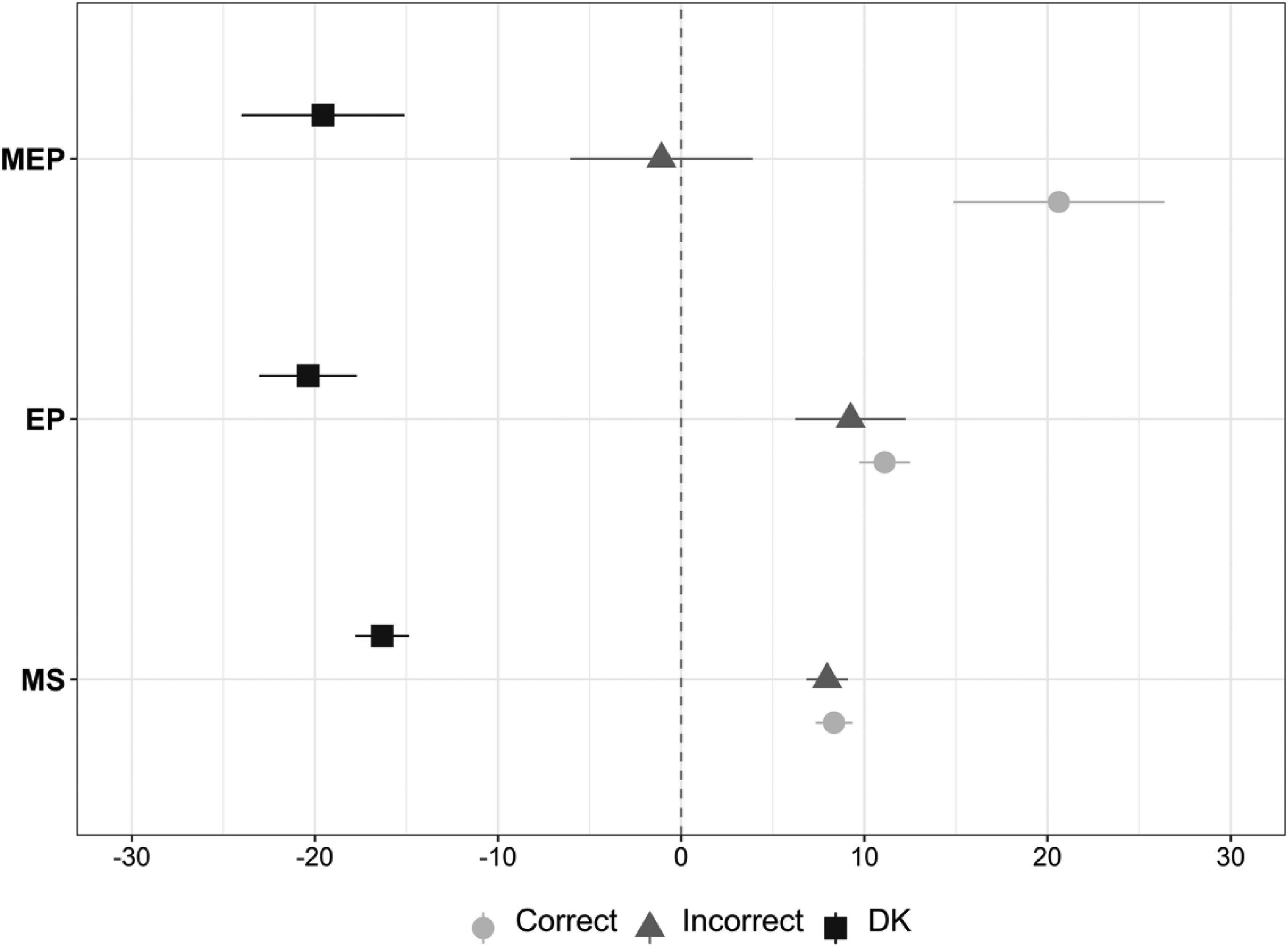
Marginal effect of political interest on EU authority perceptions.
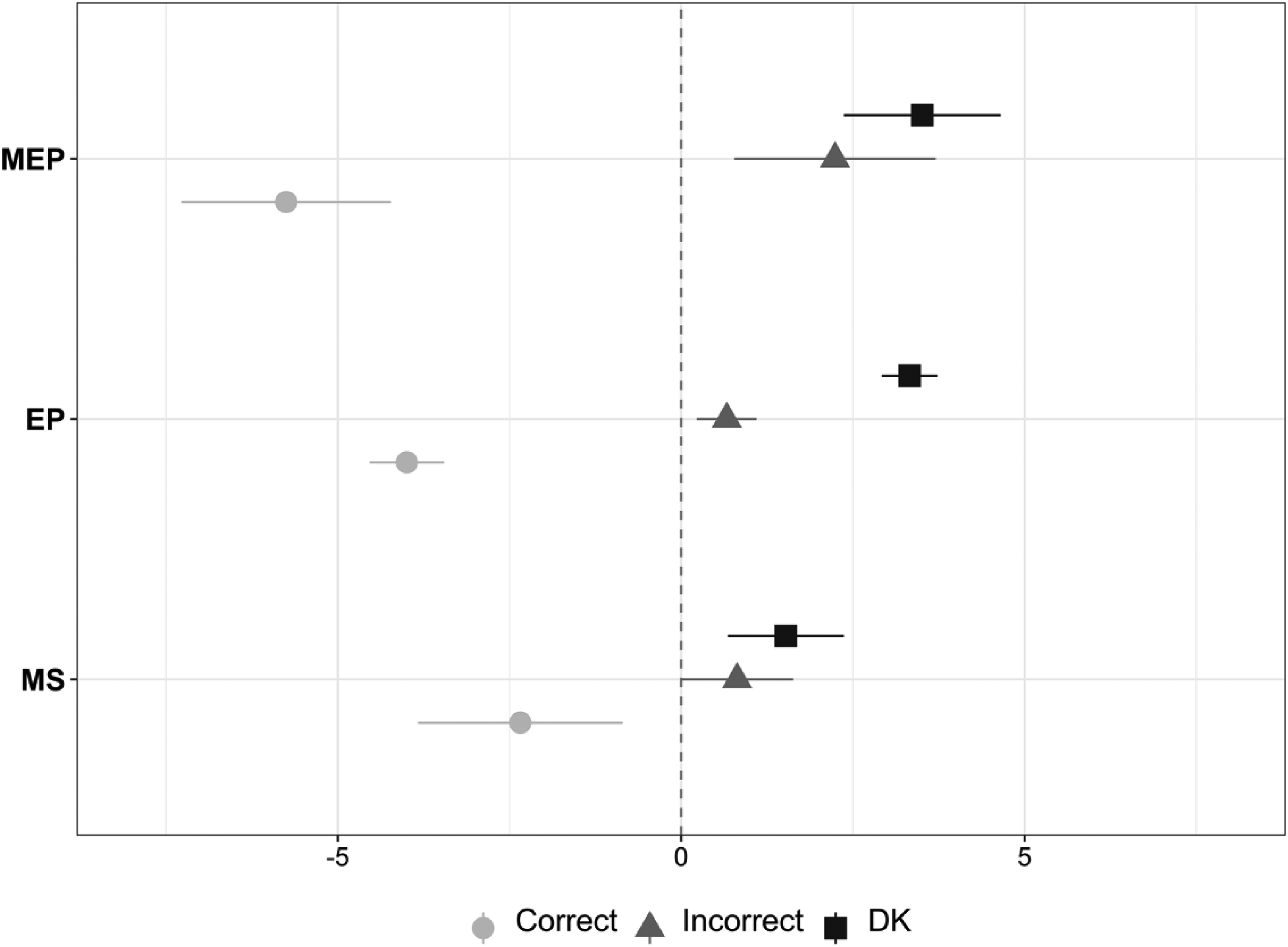
Marginal effect of exclusive national identity on EU authority perceptions.
Multinomial probit regression results (EU authority perceptions).
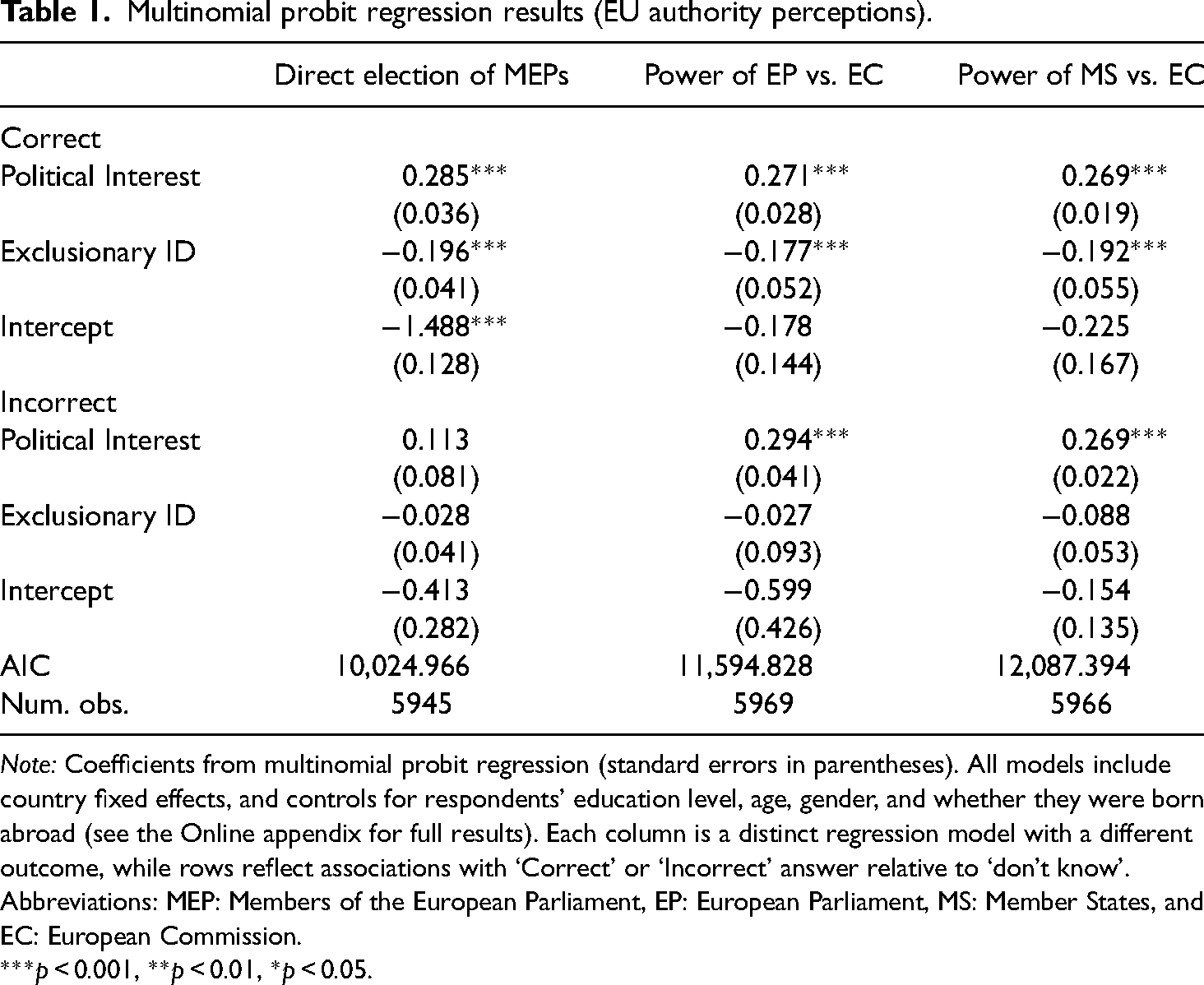
Note: Coefficients from multinomial probit regression (standard errors in parentheses). All models include country fixed effects, and controls for respondents’ education level, age, gender, and whether they were born abroad (see the Online appendix for full results). Each column is a distinct regression model with a different outcome, while rows reflect associations with ‘Correct’ or ‘Incorrect’ answer relative to ‘don’t know’. Abbreviations: MEP: Members of the European Parliament, EP: European Parliament, MS: Member States, and EC: European Commission.
***p < 0.001, **p < 0.01, *p < 0.05.
Results
When it comes to understanding EU political authority, substantial portions of the public in our six countries are either uninformed or misinformed. We pooled respondents from all countries, and we observe that 19% of our respondents hold the misperception that MEPs are not directly elected, while the remaining 21% answered ‘don’t know’. Concerning whether the EC can pass laws over the objection of the EP, 22% of respondents say they can, while 27% of the respondents selected the ‘don’t know’ category. Finally, only 35% of respondents correctly said that the EC cannot pass laws against the will of the member states of the EU, whereas 40% of respondents hold a misperception and another 25% of respondents chose ‘don’t know’. 9
Multivariate analyses
We present multinomial probit analyses that examine the association between political interest and exclusionary versus inclusive identities with citizens’ perceptions of the authority of the EU. To examine these patterns in detail, we first discuss the multinomial probit models displayed in Table 1. The coefficients in Table 1 depict how our independent variables affect the relative likelihood of a respondent holding a correct perception as opposed to answering ‘don’t know’, as well as the relative likelihood of holding a misperception rather than answering ‘don’t know’.
We begin with political interest. As Table 1 demonstrates, higher levels of interest in politics are related to a higher relative likelihood for a respondent to give a correct response rather than responding ‘don’t know’, which we observe across all three outcome variables. We also find that political interest is related to a higher relative likelihood for a respondent to give an incorrect response rather than providing no response at all when it comes to citizens’ perceptions of the authority of the EP (b = .294, p < .001), and citizens’ perceptions of the power of the EC vis-à-vis the member states of the EU (b = .269, p < .001). However, the effect of political interest is not statistically significant when it comes to citizen perceptions regarding the direct election of MEPs. Even so, this is fairly strong and consistent evidence in favour of H1.
The association between identities – whether exclusionary or inclusive – and perceptions of political authority is markedly different than that of political interest. Citizens with an exclusionary identity are less likely to correctly perceive that MEPs are directly elected by voters (B = −.196, p < .001). Notably, the effect of exclusionary identity is consistent across the remaining outcomes. Citizens with an exclusionary identity have a lower relative likelihood of correctly perceiving that legislation needs to be approved by a majority of MEPs in order for it to become law (B = −.177, p < .001). Likewise, those with an exclusionary identity have a lower relative likelihood of correctly perceiving that EU legislation cannot be passed against the will of a majority of member states (B = −.192, p < .001). Table 1 also indicates that exclusionary identity does not predict whether respondents are more likely to exhibit incorrect perceptions of the EU's political authority than they are to reply ‘don’t know’. Put differently, across the three outcomes, identity differentiates those who have correct perceptions from all others, i.e., those who hold misperceptions or those who are uninformed. An exclusively national identity makes it less likely for people to hold correct perceptions, but it does not differentiate those who hold misperceptions from those who are uninformed.
To more clearly demonstrate how an increase in an independent variable is associated with a respondents’ absolute probability of being in a specific response category, we calculate how the effects balance out once all three outcomes are considered. Our predicted probability plots provide this information; Figures 1 and 2 graph the marginal effect of a change in political interest and (exclusive) national identity (respectively) on the probability of an individual falling into one of the three categories of the dependent variables.
Figure 1 depicts the marginal effect on each predicted probability when interest in politics changes from two standard deviations below the mean to two standard deviations above the mean. Overall, we find that interest in politics decreases the probability of respondents not having a perception at all. At the same time, interest in politics increases the probability of respondents holding a correct perception and holding an incorrect perception. The results are consistent and statistically significant across outcomes, except in the case of one outcome category. Interest in politics does not affect the probability of respondents to have an incorrect view of MEPs in the EU.
Next, Figure 2 graphs how the difference between exclusionary and inclusive identity affects each probability. Consistent with H2, we find that exclusionary identity – relative to inclusive identity – decreases the probability for respondents to hold a correct perception of the authority of the EU. Exclusionary identity increases the probability for respondents to misperceive the authority of the EU and the probability to report no answer. All of these marginal effects are statistically significant (p < .05).
In sum, we find broad support for our hypotheses. Interest in politics helps us understand whether respondents report a substantive answer to survey questions about political authority within the EU rather than saying ‘don’t know’. We also expected exclusionary and inclusive identity to shape if citizens hold correct perceptions of the EU and if they hold misperceptions. Critically, we find that respondents who think of their identities in a narrow, national way portray the EU as an organisation with more unrestricted powers. Citizens who only identify with their nation and who do not also identify as Europeans are more likely to hold misperceptions when it comes to the authority of the EU: for instance, these respondents believe that MEPs are not directly elected as well as that the EC can rule over the EP and EU member states. The takeaway is that an exclusionary national identity makes it less likely for respondents to hold correct perceptions of the EU.
As a set of placebo tests, we also examine citizen perceptions of issues that are likely unrelated to perceptions of political authority within the EU. We do this by examining citizen perceptions of non-polarising issues at the supranational level, as well as citizen perceptions of issues at the national level. Our reasoning behind these placebo tests is that political interest as well as identities predict citizen perceptions of issues that citizens are likely to see in a biased fashion (i.e., political authority). As such, our measures of political interest and identity should not predict citizen attitudes to a host of issues where biased information processing or biased group processes are unlikely to shape mass opinion. The results of our placebo tests are presented below in Table 2.
Multinomial probit regression results (non-authority related EU knowledge and national-level knowledge).
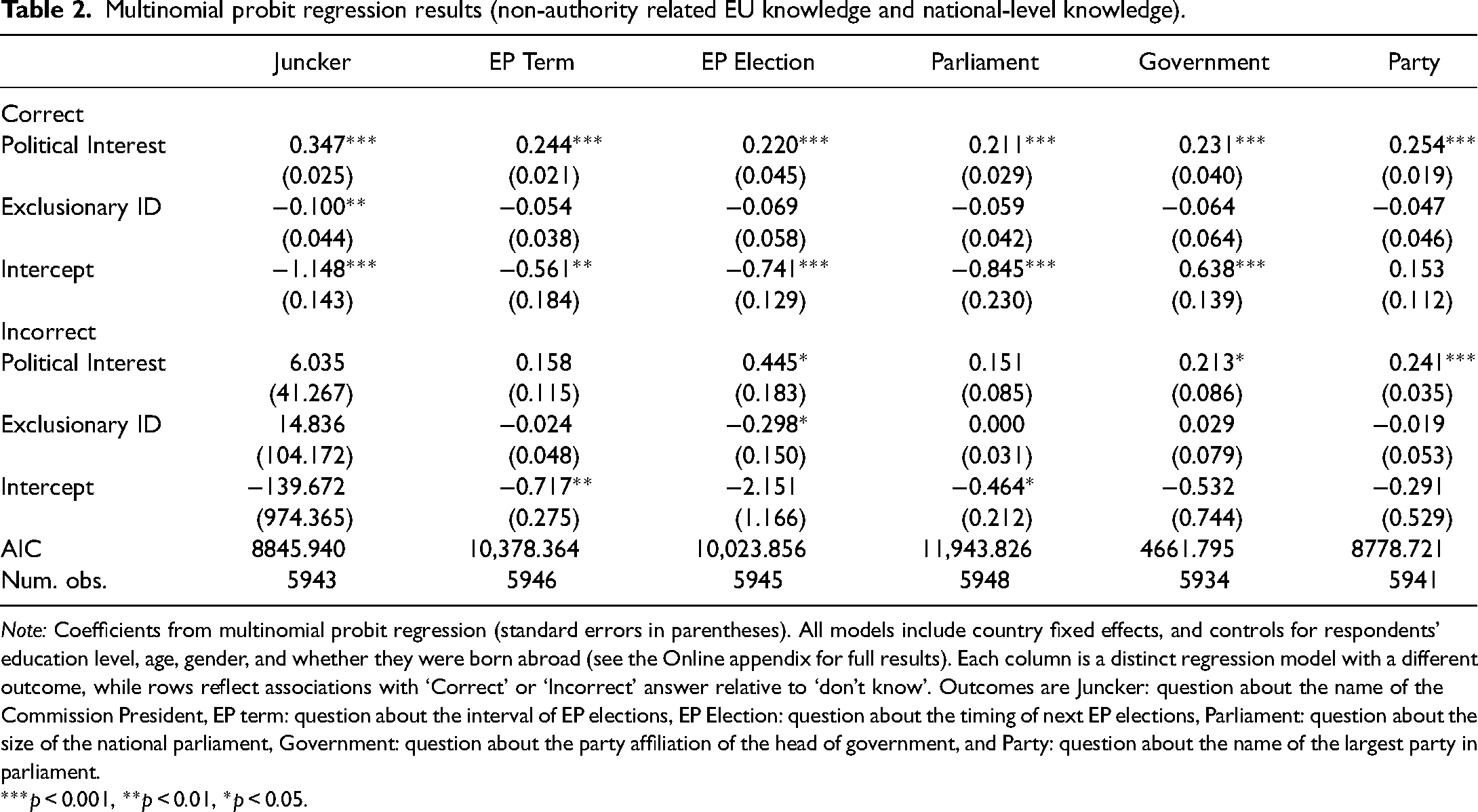
Note: Coefficients from multinomial probit regression (standard errors in parentheses). All models include country fixed effects, and controls for respondents’ education level, age, gender, and whether they were born abroad (see the Online appendix for full results). Each column is a distinct regression model with a different outcome, while rows reflect associations with ‘Correct’ or ‘Incorrect’ answer relative to ‘don’t know’. Outcomes are Juncker: question about the name of the Commission President, EP term: question about the interval of EP elections, EP Election: question about the timing of next EP elections, Parliament: question about the size of the national parliament, Government: question about the party affiliation of the head of government, and Party: question about the name of the largest party in parliament.
***p < 0.001, **p < 0.01, *p < 0.05.
First, we expect that exclusionary or inclusive identities will not bias citizens’ perceptions of issues that are unrelated to the political authority of the EU. To test this expectation, we use the same set of predictors as in Table 1, with politically neutral surveillance knowledge questions at the EU and national levels as (placebo) outcomes. EU-level questions are: (a) whether citizens are able to identify the president of the EC; (b) whether citizens know the interval length between EP elections; and (c) whether citizens know the month in which the upcoming EP election is to be held (see Online appendix for question wording). As shown in Table 2, the results support our expectation – exclusionary identities do not predict whether citizens hold incorrect beliefs on non-authority related EU issues, unlike the previous results with issues around EU authority.
Similarly, we do not expect national identities to predict whether citizens hold incorrect beliefs about (non-EU) national level knowledge. Our national-level knowledge questions are: (a) whether citizens know the size of their national parliament; (b) whether citizens know the identity of their head of government; and (c) whether citizens know which party has the most seats in their national parliament. As indicated by Table 2, exclusionary identity is not associated with our outcome measures. We infer that the role of national identity is therefore specific to political authority within the EU specifically, and not a broader range of issues with more tenuous theoretical connections to perceptions of political authority within multi-level systems. As such, our results show that exclusionary and inclusive identities are not capturing general differences in knowledge, nor any different propensities for acceptance of accurate beliefs, but instead reflect a specific divergent set of (polarising) beliefs around the political authority of the EU.
Robustness tests
We conducted a series of robustness checks, with full details available in the Online appendix. First, we introduce controls for left-right ideology and partisan attachment (the ideological family of the parties), subjective political knowledge, and cognitive reflection (CRT). None of these variables substantively change the main results. We additionally control for EU attitudes (measured in two different ways) and general political knowledge, and again our conclusions are unaltered. Taken as a whole, these robustness tests help show that the effects of identity and political interest are not a result of differences in EU attitudes or broader political knowledge. Instead, these results help support our contention that identity has pride of place as an explanatory factor when it comes to beliefs about political authority of the EU. These additional tests also confirm the underlying logic of the political interest results, also supported by the placebo results above: it is based on a general propensity to express political views, regardless of their nature, and is not confounded by broader levels of knowledge, ideology, partisanship, or cognitive ability and views about the EU. To further highlight the robustness of our results, we include country-by-country analyses of our three main outcomes in the Online appendix, which demonstrate the general stability of our results across the different country samples.
Discussion
In this article, we examine the extent to which citizens of six EU member states are able to accurately answer survey questions about the political authority of the EU. We advance the scholarship by demonstrating that citizens’ proclivity to search for and identify factual information (i.e., their levels of political interest), as well as their group serving biases (i.e., their exclusionary and inclusive national identities) play a vital role in understanding why some hold inaccurate perceptions about the exercise of political authority within the EU.
Our analysis uncovers several important findings. First, even though the EU is a complex political system, we find that knowledge about the EU is a mixed bag. On some issues, the public is reasonably well-informed whereas on others there are high levels of both uninformed and misinformed respondents.
Second, we find that citizens with more interest in politics are more likely to express factual beliefs when it comes to the authority of the EU. However, what we find is that interest in politics does not differentiate those with correct and incorrect perceptions very much from one another, but it sets these groups of respondents apart from individuals who have no views on the matter.
Third, and consistent with our hypotheses, we find evidence that citizens’ exclusionary and inclusive identities predict whether they hold correct or incorrect perceptions about the political authority of the EU. This finding is consistent with the work of Hobolt and Tilley (2014), who note that it is citizens’ relative attachment to the EU (as opposed to their partisan identities) which creates a group-serving bias when it comes to Europe. Our results indicate that citizens who only identify with their nation are more likely to hold misperceptions when it comes to the authority of the EU.
Our findings speak to existing debates about a democratic deficit in the EU. One side in this debate argues that decision-making in Brussels is not sufficiently democratic, especially when compared to decision making structures at the national level. What our results uncover is that even the existing channels of legitimation are not known to much more than around 50% of voters. Moreover, precisely those who do not hold a European identity are more likely to misperceive the EU as more undemocratic than it actually is. This does not necessarily mean that the institutional structure of the EU is or is not sufficiently democratic. Still, the public discourse could consider that decision-making in Brussels is not as undemocratic as some citizens believe. Relatedly, our findings help elucidate the rhetorical value of ‘taking back control’ from Brussels. Indeed, to voters who believe that the EC can legislate against the will of a majority of MEPs or member states, European integration is likely to appear like an absolute loss of the sovereignty of the general will, rather than just a transfer of authority to another level.
Our identity centered approach is an attempt to try and think about how to unravel the murky causal relationships connecting knowledge with broader EU attitudes. Indeed, other work finds that low political knowledge is associated with lower levels of institutional trust (Harteveld et al., 2013) and participation in EU elections (De Vreese and Boomgaarden, 2006). But the causal direction between these – or whether a confounder is responsible for both – is difficult to parse out. Of course, our use of cross-sectional data does not by itself alleviate concerns related to causal direction. While experiments can be used to gain leverage on causal effects, using this approach is particularly difficult in a setting like this because randomly assigning national and European identities is difficult to impossible in survey settings. Thus, theory needs to guide model specification and interpretation, while remaining mindful of the possibility that the causal direction might be reversed. We cannot conclusively answer whether group serving biases such as identities shape misperceptions or whether the inverse is true (i.e., that misperceptions shape identities). However, scholarship consistently privileges the role of identities as the screen through which citizens consume information and interpret the political world, providing some reason to assume that identities are causally prior to perceptions of a political object (Campbell et al., 1960). Notwithstanding, more recent work finds that citizens may change their identities in order to better align with their political preferences (Egan, 2020). In this respect, citizens might see the EU as encroaching on the sovereignty of nation states, which, in turn, could reduce their identification with Europe.
Nonetheless, we complement prior work on misperceptions about the EU in a few key ways. We focus on beliefs regarding authority, a concept at the heart of EU support. By understanding these perceptions through the RAS model, we can account for the roles of both political interest and identity. In examining response and non-response as a function of interest, we are able to describe the proportions of the public who are not only informed and misinformed, but also those who are uninformed. Finally, we examine the direction of bias as a function of identity. Although we do not manipulate identity in an experimental setting, a set of placebo tests helps strengthen the notion that these outcomes are shaped by a respondent's exclusionary or inclusive national identity.
Supplemental Material
sj-pdf-1-eup-10.1177_14651165231193833 - Supplemental material for Public perceptions and misperceptions of political authority in the European Union
Supplemental material, sj-pdf-1-eup-10.1177_14651165231193833 for Public perceptions and misperceptions of political authority in the European Union by Florian Stoeckel, Vittorio Mérola, Jack Thompson, Benjamin Lyons and Jason Reifler in European Union Politics
Supplemental Material
sj-dta-2-eup-10.1177_14651165231193833 - Supplemental material for Public perceptions and misperceptions of political authority in the European Union
Supplemental material, sj-dta-2-eup-10.1177_14651165231193833 for Public perceptions and misperceptions of political authority in the European Union by Florian Stoeckel, Vittorio Mérola, Jack Thompson, Benjamin Lyons and Jason Reifler in European Union Politics
Supplemental Material
sj-r-3-eup-10.1177_14651165231193833 - Supplemental material for Public perceptions and misperceptions of political authority in the European Union
Supplemental material, sj-r-3-eup-10.1177_14651165231193833 for Public perceptions and misperceptions of political authority in the European Union by Florian Stoeckel, Vittorio Mérola, Jack Thompson, Benjamin Lyons and Jason Reifler in European Union Politics
Footnotes
Funding
The author(s) disclosed receipt of the following financial support for the research, authorship, and/or publication of this article: Jason Reifler received funding from the European Research Council under the European Union’s Horizon 2020 research and innovation program (grant agreement No. 682758).

Supplemental material
Supplemental material is available for this article online.
Notes
References
Supplementary Material
Please find the following supplemental material available below.
For Open Access articles published under a Creative Commons License, all supplemental material carries the same license as the article it is associated with.
For non-Open Access articles published, all supplemental material carries a non-exclusive license, and permission requests for re-use of supplemental material or any part of supplemental material shall be sent directly to the copyright owner as specified in the copyright notice associated with the article.
