




Abstract
National identification strength is a key Euroscepticism driver. We examine how politicians’ framing of immigration policies increases the salience of different national identity representations and its relationship with support for the European Union (EU) in a two-waves between-subject survey-experiment using French and German samples. As predicted, exposure to assimilation frames (directly for the French sample or via frame perception for both samples) increased the salience of ethnocultural national identity representations. Additionally, as hypothesised, higher ethnocultural representations salience following assimilation frames exposure was related to higher Euroscepticism. However, feeling emotionally attached to the EU reduced this negative impact of ethnocultural national identity representations on EU attitudes. We discuss the role of ethnocultural nationalism in Euroscepticism and the importance of fostering stronger emotional ties to the EU.
Keywords
In June 2016, the United Kingdom (UK) voted to leave the European Union (EU or Union) in what became known in the media as Brexit. After a campaign where the issue of immigration was highly salient, the UK Independence Party (UKIP) and the anti-EU factions of the Conservative Party were able to turn fears over national-identity loss and immigration into anti-EU votes (Goodwin and Milazzo, 2017). Also in the rest of Europe, political elites and the media have conflated nationalism and immigration concerns in their discourses on the EU almost since the inception of the Union (Lesińska, 2014). Thus, the Brexit campaign was the highest point in a long trend of framing EU admission policies in assimilation terms that emphasise the threat that the admission of immigrants and refugees poses to national cultures, norms and values. In this sense, Brexit laid bare how framing immigration and asylum in identity-related terms promotes national identity salience in ways that increase Euroscepticism – defined as a range of critical positions or outright opposition towards the EU (Taggart and Szczerbiak, 2001).
In light of these events, understanding how the use of identity-related frames – frequent among EU politicians (Helbling, 2012) – affects Euroscepticism is crucial. This study aims to expand this area of research through an experiment that investigates how exposure to assimilation versus multicultural frames (used by politicians in a real electoral campaign) is related to individual Euroscepticism. Specifically, we examine three crucial aspects of anti-EU sentiment: opposition to EU integration, identification with the EU, and the intention to vote to leave the EU.
We test the effects of exposure to identity-related frames across three treatment conditions: two non-competitive ones where participants are exposed to either assimilation or multicultural frames, and a third competitive condition where – resembling a real-life campaign setting – participants are exposed to both frames simultaneously (Matthes and Schemer, 2012).
France and Germany are the two largest EU economies; their exit from the Union would have devastating consequences on its continuity. It follows that public support for the EU in these countries is paramount to its stability. As the use of assimilation and multicultural frames in media and political discourses increases in both countries (Helbling, 2012), this study investigates how exposure to these identity-related frames affects EU attitudes among French and German citizens.
In support of our hypotheses, exposure to assimilation frames (directly for the French sample or via frame perception for both samples) increased the salience of ethnocultural national identity representations. Additionally, as hypothesised, higher ethnocultural representations salience following assimilation frames exposure was related to higher Euroscepticism. However, feeling emotionally attached to the EU reduced this negative impact of ethnocultural national identity representations on EU attitudes. At the outset, we discuss the role of ethnocultural nationalism in Euroscepticism and the importance of fostering stronger emotional ties to the EU.
Identity-related framing effects
Entman (1993: 52) defined framing in communication as selecting some aspects of a certain issue and rendering them more salient in a message to promote a given “problem definition, causal interpretation, moral evaluation, and/or treatment recommendation”. A framing effect occurs when a communication frame influences individuals’ frames in thought, or their understanding of which are the most salient aspects of an issue, impacting subsequent attitudes and behaviours (Chong and Druckman, 2010). We define identity-related frames as those that emphasise the importance of shared social identities, values and norms (Habermas, 1993). Accordingly, identity-related framing effects are those resulting from exposure to these frames.
Over the past decades, two identity-related frames in particular – assimilation and multicultural – have been increasingly used in debates about immigration and asylum in the EU (Helbling, 2012). Assimilation frames emphasise that ethnic minorities need to adopt the national culture, norms and values to minimise intergroup distinction (Lecheler et al., 2015). These frames often refer to the importance of integration as the only viable solution to the problem that cultural diversity poses to the nation. Multicultural frames, conversely, present cultural diversity as an asset and biculturalism as an inalienable right of minorities living in the country (Vliegenthart and Roggeband, 2007).
Helbling (2012) compared the use of assimilation and multicultural frames in six EU countries in two different periods from 1999 to 2001 and 2004 to 2006. Across countries, the author observed a slight reduction in multicultural frames but a considerable increase in assimilation frames. Furthermore, while the use of multicultural frames was similar in France and Germany, assimilation frames were used significantly more often in the former than the latter. However, while a handful of studies have focused on the effect of news on EU attitudes (e.g., Brosius et al., 2019; Harteveld et al., 2018; Rooduijn et al., 2021), we were unable to identify any studies on the effects of assimilation and multicultural frames on Euroscepticism.
National identity representations and Euroscepticism
Until the 2000s, Euroscepticism was explained by hard factors such as economic self-interest and labour market position (e.g., Eichenberg and Dalton, 1993; Gabel and Whitten, 1997. For more recent studies, see Foster and Frieden, 2021; Jurado, 2022). At the turn of the new millennium, research began exploring the role of soft factors such as national identity and cultural allegiances (de Vreese et al., 2008; de Vreese and Boomgaarden, 2005). In a seminal study in this new line of research, McLaren (2002) proposed that, when faced with the (perceived) cultural threat derived from increased European integration and national sovereignty loss, national attachment triggers ingroup protection and, consequently, higher Euroscepticism (Clark and Rohrschneider, 2019). Other authors also support the assertion that Euroscepticism is positively associated with how close people feel to their nation (Carey, 2002; Luedtke, 2005).
However, depending on their content, national identities can be more inclusive or exclusive. Accordingly, Hooghe and Marks’ (2004, 2005) seminal studies revealed that the salience of more inclusive versus exclusive national identities went along with higher support for the EU. More recently, Plescia et al. (2021) showed that more exclusive national identities limited the positive impact of voting for a winning party in an EU election on satisfaction with EU democracy. Other studies also concluded that the impact of national identity salience on attitudes depends on how national identity is defined or represented (Pehrson et al., 2009). For instance, Aichholzer et al. (2021) found that national identity was not automatically associated with anti-EU attitudes, but this relationship depended on how national identity was conceptualised. Similarly, studies revealed that strongly identifying with exclusionary (versus inclusive) national identities influenced outgroup prejudice, preference for restrictive immigration and asylum policies, and voting for more conservative parties (e.g., Citrin and Wright, 2009; Cossette-Lefebvre and Daoust, 2020; Reijerse et al., 2015). Taken together, these studies suggest that national identity strength alone does not explain attitude outcomes, but national identity content or representations play a cardinal role.
National identity representations (henceforward, NIR) are subjective criteria that individuals apply to categorise themselves and others as national ingroup members (Pehrson et al., 2009). Commonly, NIR are classified into ethnic and civic (Pehrson et al., 2009). Ethnic NIR are grounded on an understanding of the nation as a community of shared ancestry and ethnicity (Mepham and Verkuyten, 2017). Consequently, ethnic NIR define national membership based on ascribed characteristics (e.g., having native parents). Conversely, civic NIR depart from the notion that the nation is “a community of people who inhabit a common territory and are citizens of the same state – with identical political, legal, and social rights and obligations” (Nieguth, 1999: 158). Thus, civic national identity is based on adherence to the political institutions and values of the nation-state.
However, some authors have theoretically decoupled the ethnic dimension from a cultural dimension based on shared customs and traditions (Nieguth, 1999; Shulman, 2002). Accordingly, this tripartite classification found some empirical support (Reijerse et al., 2013, 2015). Conversely, other authors propose an ethnocultural dimension composed of both ethnic and cultural elements, with most empirical research supporting this bidimensional – ethnocultural and civic – classification (Cossette-Lefebvre and Daoust, 2020; Reeskens and Hooghe, 2010; Violante et al., 2020). In this study, we adopt the broader ethnic, cultural and civic classification in our theoretical models but we use the available data to test whether there are two or three NIR dimensions.
EU integration – defined as the process of increasing cooperation and shared decision-making, laws and institutions among EU members (Carey, 2002; Luedtke, 2005) – threatens to blur or even obliterate cultural and communitarian boundaries (Kriesi and Lachat, 2004). Therefore, we can expect that assigning more importance to cultural NIR will be related to higher opposition to EU integration. Likewise, we can expect that cultural NIR will hamper EU identification – an important driver of support for the EU (Boomgaarden et al., 2011) – and increase the likelihood of people voting to leave the EU.
Taken together, we postulate that identity-related frames influence EU attitudes not by increasing national identity strength, but by increasing NIR salience.
H1: Because assimilation frames emphasise the importance of cultural homogeneity for social peace and cohesion, we expect that exposure to assimilation versus multicultural frames will increase cultural NIR salience. In turn, cultural NIR salience will be related to higher opposition to EU integration, lower EU identification, and higher EU-leave voting intention.
Additionally, studies showed that the extent to which people are emotionally attached to the nation versus to the EU influenced Euroscepticism (Clark and Rohrschneider, 2021). Other studies also found that NIR salience effects on attitudes depended on how strongly people identified with their nation (Aichholzer et al., 2021).
RQ1: We explore if the extent to which people feel emotionally attached to their nation (or national attachment) and the EU (or EU attachment) – as two separate variables – moderates the relationship between NIR salience and EU attitudes hypothesised in H1. 1
In the public arena, frames often coexist – and, thus, compete – with other frames. This is particularly true in an electoral competition where different parties bring their policy proposals to the public (Chong and Druckman, 2007a). Studies revealed that, in a competitive framing environment where people are exposed to several competing frames, these cancelled each other out (Chong and Druckman, 2010), or the persuasively stronger frame prevailed (Coronel et al., 2020). Alternatively, other studies suggested that people tended to choose the frame consistent with their prior attitudes and beliefs (Haider-Markel and Joslyn, 2001). We examine how exposure to identity-related frames affects NIR salience in a competitive framing environment by introducing, in addition to the two non-competitive conditions where participants are exposed to only one of these frames, a third competitive condition where participants are exposed to both frames simultaneously. 2
Frames can exert their effects on attitudes through their content (i.e., the considerations emphasised by a frame) or their valence (i.e., the extent to which a frame advances a positive or negative stance in relation to an issue) (de Vreese and Boomgaarden, 2003). Furthermore, valence effects are often independent – and, sometimes, different from – those derived from frame content (Bos et al., 2016). Thus, research presents frame content and valence as two separate (and objective) frame attributes through which frames exert their effects. However, individual perception of frame content and valence can be affected by biased cognitive processes, peripheral cues and other individual and contextual factors (Igartua, 2013; von Sikorski and Schierl, 2012), impacting subsequent framing effects.
Still, most studies overlook this essential aspect of framing effects by only focusing on objective frame content and valence, and neglecting the extent to which individual variation in frame perception plays a role in identity-related framing effects on attitudes. Conversely, we depart from the assumption that framing effects are a cognitive phenomenon in which the way people understand and process the frame (i.e., frames in thought) will have a role in the relationship between exposure to objective frame content and valence and subsequent attitudes (Bogado et al., 2023).
RQ2: We explore if variation in perceived frame content and valence play a role in identity-related framing effects on NIR salience or whether these effects are driven only by exposure to objective frame content and valence.
Figure 1 summarises the proposed theoretical model.
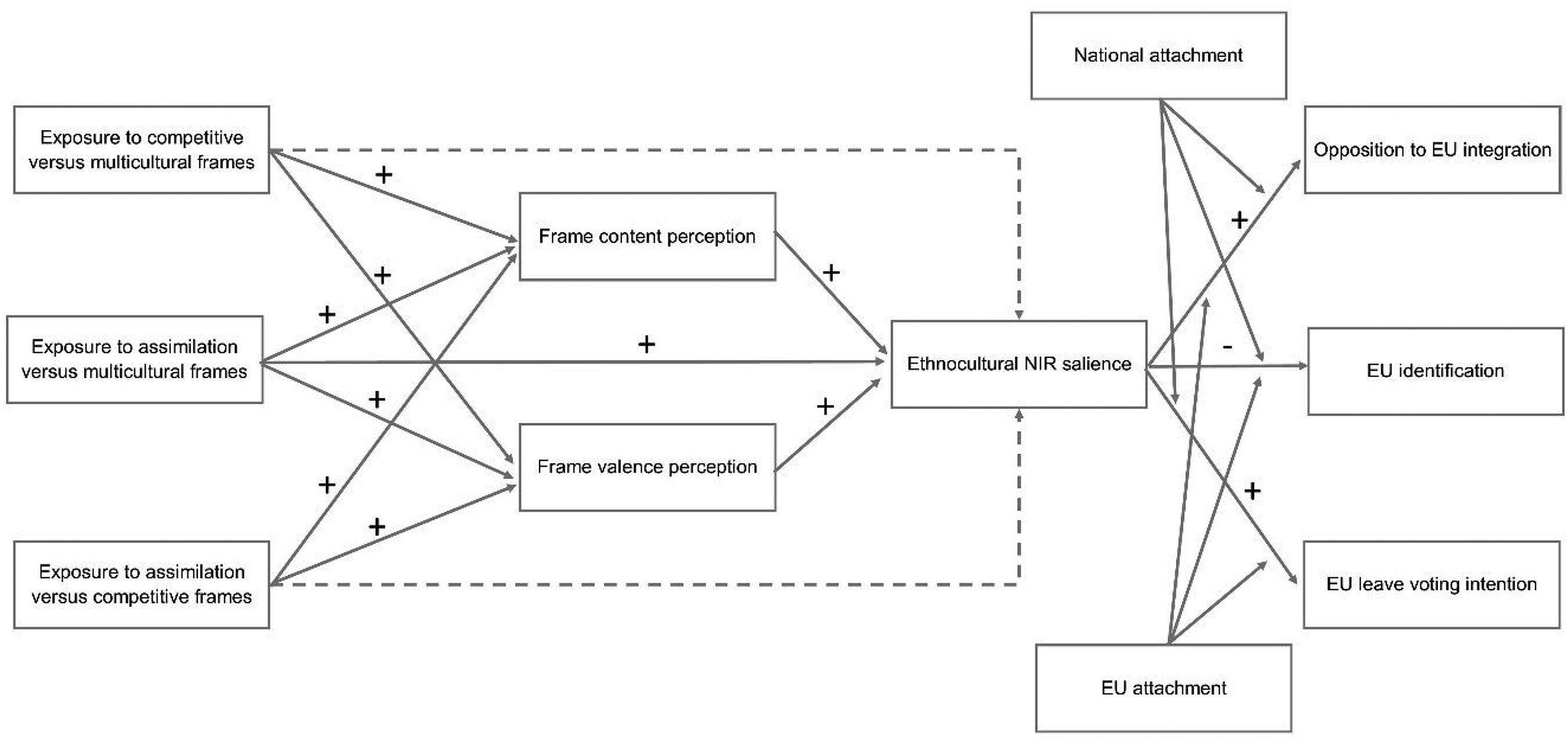
Theoretical model.
Finally, experimental research on media effects often uses samples recruited in different countries to test the assumption that the different social, cultural and historical contexts from where the samples are drawn will influence the observed effects (e.g., Esses et al., 2006). However, while contextual factors may affect media effects to some extent, framing effects remain a cognitive process driven by changes in the weight people assign to different considerations – or the introduction of new considerations – impacting attitude formation (Nelson et al., 1997).
Departing from this assumption, we predict that identity-related framing effects will result from frames increasing NIR salience in attitude formation, and this cognitive process will be consistent for both French and German participants. We test this assumption in a 3 (frame condition: assimilation; multicultural; competitive) x 2 (sample: French; German) factorial design. Where any sample differences in identity-related framing effects emerge, we analyse them comparatively and use the available data to identify the factors (i.e., significant differences in sample characteristics) driving them.
Method
We conducted an online experiment. We randomly assigned participants to one of three framing conditions: a) assimilation, b) multicultural, and c) competitive (exposure to both assimilation and multicultural frames simultaneously). We collected data in two waves approximately two weeks apart, between April and May 2021, in France and Germany. 3
Participants
We used the same online-access-panel company (respondi) to recruit 649 participants in France (914 in Wave 1) and 605 in Germany (872 in Wave 1). To increase sample quality, we removed participants who answered too fast (n = 153) (Leiner, 2019), resulting in N = 1101 (France = 569; Germany = 532). Since we took an experimental approach, we did not use a representative sample and, consequently, did not apply quotas. However, because of the characteristics of our study, we only included participants who are citizens (in their respective countries) over the age of 18 and eligible to vote in their country of citizenship. Across the two samples, 42% of participants identified as female and 53.7% as male (4.3% non-responses), and the average age was 54.24 (SD = 14.08). There were no significant differences by condition for age (F(2, 1050) = .24, p = .783), gender (X2(2, 1053) = 2.01, p = .366), or education level (X2(16, 1053) = 16.65, p = .408). Similarly, there were no significant differences between the French and German samples for age (F(1, 1051) = .05, p = .827) or gender (X2(1, 1053) = 2.12, p = .145) in line with the reasonable expectation that samples drawn from the same paid panel are socio-demographically similar. 4
Procedure
In Wave 1, participants answered questions about their EU identification, attitudes towards EU integration, EU-leave voting intention, EU and national attachment, NIR salience and sociodemographic information, among other supplementary variables (see the Online appendix). In Wave 2, participants read four EU election pledges on immigration and asylum policy from real party manifestos from the 2019 European Parliament Election. Participants were explained that the pledges were real, but no references to any specific party were made to avoid party preferences influencing treatment outcomes.
Participants in the multicultural condition (n = 371; French = 192; German = 179) read four election pledges that framed EU immigration and asylum policy in multicultural terms (e.g., “We welcome cultural diversity and want to make Europe a safe place for all”). In the assimilation condition (n = 368; French = 185; German = 183), participants read four election pledges framing immigration and asylum into the EU in assimilation terms (e.g., “We must protect our European way of life by preserving our Christian values and fundamental principles, which are being threatened by unconditional immigration”). In the competitive condition (n = 362; French = 192; German = 170), participants were presented with two multicultural and two assimilation election pledges (see the Online appendix).
After treatment, participants answered questions about frame content perception, NIR salience, EU identification, EU integration attitudes, EU-leaving voting intentions, EU and national attachment, and frame valence perception (among other variables). Respondents were then debriefed.
To maximise external validity we used pledges from an actual election campaign (see, e.g., Adam and Maier, 2011; Maier et al., 2012). At the same time, we ensured the study's internal validity by including frame perception as a variable to show that participants’ perception that the pledges framed immigration policies in either assimilation or multicultural terms – and not any other message aspect or confound – drove the observed effects.
Variables
To measure NIR salience, we used items from the ISSP 2013 National Identity III Survey, Eurobarometer 88.2 and European Social Survey (ESS) that assess, on a scale from 1 (not important at all) to 7 (very important), the importance people assign to different criteria in deciding who is truly a national member. We chose these items for their availability in French and German and extensive use in different cultural and social contexts. We measured this variable along three theoretical dimensions – ethnic, cultural, and civic – using items for each dimension according to their theoretical definition (i.e., “To have [national] ancestry” for ethnic; “To participate in a club or association” for cultural; and “To speak [national language]” for civic).
We validated our preregistered NIR salience scale using exploratory factor analysis (EFA). Notably, the data did not confirm the predicted civic, cultural and ethnic dimensions. Instead, results were in line with a two-dimensional – civic and ethnocultural – NIR structure (see the Online appendix). A similar factor structure emerged when we analysed this scale for each sample separately (other studies reported similar findings, i.e., Cossette-Lefebvre and Daoust, 2020; Reeskens and Hooghe, 2010; Violante et al., 2020). Consequently, we used an ethnocultural NIR scale (in place of the pre-registered cultural scale) composed of five items averaged into a single score (Wave 1 Cronbach's α = .79; Wave 2 Cronbach's α = .82).
Unless explicitly mentioned, all other variables in this study were measured using a scale from 1 (completely disagree) to 7 (completely agree) and averaged into a single score. We measured opposition to EU integration – from low to high – using seven items (i.e., “I am against more decision/policy making at EU level”) taken from Carey (2002) and Boomgaarden et al. (2011) (Wave 1 Cronbach's α = .83; Wave 2 Cronbach's α = .86). 5 EU identification was measured using two items (after one item from the preregistered scale was removed due to low reliability) taken from the 2018 ESS (i.e., “The EU flag means a lot to me”, Wave 1 Cronbach's α = .88; Wave 2 Cronbach's α = .86). Higher scores indicate stronger EU identification.
We measured EU-leave voting intention using an item taken from the 2019 European Parliament Election Voter Study asking participants if, in the case of a referendum to leave the EU, they would vote in favour, against or abstain. We included the “abstain” option to avoid forcing participants to report a defined voting intention. However, to test our hypotheses regarding EU-leave voting intention, we excluded “abstain” responses (n = 106) (see Dennison et al., 2021). We coded the remaining responses as “Remain = 1”, “Leave = 2”. 6
We measured national attachment using a single item (“How strongly do you feel emotionally attached to [country]?”) taken from the 2018 ESS inquiring, on a scale from 1 (not attached) to 11 (very attached). On the same scale, we used a single item (“How strongly do you feel emotionally attached to the European Union?”) to measure EU attachment.
Finally, we measured frame content perception (or the extent to which participants perceived the frame as either multicultural or assimilationist) by asking participants, on a scale from 1 (not at all) to 7 (very strongly), whether they think the pledges emphasised, for instance, that “Cultural diversity is a problem for the integrity of Europe”, among other items (Cronbach's α = .74). Higher scores indicate perceiving the frame as more assimilationist (versus multicultural). For frame valence perception, additional items (such as ‘Immigrants make the EU a worse place to live’) inquired, on the same scale, the extent to which participants perceived the article as advancing a negative or a positive stance towards immigration (Cronbach's α = .76). Higher scores indicate perceiving the frame as advancing a more negative immigration stance.
Data analysis
To test the main effect of treatment on the dependent variables (all measured at both waves), we used a 3 (frame condition: assimilation; multicultural; competitive) x 2 (sample: French; German) ANOVA with the respective dependent variable from Wave 1 as covariate. We used Bonferroni adjustments to test the effect of each factor within one level of the other factor. However, where sample emerged as a significant factor in the 3 × 2 ANOVA, subsequent analyses were conducted separately for each sample to compare outcomes. In these subsequent analyses, we used univariate ANOVA to test the main effect of treatment on the dependent variables and Bonferroni adjustments to identify which frame conditions were significantly different from each other.
To test the mediation and moderation models suggested in this study, we used Hayes’ (2018) SPSS macro PROCESS (version 3.5; models 4 and 1, respectively) and 5000 bootstrap re-samples. We report unstandardised coefficients (b), 90% confidence intervals and one-tailed significance tests as all hypotheses were directional (Meiser, 2011). In the moderation analyses, we probed interactions at the 16th, 50th and 84th percentiles. We coded frame conditions as “Multicultural = 1”, “Competitive = 2” and “Assimilation = 3”. We used categorical dummy coding to report mediation and moderation effects for the contrast between the competitive versus multicultural conditions, and assimilation versus multicultural conditions. Additionally, we created a dummy variable where “Competitive = 1” and “Assimilation = 2” to test mediation effects for the contrast between the assimilation versus competitive conditions. We used Wave 2 data as dependent variables with Wave 1 as covariates (except for EU-leave voting intention, as PROCESS does not allow for categorical covariates).
Results
H1 (preregistered)
The 3 × 2 ANOVA revealed significant differences in ethnocultural NIR salience across samples (F(1, 1022) = 17.38, p < .001, ηp2 = .017) but not frame conditions (p = .913). Additionally, we observed a significant interaction effect of condition and sample on ethnocultural NIR salience (F(2, 1022) = 4.12, p = .017, ηp2 = .008). Overall, French participants reported higher ethnocultural NIR salience than German participants (Table 1). However, simple effects tests showed that these sample differences were significant only for participants in the assimilation condition (p < .001, ηp2 = .021). In the multicultural condition, sample differences fell short of statistical significance at p = .074 (other ps > .4). Given these significant sample differences in ethnocultural NIR salience, we tested H1 for each sample separately.
Mean scores (standard deviation) for variables by condition, country of citizenship (sample), and wave.
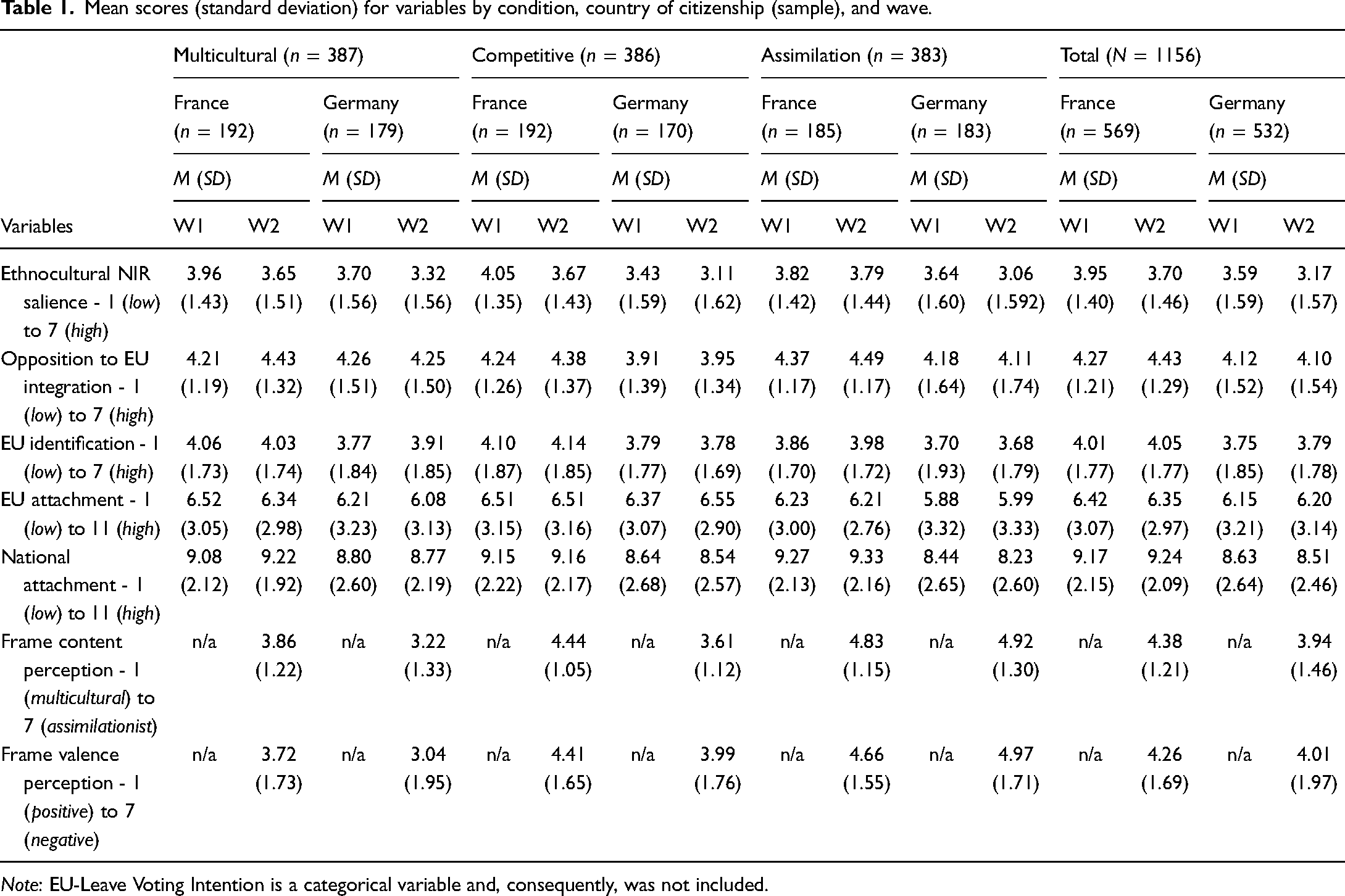
Note: EU-Leave Voting Intention is a categorical variable and, consequently, was not included.
For the French sample, main effect tests revealed significant differences in ethnocultural NIR salience across conditions (F(2, 525) = 3.17, p = .043, ηp2 = .012 with ηp2 < .06, a small effect in strict sense). In support of H1, data showed that exposure to assimilation (versus the other two conditions) led to higher ethnocultural NIR salience (see Table 1). However, simple effects tests revealed that this effect was only significant for the contrast between the assimilation and competitive conditions, p = .048 (other ps > .2). These findings suggest that exposure to assimilation frames versus multicultural and assimilation frames in a competitive environment increased ethnocultural NIR salience.
Our preregistered H1 also predicted that higher ethnocultural NIR salience following exposure to assimilation frames would be related to higher opposition to EU integration. ANOVA results revealed that treatment had no direct effect on attitudes towards EU integration among French participants, p = .540. Conversely, data supported a mediated effect by which ethnocultural NIR salience mediated the relationship between exposure to assimilation versus competitive frames and opposition to EU integration (indirect effect: b = .03 [.01; .06], SE = .02). As Figure 2 shows, exposure to assimilation versus competitive frames led to higher ethnocultural NIR salience (b = .24 [.06; .41], SE = .11, t = 2.20, p = .029). In turn, higher ethnocultural NIR salience was related to higher opposition to EU integration (b = .12 [.04; .19], SE = .05, t = 2.62, p = .009). Exposure to assimilation versus competitive framing was not related to attitudes towards EU integration, p = .762. Additionally, we found no support for the theorised mediation models for the contrasts between assimilation and multicultural (indirect effect: b = .02 [.00; .04], SE = .01) or competitive and multicultural conditions (indirect effect: b = -.01 [-.03; .01], SE = .01).
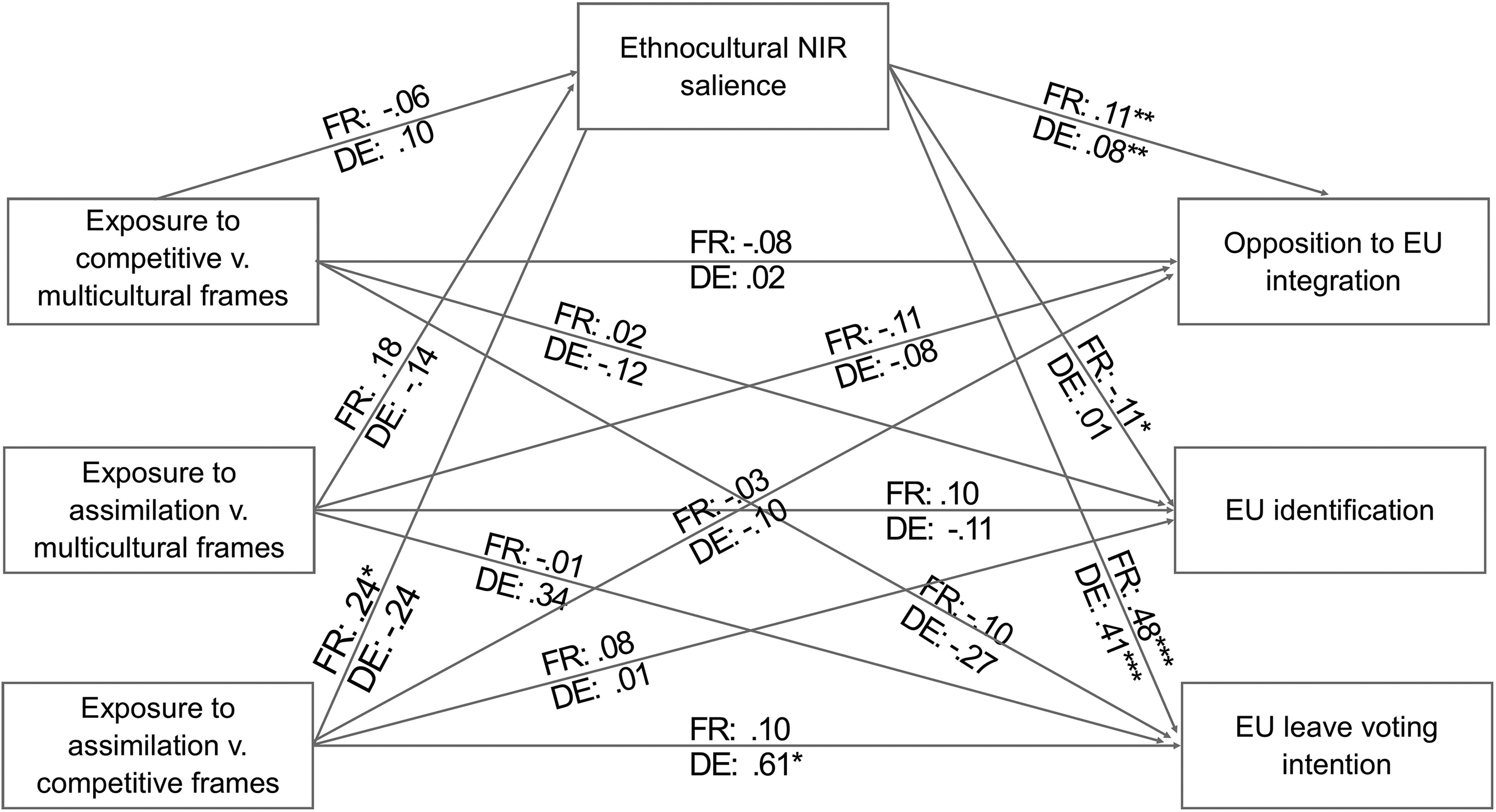
Mediation model for identity-related framing effects on ethnocultural NIR salience, EU integration attitudes, EU identification and EU-leave voting intention (H1) for French (FR) and German (DE) samples.
Then, we tested the mediation models proposed in H1 in relation to EU identification for our French sample. An ANOVA initially confirmed that there was no significant effect of treatment on this variable, p = .828. Results of mediation analyses supported the assumption that ethnocultural NIR salience mediated the relationship between exposure to assimilation versus competitive frames and EU identification (indirect effect: b = -.03 [-.06; -.01], SE = .02). Figure 2 shows that exposure to assimilation versus competitive frames led to higher ethnocultural NIR salience (b = .24 [.06; .41], SE = .11, t = 2.20, p = .028). Additionally, higher ethnocultural NIR salience was related to lower EU identification (b = -.12 [-.22; -.02], SE = .06, t = -2.03, p = .044). Exposure to assimilation versus competitive framing was not related to EU identification, p = .484. Additionally, the data did not support the theorised mediation models for the contrasts between assimilation and multicultural (indirect effect: b = -.02 [-.05; .00], SE = .02) or competitive and multicultural conditions (indirect effect: b = .01 [-.02; .03], SE = .01).
Finally, we turned to EU-leave voting intention. Main effect tests revealed no significant effect of treatment on this variable, p = .854. Instead, data were in line with the assumption that ethnocultural NIR salience mediated the relationship between exposure to assimilation versus competitive frames and EU-leave voting intention (indirect effect: b = .14 [.04; .27], SE = .07). As outlined in Figure 2, exposure to assimilation versus competitive frames led to higher ethnocultural NIR salience (b = .28 [.09; .47], SE = .12, t = 2.42, p = .016). In addition, higher ethnocultural NIR salience was related to higher intention to vote to leave the EU (b = .48 [.26; .70], SE = .14, Z = 3.54, p < .001). Exposure to assimilation versus competitive framing was not related to EU-leave voting intention, p = .708. Additionally, data did not support the hypothesised mediation models for the contrasts between assimilation and multicultural (indirect effect: b = .11 [.01; .24], SE = .07) or competitive and multicultural conditions (indirect effect: b = -.03 [-.14; .07], SE = .07).
For the German sample, main effect analyses showed no significant effect of treatment on ethnocultural NIR salience (F(2, 496) = 1.30, p = .274, ηp2 = .005). Additionally, treatment had no significant effect on EU integration attitudes, EU identification and EU-leave voting intention (ps > .1), and we found no support in the German data for the mediation models proposed in H1 concerning these variables (see mediation pathways in Figure 2 and indirect effects estimates for all models in the Online appendix).
RQ1 (preregistered)
We began by testing the moderating role of national attachment in the relationship between NIR salience and Euroscepticism. The 3 × 2 ANOVA revealed that French participants reported feeling significantly more attached to the nation than German participants (F(1, 1012) = 15.30, p < .001, ηp2 = .015; see Table 1). Therefore, we proceeded with the analyses for each sample separately. However, national attachment did not moderate the relationship between ethnocultural NIR salience and EU integration attitudes, EU identification or EU-leave voting intention for either of the samples (ps > .05).
Regarding EU attachment, we found no significant differences across samples (p = .778). We thus conducted the moderation analyses proposed in RQ1 for both samples combined. Results were in line with a moderating effect of EU attachment on the relationship between ethnocultural NIR salience and EU integration attitudes (ΔR2 = .002, F(1, 1020) = 8.52, p = .004). This moderating effect was significant at all levels of EU attachment (ps < .021). Figure 3 shows that, overall, higher ethnocultural NIR salience was related to higher opposition to EU integration. However, this relationship was more pronounced for those who felt less attached to the EU. Conversely, EU attachment did not moderate the relationship between ethnocultural NIR salience and EU identification (p = .559) or EU-leave voting intention (p = .666).
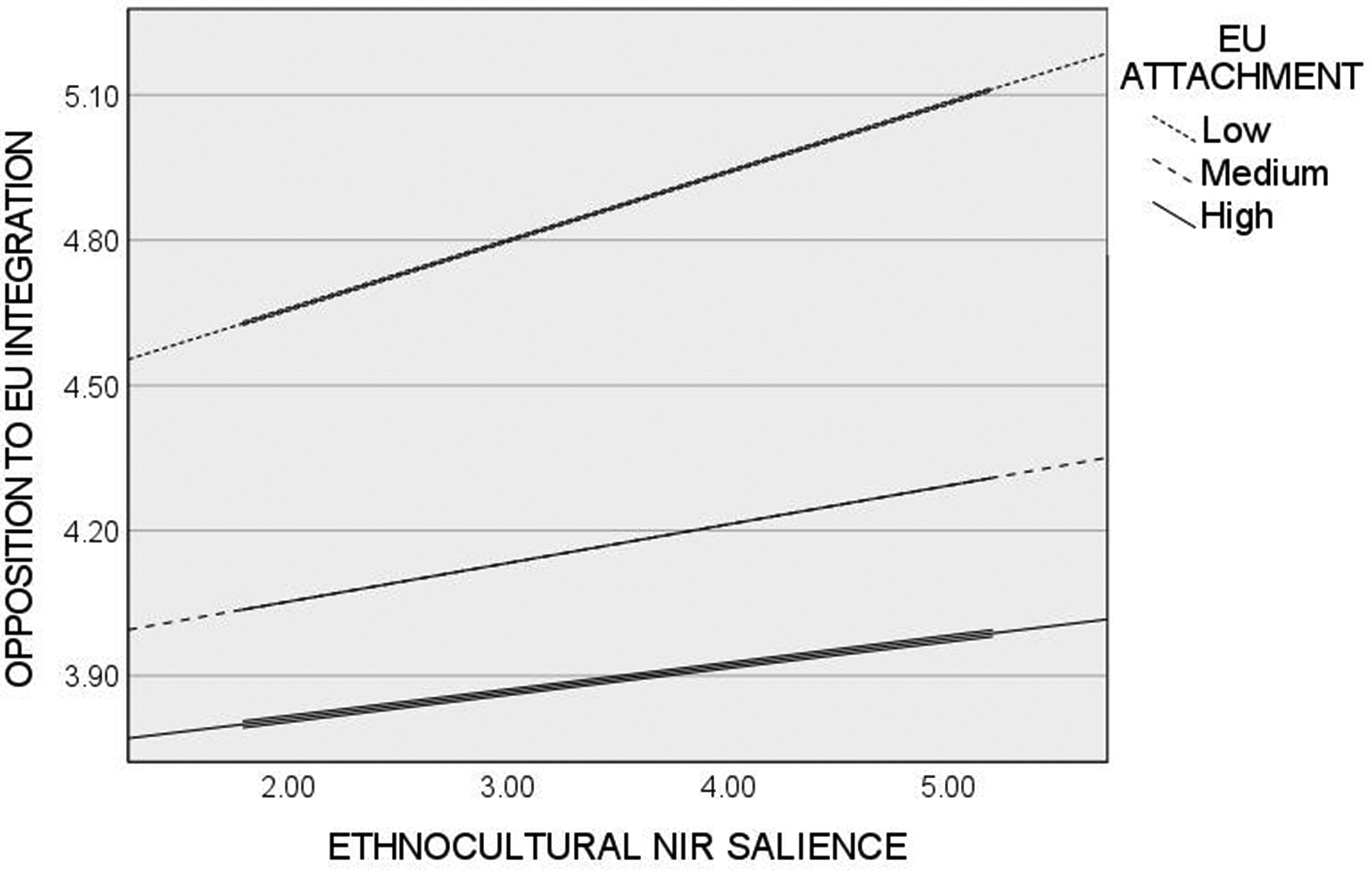
Moderating effect of EU attachment in the relationship between ethnocultural NIR salience and opposition to EU integration for both samples combined.
Thus, the data supported the assumption that the relationship between ethnocultural NIR salience and opposition to EU integration was less pronounced for those who felt more emotionally attached to the EU. Conversely, feeling attached to the nation did not play any role in the relationship between NIR salience and EU attitudes.
RQ2 (exploratory analyses)
The 3 × 2 ANOVA showed a significant interaction effect of condition and sample on frame content (F(2, 1047) = 14.49, p < .001, ηp2 = .027) and valence perception (F(2, 1047) = 7.79, p < .001, ηp2 = .015). Table 1 shows that participants in the assimilation condition perceived the frame as significantly more assimilationist than those in the competitive condition, and participants in both these conditions as significantly more assimilationist than those in the multicultural condition (F(2, 1047) = 112.25, p < .001, ηp2 = .177 with a large effect size, ηp2 > .1). Differences were significant for all contrasts between conditions (ps ≤ .009). Similarly, participants in the assimilation condition perceived the frame as advancing a more negative immigration stance than those in the competitive condition, and participants in both these conditions as significantly more negative than those in the multicultural condition (F(2, 1047) = 61.25, p < .001, ηp2 = .105, a large effect size, ηp2 > .1; see Table 1). These differences were significant for the contrast between all conditions in both samples (ps < .001) except for the contrast between the assimilation and competitive conditions in the French sample (p = .481). These results suggest that participants generally perceived the frames according to their objective content and valence.
Additionally, there were significant sample differences in frame content and valence perception as French participants perceived the frames as more assimilationist (F(1, 1047) = 38.65, p < .001, ηp2 = .036) and more negative towards immigration than German participants (F(1, 1047) = 6.11, p = .014, ηp2 = .006). Furthermore, as shown in Table 1, German participants perceived the frames more consistently with their objective content and valence than French participants. Pairwise comparisons revealed that these observed sample differences were only significant in the multicultural and competitive conditions (for content perception: ps < .001; other p = .474; for valence perception: ps ≤ .025; other p = .091). Consequently, we proceeded with the analyses for each sample separately.
Data supported the assumption that, among both French and German participants, content and valence perception mediated the relationship between frame exposure and ethnocultural NIR salience (see indirect effects estimates in the Online appendix). These mediation effects were significant for the contrast between all conditions in both countries (with the following exception: for content perception, mediation was nonsignificant for the contrast between the assimilation and competitive conditions among German participants, b = .06 [−.04; .17], SE = .06).
These results suggest that, for both samples, perceiving the frame as assimilationist versus multicultural played a role analogous to perceiving the frame as advancing a negative versus positive immigration stance. Participants in the competitive versus multicultural, assimilation versus multicultural and assimilation versus competitive conditions perceived the frame as more assimilationist (Figure 4) and as more negative towards immigration (Figure 5). In turn, perceiving the frame as assimilationist versus multicultural as well as negative versus positive was related to higher ethnocultural NIR salience. Notably, although the contrast between the assimilation and competitive conditions had no direct effect on valence perception among French participants (in line with results for simple effects tests above), indirect effects estimates indicated that the proposed mediation model was significant for this contrast as well (b = .03 [.01; .07], SE = .02).
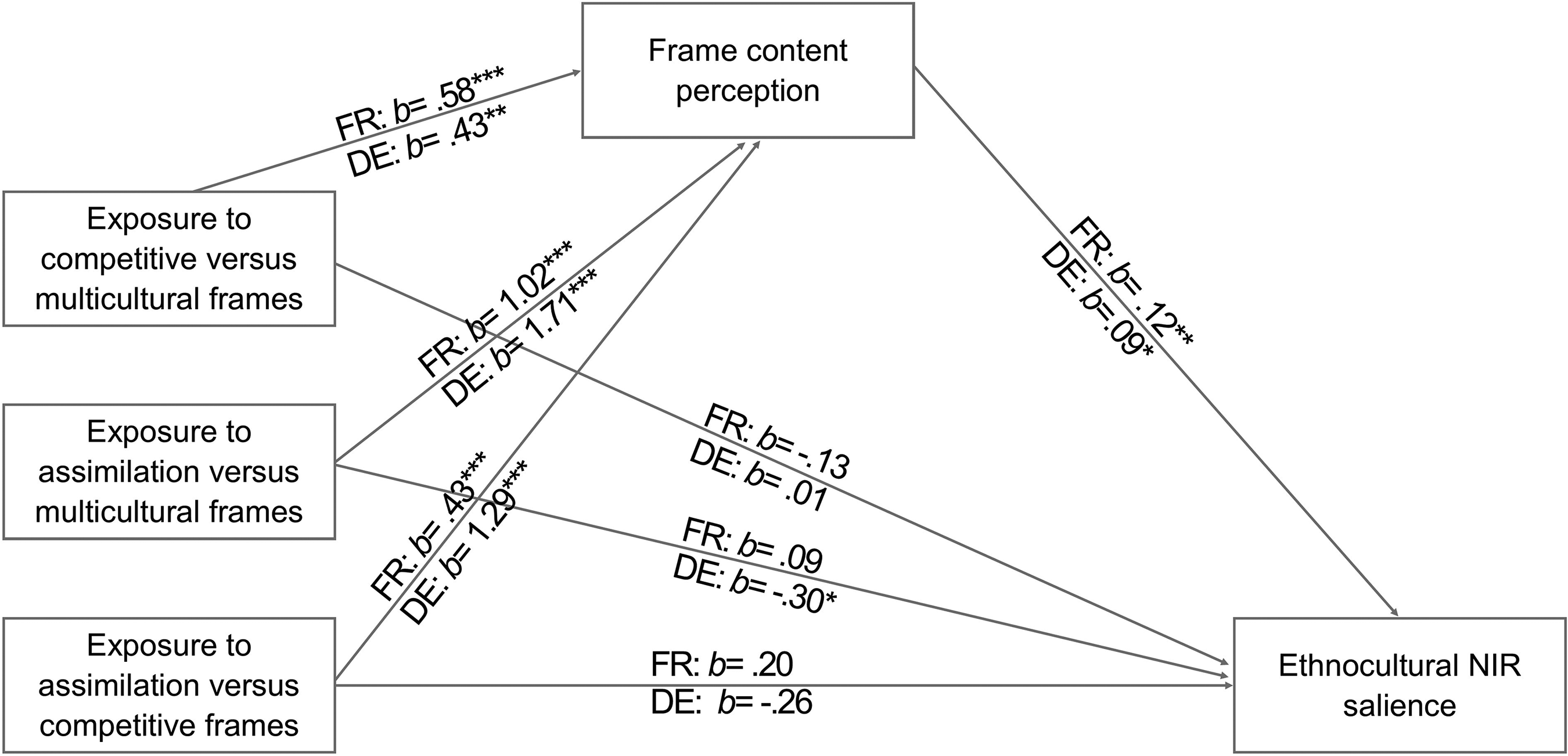
Mediation model for identity-related framing effects on frame content perception and ethnocultural NIR salience for French (FR) and German (DE) samples.
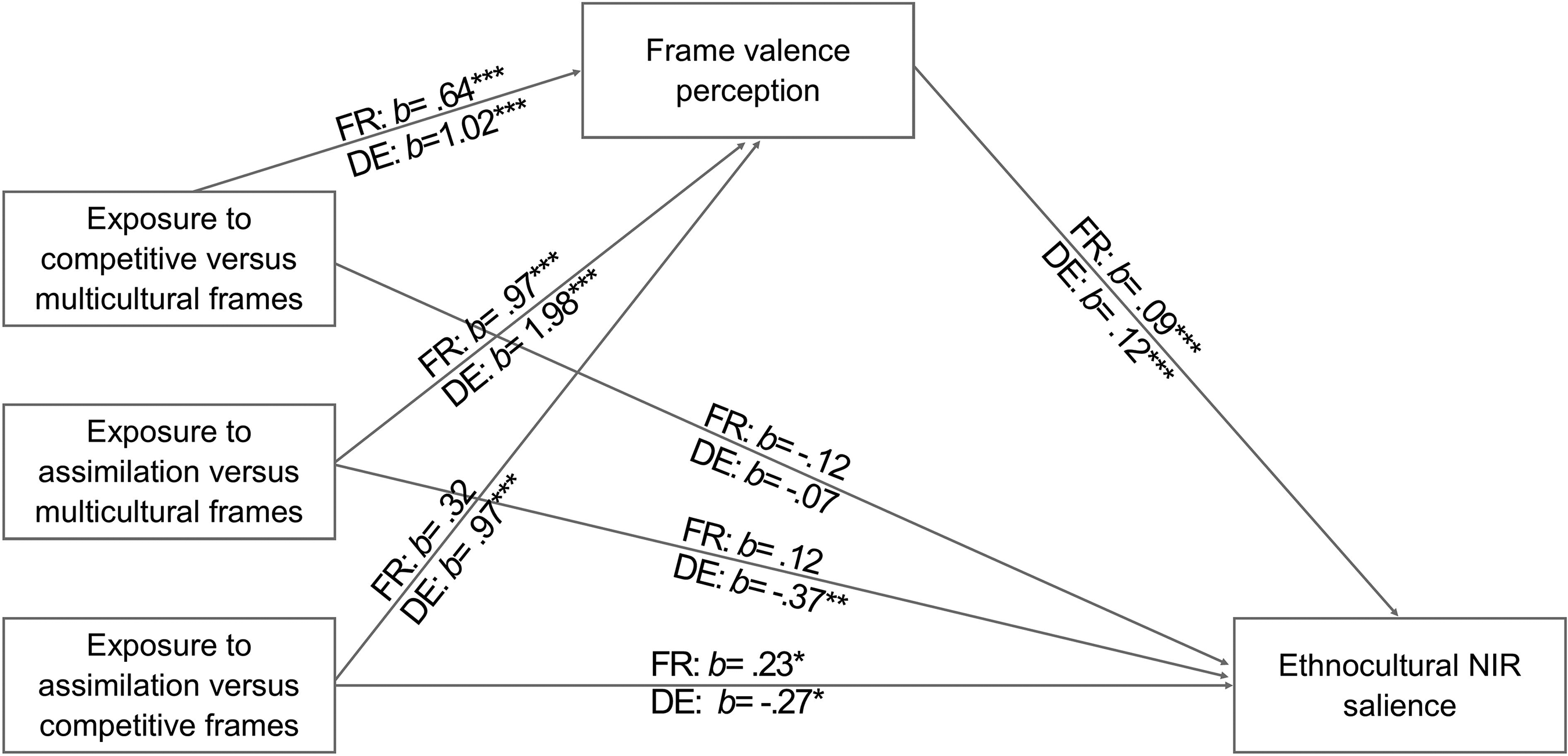
Mediation model for identity-related framing effects on frame valence perception and ethnocultural NIR salience for French (FR) and German (DE) samples.
Thus, for both samples, frame content and valence perception played a crucial and analogous role in identity-related framing effects on ethnocultural NIR salience. However, the absence of direct effects of frame exposure on NIR salience in the ANOVA for the German sample (see H1 results) suggests that frame perception played a larger role for this sample compared to the French sample.
Discussion
Overall, we found support for our theoretical model as identity-related frames were related to EU attitudes via NIR salience. However, differences in the pattern observed for identity-related framing effects on NIR salience across samples commanded a comparative analysis.
Among French participants, exposure to assimilation frames significantly increased ethnocultural NIR salience compared to exposure to both multicultural and assimilation frames in a competitive environment (for the contrast between assimilation and multicultural frames, the effect on ethnocultural NIR salience was in the predicted direction but nonsignificant). Thus, simultaneous exposure to competing frames did not result in the mutual cancellation of their effects (cf. Chong and Druckman, 2010). Likewise, we found no evidence that participants in the competitive condition reacted to the frame in line with their prior beliefs and attitudes (the Online appendix). Conversely, findings suggest that exposure to identity-related frames in a competitive environment enhanced the descriptive effect of multicultural frames on ethnocultural NIR salience.
Furthermore, the absence of significant differences between the multicultural and competitive conditions and the similarity in their mean values suggest that these two frame conditions pushed ethnocultural NIR salience in the same direction and intensity (see, e.g., Kinder and Sanders, 1990). Additionally, a significant contrast between the assimilation and competitive conditions but not the multicultural condition may indicate that, for French participants, the multicultural frame was persuasively stronger in a competitive environment than when unchallenged by a competing frame.
However, the results for German participants did not support H1, as treatment was only related to ethnocultural NIR salience via frame perception for this sample. Notably, content perception played an important role – even larger than treatment alone – in identity-related framing effects for both samples as participants who perceived the frame as more assimilationist reported higher ethnocultural NIR salience, which was then related to more negative attitudes towards the EU. Additionally, perceiving the frame as advancing a more negative stance was related to higher ethnocultural NIR salience, evidencing that frame content and valence perception played an analogous role in identity-related framing effects on ethnocultural NIR salience (cf. Bos et al., 2016 who concluded that objective frame content and valence affected attitudes differently). In all, these findings support our assumption that subjective content and valence play a crucial role – even larger than frame exposure – in identity-related frames.
In addition to individual variation, this article observed differences in frame perception across samples, with German participants perceiving frames more in line with their objective content and valence than French participants. Furthermore, the absence of direct treatment effects – but only those mediated by frame perception – suggests that frame perception played a larger role for participants in Germany than in France. Future research should further explore the factors influencing perception. For now, our data suggested that, for both samples, individual willingness to reflect on the considerations advanced by the frame (i.e., need for cognition or NFC) was related to interpreting the frame more in line with the frame's objective content (the Online appendix). Thus, overall higher NFC among German participants may explain why this sample perceived the frame as more in line with its objective content. Additionally, it may explain why German participants assigned more weight to their understanding of the frame in subsequent attitude formation (Cacioppo et al., 1983), leading to the increased importance of frame perception in identity-related framing effects observed for this sample.
In line with our expectations, data supported that exposure to assimilation frames (directly for French participants or via frame perception for both samples) was related to higher ethnocultural NIR salience for all participants (see also, Bogado et al., 2023). Additionally, higher ethnocultural NIR salience following exposure to assimilation frames was related to higher opposition towards EU integration, lower EU identification and higher EU-leave voting intentions.
Nonetheless, for both samples, the relationship between ethnocultural NIR salience and opposition to EU integration was less pronounced for those who felt more emotionally attached to the EU. We departed from the assumption in RQ1 that ethnocultural NIR salience would be related to lower support for EU integration as the Union may be perceived as a threat to the ethnocultural integrity of the nation. Accordingly, our data suggested that individuals who feel more attached to the EU perceive its expansion as less threatening to their ethnocultural national identities than those who – identifying with an ethnocultural notion of national identity – are not as emotionally attached to the Union.
Limitations
Overall, this article sheds light on how politicians’ use of identity-related frames promotes more exclusive national identities and the relationship between this exclusionary nationalism and Euroscepticism. Still, some limitations need to be noted. First, while significant, the observed effects of frame exposure on ethnocultural NIR salience for our French sample were small according to conventional benchmarks. However, other studies on framing effects – of similar characteristics and design – have observed similar effect sizes to the ones in our study (see, e.g., Bos et al., 2016; Igartua, 2013). The small effect sizes observed could result from the experimental setting, where participants are exposed to a single treatment instance. Nevertheless, empirical research supports that in real life, where people are frequently exposed to these frames, effects of the size observed in this study add up to exert a larger impact on ethnocultural NIR salience and EU attitudes (Lecheler and de Vreese, 2013).
Second, its experimental design allowed this study to draw a clear causal connection between the independent variable (frame exposure) and the dependent variables (e.g., NIR salience). Conversely, the order of the variables in our mediation models could not be experimentally confirmed. However, our assumption that NIR salience would mediate the relationship between frame exposure and EU attitudes is based on research showing that national identification drives EU attitudes (Hooghe and Marks, 2005; Plescia et al., 2021). Furthermore, empirical research supports the assumption that, while identity-related media messages affect national identity salience (Atwell Seate and Mastro, 2016; Bogado et al., 2023; Figueroa-Caballero and Mastro, 2019), the salience of more exclusive or inclusive national identities is a key driver in attitude formation (Esses et al., 2001, 2006). The same can be extended to frame perception, whose mediating role in the relationship between frame exposure and NIR salience is theoretically (e.g., Chong and Druckman, 2007b) and empirically (e.g., Igartua, 2013; von Sikorski and Schierl, 2012) supported. Thus, the variable order in our mediation models is both theoretically and empirically grounded.
Conclusions
Brexit poses a serious threat for EU continuity, as fears of sovereignty loss and exposure to information about the UK's sovereignty gains following Brexit increase Euroscepticism and willingness to leave the EU (Hobolt et al., 2022; Yordanova et al., 2020). Thus, Brexit will not deter and may even inspire other EU countries to leave the Union. While in Germany, politicians, media, and the public mostly support the EU, in France, the possibility of a “Frexit” – promoted by the right-wing Eurosceptic National Rally – is ever-present (Ivaldi, 2018). The same conclusions can be extended to other EU members, such as Italy and Greece, where Eurosceptic parties continue to rise in the polls (Baccaro et al., 2021; Vasilopoulou, 2018).
In this context where Euroscepticism continues to grow, our study contributes to understanding how politicians’ use of identity-related frames can promote or reduce ethnocultural NIR salience and the negative relationship this form of exclusive nationalism has with support for the EU. Notably, media exposure is not the only factor affecting NIR salience: other factors such as labour market position, employment status, educational level, or living close to culturally distant migrant groups were all found to increase the salience of more exclusive national identities (Foster and Frieden, 2021; Schraff and Sczepanski, 2022). Our study adds to this buoyant literature by highlighting how framing EU policies in assimilation terms fosters ethnocultural nationalism, thus contributing to explain why Euroscepticism grows aided, among other factors, by the increased use of assimilation frames in EU countries.
However, this study also offers hope: fostering an emotional connection to the EU can protect it from assimilationist discourses commonly used by politicians and the media. Unfortunately, data from the European Social Survey (2018) revealed that, while national attachment is mostly high among Europeans, EU attachment is moderate (see also Plescia et al., 2021). 7 Accordingly, Polonska-Kimunguyi and Kimunguyi (2011) argued that those who advocate for the EU have failed to create a solid emotional connection between European citizens and the Union. Still, research has identified ways to promote EU attachment. For instance, Borz et al. (2022) found that the EU Cohesion Policy increased the likelihood of developing a strong European identity. Similarly, the introduction of the euro fostered, although to a small extent, European identification (Negri et al., 2021). Future research should continue to explore avenues to achieve this longstanding goal. For now, the current war in Ukraine offers a unique opportunity for the EU to display its political and cultural leadership in the region and thus strengthen Europeans’ emotional attachment to the Union.
Supplemental Material
sj-pdf-1-eup-10.1177_14651165231152378 - Supplemental material for The use of identity-related frames in electoral pledges and its effects on Euroscepticism in France and Germany
Supplemental material, sj-pdf-1-eup-10.1177_14651165231152378 for The use of identity-related frames in electoral pledges and its effects on Euroscepticism in France and Germany by Natalia Bogado, Evelyn Bytzek and Melanie C Steffens in European Union Politics
Supplemental Material
sj-sav-2-eup-10.1177_14651165231152378 - Supplemental material for The use of identity-related frames in electoral pledges and its effects on Euroscepticism in France and Germany
Supplemental material, sj-sav-2-eup-10.1177_14651165231152378 for The use of identity-related frames in electoral pledges and its effects on Euroscepticism in France and Germany by Natalia Bogado, Evelyn Bytzek and Melanie C Steffens in European Union Politics
Supplemental Material
sj-sps-3-eup-10.1177_14651165231152378 - Supplemental material for The use of identity-related frames in electoral pledges and its effects on Euroscepticism in France and Germany
Supplemental material, sj-sps-3-eup-10.1177_14651165231152378 for The use of identity-related frames in electoral pledges and its effects on Euroscepticism in France and Germany by Natalia Bogado, Evelyn Bytzek and Melanie C Steffens in European Union Politics
Supplemental Material
sj-sps-4-eup-10.1177_14651165231152378 - Supplemental material for The use of identity-related frames in electoral pledges and its effects on Euroscepticism in France and Germany
Supplemental material, sj-sps-4-eup-10.1177_14651165231152378 for The use of identity-related frames in electoral pledges and its effects on Euroscepticism in France and Germany by Natalia Bogado, Evelyn Bytzek and Melanie C Steffens in European Union Politics
Supplemental Material
sj-sps-5-eup-10.1177_14651165231152378 - Supplemental material for The use of identity-related frames in electoral pledges and its effects on Euroscepticism in France and Germany
Supplemental material, sj-sps-5-eup-10.1177_14651165231152378 for The use of identity-related frames in electoral pledges and its effects on Euroscepticism in France and Germany by Natalia Bogado, Evelyn Bytzek and Melanie C Steffens in European Union Politics
Supplemental Material
sj-sps-6-eup-10.1177_14651165231152378 - Supplemental material for The use of identity-related frames in electoral pledges and its effects on Euroscepticism in France and Germany
Supplemental material, sj-sps-6-eup-10.1177_14651165231152378 for The use of identity-related frames in electoral pledges and its effects on Euroscepticism in France and Germany by Natalia Bogado, Evelyn Bytzek and Melanie C Steffens in European Union Politics
Footnotes
Acknowledgements
The authors would like to thank Prof. Dr Eva Louvet and Cécile Gaubert for their contribution to this study and Prof. Dr Michaela Maier and Prof. Dr Christian von Sikorsky for their invaluable feedback.
Authors contributions
Natalia Bogado conceived the theoretical framework, hypotheses, and research questions, conducted all the data's statistical analyses, and composed the study's manuscript. Evelyn Bytzek designed the study (i.e., defined the countries to be included and the type of materials to use, among other key methodological decisions). Evelyn Bytzek and Natalia Bogado identified suitable treatment materials, composed the online survey, and liaised with the online panel throughout the data collection process. Melanie C Steffens defined the data analysis strategy and provided key methodological feedback and support throughout the study. All authors contributed to the revision and correction of the manuscript and approved its submitted version.
Funding
The author(s) disclosed receipt of the following financial support for the research, authorship, and/or publication of this article: This work was supported by the Fritz Thyssen Stiftung, (grant number 10.18.1.007PO).

Supplemental material
Supplemental material for this article is available online.
Notes
References
Supplementary Material
Please find the following supplemental material available below.
For Open Access articles published under a Creative Commons License, all supplemental material carries the same license as the article it is associated with.
For non-Open Access articles published, all supplemental material carries a non-exclusive license, and permission requests for re-use of supplemental material or any part of supplemental material shall be sent directly to the copyright owner as specified in the copyright notice associated with the article.
