




Abstract
The European Union (EU) is increasingly relying on regional policy networks to govern climate change outside its borders, both in the areas of climate change adaptation and mitigation. Although the functioning of such policy networks has consequences for climate policy in participating countries, little is known about the role of such networks. This article focuses on the example of climate cooperation with the European Neighbourhood Policy region, conceptualizing the EU as a network manager. Using a novel dataset on climate networks in the European Neighbourhood Policy region for the period 2013–2017, we show that the EU uses climate networks for multiple purposes. The results suggest that the EU uses climate networks not only to mitigate the risks associated with climate change, but also to manage varying contexts in the region.
Keywords
Introduction
The European Union (EU) is often referred to as one of the leading actors in global climate governance (e.g., Bäckstrand and Elgström, 2013). Examples underpinning this reputation are the EU's energy policy (Dupont, 2016), its Emission Trading System (Liu et al., 2019), its regulation of aircraft emissions (Bernauer et al., 2013), the Green Diplomacy Network (Bremberg et al., 2019) and the EU's funding of multilateral climate action (Dellmuth et al., 2020). Given this track record, it comes as no surprise that the EU has also extensively engaged in climate governance in the European Neighbourhood Policy (ENP) region. 1
This region is highly vulnerable to climate change. Especially the southern neighbourhood has experienced dramatically rising temperatures, more frequent droughts and increasing water scarcity (Rizzo, 2016). Existing vulnerabilities to climate change in the region could, in turn, adversely affect national security, human livelihoods and migration flows – all areas of strategic importance to the EU (European Commission, 2009). The region's strategic importance for the EU warrants an inquiry into the motivations underpinning the EU's climate governance in the ENP region, which is the focus of this article.
Climate change poses a complex transboundary policy challenge, as it cannot be handled unilaterally. In the absence of international cooperation among partner states, climate policies become uncoordinated and inefficient. To coordinate efforts to combat the threats posed by climate change for nature and societies, the EU uses various instruments. Unlike the instruments that the EU can apply unilaterally, such as conditionality attached to trade agreements or climate diplomacy, climate policy networks build on horizontal ties between the EU and third countries (Shyrokykh, 2022).
In this article, we shed new light on the EU's climate governance in regional policy networks. Toward this end, we build on network governance theory which yields important insights for this current study for two main reasons. First, network governance theory is uniquely suitable for studying the international governance of complex issues such as climate change, as this governance is often characterized by interdependent and interconnected sets of actors. To capture the dynamics in these forms of governance, network governance theory acknowledges the interdependence of actors in a network (e.g., Agranoff and McGuire, 1999; McGuire, 2002; Slaughter and Hale, 2013). Network governance is defined as decision-making in relation to cross-border challenges and situations when joint problems require policy solutions from interdependent actors (cf. Jones et al., 1997; McGuire, 2002). In this article, EU climate networks are well captured by the theoretical concept of policy networks, as the latter are issue-specific, focus on joint problem-solving and have the aspiration to improve climate cooperation. Second, we build on network governance theory as it provides insights into the functions served by policy networks. More specifically, it enables us to develop hypotheses that contribute to a better understanding of the role of climate networks in the EU's external climate governance and in climate policy networks more broadly.
In so doing, we advance on two related literatures that have studied EU climate governance in third countries, but that have paid insufficient attention to network governance. First, climate governance research has privileged the study of climate policy mainstreaming, analysing how the EU promotes policies on energy (Dupont, 2016; Shyrokykh, 2021b), security (Dellmuth et al., 2018), health, migration and economic affairs (Dellmuth and Gustafsson, 2021). Previous research has also examined the EU's involvement in international climate negotiations (e.g., Bäckstrand and Elgström, 2013) and in bilateral climate cooperation (e.g., Liu et al., 2019).
Second, Europeanization research has predominantly focused on the ways in which the EU promotes democracy in the ENP region (e.g., Noutcheva, 2015, 2016). Little attention has been paid to EU climate governance. Although there are notable exceptions (Börzel and Fagan, 2015; Buzogány, 2013; Shyrokykh, 2021b), these have not systematically distinguished between environmental and climate cooperation, or between cooperation on adaptation and mitigation. The network governance perspective is well suited to contribute to the investigation of EU networks on adaptation and mitigation, as well as to identify their key functions. Policy networks are by definition issue-specific and require clear objectives to be effective (McGuire, 2002), which suggests that it is useful to distinguish between networks on adaptation and mitigation.
In this article, we focus on the first generation of EU regional climate projects in the ENP region that aimed to support low-carbon development and to increase resilience to climate change: Clima East and Clima South. 2 We ask: what are the determinants of the EU's resource allocation in EU climate networks? To address this question, this article develops different hypotheses about the specific functions of climate policy networks by drawing on the network governance literature. To test these hypotheses, we compiled a novel dataset including measures of the extent to which the EU allocates resources in climate policy networks in the ENP states within Clima East and Clima South, and the correlates of these measures.
A distinct strength of our empirical approach is that our dataset distinguishes between adaptation, or the process of adjustment to actual or expected climate and its effects, and mitigation, which refers to the reduction of greenhouse gas emissions (IPCC, 2022). This distinction enables us to relate our analysis to both of these central pillars of climate policy in the Bali Action Plan of 2007 and in the 2015 Paris Agreement (Liberatore, 2013). Most studies on global climate governance and the EU's external climate governance in the ENP region foreground mitigation, while adaptation as a transboundary policy issue has only recently started attracting scholarly attention.
The results from a statistical analysis of this dataset suggest that the EU climate networks are both cohesive and fluid at the same time. On the one hand, both adaptation and mitigation networks are used to govern interdependencies and to enhance partner countries’ institutional capacities. On the other hand, network resources are allocated in a fluid and flexible way that follows the pattern of the interdependencies between the EU and individual ENP countries. These findings contribute to EU climate governance research and to the literature on Europeanization and network governance, which we discuss by way of conclusion.
EU climate networks in the neighbourhood
The ENP was established in response to the Eastern enlargement in 2004. It aligned previously disparate foreign policy strategies vis-à-vis the neighbouring states in a single policy vision. Since then, the ENP has developed more nuanced approaches to the region by way of establishing the Eastern Partnership and the Mediterranean dimension of cooperation in 2009.
Two central projects were created to support the development of so-called “ecosystem-based” approaches to climate change in the ENP region: Clima East and Clima South. An ecosystem-based approach is defined by the United Nations Convention on Biological Diversity (CBD) as the “use of biodiversity and ecosystem services to help people adapt to the adverse effects of climate change as part of an overall adaptation strategy” (CBD, 2009). The aim of the projects was to improve policies, strategies and market mechanisms relevant for adaptation and mitigation, by fostering regional cooperation and by improving access to information on EU climate policies, laws and expertise. 3
The EU's aspiration with both regional projects was to appear as a climate actor and to help neighbouring countries to improve their climate governance standards (European Commission, 2009). Clima East and Clima South were designed to assist the ENP states in their transition to low-carbon economies and to climate resilience, by strengthening domestic capacity through expertise sharing and improved monitoring and verification methodologies for measuring and reporting emissions. The objectives of the cooperation were defined by the EU in line with international climate treaties and climate science (European Commission, 2009). Both Clima East and Clima South were active between 2013 and 2017 and individual activities lasted until 2018. The total cost of the Clima projects amounted to about €23m. 4
More generally, policy networks established by regional projects like Clima East and Clima South tend to be technocratic and depoliticized, so as to facilitate joint governance of complex cross-border issues (Shyrokykh, 2021b). Such networks aim to share expertise with partner countries, mainly targeting related ministries and state agencies, technical units and the legislative bodies of partner countries (Buzogány, 2013; European Commission, 2004). 5 Clima East and Clima South provided technical assistance in legislative drafting, as well as in the implementation and enforcement of previously signed international treaties. 6 Clima East and Clima South did not direct any funding to the beneficiary countries, but their scope was rather limited to technical cooperation.
Theory and hypotheses
Conceptualizing network governance
Network governance is usually described as coordinated deliberation and decision-making with the aim to provide public goods and to address complex problems by way of cooperation rather than by relying on bureaucratic structures in formal institutions (cf. Jones et al., 1997). Network governance focuses on transboundary issues and can involve various interdependent stakeholders. Although policy networks are sometimes referred to as “trans-governmental” and are primarily designed for government-affiliated actors, the EU's climate policy networks bring together stakeholders from various domains such as academia, business, and civil society.
There are a number of other types of governance, such as multi-level governance and private sector governance, which warrants a systematic conceptual discussion. Much climate governance takes a hybrid form or represents a mix of different types of governance. Hybrid climate governance models have been extensively studied in the literature and include public non-profit governance across national, regional and local levels with some involvement of civil society, public for-profit governance and private sector governance (Young, 2005: 28–29; Pattberg and Stripple, 2008). This article focuses on the intersection between the three hybrid approaches – network governance – where state and non-state actors from different countries and levels of governance collaborate to address climate change.
Although the terms are sometimes used interchangeably, network governance also differs from multilevel governance. While both concepts refer to non-hierarchical and fluid cooperation settings, most multilevel governance research does not consider non-state actors to be part of governance processes and instead privileges state actors at the international, national, regional and local levels (Slaughter and Hale, 2013). The notion of network governance best captures the EU's climate policy networks, which are open to the participation of both state and non-state actors at different levels.
Similar to international organizations, policy networks reduce transaction costs and provide information that facilitates both effective monitoring and flexible problem-solving at the international level (Slaughter and Hale, 2013). Unlike the cooperation that takes place within international organizations, however, policy networks cannot take recourse to enforcement mechanisms (McGuire, 2013: 439).
Policy networks do not emerge spontaneously as self-sufficient and autonomous entities; both the operational and strategic character of networks depends on the actions of network managers (McGuire, 2002). Network management refers to activities intended to steer interactions between network participants to enhance collective efficiency (Agranoff and McGuire, 1999). While network managers drive governance processes in networks, they do so in ways that are different from command-and-control processes (Agranoff and McGuire, 1999; O’Toole, 1997). The primary activities of network managers involve selecting the appropriate partners and resources, shaping the operating context of the network, and developing ways to cope with strategic and operational complexity (Agranoff and McGuire, 1999; McGuire, 2002).
In climate governance in the ENP region, the EU acts as a network manager. Unlike in other policy networks in which cooperation is demand-driven (Shyrokykh, 2022), priorities for cooperation in Clima East and Clima South were rather supply-side spearheaded by the EU's policies on neighbouring countries (European Commission, 2009). A particular emphasis was put on the areas of agriculture, biodiversity, forests, energy, health, disaster risks and water management.
The Clima East and Clima South projects invited eastern and southern neighbours to participate in capacity-building and information-exchange events in the areas of adaptation and mitigation. While cooperation was optional, state authorities or centralized institutions were not directly involved in these loosely structured peer-to-peer interactions. The two programs thus fit the description of network governance well, and the role of the EU in these programs is best described as the role of a network manager who defines cooperation objectives and arranges cooperation opportunities.
Hypotheses: matching resources and policy context
One of the main tasks of the network governance literature is to understand how resources are allocated in policy networks – in other words, how network managers match available resources to policy context. In this section, we develop hypotheses on contextual factors that might explain the extent to which the EU, as a network manager, allocates resources to climate networks in the areas of adaptation and mitigation.
The existing network governance literature has identified three main functions of policy networks: managing external dependencies, improving the institutional capacity of partner countries and providing support for less advanced partners (Slaughter and Hale, 2013). In the context of EU policy networks on adaptation and mitigation, we argue that these functions can co-occur but are analytically distinct. In the following, we discuss each function to elicit how resources are allocated in climate networks in the ENP countries.
Manage external dependencies. According to the network governance literature, managing external dependencies is one of the most important functions of policy networks. As “interdependent actors, by definition, cannot achieve their goals on their own”, cooperation in such networks is essential (McGuire, 2013: 437). External dependency is typically understood in terms of actors’ inability to resolve their own problems without cooperating and coordinating with others (Lavenex et al., 2021).
Although the defining feature of policy networks is that they are meant to be non-hierarchical in terms of a lack of demand-and-control type of relations, networks do have network managers (McGuire, 2002). In the context of the Clima projects, this role was assumed by the European Commission. As noted above, the European Commission funded these networks and defined their objectives, which raises the possibility of influencing the extent and focus of the cooperation.
There might be different types of interdependencies between the EU and its neighbours (Gleditsch and Ward, 2001; Lavenex et al., 2021). Three types of external dependencies are chiefly relevant here, namely: (a) interdependencies due to geographic proximity, (b) trade relations, and (c) energy interdependence. We will discuss each of these three types in more depth to develop a hypothesis about how the EU can be expected to use policy networks to address its external dependencies.
Geographic proximity fosters multiple complex dependencies. A case in point are resource dependencies between states. In the context of climate governance, EU member states and ENP countries draw on interconnected natural and environmental resource pools, including air, biodiversity, forestry and water. For example, sustainable forest management is a key objective in EU mitigation policies. The deforestation in the Carpathian mountain range, partially caused by illegal logging in Ukraine, has adversely affected biodiversity and ecosystems in the EU member states that share the mountain range. This is the case in the Czech Republic, Hungary, Poland, Romania and Slovakia (UNEP, 2020). As Carpathian ecosystems are interconnected, the damaging practices of a neighbouring country can affect EU member states. The European Commission has acknowledged the need for coordinated climate policies with neighbours due to mutual dependencies and shared climate risks (European Commission, 2009). The EU is thus likely to have an interest in climate governance in its closest neighbouring states as there is a greater shared dependency related to natural and environmental resources.
Similarly, interdependencies in trade and energy relations can shape the degree to which the EU as a network manager allocates resources to climate networks. Trade and energy relations between the EU and the ENP states can be affected by climate-related reforms, or the lack thereof. In turn, policy networks can be useful to promote such reforms. For example, the EU usually includes energy-related objectives in its climate projects as part of its cooperation with some neighbouring states. In doing so, the EU pursues its own energy security and trade interests as a network manager by allocating more resources to countries with which it has relevant interdependencies (Shyrokykh, 2021b).
Taken together, the EU's allocation of resources in adaptation and mitigation networks in the neighbourhood might at least partially be motivated by the EU's interest in managing interdependencies. Assuming that the function of EU adaptation and mitigation networks is to manage external dependencies, we expect that the EU allocates more resources to states with which it has more interdependencies.
H1a: The EU allocates more resources in climate networks to ENP countries with which it has more interdependencies.
At the same time, adaptation and mitigation networks have different policy foci. Mitigation policies address the issue of global greenhouse gas emissions by promoting decarbonization in areas such as energy, trade and economic development. These issue areas are of strategic importance to EU member states (European Commission, 2009). By contrast, adaptation policies tend to be highly localized as national and international policy-makers have only recently started to recognize the transnational dimension of adaptation challenges (Benzie and Persson, 2019; Dellmuth et al., 2020).
The varying nature of policy challenges related to adaptation and mitigation, respectively, might impact how the EU, as a network manager, uses climate networks to further its objectives in these two issue areas. More concretely, the EU might have incentives to prioritize mitigation over adaptation in cooperation with states with which it has more economic dependencies (such as on trade and energy).
H1b: The relationship stated in H1a is more pronounced in mitigation networks than in adaptation networks.
Enhance institutional capacity. Another important function of policy networks is to address capacity gaps in partner countries (Slaughter and Hale, 2013). From this vantage point, developing an adequate and effective response to global challenges such as climate change requires functional state institutions. A lack of expertise or inability to retain in-house expertise, for example, are highlighted as the main factors that undermine the establishment of robust Measurement, Reporting and Verification systems in neighbourhood states (Rizzo, 2016). Similarly, a lack of institutional capacity has been pointed out as one of the main reasons why the ENP countries fail to make full use of existing climate finance mechanisms (Clima South, 2017). Against this background, the EU might allocate resources to climate networks to enhance the institutional capacity of neighbours in order to ultimately improve adaptation and mitigation governance.
More generally, institutional capacity is vital to the quality of governance, public service provision and problem-solving (Charasz and Vogler, 2021; Shyrokykh, 2022). Vice versa, weak institutional capacity can undermine policy implementation and the absorption of available funding (Börzel and Fagan, 2015; Buzogány, 2009). Thus, it comes as no surprise that the EU has paid particular attention to capacity building in its own member states (e.g., Charasz and Vogler, 2021) and in third countries (Buzogány, 2009; Lavenex, 2008).
Given that adaptation and mitigation governance require appropriate policy responses, the ability of states to effectively achieve a chosen policy outcome is key. Climate policy networks are useful vehicles to improve institutional capacity, for example, by providing policymakers with guidance to design adequate adaptation and mitigation measures, by strengthening the administrative capacity of the public sector, and by disseminating knowledge about how to foster effective implementation and enforcement of climate policies.
In sum, the capacity building argument aligns well with the EU's approach to climate governance in the ENP. Recognizing the potential implications of low institutional capacity, policy networks in Clima East and Clima South were used to provide technical training for civil servants, to share best practices, and to advise on climate change resilience (e.g., Clima South, 2017). Assuming that the function of EU climate policy networks is to enhance the institutional capacity of partner countries, the EU is likely to use such networks to engage more with countries with relatively low levels of institutional capacity.
H2a: The EU allocates more resources in climate networks to ENP countries that have relatively low institutional capacity.
Similar to H1b, we expect differences between adaptation and mitigation networks. Most of the neighbourhood states have a better understanding of the need for mitigation than adaptation. To date, many of these states have no adaptation plans (Shyrokykh, 2021b), indicating a lack of awareness or willingness of engaging in adaptation. Additionally, as noted earlier, cross-border adaptation is a more recent policy priority when compared to mitigation (European Commission, 2009), which might require particular attention and capacity.
H2b: The relationship stated in H2a is more pronounced in adaptation networks than in mitigation networks.
Supporting vulnerable states. The third function of policy networks is that policy networks are issue-specific in the sense that they are usually built to address a specific transboundary problem. Taking this perspective, we assume that the EU in part establishes climate policy networks with its neighbours to improve their responsiveness to adaptation and mitigation challenges.
Indeed, the EU's aspiration to support vulnerable states might not only be grounded in principled, but also in strategic considerations. To be sure, unmanaged climate vulnerabilities in the neighbourhood could adversely affect the security of EU member states (European Commission, 2009). Failure to address disaster risks can have adverse security implications and thereby destabilize regional security, economy and trade. The EU has long considered and framed climate change as a threat to national and human security (European Commission, 2009).
Climate change poses a security risk to the livelihoods of vulnerable societies in the neighbourhood, as conflicts could arise over scarce resources such as water or food (World Bank, 2020). This could affect the lives of millions of people. Policy networks can be used to transfer expertise to enable more effective management of joint problems, implying that this type of cooperation can also be used to alleviate pressing climate vulnerabilities. If the function of EU adaptation and mitigation networks is to address climate change vulnerabilities, we would expect the EU to strengthen climate networks in vulnerable countries.
H3a: The EU allocates more resources in climate networks to ENP countries that are more vulnerable to climate risks.
Again, we expect different effects for adaptation and mitigation. Mitigation-related policies are not designed to reduce vulnerabilities to climate risks. In contrast, adaptation policies typically seek to reduce climate-related risks for nature and human livelihoods, for example by supporting communities and infrastructures to become more resilient to the adverse effects of climate change. Adaptation is also typically geared at the areas of agriculture, water management, coastal protection, disaster risk reduction, migration and security (European Commission, 2009).
H3b: The relationship stated in H3a is more pronounced in adaptation networks than in mitigation networks.
Research design
To test the hypotheses, we compiled a longitudinal dataset for 14 ENP countries (2013–2017). 7 The dataset includes measures of the EU's allocation of resources in adaptation and mitigation networks, several country-level indicators for the explanatory factors and a number of control variables. The structure of the data is time-series cross-sectional, whereby the unit of analysis is a country-year.
Two dependent variables were used to distinguish between mitigation and adaptation policy networks set up by the EU. The first dependent variable captures the resources allocated in mitigation networks, measured by the annual number of Clima East and Clima South mitigation-related activities in each ENP country. The second dependent variable, the resources allocated in adaptation networks, expresses the annual number of Clima East and Clima South adaptation-related activities in each ENP country (see the Online appendix).
An “activity” refers to a single instance of cooperation. Activities take different forms, such as seminars, workshops, study visits and expert missions. The data were coded manually from the Clima East and Clima South websites on each activity. There were 124 distinct activities in climate policy networks and multiple countries typically attend the same activity. In total, our data contains 440 country-activities.
Unlike other cooperation formats, cooperation in Clima East and Clima South built on adaptation and mitigation objectives that were defined by the European Commission, rather than being a reaction to beneficiary countries’ requests. The European Commission (2009) stressed the importance of addressing both adaptation and mitigation in partner countries and defined policy areas that were to be addressed in cooperation with neighbours. As a consequence, partner countries were invited to participate in cooperation events arranged by the EU.
About 19% of the activities deal with adaptation and 21% deal with mitigation. About 60% of the activities in the climate networks in our dataset have no specific focus or were related to both mitigation or adaptation (see the Online appendix). The large proportion of unspecified and cross-cutting activities can be explained by the fact that Clima East and Clima South were the first generation of regional climate projects; many of their activities prioritized establishing ways of working and defining objectives of cooperation, raising awareness about climate risks, and sharing information about the potential consequences of these risks. This observation is in line with one of the propositions of the network governance literature that suggests that in policy networks without clear policy-specific objectives, network managers will direct most of their resources to framing the networks by defining operating rules, clarify foundational values, establishing objectives and arranging structures (McGuire, 2002; O’Toole, 1997). Given that both Clima East and Clima South were the first EU climate networks in the ENP region, it is logical that most of the resources were directed to the framing of climate change.
In this study, we examine how the EU distributes scarce resources to improve climate governance in third countries. As elaborated earlier, policy networks tend to be most efficient when they have a concrete policy objective (Agranoff and McGuire, 1999; McGuire, 2002). Consequently, we focus on those activities that have a concrete policy focus, either on adaptation or on mitigation, excluding activities that do not have such a specific focus. This design choice enables us to systematically examine our hypotheses on adaptation and mitigation – two central pillars in regional and global climate governance – which existing research on EU climate and environmental governance has not yet compared.
The dependent variables capture the frequency of climate cooperation activities and provide a good sense of the extent of the EU's resource allocation in climate change mitigation and adaptation to the region. These variables do not reflect the number of attendees from each country or the actual cost of each activity because this data was not available.
While other EU projects might be directly or only indirectly related to climate, we focus on Clima East and Clima South because they were the first regional projects to explicitly and exclusively focus on climate policies in the ENP region. Since both projects were completed in 2018, new formats of cooperation have been established – EU4Climate and ClimaMed – that continue and expand collaboration. We leave the analysis of these new regional climate projects to future research.
To operationalize H1a and H1b, we required a measure of external dependence between the EU and its ENP partners. Because it is a complex concept, we chose several measures that each capture a different aspect: interdependence generated by geographic proximity, interdependence generated by trade relations and energy interdependence. Interdependence generated by geographic proximity can be best captured by the geographic distance (in log kilometres) between the EU and ENP countries, which is also the most common proxy for capturing interdependence between countries (see Gleditsch and Ward, 2001).
Although frequently used, measures of interdependence through geography do not capture other important aspects, such as economic and energy interdependence. To address this, we distinguish between different aspects of interdependence. Thus, to capture economic interdependence, we account for the effects of total trade (log) between the EU and each of the ENP countries and energy interdependence. The latter is a measure of energy cooperation on natural gas and oil between the EU and neighbouring countries, coded to reflect whether a country exports energy to EU member states (=3), is an energy transit country to the EU (=2), has signed an agreement planning for future energy cooperation (=1) or has no energy cooperation (=0). Using these three measures of interdependence enables us to distinguish between trade dependency, energy dependency and dependency stemming from geographic distance.
To measure institutional capacity (H2a and H2b), we used the Government Effectiveness Index (Kaufmann et al., 2010) as it captures the quality of policy formulation and implementation, as well as the credibility of a government's commitment to its policies. The index ranges between weak (= −2.5) and strong (= 2.5) governance performance.
H3a and H3b are operationalized by a measure of vulnerability to climate risks. We captured vulnerability using the Climate Risk Index (CRI) (Eckstein et al., 2020). This index reflects socio-economic losses in terms of the annual number of deaths and the amount of economic losses in US dollars that occurred due to extreme weather events in each country. The CRI scores for each country were coded from annual reports retrieved from the website.
Finally, we added a number of control variables to consider the influence of potential confounding factors on the EU's engagement in adaptation and mitigation policy networks. First, the models controlled for whether a country belonged to the Eastern Partnership (0 = Southern neighbour; 1 = Eastern neighbour). Armenia, Azerbaijan, Belarus, Georgia, Moldova and Ukraine were coded 1, whereas all the other countries were coded 0. The ENP originated from deepening relations with the EU's Eastern neighbours, but later incorporated the Southern Mediterranean countries. This legacy can result in greater cooperation with the Eastern than with the Southern neighbours.
We also included the (log of) gross domestic product (GDP) per capita to account for the effects of economic development (World Bank, 2019). Lastly, we controlled for the effects of democracy because cooperation with the EU is conditional on a democratic record. It is also possible that representatives from non-democratic countries are less interested or are not allowed to participate in EU climate networks. We therefore used the Policy score to capture the level of democracy (Marshall and Gurr, 2020). We used a set of additional control variables as robustness checks. The Online appendix provides summary statistics and data sources for these variables.
Model specification
The outcome variables in our models capture the number of cooperation activities related to climate adaptation and mitigation, respectively, implying that they are count variables. We therefore opted for a model designed for count data, which is both skewed and discrete. To decide between Poisson, zero-inflated and negative binomial models, which are widely used for count data, we relied on several statistical tests. First, we plotted the distribution of the outcome variables to detect the frequency of zero-values in the data (see the Online appendix). The value of 0 was not over-represented, so we ruled out zero-inflated models. Next, we computed a likelihood-ratio test to decide between Poisson and negative binomial models. The results of the test suggested that the former was more appropriate for our data (detailed results are reported in the Online appendix).
In light of these considerations, we estimated a series of time-series cross-sectional population-average Poisson regression models with robust standard errors clustered at the panel level to account for the presence of heteroskedasticity and autocorrelation (Wooldridge, 2002). A population-average model is preferred over a random-effects model because the number of events for countries are correlated – a few countries typically participate in cooperation events at the same time, which violates the independence assumptions inherent in random-effects models.
Results
The results reported in Table 1 support H1a and H2a. In Model 1 (Table 1), the dependent variable is the extent of resources allocated in climate adaptation networks, whereas in Model 2 (Table 1), the dependent variable is the extent of resources allocated in climate mitigation networks.
Effects of interdependence, state capacity and vulnerability on climate cooperation.
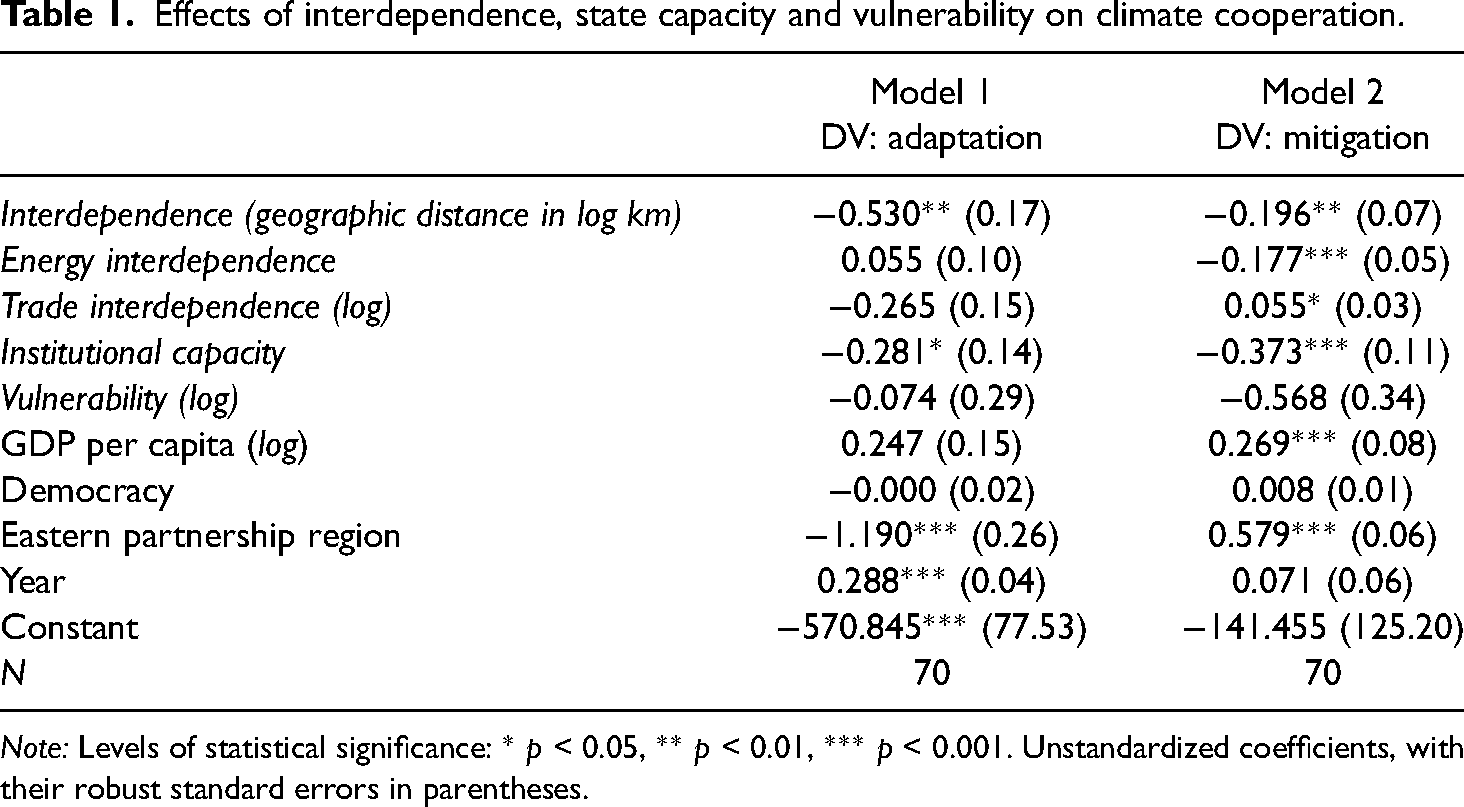
Note: Levels of statistical significance: * p < 0.05, ** p < 0.01, *** p < 0.001. Unstandardized coefficients, with their robust standard errors in parentheses.
In both models, the coefficients of geographic distance are statistically significant in the expected direction, suggesting that the EU allocates more resources to climate networks in ENP countries that are geographically close to the EU. More precisely, on average, a 0.5% increase in the number of adaptation activities and a 0.2% increase in the number of mitigation activities in climate networks can be expected for every 1% decrease in geographic distance between the EU and the ENP country. Moreover, a 0.1% increase in the number of activities on mitigation is associated with every 1% increase in trade.
These results suggest that the EU allocates more resources in climate networks to countries where there are interdependencies stemming from geographic proximity and trade. This finding corroborates existing research emphasizing the importance of external dependencies in horizontal cooperation between the EU and third countries (Lavenex 2015; Lavenex et al., 2021; Shyrokykh, 2021a).
The findings also add to existing knowledge as we distinguish between different types of interdependencies. Thus, the effects of trade and energy interdependencies in Model 2 (Table 1) are statistically significant, indicating that they are observed only in mitigation and not in adaptation networks. The positive effect of trade interdependence suggests that the EU is more likely to allocate resources to those countries with which it is more entangled in trade. The positive effects of trade interdependence on the allocation of resources in mitigation networks support H1b.
Additionally, the negative effect of energy interdependence in Model 2 (Table 1) is a result worthy of discussion, as it suggests that the EU is less likely to allocate resources to those countries with which it has more intense energy cooperation. While counterintuitive at first, this finding aligns with existing research. Katsaris (2016) shows that mitigation networks tend to create antagonistic relations between the EU and neighbouring energy-exporting states. So, energy-exporting ENP countries are less likely to participate in mitigation networks as this might be at odds with their energy export policies. Future research could usefully examine the EU's climate cooperation with third countries in the presence of different energy relations.
Turning to H2a, the coefficient of institutional capacity is statistically significant and in the expected direction (Table 1). This suggests that the EU establishes adaptation and mitigation cooperation with countries that have relatively low levels of institutional capacity. Holding other variables constant, for each one-unit decrease in institutional capacity (on a scale from −2.5 to 2.5), on average, countries receive 32% more adaptation activities and 45% more mitigation activities. 8
Meanwhile, H2b is not confirmed – institutional capacity is negatively associated with resource allocation in both adaptation and mitigation networks. This result indicates that resources are allocated in climate networks to enhance the domestic institutional capacity of the ENP countries, which is line with network governance theory. Finally, the coefficients of vulnerability to climate risks are not statistically significant, which is not in line with H3a and H3b. In contrast to much of the network governance literature, these results suggest that not all EU climate policy networks are established to fulfil all three functions – manage interdependencies, enhance institutional capacity and address multijurisdictional challenges. In our view, the findings showcase the power of the EU as a network manager: the EU appears to allocate resources in climate networks to manage external dependencies with the ENP countries, while also assisting countries with lower institutional capacity.
Importantly, although we find cohesion in the way how the EU allocates resources in climate networks – both types of networks are allocated to address interdependencies and to improve partner states’ institutional capacity – the results also indicate some degree of fluidity in climate networks. Namely, the effects of the independent variables vary across the models with different dependent variables. The effects of interdependence as defined by geographic proximity are larger when we study resource allocation to adaptation compared to mitigation. Indeed, flawed adaptation could fail to prevent physical damage from extreme weather events to local areas. For example, if water dumps and related infrastructure in a neighbouring country are not climate-resilient, devastating cross-border effects can affect EU member states. In fact, adaptation is largely discussed in the contest of disaster risks and cross-border effects of climate change have been highlighted among other reasons to promote adaptation in neighbourhood countries (European Commission, 2009). Thus, the observed differences between cooperation on adaptation and mitigation further support our interpretation of the results as evidence for the EU's cohesive and strategic considerations and self-interest in climate networks in the ENP region.
Likewise, we detect differences in the effects of trade interdependence on resource allocation. The stronger trade interdependence, the more resources are allocated for climate change mitigation networks. These findings are in line with existing literature suggesting that more climate-related rules have to be followed by third countries the more advanced trade relations between the EU and third countries are (Shyrokykh, 2021b). These results underpin a common assumption made in network theory that policy networks are fluid and adaptive – in other words, they are established to address a particular structure of interdependencies. Taken together, our findings demonstrate that EU climate networks are both cohesive and fluid.
Finally, we wish to highlight that these results add to the existing literature as we examine adaptation and mitigation policy networks separately. Previous research has neither distinguished between climate and environmental cooperation, nor between mitigation and adaptation. Although more general assessments of EU-ENP cooperation on environmental and climate affairs have advanced understanding of the drivers of cooperation (Shyrokykh, 2021a), the issue areas of adaptation and mitigation, with their specific and distinct policy objectives and logics of cooperation, can be usefully distinguished.
Robustness checks
Before discussing the broader implications of these results, we document five robustness checks. First, we checked for the presence of endogeneity because institutional capacity could be affected by cooperation in earlier policy networks. We ran a two-stage least squares model that explicitly modelled institutional capacity as an outcome of earlier climate cooperation. We then performed a post-estimation test for endogeneity. The results suggest that state capacity is an exogenous variable.
Second, we checked the sensitivity of the results in models with additional control variables. To account for the fact that some countries might be more willing to establish cooperation with the EU in climate networks, we controlled for EU membership aspirations. States that have more developed relations with the EU could be more likely to participate in policy networks, compared to states that are more reserved or even hostile towards the EU. Next, we controlled for the level of political stability in countries, as unstable states might have limited ability to participate in, and be less likely to be invited to join, policy networks. To capture this possibility, we used the Political Stability and Violence Indicator (Kaufmann et al., 2010). As a result, institutional capacity loses its statistical significance, but this can be explained by the fact that the political stability index is moderately correlated with this variable (see the Online appendix). 9
Third, we used an alternative operationalization of interdependencies generated by geographic proximity through a count variable expressing the number of shared borders with EU member states, ranging between 0 (no shared borders, e.g., in the case of the southern neighbours) and 4 (the number of shared borders between Ukraine and EU member states). When interdependence was operationalized through the number of shared borders, the effect of proximity loses its statistical significance. Thus, geographic distance seems to capture what shared borders do not. Actual distance rather than shared borders seems to define the EU's horizontal cooperation on climate. This makes sense as climate change is not limited by the physical borders of states – even localized climate risks can have cross-border impacts (cf. Benzie and Persson, 2019). Climate change is a transboundary policy challenge by nature – greenhouse gas emissions, loss of forests and the deteriorating effects of climate change do not depend on state boundaries, but rather distance. The negative effects of the degrading practices of neighbours can be felt more if the neighbour is close. Consequently, we interpret this finding in the sense that distance and shared borders capture different dimensions of interdependencies. Distance to the so-called centroid (Brussels) captures interdependence with the entire EU, while the variable of the number of shared borders captures interdependence with individual member states.
Lastly, we checked the results against models with time-fixed effects to account for the effects of potential time-specific exogenous shocks. The results of the robustness checks are documented in the Online appendix.
Discussion and conclusions
Horizontal cooperation that takes place in climate networks on adaptation and mitigation is a central hallmark of EU regional climate projects. This article has examined how the EU allocates resources to advance climate governance in the ENP region. To date, this remains an understudied topic of EU climate governance and Europeanization research. Thus, this study addresses an important limitation in earlier research and adds knowledge on the functions of adaptation and mitigation networks. The article makes three principal contributions.
First, we find that the EU's adaptation and mitigation networks in the ENP region serve the EU's interests in managing its external dependencies on the ENP countries. Our results suggest that the EU's policy networks might not just deal with “low politics”, as suggested in the existing literature (Buzogány, 2013). Climate networks appear to be at least partly “high politics”, tackling external interdependencies and challenges arising from these interdependencies. These findings contribute to the network governance literature by showing that network managers can sometimes use policy networks for their strategic purposes.
Second, the results indicate that climate networks on adaptation and mitigation also serve to improve partner countries’ institutional capacities. Using its power to decide on the scope of adaptation and mitigation policy networks, the EU tends to prioritize some cooperation foci and partners over others. These findings contribute to the understanding of the role of the EU as a network manager driven by multiple motivations.
Third, our study is the first to examine the functions of adaptation and mitigation policy networks in EU regional climate projects separately, rather than focusing on climate or environmental policy networks in general, as done in previous research (Börzel and Fagan, 2015; Buzogány, 2013; Shyrokykh, 2021b). We demonstrate that EU climate networks are fluid in the sense that they allow for flexible resource allocation depending on context. Mitigation received more attention from the EU in the projects addressing a complex interdependence structure with the neighbours. Adaptation cooperation is more likely to target closely located countries, given the potentially devastating effects of insufficient adaptation or maladaptation (Schipper, 2020). We also show that EU network governance of climate change demonstrates cohesion across mitigation and adaptation cooperation, which helps the EU to pursue its policies.
To conclude, we sketch avenues for future research on the causes and consequences of EU external climate governance. To begin with, future research could examine EU climate governance in other geographic regions that are targeted by EU region-specific climate projects. Indeed, the regional approach to external climate governance is not limited to the ENP. For example, to help Latin American countries improve their climate governance, the EU has established two climate policy networks – EUROCLIMA and EUROCLIMA+. Similar networks address climate cooperation with the Western Balkan region.
Moreover, future research in European studies could explore the influence of EU external climate governance on third countries’ climate legislation and climate practices. We still know little about the conditions under which the EU's external climate governance is likely to trigger change towards deep adaptation and decarbonization, and our study has indicated that the distinction between these issue areas is consequential.
Finally, our results from the context of the EU speak to broader issues related to climate policy networks. Climate policy networks, be they managed by international organizations or domestic authorities, remain an understudied tool in global governance. Our findings show how a network manager can navigate different issue areas in relation to the same policy networks, and under what conditions different priorities are likely to be made, with implications for policy outcomes. As climate risks pose pressing challenges, understanding how climate policy networks are governed becomes even more important.
Supplemental Material
sj-pdf-1-eup-10.1177_14651165231152836 - Supplemental material for Managing networks: Cohesion and fluidity in EU climate cooperation with European neighbours
Supplemental material, sj-pdf-1-eup-10.1177_14651165231152836 for Managing networks: Cohesion and fluidity in EU climate cooperation with European neighbours by Karina Shyrokykh, Lisa Dellmuth and Elisa Funk in European Union Politics
Supplemental Material
sj-do-2-eup-10.1177_14651165231152836 - Supplemental material for Managing networks: Cohesion and fluidity in EU climate cooperation with European neighbours
Supplemental material, sj-do-2-eup-10.1177_14651165231152836 for Managing networks: Cohesion and fluidity in EU climate cooperation with European neighbours by Karina Shyrokykh, Lisa Dellmuth and Elisa Funk in European Union Politics
Supplemental Material
sj-dta-3-eup-10.1177_14651165231152836 - Supplemental material for Managing networks: Cohesion and fluidity in EU climate cooperation with European neighbours
Supplemental material, sj-dta-3-eup-10.1177_14651165231152836 for Managing networks: Cohesion and fluidity in EU climate cooperation with European neighbours by Karina Shyrokykh, Lisa Dellmuth and Elisa Funk in European Union Politics
Footnotes
Acknowledgements
We are grateful to the editors and three anonymous reviewers for very valuable advice.
Author contributions
Karina Shyrokykh contributed the idea of the paper and drafted the initial manuscript. Lisa Dellmuth contributed to drafting and revising the manuscript. Elisa Funk contributed to acquisition of data and literature review.
Funding
This work was supported by the Formas-funded project ‘Glocalizing Climate Governance (GlocalClim)’ under grant number 2018-01705.

Supplemental material
Supplemental material for this article is available online.
Notes
References
Supplementary Material
Please find the following supplemental material available below.
For Open Access articles published under a Creative Commons License, all supplemental material carries the same license as the article it is associated with.
For non-Open Access articles published, all supplemental material carries a non-exclusive license, and permission requests for re-use of supplemental material or any part of supplemental material shall be sent directly to the copyright owner as specified in the copyright notice associated with the article.
