




Abstract
How reliable are the EU’s reports when assessing its Eastern neighbouring countries’ progress towards democracy? To explore this question, I first developed an original scale that enables to identify the variation in the quality of the EU’s assessment reports across the partner countries and over time. Subsequently, by employing both quantitative and qualitative research techniques, I carried out a systematic analysis of the key structural factors that tend to influence and compromise the quality of the EU’s assessments. The main results of the study suggest that the more dependent partner countries are on the EU as a source of development aid and export market, the less lenient the EU’s institutions appear in their assessment reports. Furthermore, the findings of the study show that somewhat counter-intuitively, the more authoritarian the regime in question is, the less willing the EU appears in criticizing the country’s poor democratic performance. However, when a certain level of political liberalization is underway, the EU institutions become rather critical in their assessment reports by explicitly and openly denouncing the country’s poor democratic performance.
Keywords
Introduction
At regular intervals, the European Union (EU) within its European Neighbourhood Policy (ENP) project publishes reports assessing the performance of its neighbouring countries in a wide range of fields, including respect for human rights, fundamental freedoms, the rule of law and good governance. Primarily, the reports are designed to monitor the countries’ progress toward democracy and guide the EU’s decisions to either grant or withhold its benefits such as financial aid, preferential market access, and association agreements. 1
Beyond guiding the EU’s policy decisions, the progress reports represent a distinct tool of democracy promotion per se. By systematically monitoring, reporting and, essentially, censuring countries’ performance, the reports play an important role in pressuring partner countries to comply with internationally recognized principles of democracy. In addition, the reports provide a source of validation of the states’ policies by determining the extent to which the governments’ actions adhere to or infringe upon the principles of democracy.
Given the significance of the progress reports for both domestic politics and the effectiveness of the EU’s democracy promotion actions, it is important that the EU evaluate the state of democracy in partner countries as accurately as possible. Reports that leave flawed elections unnoticed or fail to criticize abuses of human rights open the door to double standards and inconsistencies, which may not only undermine the effectiveness of the EU’s actions in the partner countries but may also jeopardize its overall credibility as an international actor. What is more, inaccurate assessments may falsely legitimize undemocratic regimes and provide a “green light” for further manipulation by governments. The question then arises: How reliable are the EU’s reports when assessing the quality of democracy in the neighbouring countries?
Despite the importance of this question, studies on the quality of the EU’s assessment reports are deficient. The scholarship on EU democracy promotion lacks both comprehensive empirical analysis and a consistent theoretical framework to understand the extent to which the EU provides reliable assessment reports on the state of democracy in its partner countries. Anecdotal evidence seems to suggest that the EU is generally cautious about criticizing and shaming countries’ poor democratic performance. It appears that the EU is more willing to speak of their progress and improvements and rather hesitant to make harsh judgments, even when the lack of progress is evident. The use of a lenient approach by the EU appears particularly notable when viewing its assessments on the quality of presidential elections in Armenia in 2008 and in Azerbaijan in 2013.
The 2008 presidential elections held in Armenia were considered fraudulent and deeply flawed. 2 During the post-election protests, the authorities used force to disperse peaceful demonstrators, which resulted in the deaths of ten people, led to hundreds of arrests, and the imposition of a state of emergency. 3 According to Human Rights Watch, in 2008, “Armenia experienced one of its most serious civil and political rights crises since independence.” 4 By contrast, the Presidency, on behalf of the EU, congratulated the “Armenian people for the conduct of a competitive presidential election in Armenia” and concluded that the elections were mostly in line with OSCE commitments and international standards. 5 Similar statements were also made by the European Commission, the EU High Representative for the Common Foreign and Security Policy, and the Commission for External Relations. 6
The EU’s response to Azerbaijan’s electoral malpractice in 2013 provides another example of its leniency. Since the Aliyev family took charge in 1993, Azerbaijan has not had a single election reported “free and fair” by international election monitors. Likewise, the 2013 presidential elections have been widely contested and seriously flawed. 7 According to official election results, Aliyev was re-elected to a third term with over 80 percent of the vote. The OSCE’s observer mission reported that the elections were marred by blatant irregularities throughout all stages of the campaign, including the intimidation of both candidates and voters, vote-buying, ballot-box stuffing, and restrictions on the freedom of expression, assembly, and association. 8 In stark contrast to these findings, the European Parliament’s official election observation mission concluded that they observed a “free, fair and transparent electoral process.” 9 The European Commission, in turn, stated in its progress report that “the elections demonstrated the commitment of the people of Azerbaijan to the democratic process.” 10
These two cases depict that the EU, at times, is quite reluctant to openly criticize the target countries’ electoral malpractices and their overall poor democratic performance. However, is it possible that these scenarios are more exceptions rather than the rule? Alternatively, are the EU’s reports less impartial in their assessments of the quality of democracy in some target countries than in others? If so, how does the quality of the EU’s assessments vary across countries and differ over time? Finally, what are the conditions under which the EU’s assessments are likely to be lenient and less impartial?
This study seeks to shed light on these questions, particularly by conducting systematic empirical analyses of the quality of the EU’s reports that provide assessments of the state of democracy in its five Eastern Partnership (EaP) countries: Armenia, Azerbaijan, Georgia, Moldova, and Ukraine. It aims to explore to what extent the EU’s reports provide a reliable source of information on the quality of democracy in these post-communist countries, and relatedly, it seeks to explain the conditions under which the EU tends to issue more lenient assessments. 11
The article continues as follows: the next section discusses the theory and generates a set of analytical hypotheses to explain the underlying factors that may influence and shape the content of the EU’s progress reports. The third section presents the study’s empirical focus, where first by developing an original measure, it identifies the variation in the quality of the EU’s assessments across the EaP countries and over time. Subsequently, by utilizing both quantitative and qualitative research techniques, the study examines the explanatory power of the hypotheses proposed. The last section concludes by discussing the study’s practical implications.
Theoretical Propositions and Hypotheses
That normative concerns guide EU policy decisions; specifically, its democracy promotion actions abroad, can be commonly found both in the EU’s official statements and in academic research. 12 This idea, however, has been widely challenged by several scholars who highlight inconsistencies between the EU’s statements on democracy promotion and its actual actions on the ground. 13 As Schimmelfennig 14 argues, “despite the pervasive political and legal rhetoric of democracy and human rights promotion, [the EU’s] actual policy seems to match rhetoric only when consistency is ‘cheap’; otherwise, it is driven by a host of other geopolitical, economic or security interests.”
In the context of the EU’s neighbourhood policy, scholars argue that the emergence of these inconsistencies lies in the very nature of its European Neighbourhood Policy design. In general, the ENP has been based on the assumption that the advancement of democracy and that of security in target countries can go hand-in-hand. By linking these two key policy objectives the EU perceived them as a virtuous circle, whereby fostering human rights, democratic principles, and the rule of law could lead to socio-economic and political stability in the neighbouring countries. 15 However, studies suggest that while democracy is a desirable long-term goal for the EU, in the process of realizing this objective it often confronts by the more immediate risk of destabilizing political regimes, as a transition to democracy requires the reform of old power structures and constellations, and often regime change, which entails a period of political instability and uncertainty. 16 Furthermore, promoting democratization may endanger not only the stability of a target country but sometimes even that of the entire region, leading to an influx of refugees, an increase in trans-border crime, a loss of energy security or other threats to the EU’s political and economic interests. 17 Consequently, in such a scenario when the goal of democracy promotion contradicts the EU’s short-term objectives of maintaining political stability and security, the EU, based on its own risk assessments, is likely to imply a preference for stabilization over democratization.
According to Börzel and van Hüllen, 18 this democratization–stabilization dilemma becomes especially pronounced when the EU targets non-democratic and fragile regimes. Specifically, the study suggests that the lower the degree of political liberalization of a neighbouring country, the greater is the risk of provoking destabilization by promoting democratic reforms. The EU’s reluctance to advance a democratic reform agenda is likely to be further reinforced if the statehood of a target country is challenged, whether because it lacks sufficient administrative capacity to govern or because the country is challenged by internal or external conflicts. 19 In such settings, it is more likely the EU would prioritize its policy of state-building over its democracy promotion concerns. 20 Furthermore, in such a scenario, even the EU’s promise of a membership perspective would not make much of a difference, as the EU would still face the democratization–stabilization dilemma as long as it interacts with non-democratic and unstable countries. 21
Drawing on these studies, the article argues that these conflicting objectives not only compromise the effectiveness of the EU’s actions in its neighbourhood but also the impartiality of its progress reports. Specifically, the study argues that the more pronounced the democratization-stabilization dilemma becomes, depending on the country’s levels of political liberalization and stability, the less willing the EU will be to openly criticize the target country’s poor record of democracy. Politically unstable and less democratic countries are presumed to be the worst settings in which EU monitors can issue reliable reports. In such precarious situations, the EU is likely to downplay its criticism, even if it implies “soft-pedalling” its findings, not to risk provoking even greater political closure, exacerbate instability, and threaten its special interests in the country. Hence, these arguments prompt the following hypotheses:
Hypothesis 1a. Political Liberalization: The lower the degree of political liberalization in the target country, the more likely it is that the EU will be reluctant to issue critical reports shaming the target country’s poor democracy record.
Hypothesis 1b. Statehood: The lower the degree of statehood in the target country, the more likely it is that the EU will refrain from openly criticizing the country’s poor democratic performance.
Beyond these two country-specific structural conditions, research suggests that the patterns of economic interdependence between the EU and target countries may further influence the extent to which the EU has leverage to advance its desired approach in promoting democracy. 22 This study focuses specifically on two major indicators of economic interdependence between the EU and target countries—the volume of financial aid and the density of trade links. It argues that if the asymmetries in interdependence favour the EU, then the latter is likely to be less hesitant to openly voice its criticism. This implies that the target country depends on the EU as a major trade partner and/or donor and thus faces higher incentives for cooperation with the EU. Using such dependence as a lever, the EU can in turn advocate for its preferred outcome, including openly criticizing and pressuring the target country to implement democratic reforms.
Conversely, when the EU is dependent on the target country, then its leverage for influence will be diminished and such dependence might even imply certain costs for the EU. 23 For example, the use of a shaming strategy to advocate for reforms might be a less desirable tactic for the EU if it has energy-related interests in the target country. In such a situation, the EU’s harsh judgments may, if not break down, at least risk damaging its strategic ties with the partner country, which would be at odds with its own security- and welfare-related interests. Thus, the following can be hypothesized.
Hypothesis 2. Economic interdependence: The more dependent a country is on the EU as a source of development aid and export market, the more likely it is that the EU will openly criticize the country’s poor democratic performance.
In the academic debates, it has often been suggested that the lack of the EU’s internal cohesiveness and actorness is another important factor that accounts for limited effectiveness in bringing about democratic change in its neighbouring countries. 24 Specifically, scholars contend that the European Commission and the Member States often fail to speak with one voice and act as one when negotiating domestic reforms with neighbouring countries, which potentially undermines the overall effectiveness of its neighbourhood policies.
Recent studies suggest that the adoption of the Lisbon Treaty as well as the launch of the EaP policy initiative, which were both introduced in 2009, created the potential for the conduct of more coherent, coordinated, and consistent external actions by the EU in its neighbourhood. 25 The Lisbon Treaty introduced numerous amendments to treaties governing the EU’s external actions and put forward major institutional reforms that were considered important for strengthening the EU’s actorness and foreign policy coherence. The launch of the EaP initiative, embedded within the ENP, in turn marks the development of a more coordinated policy approach towards its Eastern neighbours. Tailored to the concrete needs and advantages of the region, the policy initiative has intensified economic and political engagement between the EU and the partner countries.
The implications of these two events on the quality of the EU’s assessments are certainly more complex and it would go beyond the scope of this study to provide a systematic analysis of the underlying causal mechanisms. However, the potential before/after effects of these events are worth considering, which are presumed to account for certain variations in the quality of the EU’s reports. Thus, these arguments lead to the following hypothesis.
Hypothesis 3. The Effect of EaP/Lisbon Treaty: The launch of the Lisbon Treaty and the EaP policy initiative in 2009 are likely to produce a positive effect on the quality of the EU’s assessments compared to the previous period.
How Reliable Are the EU’s Progress Reports?
Before empirically testing the above-discussed hypotheses, it is important to determine whether and to what extent the EU’s reports provide a reliable source of information about the partner countries’ state of democracy. To this end, the study suggests an original method of measuring the degree of the EU’s assessments’ bias 26 across the EaP countries and over time. 27 In essence, the measure is developed by comparing the EU’s annual assessments with the standard indicators of democracy commonly used in comparative research: Freedom House’s (FH) Nations in Transit Index (NIT) and the Bertelsmann Foundation’s Transformation Index (BTI). As all the three raters—EU, FH NIT, and BTI—represent the Western view of democratization, use similar dimensions of liberal democracy in their evaluations, and produce their assessments independently from one another, drawing comparisons among their reports becomes plausible. 28
To develop the measure, at first a quantitative content analysis technique is employed. To this end, I begin with extracting, coding, and translating into numerical values the text units from the ENP progress reports 29 that contain assessments of the state of democracy in each target country. 30 The study relies on the seven core categories of democratization used by the FH NIT as the final coding scheme for the content analysis of the reports: electoral process; civil society; independent media; national democratic governance; local democratic governance; judicial framework; and independence and corruption. The numerical values for each category, in turn, are chosen to correspond to FH’s quarter-point scale of evaluation, which ranges from (−0.50) to (+0.50) points. The range is counterintuitive: a minus sign indicates positive developments and a plus sign suggests negative developments. Specifically, a country experiencing minor to moderate democratic progress is typically assumed to warrant a negative change of a quarter-point (−0.25), whereas significant positive developments warrant a negative half-point (−0.50), and vice versa. When the EU underlines no progress in a given category of democratization or provides no comment on the category, zero is assigned. 31
Figure 1 displays trends of democratization in the EaP countries according to the FH and the EU. By taking the straight average of the EU assessments for all seven categories per country per year, a scale for the EU’s overall democracy score is constructed. Thus, the solid lines depict the EU’s assessments, whereas the dashed lines exhibit the change in FH’s overall democracy scores compared with the previous year taken as a baseline year. It is assumed that when the difference between FH’s scores and the EU’s assessments is positive, that is, the FH’s score is higher than the EU’s score, the EU overestimates a country’s progress. Whereas when the bias is negative, that is, the EU’s score is higher than the FH’s score, then the EU is overly rigorous in its assessments in comparison to FH’s assessments.
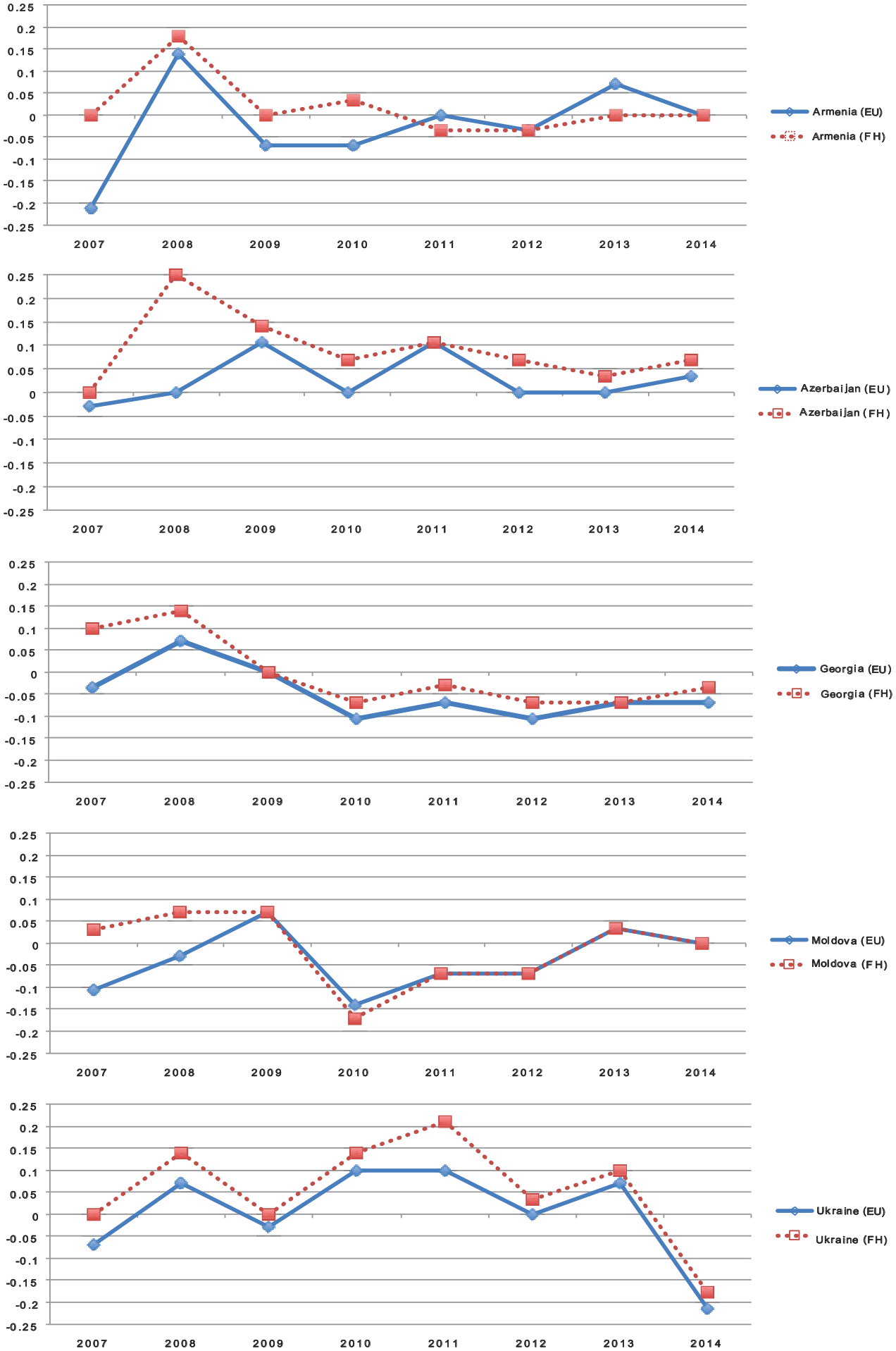
Democratization trends in the Eastern Partnership (EaP) countries according to Freedom House’s (FH) Nations in Transit Index (NIT) and the EU
Three main observations stand out from this analysis. First, it reveals that in the majority of the observations, the EU appears to be rather “optimistic” in its evaluations. On the other hand, however, the gap appears to vary considerably across the countries. As the results indicate, the EU is rather lenient when it comes to evaluating the quality of democracy of Azerbaijan and to some extent of Armenia. A close examination of the reports reveals that the EU often gives preference to soft judgments, and words like progress, improvement, a step forward often permeate in its assessment reports on these countries, whereas negative references appear far less frequently. At the same time, the EU is relatively more open in its criticism when assessing the quality of democracy in Ukraine and Georgia and produces on average the most reliable reports when evaluating the performance of Moldova. Finally, when tracking the quality of the EU’s assessments over time it is clearly observable that the year 2009, coinciding with the launch of the Lisbon Treaty and the EaP initiative, was effectively a breaking point. The results reveal that the gap between the EU’s assessments and those of FH has essentially reduced thereafter. 32
Although this analysis is original in measuring the quality of the EU assessments, it is crucial to stress that the measure does not reveal the true degree of bias in the EU’s assessments. As no single “objective” measure of democracy exists, this measure captures merely the broad cross-country and cross-time variations in the quality of the EU’s assessments relative to the conventional expert-based ratings of democracy.
Quantitative Analysis
Data and Empirical Strategy
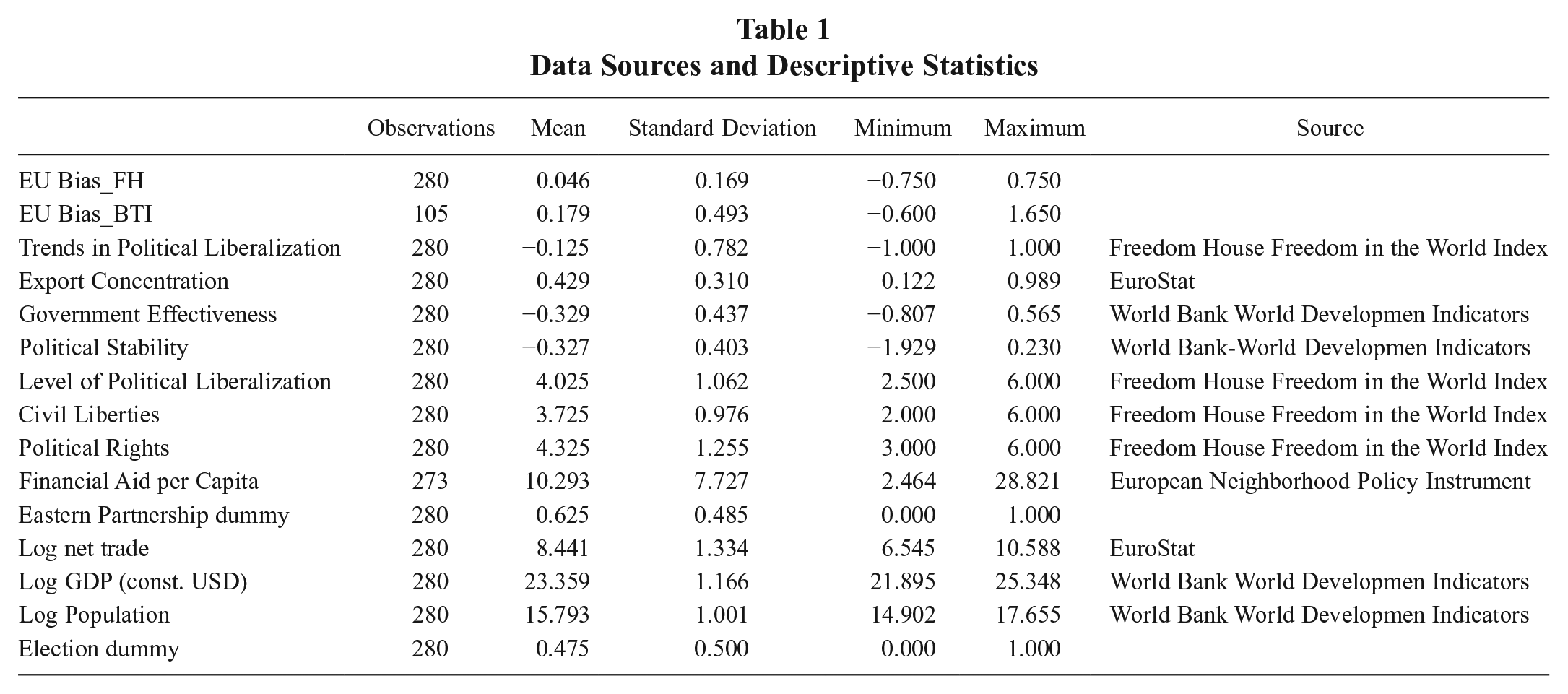
This section quantitatively tests the above-developed hypotheses. The sample consists of five EaP countries over eight years in seven democracy categories, which results in a panel data set of 280 observations. The summary statistics of all variables and their sources are collected in Table 1.
Data Sources and Descriptive Statistics
The empirical model is estimated using an ordinary least squares (OLS) regression of the following form:

where the dependent variable, EU Bias, is the deviation of the EU’s assessments of the democratic processes in target countries from the FH (or BTI) scores in seven categories (h) for each country (i) and year (t). A positive (negative) number would indicate that the EU shows lenience (rigor) in evaluating a given country’s progress relative to the previous year, whereas numbers closer to zero imply more similar evaluations between the standard indicators of democracy and that of the EU.
On the right-hand side, the key independent variables of interest include the measurements of (1) political liberalization, (2) statehood, and (3) economic interdependence between the EU and the target countries. FH’s Freedom in the World Index provides the measurement for the Political Liberalization variable, which ranges from 1 indicating the highest and 7 the lowest level of political rights or civil liberties in a given country. Taken in absolute terms, this index clearly depicts the variation across countries; however, the differences over time are less pronounced. To nuance these assessments, the data on the overall trends in this indicator over time are also utilized for statistical tests (i.e., Trends in Political Liberalization). The variable takes the value 1 if there is any improvement in a country, −1 if there is a negative development, and 0 if no change has occurred.
The countries’ level of statehood—defined in terms of a state’s stability and capacity to maintain order—are measured by the World Bank’s World Governance Indicators on Political Stability and Absence of Violence and Government Effectiveness, respectively. Both measures range between −2.5 and 2.5, with higher scores corresponding to better outcomes. Accordingly, the following three variables enter the regression: Political Stability, Government Effectiveness, and the straight average of these two variables, comprising the overall level of Statehood in target countries.
Finally, the level of target countries’ economic dependence on the EU is captured on two dimensions, the density of trade flowing from the EaP countries to EU markets on the one hand, and the countries’ level of aid dependence on the EU on the other hand. Trade density is measured by considering the target countries’ level of export concentration to the EU markets. Specifically, a low level of export concentration suggests that the target country exports a wide range of products to the EU over time and thus exhibits greater dependence on the EU as an export market. Conversely, when a country’s export portfolio with the EU comprises a small number of products, it is considered to have a lower level of export density and relatedly low dependence on the EU. The variable Export Concentration is measured as the shares of different categories of traded goods in a country’s total exports to European markets. In addition, the country’s aid reliance on the EU is used, which is measured considering the per capita amount of financial assistance provided to the EaP countries through the ENP Instrument (Financial Aid per capita).
I test also the effect of the Lisbon Treaty and the EaP initiative on the EU’s assessment reports. A dummy variable (EaP dummy) is created, coded as 1 for the years following the events in 2009 and 0 otherwise. To control for other variables that might affect the bias of the EU’s assessments, several other cross-time and cross-country variables enter into the regression. First, the Elections dummy is created, which takes value 1 for those years when either parliamentary or presidential elections were held in the target countries, 0 otherwise. As elections in non-democratic regimes are often considered to increase the risk of conflict, violence, and social unrest in a country, the EU presumably will become especially cautious in issuing negative reports during election years, to avoid further fueling potential violence. In addition, the specification includes GDP (in 2005 USD) and the size of the Population, which are both specified in natural logarithms as well as Net Trade, which is the (log) volume of bilateral trade flows (exports plus imports) between the EU and each EaP country. To control for the remaining time-constant cross-country heterogeneity, the study includes country fixed effects, μi, which help to rule out any spurious correlations coming from unobservable country-specific effects. Finally, εi,t,h is the idiosyncratic error term.
Baseline Results and Robustness Tests
Table 2 collects the results from estimating the equation specified above. In line with theoretical expectations, the findings suggest that there is a statistically significant correlation between the EU’s lenient assessments and low levels of political liberalization (column 1). This pattern is confirmed when Political Liberalization is measured in terms of trends in political openings over time. The variable enters the regression with a negative coefficient, which is statistically significant at the 10 percent level. The variable Statehood partially conforms to predictions. Whereas the state’s effectiveness in governance appears to have a strong positive effect on the EU’s assessments (column 4), the other dimension of statehood—state stability—did not reach conventional levels of statistical significance (column 5). One possible explanation is that the World Bank data on “State Stability and Absence of Violence” taken as a measure of state stability exhibit low variance across countries and over time.
Baseline Results
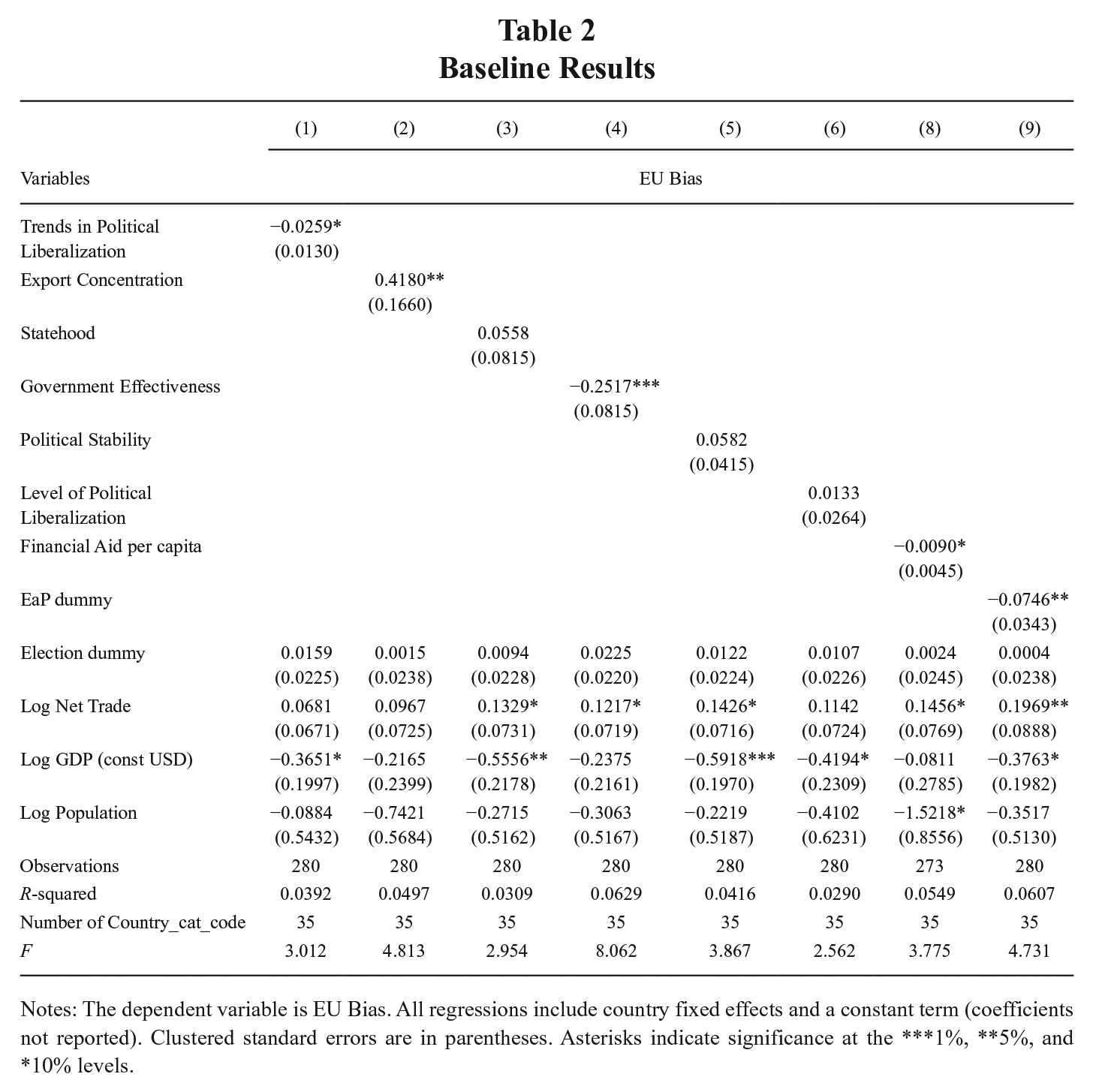
Notes: The dependent variable is EU Bias. All regressions include country fixed effects and a constant term (coefficients not reported). Clustered standard errors are in parentheses. Asterisks indicate significance at the ***1%, **5%, and *10% levels.
The level of partner countries’ dependence on the EU appears to have strong positive effects in terms of reducing bias in EU assessments. Specifically, Export Concentration takes a positive and significant value at the 5 percent level, suggesting that a higher concentration of exports is associated with greater lenience in the EU’s assessments (column 2). In other words, greater dependence on a small number of exported goods (which usually encompasses the export of energy and raw materials) leads to biased assessments by the EU, whereas more diversified exports suggest more reliable assessments. The results also suggest that greater EU financial assistance to the partner countries is correlated with less-biased EU assessments (column 8).
Finally, the findings, consistent with the observational results, confirm that in the post-EaP era the EU produced, on average, significantly more reliable assessments than before (column 9). Regarding the control variables, there is weak evidence that higher Trade Volume is positively associated with more lenience and that the size variables of population and GDP are negatively associated with EU bias. These coefficients and the dummy on election years are not consistently statistically significant across all models.
Several robustness tests of the baseline results are performed. First, to ensure that the findings of the study are not driven by potential measurement errors in the FH ratings, in this section, the study uses the BTI democracy score as a benchmark to measure the bias of the EU’s assessments. This new index enters the regression as the dependent variable. The BTI index is available on a biannual basis, and therefore, the remaining variables have been measured biannually.
The results are in line with the main findings, indicating that the latter are not driven by measurement errors in the FH scores (Table 3). All variables enter the regression with the same signs as before and are statistically significant. In line with main expectations, the results again indicate that there is a strong negative association between low levels of political openness in target countries and biased EU assessments. And with respect to the country’s level of dependence on the EU, the results of statistical tests suggest that the higher dependence of the partner countries on the EU appears to have positive significant effects in the release of less biased EU assessments.
Robustness to an Alternative Measure of EU Bias
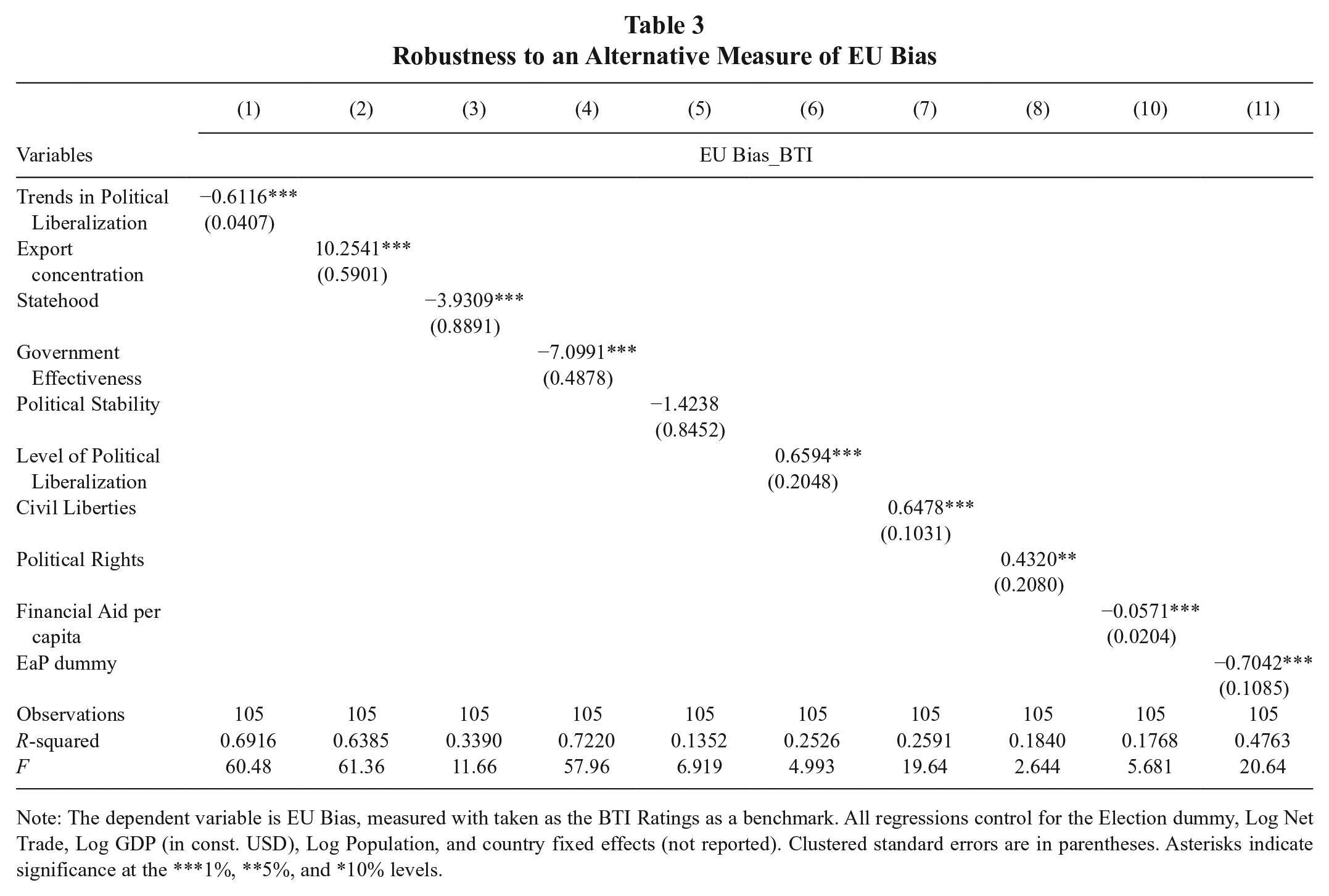
Note: The dependent variable is EU Bias, measured with taken as the BTI Ratings as a benchmark. All regressions control for the Election dummy, Log Net Trade, Log GDP (in const. USD), Log Population, and country fixed effects (not reported). Clustered standard errors are in parentheses. Asterisks indicate significance at the ***1%, **5%, and *10% levels.
To test whether the baseline results are likely to be driven by any single country, the study next excludes each of the countries one by one from the baseline estimations. The results for three main independent variables are collected in Table 4 and suggest that the findings are not sensitive to any specific country. The main variables of interest remain at statistically significant levels and in the expected directions.
Robustness of baseline regression analysis results to sample selection
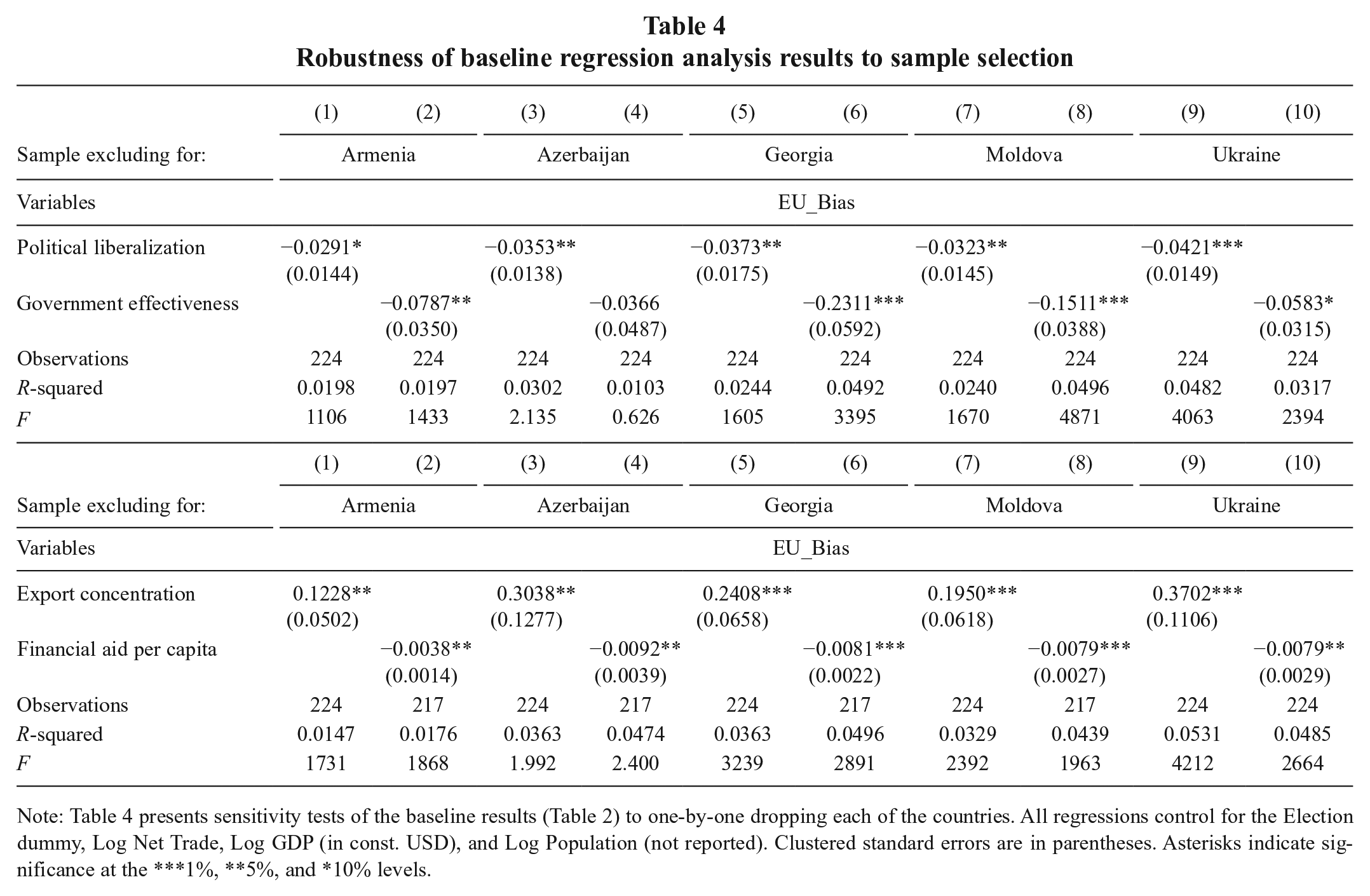
Note: Table 4 presents sensitivity tests of the baseline results (Table 2) to one-by-one dropping each of the countries. All regressions control for the Election dummy, Log Net Trade, Log GDP (in const. USD), and Log Population (not reported). Clustered standard errors are in parentheses. Asterisks indicate significance at the ***1%, **5%, and *10% levels.
To move beyond the estimated correlations and to provide a more nuanced in-depth analysis of how the explanatory factors operate and shape the content of the EU’s assessment reports, in the following section I track the processes of political opening and closure in the two most contrasting countries of the sample, Azerbaijan and Moldova, and cover a longer time period of 13 years (2007–2019). These two cases are selected since with respect to the key independent variables of interest (i.e., their levels of political liberalization and patterns of interdependence with the EU), on average they display the most extreme values thus putting in stark relief how the causal arguments operate. The case studies by and large bolster the statistical findings showing that a certain increase and decrease in the countries’ levels of political liberalization as well as the variation in the patterns of their economic interdependence resonate with the EU being more or less willing, respectively, to openly criticize the countries’ poor democratic performance.
Case Studies
When Conditions Fail: The EU’s Lenient Assessments of Azerbaijan
That Azerbaijan’s oil wealth has especially contributed to strengthening authoritarian rule in the country has been widely discussed in the literature. 33 Oil rents directly accumulating in the hands of the state elite and its loyalty enabled the regime to create patron–client networks, which helped to sustain the country’s macroeconomic and political stability and provide the government with a certain degree of legitimacy. 34 Oil has become the key element in building the regime’s international legitimacy as well. By using widespread international interest in the country’s rich energy resources, the regime has managed to attract a remarkable level of foreign investments in oil exploration and development operations and to design international contracts giving the regime ultimate control over the distribution of oil rents. 35
The rapid, oil-driven growth of Azerbaijan’s economy facilitated the reinforcement of the existing autocratic elements of governance and steadily transformed the country from a hybrid regime into a consolidated authoritarian state. In 2003, Azerbaijan became the only post-Soviet state where executive power was transferred from an incumbent president to his son, Ilham Aliyev. 36 By harassing opposition parties, limiting political competition, rigging elections, intimidating independent media, and breaking up public protests with excessive violence, Aliyev began to lead a regime that mixed crime, extensive corruption, and nepotism.
Azerbaijan signed a bilateral Action Plan with the EU in 2006, whereby it committed to reform the country’s economy and democratize its political institutions to better meet EU standards. However, it is strategic energy cooperation which figures prominently in EU–Azerbaijan relations. In fact, in 2006, in parallel to the launching of the Action Plan, the EU and Azerbaijan drew up a separate Memorandum of Understanding on Energy which emphasized that Azerbaijan is an important strategic partner of the EU and energy is a core area of their relations.
It is remarkable, however, that the cooperation between the EU and Azerbaijan in this important area was not made conditional on Azerbaijan’s commitment to respect human rights and democratic principles. Various civil society organizations have repeatedly called on the EU to draw consistent links between energy, trade, and human rights policies in Azerbaijan. 37 Yet such a passive stance of the the EU comes of no surprise. Being the world’s one of the largest importers of crude oil and natural gas, the EU’s strong energy dependence is further accentuated by the fact that its imports are concentrated among relatively few partners. Against this background, Azerbaijani energy exports to Europe are of strategic importance, allowing the EU to diversify its energy supplies and routes away from Russia and the Middle East. 38
The EU’s overall reluctance to link its energy policies with demands for democratic reform in Azerbaijan accords with Azerbaijan’s passive position for closer political and economic association with the EU. The ruling elite, which earns substantial revenues from rich natural resources, displays no sense of urgency to bring its national legislation in line with the EU’s economic standards, not to mention compliance with its principles of democracy. With few variations over the course of the past decade, approximately 99 percent of Azerbaijani exports to the EU have consisted of fuel and mining products (Figure 2), thus making the energy sector virtually the only sphere where EU–Azerbaijan cooperation is flourishing.
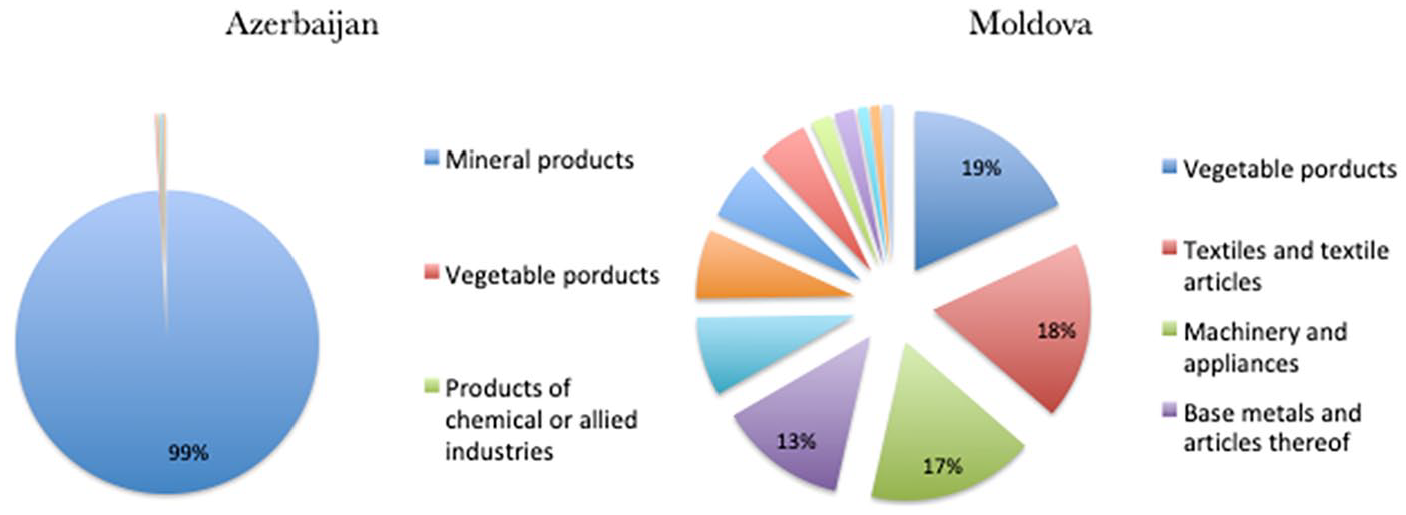
Structure of Azerbaijan's and Moldova's exports to the EU
While the supply of crude oil has traditionally been at the centre of their cooperation, with the opening of the Shah Deniz gas field in late 2006, natural gas has come to the foreground. The Shah Deniz field transformed Azerbaijan into a major gas producer and exporter country and turned it into a decisive broker in a number of gas deals involving competing commercial entities from different EU member states. 39 Most important, Azerbaijan was given a strategic role in the realization of the Southern Gas Corridor (SGC) project, which is a network of pipelines stretching from Azerbaijan to Turkey and into the EU. Essentially, the corridor intended to reduce Europe’s reliance on Russian fossil fuels and open new possibilities for gas exports from the Caspian basin to Europe.
When Barroso, then the president of the European Commission, visited Baku in 2013 to sign the deal, he welcomed it as “a strategic door opener for stronger European energy security.” 40 In addition, when asked about the state of democracy in the country, Barroso “recognized the tremendous progress achieved and was glad that Azerbaijan is committed to political reform, democracy and the rule of law.” 41 A couple of months after Barroso’s visit, Aliyev, running for a third term, won another contentious election. The electoral fraud in Azerbaijan was blatant and “significant problems were observed throughout all stages of election day.” 42 The OSCE’s assessments came in dramatic contrast to the European Parliament’s official election monitor’s conclusions, which observed a “free, fair and transparent electoral process” and praised the “professional and peaceful way” in which electoral procedures were implemented. 43 The European Commission in turn stated “the elections demonstrated the commitment of the people of Azerbaijan to the democratic process.” 44
The EU’s aid allocations for cooperation programs with Azerbaijan do not represent sufficient incentive for reforms either. Over the last ten years, more than €300 million have been made available for various programs through the ENPI. However, considering the fact that in 2011 the daily income from Azerbaijani’s oil revenues alone amounted to $55 million, it is apparent that the EU’s aid is less likely to provide sufficient impetus for democratic reforms in Azerbaijan.
In 2014, Azerbaijan suspended the association agreement negotiations with the EU even though its National Security Concept explicitly states that “integration into the European and Euro-Atlantic political, security, economic and other institutions constitute the strategic goal” of the country. 45 Since then, the country has shown no interest in deepening its contractual relationship with the EU while Aliyev in turn began explicitly rejecting the idea of European integration, viewing the EU, as he states, as “a region in economic crisis with anti-Islamic attitudes.” 46 Azerbaijan thus seemed to move further away from its EU integration policy towards more strategic cooperation, and in 2016 a renewed format of strategic partnership agreement negotiations was launched between the EU and Azerbaijan, which is yet to be concluded.
In the same year, another controversial referendum on constitutional amendments was held in Azerbaijan. The Venice Commission issued a critical report ahead of the referendum criticizing especially the increase of presidential powers (which are seen to reduce the president’s political accountability and further weaken the parliament); the unjustified extension of the term of the president from five to seven years (which is unprecedented among the Council of Europe member states); and the introduction of the figure of unelected vice presidents, 47 for which ironically Aliyev named his wife, Mehriban Aliyeva, as the first vice president in 2017.
In contrast to the critical assessment of the Venice Commission, the EEAS issued a short statement inviting Azerbaijan to take into account the Commission’s findings and mentioned that the referendum took place in a “peaceful atmosphere” and where only some shortcomings were noted, “as regards prior debate in Parliament,” and that some activists were detained during the campaign period. 48
Gross human rights violations, arbitrary detention of political opponents, and repression of peaceful protests further intensified ahead of Azerbaijan’s 2018 presidential elections, which were pronounced flawed and undemocratic by the OSCE/ODIHR observers. 49 The EU by referring to the OSCE reports also stated that the elections “took place within a restrictive political environment and under laws that curtail fundamental rights and freedoms” and offered its assistance to Azerbaijani authorities in implementing the OSCE observers’ recommendations. 50
Yet in the meantime, the European Commission together with the EEAS strongly supported further investments in the SGC project despite much criticism from human rights organizations as well as the European Parliament that pointed to possible links between European investments and the “Azerbaijani Laundromat.” 51 The European Commission waved away this criticism and instead classified the SCG as part of “one of the priority corridors” within its Projects of Common Interest list.
This strategy, in fact, reflects the EU’s long-term transition to a low-carbon economy where a growing focus on natural gas (as a low-carbon alternative to coal and oil) plays a significant role in its decarbonization policies. In March 2018, thus, the European Investment Bank (EIB) after consulting the EEAS and the European Commission, approved a loan of around €1.5 billion for the construction of the Trans-Anatolian and Trans-Adriatic Natural Gas Pipelines, both of which are part of the SCG and would bring Caspian natural gas from Azerbaijan to Europe. 52
The EIB did not condition the loan on the improvement of human rights, and furthermore, during the EIB appraisal of the loan, the EEAS confirmed that despite Azerbaijan’s withdrawal from the Extractive Industries Transparency Initiative (EITI) “Azerbaijan is developing, in line with EITI requirements, standards of transparent extractive revenue management” and confirmed that “The EU has a policy of constructive dialogue and engagement with Azerbaijan, and maintains a continued policy dialogue on issues such as human rights and civil society organizations.” 53
Taken together, it appears that, when an authoritarian system of governance was being consolidated in Azerbaijan, somewhat ironically the EU’s much-needed critical response, one that could help to pressure the government to change its abusive policies, was lacking. Not to risk provoking even greater political closure or being wary of triggering unwanted instability in the country, the EU, against the background of Azerbaijan’s low levels of political liberalization, was largely reluctant to use negative assessments and openly criticize the government’s poor record of democracy. In addition, Azerbaijan exhibiting no aid dependency on the EU and posing strategic importance in terms of energy security for the EU further reinforces the EU’s reluctant approach to openly and publicly criticize Azerbaijan’s poor democratic performance.
Impressively Outspoken: The Effect of Moldova’s Political Opening on EU Assessments
With no previous experience of democratic statehood, throughout the 1990s Moldova managed to have a relatively strong legislature, free and diverse media, few restrictions on political organization, and two democratic electoral turnovers in 1992 and 1995. However, this was not so much the result of the government’s genuine effort to craft strong democratic institutions, but rather a consequence of its inability to control elections and mass media and use force against its political opponents. 54 The government’s inability to build sustainable democratic institutions coupled with continued tensions in the secessionist Transnistria region and worsening economic conditions further hampered the country’s prospects of developing democratic and effective institutions. Against this background, the 2001 parliamentary elections returned the Moldovan Communists to power, which, functioning in an environment of fragmented and weakly institutionalized parties, quickly managed to dominate the political landscape in the country. 55
Since 2004, when eastern enlargement transformed Moldova into the EU’s immediate neighbor, the EU’s engagement in the country has enhanced significantly. In early 2005, an Action Plan was signed to strengthen democratic institutions in Moldova and an EU Special Representative with a mandate to bolster the EU contribution to the resolution of the Transnistria conflict was appointed. 56
The rise of the EU’s profile in Moldova coincided also with the first cracks in communist rule, becoming noticeable after the 2005 parliamentary and, especially, the 2007 local elections. Although the parliamentary elections produced a second victory for the Communist Party, their victory was less decisive this time. It lost its supermajority and was forced to make an alliance with opposition parties to create a sufficient majority in the parliament for the re-election of Voronin. Both elections, however, failed to satisfy a number of key international standards central to a competitive electoral process such as unequal campaign conditions, manipulation of the state media, widespread use of administrative resources, and intimidation and pressure of a number of opposition candidates. 57 Additionally, ahead of the subsequent parliamentary elections, Voronin promulgated amendments to the Electoral Code that prohibited parties from forming electoral blocs in advance of the election and raised the electoral threshold for a party to enter parliament.
By being less vocal about the country’s electoral malpractice and democratic deficits, the Commission appraised the country’s prospects for political opening. It welcomed Moldova’s significant progress in advancing its ambitions domestic reform agenda and for taking important steps towards ensuring respect for human rights and fundamental freedoms. 58 In response to these reforms, furthermore, the EU granted Moldova a number of unilateral trade preferences for closer economic association with the EU. Since 2007, the EU has become the main trading partner of Moldova, absorbing 52.3 percent of its exports and showing a rather diversified export structure that is mainly based on agricultural products, clothing, textiles, and machinery (see Figure 2).
In the same year, a visa facilitation and readmission agreement was signed and the EU also enhanced its financial assistance for the period of 2007–2010 to more than €250 million in total, under the ENP instrument alone, which was the highest per capita allocation among the EU’s neighboring countries and second only after the occupied Palestinian territory. 59 Known as the poorest country in Europe, with the lowest GDP per capita in Europe and being nearly entirely dependent on the agricultural sector, financial assistance from the EU, in turn, is crucial for Moldova, and constitutes a considerable part of the government’s revenue. 60
Against the backdrop of growing aid and trade dependence on the EU, ahead of the 2009 parliamentary elections the EU began more actively to encourage the government to democratize its political institutions and in particular to improve its electoral legislation and practice. The Commission urged Moldovan authorities to hold free and fair elections and called for lowering its electoral threshold of 6 percent to provide smaller parties with a better chance to enter parliament. In addition, it allocated special funds amounting to €3 million for projects to promote and monitor the compliance of elections with international democratic standards. 61
The official election results indicated a Communist victory for the third consecutive time. The opposition parties rejected the results, accusing the authorities of fraud and vote-rigging and demanded new elections. In addition, various international election observers, including the EU monitors, reported observing multiple flaws with the elections. 62
Tens of thousands of anti-government protesters took to the streets to oppose the outcome of the elections and demand an end to the Communists’ rule. In an attempt to disperse demonstrators, police responded with the use of force and detained hundreds of protesters. The Commission expressed its deep concerns about the post-election developments, stating “street riots met with serious violations of human rights and fundamental freedoms by the law enforcement bodies.” 63 The European Parliament was even more critical in its assessments, noting that the “Moldovan Communist leadership has imposed terror, torture, murder, kidnappings, intimidation, and threats against the Moldovan population.” 64
These events set the stage for new parliamentary elections and subsequently resulted in a change of power to a new governing coalition called the Alliance for European Integration (AEI). As the name suggests, the AIE adopted a pro-European policy program, calling for major reforms to strengthen the rule of law, foster the development of civil society, dismantle Communist patron–client networks, and achieve Moldova’s gradual integration into the EU. The response of the EU and the multilateral agencies to the government initiatives was highly positive. Donors committed $2.6 billion in support over the course of the next four years and gave every indication of their willingness to assist in advancing reforms. In the same year, negotiations began with the EU on an Association Agreement and visa liberalization.
Even though the AIE was successful in taking steps toward eliminating certain limitations on civil liberties and political rights in the country, serious efforts were still lacking to ensure the sustainability of those reforms. A high level of corruption, deeply embedded in political institutions, has remained a major problem in Moldova. International watchdogs reported widespread corruption, particularly in government institutions and the judiciary. 65 The situation worsened when during the country’s 2014 general parliamentary elections campaign, $1 billion, which is equivalent to more than one-eighth of the country’s GDP, was stolen from three of the country’s banks. 66 This massive bank fraud discredited the governing coalition further and again brought protesters to the streets demanding the government’s resignation and early elections. In response to these events, the EU explicitly and publicly criticized the government’s malpractices. The EU froze its 40 million budgetary support programme for the government. 67 In addition, the Commission has repeatedly raised deep concerns regarding the government’s poor and low level of response to combat corruption and improve the independence and functioning of the judiciary. 68
The democratic backsliding of the country including high levels of corruption, lack of trust in the judicial sector, and rising concerns about attacks on human rights and fundamental freedoms continued in Moldova against the backdrop of the country’s upgraded contractual relations with the EU under the AA and DCFTA.
After multiple changes of government in 2015 and anti-government demonstrations, the Democratic Party Moldova (PDM) fully monopolized political power by the end of 2015. In 2017, the PDM introduced a controversial initiative of changing the electoral legislation from the exiting proportional to a mixed system, which was eventually adopted by the parliament. 69 This new electoral law favoured governing parties and was strongly criticized by various civil society and opposition groups as well as by the European Commission, which warned that these changes could undermine democratic standards in Moldova. 70 A year later, in 2018 the results of the mayoral elections in the capital Chișinău—won by the opposition leader—were nullified by the Supreme Court, which was strongly condemned and regarded as “non-transparent” by the EU and other international organizations. 71
In light of these developments, the European Parliament adopted two resolutions in 2018 raising its concerns about the deterioration of democratic standards and the rule of law in the country and calling for financial sanctions against Moldova until the Moldovan authorities “guarantee the functioning of democratic mechanisms.” 72 The European Commission in response decided to substantially reduce its financial assistance (by about €20 million per year for both 2017 and 2018) as well as suspend macro-financial assistance (€100 million) and EU budgetary support programs, thereby aiming to penalize the government and provide an impetus for reforms. The Commission resumed its budgetary support and macro-financial assistance to Moldova only following the change of government in 2019 when the new government showed a commitment and took some steps toward strengthening the rule of law, democracy, and the fight against corruption. 73
The case of Moldova, in sum, shows that the willingness of EU institutions to raise criticisms of the country’s poor democratic performance became pronounced when the country began to show clear tendencies toward a more open, competitive, and participatory political system. Accordingly, before the advent of the pro-EU governing coalition in Moldova, the EU in its reports appeared to be rather hesitant in openly criticizing democratic malpractices in the country. By using the tactic of “naming and praising” the few reforms that the Communist Party had undertaken, the EU, in fact, hoped to encourage further domestic reforms. Since 2009, when the pro-European governing coalition came to power, EU institutions have become relatively more open and explicit in criticizing the government’s lack of progress and publicly demanding that the Moldovan government make a determined fight against corruption and ensure effective and sustainable implementation of the reforms. The EU’s strong critical rhetoric was backed with actions when in 2018 for a nearly two-year period the EU put on hold its financial assistance to Moldova to penalize the government for not respecting the rule of law and democratic mechanisms. Unlike Azerbaijan, Moldova over the course of the past decade has become highly reliant on the EU as a source of development aid and an export market. This factor, combined with the EU’s lack of special economic interests in the country, gave the EU greater leverage to push for reforms and be outspoken in its criticism.
Conclusion
This study contributes to the growing literature on the critical role of international monitoring and reporting mechanisms as a way to affect state policies and focuses particularly on the quality of the EU’s reports assessing its Eastern neighbouring countries state of democracy. In this respect, the study also contributes to the broader debate on the credibility of the EU’s democracy promotion policies in its neighbourhood.
Empirically, the study has designed an original scale that helps to identify the degree of lenience in the EU’s assessments across its Eastern neighbouring countries and over time by conducting an in-depth analysis of the content of the EU’s assessment reports. Subsequently, the study has provided a systematic analysis of the key structural factors that tend to influence and compromise the quality of the EU’s assessment.
In summary, the empirical findings of the study suggest that when the domestic conditions are favourable, namely, when the regime allows for a certain level of political liberalization in the country while demonstrating high aid and trade dependence on the EU, the latter is likely to issue more impartial assessments on the quality of democracy in the country. However, the results also suggest the release of less reliable reports when these conditions are not met, suggesting, quite counter-intuitively, that in political settings where authoritarian elements prevail, much-needed criticism from the EU is often lacking. This approach by the EU is often further reinforced when the latter maintains certain strategic relations with the partner country.
The lenient assessment reports carry several risks for the effectiveness and credibility of the EU’s democracy promotion policies but even more important, for domestic efforts towards democratization. This study has not systematically examined those risks, leaving them to a future research inquiry, but they are at least worth mentioning.
In such political settings where credible domestic watchdogs such as free media, civil society, or an independent judiciary are weak, reliable EU assessment reports are critical in providing alternative information beyond government-controlled sources and raise public awareness of the democratic deficits in the states. In addition, by openly criticizing and exposing government malfeasance, EU reports may play an essential role in pressuring the government to change its policies and incentivizing domestic reforms. Conversely, lenient assessment reports by the EU provide false legitimacy to governments’ actions and policies. By turning a blind eye to a regime’s violations of civil liberties, rigged elections, and abuse of democratic procedures, such assessments may, in turn, open the door to further manipulation.
The implications of such assessments by the EU are probably more complex and vast but are clearly alarming. When EU institutions take the responsibility to evaluate the progress of democracy in partner countries, it is crucial to produce as assessment reports that are as reliable as possible. It needs to create a more transparent process of monitoring the partner countries’ practices of democracy, to rely on highly impartial and neutral sources of information, to vet the accumulated information carefully, and ultimately to ensure the assessments are as accurate as possible.
Supplemental Material
sj-pdf-1-eep-10.1177_08883254211018735 – Supplemental material for Monitoring Democracy in the Eastern Neighbourhood: When Are the EU’s Assessments Lenient and Why?
Supplemental material, sj-pdf-1-eep-10.1177_08883254211018735 for Monitoring Democracy in the Eastern Neighbourhood: When Are the EU’s Assessments Lenient and Why? by Lusine Badalyan in East European Politics & Societies and Cultures
Footnotes
Acknowledgements
This work is part of the project “Domestic Preferences and EU Cooperation—Explaining Foreign Policies in Ukraine, georgia, and Moldova. A Two-Level-game Analysis,” supported by the german Research Foundation (DFg) under grant Number 387774818. I would like to thank Heiko Pleines, Tanja Börzel, Thomas Risse, and Sandra Lavenex for their many insightful comments on the earlier versions of this article.

Notes
Supplementary Material
Please find the following supplemental material available below.
For Open Access articles published under a Creative Commons License, all supplemental material carries the same license as the article it is associated with.
For non-Open Access articles published, all supplemental material carries a non-exclusive license, and permission requests for re-use of supplemental material or any part of supplemental material shall be sent directly to the copyright owner as specified in the copyright notice associated with the article.
