



Abstract
Citizens with higher levels of education are consistently found to be more open to immigration and European integration than those with less education. However, the literature has neglected the issue of whether educational divides in anti-globalisation sentiment result from people's own educational attainment or whether they are a consequence of deep-rooted positions of disadvantage across generations. In this article, we address the question to what extent the attitudes towards globalisation of intergenerationally mobile citizens, that is, those who obtain a different educational outcome than one's parents, adapt to the newly acquired social position or remain attached to the parental milieu. We apply diagonal reference models to study the influence of one's own and parental education level on attitudes to globalisation in 26 European countries using the European Social Survey between 2008 and 2018. Our results indicate that while mobile citizens adjust their attitudes to the achieved education level, there remains an enduring influence of the education level of origin. In addition, we find that the importance of parental educational attainment does not depend on the social fluidity between education levels within countries. Consequently, this study has important implications for studying political socialisation and the future of the educational divide over globalisation.
Introduction
The exit of the United Kingdom from the European Union (EU) and the electoral success of anti-immigration parties demonstrate that the consequences of globalisation and its institutions have become heavily politicised in recent years (Walter, 2021). Scholars speak of the emergence of a transnational cleavage that has as its focal point the ‘the defense of national political, social and economic ways of life against external actors who penetrate the state by migrating, exchanging goods or exerting rule’ (Hooghe and Marks, 2018: 110). Central to this transnational-nationalist dimension of political contestation are the issues of immigration and European integration (Jackson and Jolly, 2021; Kriesi et al., 2008). Whether one embraces or rejects the permeability of national borders is socially rooted in demographic characteristics such as urban-rural residence, gender, and most importantly, education (Bornschier et al., 2021; Hooghe and Marks, 2018). Specifically, it is well-established that those with less education are more likely to oppose immigration and further European integration than those with more education (Cavaille and Marshall, 2019; Hakhverdian et al., 2013).
Existing research suggests that educational divides in anti-globalisation sentiments are not only formed by citizens’ own educational attainment but also reflect deep-rooted positions of disadvantage across generations (Kuhn et al., 2021; Lancee and Sarrasin, 2015; McNeil and Haberstroh, 2022). Therefore, we study the relative importance of own and parental education for shaping openness towards globalisation for the socially mobile. Since socially mobile individuals achieve a lower or higher educational level than their parents, they are connected to both their parental and their own educational milieu. Consequently, these citizens are shown to form their political opinions in a different fashion than those who remain in the same social environment throughout their lives (De Graaf et al., 1995; Tolsma et al., 2009).
However, it is an open question whether the attitudes of socially mobile citizens reflect more the attitudes of their parents’ educational level or of their own educational level. One perspective argues that ‘mobile’ people's own education level is most important in forming attitudes towards globalisation due to peer socialisation, exposure to liberal norms and skills development in education (Hooghe and Marks, 2005; Kriesi et al., 2008). Hence, it assumes that people's attitudes are dynamic and adapt to the interests and cultural practices that result from holding different educational credentials (De Graaf and Ultee, 1990). A competing perspective argues that early childhood experience within the parental environment is key in developing lasting values, beliefs, and attitudes (Kam and Palmer, 2008; Neundorf and Smets, 2017). Parents transmit preferences to their children directly via family socialisation (Glass et al., 1986; Langsæther et al., 2022) and indirectly through, for example, the selection of neighbourhoods, social networks, or job opportunities (Friedman and Laurison, 2020; Kam and Palmer, 2008). From this perspective, parental background is ‘sticky’, and attitudes change little despite educational re-socialisation or the position obtained in the labour market. In turn, following status maximisation theory, people seek to associate themselves with higher states, and hence socially upward mobile people should subscribe to the attitudes of their own educational group whereas downwardly mobile should stick to their parents’ attitudes. Thus, while both parental background and one's own education level are considered vital in shaping political attitudes (Neundorf and Smets, 2017), the exact balance between the two, and its possible context dependency, deserves further attention.
To examine socially mobile citizens’ attitudes central to the transnational-nationalist dimension, i.e. immigration and European integration, we employ diagonal reference models (DRMs) in 26 European countries using data from the European Social Survey (ESS). DRMs are statistical models, which allow the researcher to disentangle the separate influence of parental education, one's own education level, and the difference between the two (Sobel, 1981). Although rarely used in political science research, DRMs are an established method in sociology, including studies about the role of social mobility for health (Schuck and Steiber, 2018), and political attitudes (Jaime-Castillo and Marqués-Perales, 2019; Paskov et al., 2021). While we stress that we cannot test causal effects in cross-sectional data, the use of DRMs helps us better understand whether the educational differences in attitudes towards globalisation is rooted in a long-standing socio-economic divide that cuts across generations.
Our article makes two important contributions. First, although scholars agree that the transnational cleavage is socially rooted in differences in educational attainment, it is still unclear what the exact role of education is in fostering people's position on the transnational-national dimension. This article adds to a larger theoretical debate on whether parental or educational socialisation is more important in political attitude formation (Kam and Palmer, 2008; Sieben and De Graaf, 2004). Second, the degree to which attitudes are ‘sticky’ concerns the broader discussion in the literature on the extent to which attitudes adapt to people's position in the societal hierarchy. The implicit assumption in much of the literature is that regardless of people's social origins, the material opportunities and life chances that education provides overrides any predispositions. In this regard, we illuminate whether attitudes indeed adjust to people's position in the societal hierarchy, or whether the lasting influence of social origins prohibit to fully adjust to the newly acquired social position. If newcomers do retain part of their social origins and not fully assimilate, the heterogeneity of attitudes that intergenerational social mobility brings about within each educational milieu could weaken the educational divide over issues related to globalisation.
Theoretical framework
Social mobility is most often measured in changes of income, occupation, or education. We focus on education as it has been demonstrated to be especially important in predicting opinions towards globalisation in Europe (Bovens and Wille, 2017; Hooghe and Marks, 2018). This is related to the observation that these opinions are more grounded and expressed on the basis of cultural values rather than economic ones (Hainmueller and Hiscox, 2007; Norris and Inglehart, 2019; Van de Werfhorst and De Graaf, 2004). Consequently, more broadly speaking, education serves as an important source of social stratification, as it not only plays an important role as selection device and signalling human capital, but it also gives clues about people's overall opportunities in life, and norms and values (Van De Werfhorst, 2015). As such, education is argued to have become a distinct cleavage from occupation in political values and orientations in Europe (Bovens and Wille, 2017; Ford and Jennings, 2020). Not only do educational groups hold different values, education has also been shown to provide the basis of new forms of group consciousness (Bornschier et al., 2021; Kuppens et al., 2018; Stubager, 2009) and provide an important source of (subjective) social status (Van Noord et al., 2019, 2021). In addition, educational groups are mobilised by different political actors, as higher educated are more likely to vote for social-liberal and Green parties that have a cosmopolitan outlook, while the less educated are more likely to vote for conservative and radical-right parties that insist on the importance of protecting the nation's own national identity and traditions (Kriesi et al., 2008).
Intergenerational educational mobility concerns the process by which people obtain a lower or higher education level than their parents (Breen, 2010). As ‘mobile’ individuals climb or fall on the social ladder, they are exposed to two different social contexts, namely their social origin and social destination. However, they experience both contexts at different points over the course of their life. In childhood, the parental home is a prime locus of political socialisation. In contrast, the social destination is likely to be salient during and after leaving education, as students enter the labour market and spend less time within the family environment. Previous studies on the relationship between social mobility and political attitudes have found that the political preferences of the socially mobile are influenced by both their parental and their own social milieu (De Graaf et al., 1995). Thus, the attitudes of socially mobile people are likely to be distinct from those of the socially immobile, i.e. those who spend their entire lives in the same social class or education level (Ares, 2020; Tolsma et al., 2009). Consequently, our first hypothesis states as follows:
H1: Both parental and one's own education level shape socially mobile people's openness towards globalisation.
Social destination hypothesis
According to the social destination hypothesis, we should expect the attitudes of ‘mobile’ individuals towards globalisation to resemble their social destination more than their social origin (De Graaf and Ultee, 1990; Nieuwbeerta et al., 2000). First, people with higher levels of education are expected to be more open to globalisation due to exposure to liberal values in education, such as tolerance and post-national models of society, for a longer period (Stubager, 2008; Van de Werfhorst and De Graaf, 2004). Second, those with more education are more supportive of globalisation, as a higher education level increases the likelihood of becoming a ‘winner’ of globalisation and thus profit from increased mobility across borders (Gabel and Palmer, 1995; Kriesi et al., 2008). Finally, we can expect ‘mobile’ individuals to largely adapt their views to the new social position because of group dynamics. As people acquire a new social position, they become embedded in networks that uphold certain identities and attitudes. Hence, individuals feel social pressure to adjust their attitudes to those dominant in the new in-group to maintain their psychological well-being (Hogg and Smith, 2007). In sum, people's attitudes more closely resemble those of the newly acquired social position.
H2a: The relative weight of one's own education for openness towards globalisation is higher than the relative weight of parental education on openness towards globalisation.
Social origin hypothesis
In contrast, based on the social origin hypothesis, we should expect that the attitudes of ‘mobile’ individuals are closer to their social origin than their social destination (Jaime-Castillo and Marqués-Perales, 2019; Tolsma et al., 2009). According to this hypothesis, what people learn and experience in early childhood is especially important for crystallising their political preferences in the long run. In this regard, the family is considered the key political socialisation agent in youth (Neundorf and Smets, 2017). Ample literature has shown that parents are key in shaping political dispositions through various mechanisms (Jennings et al., 2009; Kam and Palmer, 2008). This happens not only through the transmission of values and attitudes by their words and deeds, but also through their vital role in the ‘selection of neighbourhoods, schools, and by extension, peer groups’ (Kam and Palmer, 2008: 616). In addition, there is also evidence that genetic factors play a role in forming attitudes via the inheritance of cognitive skills and personality traits (Alford et al., 2005). Moreover, research on social mobility shows that social origin is also important for shaping labour market position. Specifically, while obtaining the same degree, students from lower social strata are more likely to earn less and have less prestigious occupations than students from higher-status social backgrounds (Friedman and Laurison, 2020). In sum, this means that upbringing is ‘sticky’ and that the attitudes of ‘mobile’ individuals should largely resemble those of their parental education level.
H2b: The relative weight of one's own education on attitudes towards globalisation is lower than the relative weight of parental education on openness towards globalisation.
Status-maximisation hypothesis
While the social origin hypothesis argues that political attitudes resemble those of one's parental education, the social destination hypothesis assumes that ‘mobile’ individuals largely adjust their attitudes to their new social position. That is, irrespective of whether one moves up or down on the social ladder, the social networks, values, and material interests that result from different educational credentials override most parental influences. However, the consequences of downward mobility are assumed to be rather different than those that stem from upward mobility. Specifically, research has connected downward mobility with fuelling feelings of anger, frustration, and social marginalisation (Daenekindt, 2017). In response to this asymmetry between upward and downward mobility, the status-maximisation hypothesis has been proposed. According to this hypothesis, it is assumed that the downwardly mobile respond to their decline by anchoring their point of social reference in the most prestigious education level (De Graaf et al., 1995; De Graaf and Ultee, 1990). The underlying assumption is that people prefer to adopt the most prestigious identity and thus maximise their social status (Daenekindt and Roose, 2014). Although the status-maximisation hypothesis was originally formulated in the context of class mobility, we could expect this hypothesis to also apply to educational mobility because higher education signals higher social status.
Due to the centrality of education in contemporary European societies, and the large-scale education expansion in recent decades, education has become an independent source of (subjective) social status across most advanced industrialised democracies (Sandel, 2020; Van Noord et al., 2019, 2021). Schooling not only signals human capital, but it also classifies people into specific categories that have different status connotations to them. Specifically, educational degrees are seen as ‘badges of ability’ that have important status consequences (Van Noord et al., 2021: 4). Van Noord et al. (2021) show that people with less prestigious educational degrees have stronger feelings of misrecognition and higher dissatisfaction with one's own education. Furthermore, people are likely to not only know whether they are seen as highly or less educated, they also know to a certain extent what these labels stand for in terms of political behaviour and opinions (Stubager, 2009; Van Noord et al., 2021). According to Spruyt and Kuppens (2015: 298–299), ‘this enables them to classify persons (and to be classified) in the educational hierarchy by merely observing their opinions and conduct’. Consequently, based on processes of social distinction to signal their identity, people can express attitudes that reflect or are consistent with these (higher) education-based labels.
Because of the social status that is attached to education in contemporary European societies, people in general try to avoid the social stigma of being categorised as lower educated (Sandel, 2020; Van Noord et al., 2019, 2021). Consequently, the upwardly mobile are open to influences from their new social position and adjust their preferences accordingly as it yields a higher social status. In contrast, the downwardly mobile, to deal with their decline in status, anchor their point of social reference in the most prestigious education level, and are hesitant to change and are less open to social influences from their new position (Clifford and Heath, 1993). In our case, this implies that the upwardly mobile become more supportive of globalisation as this reflects their higher social status position, the downwardly mobile resist becoming more opposed to globalisation, as this conflicts with their more prestigious educational origins.
H3: The relative weight of one's own education compared to the relative weight of parental education on openness towards globalisation is higher for the upwardly mobile than for the downwardly mobile.
Societal mobility
Finally, it is reasonable to expect that the relative weight of parental and one's own education level on openness towards globalisation differs across countries. We explore one possible source of cross-country variation, namely the degree of social mobility between education levels within countries. A society is characterised by more social mobility if parental education is less important for determining the educational attainment of their offspring. Consequently, low social mobility implies that there is limited in- and outflow from different education levels. Lower social mobility within a country, and subsequently the limited in- and outflow from different education levels, makes it more likely that enduring traditions, norms, and values are present within each educational milieu (Bourdieu, 1984).
Based on expectations from the class mobility literature, homogeneity within each educational stratum increases the socialisation influence of the educational milieu (Curtis, 2016: 111; Nieuwbeerta et al., 2000: 328). This leads to two competing hypotheses about whether this will lower or boost the relative weight of parental background for the socially mobile. On the one hand, higher social mobility within societies lowers the early childhood socialisation influence of each educational milieu, which would make the parental background of the socially mobile less important for shaping political preferences. On the other hand, higher in- and outflow from different education levels would also mean that the destination educational milieu exhibits weaker norms and traditions for newcomers to adhere to. As newcomers are likely to retain part of their social origins, societies with high levels of social mobility are likely to create milieus that are more heterogeneous in terms of values and attitudes (Notten et al., 2015). This would curb the socialisation influence of the newly entered milieu, and thus, help to maintain the importance of social origins.
H4a: The relative weight of parental education for openness towards globalisation is lower in societies with higher social mobility. H4b: The relative weight of parental education for openness towards globalisation is higher in societies with higher social mobility.
Data, measurements and methods
Data
To test our hypotheses, we used data from five rounds of the ESS (2008, 2012, 2014, 2016, and 2018). The ESS is a high-quality, biennial, cross-national survey of attitudes and behaviour that uses probability samples of individuals of 15 years and older which are representative of the population in each participating country. In contrast to earlier rounds, round 4 and upwards include a new measure of education which is specifically designed for cross-country comparative analyses (for more details, see Schneider, 2010). Since a valid cross-country comparison of education was vital for this study, we excluded round 1 to 3 of the ESS as this measure was not available in these rounds. Furthermore, we excluded round 5 (2010) as it did not include a measurement for European integration. For each survey-round, approximately 1000 respondents per participating country are surveyed. We selected respondents who were between 25 and 64 years old to ensure that only those who have left school and are active in the labour market are included. Moreover, we dropped respondents who were born abroad or did not have at least one parent born in the country of the survey. This was necessary because the educational credentials of immigrants are not easily compared to those of natives. We used data from 26 European countries, which included post-communist nations and two non-EU member states: Austria, Belgium, Bulgaria, Croatia, Cyprus, the Czech Republic, Denmark, Estonia, Finland, France, Germany, Hungary, Ireland, Italy, Latvia, Lithuania, the Netherlands, Norway, Poland, Portugal, the Slovak Republic, Slovenia, Spain, Sweden, Switzerland, and the United Kingdom. After the listwise deletion of missing values, a total analytical sample of 94,109 respondents remained.
Dependent variables
Previous work has identified European integration and immigration as the core issues of the transnationalism-nationalism divide (Hooghe and Marks, 2018; Jackson and Jolly, 2021). Therefore, we used two dependent variables. Support for European integration was measured with the item ‘Some people think European unification has gone too far; others believe it should go further. What is your position?’. People could indicate that European unification has already gone too far (0) or should go further (10). Support for immigration was measured with a composite index consisting of three statements: (1) immigration good or bad for economy; (2) a country's cultural life is undermined or enriched by immigration; and (3) immigration makes countries a worse or better place to live. All items had a scale from zero to 10, with higher scores indicating more support for immigration. Together, these items measure people's sense of a realistic threat (item 1), symbolic threat (item 2), and opinions of immigrants more generally (item 3; Paskov et al., 2021). The Cronbach's alpha of this scale is 0.86, which indicates a reliable measure.
Independent variables
The main independent variables were respondents’ own educational attainment and that of their parents. We used a reduced version of the International Standard Classification of Education (ISCED), which is designed specifically for cross-country comparative analyses (Schneider, 2010). We distinguished between three educational levels: lower than secondary (ES-ISCED-I) and lower secondary education (ES-ISCED-II) together comprised the least educated group; lower-tier (ES-ISCED-IIIb) and upper-tier (ES-ISCED-IIIa) secondary and advanced vocational sub-degrees (ES-ISCED-IV) formed the group with a medium education level; and lower (ES-ISCED V1) and higher (ES-ISCED-V2) tertiary education constituted the most educated group. Parents’ highest educational attainment was assessed by combining information about the father and mother. We used the highest education level of the two possible options. If a respondent had a missing value for one parent, we used the available information regarding the other parent.
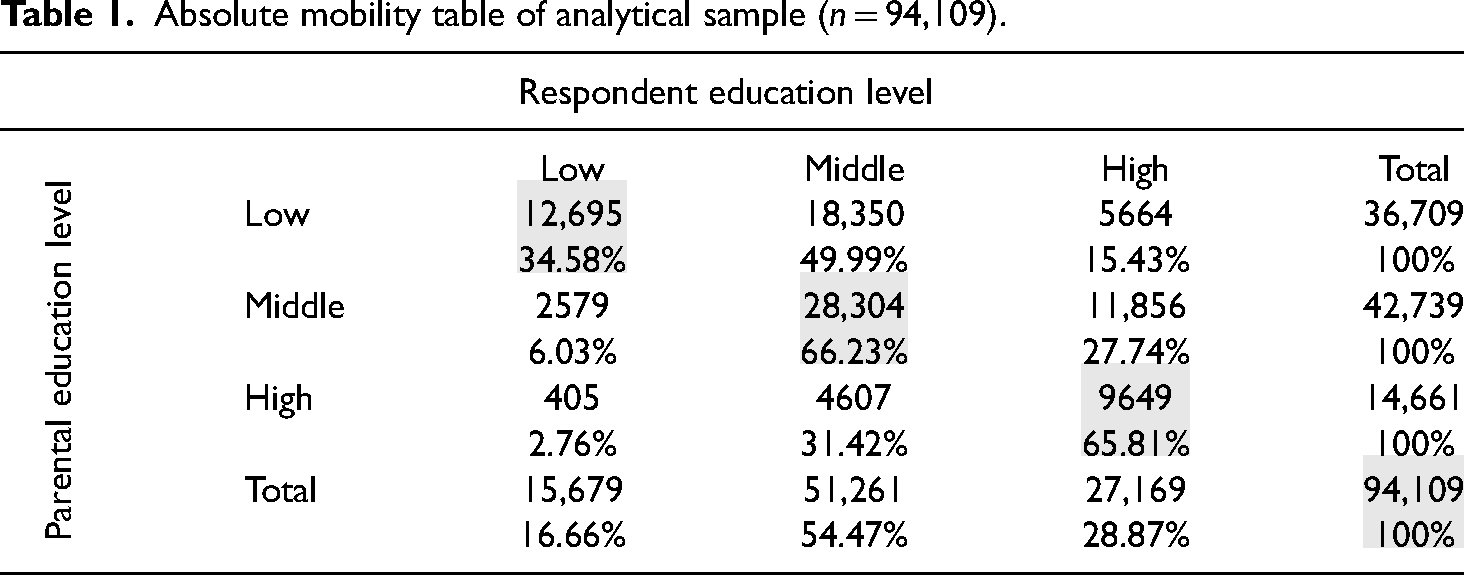
Table 1 presents a contingency table on the distribution of one's own and parental education levels. We compare the (absolute) education level of respondents and their (highest-educated) parent. 1 The grey diagonal represents the socially ‘immobile’, i.e. respondents who obtained the same education level as their parents. The white cells show the socially ‘mobile’, as there is a discrepancy between the education level achieved and the highest educational attainment of the parents. The highest rate of educational reproduction is visible among the medium-educated group (66.23%), closely followed by the highest-educated group (65.81%). The lowest reproduction was found among the least educated (34.58%), which is likely a consequence of educational expansion in many European countries in the 20th century (Breen, 2010). Upward mobility is much more common in our sample than downward mobility, which reflects the widespread educational expansion in European societies. In addition, we controlled on the individual level for sex, age and survey-round. Summary statistics of the analytical sample can be found in the Online appendix.
Absolute mobility table of analytical sample (n = 94,109).
Country-level variables
In the second part of the analysis, we sought to explain cross-country differences in the relative weight of parental education by societal social mobility. The degree of social mobility within a country was calculated by running an OLS regression for each individual state to predict respondents’ educational attainment by their parental education level for respondents aged 25 and older (Hertz et al., 2007; Notten et al., 2015). A weaker correlation between the two would indicate a societal context of greater societal mobility. We included age, sex, and survey-round dummies as control variables. The β coefficient of parental education level was saved, and consequentially reversed and standardised to ease interpretation. As a result, a higher coefficient on this measure indicates a national context of greater societal mobility. 2
In addition, we controlled for possible other variables that could both explain societal social mobility and weight of social origin, namely Gini (World Bank, 2022b), government spending on education as percentage of GDP (World Bank, 2022c), and GDP per capita (World Bank, 2022a). The data for each country was accessed through the database of the World Bank. For each control variable a specific country average over the period 2008–2018 was calculated, which is the time span of the ESS data we used. For an overview of the variables used in the country-level analyses, see the Online Appendix.
Methods
To study the relative importance of social origin and of social destination for socially mobile individuals in relation to openness towards globalisation, we used DRMs. These models are specifically designed to study the effects of social mobility (De Graaf and Ultee, 1990; Sobel, 1981). The rationale behind the DRM is that the ‘immobile’, i.e. those who are born and remain in the same social milieu, from each category represent the dominant attitudes of each stratum (Tolsma et al., 2009: 266; Van der Waal et al., 2017: 1032). In our study, the ‘immobile’ have the same absolute level of educational attainment as their parents and formed their attitudes without experiencing social mobility. In short, the DRM estimates whether the attitudes of the socially mobile are closer to the ‘immobile’ members of their origin or destination education level. For example, if a person grows up in a less educated family but achieves a higher level of education, then their attitudes are modelled as a function of the attitudes of the ‘immobile’ lower educated (origin) and higher educated (destination).
The formal baseline model (including covariates) can be written as:
The status-maximisation hypothesis presupposes that social origin is more important for the downwardly mobile than the upwardly mobile. Therefore, we interacted the weight parameter p with a dummy variable (
Finally, to explain cross-national differences in the relative weight of parental education, we took the following steps. First, we ran a separate DRM and included control variables for each country and dependent variable; subsequently, we saved the weight parameter and its standard error. Second, a meta-analysis was performed for each of the dependent variables to see whether the weight of social origin and destination varies across countries for support for European integration and immigration. Between-country heterogeneity was tested by using the Cochran Q statistic at a significance level of p < 0.1 (as this measure is often underpowered) and quantified by the I2. A statistically significant Cochran Q statistic indicates the presence of heterogeneity. The I2 informs about the degree to which the observed variance is due to real differences between countries (i.e. true heterogeneity) and ranges from 0 to 100. An I2 of 0% indicates that all variance is due to chance, while a value of 100% means that all observed variance is real between countries (Borenstein et al., 2017). The I2 should be higher than 50% to speak of moderate heterogeneity, while above 75% to speak of high heterogeneity. Both meta-analyses are reported. Third, if significant heterogeneity existed between countries, a random-effects meta-regression was estimated, to test whether an association existed between macro-level social mobility and the relative importance of parental education (Harbord and Higgins, 2008). The sample size is 26 countries. Within a meta-regression, the weight of each country is the inverse of the precision of the estimate as indicated by the standard error. Hence, countries with a less precise estimate have a smaller weight.
Results
We proceed with the results of the DRMs for support for European integration and immigration (Table 2). We include country dummies to remove observed heterogeneity between countries. Moreover, we use cluster robust standard errors by country to correct for heteroscedasticity. Finally, since we use data from several rounds of the ESS, we include survey-round dummies to control for variation over time. All models control for sex and age. 3
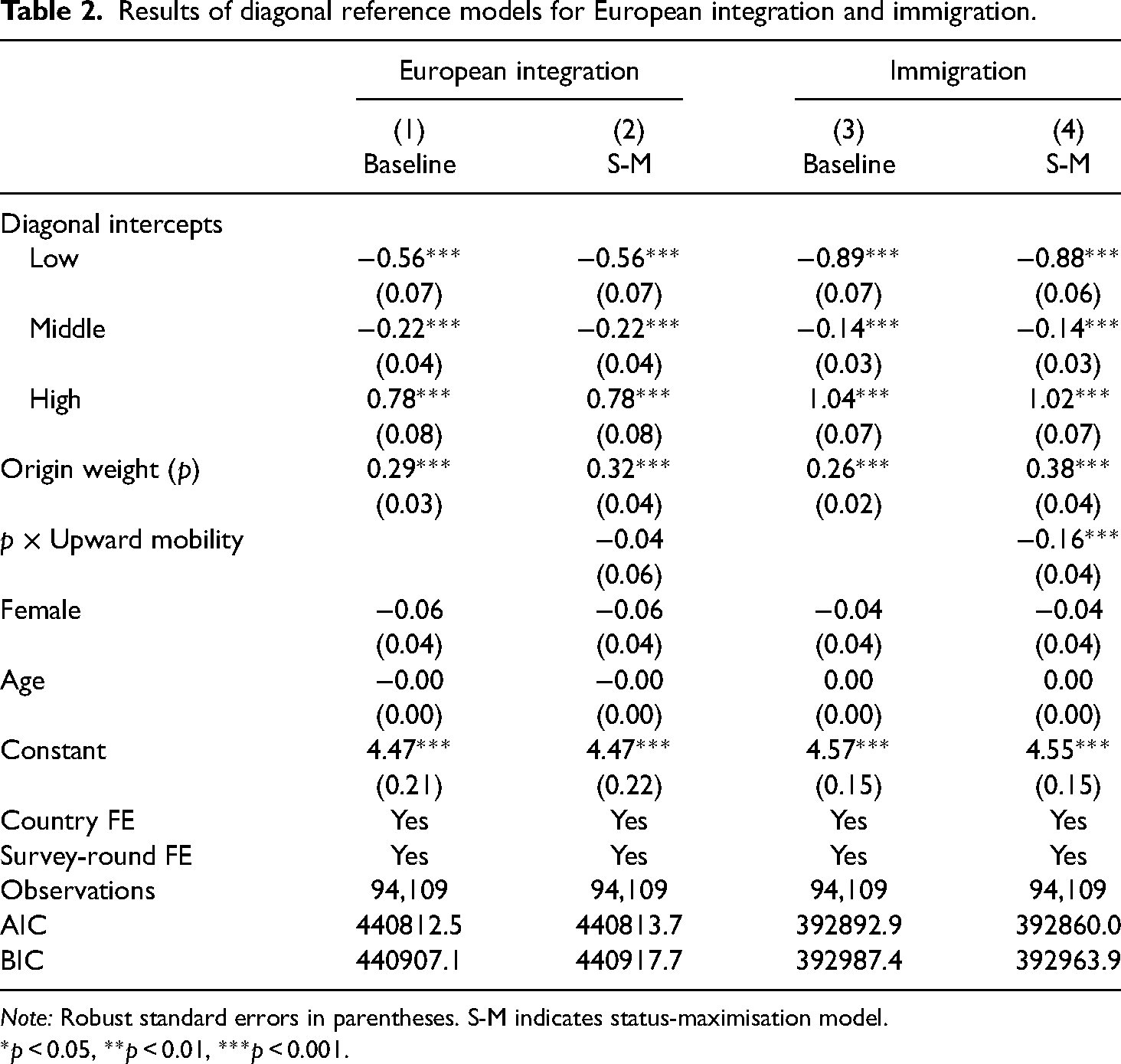
Results of diagonal reference models for European integration and immigration.
Note: Robust standard errors in parentheses. S-M indicates status-maximisation model.
*p < 0.05, **p < 0.01, ***p < 0.001.
Support for European integration
Table 2 shows the results of the DRMs for support for European integration. Models 1 presents the baseline specification, while Model 2 tests the status-maximisation hypothesis. The top lines of the tables are the diagonal intercepts, which indicate the support for European integration among the immobile lower, middle, and higher educated. These coefficients for the ‘immobile’ groups indicate the deviation from the constant as reported in the table. As such, this shows that there is a strong educational divide visible in attitudes towards European integration. Those with less education are in general less supportive of the EU than those with more. To determine which models fit best, we followed standard practice within the literature and examined the Bayesian information criterion (BIC) and Akaike information criterion (AIC) (Jaime-Castillo and Marqués-Perales, 2019). A lower BIC and/or AIC indicates a better model fit.
For European integration, we find that the baseline model fits best (Model 1, Table 2). That is, the weight of social origin is equally important for upwardly and downwardly mobile citizens. We find that the weight of parental education is 0.29, 95% CI [0.23; 0.35]. This means that the weight of one's own education level for attitudes towards the EU is 1–0.29 = 0.71, 95% CI [0.65; 0.77]. This provides three valuable insights. First, the weight parameter p is significantly different from 0, which confirms H1. Thus, attitudes of socially mobile citizens are not completely similar to attitudes of immobile citizens in the destination position, but also partly resemble the attitudes of the immobile of their social origins. Second, as the weight is significantly different from 0.5, support for European integration among the socially mobile is more similar to the immobile of their educational level of destination. This confirms hypothesis H2a. Third, as the status-maximisation model does not yield a better model fit than then baseline model, we must reject the status-maximisation hypothesis for European integration (H3).
Support for immigration
Next, we move to support for immigration (Model 3 and Model 4, Table 2). Similar to support for European integration, immigration attitudes show a strong educational divide by looking at the diagonal intercepts for the immobile lower, middle, and higher educated. That is, those with less education are less supportive of immigration than the more highly educated. We find that the status-maximisation model has a better model fit, as indicated by the AIC and BIC (Model 4). Hence, the weight of social origins and destination differs for the upwardly and downwardly mobile. This provides us with three important conclusions. First, the weight of social origin is significantly different from 0; hence, we again find support for H1. Second, as the weight is also significantly different from (and smaller than) 0.5, support for immigration among the socially mobile is more similar to the immobile of their own achieved educational level. This confirms hypothesis H2a. Third, for the upwardly mobile, the parental weight is reduced by 0.16. Hence, the weight of parental background for the downwardly mobile is 0.38, 95% CI [0.30; 0.46], while for the upwardly mobile, it is 0.38 −0.16 = 0.22, 95% CI [0.14; 0.30]. In sum, we find support for H3. 4 That is, the attitudes of the downwardly mobile more closely resemble those of their parental milieu than is the case for the upwardly mobile. 5
Societal mobility
Finally, we analysed the cross-country difference in the relative weight of parental education level for the attitudes of the socially mobile. We first provide a random-effects meta-analysis of weight of social origin for both outcome variables. These can be found in Figure 1 (support for European integration) and Figure 2 (support for immigration).
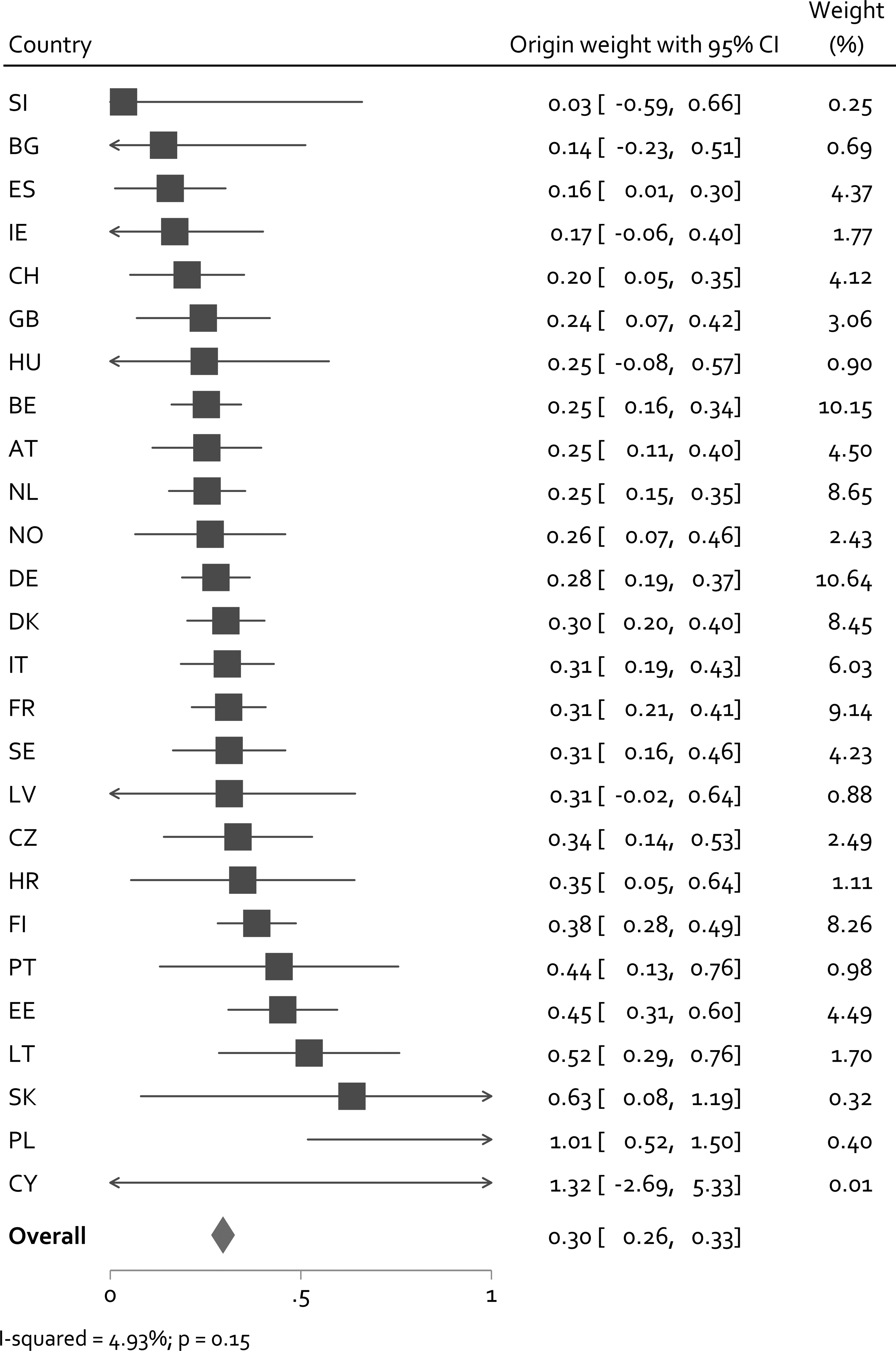
Random-effects meta-analysis forest plot for weight of social origin for support for European integration.
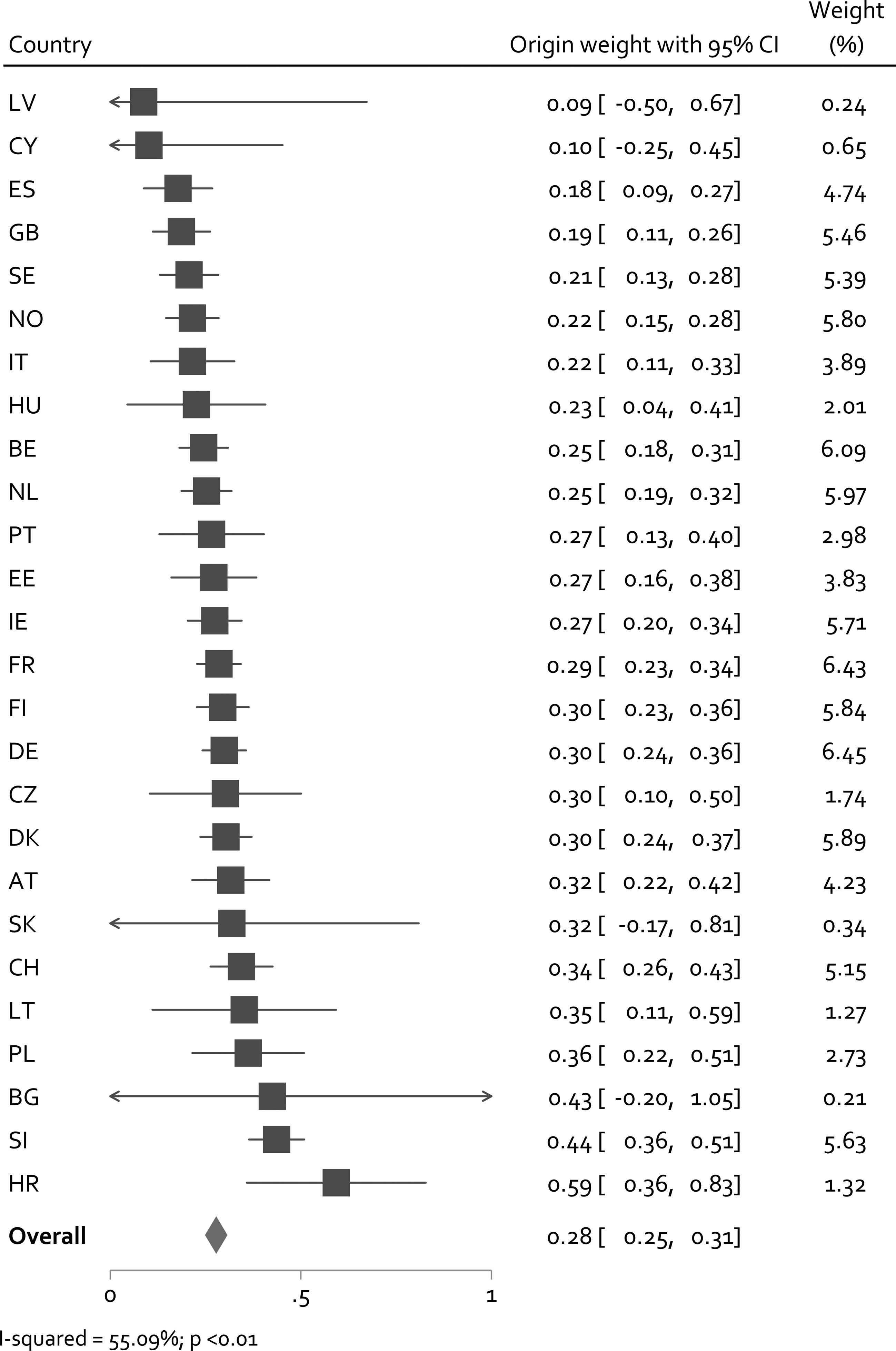
Random-effects meta-analysis forest plot for weight of social origin for support for immigration.
As shown in Figure 1, the weights of social origin for support for European integration vary between 0.03 (Slovenia) and 0.63 (Slovak Republic). The weights for Poland and Cyprus are beyond the interval of zero and one. Note that almost all estimates have large standard errors. For immigration attitudes, we see that the estimates of the weight of social origin vary between 0.09 (Latvia) and 0.59 (Croatia). The I2 of the meta-analysis for European integration is 4.93%, and the Q is not statistically significant from 0. Hence, we cannot be certain that there is cross-country heterogeneity; the observed variance is likely due to chance. Therefore, estimating a meta-regression for EU support is not warranted as there is absence of significant true heterogeneity. For immigration attitudes we find that there is moderate heterogeneity between countries (I2 = 55.09%), and Q is statistically significant. Therefore, we run a random-effects meta-regression model to explain the heterogeneity.
We first run a bivariate meta-regression. The results are displayed in the ‘bubble’ chart in Figure 3 (for the full model, see the Online Appendix). The larger the size of the bubble, the more important this observation is for the estimation. As indicated by the flat line, the estimate for societal social mobility is close to zero and does not reach conventional levels of statistical significance. In the Online Appendix, we study whether this result is robust when controlling (in separate models due to the low number of cases) for Gini (standardised), educational spending as percentage of GDP (standardised), and GDP per capita (logged). In all models, the coefficient for societal social mobility does remain small, and does not reach conventional levels of statistical significance. Taken together, we cannot conclude that the importance of social origins for attitudes towards globalisation is associated with societal social mobility. 6
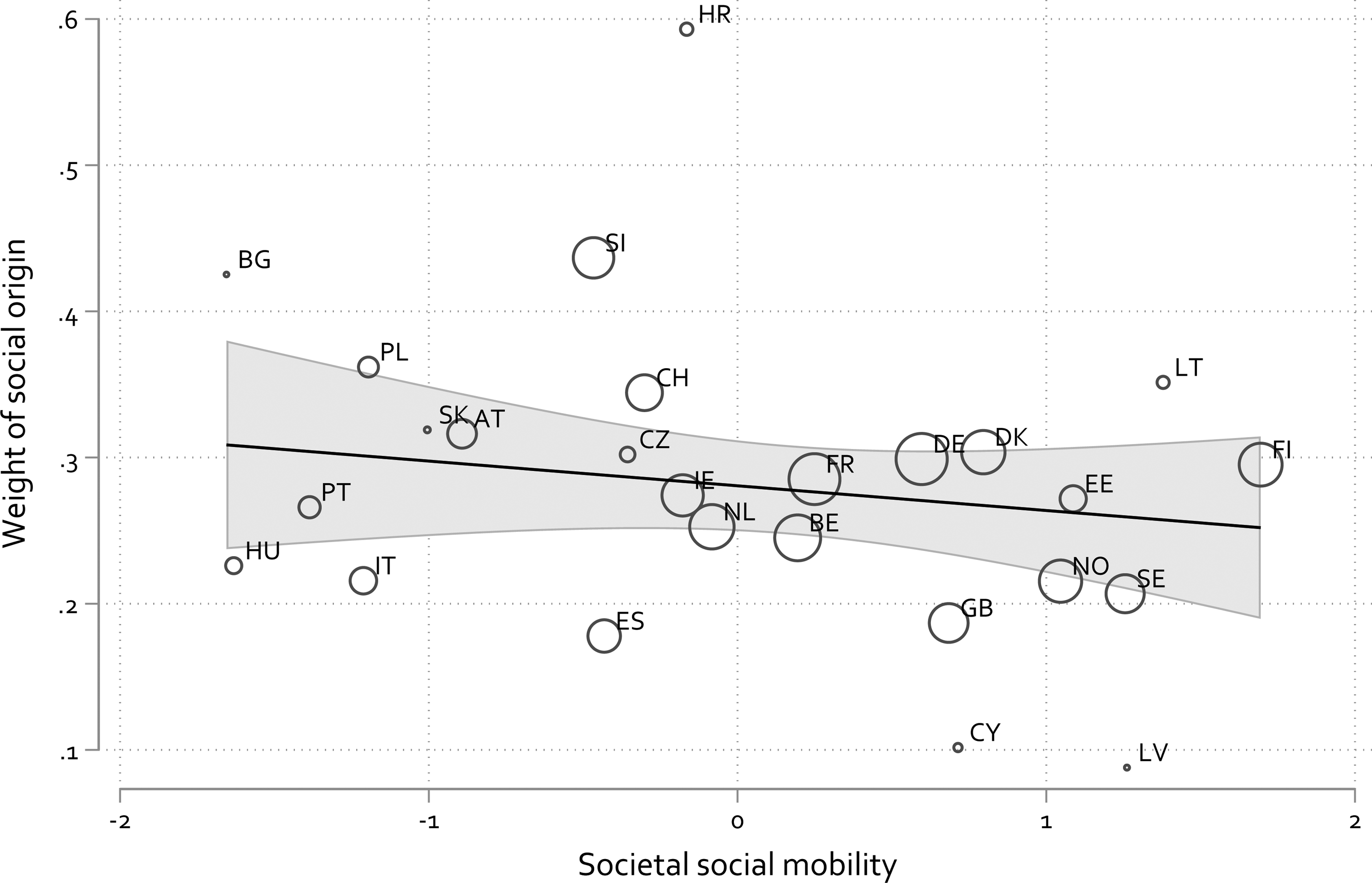
‘Bubble’ chart of the association between societal social mobility and the relative weight of social origin for support for immigration.
Conclusion
Previous work has demonstrated that attitudes towards globalisation in European societies are strongly determined by educational attainment (Bovens and Wille, 2017; Hooghe and Marks, 2018). We tested whether globalisation attitudes, specifically EU support and immigration attitudes, are formed by citizens’ own educational attainment, or whether they result from deep-rooted positions of disadvantage across generations. We analysed the political attitudes of the socially mobile, as they are connected to both their own and their parents’ educational milieu.
Our results indicate that, although both contexts shape political preferences, ultimately, people's own education in particular forms their attitudes. Moreover, for immigration, we find that the relative importance of parental education differs between upwardly and downwardly mobile individuals. Parental education is especially important for the downwardly mobile to maintain a positive self-image and to respond to the loss in social status (Daenekindt, 2017). Finally, we failed to provide robust evidence for the idea that, in societies with more social mobility, the relative importance of parental education for shaping political preferences is lower. This indicates that educational opportunity does not necessarily reduce the importance of social origins for people's perceptions on globalisation.
A corollary of our findings is that the socially mobile differ from both the socially immobile in their own educational category and in their parents’ educational category. A plausible alternative interpretation of this empirical result is that the differences in attitudes between socially mobile and immobile citizens are due to a self-selection effect (Van Ditmars, 2020). Specifically, those who are socially mobile could differ from immobile citizens from the outset, which could be the primary reason they have become mobile. Since we use cross-sectional data, we cannot exclude the possibility that self-selection is at play. Applying longitudinal designs in future research could help unravel these different mechanisms.
Bearing this caveat in mind, our article contributes to existing literature in two important ways. First, there is a growing discussion on the relevance of parental and one's own education for shaping political values and attitudes (Kam and Palmer, 2008; Persson, 2015; Persson et al., 2016). We show that, although both contexts affect political preferences, citizens’ own education in particular emerges as the crucial factor. However, social origins do continue to influence political preferences, which show that attitudes towards globalisation are partly intergenerational (Fox et al., 2019; McNeil and Haberstroh, 2022). Consequently, this indicates that the educational divide in globalisation attitudes cannot solely be explained by people's own educational credentials as is the implicit assumption in the literature. We demonstrate that this relative importance of one's own education level can depend on the specific context. Primarily, whether people move up or down on the social ladder can potentially affect the extent to which their new milieu alters them.
Second, we add to existing literature, which argues that political attitudes adjust to people's perceived position within the societal hierarchy. We question the implicit assumption in much of the literature that regardless of people's social origins, the material opportunities and life chances that education provides overrides any predispositions. Although people adjust to a large extent to their new social milieu, social origins remain to play a role in their political attitudes. This means that socially mobile individuals cannot (or resist to) fully adjust their political attitudes to their education level. Hence, this implies that social origins can work as a boundary to completely assimilate into a better or lesser social milieu. Consequently, as newcomers are likely to retain part of their origins, social mobility can in the future potentially weaken the educational divide over issues such as immigration and European integration.
While we find that both EU support and immigration attitudes are primarily shaped by one's own educational level, our analyses yield support for the status maximisation hypothesis only with respect to immigration attitudes but not in the case of EU support. Hence, immigration attitudes reflect the predominant opinion of the higher-status ‘globalisation winners’, whereas EU support reflects one's own educational background regardless of whether people are upwardly or downwardly mobile. A plausible explanation for this difference is that immigration attitudes are more status driven, for example because they are more closely linked to questions of labour market competition, than EU support. Moreover, European integration figures more prominently in today's school curricula than in previous generations (Keating, 2009), and hence parental socialisation might therefore be weaker with respect to European integration. This is also in line with recent research that found that educational expansion in the 20th century had an impact on immigration attitudes (Cavaille and Marshall, 2019), but not on EU support (Kunst et al., 2020).
To conclude, our results indicate that scholars should not see attitudes towards globalisation solely as a consequence of one's own educational attainment; rather, these attitudes are also intergenerational in nature.
Supplemental Material
sj-do-1-eup-10.1177_14651165221140230 - Supplemental material for As the twig is bent, the tree is inclined? The role of parental versus own education for openness towards globalisation
Supplemental material, sj-do-1-eup-10.1177_14651165221140230 for As the twig is bent, the tree is inclined? The role of parental versus own education for openness towards globalisation by Sander Kunst, Theresa Kuhn and Herman G van de Werfhorst in European Union Politics
Supplemental Material
sj-dta-2-eup-10.1177_14651165221140230 - Supplemental material for As the twig is bent, the tree is inclined? The role of parental versus own education for openness towards globalisation
Supplemental material, sj-dta-2-eup-10.1177_14651165221140230 for As the twig is bent, the tree is inclined? The role of parental versus own education for openness towards globalisation by Sander Kunst, Theresa Kuhn and Herman G van de Werfhorst in European Union Politics
Supplemental Material
sj-pdf-3-eup-10.1177_14651165221140230 - Supplemental material for As the twig is bent, the tree is inclined? The role of parental versus own education for openness towards globalisation
Supplemental material, sj-pdf-3-eup-10.1177_14651165221140230 for As the twig is bent, the tree is inclined? The role of parental versus own education for openness towards globalisation by Sander Kunst, Theresa Kuhn and Herman G van de Werfhorst in European Union Politics
Supplemental Material
sj-dta-4-eup-10.1177_14651165221140230 - Supplemental material for As the twig is bent, the tree is inclined? The role of parental versus own education for openness towards globalisation
Supplemental material, sj-dta-4-eup-10.1177_14651165221140230 for As the twig is bent, the tree is inclined? The role of parental versus own education for openness towards globalisation by Sander Kunst, Theresa Kuhn and Herman G van de Werfhorst in European Union Politics
Footnotes
Acknowledgements
We would like to thank the three anonymous reviewers and Gerald Schneider for their valuable feedback.
Author contributions
SK constructed the theoretical framework, prepared the data, ran the statistical analyses, and wrote the main text. TK and HvdW provided detailed feedback and contributed to the text and the analyses.
Declaration of conflicting interests
The author(s) declared no potential conflicts of interest with respect to the research, authorship, and/or publication of this article.
Funding
The author(s) received no financial support for the research, authorship, and/or publication of this article.

Supplemental material
Supplemental material for this article is available online.
Notes
References
Supplementary Material
Please find the following supplemental material available below.
For Open Access articles published under a Creative Commons License, all supplemental material carries the same license as the article it is associated with.
For non-Open Access articles published, all supplemental material carries a non-exclusive license, and permission requests for re-use of supplemental material or any part of supplemental material shall be sent directly to the copyright owner as specified in the copyright notice associated with the article.
