



Abstract
This article studies the impact of immigration from Central and Eastern Europe on support for Eurosceptic parties. The analysis covers 30 national and European Parliament elections in seven Western, Northern and Southern European countries (2004 to 2019). For each election, I analyse how the local-level share of the vote for right- and left-wing Eurosceptic parties varies as a function of the levels and changes in the local-level share of Central and Eastern European immigrants from the population, controlling for the influence of relevant demographic, social and economic variables. I find that higher levels of immigration from Central and Eastern Europe are systematically related to higher voting shares cast for right-wing Eurosceptic parties at the local level in all of these countries, net of the influence of non-Western immigration, in elections for the European Parliament and in national elections as well. The effects on left-wing Euroscepticism are heterogeneous: positive in the Netherlands, Austria and Portugal, but negative in Italy, Denmark and Sweden. The effects have not diminished significantly over the past 15 years and are most visible in mid-sized localities.
Introduction
Modern states have erected significant barriers to population movements within their territories and across their borders. But in Europe, the European Union (EU) gradually removed these barriers between its member states and secured free movement of its citizens within the territory of the EU (Schmidt et al., 2018). The opportunities for free movement and work led to significant cross-border migration, especially since the accession of the former communist countries from Central and Eastern Europe (CEE) in 2004 and 2007. Migration has well-recognized, if difficult to estimate, economic and social effects (Borjas, 2019; Suari-Andreu and Van Vliet, 2023), both for the receiving and the sending countries. But migration also has political effects, which we know much less about. Moreover, in the context of a multi-level system of governance such as the EU, migration can affect not only the politics of the member states, but also the politics of the union itself.
This article examines the impact of intra-EU migration on support for Eurosceptic political parties. This political effect is potentially highly significant because it can undermine the course of European integration itself, in addition to disturbing the national politics of the EU member states. The surge of support for Eurosceptic parties across the EU since the beginning of the 2000s coincides in time with increasing intra-EU migration. In addition, we know that at the individual level anti-immigration attitudes are strongly predictive of voting for Eurosceptic parties (i.a. Hobolt and De Vries, 2016; Kentmen-Cin and Erisen, 2017). We still lack systematic evidence, however, whether the arrival of immigrants from other EU states causes more anti-immigrant sentiments that increase support for Eurosceptic parties.
Indeed, in theory, the presence of new immigrants can both attenuate anti-immigration attitudes of the host population through increased direct contact with the outgroup and it can bolster exclusionary and xenophobic attitudes through increases in perceived threat and competition (Allport, 1954; MacInnis and Page-Gould, 2015; Paluck et al., 2019; Pettigrew and Tropp, 2008; Schneider, 2008). In the case of intra-EU migration, it is unclear which of these mechanisms prevails. On the one hand, the cultural distance between immigrants from CEE and the host populations in Western Europe is relatively small, EU membership provides a strong legitimation of free movement and more than 15 years have passed since the initial post-enlargement East–West migration flows. On the other hand, negative political discourses targeted at CEE immigrants in the West are still widespread and opportunities for direct contact with such immigrants have not been equally distributed across the territories of the host countries. All these different arguments leave the question about the impact of intra-EU migration on support for Eurosceptic parties open.
Both the societal and theoretical importance of this question necessitate a more comprehensive empirical analysis than is currently available in the academic literature. Existing research shows that the local-level presence of Central and Eastern Europeans was associated with lower levels of approval for the Constitutional Treaty of the EU at the referenda in the Netherlands, France, Ireland and Spain (Toshkov and Kortenska, 2015). Country-level panel data also suggest that the presence of CEE immigrants is positively associated with negative evaluations of the benefits of EU membership, and to a lesser extent, with lower trust in the EU (Jeannet, 2020c). 1 In addition, at the individual level, increasing numbers of CEE immigrants have been linked with increased perceptions of immigration as an economic threat (Jeannet, 2020a). This study significantly extends the empirical scope of this literature and presents new theoretical ideas about how the effect of intra-EU immigration should vary over time, types of elections, varieties of Euroscepticism and size of localities.
For its theoretical contribution, the article develops hypotheses suggesting that the positive effect of intra-EU migration on support for Eurosceptic parties should be relevant for both left- and right-wing Euroscepticism, should be most visible in mid-sized localities, should diminish over time and should be smaller in national versus European elections.
For the empirical analyses, I collect and combine from different sources: (a) local-level data on immigration presence disaggregated by country of origin; (b) election data; and (c) relevant demographic and socio-economic variables, for seven countries from Western, Northern and Southern Europe: the Netherlands, Denmark, Sweden, Finland, Italy, Portugal and Austria. In total, the analyses cover 30 European and national elections. For each election, I regress the local-level share of the vote for right- and left-wing Eurosceptic parties on levels and changes in the local-level share of CEE immigrants from the population, levels of non-Western immigration and a number of other social and economic variables that could potentially confound the relationships of interest.
I find that higher levels and increases in the local-level share of CEE immigrants are associated with higher levels of support for right-wing Eurosceptic parties, net of the socio-economic confounders, in almost all countries and elections in the sample. The effect on left-wing Euroscepticism is heterogeneous: positive in the Netherlands, Austria and Portugal, but negative in Italy, Denmark and Sweden. In line with the theoretical predictions, the effect of immigration presence is greater in mid-sized localities than in small ones and more discernable than in very big ones. But contrary to the hypotheses, there is no evidence that the effect diminishes over time nor that it is systematically smaller in national versus European elections.
These results imply that the positive effect of direct contact between immigrants and host populations on immigration attitudes can be overwhelmed by the negative effect of threat and competition, even when the cultural distance between the in- and outgroups is relatively small and opportunities for contact last a long time. The negative effect of intra-EU migration on political support for the EU is anything but short-lived and it has spilled over from the European to the national electoral arenas as well.
The findings contribute to the emerging literature on the politics of place (Adler and Ansell, 2019; Hopkins, 2010) and show how the local demographic context interacts with national-level political discourses to influence support for European integration and increase the votes of right-wing Eurosceptic parties. Not only European, but national politics in many countries is affected by the effects of migration flows enabled by European integration.
Immigrants as an outgroup: Contact, threat and competition
The contact hypothesis and outgroup threat
In most general terms, the research question of this study is about the effects of contact between in- and outgroups, with the CEE immigrants being the outgroup and the host populations in Western, Northern and Southern Europe where the immigrants arrive to work and settle being the ingroups. A common point of departure for studies of the effects of intergroup contact is Allport's (1954) work, which suggests that intergroup contact can reduce intergroup prejudice. The empirical evidence in favour of this so-called ‘contact hypothesis’ appears to be significant (Paluck et al., 2019; Pettigrew and Tropp, 2006). Contact reduces prejudices via reducing anxiety about intergroup relations, increasing empathy and, to a lesser extent, enhancing knowledge about the outgroup. For anxiety to be reduced, direct and prolonged contact is typically needed, for example in the form of intergroup friendships (Pettigrew and Tropp, 2008).
However, intergroup interactions (which are indirect and fleeting) can increase intergroup bias, stress, anxiety and outgroup avoidance, even if (direct and sustained) contact might have the opposite effects (MacInnis and Page-Gould, 2015). When the presence of an outgroup becomes more visible and salient but there is no direct contact, the threat from the outgroup can increase exclusionary attitudes instead of decreasing prejudice (i.a. Enos, 2014). Feelings of threat from an outgroup can arise from expectations about economic and social competition, but they can also be based on lacking familiarity and fear of cultural and value conflicts (Schneider, 2008).
Outgroup size, perceptions and their effects at different scales
Individual intergroup interactions and contact scale in a complex way, so that in spatially aggregated data the relationship between outgroup presence and social outcomes of interest depends on the exact level of aggregation (Semyonov et al., 2006). For example, according to Jeannet (2020b: 212), an increase in ‘foreign populations is associated with higher political distrust amongst individuals who have anti-immigration attitudes’. Yet, studies that look at highly aggregated regional data find a positive association between levels and increases in total immigration and favourable immigration attitudes (Hoxhaj and Zuccotti, 2021; Van Hauwaert and English, 2019). Schraff and Sczepanski (2021) make an important qualification to this argument based on a study of the Netherlands: while the presence of large non-Western populations is associated with more exclusive national identities, the presence of mixed Western and non-Western populations is related with more inclusive identities.
The perceived size of immigrant group has a stronger association with anti-immigration attitudes than actual immigration presence (Gorodzeisky and Semyonov, 2020). However, it is plausible that the numbers that people provide as estimates of the foreign-born population (‘perceptions’) are as much expressions of pre-existing attitudes towards immigrants as they are rational calculations of the share of immigrants in society. Providing information can correct misperceptions about immigration, but is not enough to change policy views, with mixed evidence about effects on anti-immigration attitudes (Grigorieff et al., 2020; Hopkins et al., 2019; Jørgensen and Osmundsen, 2020).
Immigrant characteristics matter significantly for the evaluation of the desirability of different immigration groups and the perceived threat that they pose. Europeans prefer immigrants (asylum-seekers in particular) who have higher employability, severe vulnerabilities and are Christian (Bansak et al., 2016; see also De Coninck, 2020). Hence, both cultural proximity (based on religion) and deservingness (based on the vulnerabilities) affect the judgements.
Populist messages can increase negative feeling towards migrants for supporters of populist parties, even if they fail to change people's minds about the social consequences of immigration (Rooduijn et al., 2021). While negative immigration frames might increase exclusionary attitudes, such as support for restricting welfare politics, this does not imply that positive immigration frames should have the opposite effect (Avdagic and Savage, 2021).
While in general intergroup contact may be associated with less opposition to immigration, political ideology might be moderating this association, so that the positive effect does not work to the same extent for people with right-wing political ideology (Thomsen and Rafiqi, 2019). According to Goodman (2021: 2052), ‘immigration threats are filtered through partisanship in polarized settings’. Partisan affinities might condition the effect of contact with immigrants, reducing threat only among leftist voters (Homola and Tavits, 2018; see also Thomsen and Rafiqi, 2020).
The effects of immigration presence on social attitudes and voting
Direct exposure to one particular outgroup – refugees and asylum-seekers – has been studied extensively and shown to induce hostility towards different groups of migrants and minorities, to broaden support for restrictive asylum and immigration policies in Greece (Hangartner et al., 2019) and to increase voting for the far right in Denmark (Dustmann et al., 2019), Austria (Steinmayr, 2021) and Hungary (Gessler et al., 2022). In a carefully executed study in Eastern Germany, Schaub et al. (2020) find no effects of local exposure to refugees on average voting and attitudes, but they note a convergence of right- and left-leaning individuals towards the centre. Relatedly, Alesina et al. (2021) find that support for redistribution is lower when the share of immigrants in a region is higher. This negative association is stronger for immigrants from the Middle East and Eastern Europe and is not significant for immigrants from EU-15 or sub-Saharan Africa.
There are several studies that find links between support for populist and radical right parties and immigration. Unsurprisingly, at the individual level, anti-immigration attitudes are strongly related to the likelihood of supporting radical right parties, for many of which anti-immigration rhetoric is a central part of their message. But it might not be that changes in anti-immigration attitudes drive support for the radical right, as much as an increase in the salience of immigration that activates pre-existing opposition to immigration (Damstra et al., 2021; Dennison and Geddes, 2019; Finseraas and Strøm, 2022; Hopkins, 2011). Yet, salience and media coverage cannot be taken as completely exogenous to the concerns that higher immigration levels and changes in the composition of arrivals bring to the host populations.
At the aggregate level, the evidence for links between immigration presence and support for the radical right is mixed. For example, Stockemer (2016) argues that individual perceptions of levels of immigration are positively related to higher support for radical right-wing parties, but the number of foreign-born citizens is not. However, in this study immigration levels are measured at a level of spatial aggregation that is too high to detect the effects of the local presence of specific group of immigrants.
Rydgren and Ruth (2013) find that in Sweden support for the radical right increases in places close to areas with a high concentration of immigrants, but not within these areas. In Austria, local voting for the Freiheitliche Partei Österreich has increased as an effect of the inflow of immigrants into a community (Halla et al., 2017). One study of Finland finds that increases in the share of all foreign citizens in a municipality decreases the votes for the Finns Party (Lonsky, 2021). In the United Kingdom (UK), membership of the British National Party is higher in highly segregated cities with a larger proportion of non-whites (Biggs and Knauss, 2012). A study of the arrival of CEE immigrants in different areas of London based on an instrumental-variable approach found that this increased the vote for the far-right at the local elections (Pupaza and Wehner, 2023).
In France, immigration increased support for far-right (and to a smaller extent to far-left) candidates at presidential elections between 1988 and 2017 (Edo et al., 2019). Bolet (2020) also finds that in places with high local unemployment rate, the presence of immigrants and the labour market competition it engenders increase the vote share of the radical right. Evans and Ivaldi report a curvilinear ‘halo effect’: the vote for the radical right in 2017 increased in areas ‘surrounding communities with significantly higher-than-average immigrant populations’ (Evans and Ivaldi, 2020).
In the Netherlands, support for the radical right Partij voor de Vrijheid (PVV) is found to be high in areas with low shares of minorities (up to a tipping point) (Van Wijk et al., 2019, 2020). But, importantly, the authors also find a ‘halo effect’, which is consistent with the idea that direct contact might decrease anti-immigration attitudes and support for anti-immigration policies and parties, but indirect ‘interactions’ and the local-level presence of an outgroup can have the opposite effects. Therefore, at the very low-aggregation level of neighbourhoods, an increase in the proportion of (non-Western) immigrant residents can be associated with more positive views on immigrants among natives (Van Heerden and Ruedin, 2017), but this association could be due to reversed causality. Accordingly, using panel public opinion data, Savelkoul et al. (2017) find that ethnic minority density is positively associated with voting for the PVV and Janssen et al. (2019) underscore the importance of aggregation scales for such studies.
In a meta-analysis, Cools et al. (2021: 988) find that a ‘1 percentage point increase in immigrant share is associated with a 0.57 percentage point increase in the vote share of anti-immigration parties’. However, this average effect is very heterogeneous, due to ‘a mix of statistical sampling variability, true effect heterogeneity, reporting and publication bias, and specification bias’.
Effects of immigration on Euroscepticism
There is strong and uncontroversial evidence that at the individual level anti-immigration attitudes are related to opposition to European integration (De Vreese and Boomgaarden, 2005; Hobolt and De Vries, 2016; Kentmen-Cin and Erisen, 2017) and EU enlargement (Azrout et al., 2013). But there is much less evidence that immigration presence and increases in immigration drive Euroscepticism (Jeannet, 2020c; Stockemer et al., 2018; Toshkov and Kortenska, 2015; Yeung, 2021).
In the UK, support for the Eurosceptic right-wing party UK Independence Party has been shown to be related to anti-immigration attitudes (Clarke et al., 2016). While British regions with high levels of immigration had some of the lowest levels of support for Brexit at the 2016 referendum, perceived immigration levels were associated with greater Euroscepticism, contrary to self-reported actual contact with immigrants (Palma et al., 2020). According to Meleady et al. (2017) anti-immigrant prejudice was highly predictive of voting to leave the EU and was fuelled by negative intergroup contact. There is also evidence that in the UK the presence of Poles was associated with higher support to leave the EU (Becker et al., 2017; Viskanic, 2017).
Studies of attitudes towards free movement in the EU find that the sentiment and framing of the issue by the media (e.g. in terms of labour market or security) can have an influence that varies, however, strongly in different countries (Meltzer et al., 2020). Lutz (2021) concludes that support for free movement depends on the relative salience of inward and outward mobility. According to Vasilopoulou and Talving (2019), people with strong national identity are more likely to oppose intra-EU migration (see also Blinder and Markaki, 2019), but only in richer member states.
Intra-EU immigration and support for Eurosceptic parties: theoretical hypotheses
The review of existing literature established that there are multiple plausible mechanisms through which increasing presence of an outgroup, such as immigrants, can affect the political attitudes and behaviour of the local population. In the following, I develop a theoretical framework based on these mechanisms that are calibrated to the case of intra-EU migration following the EU enlargement to the East and its impact on support for Eurosceptic political parties.
Overall, the mechanisms of threat and competition for economic and other resources provide enough reasons to expect that CEE immigration could have increased support for Eurosceptic parties. While direct contact could reverse these effects, it is possible that the frequency and intensity of contact between CEE immigrants and the locals are not sufficient to overwhelm the effects of threat and competition. The local-level presence of CEE immigrants can be salient and ‘immediate’ enough to provoke cultural and economic anxieties without being close and sustained enough to generate the positive effects of contact, which come from forming friendships and affective ties between the in- and outgroups. Higher levels and increases in CEE immigration at the local level then provoke anti-immigration sentiments that lead to negative attitudes towards European integration, as the EU is the enabler of free movement that allows for the growth in CEE immigration. Anti-EU attitudes then increase electoral support for political parties that endorse Eurosceptic positions. As radical right-wing parties have been the main political actors to politicize immigration and European integration, the primary expectation is to see effects of CEE immigration for these parties (but see H2 below):
Whether and how CEE immigration influences politics and support for different parties depends on the national context as well. Media and political parties can increase the salience of immigration from this particular group and promote narratives that fuel economic and cultural anxieties based on fear. In some countries, the political discourse on immigration is often dominated by discussion of other immigrant groups, such as asylum-seekers or irregular migrants. In addition, political actors can openly engage in negative stereotyping of Central and Eastern Europeans and challenge the rationale of free movement in the EU.
In many European countries, Euroscepticism exists both on the left as well as on the right of the political–ideological spectrum (Wagner, 2021). Right-wing Euroscepticism exploits cultural anxieties from immigration, while left-wing Euroscepticism is more concerned with economic ones. For example, Van Elsas et al. (2016) find that left-wing Euroscepticism is motivated by economic and cultural concerns while only the latter is relevant for right-wing opposition to the EU. Both of these types of concerns can be related to immigration, although via different mechanisms.
Large numbers of left-wing voters express xenophobic attitudes (Kopyciok and Silver, 2021), which provides fertile ground for anti-immigration and anti-EU appeals by (extreme) left-wing parties. In the context of intra-EU migration, right-wing Eurosceptic parties emphasize not only the economic threat posed by low-skilled immigrants from CEE and their impact of national welfare systems, but also threats related to crime, loss of national identity and values. Some left-wing Eurosceptic parties are focused on economic effects, such as social dumping within the EU, increasing pressures on health, welfare and social services and the living conditions of immigrants. While the framing and salience of intra-EU migration differs on the left and on the right, there are plausible mechanisms that link both left- and right-wing Euroscepticism to rising immigration from within the EU, even if on the left the discursive link between immigration and Euroscepticism is weaker and more heterogeneous across political contexts:
Note that these two hypotheses refer to local-level immigration shares. The level of aggregation is crucial, because at too low levels of aggregation (very small localities, even if rural), the effects of direct contact can dominate the effects of threat, while at too high levels of aggregation (big localities, i.e. cities) macro-level factors become more important and multiple local-level effects of immigration get bundled together. Therefore, it would be expected that the effect of CEE immigration on Euroscepticism is greatest within a certain population range, that captures differences between small, medium and large cities (>50,000 inhabitants), other urban and rural areas (cf. Huijsmans et al., 2021). In bigger towns and cities, segregation of immigrants is generally rather high, also with respect to Eastern Europeans, but varies from place to place (Biggs and Knauss, 2012; see e.g. Pupaza and Wehner, 2023; Rodon and Kent, n.d.). In small localities, segregation is more difficult. The big cities offer more opportunities for social mixing, although residential segregation can persist. It is hard to put precise numbers around the notion of a locality being too small or too big. But it can be proposed that in a locality with anything fewer than 10,000 inhabitants, opportunities for direct contact with the locals will be widespread (cf. Gauci, 2020; Glorius et al., 2020; Moore, 2021):
Existing evidence suggests that the effects of outgroup threat diminish over time with increasing familiarity with the outgroup, which decreases anxiety and presents opportunities for learning about the outgroup, even when direct contact remains limited. As the first significant increases in immigration from CEE happened around the time of enlargement of these countries to the EU (starting in 2004), a significant amount of time has passed already that should have provided opportunities for the host populations to get to know to new immigrants as a group. Moreover, the cultural distance between Central and Eastern Europeans and Western Europeans can be considered relatively small, compared to, say, asylum-seekers from Afghanistan or labour migrants from rural China. Therefore, the increasing familiarity that comes with time could significantly reduce cultural anxiety (cf. Nordø and Ivarsflaten, 2022). The legitimation of free movement by the EU institutions and pro-European political parties (to the extent that it exists in the West) would work in a similar direction.
Because the arrival of CEE immigrants is enabled by the process of European integration and the freedom of movement that membership in the EU provides, it could be expected that the political effects are strongest when it comes to elections for the European Parliament (EP), which is the only EU institution for which the people vote directly. It has been argued that EP elections are second-order and electoral campaigns are dominated by national political issues. Moreover, national political parties in government can still exercise major influence over the details of EU policies, such as free movement and, of course, national heads of states and government still control the overall course of European integration via intergovernmental conferences and treaty changes. Therefore, it also makes sense for voters who want to limit intra-EU migration to vote at national elections for parties that oppose free movement. Still, to the extent that voters connect CEE immigration primarily to the EU, their political reactions should be most visible at EU-level elections.
This set of five hypotheses is rooted in existing scholarship on intergroup interactions but provides concrete and novel expectations about the effect on one important group of immigrants on one important aspect of political attitudes in Europe. The expectations predict variation across type of localities and elections, as well as over time. They also suggest that both left- and right-wing varieties of Euroscepticism should be examined. But to test these hypotheses, data are not readily available – needs to be compiled.
Research design, data and method of analysis
Even though interactions between migrants and hosts occur at the individual level, the theoretical expectations are not at the individual, but at an aggregate level. The unit of analysis is referred to as a locality and corresponds in most cases to the Local Administrative Units 2 (LAU 2) level of the Nomenclature of Territorial Units for Statistics (NUTS). 2
The empirical analysis cannot proceed at the individual level for a number of reasons. First, the required data for a comprehensive, comparative study is not available: public opinion surveys of political preferences and immigration contact and attitudes very rarely separate CEE immigrants into a separate group. Second, in methodological terms, individual-level surveys face the problem of self-selection of respondents into contact with immigrants. Objective levels of immigration presence are not possible to establish for each respondent, and subjective perceptions are tinted by the very attitudes of interest. Third, and most importantly, due to the multitude of countervailing mechanisms that can exist at the individual level, the relationships between the variables of interests can be different at the aggregate level from the most commonly encountered relationship at the individual level. That is, even if most individuals report lower anti-immigration attitudes and support for Eurosceptic parties conditional on having close contacts with CEE immigrants, it could still be that at the aggregate level, the presence of CEE immigrants has the opposite effects, if close contacts are rare and immigration presence without contact increases anti-immigration attitudes and Euroscepticism. Note that the fact that the design is at the aggregate level does not lead to the problem of ecological inference, because the inferences are also stated at that aggregate level, and not at the level of individuals. The Online appendix shows the exact level of analysis for each country and summary statistics of the population size of these localities.
The analyses are conducted within each of the countries in the sample separately. In terms of methodology, the precise level of aggregation, variable definitions and set of confounders I control for in the statistical models differ across countries. In theoretical terms, the national-level political discourse is expected to affect not only the baseline level of support for Eurosceptic parties, but the relationship with immigration itself. Therefore, the next section presents the empirical results for separate country-level analysis, while in the Online appendix I show the results from a multi-level model in which the country-level data is pooled.
The sample of countries included in the analysis consists of the Netherlands, Denmark, Sweden, Finland, Italy, Austria and Portugal. The criteria for inclusion are the country being a major destination for CEE immigrants since 2000, the existence of a Eurosceptic party competing at the EP elections and immigration data being available at the local level and disaggregated by country of origin or nationality of the immigrants. Data for the UK, Spain, France and Germany are not available at the level of aggregation needed in a centralized database for the entire countries, so these countries cannot be covered in the analysis. The CEE countries of emigration are not included, because the mechanisms through which migration affects Euroscepticism there are likely to be very different.
The sample of included countries is diverse, featuring countries in Western Europe (the Netherlands), Central Europe (Austria), Southern Europe (Italy, Portugal) and Northern Europe (the three Scandinavian countries) that together account for a large share of all intra-EU immigrants from CEE since the early 2000s. Data over time are available for the Netherlands, Denmark, Finland, Austria and Italy: for Sweden and Portugal there are only snapshots as of the latest EP elections in 2019 due to data availability (see the overview in the Online appendix). In light of results suggesting big variability of the link between immigration shares and votes for anti-immigration parties (Cools et al., 2021), it is very important that the current study covers several countries from different parts of Europe, especially given the fact that much of the existing literature relies on studies of individual countries.
CEE immigration is measured as the local-level share of CEE immigrants from the total number of people living in the locality. The numbers include all people who have registered at the local municipality: registration is necessary for access to public services and work, so short- and long-term migrants are covered. Wherever possible, I include in the CEE region the 11 EU member states from CEE that joined in 2004 (Czechia, Hungary, Estonia, Latvia, Lithuania, Poland, Slovakia and Slovenia), 2007 (Bulgaria and Romania) and 2011 (Croatia). This measure varies between (a) 0.16% and 8.82% with a mean of 1.23% in the Netherlands; (b) between 0 and 5.15% with a mean of 2.11% in Denmark; (c) between 0.53% and 7.13% with a mean of 2.41% in Sweden; (d) between 0 and 12.73% with a mean of 0.64% in Finland; (e) between 0 and 30% with a mean of 2.21% in Italy; (f) between 0 and 4.66% with a mean of 0.30% in Portugal (where only Romanians are counted); and (g) between 0 and 44% with a mean of 3.07% in Austria.
I also employ alternative definitions that include other CEE countries that are not members of the EU, on the presumption that host populations are not very well informed about the exact status of these countries in the EU accession process. I take the natural logarithm of the share of immigrants (adding one person to the immigration tally for localities with no CEE immigrants). See the Online appendix for further details of the operationalization of the CEE immigration presence variables.
The outcome variable of interest is measured as the local-level share of votes cast for Eurosceptic parties from all valid votes cast in the locality. To identify left- and right-wing Eurosceptic parties, I rely on party manifestos, media statements, membership of the EP transnational party groups and existing classifications and theoretical discussions (Brack, 2020; Franzosi et al., 2015; Halikiopoulou et al., 2012; Pirro et al., 2018; Van Elsas and Van Der Brug, 2015; Wagner, 2021). The definition of Euroscepticism is ‘softer’ and more inclusive than the most restrictive one that would only include parties that explicitly argue for a dissolution of the EU and a reversal of European integration, but ‘harder’ that the most inclusive one that would cover any party that is critical of any policy or institutions of the EU. In essence, the parties classified as Eurosceptic have criticism of the EU close to the core of their electoral messages and a focus on intra-EU migration in particular. The list of all parties that fall into the Eurosceptic category is available in the Online appendix.
Note that there is a very significant overlap between Eurosceptic, radical right (and to a lesser extent, radical left) and populist parties. While the theoretical interest is in support for Eurosceptic parties, there are similar mechanisms that would also produce support for radical and for populist parties. It is not a major objective of this article to separate the reasons for support for Eurosceptic, radical and populist parties, so this overlap is acknowledged but is not a methodological concern.
At the 2019 EP elections, right-wing Eurosceptic parties gained on average (across municipalities) (a) 15.24% of the valid votes in the Netherlands; (b) 14.29% in Denmark; (c) 19.40% in Sweden; (d) 15.88% in Finland; (e) 45.60% in Italy (including Lega); (f) 1.60% in Portugal; and (g) 18.42% in Austria, but with great variation across localities. Left-wing Eurosceptic parties gained an average of (a) 7.67% in the Netherlands; (b) 8.68% in Denmark; (c) 5.8% in Sweden; (d) 15.72% in Italy; (e) 4% in Portugal; and (f) 0.5% in Austria (no such party competed in Finland).
To probe the causal nature of the relationship between CEE immigration presence and the vote shares of Eurosceptic parties beyond any correlations observed, the analysis must control for potential confounders. The economic and social conditions in a locality, as well as the existing presence of immigrants are the most likely confounders, which is why adjust for indicators of these variables. 3 Importantly, I also control in the models for levels of non-Western immigration. While these levels are often positively correlated with levels of CEE immigration, they diverge to a sufficient extent to allow the estimation of a separate effect of CEE immigration (the correlations between the shares of CEE and non-Western immigrants from the local population at the municipal level are (a) 0.27 in the Netherlands; (b) 0.45 in Denmark; (c) 0.44 in Sweden; (d) 0.29 in Finland; (e) 0.11 in Italy; (f) 0.35 in Portugal; and (g) 0.42 in Austria). In addition to non-Western immigration shares, the models control for the relative size of the locality (population, urbanization), economic conditions (unemployment, income), social conditions (social assistance, crime), social structure (shares of highly educated people and pensioners) and other variables that are important predictors of Eurosceptic voting in the country (religiosity, share of minority populations). The precise set of controls and the variable definitions and data sources are described in detail in the Online appendix.
There are several methodological reasons that make it harder to find a relationship between CEE immigration and support for Eurosceptic parties, even if the relationship exists in reality. First, CEE immigrants are likely to settle in more immigration-friendly localities, all things equal. Self-selection into localities is controlled for via the economic and social variables included in the models, but to the extent that it remains, this selection effect should bias downwards the estimate of the effect of immigration presence. Second, at the EP elections CEE immigrants are allowed to vote where they reside and are likely to support liberal, pro-European parties when they do so (Auer and Schaub, 2024; Lim, 2023), which would decrease the share of Eurosceptic voting cast by the host populations and mask an effect of immigration presence on Euroscepticism. Third, collinearity with non-Western immigration and the other covariates works to increase the standard errors of the effect estimates for CEE immigration presence.
To sum up the modelling strategy, I use a set of linear regressions to estimate the effects of the logged share of CEE immigrants in a locality on the share of the votes received by right- and left-wing Eurosceptic parties, separately in each of the seven countries, while controlling for the logged share of non-Western migrants, demographic, social and economic variables. To produce valid causal inferences, this modelling strategy requires that there are no major unobserved confounders (omitted variables). While this assumption cannot be directly tested, I provide sensitivity tests (Cinelli and Hazlett, 2020), reported in the Online appendix, that show how strongly such an omitted variable would have to be related to CEE immigration and Eurosceptic voting in order to overturn the results. 4
Empirical results
Figure 1 summarizes the main results from the empirical analysis. The figure shows the estimated coefficients and 95% confidence intervals for the effects of CEE immigration presence on voting for right- and left-wing Eurosceptic parties at the 2019 EP elections, testing H1 and H2. Positive coefficients imply that more immigrants from CEE at the local level are associated with greater voting shares for Eurosceptic parties. The details of the regression models on which Figure 1 is based are available in the Online appendix.
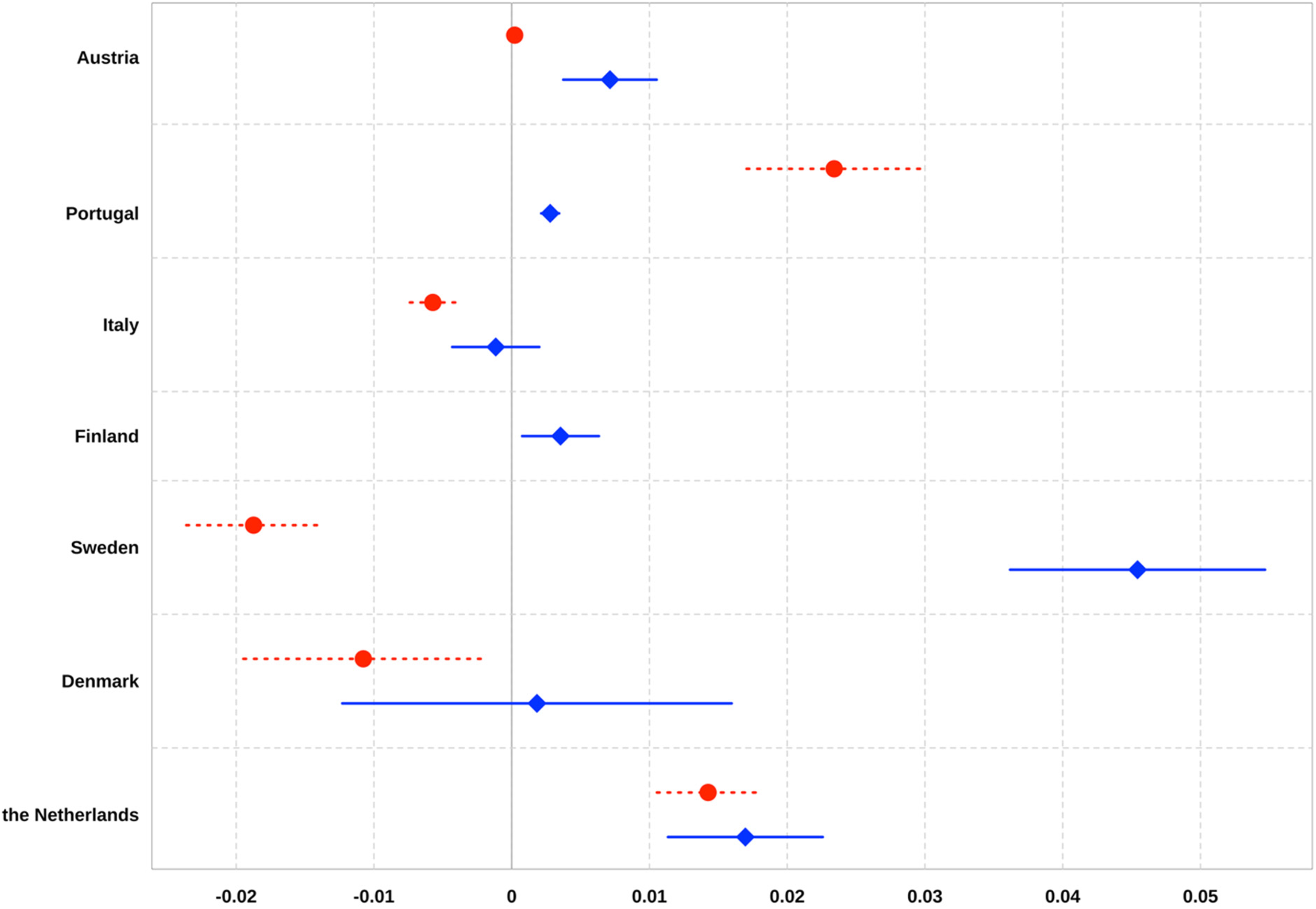
Coefficients and 95% confidence intervals for the effects of the (natural log of the) share of CEE immigrants from the local population on the vote shares of right-wing (blue rhombuses and solid lines) and left-wing (red dots and dotted lines) Eurosceptic parties at the 2019 EP elections. (See online file for color).
The effect of CEE immigration presence on the vote shares of right-wing Eurosceptic parties is positive in all countries with the exception of Italy, and it is statistically significant at the 0.05 level in all countries but Denmark and Italy. The effect on left-wing Euroscepticism varies: it is positive in the Netherlands, Austria and Portugal, but negative in Denmark, Sweden and Italy. In terms of substantive size, the importance of the effects differs across countries. Since the CEE immigration variable is log-transformed, the plotted coefficients show the expected effects for an increase of 2.7 of the CEE immigration share of the local population; for example, going from 1% to 2.7%, or from 2% to 5.4%. The size of the effects should be judged relative to the vote shares that the parties have received. The effect is rather big in Sweden, where the effect is comparable to the standard deviation of the right-wing Eurosceptic vote shares (which is 0.05), it is moderate in the Netherlands, where the effect is smaller than half a standard deviation of the right-wing Eurosceptic vote shares (which is 0.04) and it is substantively small in Austria (0.13 of a standard deviation in the right-wing Eurosceptic vote share). Despite the small absolute size (0.003), the effect is also substantively important in Portugal, where the standard deviation in the vote share for the Eurosceptic party is 0.0008.
Even in Denmark and Italy there is a positive and statistically significant effects of CEE immigration presence on the vote share of right-wing Eurosceptic parties when the economic and social covariates are excluded from the models. This implies that in these countries the effect of CEE immigration is confounded by the socio-economic context or that part of the effect of immigration is exercised though changes in the local socio-economic conditions (e.g. higher crime or unemployment levels).
When the full set of covariates are considered, the effects of CEE immigration presence on right-wing Euroscepticism in the Netherlands, Sweden, Finland, Austria and Portugal are robust for calculating the vote shares from all eligible voters rather than from the valid votes cast at the election, to alternative definitions of Central and Eastern Europeans (with the exception of Finland) and to calculating the change in CEE immigration shares between 2019 and 2004 rather than the 2019 levels (Finland is an exception; see the Online appendix for further details).
In Italy, even with the full set of covariates there is a significant positive effect of CEE immigration presence on the vote share of Fratelli d’Italia – a strongly nationalistic and Eurosceptic party that has support that is less clustered regionally than the support of Lega, the other Italian party included in the share of right-wing Euroscepticism in the country (for arguments about the differential impact of immigration on different far-right parties, see Pupaza and Wehner, 2023). When the models are estimated on a log-transformed version of the vote shares of right-wing Eurosceptic parties, the effects of CEE immigration appear even stronger in the Netherlands, Sweden, Portugal and Austria. All in all, I find considerable evidence in support of H1. 5 This is confirmed when I pool the data from the different countries 6 and estimate a multi-level model with random intercepts at the country level, which shows an overall positive coefficient for CEE immigration.
When it comes to H2, however, only in the Netherlands, Austria and Portugal there is evidence that CEE immigration presence is related positively to left-wing Euroscepticism. In fact, in Denmark, Sweden and Italy there is evidence for negative effects, meaning that higher relative shares of CEE immigrants at the local level are associated with fewer votes for such parties. 7 It can be concluded that the effect is heterogeneous and much more variable across countries that the effect on right-wing Euroscepticism. This is perhaps explained by the fact that the category of left-wing Eurosceptic parties is much more loosely defined and collects a more diverse set of parties under its umbrella, from the Portuguese Communist Party to the 5 Stars Movement in Italy. The results are substantively the same when I use the logged version of the outcome variable.
While I find evidence for relatively robust effects of CEE immigration presence – positive in the case of right-wing Euroscepticism and both positive and negative in the case of left-wing Euroscepticism, non-Western immigration shares are not significantly associated with Eurosceptic voting in most of the countries included in this analysis. In Italy, non-Western immigration is positively associated with right-wing Euroscepticism and negatively with the left-wing variety. In Denmark, the effect of left-wing Euroscepticism is positive. In the other countries the effects are not robust.
Moving to the test of H3, I classify the municipalities in each country in small, medium and big, using 10,000 and 50,000 as cut-off points (the empirical results are not too sensitive to the exact cut-off points). Figure 2 shows the effects of CEE immigration presence on right-wing Euroscepticism for these three different types of localities in each country. The estimates are based on simplified versions of the models reported in Figure 1, which only feature non-Western immigration as a covariate, due to the lower number of observations available, especially for the category of big localities. In accordance with the hypothesis, the effect of CEE immigration is smaller and, in most cases, insignificant in very small localities (plotted in red). In Denmark, the effect is even significant and negative. The effect is less precisely estimated in big compared to medium-sized localities, but this could be due to the lower number of observations available in that category.
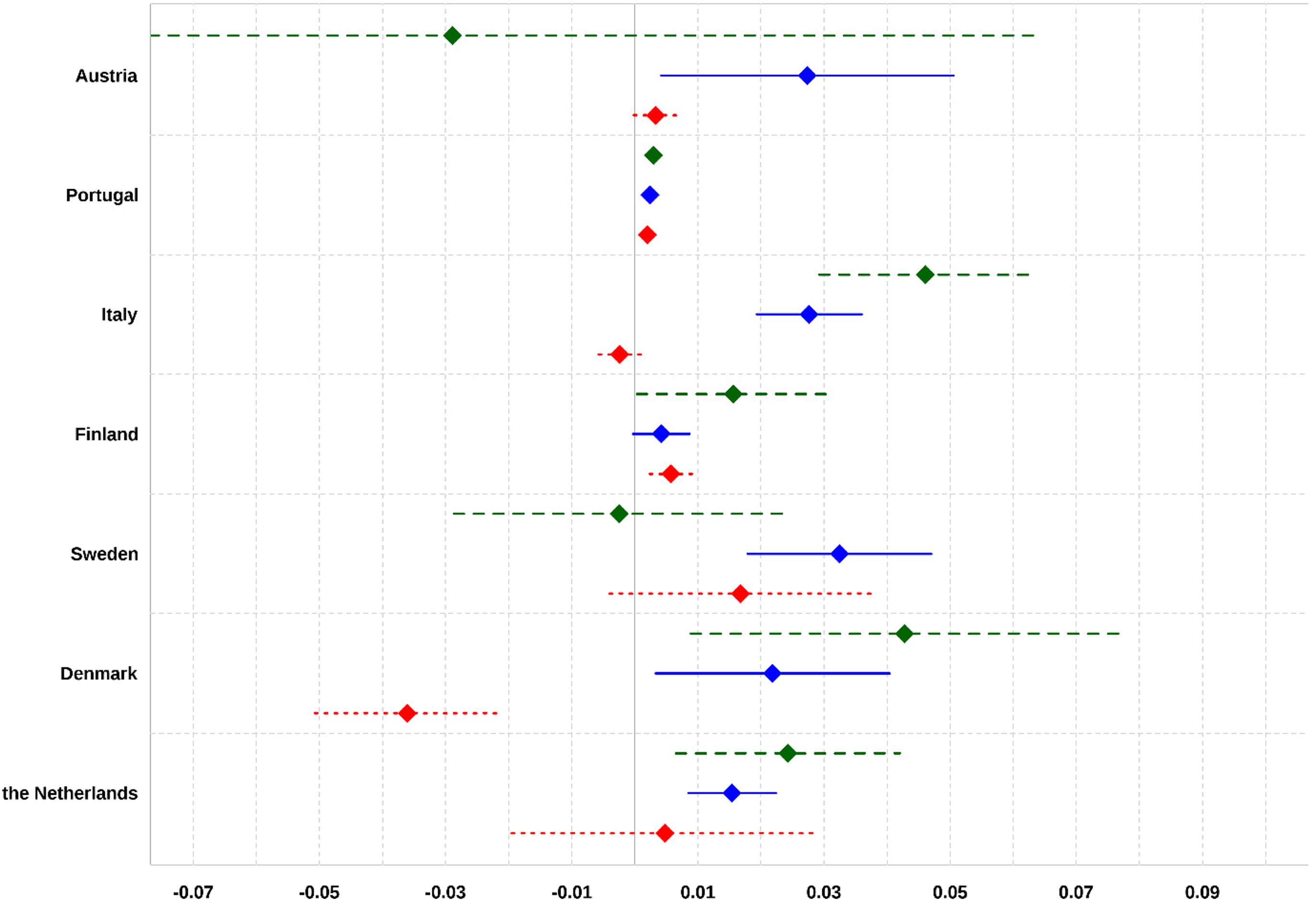
Coefficients and 95% confidence intervals for the effects of the (natural log of the) share of CEE immigrants from the local population on the vote shares of right-wing Eurosceptic parties at the 2019 EP elections in small (<10,000) (red dotted lines), medium (>10,000 but <100,000) (blue solid lines) and big (>50,000) (dark green dashed lines) localities. (See online file for color).
The equivalent figure for left-wing Euroscepticism is reported in the Online appendix. The pattern of results is mixed. The positive effect of CEE immigration is non-existent in very small municipalities in the Netherlands and in Austria and in very big ones in Austria and in Portugal, broadly in line with the hypothesis. But in the other countries, the negative effects of CEE immigration on left-wing Eurosceptic support do not conform to the pattern. Altogether, there is mixed support for H3: while in small localities the positive effect of CEE immigration presence on Eurosceptic voting is indeed smaller or non-existent, the effect is not necessarily smaller – but it is more variable – in very big localities.
Moving to H4 and H5, I first focus on the case of the Netherlands and look at the past four EP elections since 2004, three national parliament elections and the 2016 referendum on the association agreement between Ukraine and the EU. Figure 3 shows the estimated effects on right- and left-wing Eurosceptic voting. As the figure makes clear, the effects are present both in national and in EP elections, as well as in the referendum voting. See the Online appendix for a plot of the share of CEE immigrants against the vote shares for Eurosceptic parties at the 2019 EP.
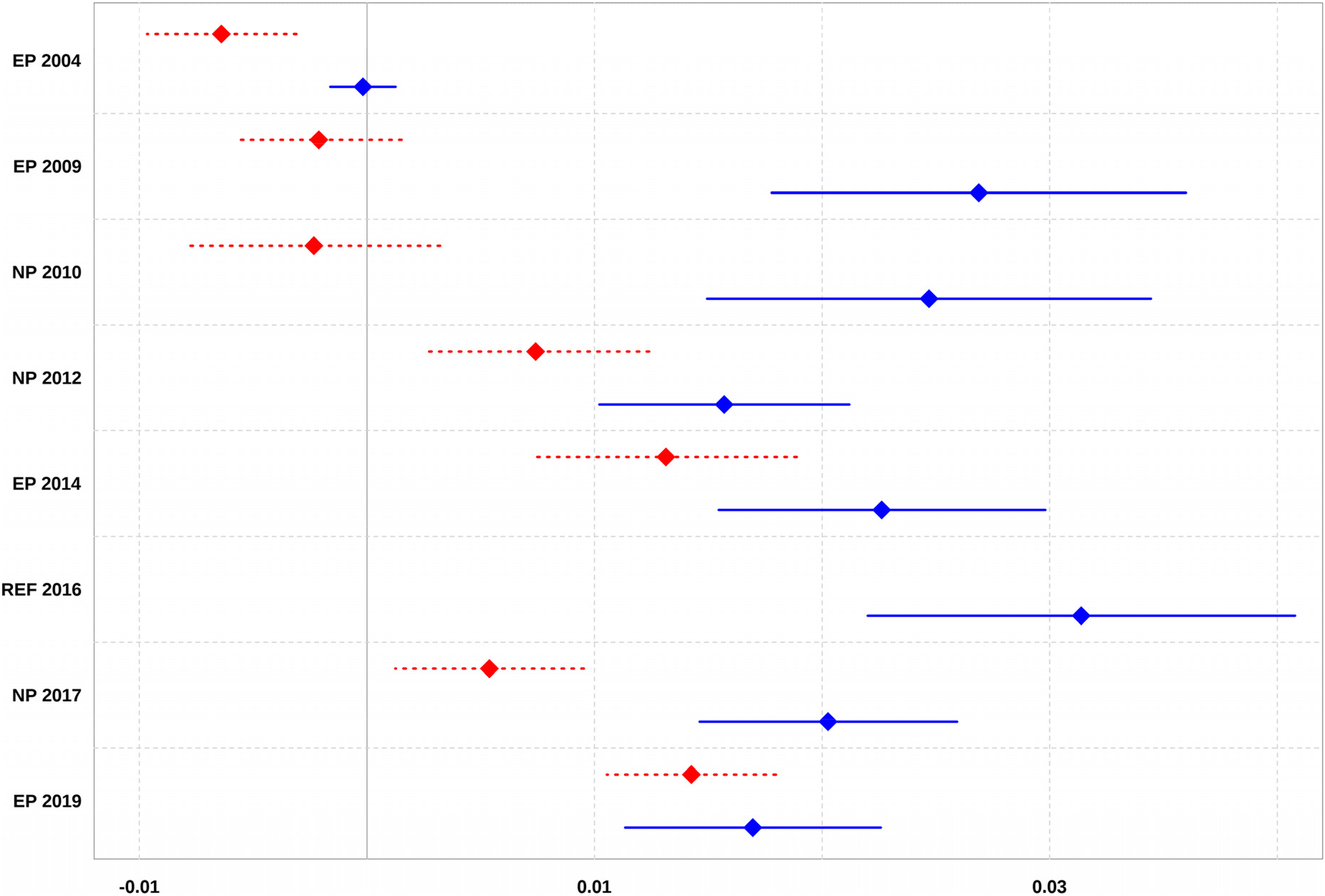
Coefficients and 95% confidence intervals for the effects of the (natural log of the) share of CEE immigrants from the local population on the vote shares of right-wing (blue solid lines) and left-wing (red dotted) Eurosceptic parties in the Netherlands at EP and national parliament (NP) elections and the share of votes at the 2017 referendum (REF) cast against the association agreement between Ukraine and the EU. (See online file for color).
The effects on right-wing Eurosceptic voting are greatest in 2009 and 2010, but they have not declined significantly since. The effect of left-wing Euroscepticism is visible only after 2012. The effects are not present in 2004, when the Eastern enlargement had just been concluded and the CEE immigration presence had not increased too much yet. The details of the regression models are in the Online appendix. When right- and left-wing Eurosceptic vote shares are added together, the effect of CEE immigration is visible in all elections after 2004.
In Finland, the pattern is similar, but the positive effect appears between the 2009 and 2014 EP elections and between the 2011 and 2015 national elections. In Italy, the effect of CEE immigration presence on right-wing Eurosceptic voting increases until the 2019 EP elections and is actually significantly negative at the previous EP elections and at the national elections in 2018. In Denmark, there is a similar development with the effect of CEE immigration presence on right-wing Eurosceptic voting becoming more positive, even if it is not significant in 2019, while the effect of non-Western immigration declines in size and switches signs. In Austria, the positive effects on right-wing Eurosceptic vote shares are visible both in European and in national elections and have not declined over time. The positive effects on left-wing Eurosceptic vote shares are detectable only in European elections.
Altogether, there is strong evidence to reject H4: the effect of CEE immigration presence does not diminish significantly over time, and in some countries, it actually becomes stronger. With regards to H5, there are no big differences between the effects of immigration on voting for Eurosceptic parties at national and at EP elections. This is quite significant, because it suggests that the political effects of intra-EU migration are not restricted to European elections, but spill over to national political and elections as well.
Conclusion
This study examined the political effects of immigration presence. Focusing on the impact that the arrival of migrants of CEE had on the voting preferences of the host populations in Western, Northern and Southern Europe, the article reported strong evidence that immigration contributed to support for right-wing Eurosceptic parties in the Netherlands, Sweden, Finland, Portugal, Austria and possibly in Italy and Denmark as well. The effects are specific to CEE immigration and distinct from any possible influence of non-Western immigration. The relationship of CEE immigration presence (measured in levels and in changes) with voting for right-wing Eurosceptic parties does not diminish over time and is discernable in national as well as in EP elections.
These results have significant theoretical import. The findings are compatible with both mechanisms of contact and outgroup threat operating at the same time: the fact that I find no effects in small localities is consistent with an interpretation that contact can have positive effects on outgroup acceptance at a small scale, which however are overwhelmed by the negative effects of threat and competition in bigger places.
Free movement within the EU can be seen as a hard case for finding negative political effects of immigration. After all, free movement, as a fundamental principle of European integration, is enshrined in the founding EU treaties and is supported by strong normative discourses. Moreover, the cultural distance between CEE migrants and the host populations is relatively small and a lot of time has passed since the first wave of mass East–West migration. Yet, even 15 years after the enlargement of the EU to the East, the negative political effects of CEE immigration are clearly visible in the voting data and show no signs of withering away. One potential explanation is that CEE immigrants are perceived as less deserving than people who are persecuted or come from poorer parts of the world. Another is the continuing negative framing of (labour) migration from the East in national media and political discourses in the West.
It is remarkable that the effect of immigration on Euroscepticism is found in all these rather different party-political systems and political contexts. This article significantly extended the empirical scope of the existing literature, which had already claimed similar effects of immigration on voting at EU-related referenda (Toshkov and Kortenska, 2015), anti-immigration attitudes and EU trust (but at the country level) (Jeannet, 2020b, 2020c) and support for radical right parties in Austria (Halla et al., 2017), France (Bolet, 2020; Edo et al., 2019; Evans and Ivaldi, 2020) and the UK (Pupaza and Wehner, 2023; Viskanic, 2017). The evidence for effects in Southern Europe is particularly noteworthy, given long-held assumptions that this region is immune to Euroscepticism and the radical right. But this evidence fits results about links between CEE immigration presence and voting for the radical right party Vox at the regional election in Andalucía in Spain (Toshkov, 2018) and between the Roma minority and Chega! at the presidential elections in Portugal (Afonso, 2021).
Yet, there are differences in how the effect plays out (cf. Denmark, where it is non-Western immigration that seems related to the radical right), especially when it comes to support for left-wing Eurosceptic parties. This effect ranges from strongly positive in the Netherlands to strongly negative in Italy and Sweden. But left-wing Euroscepticism is a rather diffuse category with significant ideological and programmatic differences between the parties that are classified as such. Moreover, negative discourse against CEE immigration can spill over throughout the political system. As Treib (2020) shows, claims about restricting migration from poorer countries in the EU occur in the election manifestos of centre-right as well as radical right parties. Hjorth and Larsen (2020) argue that even mainstream left parties can attract anti-immigration voters by taking more restrictive positions on immigration. If mainstream and pro-European parties also endorse such views, they take the air out from the Eurosceptic parties on the fringes of the ideological spectrum, which weakens the relationship between CEE immigration shares and votes for Eurosceptic parties.
The results also contribute to the study of the politics of place and the ‘geography of discontent’ (Adler and Ansell, 2019; Bolet, 2021). In line with the hypothesis of politicized places, the differences found indicate that ‘national and local conditions interact to construe immigrants as threatening’ (Hopkins, 2010: 40). In addition, this study shows that when on the search for the impact of immigration, we should be careful to disaggregate the types of migrants we look at, because different categories of migrants might be associated with different effects. This might explain why the literature on the links between immigration presence and votes for radical right parties has produced divergent results.
The evidence presented in this article is consistent with studies at the individual level that find connections between EU support and anti-immigration preferences (i.a. Hobolt and De Vries, 2016; Kentmen-Cin and Erisen, 2017). However, importantly, it suggests that anti-immigration preferences themselves are rooted to some extent in developments in the real world and population changes at the local level in particular. The perceptions of citizens (or at least what they tell pollsters) of national immigration levels might be far from the true levels, but at the margin, their political choices seem responsive to the local conditions (Schlüter and Scheepers, 2010). Hence, to some extent people's perceptions of the local immigration context must be grounded in reality (cf. Holbrook and Weinschenk, 2020) – otherwise, it is hard to explain how the true levels can be systematically related to relevant voting choices.
The conclusions of this article are consistent with historical evidence from the United States of America (USA) that ‘immigration triggered hostile political reactions, such as the election of more conservative legislators, higher support for anti-immigration legislation, and lower redistribution’ (Tabellini, 2020: 454). Similar to the USA, the discontent does not seem rooted in economic factors, but in cultural differences between immigrants and the host populations. Hence, the dynamic between immigration and political integration has broader historical relevance than the case of the EU. Any polity information faces the challenges of accommodating social mixing and making sure that this mixing does not derail the process of integration itself through political channels. In the words of Robert Putnam, ‘In the short run … immigration and ethnic diversity tend to reduce social solidarity and social capital…. In the long run, however, successful immigrant societies have overcome such fragmentation by creating new, cross-cutting forms of social solidarity and more encompassing identities’ (Putnam, 2007: 137). It remains a challenge for the EU to find such forms of social solidarities and identities that can counteract the political forces of Euroscepticism.
It will be worth extending the geographical scope of the current study to other major countries that received substantial numbers of CEE migrants (e.g. Germany, Spain) once the necessary data become available. But it will be even more interesting to study the political effects of CEE migration for the countries of origin of these population movements – the places that the migrants abandon. The social consequences of emigration can be just as great, and there are plausible mechanisms through which emigration can also increase distrust and resentment of the EU among those literally left behind.
Supplemental Material
sj-pdf-1-eup-10.1177_14651165241271979 - Supplemental material for The political effects of intra-EU migration: Evidence from national and European elections in seven countries
Supplemental material, sj-pdf-1-eup-10.1177_14651165241271979 for The political effects of intra-EU migration: Evidence from national and European elections in seven countries by Dimiter Toshkov in European Union Politics
Supplemental Material
sj-zip-2-eup-10.1177_14651165241271979 - Supplemental material for The political effects of intra-EU migration: Evidence from national and European elections in seven countries
Supplemental material, sj-zip-2-eup-10.1177_14651165241271979 for The political effects of intra-EU migration: Evidence from national and European elections in seven countries by Dimiter Toshkov in European Union Politics
Footnotes
Acknowledgements
The author is grateful to the Robert Schuman Centre for Advanced Studies at the European University Institute for a Jean Monnet fellowship during which some of the research for this article was conducted.
Funding
The author received no financial support for the research, authorship and/or publication of this article.
Data availability statement
The replication materials, including a dataset, are available in the Supplemental material.

Supplemental material
Supplemental material for this article is available online.
Notes
References
Supplementary Material
Please find the following supplemental material available below.
For Open Access articles published under a Creative Commons License, all supplemental material carries the same license as the article it is associated with.
For non-Open Access articles published, all supplemental material carries a non-exclusive license, and permission requests for re-use of supplemental material or any part of supplemental material shall be sent directly to the copyright owner as specified in the copyright notice associated with the article.
