




Abstract
What are the attitudinal consequences of the growing pervasiveness of populism and nativism? We conceive of both populism and nativism as binary moral frameworks predicated on an antagonistic relationship between ‘us’ and ‘them’. Our study investigates the presence of spillover effects between these two forms of ingroup-outgroup thinking among survey respondents in the Netherlands. We posit that exposure to populist (nativist) messages fuels nativism (populism), but only among those positively predisposed toward these messages in the first place. A first survey experiment, focusing on antipathies toward refugees and Muslim immigrants, confirms the former expectation, but a second experiment calls into question the latter hypothesis. Moreover, the second experiment does not replicate the effects of populist message exposure on general immigration attitudes. We discuss several possible reasons for these mixed results.
Introduction
Recent studies have argued that populism and nativism are analytically distinct phenomena. Populism concerns the ‘vertical’ relationship between the ‘good people’ and a vilified elite (see Hawkins, 2010; Mudde, 2004; Müller, 2016), whereas nativism concerns the ‘horizontal’ antagonism between natives and non-natives (Bonikowski, 2017; Mudde, 2007; Pappas, 2018). Because populism and nativism are often combined in practice, scholars have advocated for the two concepts to be theorized and measured separately (De Cleen et al., 2018; Rooduijn, 2019). At the same time, however, it is important to note that populism and nativism also share a common feature: both are manifestations of a general propensity to divide the world into ingroups and outgroups, into ‘us’ versus ‘them’ (Bizumic and Duckitt, 2012; Hawkins, 2010; Kinder and Kam, 2010; Schulz et al., 2020).
In this study, we hypothesize that exposure to populist or nativist messages activates general ingroup-outgroup thinking, and thereby fuels binary classification across cognitive domains (see Akrami et al., 2011; Zick et al., 2008). Specifically, we predict that exposure to populist messages may strengthen nativist attitudes (Bonikowski and Zhang, 2020), and exposure to nativist messages may increase populist attitudes. We expect such spillover effects to be observed, however, only among individuals who are susceptible to populist and nativist messages in the first place (see Hameleers and Schmuck, 2017; Kinder and Kam, 2010; Sniderman et al., 2004; Valkenburg and Peter, 2013). Others are likely to ignore the messaging or see it as antithetical to their political sensibilities (perhaps by associating it with the opposite political camp) and recoil from it.
Using two nationally representative survey experiments fielded in the Netherlands in 2017 and 2019, we find partial support for the hypothesized spillover effects. The first study shows that exposure to a populist message strengthens antipathy toward refugees among supporters of populist parties. The second study, however, finds no support for our expectation that a nativist message would increase populism among supporters of nativist parties. Moreover, in a partial replication of the first experiment using a different dependent variable, we fail to observe significant differences in views about the social consequences of immigration between respondents who were exposed to a populist message and respondents who were not. In the concluding section of the article we offer possible reasons for these mixed findings.
Populism and nativism
There is growing scholarly consensus that populism is a Manichaean moral (Hawkins, 2010; Müller, 2016) outlook that pits the good, virtuous people against a fundamentally corrupt elite (see Mudde, 2004; Stanley, 2008). Scholars have argued that populism should be distinguished from related ideational constructs, including nativism (Bonikowski, 2017; Clark and Rohrschneider, 2021; De Cleen et al., 2018; Rooduijn, 2019). Mudde (2007: 19) defines nativism as ‘an ideology which holds that states should be inhabited exclusively by members of the native group (“the nation”) and that nonnative elements (persons and ideas) are fundamentally threatening to the homogeneous nation-state’. Hence, nativism concerns the antagonistic relationship between the nation on the one hand, and ‘dangerous others’ and their ideas on the other (see Albertazzi and McDonnell, 2008). Nativism could be conceived of as a ‘certain kind of nationalism’ (Higham, 1955: 3) and can be directed towards different types of outgroups (Bennett, 1990).
Radical right-wing parties have discovered that the combination of populism and nativism forms an electoral winning formula. These parties combine the message that the people are neglected, betrayed, or exploited by a self-interested and morally reprehensible elite with the claim that the native group is threatened by ‘dangerous others’. Yet, only some varieties of populism evoke exclusionary beliefs toward outgroups: radical left-wing populists like Podemos in Spain or Syriza in Greece, for instance, tend not to employ nativist messaging. The same is true in public opinion. Someone who is strongly populist need not be strongly nativist as well.
Even if populism and nativism are distinct, however, the corresponding attitudes can still be expected to be correlated. Both populism and nativism are dispositions that emphasize the positive characteristics of one’s own group and the negative features of ‘others’. In other words, they share a tendency toward ingroup favoritism and outgroup derogation (Adorno et al., 2019; Tajfel and Turner, 1979). As Kinder and Kam (2010: 8) put it: ‘Members of ingroups (until they prove otherwise) are assumed to be virtuous: friendly, cooperative, trustworthy, safe, and more. Members of outgroups (until they prove otherwise) are assumed to be the opposite: unfriendly, uncooperative, unworthy of trust, dangerous, and more’.
Allport (1954: 68) was one of the first to argue that attitudes towards distinct outgroups are related and may in fact reflect a single underlying general predisposition: ‘One of the facts of which we are most certain is that people who reject one outgroup will tend to reject other outgroups. If a person is anti-Jewish, he is likely to be anti-Catholic, anti-Negro, anti any outgroup’. Indeed, studies have empirically demonstrated that different forms of prejudice are related to each other (see Akrami et al., 2011; Bäckström and Björklund, 2007; Ekehammar et al., 2004; Guimond et al., 2003; Zick et al., 2008). And, of specific interest to this study, scholars have shown this to be true of populism and nativism in particular (e.g., Van Hauwaert and Van Kessel, 2018).
The main question of this study is whether populist or nativist communication may generate spillover between these two ideological domains. Past studies have examined the effects of populist messages on populist attitudes (e.g., Hameleers et al., 2017; Müller et al., 2017), while others have assessed the impact of nativist communication on nativist or anti-immigrant attitudes (e.g., Boomgaarden and Vliegenthart, 2009; Schlueter and Davidov, 2013). We know little, however, about the extent to which populist messages can fuel nativist attitudes or nativist attitudes can fuel populism (but see Bonikowski and Zhang (2020) on the former). Because both populism and nativism are concrete manifestations of the cognitive tendency to divide the world into ‘us’ versus ‘them’ (likely reinforced by the persistent coupling of populism and nationalism in radical right political discourse), we expect that exposure to populist messages could activate general ingroup-outgroup thinking and thereby also fuel nativism. For the same reason, we expect that nativist messages could heighten populist attitudes.
In exploring these questions, we build on past research on media effects that shows some people to be more susceptible than others to the same messages (Valkenburg and Peter, 2013). Individuals’ dispositions and identity commitments determine which messages resonate, and, hence, the extent to which such messages are consequential for public opinion formation and mobilization. More specifically, Sniderman et al. (2004) argue that a media message will be particularly effective among those who are already likely to agree with it, thereby producing a ‘galvanizing effect’. Similarly, Kinder and Kam (2010: 35–41) theorize that predispositions will be ‘switched on’ or ‘activated’ if there is resonance between them and dominant features of the political and media context. This suggests that even if political communication rarely leads to radical opinion change among those strongly opposed to a given message, it makes pre-existing beliefs more salient among susceptible publics and further strengthens political support among those predisposed to agree with the message. Occasionally, it may also convince reluctant leaners or undecided voters toward a given candidate or party.
Consistent with these insights, studies have shown, for instance, that threatening messages about outgroups most strongly exacerbate prejudice among those who are susceptible to such threats in the first place (e.g., those who score high on the authoritarianism scale; see Claassen and McLaren, forthcoming). Similarly, scholars have demonstrated that populist anti-establishment messages resonate more strongly with respondents who hold populist attitudes (Bakker et al., forthcoming) and who support populist parties (Hameleers and Schmuck, 2017).
Hence, it is likely that individuals are not equally responsive to populist and nativist messages that emphasize moral conflict between two groups. If so, we anticipate that only those who already support populist or nativist parties (i.e., those who tend to agree with populist or nativist messages) will be affected by our experimental treatments (Bonikowski and Zhang, 2020; Busby et al., 2019; Hameleers and Fawzi, 2020; Rooduijn et al., 2017). Conversely, it is likely that those who do not support such parties, and therefore do not identify with populist or nativist claims, will be unaffected—or even put off—by the experimental primes (Krämer, 2014; Müller et al., 2017). Consequently, we hypothesize that: H1: Individuals who are exposed to a populist message will exhibit stronger nativist attitudes than those who are not exposed to such a message, but this will only hold for respondents who are favorable toward populist claims in the first place (i.e., those who vote for populist parties). H2: Individuals who are exposed to a nativist message will exhibit stronger populist attitudes than those who are not exposed to such a message, but this will only hold for respondents who are favorable toward nativist claims in the first place (i.e., those who vote for nativist parties).
Research design
Our study focuses on the Netherlands. The reasons are twofold. First, both right-wing populists (Forum voor Democratie (FvD), Partij voor de Vrijheid (PVV) and the Lijst Pim Fortuyn (LPF)) and left-wing populists (Socialistische Party (SP)) have been successful in this country. This allows us to take advantage of the fact that some parties express populist messages separately from nativism and therefore that not all segments of the Dutch public are likely to automatically associate the two phenomena. Second, populist and nativist messages are relatively widespread in this country (Pauwels, 2014). This is an important precondition for our study, because we conducted survey experiments in which we exposed respondents to populist and nativist messages (see below). Such messages would have been less credible in a context in which populism and nativism are relatively uncommon.
We administered two survey experiments. The first examines the effects of exposure to populist messaging on nativist attitudes toward refugees and Muslim immigrants, allowing us to evaluate Hypothesis 1. The second experiment focuses on the opposite causal relationship: the effect of exposure to nativist messaging on populist attitudes. We use the results to evaluate Hypothesis 2. In addition, the second experiment partly replicates our initial populist treatment (with a different dependent variable) to establish a baseline against which the results of the nativism condition can be interpreted.
The experiments were part of two special modules of the DNB Household Survey (DHS), conducted by CentERdata at Tilburg University. This is a panel that includes approximately 2000 households (from which one or more household members may take part in the surveys). The panel is designed to be representative of the Dutch-speaking population by drawing respondents from a random sample of households and replacing households that refuse to participate or quit the panel with households with similar characteristics (for further details, see Teppa and Vis, 2012). The first survey experiment was fielded between June 5th and 20th, 2017. It was sent to 3035 individuals, out of whom 2381 completed the questionnaire (response rate of 78.5%). The survey featuring the second experiment was in the field between December 2nd and 17th, 2019, yielding a sample of 2596 respondents (response rate of 77.2%). Because the survey featured multiple treatments, we focus here on the relevant subset of 1282 respondents (see also note 10). Given that the 2017 and 2019 samples were drawn from the same panel, 776 respondents participated in both of the experiments featured in our study. 1
Experiment 1: Effect of populist cues on nativist attitudes
The first survey experiment focuses on the effect of populism on nativism. Our stimulus (populist message) was a fictitious newspaper article about the electoral losses of mainstream parties in European national elections. The first two paragraphs of the article described the election results and did not vary across experimental conditions. The third paragraph, which contained an interpretation of the results by a political analyst, contained the experimental manipulation: in the text given to the treatment group it included populist language, which was legitimized by the political analyst’s professional authority. The control group was presented with an interpretation by the same political analyst, but without the use of populist language. 2
We expected those who support populist parties to be more susceptible to populist messages. Therefore, prior to treatment, we asked respondents which party they voted for in the national elections on March 15, 2017. We coded a vote for FvD, Geen Peil, PVV, SP, and Voor Nederland (VNL) as a populist vote. A vote cast for any of the other parties was coded as support for a non-populist party.
We estimate two ordinary least squares (OLS) regression models with antipathy toward refugees and antipathy toward Muslim immigrants (measured on a five-point scale) as dependent variables. 3 The refugee item was framed positively, whereas the one concerning Muslim immigrants was framed negatively. We recoded the refugee item, so that for both variables low values indicate non-nativist attitudes and high values indicate nativist attitudes.
Our main quantity of interest is the interaction between populist message and populist vote. We expect a positive effect of exposure to the populist message on antipathy towards refugees and Muslim immigrants, but only among respondents who support a populist party. Because we examine moderation effects using an interaction in our regression models, we also control for socio-demographic and ideological variables, including gender (1 = female), age, net (household) income, education (six categories) and political ideology (0 = left, 10 = right). Standard errors are clustered at the household level.
Confirming that our manipulation was successful, respondents exposed to the populist treatment were significantly more likely to agree that the political sociologist quoted in the vignette makes reference to a divide between what politicians and ordinary citizens find important (F(11,697) = 6.93, p < 0.01). 4
Results
In the aggregate, the treatment has no statistically significant effect on the two dependent variables: exposure to a populist message does not appear to fuel nativist sentiments (see the Online Appendix). In line with Hypothesis 1, however, we observe a significant effect among respondents who are most likely to be susceptible to the message: those who reported voting for populist parties. Figure 1 visualizes the interactions between populist message and populist vote as predictors of antipathy toward refugees and antipathy toward Muslim immigrants.
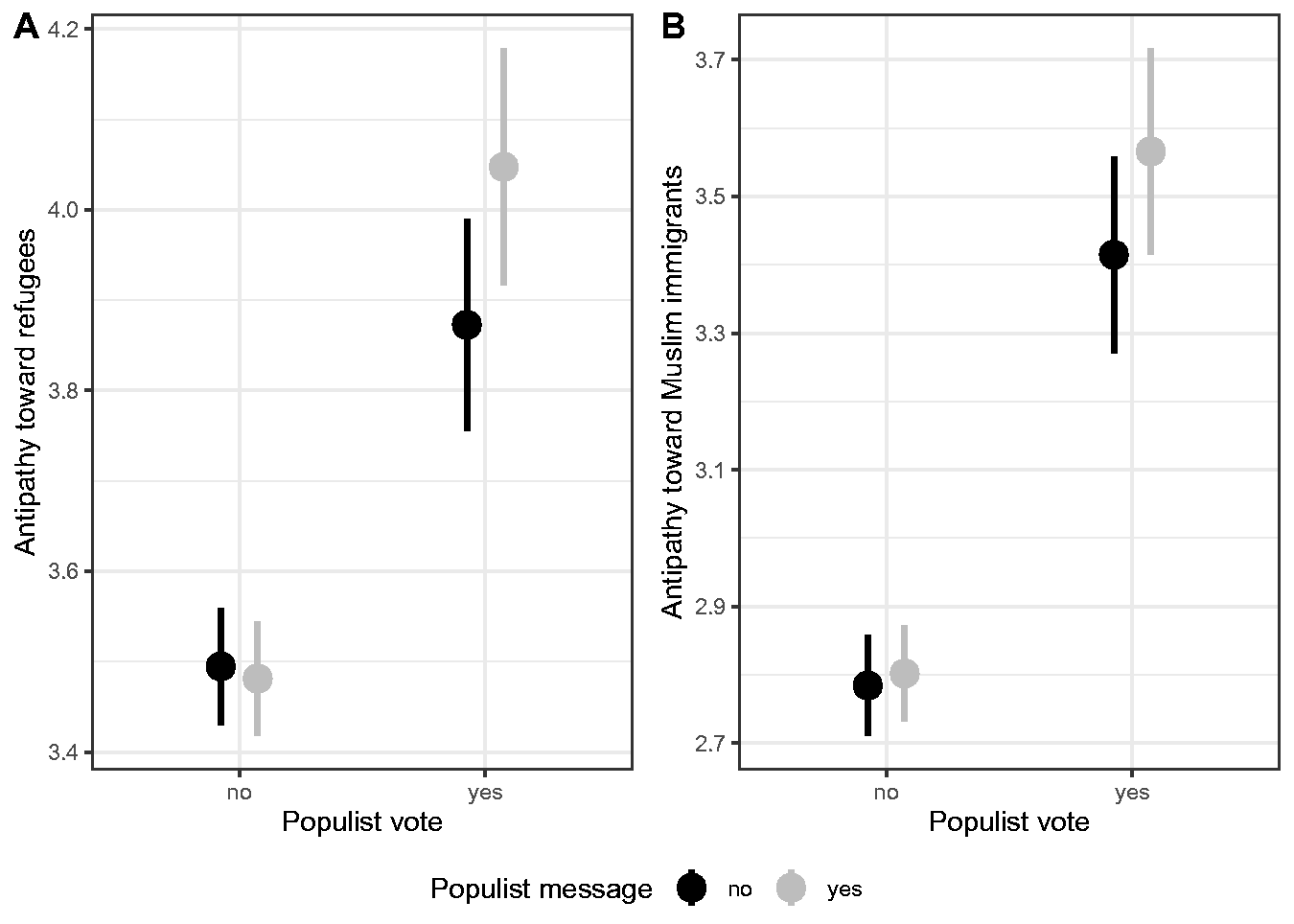
Marginal effects of populist message exposure on nativism toward refugees (panel A) and Muslim immigrants (panel B), conditional on populist vote (including 95% confidence intervals).
For antipathies toward refugees, the interaction is in the expected direction and statistically significant at p < 0.05. For those toward Muslim immigrants, the interaction is in the expected direction, but does not reach statistical significance. Figure 1 helps to interpret these interaction effects. Figure 1(a) focuses on antipathy toward refugees. The point estimates with grey shading represent respondents who received a populist message and those in black represent respondents who did not. Among respondents who did not vote for a populist party (left), there are no differences in nativist attitudes between the two experimental conditions. Among respondents who supported a populist party (right), however, those who were exposed to the populist message expressed significantly stronger nativist attitudes. Figure 1(b) focuses on antipathy toward Muslim immigrants, illustrating a positive non-significant effect of the experimental manipulation.
There are three possible reasons why the effect vis-à-vis Muslim immigrants may be weaker and not statistically significant. First, as we argued above, the refugee item is framed positively, whereas the one concerning Muslim immigrants is framed negatively. Since people might be less inclined to agree with the latter due to social desirability, the effect of populism on this variable may be less pronounced. This is all the more likely given that the moderation analysis focuses on populist supporters on both the right and the left – the latter (i.e., supporters of the Socialist Party) may be especially hesitant to be perceived as xenophobic or racist.
Second, people’s attitudes toward refugees may be more malleable—and thus more susceptible to our experimental treatment—than those toward Muslim immigrants. The category of refugees is more heterogeneous than the category of Muslim immigrants, and research has shown that attitudes toward general, heterogeneous groups can be different from feelings towards specific sub-groups (Burkley et al., 2017; Kotzur et al., 2019). It could well be the case that people are more likely to update their attitudes when it comes to a less well specified group, because its vagueness leaves more room for personal interpretation. 5
Finally, it may be the case that the continued salience of the 2015 ‘refugee crisis’ in Dutch politics has made anti-refugee sentiments more prone to activation than those toward Muslim immigrants. The radical right in the Netherlands had been staunchly anti-Muslim during the political era of Pim Fortuyn and especially Geert Wilders, roughly from 2002 to 2015. But in the aftermath of the ‘refugee crisis’, the emphasis shifted toward the more amorphous but more consistently vilified category of refugees. Moreover, in 2017, support for Wilders’ PVV started to decline, while at the same time support for the newly founded FvD was on the rise. The FvD’s messaging has been less focused on targeting Islam in particular and more on vilifying immigrants and refugees in general.
Experiment 2: Effect of nativist cues on populist attitudes
The second experiment examines the effect of nativism on populism and, additionally, replicates the populism condition from Experiment 1, but in so doing focuses on immigration in general rather than on Muslim immigrants or refugees in particular. We chose this dependent variable in order to assess whether the findings from our first experiment generalize to other demographic reference groups. Our stimulus is again a fictitious newspaper article, this time about the 2019 elections to the European Parliament. The first two paragraphs of the newspaper article summarize the election results and are identical across experimental conditions. The third paragraph, again, contained an interpretation of the results by a political analyst. 6 Respondents were randomly assigned to one of three conditions: (1) treatment with a nativist message; (2) treatment with a populist message; and (3) a control condition with only the first two paragraphs of the article. 7
We expect that those who support populist parties will be more strongly affected by populist messages, whereas those who vote for nativist parties will be more susceptible to nativist messages. We therefore asked respondents which party they would vote for if Dutch parliamentary elections were held today. We coded a vote for FvD, PVV and SP as a populist vote 8 and a vote for FvD and PVV as a nativist vote. A vote cast for any of the other parties was coded as support for a non-populist/nativist party.
We estimate OLS regression models with populist attitudes and anti-immigration attitudes (in general) as dependent variables. Populist attitudes were measured with the following items: (1) ‘The politicians in the Dutch parliament need to follow the will of the people’; (2) ‘The people, and not politicians, should make our most important policy decisions’; (3) ‘The political differences between the elite and the people are larger than the differences among the people’; (4) ‘I would rather be represented by a citizen than by a specialized politician’; (5) ‘Elected officials talk too much and take too little action’; (6) ‘What people call “compromise” in politics is really just selling out on one’s principles’. All response categories range from 1 (strongly disagree) to 5 (strongly agree). The reliability of the scale is satisfactory (Cronbach’s Alpha = 0.85). We recoded the scale so that it ranges from 0 (not populist at all) to 10 (very populist) in order to make it directly comparable to the other dependent variable in this experiment.
Anti-immigration attitudes were measured with a scale consisting of three items: (1) ‘Would you say it is generally bad or good for the Dutch economy that people come to live here from other countries?’ (0 = bad; 10 = good); (2) ‘Would you say that cultural life in the Netherlands is generally undermined or enriched by people coming to live here from other countries?’ (0 = undermined; 10 = enriched); and (3) ‘Is the Netherlands made a worse or a better place to live by people coming to live here from other countries?’ (0 = worse; 10 = better). 9 We recoded the scale so that low values indicate pro-immigration attitudes and high values indicate anti-immigration attitudes (Cronbach’s alpha = 0.88).
Our main quantities of interest are the interactions between nativist message and nativist vote and between populist message and populist vote. First, we expect a positive effect of exposure to the nativist message on populist attitudes, but only among respondents who support a nativist party. Second, we expect a positive effect of exposure to the populist message on antipathies towards immigrants, but only among respondents who support a populist party. This is a replication of the first experiment, but with a dependent variable that focuses on perceived impacts of immigration in general on Dutch society. We include the same control variables as in the first experiment. Standard errors are clustered again at the household level.
Our manipulation was successful. Respondents exposed to a populist message were more likely to agree that the political sociologist in the article refers to a gap between what politicians and ordinary citizens find important (F(1, 690) = 58.44, p < 0.001). Those exposed to a nativist message were more likely to agree that the political sociologist in the article expressed negative views of immigrants (F(1, 667) = 31.94, p < 0.001). See the Online Appendix, for the full manipulation check analyses.
Results
Figure 2 visualizes the main results of the experiment (see the Online Appendix, for the full regression tables). Figure 2(a) focuses on the effects of exposure to a nativist message on populist attitudes. Among those who do not vote for a nativist party (left), there are no differences between the experimental conditions: when those respondents are exposed to a nativist message (see point estimates shaded in grey), they are not more or less populist than respondents in the control condition. The same holds true, however, for respondents who do vote for a nativist party (right). Although nativist party supporters report higher mean levels of populist attitudes, these attitudes do not appear to be heighted as a result of exposure to a nativist experimental vignette. This suggests that, contrary to Hypothesis 2, nativism does not spill over onto populism despite both sharing an ‘us’ versus ‘them’ logic.
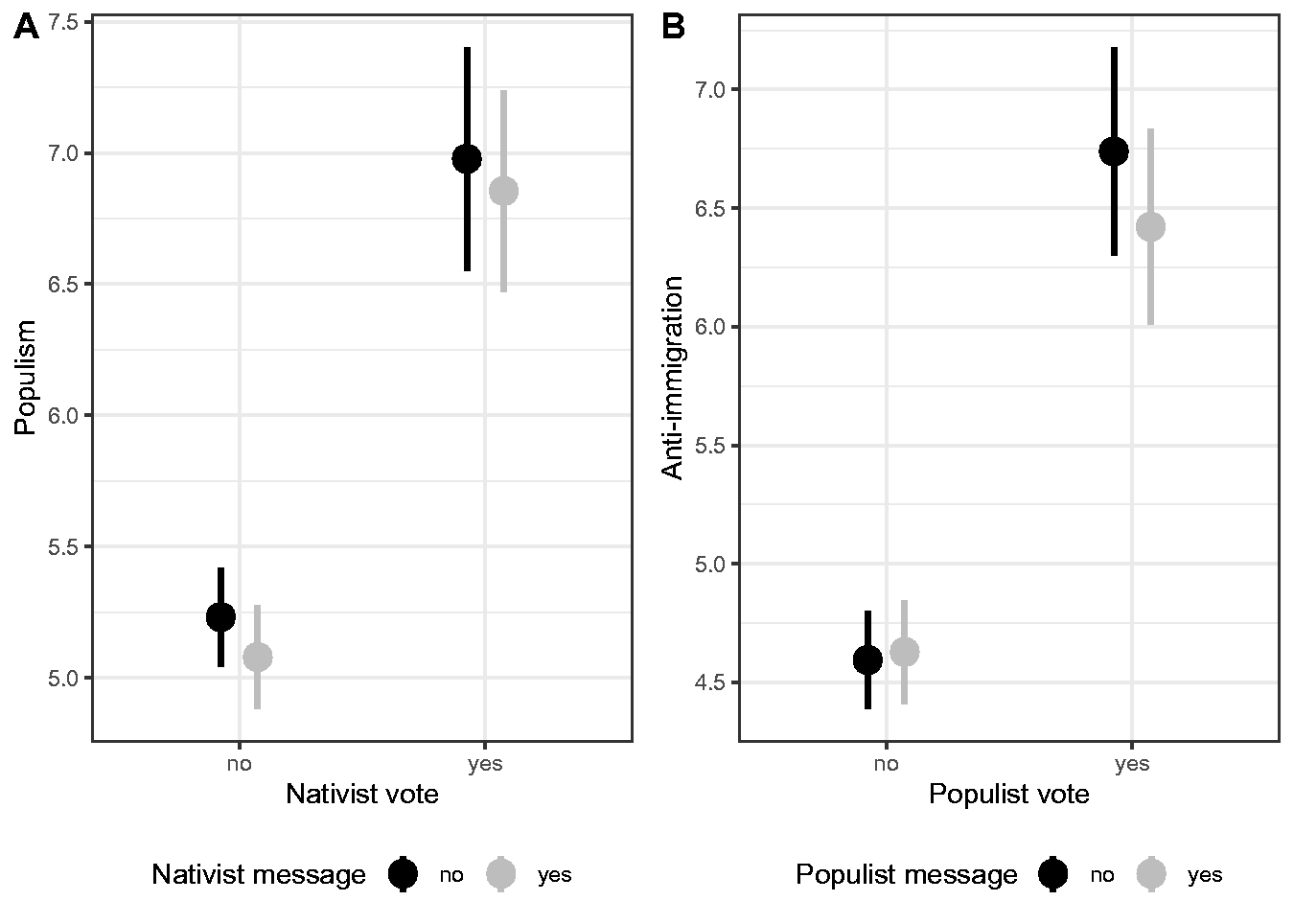
Marginal effects of nativist message on populism (panel A) and populist message on nativism (panel B), conditional on populist/nativist vote (including 95% confidence intervals).
Figure 2(b) examines the effect of the populist message on general anti-immigration attitudes. As in Experiment 1, among those who do not support populist parties (left), there are no significant differences between those who were exposed to a populist vignette (grey) and those who were assigned to the control condition (black): respondents in both conditions reported similar anti-immigration attitudes. Those who do support populist parties (right), on average, tend to hold significantly more negative attitudes about immigration. This is not surprising, given that most of these respondents (roughly 70%) vote for radical right-wing populists who routinely rely on nativist messages. More surprisingly, however, we observe no significant differences across the two experimental conditions among supporters of populist parties: populist respondents exposed to a populist message do not report greater hostility towards immigrants than those who read a neutral text.
This result stands in contrast to the findings of our first experiment and complicates our interpretation of the null effects of the nativism treatment. We address possible causes for this outcome in the discussion section below, but at a minimum, it suggests that the lack of impact of the nativism treatment on nativist party supporters may be due either to (a) the absence of spillover effects between nativism and populism or (b) limitations of the research design used in Experiment 2. 10
Discussion and conclusion
What are the attitudinal consequences of the upsurge of populist and nativist parties and the increasing pervasiveness of the messages expressed by them? We have argued that populism and nativism are concrete manifestation of ingroup-outgroup thinking (Adorno et al., 2019; Tajfel and Turner, 1979), and as such, can be expected to be related to each other (Van Hauwaert and Van Kessel, 2018) and other moral binaries (Ekehammar et al., 2004; Zick et al., 2008). More specifically, we hypothesized that populist and nativist communication would activate (see Kinder and Kam, 2010) ingroup-outgroup thinking across domains—but only among those who are susceptible to populist or nativist messages in the first place (Bonikowski and Zhang, 2020; Hameleers and Schmuck, 2017; Rooduijn et al., 2017; Sniderman et al., 2004).
In a first survey experiment, conducted in 2017 in the Netherlands, we found support for the hypothesis that populist messages fuel nativism among supporters of populist parties. Populist party supporters who were exposed to a populist message expressed greater antipathy toward refugees and, to a lesser degree, Muslim immigrants, compared to respondents assigned to a control condition. In contrast, the second experiment, administered in the Netherlands in 2019, failed to confirm the second hypothesis that a nativist message would strengthen populist attitudes among supporters of nativist parties. Participants who reported supporting a nativist party did not express stronger populist attitudes following exposure to an experimental vignette with strongly negative anti-immigrant content.
The latter finding may suggest that the cross-domain spillover generated by morally binary messaging moves in only one direction: from populism to nativism, but not from nativism to populism. What might attenuate one side of this two-way relationship? It is possible that populism and nativism are not cognitively and affectively equivalent phenomena. Scholars have argued that nativism is the only commonly shared ideological feature of radical-right parties (Ivarsflaten, 2008) and that nativism is more likely than populism to be a source of deeply meaningful collective identity (Bonikowski, 2017; Mudde, 2007). If so, radical-right parties may be using populism as a seemingly innocuous stand-in for their core nativist messages, rather than using nativist messages as a veneer for a deep commitment to anti-elite politics. Put differently, nativism and not populism may be at the heart of radical-right politics.
While plausible, this conclusion is complicated by the second finding in Experiment 2: supporters of populist parties exposed to a populist experimental treatment did not exhibit stronger general anti-immigration attitudes than those assigned to a control condition. The failure to replicate the results of Experiment 1 (using a notably different dependent variable) makes it difficult to evaluate the effects of the populist treatment. It may indeed be the case that exposure to populism does not result in increased nativism, or it may be that our experiment as a whole did not work well in the context in which it was administered. Below we discuss three possible reasons for the latter scenario.
The first possible reason for the null effects in Experiment 2 is simply chance. Though less satisfying than a theoretical explanation, it is not unusual for replications of experimental effects to be inconsistent. This is especially true of samples collected from online panels, which are often heterogeneous on unobserved variables, which makes repeated draws from the panel population difficult to compare. Given that scholars in the United States have found similar effects of populism on nativism (Bonikowski and Zhang, 2020), we are reasonably confident that the relationships observed in Experiment 1 are not spurious.
Second, radical-right parties have become increasingly successful throughout Europe (and beyond), and their nativist and populist discourses have become widespread. The Netherlands is no exception. In fact, in the last two decades, this country has witnessed upsurges of three influential radical right-wing populists: Pim Fortuyn in 2002, Geert Wilders in 2006, and Thierry Baudet in 2017. As a result of exposure to these candidates, it is possible that by 2019, Dutch people had become so used to populist and nativist messages that seeing yet another instance of such rhetoric had little marginal effect on their survey responses. This might be especially true for populist/nativist voters, whose exposure to populist/nativist messages is likely to be more frequent than for those who do not support such parties. If these intuitions are correct, this would suggest that the effects of exposure to nativist/populist frames are not temporally linear (that is, early exposure matters more than later exposure, with possible eventual ceiling effects) and that even though assignment to our experimental treatment was random, the ‘real-life’ pre-treatments are not in fact randomly distributed across the population.
While the non-linear effects of pre-treatment are plausible, it is important to keep in mind that we did find a statistically significant effect of exposure to a populist message on antipathy toward refugees in the first experiment. This experiment was conducted in 2017, after 15 years of continuous and widespread populist radical right rhetoric. This suggests that even though the experimental effects identified by one-off treatments like ours may be small—and sometimes fail to reach statistical significance—any detectable effects are likely to be conservative estimates of much larger real-life consequences of repeated exposure to stronger and more persistent populist and nativist messaging.
Given this, future studies should examine whether prolonged exposure to a repeated sequence of populist and nativist messages would lead to more pronounced spillover effects across attitudinal domains. This could be accomplished through longitudinal survey experiments administered to a panel of respondents, perhaps with varied message intensity or exposure frequency. Scholars could also attempt to directly measure and control for respondents’ (non-randomly distributed) ‘real-life’ pre-treatment by assessing their media use and familiarity with parties’ messaging.
Future studies may also want to investigate the relationship between populism and nativism in countries where populism and nativism are less widespread, like Luxembourg, Portugal, or Ireland. This could help address the extent to which the (political) contexts in which experiments take place exert an effect on the outcomes. Survey experiments administered across several countries could directly test for the impact of contextual variables—such as issue salience or the relevance of particular elite or minority outgroups (see Van der Brug and Harteveld, 2021)—on respondents’ susceptibility to cross-domain effects of populist or nativist discourse.
Third, it could be that the research design of Experiment 2 failed to capture an existing effect of populism on nativism (and possibly of nativism on populism) in 2019. In particular, there are two differences between Experiments 1 and 2 that may have produced downward bias in the Experiment 2 estimates. Not only were the studies conducted two years apart, but to ensure that the vignettes were credible, they referred to two different elections: Experiment 1 featured an article about Dutch general elections whereas Experiment 2 focused on European Parliament elections. This difference may appear minor but given the general disinterest of voters in EU politics, it is possible that respondents’ exposure to a news story about the European Parliament resulted in weak engagement with the vignette and lower susceptibility to its framing effects.
The other design difference is related to the dependent variable for the populist treatment: Experiment 1 asked about views toward refugees and Muslim immigrants, while Experiment 2 assessed respondents’ opinions about the negative impact of ‘people coming to live here from other countries’ on Dutch society. It is possible that this wording was too vague to activate specific outgroup antipathies, particularly since it may have evoked perceptions not only of refugees and Muslim immigrants, but also of intra-European migrants, who are rarely stigmatized in Dutch political discourse. This tendency could have been further reinforced by a broader shift in radical-right politics away from the vilification of immigrants and toward a focus on refugees in the aftermath of the 2015 refugee crisis, which may have made broad anti-immigrant attitudes (both general ones and those specific to Muslims) less salient for our respondents. Moreover, it may be the case that opinions about the possible social risks of immigration (the focus of Experiment 2) are less susceptible to cross-domain spillover effects than would be evaluations of immigrants themselves as an outgroup.
Relatedly, it could also be the case that our treatments were too subtle to exert consistent and large effects on our dependent variables. In particular, the populist and nativist claims in our experiments were made by a ‘political analyst’. Given that populists are highly skeptical of expertise and nativists may view intellectuals as particularly hostile to nativist issue positions, this choice of message sponsor may have dampened the magnitude of the observed experimental effects (Merkley, 2020). Moreover, the relatively reserved tone typical of expert commentators—and featured in our experimental primes—may have failed to exert a strong effect on respondents who are regularly exposed to more incendiary populist and nativist messages in their daily lives.
Finally, the specifics of our experiments aside, it could be that our assumption about the common psychological mechanisms underlying nativism and populism is inaccurate. Perhaps populism and nativism are only to a limited extent manifestations of a single underlying predisposition to categorize the world into ‘us’ and ‘them’. Instead, it may be the case that the correlation between populism and nativism is not caused by general psychological tendencies, but by the persistent coupling of populism and nativism in the discourse of radical political parties and media outlets. Indeed, this is the theoretical argument in Bonikowski and Zhang’s (2020) experimental analysis of spillover effects in the United States, which shows that left-wing populism does not generate spillover onto chauvinism, whereas right-wing populism does intensify nativist attitudes. Future studies could assess, perhaps by means of innovative new survey questions and confirmatory factor analyses, whether there indeed exists a general moral binary underlying populism and nativism. Most existing interventions into survey measurement of populism focus solely on manifest attitudes and refrain from assessing deeper cultural dispositions that may underlie them (see Castanho Silva et al., 2019; Schulz et al., 2018; Wüttke et al., 2020). We welcome research assessing such dispositions, including authoritarianism or the ‘big five’ personality traits (see Curtis and Miller, 2021).
Despite our study’s limitations, we believe that it represents an important advance in research on the attitudinal consequences of populism. In providing evidence for the impact of populist messaging on negative attitudes toward refugees, we have demonstrated the possibility of cross-domain spillover between populism and nativism, two constitutive elements of radical-right politics. This suggests that seemingly innocuous anti-elite claims, even when unaccompanied by the explicit vilification of minority groups, can have negative consequences for the inter-group relations and the stability of liberal rights regimes.
Supplemental Material
sj-pdf-1-eup-10.1177_1465116521992876 - Supplemental material for Populist and nativist attitudes: Does ingroup-outgroup thinking spill over across domains?
Supplemental material, sj-pdf-1-eup-10.1177_1465116521992876 for Populist and nativist attitudes: Does ingroup-outgroup thinking spill over across domains? by Matthijs Rooduijn, Bart Bonikowski and Jante Parlevliet in European Union Politics
Supplemental Material
sj-zip-2-eup-10.1177_1465116521992876 - Supplemental material for Populist and nativist attitudes: Does ingroup-outgroup thinking spill over across domains?
Supplemental material, sj-zip-2-eup-10.1177_1465116521992876 for Populist and nativist attitudes: Does ingroup-outgroup thinking spill over across domains? by Matthijs Rooduijn, Bart Bonikowski and Jante Parlevliet in European Union Politics
Footnotes
Funding
The author(s) received no financial support for the research, authorship, and/or publication of this article.

Supplemental material
Supplemental material for this article is available online. The data employed in this study have been collected by CentERdata. The datasets are available for academic research purposes but will only be accessible after completing a statement. With this statement the data user certifies that information on individuals and households will not be passed on to others and that all data will be treated as confidential. The datasets employed in our study are the Study 1: C_ah118dnb and Study 2: C_ah139dnb.
The statement can be signed here:https://statements.centerdata.nl/centerpanel_data_statement.
Notes
References
Supplementary Material
Please find the following supplemental material available below.
For Open Access articles published under a Creative Commons License, all supplemental material carries the same license as the article it is associated with.
For non-Open Access articles published, all supplemental material carries a non-exclusive license, and permission requests for re-use of supplemental material or any part of supplemental material shall be sent directly to the copyright owner as specified in the copyright notice associated with the article.
