



Abstract
In a multidimensional environment, parties may have compelling incentives to obscure their preferences on select issues. This study contributes to a growing literature on position blurring by demonstrating how party leaders purposively create uncertainty about where their party stands on the issue of European integration. By doing so, it theoretically and empirically disentangles the cause of position blurring—parties’ strategic behavior—from its intended political outcome. The analysis of survey and manifesto data across 14 Western European countries (1999–2019) confirms that three distinct strategies—avoidance, ambiguity, and alternation—all increase expert uncertainty about a party's position. This finding is then unpacked by examining for whom avoidance is particularly effective. This study has important implications for our understanding of party strategy, democratic representation, and political accountability.
Citizens choose. They vote. […] Politicians also choose. […] They choose sometimes to highlight their acts by seeking publicity for them. At other times, they obscure them by acting quietly, perhaps by taking positions that are contradictory or confusing.
In 1997, the British Conservative Party devoted roughly 1 in every 15 lines in its manifesto to the European Union and its relationship with the United Kingdom (UK). The party's position on European integration was by no means unambiguous, however. On the one hand, the party called for a “flexible Europe” and supported the aspirations of Central and Eastern European countries to join the European Union. At the same time, it argued that “a nation's common heritage, culture, values and outlook are a precious source of stability,” so it would therefore “retain Britain's veto and oppose further extension of qualified majority voting in order to […] prevent policies that would be harmful to the national interest.” This mixed message was perhaps best summarized by the party's adage, “we want to be in Europe but not run by Europe.” More recently, observers have called out the contradictory positions of the Labour Party on Europe in the wake of the Brexit referendum, as its then leader, Jeremy Corbyn, expressed support for the customs union to preserve the free movement of goods and the soft border within Ireland, but opposed the single market on the basis of its neoliberal aspects (Kaldor, 2018).
Why would a political party adopt an equivocal position? Spatial models of elections assume that party elites use, and continuously alter, policy appeals to maximize electoral support (Adams, 2012; Adams et al., 2004; Downs, 1957). From this perspective, position blurring is logically expected to be costly (Bartels, 1986; Shepsle, 1972). However, a growing literature suggests that, at times, party leaders have an incentive to deliberately eschew from clear position taking, especially on issues they are less invested in (Elias et al., 2015; Han, 2020; Rovny, 2013; Rovny and Polk, 2020). For instance, a party could opt to shun an issue on which its voters are divided (Rovny, 2012), or it might try to broaden its support by reaching out to opposing ideological camps through otherwise inconsistent policy statements (Somer-Topcu, 2015). For this reason, recent work has started to probe the relative uncertainty surrounding parties’ ideological positions in a multidimensional environment, because it could be a product of their conscious and strategic attempts to manipulate the structure of political competition (Rovny and Edwards, 2012; Tavits and Potter, 2015).
It is unclear from these accounts, however, how a party might blur its position. This study breaks new ground by identifying, and subsequently testing, three main strategies by which a party may attempt to generate positional uncertainty: avoidance, ambiguity, and alternation. It uses a party's manifesto—a strategic document drafted by the party itself to shape its electoral message—to measure whether it evades an issue, takes conflicting positions on it, or shifts its policy appeals, respectively. This study focuses on the issue of European integration, which is a particularly appropriate domain for testing its theory, as it offers a salient but relatively new political conflict in European politics. The cross-sectional time-series analysis across 14 Western European democracies (1999–2019) confirms that all three strategies increase disagreement among country experts when asked to position a party on the European issue. Expert uncertainty is employed as a proxy for voter uncertainty, which, if we assume that experts are the most informed of observers, provides a conservative test of the above predictions. The analysis then unpacks further the effect of avoidance, arguably the most drastic and powerful strategy given its reliance on non-engagement. It finds that its potency is diminished for parties in government or when the issue becomes more important to the party system agenda, because increased public scrutiny and attention undermine a party's avoidance efforts.
The policy promises of political parties are an essential component of democratic representation (Dahlberg, 2009), as they are a response to public opinion (Adams et al., 2004; Stimson et al., 1995) and citizens tend to vote for the party that is ideologically most proximate to them (Downs, 1957). While extant empirical research suggests that voters do not (or only marginally) update their perceptions in response to parties’ policy shifts (Adams et al., 2011; Bernardi and Adams, 2019; Fernandez-Vazquez, 2014), the presented findings provide evidence that party platforms do matter, as clarity in messaging reduces positional uncertainty. And party leaders will presumably use additional outlets, including campaign speeches and media appearances, to further implement and achieve the strategic goals outlined in their manifestos (Neundorf and Adams, 2018). This study thus contributes to the relevant literature by showing how a party can use position blurring to retain control over its own policy agenda, or to insulate itself from electoral punishment and accountability.
European integration, globalization, socio-economic developments, immigration, and a new information environment are dramatically transforming European society and politics. Voting behavior is now less predictable (Knutsen, 2005; Thomassen, 2005), party–voter linkages are weakening (Mair, 2008; Mair and Van Biezen, 2001), and party competition is increasingly shaped and structured by different issues and dimensions (Green-Pedersen, 2007; Koedam, 2021). Although some scholars have focused on the opportunities that a changing political landscape, and its new lines of conflict, offers to especially the losers of the existing status quo (Carmines and Stimson, 1986; Hobolt and De Vries, 2015; Riker, 1986; Van de Wardt et al., 2014), there is a growing awareness for its inherent risks and uncertainties. Position blurring is not new, nor is theorizing about politicians’ motivations to do so (e.g. Alesina and Cukierman, 1990; Aragonès and Neeman, 2000), but it has become a more useful and attractive strategy for party leaders in an increasingly volatile and multidimensional environment—both in Europe and beyond.
Why do parties blur?
Before introducing the main position blurring strategies that are available to a party, we need a better understanding of the incentives that party leaders may have to deliberately create uncertainty about their policy preferences. Indeed, much of our understanding of contemporary political contestation rests on the assumption that party positions are essential for democratic representation, as they provide a valuable tool for voters to evaluate the political choices available to them. Spatial theory provides a welcome simplification to a complex political reality by aggregating individual policies into broad, underlying ideological dimensions (Budge, 1994; Downs, 1957). Parties compete with each other during election campaigns by promoting contrasting programmatic platforms across these dimensions, their subsequent actions in government are influenced by their promised policies, and citizens rely on ideological proximity to determine their vote choice (Adams, 2012; Adams et al., 2004; Huber and Powell, 1992). From this perspective, positional obfuscation is logically expected to be detrimental to a party's electoral fortunes (Bartels, 1986; Shepsle, 1972).
Yet, the political environment in Western Europe has changed dramatically since the 1970s, as politics has become more volatile (Knutsen, 2005; Thomassen, 2005) and new cross-cutting cleavages now structure the relationships between citizens and elites (Hooghe and Marks, 2018; Hooghe et al., 2002; Inglehart, 1990; Kitschelt, 1994; Kriesi et al., 2012). Although extant party competition research has not fully abandoned unidimensionality (e.g. Adams et al., 2004; Somer-Topcu, 2009), it is clear that the policy space in which parties compete is no longer fixed. Rather, it is in flux and diversifying the political agendas of voters and parties alike. This presents party leaders with a challenging question: how to position the party on a policy issue that falls outside of its core agenda?
As scholars have begun to analyze how parties try to manipulate the increasingly fluid and multidimensional structure of political contestation in their favor (Rovny and Edwards, 2012), two different perspectives are worth highlighting here. First, one can identify a more aggressive, risk-seeking approach that aims to promote conflict on an emerging issue in order to divide a party's competitors while strengthening its own position. Extending the seminal work by Riker (1986), an influential body of research explores how a party can exploit new issues and dimensions to upend the status quo (see also Carmines and Stimson, 1986). The introduction of a new axis of political conflict can be beneficial especially to the current losers of party competition, such as niche parties (Meguid, 2005), opposition parties (Van de Wardt et al., 2014), or issue entrepreneurs (Hobolt and De Vries, 2015).
Alternatively, attempts to manipulate the dimensional structure of political contestation can be driven by risk-averse behavior. In the same way that the potential consequences of positional shifts can be unpredictable and costly (Adams et al., 2004; Janda et al., 1995; Somer-Topcu, 2009), expanding a party's agenda beyond its primary set of issues could reveal internal party divisions, compromise future coalition negotiations, and alienate voters. In other words, a party might be served best by refraining from engaging with secondary issues. It can opt to emphasize those issues on which it enjoys a competitive edge over its rivals (Budge and Farlie, 1983; Petrocik, 1996; Robertson, 1976), while muting the importance of less salient issues (Rovny, 2012, 2013). Position blurring thus aims to willfully distort a party's ideological profile on an outside issue or dimension in order to protect its core political message and to retain, or possibly even broaden (Somer-Topcu, 2015), its electoral base (Rovny and Polk, 2020).
A modicum of uncertainty around a party's position is of course inevitable, but the underlying assumption of the position blurring literature is that not all of this noise is stochastic. Rather, party leaders purposively choose to produce part of this uncertainty (Bräuninger and Giger, 2018; Elias et al., 2015; Han, 2020). And, given the prevalence of multidimensionality in European politics and its ensuing salience differential across different issues and dimensions (Koedam, 2021), this approach should not be exclusive to a subset of parties or countries (Rovny, 2012). Indeed, scholars have identified position blurring behavior among the populist radical right (Enggist and Pinggera, 2021; Rovny, 2013), regionalist parties (Alonso et al., 2015; Basile, 2015), and even the political mainstream (Elias et al., 2015). Looking at the issue of European integration, Figure 1 confirms that expert uncertainty is not limited to the positions of a subset of parties. Mainstream party families, such as liberal, socialist, or Christian democratic parties, generally show lower degrees of expert uncertainty than the greens or the radical left, but considerable variation exists within each group of parties as well.
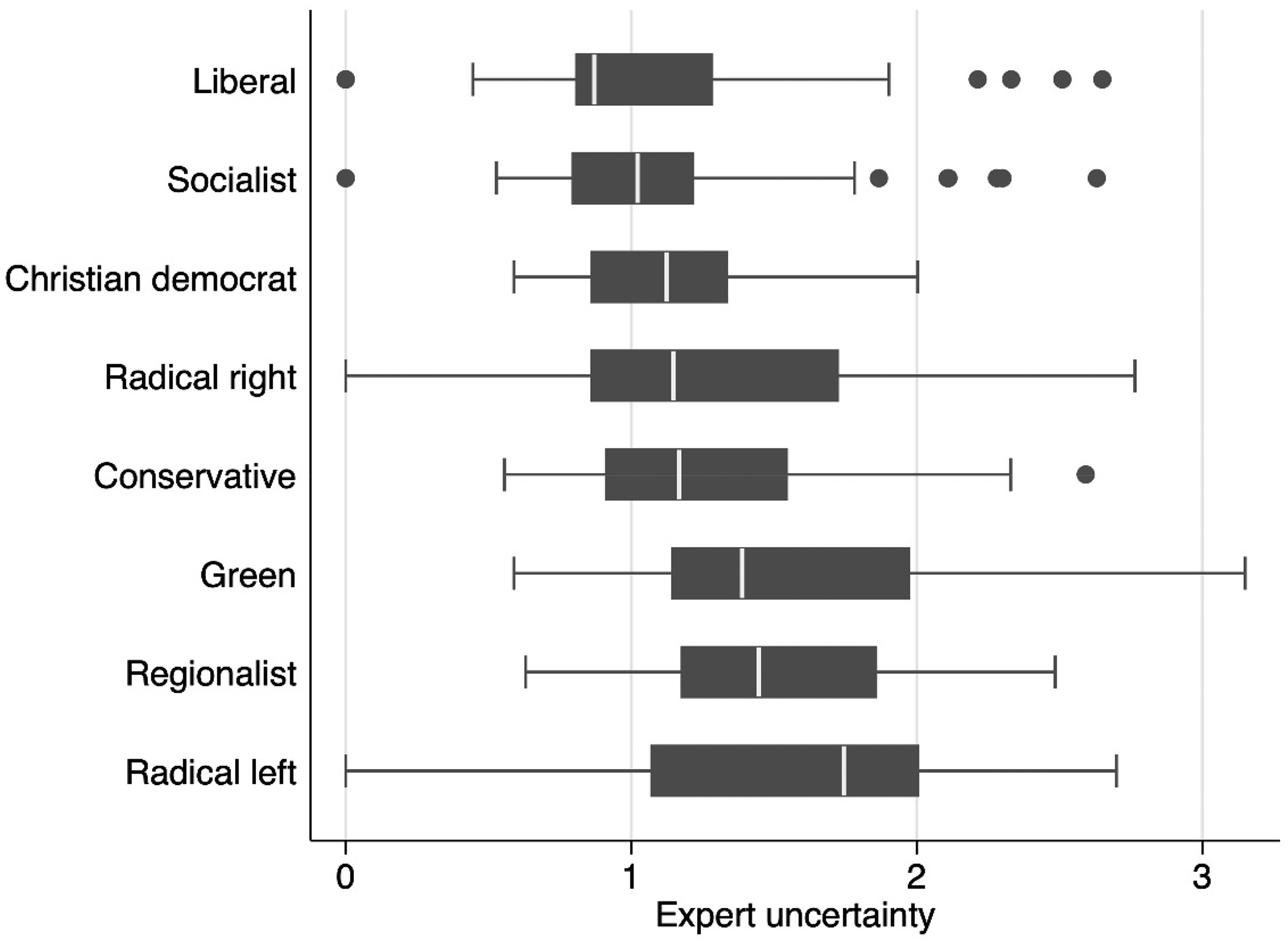
Expert uncertainty on European integration by party family.
How do parties blur?
The above discussion makes clear why party leaders may have compelling incentives to obfuscate some of their policy stances in an increasingly unpredictable and multidimensional political environment. But how is such positional uncertainty achieved? The existing literature has largely overlooked this question, and at times conflates the strategic actions of parties with their intended outcome. 1 This section develops a theoretical framework to explore systematically the different strategies that parties employ to produce uncertainty and their predicted effectiveness.
We can distinguish between three main strategies: avoidance, ambiguity, and alternation. 2 This classification resonates with Rovny’s work, who states that “position blurring can […] appear as either a lack of a position, as concurrent multiplicity of positions, or as positional instability over time” (2013: 6). Each is discussed in more detail below.
Avoidance. First, a party can simply try to evade an issue that it considers too contentious or risky. This is arguably the most dramatic course of action and reflects how observers commonly approach position blurring. A party might be concerned about an issue's polarizing potential, as it could internally divide the party and its supporters. The example of the British Conservative Party in 1997, introduced earlier, certainly fits the bill here. The leadership was concerned about infuriating the party's Europhiles and therefore adopted a “best not mentioned” strategy (Bale, 2006). Similarly, during the first few decades of its existence, the Scottish National Party shunned economic issues, worried that a more outspoken agenda could alienate voters and thus endanger its push for independence (Newell, 1998). Indeed, the party was sidelined in the late 1970s, following ideological factionalism over its center-left identity (Lynch, 2002). Thus, avoidance concerns a party's attempt to eschew an issue outside of its core agenda on which it might be vulnerable to dispute, alienation, and defection.
Ambiguity. Second, if a party does engage the issue—be it by choice or because it is forced to—it can create uncertainty about its profile by taking up ambiguous, or inconsistent, positions. By sending out mixed signals, it can attempt to placate different party and voter groups, and preserve the larger coalition's unity. In fact, an ambiguous strategy could potentially serve as a two-pronged approach, meant not only to keep existing factions on board, but also to reach out to new voters. Consider, for instance, the Dutch Christian democrats’ (CDA) 2012 proposal to implement a flat tax in the Netherlands. This reform would simplify the current tax system and promote economic growth, which was expected to resonate with more rightist voters. Yet, simultaneously, the party acknowledged that this system is often associated with increased income inequality, which would undoubtedly fuel concern among left-leaning supporters. To deflect such criticism, the party proposed a flat tax with an additional “solidarity levy” on wealthier individuals to promote burden sharing—two measures that are seemingly at odds and likely increased observers’ uncertainty about the CDA's economic position. Yet, by adopting language that could prime and galvanize opposing ideological camps, it might actually broaden the party's electoral appeal (see also Somer-Topcu, 2015).
Alternation. Third, and contrary to ambiguity's concurrent inconsistencies, a party can distort its profile over time by frequently shifting its position on an issue (Dahlberg, 2009). This strategy is reminiscent of ideological zigzagging, as identified by Budge (1994), and can be used to appease the various internal factions fighting for dominance within a party. Although “flip-flopping” is typically assumed to tarnish a party’s reputation and trustworthiness, at times it might go unpunished and actually benefit a party or candidate. President Trump, for example, reversed course in 2019 when he announced his support for a continued US military presence in Syria, continuing a pattern of oscillation on foreign policy that dates back to his presidential election campaign. 3 Rather than hurting President Trump's approval ratings, research suggests that he was shielded from this due to voters’ existing loyalties and entrenched political attitudes (McDonald et al., 2019). Temporal positional inconsistency can thus be an attractive strategy to placate different factions within a party, including European parties, but its net result should be increased confusion about its overall position.
The above strategies are distinct, but they all serve the same purpose, namely to produce positional uncertainty.
H1: Avoidance, ambiguity, and alternation increase expert uncertainty about a party's position.
However, the three strategies are not identical courses of action, nor is position blurring expected to be uniformly productive across the party system. First, avoidance is fundamentally distinct from the other two strategies, because it is based on non-engagement. Ambiguity and alternation, by contrast, do require a party to address an issue, albeit through inconsistent or wavering statements, and are dependent on observers actually perceiving a party's intended, muddled messaging. Consequently, avoidance is likely the most powerful strategy available to a party and worth unpacking in more detail.
Second, avoidance is likely not a viable strategy for all parties. As the above discussion shows, extant research has highlighted the cardinal difference between the winners and losers of the status quo, especially for understanding the conflict over the dimensionality of the policy space (Hobolt and De Vries, 2015; Rovny and Edwards, 2012). This literature would suggest that established parties have an incentive to avoid emphasizing any issue that might further fragment the party system. Yet, it is the very success of these parties that undermines the potency of this position blurring strategy, as obscuring one's issue position is complicated for those with comprehensive policy agendas and long-standing ideological reputations (Rovny, 2013). Specifically, both government participation and electoral strength—which define what it means to be a political winner for office and vote-seeking parties—increase a party's exposure and limit its ability to avoid a given issue. First, government parties need to formally propose, support, and implement an executive agenda, which compromises any attempt to retain a more confined issue platform (Greene, 2016; Green-Pedersen and Mortensen, 2010; Rovny, 2013), and second, electorally large parties tend to receive more attention from the media (Brandenburg, 2002), as well as from voters and opponents alike, and this scrutiny will hurt efforts to control their own agenda (Wagner and Meyer, 2014).
H2: Government participation and electoral strength reduce the effect of avoidance on expert uncertainty about a party's position.
Lastly, it should be acknowledged that a party does not operate in a void. Rather, in addition to the above individual-level characteristics, a party's actions are at least in part shaped by the behavior of its competitors. This is true for a party's positional shifts, but also for its issue emphases. The party system agenda strongly dictates which issues a party has to address and ignoring a salient issue, no matter how disadvantageous to a party, is inherently difficult and precarious (Green-Pedersen and Mortensen, 2010). This suggests that, even if a party tries to avoid an unfavorable issue, the party system dynamics will likely limit the extent to which it can successfully employ this strategy to obfuscate its position on that issue.
H3: System salience reduces the effect of avoidance on expert uncertainty about a party's position.
To analyze the three position blurring strategies, this study focuses on the issue of European integration. This approach has several advantages. First, the continued transfer of political authority away from national governments poses a challenge to every European Union member state and, subsequently, this issue has permeated all national party systems (Hooghe and Marks, 2009). It has become an important part of how parties campaign for votes. Second, European integration is not easily integrated into the dominant European political conflicts, especially compared to issues like redistribution or immigration. Indeed, scholars continue to debate whether questions related to the European project can be subsumed into the existing dimensions of political contestation (e.g. Bakker et al., 2012; Hooghe et al., 2002), which makes it more likely that a party perceives the issue as potentially contentious. As such, European integration presents a salient but relatively independent issue that can be analyzed in isolation, including the party strategies employed to address it. Third, exactly because of the above considerations, multiple existing studies on parties’ attempts to manipulate the dimensionality of political contestation have focused specifically on how European integration might be exploited for that cause (e.g. Hobolt and De Vries, 2015; Van de Wardt et al., 2014). Fourth, focusing on a single issue allows for a more fine-grained evaluation of positional inconsistency. It can be difficult to separate centrism from intentional blurring in certain contexts (Massetti and Schakel, 2015), but expressing both positive and negative statements in one's platform on a specific issue like European integration is seemingly contradictory and, thus, meaningful.
Data and measurement
This study combines data from expert surveys and party manifestos to examine almost 400 party-wave observations from 1999 to 2019 across 14 democracies in Western Europe. 4 The Chapel Hill Expert Survey (CHES) invites experts to position parties in their respective countries on multiple policy issues and ideological dimensions, including European integration (Bakker et al., 2015; Polk et al., 2017). The average value among the experts is subsequently used as an estimate of a party's position (from 0 to 10), which strongly correlates with voter perceptions of where a party stands (Dalton and McAllister, 2015). 5 The dependent variable, uncertainty about a party's position on European integration, is measured using the standard deviation in expert placements (see also Han, 2020; Rovny, 2012, 2013). This is a departure from some prior work, which used this indicator as a proxy for obfuscation behavior. However, given that position blurring's aim is spatial misrepresentation (Rovny and Polk, 2020), the degree of uncertainty (or disagreement) among experts about where to place a party is arguably a more appropriate measure of its intended outcome—and, assuming that experts are the most informed citizens, a relatively cautious one. By contrast, a party's strategic efforts to achieve that goal can be gauged directly. Because positional uncertainty might capture more than a party's intentional behavior alone, additional controls are included to account for situations in which experts have limited information, for example when a party is new or relatively small (Rovny, 2012).
The three position blurring strategies—the key independent variables—are measured using manifesto data collected by MARPOR (Volkens et al., 2020). 6 This data set codes quasi-sentences of a party platform using a total of 56 categories to evaluate which issues it devotes attention to. The decision to use party platforms has three main advantages. First, manifestos are strategic documents, written by party officials with the distinct purpose to outline a party's message on their own terms (Bräuninger and Giger, 2018). Party elites confirm that the manifesto plays a central role in how they campaign in the run-up to an election (Adams et al., 2011). Consequently, if a party's platform does not include a discussion of its position on a certain issue, or only in ambiguous or inconsistent terms, one can more confidently assume that conscious, strategic decisions led to such a formulation. Second, a manifesto is plausibly less dependent on external forces than, for instance, a campaign speech (which may vary by audience) or actions in parliament or government (which may depend on the balance of power). This makes it a particularly valid source for gauging party strategy, though it is unlikely to be the sole arena in which politicians implement position blurring behavior (Neundorf and Adams, 2018). Third, the combination of party information from two different sources with separate data generation processes, expert surveys, and party manifestos, makes it less likely to find strong relationships between the dependent and independent variables. Put differently, the adopted research design leverages the strength of each methodology while presenting a conservative test of this study's predictions, increasing our confidence in the validity of its findings.
The three strategies are theoretically and empirically distinct, which is reflected in their operationalization. Avoidance, the extent to which a party evades the issue of European integration, is analyzed by looking at mentions of the European Union in its manifesto. This provides an indication of whether a party covers this issue, and to what degree, as a percentage of its entire platform. 7 The scale is inverted so that a higher score indicates more avoidance (ranging from 0 to 100).
Ambiguity, which maps whether a party makes inconsistent statements about the European issue, is estimated using the same MARPOR codes. As this cluster includes both positive and negative mentions of the European Union, it can be used to evaluate how a party talks about this policy area. Specifically, a ratio of the positive and negative codes is constructed, where the greatest value of the two is used as the denominator to ensure that the indicator runs from 0 to 1. The variable is set at 0 otherwise, that is, in the case of exclusively positive or negative mentions of European integration (or no discussion of the issue at all). So, a party receives a higher score when it combines explicitly positive and negative statements about the European Union in its manifesto. The variable does not account for the overall salience of the cluster, because: (a) experts are asked to evaluate a party's position on European integration regardless of its overall importance, and (b) a manifesto-based salience measure would be perfectly collinear with the avoidance variable.
Alternation, the third strategy, requires a measure of temporal ideological flexibility. Ideally, we would have frequently updated party positional data to map short-term, intentional zigzagging. Unfortunately, such data are not available. This study therefore uses the change in a party's position on European integration between survey waves to track policy shifts. An extensive debate exists on the measurement of party positions but, for consistency, the remaining strategy is similarly based on the manifesto data set, specifically the commonly employed logit transformation (see Lowe et al., 2011). The higher a party's score, the greater its positional change on the European issue compared to the previous time point. The variable does not account for the direction of a positional move, as the magnitude of change is what contributes to expert uncertainty. It is important to note that the data do not allow us to separate a sincere policy shift from deliberate and strategic zigzagging. If sincere, a party might very well signal its changing position, thus not necessarily increasing expert uncertainty, but we cannot be certain. Given these limitations, it is important to interpret the effect of this measure with caution.
In addition, multiple variables are included that could either moderate the effect of avoidance, as discussed above, or directly affect expert uncertainty (see Rovny, 2012; Whitefield et al., 2007). A binary indicator variable records whether a party was part of a governing coalition during the previous wave. Vote share records its electoral strength in the most recent national election. Age is the number of years since a party was formally founded, at the time of the survey. A measure of the internal balance of power between party leaders and activists is included (Rohrschneider and Whitefield, 2012), whereby higher scores indicate stronger leadership dominance. Extremism reports a party's positional distance from the relative ideological center on the issue of European integration in a country at time t, which is calculated as the average position across a party system. 8 The appeal of extremist parties is their ideological distinctiveness, something they tend to emphasize (Wagner, 2012) and which might affect the clarity of their stances (Dalton, 1985; Ezrow et al., 2014). To gauge the diversity of a party's issue agenda, a measure of the effective number of manifesto issues (ENMI) is included (for a detailed description, see Greene, 2016). A CHES item controls for internal dissent on European integration (on a 0–10 scale), because intra-party disagreement could lead to uncertainty. Finally, the model accounts for the average importance of the European issue to the party system, excluding a party's own score, calculated using the same salience measure employed to gauge avoidance. The descriptive statistics and the correlation matrix for the included dependent and independent variables are presented in the Online appendix.
Analysis
To analyze the strategic position blurring behavior of parties, this study runs a cross-sectional time-series analysis. A simplified specification of the model can be formulated as follows:

The results of the analyses are presented in Table 1. Model 1 shows the main specification, which evaluates the effect of the position blurring strategies. As hypothesized, the coefficient estimates for avoidance (0.026), ambiguity (0.389), and alternation (0.024) are positive and statistically significant, indicating that all three strategies increase expert uncertainty about a party's position on the issue of European integration. These variables are measured on different scales, but it can be calculated that the effect sizes correspond to a positive change in the dependent variable of 0.08, 0.09, and 0.03 for a one standard deviation increase in each strategy, respectively. These are modest but substantively meaningful results. One must bear in mind that these are the isolated effects of the individual strategies likely amplified by a party through other outlets, after accounting for an array of covariates, and produced by a conservative test.
Analysis of expert uncertainty, 1999–2019.
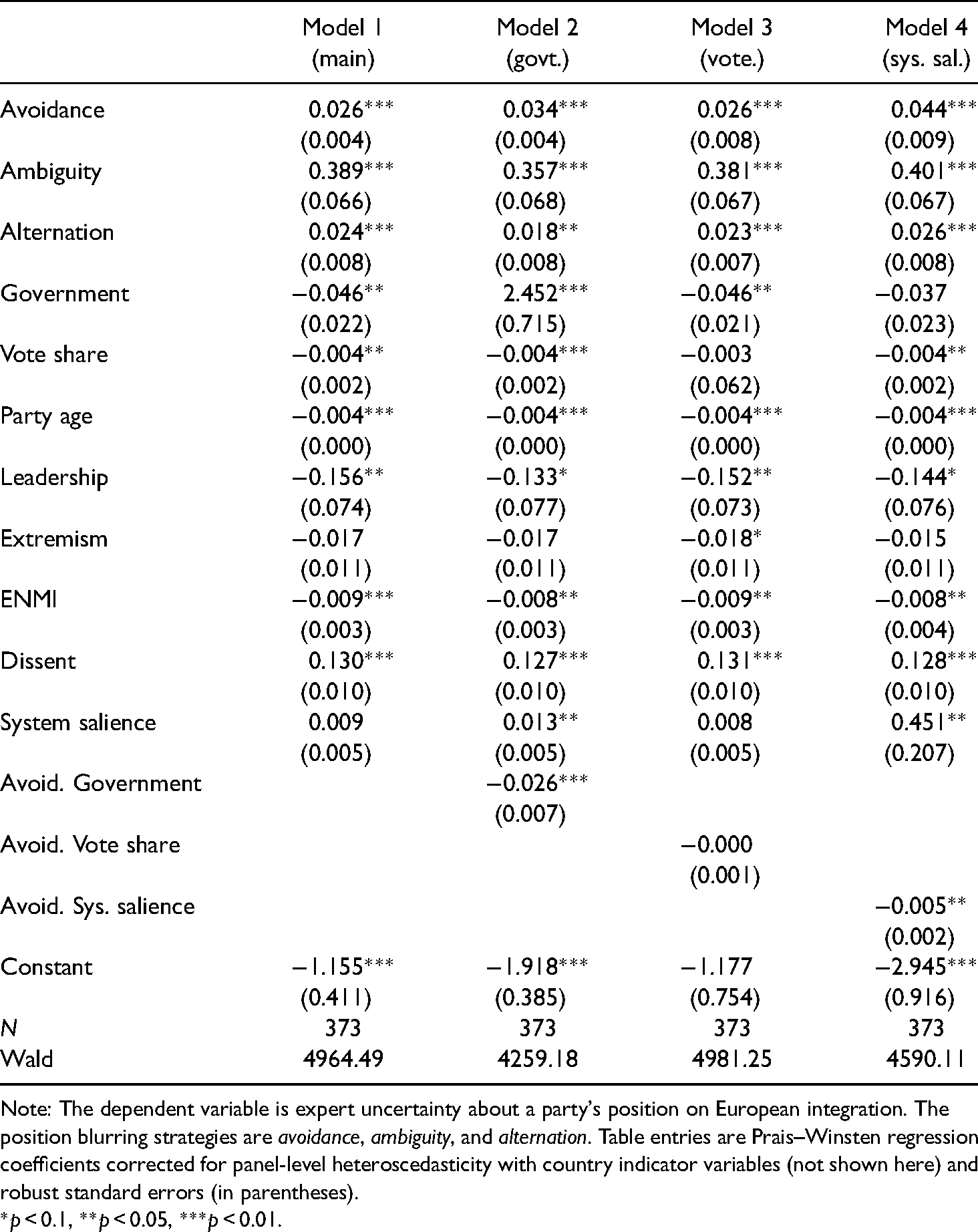
Note: The dependent variable is expert uncertainty about a party's position on European integration. The position blurring strategies are avoidance, ambiguity, and alternation. Table entries are Prais–Winsten regression coefficients corrected for panel-level heteroscedasticity with country indicator variables (not shown here) and robust standard errors (in parentheses).
*p < 0.1, **p < 0.05, ***p < 0.01.
Turning to the other independent variables, their estimates are in the expected direction and statistically significant, with the exception of extremism and system salience. Government status, vote share, party age, leadership, extremism, and ENMI have a negative coefficient, which means that experts tend to be more certain about the positions of parties that are in government, electorally strong, older, leadership dominated, extremist, and have broader issue agendas. In line with expectations, internal dissent about European integration strongly increases expert uncertainty. Crucially, the coefficient estimates for the included controls are nearly identical when excluding the three position blurring variables (see the Online appendix). This lends further credence to the notion that the strategies measure a distinct phenomenon, separate from a range of additional (non-strategic) factors that might produce doubt or disagreement among observers about a party's platform.
Multiple examples can be introduced to illustrate the above findings. For instance, the 2002 manifesto of the French green party (Les Verts) devoted just over 1% of its platform to the EU, down from almost 15% 5 years earlier. As a result of its avoidance of the European issue, expert uncertainty about the party's position more than doubled from around the median to the 98th percentile. Similarly, during the European financial crisis, the Dutch liberal conservatives (VVD) reformed its platform from unambiguously pro-European Union to one that contained an equal number of positive and negative statements about Europe (2010). This fueled disagreement among experts, exemplified by an increase in the dependent variable of 0.40 (a change of 22%). In Greece, New Democracy temporarily shifted to a relatively more critical position on the European Union around the time of the country's debt crisis, more than tripling expert uncertainty and reaching one of the highest values recorded. Finally, and by contrast, the Danish Radikale Venstre actually increased attention to the European Union in its manifesto by almost 12 percentage points from 2007 to 2011, resulting in complete agreement among the experts when asked to place the party at the time of the next survey.
But is the observed effect of avoidance on expert uncertainty conditional (H2 and H3)? The next set of analyses sheds light on this question by extending the main model with the interaction terms between avoidance and the conditioning variables. To reiterate, this strategy is expected to be less effective for government and electorally strong parties, owing to their increased scrutiny and more established reputations. Moreover, it is also predicted that the coefficient estimate for avoidance decreases when the European issue becomes more salient to the party system. The results are listed in Table 1 (Models 2 to 4). As expected, avoidance shows the largest potential magnitude across the various models, but the preferred way to interpret the findings of the interactions is by means of marginal effects plots. 9
Starting with government status, Figure 2(a) confirms that the effect of avoidance diminishes when a party joins the executive branch. In fact, compared to a party in the opposition, the coefficient estimate loses three-fourths of its magnitude and is no longer statistically significant. This means that taking on cabinet responsibilities greatly limits the extent to which a party can obfuscate its position on European integration through avoidance, which is in line with extant research on the importance of governing experience for understanding party behavior (e.g. Hobolt and De Vries, 2015). It should be noted that the results reflect that an avoidance strategy is a less powerful tool to governing parties, not that they are less likely to employ it. The correlation between avoidance and government status is low and the strategy's descriptive statistics are highly similar when compared to opposition parties (see the Online appendix).

Marginal effect of avoidance on expert uncertainty by government (a) and vote share (b).
Next, Figure 2(b) shows that a similar conditional relationship does not exist for vote share. The marginal effect of avoidance on expert uncertainty only decreases minimally as a party's electoral strength increases. It is no longer statistically significant at a vote share >30%, as the confidence interval encompasses zero, but this is likely due to the limited number of observations. This is a partial rejection of H2. However, it suggests that avoidance is an equally powerful position blurring strategy for all parties, regardless of their size.
Lastly, the analysis explores whether the marginal effect of avoidance is conditioned by system salience. To reiterate, the expectation is that a party's position blurring attempts will be less powerful when the issue is salient to the other parties in the system. Figure 3 convincingly shows that this is indeed the case. As European integration becomes more important to a party's competitors, avoidance ceases to be an effective strategy, especially when the issue truly comes to dominate the political debate.
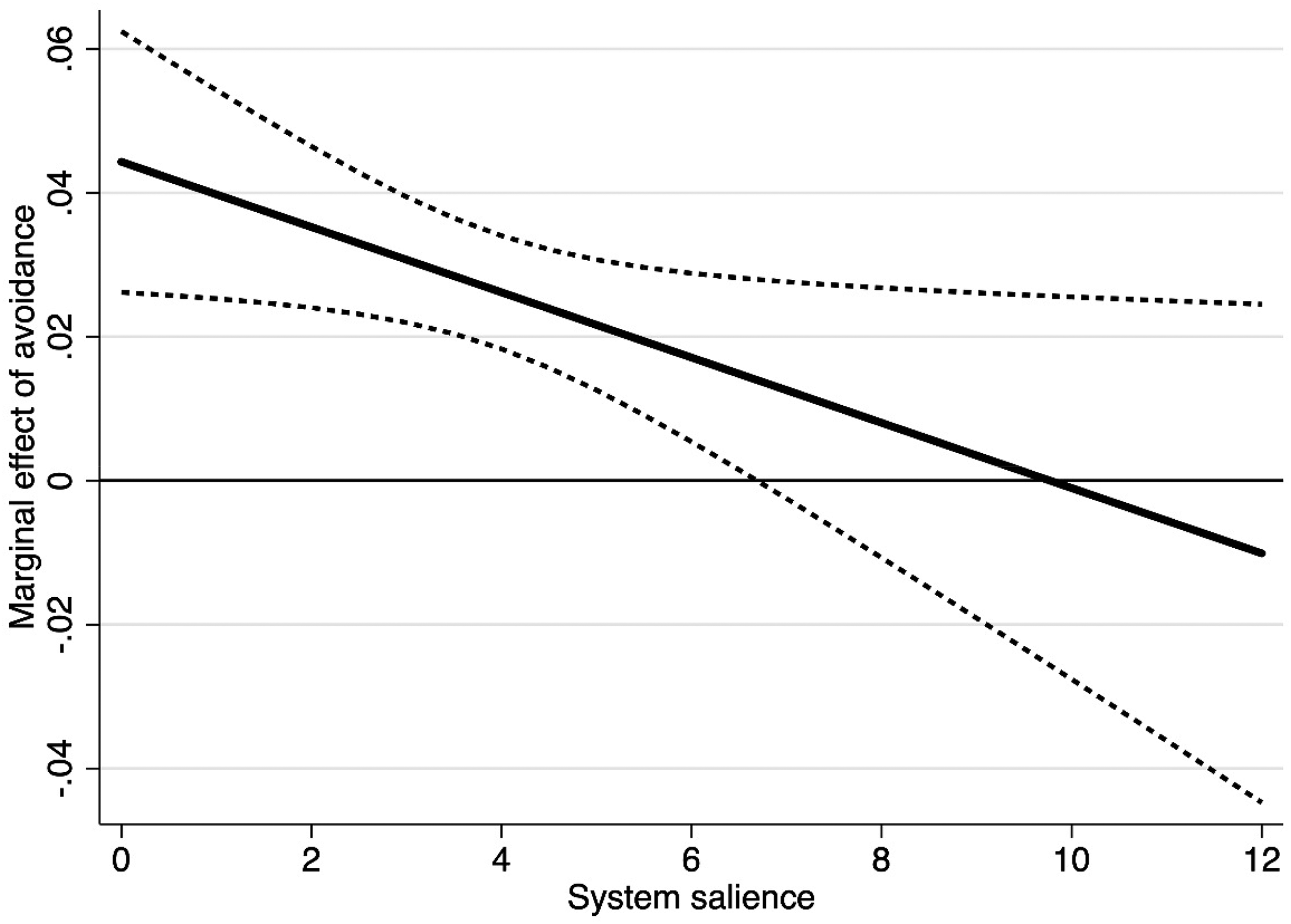
Marginal effect of avoidance on expert uncertainty by system salience.
To make the above findings more tangible, we can again introduce illustrative examples. For example, the Portuguese conservatives (CDS-PP) shifted to a more Eurosceptic position in the 1990s, seemingly confusing observers about its overall position towards the European Union. Yet, upon the party's entry into government in the early 2000s, and despite engaging with the European issue less than before in its manifesto, expert uncertainty actually went down. With regard to the importance of system salience, consider the Flemish social democrats (sp.a). Throughout the 2000s, with each election the party devoted less attention to European integration. Yet, expert uncertainty around its position also steadily declined during this period, possibly because the European issue was highly salient to the party system as whole. While anecdotal, the above examples exemplify how a party's strategic efforts to obscure its position can be undermined by individual and system-level dynamics. Under these circumstances, a party may opt to use another position blurring strategy. Alternation, for example, does not seem to be similarly affected by the two conditioning variables (see the Online appendix), and might be an appealing alternative to avoidance.
Sensitivity analyses
This study's main finding that the three position blurring strategies produce expert uncertainty is robust to a variety of alternative operationalizations and estimation techniques (see the Online appendix). These include: (a) assessing the effect of each strategy individually; (b) reversing a CHES survey item on the salience of European integration to measure avoidance; (c) analyzing alternation on the basis of a CHES estimate of party position change; (d) employing a measure of positional instability across three waves; (e) evaluating the impact of governing when separating junior coalition partners from the Prime Minister's party; and (f) including wave fixed effects. Taken together, these sensitivity analyses confirm that the effects of the position blurring strategies are not dependent on any particular measure or data set.
One additional alternative operationalization is worth discussing in more detail. So far, avoidance has been treated continuously. This is appropriate, because avoidance is neither conceptualized as an all or nothing strategy, nor is its distribution bimodal or otherwise clearly bifurcated between those who do and those who do not engage with the European issue. Nevertheless, it is worthwhile to explore the effect of a dichotomous measure of avoidance, which would emphasize its distinctiveness from ambiguity and alternation. That is, one could describe a party's choice on whether to engage with the issue of European integration as binary.
The Online appendix presents the results of an analysis that employs a dichotomous avoidance variable. Of course, relatively few party platforms do not mention Europe at all—here, that is true for 38 cases, or about 10% of the included party-wave observations. Therefore, for comparison, an additional threshold is calculated, set at the peak of its density distribution (98%). As before, avoidance has a positive effect on expert uncertainty, which is particularly strong for the parties that eschew the European issue entirely (0.103). The other coefficients are nearly identical to the main analysis, which further corroborates that the three blurring strategies are distinct and together explain a different share of the variation in the dependent variable than the control variables. Moreover, the analysis suggests that avoidance should be conceptualized as a continuous strategy, given the similarities across the different models. Indeed, avoidance is best understood as a party's ongoing effort to steer clear of a policy issue, even when it cannot evade it completely.
Finally, there is the question of generalizability. This study has built on the relevant literature to argue that the European issue offers a particularly appropriate test of its predictions, given that it is not neatly integrated into the underlying ideological dimensions of party competition. Nevertheless, can we assume that the results travel to other issues? Initial tests suggest that they do, despite important data and methodological caveats (see the Online appendix). Specifically, they show equally strong results of avoidance, ambiguity, and alternation for decentralization and religion—two issues that, given their historical roots in the urban–rural and state–church cleavages, can similarly be argued to lie outside the dominant two-dimensional political landscape. By contrast, the results are mixed for issues that do relate directly to the economic or cultural dimension, such as market deregulation or multiculturalism. This suggests that, on these issues, experts are at times able to infer a party's position on the basis of its overall dimensional agenda, regardless of any issue specific position blurring efforts.
Discussion
In a political landscape that has become increasingly volatile, unpredictable, and multidimensional, party leaders have compelling incentives to choose the issues on which they compete. By engaging with their preferred issues, and obscuring those on which they are vulnerable, parties can appease different internal factions, reach out to new voters, and prevent alienating current supporters. As a result, policy positions are no longer necessarily clearly delineated, as typically assumed in the party competition literature (see Adams, 2012).
This study makes an important contribution to ongoing party competition research, particularly with regard to position blurring. It sheds light on the behavior that parties adopt to retain control over the way in which they present themselves to the public. A close examination of three distinct strategies confirms that avoidance, ambiguity, and alternation are all effective in increasing expert uncertainty about a party's position on European integration. Avoidance is less powerful, however, as an obfuscation tool for government parties and when the issue is salient to the party system agenda. This study's focus has been on European integration, which is particularly suited to test the effect of position blurring strategies, but its findings may help to explain party behavior on other salient issues as well. Future research will need to test this directly.
The result that a party can produce disagreement about its policy preferences through its election platform has several important implications. First, it suggests that party manifestos do matter, which is surprising, as previous research found little evidence that voters pick up on changes in parties’ strategic messaging (Adams et al., 2011; Bernardi and Adams, 2019). The presented results are likely even stronger and more widespread among the general public, as experts are presumably less susceptible to blurring strategies. Second, and relatedly, the party platform will not be the sole outlet through which party leaders implement their strategic decisions (Neundorf and Adams, 2018), so the observed effects are likely amplified by means of, for example, campaign speeches and media appearances. Third, this study highlights the significance of a party's message beyond its position alone, as the degree of lucidity around it is equally valuable—both to the party and to the electorate (Dahlberg, 2009). Future spatial models of elections should strive to account for this positional uncertainty. Fourth, this study has important normative ramifications for our understanding of democratic representation by elucidating how a party might use position blurring to bypass political accountability and electoral punishment.
Nevertheless, the observed patterns in party behavior do not necessarily mean that position blurring is an effective tool to alleviate discord among party members or supporters. Future research needs to investigate whether position blurring can truly assuage, if not prevent, internal disagreement or party switching by disgruntled voters. Initial evidence suggests that it might (Rovny, 2012; Somer-Topcu, 2015; but see Ezrow et al., 2014). In addition, a more fine-grained measure of party policy shifts would allow us to better evaluate alternation as a strategy to obscure one's position. Finally, while manifestos provide a valid insight into how parties attempt to frame their electoral message, in-depth interviews with party leaders could provide us with a better understanding of the strategic incentives behind their actions. Case studies could help unpack party leaders’ motivations and the intra-party decision-making processes that lead to position blurring behavior.
This study has focused on the advanced industrial democracies of Western Europe, but the phenomenon of position blurring is not exclusive to countries with a history of programmatic politics. Parallels can be drawn, for instance, to the political platforms of the authoritarian leaders that are driving the illiberal turn in Central and Eastern Europe, for example, Fidesz in Hungary and the Law and Justice Party (PiS) in Poland. Their fixation on issues like nationalism, xenophobia, and a fierce opposition to the European Union means that they can purposively mute and avoid concrete policy proposals that could sway or alienate supporters, echoing the strategic rationale behind obfuscation efforts. Position blurring is best conceptualized as a continuum, and future research will have to unpack its implications for the study of regime types.
Supplemental Material
sj-docx-1-eup-10.1177_14651165211027472 - Supplemental material for Avoidance, ambiguity, alternation: Position blurring strategies in multidimensional party competition
Supplemental material, sj-docx-1-eup-10.1177_14651165211027472 for Avoidance, ambiguity, alternation: Position blurring strategies in multidimensional party competition by Jelle Koedam in European Union Politics
Supplemental Material
sj-zip-2-eup-10.1177_14651165211027472 - Supplemental material for Avoidance, ambiguity, alternation: Position blurring strategies in multidimensional party competition
Supplemental material, sj-zip-2-eup-10.1177_14651165211027472 for Avoidance, ambiguity, alternation: Position blurring strategies in multidimensional party competition by Jelle Koedam in European Union Politics
Supplemental Material
sj-zip-3-eup-10.1177_14651165211027472 - Supplemental material for Avoidance, ambiguity, alternation: Position blurring strategies in multidimensional party competition
Supplemental material, sj-zip-3-eup-10.1177_14651165211027472 for Avoidance, ambiguity, alternation: Position blurring strategies in multidimensional party competition by Jelle Koedam in European Union Politics
Footnotes
Acknowledgements
Earlier versions of this paper were presented at the 2017 EPOP annual conference in Nottingham, the 2018 APSA annual meeting in Boston, and at Duke University and the University of Amsterdam. I am particularly grateful for the valuable insights of Jim Adams, Michele Fenzl, Liesbet Hooghe, Gary Marks, Jonathan Polk, Jan Rovny, Gijs Schumacher, Jae-Jae Spoon, Milada Vachudova, Markus Wagner, and the anonymous reviewers.
Declaration of conflicting interests
The authors declared no potential conflicts of interest with respect to the research, authorship, and/or publication of this article.
Funding
The authors received no financial support for the research, authorship, and/or publication of this article.

Supplemental material
Supplemental material for this article is available online.
Notes
References
Supplementary Material
Please find the following supplemental material available below.
For Open Access articles published under a Creative Commons License, all supplemental material carries the same license as the article it is associated with.
For non-Open Access articles published, all supplemental material carries a non-exclusive license, and permission requests for re-use of supplemental material or any part of supplemental material shall be sent directly to the copyright owner as specified in the copyright notice associated with the article.
