



Abstract
Recent research argues that European integration has led to an ideological convergence of member state party systems, which is purported to have significant consequences for democratic representation. We argue that convergence of party positions is less problematic if congruence between governed and governing is maintained. We therefore turn to test whether integration has had an effect on congruence between the public and their governing elites. Using five measures of integration, two sources of public opinion data, and expert surveys on political parties, we find little evidence that integration into the European Union reduces congruence between the public and the national party system, government or legislature either ideologically or across five issue areas. These results should assuage concerns about integration’s effect on domestic political representation.
Introduction
International integration has had a profound impact on domestic mass politics. On the supply side, European and global integration have shifted political parties’ policy positions (Dorussen and Nanou, 2006; Konstantinidis et al., 2019; Nanou and Dorussen, 2013; Ward et al., 2015) and the level of welfare and social spending governments commit to (Heimberger, 2020); on the demand side, integration is linked to, among other consequences, declining turnout (Steiner, 2010) and changing demands from voters (Hellwig, 2014) (for reviews, see Gall, 2017). These accounts are particularly pessimistic about the normative consequences for democratic legitimacy, insofar as they point to the weakening of ties between the voting public on one side and the policy output and accountability of governments on the other (Mair, 2013). Public, and particularly populist, contestation over international integration precisely emphasises the relationship between national institutions and citizens that are being altered in the wake of greater integration (Halikiopoulou et al., 2012).
In this paper, we contribute to this debate by asking whether European integration is associated with the decline of ideological and issue-based congruence across the European Union (EU) since the early 1980s, the earliest point at which data is available. European integration represents a particularly intense form of international integration, in which states pool sovereignty to pursue common policy interests, and so provides an arena to understand the effects of deep and wide integration processes. Some crucial areas of policymaking, such as monetary policy in the case of the EU 19, are the sole competence of European decisionmaking, and many others are shared competencies. At the elitelevel, one important result of the European integration process is that the positions that parties adopt in the policy areas over which the EU has significant competence move closer to a ‘European’ position (Dorussen and Nanou, 2006; Hix, 2003; Nanou, 2013; Ward et al., 2015). In other words, parties converge on the policy position decided at the EU level, which we refer to as party convergence.
Has this convergence occurred alongside a concomitant decline in public–elite congruence? A loss of public–elite congruence is frequently cited as a particularly nefarious effect of European governance on domestic democracy. For instance, Follesdal and Hix (2006) highlight that integration leads to ‘policy drift’, where policies are adopted away from (most) voters’ ideal position. More recently, Nanou and Dorussen (2013, 90) go further, arguing that party convergence means that ‘as EU authority increases, parties become less responsive to their electorate’. However, the evidence brought to bear on this question has missed a fundamental element of this link: the public. Party convergence, we argue, is less problematic if there is still congruence between the public and its representatives.
We provide the first study on the effects of integration on congruence by examining both ideological congruence on the left–right scale (the distance between the ideological preferences of the electorate and its representatives) and policy-based congruence (the distance between the policy preferences of the electorate and its representatives). The latter type of congruence is examined across five issue areas (redistribution, social lifestyle, European integration, environment and immigration). Our substantive focus is on the breadth (Börzel, 2005) of integration, or the extent of EU involvement in policy making. We study congruence between the public and three representative bodies at the centre of representation and preference aggregation: the party system, government and legislature. Building on the relevant literature, we develop a nuanced theoretical argument that accounts for varying effects of European integration across policy areas and types of congruence.
Contrary to our theoretical expectations, our results provide no clear evidence that European integration – measured by six different indicators – increases or decreases ideological and issue-based congruence. These results assuage concerns about integration’s effect on domestic political representation. We speculate in the concluding section on the potential explanations for our findings.
Our contribution is, first, to provide a theoretical argument about how European integration changes how citizens and elites relate to each other at the national level, which has so far been neglected in the current literature. Our second contribution is empirical, in which we provide a robust and rigorous empirical test of this argument, extending the existing literature theoretically and empirically. As such, we advance the literature on the consequences of European integration, specifically on the effect on party systems (Dorussen and Nanou, 2006; Hix, 2003; Konstantinidis et al., 2019; Mair, 2000; Nanou and Dorussen, 2013), by turning from convergence to congruence. Our results provide important and relevant insights for other integration projects, including globalisation, indicating that such processes do not inevitably lead to a loss of either ideological or issue-based public–elite congruence, even in the most intense of circumstances.
Integration, convergence and congruence
The importance and types of congruence
Understanding the congruence between the governors and the governed is of fundamental importance. First, congruence is normatively important for adequate public representation (Harding, 2011; Rosset and Stecker, 2019). In terms of how elites represent public opinion, ‘congruence is the ultimate goal’ (Golder and Ferland, 2018, 215). Second, voters also seem to care about ideological and policy congruence. For instance, there is evidence that congruence increases democratic satisfaction – a useful indicator for how citizens view the functioning of the democratic system (Bakker et al., 2020; Harding, 2011; Hobolt and Hoerner, 2019; Mayne and Hakhverdian, 2017).
While congruence is necessary, it is an element of wider representation; elites must also be responsive to the electorate (though see Mansbridge, 2003). Golder and Ferland (2018) argue that congruence is a static component of representation. Responsiveness is the dynamic component, needed when the interests of the elite and public are not congruent, thus requiring the elites to ‘bridge the gap’. In this paper, while recognising the importance of responsiveness, we focus on congruence.
We follow Mayne and Hakhverdian (2017) in studying the congruence between the median voter and the position of the legislature (defined as the position of the party holding the median legislator (legislative congruence)), the congruence between the median voter and the position of the government (government congruence) and the congruence between the distributions of citizens and representatives (party–system congruence). Legislative and government congruence are variants of ‘many-to-one’ congruence (Golder and Stramski, 2010). Congruence between the median citizen and government positions is important because it indicates whether the key actors setting public policy in democracies (governments) are aligned with the median voter position that in the uni-dimensional setting minimises the sum of absolute distances between all citizens (Golder and Stramski, 2010, 92). Legislative congruence is an important step in achieving government congruence (Powell, 2019) and has also been intensely studied by the scholars of representation. Finally, party–system congruence is equivalent to ‘many-to-many’ types of congruence (Golder and Stramski, 2010) and complements the study of legislative and government congruence by taking into consideration the distributions of citizens’ and representatives’ preferences.
Integration and convergence
Existing work on the effects of integration on party competition does not focus on congruence, but rather a convergence – whether integration reduces the range of options that parties can, or will, offer to citizens. An important line of research (Nanou and Dorussen, 2013; Ward et al., 2015) suggests a simple logic of this hypothesised relationship. As integration increases, domestic political parties, as well as governments and legislatures, are increasingly constrained by the policies set at the EU level. While a certain degree of variation in national policies is possible, to be credible national parties must adopt relatively similar policy positions. 1
This stylised view of convergence can be nuanced in several ways. First, globalisation and European integration have led to the rise of challenger parties, particularly populist radical right parties with extreme positions on the socio-cultural dimension (Kriesi and Hutter, 2019). The impact of challenger parties on the convergence/polarisation of party systems and government composition should, however, not be overestimated. Electorally they remain weaker than the mainstream centre–left (CL) and centre–right (CR) blocs, and their role in government formation remains limited in most countries (Rooduijn et al., 2019).
Second, the patterns of convergence also vary across policy dimensions and areas. According to Hix and Høyland (2013, 181), ‘the EU produces a particular set of policy outcomes [
Integration and congruence
How does the increased party convergence resulting from European integration affect party–voter congruence? We use Figure 1 to summarise our assumptions (as outlined in the previous subsection) about parties’ positions and derive our expectations. In the figure, we compare the scenario of low integration with two scenarios of high integration.
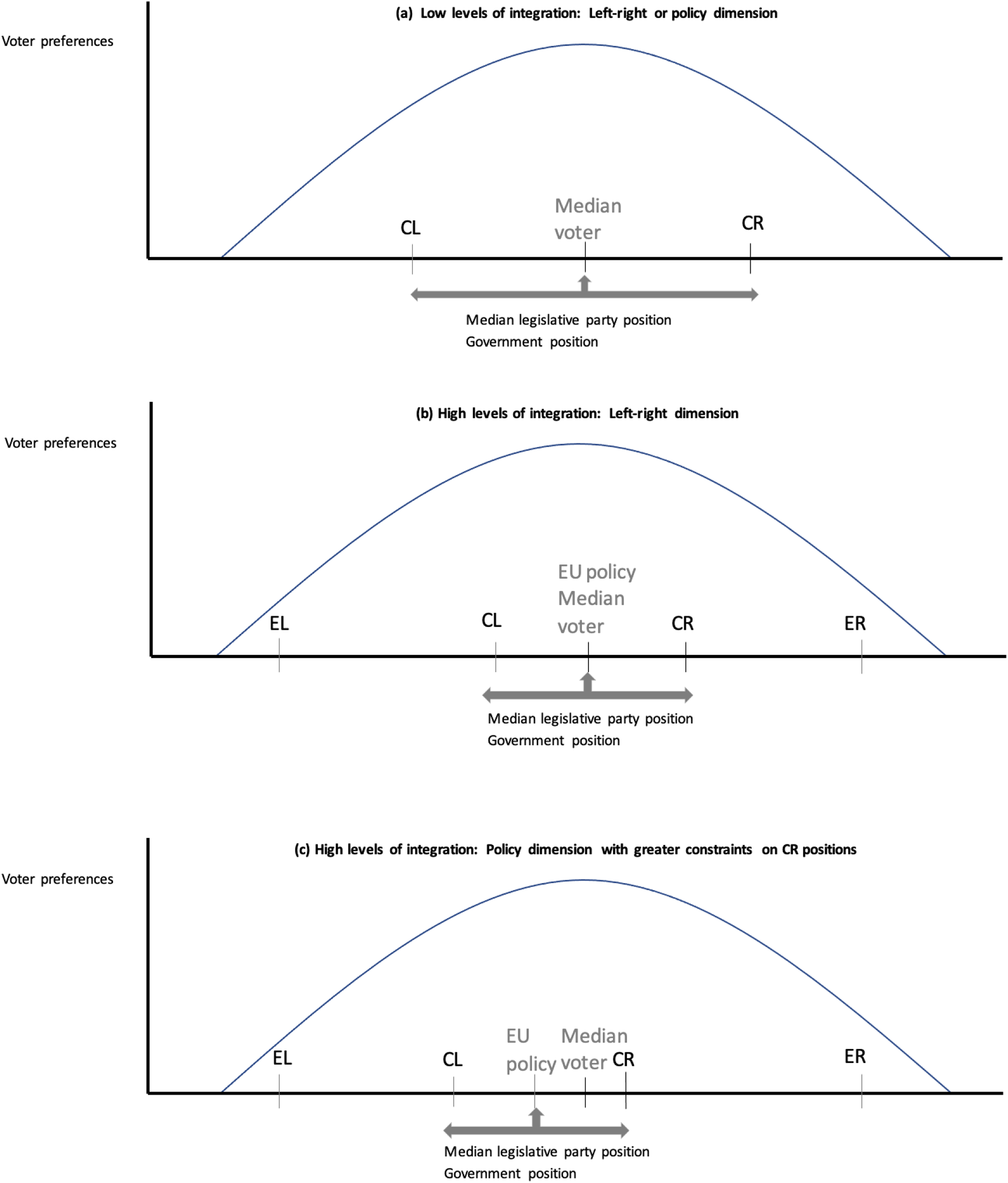
European integration and parties’ and voters’ positions.
In the baseline, low integration scenario, the CL and CR (blocs of) parties are characterised by a similar and relatively high distance from the median voter on a given policy or ideological dimension. 3 We also show the scenario of high integration (most applicable to the general left–right scale) with similarly sized constraints of European integration on the positions of the CL and CR parties. Compared with the low integration scenario, both sets of mainstream parties move closer to the centre of the ideological spectrum. Challenger parties on the left and right emerge, but, being more ideologically motivated and therefore less responsive to and congruent with public opinion (Adams et al., 2006; Dalton, 2017), they adopt extreme positions that are distant from those of the large majority of the electorate.
In the second scenario of high integration in Figure 1(c), we assume greater constraints on the positions of the CR parties. This corresponds to our assumptions about the effects of European integration on party convergence on social issues. 4 Compared with the low integration scenario, particularly CR parties move closer to the central point in voter distribution.
We assume that the distribution of voter preferences remains stable regardless of the level of European integration. We recognise that the public follows elite cues, whether directly or through filters such as partisanship or media consumption (Druckman et al., 2013; Murphy and Devine, 2020). However, the convergence of mainstream parties may not necessarily result in a similar convergence of the policy preferences of the electorate. 5 Voters may be pulled away from the centre by the cues from the challenger parties, and voters also respond to, for example, external events and public policies (Soroka and Wlezien, 2010).
From this, we can derive our expectations for the effect of integration on congruence. We start with party–system congruence. When integration is limited, party–system congruence is relatively high as the moderately polarised party system represents fairly well the similar levels of polarisation in citizen preferences. However, when levels of integration are high, the consequent shift of the mainstream parties towards the centre leaves many non-centrist voters without a proximate party. The emergence of fringe parties on the left and/or the right does not attenuate this representational gap: the positions of these parties are too extreme and distant from the large majority of the electorate. Overall, we expect integration to decrease party–system congruence.
The specific patterns of party–system incongruence differ depending on the ideological or policy dimension. On the general left–right dimension, the convergence of both mainstream left and mainstream right parties to the centre reduces the representation of both CL and CR voters. On the issue dimensions, the under-representation is more prominent on one side of the policy spectrum. Thus, when CR parties are more constrained by the EU, a pattern characteristic to many socio-cultural issues, CR voters representation is particularly diminished. When CL parties are more constrained by the EU (e.g. on economic issues), the representation of the CL voters suffers.
Moving to parliamentary congruence, we expect that, while the position of the median legislator at a given point in time depends on the outcomes of individual elections, it is generally located at or between the positions of the CL and CR parties or blocs (this interval is shown by the arrows in Figure 1). When integration is low, and mainstream parties are quite polarised, the median legislator can be quite distant from the central point in voter distribution. When mainstream CL and/or CR parties converge towards the centre under high integration, the range in the values of the median legislator position decreases. Thus, on average, the median legislator position is expected to be closer to the median voter distribution, meaning that parliamentary congruence increases.
The logic applies to both ideological and policy dimensions, although with some differences. On the general left–right scale, the position of the median legislator, as averaged across multiple elections, is less likely to diverge from the median voter to either direction. On the specific policy dimensions, the median legislator position may diverge from the median voter position significantly more in one direction than in the other.
In relation to government congruence, we assume that governments are formed by mainly mainstream CL and CR parties under both low and high integration scenarios. Similarly to the position of the legislature, the government position (equal to the average position of parties in government weighted by their legislative size) will be located at or between the positions of the CL and CR parties or blocs.
6
Due to the mainstream party convergence resulting from integration, the range in the potential values of government positions decreases. On average, the government position is closer to the median voter position, which means that government congruence increases. As in the case of parliamentary congruence, the logic applies regardless of whether EU constraints on parties’ positions are symmetric (the general left–right scale) or not (more specific policy dimensions).
7
The theoretical argument can be extended by taking into consideration the strength of EU constraints. If the mechanism at play is that a higher degree of policy constraint by the EU leads to greater external pressure on domestic politics to conform to the European policy position, we would also expect that there is variation between policy areas. Namely, those areas which are highly integrated, such as on immigration policy, should be more likely to be affected than those which are not, such as policy on social welfare. Nanou (2013) finds this with respect to the convergence of party programmes.
Data and methods
To study these hypotheses, we conduct two analyses. Our first analysis focuses on ideological congruence on the left–right scale while our second analysis includes issue-specific policy areas.
Dependent variable
As discussed above, we examine three variants of congruence. To measure legislative congruence, we use the absolute distance between the median voter position and the position of the party holding the median legislator (median legislative party). The government congruence measure captures the absolute distance between the median voter position and the government position. The government position is estimated as the mean position of government parties on a given ideological or policy dimension weighted by the parliamentary size of the parties. For the distributional measure of the congruence between citizens and the party system (party–system congruence), we use the Earth Mover’s Distance (Lupu et al., 2017). The intuition behind this is that the measure minimises the ‘cost’ of transforming one statistical distribution into another (Lupu et al., 2017, 102). This relatively new measure makes three improvements over more traditional measures: it does not lose information as in the point-estimate variety of measures; it does not assume any form of ‘overlapping’ or distribution as in alternative distributional measures; it is available beyond the commonly used left–right dimension (Lupu et al., 2017, 96). For all measures, higher values mean greater incongruence or, conversely, lower levels of congruence.
The data we use to construct these measures differs between the two analyses. The first (referred to below as the ‘Eurobarometer (EB) dataset’) draws the measures of public opinion from EB data, a cross-national survey with one of the longest time series. This uses the traditional left–right self-placement of political ideology on a 1 to 10 scale following the question ‘In political matters, people talk of ‘the left’ and ‘the right’. How would you place your views on this scale?’. We combine this with several expert surveys: six waves of the Chapel Hill Expert Survey (CHES) conducted between 1999 and 2017 (Bakker et al., 2014; Polk et al., 2017) complemented with two surveys from the early and late 1980s (Castles and Mair, 1984; Laver and Hunt, 1992) and another from the early 1990s (Huber and Inglehart, 1995). All but one of these surveys asked country experts to place main parties in individual countries on the general left–right scale. To assure comparability across expert surveys and EB data, we recode, wherever necessary, original scales to the 0 to 10 scale. We use the EB surveys conducted in the same years as the expert surveys. While the left–right measure is understandably criticised (e.g. Caughey et al., 2019), it is also useful at capturing the main cleavage structure in European politics, an issue dimension on which most people and parties are placed along, and is one of the few constants in survey and political research.
The second dataset (referred to below as ‘European Social Survey (ESS) dataset’) uses the ESS, which contains the required variables to construct the issue-specific congruence measures. 8 Parties’ positions almost exclusively come from the CHES waves conducted between 2006 and 2017. Our approach in selecting survey questions from ESS and CHES follows Stecker and Tausendpfund (2016), thus allowing us to match the two datasets at multiple points in time to construct incongruence measures on five issue dimensions and the general left–right ideological scale. Since the 2002 CHES survey did not include questions on these issue dimensions, for three issue dimensions (social lifestyle, environment, and immigration), where the wording of the questions in the CHES survey is almost identical to the expert survey conducted in 2003–2004 by Benoit and Laver (2006), we use the data from the latter survey. Further extensions back in time are however not possible because the first wave of ESS was conducted in 2002. Full question wordings for the ESS and CHES are in the Online appendix. Briefly, however, redistribution refers to efforts to reduce income differences between rich and poor; social lifestyle policies tap party positions on policies regarding lesbian, gay, bisexual and transgender (LGBT) rights and gender equality; integration refers to preferences on further integration; environment refers to how important environment is to the respondent or party; and immigration is an index of three items addressing preferences on immigration from the same ethnic group as the host country; a different ethnic group; and from poorer countries outside Europe. While the inclusion of countries and issue dimension questions varies across ESS waves, we are able to match expert surveys and ESS waves in such a way that the timing of the two does not differ by more than 2 years.
Five issue areas differ in relation to the level of European integration. EU institutions have important authority on environment and immigration (particularly within-EU migration). While member states play a key role in amending EU treaties, EU institutions can also deepen EU integration through the procedures for adopting secondary legislation. However, the authority of EU institutions remains more limited in relation to taxation and welfare state (i.e. redistribution) and social preferences including LGBTQ rights and gender equality. This variation allows us to test our fourth hypothesis.
The use of expert surveys for measuring parties’ positions has several advantages in the context of this analysis compared with alternative sources. The widely used manifesto project data provides left–right (and other) scales that are however hard to compare with the scale used in the voter survey data (Klingemann et al., 2006). Parties’ positions derived from voter surveys do not have these problems, but are not available for many countries and time periods due to the existence of long time-series election survey data in only a few countries. Further, with a partial exception of the European integration issue dimension, voter surveys permit the measurement of only the ideological left–right positions of parties. The elite survey data (e.g. election candidate surveys conducted in combination with some European Election Studies) is also available only for a small number of elections. Expert surveys on the other hand have been used to measure party–voter congruence on both ideological and more specific issue dimensions in combination with several voter surveys (Rosset and Stecker, 2019; Stecker and Tausendpfund, 2016). When using several surveys in the same dataset, we build on studies that show high levels of comparability between different expert surveys (Whitefield et al., 2007).
Explanatory variable
In both analyses, we use five measures of European integration aimed at capturing the economic, political, and legal aspects of integration. We use an expert survey that measures the level of integration over time, as described in Nanou et al. (2017). This is calculated at five-yearly intervals and also aims to address the gaps in previous research, which instead relies on treaty readings which vary little over time (e.g. Börzel, 2002). Second, we use an indicator aimed at capturing the level of economic integration. The ‘EU index’ (König and Ohr, 2013) consists of numerous sub-indicators relating to trade, labour migration, the importance of the EU to the national economy, how homogeneous the EU is, and how closely related the country is to European trends. It also has political and legal indicators for Economic and Monetary Union and Schengen membership and infringement proceedings, but the bulk of the measure is economic (the political–legal aspects are weighted 22% in the measure). While this measure does vary between countries, the time period is limited to between 1999 and 2012 and only for the EU15. There are no alternative measures for economic integration. For the final three measures, we use data derived from EURLEX (Toshkov, 2013), which consists of the number of regulations, directives and decisions in any given year, with the complete dataset containing over 100,000 legal acts. In the Online appendix, we also use the enlargement database (ENLABASE) measure of integration (e.g. Schimmelfennig et al., 2015).
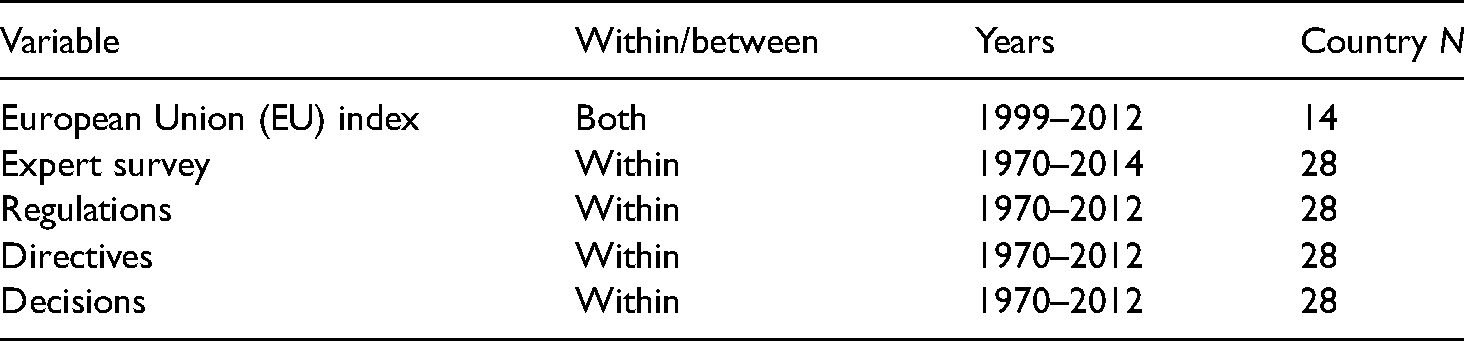
The variables, while being substantively different, also differ on how much variation they have over time and between countries. Table 1 summarises these differences. While all other measures begin from 1970, the EU index measures only between 1999 and 2012; the strength is that it has between country variation and the others do not, in effect measuring differentiated integration. The limitation of the legislative output measures is that they are not cumulative, and therefore rather capture the yearly variation in legislative output rather than ongoing integration per se. Only the EU index – as indicated in column 2 of Table 1 – measures country-level integration in each issue area rather than overall levels of EU integration. Still, we believe that using all of these ensures our analyses are not (only) driven by choice of the indicator. This also improves on previous research which has used a single measure of integration and often one that displays little variation over the time period analysed. For instance, Dorussen and Nanou (2006) and Nanou and Dorussen (2013) use a measure of integration drawn from analysis of treaties that only varies with a new treaty, while Hix (2003) uses a continuous variable starting from when the country joined the EU.
Description of integration measures.
Control variables
We control for variables that may intervene in the overtime relationship between integration and public–elite congruence. It is not possible to control for all possible variables, given a relatively small sample size, and the necessity of doing so is somewhat reduced by country fixed effects (FEs) such that we do not need to control for all institutional factors. Our selection of control variables is primarily driven by controlling for other causes of incongruence within a country over time. First, we control for a battery of economic indicators. We measure gross domestic product as the year-on-year percentage change and is drawn from the Organisation for Economic Co-operation and Development (OECD). We measure inflation as the year-on-year percentage change in the consumer price index, which we source from the International Monetary Fund and the OECD. Finally, we measure unemployment as the percentage of unemployed people as a share of the labour force, which we obtain from the European Commission. While economic conditions, in general, may affect citizen–elite congruence, we are also conscious of the evidence that the Eurozone crisis, in particular, interrupted the relationship between governed and governing, which may drive congruence, but also the relationship between integration and congruence (Hobolt and Tilley, 2016; Kriesi, 2018).
We control for three ‘political’ variables. First, we control for the effective number of electoral parties (Laakso and Taagepera, 1979), which we take from the Election Indices Dataset. This is to control for the changing institutional systems over time within a country, which may affect congruence (Matakos et al., 2016). Second, we control for corruption through Varieties of Democracy’s ‘political corruption’ index. Finally, using the KOF index of globalisation, we also control for broader international integration, considering that globalisation and integration may have the same congruence-reducing effects (Gall, 2017). Collectively, these political variables follow previous research, which examines citizen–elite congruence (e.g. Reher, 2015) and the effects of integration on party convergence (Nanou and Dorussen, 2013). We provide summary statistics and a table with links to our sources in the Online appendix.
Empirical approach
Our primary models are linear ordinary least squares regressions with two-way (country and year) FEs. We also cluster the standard errors by country. This modelling technique controls for country-specific factors, changing the interpretation of the coefficients to the effect of a one unit change within a country, rather than a pooled estimate of within and between effects. All but one of the measures of integration do not vary between countries, so this does not lose information relative to a pooled or random effects model. Since there is, across most measures, a trending increase in integration, year FEs attempt to control for this trend. This method uses a similar logic to a difference-in-difference estimation within each country unit, with the coefficient the averaged estimate.
The equation can be seen below. The first two coefficients indicate the constant and coefficient of interest, 
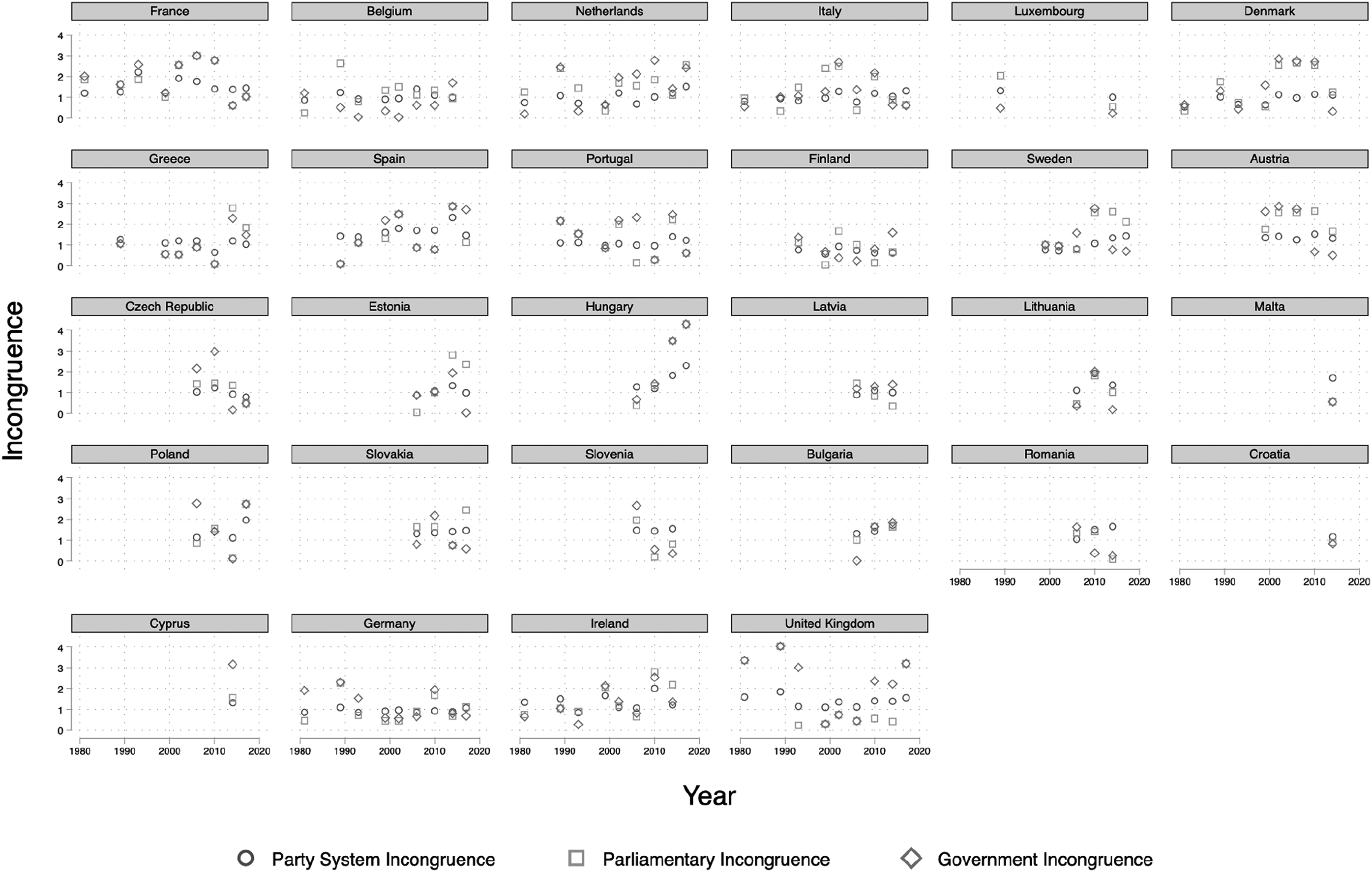
Left–right incongruence by year and country (Eurobarometer dataset).
Similar graphs for the specific issue areas in the second analysis are shown in the Online appendix.
Results
Ideological congruence
Table 2 presents results of integration on party–system congruence. Each column uses a different measure of integration as the independent variable. Full tables are available in the Online appendix.
The effect of integration on party–system (in)congruence (EB dataset).
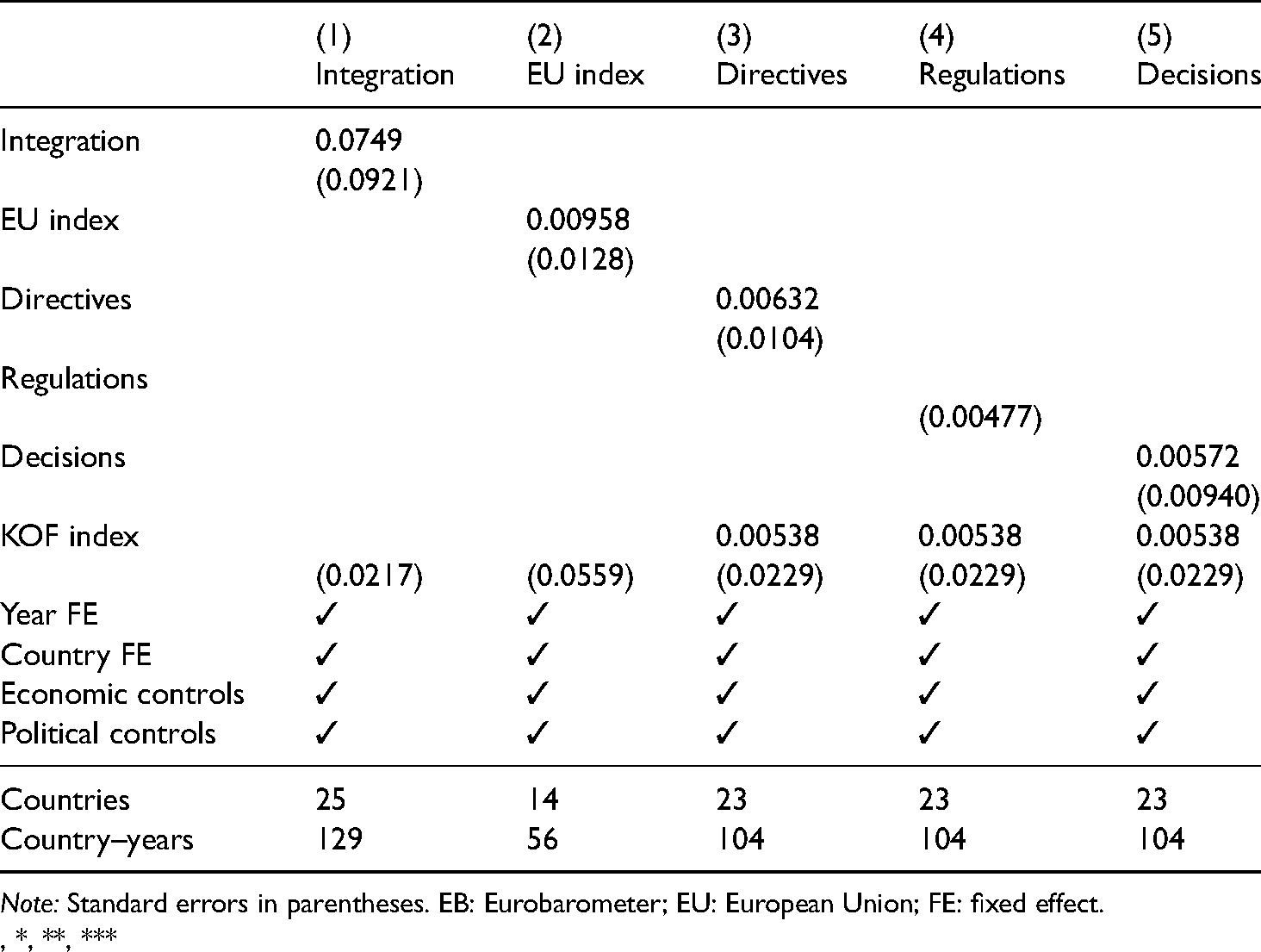
Note: Standard errors in parentheses. EB: Eurobarometer; EU: European Union; FE: fixed effect.
The results provide no evidence of the effect of European integration on (in)congruence of the party system on the left–right scale. Whether integration is measured using economic, political or legal variables, the coefficients remain far from significant at the 10% level and trivial in size, though signed positively.
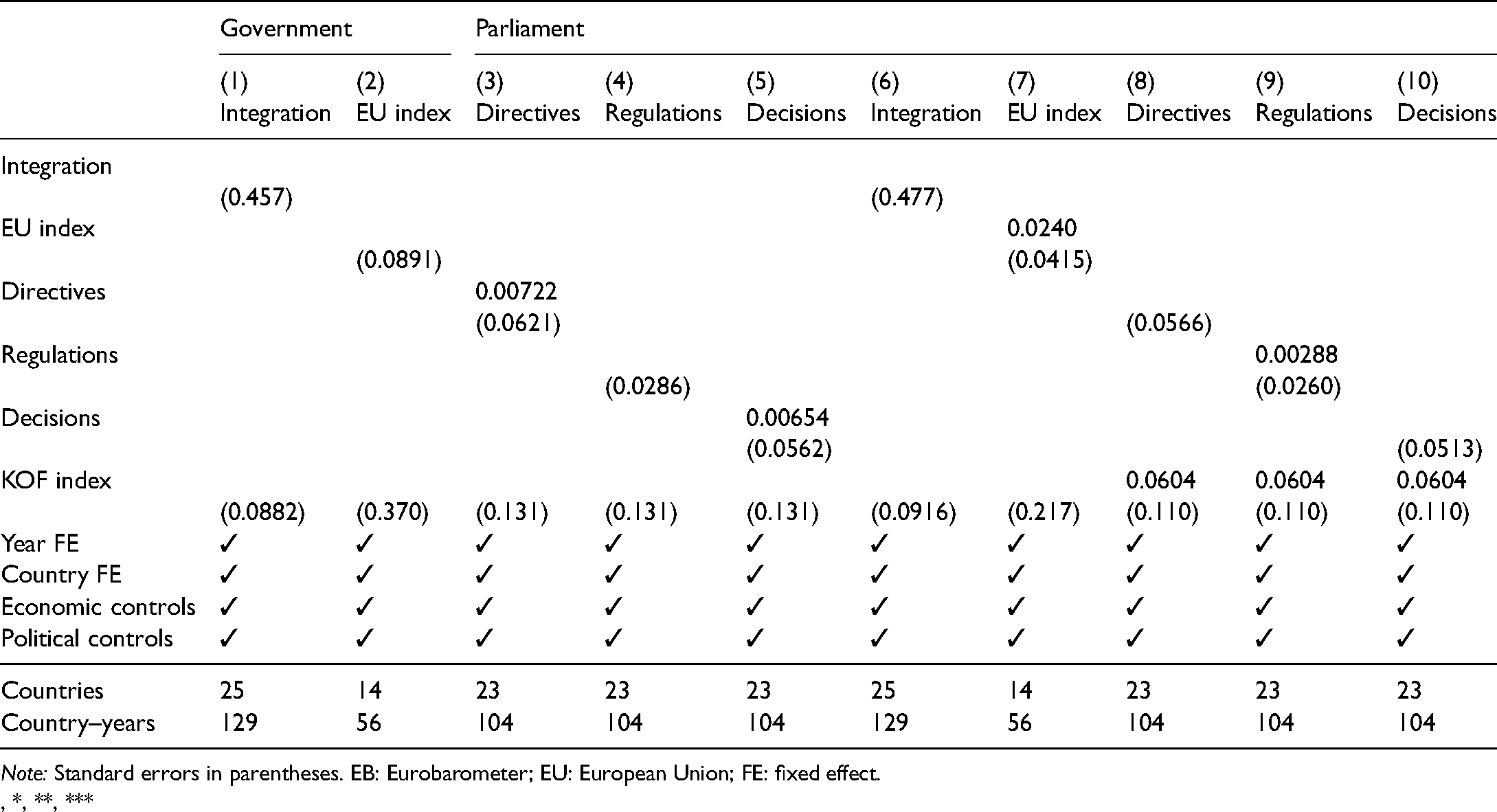
Table 3 turns from the party system to congruence between the public and parliament and government. Much like the previous analysis, there is no significant relationship between measures of European integration and public–elite congruence. Across most models, the coefficient on globalisation is negative, suggesting that it actually reduces incongruence. These effects are quite small in size: to increase party–system incongruence by one standard deviation would require an increase of 4.7 standard deviations in the EU index. In terms of the measure, this is similar to going from zero integration to approximately as integrated as Greece or Denmark were in 1999. Similarly, to increase parliamentary incongruence by its standard deviation is akin to the EU integrating as much as it did between the early 1990s and 2005. In summary, these effects are both insignificant and relatively trivial.
The effect of integration on government and parliament (in)congruence (EB dataset).
Note: Standard errors in parentheses. EB: Eurobarometer; EU: European Union; FE: fixed effect.
Overall, there is no systematic evidence that European integration leads to a lack of congruence between elite actors and their domestic public. With respect to the party system (Table 2), government (columns 1–5 of Table 3), or parliament (columns 8 and 10 of Table 3) there are no significant effects. More importantly, considering the small sample size, the coefficients vary in direction and are often trivial in size. Therefore, Hypothesis 1 to Hypothesis 3 do not receive support.
Ideological and issue-based congruence
As highlighted by Hypothesis 4, however, there may be meaningful variation across policy areas that the left–right indicator does not identify. We therefore repeat the analysis on specific issue areas using the ESS data: redistribution, social lifestyle, EU integration, environment and immigration. We also repeat the analysis on the left–right dimension using this new data. The expectation, in this case, is that policy areas more highly integrated (immigration, environment and the issue of EU integration itself) will be more affected by integration than areas that are less directly integrated (such as redistribution and social lifestyle). As before, we use multiple measures of European integration and congruence.
Because of the multiple dependent variables (party–system, government and parliament congruence in the issue areas) and independent variables (integration measures), the number of models is large (
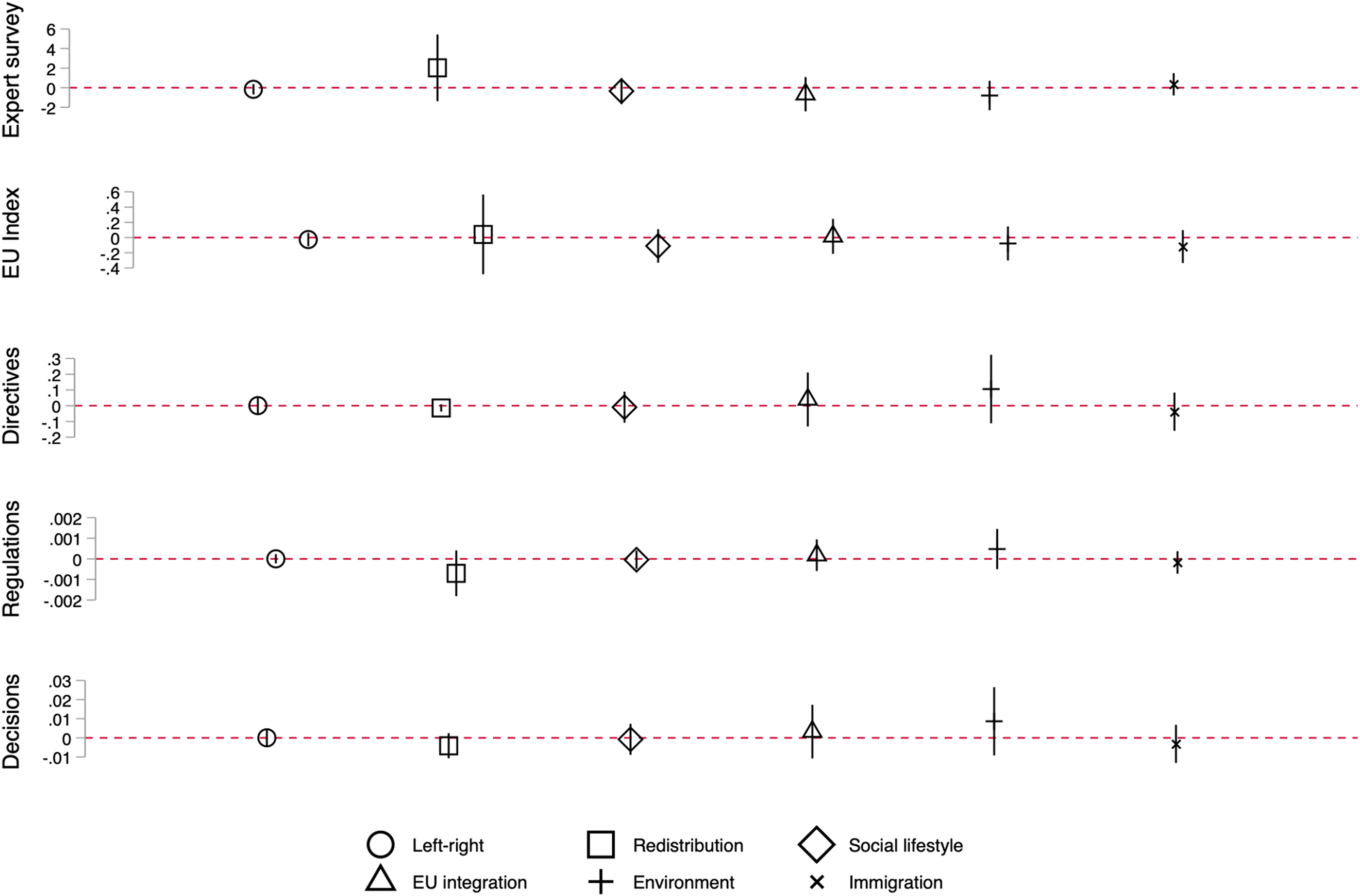
Effect of EU integration on party–system congruence (ESS dataset). Note: EU: European Union; ESS: European Social Survey.
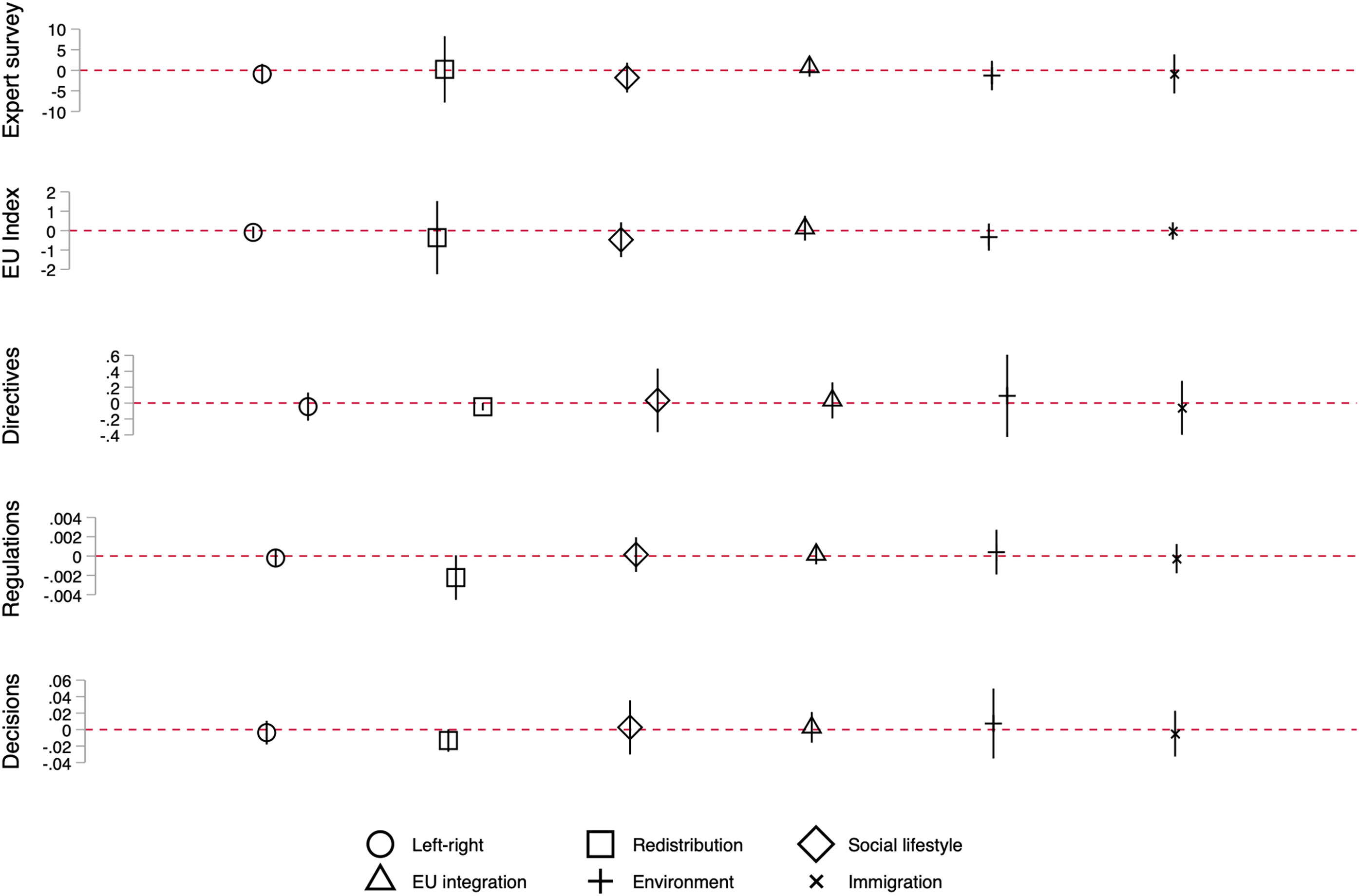
Effect of EU integration on government (in-)congruence (ESS dataset). Note: EU: European Union; ESS: European Social Survey.
Turning first to Figure 3, which plots the effect of integration on party–system congruence, the results are consistent with the previous analysis: there is no observable effect of integration across any of the issue areas on any of the measures. In addition, the coefficients are not clear in the potential direction of the effect if there were one, and are all relatively trivial in size and centred over zero.
Figures 4 and 5 show congruence between the public and parliament and government, respectively. Similar to the previous analyses, there are no significant effects.
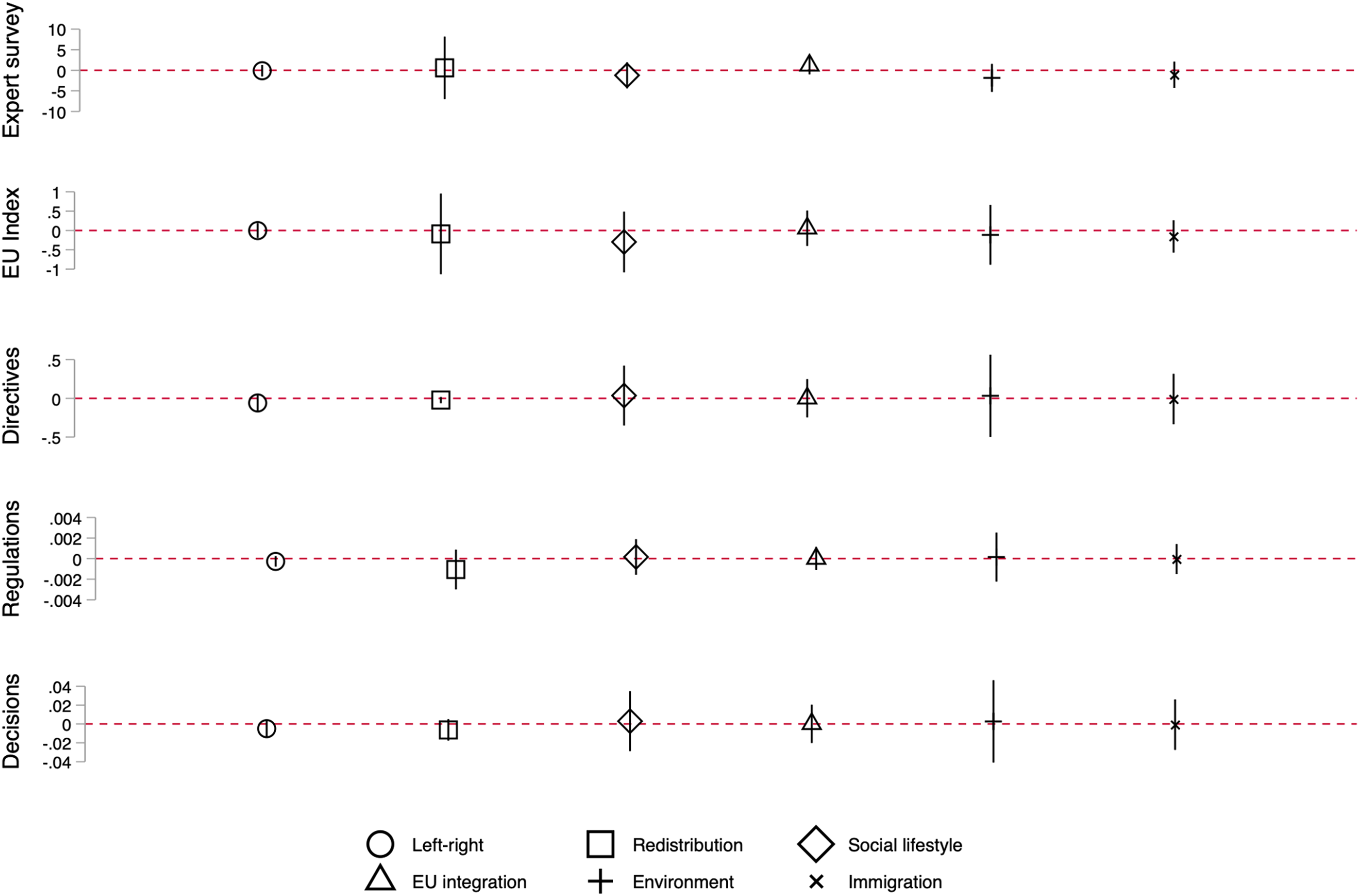
Effect of EU integration on parliament (in-)congruence (ESS dataset). Note: EU: European Union; ESS: European Social Survey.
The largest effect for the EU index (on social lifestyle with respect to parliament–public congruence) would require a two standard deviation increase in the EU index to change congruence by one standard deviation, yet the effect of ‘decisions’ on parliamentary congruence on redistribution, indicates that 402 decisions are required to decrease incongruence by its mean. Since the mean is 586 decisions per year, this is quite a large and perhaps unrealistic increase.
Collectively, however, these results reject the hypotheses posited. While it may well be true that integration has led to a convergence of party positions, it is not necessarily problematic if a key aspect of representation – congruence – remains stable. The results presented here indeed show that there is a limited effect on the congruence of parties either through the party system, government or legislature or on a unidimensional left–right scale or specific policy areas.
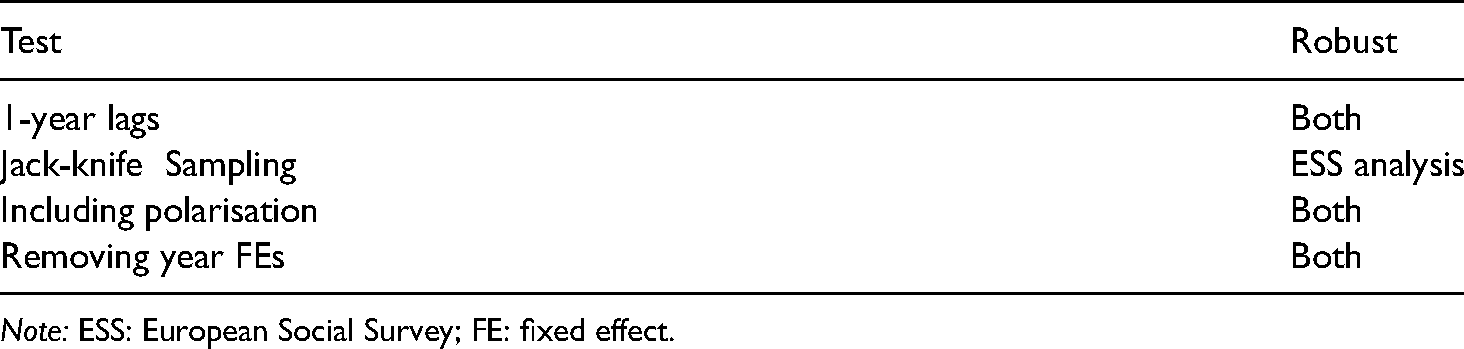
We turn to alternative modelling strategies to test the robustness of these results, results of which are available in the extensive Online appendix. Our main intention here is to see whether other, alternative specifications yield substantively different results. The tests we include, and whether they change our conclusions, are presented in Table 4.
Description of robustness tests.
Note: ESS: European Social Survey; FE: fixed effect.
The only test showing some differences from our main results is the jack-knife sampling (i.e. we omit each country from the sample in turn) for the first (EB) analysis. Excluding the United Kingdom, and less frequently, several other countries lead to a statistically significant positive coefficient for party-system and parliamentary incongruence in several models (and a statistically significant negative coefficient in one model). What remains robust, however, is the null effect of all measures of European integration on government congruence, and the null effect for all three forms of congruence when using the EU index as a measure of integration (see the Online appendix for full details). Also, our results for the second (ESS) analysis remain robust under jack-knife resampling. The exceptions mostly concern redistribution congruence (jack-knife resampling leads to different results for one or two countries in four out of 15 tests), but in all cases the effect of European integration measures on incongruence is negative. Overall, we consider deviations from the main results too infrequent and inconsistent to provide an important challenge to our main conclusion of the lack of European integration on congruence.
As indicated in Table 4, our three other robustness tests show no cause for concern. First, including lags of one year for the explanatory variables do not considerably change the results; there is some evidence of decreasing congruence with respect to the left–right dimension in parliament–public congruence. Second, we also include a measure of polarisation, which does not change our results. Finally, to make sure we are not setting too tough a test, we also remove year FEs and run all the models again: the integration variables are correlated with time, and so we remove that control, but our conclusions do not change.
Finally, worth mentioning is that we take advantage of the EU index varying between countries by removing the country FEs, which show whether the level of integration between countries has an effect. In line with Hypothesis 1, we find that more integrated countries have a greater party–system incongruence on several dimensions, which suggests that any potential effect is going to be in absolute levels of integration rather than within a country over time. More integrated countries also seem to have higher parliamentary and government incongruence, but only on the issue of redistribution, not the other five dimensions. We are cautious of reading too much into this result: the omission of country FEs means that any idiosyncratic factors related to integration or congruence are not controlled for beyond the control variables, which are unlikely to capture all potential variation.
Discussion
Previous research has established that European integration has had an influence on the domestic political competition by narrowing the range of options parties offer – a convergence of party programmes (Dorussen and Nanou, 2006; Konstantinidis et al., 2019; Nanou and Dorussen, 2013; Ward et al., 2015). We have extended this work by turning to another potential implication: that integration also has an effect on the congruence between the public and their governing elites. We hypothesised that integration reduces congruence between the distributions of citizens and parliamentary representatives due to the convergence of mainstream parties. At the same time, we also expected that party convergence resulting from integration may increase the congruence between the public and the median legislative party and government.
Using more measures of European integration and congruence than previous research, two sources of public opinion data, and a range of party-level data, we have shown that European integration seems to have very little impact on the congruence between the party system, parliament or government and the public. While it is beyond the scope of this paper to account for this result, we suggest several possible explanations. First, significant evidence suggests that (mainstream) parties and governments in the EU member states generally respond to their citizens (e.g. Hobolt and Klemmemsen, 2005; Ibenskas and Polk, 2020). The constraints of the EU on political parties’ ability to offer diverse policy positions may therefore be limited. Second, challenger parties may be more vote-seeking than our argument assumed, thus leading them to adopt less extreme positions and represent moderately non-centrist voters left behind by the convergence of mainstream parties towards the common EU policy. In other words, the effects of the convergence of mainstream parties on congruence may be attenuated by the increase in party–system polarisation due to the rise of challenger parties (Konstantinidis et al., 2019). Third, it is possible that mainstream party convergence is accompanied by similar convergence among the voters, either due to mainstream party cues or because mainstream parties respond to the converging public. Fourth, European integration may have opposite effects in different countries and also depend on the characteristics of political parties and individual voters.
Our results can assuage but not remove concerns about the effect of European integration on the democratic process. First, the previous findings that integration leads to convergence is important in its own right, given the debate that having a range of options is as good or better than having a congruent one (Harding, 2011). Second, we have of course only addressed one aspect of integration and domestic politics, of which there are many more.
Third, our results are not without nuance. There is evidence that the within-country analysis, necessitated partly by independent variables that do not vary between countries, masks the effect of different levels of integration between countries. Perhaps more substantively, robustness tests indicate that removing the United Kingdom shows evidence of integration leading to greater incongruence on the left–right scale. Likewise, while very few of the results are not significant, some are not trivial in size. We do not think it is prudent to conclude there is an effect, and many of our results are either centred over zero or inconsistently signed. Overall, we consider this lack of significance and consistency in size and direction as evidence against our hypotheses. Aside from these exceptions, the bulk of the evidence presented suggests no effect of integration on congruence at the domestic level.
This paper makes both substantive and methodological contributions. Substantively, we contribute to the literature studying the effect of European integration generally, but specifically on its effect on the relationship between domestic political actors (parties, parliaments and governments) and the public. We have developed a theoretical argument on how integration may impact different types of congruence across diverse policy issues and ideological dimensions. Empirically, we have shown that integration does not translate to a lack of congruence between parties, parliaments, governments and the public. Thus, the benefits of European integration in increasing aggregate prosperity may be compatible with democratic representation. Methodologically, we have expanded on existing literature by using a number of different measures of both congruence and integration. For congruence, we have used three different measures. For integration, we have for the first time used multiple measures of integration rather than one measure, usually drawn from treaty readings which vary little over time. A benefit of this is that we have been able to provide greater confidence that the results are not reliant on one particular measure.
Finally, we can propose some promising future avenues and implications. In this paper, we have concluded that integration is not leading to a loss of congruence, we have not investigated empirically why this is the case. Future research could address this question building on our results and speculation above. Secondly, although our results are consistent across measurements, future research could also study similar problems using the range of measures of integration that we have employed here.
Footnotes
Acknowledgements
We would like to thank Adriana Bunea, Jonathan Polk and Sara Hobolt for comments on previous versions and the Editor and three anonymous reviewers for improving the paper during the review process.
Declaration of conflicting interests
The authors declared no potential conflicts of interest with respect to the research, authorship and/or publication of this article.
Funding
The authors disclosed receipt of the following financial support for the research, authorship and/or publication of this article: This work was supported by the Economic and Social Research Council South Coast Doctoral Training Partnership under Grant number ES/J500161/1.
