




Abstract
We examine whether collective memories on the aid and reform programs chosen to handle the 2010 European debt crisis differ between citizens from borrower and lender countries. We use new international survey data for non-experts and experts in member countries of the euro area. The results show that non-experts from borrower and lender countries remember aspects of the programs in different manners; indicating biases for assessments of how the crisis outcomes are perceived in borrower and lender countries. Nation-serving biases may well explain that the 2010 European debt crisis has reduced the sense of belonging rather than bringing European citizens closer together.
Keywords
Introduction
The 2010 European debt crisis partitioned the countries of the euro zone into two groups: fiscal and financial market conditions dramatically deteriorated in some Euro area countries (for an account of the crisis see, e.g. Frieden and Walter, 2017, 2019; Schimmelfennig, 2015). Five countries (Greece, Ireland, Portugal, Spain and Cyprus) individually made formal applications for financial aid. These applications led to memoranda of understanding with the ‘Troika’, consisting of the European Commission, the International Monetary Fund and the European Central Bank. The memoranda contained two main aspects. The applicant country received loans or loan guarantees and had to agree to pursue structural reforms in its own economy under the supervision of the Troika. We refer to the countries that made formal applications as the ‘borrower countries’. Other countries of the eurozone collectively used their fiscal credibility to provide these loans or guarantees and delegated the monitoring process on requested reforms in the borrower countries to the Troika. These countries are referred to as ‘the lender countries’.
We examine how citizens from borrower and lender countries remember the European debt crises, the aid and reform programs, their motivation and their consequences. To this end, our study conducts two new international surveys. We used an internet survey tool (Prolific) to interview citizens in the eurozone countries and CESifo’s World Economic Survey panel of experts (WES) to interview international economic experts. To our knowledge, this is the first systematical attempt to measure collective memories and differences in collective memories for borrower countries and lender countries for the 2010 European debt crisis and for its financial rescue missions. The study also compares the memories of eurozone citizens and expert economists from the eurozone.
The memories of citizens (non-experts) and experts turn out to differ quite a bit. The results show that non-experts from borrower countries had different memories than non-experts from lender countries. In their memories their own country group (borrower or lender country) appears in a favorable light. For example, non-experts from borrower countries are 13.2 percentage points less likely to report that the lender countries wanted to help the borrower countries than non-experts from lender countries. In a similar vein, they are also 28 percentage points more likely to report that the lender countries were the main beneficiaries of the program. By contrast, the results do not suggest that experts from borrower countries remember the 2010 European debt crisis in a different manner than experts from lender countries.
To explain such differences, we refer to a finding in psychology according to which people care about self-image and manage to remember events in a way that makes them look more decent. A possible way in which this might happen is gradual transformation of memories over time. This makes our work related to studies in neuroscience and economic psychology approaches that deal with how memories on private credit relationships that transform over time (Dezső and Loewenstein, 2012), and collective memories (Roediger and Abel, 2015; Roediger et al., 2019). The source of resulting memory divergences can have several causes, which we cannot trace. These might include biases in nation-state media coverage, and such media effects might also interact with mental processes of memory formation.
The explanation of how citizens and experts perceive or remember aid and reform programs is related to the studies of attitudes of citizens or elites toward the European Union (EU) in general and toward the European Monetary Union (EMU). A large share of this literature finds that national economic consequences and personal economic benefits of integration contribute to individuals’ EU approval rates. Objective economic indicators as well as their subjective perception can be relevant (Gabel and Palmer, 1995; Gabel and Whitten, 1997). Analogously, Xezonakis and Hartmann (2020) seek to identify economic explanations for the outcome of the bailout referendum in Greece in 2015, and Jurado et al. (2020) seek answers to the question why the EMU politically survived the 2010 European debt crisis. Economic motives and perceptions of alternative scenarios seemingly played a role. Negri et al. (2021) examine the integration effect and identity-building impact of the EMU. Economic aspects draw the dividing line between borrower and lender countries that we study, too. However, the argument is quite different and related to self-image concerns: a borrower appears more decent if help was offered to him, and if the helper is the main beneficiary of the lending contract, whereas the lender appears more decent if the lender was asked for the money and was motivated by altruistic motives to help.
We also contribute to the literature that investigates views of economic experts and nonexperts (e.g. Andre et al., 2019; Sapienza and Zingales, 2013) and show that economic experts and non-experts have different collective memories about the 2010 European debt crisis.
Theory and hypotheses
Collective memories
Theories about memory and its plasticity describe how individuals’ memory is formed, kept, reactivated and changed over time, and how a self-serving bias manifests itself in individuals’ memories. Dudai and Edelson (2016: 276) describe: ‘When the memory is retrieved, it seems to re-enter a transient phase in which it again becomes susceptible to the same amnesic agents that were effective in the original consolidation window’ (Dudai, 2012; Nader et al., 2000; Sara, 2000). Brain sciences suggest that memory enters a state of plasticity when it is reactivated and the copy that is then stored might differ from the one that has been activated (see Agren, 2014; Lee et al., 2017). Also, a tendency to memorize in a ‘self-serving’ way has been shown (see Bell et al., 2014). An important application in the context of informal credit relationships is the study by Dezső and Loewenstein (2012). Using data about informal credit relationships between relatives and friends, the authors find that borrowers’ and lenders’ recollections diverge on average and in a self-serving way about the credit event as such, the conditions of the loan they had agreed upon, and the loan performance.
The logic of self-serving memories cannot be applied straightforwardly to how citizens remember issues related to their nation. The lenders and borrowers in the 2010 European debt crisis are nations, not individuals, and the citizens we asked were not personally responsible for their countries’ roles in the credit crisis. The formation of memories of individuals who belong to and identify with an individual nation might interact in more complicated ways. 1 The multiple mechanisms and reinforcing effects that give rise to divergent memories of individual nations are difficult to separate from each other. 2 Clearly, we cannot test hypotheses why collective memories differ. We will offer interpretations for why collective memories are likely to differ and the extent to which results are likely to suggest a nation-serving bias.
Nation-serving collective memories of citizens may well influence cooperation and conflicts between states in a currency union, and in international politics more generally. Collective memories and own-nation-serving biases have been investigated in a few previous studies (e.g. Hirst et al., 2018). Much of the empirical work on nation-serving collective memories is on war and how aspects of it are remembered. Subjects overestimate their country’s contribution to the Second World War (Roediger et al., 2019). Groups employ techniques such as selective omission, fabrication of alternative narratives and exaggeration or embellishments of events to let their group appear in a favorable light (Baumeister and Hastings, 2013). Common institutions inside a nation, such as common exposure to the same public media and other public institutions, might intensify information exchange inside the group, might strengthen and homogenize the national collections of memories and reinforce diverging views between countries (Rigney, 2018; Roediger and Abel, 2015). H1: Citizens from borrower countries remember the 2010 European debt crisis in a different manner than citizens from lender countries.
Experts and non-experts
Scholars have examined for a long time whether elites and the general public view policy issues in similar ways. A prime example is European integration (see, for example, Gabel and Palmer, 1995; Hooghe, 2003). Elites have been favoring European integration to a larger extent than the general public. 3 A major question is why. It is conceivable that both the elites respond to changing preferences of their electorates and that the elites make attempts to influence their electorate’s preferences (e.g. Steenbergen et al., 2007). Since the 2010 European debt crisis, European citizens with a high education and many skills had more trust in government than citizens with a low education and less skills. Among borrower countries, citizens from countries that suffered from high unemployment rates had less trust in national governments than citizens from countries with lower unemployment rates (Foster and Frieden, 2017, 2021). 4
Economic experts often evaluate economic policy issues in different manners than non-experts. Citizens were influenced by the views of economic experts, more so if the issue at stake is highly technical and less ideological (Johnston and Ballard, 2016). In the United States, for example, views between experts and non-experts differed especially on those issues on which economic experts had very homogeneous views (Sapienza and Zingales, 2013). Experts and non-experts have been shown to assess effects of macroeconomic shocks in different manners (Andre et al., 2019). People with a high degree of formal education and cosmopolitan communications maintain a more positive attitude towards European integration than people with a low degree of formal education and hardly any cosmopolitan communications (Inglehart, 1970). Expertise might be more developed among the economic experts, with less scope for a nation-serving adaptation of memories. Experts are likely to rely on sources of statistical evidence and on largely overlapping sets of research reports when forming their opinions. Also, national identity may be less pronounced among experts and overlaid by other identities, such as membership of an international elite, or a European identity. These factors suggest that national differences in assessments of the 2010 European debt crisis are less pronounced among experts than non-experts. H2: Collective memories on the aid and reform programs chosen to handle the 2010 European debt crisis differ to a greater extent between non-experts than between experts from borrower and lender countries.
Data
Our data were obtained through international surveys that were conducted among two pools of participants. First, we asked economic experts from the World Economic Survey (WES) on their views about the financial entrenchment following the 2010 European debt crisis. The WES is a quarterly survey conducted by the ifo Institute. The survey includes many questions, indicating the opinion towards overall economic development from European and non-European experts such as economic growth and inflation. Furthermore, scholars used the WES to ask a limited number of one-off questions in individual survey waves (Andre et al., 2019; Boumans et al., 2018, 2021; Gründler and Potrafke, 2020a, 2020b; Mosler et al., 2019). Our questions on the 2010 European debt crisis were included in the WES survey in August 2018. We restrict our sample to include only experts who are currently living in the EU. Our sample includes 517 participants from EU member countries, among them 90 experts from program countries.
Second, we asked non-experts by using the website prolific.co. In contrast to other crowdsourcing platforms such as Mturk, Prolific is a platform specifically designed to recruit participants for academic research. 5 In exchange for their participation in surveys or experiments, participants receive a financial reward. The survey was distributed to 1702 participants in August 2019, 498 of these participants came from program countries. To ensure that our participants had an opportunity to actively remember the events during the 2010 European debt crisis we restrict our sample to include only participants aged 25 or older. Both samples, for experts and non-experts, are not representative of the populations in the individual EU countries, however.
The same questions are used in both surveys, and in unchanged ordering. The individual questions and the country composition of survey participants for both samples are shown in the Online appendix. Of course, as the participants of the WES sample are mostly professional experts, respondents in both samples are unlikely to have similar socioeconomic characteristics. 6 We control for individual socioeconomic characteristics in the empirical analysis. We refer to the WES sample as the expert sample and to the Prolific sample as the non-expert sample.
Empirical model
We estimate the following model using logit estimation both for the sample of experts and the sample of non-experts:

There may well be unobserved variables that are likely to be correlated with the respondents’ answers and the borrower country dummy variable, our main explanatory variable. It is conceivable, for example, that the role of the media is quite important. First, the media in lender countries are likely to have reported about the 2010 European debt crisis in a different manner than the media in borrower countries (Müller et al., 2018). Second, media usage is very likely to vary a great deal across the individual respondents (and between experts and non-experts) and to be correlated with the individual answers. We do not have data at hand, however, that measure media coverage.
Results
Baseline results
At the beginning of the survey, we ask the respondents to recall which countries signed memoranda of understanding. The central cluster of questions is about the assessments of these aid and reform programs. We first examine the respondents’ perceptions about the general purpose of these programs: to help the borrower countries, to help the lender countries to avoid contagion, and/or to force institutional reforms upon the borrower countries. Related to the purpose of the aid and reform programs is the question of whether the borrower countries or the lender countries were considered the driving force behind these programs. And we ask about the assessments of which country group was the main beneficiary of the aid and reform programs.
We discuss the extent to which answers from non-experts and experts from borrower and lender countries differ. Figure 1 deals with reasons of why the lender countries entered the rescue program. Non-experts from borrower countries are 13.2 percentage points less likely to report that the lender countries wanted to help the borrower countries than non-experts from lender countries. The difference in assessments between non-experts from borrower and lender countries is large and statistically significant at the 1% level. By contrast, the assessments between experts from borrower and lender countries do not turn out to be statistically significant. Participants from borrower and lender countries agree that lender countries wanted to avoid a crisis at home both in the expert and non-expert sample (62% of non-experts from lender countries agree that the lender countries wanted to force institutional change compared to 72% among the lender countries). We discuss descriptive statistics in the working paper version, see Arnemann et al., 2021. The marginal effects of the program dummy in the expert and non-expert sample lack statistical significance. However, non-experts from borrower countries were 11 percentage points more likely to agree that the lender countries wanted to impose institutional change upon the borrower countries (Figure 1).
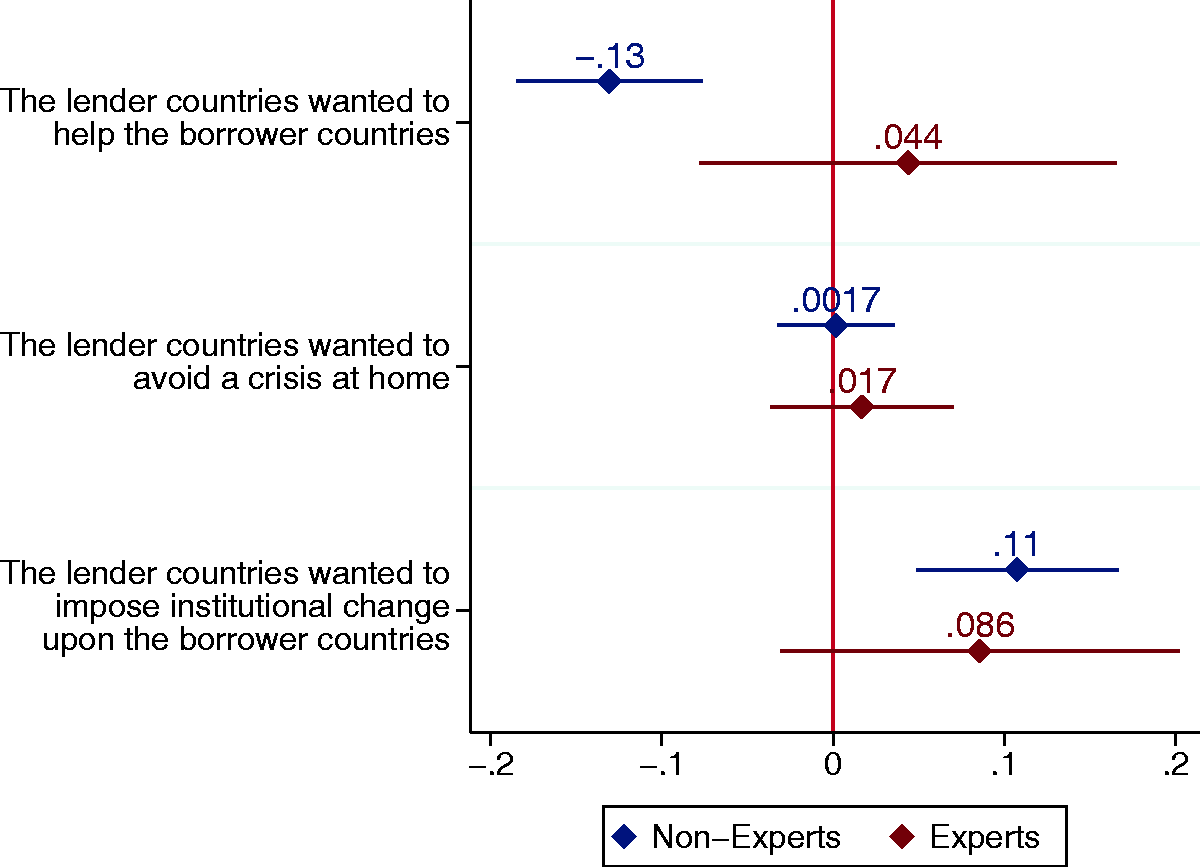
Intentions of the lender countries.
How can these differences be interpreted as own-nation serving? To address this question we concentrate on the results for the non-expert sample and consider the assessments about who mainly benefited from the aid and reform programs. As shown in Figure 2, non-experts from borrower countries are 28 percentage points more likely to report that the lender countries were the main beneficiaries of the program than non-experts from lender countries. This is compatible with each side inflating their contributions and costs and/or deflating their receipts or benefits - an attitude which one might call own-nation serving. Differences are not statistically significant in the expert sample.
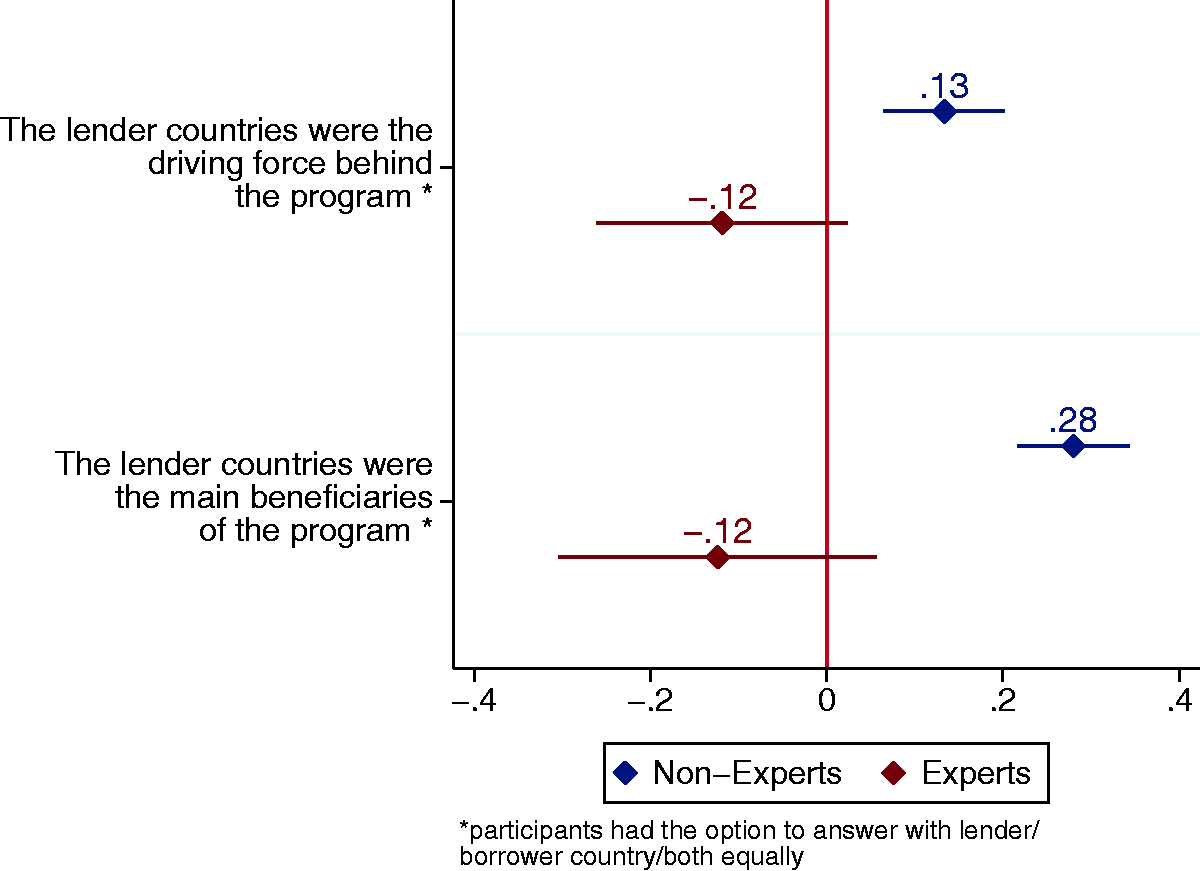
Who initiated and benefited from the rescue program.
These views of being the generous helper fit well with the memory biases shown in Figure 1. A large share of respondents from the borrower countries answer in a way that is consistent with the following narrative. They were more likely to believe that the lender countries wanted to help themselves. They also tend to repress the idea that they were desperately in need of help and are more likely to entertain the idea that they did not push for help. Non-experts from borrower countries are 13 percentage points more likely to report that the lender countries were the driving force behind signing the memorandum than non-experts from lender countries (Figure 2), but were helped because the lender countries had no choice – they wanted to help themselves, and therefore ‘wanted’ to help (Figure 1).
The differences between respondents’ answers in borrower countries and in lender countries in the expert group do not turn out to be statistically significant. It is conceivable, for instance, that there simply is no major memory bias among experts. Experts from different countries are informed by reading much of the same statistical material and scientific reports. And they might identify less with their own countries of origin and have a more cosmopolitan orientation. Therefore, the forces for developing a nation-bias might be less strong for experts than for non-experts. We address some of these issues below.
We now turn to a second set of questions (Figure 3). We ask whether the rescue experience might have caused feelings of guilt, feelings of being exploited, and/or feelings of inferiority in the borrower countries, and whether the populations in the lender countries are feeling exploited and/or disappointed. All these questions were presented to participants from all countries. We investigate whether the answers of participants from borrower countries and lender countries differ. If we find differences, they do not straightforwardly reflect a nation-serving bias but might rather be the outcome of such a bias. Figure 3 shows that the answers of non-expert respondents from borrower countries differ from those from lender countries. Participants from borrower countries in the non-expert sample are 9.2 percentage points more likely to agree that the program experience made them feel guilty and inferior. Further, the probability to agree to ‘The rescue experience made many citizens in the borrower countries feel exploited’ is 17 percentage points higher among non-experts from borrower countries. These marginal effects are statistically significant at the 1% level (Figure 3).
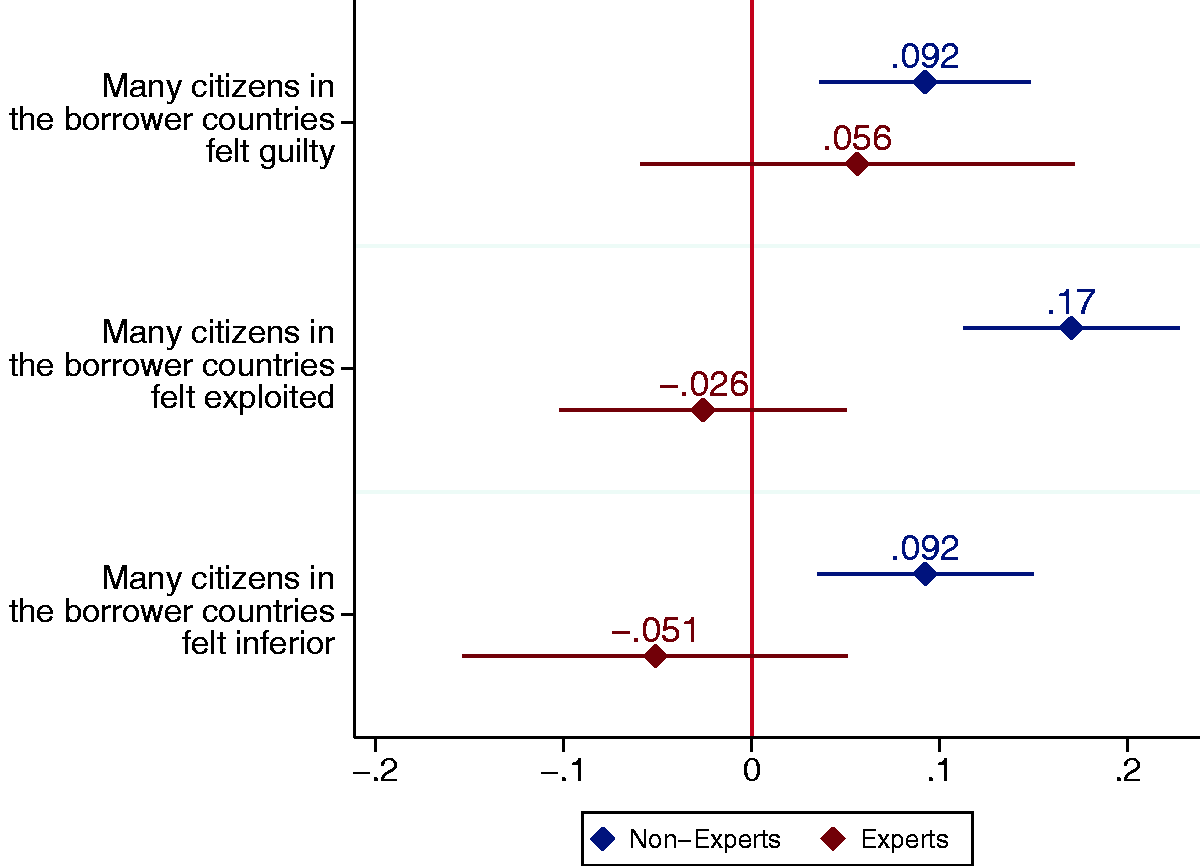
Sentiments among borrower countries.
These differences are important in their own right, because they suggest country biases. An interpretation along the lines of nation-serving assessments is more complex and more difficult. A respondent from Greece might think that the aid and reform programs mainly benefited the lender countries who forced Greece to undertake the reforms. Hence, a Greek respondent might not feel guilty. On the other hand, a respondent from the lender countries might feel that the aid and reform programs were a benevolent gesture from the lender countries which provided large benefits to the program countries. Hence, a respondent from the lender countries might be more prone to assume that citizens in the borrower countries felt guilt due to the large benefits they received. Also, the respondents’ perceptions might be formed by direct observations in the countries or media reports, but their views about the reasons and motivations for aid and reform programs and their views about who actually benefited from these programs should correlate with their assessments and might affect their beliefs about these feelings. 7
Similar questions measure the assessments in the groups of respondents about the feelings in the lender countries (Figure 4). In particular, we asked the participants whether they agree that the aid and reform programs made the citizens in the lender countries feel exploited and disappointed. We do not observe significant differences for respondents from the two country groups. The same applies for the differences in the views of experts from the two country groups. Perhaps not unexpected, and similar to the first set of questions, experts from borrower and lender countries answered in quite a similar manner. We also asked whether the rescue experience strengthened friendship between the citizens in the two groups of countries (Figure 4). The results do not suggest that respondents from borrower countries have different views than respondents from lender countries, but the results draw a disappointing picture that is of interest in its own right. Building on realistic group conflict theory, an event such as the 2010 European debt crisis was a major challenge that was overcome by joint action. In the light of realistic group conflict theory (for a survey see Böhm et al., 2018; Sherif et al., 1961) it could have been a major opportunity for the governments of member countries to overcome cleavages and strengthen the friendship ties between the countries. However, only some 25% of the non-experts and some 20% of the experts believe that the aid and reform programs strengthened friendships (descriptive statistics are shown in the working paper version, see Arnemann et al., 2021). 8 This is in line with the high percentage rates of all respondents who think that the crisis and its treatment caused feelings of exploitation, inferiority and disappointment.
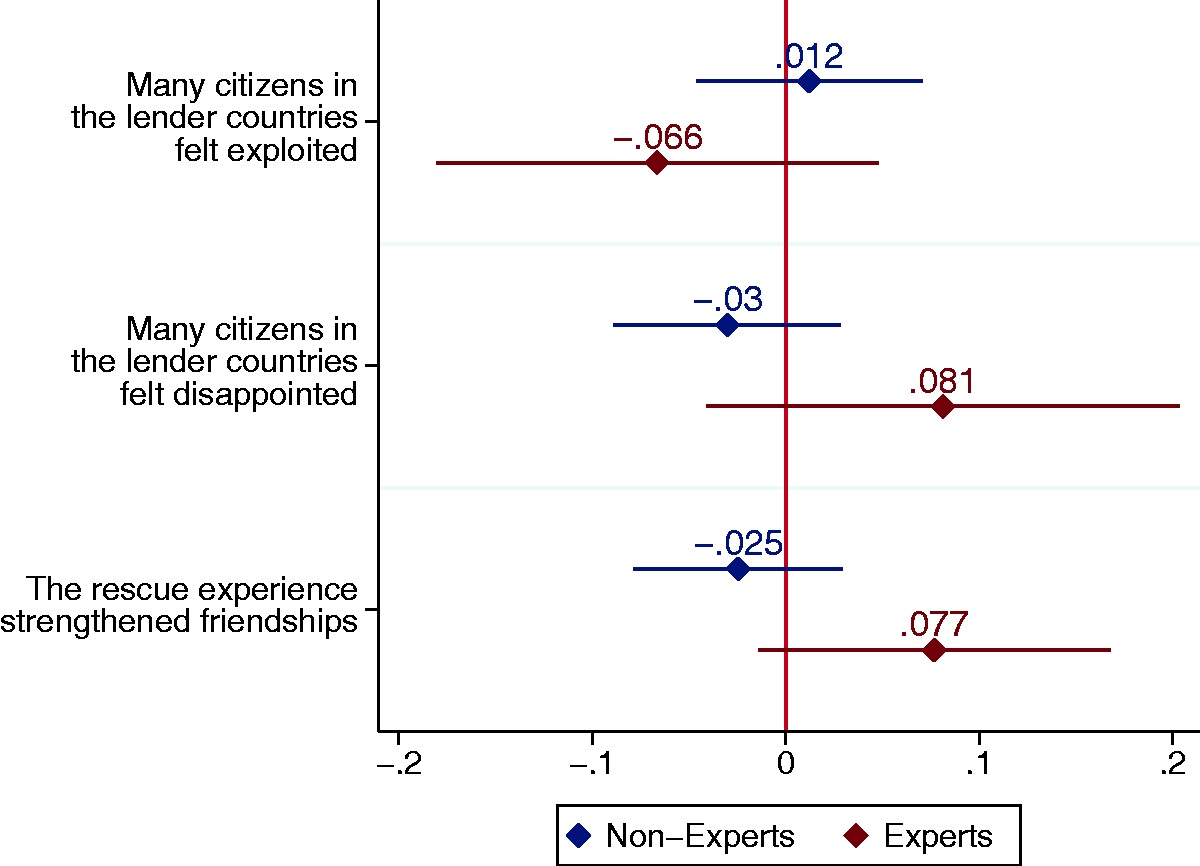
Sentiments among lender country citizens.
The borrower countries were affected by the crisis in different manners. The 2010 European debt crisis first became manifest in Greece. Three extensive financial rescue packages and comprehensive reform programs were adopted and simultaneously accompanied by massive political protests. The resistance of the population in Greece was large and the consequences for the population were drastic (scholars examine the 2010 European debt crisis in Greece in detail; for example, Katsanidou and Otjes, 2016; Mink and de Haan, 2013; Mosler et al., 2019; Sinn, 2015). The salience of events in Greece might have caused a higher level of consensus among the lender and borrower countries about the situation in Greece. On the other hand, since Greece was by far the most affected country, there might be solidarity between the other lender countries and Greece. This invites a specific view on Greece (Figure 5). We only ask about Greece, since Greece remains the only country that has not repaid its debt.
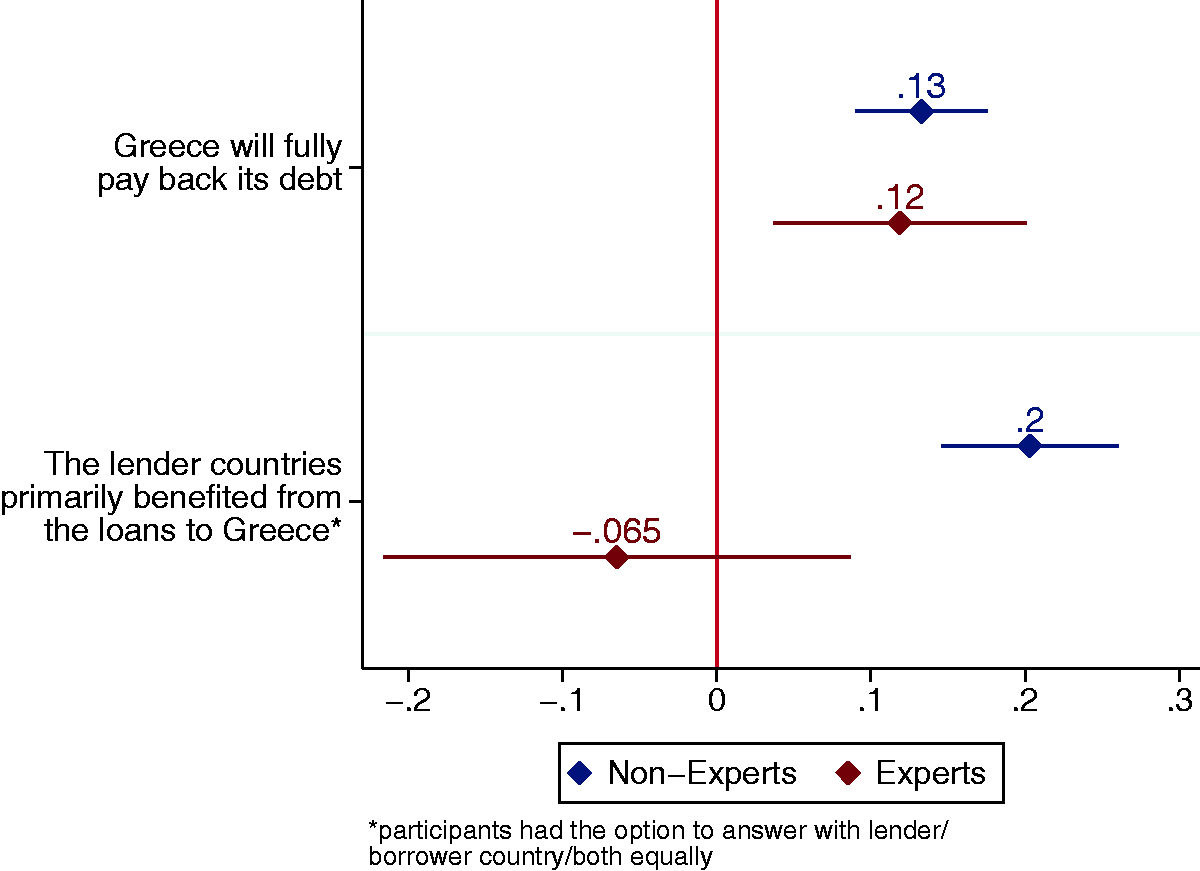
Situation in Greece.
When asked whether Greece will be capable of fully paying back its debt, citizens from program countries show a 13 percentage point higher likelihood to agree in the non-expert sample and a 12 percentage point higher likelihood in the expert sample. The effect in both samples is statistically significant at the 1% level. When asked about who benefited from the loans to Greece non-experts from the borrower countries are 20 percentage points more likely to state that lender countries benefited from the loans to Greece (Figure 5).
Both these divergences have natural interpretations as nation-serving biases. Respondents from the borrower countries might associate themselves with Greek citizens and perceive Greek citizens as more reliable borrowers than the respondents from lender countries. And respondents from borrower countries who had a similar experience as Greece are less inclined to interpret the aid and reform programs as benevolent acts of the helper countries for the benefit of Greece. They might be more inclined to think that the lenders’ actions were guided by their self-interest.
We also examine how answers differ between the citizens from the individual borrower countries. The results suggest that Greek citizens had somewhat different views than the citizens from the other borrower countries. The descriptive statistics are shown in Table 1.
Comparison of answers from borrower country citizens (non-experts).
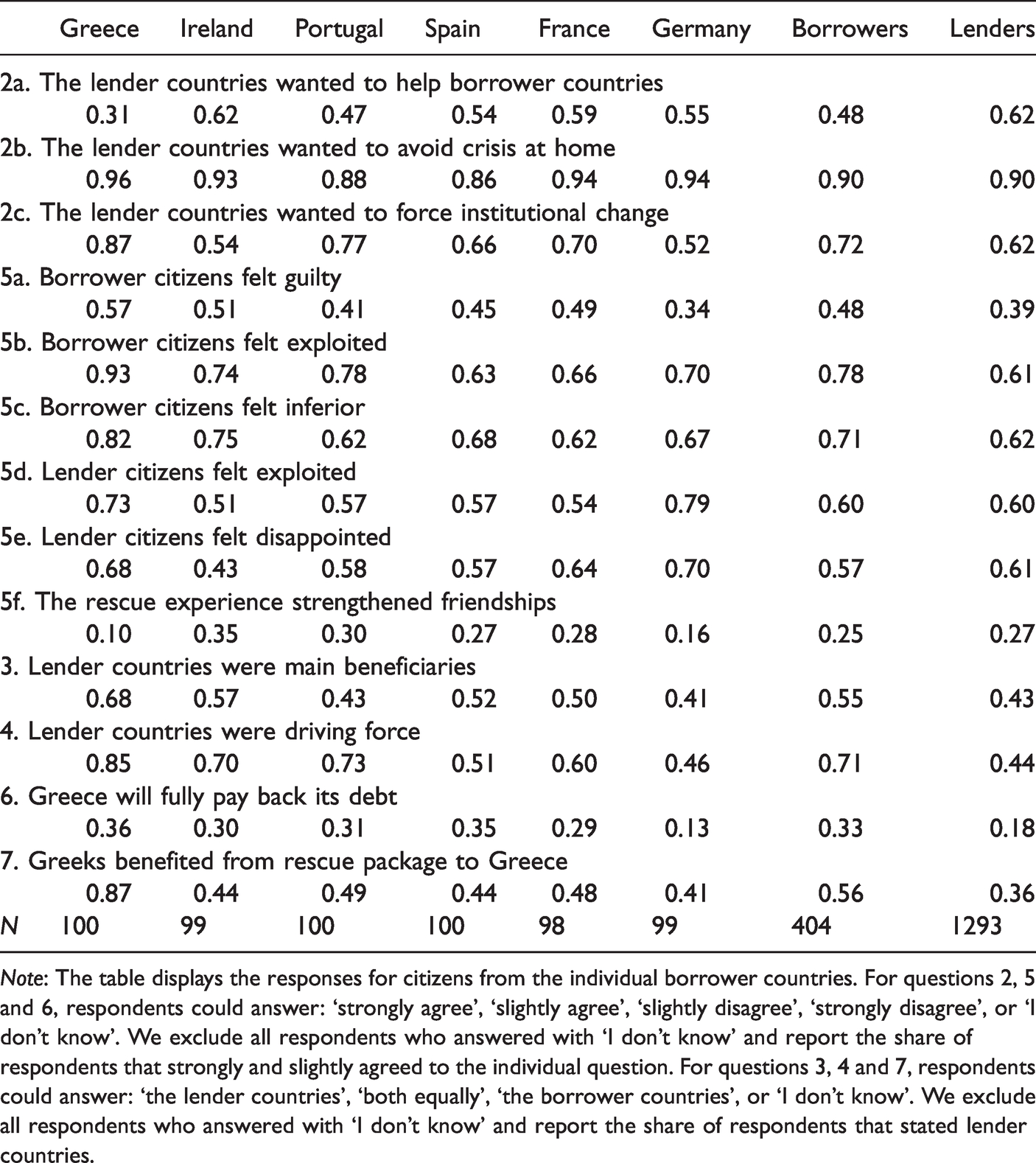
Note: The table displays the responses for citizens from the individual borrower countries. For questions 2, 5 and 6, respondents could answer: ‘strongly agree’, ‘slightly agree’, ‘slightly disagree’, ‘strongly disagree’, or ‘I don’t know’. We exclude all respondents who answered with ‘I don’t know’ and report the share of respondents that strongly and slightly agreed to the individual question. For questions 3, 4 and 7, respondents could answer: ‘the lender countries’, ‘both equally’, ‘the borrower countries’, or ‘I don’t know’. We exclude all respondents who answered with ‘I don’t know’ and report the share of respondents that stated lender countries.
Robustness checks
Socioeconomic characteristics
An interesting question is which socioeconomic characteristics inherent to experts might explain why they do not show differences in memories. We use interaction effects based on a linear model to examine whether individual groups of participants have a stronger differences in memories than others.
Age might well influence the perception of historic events. We therefore examine whether the effect of living in a borrower country differs for participants above the age of 35 as compared to participants below the age of 35. We find no statistically significant differences for citizens living in a borrower country above the age of 35.
Participants with a high level of education might have different political attitudes or use different types of media than participants with a low level of education (Inglehart, 1970). We interact the program variable with a dummy variable indicating whether the respondents have completed or are currently completing tertiary education. For most responses there is no differential effect of living in a borrower country for participants with a higher level of education. Citizens with a higher level of education from borrower countries are more likely to agree that lender country citizens felt exploited.
We also investigate whether not living in one’s country of birth influences the recollection of the 2010 European debt crisis. Bechtel et al. (2014) show that having a cosmopolitan attitude explains differences in the attitudes of German citizens towards the aid and reform program. Choosing residence in another country might be an indication of a more cosmopolitan attitude. But it might also be an indication of unclear or weaker national identities: it becomes unclear whether someone who migrated from one country to another country some years ago should show a nation bias in favor of the country of origin, or for the country of residence. And for either of the two we might expect a weaker identification with both of these countries. 9
We find that most responses remain unchanged for respondents not living in their country of birth. For the assessment of whether Greece will pay back its debt and whether lender countries were the driving force the divergence between borrower and lender country citizens becomes smaller for the subsample of citizens living outside their country of birth. We interpret these results as being in line with the idea of own-nation biases.
Macroeconomic variables
We examine whether the correlation between the program country dummy variable and the respondents’ answers depend on macroeconomic variables in the individual countries. We use interaction effects based on a linear model. Our macro variables include: the unemployment growth, public debt growth, gross domestic product (GDP) growth during the years after the great recession and the 2010 European debt crisis from 2007 to 2012. We also consider countries located more at the periphery (as measured by distance from Brussels). The baseline results remain unchanged when we condition the program country effect on these variables.
Non-experts from program countries who experienced large declines in GDP were more likely to agree that Greece will fully pay back its debt than non-experts from program countries who experienced small declines in GDP and low unemployment.
The effect of the program country dummy is somewhat smaller when the individual country was located closer to Brussels and when we use questions 4, 5b, 5c and 7 as the dependent variable.
Ordered and multinomial estimation
In the baseline model’ the response options are aggregated into two categories, namely whether participants agree or do not agree with an individual statement. Differences between participants from non-program and program countries also emerge when the full likert scale is used as the dependent variable using multinomial and ordered logit models. For all questions in which participants were asked to rank their level of agreement, we estimate an ordered logit model. For questions in which participants were asked to name the responsible party, we estimate a multinomial logit model. Inferences do not change.
Inattentive respondents
When distributing the survey online, an attention check was included when asking non-experts about socioeconomic characteristics. All participants failing this attention check are excluded from the survey. Excluding all participants at the top 10% and bottom 10% of the survey time distribution does not change the inferences of the baseline estimation in the non-expert sample.
Clustered robust standard errors
We cluster standard errors on the country level. Due to the limited number of member states of the EU we adjust for the small number of clusters using the wild bootstrap method for logit regressions as suggested by Cameron and Miller (2015). Inferences change for some questions when applying this method (Roodman et al., 2019). The marginal effects of the borrower country dummy variable lack statistical significance, when we use the question about whether the lender countries wanted to force their desire for institutional change upon the borrower countries as the dependent variable.
Multiple hypothesis testing
Applying the Bonferroni Method to control for multiple hypothesis testing, the p-values can be adjusted by the number of questions that we ask our participants. Applying the Bonferroni correction does not change the inferences.
The French-German divide
Collective memories on the 2010 European public debt crisis may not just differ between respondents from borrower and lender countries. Brunnermeier et al. (2016) propose that the 2010 European debt crisis was a clash of ideas between France and Germany. 10 We therefore examine whether the memories of respondents in France are more in line with the borrower countries and, in particular, differ from the memories of German respondents.
The memories of French and German non-experts differ for individual questions (Table 1). For example, 70% of the French and 52% of the German non-experts agreed that the lender countries wanted to force institutional change in the borrower countries. The answers of French and German non-experts regarding this question diverged to a larger extent than the answers of non-experts from borrower (72%) and lender countries (62%). In a similar vein, 29% of French and 13% of German non-experts agreed that the lender countries were the main beneficiaries of the aid and reform programs (33% of the non-experts from borrower and 18% of the lender countries). Regarding other questions, however, the memories between French and German non-experts were more similar than the memories of non-experts from borrower and lender countries. For example, 66% of the French and 70% of the German non-experts agreed that the borrower countries felt exploited – this difference was much larger between non-experts from borrower (78%) and lender countries (61%).
Comparison of answers from borrower country citizens (experts).
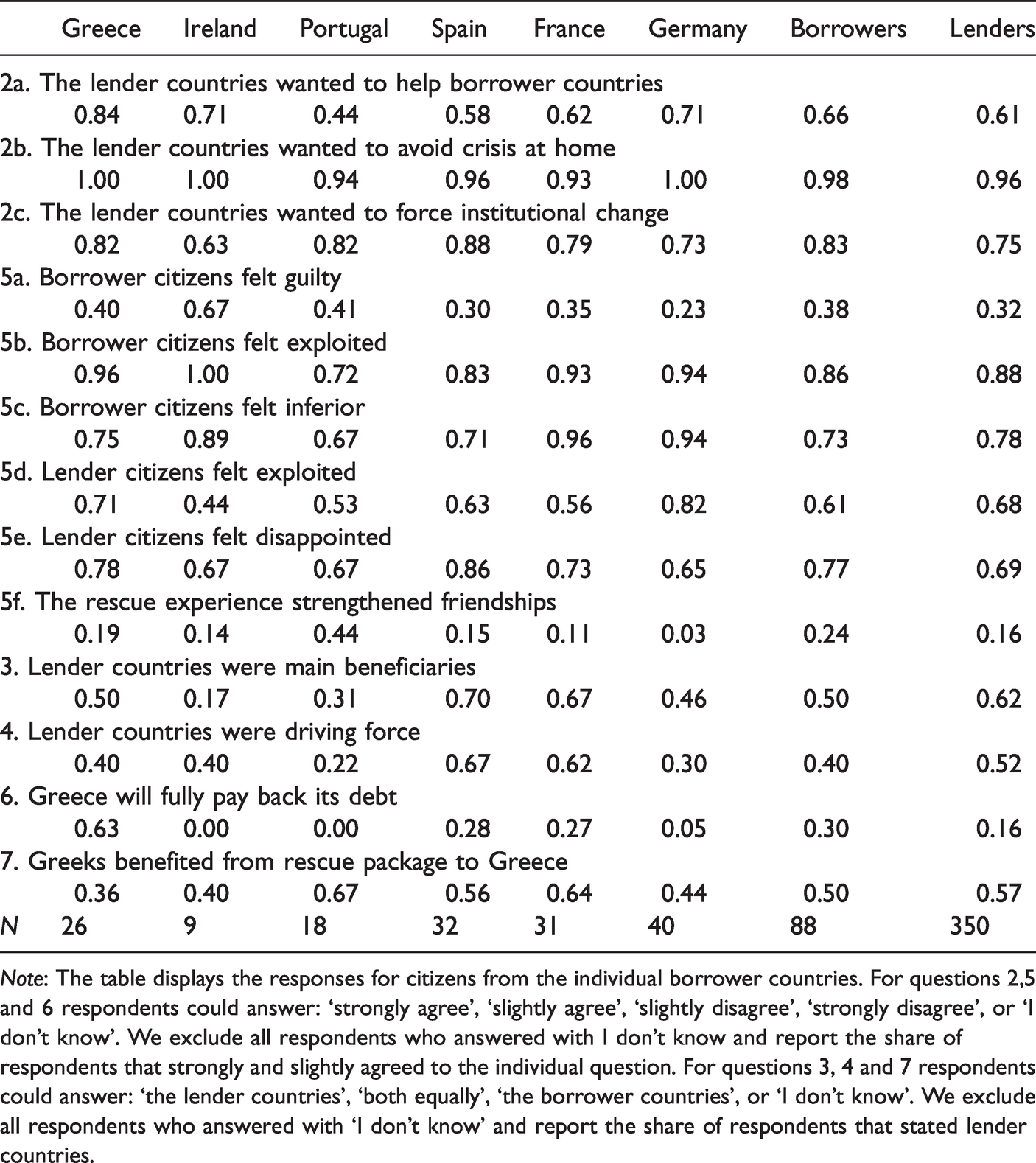
Note: The table displays the responses for citizens from the individual borrower countries. For questions 2,5 and 6 respondents could answer: ‘strongly agree’, ‘slightly agree’, ‘slightly disagree’, ‘strongly disagree’, or ‘I don’t know’. We exclude all respondents who answered with I don’t know and report the share of respondents that strongly and slightly agreed to the individual question. For questions 3, 4 and 7 respondents could answer: ‘the lender countries’, ‘both equally’, ‘the borrower countries’, or ‘I don’t know’. We exclude all respondents who answered with ‘I don’t know’ and report the share of respondents that stated lender countries.
We have also considered the view of Brunnermeier et al. (2016) in the multivariate analysis. We have considered France to be a program country and excluded Italy from the sample because Brunnermeier et al. (2016) propose that Italy was divided in a ‘teutonic’ north and a ‘mediterranean’ south. Doing so does not change the inferences as compared to our baseline model.
We have also examined differences between France, Spain, Greece, Portugal, Cyprus, the United Kingdom, Ireland, and Croatia (‘mediterranean’ countries) and Germany, Austria, Slovakia, Sweden, Finland, Denmark, the Netherlands, Estonia, Latvia, Lithuania, Poland and Czech Republic (‘teutonic’ countries). If we use the distinction between answers from respondents from ‘mediterranean’ countries and ‘teutonic’ countries as an explanatory dummy variable, differences as compared to our baseline model change. Doing so, however, does not distinguish between borrower and lender countries (the purpose of our study).
Overall, our results corroborate the hypothesis by Brunnermeier et al. (2016) that French and German respondents had different views regarding individual memories of the 2010 European debt crisis. Also, the memories of French respondents and the memories of the respondents from borrower countries were more similar than the memories of German respondents and the memories of the respondents from borrower countries.
Conclusion
Economic psychology suggests that individual borrowers and lenders remember informal credit relationships in different manners: memories are influenced by a self-serving bias. Similar phenomena are reported in the context of major other international events for collective memories in different countries, the Second World War being an important example (Roediger et al., 2019).
We examine citizens’ views about the 2010 European debt crisis. In particular, we investigate how the policy measures taken during the 2010 European debt crisis are remembered and whether there are systematic differences between citizens from borrower countries and citizens from lender countries. The results show differences in memories 8-9 years after the crisis.
Distinguishing between experts and non-experts, the results suggest that experts from lender and borrower countries have quite similar views about the 2010 European debt crisis. The views of non-experts are, by contrast, influenced by the country group of origin, and this influence may well be interpreted as a nation-serving bias.
Such biases may explain if the 2010 European debt crisis has reduced the sense of belonging rather than bringing European citizens closer together. This experience is also useful for future assistance activities within the EU as the ones discussed to handle the COVID-19 pandemic.
Differences in memories regarding the 2010 European debt crisis also occurred between French and German respondents (Brunnermeier et al., 2016). In particular, French and German experts had different memories regarding individual aspects of the crisis. An example is that French experts were more likely to agree that the lender countries were the driving force of the aid and reform program than German experts. Overall, the memories of French respondents and the memories of the respondents from borrower countries were more similar than the memories of German respondents and the memories of the respondents from borrower countries. Clearly, France and Germany are key players in the EU. Undertakings within the EU are more likely, the more France and Germany agree.
Our study did not consider the role of media and the narrative of national politicians. The media and the narrative of national politicians are likely, however, to influence collective memories. The study by Müller et al. (2018) shows, that leading newspapers in Germany, France, Italy and Spain blamed (or did not blame) individual countries for the 2010 European debt crisis. The narrative of national politicians is also very likely to influence collective memories: when national politicians blame individual countries for the crisis or downplay public debt, citizens are likely to adopt those views (Blesse et al., 2020b). Future research may therefore examine in more detail why collective memories on the 2010 European debt crisis differ.
Supplemental Material
sj-pdf-1-eup-10.1177_14651165211009972 - Supplemental material for Collective memories on the 2010 European debt crisis
Supplemental material, sj-pdf-1-eup-10.1177_14651165211009972 for Collective memories on the 2010 European debt crisis by Laura Arnemann, Kai A Konrad and Niklas Potrafke in European Union Politics
Supplemental Material
sj-zip-2-eup-10.1177_14651165211009972 - Supplemental material for Collective memories on the 2010 European debt crisis
Supplemental material, sj-zip-2-eup-10.1177_14651165211009972 for Collective memories on the 2010 European debt crisis by Laura Arnemann, Kai A Konrad and Niklas Potrafke in European Union Politics
Footnotes
Authors’ contribution
K.K. and N.P. conceptualised the research question; L.A. conducted the empirical analysis. The remainder of the work was shared equally.
Acknowledgements
We would like to thank Jana Cahlikova, Klaus Gründler, Christa Manta, Felix Rösel, Gerald Schneider, Heinrich Ursprung, Lisa Windsteiger, four anonymous referees, and the participants of the MPG Workshop on Political Economy and Public Finance 2019, the CESifo Area Conference on Macroeconomics and Survey Data 2020 and the meeting of the Verein für Socialpolitik 2020 for helpful comments. Armin Hackenberger and Philipp Heil provided excellent research assistance.
Funding
The author(s) received no financial support for the research, authorship, and/or publication of this article.

Notes
References
Supplementary Material
Please find the following supplemental material available below.
For Open Access articles published under a Creative Commons License, all supplemental material carries the same license as the article it is associated with.
For non-Open Access articles published, all supplemental material carries a non-exclusive license, and permission requests for re-use of supplemental material or any part of supplemental material shall be sent directly to the copyright owner as specified in the copyright notice associated with the article.
